
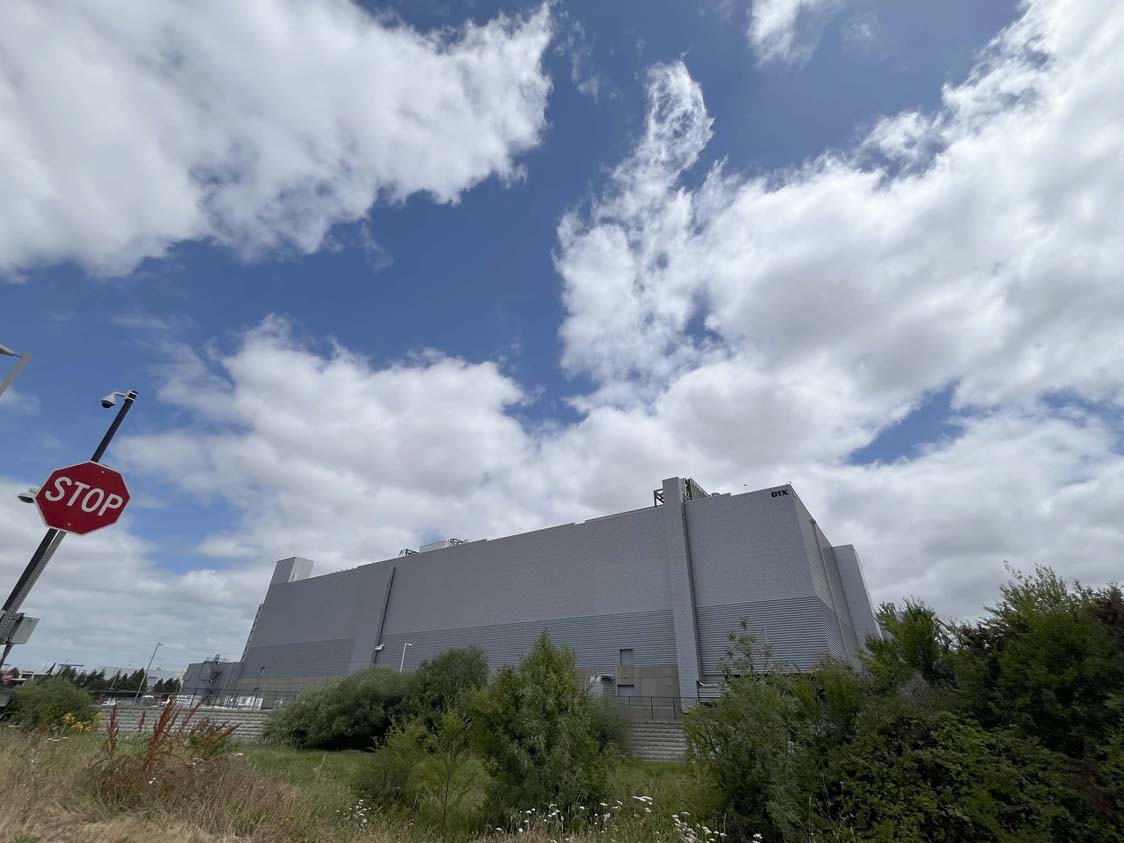
Before the heat got to me, I went on a joint adventure with my friend Jan to photograph multiple data processing centers that have sprung up in the vicinity of Portland. Her insightful take, as a psychologist and a documentarian, on how these AI molochs are sold to the public, can be found here.

Basically, these buildings house computers that train AI language models. There are thousands of them across the country, with many more thousands planned, including in our own backyard. Communities are told to hand over land, electricity and water with the promise that they will benefit in turn. Vision of tax revenues and job- and future business opportunities are floated.

The reality? Tax revenues are usurped by tax breaks granted to the centers. That money goes back to the investors rather than the communities. Job opportunities might happen during the construction phase, but that only lasts for a year or two. And even there, often labor is assigned to trade professionals from out of state. A staff of only 20-50 people is needed, once the center is running, tending to the servers (note that many of these behemoth buildings sport no more than 2 toilets – a clear indication of the planned number of staff). No ripple effects either – you don’t get cheaper or faster access to these technologies, just because you live close by. No thousands of workers buying lunch at the local markets, or added medical facilities that could serve a rural community.(Ref.)
The immediate benefits to communities are small to non-existent. The costs are real. The massive expansion of fuel and water demands depletes communal resources, increases costs for individuals, and interferes with our agreed climate goals because it keeps fossil fuel plants open for longer instead of moving towards renewable energy sources. It is predicted that center demand will be up to 15% of our nation’s total electricity volume in the near future. (In Wyoming, for example, a planned Meta data center will require more electricity than every household in the state, combined. To meet demand for power-hungry data centers, utilities are adding capacity to the grid. But although that added capacity may benefit tech companies, the cost is shared by local consumers. )

There is also physical harm if you live near these centers. Air pollution is the largest concern. But the unending noise pollution from HVAC cooling systems, diesel generators and fans also stresses people out, interrupts their sleep and gives them headaches. There is economic harm since the resale value of your homes drops like a stone. Agencies tasked with overseeing noise pollution have no handle, since local governments selling out to AI firms can simply change zoning rules that favor the centers.
Here is a sample of the noise neighbors have to deal with.

People are no fools. The absence of gains and presence of harm (particularly when it comes to water depletion caused by the infinite thirst of these centers) is well noted and has lead to a opposition that runs across the political divide, a divide otherwise so unsurmountable in this country. A recent Gallup poll found that 7 in 10 Americans oppose these schemes that produce suffering for the communities while the companies profit.
What is needed for opposition? Transparency, for one. Often the negotiations for land sale, water rights and tax credits are done under the veil of secrecy and non-disclosure requirements. That alone should make one think: why should there be secret deals if everything is a-ok? Particularly around water usage? Google, for example, consumed 40% of all water in The Dalles, OR in 2025. The city won’t say how much of the rising demand comes from Google, citing a promise to keep the numbers secret and confidentiality provisions in Oregon public records law. (Ref.)

Local engagement by citizens flooding the relevant local officials with demands and calls for rejection is another factor. Calls for legislation or communal bans that imposes moratoria on new buildings until we know the actual costs, have multiplied. Lawsuits, if necessary, letting the courts decide about false or broken promises, harm assessment, or legal loopholes.
Then there are workers. On the one hand, the International Brotherhood of Electrical Workers (IBEW) has argued that union workers are powering the AI industry. “Meta recently announced a skilled trade academy program, and Google committed $50 million to help train people in skilled trades.” But, as reported here, some electricians are starting to wonder about the ethics of the job and refuse to work for AI companies.
The bi-partisan pushback has already affected the trade – and is expected to become a flashpoint for both the primaries and the actual mid-term elections (lots of candidates in favor of data centers lost their primaries, for both parties.) For example, residents in Los Angeles County’s Monterey Park becoming the first to vote to permanently ban data centers earlier this month. Virginia’s Democratic-controlled state legislature and Democratic governor ended a budget standoff over the state’s data center tax breaks on Monday, agreeing on a new tax on data centers for their energy consumption. (Ref.) Closer to home, we have seen real resistance in La Pine, Prineville, and now Hillsboro. Hillsboro, where I photographed, has an estimated 125 data centers and is currently exploring its options to pause further development. 1000 friends of Oregon have filed a lawsuit just last week, to stop giving public dollars to data centers, with tax rebates locked in for potentially decades.

So far, some $64 billion of data center projects have been blocked or delayed by local opposition around the country. Details per state can be found here. Clearly, when people overcome their alignment to party only, and get together to fight for the common good, they can be successful.
Optimists are already speculating: When these data centers become debt traps in a few years at most, the next Dem president should offer to wipe out those debts if they’re sold for a dollar back to cities for community centers, mutual aid hubs, YMCA-style temporary housing services. Try to salvage anything out of this mess. (Ref.) (Sometimes doesn’t pay to be an optimist – the million responses to this post from last week were pointing out why none of those suggestions was feasible (often for toxic pollution left over by the centers. Poor Ben Collins, the author.)

Here is a friendly reminder (by Hitchhikers of the Galaxy) about the future of computers. And some visual examples of what is (about to be) out there….

Microsoft/Wisconsin

Switch/Nevada

Dupont/Virginia

OpenAI Stargate/Arizona

Meta – Plans/Arizona