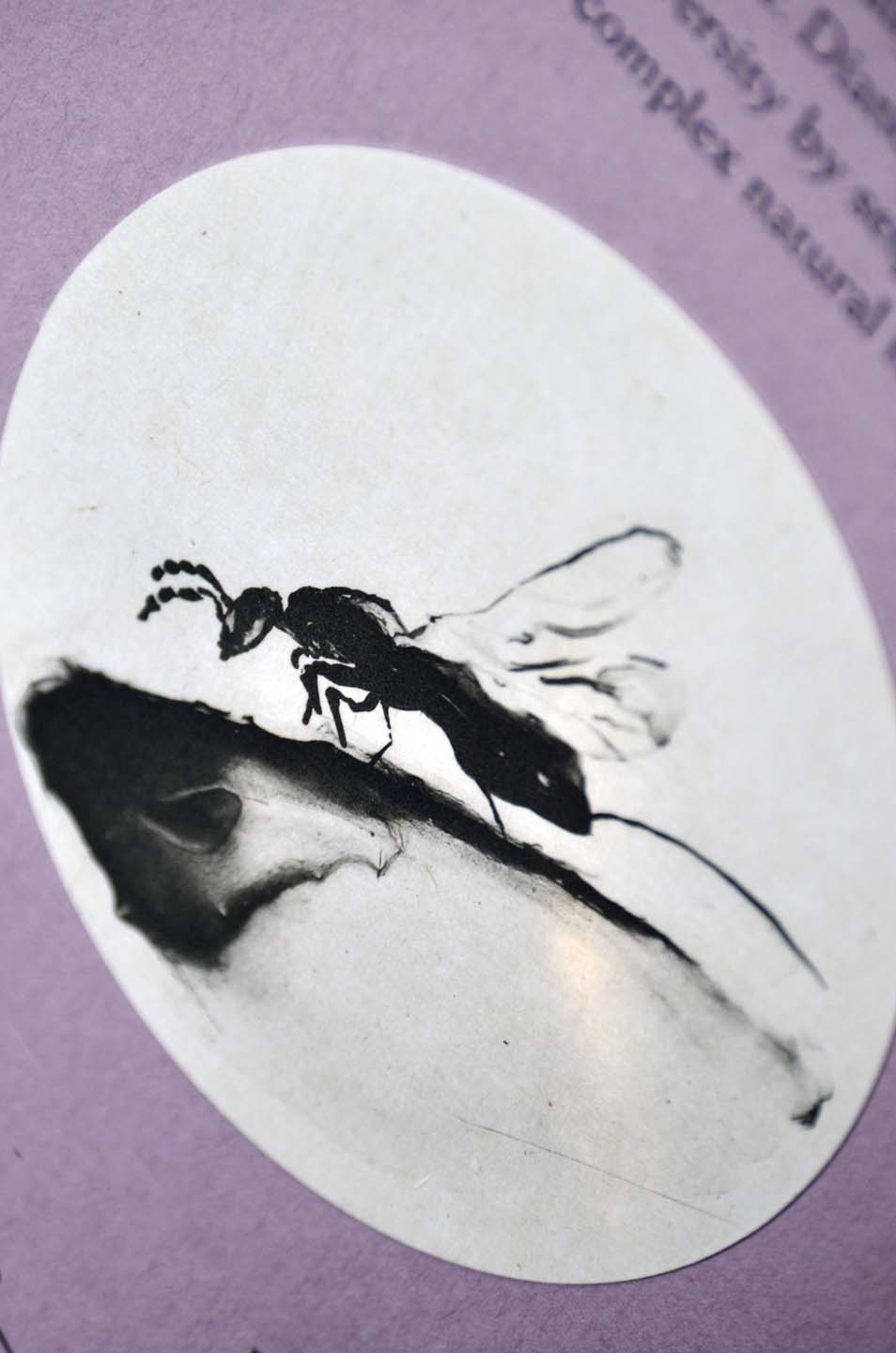
Wasp
When the honey, fruit and flowery tablecloth were whisked from the table in one sweep, it flew off with a start. Entangled in the suffocating smoke of the curtains, it buzzed for a long time. At last it reached the window. It beat its weakening body repeatedly against the cold, solid air of the pane. In the last flutter of its wings drowsed the faith that the body’s unrest can awaken a wind carrying us to longed-for worlds.
You who stood under the window of your beloved, who saw your happiness in a shop window – do you know how to take away the sting of this death?
***
Imagine entering a small garden, overgrown paths lined with lungwort. A humongous fig tree granting shade, a few vegetable beds exploding with the smell of ripe tomatoes. Sun dappled verdant corners, whimsical ceramics catching the light here or there.


Red calla lilies shining like little lamps eager for attention, chicken contentedly clucking in a coop next to the persimmons, fruit still green.

Your eye is caught by the plum trees, laden with fruit, some ripe on the ground, the purple skin of Italian prunes encasing glimpses of gold where the fruit has split open.
A feast for wasps, and wasps were what I came for.
An art book about wasps, to be precise.

Let me hazard a guess: your first reaction upon hearing the word “wasp” was not entirely positive. Pesky yellow jackets interfering with your labor day picnic, stings that not too infrequently hurt like hell or even lead to anaphylactic shock, visions of angrily buzzing swarms of insects building their dreaded nests too close to the eves of your house.

Wasp nest, displayed in the artist’s studio.
You would not be alone in this assessment, and surely not the first one. Already in 300 bc, Aristotle insisted ‘Hornets and wasps … are devoid of the extraordinary features which characterize bees; this we should expect, for they have nothing divine about them as the bees have.’
A recent scientific study published in the Royal Entomological Society, found that people across 46 countries really had it in for wasps. They are universally disliked much more than bees or other insects. The public associates them with negative terms like angry, painful, dangerous, scary, and those sentiments map onto relative research efforts: wasps are significantly under-studied. Across 40 plus years of thousands of papers published in entomological journals, more than 80% cover bees, and not even 20% wasps.

Paper fold drawing our attention to common reactions.
Consequently what we know is relatively little, and what little we know is not communicated sufficiently to open people’s eyes to the utility of wasps for humans as well as their general importance for ecosystems as a whole.

From the studio collections.
Just a few facts: the wasps that bug us – the yellow jackets, the hornets – represent less than 1% of the stinging wasps, the species Vespines. Wasps belong either to social or to solitary species – the latter containing many more species, in fact hundreds of thousands of them, who do not sting and live quite separate from human contact areas.

Folded paper telling a story.
Wasps have several functions. Like bees, they pollinate our crops (although to a lesser extent.) They excel, though, in helping get rid of parasites. They regulate populations of arthropod pests and vectors of disease, decompose organic matter and improve soils. Important contributors to maintaining biodiversity, then, and now severely threatened, just like bees. Agricultural practices (use of genetically modified seeds, pesticides, etc.) habitat loss due to encroaching urbanization, and climate change all contribute to endangering these guardians of our ecosystems.

Eco prints of plants frequented by wasps.
Our implicit bias against wasps can only be remedied, if we change the rhetoric of fear to a rhetoric of love. For that to happen, we need to be familiarized with what there is to love: the beauty, the amazing survival mechanisms, the intricacies of wasp life cycles, and last but not least the tremendous ecological services these insects render. Which brings me to the owner of the enchanted garden described above, artist Diane Jacobs who has just finished creating a book celebrating all things wasp, the culmination of years of study and creative exploration of the subject.
***
Jacobs received an MFA in printmaking from San Francisco State University in 1996. and was awarded multiple prizes, fellowships and residencies in the years since. Her work – prints, sculptures and folio books – can be found in museums (The Portland Art Museum, the San Francisco Museum of Modern Art, the De Young Fine Arts Museum,), and educational institutions (The New York Public Library, the Library of Congress, Savannah College of Art and Design, University of Alberta, University of Chicago Library, University of Miami, Corcoran School of the Arts & Design, Yale, and Stanford among them.)

Artist Diane Jacobs.
Her newest book intends to educate us about wasps and show the intrinsic beauty of Apocrita, those narrow waisted insects that populate pretty much our entire planet. Wasps and their environments are represented in stunning detail and through a plethora of artistic processes. The deeply serious intent to help us overcome our antipathies by getting to know the various species and their quirks, is often softened by using more whimsical means to do so.
Pop-up structures vie for attention,

Pop-ups.


paper layers inviting hands-on folding and unfolding to reveal ever more details are hidden in various pouches along the folios.

Paper folding for multi-surface info presentation.

Miniature sculptures made of natural and artificial materials expose the delicateness of wasps’ body parts, and also point to means of helping identification.

Beads and plant materials (thorns from a defunct dragon tree) sculpted into antennae.
The work evolved through Jacobs’ friendship with naturalist and photographer Kate Taormina, their shared interest and separate expertise cross-pollinating a successful collaboration. The joint project started in earnest during Jacobs’ 2024 residency at PLAYA, located in extremely remote Lake County in Oregon. The prestigious PLAYA residencies foster interaction between international artists and scientists, true to the belief of the organizers (and many of the rest of us who happen to have a foot in each of those camps!) that interdisciplinary exchange helps shape new ways of seeing the world, ultimately enhancing our approach to conservation. The concept of the book evolved over time. Now each page affords glimpses into a different universe, some pleasantly playful, others creating a sense of awe given nature’s diversity.
Whatever I learned about wasps, I learned even more about what can happen when an artist puts their mind to a singular pursuit of topic, but is open to embracing a huge number of different representational processes. Some of them surely needed to be acquired long after formal education had run its course.

Woodcuts in paper windows.
Just look a the list of processes and materials that the artist provided, all used to create the 16 hand-made copies of this book – one already snapped up by Yale University.
” Materials and printmaking techniques for this project include reduction woodcuts, wood engravings, mono print, lithography, photogravure etching, stitching, beading, hand painting, pressure printing, collage, polymer plates, book cloth, ceramic wasp, beech wood, unique eco print, and glass petri dish. Papers include Kitakata, handmade abaca, kozo, Gampi, mino washi, masa, Rives Lightweight, rayon, and Tyvek. All text on pages is handset and letterpress printed. Some booklets are letterpress printed from polymer plates and some are handset.”

So many artists who have had a successful 30 year career really stick to the tried and true, their developed expertise, even their general subjects. To embark on new fields of learning, as well as new processes that require tolerance of potential imperfection, takes courage. Jacobs, for example, was introduced to photogravure etching only 3 years ago, during a workshop at Mullowney Printing. Also fairly recently she learned how to do wood engraving. For Wasp Love alone the artist was going to carve 8 little wood engraving blocks. “It took me a bit to get in the groove.”

Wood engraving.
Yes, it takes courage, or at least an absence of vanity in pursuit of a greater goal. In this case helping nature to survive human indifference, or, worse, capitalism’s endless extractive exploitation, by deconstructing one stereotype after another.

Jacobs’ book Wasp Love is a marvel, not least in the way it balances education with art to be appreciated in its own right, independent of the book’s subject. Pacific NW audiences will be able to see and explore a show copy next February at The Patricia Reser Center for the Arts. It will be shown together with her wasp-related sculptural work and a series of her eco prints, as well as installations and paintings by Susan Murrell and my photomontages, in the context of Collective Effervescence. The exhibition is dedicated to our love of and fear for nature.

Pop-up folio.
***
Replacing the rhetoric of hate with the rhetoric of love – not an easy task. One of the obstacles lies in the psychological nature of hate, compared to love. For hate all you need is a simple, stereotyped target. There is “the enemy,” out to get us, in a zero-sum game of one side wins, when the other side loses. “Wasps are aggressive and hurtful.” Simplistic ideas like that are much more easily communicated and adhered to, than more complex ones.
It’s more difficult to convey the many aspects of multidimensional targets – endless species of wasps, a variety of functional advantages outweighing the occasional sting by a minority of Vespines. Complex concepts defy our desire to stereotype by means of their sheer diversity. You need to learn and integrate so many different facts. Which is made even more difficult by the reality that our old feelings were negative and now need to be recalibrated (in comparison to just sticking to your culturally transmitted biases that ruled the world across time.)

Wood engraved plates.
Art is enormously useful here. It can try and break the cycle of negative stereotyping in many different ways.
There is poetry. If we go back to the beginning of this post, you have Zbiegniew Herbert’s poem that subtly reminds us of the similarity of wasps and humans, not elevating one species over another. Rather than showering us with facts, and patronizing demands to let go of prejudice, its symbolism offers something that speaks to our emotions. Are we not all familiar with the feeling of being trapped in certain realms of our existence? Are we not all hoping against hope, to the last breath, that moving forward at all cost will bring us to a longed-for future, no matter how much we bang our heads against the wall? Because we look in the mirror, the observed death causes a premonition, a sting that cannot be resolved. Could it be that wasps are us?

Paper fold in book pocket.
Then there is literature. What comes to mind are Ursula LeGuin’s brilliant musings published some 40 years ago in The New Yorker. We are told that a woman is un-naming all members of creation, a woman who we later learn is Eve, about to leave Adam and the garden of Eden, unhappy with having been named in certain ways. The idea is that a name usually allows for categorization and/or stereotyping. Its absence will lead to equality not impeded by artificially drawn hierarchies.
“The insects parted with their names in vast clouds and swarms of ephemeral syllables buzzing and stinging and humming and flitting and crawling and tunnelling away.
…
None were left now to unname, and yet how close I felt to them when I saw one of them swim or fly or trot or crawl across my way or over my skin, or stalk me in the night, or go along beside me for a while in the day. They seemed far closer than when their names had stood between myself and them like a clear barrier: so close that my fear of them and their fear of me became one same fear. “
The merging of equals, affiliating through emotion, becoming extremely close: could it be love? As always with LeGuin, of course, there’s an undercurrent of brusqueness below the witty narration, pointing to the power naming has for those on top of social or gendered hierarchies.

Trial paper folding in the studio.
And finally, there is visual art. Jacobs’ book radiates joyfulness, in its colorfulness, playfulness with hidden and revealed shapes, its use of surprise perspectives. You cannot help but find these folios emotionally rousing, no matter how concept-driven and filled with scientific facts they are. The book might not manage to induce love, admittedly. But surely it ignites strong admiration for a life form that is so much more complex than we had known. A first step away from hate or fear.
I’ll take that in a heartbeat.
Or a wingbeat, as the case may be.

Snippets in Jacobs’ studio.