Browsing Tag

StreetRoots

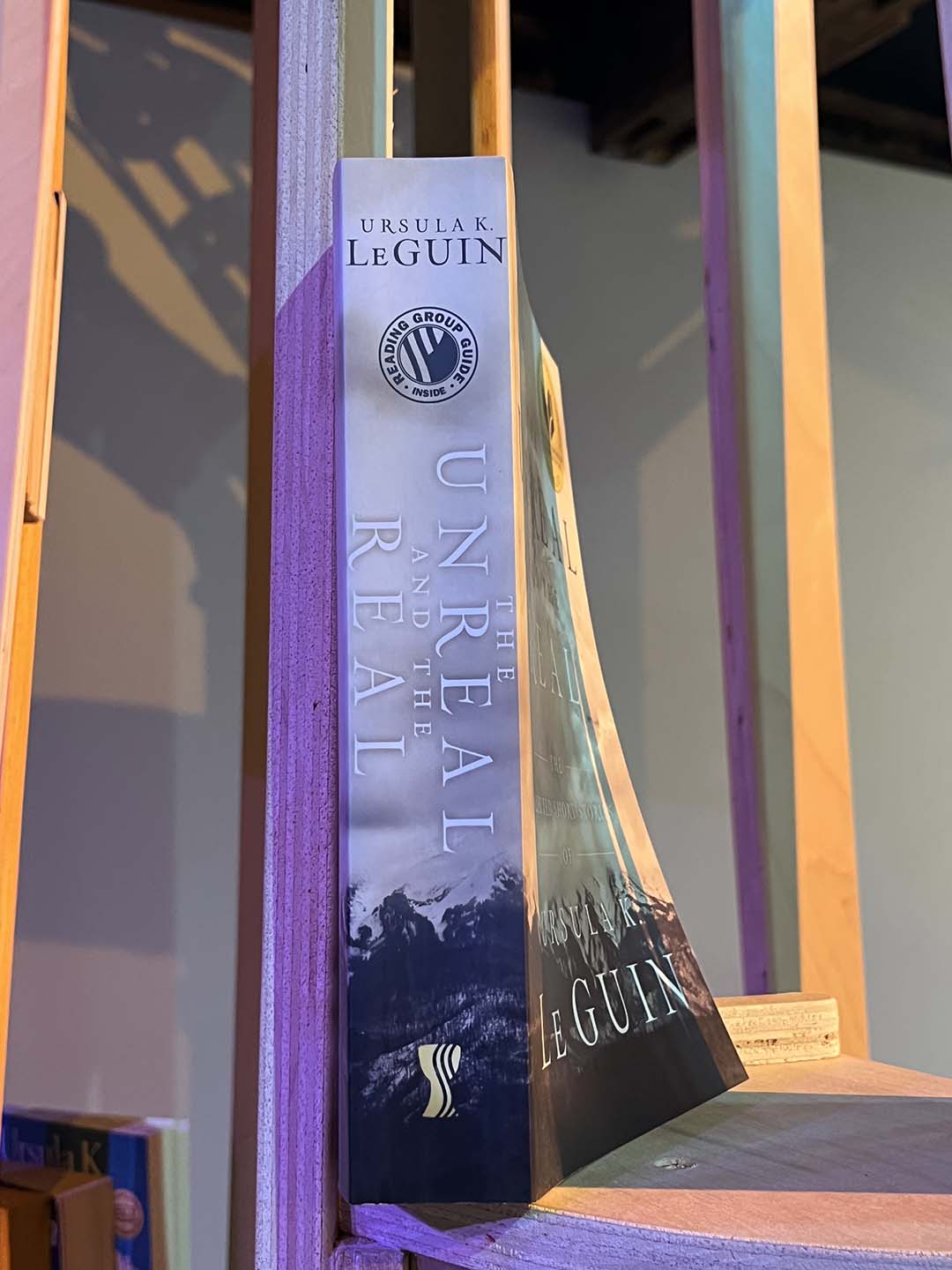
The Unreal and the Real.

· Oregon Contemporary presents: A Larger Reality: Ursula K. Le Guin ·
And eyes beholding radiance.
And the gnats’ flickering dance.
And the seas’ expanse.
And death, and chance.

Ursula K. Le Guin, second stanza in A Hymn to Time (From Late in the Day Poems 2010 – 2014)

Some people spend their entire lives reading but never get beyond reading the words on the page, they don’t understand that the words are merely stepping stones placed across a fast-flowing river, and the reason they’re there is so that we can reach the farther shore, it’s the other side that matters…

by José Saramago The Cave (p.60), (2003)

A few years ago I visited the Sigmund Freud Museum in Vienna’s Berg Gasse. Driven by a somewhat morbid curiosity, I guess, given that I ain’t buying what the man was selling. His claims of offering “science” out of step with how science proceeds, his concepts of memory often completely inaccurate, his assertions about children and child development flatly wrong, his analytic method for the therapeutic process, involving class and traditional gender stereotypes, having done more harm than good. I do concede, however, that the he was a literary giant, converting his extensive humanistic education into far-reaching and complex contemplations that challenge readers to think hard about his suggestions.

What can an exhibition about a literary figure, (or for those so inclined, the father of Psychoanalysis,) convey? A recreation of his environments, the typewriter here, the ashtrays there, the proverbial couch long moved to England, various photographs of different life stages, copies of manuscripts or even original pages, earned awards, and everywhere the collection of knick-knacks, or artifacts from ancient cultures: it all struck me as detritus of a life forced to abandon, or a shed carapace with the substance – his towering intellect – missing in the room.

Then again, the exhibition certainly fed our eternal craving for human interest stories, opening a window into the life of an (in)famous man, if not his mind (or even at the expense thereof.) And having opened this window into the personal details of an existence might, in turn, lure you to open the door into the more interesting part of the house: actually engaging with his writings.

All this came back to me, with trepidation, when I planned to visit a recently opened exhibition at Portland’s Oregon Contemporary. Another literary great on view, and one, in contrast, who I greatly admire: the author, poet, blogger and all around renaissance woman regarding creative modalities: Ursula K. Le Guin (1929 – 2018).

To come straight to the point: this exhibition is much more successful on many levels, although, it, too, suffers from the structural constraints around conveying at least some of the heft and style of the intellectual output of its literary protagonist. There were many things I delighted in, and there were some I sorely missed, that might or might not have been possible to introduce.

(I will skip biographic details that can be easily learned from her website. A compact overview was also recently offered by one of the talented StreetRoots writers – shout out to our local street newspaper! By her counting, it is pretty amazing to look at the volume of Le Guin’s output: 21 novels, 11 volumes of short stories, 12 children’s books (please see the popular picture book “Catwings”), four collections of essays, multiple volumes of poetry, and four of translation, including the Chinese classic text Lao Tzu: Tao Te Ching and the poems of Gabriela Mistral.)

The exhibition title A Larger Reality is ambiguously open to multiple interpretations, but LARGE unambiguously ruled sensory perceptions. The visitor enters a cavernous space, greeted by a larger than life portrait of the author. A brilliant choice among the many photographs available of a strikingly photogenic woman across her life-span, depicting Le Guin as we knew her during the last years of her life, no shying away from old age skin and sagging features. No pretense here, no softening of reality. I cannot think of a better promise that this will be no hagiographic show, but an uncompromising honoring of the truth embodied by this face, a face exuding wisdom and zest in equal measure.

An enormous dragon stretching across almost an entire wall, grabs your attention next – a fanciful mural that embodies the playfulness so prominent in the written work. The scales are dotted with photographs of the author across a lifetime, many including her family. The dragon spikes on top, or whatever they are called, contain the titles of her most successful output.

Small display cases accompany the mural, offering personal benchmarks, and glimpses of activities that cannot be separated from her life as a writer, or that mattered in addition to her professional career. I’ll get back to that in a bit.

Next we encounter a large accumulation of drawings of maps, all preceding the various worlds Le Guin created in her novels and stories. The facility with drawing, and as shown in subsequent display cases, water colors and sketches is enviable – but not as enviable as the fact that the quality of prose is absolutely matched by the quality of her poetry (something you would not learn from this show.) It was a smart curatorial choice not to dilute the impact of the geographic inventions and depictions by other illustrative output. The stunning variability of the maps themselves can be better appreciated this way. (Readers in GB: You can see some of this work as well. Open through December 6: The Word for World: The Maps of Ursula K. Le Guin at the Architectural Association Gallery, London, UK.)

Not done with large yet. There is Mother Oak, a humongous tree where you can sit and read her stories or listen to her voice (what a gift to have those recordings. I so miss the voice of my parents, unable to recreate them accurately in my mind, much more so than visual memories.) In contrast to the oak tree in her book Direction on the Road, this one does not expand and shrink depending on the approach or departure of people interested in its stories. It is just a – large – reality.

Multiple interactive stations invite the visitor to engage with some of the science fiction and fantasy ideas. A recreation of the author’s workspace, including the view out of her window, familiarizes us with her environment. Videos add more introductions to visual creativity.

In the next room we encounter numerous display cases offering ephemera of her various interests. The walls are exhibiting pieces by very different artists done in response to Le Guin’s work, and yet another large mural depicts a variety of people and anthropomorphic creatures offering books that had some impact on the author. Framed in pink, no less. It did not work for me, too contrived, and lacking the intellectual elegance that I so associate with the writer and that was captured in the mural by the entrance.

A wizard’s cape, created by one of Le Guin’s daughters, reminds us of the abolition of genders in Earthsea, times for great celebration marked by such a robe. She fashioned it from various hoods of doctoral gowns worn by the writer who received no fewer than 8 honorary doctorates. Smartly conceived and beautiful in one fell swoop!

***

Political writing of the highest order is rare. Moments at which a particular language is opened to a further range of possibilities – a new tone, a new conception of human purposes, a sharper or wilder rhetorical ascent – in any case happen very infrequently.

T.J. Clark Those Passions: On Art and Politics, p.327

The gallery website introduces the exhibition as such: “A Larger Reality: Ursula K. Le Guin offers a biographical and poetical portrait of one of Oregon’s best known artists. Examining important moments and themes in Le Guin’s life and oeuvre, the exhibition encompasses a rich variety of media, immersing guests in the ideas, playfulness and hope that course through Ursula K. Le Guin’s art.

The exhibition scores on most of those points. Yet, the important themes in her oeuvre just weren’t exposed enough (and, mind you, I am always willing to admit maybe I missed the relevant info. I will happily stand corrected.) For example, Le Guin’s political advocacy is represented with a variety of buttons on a bag with a tongue in cheek printing of “I have abandoned truth and am now looking for a good fantasy.” The signage there reads that she was advocating for a variety of causes in her life, from anti-war movements to tree preservation. The description of her as an anti-capitalist is softened with the humorous referral to her love of shopping, particularly shoes. These attenuations might bring her closer to the rest of us mortals, but they really underplay the intensity or progressiveness of her positions as they appear in her writings. Cloaked in science fiction, her writing was political of the highest order.

It would have been great to introduce, particularly to those new to her, the variety of political topics that forever reappeared, and associate them with particular books, to catch new readers’ interest. Curious about feminism or gender identity? Read Lavinia, or The Left Hand of Darkness, or The Wizard of Earthsea. Thinking about the evil of colonialism? Read The Word for World is Forest or Always coming Home. Can anarchism work as a form of political entity? Find out in The Dispossessed. I could go on about issues of power, our relations to the natural, world, you name it. But here is one I care about most: Want to know why the writer is considered by so many as the queen of moral dilemmas? Go straight to The Ones who walked away from Omelas, a short story that won the 1974 Hugo Award for Best Short Story, given annually for a ​science fiction or fantasy story, and appeared a year later in The Wind’s Twelve Quarters.

A city full of joy, prosperity, security relies on its citizens’ complicit acceptance that it is all maintained by a single child being tortured and kept in permanent isolation in a fetid hole. Only a select few walk away from the city and its immoral bargain after viewing the child, towards an unknown fate beyond the perimeters of “paradise.” We have obviously graduated from one child to several million who we currently willingly starve in our own country, or kill by omission around the world with the abandonment of USAID, or murder by commission of weapons sales for the Gazan genocide, which brings the issue of complicity in ever sharper focus.

Pat Barker, another inimitable writer, voiced in an interview with the Guardian’s Susanna Rustin almost 20 years ago: “Fiction should be about moral dilemmas that are so bloody difficult that the author doesn’t know the answer. What I hate in fiction is when the author knows better than the characters what they should do.”

I can’t think of a single novel that I’ve read of Le Guin’s that does not directly or indirectly force us to face a moral or ethical quandary and think through the consequences of free will, or the constraints on destinies imposed by oppressive powers.

The real is imported into the unreal, and vice versa.

What makes her so impressively different is the fact that none of this involves didactic scolding, or condescension, but always, always offers glimpses of hope, the possibility of change if courageously – and collectively – pursued. No defined solutions, but no Antigones for Le Guin either!

At the same time, she could be quite cutting in her answers to those of us (yes, myself included) who asked apparently stupid questions during readings and lectures. She did not suffer fools.

The refusal to accept black & white answers or cling rigidly to positions, made up for that. I remember vividly my college students’ reactions year after year, when we discussed a video of her talking about gender issues in my Social Psychology or Psychology of Women classes. The expected outline of the difficult position of women in societies organized around patriarchal principles was always counterbalanced by Le Guin holding forth on the fate of young men in those very same societies – they are expendable, good for canon fodder. Male and female students alike felt seen and were able to engage in much less defensive discussions.

And speaking of young people, it would have been great to have some knowledgeable sources provide an overview of how much of an influence this author has had on younger, aspiring writers across the years, including the awards given to them, like the 2025 Ursula K. Le Guin Prize for Fiction, which you can see for yourself here. Her breadth of interests is certainly reflected in the composition of nominees.

***

Theo Downes Le Guin introduces the prize ceremony in the video link above. He is also the main curator for the exhibition portraying his mother, with his sisters offering major contributions as well. I cannot help but wonder how you find a balance between (on one side) the desire for proud public display of your mother and all she achieved, and (on the other side) the need for privacy not just regarding the subject of the show, but your own relationship to a parent who, by public decree, was a Living Legend. 

Portland was hometown of all the Le Guin’s, with near cult status afforded to the elder sitting alongside of the fact that the younger ones have considerable standing in their own right. If curatorial interests clash between what is opportune for public display and what is important both for privacy and for keeping the spotlight on the mother, how do you solve the dilemma?

I have earlier described in Oregon ArtsWatch Theo’s curatorial prowess, but the current situation is unique, with a number of potential vulnerabilities. What does it imply psychologically when you set your task to be one of describing comprehensively the importance of your mother, while also mourning the absence of a beloved person, gone for good? Digging through life-long archives inevitably entails reminders of a childhood shared with her profession, no matter how often (and in this exhibition repeatedly stressed) she voiced her conviction that parenting and authoring were perfectly compatible, even complementary. What does it mean to be in the wake of your mother’s departing ship, likely happily engaged as her literary executor, building the Foundation, arranging traveling exhibitions (at least I hope, for this one should find a broader audience) but – as a result of all of this — no longer able to devote full energy to pursuing what you used to do?

These are all questions brought to mind in a year that has seen its share of biographies about larger-than-life mothers and the complexities of filial love – the off-putting How To Lose Your Mother: A Daughter’s Memoir by Molly Jong-Fast and the fascinating Mother Mary Comes to Me by the brilliant Arundhati Roy the most prominent ones.

I experienced the Le Guins’ curation as an act of generosity as well as a public service, keeping an important voice alive for all of us. Cannot imagine that it hasn’t been hard, though.

One last shout-out: Oregon Contemporary’s Executive Director Blake Shell not only checked people personally into the exhibition, but approached with serious interest at the end of my round, offering to engage in conversation. I was pressed for time and so had to leave promptly, but would have enjoyed that interaction with someone so intimately involved in the whole enterprise. The gallery is facing hard times, like so many of our cultural institutions. The National Endowment for the Arts revoked its federal funding for the 2026 Artists’ Biennial that was intent to showcase a diverse group of Oregon artists, many expected to defy the administration’s imperative to deprive us of “DEI” associated art. You can learn more and help here.

Oregon Contemporary
8371 N. Interstate Ave
Portland, OR 97217

Hours
Fri / Sat / Sun, Noon–5pm
Free and open to the public / ADA accessible

Suggested Donation $14.90 for those who can.

Additional events:

Saturday, December 6th
Event: First Saturday, Talk with Michelle Ruiz Keil & Ashley Stull Meyers and Screening of CROSSLUCID’s Vaster than Empires
Time: 5:00-8:00pm, 6:00pm start of event

Saturday, February 7th
Event: Todd Barton performance of Music and Poetry of the Kesh by Ursula K. Le Guin & Todd Barton with a screening of Kesh, a short film by Rankin Renwick
Time: 5:00-8:00pm, 6:00pm start of event

Past, Present and Future: Thoughts at the Time of the Lunar New Year.

“Our mission is to collect, preserve and share the stories, oral histories and artifacts of Portland’s Chinatown as a catalyst for exploring and interpreting the history of past, present and future immigrant experiences.” Portland Chinatown Museum (PCM) Mission Statement

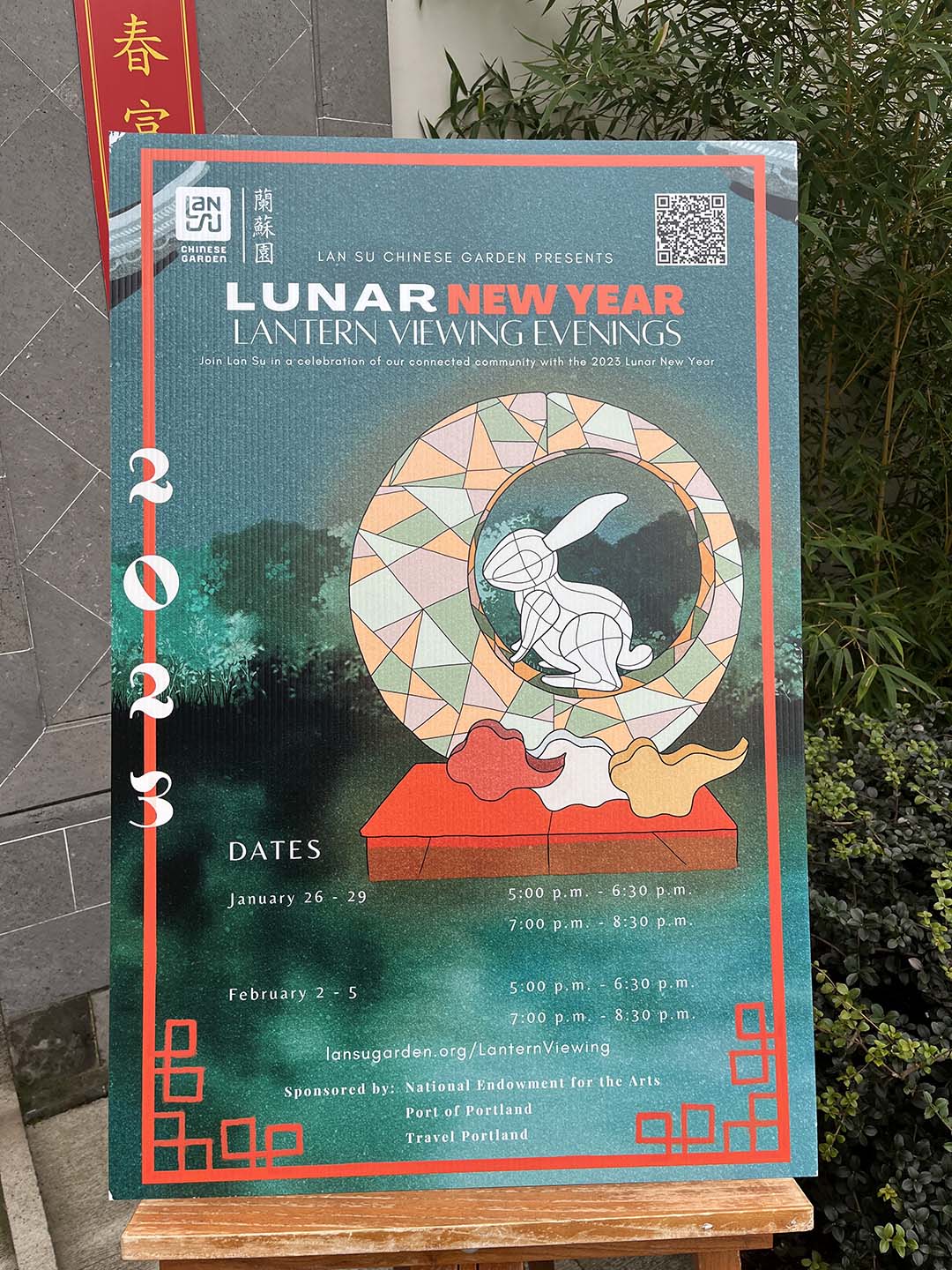
The Lunar New Year – The Year of the Water Rabbit – started yesterday and the Chinese government expects about 2.1 billion journeys to be made in Asia during a 40-day travel period around the celebration as people rush back for the traditional reunion dinner on the eve of the new year. I took a short trip to Portland’s Old Town Chinatown instead on Friday, an annual pilgrimage to admire the beauty of Lan Su Chinese Garden with its festive decorations for the occasion.

This year I added a second stop, a first visit to Portland Chinatown Museum (PCM,) which is just a block away on NW Third Ave, and not too far from the Chinatown Gateway. The museum opened in 2018 and did not appear on my radar during the pandemic years. I cannot recommend a visit strongly enough: opening hours are limited from Friday to Sunday, and the current temporary exhibition will close on January 29th. So if you can, make it down there next Friday or Saturday between 11 am-3 pm, there is some revelatory art on display.

The history of the museum’s founding can be found here. Like other Old Town institutions devoted to collecting and preserving immigrants’ histories, the Japanese American Museum of Oregon and the Oregon Jewish Museum and Center for Holocaust Education among them, PCM offers a permanent exhibition depicting the lives and plight of the Chinese immigrants. Beyond the Gate: A Tale of Portland’s Historic Chinatowns provides a comprehensive look at historical artifacts, some arranged in diverse dioramas, and guides you through the various aspects of the immigrant experience with informative exhibition texts and archival photographs.

***

Two separate galleries provide space for the work of contemporary Asian American artists, currently showing Illuminating Time, installations by three different artists-in-residence working with different media. The exhibition is exquisitely curated by Horatio Law, one of the PNW’s premier public art and installation artist who serves as the Artist Residency Director. It echoes the permanent exhibitions’s themes of loss, hope and belonging, so familiar to all immigrants.

___

一方有难,八方支援 “When trouble occurs at one spot, help comes from all quarters.” – Chinese Proverb

The theme of community, integral to collectivist cultures and so prominent in the museum’s permanent exhibition of historic Chinatown’s structural support systems, is picked up by Alex Chiu. Known to many of us for his vibrant murals that can be found across PDX, he undertook a series of ink drawings of community members that are displayed in the entrance hall of the museum. Placed against the backdrop of a stylized rendering of the Chinatown gateway, they depict a range of characters of all ages and degrees of visibility, pointing to the diversity of Portland’s Chinese population. Expressive and detailed, these portraits are a lively counterpart to the archival photographs of the Chinese ancestors who set foot here in the 1800s.

The juxtaposition between the traditional valuing of community and the artist’s modern ways of portraying individuals reminded me of the current trends in social psychology exploring the status of young Chinese who grow up in a world where the traditional collectivism of their culture and the modern demands and offers of Western individualism intersect. It is interesting work, based on spontaneous recollection of Chinese proverbs by these college students, reflecting which values come to mind first and how they are weighted. A changing world, yet heavily anchored still in tradition.

Clockwise from upper left: Portland Chinese Community Portrait Series: Billy Lee, Beatrix Li, Roberta Wong, Terry Lee.

***

“Take care of each other. Take care of the soil.” Shu-Ju Wang, in conversation.

Off to the side of the front venue is a room dedicated to Shu-Ju Wang‘s exploration of the history of Tanner Creek and its connection to the Chinese laborers and farmers who tended to its surrounding fertile soil to grow vegetables for both, sale and consumption. Her installation consists of multiple parts, prominently displaying a wooden slide constructed to represent the topography of the waterway with its angles and gradient. It is actually a marble run, and visitors are invited to play around, connecting through interaction. Above it hangs a mobile, made from silkscreen and gouache with a top part that was embroidered on paper tinted with gouache as well. It represents rain drops, a sense of fluidity enhanced by the aqua color range and the lightness of the material that slightly trembles in the draft. The sturdiness of the wood and the fragility of the paper assembly complement each other, rather than being opposed, representing aspects of nature that remind us of its power as much as its vulnerability.

Wang’s interest in and facility with science is evident in the exhibition posters that provide facts about the history of the creek within the build-up of Portland, the encroachment endangering the creek’s initial free run and displacing those human communities that had respected natural cycles of flooding necessary for fertile ground. Creatively, these narrative are told in letters from the creek to us, making a personal statement in a voice that I can see as particularly effective for young minds, children feeling addressed and drawn in. That said, it sure got my attention. The remaining walls are hung with the artist’s recent paintings and printings of nature-related topics, the theme of the need for environmental stewardship pervasive, meticulously and insistingly expressed.

Left to right: A fold-up book Castor and Sapient; A Study of Home (2021) Silk screen, pressure print and collage; a basket by Sara Siestreem (Hanis Coos) woven from native plant materials to catch the marbles.

I walked out with a plant cutting in hand, small annuals which are offered for free – by March, when this part of the exhibition is likely still on, it will be vegetable plantings to connect to the Chinese farmers’ history at Tanner Creek.

***

” …and someone far away will see flight patterns,” – excerpt from Sam Roxas-Chua’s poem Please Be Guided Accordingly.

If we link the immigrant experience to the past, present and future, as the museum intends to do, then Wang’s depiction of the past and Chiu’s capture of the present is joined by Roxas-Chua’s work incorporating the future. That might seem counterintuitive given the prevalence of allusions to memory, including the title for some of the major works.

Yet I was flooded with an impression that the work was about opening towards something, with the release that comes with the acknowledgement and acceptance of grief.

Detail: Gold Lighting and Lullaby Scripts

Part of that might have been triggered by the realization of the ephemeral character of both materials used and conceptual expression. The artist will destroy all that was presented by the end of the exhibition’s run and bury it at its source, the places in nature from which materials for the ink and paper were borrowed, and from which the inspiration was drawn. What is gone makes room for the new.

Left and RightL Gold Lighting and Lullaby Scripts. Center: Stone Satellites over an Excavation Site in John Day, Oregon.

Part of it can be found in the way Roxas-Chua’s calligraphy is open to interpretation. The technique of asemic writing that he uses is a form of communication that is unconstrained by syntax or semantics, an aesthetic rather than a verbal expression. It is the perfect medium for someone who is overburdened by the demands of too many languages (In Roxas-Chua’s case four) or too little rootedness in each.

Excerpt: Three Oranges and Blue Mountains Moon

For the viewer this opens space to connect to the calligraphy in ways unrestricted by formal demands. Unsurprisingly for me, who has spent her scientific research years studying memory, the art appeared as patterns of synaptic connections, but also of plaques causing retrieval failure, of parallel processing and encoding bias. The malleability of memory was perfectly caught in the flow of these marks, the way how present context is re-shaping, even altering what is remembered, ultimately influencing an assessment of the future.

How we approach the future is not just guided by how much our memory has changed over time, shifting away from facts and towards a narrative that helps emotional adaptation. How much any of us can remember the specifics of our past also plays a big role.

In many realms, all of our thinking about the future is rooted in memory. Policy planners, for example, routinely contemplate past patterns as a way of anticipating things to come. At a much more personal level, researchers suggest that a sense of hopefulness, or its lack, depends on how specifically we remember the past. Think about someone saying, “I cannot see how that could possibly happen,” or the opposite, “I can easily imagine how that can come to be.” That step of imagination is arguably central to how hopeful someone will be about the future, or not. And that ability to project is clearly linked to the specificity of your memory of how things unfolded in the past. Remembering opening the path to hope.

Excerpt: Three Oranges and Blue Mountains Moon

For the artist it was perhaps a way of connecting to the various landscapes and human sources that linked to the past of Chinese immigrants, from John Day to Astoria, where he interviewed people and recorded soundscapes of the environment (QR codes direct you to a listening experiences that captures these sounds, or music, or the artist’s poetry, providing additional levels of experience of the Gesamtkunstwerk, the totality of each artwork.)

Loss and re-emergence are central to the work. It was, I believe, most urgently captured in The Weeping Script. Please Be Guided Accordingly, the poem that accompanies the calligraphy, seizes the stages at which death rips a loved one away from you, bit by bit. There’s a release provided by inklings of hope and uplift in the future, though tempered by the knowledge that it will be a cold, lonely run. Maybe not the entire three year mourning period proscribed by Confucius, but the concession that grief exists and yet can be turned around. It calmly points to opening of new horizons.

For anyone mourning it will be brutally moving, and yet it is incredibly beautiful, hopeful work.

***

And now we turn to the elephant in the room. If the consummation of loss is part of the art inside the museum, wait until you see it instantiated in the suffering of the houseless in real life outside. The many houseless in the neighborhood, their tents, their misery, their detritus, are something the Old Town businesses are trying to deal with.

City plans almost a decade in the making have not yielded visible results, even though the mayor’s office claims progress. In October 2021, spurred by the rise in crime, violence and public camping in the Old Town neighborhood, the leaders of four cultural institutions — Lan Su Chinese Garden, the Japanese American Museum of Oregon, Oregon Jewish Museum and Center for Holocaust Education and Portland Chinatown Museum — wrote a joint open letter asking each city and county commissioner for immediate help. In March of last year, Old Town Community leaders unveiled a plan to repair and reopen the neighborhood, which included goals like reducing 911 call answering times, improving lighting in the area, and reducing tent camping by one-third.

The right words were said: “As Portland’s oldest neighborhood, home to immigrants who overcame decades of discrimination and indignity, and today, home to so many who are fighting just to stay alive, we must to whatever we can to respond to the crisis of humanity unfolding around us. And we must do it today,” said Elizabeth Nye, the executive director of Lan Su Chinese Garden, “the local government’s inability to safeguard Old Town disrespects its history.It is particularly devastating to our houseless neighbors who deserve more from their government.”

Mural on NW Davis St

The subsequent reality, however, amounted to an exponential increase in sweeps of the neighborhood. The 90-day “re-set” led to a particular form of camp removal, structure abatement sweeps, that can be ordered by the police chief or engineers in two different bureaus overseen by city commissioners. The standard Homelessness and Urban Camping Impact Reduction Program, or HUCIRP, sweep provides at least 72 hours’ notice to unhoused Portlanders so they can gather their belongings and voluntarily move before city contractors remove them from a given area. The structure abatement approach extends 1 hour warning, if that. If you happen to be away from your tent or belonging, all is lost. (For a detailed description of the way things unfolded last summer, here is a report by advocates from Streetroots, an organization where I taught writing workshops for the houseless until the pandemic started.) Shelter referrals given during or after sweeps are not enough – you can stay for one night, after having been completely uprooted. Many feel unsafe in shelters even for that one night, or can’t apply because they have pets.

Mural on NW Davis St depicting the view South on NW 4th Ave

Do these sweeps help solve the situation? Of course not. They clean up the streets for a short time or for a particular event, while making people less stable, re-traumatizing them, and shifting the entire problem just to a different location. Mayor Ted Wheeler and Commissioner Dan Ryan’s five October 2022 resolutions on homelessness included a ban on unsanctioned camping and the construction of compulsory mass homeless encampments, which would host up to 250 people. This can only be seen as a way to circumvent the Supreme Court decision letting the 9th Circuit Court of Appeals re Martin v. Boise decision stand, stating that a houseless persons cannot be punished for sleeping outside on public property in absence of alternatives.

Mural on NW Davis St

Of the six promised safe-rest villages only 2 have opened so far. Evictions from rental properties have skyrocketed since the renter protection during the pandemic was lifted – in the first 10 months of 2022 alone there were 18.831 evictions, as reported by a PSU research group. According to the 2022 Multnomah County Point-in-Time Count report, 24% of those experiencing unsheltered homelessness reported COVID-related reasons as the cause, adding to increased inflation and rising rent costs. Despite the stereotype, these are not all people with criminal records, or mental illness, or living with substance abuse problems. And even if they were, they would have the same human right to shelter as we all do. On top of it all, Senator Wyden’s DASH Act, (Decent, Affordable, Safe Housing for All) languishes in committee, even though it has support from all sides, business owners, land lord organizations and advocates for the houseless included.

I completely understand the need for businesses and institutions to be able to function in a safe environment and one that does not interfere with business under the specter of violence and crime. But let us acknowledge that the reaction so far has been to try and disperse the unhoused, without providing sufficient, actual housing, the only permanent solution to homelessness.

Archival photograph of NW Fourth Avenue

Until something changes structurally and expediently, I fear museums like the Portland Chinatown Museum will not get the exposure they deserve because many people hesitate to visit Old Town. It is truly sad, given what is on offer. But it is heartbreaking to see the suffering and loss in the surrounding streets, with poverty levels probably comparable to those experienced by the very first Chinese immigrants that came to seek a better life in a new home, leaving famine and disease behind. Past, present and future connected at the most basic level of human experience, daily survival.

Portland Chinatown Museum

127 NW Third Avenue
Portland, OR 97209

Friday – Sunday
11:00 AM – 3:00 PM

Docent-led group tours are Friday through Sunday by reservation only.

Current exhibition Illuminating Time closes on January 29th.

Join the museum on Saturday, January 28 at 10:00 a.m. for the seventh annual Lunar New Year Dragon Dance Parade and Celebration, presented in partnership with the Oregon Historical Society. 

The 150-foot dragon will be celebrating the holiday with lion dancers, performers, and a lively community parade through Old Town, Downtown, and up to the Oregon Historical Society Park