About time we introduce some new members to that idiosyncratically chosen group, don’t you think?
The first person should have been known to me, but wasn’t. I only learned about them when a dear friend sent me a bundle of postcards from a current blockbuster exhibition in Hamburg, Germany. She knew how much I wished to see Rendevous of Dreams at the Hamburger Kunsthalle, celebrating a century of Surrealism and juxtaposing some of the works with those of German Romanticists who were influenced by some of the same inspirations as the more modern movement.
“The supernatural and irrational, dreams and chance, a feeling of community and encounters with a changing natural world were vital sources of inspiration for German Romanticism and shaped international Surrealism differently a century later.” (Ref.)
Toyen The Dream (1937)
If you live in northern Germany, go see paintings by Max Ernst, Meret Oppenheim, René Magritte, Salvador Dalí, Valentine Hugo, Toyen, André Masson, Paul Klee and Caspar David Friedrich (1774–1840) and Philipp Otto Runge (1777–1810,) while I longingly stare at the postcards.
So: here is Toyen, a name that means “it is he” in Czech, but could also be a play on the French citoyen,) chosen by a painter originally named Marie Čermínová (1902 -1980) who refused to use any feminine endings in her own language (which contains linguistic gender differentiation). They were a firebrand, left home as a young teenager and followed progressive political movements while attending UMPRUM (Academy of Arts, Architecture and Design) in Prague. They worked closely with fellow Surrealist poet and artist Jindřich Štyrský until Štyrský’s death, collaborated with the future Nobel prize-winning poet Jaroslav Seifert, and poet František Halas. Living for some years in Paris, they and Styrsky founded an artistic alternative to Abstraction and Surrealism, which they dubbed Artificialism.
Toyen Among the Long Shadows (1943)
Their output was prolific, in paintings, drawings and book illustrations even during the years when they went underground during the Nazi Occupation in Prague, sheltering Jewish poet Jindřich Heisler. The two moved to Paris permanently after the war and joined the Paris Surrealists. Even when fascism struck and attacked a person and their work, they did not give an inch, much less capitulated. I am so grateful for models that indicate you can – and must – follow your passion, even under the most dire of circumstances.
The work is ravishing. If you live in Great Britain, you had a chance to see some of it at Richard Saltoun Gallery in London. Dreaming in the Margins was up until October 4th (this blog got delayed, alas, by reports on more pressing current events…) You can still look at the website, though.
Toyen THE LAW OF SILENCE (1953)
Toyen’s sexuality is unknown, since they avoided revealing any details about their personal life, creating a mysterious persona, but their public styling cut across gender boundaries. This fluidity was one of the factors that led to an artistic focus on themes of gender, politics, and eroticism, but they also created highly political art that addressed women’s experiences, misogyny and the destructive effects of war and authoritarian regimes. Here is a longer biographical sketch of the artist which labels Toyen as transgender.
Toyen Eclipse (1968)
***
I really can’t figure out how that artist escaped me, given my preoccupation with Surrealism this year with all those centennial celebrations (and prior to that just my affinity to some of the female artists of that movement before they were introduced to mainstream audiences.)
I am less perturbed by the fact that I had never encountered Frank Menchaca, the second person for today’s addition to the interesting people department, a composer who turns out also to be a visual artist, a poet and writer, with a foot in the sustainable energy business and education. Talk about a renaissance man. His visual art work can be perused on his website (link in name) that offers some 14 galleries. I came across his music first; just like Toyen cross-referenced poetry in her illustrations and other works, Menchaca links some of his compositions to poetry, in direct and indirect ways. As you know, I am a sucker for cross overs. And I feel certainly encouraged by people who do not restrict themselves to one creative or intellectual area only, even if standards of excellence might differ across media. I allow myself too often to beg off of some project just because I am not good (enough) at it, and it is so easy to retreat to the familiar.
What brought me to Menchaka is a piece titled Crows listening to Wallace Stevens. It can be found on an album The Demon rubs his Palm which I have listened to so often now that I can whistle in the demon’s company. By all descriptions, the music relates to multiple contemporary composers like John Luther Adams, for example. I wouldn’t know. I do know Steven’s 13 Ways of looking at a Blackbird, though, given that I spent an entire spring 15 years ago creating drawings and montages for the stanzas of this poem that I found wonderfully challenging to interpret. Early days for me regarding the craft, but I still like the ideas.
Here is my exhibition statement from 2011:
Wallace Stevens’ poem Thirteen Ways of Looking at a Blackbird, first published in 1913, has been hailed as an imagistic masterpiece. Stevens himself called it “a collection not of epigrams or ideas, but of sensations.” A first reading of the 13 stanzas, each mentioning the blackbird, offers indeed a multitude of sensory modes and perceptions. On closer inspection, though, the poem hints, as so much of Stevens’ work, at the relation between the perceivers and the world they perceive, extending our focus beyond perception to thoughts and feelings as well. Yet the text is challenging, frequently switching perspectives between who does the looking and who beholds whom in knowledge of the world. For good measure, Stevens adds the occasional barb, sufficiently opaque to leave the reader even more unsettled. Who would know that “the bards of euphony” refers to his critics (Stanza X) or that the men of Haddam, a hamlet in Connecticut, embarked on a futile search for gold (Stanza VII).
My challenge was to provide sufficiently representational images to echo the content of the stanzas, but to stay abstract enough to mirror the reticence of the poem’s language. I tried to convey my sense of the poem as a whole, taking as my guide the notion that our perception inevitably goes “beyond the information given,” such that the phenomenal world can never be objectively represented but consists rather of a chain of apperceptions guided by interpretation. To accomplish this goal, I, among other things, replaced the poem’s blackbird with glass marbles that were montaged into my drawings and photographsfrom my daily environment.
Thirteen Ways of Looking at a Blackbird
I Among twenty snowy mountains, The only moving thing Was the eye of the blackbird.
II I was of three minds, Like a tree In which there are three blackbirds.
III The blackbird whirled in the autumn winds. It was a small part of the pantomime.
IV A man and a woman Are one. A man and a woman and a blackbird Are one.
V I do not know which to prefer, The beauty of inflections Or the beauty of innuendoes, The blackbird whistling Or just after.
VI Icicles filled the long window With barbaric glass. The shadow of the blackbird Crossed it, to and fro. The mood Traced in the shadow An indecipherable cause.
VII O thin men of Haddam, Why do you imagine golden birds? Do you not see how the blackbird Walks around the feet Of the women about you?
VIII I know noble accents And lucid, inescapable rhythms; But I know, too, That the blackbird is involved In what I know.
IX When the blackbird flew out of sight, It marked the edge Of one of many circles.
X At the sight of blackbirds Flying in a green light, Even the bawds of euphony Would cry out sharply.
XI He rode over Connecticut In a glass coach. Once, a fear pierced him, In that he mistook The shadow of his equipage For blackbirds.
XII The river is moving. The blackbird must be flying.
XIII It was evening all afternoon. It was snowing And it was going to snow. The blackbird sat In the cedar-limbs.
Again, here is the full album, best listened to without interruptions, and on multiple occasions, when the connections become ever more visible, or should I say audible, rooted in a poem performed at the end.
Update: Due to copyright issues to be resolved, I will remove the photographs I had taken of Carrington’s work at OJMCHE or found in a book about her paintings. Stay tuned.
“You’re trying to intellectualize something, desperately, and you’re wasting your time. That’s not a way of understanding, to make it into some kind of mini-logic. You’ll never understand by that road.” “What do you think we can understand by?” ” By your own feelings about things. It’ a visual world. You want to turn things into some kind of intellectual game. It’s not. ” – Leonora Carrington in a interview published in 2015, with Carrington’s cousin, journalist Joanna Moorhead, author of Surreal Spaces: The Life and Art of Leonora Carrington.
2024 marks the centennial of Surrealism, a movement born in 1924 with the publication of a Manifesto by André Breton. Oregon Jewish Museum and Center for Holocaust Education’s new exhibition The Magic World of Leonora Carringtonjoins the celebration, offering a small collection of prints by Leonora Carrington, one of the female pioneers of Surrealism and a life-long painter of mystifying imagery full of passion for an otherworldly realm.
It was Bruce Guenther’s suggestion to introduce Carrington’s work for this special occasion, and he also secured the loan of the prints from Mixografia. As the Adjunct Curator for Special Exhibitions, he made his mark on OJMCHE’s visual arts programming during the last seven years, and we were the richer for it. In addition to being connected to the art world and able to draw on a trove of curatorial experiences, he, more importantly, pursued two goals. For one, he wanted to widen the horizon of a local audience to the diversity and depth of contributions by Jewish artists, many of them unfamiliar, and secondly, intended to shoot for the moon, when it came to bringing work here that had previously seemed out of reach. Succeed he did!
He introduced us, among others, to Grisha Bruskin (Alefbet: The Alphabet of Memory) for OJMCHE’s inaugural exhibition in its current location, or a wide range of local Jewish artists’ work relating to identity and religion (I AM THIS: Art by Oregon Jewish Artists,) confronted us with the provocative, self-reflective art of Kitaj ( R.B. Kitaj: A Jew Etc., Etc.) or reminded us of the art-historical importance of feminist Judy Chicago (Turning Inward, JUDY CHICAGO). Continually, Guenther encouraged us to question, reevaluate and improve on our understanding of art in the context of Judaism. He pushed us, guided us, helped us. It is our loss that he is no longer going to surprise us with his choice of exceptional programming at OJMCHE.
***
A plethora of exhibitions here and in Europe are currently lined up to celebrate Surrealism’s centennial. Some are offering a general overview of this revolutionary art movement, others have a specific focus. Until mid-July you can visit The Royal Museums of Fine Arts of Belgium which inaugurated IMAGINE!, a touring exhibition of works of the most famous surrealists conceived in close collaboration with the Centre Pompidou (Paris). By September, Surrealism. L’exposition du centenaire (1924-1969) will open at the Centre Pompidou, then travel on to the German Hamburger Kunsthalle. On the wings of its recent blockbuster exhibition about Caspar David Friedrich and the reaches of Romanticism, Hamburg will focus on the affinities and differences between Romanticism and Surrealism in 2025. Then on to Madrid, and eventually we can visit closer to home, at the Philadelphia Museum of Art. This fall, the Lenbachhaus in Munich inaugurates a highly anticipated exhibition about Surrealism and anti-fascism, But live here? No thanks!, illuminating Surrealism as a political movement with an internationalist commitment in the fight against colonialism and fascism. The Henry Moore Institute in Leeds will display The Traumatic Surreal, concentrating on post-war surrealist women artists and their opposition to the patriarchy since 1960. And last but not least, a show entirely dedicated to Leonora Carrington will also open in October at the Palazzo Reale in Milan, Italy.
This – believe it or not – selective list of exhibitions points to the many facets of the surrealist movement and the fact that it has finally “arrived.” The shows will be accompanied by various intellectual explorations of the nature, origins and practical consequences of Surrealism, helping us to understand what the movement is about, its implications for our own time and where to place various artists within its margins. A movement that was dedicated to the deconstruction of rational language, to dissolving the contradiction between reality and the irrational, to resisting habitual modes of thought and perception, is celebrated by means of the traditional intellectual lens and rational analysis of art historians and/or sociologists. One wonders if the artists would have been pleased or annoyed.
I speculate, though, that Leonora Carrington (1917 – 2011) couldn’t have cared less. I think of her as a force of nature who marched to her own drummer all her life, pursuing her painting, her writing and her fervent political engagement for women’s liberation without a moment’s thought of the world’s reaction. Then again, she would likely be pleased that female artists within the movement have eventually gotten their dues, rescued from the assigned roles as muses or child-women, young and subservient, as the male founders of the movement liked to think of them and/or treat them. Across the last decades they have finally been recognized as brilliant artists in their own rights, most recently with a magnificent survey exhibition at The Schirn, Frankfurt a.M., Fantastic Women.
Born in England into a family of wealthy if staid manufacturers, sister to three younger brothers and raised by an Irish nanny fond of myths and fairy tales, Carrington rebelled from an early age. Thrown out of countless boarding schools, she enrolled in art programs and ended up in Paris at age 20, where she met and fell in love with a surrealist painter 26 years her elder, Max Ernst. He abandoned his second wife (having divorced his first, Luise Straus, who was later murdered in Auschwitz, marrying and divorcing two more during his lifetime) for Leonora with whom he settled in rural France when interpersonal drama threatened to take over their productivity in Paris. Carrington refused to be a “muse” from the very beginning and engaged in her own – and distinct – exploration of both the themes and the processes closely associated with the new movement.
Photographs removed
Leonora Carrington A Magnificent Bird Portrait of Max Ernst (1939) — Max Ernst Leonora in the Morning light (1940)The artists exchanged these portraits during a reunion in New York. Carrington, by her own desire, never saw Ernst again after that.
When Ernst was arrested by the Nazis and later escaped to New York, she fled to Spain, suffering a severe mental breakdown, made worse by inappropriate, possibly sadistic psychiatric care during inpatient treatment. She eventually left Europe on a visa provided by a marriage of convenience, and after some time settled in Mexico, finding love, committing to motherhood, and becoming extraordinary prolific in her various creative endeavors, as a painter and novelist processing her autobiographical experiences, including her psychotic break. In Mexico she was embedded in a group of close women friends who were also expatriate artists, Remedios Varo whose painted dream worlds incorporated mystical philosophy and surrealist techniques not unlike Carrington’s, and photojournalist and surrealist photographer Kati Horna. They shared various interests that, at a minimum, enlivened quotidian domesticity and, more importantly, provided substance for their creative output less chained to reality: interests in alchemy, witchcraft, mythology and more.
Some of Carrington’s prints on hand are products of her imagination, typical hybrid figures or grotesques that combine animal and human features. The bulk of the work, however, are paintings made in the early 1970s to dress characters of a play “The Dybbuk or Between two Worlds.“ The word Dybbuk originates from the Hebrew דָּבַק , dāḇaq, meaning ‘adhere‘ or ‘cling’ and refers to the soul of a dead person, always a man, now possessing the body of a living human being, most often a woman. Written by S. Ansky who was interested in Hassidic folklore that contained elements of the story since the 13th century, the play was originally performed in 1920, first in Russian, later in Yiddish. (דער דיבוק, אדער צווישן צוויי וועלטן; Der Dibuk, oder Tsvishn Tsvey Veltn. Here is a link to a magnificent Polish film made from the play in 1937, in Yiddish with English subtitles, a window into a world long gone.)
Alternatively, here is a short summary by a modern, feminist playwright, Lila Rose Kaplan.
“Once upon a time a woman named Leah was allowed to be in a story because she was getting married. Her father picked her a rich husband. Then her dead boyfriend possessed her, because if a woman’s gonna take up space in a story she must not be a woman. Then they learned that Leah had been promised to her dead boyfriend before she was born. She screamed why don’t I have any agency, but no one could hear her. So, they did an exorcism and got her unpossessed. Then she killed herself to be with her dead boyfriend or maybe she just wanted to be left alone.“
Photographs removed Leonora Carrington Leye returns transformed into the Dybbuk (1974)
Rachel Elior, the John and Golda Cohen Professor of Jewish Philosophy and Jewish Mystical Thought at Hebrew University, discusses the societal function served by the notion of possession by a spirit in her book DYBBUKS AND JEWISH WOMEN in Social History, Mysticism and Folklore. She argues that it could have been a means of escape for women who saw no other way out of the misery of oppression. Once “possessed,” women would no longer be held responsible for acting out or demanding agency of any kind, giving them a certain degree of freedom, including the refusal of arranged marriages. Of course there was a price to be paid, eventually, in the form of torturous exorcism.
Carrington was not Jewish – and she certainly did not lack agency! – but the appeal of this quintessentially Jewish story must have been strong, given that it contains so many elements that spoke to her interest in mysticism, soul transmigration, the role of women in male dominated societies, and ultimately resonated with some of her own biographical experiences.
Between two Worlds: Surrealist artists surely moved between worlds, that of reality and that within the recesses of the unconscious, a magical realm where irrationality was a prize, not a burden. As a female artist, Carrington had to fight to have her own voice heard, not being subsumed as a muse, possessed by a male, however smitten. Father figures in her own life, whether her actual father or a substitute, Ernst, had controlled her existence to some extent. But the memory of forced separation from her lover might have also been evoked by the elements of loss in Leah’s world. As one who had experienced “being possessed” during her psychotic episode, the painter could surely imagine herself into the psyche of Leah, to whom this male spirit adheres, using her as a vessel for his own unfinished life. Exorcism was not simply a technical term for someone who had been forced through fit-inducing medication at the asylum in Spain. And last but not least, emigration placed you between worlds, the old and the new, neither one fully your own.
Even though the characters themselves did not spring from her imagination, the way Carrington depicted them with her own aesthetic, strangely graceful, elongated figures, infused them with a life of their own. The lithographs offer, indeed, a visual world, one that generates feelings rather than lending itself to rational analysis (which will not stop me from speculation, as per usual…). The collection traveled through Mexico, exhibited early at the Salón de la Plástica Mexicana, after they were transferred to lithographs at the Taller de Gráfica Popular in 1974. (I wrote about the political role the print studio played in Mexico previously here.)
I consider her renderings remarkable in the sense that suffering, doubt, or bitterness are anything but central – somehow I find primarily resilience in the strong colors, the androgynous representations. And maybe there are traces of rage, in purple and red. Given that the artist was raised in a staunchly catholic household, these colors might also refer to the liturgical colors associated with the Celebrations of Martyrs (red) and Masses for the Dead (purple.) Then again, we have the red stockings of the women’s liberation movement and in England, her country of origin, the Suffragettes used purple that symbolized royalty, loyalty to the cause, and women’s quest for freedom.
Photographs removed Leonora Carrington Leye y Frade (1974)
The continual presence of protective females in the vicinity of Leah echoes one of the characteristics of the artist herself: she was acknowledged as a reliable supporter of the women around her, building strong connections to women all her life. It is as if Carrington’s own strength and endurance is gifted to the female protagonist, in defiance of the customary image of Leah as the victim. The fact that some Mexican graphic elements are included also signals the possibility that a soul has come home, can come home, no longer restlessly wandering. They might reference the surrealist artist’s own political beliefs captured by the movement statement found already in 1935 in the Bulletin International du Surréalisme: “The human soul is international.”
***
“Those who read or listen to our stories see everything as through a lens. This lens is the secret of narration, and it is ground anew in every story, ground between the temporal and the timeless. If we storytellers are Death’s Secretaries, we are so because, in our brief mortal lives, we are grinders of these lenses.” – John Berger inWhat Time Is It? (2019)
War, like the soul, is international as well, alas. It claimed and continues to claim victims regardless of their association with the warring parties – international observers, aid workers and photojournalist have paid that heavy price for trying to inform the world. David Seymour (Dawid Szymin, 1911- 1956,) known as Chim, was one of them – he was killed, three days after the armistice, no less, by Egyptian soldiers during the Suez Crisis when British–French–Israeli forces invaded Egypt in 1956 after Nasser nationalized the Suez Canal.
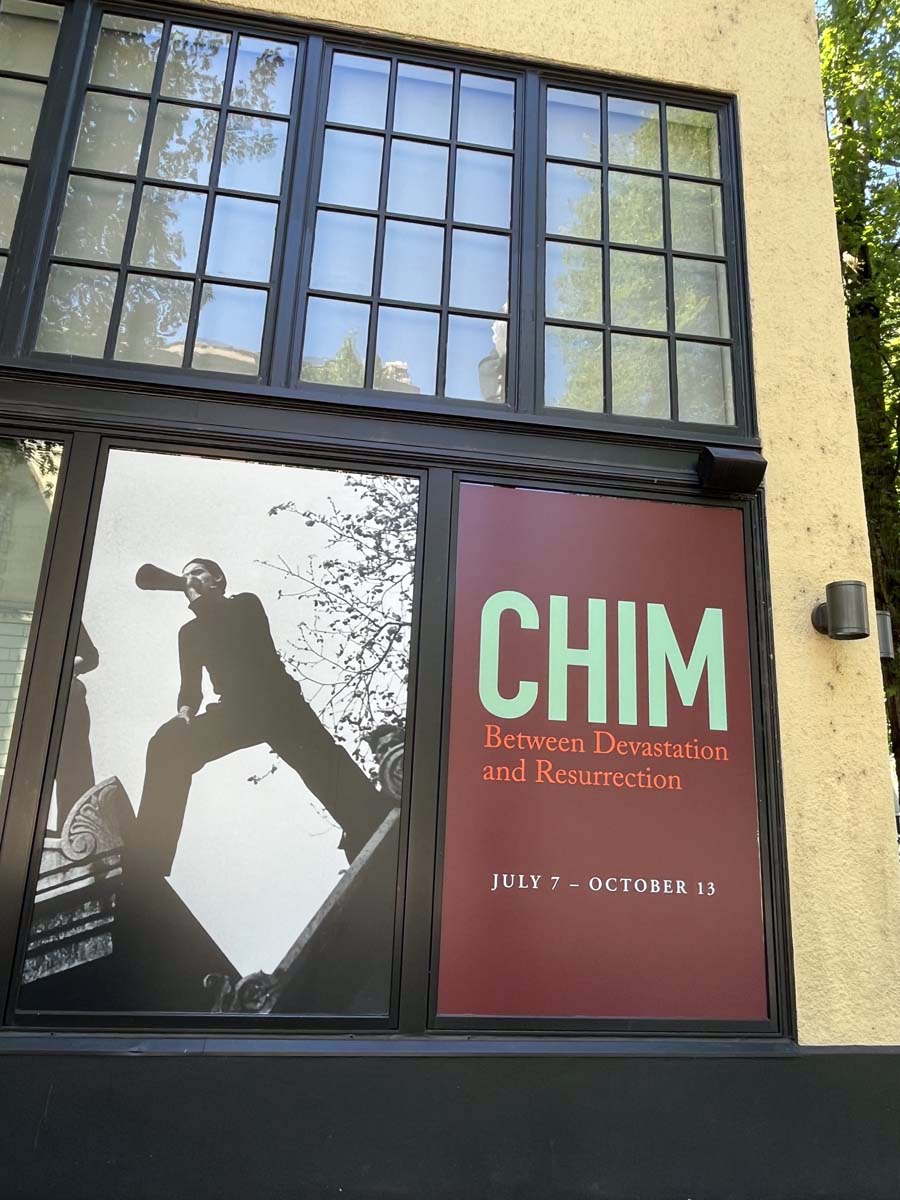
Chim: Between Devastation and Resurrection presentsphotographs that cut through to the reality of war, ignoring nationalistic or ideological fervor in favor of an empathetic response to the horrors wars impose on their victims. His lens told stories capturing both his times and the timelessness of suffering.
Born in Poland, Chim studied graphic arts at Leipzig’s prestigious Staatliche Akademie für Graphische Künste und Buchgewerbe in the early 1930s and then enrolled at the Sorbonne in Paris to study physics and chemistry. He started to take photographs for a variety of journals and magazines to make money for a living and soon got a reputation to be a talented social documentarian as well as war photographer when he documented the Spanish Civil War in 1936. Together with Henri Cartier-Bresson, Robert Capa, and George Rodger, Chim co-founded the Magnum photo agency after WW II ended and he had returned to Europe, having enlisted in the US Army during war times. In 1948, he was commissioned by UNICEF for a project he is now most known for, documenting the war’s effect on European children. “Children of Europe” was published by LIFE magazine and in book form eventually.
David Seymour (Chim) Girls playing in the ruins of a former orphanage, Monte Casino, Italy (1948)
***
OJMCHE’s photography exhibitions have been hit and miss. There have been brilliant shows (Southern Rites and Die Plage come to mind,) but also more pedestrian ones. One of the problems has to do with receiving previously curated package exhibitions that served well in their original purposes, but do not necessarily speak to contemporary questions. They also do not allow juxtapositions with work that one might choose if curating independently, to complement or off-set the photography on view.
The collection, on loan from the Illinois Holocaust Museum, and excerpted from an original show by the International Center for Photography, exhibits works that are solid, beautiful at times, and often moving. Chim was a master of the medium’s technical aspects, lighting and depth of field. He also often incorporated signs, banners, or posters into his images that functioned like internal captions, reminding us of the important legacy of Constructivism.
If a show had been independently curated, though, it could have raised a number of important issues. For one, just as the female artists within the surrealist movement have long stayed unacknowledged, much less feted, so has the legacy of female photographers in the realm of war photography. Chim has often been called “photography’s forgotten hero,” but there are a surprising number of Jewish women who documented war since WW I, continuing through the Spanish Civil War and on to WW II, and are completely ignored by the canon, no matter how remarkable.
There was Alice Schalek ((1874-1956) who lived in Vienna and is regarded to be the first woman who photographed Austrian soldiers at the frontlines during WW I. Gerda Taro (Gerta Pohorylle) was the first Jewish female photographer killed in the field, in Spain. A lifelong socialist and gifted photographer, she was the partner of Magnum-photographer Robert Capa, who, in contrast to her, has become legendary. Faigel Faye Schulman (1919 – 2021) was a Jewish partisan photographer, and the only such photographer to photograph their struggle in Eastern Europe during World War II. Honorable mention belongs to Margaret Bourke-White (1904-1971) who, although not Jewish, documented combat zones in WW II as the first woman war correspondent from the US., and, importantly, photographed Buchenwald when the concentration camp was liberated.
And then there was Kati Horna (1912 – 2000), one of Carrington’s closest friends in post-war Mexico. Born into a Jewish family in Hungary, a close childhood (and life-long) friend of Robert Capa, she studied Political Science in Berlin, and, after the rise of the Nazis, photography back in Budapest. She ended up in the early 1930s in Paris, working as a freelance photographer for a press picture agency, Agence Photo. Her work shares both a modernist aesthetic and a focus on narrative with Chim’s. During her documentation of the Spanish Civil War, she concentrated on the conditions of women and children through mainly portraiture, just as we see in Chim’s later work for the UNICEF project. She utilized bird’s eye views early, as we’ve come to associate with Chim.
Kati Horna Umbrellas, Meeting of the CNT, Spanish Civil War, Barcelona 1937
David Seymour (Chim), Child’s Funeral, Matera, Italy, 1948,
It would have been valuable to learn about the history of photographers working at the same time in the same places, with the same political beliefs and then wonder the women disappeared from view. Again.
***
Another question raised by exhibiting images of the effects of previous wars relates to war reporting in our contemporary society flooded with war imagery. LACMA’s exhibition ‘Imagined Fronts – The Great War and Global Media,’ closing after a long run just this week, reminded us of the role of photography in a war-torn world. Photography can be used as a tool of propaganda to generate both psychological and material support for the war effort. Likewise, it can be utilized to create empathy with its victims and oppose war actions. The borders between propaganda and information are porous, since war parties strive to claim that their efforts are just if not heroic, intending to legitimize their efforts, or dehumanize the opponent.
David Seymour (Chim) Boy in bombed building, Essen, Germany (1947)
(Essen was one of the most heavily bombed cities in Germany, with 90% of its urban structures destroyed. A seat of heavy industry in the Ruhr region, it housed over 350 forced labor camps during the war mining coal and producing weapons, working for Krupp and Siemens. Alfried Krupp was sentenced in the Nuremberg trials, but pardoned by the US in 1951. Some people reliably get away with anything.)
War photography during the World Wars and up until the Vietnam war was regulated and controlled by states and military, censorship included. Imagery of direct violence and death was traditionally avoided, replaced by clichés. In fact Richard Nixon attributed the loss of the Vietnam war to the media’s willingness to show violent images of the victims. I continually wonder how the availability of phone cameras in people’s hands and easy internet dispersal have changed the impact of photography, now depicting participant horrors beyond our imagination, the fate of the victims and the actual unfolding of violent acts in real time. Do we accept their veracity or are they manipulated? Do we avoid them for fear of drowning in helpless bystander feelings? Will they distance us from understanding war because they come from sources that we associate with the “enemy?” Can war documentation cut through hate, anger, resentment, violence and destruction, change minds? Could it in 1956, can it now?
In reviewing the LACMA exhibition, my thoughts were these:
I have no definitive answer. This exhibition’s imagery most meaningful to me, a pacifist, namely the depictions of suffering and the satirical stabs at those who financially gain from war, will likely not speak to those eager to go to war, just as racist propaganda posters embraced by them do nothing for me. Maybe our ideological or political divisions prevent us to think through art that does not confirm our preexisting beliefs. To that extent, art will not be able to produce change, given the strength of our biases.
It is certainly worth a further discussion, and I hope Chim’s images will provide a starting point for exploring these issues at OJMCHE. The last photo he took before he was killed two days later, encapsulates war’s human toll – two wounded civilians sharing a mattress with paltry enough to eat. Half a century later we still see the same pictures, multiplied by thousands. Stories told through a lens were intended as a wake-up call. It seems, to no avail.
David Seymour (Chim) Civilians, Port Said, 1956
OREGON JEWISH MUSEUM AND CENTER FOR HOLOCAUST EDUCATION 724 NW Davis Street Portland, OR 97209
Wednesday – Sunday: 11 – 4
Chim: Between Devastation and Resurrection
The Magic World of Leonora Carrington
July 7 – October 13,2020
Special events:
Opening Reception this Sunday July 7, 1:30 – 3:00 pm.
Goddess of Surrealism: A Lecture About Leonora Carrington with Dr. Abigail Susik
August 8 | Event starts at 6 – 7pm, Doors open at 5:15pm for reception
The Life and Work of David “Chim” Seymour, presented by Ben Shneiderman
July 21 | Event starts at 2pm – 3pm, Reception at 3pm – 4pm