Browsing Category

Nature

Moss Musings and Lichen Lament

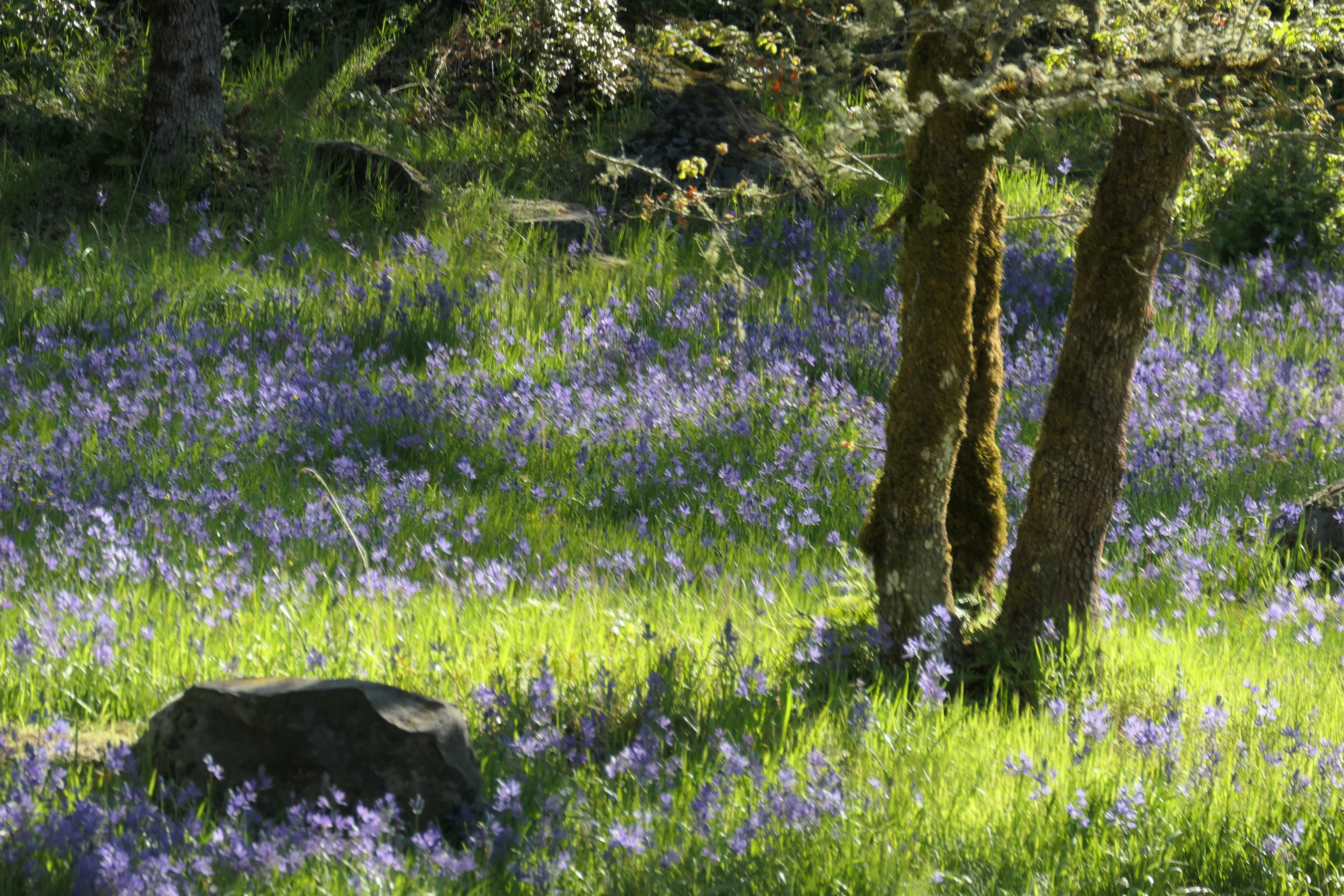
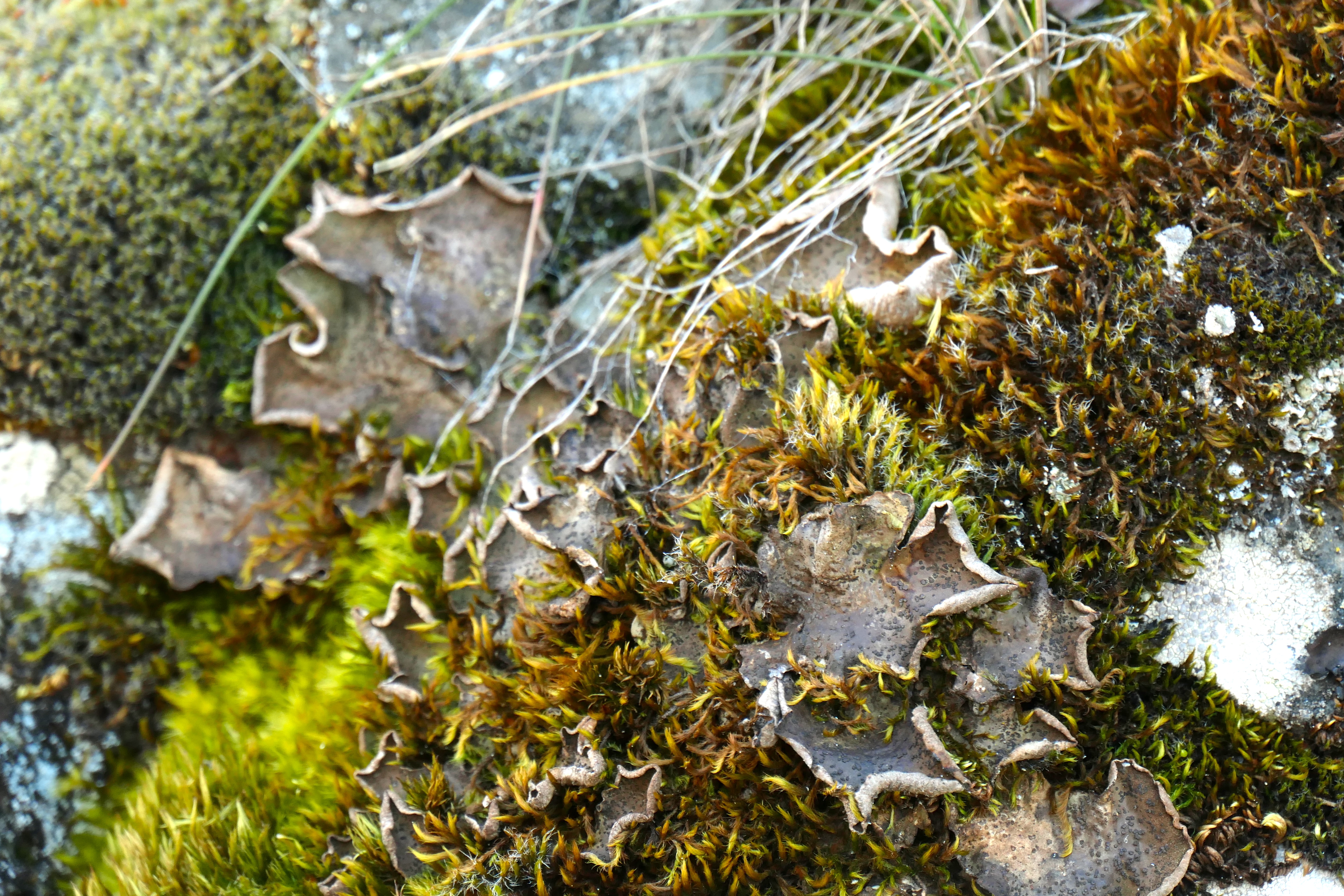
This is the time for wildflower hikes, more to be found every single week. It is also the time where there is enough moisture and warmth in the air that mosses and lichens awake from potential dormancy and fill the world with green, or, for that matter, orange, yellow, white and black, depending on the species.

The distinction between mosses and lichens, at my pay grade, is simple. One is a plant and the other a sandwich. Or so claim the teaching materials trying to instruct grade schoolers about their environment. Mosses are multicellular organisms that are able to use photosynthesis, like any other plant. They can’t transport moisture though, and thus need to stay close to the surface to absorb it.

Lichen, in contrast. are a mix of different organisms, one enveloping the other, thus the metaphor. The assembly consists of fungi fused with algae or cyanobacteria, and, only recently discovered, yeast. The individual ingredients benefit each other – the algae provide food for the fungus via photosynthesis and the fungal layer protects the algae from drying out, or being damaged by the sun. The yeast, as it turns out, produces noxious stuff that keeps animals from eating certain lichen. The resulting intact surfaces of lichen carpets help to keep things where they’re supposed to be, sort of gluing them down.

Most interestingly, lichens are a superb bioindicator – another sentinel warning us of environmental danger and destruction. “Because lichens have no specialized protective barriers, they also readily absorb contaminants and are among the first organisms to die when pollution increases, making them good sentinels for air quality.” They are sensitive to acid rain (the culprit being sulfur dioxide, from coal plants or long range industrial emissions.) They also get hurt by ammonia and nitrates used in agriculture, and they accumulate metals from power plant emissions. When they die off, we know WE are in trouble.


The US Forest Service has had a bio-monitoring program for lichen since the 1990s,

http://gis.nacse.org/lichenair/

in which scientists record census data on the diversity and abundance of lichens in thousands of designated survey plots across the country. They collect some samples and send them off to a lab for elemental analysis to identify the type and amount of pollutants. The data help federal agencies set pollution targets and map out areas where the targets are not being met, and they also help state and federal agencies that review emissions permit applications and existing regulations.”

https://cen.acs.org/articles/95/i46/meet-the-sentinels.html

Who wants to bet that under the current administration pollution targets are changing, regulations are shifted – or for that matter, whole programs like these are terminated? Luckily, lichen are ubiquitous, and one or another of the up to 17.000 species will survive in regions where none of us would. We are the ones that will pay the health and environmental cost in our areas, when pollution is again unchecked.

In any case, I find all this fascinating; if you don’t, perhaps you can at least enjoy the beauty of these lifeforms as they cling to the surfaces around us.

Music today shall be Mahler’s 3rd – probably of his symphonies the closest to nature, in its description of glory and wrath, both. That should make your morning lively!!

Bonus: some daily wildlife!

Widow-makers

The term widow-maker probably means different things to different people. The uninitiated older-than-35-year-old set who has never heard of, much less played the video game Overcraft, is probably oblivious to the fact that the term refers to an assassin also known as Amélie Lacroix. The unconcerned younger-than-35-year-old set will have no idea that it is the informal term for a deadly heart attack that involves 100 percent blockage in the left anterior descending (LAD) artery. And all of us in the overlap of those sets will probably be blissfully unaware that it is a term used in conjunction with dreadful accidents in forestry.

The reason this came to mind was a conversation with a person who happened to come by when I stood in front of the tree below – or what’s left of it – on Monday. A large part of the tree had come down last year, luckily falling when no-one was around. The remaining stump, still taller than a person, seemed solid enough, but all of a sudden in the last few days all of its bark, huge pieces of it, had come down at once, forming a large pile.

I was wondering out loud if someone or something had attacked it, it looked so violent. The guy explained: this is a widow-maker. I learned that diseased or old trees not only have limbs that break off, hang in the crowns and topple down when forestry workers try to fell the trees. They often spontaneously shed their entire bark when shaken by wind or axes, and those can kill the people underneath. The passer-by had indeed a friend who met that fate while working in the Oregon forestry industry.

Walking home, I was thinking of how many of those trees I encounter in my regular wanderings, here in Tryon Creek, Forest park, Oaks Bottom and out in the Gorge. How much depends on luck, not to be at the wrong place at the wrong time. And how overthinking of the possibilities can lead to levels of anxiety that would make it impossible to explore my world. This in turn lead me to remember a psych paper I read (with the advisory that the research area of personality is often subject to non-replication problems.) But here is the argument, a theoretically interesting one, in a nutshell (all research details and data sources can be found in the link below):

People have different attachment styles, some being secure, others less so. This leads to different advantages and disadvantages when it comes to how we function in life in general and face threats and dangers in particular. A third of us are securely attached and faring fine, the other two thirds not so much, being either highly anxious or avoidant. Why would evolution tolerate such a mix? It seems that independently of what it means for an individual to be anxious, or avoidant, or securely integrated, these differences in style might have huge positive implications for the social groups we live in.

For example, people who are close with their family members are less likely to react to noises or alarms indicating impending danger, like a fire. They only react to unambiguous signs, like flames and smokes, when precious time is already running short. Highly anxious people, on the other hand, are like the canary in the coal mine, sentinels who signal early warning.

Avoidant people are also late to realize danger, but then act quite decisively to rescue themselves, and their protective action signals to others the presence of danger as well as potential escape routes. The avoidant person’s survival behavior then might also, if unintentionally, save other people’s lives.

https://www.ncbi.nlm.nih.gov/pmc/articles/PMC4261697/

Now, all of this might be of no relevance if I walk alone in the woods, but it is reassuring to think that we as a social species have evolved to help each other out in social situations with present danger, whether consciously or not. Probably won’t be my last thought, though, when that branch hits……

Music today seems to beckon for Dvorack’s Silent Woods…..

https://www.youtube.com/watch?v=yZYmFWcHdB4

And here is one of the most beautifully written essays on facing just this kind of threat. https://www.nytimes.com/interactive/2019/03/20/magazine/kayaking-trip-alaska.html

Twigs and Stones

About a 5 minute walk from my house is a small neighborhood park, a refuge for kids, dogs and the rest of us. A patch of old-growth forest, it has a path circling the periphery which gives you a good 20 minute stroll and leaves the interior protected, for deer, coyotes, kids’ forts and all. On balmy spring evenings at dusk the high schoolers or L&C students hang out with Today’s Herbal Choice – and the whole place pleasantly smells like those initials. But I digress.

A few years back a tiny wooden fairy house appeared, lovingly constructed and painted, with a house number and doors and windows that could be opened. Then another, and another, I think at its peak there were over 10 of them, parked under or affixed to the trees. Kids would bring little toys to decorate, and dogs would ignore those, if you were lucky. A walk in the wood was no longer boring for the young ones and everyone had a blast to spot new houses. Well, not everyone. There was a serious discussion in the neighborhood association about leaving nature to be nature and not make it a kitschy theme park, and that was that. Everything disappeared overnight.

This spring, a spark of defiance appeared at the bottom of the trees. Small painted stones can be found in locations close to the path, and for those of us walking there daily it has once again become either a bit of joy at the creativity of the young artists and our own sleuthing for new ones, or a source of dismay that there is yet again artificiality introduced into nature.

(Some of you might remember that I have argued along similar lines in an essay on Botanic Gardens, but here we are talking about a sort of playground (albeit a nature one) for families. https://www.orartswatch.org/art-among-the-plants-a-lament/)

The presence and fate of these stones might be under dispute – the way twigs have been affixed in what I am about to introduce next should not be controversial – it is simply ingenious.

Meet eyesasbigasplates – a duo of women photographers who do spectacular work with older people who participate in creating their “costumes” from materials found in their natural surroundings. They introduce themselves and their work here:

We are a Finnish-Norwegian artist duo Riitta Ikonen and Karoline Hjorth. Starting out as a play on characters from Nordic folklore, Eyes as Big as Plates has evolved into a continual search for modern human’s belonging to nature. The series is produced in collaboration with retired farmers, fishermen, zoologists, plumbers, opera singers, housewives, artists, academics and ninety year old parachutists. Since 2011 the artist duo has portrayed seniors in Norway, Finland, France, US, UK, Iceland, the Faroe Islands, Sweden, Japan and Greenland. Each image in the series presents a solitary figure in a landscape, dressed in elements from surroundings that indicate neither time nor place. Here nature acts as both content and context: characters literally inhabit the landscape wearing sculptures they create in collaboration with the artists.

https://eyesasbigasplates.com

I adore everything about the idea (and admire the photographers’ technical skills as well – the images are of outstanding quality.) Collaborating with a group that usually falls by the wayside, making them active participants in their portraiture, using natural materials in such inventive fashion and creating portraits that simultaneously crystallize the person’s characteristic face and hint at something more fleetingly, almost magical – it’s just terrific. Why don’t I have ideas like that???? And why am I not the wisdom-radiating rhubarb lady??? All the portrait images are from this website: https://eyesasbigasplates.com/list-of-works/

A big shout out to T.L. who introduced me to this work.

Best fit for music today (magic in the forest!) happens to be one of my favorite operas of all times: Janacek’s The Cunning Little Vixen. Here is a Prague production from 1970, conducted by Bogumil Gregor.

Purim

Yesterday afternoon was the beginning of spring, and at sundown we saw the beginning of Purim.

This Jewish festival is a celebration of the courage of one woman to do everything in her power to save her community from evil attacks of anti-Semites, with her own life under threat. For once, there was a happy ending – Queen Esther, the woman in question, was able to convince her husband, King Ahasveros, to save the Jews in the Persian empire from attacks by the King’s vizier, Haman. Not so happy an ending for the latter – he and his descendants were hanged.

It is a boisterous holiday, with the story, contained in the Megillah, being read out loud, with people making lots of appropriate noises and appearing in costume (think of it as the Jewish version of movie night for Rocky Horror Picture fans.)

The costume part is actually an interesting possibility of cultural appropriation: some academics argue that the first Purim masquerading appeared around the medieval times when Jews and Christians first lived in proximity together. Mardi Gras or the Venice Carnival were tied to the vernal equinox and all involved costumed celebrations.

Here is a link that details history and customs, including the hotly debated question if we can trust the historicity of the story.

https://www.haaretz.com/jewish/.premium-the-odd-history-of-purim-1.5332554

My favorite Purim food – cookies, what else – is served and also added to gift baskets that are generously shared among friends and family. The cookies’ name is derived from two German words: mohn (poppy seed) and taschen(pockets). Mohntaschen, or “poppy seed pockets,” were a popular German pastry dating from medieval times.

Around the late 1500s, German Jews dubbed them Hamantaschen, or “Haman’s pockets, although earlier versions of the pastry had been known as Haman’s ears – see the etymology of the pun here: http://time.com/4695901/purim-history-hamantaschen/

Beyond feasting, making merry, and remembering a time when the actions of a single model individual saved a whole population, there is the proscription to give to the needy, matanot l’evyonim.

And here is a wonderful example of that in 2019: two orthodox rabbis in NZ are asking their congregations to contribute to the victims of the Christchurch massacre in New Zealand, where 50 people were murdered last Friday.

Rabbi Ariel Tal, head of the Wellington Jewish Community Center, and Rabbi Natti Friedler, head of the Auckland Hebrew Congregation, issued a request to their respective communities, asking them to donate the traditional charity money given on the upcoming Purim holiday to support the families of the victims of the attack in addition to the Jewish poor.

https://www.jpost.com/Middle-East/Give-Purim-charity-to-victims-of-mosque-massacres-583933

Interfaith connection that we can all celebrate, whether we observe Purim or not!

Images today capture spring’s arrival. All photographed yesterday.

Music has an interesting genesis: https://www.classical-scene.com/2019/02/16/miryam-esther/

Contrasts

Today is the birthday of Grover Cleveland, the nation’s 22nd president from 1885 to 1889 and its 24th president from 1893 to 1897, who was born in 1837 in Caldwell, N.J.

Among all US presidents he scored high, if not highest, in integrity, honesty and independence. As a democrat he fought against corruption and protectionist trade policies. He is supposed to have said this:

“I would rather the man who presents something for my consideration subject me to a zephyr of truth and a gentle breeze of responsibility rather than blow me down with a curtain of hot wind.”

https://www.politico.com/story/2019/03/18/this-day-in-politics-march-18-1223872

On my hike yesterday, out and up in the Eastern Gorge there were plenty of mild breezes. The hot air emanated somewhere else in Washington DC. But that was not the only contrast that came to mind.

Here I was, amidst indescribable beauty, strong enough to tackle a considerable climb, some of it in snow, accompanied by one of my most cherished persons on earth, discovering the first wildflowers

Yellow Bells: Fritillaria pudica
Columbia Desert ParsleyLomatium columbianum


Grass WidowsOlsynium douglasii 

and digging into a sumptuous sandwich during a picnic on a sunny if cold meadow.

All this while others are too afraid to eat anything that is not coming out of a vending machine for fear of poisoning, put behind bars, harassed and violated by people out for revenge. I am specifically referring to Ramsey Orta, a friend of Eric Garner, who filmed and later posted a cell phone video of how Garner died in a police chokehold. Orta has been in prison since 2016, and is fearing for his life in retribution of showing police brutality. I cannot independently assess the validity of the claims, but the article has taken hold in my head since I read it last week.

https://www.theverge.com/2019/3/13/18253848/eric-garner-footage-ramsey-orta-police-brutality-killing-safety

On March 3rd, 2015, Orta’s cell block was served a meal of corn, cabbage, bread, juice, and meatloaf. He didn’t touch it. He’d fallen ill a few times after eating the food at Rikers and was convinced he was being targeted and poisoned.“Eat, inmate,” a CO commanded, banging Orta’s cell with a baton. The guards were all standing too close, watching too intently as the others ate. This kind of attention was unusual. He saw others from his cell block staring down into their meatloaf, forks frozen in midair.

Court documents filed six days later alleged that the prisoners had suffered and continued to suffer from “nausea, vomiting, pain, dizziness, aches, headaches, stomach/intestinal pains, dehydration, diarrhea, nosebleeds, throwing up blood, diarrhea with blood, and/or an overwhelming sense of illness.” The symptoms were consistent with human consumption of rat poison, and when the tainted meatloaf was finally tested, the results found that the blue-green pellets visible in the meatloaf were brodifacoum, the active ingredient in rodenticide.

Not the kind of country Grover Cleveland envisioned. And one that seems just fine for those currently at the helm. As I said, contrasts.

Playing Hide and Seek

If you find yourself at 101 Park Ave, Midtown, Manhattan please go into the newly opened American Kennel Club Museum of the Dog (I bet their dogs’ names aren’t Fido either but consist of hyphenated classics…) and send me some pictures. Unfortunately that still deprives me of heading straight for the touch-screen monolith in the museum that matches one’s photo with the dog breed one most resembles. What would I be? Care to comment?

My dog has been playing hide and seek with me for much of the day, curiously with me being assigned the role of seek exclusively…. the subsequent exhaustion allowed me to read but one article I want to share, if only for the photographs contained with in it.

Really, go read for yourself, if only to enjoy the smiles the author’s clever puns bring to your lips. And I quote: It’s stuffed to the brim with oodles of poodles and painted Pomeranians. But are these pooch paintings Pugcassos, or just plain Shih Tzu? Blame it on my fatigue after walking several miles in the rain, hail, sun and everything in between, but I find that funny.

Yes, you cat people, read it too. The critic has something to say about cats as well in the realms of “serious” art. And is nicely snarky about the museum at large. In the meantime I’ll put up some photos of the amazing changing skies today

and the vegetation that hid enough birds to keep a German short-hair pointer happy in perpetuity. And only occasionally back in view.

And here is Frank giving his poodle lecture (alas cut off in the end): https://www.youtube.com/watch?v=2mQSf4QOwxw

and the poodle’s reappearance on Overnite Sensation, one of the first albums I ever bought. :https://www.youtube.com/watch?v=bIrr624DFY0

The Return of Winter

And just like that, it snowed again. Covering the Hellebores, the bamboo, the whole of the backyard. I am very fond of Hellebores, also known as Christmas or Lenten Roses, their origins explained by lots of different folk tales.

A different take on them can be found in Darwin’s writings. No, not that Darwin, but his grandfather (as well as Francis Galton’s), Erasmus. Erasmus Darwin was an English physician, one of the key thinkers of the Midlands Enlightenment, a natural philosopher, physiologist, abolitionist, inventor and poet in the late 1700s. He was beyond fascinated with the newly revealed research and subsequent taxonomy of plants devised by Linnaeus.

Darwin wrote The Loves of the Plants, a long – eternally long – poem, which was a popular rendering of Linnaeus’ works, as well as the Economy of Vegetation, and together the two were published as The Botanic Garden.

Finally a way to talk about sex! Even if in the disguise of the propagation amongst plants. So many poetic possibilities!

Here is the bit about Hellebores:


And here are some of his explanatory notes:

Clearly he anticipated natural selection in ways to be explored and confirmed by his grandson 60 years later. And the colors now vary, from white, to pink, to the deepest of purples. Which is not true for snowdrops, which have stayed in their wintry camouflage forever.

I’m throwing some other garden sights in for good measure. It’s all too beautiful!

Music today two lesser known but distinct recordings of Schubert’s Winterreise. One from the 1950s https://www.youtube.com/watch?v=IMImz94Lb78

And a newer one from some years back:https://www.youtube.com/watch?v=wh1Ky7gj4vw

Up and Down

The weather is echoing the mood – from spring in the air, sun galore, take- the -downjacket-off temperatures to snow on the ground with rain, sleet, and wind in-between.

Let’s focus on spring and good moods. And Kulning. What’s that, you ask? It’s what comes to my mind when I wander on Sauvie Island, happy, looking at the first signs of spring off-set by the snow covered mountains. Stare at the cows, and admire the birds.

Kulning was the traditional singing of Scandinavian women herders. “Less than a century ago, Sweden’s remote forests and mountain pastures swelled with women’s voices each summer. As dusk approached, the haunting calls of kulning echoed through the trees in short, cascading, lyricless phrases. Though often quite melodic, these weren’t simply musical expressions. They were messages intended for a responsive audience: wayfaring cattle.

Kulning was a surefire way to hurry the herds home at the end of the day.

Susanne Rosenberg, Professor of folk singing at the Royal College of Music in Stockholm (KMH), head of Department of Folk Music and member of the Academy of Music is an expert on kulning. She has been a pioneer in both rediscovering the older Swedish style of traditional singing, as well as using it in new artistic environments, involving cooperation with Sweden’s foremost contemporary composers.

Accoding to her research “the vocal technique likely dates back to at least the medieval era. In the spring, farmers sent their livestock to a small fäbod, or remote, temporary settlement in the mountains, so cows and goats could graze freely. Women, young and old, accompanied the herds, living in relative isolation from late May until early October. Far from the village, they tended to the animals, knitted, crafted whisks and brooms, milked the cows, and made cheese—often working sixteen hour days. Life on the fäbod was arduous work, but it was freeing, too.” Women alone, making a lot of noise. My good mood continues.

Not that I dare to scream out like that – the birding community on Sauvie would declare me finally mad rather than a wizard woman of the Northwest….

But even swans have been seen to respond to kulning – unless they approach you hoping for breadcrumbs.

Jonna Jinton, in the link attached above, is currently riding the wave, and making pretty you-tube videos re-introducing the ancient art.

The serious music, combining old and new, can be found below. It’ll preserve the good mood for the entire day, even if I see the first snowflakes mixed with icy rain when looking out of my window.

Photographs are from Sauvie 5 days ago.

Ways to reminisce

When I read the passages posted below I was moved on so many levels. Moved by the pervasive sense of home-sickness. Moved by the way wit is used to defuse nostalgia. Moved by the display of fabulous teaching – who will forget the names of the birds and their sounds after seeing them placed in these snarky contexts?

The author is Liam Heneghan who is a professor of environmental science at DePaul University, where he also co-directs the Center for Nature&Culture. The piece below was published here:

https://www.irishtimes.com/culture/books/memories-of-irish-birdsong-1.3765719?fbclid=IwAR3gRIetTqrp9eqce9xtfg-WQQ8bVm42AJO0Z-e8xExeMdaSNI-XERyge_A

Before I get to it, let me mention that he also wrote a well-received book on the ways ecosystems are described in children’ literature. Here is an excerpt from the TLS review: Those familiar with Tin Woodman in The Wonderful Wizard of Oz, the Ents in The Lord of the Rings or the Once-ler in Dr Seuss’s book The Lorax may well have learnt something about the spiritual and economic value of trees, or at least the deeds of the brave but usually unromantic eco-warriors who protect them. As the zoologist Liam Heneghan argues in his new book Beasts at Bedtime, ecological themes and nature lore have long been deeply embedded in children’s bedtime stories.https://www.the-tls.co.uk/articles/private/let-the-wild-rumpus-start/)

Today’s photographs are not necessarily matched to the birds named in the passages below – they were taken in recent weeks in these parts, true US musicians all.

Memories of Irish Birdsong

By Liam Heneghan

1. My mother once saw the chaffinch (Fringilla coelebs; in Irish: “Rí Rua”) take a shit on Grafton Street and she scolded him. He just kept repeating his distinctive call “pink, pink, pink, trup,” over and over again, but you could kinda tell that he was mortified. Good bird, really; had trouble later with the auld drugs, and got very stout. Died way too young. In the eighties, those birds had a string of great hits.

2. I worked one summer on the Cork Train on the food trolley. A young fella with me in the kitchen car was really into the skylark (Alauda arvensis, in Irish: “Fuiseog”). He could play skylark’s famous guitar riff on his knock-off Les Paul (you know the one, it goes “chirrup… chirrup, trrrp”). Claimed the skylark did not play a real Gibson either. I will never forget that little detail; I lost touch with that kid later on. 

3. Back in the day, I’d hear corncrakes (Crex crex; in Irish: “Traonach”) along the Co Mayo coast all the time. They are a rare breed now, of course; almost extinct. Once when I was pushing my bike up a laneway I saw the corncrake standing with his sister outside a cottage. He must have thought I had looked at his sister funny, as he snarled “kerrx-kerrx” at me and started to fling his droppings. I was told afterwards that the whole family was mad. Brothers all musicians in America.

4. I heard the wren (Troglodytes troglodytes, in Irish: “Dreolín”) play in An Béal Bocht on Charlemont Street Dublin back in 1986. Small fella, drab feathers; mainly sang in hedges. It was almost Christmas time; when he finally sang his big hit “check…, check, churrrrr”, there wasn’t a dry eye in the house. Very Christmassy. Then they passed around a can, collecting for “the lads north of the border.” They were different times, back then, that’s for sure.

5. Every summer in the mid-80s, I’d pitch a tent in a field by the River Flesk in Killarney. Right beside the Gleneagle Hotel. Back then, the woodcock (Scolopax rusticola, in Irish: “Creabhar”) was blowing up. He’d fly in from his perch in the oak woods and appear there on Friday evenings, flying high above the mainstage groaning and whispering ‘pissp.’ “Roding” is what the birders call it. The fans went wild when he swooped down and ate earthworms. You can never really tell what some people will think is cool. 

6. My father and I took a trip up in Gweedore in the early 90s and he tried to strike up a conversation with the Lesser Black-backed Gull (Larus fuscus, in Irish: “Droimneach beag”). Big bloke, wore a heavy sea-worthy jacket. I’d seen that bird play all the seisúns in pubs in the area. My dad let out a very plaintive ‘peep, peep, peep’ and then anxiously flicked his head from side the side. But the gull either didn’t understand him, or perhaps he thought he was a herring gull. My dad muttered something under his breathe, but I did not quite catch it. 

7. When I moved to New York in December 1987, I avoided Irish birds as best I could; they made me homesick I suppose. Once I was on a “2” train going up to the Bronx Zoo and spotted the starling (Sturnus vulgaris, in Irish: “Druid”) fly on at Times Square. She used to busk at the Dandelion market on Stephen’s Green. Sold jewelry on the side, condoms too. It had been snowing heavily so she had ice packed hard on her toes. Starling slipped, swiveled and fell onto an old woman’s lap, called out “chackerchackerchacker” and laughing like it was the funniest thing. Everyone on the subway car just ignored her; she’s just put out her new album. 

8. You will consider me nostalgic, I suppose, but the music those guys were making in the 1970s was rawer, more radical, really. I once heard the fieldfare (Turdus pilaris; in Irish: “Sacán”) in a park in Dublin sing one glorious note, just a single gawddammed note, sustained it for an eternity, as if he really did not give a shit. But you could really feel the emotion in it. I dated his sister back then, but told her I didn’t want to meet her garage band loser of a brother. I regret that now; those guys became huge in America.

And here are some Irish musicians: https://www.youtube.com/watch?v=SBATrLRWySg

Beware, Arachnophobes

This week I’ll explore some topics outside of politics. It will improve my sanity, and, judging by the volume of emails received last week, also that of my readers.

I’ll start with flying spiders. Now that should put your mind at rest…. https://www.theguardian.com/world/2019/jan/11/raining-spiders-brazil

If you look at the link attached above, you’ll see a video of a sky that seems to have spider raindrops or snowflakes, 1000s of them, come down. It is a phenomenon associated with particularly hot air. (Climate change? Nope, not going there today.) Before you cringe in disgust, listen to the really amazing facts associated with these spiders.

First of all, they are tremendously good for the environment, because they devour insects and pests. (Which reminds me, so are ducks. They are increasingly used to replaced toxic pesticides in rice farming – check it out here: https://www.bbc.com/news/av/world-europe-43588774/dumping-pesticides-using-ducks-instead) 

Secondly, they are amazingly social – out of 40.000 species of spiders there are only 23 that form communities, and parawixia bistriata is one of them. They basically curl up in a tight ball in the trees during the day

and then come out at dusk to weave giant, connected, invisible nets where they hang out waiting for dinner. A colony can have up to 50.000 individuals with females outnumbering males at a high ratio. If there is enough wind, the nets break loose and get carried, spiders and all, across the sky which makes for the illusion of raining spiders.

And before you comfort yourself with the thought that all of this happens between Panama and Argentina, I have news: ballooning spiders have arrived in Texas. (Maybe they could stand in for the wall, building an elongated web along the border? I forgot, no politics. My bad.)

The good news: they are not poisonous, and they are exceedingly small (otherwise they’d be too heavy to float in the air) so that their bite, if it ever happens, is no more harmful than a mosquito’s.

The fascinating news: individual spiders do not only travel with the wind, but use flight by electrostatic compulsion, reaching heights of over a mile and many more in distance.

Every day, around 40,000 thunderstorms crackle around the world, collectively turning Earth’s atmosphere into a giant electrical circuit. The upper reaches of the atmosphere have a positive charge, and the planet’s surface has a negative one. Even on sunny days with cloudless skies, the air carries a voltage of around 100 volts for every meter above the ground. In foggy or stormy conditions, that gradient might increase to tens of thousands of volts per meter. Ballooning spiders operate within this planetary electric field. When their silk leaves their bodies, it typically picks up a negative charge. This repels the similar negative charges on the surfaces on which the spiders sit, creating enough force to lift them into the air. And spiders can increase those forces by climbing onto twigs, leaves, or blades of grass. Plants, being earthed, have the same negative charge as the ground that they grow upon, but they protrude into the positively charged air. This creates substantial electric fields between the air around them and the tips of their leaves and branches—and the spiders ballooning from those tips.

The whole argument can be found here:

https://www.theatlantic.com/science/archive/2018/07/the-electric-flight-of-spiders/564437/

Nature will never cease to amaze me. And here is a little something to commemorate the spiders’ victims:

Photographs are of spiderwebs found in the Northwest woods.