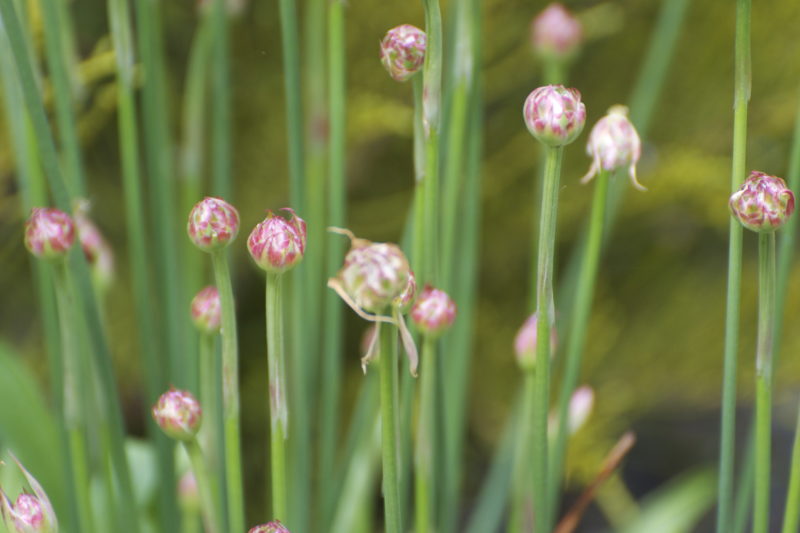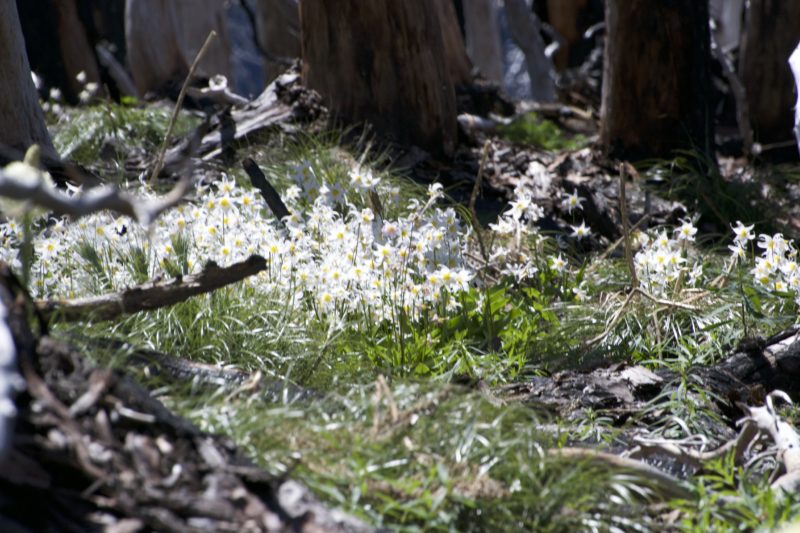

Cooper Spur and Vista Ridge both offer a profusion of wildflowers at this time of the year. The latter area experienced a serious forest fire (more on that tomorrow) 6 years ago. As a consequence there is less shade and more sun on the trail which has led to an explosion of wildflowers in areas already blessed with them during normal times.

The forest is carpeted with avalanche lilies at this time of year; once you arrive at the meadow, Eden Park, which is one of the destinations of this hike, there is a field of flowers of every color of the rainbow traversed by a meandering stream. Breath taking. Whoever named that place had it right. Eden does come to mind.
Here are a few that I particularly liked. (Descriptions can be found here https://www.wta.org/news/magazine/magazine/WT-06-08-WILDFLOWERS.pdf which also taught me that there are more than 57 species of wildflowers in the Cascades and Olympics.} I give the names where I think I know them – happily stand corrected.
Bear Grass


Indian Paintbrush and Alpine Cinquefoil


Sitka Valerian

Jeffrey Shootingstar

Lewis’ Monkeyflower
The Cooper Spur trail has the advantage of leading through trees in the beginning which give shelter to seas of lupines.

Above the tree line you get plants hugging more closely to the ground to avoid the constant wind. It sometimes looks like some giant infatuated with polka dots painted scores of colorful circles onto the volcanic ash and pumice stones.

Wild Asters
Explorer’s Gentian


Spreading Phlox
And the last photo is dedicated to Charlie, the Mole Magician. Friend and neighbor, he manages to keep his yard mole-free while mine, which merges seamlessly into his, looks more like this. What’s the secret, Charlie?










 “Marston was a man of a thousand lives and a thousand lies. “Olive Richard” was the pen name of Olive Byrne, and she hadn’t gone to visit Marston—she lived with him. She was also the niece of Margaret Sanger, one of the most important feminists of the 20th century. In 1916, Sanger and her sister, Ethel Byrne, Olive Byrne’s mother, had opened the first birth-control clinic in the United States. They were both arrested for the illegal distribution of contraception. In jail in 1917, Ethel Byrne went on a hunger strike and nearly died.
 Byrne stayed home and raised the children. They told census-takers and anyone else who asked that Byrne was Marston’s widowed sister-in-law. “Tolerant people are the happiest,” Marston wrote in a magazine essay in 1939, so “why not get rid of costly prejudices that hold you back?” He listed the “Six Most Common Types of Prejudice.” Eliminating prejudice number six—“Prejudice against unconventional people and non-conformists”—meant the most to him. Byrne’s sons didn’t find out that Marston was their father until 1963—when Holloway finally admitted it—and only after she extracted a promise that no one would raise the subject ever again.“








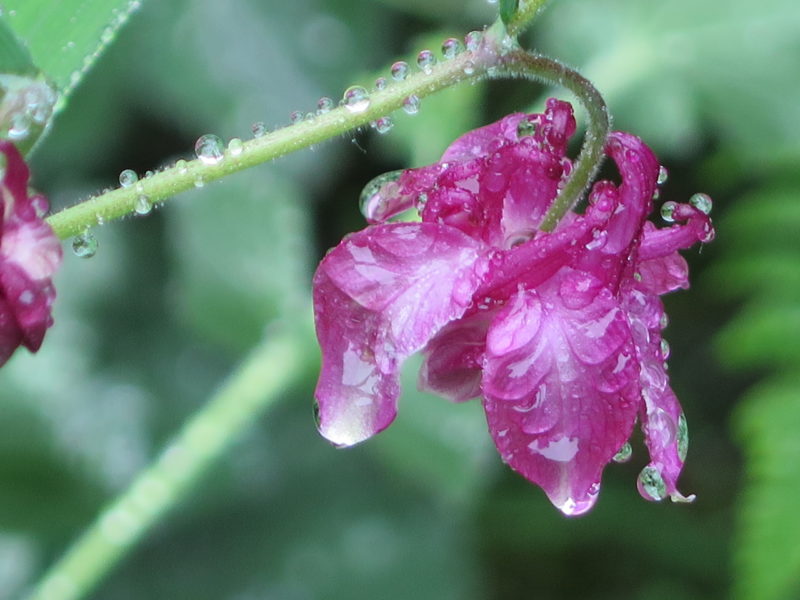





 http://www.mnn.com/your-home/organic-farming-gardening/stories/the-science-of-blue-flowers