Browsing Category

Nature

Salvia and Szymborska to the Rescue.

One of those weeks. Between the heat and a body with its own intentions I had to cancel all planned outings, miffed and distraught. As luck would have it, a friend sent out a poem that shut me up and set me right. It converts disappointment into the insight that all moments matter. They all contain their very own history, asking us to value what is, not what has been or might come along. We are embedded in a timeline, each moment of its own importance.

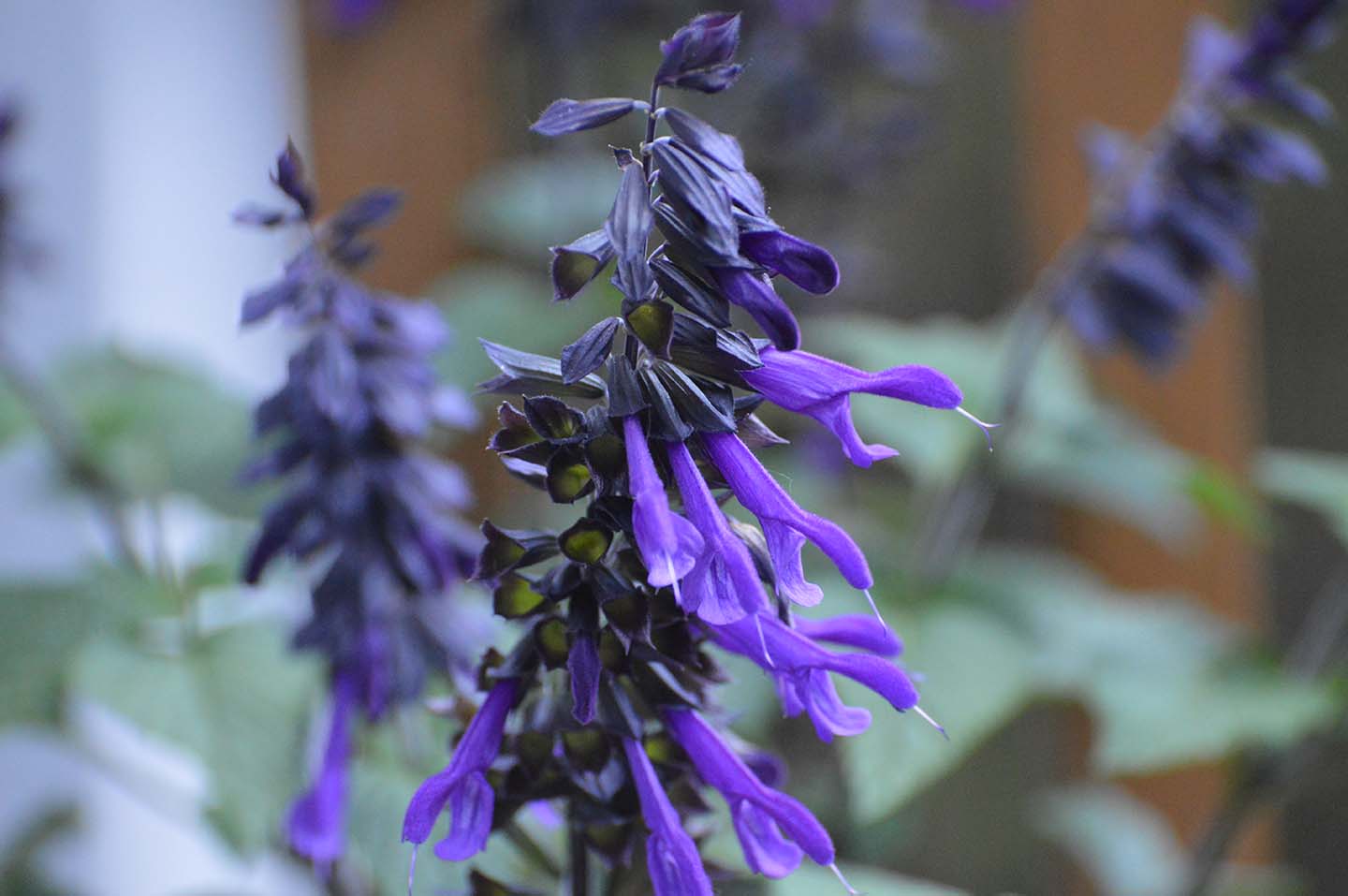
“So it happens that I am and look.” Which is what I did. At a single plant on my balcony, a blue salvia visited by the occasional humming bird, the bees preferring its neighboring lavender and the yellow zinnias (this year’s color scheme in solidarity with Ukraine. Much good it will do, other than reminding me to be a witness. But I digress.)

No Title Required

 It has come to this: I’m sitting under a tree
beside a river
on a sunny morning.
It’s an insignificant event
and won’t go down in history.
It’s not battles and pacts,
where motives are scrutinized,
or noteworthy tyrannicides.
 
And yet I’m sitting by this river, that’s a fact.
And since I’m here
I must have come from somewhere,
and before that
I must have turned up in many other places,
exactly like the conquerors of nations
before setting sail.


Even a passing moment has its fertile past,
its Friday before Saturday,
its May before June.
Its horizons are no less real
than those that a marshal’s field glasses might scan.
 
This tree is a poplar that’s been rooted here for years.
The river is the Raba; it didn’t spring up yesterday.
The path leading through the bushes
wasn’t beaten last week.
The wind had to blow the clouds here
before it could blow them away.
 
And though nothing much is going on nearby,
the world is no poorer in details for that.
It’s just as grounded, just as definite
as when migrating races held it captive.


Conspiracies aren’t the only things shrouded in silence.
Retinues of reasons don’t trail coronations alone.
Anniversaries of revolutions may roll around,
but so do oval pebbles encircling the bay.
 
The tapestry of circumstance is intricate and dense.
Ants stitching in the grass.
The grass sewn into the ground.
The pattern of a wave being needled by a twig.
 
So it happens that I am and look.
Above me a white butterfly is fluttering through the air
on wings that are its alone,
and a shadow skims through my hands
that is none other than itself, no one else’s but its own.
 
When I see such things, I’m no longer sure
that what’s important
is more important than what’s not.

By Wislawa Szymborska
 
From Poems New and Collected 1957-1997

Here is music about a summer garden.

June Excursion.

If you like vistas, wildflowers and wondrous limestone ponds, come walk with me around a lake or two at the southern side of Mt. Hood.

If, on the other hand, you prefer your landscapes more accessibly packaged into paintings, go see the current show at Maryhill Museum on the northern side of the Columbia river. One of the artists, Erik Sandgren, is giving a talk about The Columbia River: Wallula to the Sea featuring works by Thomas Jefferson Kitts and Erik Sandgren this Saturday, June 15, 2024 from 2 – 4 pm. I will report on the work likely next week.

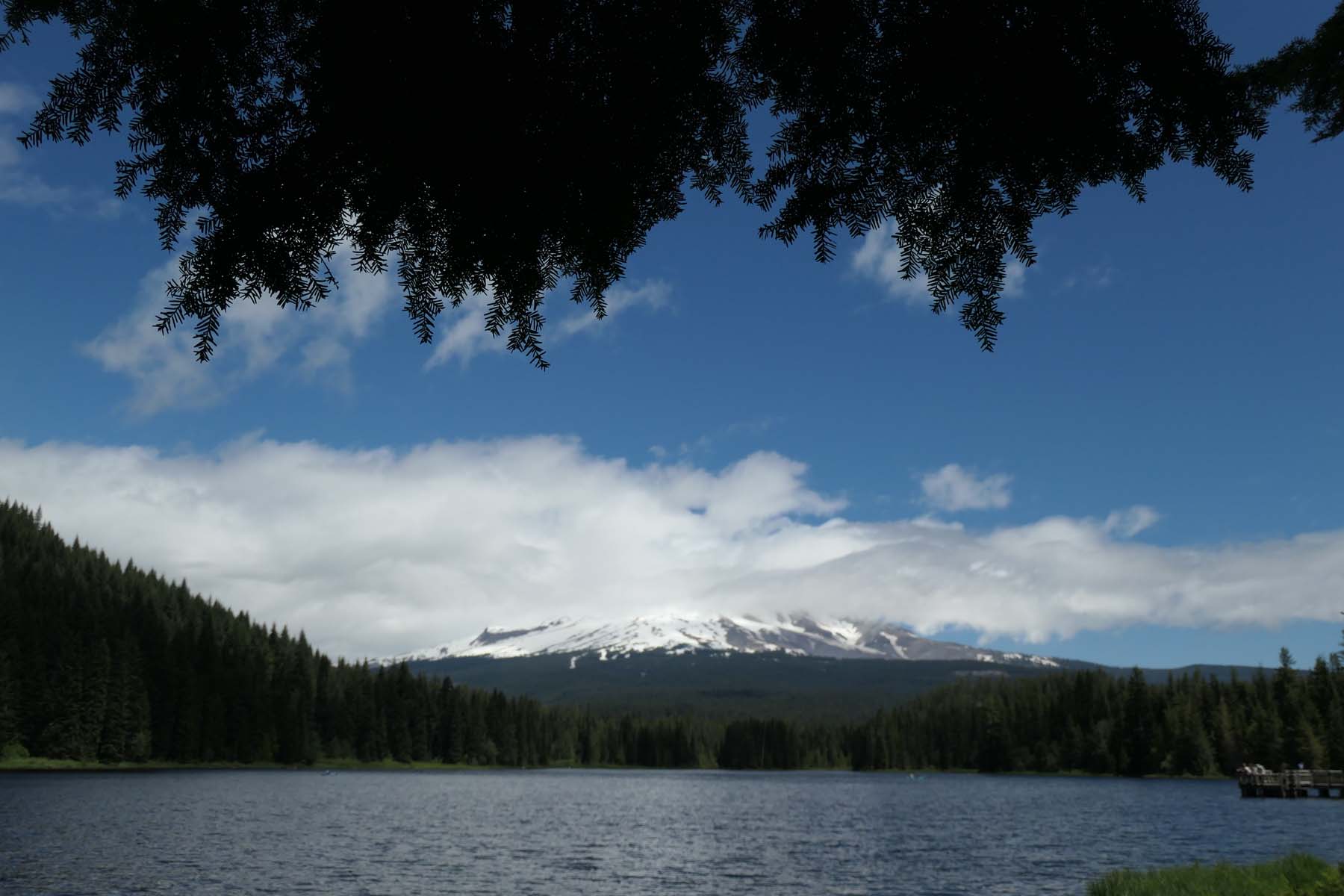
I had the fortune to explore Trillium Lake on a day with perfect weather, wispy clouds in a blue sky, snow-capped mountain brilliantly lit, green exploding all around me. Created in 1960 by the US Department of Fish and Wildlife by damming Mud Creek, a tributary to the Salmon River, the lake has become a favorite of day visitors, engaged in canoeing, kayaking, paddle boarding and angling. There is also a campground for longer stays.

The place is jumping, conveniently located less than a 2 hour drive from Portland, offering an easy, flat trail around its circumference with recently repaired boardwalk and bridges, and plenty of trout. The views were pretty, if crowded.

The wildflowers were abundant, many only now coming into bud.

Knotflower

Salmonberry, false Solomon seal, wind anemone, horn violets, monkey flower, skunk cabbage, shooting star primula, bear grass about to bloom and same for rhododendron.

Trillium on their last leg, wild strawberries and elderberry in full swing.

Bald eagles and other raptors circled overhead, dragon flies and butterflies rested here and there.

Marshes rimmed the lake and old growth forest contained quite a few campsites.

It was uplifting, but paled in comparison to the second stop of our June excursion, Little Crater Lake. It is a 45′ ft deep pond formed by dissolving limestone, fed by spring at the bottom and Little Crater Creek.

The water is crystal clear, with colors changing depending on where you look – overall it has a turquoise appearance where it is deep, at the rims there are orange shades where the water is less deep, covering the stone. Due to the properties of the aquifers it is 34 degrees cold year round (swimming – wisely – prohibited.)

You reach the lake by wandering through a pristine, mysterious meadow, clouds of yellow pine tree pollen wafting through the air. The path goes around the tiny lake – more of a pond – and eventually connects with the Pacific Crest National Scenic Trail.

I did not make it that far – too busy photographing the wondrous jewel from all angles, with light tinging both marsh, water edges and water with flecks of gold, setting off the bluish green with contrast. Submerged logs seemed in a state of suspension, the only movement coming from small ripples set in motion by the wind.

A silent spot, you could hear the pines, cedars and hemlocks sighing in the breeze, if you listened closely, occasionally interrupted by a screeching jay.

The meadows were damp, closer to marshes, rimmed with lupines in full bloom, stippled with camas and the occasional mountain bluebell, all softly merging with the greenest of green of fresh cordgrass.

It is late spring at the foot of the mountain. I hope for many returns during the months leading in and out of summer. These outings restore the soul. They also restore the body, if you don’t overdo it, because of the kind of stress relief that they provide: activating the parasympathetic nervous system, the one that handles physiological processes like digestion and breathing.

Lupines and Buttercups

I believe this is what many people overlook – we are so geared towards thinking that only meditation or some other mindfulness practice can relax us to the point where it restores balance to our overly busy systems, that it doesn’t dawn on us there are other ways to disconnect – doing something while doing not much of anything required.

Veratrum

In fact there are many, many people for whom a total disconnect as achieved in meditation, or sitting still and doing absolutely nothing, produces an enormous amount of anxiety or guilt: we are so trained to be productive or responsible for being on all the time to care for others’ needs, that disengagement has the paradoxical effect of making us panic. And then we feel the added shame that we are not accomplishing our meditation goals!

Engaging in focused activity that you enjoy, like cooking, gardening, reading to your kids, or ambling along a nature path, is indeed more healing for some people, particularly those with generalized anxiety, than completely disconnecting. (Ref.)

Walking in the woods around a lake, starting to listen to the wind or the waves instead of the inner voices of “you should!” or “have you?” is an acceptable alternative to meditation, partly because we consider connection to nature a positive, justifiable endeavor. Listening to the former sounds makes it easy not to listen to the latter inner voices, with no guilt attached.

Mountain Bluebell

Mindfulness, in other words, does not need to be disconnected from any old activity. You just need to find one that allows you to focus and that is sufficiently attention holding, that the old worries can be kept at bay. I recommend sitting under a tree at Little Carter Lake with a journal or a camera….

Music today honors the trouts – again….with a particularly poignant farewell recording.

Juxtapositions

Walk with me. Be warned, though, you need to bring your ear plugs. I, of course, had no clue that they would be needed. The one day last week that I was able to hike was also the day that the Oregon International Airshow opened. Officially it started in the evening, but planes were already practicing during the day, low in the skies over Hillsboro where I happened to make my way through the wetlands.

The noise was deafening, and since I didn’t know then that the air show was slated, my thoughts went immediately to images of training for war, or some kind of emergency. Catastrophic thinking seems to be on a hair trigger these days. I wonder why.

I have written fairly recently about the soundscape of war and its long lasting psychological implications, for people living through war and suffering from PTSD. (Link for new readers, below). So, today I’ll just be looking at the positive side of things and share with you the sights. It will distract me from the fact that only 20% or so of all Oregonians voted, and the candidates I favored were, with few exceptions, not elected. Apathy sure enables the march towards less progressive times.

Here is a link to a video from the airshow that provides a bit of the noise that visitors experience. I was immediately underneath the planes at the time during practice, as you can see from the photographs.

The rest of nature’s sounds were drowned out, particularly the soft twittering from the songbirds and swallows who I had come to photograph.

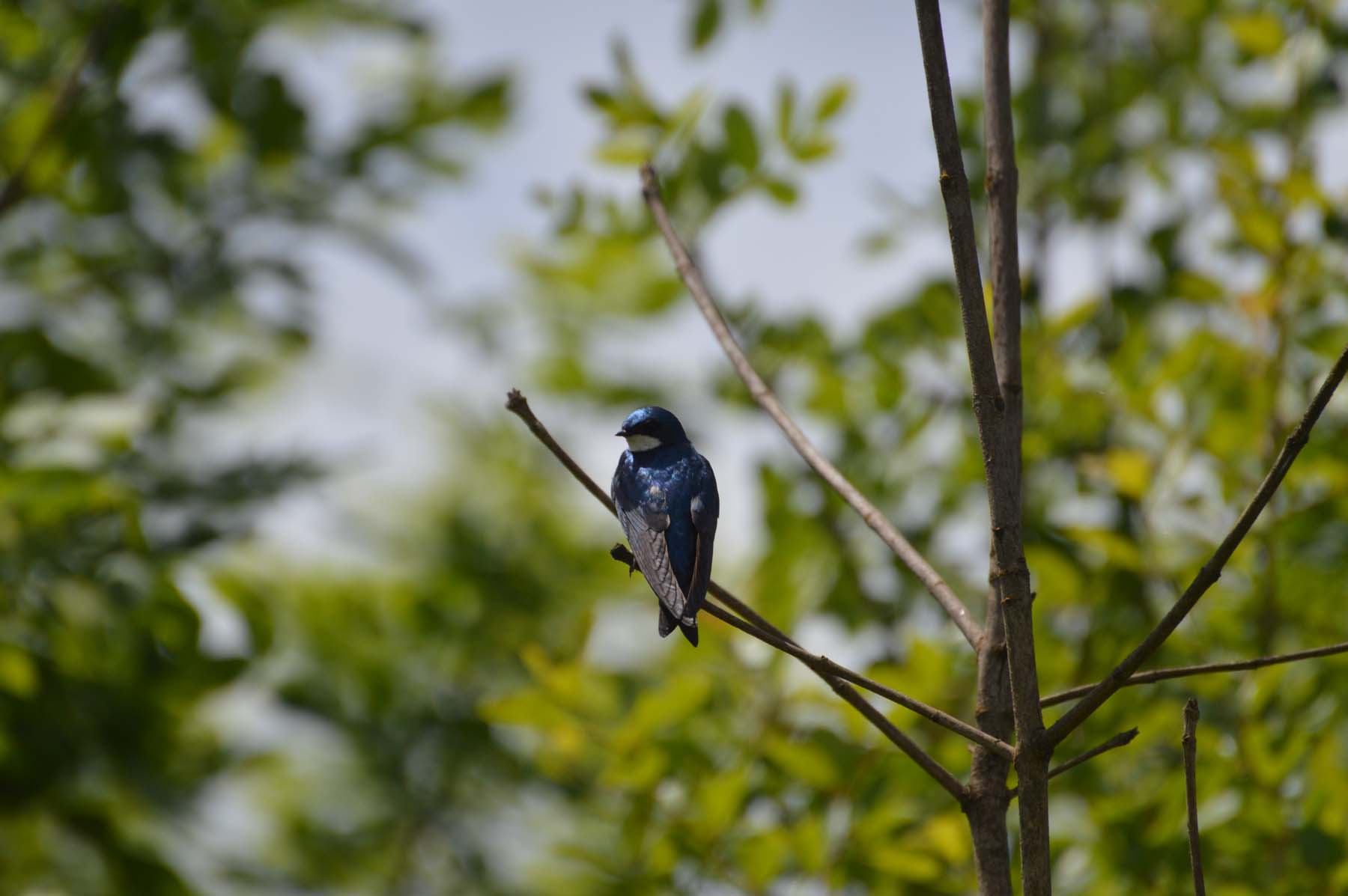
It was so beautiful to watch them loop around before they went into the nesting sites, or met with their mates on top of them, that I soon forgot the distraction and focused on shimmering cerulean blues and teals and whites instead.

Flora was ready to compete, pink swaths of mallows coloring the meadow, pink valerian (sea foam) dotting the grass, and pink bleeding hearts hiding in the underbrush. Coral bells just about to blush.

Mystery Pink

Bright yellow popped up here and there, with common toadflax, buttercups and thapsias.

There were blue lupines, purplish blue wild irises, and camassia.

Whites everywhere, a perfect match to the white clouds above, the white of the arrowheads, the blackberry blossoms, the cowslip, the dog roses in large clusters, you name it.

Piercy’s poem captures it to perfection, even though we are still in May, not June and the lilies still hesitant. The mood was matched – as long as you kept your hands over your ears, plugging them with your fingers.

More Than Enough

The first lily of June opens its red mouth. 

All over the sand road where we walk 

multiflora rose climbs trees cascading 

white or pink blossoms, simple, intense 

the scene drifting like colored mist. 

The arrowhead is spreading its creamy 

clumps of flower and the blackberries 

are blooming in the thickets. Season of 

joy for the bee. The green will never 

again be so green, so purely and lushly 

new, grass lifting its wheaty seedheads 

into the wind. Rich fresh wine 

of June, we stagger into you smeared 

with pollen, overcome as the turtle 

laying her eggs in roadside sand.

BY MARGE PIERCY

Let’s have some cheerful music from a lovely debut album that brings warmer temperatures back into memory.

Tales from the Backyard

Yesterday I had a few visitors in the backyard, which suited me just fine. I figured ending the week with tons of pictures rather than ever more words would do us all good.

You know me, though. Words snuck back into my head – words, alas, that refuse to make their way into print in this family friendly blog. So use your imagination as to what I was thinking when I learned that the North Carolina Senate voted along party lines Wednesday to ban anyone from wearing masks in public, even for health reasons. House Bill 237 would extend to everyone, not just protesters towards whom this ban is of course directed, to wear medical masks.

A proposal to amend the bill to ban hate groups — explicitly the Ku Klux Klan and Proud Boys — from being allowed to wear masks in public, which the law currently allows them to petition for (!), was shot down by Republican lawmakers with no debate or explanation, as were calls by Democratic lawmakers to amend the anti-mask bill to protect people who want to wear masks for health concerns. So for immune-compromised people like me there is now the additional worry to either be arrested for wearing a mask or risking infection that can basically kill you. Not that I will ever see North Carolina again, but how many people who live there and can’t leave will be affected? and how does that not violate Federal laws, like the Americans with Disabilities Act?

“The federal disability law requires governments to provide people with disabilities equal access to government programs, services and activities — including public transportation, schools, voting precincts and town meetings. Banning masks could diminish access to those kinds of services to people who are covered under the ADA, such as cancer patients who may need to wear a mask due to a weakened immune system, disability rights advocates say. It could also limit their day-to-day activities.” (Ref.)

I wasn’t the only one watching the deer decimate the apple trees and then leisurely chew cud while resting on the grass, ignoring a cacophony of noises – my dog barking his head off, the Thursday Pickup garbage trucks circling the neighborhood, and my neighbor using a chainsaw to deal with the winter windfall. Be glad to have these pastoral scenes without the sound track!

The crows watched as well, eventually doing some up and down flying maneuvers to get their own luncheon, served on my balcony. Up and down triggered the notion of upside-down, another image eliciting a number of words in my head, “We’re living in a FARCE,” among them.

The upside down flag, a symbol for “Stop the Steal!” used by Trump supporters, was apparently flying in front of Justice Alito’s home. According to the New York Times, the flag was up in January 2021 for multiple days, while the court was still contending with whether to hear a 2020 election case. We are, of course, still waiting on two other cases to be decided by the Supreme Court, involving the storming of the Capitol on Jan. 6, including whether Mr. Trump has immunity for his actions. So far, no recusals.

Concerned neighbors took the photos and informed the Court at the time – what say you, Justice Roberts? We do know what Justice Alito had to say:

“I had no involvement whatsoever in the flying of the flag,” Justice Alito said in an emailed statement to The Times. “It was briefly placed by Mrs. Alito in response to a neighbor’s use of objectionable and personally insulting language on yard signs.”

Isn’t it funny how Supreme Court Justices are completely fenced off against the dealings of their wives, while the sitting President is supposed to be responsible for alleged misdeeds of his adult son? Just wondering.

Here is a crow’s reaction – you may use your imagination once more.

If your blood pressure reacts like mine to these news, here is the perfect music to bring it down.

Spring, the umpteenth look.

Nostos
There was an apple tree in the yard —
this would have been
forty years ago — behind,
only meadows. Drifts
off crocus in the damp grass.
I stood at that window:
late April. Spring
flowers in the neighbor’s yard.
How many times, really, did the tree
flower on my birthday,
the exact day, not
before, not after? Substitution
of the immutable
for the shifting, the evolving.
Substitution of the image
for relentless earth. What
do I know of this place,
the role of the tree for decades
taken by a bonsai, voices
rising from tennis courts —
Fields. Smell of the tall grass, new cut.
As one expects of a lyric poet.
We look at the world once, in childhood.
The rest is memory.

by Louise Glück

Gustave Caillebotte Apple Tree in Bloom (1885)

I do not agree with Glück’s assessment, “We look at the world once, in childhood. The rest is memory.” We look at the world – able to see it – a million times, if we only move about with intention. Or share in the wonder expressed by next generations. Or allow art to be more than representation, pointing us to the beauty inherent in the real world. Maybe we can’t return to the exact childhood tree, but there are plenty apples around.

In some funny way, the title of the poem, Nostos, makes that very point, doesn’t it? The term comes from ancient Greece and refers to the homecoming of the hero after a prolonged absence (one of the main themes of the Odyssey.) Not remembered, but re-experienced, connected again, the world seen, not just recalled. If it was only about a particular childhood garden, it should have been Nostalgia, the combination of Nostos /homecoming with the word Algos/pain, although nostalgia most often descends into this sentimental wistfulness that I can’t stand.

Back to spring: In today’s images, spring has returned, after a long absence. So has this viewer, in my annual exploration of spring’s bounty, seeing it afresh. And so have paintings, that are not molding in museums, but here, in front of our eyes, conveying a shared appreciation of this season. Forget memory! Here are this week’s perceptions, on walks punctuated by heavy rains and sudden reappearance of the sun.

Max Beckmann SPRING NEAR SÜDENDE (1907)

Hawthorne blossoms shimmered through the trees, or exploded in full view.

Dwight William Tryon Spring (1893)

David Hockney Hawthorne Blossom Near Rudston (2008)

Cows were curious as to what I had to offer…

Doris Lee, Blossom Time, 1959

Plants unfurled, echoing van Gogh’s brush strokes.

Vincent van Gogh, Green Wheat Fields, Auvers, 1890

Meadows exploded with Camassia, and other early spring blooms, many reminiscent of rockets, all shooting towards the light.

Janene Walkky Common Camas or Camassia quamash (2013)

Ruth Asawa, Spring, 1965, lithograph

Then there are the fruit tree blossoms, holding up their own against the orange bloom,

Vincent van Gogh Orange Blossoms (1890)

Claude Monet Spring (Fruit Trees in Bloom) (1873) 

Walking through the woods was a green, dripping, wet experience, then sunbursts the next minute.

Abbott Handerson Thayer Landscape at Fontainebleau Forest (1876)

Did someone say birds? Ducklings! Orioles, yellow rump warblers (butter butts!), kill deer, wood ducks, geese, barn swallows and purple martins all showing off.

Magnus von Wright Mallard Ducklings (1841)

Tracey Emin Believe in Extraordinary (2015)

AUDUBON bird Red-Breasted Nuthatch Purple Martin (1890)

Even the turtles came out.

The only thing I could not find were these:

Franz von Stuck The sounds of spring (1910)

Maybe they went that way.

Music captures it all.


Bear Divide

A friend sent a poem this week that had me thinking ever since. I was riveted by the way it palpably conveys loss, the way it captures how pain can suddenly emerge in the most mundane situations, and the way it contains phrases that are incredibly well forged, “a noticeably notice-me-I’m-nature nature sound.”

There Are Plenty of Angels,
She Said in the LADIES

in the rest area LADIES on the road to 
Terre Haute. Plenty of angels, she said again.
But not one, I’ve heard, not a single one
will mission to the fade as it does to the darkness.
A stall door latched. Her bag got hung.
Seen that sign, back west a ways?
The one on the warehouse, in a movie marquee?
Blessed Hope, it says. Blessed Hope, she said.
It’s meant to be a sign from heaven,
but hope’s, I’d say, more a human invention,
like freeways, she said. Funny word, she said.
They call ’em highways when you pay to ride ’em.
Mama’s buried off one in Missouri. Had her
forty years and forty days on earth.
And the day we did it was a noisy day,
all out-o’-doors like a day at the beach:
the tearin’ down sounds of the sun and the wind,
clouds and trees, grass and stones,
a noticeably notice-me-I’m-nature
nature sound. Mother never did care much
for nature. Enjoyed a sunset well enough
Those shameless ones like colored candy,
those ones can look like wall-to-wall
in a Cineplex foyer: pinks and purples, reds, she said.
It was so noisy, anyway, that day
even the birds shut up for once.
Or got their singin’ drownded out.
But I could hear when the box hit bottom:
Get on with it, is what it sounded like to me—
She had dried her hands on a paper towel—
I’m done here.

by Kathy Fagan
 
From The Paris Review, Issue no. 129 (Winter 1993)

I experienced a noticeably notice-me-I’m-nature nature view a few weeks ago, and was thinking that my own mother and paternal grandfather loved nature, as do my children and now the next generation who partook in the views of that day. Somehow that shared affinity softens loss, since you can always recall the joyful moments when you were inseparably linked in awe.

That morning we drove from Altadena, CA north into the San Gabriel mountains. Clouds of lifting mist weaved in and out of the valleys, giving the scenery a mysterious, fairy-tale look.

Ceanothus covered the hills in differing shades of blue, occasionally punctuated by yellow tree poppies that looked like sun confetti.

Our goal was the Bear Divide, a location on the Pacific Flyway, the north-south migratory route that connects Alaska to Patagonia for innumerable migratory birds. The San Gabriels provide both rest and food for the flocks, who tend to seek the specific passage way at the location that we drove to.

The corridor which allows passage at relatively high altitudes, was discovered by chance in the spring of 2016. Brought to the attention of the folks at the Moore Lab at Occidental College, a systematic monitoring of the migratory flocks started soon after. (Everything I learned, including the statistics, I found here.) In 2023 they counted 53,511 birds of 140 species from February to May, (the return trip for the birds seems to happen somewhere else) with some mornings as many as 20.000 birds recorded. The sheer variety is stunning.

The lab uses the help of citizen scientists, local birdwatchers and volunteers, to help with the observations. As it turned out, we chanced on a group of volunteers with the USFS who were netting and banding birds the very morning we arrived.

The nets are erected in the mornings and inspected every thirty minutes. They catch birds without harming them, who are then banded with a very light metal ring around a leg that provides numbers for scientists all over the world to report on flight routes, durations, survival.

The data reveal helpful information about birds’ responses to changes in environmental conditions and ecological shifts across the world. If that made me feel good, something else lifted my soul even more: seeing son and toddler rejoice beyond the sheer fascination with the procedures, sensing their appreciation of the world around us (if only lifting every single pebble or bug on the path as behooves a 14 month-old) reminded me of my own happiness during nature walks with my mother or my Opa. Little is lost. Much lives on.

Orange crowned warbler

Highway restrooms: I no longer fear you! When hope is met, who cares if it’s a human invention!

Music today from the Bowerbird Collective. The video alone is worth it.

Of Deer and Depletion

Walk with me, on a rain drenched Sunday in the Pacific Northwest. First we trudge through my garden – have the galoshes ready.

These are columbines, some of the early bloomers in spring, dainty as they come, and, as it turns out, a delicacy for wandering visitors. As are the apple trees.

These are deer. They have made daily appearances in the yard for the last week, and as of Sunday afternoon, when I am writing this, there are no more columbines. Blossoms completely depleted. Disappeared. Digested. Man.

I have a choice: mourn the destruction of my flora or celebrate the fact that I look out of the window to see four frolicking creatures, feeling at home, at a location that is a 15-minute ride from Portland city center.

You can see the remnants of the destruction of the winter storm – still a lot of windfall around.

True to form I do both, and then I go visit a friend’s wondrous garden that is carefully deer-proofed and full of spring’s signifiers: growth that is tender, soft colored, dripping with wetness and sending out tendrils and shoots to claim the next cycle of life.

It feels like walking through a watercolor painting when you look at the bloom.

The tree peonies proud like queens,

Just the maple leaves show sharp, contrasting rims, but they, too, are softened by their unfocused surround, enveloping them with diffused light.

They come in so many different colors

Such beauty – let it help start the week on the right note, grateful for what is, not what’s been lost. Now tell me what I should plant that the deer won’t eat….

Here is a romantic period Ode to Spring by composer Joachim Raff.

No ode to the deer, but grudging admiration.

WHAT A DAY

My morning visitors, just beyond the kitchen door, were two parrots. I was lured outside because I heard their incredibly loud squawking and wondered what was going on. There they sat, happily chatting or gossiping.

At some point they got fluttery, hopping from position to position on the telephone pole.

Suddenly a pair of acorn woodpeckers made themselves known – I had completely overlooked them on top of the pole, because I was so taken with the parrots.

Aaaaaaaaaaand: attack. Victorious. Parrots fled.

In case that was not enough excitement, my lunchtime visitor was coming by to check out if I had maybe dropped some food, while eating and reading my email at the same time. No luck. She disappeared disapprovingly, picking up the last few peanuts I had offered the ravens (who will soon be featured in another post.)

But that’s not all: around 5 pm this bobcat appeared, and I just happened to have the camera in hand sitting on the patio, to catch her. She left promptly, soundlessly.

Tell me, how can this year get any more magical? We’ll see. I will be returning to this ranch in November.

I am back in Portland, doing lots of catch-up errands after a month away, and sorting through a number of interesting California adventures that still need to be written up. Hope to get back to regular rhythm soon.

Here is music from the land of the parrots, Brazil.

(Re)Birth

There have been rich moments during my stay at the Californian Zorthian Ranch, in the course of daily wanderings, or, for that matter, having my coffee on the patio.

Pigs come by and want to be scratched, or, alternatively, bite your ankles (luckily I was warned and the single culprit is easily identifiable.)

Scout the cat visits regularly, and a small dog named Chicken pretends to be fearless.

I have mentioned the owls before, and have come to realize that the entire soundscape is a reenactment of my childhood, on another continent, in an equally rural surround: Goats, cows, roosters and chickens, peacocks, the occasional horse, crows and multiple songbirds – old traces of “home” reappear from some deep place in memory. Except my village did not have Los Angeles or the likes, one of the largest cities ever, attached, but was a truly isolated. I listen to warblers, finches, mourning doves, and am stunned by the arc that my life has taken, from the sugar beet fields of Western post-war Germany, to the San Gabriel mountains in Southern California, with multiple land mark locations in between. So many new beginnings, so many adventures.

How best avoid being eaten: mayflies hiding on lizard’s head….

Next to the rich moments there are magical moments. If you stand still enough for long enough, you can actually watch a pair of tiny wrens build a nest inside some of the discarded machinery. Every time they deliver a twig they serenade, “Look, world, I did it! One more stick to make it a home! Eggs next!”

Gathering twigs

Oops, dropped one

A triumphant trilling after twig deposit in that wheelhouse.

Most moving was the birth of two little goats, literally a stone’s throw away from my porch. I met them not even 24 hours after their birth. Aptly named Chocolate Milk and Brownie by the resident five-year-old, they are exploring their world, trying to persuade their mother to nurse them, for which she has little patience. They romp, they sleep, they are so cute that it brings tears to my eyes, when really, I am not the most sentimental.

Birth: we – I – tend to overlook the enormity of creation, the possibilities of new beginnings, when the world events draw attention so much more frequently to its opposite: death. I have been thinking way too much through the trauma of real wars and our participation in it through acts of commission and omission; the suffering of women condemned to death through new abortion legislation (it is estimated, that over 1000 women each year will dye of ectopic pregnancies alone in Arizona after the lates court rulings that sets the state back to 1864) or reviewing art so completely focussed on the imagination of war action and outcome, as I did earlier this week.

Hannah Arendt ‘s words come to mind, as ever a reminder that we need to fight off a sense of defeat or resignation.

“With word and deed we insert ourselves into the human world, and this insertion is like a second birth, in which we confirm and take upon ourselves the naked fact of our original physical appearance. This insertion is not forced upon us by necessity, like labor, and it is not prompted by utility, like work. It may be stimulated by the presence of others whose company we may wish to join, but it is never conditioned by them; its impulse springs from the beginning which came into the world when we were born and to which we responded by beginning something new on our own initiative” (The Human Condition 176-7).

The concept, as she devised it, is called natality. It does not simply describe the fact of being born. It embraces the potential that is inherent in birth, a potential that needs to be converted into action to make a difference or some impression on the world. (There are lots of other concepts attached as well, including the way we can and must connect with others, for political action that is part of shaping the world, but that would lead us to far away from my main point.)

We have the choice to act, in whatever minimal ways, as creatives, or educators, or supporters, or by providing mutual aid. We can run for something, or we can donate, we can plant trees, or hold others in their grief. We can decide what we focus on – Death? Birth? – to allow us to preserve a semblance of sanity, or to generate sufficient rage so that we refuse to give up.

I have not yet read a recent book by Jennifer Banks, Natality: Toward a Philosophy of Birth which came highly recommended from the L.A. Review of Books. Banks’s case studies include Friedrich Nietzsche, Mary Wollstonecraft, Mary Shelley, Sojourner Truth, Adrienne Rich, Toni Morrison and Hannah Arendt as well, looking at the centrality of the topic of (re)birth in the authors’ work. It’s on the list! When I have time to read again, that is, away from the temptation to hang out with the baby goats and photograph the wrens.

Books have always been my source to screw up the courage for new beginnings. They modeled the worlds that a bored or lonely child would consider open, just a step needed to enter a new universe. Who cared that I probably understood only half of what I read, way too early, from the classics of Russian and French literature to the German canon of the Greats, from Heine to Mann. I know exactly what triggered my Wanderlust, though, at age 9 or thereabouts: a book about chasing white Rhinos in Africa, on a land rover trip from Algiers to Cape Town. I never made it to South Africa. The Zorthian farm is enough.

Music today is a 1902 symphony called Rebirth.

Little Lizards

““Precisely the least thing, the gentlest, lightest, the rustling of a lizard, a breath, a moment, a twinkling of the eye – little makes up the quality of the best happiness. Soft!” – Friedrich Nietzsche Thus spoke Zarathustra

I learned some days ago that a new gecko species, discovered in India, was named Cnemaspis vangoghi because the blue coloration evoked Vincent van Gogh’s iconic “Starry Night” (1889.)

Nothing quite that fancy to be found around here, but, in truth, I consider all of the lizards beautiful, and was tempted to name this dotted fellow below Lizard Kusama. If Yayoi Kusama, the princess of polka dots, had the least bit of humor, she’d probably be pleased, given that she specializes in weird, as The Tate once claimed on their kids’ page…

Lots of artists have attempted to capture what is special about these little reptiles, representing their respective mythologies, trying to depict their biological features, or using them as symbols for an array of concepts. In ancient Rome, lizards were a symbol of death and rebirth, given that the animals hibernated in the winter months and reappeared in the spring. The Etruscans believed that lizards went blind as they aged but could regain their sight by bathing in bright sunlight, making them a symbol for light and heat.

Maria Sibylla Merian Lizard with eggs and hatchling, butterflies and banana plant. (1705)

Native American tribes created lots of lizard representations across the U.S, both as petroglyphs and pictographs. Their shapes are also a dominant feature of Aborigine art from Australia and New Zealand and folk art from Mexico and Central America.

Leonardo da Vinci used them for stage settings.

Leonardo da Vinci  Allegory on the Fidelity of the Lizard (recto) (1478)

Scientific treatises of the Middle ages mixed fact and fiction.

Konrad Gesner,  Historia Animalium Liber Ii : De Quadrupedibus Ouiparis (1586.)

Some artist quite often added them as small details to larger compositions, here one of my favorites for its color.

Paul Gauguin Vairumati (detail) (1897)

Some were playful,

Paul Klee  Eidechse (1926)

some were constructed,

Maurits Cornelius Escher Lizard (no.25) 1939

and some are simply allegorical.

Joan Miró Le lezard aux plumes d’or (1971)

Lizards’ rustlings are ubiquitous here at the Zorthian ranch where they abide in abundance. An old, abandoned piano on the patio is home for quite a number of them, begging to be photographed. Although none of these images can live up to what one of the most brilliant Mexican photographers, Graciela Iturbide, has captured across the decades, they, or perhaps the moments when they were captured, are of the quality – little, fleeting – that makes for the best happiness.

That said, do check out Iturbides‘ work – it is phenomenal.

Graciela Iturbide Nuestra Señora de las Iguanas (Our Lady of the Iguanas), Juchitán, México. (1979.)

Graciela Iturbide Lagarto (Lizard), (1986)

Music today by Sibelius. The Lizard, of course.