Browsing Category

Nature

A Change of Weather

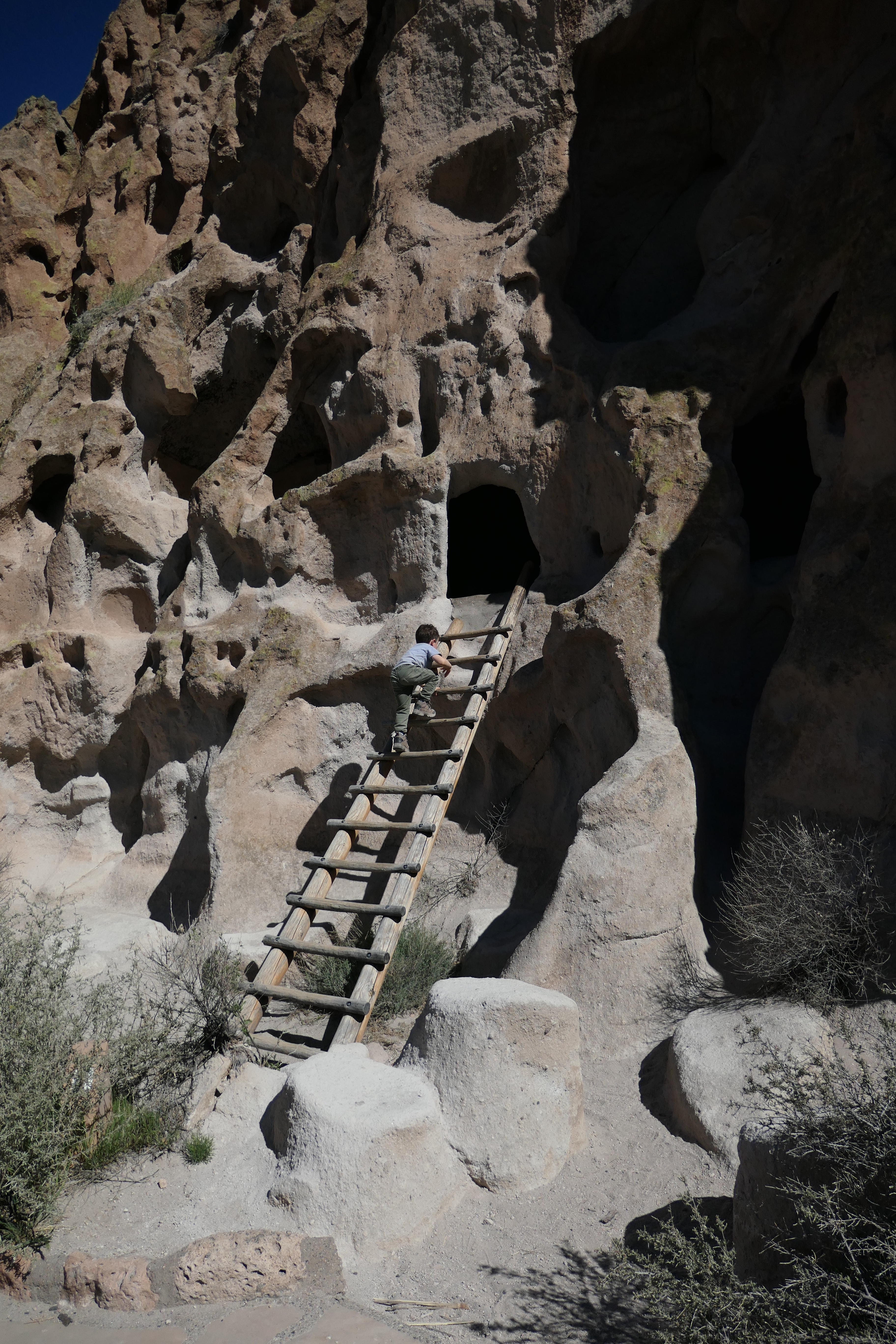
On my last full day in New Mexico I drove to Frijoles Canyon to explore the Bandelier National Monument. It is located within the Pajarito Plateau which was formed by two eruptions of the Jemez volcano nearby, more than a million years ago.

Each of these eruptions were about six hundred times more powerful than that of Mount St. Helens in 1980. Just saying.

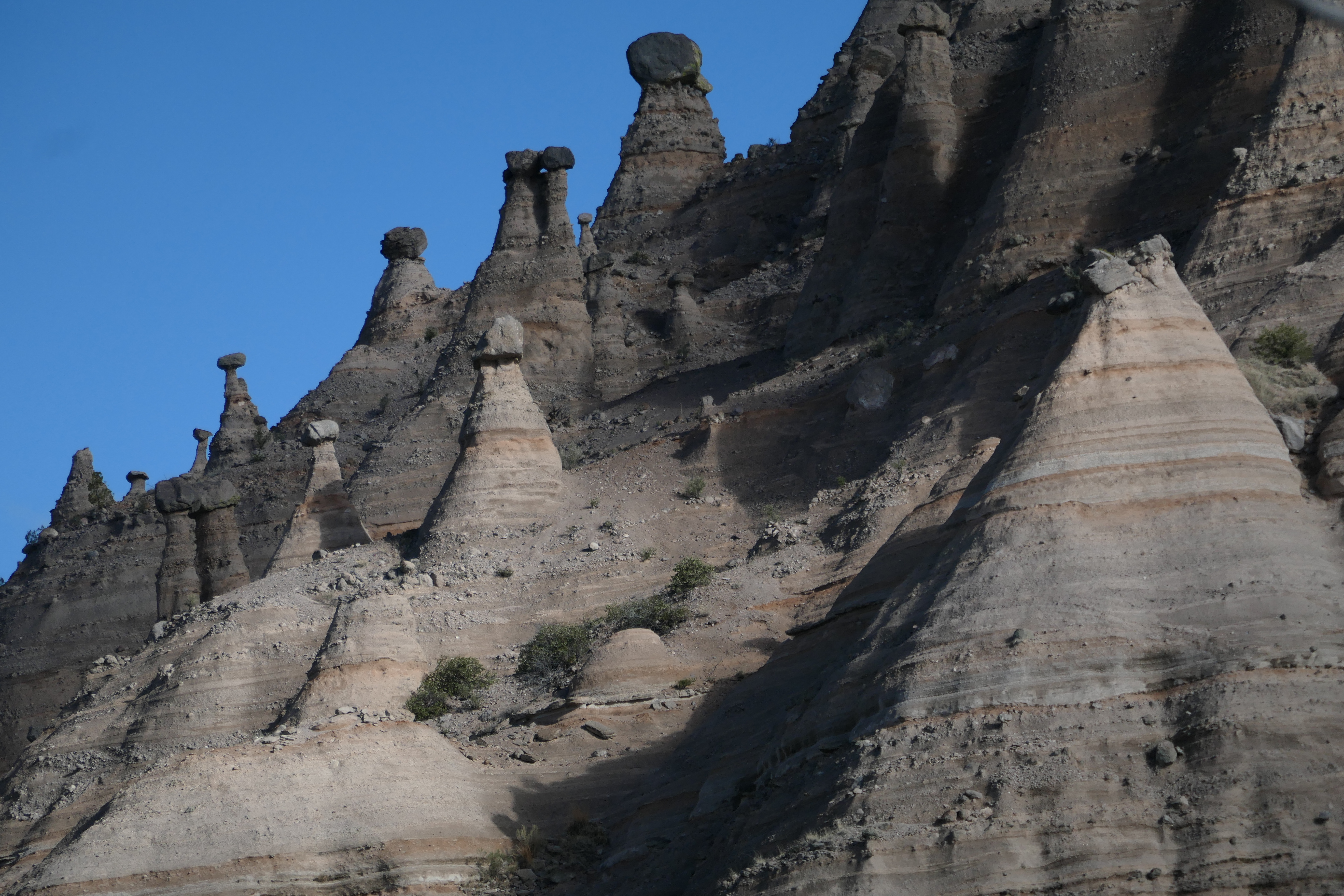
The rocks you are seeing in the photographs are actually volcanic ash, compacted over time into a crumbly rock called tuff.

It can be easily eroded by the weather or human tools – and indeed the Ancestral Pueblo people living here more than 10.000 years ago made their homes in the rocks, enlarging existing holes and caves and building in front of them.

Both petroglyphs and pictographs can be found here

A small, seemingly innocuous creek runs through the canyon, bearing water all year long, so important for human habitation, and even more so in this arid climate. The regular 10 cubic feet per second (cfs) occasionally converts into flash floods.

A horrid one in recent history followed the 2011 Las Conchas Wildfire, that completely destroyed the upper watershed of the stream.

The creek surged with 7.000 cfs of water; in 2013 it got even worse with a flash flood of 9.000 cfs – the piles you see in the pictures are the left overs of the uprooted trees and rocks and other debris that haven’t been cleared by the National Park Service. At the time they came down the mountain in waves reportedly three stories high. The clip shows the flood coming into the parking lot of the site.

https://www.nps.gov/band/learn/photosmultimedia/flood913.htm

These kind of weather-related events probably happened across the centuries but are now increasing in frequency. They would have cost many lives during the times people actually inhabited the canyon. In general, their life expectancy was short, 35 years on average, women regularly dying in childbirth and almost everyone suffering from bad teeth and arthritis. Men were responsible for hunting, constructing and weaving, while women did the farming, (grid gardens and scattered fields all across the mesa in hopes that localized rains would water at least some of the crop of beans, corn and squash), took care of the children, cooked, made pottery and regularly plastered the outer walls of the buildings.

I fiddled with my own life expectancy by deciding to dare climb into the restored cliff dwellings. It was worth it, but, honestly, a challenge. Some kind woman spontaneously offered to take a picture of me, so here is factual evidence in case you don’t believe me.

You had to do several of these, some longer than others, interspersed with staircases

I envied the ravens and the swallows who sail seemingly without efforts between the canyon walls.

Inside the cliff dwelling looking out into the canyon

Not much bird life to be seen, overall, although I did luck out with two owls, closer to Albuquerque, one sitting on the nest and her partner guarding them from across the path.

Her head is peeking out of the hole

Also spotted were quails, a curved beak thrasher and an occasional woodpecker. And here you thought you’d get away from bird pictures…

A Change of Occupiers

The first humans to come to what we now call the United States got here on foot. They crossed the Bering Land Bridge from Asia some 20.000 years ago, perhaps even 30.000 – 40.000 years ago. They made their way up and down the coast by boats, nomadic tribes often driven to new places by changes in climate. Scarcity of food led to various intertribal fighting for resources, a culture fostering warriors, but also to tribal migration to climes where they could eventually settle.

The North American Indian people who live in permanent compact settlements in New Mexico are known as Pueblos, descending from the pre-historic Ancestral Pueblo people (Anasazi). The eastern Pueblo villages are in New Mexico along the Rio Grande and comprise groups who speak Tanoan and Keresan languages, comprised of Tiwa, Town and Tewa, as well as Athabaskan.

At the time the Spanish conquistadors arrived in 1539, the Pueblos had autonomously governed villages, where decisions were made in subterranean ceremonial chambers called Kivas. Hunting and gathering was supplanted by farming of corn, squash and cotton – the only crops available. Complex irrigation ditches were constructed and lined with clay to preserve water (the latter giving archeologists a leg up in mapping the water systems.) Plant plots were sheltered with gravel to prevent evaporation. Societies were matrilineal (inheritance went down the female line) and matrilocal (boys married into the villages of the girls.)

Hunting was communal, including the hunt for rabbits – up to 60 people at a time would cut their hair and weave it into hare-nets, enormously long structures that snared the bunnies, some persevered from 11.000 BC in the museum where I learned all the rest of it: the MUSEUM OF INDIAN ARTS AND CULTURE in Santa Fe.

I had gone there to explore their exhibit Beyond Standing Rock which highlights encroachments and violations of Native American sovereignty, many of which have impacted Native health and sacred lands and describes what led up to the DAPL protests. http://miaclab.org/current&eventID=4044

As luck would have it, I was invited to a practically private 2 hour tour of the museum with an incredibly knowledgeable docent, who taught about the archeological finds, but also the bloody history the Pueblo people had to endure. Although they managed, after 90 years of Spanish colonization, to unite in rebellion and reclaim their land and independence (as well as the horses, sheep and fruit trees introduced by the conquistadores,) that success didn’t last long.

https://blogs.loc.gov/law/2013/10/1680-the-pueblo-revolt/

After the reconquest in 1691, villages adapted to colonial rule by incorporating some aspects of the dominant culture necessary for survival while maintaining the basic fabric of traditional cultured in some instances converting to Christianity.

Skip forward to the appropriation of land and treatment of indigenous peoples by the US government and military, with forced relocations, death marches and concentration camps that claimed every 2nd life of those displaced in the 19th century. Less deadly but psychologically equally damning were the more recent attempts to Kill the Indian in him and save the Man, which was the motto of U.S. government forcing tens of thousands of Native American children to attend “assimilation” boarding schools in the late 19th century. https://www.history.com/news/how-boarding-schools-tried-to-kill-the-indian-through-assimilation

Judicial decisions by the Supreme Court managed to weaken protections for the sedentary Pueblos wherever they could.

The United States Supreme Court, in the 1876 United States versus Joseph, declared that the Intercourse Act of 1834 was not applicable to the Pueblos of New Mexico. The Court viewed the Pueblos as having a settled, domestic existence and therefore were not subject to laws which were passed for the protection and civilization of “wild Indians.” The ruling denied the Pueblos the protection of the federal government and placed them within the jurisdiction of the local courts and officials. The Court did not define the Pueblos as citizens, and thus they did not have the right to vote, nor did they have the right to hold public office. While the Court excluded the Pueblos from participation in political life, it opened up the way for their lands to be appropriated for private enterprise by non-Indians.

https://nativeamericannetroots.net/diary/1066

In a most interesting bit, my docent added to descriptions of these politics a terse report on HUD, our Housing and Development Administration. HUD is actively building and distributing housing for descendants of the Ancestral Pueblo people. These dwellings, however, are rigidly restricted to sizes accommodating only a core family. The previously common multi-generational living situations are thus disrupted; this has the consequence that transmission of ancestral language, culture and religious practice by daily interactions with the elders is no longer happening. A sly mechanism to force acculturation, in the guise of guaranteed electricity and indoor plumbing.

I was trying to digest all this during a somewhat challenging hike at Kasha-Katuwe National Monuments (Tent Rock) within the lands of the Cochiti Pueblo. The canyon trail is a one-way trek into a narrow, “slot” canyon with a steep (630-ft) climb to the mesa top. One scraped knee and a head bursting with pride of my stamina later I enjoyed the excellent views of the Sangre de Cristo, Jemez, Sandia mountains and the Rio Grande Valley.

https://music.si.edu/video/members-cochiti-pueblo-perform-eagle-dance-2000-smithsonian-folklife-festival

And here are some interesting voices from a different pueblo.

And here are some photos taken by E. Curtis in the early 1900s in New Mexico – these are postcards, I was not allowed to photograph in the museum itself.

Spring Showers

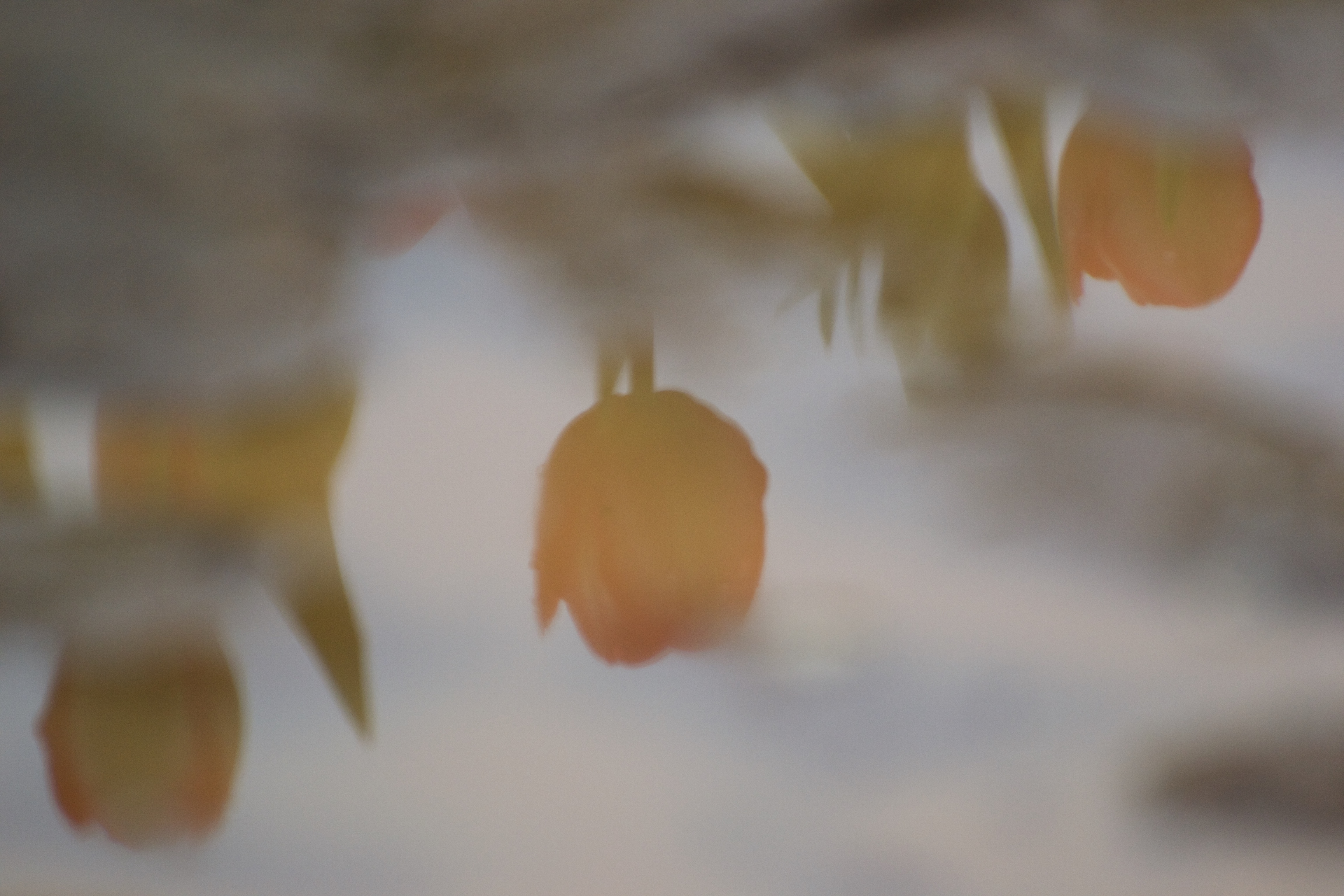
To round out this week devoted to the natural beauty around us I paid a visit to the tulip farm. It ain’t Keukenhof, the Dutch garden, but it ain’t shabby either. Jumping from puddle to puddle, dodging rain clouds, trying to argue with yet another shower threatening my camera, I had a grand time.

It’s still early, more than half of the fields not yet in bloom, and the place going to be open for almost another month. But the foliage alone was thrilling, and what was open did not disappoint.

Neither did the perennial viewing of humanity; some dressed to match the flowers, or at least their color;

some ignoring the weather and appearing in apparel more fitting for July;

some clutching their unicorns, or shivering in their cow mobile,

and the workers on break happy to rest those muddy limbs and heavy rain coats.

Did I mention it rained? It surely made for beautiful light. And it felt like spring, a riot of soft, muted color, and pastel air.

Some new sights,

Short-stemmed, nestling like Easter eggs

and some names that made me smile.

My intention to post Sylvia Plath’s Tulip poem evaporated upon re-reading. It is just too depressing, written from hospital when she was undergoing surgery and on war-footing with those gorgeous flowers that disturbed the waxen peace of the ward. I will attach a link all the way at the bottom where she reads it herself only for those who need a dose of downward comparison.

It shall be William Wordsworth instead (and I just happened to photograph daffodils as well….):

Daffodils

I wandered lonely as a cloud
That floats on high o’er vales and hills,
When all at once I saw a crowd,
A host, of golden daffodils;
Beside the lake, beneath the trees,
Fluttering and dancing in the breeze.

Continuous as the stars that shine
And twinkle on the milky way,
They stretched in never-ending line
Along the margin of a bay:
Ten thousand saw I at a glance,
Tossing their heads in sprightly dance.

The waves beside them danced; but they
Out-did the sparkling waves in glee:
A poet could not but be gay,
In such a jocund company:
I gazed – and gazed – but little thought
What wealth the show to me had brought:

For oft, when on my couch I lie
In vacant or in pensive mood,
They flash upon that inward eye
Which is the bliss of solitude;
And then my heart with pleasure fills,
And dances with the daffodils.

So much dancing in that poem, so much dancing in my very own grateful heart from the joy that is spring in Oregon, dark skies or not.

And here is the perfect garden-in-the-rain music….

Moss Musings and Lichen Lament

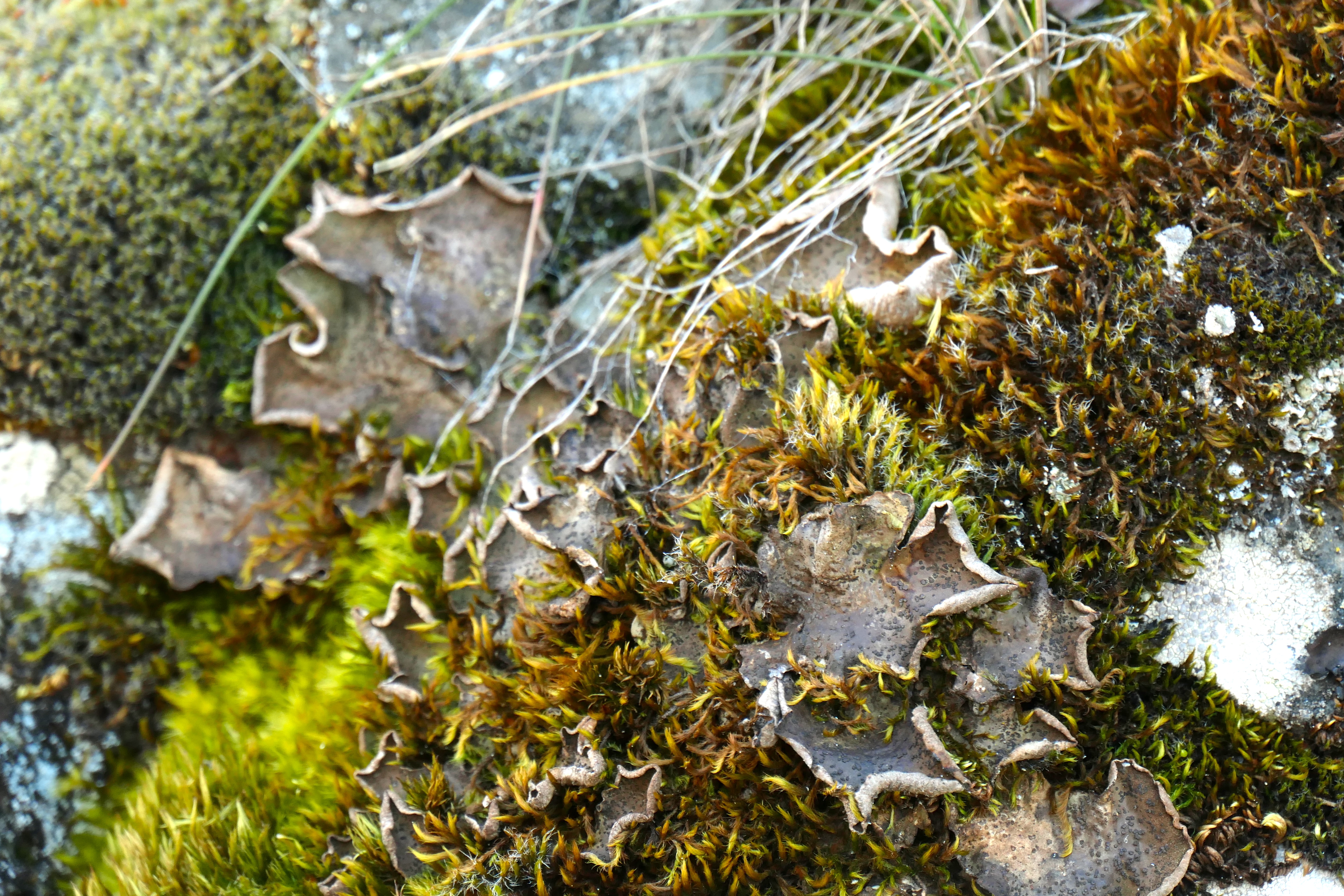
This is the time for wildflower hikes, more to be found every single week. It is also the time where there is enough moisture and warmth in the air that mosses and lichens awake from potential dormancy and fill the world with green, or, for that matter, orange, yellow, white and black, depending on the species.

The distinction between mosses and lichens, at my pay grade, is simple. One is a plant and the other a sandwich. Or so claim the teaching materials trying to instruct grade schoolers about their environment. Mosses are multicellular organisms that are able to use photosynthesis, like any other plant. They can’t transport moisture though, and thus need to stay close to the surface to absorb it.

Lichen, in contrast. are a mix of different organisms, one enveloping the other, thus the metaphor. The assembly consists of fungi fused with algae or cyanobacteria, and, only recently discovered, yeast. The individual ingredients benefit each other – the algae provide food for the fungus via photosynthesis and the fungal layer protects the algae from drying out, or being damaged by the sun. The yeast, as it turns out, produces noxious stuff that keeps animals from eating certain lichen. The resulting intact surfaces of lichen carpets help to keep things where they’re supposed to be, sort of gluing them down.

Most interestingly, lichens are a superb bioindicator – another sentinel warning us of environmental danger and destruction. “Because lichens have no specialized protective barriers, they also readily absorb contaminants and are among the first organisms to die when pollution increases, making them good sentinels for air quality.” They are sensitive to acid rain (the culprit being sulfur dioxide, from coal plants or long range industrial emissions.) They also get hurt by ammonia and nitrates used in agriculture, and they accumulate metals from power plant emissions. When they die off, we know WE are in trouble.


The US Forest Service has had a bio-monitoring program for lichen since the 1990s,

http://gis.nacse.org/lichenair/

in which scientists record census data on the diversity and abundance of lichens in thousands of designated survey plots across the country. They collect some samples and send them off to a lab for elemental analysis to identify the type and amount of pollutants. The data help federal agencies set pollution targets and map out areas where the targets are not being met, and they also help state and federal agencies that review emissions permit applications and existing regulations.”

https://cen.acs.org/articles/95/i46/meet-the-sentinels.html

Who wants to bet that under the current administration pollution targets are changing, regulations are shifted – or for that matter, whole programs like these are terminated? Luckily, lichen are ubiquitous, and one or another of the up to 17.000 species will survive in regions where none of us would. We are the ones that will pay the health and environmental cost in our areas, when pollution is again unchecked.

In any case, I find all this fascinating; if you don’t, perhaps you can at least enjoy the beauty of these lifeforms as they cling to the surfaces around us.

Music today shall be Mahler’s 3rd – probably of his symphonies the closest to nature, in its description of glory and wrath, both. That should make your morning lively!!

Bonus: some daily wildlife!

Widow-makers

The term widow-maker probably means different things to different people. The uninitiated older-than-35-year-old set who has never heard of, much less played the video game Overcraft, is probably oblivious to the fact that the term refers to an assassin also known as Amélie Lacroix. The unconcerned younger-than-35-year-old set will have no idea that it is the informal term for a deadly heart attack that involves 100 percent blockage in the left anterior descending (LAD) artery. And all of us in the overlap of those sets will probably be blissfully unaware that it is a term used in conjunction with dreadful accidents in forestry.

The reason this came to mind was a conversation with a person who happened to come by when I stood in front of the tree below – or what’s left of it – on Monday. A large part of the tree had come down last year, luckily falling when no-one was around. The remaining stump, still taller than a person, seemed solid enough, but all of a sudden in the last few days all of its bark, huge pieces of it, had come down at once, forming a large pile.

I was wondering out loud if someone or something had attacked it, it looked so violent. The guy explained: this is a widow-maker. I learned that diseased or old trees not only have limbs that break off, hang in the crowns and topple down when forestry workers try to fell the trees. They often spontaneously shed their entire bark when shaken by wind or axes, and those can kill the people underneath. The passer-by had indeed a friend who met that fate while working in the Oregon forestry industry.

Walking home, I was thinking of how many of those trees I encounter in my regular wanderings, here in Tryon Creek, Forest park, Oaks Bottom and out in the Gorge. How much depends on luck, not to be at the wrong place at the wrong time. And how overthinking of the possibilities can lead to levels of anxiety that would make it impossible to explore my world. This in turn lead me to remember a psych paper I read (with the advisory that the research area of personality is often subject to non-replication problems.) But here is the argument, a theoretically interesting one, in a nutshell (all research details and data sources can be found in the link below):

People have different attachment styles, some being secure, others less so. This leads to different advantages and disadvantages when it comes to how we function in life in general and face threats and dangers in particular. A third of us are securely attached and faring fine, the other two thirds not so much, being either highly anxious or avoidant. Why would evolution tolerate such a mix? It seems that independently of what it means for an individual to be anxious, or avoidant, or securely integrated, these differences in style might have huge positive implications for the social groups we live in.

For example, people who are close with their family members are less likely to react to noises or alarms indicating impending danger, like a fire. They only react to unambiguous signs, like flames and smokes, when precious time is already running short. Highly anxious people, on the other hand, are like the canary in the coal mine, sentinels who signal early warning.

Avoidant people are also late to realize danger, but then act quite decisively to rescue themselves, and their protective action signals to others the presence of danger as well as potential escape routes. The avoidant person’s survival behavior then might also, if unintentionally, save other people’s lives.

https://www.ncbi.nlm.nih.gov/pmc/articles/PMC4261697/

Now, all of this might be of no relevance if I walk alone in the woods, but it is reassuring to think that we as a social species have evolved to help each other out in social situations with present danger, whether consciously or not. Probably won’t be my last thought, though, when that branch hits……

Music today seems to beckon for Dvorack’s Silent Woods…..

https://www.youtube.com/watch?v=yZYmFWcHdB4

And here is one of the most beautifully written essays on facing just this kind of threat. https://www.nytimes.com/interactive/2019/03/20/magazine/kayaking-trip-alaska.html

Twigs and Stones

About a 5 minute walk from my house is a small neighborhood park, a refuge for kids, dogs and the rest of us. A patch of old-growth forest, it has a path circling the periphery which gives you a good 20 minute stroll and leaves the interior protected, for deer, coyotes, kids’ forts and all. On balmy spring evenings at dusk the high schoolers or L&C students hang out with Today’s Herbal Choice – and the whole place pleasantly smells like those initials. But I digress.

A few years back a tiny wooden fairy house appeared, lovingly constructed and painted, with a house number and doors and windows that could be opened. Then another, and another, I think at its peak there were over 10 of them, parked under or affixed to the trees. Kids would bring little toys to decorate, and dogs would ignore those, if you were lucky. A walk in the wood was no longer boring for the young ones and everyone had a blast to spot new houses. Well, not everyone. There was a serious discussion in the neighborhood association about leaving nature to be nature and not make it a kitschy theme park, and that was that. Everything disappeared overnight.

This spring, a spark of defiance appeared at the bottom of the trees. Small painted stones can be found in locations close to the path, and for those of us walking there daily it has once again become either a bit of joy at the creativity of the young artists and our own sleuthing for new ones, or a source of dismay that there is yet again artificiality introduced into nature.

(Some of you might remember that I have argued along similar lines in an essay on Botanic Gardens, but here we are talking about a sort of playground (albeit a nature one) for families. https://www.orartswatch.org/art-among-the-plants-a-lament/)

The presence and fate of these stones might be under dispute – the way twigs have been affixed in what I am about to introduce next should not be controversial – it is simply ingenious.

Meet eyesasbigasplates – a duo of women photographers who do spectacular work with older people who participate in creating their “costumes” from materials found in their natural surroundings. They introduce themselves and their work here:

We are a Finnish-Norwegian artist duo Riitta Ikonen and Karoline Hjorth. Starting out as a play on characters from Nordic folklore, Eyes as Big as Plates has evolved into a continual search for modern human’s belonging to nature. The series is produced in collaboration with retired farmers, fishermen, zoologists, plumbers, opera singers, housewives, artists, academics and ninety year old parachutists. Since 2011 the artist duo has portrayed seniors in Norway, Finland, France, US, UK, Iceland, the Faroe Islands, Sweden, Japan and Greenland. Each image in the series presents a solitary figure in a landscape, dressed in elements from surroundings that indicate neither time nor place. Here nature acts as both content and context: characters literally inhabit the landscape wearing sculptures they create in collaboration with the artists.

https://eyesasbigasplates.com

I adore everything about the idea (and admire the photographers’ technical skills as well – the images are of outstanding quality.) Collaborating with a group that usually falls by the wayside, making them active participants in their portraiture, using natural materials in such inventive fashion and creating portraits that simultaneously crystallize the person’s characteristic face and hint at something more fleetingly, almost magical – it’s just terrific. Why don’t I have ideas like that???? And why am I not the wisdom-radiating rhubarb lady??? All the portrait images are from this website: https://eyesasbigasplates.com/list-of-works/

A big shout out to T.L. who introduced me to this work.

Best fit for music today (magic in the forest!) happens to be one of my favorite operas of all times: Janacek’s The Cunning Little Vixen. Here is a Prague production from 1970, conducted by Bogumil Gregor.

Purim

Yesterday afternoon was the beginning of spring, and at sundown we saw the beginning of Purim.

This Jewish festival is a celebration of the courage of one woman to do everything in her power to save her community from evil attacks of anti-Semites, with her own life under threat. For once, there was a happy ending – Queen Esther, the woman in question, was able to convince her husband, King Ahasveros, to save the Jews in the Persian empire from attacks by the King’s vizier, Haman. Not so happy an ending for the latter – he and his descendants were hanged.

It is a boisterous holiday, with the story, contained in the Megillah, being read out loud, with people making lots of appropriate noises and appearing in costume (think of it as the Jewish version of movie night for Rocky Horror Picture fans.)

The costume part is actually an interesting possibility of cultural appropriation: some academics argue that the first Purim masquerading appeared around the medieval times when Jews and Christians first lived in proximity together. Mardi Gras or the Venice Carnival were tied to the vernal equinox and all involved costumed celebrations.

Here is a link that details history and customs, including the hotly debated question if we can trust the historicity of the story.

https://www.haaretz.com/jewish/.premium-the-odd-history-of-purim-1.5332554

My favorite Purim food – cookies, what else – is served and also added to gift baskets that are generously shared among friends and family. The cookies’ name is derived from two German words: mohn (poppy seed) and taschen(pockets). Mohntaschen, or “poppy seed pockets,” were a popular German pastry dating from medieval times.

Around the late 1500s, German Jews dubbed them Hamantaschen, or “Haman’s pockets, although earlier versions of the pastry had been known as Haman’s ears – see the etymology of the pun here: http://time.com/4695901/purim-history-hamantaschen/

Beyond feasting, making merry, and remembering a time when the actions of a single model individual saved a whole population, there is the proscription to give to the needy, matanot l’evyonim.

And here is a wonderful example of that in 2019: two orthodox rabbis in NZ are asking their congregations to contribute to the victims of the Christchurch massacre in New Zealand, where 50 people were murdered last Friday.

Rabbi Ariel Tal, head of the Wellington Jewish Community Center, and Rabbi Natti Friedler, head of the Auckland Hebrew Congregation, issued a request to their respective communities, asking them to donate the traditional charity money given on the upcoming Purim holiday to support the families of the victims of the attack in addition to the Jewish poor.

https://www.jpost.com/Middle-East/Give-Purim-charity-to-victims-of-mosque-massacres-583933

Interfaith connection that we can all celebrate, whether we observe Purim or not!

Images today capture spring’s arrival. All photographed yesterday.

Music has an interesting genesis: https://www.classical-scene.com/2019/02/16/miryam-esther/

Contrasts

Today is the birthday of Grover Cleveland, the nation’s 22nd president from 1885 to 1889 and its 24th president from 1893 to 1897, who was born in 1837 in Caldwell, N.J.

Among all US presidents he scored high, if not highest, in integrity, honesty and independence. As a democrat he fought against corruption and protectionist trade policies. He is supposed to have said this:

“I would rather the man who presents something for my consideration subject me to a zephyr of truth and a gentle breeze of responsibility rather than blow me down with a curtain of hot wind.”

https://www.politico.com/story/2019/03/18/this-day-in-politics-march-18-1223872

On my hike yesterday, out and up in the Eastern Gorge there were plenty of mild breezes. The hot air emanated somewhere else in Washington DC. But that was not the only contrast that came to mind.

Here I was, amidst indescribable beauty, strong enough to tackle a considerable climb, some of it in snow, accompanied by one of my most cherished persons on earth, discovering the first wildflowers

Yellow Bells: Fritillaria pudica
Columbia Desert ParsleyLomatium columbianum


Grass WidowsOlsynium douglasii 

and digging into a sumptuous sandwich during a picnic on a sunny if cold meadow.

All this while others are too afraid to eat anything that is not coming out of a vending machine for fear of poisoning, put behind bars, harassed and violated by people out for revenge. I am specifically referring to Ramsey Orta, a friend of Eric Garner, who filmed and later posted a cell phone video of how Garner died in a police chokehold. Orta has been in prison since 2016, and is fearing for his life in retribution of showing police brutality. I cannot independently assess the validity of the claims, but the article has taken hold in my head since I read it last week.

https://www.theverge.com/2019/3/13/18253848/eric-garner-footage-ramsey-orta-police-brutality-killing-safety

On March 3rd, 2015, Orta’s cell block was served a meal of corn, cabbage, bread, juice, and meatloaf. He didn’t touch it. He’d fallen ill a few times after eating the food at Rikers and was convinced he was being targeted and poisoned.“Eat, inmate,” a CO commanded, banging Orta’s cell with a baton. The guards were all standing too close, watching too intently as the others ate. This kind of attention was unusual. He saw others from his cell block staring down into their meatloaf, forks frozen in midair.

Court documents filed six days later alleged that the prisoners had suffered and continued to suffer from “nausea, vomiting, pain, dizziness, aches, headaches, stomach/intestinal pains, dehydration, diarrhea, nosebleeds, throwing up blood, diarrhea with blood, and/or an overwhelming sense of illness.” The symptoms were consistent with human consumption of rat poison, and when the tainted meatloaf was finally tested, the results found that the blue-green pellets visible in the meatloaf were brodifacoum, the active ingredient in rodenticide.

Not the kind of country Grover Cleveland envisioned. And one that seems just fine for those currently at the helm. As I said, contrasts.

Playing Hide and Seek

If you find yourself at 101 Park Ave, Midtown, Manhattan please go into the newly opened American Kennel Club Museum of the Dog (I bet their dogs’ names aren’t Fido either but consist of hyphenated classics…) and send me some pictures. Unfortunately that still deprives me of heading straight for the touch-screen monolith in the museum that matches one’s photo with the dog breed one most resembles. What would I be? Care to comment?

My dog has been playing hide and seek with me for much of the day, curiously with me being assigned the role of seek exclusively…. the subsequent exhaustion allowed me to read but one article I want to share, if only for the photographs contained with in it.

Really, go read for yourself, if only to enjoy the smiles the author’s clever puns bring to your lips. And I quote: It’s stuffed to the brim with oodles of poodles and painted Pomeranians. But are these pooch paintings Pugcassos, or just plain Shih Tzu? Blame it on my fatigue after walking several miles in the rain, hail, sun and everything in between, but I find that funny.

Yes, you cat people, read it too. The critic has something to say about cats as well in the realms of “serious” art. And is nicely snarky about the museum at large. In the meantime I’ll put up some photos of the amazing changing skies today

and the vegetation that hid enough birds to keep a German short-hair pointer happy in perpetuity. And only occasionally back in view.

And here is Frank giving his poodle lecture (alas cut off in the end): https://www.youtube.com/watch?v=2mQSf4QOwxw

and the poodle’s reappearance on Overnite Sensation, one of the first albums I ever bought. :https://www.youtube.com/watch?v=bIrr624DFY0

The Return of Winter

And just like that, it snowed again. Covering the Hellebores, the bamboo, the whole of the backyard. I am very fond of Hellebores, also known as Christmas or Lenten Roses, their origins explained by lots of different folk tales.

A different take on them can be found in Darwin’s writings. No, not that Darwin, but his grandfather (as well as Francis Galton’s), Erasmus. Erasmus Darwin was an English physician, one of the key thinkers of the Midlands Enlightenment, a natural philosopher, physiologist, abolitionist, inventor and poet in the late 1700s. He was beyond fascinated with the newly revealed research and subsequent taxonomy of plants devised by Linnaeus.

Darwin wrote The Loves of the Plants, a long – eternally long – poem, which was a popular rendering of Linnaeus’ works, as well as the Economy of Vegetation, and together the two were published as The Botanic Garden.

Finally a way to talk about sex! Even if in the disguise of the propagation amongst plants. So many poetic possibilities!

Here is the bit about Hellebores:


And here are some of his explanatory notes:

Clearly he anticipated natural selection in ways to be explored and confirmed by his grandson 60 years later. And the colors now vary, from white, to pink, to the deepest of purples. Which is not true for snowdrops, which have stayed in their wintry camouflage forever.

I’m throwing some other garden sights in for good measure. It’s all too beautiful!

Music today two lesser known but distinct recordings of Schubert’s Winterreise. One from the 1950s https://www.youtube.com/watch?v=IMImz94Lb78

And a newer one from some years back:https://www.youtube.com/watch?v=wh1Ky7gj4vw