Browsing Category

Psychology

Ach, Emily….

Dickinson, she leaves me confounded. Always. And now this poem, that I have been mulling over for some weeks. What to make of the words below, what do they intend to represent? (You can tell I am still thinking about yesterday’s musings about artists and representation….)

By the Sea

Published 1896 (posthumously)

I started Early – Took my Dog –
And visited the Sea –
The Mermaids in the Basement
Came out to look at me –

And Frigates – in the Upper Floor
Extended Hempen Hands –
Presuming Me to be a Mouse –
Aground – opon the Sands –

But no Man moved Me – till the Tide
Went past my simple Shoe –
And past my Apron – and my Belt
And past my Boddice – too –

And made as He would eat me up –
As wholly as a Dew
Opon a Dandelion’s Sleeve –
And then – I started – too –

And He – He followed – close behind –
I felt His Silver Heel
Opon my Ancle – Then My Shoes
Would overflow with Pearl –

Until We met the Solid Town –
No One He seemed to know –
And bowing – with a Mighty look –
At me – The Sea withdrew –

So here is a woman poet, a recluse, who never saw the sea, I am told, writing about her visit. Planning a visit, note, not a walk on the beach, or a look at the water, but an encounter. She left early, thus avoiding being caught by the dark, took the protective dog, sensible precaution if you think this is about a woman out there on her own. She encounters a world just like the one she knows from home, the women at the bottom, the men on top. The mermaids doing what women do so well, looking their sisters over, judging.

The sailors trying to get their hands on you and rope you in – all menacing enough to induce that familiar feeling, being just a little mouse easy to be stepped on in the sand.

A slightly hypnotizing ballad rhythm, interspersed with these long dashes, making you stop and take in what she says.

And then she’s in the water – no man moved her; did she move herself into the waves, slowly going in like so many before her, ready to give up? Or is the ocean approaching, about to drown her, or representing a sexual danger – or enticement – an interpretation frequently offered because of the various items of clothing described in the inevitable rising, items that hint at fetishistic objects? Is the dew drop on a dandelion leaf describing her sense of diminutiveness, fragility, to be devoured by the floods, water returning to water, like dust to dust? Or is it a watery pearl, a metaphor for an altogether different aspect of the female anatomy?

But then she starts to move herself – just like she set out for the visit (remember started in the first line?) she now sets to leave, willing it, with him (the sea took on a personal pronoun) following. Her shoes filled with foam, a precious, pearly gift, or something to weigh her down or a tantalizing allusion to other bodily fluids, she turns her back on the pursuer. He decides to bow out – this time – once she reaches solid ground, anchored in community unfamiliar to his solitary existence.

Death? Desired or inflicted? Sex? Desired or inflicted? A feminist clarion call? I couldn’t care less. The poem whispered something altogether different in my ear in our current situation of unfamiliar danger.

We have a choice.

We can succumb to varying forms and degrees of despair, feeling helpless like little creatures easily crushed. We can give up and step into the devouring vastness of fear, letting it drown us. We can permit the lead of fomenting depression weigh down our shoes. We can allow panic to rise practically to our throats and choke us.

Or we can turn our backs to all that, willing it. There is no guarantee of safety – the sea – be it our fears, sadness or the pathogen itself – might not be willing to bow out the next time. But here and now, we can start to step back from it, both literally and metaphorically, and turn our eyes to the solid town, the community of friends, neighbors and strangers, who can act in solidarity (albeit in physical distance) to get us all through this, if not make us safer. We can focus on increasing support for those in need instead of catastrophizing. We can organize or be part of a movement that will carry the lessons we learn during crisis into a reshaping of our society for the better in the long run.

I know those words are more easily written than enacted. I have days where I barely make it out of bed. But we can alternate – on days where I am low, you can lift me up, and I’ll do the same on other days for you.

We can refuse to be a mouse!

So what happened to the dog – so prominently mentioned in the very first line and disappeared ever since as if protection was but an illusion?

Why, modeling social distancing, of course!

Where’s Milo???

Here is Copland’s music for some of Emily Dickinson’s poems. Hang in there, folks!

Silence, golden?

So here is a dilemma: do I listen to the advice of my Beloved who insists that art shouldn’t come with an instruction manual? Or do I listen to the urging of friends to provide extensive explanations for my, admittedly, often complex photomontages? Do I tease with titles? Rely on short introductory artist statements? Write up lengthy descriptions of individual works?

Montages today from an old series (S)Elective Affinities Here: Water Rats

It is not just a theoretical question. I have two exhibitions coming up, with two very different series, and quite a body of work. (Details attached below.) With no introduction whatsoever you can have the most personal encounter with an image possible, defined by your own visual pleasure or your own thoughts evoked by the piece. Will you miss something? Perhaps. Will you understand what I was trying to accomplish? Maybe. Will your reaction be influenced by some extraneous manipulations? Definitely not.

On the other hand, does it help to understand the context of the larger body of work to decipher this or that meaning? You bet. Do textual references enable you to understand the framework and relations to art-historical elements? I’d say. Can I smuggle concepts and ideas into your head that guide your perception? Count on it.

La Couturière

It is all about manipulating attention.

I’ll save the truly fascinating, larger topic of attention research for some other day and focus on the basics today relevant to the questions above.

In the simplest of terms, attention is a mechanism that relies on multiple control mechanism. The exogenous control of attention comes from stimuli in the environment that trigger your attention automatically – the streaking movement perceived from the corner of your eye that has you look to where it came from. The piercing noise that alerts you whether your like it or not. A sudden burst of color that grabs you. A design of a page that draws your eye to a certain position. Something is literally grabbing your attention, hard, if not impossible, to resist.

Parallel to that we can control much of our attention endogenously, choosing where to look and what to process on the basis of what holds meaning for us, what we are trying to find, or what we expect to see or when to see it. (This, by the way, is what makes experts so good at perceiving in their field of expertise: they know where to attend at what point in time, which is crucial for events unfolding in time – think referees at a sports competition or mothers catching the kid at the moment where it falls off the play-structure.

The Analysis

Back to art: If I put a concept into your head, by alluding to something, or simply asking a question, or showing you hints that trigger stereotypes, you will attend to the work in front of you trying to integrate what you see with what you ponder. Here is the classic demonstration (Yarbus, 1967) by a Russian psychologist who used one of the very first eye trackers to check where people attended when moving their eyes to various locations on a given stimulus.

He asked subjects to look at a reproduction of a Russion oil painting An Unexpected Visitor painted by Ilya Repin in 1884, with different questions in mind, provided by the experimenter. The conditions included [1] examine the painting freely. [2] estimate the material circumstances of the family. [3] assess the ages of the characters [4] determine the activities of the family prior to the visitor’s arrival. [5] remember the characters’ clothes. And [6] surmise how long the visitor had been away from the family.

As you can see the patterns of eye movements (the black lines going back and forth) to explore the painting was dramatically different from condition to condition, with your “set” or assumptions about the potential discovery guiding your attention.

Here is an overlay of 2 question conditions and the recorded eye movements onto the actual color reproduction, making the differences even clearer (work by Sasha Archibald) (free examination at center, question about material circumstances of the family to the right.)

And here is of course the trick: only those things you attend to will get fully processed in your visual system, and potentially put into your memory stores. Unattended input might linger on some low levels of the processing hierarchy but will soon end up in the dustbin with all the other junk our brains discard. Details that might have significance will be simply overlooked if we were not conceptually driven to check them out. That might be of crucial importance if you are called as an eyewitness. But it also might affect how you embrace or understand a work of art, particularly if it is detailed and representational.

The Director

Then again, you might share the opinion of one half of our current household: I either like it or not!

Exhibit 1: Tied to the Moon

Stevens-Crawford Heritage House Museum
603 6th St, Oregon City
March – June 2020
Open: Friday – Saturday, 11:00am – 4:00pm
Admission: $5

Artist Reception on March 21st – 11:00 am – 1:00 pm

http://clackamashistory.org

This 2019 photomontage series describes some of the common experiences of women across centuries. Just like our physiologies are tied to the phases of the moon so are we tied through shared life events and states connected to our lives. A lot has changed for women; not enough has changed for women. Giving birth, raising children, aging, being loved or abandoned, being controlled or forging our own path has always been basic to the female experience. Finding solace among sisters or competing for scraps as rivals was often part of our existence. Curiosity, skepticism, learning and rebelling had to be fought for. Longing, dreaming and hope were part of the way.

Exhibit 2: Postcards from Nineveh

Oregon Coast Council for the Arts

Newport Visual Arts Center – 777 NW Beach Drive, Newport, OR 97365

March 7 – April 25, 2020

Artist Reception March 14, 1:00 – 5:00 pm, talk at 4:00 pm

On display is a new (2020) series of works that combine photographed snippets of 17th-century Dutch paintings of whaling expeditions along with contemporary environments.  It calls for attention to environmental stewardship at a time where nature is under threat. The title is a play on Jonah (the one swallowed by a whale) who was a reluctant prophet, ignored by the people of Nineveh. We, on the other hand, should listen to clarion calls about the need to protect our oceans and fish populations.”

Here is a piece of music by Arvo Pärt where silence commands everything around it. (For more examples of composers using silence, go here.)

Moss Green

And when thou art weary I’ll find thee a bed
Of mosses and flowers to pillow thy head; – John Keats To Emma (ca. 1815)

I cherish this couplet, find the thought of a pillow of moss appealing (although currently you might want to bring a waterproof plane before you sit down…)

And since I want to start the week with making you less weary, the couplet is the perfect fit. (Which cannot be said for the rest of the poem, which closes with this: So smile acquiescence, and give me thy hand,
With love-looking eyes, and with voice sweetly bland
. No sweetly bland voice here, googly eyes and/or acquiescence…. but lots of intentions to get your spirits up.

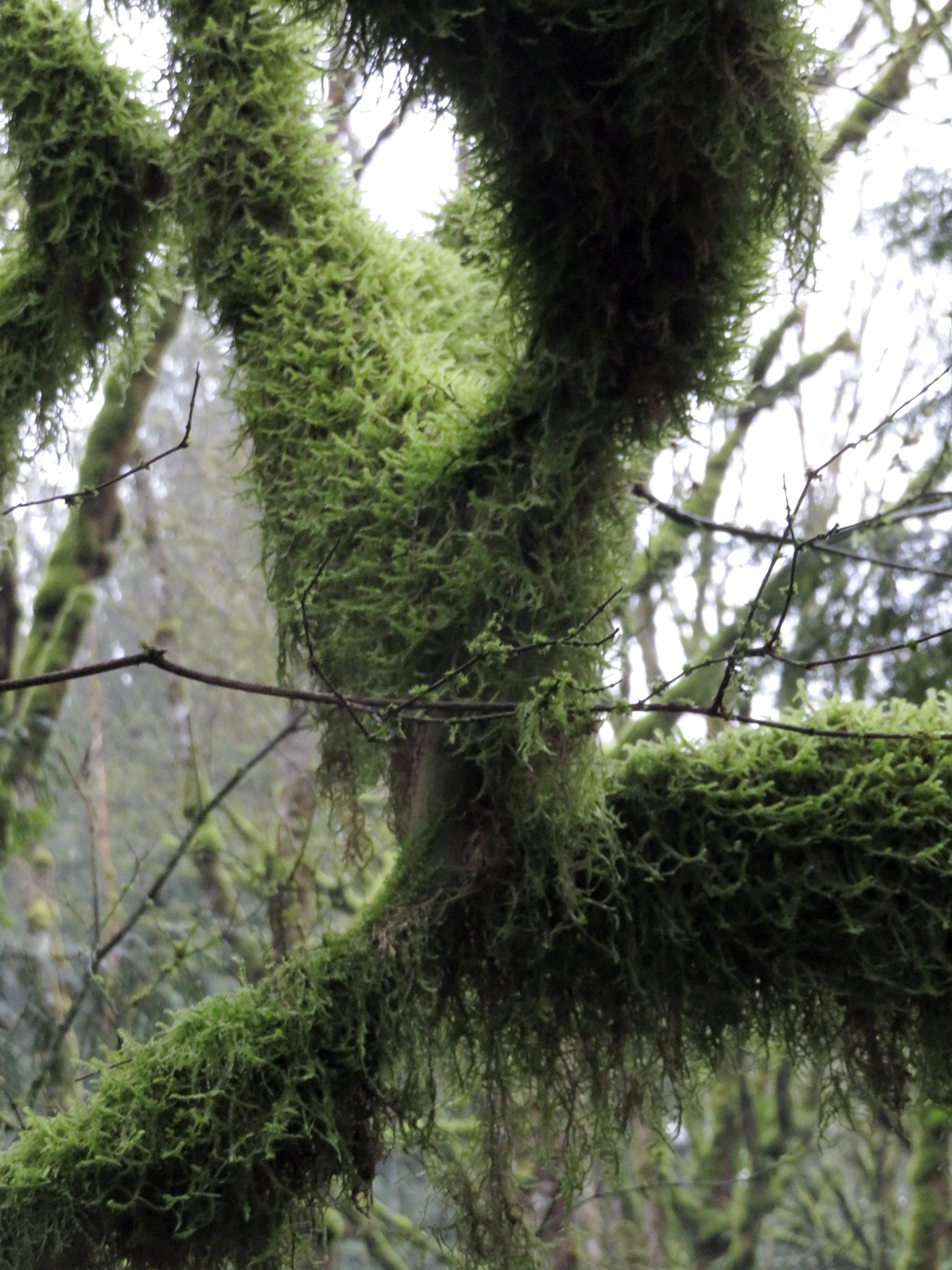
Moss it shall be: for one, because it shines, glimmers, glows in abundance right now, greenest, most brilliant green in those watery woods (Tryon Creek). Secondly because it gives me the opportunity to cite Wikipedia’s color page where I found this gem: Green is common in nature, especially in plants.

I hope you spill your coffee laughing. I did. Or maybe you need to know German, where the equivalent of nature is green: Wir gehen ins Grüne…

Let’s proceed to name the biological greens:

We are subsequently told that:

Moss green is a tone of green that resembles moss. Who would have thought.

Tidbit: Moss is practical. It used to be the diaper of millennia of babies – Native Americans stuffed spagnum in bags with which they swaddled their children, the Inuit used moss inside sealskin covers, and Mongolians used fur sacks stuffed with moss to carry the young. Biodegradable, too. It was used as antiseptic bandages to treat the wounds of thousands of WWI soldiers, when the Allied forces ran out of cotton bandages. (Link is to a fascinating article in the Smithsonian.)

I have written a bit more seriously some time back on moss and lichen, with a focus on the latter. If memory serves me right, we talked about rootless Bryophyta, which is the botanical name for moss, attaching themselves to their environment via hairy protrusions called rhizoids, take water and air in to create their food through photo synthesis.

Today I am more interested in why moss appears so intensely luminous when you hike through the forests during these dark, rainy days.

It has to do with a process called the Purkinje effect, or Purkinje shift, named after the Czech anatomist Jan Evangelista Purkyne, who proposed it at the beginning of the 19th century. It is the tendency for the peak luminance sensitivity of the human eye to shift toward the blue-green end of the spectrum at low illumination levels. Simply put, we have two main receptor types in the retina, the rods and the cones. The former are more light sensitive, but pretty much worthless for distinguishing color. They take over when it gets dark, because the cones, which are color-sensitive, fire best only when there is lots of light.

When light is scarce, at dawn and dusk, but also on these cloudy, rainy days in the woods, the reds, processed by cones now starved of stimulation, will appear duller and duller. The greens take on a contrasting brightness, because the rods take over. Voilà, iridescent green.

Before we all get too happy basking in that glow, here is the dark side of moss: half a billion years ago, when Bryophyta first appeared on land, they plunged earth into an ice-age and caused mass extinction of ocean life. Before you freak out, it took them 35 million years to do so, and they might just be the antidote to global warming if we could only wait that long.

Nonetheless, then it was a catastrophe – moss secretes a wide range of organic acids that can dissolve rock, and the altered rock can then suck CO2 out of the atmosphere. Sharp reduction in carbon dioxide levels ensues – here comes the ice. (For a more detailed account, go here.)

Reminder to self: this was supposed to cheer, not make more weary. Music to the rescue:

So here is a ditty from the 50s – Ja ja im Moos, da ist was los – well, well, things are hopping in the moss…..

Pileated woodpecker

and one a little older: Brahms says it all about the cool forest.


Sound Description

Sometimes a piece of writing makes me drool. This, for example:

“The piece of music I have in mind lasts only forty-five seconds, which is shockingly brief measured against the inner world it evokes. In what I now know is a fragmentary motif, a few lowing bass notes rise like bubbles from the bottom of a pool, becoming increasingly ragged as they approach the surface. They get close enough to one another to imply melancholy harmony before they dissipate. The riff repeats only once, a little more achingly. Then the bass hands its figurative duties over to a dulcimer, whose jaunty fatalism carries the mood forward even as a more deliberate structure begins to eat away at the oceanic resonance of those bass notes. As the bass recedes into a supporting role, providing squiggly accents at odd intervals, a mental image slides back into inaccessibility too. In my memory, the soundtrack, by Henny Vrienten, to George Sluizer’s 1988 film The Vanishing, was an expanse of fretless bass only, mournful and spare, diaphanous and purplish, like neon light filtered through glass bricks. I feel a spasm of disappointment in realizing its magic is more contained than I recalled, that the film’s music on the whole is not remarkable enough to justify a soundtrack album in which I could wallow between viewings.”

Jaunty fatalism, oceanic resonance…. now wouldn’t you have liked to coin those terms? The short essay goes on to describe the actual affinity to The Vanishing beyond loving the introductory music: a longing for time spent without supervision, without fulfilling expectations of constant busyness, of “a reflexive drive to busyness defined my experience of free time as a terrifying void to be filled, a wish for blithe indifference to the internalized requirements of managerial bureaucracy,”(another winner!) (The film refers to a young French couple going on vacation before crisis erupts, evoking French cinematic history of all those aimless hours spent in Provençal town squares and at Mediterranean beaches.)

Loitering, in other words, seems to be a thing of the past. And even if you manage to take a bit or a lot of time off work, the space that opens is filled with: sound. Books on Tape at the elliptical. Music in your headphones while doing routine tasks like ironing or the dishes, or folding the laundry or cooking. Podcasts while taking a walk. I think the last one irks me the most – how are you going to hear yourself think, which is what walking allows you to do in the most effective ways possible? Never mind being connected to the soundtrack of nature that happens during walks in the woods, or connected to humanity which happen if you walk the city? From the New Yorker essay, linked above:

There, it becomes apparent that writing and walking are extremely similar feats, equal parts physical and mental. When we choose a path through a city or forest, our brain must survey the surrounding environment, construct a mental map of the world, settle on a way forward, and translate that plan into a series of footsteps. Likewise, writing forces the brain to review its own landscape, plot a course through that mental terrain, and transcribe the resulting trail of thoughts by guiding the hands. Walking organizes the world around us; writing organizes our thoughts.

Writing might organize the thoughts, but walking actually improves the content of them – there are numerous studies now that show that creativity and problem solving is enhanced because of free floating attention and spurious environmental stimulation during walks. That will not happen if your attention is focused on following Chris Hayes’ arguments.

Another way of looking at it:

On my afternoon walk I would fain forget all my morning occupations and my obligations to society. But it sometimes happens that I cannot easily shake off the village…What business have I in the woods, if I am thinking of something other than the woods?
Henry David Thoreau, 1862, in an essay entitled “Walking”

I, personally, hold it with Virginia Woolf and spend my afternoon in solitary trampling. That description is as sound as it gets.

If you don’t have time or have trouble walking, then listen to this: Mendelsohn’s music here was inspired by hiking the Hebrides.

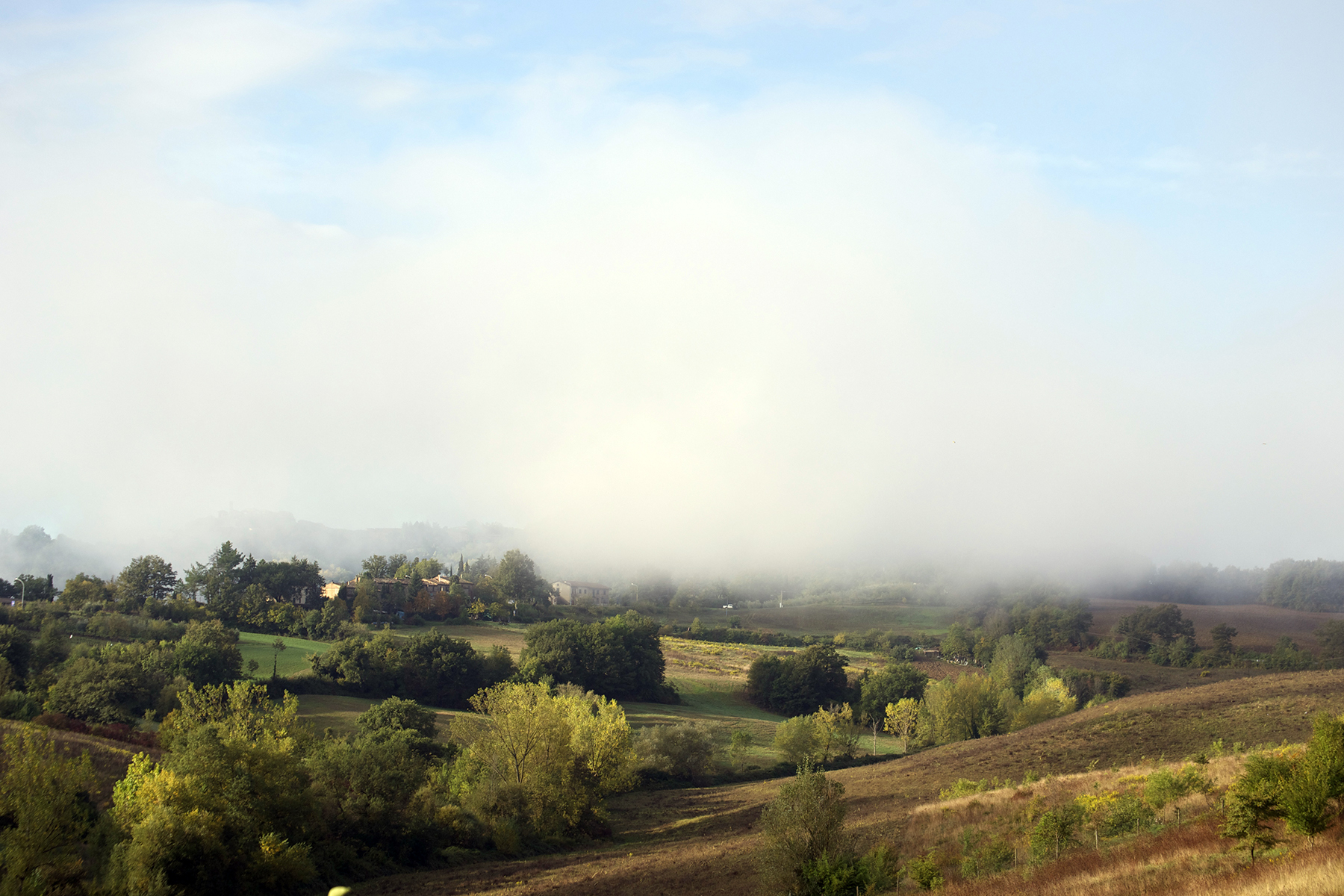
Photographs are from the Tuscany countryside. As close to dolce far niente as I’ve been on my journeys.

Sound Variations

Let’s start this week on a quiet note. Like really quiet, preparing for silence in space – quiet. Not a random choice of metaphor, either, since I learned that astronauts are sent by NASA to an anechoic chamber at the Orfield Laboratories in Minnesota where they practice being in environments where sound does not reverberate.

“An anechoic chamber is a room designed to completely absorb reflections of either sound or electromagnetic waves. They are also often isolated from waves entering from their surroundings.” It turns out that you cannot stand being in one of those chambers for very long – 45 minute has been the longest someone endured before fearing they would go insane. When you hear nothing else, you start hearing the noises that your own body makes, “you become the sound.”

All this came up when, as so often, I randomly ran across a poem that caught my attention.

Anechoic

George Foy stayed in the anechoic chamber
for 45 minutes and nearly went mad.
He could hear the blood rushing in
his veins and began to wonder if he was
hallucinating. He had been to a monastery,
an American Indian sweat lodge,
and a nickel mine two kilometers underground.
In the anechoic chamber, the floor’s design
eliminates the sound of footsteps.
NASA trains astronauts in anechoic chambers
to cope with the silence of space.
Without echo, in the quietest place on earth,
what else can we hold onto? What replaces sound
in concert with what you see? The human voice,
the timber when a person says kamsahamnida
or yes, please, or fuerte, is 25 to 35 decibels.
Hearing damage can start around 115 decibels.
Metallica, front row, possible damage
albeit possible love. The Who, 126 decibels.
A Boeing jet, 165 decibels. The whale, low rumble
frequency and all, 188 decibels, can be heard
for hundreds of miles underwater.
I once walked around inside a whale heart,
which is the size of a small car. The sound
was like Brian Doyle’s heart that gave out
at 60 after he wrote my favorite essay
about the joyas voladoras and the humming
bird heart, the whale heart, and the human
heart. Glass can break at 163 decibels.
Hearing is the last sense to leave us.
Some say that upon death, our vision,
our taste, our touch, and our smell
might leave us, but some have been
pronounced dead and by all indication
are, but they can hear. In this moment,
when the doctor pronounces the time
or when the handgun pumps once more,
what light arrives? What sounds, the angels?
The Ultrasonic Weapon is used for crowd
control or to combat riots—as too many
humans gathered in one place for a unified
purpose can threaten the state. The state
permits gatherings if the flag waves. Sound
can be weaponized or made into art.
It can kill. It can heal a wound. It is
a navigation device and can help determine
if the woman has a second heart inside of her
now, the beating heart of a baby on the ultrasound,
a boy or a girl, making a new music in the body
of another body, a chorus, a concert, a hush.

by Lee Herrick
from Scar and Flower,
Word Poetry, 2019.

To tell the truth, I was not particularly taken by this poem as a whole. Little things, the list -like quality of researched facts (I mean who knows all those decibel numbers….) or the discussion of hearing being the last sense to go (after he cued in on hearing all along,) and then wondering “which light will arrive,” they irritate me. Or the tale of walking inside a whale’s heart and affixing the sound to the memory of a favorite author’s writing – I was in one of those last summer (they have them as plastic reproductions in all kinds of science museums, and all you hear is the delightful screaming of young visitors around you. Nitpicky, I know. Not granting generous artistic license. Guilty as charged. Perhaps it would help to know more of his work, apparently often preoccupied with hearing, but also quite political. Herrick, of Korean descent, was the poet laureate of Fresno, 4 years ago, teaches at college there. Here is a review.

But one line stuck, and made it worth slogging through all those facts he lines up: Sound can be weaponized or made into art. It can kill. It can heal a wound.

Think of how sound was used to manipulate you when you were a child. Ok, when I was a child, sent off, sickly still, to boarding school. Being yelled at loudly was pretty upsetting. Worse, though, was when punitive words came out really quietly, almost whispered, ominous as can be.

Sounds could be frightening, the pillow-muffled homesick sobs, my own included, of the new arrivals. Sounds could be disturbing, the penetrating school bell that cut time into slices. Sounds could be shaming – the snickering of the girls behind your back. The tsk tsk of a revered teacher, handing back insufficient work, not even worth a verbal assessment, just those devaluing sounds. The screeching of the coach on the sports field, egging you on to run even faster, until your lungs hurt so badly that you were ready to collapse. Sounds that were missing hurt as well: my childhood background chorus of lowing cows and songbirds, the farmer’s peacock.

Sounds could be healing. A hummed melody of a (forbidden) pop song as a reminder that there was still a world out there beyond the dormitory walls. The clinking of the silverware when 120 places were laid for breakfast, the only edible meal, really, of the day. The sounds of the gentle river waves of the Neckar, when you were allowed twice weekly to leave the walled estate, for an hour’s walk. Or being assigned an empty quiet classroom to practice your cello or piano, day after day escaping the noises of overcrowded, restless adolescent girls. Add the music, however incompetently, scratchily executed, with a blueprint in mind of the beauty of the real thing, and you were ready to tackle the next day. Healing, indeed. (My most played piece during those horrid years was this, (Khatchaturian’s Toccata ) allowing rage to flow into the fingers as well. It’s not as hard as it sounds, particularly if you play it slower like the older Russian recordings.)

What counts as healing, though, is in the ear of the beholder. Just a few centuries back the Church accepted only a limited number of intervals assume to please G-d, and that is why Gregorian chants are as they are. And the Church expressly forbade some intervals, including the tri-tone, composed of three adjacent whole tones, because they were thought to be the devil’s interval. Don’t ask me why. Times have, of course, changed.

Wagner used the tri-tone in Tristan and Isolde, to convey forbidden love and longing.

So did Leonard Bernstein’s Westside Story.

Beautiful. Unsettling. I guess it won’t be a quiet Monday morning after all. But one where I made you forget about sham trials and deadly viruses for at least 10 minutes!

Thursday Morning – a Continuation

Pull up a chair, dear reader, join us at the breakfast table. (I cannot begin to tell you how much it gives me pleasure to think that there are several of you reading this with coffee cup in hand as a morning routine while I write the next installment. Community!)

“It’s a complicated issues.” “I know.” “We should make a list of all the questions.” “Well, there is only one interesting one.” “No, there are at least two!” “Persuade me.” “Let’s look at the list:”

  • There are people who enjoy things because they own them, and the ownership does something for them: signal status, boost self-esteem, soften the mid-life crisis. In fact, if I put you in a situation where (false) feedback on your performance lowers your self esteem, your appreciation for the things you own goes up, as if they enhance the value that was just threatened. Same for the choice you make in buying something after I threatened your fragile ego: you go for luxury goods over garden variety objects in this situation. —-We agree, not particularly interesting, our grandmas could have told us that, right? Or any wife of the convertible-buying 50-year old….(This is, by the way, true for Westerners in these psychological experiments, not for others from collectivist societies, like Asians – threat to a sense of self seems to be of less concern there.)
  • People are attached to objects because they connect them to the past, remind them of the past, allow them to show respect for the past. Much of it is linked to a sense of continuity, across your own life time and between generations, that many cherish. —-True, we agree, and not especially interesting, since it makes perfect sense given how memory works, attachments are formed, and group (tribal) membership is beneficial for the individual. (Never mind that the Jewish grandmas cited above also preach the value of letting something be verfallen (by-gone).
  • People react to historical or rare objects with awe – framing the letter Buzz Aldrin sent them, or getting shivers when touching Charlemagne’s throne. It is almost like the physical connection provides a worm hole into the past, and some essence is connected to us. Now, that IS interesting, we both agree. Why is that? How does it make you feel connected to history and why does that matter to you?
  • People vary in how much they attach to objects as possessions, or as links to personal history, or how much they have emotional responses to historic objects, or all of the above. Where do these individual differences come from? I find that highly interesting, my breakfast partner not at all – too many variables under consideration, therefor hard to test scientifically. Note to self: scour the research literature and see if someone has come up with a plausible answer….

For us this is a continuation of a conversation we had while visiting the strangest little museum in Los Angeles, two weeks ago, the Museum of Jurassic Technology. Like the aristocratic collections and cabinets of curiosities assembled in early modern Europe, which were shared by their owners to reflect their status as powerful individuals of knowledge and prestige, it offers a seemingly random mix of exhibits acquired by chance. In fact, it offers – sufficiently dimly lit that you can’t be sure of anything – a hodgepodge of serious scientific objects and description of processes, and whole rooms full of things that are completely made up, nonetheless so perfectly imitating scientific explanations that they are frankly more amazing than the real thing. For someone like me, who is not partial to authenticity to begin with, it was a wondrous time. The creativity and wit and knowledge about museum culture was mind boggling. (They also have live birds wandering around in the museum – my kind of place…) If you can’t make it there in person, the next best thing is to read this: Mr. Wilson’s Cabinet of Wonder: Pronged Ants, Horned Humans, Mice on Toast, and Other Marvels of Jurassic Technology. Written more than 20 years ago, every word holds.

Less of a mystery novel, and harder reading, is Walter Benjamin’s essay The Work of Art in the Age of Mechanical Reproduction. It explains, better than I can, the psychological effects of the “aura” of a historically significant object and how it relates to our cravings for authenticity. Just the thing, over the holidays!

Photographs today are my homage to thorny issues and sticky topics.

Music today is by special request: the thing that literally reminds us, the souvenir, captured by Samuel Barber.

Wednesday Morning, a conundrum

He made me do it. I actually listened to a podcast, an activity I usually avoid like, well, whatever. I felt compelled to follow his suggestion because the dilemma described in the radiolab program is a familiar one in our household: the night-and-day different reactions and connections you have to things, both those with historical and those with sentimental value.

To be clear at the outset, I don’t consider there to be a any right way to relate to objects, or, for that matter, to the past relative to the future. I happen to be not very attached to things from the past, or dwell on or cherish events from the past. I appreciate, though, the pleasure it can give other people, who find continuity in their memories, or great-grandma’s lamp with the shepherdess and sheep holding up the lampshade (YES – it does live in our household, mostly because the guilt to give it to good will would be unbearable for someone who shall remain nameless.) I almost envy the joy some of my friends get out of their attachment to certain objects, and I commiserate with those who are burdened by their loss, but the closest I come to those ways of feeling is perhaps with regard to place. Walking across sites of historic importance can induce awe – having no longer access to places I loved can make me cross. And, of course, I am attached, intensely, to people. But not things, even when I appreciate their meaning and beauty.

How does our relationship to objects shape up – and how do we account for individual differences which have some in awe when holding a historic artifact – a piece of the moon, or the Berlin wall, or the Shroud of Turin – while others couldn’t care less, exhibiting only some scientific curiosity, but no emotional reaction? Differences that become quite apparent in how some surround themselves with items collected across a life time while others purge anything that isn’t currently functional or clutters up the house, no matter how much they accidentally acquired meaning? Spoiler alert: I don’t have clear answers nor does, so it seems, anyone else.

I can, however, point to a few things we do know about people and things.

The idea that things don’t just disappear into thin air (object permanence) can be measured in the youngest babies, even though they “define” things a bit differently than you and I would: not necessarily by shape, but by numerosity and direction of movement. By the age of two, kids exhibit a sense of ownership, and by six they show the “endowment” effect – something that lasts into adulthood and can best be described as that we value something that we possess more than if the same thing was on a store shelf or in someone else’s hands.

Kids often have attachment objects – the proverbial blankie – but do so more in societies where they sleep alone early on instead of sharing their parents’ bed. These objects help them to transition to independence, but interestingly it has to be the one and only object – an exact copy won’t do. Same is true, by the way, for many adults: if I offered you the choice between an authentic Picasso and a copy that is indistinguishable, but not painted by him, you’d reject the latter. I, as it turns out, wouldn’t – I couldn’t care less about the execution by the famous hand, I care about the idea captured in the painting.

Ideas, it always comes down to ideas with me. (Then again, I would reject any version, real or fake, of Picasso, since I can’t stand him.) I’ll talk about our appraisal in the context of museum art authenticity tomorrow.That kind of magical thinking about the essence of a piece of art, or your teddybear, or Lincoln’s pajamas is by all reports existing across the life-span for many.

Adolescents, particularly in the mid teens, become the most materialistic of them all: things matter! Clothes, brands of shoes, bikes, types of phones all matter as a way to declare independence from parents and tribal membership with their age mates. What about adults? We get to them tomorrow. Stay tuned.

Photographs today are from a Wednesday walk before the storm came in, at the Jackson Nature Preserve. The rosehips will not survive this weekend intact – it’s amazing (and part of the unusual dry weather pattern) that they lasted this long.

Music is about a thing that is a person or is it a person that is a thing? So easy to get confused. Coppélia, by Delibes, a ballet about a mechanical doll and her human imitator. Unfortunately the concert, a wonderfully tight performance, is often interrupted by advertisements – don’t know how to fix that.

Monday Morning – a referral

“He is formless, almost faceless, a man whose countenance is a caricature, a man whose framework seems cartilaginous, without bones. He is inconsequent and voluble, ill poised and insecure. He is the very prototype of the little man.

Guess who? No, not that one. One of his predecessors, dangerously underestimated in these early words written by Dorothy Thompson, one of America’s most urgent, eloquent voices against Nazism. Her description of Hitler, as cited above, and her later flaming resistance against all things fascist led her to be thrown out of Germany in 1934, after having been one of the first successful female correspondents for the American media in Europe.

The woman was a marvel. Self-made, in many respects, suffragists, radio journalist, book author, political activist, she was a public speaker, on air for 15 nights and days straight after Germany invaded Poland in 1939. She became a source of facts and opinions for millions of American women who now had an alternative to what they were regaled with by their husband.

Her 1941 essay in Harpers, Who Goes Nazi?, is one of the most astute psychological assessments from a non-psychologist that I have read. Ever. She basically invents (or describes?) an upper-middle class dinner party with various and diverse guests (notably absent, alas, any person of color, which is probably historically an accurate scenario) and predicts for each person how likely they would join the Nazi movement if arriving on our shores. (It is no co-incidence that one of her three husbands, Nobel prize – winner Sinclair Lewis, wrote one of his famous novels, It can’t happen here, during their short marriage.)

If you took that essay and simply replaced the historically fixed term Nazi with a contemporary equivalent of immoral, unethical politician, you might have a perfect fit between the types of people she describes and those threatening an end to democracy who we are currently observing here and many European countries. Think impeachment and removal. Or the absence thereof, as the case may be….

December color!

Just as I worried in yesterday’s blog, I worry here: why don’t we learn from history? When it is all laid out for us in perfectly witty, insightful, premonitory writing?

“It’s fun—a macabre sort of fun—this parlor game of “Who Goes Nazi?” And it simplifies things—asking the question in regard to specific personalities. Kind, good, happy, gentlemanly, secure people never go Nazi. They may be the gentle philosopher whose name is in the Blue Book, or Bill from City College to whom democracy gave a chance to design airplanes—you’ll never make Nazis out of them. But the frustrated and humiliated intellectual, the rich and scared speculator, the spoiled son, the labor tyrant, the fellow who has achieved success by smelling out the wind of success—they would all go Nazi in a crisis. Believe me, nice people don’t go Nazi. Their race, color, creed, or social condition is not the criterion. It is something in them.”

*

One more remarkable item of courage and honesty associated with this path breaker: the woman who was on the cover of Time, declared together with Eleanor Roosevelt as undoubtedly the most influential women in the U.S., played by Kathrin Hepburn in Woman of the Year, and an early ardent supporter of Zionism, changed her views after visiting Palestine in 1945. Subsequently,

She ran into difficulties, including accusations of anti-Semitism, which she strongly rebuffed, after being warned that hostility toward Israel was, in the American press world, “almost a definition of professional suicide”.[10][11] She eventually concluded that Zionism was a recipe for perpetual war.[12]

She was silenced indeed, as are so many contemporary journalists in this country, who follow suit. Here is a 4 minute trailer to a documentary about her, laying out what happened to her career and livelihood, with lectures canceled, newspaper assignments withdrawn and a general shunning initiated by those who could not tolerate any criticism at all of the state of Israel. And the official accusation was, of all things, being too soft on Germany…. something taken out of thin air, to persuade a public open to that villain schema at that time. Sounds familiar?

Photographs today are from my Oaks Bottom Tuesday walk taken last week.

Music is in honor of Beethoven’s birthday yesterday, a brilliant, pure, fear-acknowledging and fear-conquering piece that seems in line with Thompson’s character, the Streichquartett #14.

Didn’t I ask you to bring home a fish???

Liar, liar….

Now why do you immediately assume I refer to a certain politician who shall remain nameless? Am I that predictable?

No, I want to discuss today yet another effect language can have on our interactions with the world. Over the last days I described how language can direct our attention to certain things, shaping our experiences with our environment.

I also described how language can establish certain frames which will influence how we all make our decisions (beast/virus), often through the use of metaphors. And last but not least I reported on how specific use of language can affect our emotions which in turn will lead to different actions we are willing to take (verb/noun form.)

Today I thought we’ll look at how language triggers beliefs which in turn lead you to (mis)perceive what’s out in the real world despite the facts in front of your very eyes.

Here is a straightforward example: I tell you that you will observe someone in a conversation and, by the way, we know this person to be a liar. After you have watched him or her, I ask you to estimate how often that person behaved in ways assumed typical of liars. Turns out you will tell me that that person quite frequently averted their gaze (a habit associated with liars in our belief system.) Problem #1: that belief is actually mistaken! Liars do not avert their gaze more often than non-liars….) Problem #2: the person who you watched converse with someone else did in no way avert their gaze as often as you swear you saw them do. (We have the videotape: we can count….)

The language suggested a concept – liar! – which in turn triggered a false belief – gaze aversion alert! – and you end up “observing” what you expected to see. Except the observation is in no way supported by what actually took place. No shifty eyes anywhere! (You can read a scholarly piece on many of our misconceptions about liars here.)

Here is a similar example, except this time language affects memory rather than perception. If you see a videotaped car accident and I probe your memory for it weeks later, asking how fast the cars were going when they bumped into each other (or, alternatively, when they crashed into each other) your estimate of the speed you observed will systematically vary. More striking, though, people in the “crashed” condition also remember vividly seeing broken glass, when there was none in the original tape. Just think about the implications for eyewitness reports in response to police questioning.

Photographs today show words I picked up on the street, often triggering certain concepts. From suggestions to commands…

Music was chosen for the fit with the concept, but also to stretch ourselves a little bit into the more contemporary realm. Stick with it!

Give those verbs a rest!

Yesterday I tried to spell out that language does influence thought, although not in the direct, unchangeable way that anthropologists like Sapir and Whorf suggested. Language can guide attention and what you attend to ultimately shapes your thinking.

People who want to influence what you are thinking are perfectly aware of these mechanisms. I can frame something as a positive outcome – this experimental medication has a 50% success rate! – or as a negative one – this experimental medication shows a 50% failure rate… – and lo and behold, people choose the treatment in scenario one and decide to forgo it in scenario two, even though there is no objective difference in the information – the medication works half of the time in both scenarios. The language use of failure vs. success makes all the difference.

Politicians know how to grab your attention – incessant repetitive messages, for example, that constantly force you to attend to a claim, have an impact. (This is one of the reasons why you should avoid repeating your adversaries’ claims with your added criticism – it increases people’s exposure to those claims.)

Politicians also know that the values of their constituencies and those of the other side often vary. In our own polarized environment, Republicans overwhelmingly value in-group loyalty, respect for authority and purity, while Democrats pay attention to fairness, harm-avoidance and reciprocity in social interaction. You can trigger these values and consequently increase the support for your political programs by using language that is associated with those concepts. If you want Republicans to support environmental measures, for example, you will be more successful pointing to the purity of our water and forests, than to how pollution will harm those most likely exposed to it. (Long versions of this argument can be found in a book by linguist George Lakoff, Don’t think of an Elephant! which should be on the nightstand of every Democratic presidential campaign advisor…)

In more insidious ways, metaphors do the work for you just fine, when you try to manipulate people into a certain direction. Scientists at USC, for example, asked people for solving a typical social problem like crime. Half of the group learned about a city wrecked by crime that preyed like a beast on the people. The other half learned that crime was a virus infecting the city. Independent of political affiliation, people increased their support for punitive measures when exposed to the beast metaphor, and opted for supportive measures when thinking about a virus. (A current textbook example of this can be found in the British press after the London Bridge stabbing. Look at the language used for the perpetrator and the proposed counter measures by Tories vs. Labour….)

It’s not just apt metaphors, though, that trigger reactions. In a fascinating recent study, a team of Israeli scientists found that how we use language will influence our emotions, particularly anger, which in turn will shape policy preferences. The researchers explain:

One of the most central and prevalent emotions in the Israeli-Palestinian inter-group conflict context is anger. Anger stems from the perception that other people are carrying out an action that is unjust, unfair, or contrary to acceptable societal norms and is associated with the goal of actively challenging the injustice and confronting the agents responsible, both at the interpersonal level and intergroup level. Importantly, in the context of intergroup conflict, anger has largely been found to decrease support for concessions and increase support for aggressive policies toward adversaries

In the most subtle manipulation, using the same word as either a noun or a verb, the researchers were able to manipulate the degree to which anger was felt. Presenting a policy as “the division of Jerusalem” vs. “dividing Jerusalem,” for example, affected participants’ subsequent evaluation of the policies. “Phrasing support for concessions as well as retaliatory policies toward the out-group in noun form (vs. verb form) reduced levels of anger. Subsequently willingness to compromise went up, and support for retaliation was diminished.

Put simply: the less angry you are the more willing you are to compromise. Verbs pull your attention towards the agency of the adversaries (e.g., dividing Jerusalem) which incites anger since you deem them responsible for the crisis. They are also more vivid in our minds, since we can imagine the activity. Nouns, on the other hand, are more abstract, creating a larger psychological distance, not triggering as much anger.

Let’s use nouns then: Conflict Resolution! Anger Reduction! Concession! Compromise! Peace. (And no, I am not naive to suggest it’s this simple. I just firmly believe that every bit that might help is worth a try.)

Here are peaceful winter landscapes – first snow on the mountains – from last week.

Haydn‘s Missa in tempore belli (Mass at a Time of War) describes alternatives.