Browsing Category

Movies

Learning (from) History.

Ferocious, complicated, brave women. 

Also: resilience, clarity, decisive action.

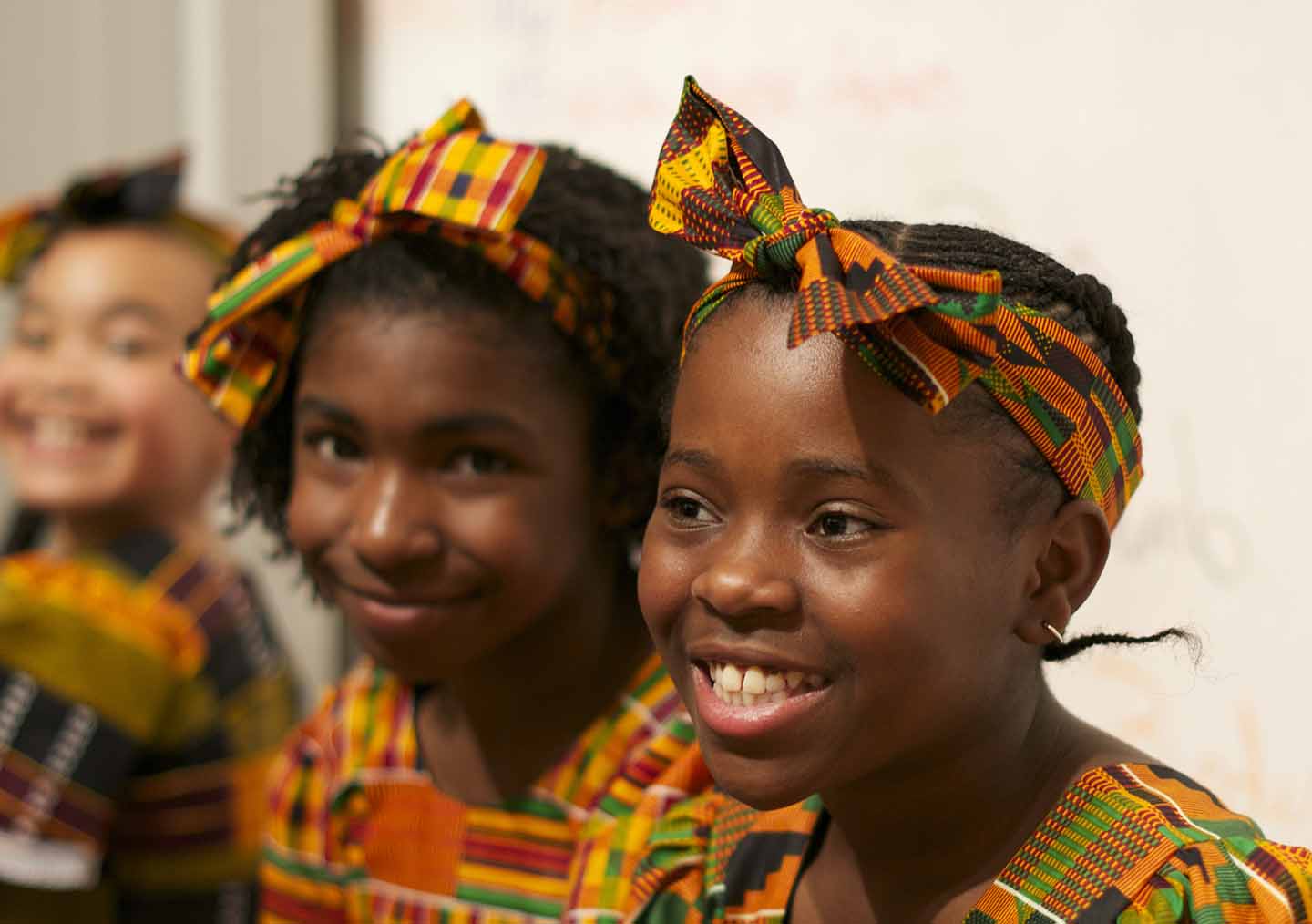
⅔ into Black History month I figured it’s time to contemplate cultural offerings that embody what’s encapsulated by the terms above. Coincidentally, my friend Catón Lyle posted photographs I had taken of him and his students 8 years ago this week on Facebook, images of people I deeply care about and worked with, now likely strong and resilient young adults either in Highschool or off to college. Institutions where Black history is no longer guaranteed to be taught across the country.

Catón Lyes, drummer extraordinaire

Let’s look at possibilities to learn about Black History outside of the educational settings, then. When it comes to ferocious women, none portrays them better than Viola Davis in her magnum opus, now on Netflix, The Woman King. The actress is a marvel (in everything she touches). Here she was training in her late 50s for a physically demanding role as an African warrior leading an army of women in the State of Dahomey (now Benin) in battle and for the political future of a kingdom contemplating to step away from participating in the slave trade.

The film is an epic mix of action movie, intergenerational, intra- and inter-tribal conflict, serious depiction of slavery, with a hint of romance thrown in, involving a non-African man at the behest of the studio bosses who wanted a White man role for sales points and settled for someone with a White father and a Black mother. Various, really numerous, subplots tug on every emotional register imaginable.

Davis and director Gina Prince-Bythewood together with screenwriter Dana Stevens had to fight for 6 years to get this film made, and only got green light after the success of the Black Panther pointed to the possibility of having this kind of film be a box-office success. It was “the product of a thousand battles.” The obstacles the production team faced when pitching a historical epic centered on strong Black women and a State that celebrated gender equity until the French colonialists crushed it, are at length described in this review in the Smithsonian. The public reaction to the finished product has also been fierce: the extremist Right condemned it for Black women killing White men. Some Black organizations found fault with the depiction of African nations actively participating in the slave trade, which is of course historically correct, and brave to be acknowledged in a Hollywood film that wants to convey history, if you ask me. But the worry remains in the eyes of many, that it partly absolves the Euro-American slavers from their responsibility.

Then there is the complaint that the film’s narrative alters what actually happened, making the Kingdom of Dahomey into a place that abandoned the slave trade, when it actually didn’t. A general complaint regards the fact that a major Blockbuster Movie could have chosen a positive event in Black history, rather than one marred by complexity of historical trade alliances.

The film’s take on history is indeed stretched and to be taken with a grain of salt, or with the understanding that movies need to entertain, and have some lines that help us identify with good or evil. The choice of featuring a female standing army, the historically real Agoodjies with all their strength and complicated lives, though, should be a boost to a current generation of women who are searching for role models in an era that is dead set to roll back both women’s and civil rights (not necessarily in the setting of the military, but fighting everyday challenges.) If you want to learn more details about the actual history of the Agoodijes, there is a smart guideline, The Woman King Syllabus, provided by a group of US-based historians, Ana Lucia Araujo, Vanessa Holden, Jessica Marie Johnson and Alex Gil. 

***

When it comes to brave women, do I have a book for you. Organize, Fight, Win: Black Communist Women’s Political Writing is a stellar compendium of sources that help us understand the Black radical tradition, from the early 1920s to the late 1980s. If we can, for a moment, put aside our immediate reaction to the term “communist” in the title, still associated with extreme negative reactions, we might particularly benefit from the section that exposes how White supremacists have always successfully used the tool of the communist specter as a weapon in their political crusade. The book, edited by Charisse Burden-Stelly and Jodi Dean, also teaches a lot about the fight against fascism on the one hand, and organizing of labor on the other, both topics of obvious contemporary relevance.

***

And last but not least, when we look for resilience and decisive action, there is a new, digitally available, resource that I strongly urge you to sign up for: Hammer and Hope, a magazine of Black Politics and Culture, founded by Jen Parker and Keeanga-Yamahtta Taylor.

Or at least read the poem, Come In, by Ashley M. Jones, the current poet laureate of Alabama, in call and response with an image by photographer and performance artists Carrie Mae Weems, who was born in Portland, OR 69 years ago and is one of our most impactful and famous contemporary artists. It sets the tone and invites all of us to cross a threshold into a community of diverse backgrounds but shared goals.

The name for the new magazine, suggested by Derecka Purnell, a brilliant young lawyer and abolitionist, is a riff on a book, Hammer and Hoe, by Robin D. G. Kelley, a professor of American history at U.C.L.A.

The goals could not be clearer and more decisive:

“….a hammer to smash myths and illusions.”

And our hope? It is not the false optimism of liberals or the fatalism of armchair revolutionaries or the pessimism of pundits waiting for the end of the world. James Baldwin understood hope as determination in the face of catastrophe: “I can’t be a pessimist because I’m alive. To be a pessimist means that you have agreed that human life is an academic matter, so I’m forced to be an optimist. I’m forced to believe that we can survive whatever we must survive.” … victory is never certain but if we don’t fight, we can only lose. Hammer & Hope is here to fight.”

Music today is the soundtrack for the Woman King.

Tiere und Türme

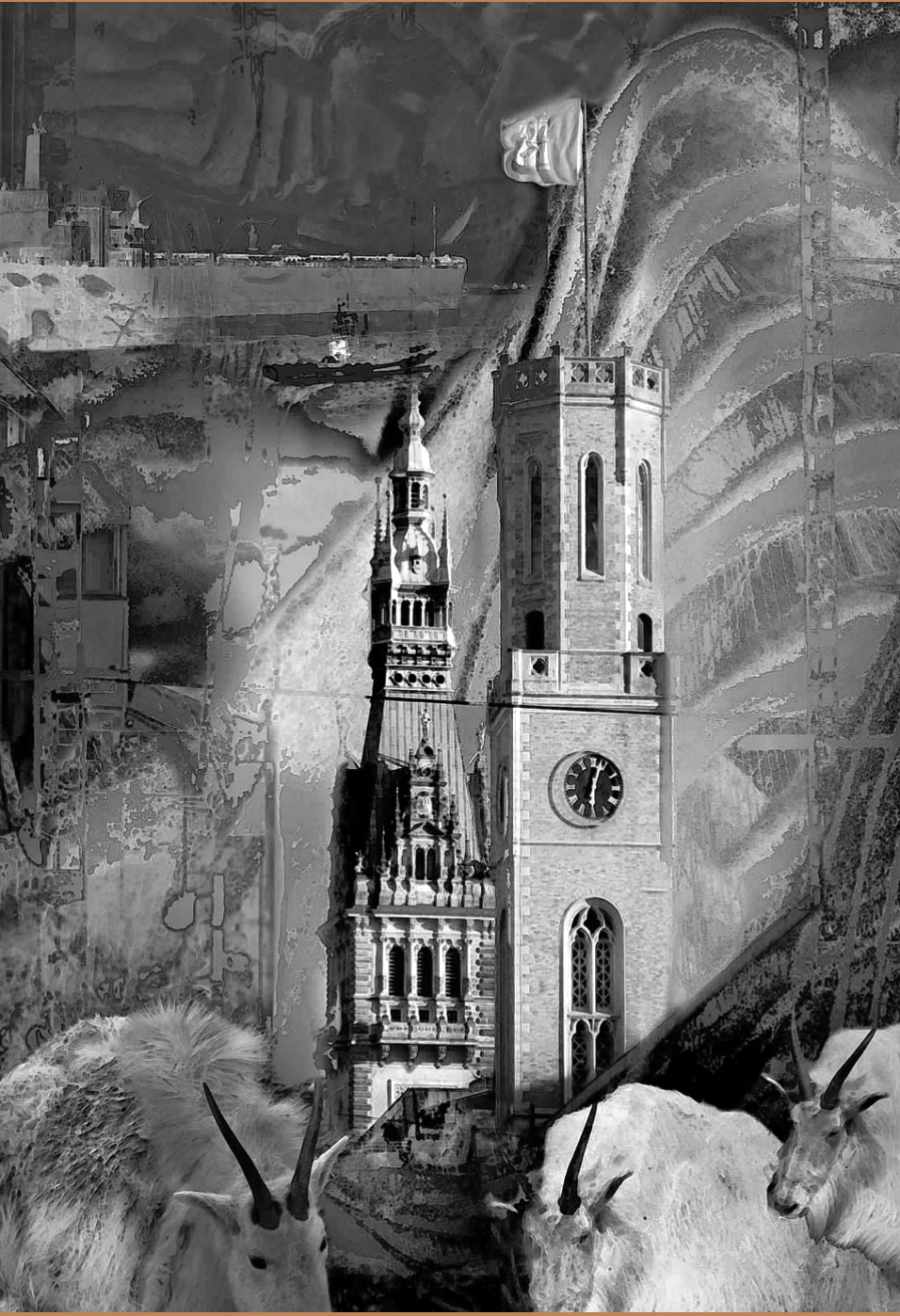
In tune with my surrealist forbears, I worked on a series of photomontages this fall: Turmwächter – Guardians of the Towers. The montages were propelled by two considerations: For one, they all depicted towers that I had photographed in Europe during multiple trips with my friends there across the years, a reminder of shared sights and better times. (The friends get a calendar each year with montage work that picks up on our travels.)

Secondly, I placed animals I had photographed (mostly) in the wild into these urban environments. I wanted to acknowledge the issue of habitat loss, ever closer contact between humans and animals, with all that that implies: the danger for those displaced and for those thrown into the company of wild animals, or the illnesses that animals now share with us, even if they themselves are harmless.

I was also thinking how our relationship to animals might change if we saw them as actors in environments belonging to us, rather than out on the pasture or other defined spaces (still) allotted to them. Would proximity and shared space make a difference, particularly when the non-humans seemingly had assigned human functions: guarding the towers? Would we afford them agency or still be masters, tempted to shoot the bears, hunt the geese, confine the giraffes to cramped zoo exhibits or slaughter the goats and sheep?

All this is a long-winded introduction to movie reviews that made me sad, because my immunocompromised body can’t sit in a theatre and watch films that I lust after, having read about them. The film in question is one that – if the reviews are on point – picks up on the issue of the relationship between animals and humans, ingeniously presented from the perspective of a donkey. What drew me last week to read the reviews of EO, the new film by the legendary Polish director Jerzy Skolimowski, was this image – I gather I don’t have to explain why.

Here is an early review of the film that describes in detail what a master can pull off when putting his mind (and technical brilliance) to telling a story that covers so many relevant dimension of the anthropocene. It opened in PDX on 12/23, go see it if you can! (Update: After reading the blog a friend uttered intense disagreement with the film-critics’ raving reviews – she and her companion left the screening half way through, despised the music and urged me to withdraw the recommendation. What can I say – as explained above, I have not seen it.)

***

I’ve talked about quite a few movies this year that were available on-line, with varying degrees of enthusiasm. C.G.Jung in the Wild West, delving into Jane Campion’s Power of the Dog, probably was the one that made me think hardest, and therefor lingers. If you are into violent and politically progressiv, astute modern Westerns – not for the faint of heart or stomach – there is a new series these days, The English, by Hugo Blick (on Amazon and BBC). Review from The Guardian here. Visually stunning, but goosebumps for the entire ride, be warned.

Music is the sound track for EO, by Pawel Mykietyn.

Disaster Porn

Disaster-porn: “to satisfy the pleasure that viewers take in seeing other people’s misfortunes, as by constantly repeating vision of an event, often without commentary or context”. – Australia Macquarie Dictionary

My morning readings include the news from Europe, brought to me among others by Der Spiegel, a German weekly and the country’s largest news platform on the web. All photographs but one today were seen on their site last week, and elicited decidedly mixed feelings. They lure with beauty while depicting disaster, simultaneously drawing attention to human suffering as well as away from it.

An ice vendor waiting for customers during the worst heat wave in decades. In neighboring Nawabshah (Pakistan) the highest value ever recorded: 128.7 F on May 1st.

Somehow the term disaster-porn came to mind. It is a phrase often used to define depictions of suffering in the developing world, but also applied to the increasing number of end-of-world or other catastrophe movies coming out of the film industry, and not just in Hollywood. Is it ethical to depict, create and watch all this stuff? Let me put the answer right in front: it can be, theoretically. At least this was what I concluded after reading the essay that I am summarizing today while trying to solve my dilemma.

The remnants of a container depot in Bangladesh that stood in flames and then exploded, throwing heavy objects through the air for hundreds of yards. Dozends dead, hundreds injured. Foto: picture alliance / dpa / AP

The term disaster-porn can be found as early as 1987 when a Washington Post editorial about the stock market crash. It described that those of us doting on the disasters in cinematic action dramas are lured into believing that it is either all fake, or that we personally will escape bad fate in the end, never mind the millions we watch dying in catastrophic scenarios. The term has been popularized ever since, sometimes in specific ways, like in Pat Cadigan’s 1991 Sci-Fi novel Synner which used “porn” as a suffix denoting an excessive, overly aestheticized focus on a single topic. (The award-winning novel, by the way, envisions a world where the line between machines and reality becomes porous, a possible disaster scenario now in the real-life news 30 years later…just google AI.) The phrase is thus applied not just to fictional descriptions of disasters but also to round-the-clock depictions of round-the-world catastrophes by the media.

Iraqi boys herding sheep in a sandstorm. They are not allowed to enter into the province of Najaf, to avoid spreading the Crim-Congo fever. They are stuck at the border in the middle of the storm. Foto: Quassem Al-Kaabi / AFP

What is the problem? On the one hand, in an ever more interconnected world where we might be called on or able to help with disasters even at distant locations, information about them helps our collective mind to make decisions. In other word, the depictions might elicit empathy and understanding, which can turn into human solidarity.

On the other hand, there are multiple problems. Disaster-porn can be gratuitous and exploitative – published to sell clicks, or used as justification to simplify complex geopolitical realities, and thereby encourage military operations under the guise of humanitarian action.

In addition, over-exposure to images of doom can lead to a muting of your reaction, draining our reserves of pity, desensitizing us to others’ pain. It can be experienced as damaging our own sense of well-being, thus having us turn away from the suffering in the world. Compassion fatigue elicited by a pity crisis.

Boy amidst storks sifting garbage in the Indian province of Guwahati. Dangerous because of the extreme heat – several garbage dumps have spontaneously caught fire and combusted. Foto: Biju Boro / AFP

There is some inherent psychological truth to the fact that we better protect ourselves from too much exposure to bad news. If we feel that there is absolutely no way we can interfere with the starvation, drowning, imprisoning, wounding, torture, and killing of people, seeing them exposed to these situations will create a sense of anxiety that we will try to resolve by averting our eyes. A barrage of doom scenarios leads to feelings of hopelessness and helplessness, both associated with depression, and subsequent paralysis when we think about possible action – just no sense left, that we could make a difference. Here is just one of the studies that lays out that scenario.

Another way to cope with extreme heat across Asia.

And yet…

Disaster porn, then, in all its iterations and for all its flaws, is a vital political terrain in which publics are at least implicitly asked to struggle with the social significance of the suffering of others. It connects public issues like war, famine, earthquakes, and terrorist attacks to the private lives of those they affect, and shows us how disruptions of social structure become disruptions in individual biographies. This is the case in even the most seemingly stereotypical news reports of suffering in the developing world, and in even the most outlandish Hollywood disaster epics as well.” (Ref.)

Literature and disaster movies contribute in an odd way: they do describe the role chance plays with some people being more endangered than others, some surviving when others don’t. Yes, there are heroes (or villains) who manage to suggest that with some amount of smarts and vision you can still control the outcome (echoing our sense of exceptionalism in U.S. culture), but there are all the others who are not so lucky, because it is often determined by the vicissitude of geographical location alone, rather than specific talents or skills. Chance confers the privilege of survival. It might make us think about our own privilege and so raise compassion, since so far chance has spared us, amidst the forest fires, or floods or infectious diseases.

The Clark Ford River flooded the houses of many of the inhabitants of Fromberg, MO. This is a lawn ornament submerged in the waters. Foto: David Goldman / AP

Leave it to me to read and watch these kinds of novels and films, if only to spare you to have to do it yourself…..

My current target is a 1973 science fiction novel by Sakyo Komatsu, Japan Sinks, which took 9 years to write. It has been made into numerous films, a highly praised animé version among them. Some had altered endings, some were withheld during certain time periods because they were too close on the heels of real life disasters in Japan, given the exposure to earthquakes and the Fukushima catastrophe. The latest, a Netflix production, is so bad that I recommend it on a day where you need help to erupt in laughter – the acting – if you can call it that – guarantees that you will.

The book, however, is worming its way into my brain. The basic story concerns a scientist’s discovery of the likelihood that all of Japan, the entire archipelago, is going to go under due to earthquakes, ocean floor faults, and what not. One of the narrative lines concerns how the government is handling the crisis, from negligence to obstruction to panic. Don’t look up, this year’s U.S. disaster movie that I discussed here, probably took a page out of that book. Another line focusses on the distribution of millions of people around the world, with nationalist impulses against immigration vying with empathy for a drowning people. The philosophical question it raises, though, is one that we will have to think through in climate change migrations to come: what does it do to your identity, as member of a nation, or a tribe or a culture or a language group, when the place that defines you ceases to exist? Literally is no longer there to return to? Is it destructive to lose that connection to place which is a base for underlying sense of self, or is it empowering because you can shed the debt you incurred as a member of the nation (say of an imperialistic or fascistic past) and start from scratch?

Think it through – time not spent doom scrolling…

We could also focus on the message conveyed by a random stranger who was kind enough to let me photograph her t-shirt 2 days ago.

Here’s to The End of Time, in music at least.

Perception of Time

Today’s post is dedicated to my grandfather Eduard (1894 – 1977) a musician, bird lover and gentle soul. His birthday was yesterday.

Canada Geese

Buckle up folks, it’s going to be all over the map today.

It all started with a reminder notice that one of the strangest pieces of music, John Cage’s ORGAN2/ASLSPAs SLow aS Possible – was about to change to a different tone on February 5, 2022. The longest composition ever – duration 639 years, you read that right – started in 2001, with a seventeen month-long pause before the first tone of the organ, especially built for the performance of this piece, was to be heard. Here is a video clip that shows the special organ in a small church in Halberstadt, Germany.

One particular tone emanates continually, and is changed at irregular time intervals according to the composer’s instructions. (Here is a calendar that shows the me changes and tone variations.) The current sound will last 2 years. This announcement had me wonder:

While we had to wait for more than 6 long years for the 14. sound change in 2020 , the next one is occurring only a few months hence, on February 5th. Quite a challenge for a subjective sense of time to get the hang of this. For those clinging to their subjective sense of time we might mention that the new sound will last exactly 24 months. Could very well be that those months will pass in a flash.

Honestly, I could not tell if this was meant seriously or ironically – probably a combination of my addled brain and being German. But be that as it may, it reminded me of a dominant topic in my current conversations. How is our sense of time shaped by the pandemic, the isolation, the sameness of the days and, admittedly, by aging?

Snowgeese yesterday

Snowgeese from other years

Cage’s composition was not the only reminder of the languid, unending spread of hours and days that I – many of us – feel, like time stalling. (This stands, of course, in extreme contrast to young families for whom the double burden of professional work and unrelieved childcare at home leads to a sense of having not enough time ever, time on 3x speed fast forward.)

One of the best cinematic experiences I’ve had in these last months also managed to capture a sense of time that is altered, aided by the elongated storytelling formats of TV series—those time-indulgent, episodic ways to weave a tale, unhurried by a two-hour time limit of movies. And no one knows how to unfold a plot in slow-mo better than the modern Korean film makers.

Steller’s Jay yesterday – Grey herons from other years

In Beyond Evil (directed by Shim Na-yeon, available on Netflix) it’s not just about the tempo of the narrative, though. Time itself seems to stand still in a small town haunted by age-old murders and secrets, with an unlikely coupling of 2 unmatched policemen churning the dregs and bringing new sorrow. It is not a serial murder case in the traditional sense, but rather a psychological study of a variety of characters stuck in time as flies are on those strips hanging in country kitchens. The protagonists are honing their compulsions, tending to their losses, and deciding what to sacrifice to remain on the ethical side of things. I know, does not sound enticing, but honestly, it was brilliant.

Sandhill Cranes yesterday

Sandhill cranes from other years

So, I thought, perhaps we should delve into the scientific psychology of time perception, since a lot of research has happened in the field lately. Nah, you can read up on it here. I much rather learn from poets than deal with my own field today.

Hawk from yesterday
Harrier Hawk
Redtail Hawks from other years

Both of the poems below managed to drag me away from moping about the altered sense of time’s passing, the feeling of being hermetically closed off from a perception of forward movement. They helped me, pushed me towards remembering what I sort of know but always forget: what matters is attention to the moment, the noticing and processing of what is afforded to you by grace of nature or the kindness of others or the tasks that give you pleasure or a sense of having something gotten done or the simple acknowledgment you’re still functioning reasonably.

Bald Eagle from yesterday

Baldies from other years

With Forever- is composed of Nows – Emily Dickinson celebrates recurrence, sameness, un-differentiation, all the while she spent her life in something akin to self-imposed lockdown.

Hummingbird (in February!) from yesterday
Kingfisher from other years

Seems like good advice. I figured I’d drag a series of “nows” out of the archives, selecting samples of the last 5 years of early February photographs all taken without travel, in my immediate vicinity (2021 excluded since it was spent in hospital…) The same ducks and geese, sandhill cranes and variety of raptors, the same small folk and an occasional outlier (elk!) thrown in – a forever of joy from repeat excursions, the last one just yesterday afternoon. It helps to live in Oregon, one of the most beautiful places imaginable.

Elk from other years

You can slow down time as much as you want, if you ask me, if it still contains the possibility of momentary encounters, anchoring us in the NOW. Even robins, bushtits, woodpeckers and sparrows in the yard suffice.

Golden Crowned sparrow from yesterday

Robin and Bushtit from other years

Forever – is composed of Nows –

BY EMILY DICKINSON

Forever – is composed of Nows –
‘Tis not a different time –
Except for Infiniteness –
And Latitude of Home –

From this – experienced Here –
Remove the Dates – to These –
Let Months dissolve in further Months –
And Years – exhale in Years –

Without Debate – or Pause –
Or Celebrated Days –
No different Our Years would be
From Anno Dominies –

Rufus Towhee from yesterday
Downy woodpecker from other years

With Clocks, Carl Sandburg extends a warning that a focus on the measurement of time can distract us from using or enjoying the one we still have, since we don’t know when time will be cut short for good. Don’t focus on the perception of passage then, but what you can do to fill time with. (Never mind that that opens another problem set during a pandemic…)

Clocks

by Carl Sandburg

HERE is a face that says half-past seven the same way whether a murder or a wedding goes on, whether a funeral or a picnic crowd passes. 
A tall one I know at the end of a hallway broods in shadows and is watching booze eat out the insides of the man of the house; it has seen five hopes go in five years: one woman, one child, and three dreams. 
A little one carried in a leather box by an actress rides with her to hotels and is under her pillow in a sleeping-car between one-night stands. 
One hoists a phiz over a railroad station; it points numbers to people a quarter-mile away who believe it when other clocks fail. 
And of course … there are wrist watches over the pulses of airmen eager to go to France…

White throated sparrow from yesterday

Sparrows from other years

And for good measure, let’s throw in the advice of Vietnamese Buddhist master Thich Nhat Hanh who died last month:

“While washing the dishes one should only be washing the dishes, which means that while washing the dishes one should be completely aware of the fact that one is washing the dishes.” Why? If we are thinking about the past or future, “we are not alive during the time we are washing the dishes.” (from The Miracle of Mindfulness.)

Told you, it would be all over the map. Off to wash the dishes now.

Sandhill from yesterday. Music today in honor of my Opa who played the stand-up bass in a small-town orchestra named Fidelio. Here is a creative – and timely – version by the Washington National Opera of Beethoven’s Fidelio, with an explanation of how the new version came to be. Fidelio is a story of hope and resilience, a more desirable focus than speed of time…..

The Clock is Ticking

What better way to distract oneself from pandemic woes than reading or watching tales of apocalyptic destruction? I mean, psychological gains from downward comparisons are real!(And yes, today’s musings are long, but then a rainy weekend awaits….)

The earliest apocalyptic writings, found in Jewish, later Christian biblical chapters at least promised that if one only behaved according to proscription there was a flicker of hope. There might be if not rescue then at least redemption after a period of despair.

More modern fare written about apocalyptic or post-apocalyptic scenarios provided scintillas of optimism through either the survival of appropriately tough heroes/heroines or the promises of miraculous scientific advancements that enabled new beginnings. Here is a list of some of the best, each in their own way trying to impart lessons of caution, all urgently linked to an existing world we choose to ignore at our peril. Some I read were Margaret Atwood’s Oryx and Crake (2003,)Cormac McCarthy’s The Road (2006,)José Saramago’s Blindness (1995,) Octavia E. Butler’s Parable of the Sower (1993.) I’d add the latest Joy Williams’ novel, Harrow,(2021) to the list, but it is a hard, hard read. They are all bleak. Importantly, instructive. It is no longer about (the) God(s) punishing us, but our own greed and negligence causing humanity’s destruction.

And then there is Neal Stephenson’s Seveneves (2015,) a book I devoured. The moon, falling apart for inexplicable reasons, showers earth with its disintegrated pieces, leaving what’s left of humanity to scramble for an alternative home in the universe, in caves or on ocean floors. 5000 years later they have survived by the billions somewhere out there, still mired in the same old conflicts that riled humanity, with issues of race, power and war as central as ever. It is a fascinating tale of adventure and a deep dive into systems, technology, genetics and associated philosophical issues.

If you don’t have the patience to read some 800 pages of this and also prefer your virtue-signaling served with a dollop of humor, you might turn to the movies instead. I saw two over the last weeks that deserve consideration, one of them quite funny. (Spoiler alert – I will discuss endings. Shall we say, any remaining optimism has fallen by the wayside, with the speed and gravity of cosmic debris…)

The first one is Adam McKay’s (The Big Short, Vice) new film Don’t Look Up. The story is simple on the surface: a large comet is approaching earth, threatening to obliterate it completely upon impact within 6 months and some days. The astronomers who try to warn are treated as Cassandras, first ignored then exploited for political purposes. The world looks away – a “Don’t look up” movement literally suggesting an ostrich’s behavior can save you – wasting time when potential measures could have mitigated the disaster, including a businessman who controls the government and wants to mine the comet for industrial materials. The comet hits, the world is destroyed, the evil politicians and the businessman, a cross of Jobs/Musk/ Zuckerberg escape to a planetary world where they are eaten by dinosaurs.

Along the way, everything that is a current political issue in the face of existential danger, be it pandemic or climate change, is skewered with dark satire and smart irony. And that is what the film is really about, rather than an extinction event per se: The role of a divided nation, the influence of mass media, the function of the entertainment world with musical superstars, technological industries, science denial, social media influencing, capitalism run berserk, political manipulation for corrupt purposes, all undermining possible rescue. (David Sirota, one of Bernie’s speech writers, was responsible for the script.) The film allows you to laugh a lot while being utterly depressed about the plausibility of its depictions. It also makes you feel part of a “we” who understand what is said as well as who is ridiculed (“them,”) making for an astonishing sense of community while you’re sitting there watching alone on your couch.

Well, so it was for me and half of the reviews I read (author and journalist Michael Harriot called it a documentary, only half in jest, Naomi Klein strongly recommended it.); the other half was scathingly critical, and many of my family and friends were giving up on the film before they were half-way in, being unmoved by the over-the-top one-liners and attempts at humor while messaging that we are doomed if we leave measures against potential destruction (climate change is clearly the intended allegory) in the hands of politicians instead of scientists. My simple mind, meanwhile, just giggled.

One could indeed argue that the film’s allegorical use of a comet, a higher fate threat, papers over the fact that climate change is manmade. I see that choice, however, as a smart one. It allows not-yet committed viewers to think through the costs of passivity without being turned off by feeling immediately guilty. Here are some thoughts by the film’s director.

The second apocalyptic tale I watched was a Korean series, also on Netflix, called The Silent Sea. It contained no humor and was utterly long, yet fascinating for its philosophical implications. Here the world is ravaged by climate change and water life-threateningly scarce, distributed via a hierarchical system imposed by authoritarian regimes. A group of engineers and scientists are sent to a research station on the moon to retrieve some mystery samples produced in a facility which was seemingly shut down by a radiation accident. A parallel mission by yet another evil industrial imperium is set to interfere, having planted two of their own among the research crew, starting to kill the good guys. It turns out the samples are of lunar water, a substance that can replicate itself to unending streams of liquid if finding a living host, yet ultimately lethal to humans who will drown in their own lungs when infected with it by a mere touch.

We learn that the government did illegal human research and cloning with children, scores of whom died in the course of trying to find a usable water replicator to rescue all of humanity. All but one, that is, a girl who has developed DNA to resist the infectious parts, acquiring some super powers along the way. She and the two female members of the retrieval team, a doctor and a scientist, are the only survivors of the mission in the end, rescued but flying off to an unknown fate of further experimentation on earth. Maybe humanity will be saved by the magical self-producing liquid, but at what cost?

The series is offering a plethora of important issues, from economic inequality that can kill you, to the ethics of scientific experimentation for a larger cause, the sacrificing of some for the greater good, or the saving of the world left in greedy hands that want to profit off it. Yet all of them are only subtly presented, with few suggested resolutions, leaving the viewer intellectually scrambling and frightened without the release provided by laughter.

So who is reached by the message shared by both tales, that the clock is ticking towards these kinds of scenarios? That a grim fate awaits unless we make some hard decisions now? We know what the solutions are regarding mitigation of a climate catastrophe; we also have some measures against threats of falling debris via the Planetary Defense Coordination Office (a NASA offshoot.) I doubt, though, that climate deniers will respond to the warnings, if they listen to them at all – why should they, when they are the targets of scorn? How should the rest of us act, those already aware of multiple existential risks? As I write this the CDC just declared that those infected with Covid could end quarantine after 5 instead of 10 days and without proof of a negative test so that employer demands can be met. Aren’t we shrugging it all off in great resignation, feeling powerless to do anything?

And those of us who accept the apocalyptic premises, do we enjoy laughing on the sofa while watching our imminent demise? Sort of “might as well,” while resigning into learned helplessness? Or are we subtly pushed into assumptions that science will have the means to rescue us if we only let it (with the Koreans at least acknowledging the huge, really unacceptable price one pays for potential discoveries?) Have we given up on wrestling it out of the hands of monopolies who hold the power, helplessly skewering their founders with condescension and scorn as a last ditch attempt to make ourselves feel involved?

I don’t have the answer. Or maybe I fear them to be in the affirmative. I do know that I was happy for laughter, so rare these days, perfectly aware that it involved gallows humor.

I did also “look up,” and around on my walk through a snow dusted landscape last week, hiking LaTourelle Falls.

Music today is from Leo Janacek’s satirical opera The Excursions of Mr. Broucek to the Moon. Full version here.

Excerpt in better sound quality here.


Hope is a discipline

Hope doesn’t preclude feeling sadness or fear or anger or any other emotion that makes total sense. Hope isn’t an emotion, you know? Hope is not optimism. Hope is a discipline… we have to practice it every single day.” – Mariame Kaba

I will write about the amazing scholar, prison abolitionist and activist Kaba on another occasion. Today I want to use her guidance, quoted above, to offer a few recent examples out of my “hope exercise bag,” so we can enter this week with a smile on our faces.

  • Over 40 camels barred from Saudi “beauty contest” over Botox! Organizers of the 6-year old competition are on top of tampering! All 143 attempts! No more inflated body parts, stretched with injections or rubber bands! No more braiding, or cutting, or dying the tail of the camel! Camels were x-rayed, subjected to ultra sounds and genetic analysis, to ensure true beauty wins fairly (to the tune of $ 66.000.000 no less.) There’s hope!

  • Delay wins the day! Hundreds of thousands of bees survived being buried under volcanic ash for over 50 days after the volcanic eruptions on the Canary island of La Palma. The owner of the hives had not yet collected the summer honey before the volcano erupted last September. The bees were able to sustain themselves with their own honey, after sealing themselves in by creating a resinous material called propolis. This “glue” is created by mixing saliva and beeswax with secretions from sap and other plant parts. There’s hope ! Procrastination isn’t always bad and spit, wax and honey can save you. Be prepared!
  • The cure for seasonal depression discovered! Acquire a Moomin rug and all else will fall into place (or at least you land on something soft if you fall…) There’s hope! My Moomin addiction is constantly served by new creations. (And no, I do not own this rug; it was meant symbolically. I do have a Moomin bag, though!)
  • The antidote to hate in this world is remembering its victims as one way to prevent more harm. This is not the funny kind of hope, but the real hope I strive for when practicing the discipline. In awe of the film maker Güzin Kar, with gratitude to the New Yorker that picked the short film up in this country. There is hope when people remember. (And this one probably one that Mariame Kaba would approve of.)
Remembrance (The Refugees’ Dreams – 2016)

Or at least there are glimpses that we can, should, must hold onto until real hope returns, as instructed by Adam Zagajewski, who died last March. A huge loss to the poetry community.

Try to Praise the Mutilated World

BY ADAM ZAGAJEWSKI

TRANSLATED BY CLARE CAVANAGH

Try to praise the mutilated world.
Remember June’s long days,
and wild strawberries, drops of rosé wine.
The nettles that methodically overgrow
the abandoned homesteads of exiles.
You must praise the mutilated world.
You watched the stylish yachts and ships;
one of them had a long trip ahead of it,
while salty oblivion awaited others.
You’ve seen the refugees going nowhere,
you’ve heard the executioners sing joyfully.
You should praise the mutilated world.
Remember the moments when we were together
in a white room and the curtain fluttered.
Return in thought to the concert where music flared.
You gathered acorns in the park in autumn
and leaves eddied over the earth’s scars.
Praise the mutilated world
and the gray feather a thrush lost,
and the gentle light that strays and vanishes
and returns.

What’s Left Behind (The Refugees’ Dreams – 2016)

There is your Monday grab bag, now go and look for the silver lining, your song of the day!

C. G. Jung in the Wild West

“Deliver my soul from the sword; my darling from the power of the dog. Save me from the lion’s mouth: for thou hast heard me from the horns of the unicorns.” Psalm 22:20-21

If you want to see The Power of the Dog, Jane Campion’s newest film now playing on Netflix, without prejudice, hints or spoilers, stop reading right here. Peruse this screamingly funny review of Christmas Movies instead, and come back to the blog once you have been seduced by Campion’s latest.

—————————————————————————————————————-

Full disclosure, I used to be an avid Jane Campion fan. The director and screen writer, who earned degrees in anthropology and sculpture in addition to one in film studies, has always struck me as the perfect mix of intellectual powerhouse and visual artist who knows how to use space, color, atmospherics in ways that doubled and tripled the impact of her already intense plot lines. The Piano and more recently the 2 part series Top of the Lake count among my favorites, for visual magic as much as feminist approaches to the conflicted states women experience when they try to free themselves from patriarchal violence and restrictions.

I also watched a lot of Westerns. The strange, far away America came to the German TV screens, still black and white in the 1960s, with visions of John Wayne’s law and order and the Cartwright family in Bonanza (I almost choked on my coffee when I read the Wikipedia description that the show was “known for presenting pressing moral dilemmas.” The only dilemma I encountered was when we 12-year-old girls fought over who had first dibs on Little Joe…)

In the 70s I was drawn into Spaghetti Westerns. I used to watch them late at night in a small, smoke-filled movie house in a suburb of Hamburg, together with like-minded students who were exploring socialist politics and enchanted with the Westerns’ subversion of the American genre’s archetypes and the films’ revolutionary messages, particularly in the Zapata movies. These parables using the Mexican Civil War at the turn of the century as a vehicle for left-wing optimism and dreams fit right into the late 60s, early 70s in Europe when we had a lot of hope for change. As did Ennio Morricone’s film music, a constant on the turntable.

Many decades later, I saw Brokeback Mountain in the movie theatre (which I rarely went to, always worried that exposure to a large screen would emotionally overwhelm me – I like my films on a computer screen that helps me modulate my reactions.) And I am not averse to filling sleepless hours with unassuming commercial fare like Longmire. There, I admitted it.

And now comes The Power of the Dog, a Western by Jane Campion. Stellar acting, brilliant camera work, a languid story told in chapters, almost like a dream that slowly, unstoppably, turns into a nightmare. Think psycho-drama against a backdrop of the Rocky Mountains, with every Jungian archetype conceivable and clever symbolism to boot, gloves, ropes, scissors, traps and ominous landscapes included. Then share my surprise when myth-buster Campion, champion of strong, self-determined women, falls right back into depictions that are conventional female stereotypes, while focusing on the complicated, tortured souls of men. The only woman who lets her hair hang down, is one who is dead – miraculously growing golden locks in her coffin, or so it is reported, as if Rapunzel meets Snow White, no further prince needed.) There is an insensitivity to women who are depicted as violated or objectified that felt jarring, going against expectations set by Campion’s previous oeuvre.

The basic story describes the fate of four people. Two adult brothers own a successful ranch in Colorado in the early 1900s. One is a Yale-educated classicist who is the quintessential Western cowboy, toxic masculinity and all. The other is a reserved, politically aspiring businessman, who might soon climb into the ranks of robber barons or state politicians. Their shared bedroom is emptied, when the business man, George (Jesse Plemmons,) decides to marry a widow with a teenage son. Phil (Benedict Cumberbatch) is aghast at the change in the household and does everything he can to taunt and torture the newcomers, deemed gold digger and weakling, respectively.

Rose (Kirsten Dunst), who was a perfectly competent restaurant owner and former piano player in a movie pit, shrinks from the limelight she is thrown into when having to host important people. Moreover, she is deeply hurt and frightened by her brother-in-law’s meanness and slowly descends into serious alcohol abuse. Her husband hovers protectively when he’s there, although he seems to vanish increasingly from the scene the more the triangular tensions become apparent. Rose’s son Pete (Kodi Smit-McPhee) also does everything imaginable to protect his mother who lost her first husband, his father, when he committed suicide.

We soon learn that cowboy Phil was shaped by an intense relationship with his mentor, Bronco Henry, with likely homoerotic leanings, or at least unconscious desires. It is hard work for Phil to suppress his longings, particularly when he is surrounded by display of male beauty right out of Thomas Eakins’ or Henry Scott Tuke’s paintings.

Thomas Eakins The Swimming Hole)
Henry Scott Tuke The Sunbathers

The teenager discovers this and makes use of this knowledge when he meticulously and cautiously plans to get rid of the tormentor to ensure his mother’s happiness. Letting himself be taunted as a “faggot” and a “Nancy” by the ranch hands, he stirs something in Phil that leads him to envision a relationship like he had with his mentor, now roles reversed. He wants to toughen up the waif-like youngster, rope him in, projecting onto him the possibility of ending loneliness. We see Phil change in front of our very eyes from bullying macho to vulnerable loner exhausted from repressing his sexual inclinations.

The boy, on the other hand, so seemingly vulnerable, stiff and thin, with a glaring lack of detectable sensuality, turns out to be made of steel, something that his father had always feared. He kills wildlife without hesitation, does autopsies to learn about biology, systematically gets the necessary tools and ingredients to kill with impunity, and eventually claims his target. His overarching desire to help his mother is not matched by any insights into what she wants or fears, just driven by his own interests, including a medical career with access to decisions over life and death.

A key scene where he walks amidst catcalling cowboys to inspect a nest of magpies gives it pretty much away. The symbolism of magpies does not just include extreme intelligence and trickery, it also stands for self-awareness. Magpies are the only non-mammals that pass the mirror test, a way to assess if an animal has self-awareness. Pete knows who he is and what he wants, no conflict between his conscious and unconscious, so prevalent in the rest of them. Dressed always in the black and white of the (NZ) magpies, with a similarly elongated shape that we mistake for a scare crow, he is the master of everyone’s fate.

While we still cringe at his executioner’s demeanor that grants a last cigarette to the condemned, smoked in alternation by Pete and Phil like a post-coital ritual that was never enacted, we soon wonder why he peruses the biblical verse exclaimed by Christ himself during cruxifixction, calling for help from the Almighty. “Deliver me from the power of the dog,” the pull of Satan’s seduction, “save me from the lion’s mouth,” the threat to Rose’s happiness, he’s dealt with all of them like a higher power himself.

The film does not just employ the various tropes of Jungian psychology, the ideas of persona and shadow, of anima and animus, or the concept of contrasexuality that was quite progressive for its time. The idea that masculinity and femininity can be contained in one person, and not correspond to being male or female, is really the focus of the narrative set in a world that abhorred that concept.

C.G. Jung was also steeped in biblical knowledge – his father was clergy, his mother came from a long line of theologians – but saw the bible more as describing psychological processes rather than revealing G-d’s word. So ending the story with a verse that refers to a cry for help at the same time that that help was delivered (as evil act, no less) is really something of a horn of the unicorn, something mysterious, inexplicable, rare.

So is Campion’s wizardry when it come to dropping clues. If the film was a dream, an analyst would have a field day. Maybe the Jungian dream analyst Campion repeatedly visited during the film shoot would agree. The symbolisms sure made my brain work, while my eyes feasted. Now can we please go back and use the director’s considerable skill-set to model for us the empowering of women? Psalm 22 could be of continued usefulness to set the stage:

But I am a worm, and no man; a reproach of men, and despised of the people. Psalm 22:6

Here is an official review.

Here’s the soundtrack. Composed by (Radiohead’s) Johnny Greenwood, with clear echoes of his fascination with Krzysztof Penderecki. Beautiful music.Disquieting too, like so much in that film.

Photographs from the American West, although not Colorado, which I still haven’t seen, nor have I visited New Zealand where the film was shot.

Fables and Fairytales

Today’s cinematic adventures hail from West Africa and South Korea, respectively. One is a film, the other an extended TV series (the latter weird enough that you might shake your head when contemplating what I spend my time on. So be it, I’ve surprised you before.)

The Unknown Saint by Alaa Eddine Aljem is a wistful fable set in the Southern desert of Morocco. You need a bit of patience for this quiet piece; its drawn-out arc echoes the languishing and stillness in a drought-stricken West-African village. It is also extremely funny, kind of a shaggy dog story, reminding me of the French Jaques Tati movies of yore with their loving humor satirizing humanity’s foibles. Three separate story lines eventually intersect. A thief buries his loot before being apprehended by the police. Released from prison some time later, he finds the site covered by a shrine erected by villagers who are bilking the faithful who come to be healed for their money. Misadventures during attempted loot retrieval ensue. The second line concerns a young doctor and his male nurse finding friendship in shared boredom, spurred to playing tricks on the villagers by freely consumed rubbing alcohol (in a Muslim society.) And lastly there is the devoted relationship of son and father who remain isolated after their neighbors all move away to be closer to the fake shrine. In the end that devotion is rewarded and the good as well as the bad receive their just desserts.

(I spent 3 months traveling in a van in Morocco in 1971. Without a camera, to my eternal regret. Photographs today are the closest approximation to the landscape of the Atlas mountains that I could come up with, taken in Death Valley, CA.)

I want to say it is a sweet (if male-centered) movie, but that doesn’t do justice to the thoughtfulness around questioning religion (and substitute worship of money) or around demonstrating reverence towards faith. In fact, that would short-change not just the thoughtfulness but the courage, given that we are talking about a Muslim filmmaker’s critical take on religion, making fun of religious rules, and making light of digressions. The visuals are glorious if you find desert scapes appealing – I’ve been there and the emptiness of the landscape is no trick by a clever director of photography. The acting is stellar, particular by some of the side kicks who aren’t too busy to look as beautiful as they come. The absolute dead pan wit that lurks unexpectedly around every corner alone makes it worth watching this film. It’s a small gem.

How to begin to describe It’s ok to not be ok, hailed by the NYT as one of the best international TV series of 2020? Written by Jo Yong and directed by Park Shin-Woo, this romance, mystery, fairy-tale and contemporary culture criticism rolled into one is a clever, clever concoction of genres. More importantly, it takes up the topics of neurodiversity (autism) and psychiatric labels (anti-social personality disorder) and gently upends negative preconceptions without moralizing. Across its 16 episodes (don’t worry, you’re saved by the bell, the streaming ends on August 9th I believe) we are introduced to about every archetype in existence and lured into complete acceptance of blurred boundaries between reality and fiction (including a mix of cartoon visuals among the real-life acting.)

Fairy-tales play a major role in the plot, the complicated romance between a fairy-tale writer (princess/sleeping beauty) and an orderly at a psychiatric hospital (prince/a frozen one right out of Andersen’s snow queen…) being just one. There are evil queen mothers and nurturing fairy god mothers, wise men and power hungry kings, true friendship, true love, jilted ladies, and another hero coming out of left field, saving the day while always having been perceived as the simple child. There are castles frozen in time, and ghosts looming. There are side kicks, and side plot lines, outlandish fashion outfits for the heroine and copious amounts of comfort food every 2 seconds.

Our emotionally frozen hero is the guardian of his autistic adult brother, sacrificing his own life to care for one he perceives to be vulnerable, suppressing his ongoing rage of having been pressed into this service after his mother was killed. Our heroine, given to malice and cruelty, is in reality a victim of parental abuse and traumatic experiences. Their budding relationship amounts to a healing journey across interminable obstacles, endured by the viewer rapt in the radiant physical beauty of these two characters. You come for the mystery and the beauty, but you stay for the sense of extended family connections benevolently including you into an ever widening circle of characters, many of whom reside in one of the major locales of the series, a psychiatric hospital that might as well be a country club. Unconventional psychiatrists know what to do, successful publishers of fairy-tale books don’t. Heroes think they are needed, when they aren’t. Autism that seemingly forces dependence on others becomes a non-issue when artistic talent provides a road to independence.

It’s a romp, but one that makes you think, with often intensely framed scenes of visual beauty. It is also utterly devoted to happy endings, which I, yes, crave. It does what movies are supposed to do: it moves you. And it has a costume designer who would be welcome to look at my closet should I ever venture out into the world again…. then again It’s ok to not be ok is an appropriate approach to one’s wardrobe as well. I think.

Traditional music from Morocco today.

Satire and Drama

In lieu of actual travel I have lately been gorging on foreign films set in different continents. A slice of Africa, bits and pieces of Europe, a view of New Zealand and Korea, all available at the push of a button (Netflix and Amazon Prime, alas.)

I might have picked them for their differences in locale, but ended up contemplating them for their similarities along other dimensions, family ties being one of them. So here is my best shot at comparative movie reviews, with two discussed today, the other two in the next installment. (And if you want to watch true travel movies, here is a list.)

Let’s begin with two films from England and New Zealand, that treat the relationships between cousins and the effects of parental abandonment in very different ways while simultaneously acknowledging the lasting damage done to children’s souls.

The Pursuit of Love is a 3-part BBC adaptation of a 1945 novel by Nancy Mitford, which skewered the foibles of English gentry, a barbed satire of class and gender relations, xenophobia, and a paean to english fortitude against German War aggression. (“Utter, utter bliss,” was the book’s reception by the Daily Mail at the time.) Written and directed by Emily Mortimer, the film is visually slick time travel, surely appealing to fans of Howard’s End, or Bridgerton, or any other BBC production that revels in period costumes and an excess of upper-class decoration, even if the acting here is quite over the top. It has some tricks up its sleeves, though, one of them the incorporation of modern (pop/rock/country)music that hits the spot and another the interspersing of historical footage showing war-time conditions.

The storyline in the film focusses on two cousins who grow up together, one abandoned by her mother early in life, the other caught in an aristocratic household where education is anathema and male dominance rules. Their friendship sustains them but is also a cause for bitterness and competition since each sees in the other what they themselves lack. Clinging to fairy tale beliefs that love will rescue them – love and marriage being the only escape routes open in any case – they throw themselves blindly into fraught relationships and pay the price in respective ways. Sins of the older generation – parental abandonment among them – are reenacted by the next, and in the end women and daughters, struggling for freedom or caught in convention, all loose.

The film tries to draw attention to Mitford’s early descriptions of women’s fates in a society that punished female independence by dividing women into madonna and whores. Some insightful observations on how their wings are clipped from the start are, unfortunately, later superseded by a pat on the back to the faithful wives and mothers who stick to their lot after all. Here and here are two different mainstream reviews.

It’s eye candy for the highbrow set and was, admittedly, a pleasant diversion for this middlebrow viewer even though it lacked the biting quality of the novel. A bit of melodrama goes a long way on nights too hot to fall asleep…

Instead of binge-watching, one might as well use the time to read a biography of the Mitford sisters, since the adapted novel was a roman-à-clef, loosely based on the Mitford family constellations. There are (too) many books to choose from, depicting the choices these sisters from a minor aristocratic British family made, from going full fascist, with Hitler as wedding guest, joining communist movements, becoming novelists and journalists, running an enterprising country estate as a business that catered to historical nostalgia. I recommend Laura Thompson’s The Six – The Lives of the Mitford Sisters. It describes in detail how of the six sisters three became Nazis, one a socialist journalist after a bout with the Communist Party, one a liberal satirical novelist who informed on her Nazi sisters, and one a duchess. The psychological role played by sibling rivalry is cleverly explored in this biography.

In contrast, Cousins, a film from New Zealand directed by Ainsley Gardiner and Briar Grace Smith (who wrote the underlying novel) is one that I cannot recommend highly enough. It follows the intertwined fates of three cousins from a Maori background whose lives are upended by racism, colonialism, greed and just tragic blows of fate. “Who needs another dark story?”, you might be thinking right now, but let me assure you the darkness is balanced by light and there is a peacefulness that descends from true emotional attachment and love that buoys your belief in humankind. Well, it did for mine. It is also cinematically as lush as they come, with landscape and interiors greatly impacting the mood of the film, with none of the staged feeling that you got when contemplating yet another flower-laden British dining room, 800-thread count linen closet or fox hunt from Pursuit of Love.

The three cousins are represented by three actresses for childhood, young adulthood and older age each, and it is often hard to decide which one of the nine makes the strongest impression, they are all so glorious in how they convey their character. One of the cousins, Mata, product of a mixed marriage, is forcibly taken away from her Maori mother and deposited in an orphanage by her disappearing White father. “Adopted” by an exploitative woman, she spends her life unable to overcome her losses, eventually descending into mental illness and homelessness. She is allowed one summer away from the orphanage as a child with her extended indigenous family, bonding with two cousins who try to find her for the rest of their lives after she is forced to return to slave-like conditions. The two cousins have diverging paths as well – one escapes an arranged marriage and becomes a lawyer fighting for Maori rights and treaties, estranged from her family because of her insistence on making personal choices. The other steps into that marriage contract and ends up being the happy mother of a growing brood of children in a good relationship with her husband, preserving the land of her ancestors against multinational corporations, and eventually welcoming the abandoned cousin home when they locate her by chance.

The topic of stolen children, exploited and forced into a White culture, is, of course, timely. The issue of loss of family and loss of culture creating such pain that it leads to loss of self, as evinced in the inability of Mata to connect to reality in later life, is also a contemporary topic when you look at forced migrations and the plight of all those displaced by circumstances. The problem with stolen land and treaties is one all too familiar to American viewers as well, or should be.

But the real force in this film comes from the sources of love and caring that stretch across generations. For every brutal encounter there is an act of kindness, by strangers and family alike, for every inch of distance to the past created by Mata’s fall through time there is an act of determination to fulfill the promise once made to her: we are coming for you to bring you home. For every competitive streak between the other two cousins, there is an act of solidarity when it comes to prop up a united front against evil. You leave with a vision of healing, not literally displayed but offered as a possible act of imagination. It will stay with me for a long time.

Music today is from NZ composer/singer Warren Maxwell who wrote the score for the film.

Photographs hark back to the satire’s style of “more is more” when it comes to flowers (as well as acting.) Some pretty English roses among them, photographed in years before the drought descended.

Mismatch

“Worth watching for the cast (period drama heaven), and the bonnets and cloaks and corsets and all the rest, but it ultimately fails to deliver where it most matters.”…. “Effie Gray can effie off.
My kind of movie review.

Yup, I did watch Effie Gray on Netflix over the weekend. Another wasted hour plus of my life, though not completely without pleasure given the visual splendor of the scenery in Scotland and Venice, of all places, and the magic of whoever was responsible for costumes.

Or maybe not totally wasted. It did make me think how intelligent people like Emma Thompson (I’m a fan,) who wrote the script and also plays a supporting role in the movie (with more facial expressions in her short appearances than Dakota Fanning, our heroine, musters in the entire film – come to think of it, she had 2, one with tears, one without) manage to ignore the deeper truth while fixating on one that fits with the Zeitgeist.

Ok, that was too long a sentence. Let me be more succinct. Effie Gray (1828 – 1897) was the love interest – at age 12 – of noted art critic, writer and complex human being John Ruskin (1819 – 1900.) Married to him when she was 19. Rejected by him in all and every aspect of marriage for the next 6 years. She rails against his parents who have an unhealthy hold over him (they were first cousins who married each other), and a Victorian-era establishment that tells women they have to accept their lot. She risks the downfall of her bankrupt parents who are dependent on Ruskin’s generosity, and insists on the passivity of a meek adorer, the painter Millais – eventually, in one big feminist swoop she fights for the annulment of the marriage due to her husband’s unwillingness to consummate it.

Success! Against all odds! (Eventually she marries Millais and has 8 children with him and manages his career quite successfully, even getting back into the good graces of the Queen. We are not granted viewing the happy ending in the movie. Nor the comeuppance awaiting Ruskin, either. The movie pretty much bombed, needless to say.)

The whole marriage dissolution was a huge scandal in its time, but the film provides only subtle hints, if that, at what was going on, so little spark in any of the characters, that you wonder what the fuss was all about. A young woman putting her foot down, when most didn’t? Ok.

The problem could be solved by focusing on the real center of the whole debacle – Ruskin – but we don’t want to give much more time to dead white males, do we? So we cast about some pseudo-Freudian hints (his mother gives her grown-up son a bath/ he flees the room when seeing an adult female naked for the first time in his life/ he takes a creepy interest in a 10-year old young sister, etc.) and then celebrate Effie’s courage.

Ruskin’s marriage cannot be understood outside of the context that, after Gray left him, he fell in love, truly, deeply, again with another child, this time aged 9, Rose La Touche. He proposed to her when she turned 18, she had him wait for 3 more years, and then refused. Her early death a few years later threw him into mental illness and steep decline. The whole topic of idealized purity and virginity by a repressed man in repressive times, his longing obsessively channeled into his admiration and support for pre-Raphaelite painting style, and later into religious conversions, would explain so much more than just being depicted as an emotionally frigid villain who is turned off by his wife’s pubic hair.

The controversy over potential pedophilia – biographers and critics at least agree he did no engage in sexual relations with children or, for that matter, anyone else, – distracts from the intellectual riches of the man, also not exactly spelled out in the film. Ruskin wrote hundreds of essays and books, breaking ground both with art criticism and later with radical views on political economy and social reform. He was revered by the Greats of his time, from Tolstoy to Proust to Gandhi, from T.S.Eliot to Ezra Pound; his work influenced Le Corbusier and Gropius, and more painters than I can list. His engagement for workers’ rights (though insisting on continued hierarchical structures of society) was quite progressive.

Not that the courage of the historical Effie Gray shouldn’t be admired. But the complexity of the psychological and societal interactions cannot and should not be reduced to what we are served here.

Should have read a book about Ruskin or Gray instead. Here are some to choose from – take your pick.

Photographs from Venice since they show some of the same views from the movie. Or maybe the building look all alike…..

Millais’s painting of the death of Ophelia from Hamlet is one of the most famous Pre-Raphaelite works. The first music embracing Shakespeare that came to mind was Mendelssohn’s Midsummer Night’s Dream. Here is the overture, composed ca. 25 years before the painting.

One of my Venice montages (2015)