What would you say are the most important tools harnessed by early mankind? Fire? The Wheel? Agriculture? Does string even come to mind?
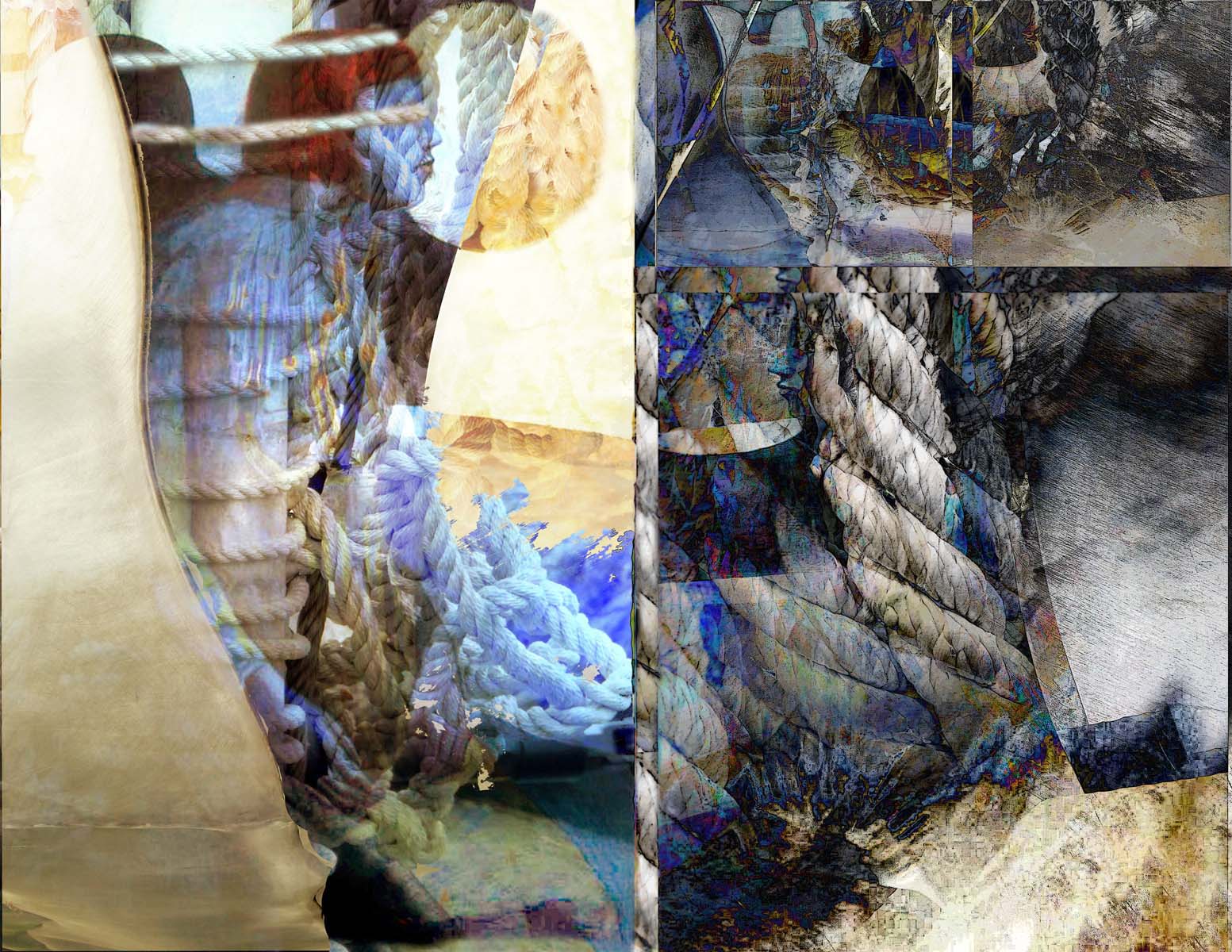
It did not, for me, until I embarked on a bit of reading about the history of string after I was stupefied by an archeological find that dates some 35.000 years back, a tool that allowed a small group of people working together to produce meters and meters of strong rope in about 10 minutes.
Single threads are not particularly useful. Twist them into yarn, though, or make yarn into strands, or strands into string and then ropes, and you have something that powerfully affects your interactions with the world. Our idioms tell the tale: learn the ropes, spin a yarn, hang by a thread, tie the knot, thread the needle, string along, cut the cord, moral fibre, loose the thread – where was I?
“A string can cut, choke, and trip; it can also link, bandage, and reel. String makes it possible to sew, to shoot an arrow, to strum a chord. It’s difficult to think of an aspect of human culture that is not laced through with some form of string or rope; it has helped us develop shelter, clothing, agriculture, weaponry, art, mathematics, and oral hygiene. Without string, our ancestors could not have domesticated horses and cattle or efficiently plowed the earth to grow crops. If not for rope, the great stone monuments of the world—Stonehenge, the Pyramids at Giza, the moai of Easter Island—would still be recumbent. In a fiberless world, the age of naval exploration would never have happened; early light bulbs would have lacked suitable filaments; the pendulum would never have inspired advances in physics and timekeeping.” (Ref.)
We lace our shoes with string, we get sewn up on the operating table with string, our clothes are woven from twisted fibers, and much of what is tied in knots depends on cordage. Hunting or camping involves plenty of ropes. String has been used as a form of mathematical expression by indigenous people in South America thousands of years ago. A system of knots and tassels hanging from a central strand would record census data and tax information. The language of modern technology refers to strings and threads as well – string theory, web-sites, links, Threads (e.g. the replacement site harboring all of us fleeing from formerly known as Twitter.)
One of the biggest and most consequential uses of string were, of course, the ropes and woven sails that enabled naval exploration: centuries of warfare, colonialism, but also economic trade and scientific exploration depended on cordage that made those boats functional. It was not just the rigging of sails. You also need rope to tow ships, and, to this day, tie even modern ships in harbor. You need hoist cables for cranes, winches, and dumbwaiters as well as woven fenders.
The history books tied rope making to early inventions and practices in Egypt, between 2000 and 1750 BCE. But archeologists knew of much earlier use by indigenous people of ready-made threads, like grasses, vines and pliable roots. Eventually people discovered that you can twist the fibers extracted from plants and animals into ropes, with pliable plants like agave, coconut, cotton, willow, and pond reeds producing strong fibers.
Here is the finding that blew my mind: archeologists unearthed tools made in the Paleolithic, some 35.000 – 40.000 years ago, that were used to manufacture rope. Excavated from a cave in southwest Germany, these are ivory batons, about 8 inches long, that have four holes containing 6 precisely carved, sharp spiral grooves.
The scientists experimented with replicas of the tools (called a Lochstab in German) to see what could possibly be processed with them.
“Individual holes of the Lochstab did not prove effective for pretreating sinew, flax, nettles, and hemp, but we achieved positive results for cattail, linden, and willow. Cattail was particularly applicable because the Lochstab could help to remove the starch for consumption by crushing the outer harder surface of the stems while separating the fibers for cordage. The use of cattail for making rope is well documented ethnographically, and archaeological accounts exist, in particular for later periods. Cattail is highly useful for food, cordage, and basketry.
The tool’s relevance lies in making thicker, stronger rope consisting of two to four strands. We twisted and fed bundles of cattail leaves through the holes. The holes help to maintain a regular thickness of the strands and facilitate the addition of new material necessary for making long stretches of rope. The grooves help to break down the leaves and orient the fibers while maintaining the torsion needed for rope making. The four-holed tool is then pulled with regular speed over the strands . Behind the tool, the strands combine automatically into a rope as a result of their twisting tension. The number of holes used determines the thickness of the rope. Because one person is needed to twist and maintain tension on each of the strands and one to operate the Lochstab, three to five people would be needed to use a four-holed Lochstab for rope making. Our experiments using cattail and four or five participants typically produced 5 m of strong and supple rope in 10 min.”
What fascinates me is not just that they figured out this tool per se. Using it also required social cooperation, communication and shared goals, bonding the people to each other and thus gaining an advantage over groups that had less developed technology and reciprocal labor. Shared labor led to in-group cohesion, augmenting survival. 35.000 years ago!
Here are some musical references to skipping rope – a childhood activity I preferred much over tug-of-war, wouldn’t you know it. There is Ukrainian composer Viktor Kosenko‘s 24 Children pieces that include jumping rope, Khatchaturian‘s Skipping rope, there is the Children’s Suite Op. 9 by Ding-Shande, really a sweet piece also referring to jumprope, and a piece for harp by Carlos Salzedo that includes Skipping Rope.
We will never know the exact number of children traumatized in today’s world, with its wars, environmental catastrophes caused by climate change, hunger, disease, and violence empowered by entrenched racist and caste systems.
Artists have taken on the task of drawing our attention to the plight of these children in ways that make it possible to confront the horrors without being fatigued by pure statistic or scared by sensation-seeking news reports. One of the artists I most admire in this regard is JR (yes, he goes by initials only) who has created work that registers emotionally, makes us think about facts, and also generates income that he is donating to funds helping children afflicted by war.
An early series of his was Déplacé·e·s, a collection of super large images of refugee children that were shown in places that housed refuges who had fled from war, famine or social instability. Aerial photographs of 170-foot-long banners—carried by groups of people around the camp or a city—depicted the full image of a child. The project generated a lot of awareness about how many millions of refugees are currently on the move or settled under horrifying circumstances, in many cases.
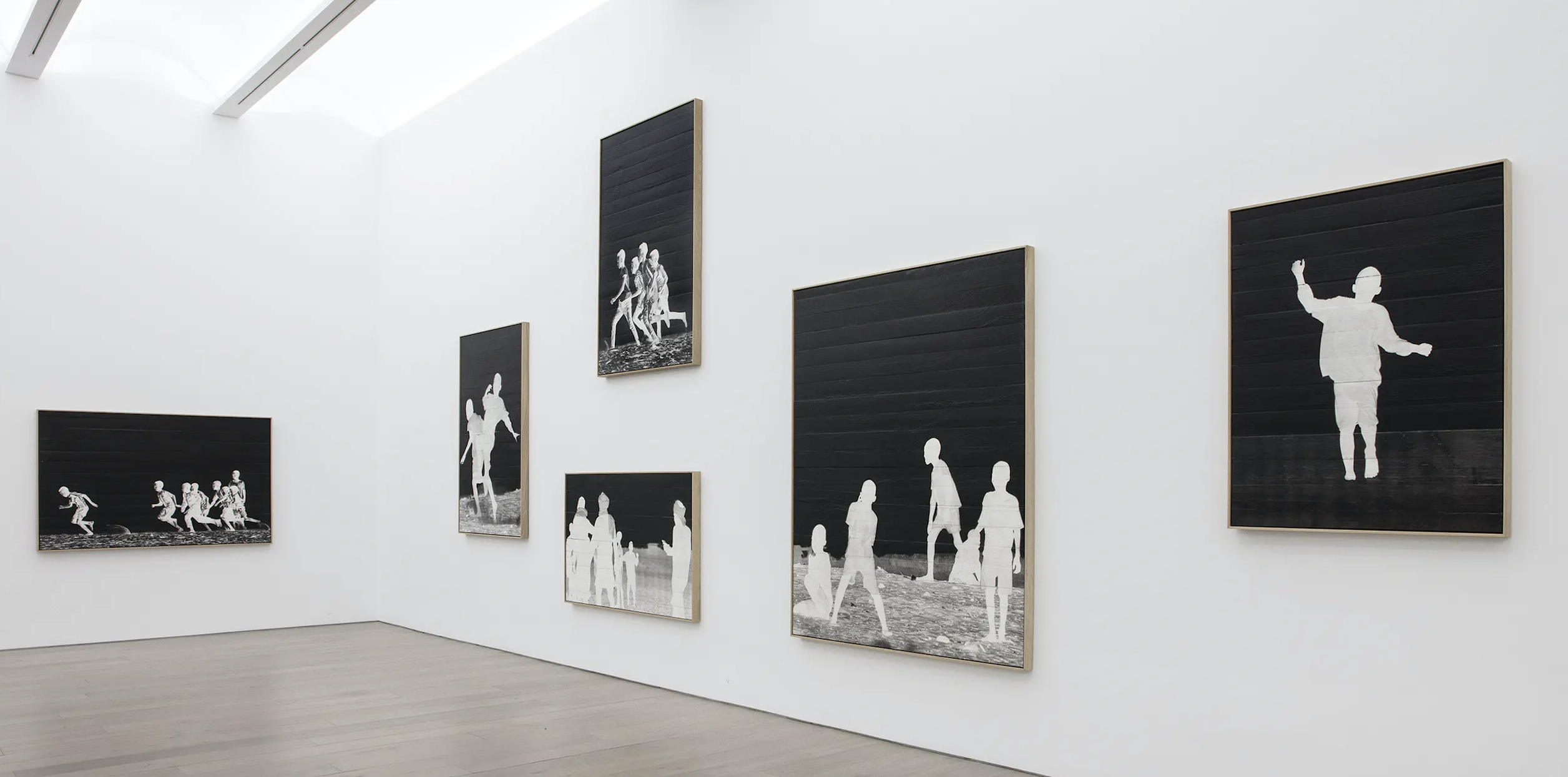
Currently, the artist is exhibiting a different way of displaying photographs of kids in refugee camps across Rwanda, Ukraine, Greece, Mauritania and Columbia, among others. Les Enfants d’Ouranos shows images that are photographic negatives transferred directly on wood, producing ghostly figures in a reversal of light and dark. The children, now anonymous silhouettes standing in for all of the displaced rather than an individual child, are bright, luminous, carriers of hope. Ouranos was the Greek God of the sky, creator of the Titans, and I wonder if his fatherly role, alluded to in the exhibition title, is that of punisher or protector. These kids are seen primarily running – away from something or towards something? Did this primordial God unleash the disasters, or is he in charge of shelter? Some of the work can be seen at the facade of the Parrish Art Museum in Waterville, NY, until the end of May. (All images are work of the artist.)
I want to talk today a little bit about what we know of what might happen when these children who lived through traumatic events have children of their own. My field of psychology and also the area of psychiatry has seen an increasing research focus over the last 40 years on how trauma is handed down through the generations. I will relate the story at the most basic level, leaving out most of the specific scientific details, because it matters to me just to get the idea across. For an in-depth overview, go here. That article will also refer you to many other sources, for investigations of specific traumas or ways of transmission.)
What we know: children of survivors of traumatic experiences are more likely to have behavioral or mental and physical health problems than children of parents, otherwise matched for age, education, financial status etc., who were spared tragedy in their lives. These can be externalizing problems such as hyperactivity, impulsivity, aggression, and rule violation, or internalizing problems that are characterized by worry, anxiety, depression, and social withdrawal. They can be bodily ailments like immune system deficiencies, asthma, autism-spectrum diseases, obesity or the propensity towards diabetes and heart disease, presumed to be modulated by the way stress affects the second and third generation.
The original traumatic experiences that were studied in humans range from the Holocaust, the Japanese Internment experience, the Vietnam War, the Cambodian and Armenian genocide, European and African hunger epidemics, slavery, the participation in Israel’s war in 1973, Palestinian displacement, to the exposure of an individual to repeated, serious childhood abuse or being victim to a sexual crime. Animal models have also been used to push our scientific knowledge further. Many researchers agreed that some of the effects of trauma on the next generation (intergenerational trauma) or even subsequent generations (transgenerational trauma) could be related to how generation 1’s experiences affected their own behavior, subsequent adjustment problems, including addiction, violence or suicidal ideation, as well as their parenting styles, aloof or overprotective, leading to problems with attachment for generation 2.
Yet scientists were curious if something else was going on in addition to what happened in the direct, day-by-day interactions between survivors and their children, interactions that of course shaped the lived experience of the children. This triggered a flurry of research into epigenetics, the study of how external factors can change or affect the ways our genes work.
Remember that we inherit our parents’ genes, with the DNA from the male carried in the sperm, and the DNA from the female carried in the egg. When sperm and egg merge they form a single cell, which then multiplies to supply us with all the different cells required to live. Throughout this process, every single cell in your body has the same genes, the same DNA. However, in each cell, some of the genes are activated and some are not; that’s how a single configuration of genes, shared by every one of your cells, can function differently in different locations and at different times. What’s at stake here is called “gene expression” – with the pattern of gene expression in your liver cells making sure those cells function as liver cells should, with the pattern of expression in your nerve cells making sure neurons do neuron things, and so on. One catalogue of genes (i.e., one “genome”) throughout, but different expressions of that genome governing the function of the DNA in each individual cell.
What governs gene expression? Basically, it’s the immediate chemical environment of that specific cell, which in turn is governed by a variety of other factors, including factors in your environment. In other words, your environment has a powerful influence on gene expression, and so your environment has a powerful influence on how your genetic material operates.
But now we add two further steps: First, it’s crucial that, when the DNA is passed to the next generation (through sperm and egg), the DNA molecules that are passed onward are (like any DNA molecules) molecules with a particular pattern of gene expression. In other words, in the DNA that’s passed to your offspring, some of the genes are currently “switched on,” and some of the genes currently “switched off.” In this way, the pattern of your experiences (which – again – influences gene expression) can literally alter the specifics of the genetic pattern you pass on to your offspring.
Second, trauma turns out to be one of the experiences that matters for gene expression, basically changing how someone’s DNA functions. In particular, trauma changes the expression of genes important for glucocorticoid function – a body chemical that’s crucial for how someone responds to stress. The result? The person (because of this change in glucocorticoids) may be overreactive to stress, and may have unhealthy cortisol levels.
Putting these pieces together: Trauma influences gene expression, and (part of) the pattern of gene expression is transmitted to your children, through your DNA. As a result, parents who have expressed trauma literally change the biology of their children. And, again, this is a purely biological, genetic transmission, in addition to whatever ways the behavior of (previously traumatized?) parents can alter the lived experience of the children raised by those parents.
I am not a biologist, so a lot of the details go beyond my comprehension. But I did learn that multiple variables correlate with different outcomes. So, for example, both maternal and paternal trauma can affect gene expression that then gets inherited by the next generation. It matters how old survivors were at the time of trauma, it matters what gestational phase the fetus is in, if the trauma occurs during the pregnancy and not before. Boys and girls are differently affected. Some studies (with very small sample sizes, so caution) say that the effects of gene expression are even more detrimental in the 3rd compared to the 2nd generation.
What conclusions are drawn? “At the present time, the field has not sufficiently grappled with the meaning of the intergenerational transmission of trauma effects for the offspring. It could be argued that this transmission is indicative of increased vulnerability. On the other hand, this transmission may extend the adaptive capacities of offspring through a biological preparation for adverse circumstances similar to those encountered by the parent. Ultimately, the potential utility, and possible stability, of an environmentally induced trait transmitted to an offspring will depend on the offspring’s environmental context.”(Ref.)
Honestly, that seems a bit bland and falsely comforting by not confronting the fact that so many trauma survivors are part of a multi-generational system. When you think about the historical backdrop of Jews’ experiences across time in this world, or that of Blacks, or the inhabitants of the Republic of Congo, or large numbers of Ukrainians, or Palestinians who have been displaced, killed and oppressed for many, many generations, increased vulnerability through a lineage of multiple survivors is likely to trump adaptive capacity.
We know how war and famine have immediate horrifying effects for those experiencing them. Captivity, whether as a hostage, a prisoner of war, or a human being fenced in a concentration camp or a strip of land with closed borders, with death looming above you or raining down, will do irrevocable, life-long damage to those who survive. Starvation, whether through natural famines, or the intentional withholding of food, during Stalin’s purges of Ukraine or the Israeli war cabinet’s decision to cut off food to the Gazan population, will change the health status of several generations down the line.
Terror and war are, as we now know, generating wounds for those in the future, generations of children who will be affected by the suffering of their parents and grandparents and great grandparents, with gene expression turned on or off in ways detrimental to their health. It will potentially feed into new cycles of violence, perpetuating trauma.
Music today is a contemporary song about refugee children.
Also a modernist’s reaction to war: Richard Strauss’ Metamorphosen.
Today I am offering a selection of favorite photographs from New Mexico. Reading a few things related to the new film that was hyped this weekend, Oppenheimer, led me to peruse the archives.. (I did not go to Los Alamos, so no footage from there.)
I have not seen Oppenheimer despite being quite interested – I have to be patient until it streams. So, my own review has to wait, but I do suggest you check out an author who I usually completely agree with, Greg Olear from Prevail (one of my all time favorite writers.) Here is the link to his assessment of the film.
And here are some choice words by another author about the depiction of nuclear testing in NM, with a side of the story apparently not fully, if at all, covered in the movie. Here is Alisa Lynn Valdes, a journalist and film producer from Albuquerque, NM:
“This quote, from the @nytimes review of the OPPENHEIMER film: “He served as director of a clandestine weapons lab built in a near- desolate stretch of Los Alamos, in New Mexico” It was inhabited by Hispanos. They were given less than 24 hr to leave. Their farms bulldozed.
Many of those families had been on the same land for centuries. The Oppenheimer’s crew literally shot all their livestock through the head and bulldozed them. People fled on foot with nowhere to go. Land rich, money poor. Their land seized by the government.
All of the Hispano NM men who were displaced by the labs later were hired to work with beryllium by Oppenheimer. The white men got protective gear. The Hispano men did not. The Hispano men all died of berylliosis. These were US citizens, folks. Their land taken, animals killed, farms bulldozed, forced to work for the people who took everything from them, and killed by those people.
For 20 years I have been trying to sell a film based on the story of Loyda Martinez, a remarkable whistleblower whose family’s land was seized for the labs. Her dad was one of the men who died from beryllium exposure at the labs. She later went to work there too. She is a computer whiz who rose to the top of her department at Los Alamos. Then she started digging for info on the Hispano men the labs killed, like her father. She filed a class action lawsuit, and won. The first Hispano governor of NM, Bill Richardson, appointed Loyda to run the state’s human rights commission. She then filed a second class-action against Los Alamos, on behalf of women scientists not paid fairly.
But, no. We want more films about the “complex and troubled” “heroic” white men, who conducted their GENIUS in a “virtually unpopulated” place. These are ALL lies. This is mythology in service to white supremacy and the military industrial complex, masquerading as “nuanced.” Because of what the labs did to the local Hispano people in northern NM, our communities now have the highest rates of heroin overdose deaths in the nation. The generational trauma and forced poverty is outrageous. We need the real stories of Oppenheimer to be told.”
We are talking tens of thousands of people who lived within a 50 mile radius of the test site. These downwinders are still seeking justice after the federal government’s exposure of citizens to nuclear fallout 78 years ago. The Tularosa Basin Downwinders Consortium, founded in 2005 by a victim descendant Tina Cordova and others, is trying to expand a government program, RECA, to compensate for the damage done. (The link above brings you to an informative website).
The Radiation Exposure Compensation Act (RECA), passed in 1990, came after decades of above-ground testing in the American West and Pacific Islands, but did not acknowledge the victims from the NM site. It is also about to expire. A planned amendment that includes new populations and longer pay-out schedules is currently on shaky feet, being deemed ” too expensive.” In three decades, RECA has paid out $2.6 billion dollars to more than 40,000 people. That’s a fraction of a percent of the $634 billion the federal government plans to spend on nuclear weapons and development in the next decade, according to estimates from the Congressional Budget Office. (Ref.)
Cordova about the Oppenheimer film: “When they came here to develop the Manhattan Project, they invaded our lands and our lives, and they treated us like collateral damage. When they came here to make the movie, they took advantage of our tax incentives. They invaded our lands and our lives, and they walked away.”
In the meantime, there is always the book on which the movie was based, which has its own fascinating story. American Prometheus was co-authored by two men, Sherwin and Bird, after the former had a serious case of writer’s block or inability to stop extensive research into the topic, the other in dire need of a job and happy to push the project to completion. It took about 25 years. Martin Sherwin died a couple of years ago. Kai Bird was interviewed at length last week here. The tome will tie me over until the movie becomes available on streaming sites!
Music had to be John Adam’s Dr. Atomic even though I don’t like it.
Alternatively let’s listen to Master’s of War by Dylan. Building shelters won’t help….
“When you find out that you are ill, your priorities are shattered. One moment you are in a boat, and the next moment you are in the water…. Once you’ve experienced being mortally ill and you’ve come back, you have learned something that’s worth knowing.” – Susan Sontag
***
THESE DAYS I seem to meet survivors wherever I turn. I can’t decide whether that’s a good or a bad thing, good for the outcome, bad for the frequency of affliction. Yet every cancer survivor who I’ve encountered, or for that matter anyone diagnosed with any life-threatening illness, can relate to Sontag’s words. They were uttered in an interview in 1988 when she had successfully navigated a return to the living from metastatic breast cancer, and before she was diagnosed a decade later with an unrelated uterine cancer. Ultimately, the treatment required to fight these cancers led to yet another one, t-MDS or therapy-related myelodysplastic syndrome, a then untreatable variant of leukemia. She died in 2004.
You are in the boat one moment, and the next you are in the water. The possibility of drowning looms large, but there is still a chance to swim, if you are lucky, strong, determined – and were taught to swim in the first place.
I was thinking of that during my visit with Laura Ross-Paul at her studio last week, meeting the artist for the first time to talk about her upcoming exhibition, The BrEaST Show, at The Nine Gallery (inside Blue Sky Center for Photographic Arts.) Ross-Paul found herself in the water in 2003, diagnosed with breast cancer, and after intense research opted for what was then experimental cancer treatment, being the very first breast cancer patient in the U.S. to undergo a procedure called cryo-ablation. She has shared what she learned ever since she’s come back on land, as an activist as well as an artist. It’s worthwhile knowledge for the rest of us as well, and the exhibition will provide the perfect forum to get informed in addition to see a painter yield color with admirable abandon.
Depending on the type of breast cancer, a person’s surgical options are mastectomy (a full removal of the breast,) lumpectomy (removal of a small part that contains the tumor,) and and now cryo-ablation, a surgical procedure that involves inserting a stainless steel probe directly into the tumor. The thin probe carries cold argon gas down an outer tube to the sealed tip of the probe, then the gas expands as it returns through an inner return tube to the gas delivery system. This makes the probe tip extremely cold, which freezes the surrounding tissue into a controlled, spherical shape with safe margins around the tumor to insure that the entire tumor is killed. (You might have encountered a version of this procedure during a visit to the dermatologist, where they use cryo-ablation to freeze off some of the undesirable growth on your skin.)
There are clear advantages to cryosurgery, breast preservation looming large for many women and/or their partners (which turns out to be something of a conundrum: how to proceed if the husband wants breast preservation at all cost, and the wife would like to avoid experimental procedures in the interest of the tried and true, the knife?) Other benefits come in multiple forms: you avoid major surgery with all the potential problems associated with it. Damage to surrounding tissues is limited. It can be used in conjunction with other cancer therapies, including hormone therapies and targeted immunotherapy which activates our body’s own defenses against the cancer. It is much cheaper (although not all insurance policies cover it) and can be done in a relatively quick in and out procedure, often with local anesthesia only, not requiring a hospital stay. And there is some evidence to suggest that the dead cancer cells, absorbed into the body, stimulate the immune system to recognize cancer on further occasions.
The big question, like for any new procedure, is, of course, does it work?
The answer is as you’d expect: it depends. The great news first (great, because it applies to all cancer types, not just a subset, thus helping the largest number of people): it is an extremely effective palliative approach for patients who cannot be cured of the diseases, but who can receive pain relief by destroying large tumors through freezing, or any tumors in locations that cannot be reached by any other surgical means, when the cancer has spread to the bones or the liver. It can buy time for patients who are too old or otherwise not able to survive conventional surgery.
The good news next: it is an option to cure you from cancer, rid you of the scourge, IF certain conditions apply. On averaged, the best candidates for this method are patients whose tumors are smaller than 15 mm, hormone receptor–positive, and HER2-negative, and have NOT metastasized into the lymph system. In other words, if you have a low-risk, non-aggressive cancer that is detected early in its first stages, cryo-ablation is ensuring survival as well as preserving your breast in full. Many clinics and cancer centers in the U.S. are offering the procedure these days, with China having embraced it full scale and developed specific immunotherapies in conjunction with the surgery, as Ross-Paul told me.
There seem to be few side effects, if any; according to the artist who also received the immunotherapy, she was advised to forgo inoculations for other diseases, which might be a problem in the age of pandemics, or age-related vulnerability to other scourges like shingles and pneumonia. There are certainly research data that show a problem for patients with active cancers undergoing immunotherapy who also received the Covid-shots: it can lead to averse reactions, including a flare of tumor growth.
***
ON MY WAY HOME I was searching for a term that best encapsulated my first impressions of the artist. Spirited, curious, plucky, driven – none seemed to fit the bill, until it dawned on me: undaunted.
As a patient, undaunted. As a pioneer subject for medical research, undaunted. As a pedagogue employing art as social practice, undaunted. And last but not least, as a painter, undaunted. Patient, pioneer, pedagogue, painter: colloquially expressed, the woman has balls.
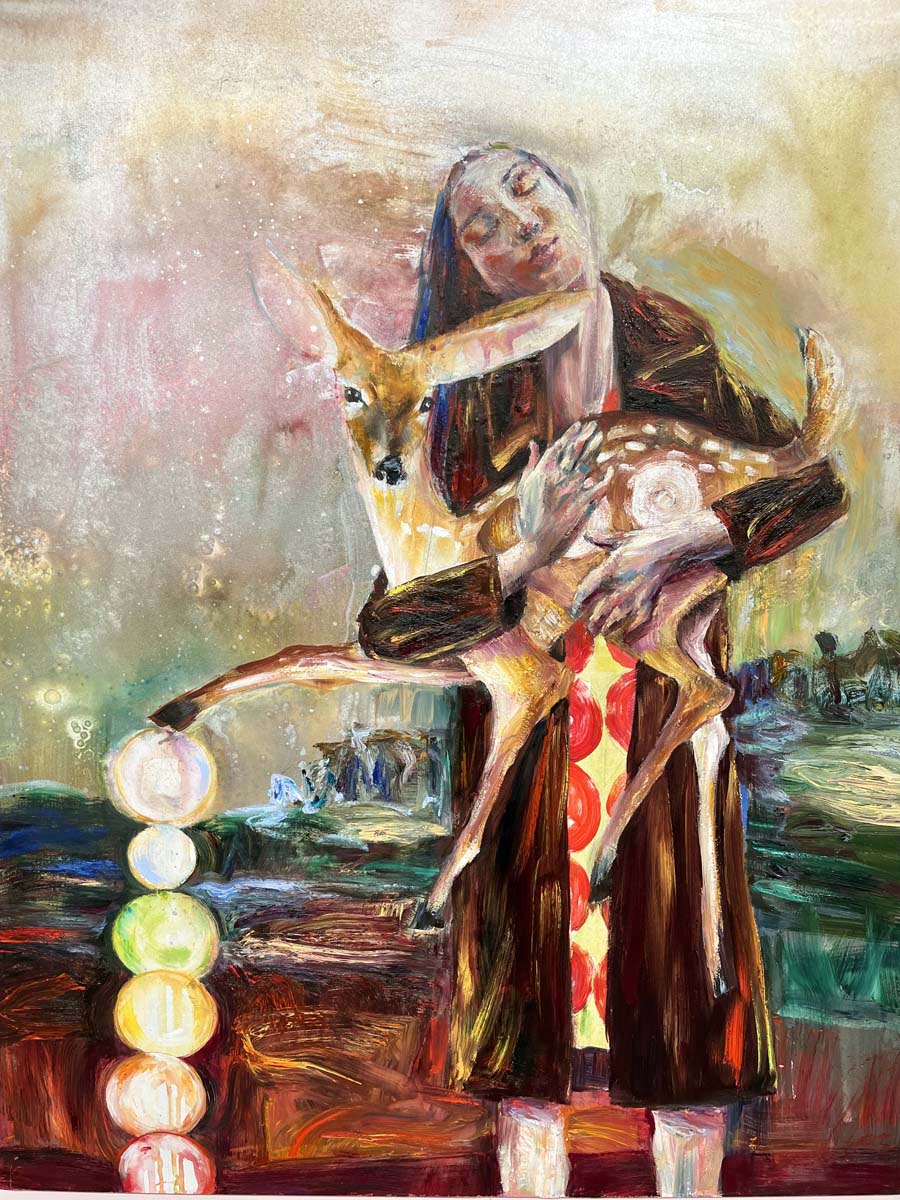
The pun, of course, applies to a recurring motif in the work to be exhibited as well. Balls, spheres, round configurations appear in the paintings as symbols linking to breasts but also the spheres of frozen tissues that saved her life as well as her physical integrity. Pearls of wisdom rain down from various sages emblematic of her learning curve during an extensive period of research to find a way to retain unblemished breasts while staying alive, her husband, award-winning author Alex Paul, and her children foremost on her mind, since she herself was orphaned at a young age.
Balls are on a dress, when exploring the possibilities of many treatment options, trying the freezing bubbles on for size. Balls are stacking up during treatment, patient now enveloped by the argon bubbles of the dress, and balls can be freely juggled, shedding the illness, leaving an impression of joyous return to a more playful life.
Spheres also appear on the cervid companion, for Ross-Paul a symbol of the innocence that is lost when you encounter existential dread. For me it evoked more of a “deer in headlight” reaction, the fear that paralyzes you at times if living with cancer. Wouldn’t want to embrace that. But then again, I’m also on the war path with these creatures who devour my beloved garden in their nightly visits, so not a neutral observer. Real-life Bambis be gone!
The accumulated work gently guides you through the stages of treatment selection and process, with a focus on the importance of collecting data, having a radar for possibilities, making decisions based on scientific information (for me an example of being “taught how to swim” that I mentioned earlier – it takes an educated person aware of resources and able to discern the quality of information.) This is really the part where Ross-Paul’s educational activism comes to the fore – visual pointers so often more effective than a complex written literature on an unfamiliar topic. She communicates ideas that, in turn, allow you to ask questions of your doctor. This is in parallel to a book she co-authored with her husband and her Doctor, Peter Littrup, M.D., which explains the journey in all of its details.
The painterly work extends to “art as social practice,” a domaine that involves participatory engagement between community and artist, when we look at the many portraits she painted in collaboration with sitters who had opted for the experimental treatment, connecting from across the world. In some ways I am reminded of earlier projects that crossed lines between art and education, if on a different scale. Miriam Schapiro and Judy Chicago’s Womanhouse in Los Angeles—which was part art installation, part educational facility, part performance space in the 1970s, comes to mind, given its focus on women’s concerns. Portland State University, by the way, has an increasingly recognized Art and Social PracticeMFA program, with an archive established in 2018, well worth exploring.
***
“There is silver blue, sky blue and thunder blue. Every colour holds within it a soul, which makes me happy or repels me, and which acts as a stimulus. To a person who has no art in him, colours are colours, tones tones…and that is all. All their consequences for the human spirit, which range between heaven to hell, just go unnoticed.” – Emil Nolde, from Emil Nolde: Die Farben sind meine Noten.
***
WHATEVER YOU THINK of Emil Nolde, one of the pioneers of German Expressionism, his work with color reigns supreme. (I have written about his anti-Semitism, his Nazi-affin politics and the incredible research by art historians that went into unraveling the clash between political identity and art of the painter here.) At times his colors do not only sing, they scream. No wonder, that one of the largest retrospectives of his work in 2018 at the National Galleries of Scotland was titled Colour is Life, while a 2019 one at the Hamburger Bahnhof – Nationalgalerie der Gegenwart in Berlin, Germany was called Emil Nolde. A German Legend. The Artist during the Nazi Regime.
The vibrancy and levels of saturation of many of Ross-Paul’s paintings remind me of his work, using electrifying color as a means of communication rather than a tool for verisimilitude. Her exhibits, if you peruse the show in order, will transition from more muted colors to a riotous slate that is the perfect carrier for the emotional palette the artist intends to invoke. When I said earlier that she is an an undaunted painter, I was motivated by the artist’s generous use of pink. Pink on the surface of the paintings, but also on the sides of the canvasses which are embedded in some sort of reflective frames that emanate a kind of rosy halo.
Pink is a curious choice for a breast cancer survivor who is also a progressive activist. Before I explain, let me say that I ended up liking the pink more so than I had anticipated, or maybe I adored the attitude of an artist who ignores symbolism when it interferes with her sheer love of color and her desire to convey some hope on the horizon. Pink, after all, reflects dawn, the beginning of a new day, not a gentle color slide into the night.
Pink is a color associated with breast cancer since the early 1990s, when Evelyn Lauder (of Estée Lauder) established the Breast Cancer Research Foundation, with pink ribbons becoming a universal symbol for the disease. Of course, the disease had been branded before – the American Cancer Society and Imperial Chemical Industries (now part of AstraZeneca, which makes several breast cancer drugs), launched Breast Cancer Awareness Month in 1985, originally intended to encourage women to get regular mammograms.
What was meant to help address the rising number of cancer diagnoses and deaths (over 4 million people have a history of breast cancer in the U.S. alone, with 43.700 expected to die from breast cancer in 2023 in this country,) has, alas, become an exercise in pinkwashing. One of the definitions goes along these lines:
Pinkwasher: (pink’-wah-sher) noun. A company or organization that claims to care about breast cancer by promoting a pink ribbon product, but at the same time produces, manufactures and/or sells products containing chemicals that are linked to the disease. (Ref.)
It is desire for profit, not compassion or education that drives the association between products with pink ribbons and inspirational quotes, particularly during October, Breast Cancer Awareness month. Some companies donate a portion of the income to the cause. Others disappear with the proceeds. We are asked to donate with total uncertainty if the funds arrive at their destination: the patients.
Some of the inspirational words, however, ring true enough that they deserve to be put up on the fridge, where my assorted collection of wisdom resides these days, for the most part.
Breast cancer is a word, not a sentence.
Actually it’s 2 words. As is undaunted painter, who already in 2003 upon diagnosis decided to take her fate into her own hands and acknowledged that her breast mattered and a mutilation of her body was unacceptable, ceteris paribus where survival was concerned. That goes beyond breasts and balls, into the realm of knowing yourself and being willing to fight for something truly existential. It was certainly the message I took home from her work that reinforced my own beliefs about living with cancer. There is no one way, no right way, no indisputable way of dealing with what ails you. Just like grief (and plenty of that to go around with the loss of body parts, or decimation of life expectancy, or simply energy levels that will never resume the status quo), you have to find an approach that honors who you are and how your values manage to survive. Otherwise you might as well jump off a cliff, instead into a life net, provided by whatever therapeutic approach you choose.
“It’s unclear where she’ll land, but she shows trust that she’ll land alright.” – Laura Ross-Paul, July 17, 2003
***
The BrEaST Show Laura Ross-Paul
JULY 6-29, 2023 Opening: Thursday, July 6 5:00-7:30pm
NINE Gallery (inside Blue Sky Gallery) 122 NW 8th Avenue Portland, Oregon 97209
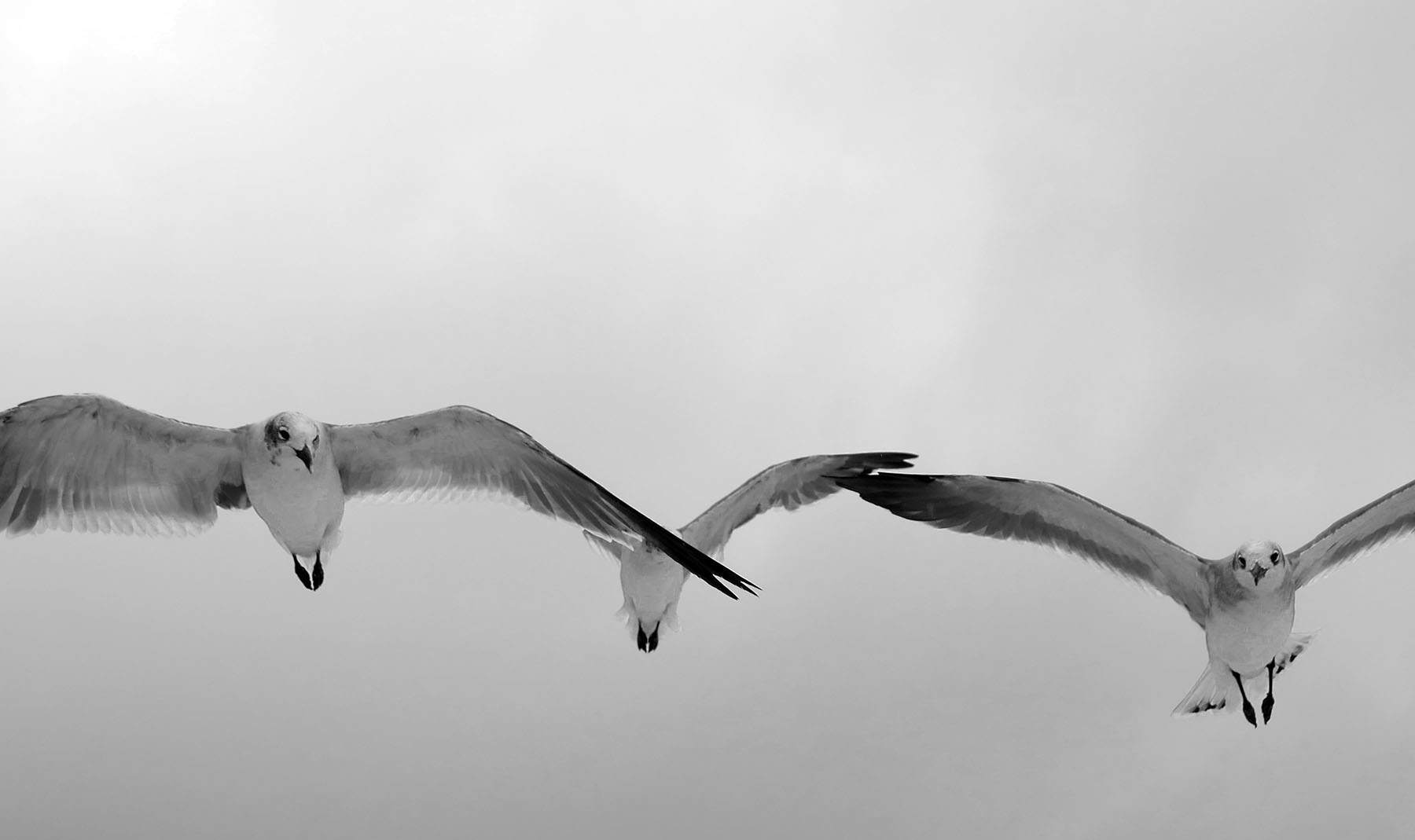
Alternatively, today’s musings could be titled “Of avenging orcas and lesbian gulls.”
Orcas: by now you have probably heard that parts of the Mediterranean are plagued by pods of orcas that have taken to disabling the rudders of sailboats, damaging the ships to the point where crews need to be evacuated and some boats having sunk. These are not isolated events – over 50 occurrences have been reported in just the last few months, involving a growing number of these mammals (it is believed there is only a total of about 60 orcas inhabiting that region.)
What on earth is going on in the Strait of Gibraltar? Some scientists believe that the killer whales are simply playful. A speaker for the organization OrcaIberica.org, for example, pointed out that the orcas don’t approach the boats with signs of aggression, nor display aggressive behavior during their attempts to break the rudders. They leave the people who evacuate into life boats in peace. The species is known to play and pursue fads in the process: there was a time when they all started to carry dead salmon on their heads for a while, and another one where they increasingly imitated the noises of sea lions.
Researchers at the University of St. Andrews, on the other hand, believe that a female who was hurt by a sailboat’s rudder in 2020, is modeling revenge, with more and more orcas now participating in the attacks where they bite, bend and break off the rudder, fighting off a perceived common enemy.
“Notions of collective self-defense in cetaceans (aquatic mammals including whales, dolphins and porpoises) are far from outlandish. We have accounts of sperm whales rising to each other’s defense when orcas attack, for example.”
It is assumed that the behavior spreads through social learning. What makes this so problematic, other than humans being thrown into the sea by a bunch of huge, toothed marine mammals, or destroying expensive boats, is the fact that this particular species is critically endangered. Political efforts to protect them will not be helped if people see them as actual “killer”whales, and if boat operators loose tourist income if they are simply asked to leave the marine habitat alone. Demands to cull the orcas are already emerging.
They are smart cookies. Captive orcas learn to regurgitate fish to use as bait for gulls, which they apparently prefer to eat over the fish, for example.
Which brings me to gulls – and the thought-provoking theme how science depends on societal approval, not just for funding, but even for research findings to see the light of day.
Gulls: I will summarize what you can hear on a fascinating RadioLab podcast in full. Lulu Miller, one of the hosts of RadioLab, wanted to showcase same-sex pairings in nature for Pride Month. She offers sea gulls, and many other species – and their sounds – as examples: “gay bonobo yelps usher in squeaking manatees; homosexual Amazon dolphins that love cuddling screech alongside male bottlenose dolphins who have sex (with each other) roughly 2.4 times per hour. Queer rattlesnakes and marsupials harmonize with homosexual bats who have sex upside-down while flying.” Many of these species are bisexual, but there are also small percentages of some species that are exclusively homosexual.
In the course of perusing the literature, she found how, across centuries, the scientific documentation of homosexuality in nature was suppressed. A 1999 compendium by Bruce Bagemihl, Biological Exuberance: Animal Homosexuality and Natural Diversity, revealed to her how much evidence was omitted from the scientific publications. Suppression also almost happened to the sea gull study by George and Molly Hunt, that showed about 10% of birds nested in same sex (female) pairs, having large clutches of eggs that they cared for together. Finally published in Science in 1977, the Hunts were condemned because of the study’s implication that homosexuality was, in fact, natural. Congress intervened, temporarily blocking the National Science Foundation budget because it had partially funded the Hunts’ research.
The (religious) denial that queerness exists in nature happens even in the face of findings that homosexuality can have adaptive advantage. (Well, I guess any concept associated with evolution is suspect…) For black swans, for example, heterosexual pairings experience a 30 percent cygnet (baby swan) survival rate, while homosexual pairs fledge 80 percent. Male-male pairs tend to commandeer larger pond territories, leaving them with more and better space for rearing their clutch. (Ref.) Miller, the podcast host, suggests that
“It’s not just swans who experience a version of this bisexual advantage. In many species, sexual fluidity enhances “conflict resolution, stress relief, hunting alliances, social fitness, pleasure, and survival rate of offspring.”
Let’s imagine, though, just for sake of thinking it through, that these scientific observations were different. Let’s imagine, perhaps, that we found that homosexuality was only observed in our species, Homo sapiens. That would not for an instant shake my view that condemnations of human homosexuality are offensive and utterly indefensible. In other words, the value judgment here has (and should have) roots that are deeper, more resolute, than the scientific findings! The science is intriguing, and may deepen our understanding of many points, but on this issue (and many others) human values about differences, inherited or chosen, need to have their foundation in immutable principles, not in the scientists’ observations of similar differences in the animal kingdom.
In case all this depletes your mood on a perfectly fine Monday morning, do I have the antidote for you: this clip of a flying squirrel getting out of a pickle made me laugh out loud. Nature at its best. (Of course, I couldn’t help but wonder: is this AI generated? We’ll never know.)
My thoughts have been occupied with the fate of certain vultures (real ones), so it is not surprising that the term came to mind when I read about the latest Supreme Court Decision today siding with (or acting as) proverbial ones, allowing developers and land owners to build and pollute in previously protected wetlands. Overall, the Sackett vs EPA decision gutted the Clean Water Act, a key 50-year-old piece of legislation to prevent pollution seeping into rivers, streams and lakes. The ruling undermines the EPA’s authority (a long term goal of those fighting the “administrative state”) and was disastrous enough that even justice Kavanaugh dissented. This comes of course on the heels of another ruling last year which curtailed the EPA’s ability to regulate planet-heating gases from the energy sector. Any hope to force industries to minimally fight climate change was scuttled.
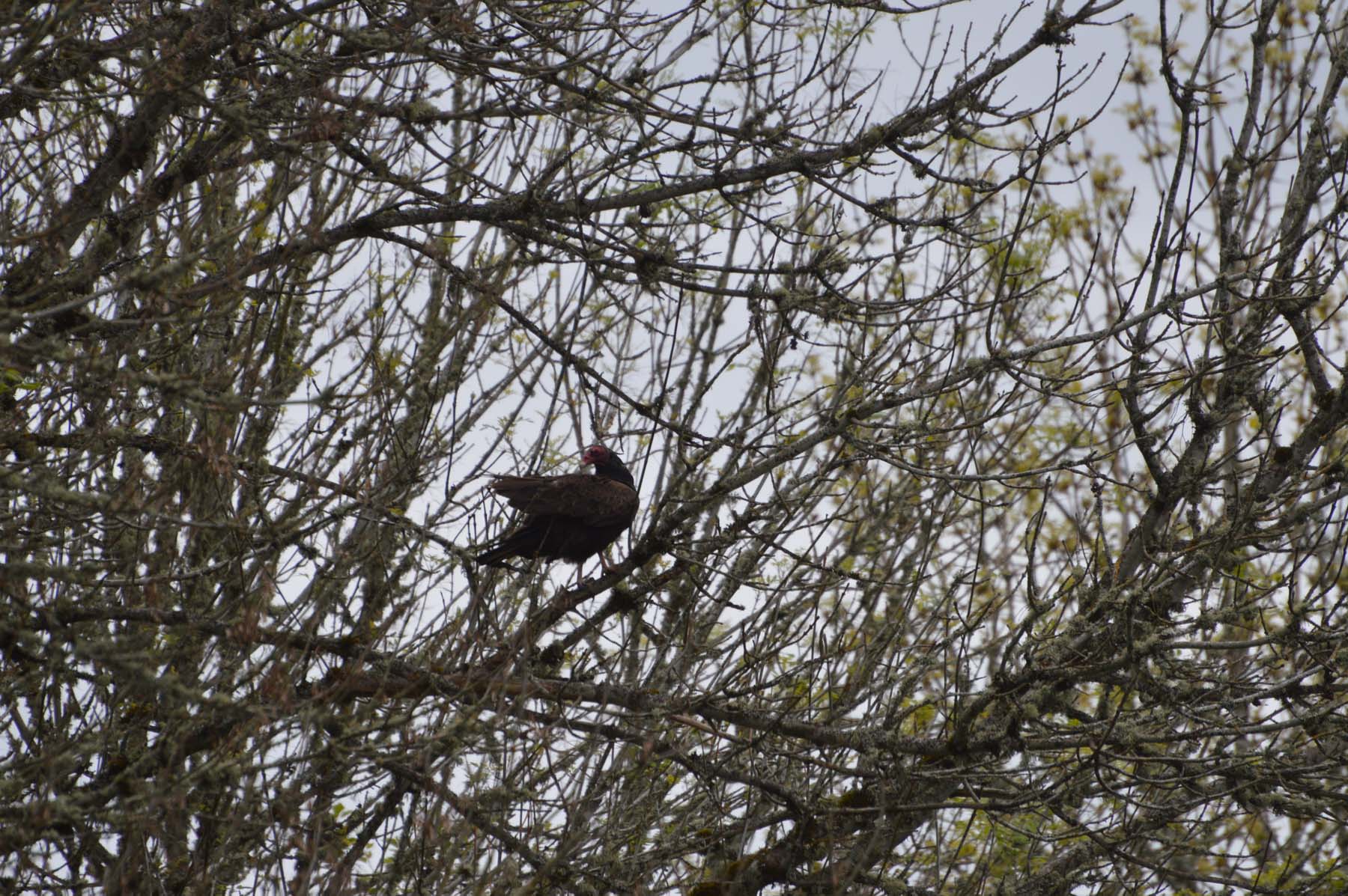
Of course I was looking at a vulture, when vulture thoughts emerged – the original thoughts not much happier than the ones following the SC news. As it turns out, some 90% of India’s population of vultures was wiped out across the last two decades. These birds play an enormous role in the health of that continent, because they devour rotten carcasses that otherwise spread disease to human populations. In fact, they were a means of picking corpses clean, human corpses who can’t be cremated or buried according to Zoroastrian religion. “Zoroastrians put their dead on top of a structure called The Tower of Silence where vultures devour the body in a matter of hours. It’s clean, efficient, eco-friendly. It’s how it’s been for thousands of years.” (I learned all this here.)
Scientists have been sleuthing for years and finally figured it out: the vultures died from kidney failure! But what caused that in all of these birds? Here’s the short version: it’s not a virus, bacteria or fungi, it not’s malnutrition or environmental toxins. It is the unintended consequence of human caring about – cows. They are holy to Hindus, and when they get old and suffer arthritic pain, they are given pain killers, the drug Diclofenac in particular. It’s in a class of drugs called NSAIDs, Nonsteroidal Anti-Inflammatory Drugs. That includes, you know, drugs like Advil, Motrin, Aleve, ibuprofen (which are of course also injuring kidneys in humans, if not taken appropriately.) The vultures eat the medicated cows’ carcasses, taking the drug in that way and it absolutely destroys their organs.
Here is the good news: once scientists had established the connection, the drug was abandoned across Asia (and replaced with other pain killers for cows,) and the vulture populations are slowly recovering. Emphasis on s l o w l y: they have only one offspring per year….
The vulture I saw was likely waiting to get a taste of Heuer, not all unlikely given the company I found myself in. Then again, it might have been rabbit for lunch.
I was walking for the first time this year on the Oak Island loop on Sauvie Island, which ended up not being a loop after all, since a quarter of it was completely submerged in water, forcing me to turn back the way I had come.
But the views were restorative, as always, birds happily courting or feeding their young.
A bald eagle hanging out, let me come surprisingly close while looking me straight in the eye from a position on the ground, no less; I later saw him flying away, maybe the starlings had gotten on his nerve.
Ospreys coming and going from their nest.
Almost enough joy to forget about black robed judges potentially bought by special interests, now delivering the spoils, environmental protection be damned. I better go find some more birds….
Quail on the run.
Time to re-up one of my go-to spring albums, Simmerdim.
After the catastrophe in Fukushima, Germany’s governing parties, abiding by a societal consensus reached as early as Chernobyl, decided in 2011 to phase out the last remaining nuclear reactors. It finally happened exactly a month ago, on April 15th, 2023.
Nuclear Power in Germany: Finally History!
Not so for the rest of Europe, where 12 of the 27 EU-nations insist that nuclear power is the way to go. They prolong the run times for old power plants and build new ones, with Poland planning to react 6 new reactors, and Holland, Great Britain Hungary and Slovakia not far behind. The largest producer of nuclear energy, 2nd only to the U.S., is, of course, France. They have 56 reactors, with 14 new ones in the planning stages.
This is all the more astounding since France has been facing a fiasco: they do not have enough electricity to meet domestic needs, much less export for economic gain, since in 2022 more than half of its reactors had to be shut down, at least temporarily, because of grave cracks, corrosion and general decay in its aging facilities, and because the summer heat and drought affected the cooling towers, with not enough water available, forcing them to be turned off. They are also grappling with political scandals around the falsification of documents that assured the safety of faulty construction materials for new reactors.
The fact that one clings to a path once chosen even if it makes no longer any sense is called “escalating commitment.” If done by you or me – “hey I stick with a job I don’t love, because I invested so much to get to this position in the first place” – it will only harm ourselves. Done by governments, it can harm a nation, or more.
Here in the U.S. we are seeing a version of this, with people granting that the old nuclear plants were bad, but also loudly proclaiming that the new small modular reactors (SMRs) will solve our energy crisis and propel us into a cleaner, cheaper future.
It ain’t so.
To find out why, you can watch Atomic Bamboozle at the Hollywood Theatre or at the Kiggins Theatre in Vancouver, WA, in case you missed the showing at Cinema 21 that I also advertised, some 2 months earlier. Highly recommended, given my vested interest in this film as part of the production team. The documentary will be shown in conjunction with PORTRAIT 2: TROJAN, a meditative short film on the day that the Trojan Nuclear Plant was imploded and decommissioned, by Portland-based artist and filmmaker Vanessa Renwick. In case my recommendation isn’t enough, here’s on from a more familiar name:
Of particular interest for the upcoming showings are several speakers, Joshua Frank and Kamil Khan among them, who will, in turn, introduce the project, and participated in a panel discussion.
Joshua Frank wrote Atomic Days – The Untold Story of the most Toxic Place in America. The book conveys the calamitous risks and staggering costs attached to nuclear power. The author is emphatically describing the threats implicit to all forms of nuclear energy production, not just from the left over underground tanks iat Hanford, currently corroding during ever delayed clean-up activities tagged at $677 billion and growing, tanks that are leaking radioactive broth from its 56 millions of radioactive waste into the ground water and Columbia river at Hanford, and that before the damage from a potential catastrophic earthquake.
There are also related, but perhaps less familiar perspectives that need to be amplified. Here is one of the relevant commentaries on the book:
Frank, by the way, will be also on site for a discussion/community reading of his book on Saturday, June 10th 3:30 – 5 pm at the Goldendale Community Library in the context of one of the most interesting and effective programs offered by the Fort Vancouver Regional Libraries: Revolutionary Reads. (Details in link.)
Kamil Khan is the new executive director of Oregon Physicians for Social Responsibility, who just recently moved to Portland. Hailing originally from Pakistan, a nuclear-capable power, he is, in his own words, aware of some of the implications of its use.
“What those celebrations of (underground nuclear testing) did not factor was the environmental and social costs of testing, maintaining, and expanding the nuclear arsenal. I firsthand saw the ramifications of a bloated military budget and the divestment from necessary social programs as a result. I was also privy to the lack of political stability and scapegoating of “enemy” countries; this nuclear flexing was a compounded abomination to the very real human suffering occurring on the daily.”
Other speakers and panel discussants are
• Jan Haaken, director and documentary filmmaker • Samantha Praus, producer • Lloyd Marbet, executive director Oregon Conservancy Foundation • Patricia Kullberg, Oregon Physicians for Social Responsibility, moderator.
Photographs today are from the Hanford site and region, where the documentary film crew spent time last summer. Music is self explanatory…
This spring, first Ohio’s and now Tennessee’s Governor signed laws that designate methane gas as “green” or “clean” energy. The legislation is pushed as part of a growing industry-funded strategy to delay climate action by codifying misinformation about natural gas into law – and make no mistake, methane is a fossil fuel, a powerful greenhouse gas. We are following closely in the footsteps of the European Union where this kind of designation meant that billions of dollars that were intended to fund climate-friendly projects could legally be used for methane power plants and terminals. But Tennessee is going a step or two further to serve the interests of the fossil fuel industry:
“The fact that methane gas is now legally “clean energy” in Tennessee is a benefit for TVA and its planned methane gas expansion. And it’s not the only recent bill that benefits TVA. Last month, Rep. Clark Boyd sponsored a bill that makes it a Class C felony to interrupt or interfere with “critical infrastructure” like pipelines. In February, Boyd also sponsored a bill to block any future bans of gas stoves. Last year, Tennessee lawmakers passed the Tennessee Natural Gas Innovation Act, which legally categorized methane gas as a source of “clean energy” for utilities. They also passed laws preventing local governments from blocking fossil fuel infrastructure and the state from working with banks that divest from fossil fuel companies.”(Ref.)
The favoring of capital over science in the context of climate change might have the most dire long term consequences, but an anti-science stance, increasingly and fervently pursued internationally by right-wing forces, has immediate impact as well, as we saw (and see) in the context of the pandemic. Antiscience is the rejection of mainstream scientific views and methods or their replacement with unproven or deliberately misleading theories, often for nefarious and political gains. Antiscience is invading the courts (think about the “un-scientific” reasoning in the S.C.’s Dobbs decision) and the educational system (think about Florida’s purging of text books, for example, or the general push to dismantle public education, so that private schools can pick and choose their curricula.
Historically, antiscience was not an exclusive domain of the Right – if anything one of the greatest antiscience authoritarian of all times was Stalin, whose “beliefs” starved millions of people to death. In the U.S. the Republican Party was actually open to science for some decades: The National Academy of Sciences was founded in the Lincoln administration; NASA in the Eisenhower administration, and PEPFAR (U.S. President’s Emergency Plan for AIDS Relief), PMI (President’s Malaria Initiative) and the NTDs (neglected tropical diseases) program were launched in the George W. Bush Administration. All this has obviously changed since 2015 when anti vaccers took over and “Health Freedom” became a rallying cry – look at the legislation signed this week by Governor DeSantis and weep. Both medical treatment and medical research are adversely affected.
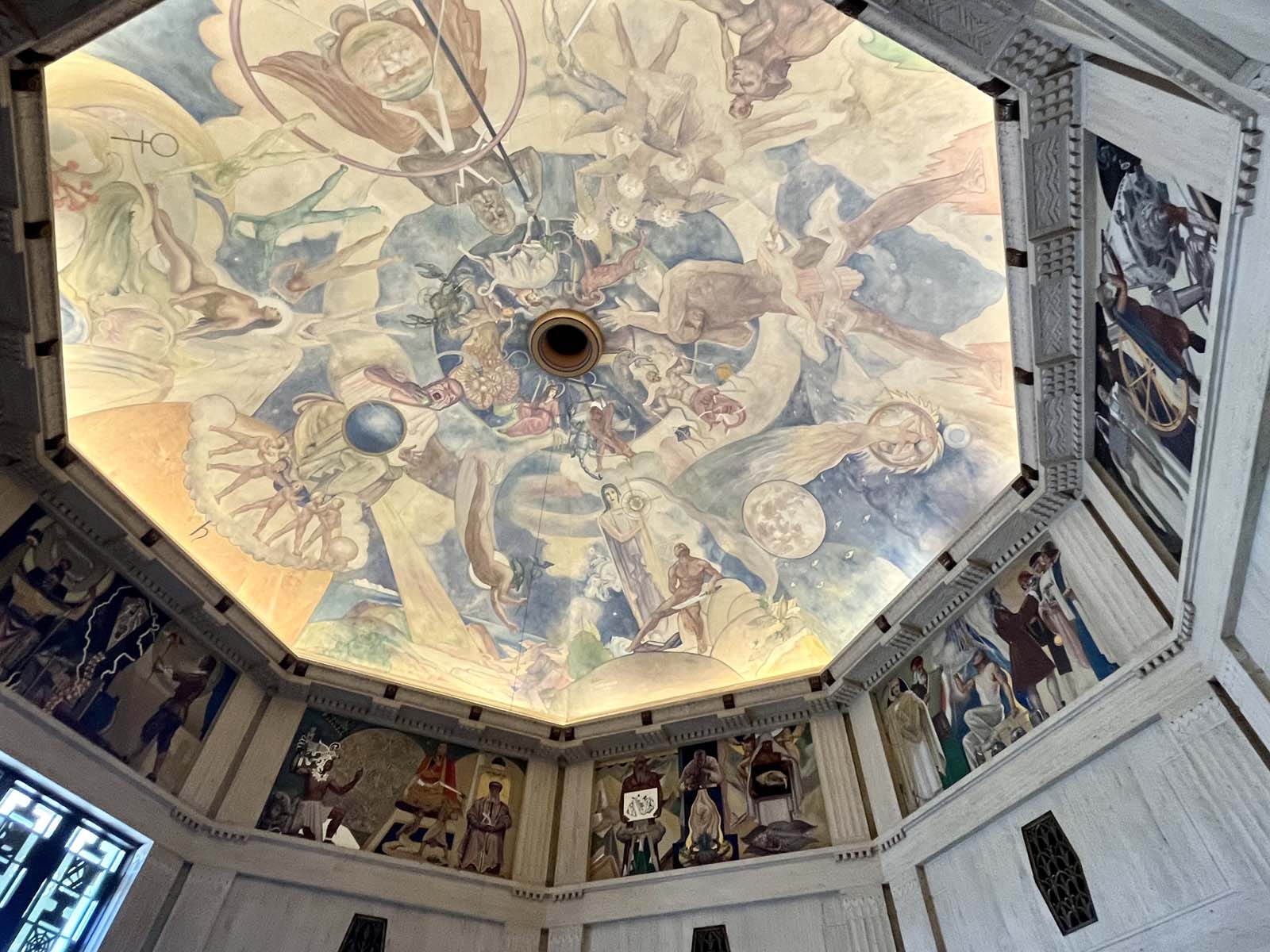
All this swirled through my head when looking at my photographs of Los Angeles’ Griffith Observatory, and its wall and ceiling murals created in 1934 by Hugo Ballin that celebrate science and scientists.
Beyond appreciating the vistas of the approach path to the observatory and the beauty of the building itself, it is really the idea of what science provides and how it moves us forwards, potentially rescuing us, that matters.
The panels on astronomy, aeronautics, navigation, civil engineering, metallurgy and electricity, time, geology and biology, and mathematics and physics celebrate science, and scientists, including path breaking ones from ancient times and non-Western regions. Will kids, traveling in large school classes, who are no longer educated in the history of science or science’s importance even understand why is depicted and why?
Ballin was onto something there, although he was somewhat conservative at heart. In fact his clinging to traditional mural subjects, techniques and representation stood in stark contrast to the progressive muralists of his times, like Diego Rivera, José Clemente Orozco and David Alfaro Siqueiros who conveyed social and political messages on public buildings. Then again, their work was eventually whitewashed, while Ballin’s embrace of the old-fashioned Beaux-Arts style made his work survive.
Born to German Jewish immigrants in NYC, the artist made his way out West to join the silent film industry, with little success. His career as a painter and muralist for civic institutions, on the other hand, took off. His impact and importance for L.A.’s Jewish community is described beautifully here with lots of historical photographs for specific projects (e.g. the observatory here.). I found the link on a generally very helpful site, UCLA’s Mapping Jewish L.A., that has numerous interesting digital exhibitions.
The art itself did not do much for me, but the ideas that propelled it forward and that it represented, did. The same could be said for what I saw this week, on the very last day of the Altered Terrain exhibit at the Patricia Reser Center for the Arts.
Michael Boonstra burn (…fall creek layers…) 2023 with detail
The work by Michael Boonstra and Christine Bourdette is the polar opposite to Ballin’s representational depictions. Both artists abstract the essence of their subjects, but both are clearly informed by science and Boonstra by the impact of humans on the environment, driven, in part, by a rejection of science. Bourdette is deeply interested in geological processes, from gas formations to the creation of geological strata through the massive forces that shape the terrain across millennia.
Christine Bourdette Notch (2023) with detail and Portal (2023) with detail
Boonstra distills his perceptions of forest fires and their aftermath. Both use materials derived from the earth, charcoal, minerals and earthy pigments to capture the colors of the landscapes they care for so deeply.
Michael Boonstra Nowhere/Now here (snowfields) 2018-2022 with detail
The pairing of the two artists worked well, the overall perceptual sparseness of the exhibition provided sufficient (and necessary!) attention for each piece, in short, the curation was spot on.
Given how much I admired the concepts, and the learnedness that went into these works, why did it not resonate on an emotional level? All I can come up with is that it felt so meticulously built-up, acribic, painstaking construction and marking that captured order instead of chaos associated with destruction, whether from fiery infernos or glacial ice-melt floods and volcanic eruptions.
Christine Bourdette Escarpement 1 (2022) with detail
Maybe the creation of beauty in resonance to the fearful natural forces provides a defensive shield, helps to inform or warn the viewer without frightening them away. I, however, could not shake off a sense of sterility, even when looking at gorgeous color palettes. (A more detailed and receptive review by Prudence Roberts, who knows what she is talking about, can be found here.)
Michael Boonstra burn (bootleg) (2023) with details
In any case, having now jumped across topics in the usual fashion again, let me add one more link as a reminder how science-informed art mapped, successfully in my eyes, the alteration of the landscape through external forces. I had written about art, forest fires and the geological Gorge formation here.
Here is Murphy’s Dark Energy, played by the (now disbanded) Linden Quartet, in honor of Einstein’s science.
It’s getting ridiculous. Here we live some 15 minutes away from the center of a medium-sized city, and yet it feels like we are out in the woods, something we cherish – in principle. We love the trees, the seclusion, the birds. We tolerate the various critters, from field mice to wood rats to rabbits that share our vegetable garden.
We have gotten used to the deer that eat everything from my peas to my hostas to my roses, forgiving their rapacious appetites that even empty the bird feeders directly in front of our windows for the pleasure of seeing “real” wildlife cross our yard several times a week.
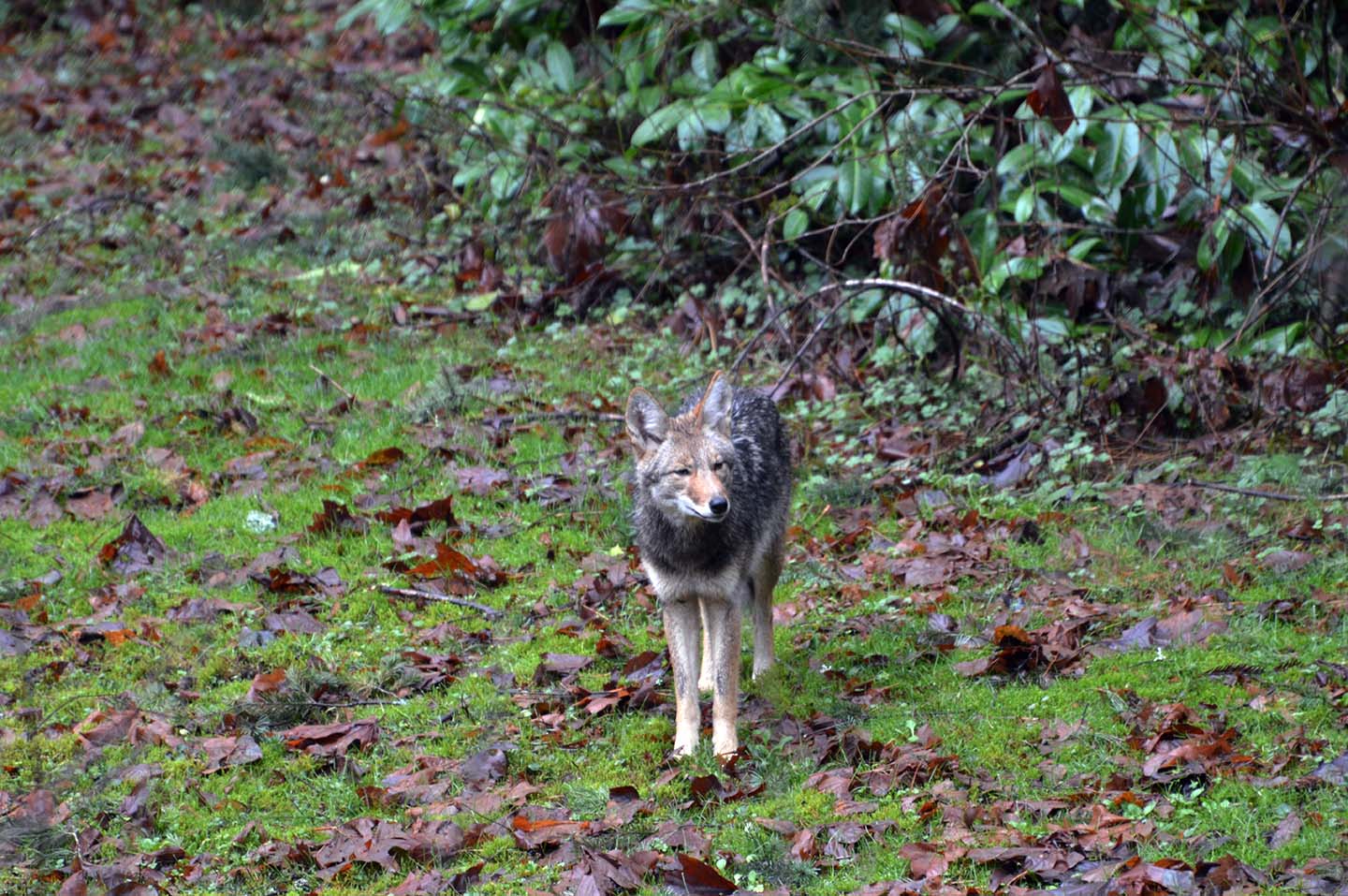
Then there are the coyotes. What used to be an occasional sighting during dawn or dusk on the road (a road jokingly known as coyote highway, since it connects several neighborhood parks and ravines,) has now become almost a daily occurrence, during all times of the day. In our yard, where all these photos were taken, as well as the street.
Not only that. Last week our substantially-sized dog, a German Shorthair pointer, ran out, barking his head off when he saw the coyote standing right next to our wheelbarrow. The coyote fled into the trees, only to re-emerge within seconds and approaching the dog, face to face, with a “play-with-me” downward dog posture, only to depart when we started screaming in order to get our dog back to safety, me with camera in hand.
Downward coyote….
Corner of the wheelbarrow lower left
Sniffing the garden bench….
It is half scary, half wondrous to see a wild animal so close. Clearly they have increasingly habituated to human locations. Part of that is our own fault. Although we keep our garbage cans closed (when there are increasing numbers of coyotes with fewer prey spread between them, they tend to go for the garbage,) we do have bird feeders. Feeder spill attracts rodents, which in turn attract coyotes. So far they have not shown signs of aggression to humans, respond with flight when we stand our ground and yell at them or wave our arms, but that might change in May when they have pups. It means always having the dog on leash, and never ever have small kids unsupervised in the yard.
We started to keep count of the daily showing, both in the garden and on our walks in the neighborhood. It is not unusual to see three or four during a single 24 hr period. Which brings me to citizen science. It is pretty amazing how much of scientific knowledge these days can be and is crowd- sourced. Here is an informative NPR podcast about what citizen science is and how ordinary people like you and I can participate in meaningful ways.
How do you do it? You can sign up on apps and websites that steer you to the right ways of observation, recording and sharing of data. Here is an example from Scientific American. You can go to CitizenScience.gov or SciStarter and see which projects tickle your curiosity. If you’re already hooked on something, why, birds come to mind, you can go to specialty programs like iNaturalist or eBird. The Audubon Society has a great Backyard Bird count every February where you can count the birds for 15 minutes to help establish which species flourish and which are on the decline. Not only will your observations help advance science but there is the additional benefit of sharing in conversation with other like minded people, no small thing in these times of isolation for many of us.
“The wisdom of the crowds” was a concept that popped up as early as 1906 when Sir Francis Galton, horrid eugenicist as well as gifted scientist, let’s face it, analyzed bets about the weight of an ox at the country fair. He realized that the average of all bets came within a hair’s width of the actual weight of the bovine. Collective wisdom was superior to any one individual guess. Aggregate answers are only superior, however, if certain conditions are present:
The guesses have to be independent of each other – you cannot be influenced by other people’s assumptions.
You need to have diverse guesses – people from all over the spectrum, from experts to laypeople who do not share the same biases.
There is a need for decentralization – people need to draw on their own, private, local knowledge.
Data need to be aggregated. You can take averages, but there are other forms as well.
The areas in which citizen scientists can make contributions are endless. A quick look at the reports unveils topics as widely disseminated as bird populations, migration patterns, bees, mushrooms, frogs, decline in ice sheets on northern lakes, northern lights, ticks, small stream flow, archeological looting and even new planets. (Ref.) Well, maybe not endless. The search for signs of extraterrestrial life by citizen scientist, an enterprise offered by UCal Berkeley’s SETI Research Center, shut down 3 years ago. SETI@home, a two-decades-old crowdsourcing effort to hunt for signs of E.T. in radio telescope data using internet-connected computers, was terminated because “we were scientifically at the “point of diminishing returns.”
I guess I stick to counting coyotes.
Music today- Joni Mitchell no regrets coyote…. about very different kinds of tricksters…
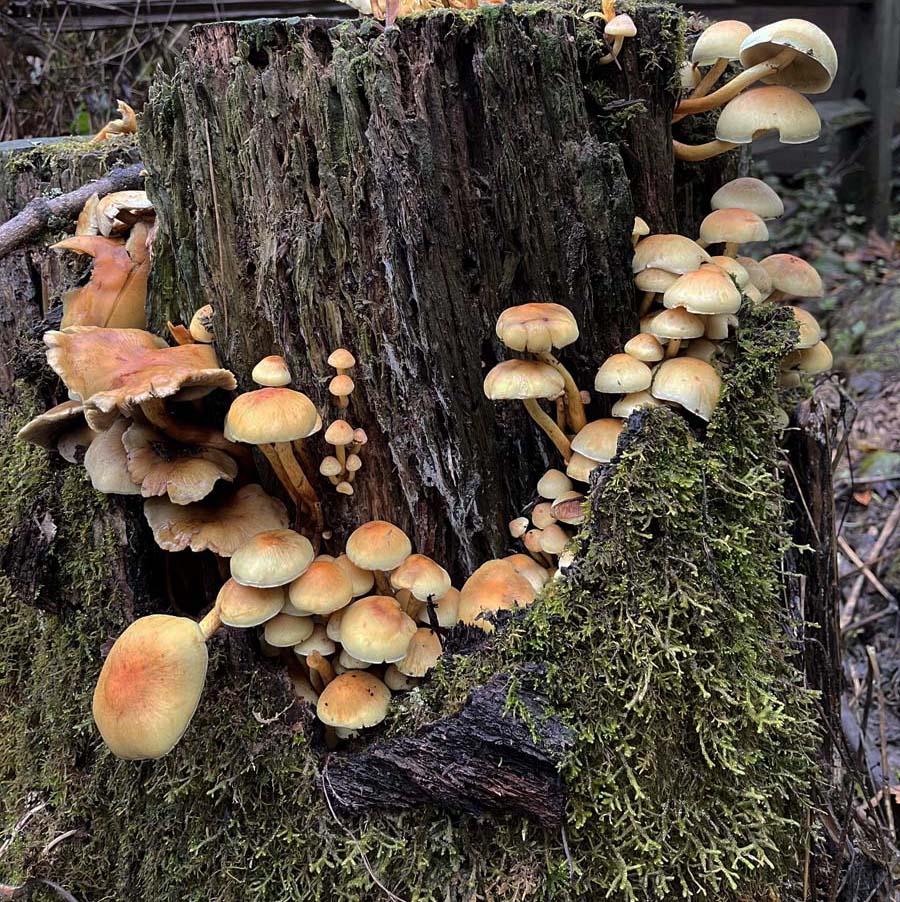
Walk with me. I know, we’ve done this loop in the State Park at my doorstep many times before. Yet every year I feel compelled to post the photographs of a yellow/orange-dotted world that appears early November, signaling transition, like yellow lights are wont to do.
There is something so utterly optimistic about yellow or orange dots swarming tree trunks, or yellow leaves providing contrast for the increasingly milky brook, or migrating birds – thrushes to be precise – fitting into the color scheme. A last Hurrah before darkness settles in.
There is something tangibly sensuous about the moist surfaces,
and something mysterious about the lamellae and gills.
A recently launched organization called SPUN (Society for the Protection of Underground Networks) is devoted to study and protect fungi to safeguard biodiversity and curb climate change. They have a pretty slick website and ambitious plans to map mycorrhizal fungi, tiny organisms that intertwine with roots of certain tress and nearly all the other plants in specific forests. You can see videos of their field trips in South America and Europe and learn about the scientists involved – they call themselves Myconauts, a clever contraction of the mushroom subject and the associated explorative adventures. For a shorter, quite educational summary essay I went here – much to learn.
No need to return to Chile, though, as much as I’d be tempted – the visual harvest in forests closer to home is just as beautiful.
Independently, since I was reading about fungi, I chanced on new research that shows fungal DNA in various human tumors. We have no clue if there is a causal connection – if fungi, in other words, could be responsible for certain cancers – we just know there is a link.
A small number of fungal cells have been found in 35 different cancer types, with fungal species composition differing among them. What are they doing there? How did they get there? Are they participating in pathology, or are they just taking advantage of immune system suppression in cancerous tissues? Or maybe there are immune cells that ate fungi and carried sequences to a tumor site?
If we knew what their role is we could use them in diagnostic procedures as markers for pathological growth. Or, more excitingly, if we knew how they got into the tumors we could theoretically have cancer-fighting drugs hitchhike on those cells and deliver the chemo specifically on site, a breakthrough in therapeutics.
Enough, let’s not spoil a perfectly glorious fall walk with thoughts of disease or environmental destruction. Let’s enjoy the ruffled beauty,
and the occasional daily wild life in search of a tasty morsel.
And for sound today there is some use of bio data sonification to help a listen to some oyster mushrooms. Changes in electrical resistance are converted into control signals for a eurorack modular synthesizer. The guy who records all kinds of fungi, electronic musician Noah Kalos, a.k.a. MycoLyco, is based in North Carolina. His goal: “just being able to find a signal that we can really observe helps to raise awareness that fungi are all living, we’re all part of the same thing.”
Alternatively, we can just listen to Massenet’s classical capture of thoughts in fall.