Some claim that Valentine’s Day had its origins in the Roman festival of Lupercalia, held in mid-February. The festival included fertility rites, wild bacchanalia and the pairing off of women with men by lottery. “Young women’s names were drawn by bachelors from a jar. These matches, initially formed for the festival’s duration, often led to long-term relationships and marriages.”
Enter the church, eager to replace Pagan rites with Christian values. Up pops the symbolic martyr St. Valentine who secretly married lovers, ignoring Roman Emperor Claudius II’s edict that prohibited young men from marrying, as to serve more efficiently as soldiers. Valentinus was executed for his defiance, but lives on as a champion of love. (Ref.)
First comes love, then comes marriage. And then comes the forfeit of women’s right to vote.
Think I am joking? Here is what Wendy Weiser at the Brennan Center for Justice has to say about the consequences of a new Republican voter registration bill sponsored by Texas Republican congressman Chip Roy, the SAVE Act, which experts warn could be a major threat to voting rights for all Americans, and particularly for married women, in addition to people of color, young voters, and other marginalized groups.
“The legislation would require all potential voters to provide, in person, proof of citizenship, such as a passport or birth certificate, when they register or reregister to vote.” The bill would not only impact the 21.3 million Americans who do not have ready access to a birth certificate or passport, as well as anyone who relies on voting by mail. It would also have a direct impact on anyone whose legal name does not match the name on their birth certificate or passport, such as the 79% of heterosexual married women, per Pew Research, who take their spouse’s last name. “If a married woman hasn’t paid $130 to update her passport—assuming she has one, which only about half of Americans do—she may not be able to vote in the next election if the SAVE Act becomes law.”
They chitter at each other violently, then hop at each other, until one flies off.
The festival Lupercalia was celebrated in and around caves. Looks like that is the location we are pushed back towards – Project 2025 explicitly condones and seeks to enforce a family structure where only the head of household, the man, votes. This was, of course, a common argument against women’s suffrage before the 19th amendment was introduced.
While I might angrily scream at the hostility extended towards all those threatening the top tier of the power hierarchy, there are others devoted to peace – probably way more effective (and certainly better for your blood pressure…)
You can join them in a Multicultural Celebration for Connection, Love, and Peace this Sunday in Hillsboro, OR. Here are the details:
A Community Event Promoting Unity and Understanding
The Oregon Society of Translators and Interpreters (OSTI), Lutheran Community Services Northwest (Beaverton Office), the Immigrant and Refugee Community Organization – Greater Middle East Center (IRCO GMEC), DAWN, and Unite Oregon, in partnership with the City of Hillsboro and the Office of Immigrant and Refugee Advancement, are proud to present the Multicultural Celebration for Connection, Love, and Peace.
This inaugural event will bring together community members from diverse backgrounds to celebrate culture, share stories, and promote unity through music, dance, art, and meaningful conversations. This event aims to foster a sense of community amidst the attacks on immigrant and refugee communities in Oregon and across the country by the new administration.
Date: Sunday, February 16, 2025 Time: 2:00 – 5:00 PM Location: The Walters Cultural Arts Center, 527 E Main St, Hillsboro, OR 97123 Website: https://tinyurl.com/connectionlovepeace
Here is a poem that will be read on Sunday, in various translations as well.
A Proclamation for Peace
Whereas the world is a house on fire; Whereas the nations are filled with shouting; Whereas hope seems small, sometimes a single bird on a wire left by migration behind.
Whereas kindness is seldom in the news and peace an abstraction while war is real;
Whereas words are all I have; Whereas my life is short; Whereas I am afraid; Whereas I am free—despite all fire and anger and fear;
Be it therefore resolved a song shall be my calling—a song not yet made shall be vocation and peaceful words the work of my remaining days.
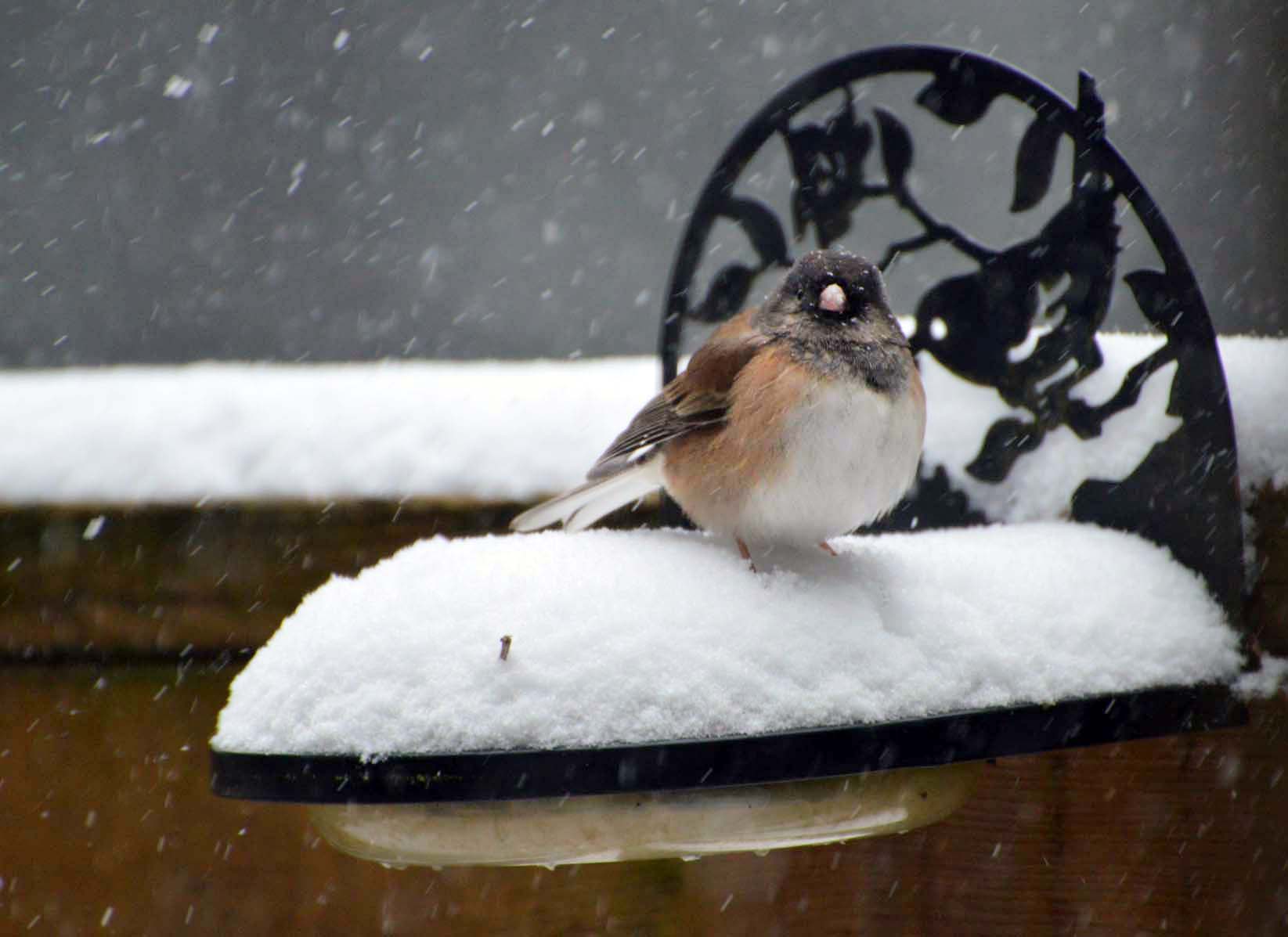
Photographs from yesterday through my (dirty) window, with House Finches and Junkos going at it, competing for seeds rather than showing some loving solidarity. Then again, maybe they are off mating in a cave, once fed. Happy Valentine’s Day!
Music is a Romanze by Schumann so long held apart from his beloved Clara. I really like this slow version. Brings out the longing.
When I wrote about my worries regarding the novel Corona virus in early (!) January 2020, I got some push-back. Did I have to be catastrophizing all the time? Couldn’t I provide a bit more levity or at least some art? 1.9 million U.S. deaths later, much as I’d like not to, I am back in Cassandra mode.
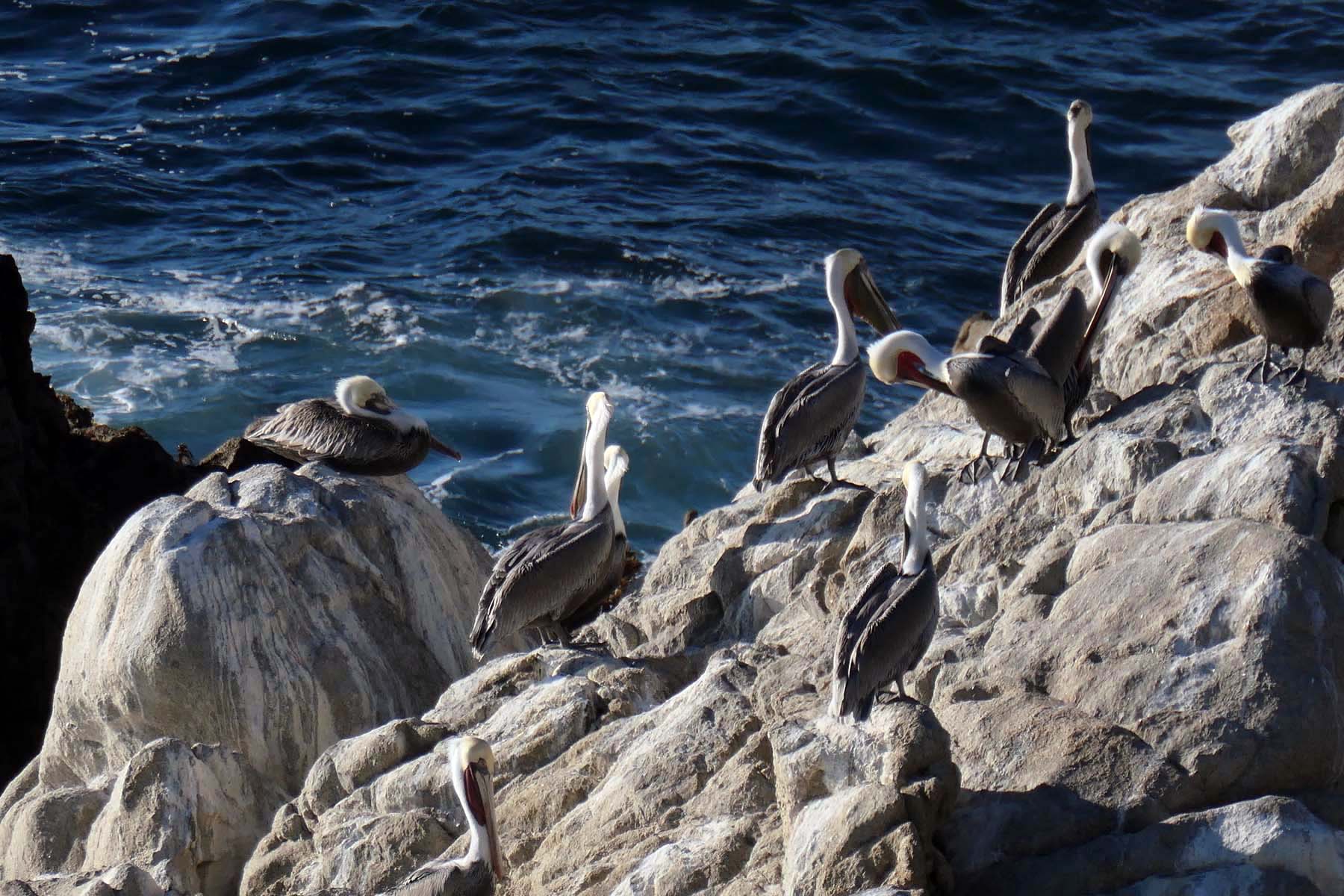
I’ll provide art (a poem below), all right, and photographs that I took at beautiful Point Lobos, CA last November, but today’s focus are issues related to the bird flu. Don’t yell at me. I am as sick, literally, as the next person, under the barrage of bad news. And today’s musings are as bleak as they come. But we must think things through to reach some kind of preparedness. That much we’ve learned from the last epidemic.
Let’s try a thought experiment, given that the Republicans’ slashing of NIH/NSF grants by more than half curtails actual scientific experimentation. (Here is a detailed, excellent review of the new rules.) Assume you learn the most important facts and statistics about the new H5N1 virus. Why assume? Well, since last week, many official publications of information about infectious diseases have disappeared from government websites. Data that briefly appeared on a C.D.C. website were gone a short time later, irretrievable despite scientists begging for a full report. For example, according to the NYT, “Cats that became infected with bird flu might have spread the virus to humans in the same household and vice versa, according to data that briefly appeared online in a report from the Centers for Disease Control and Prevention but then abruptly vanished. The data appear to have been mistakenly posted but includes crucial information about the risks of bird flu to people and pets.”
So what facts do we actually know? The disease originated in Asia, almost 30 years ago. It spread among poultry farms, caused some 400 deaths in humans across these years, but rarely spread human-to-human. The virus started to explode exponentially since 2020, when it did not simply jump from poultry farms to wild bird populations, but when the latter started to disperse it along migration routes, spreading from flock to flock. It arrived on our shores in 2021, with 148 million poultry alone ordered to be euthanized since 2022. More than 5 million egg-laying chickens died in the first 16 days of 2025. (Ref.)
From North America it jumped to South America where it traveled 6000 km in just 6 months. It caused mass mortality, not just in birds, but in infected mammals as well, with elephant seals, sea lions, porpoises, dolphins and otters all affected. Almost 50% of the Peruvian pelican population succumbed. The ecological consequences are still up for grabs but likely devastating up and down the food chain.
Deceased elephant seal pups line the beach at Punta Delgada in Chabut, Argentina, along with a bird carcass. Cause of death: bird flu. Ralph Venstreets/University of California, Davis
Now cows are infected with the virus. As of last week almost 1000 herds across 16 states in the U.S. tested positive. In fact, cows in Nevada exhibited a new variant of the virus which has scientists alarmed for its potential to trigger a pandemic in humans. The genotype, known as D1.1, contains a genetic mutation that may help the virus more easily copy itself in mammals—including humans. This D1.1 version of the virus is the same variant that killed a man in Louisiana and left a Canadian teen hospitalized in critical condition. (Ref.) The real worry: with each genetic mutation, so easily accomplished since this virus mixes with other flu viruses quite rapidly, we might see increased severity of the disease and increased probability for human-to-human infection.
Back to our thought experiment. You now know that the virus is around us, mutating, and you start seeing people felled by it (by current expectations, it has a mortality rate between 40 and 50%. Compare that to Corona Disease mortality rate: about 1%. Imagine the hospital overload, increasing otherwise preventable deaths outside of bird flu mortality as well.) Let’s assume that scientists do find a vaccine (we have to be optimistic until the last minute!), just like they did for Covid, and it proves to be safe and effective in tests done outside of the U.S., since stateside we no longer support much contagious disease research. And now factor in the fact that you have an anti-vaxxer health tzar voted into office by a Republican Senate, instructing the FDA not to approve the vaccine. (You can still write to your Senator about Kennedy’s confirmation… their websites have a contact me link.) Fantasy? Read the proposed law debated on Friday in Montana (House Bill 371) that would ban the use of mRNA vaccines – you know the ones used to treat tuberculosis, malaria, zika, the rapidly mutating influenza viruses, hepatitis b, HPV, Covid 19 and in treatment of pancreatic, lung, prostate, and brain cancer.
What would you do?
Rich folks traveling abroad to inoculate themselves and their families? Would foreigners even be served if there are limited quantities available? What about poor folks?
Stock up on masks? There are already 16 states with masking prohibitions in effect, with more legislation in the works. And always think of the babies and toddlers that can’t be masked…
What will we do?
I can’t help but wonder about questions raised a decade ago by America’s smartest Cassandra, Sarah Kendzior, who has previously predicted everything we have seen unfolding since January 20th, 2025. in great detail.
***
Omnicide
And when our children ask, Why did you do nothing as the world was dying? what will we tell them?
Will we say, We didn’t know how sick it was, or admit that We gathered our rosebuds while we could,
Old Time was still a-flying—? It’s now the end of everything, our children will say, go crawl
into your arks and sail off destitute into your doom, and leave us only your shadows. And our children
will light candles across seven continents empty now of lions, kangaroos, ravens, squirrels, javelinas, pelicans—
devoid of praying mantises, koalas, ants, cobras, snails, Doberman pinschers, pigs, vultures, lizards, and alley cats.
Our children will hide in caves with blind cockroaches, together feeding on the algae glowing in neon greens and blues
across dolomite and limestone walls. They’ll leave no pictographs behind, no sprayed handprints, no artful gods.
Such silence now, they’ll say, this you’ve bequeathed us, this human indifference. And we’ll beg them, Survive.
In the dark times, will there also be singing? Yes, there will be singing. About the dark times. —Bertolt Brecht
I would not be surprised if one or another of you read the document below and thought: “History is written by the victors…”
The special observances to be eliminated by fiat of the new administration include Black history month, Holocaust Days of Remembrance, Women’s History Month, and so on.
Memorial Site of Concentration Camp Buchenwald.
Once you discard the public remembering and teaching of history, you can fill in the blanks with anything you like, likely falsehoods that will stay with the next generations who have no access to the actual records, if it is done thoroughly enough. The current attacks on the contents of teaching materials, and even independent sources like Wikipedia (reported in Newsweek,) clearly speak to the issue. As journalist Adam Server from The Atlantic commented: “They want to ban the teaching of the unpleasant facts of American history because people might conclude injustices in the past that contribute to inequalities in the present should be rectified, instead of their belief, which is that some groups of people are inherently superior to others.”
The quote about victors shaping the narrative in their preferred fashion was attributed to Winston Churchill for the longest time. Falsely, as it turns out. People then pointed to words uttered by Reichsmarschall and war criminal Hermann Göring, a coward who did not even face his Nürnberg Trial sentence of death by hanging, resorting to suicide by poison the night before. “Der Sieger wird immer der Richter und der Besiegte stets der Angeklagte sein,” “the victor will always be the judge, and the vanquished the accused.”
Apparently, the sentiment had been around for a much longer time, in various European nations, France in 1842, Italy in 1852 and Great Britain in 1889. It arrived at our own shores a few years later:
Well, if you have (and abuse) the power to erase history when it is at odds with your ideology, you sound more like a loser than a victor to me. Might as well go golfing on Holocaust Remembrance Day…. (yes, he did.)
The real question is, of course, what can be done when the powers that be try to eliminate our remembering of acts of horror as well as acts of heroism, acts of oppression met by acts of resistance, of an evolution of rights for those who had been denied them since times immemorial. The prohibitions of public remembrances, the choice of names for institutions, the restriction of text book contents might not be easy to stop, particularly when appeals to “forgetting” are voiced by some of the largest communication platform owners in the world. (e.g. Musk’s contribution to the neo-Nazi party AfD rally last week in Germany.)
But this can be counterbalanced by art (although admittedly much harder to distribute to large enough audiences.) Films that try to document the past as it unfolded can be useful and convey content pretty directly. Poetry can be a teacher. One of the best collections I can think of is Carolyn Forché’s Against Forgetting (1993). The classic anthology contains hundreds of poems centered around events that changed history. No other than Nelson Mandela introduced the book at the time:
“Poetry cannot block a bullet or still a sjambok, but it can bear witness to brutality—thereby cultivating a flower in a graveyard. Carolyn Forché’s Against Forgetting is itself a blow against tyranny, against prejudice, against injustice. It bears witness to the evil we would prefer to forget, but never can—and never should.”
Primroses and bush anemones under the beeches of KZ Buchenwald (Beechwood) near Weimar.
A more recent one is Poetry of the Holocaust (2019), edited and translated by Jean Boase-Beier and Marian de Vooght. This volumes contains work by many lesser known poets, intended, with the help of 35 translators from languages as varied as Yiddish, Norwegian, Japanese and Hungarian, to present the poems in original and translation, with a contextual note for each. It is a remarkable book.
A particularly timely read, too. I am writing this on the day of the signing of an Executive Order to prepare a 30,000 capacity migrant detention camp in Guantanamo Bay. The site of previous human right abuses (including torture) identified by the UN, Amnesty International and Red Cross. A site three times the size of Auschwitz, outside of U.S jurisdiction (leased from Cuba,) so that many of our legal protections don’t apply and access of observers and journalists can be restricted or altogether prohibited. The justification, at this point, is that it will house undocumented immigrants, to be deported. When will the first US citizen be shipped off shore as well? According to NBC news, the President himself “suggested Monday that the United States could pay a “small fee” to foreign countries to imprison Americans (bolded by me) who are repeat criminal offenders, floating a kind of modern-day penal colony. Trump billed the idea as a cost-saving measure in remarks at a conference for House Republicans in Miami.” Gitmo next?
Crematorium at Buchenwald
Photographs today from my visits to memorial sites of German concentration camps.
Music today is unfortunately just a snippet of a piece we should have access to in its entirety. Click on the blue arrow in the lower left corner to listen to the excerpt of Jüdische Chronik, organized by Paul Dessau.
KZ Ravensbrück
The Vanished
For Nelly Sachs
It wasn’t the earth that swallowed them. Was it the air? Numerous as the sand, they did not become sand, but came to naught instead. They’ve been forgotten in droves. Often, and hand in hand,
like minutes. More than us, but without memorials. Not registered, not cipherable from dust, but vanished— their names, spoons, and footsoles.
They don’t make us sorry. Nobody can remember them: Were they born, did they flee, have they died? They were not missed. The world is airtight yet held together by what it does not house, by the vanished. They are everywhere.
Without the absent ones, there would be nothing. Without the fugitives, nothing is firm. Without the forgotten, nothing for certain.
The vanished are just. That’s how we’ll fade, too.
Nelly Sachs, to whom the poem is dedicated, was one of the foremost Holocaust poets who escaped to Sweden. The German original can be read here. It references themes of one of her famous poems, Flight and Metamorphosis.
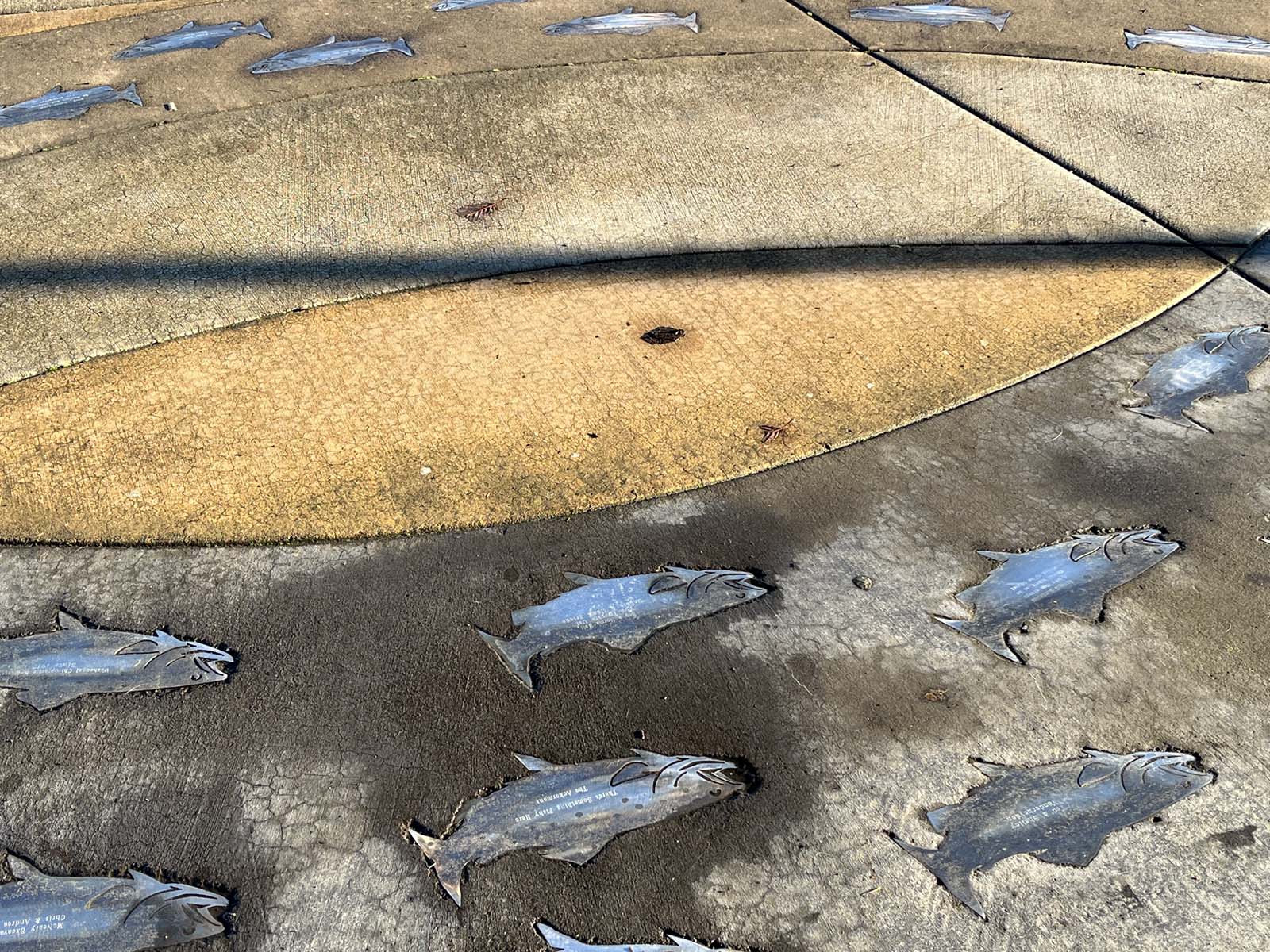
Here they were, salmons “singing in the street,” in Northern morning light that favored gold and blues. Right out of an Auden poem that stirred in the recesses of my brain, vaguely remembered. Had to dig it out, oddly relevant to our times when Southern light is dimmed by black smoke, or flickers as burning embers. Like all truly meaningful poetry, his poem captures universal truth, models defiance and stirs hope.
Malo Hasselblad Metal Fish Walkway at Washougal, WA waterfront Trail
***
As I Walked Out One Evening
As I walked out one evening, Walking down Bristol Street, The crowds upon the pavement Were fields of harvest wheat.
And down by the brimming river I heard a lover sing Under an arch of the railway: ‘Love has no ending.
‘I’ll love you, dear, I’ll love you Till China and Africa meet, And the river jumps over the mountain And the salmon sing in the street,
‘I’ll love you till the ocean Is folded and hung up to dry And the seven stars go squawking Like geese about the sky.
‘The years shall run like rabbits, For in my arms I hold The Flower of the Ages, And the first love of the world.’
But all the clocks in the city Began to whirr and chime: ‘O let not Time deceive you, You cannot conquer Time.
‘In the burrows of the Nightmare Where Justice naked is, Time watches from the shadow And coughs when you would kiss.
‘In headaches and in worry Vaguely life leaks away, And Time will have his fancy To-morrow or to-day.
‘Into many a green valley Drifts the appalling snow; Time breaks the threaded dances And the diver’s brilliant bow.
‘O plunge your hands in water, Plunge them in up to the wrist; Stare, stare in the basin And wonder what you’ve missed.
‘The glacier knocks in the cupboard, The desert sighs in the bed, And the crack in the tea-cup opens A lane to the land of the dead.
‘Where the beggars raffle the banknotes And the Giant is enchanting to Jack, And the Lily-white Boy is a Roarer, And Jill goes down on her back.
‘O look, look in the mirror, O look in your distress: Life remains a blessing Although you cannot bless.
‘O stand, stand at the window As the tears scald and start; You shall love your crooked neighbour With your crooked heart.’
It was late, late in the evening, The lovers they were gone; The clocks had ceased their chiming, And the deep river ran on.
The poem is disguised as a traditional ballad, filled with cliches which altogether take on different meanings when read in the context the poet builds around them. The message is as serious as it gets.
Our narrator is out on an evening stroll amongst the sea of humanity, fields of harvest “wheat,” that might soon meet their reaper. He overhears a lover singing, near a brimming river and the train tracks that could quickly carry one away, looming disaster and flight metaphors in one simple verse.
The lover borrows every available absurdity to express the strength and longevity of his sentiments, with love lasting until the impossible happens, physically, geographically, biologically, metaphorically – in other words, lasting forever. The depth of love is expressed in fertility symbols (said singing salmons and the rabbits.) The allusion to disaster and flight is repeated in the image of the seven stars, squawking like geese. It refers to the Pleiades, a star cluster that played a major role in Greek mythology. Like migrating geese, the seven daughters of Atlas fled from place to place for many years pursued by Orion, until Zeus turned them into a constellation as he did with Orion, who still hunts them across the sky.
The lover’s song expresses the belief of singularity: the first love of the world, flower of the ages. But, more importantly, an unshakable faith in continuity, or even permanence. This is of course, a core belief that keeps us all going. Not just for love, but for life plans, for the existence of what and who we know and hold dear.
An unshakable faith, until it is shaken, or burnt to ashes, as the current case may be.
Such relentless optimism awakens the malevolent clocks: Time will have none of it, our lovers soon be disabused of their notion of eternity. Physical decline, material worries and economic stress (icebergs in the cupboard,) the eventual abating of sexual desire (desert in the bed) all putting cracks in the vessel once thought to last forever. Time manages to put the very notion of fairy tales onto its head: the presumed innocents prove to be lascivious, and relationships revert in unexpected ways. Why should “happily ever after” be the one to survive?
Looks like an inevitable ride downhill towards impermanence or even death. But now Auden rescues us with some strangely placed exhortations that are subtly encouraging.
‘O plunge your hands in water, Plunge them in up to the wrist; Stare, stare in the basin And wonder what you’ve missed.
Could be washing your hands free from guilt of having been so naive, mistaken about continuity, or unable to live up to the promise of eternal love. But could also be a suggestion that you interrupt the narcissistic admiration of your Self in the basin, by making waves that destroy the image, pushing the focus on something else. That would make sense given how much Auden had embraced Freudian theories. It would also very much explain the next command:
‘O look, look in the mirror, O look in your distress: Life remains a blessing Although you cannot bless.
YOU might have failed in your naive or misdirected optimism, but LIFE remains a blessing. I read this as such an important reminder to be grateful. There is stuff out there, even if not what you hoped for, even if you lack agency, even if you dropped, or were dropped by a lover (a repeated theme in Auden’s personal life, made more complicated by being gay in times where it was illegal.) Even if you incurred unimaginable losses, there is a world out there. (One, I might add, shouting for us to find ways to protect it.)
And significantly:
‘O stand, stand at the window As the tears scald and start; You shall love your crooked neighbour With your crooked heart.’
Look out towards the world, no matter how rotten you feel, and remember the commandment to love your neighbor like yourself. They might be crooked, so are you. The whole idea is about goodwill/love towards others, a form that is not necessarily the sexual rush of the lovers we encountered in the first part of the poem, but the notion of Agape, the “unselfish loyal and benevolent concern for the good of another, “as the dictionary defines it. Reaching out towards humanity as a whole, engaging in brotherly love, might protect from time’s relentless drag.
***
We are experiencing Agape at this very moment. The love and support extended towards the displaced by the Eaton Fire is beyond description. I cannot thank everyone personally, but am deeply grateful for the outpour regarding my kids. From what I hear, mutual aid is generally flourishing in Altadena, trying to soften the blows while everyone is still in a state of shock, where even finding a meal or a change of clothes can become an overwhelming task. The fire is forging an already tight community into a whole, held by concern for each other.
In our personal case, it feels like a small child is at the protected core of concentric rings, reaching ever further outward. Fiercely shielded by parents, who are supported by grandparents, aunts and uncles, then friends, then acquaintances, then friends of the older generations – a whole network of emotional sustenance, physical comfort, shared expertise and financial generosity.
The Greek word apocalypsis actually means not so much doomsday, but revelation or unveiling. The fires reveal humanity’s fragility and the consequences of ecological overshoot – using more than the planet can sustain. But they also reveal something essential: We cannot count on permanence, but we are here and now surrounded by love.
You don’t know how much of a difference that makes at this very moment.
Auden wrote this in 1937, unsettling times in Europe with rising fascism, not unlike our own – he soon after emigrated to the U.S., having had a harrowing time when traveling to Spain to report on the Civil war. I think it is a poem to be bookmarked for the year(s) to come.
And here is a song cycle by Benjamin Britten. “Our Hunting Fathers, Op. 8, was first performed in 1936. Its text, assembled and partly written by W. H. Auden, with a pacifist slant, puzzled audiences at the premiere.”
This was sent by a friend – I thought I’d share the welcome sentiments.
E. B. White’s Christmas – From the New Yorker 1952
From this high midtown hall, undecked with boughs, unfortified with mistletoe, we send forth our tinselled greetings as of old, to friends, to readers, to strangers of many conditions in many places.
Merry Christmas to uncertified accountants, to tellers who have made a mistake in addition, to girls who have made a mistake in judgment, to grounded airline passengers, and to all those who can’t eat clams! We greet with particular warmth people who wake and smell smoke. To captains of river boats on snowy mornings we send an answering toot at this holiday time.
Merry Christmas to intellectuals and other despised minorities!
Merry Christmas to the musicians of Muzak and men whose shoes don’t fit! Greetings of the season to unemployed actors and the blacklisted everywhere who suffer for sins uncommitted; a holly thorn in the thumb of compilers of lists!
Greetings to wives who can’t find their glasses and to poets who can’t find their rhymes!
Merry Christmas to the unloved, the misunderstood, the overweight. Joy to the authors of books whose titles begin with the word “How” (as though they knew!). Greetings to people with a ringing in their ears; greetings to growers of gourds, to shearers of sheep, and to makers of change in the lonely underground booths!
Merry Christmas to old men asleep in libraries! Merry Christmas to people who can’t stay in the same room with a cat! We greet, too, the boarders in boarding hoses on 25 December, the duennas in Central Park in fair weather and foul, and young lovers who got nothing in the mail.
Merry Christmas to people who plant trees in city streets; Merry Christmas to people who save prairie chickens from extinction! Greetings of a purely mechanical sort to machines that think– plus a sprig of artificial holly. Joyous Yule to Cadillac owners whose conduct is unworthy of their car!
Merry Christmas to the defeated, the forgotten, the inept; Joy to all dandiprats and bunglers! We send, most particularly and most hopefully, our greetings and our prayers to soldiers and guardsmen on land and sea and in the air– the young men doing the hardest things at the hardest time of life. To all such, Merry Christmas, blessings, and good luck! We greet the Secretaries-designate, the President-elect; Merry Christmas to our new leaders, peace on earth, good will, and good management!
Merry Christmas to couples unhappy in doorways! Merry Christmas to all who think they are in love but aren’t sure!
Greetings to people waiting for trains that will take them in the wrong direction, to people doing up a bundle and the string is too short, to children with sleds and no snow! We greet ministers who can’t think of a moral, gagmen who can’t think of a joke.
Greetings, too, to the inhabitants of other planets; see you soon!
And last, we greet all skaters on small natural ponds at the edge of woods toward the end of afternoon. Merry Christmas, skaters! Ring, steel! Grow red, sky! Die down, wind!
Merry Christmas to all and to all a good morrow!
Man, do I miss NYC at times. The mere memory of the million varieties of sufganiyot make my mouth water. Here are 2024’s recommended bakeries for this greasy dessert.
This spring the birds came back again too early. Rejoice, O reason: instinct can err, too. It gathers wool, it dozes off — and down they fall into the snow, into a foolish fate, a death that doesn’t suit their well-wrought throats and splendid claws, their honest cartilage and conscientious webbing, the heart’s sensible sluice, the entrails’ maze, the nave of ribs, the vertebrae in stunning enfilades, feathers deserving their own wing in any crafts museum, the Benedictine patience of the beak.
This is not a dirge — no, it’s only indignation. An angel made of earthbound protein, a living kite with glands straight from the Song of Songs, singular in air, without number in the hand, its tissues tied into a common knot of place and time, as in an Aristotelian drama unfolding to the wings’ applause, falls down and lies beside a stone, which in its own archaic, simpleminded way sees life as a chain of failed attempts.
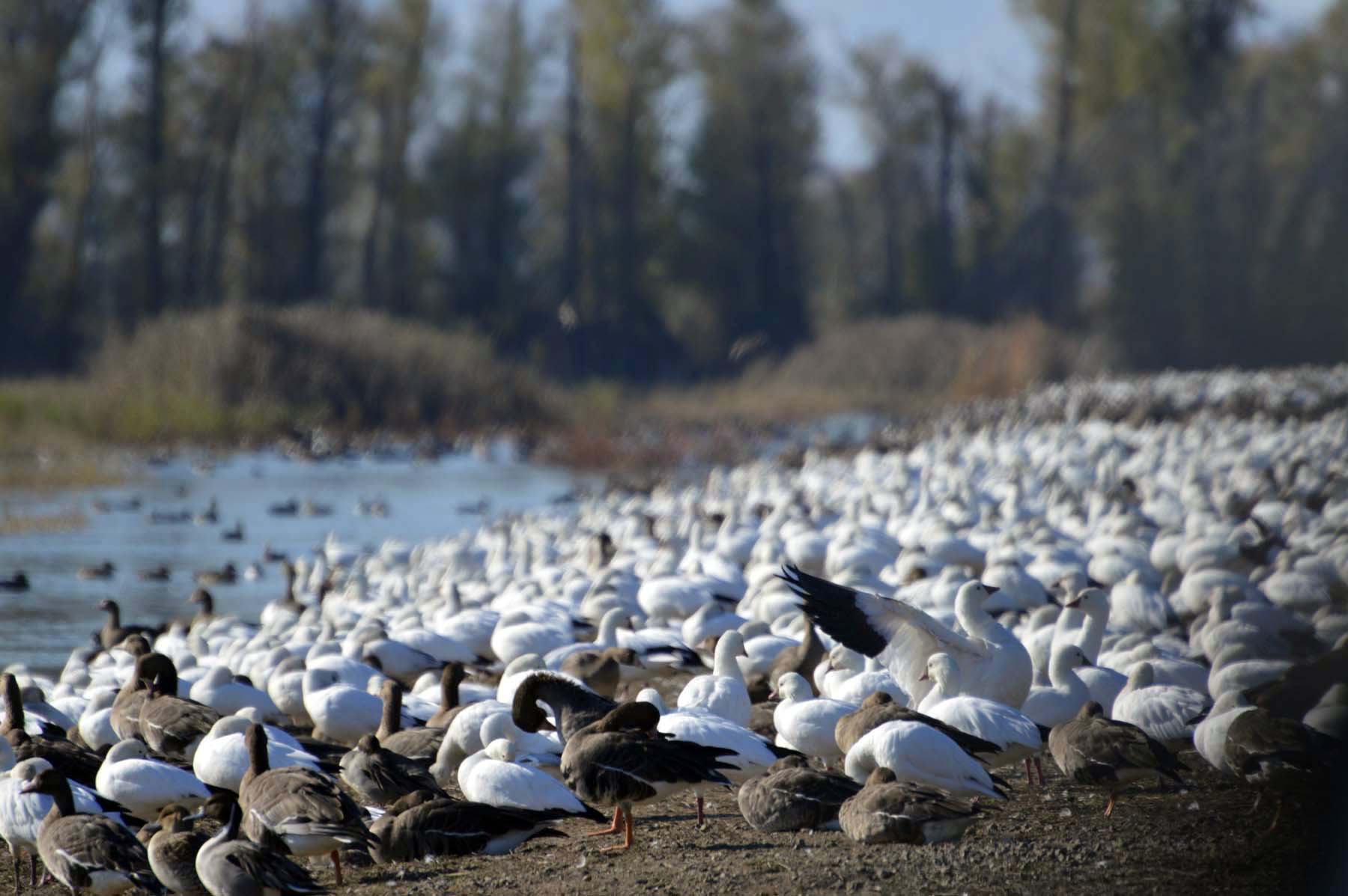
Still awed by all the snow geese I recently encountered. And it was tempting to post Mary Oliver’s Snow Geese poem for its gratitude for unexpected beauty, or Wendell Berry’s Wild Geese with its admonition to recognize the here and now, but you know me. Szymborska hits the spot, every single time. Particularly since she depicts the death of a few unlucky birds, while I try not to think about the deaths of millions of them, saving the dispiriting topic of the bird flu (and its catastrophic implications) for another blog. We’ve had our fill of horrors already earlier this week.
I adore the poet’s sly juxtaposition of instinct and reason, both known to fail. I admire the way she describes the biological features of the birds in all their beauty, linking them to positive traits like patience, honesty and conscientiousness, but also works of art, sculptural finesse worthy of museums.
“This is not a dirge — no, it’s only indignation.”
That is the feistiness I want to take into my day, my life, when contemplating mortality or dealing with the “foolish fate” of witnessing erosion of achievements, justice and equality among them, that so many generations fought for. Maybe each single life is a chain of failed attempts, indeed, but lives accumulating across centuries were clearly able to improve the world.
What was this thing about the arc of the moral universe? It’s long, but bends towards justice? If a murdered man could cling to this belief, so can we. We could even muster some sort of hope that the danger of a snowy death upon too early a return is now gone with the arrival of climate change and rising temperatures. Oh well, another “failed attempt” – at gallows humor.
Then again, we could just stick with the poet’s resigned realism. It served her well, all the way to the Nobel Prize.
No, indignation it shall be, not sorrow, indignation hatching action.
In any case. The geese were luminous and loud and basking in the California sun, grey and white geese alike. The light still radiates inside of me, providing needed warmth.
Soooooo – I was going to write about a book I thought I would have finished reading by now, but life and a knitting project intervened. Sneak preview for all you Richard Powers fans out there: he scored again. Get on the library wait list for “Playground.” Very much worth it. I will report more anon. What to do for a placeholder in the meantime?
As it turned out, Greg Olear published a W.B.Yeats poem yesterday in his newsletterPrevail. I could not think of a more prescient description of our very own situation here before November 5th. I had to look up Helicon – a mountain in Greece, praised for two springs that sustained the muses in Greek mythology – and calumny – malicious false accusation or slander. Yeats’ ire was likely directed at the religious factions in Ireland, our’s is most certainly applied to whom the descriptions below match best: those averse to learning, open to slander, masters of fantastic falsehoods and opposed to anything that diverges from white supremacist norms….
The Leaders Of The Crowd
THEY must to keep their certainty accuse All that are different of a base intent; Pull down established honour; hawk for news Whatever their loose fantasy invent And murmur it with bated breath, as though The abounding gutter had been Helicon Or calumny a song. How can they know Truth flourishes where the student’s lamp has shone, And there alone, that have no Solitude? So the crowd come they care not what may come. They have loud music, hope every day renewed And heartier loves; that lamp is from the tomb.
But before we start this week with dismay, let’s look at those beautiful owls that simply sat next to my path in the woods, looking at me while I was looking at them. Bliss.
Now I must go back to the novel, dying to know how it ends…
Music is a reference to W.B.Yeats as well…a bit strange, and quite enticing.
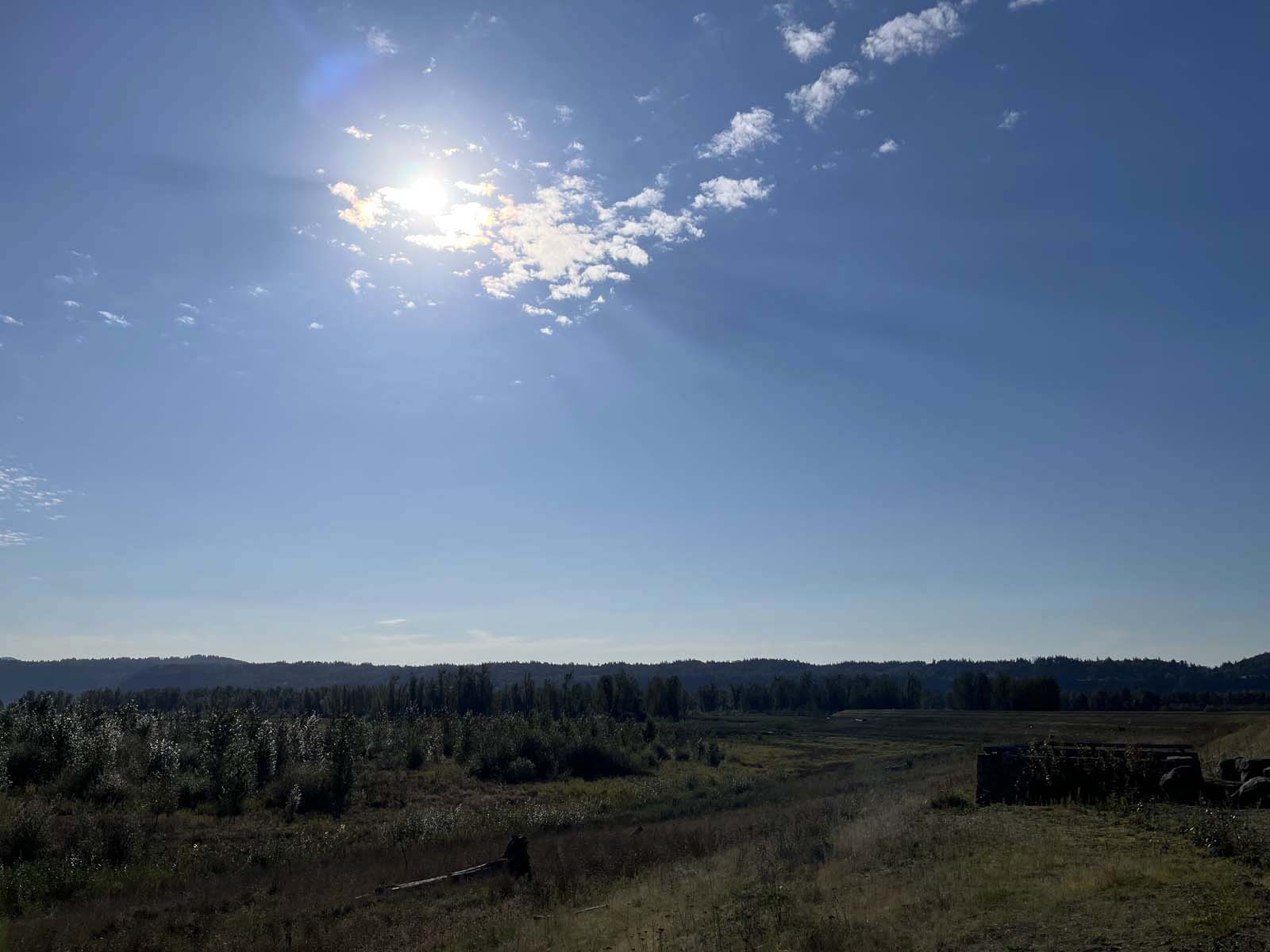
I was walking on a dike towards the Columbia river, water levels so low that the geese rested on sand banks in the middle of the sidearm.
Drought had emptied the ponds of all water, colored the landscape with muted browns.
(The brown center is usually a lake)
Leaves of the cottonwoods all silvery in the bright light, mustard yellow on the ground once shed, echoing the lichen.
A few familiars, a harrier hawk, herons and deer, a fearless kestrel advertising the location, an egret flying in search of water. It was hot and it was still, only some isolated chants of geese formations carrying across the meadows, stark light, air shimmering.
If you can’t walk with me through a strangely out-of-season October landscape, find a comfortable spot to sit and read a very long poem. It contains worlds. Cyclic worlds of destruction, worlds of renewal, worlds of despair and ultimately resilience.
It also contains lines that describe perfectly what I experienced yesterday, “summer after summer has ended, … the low hills shine, ochre and fire, even the fields shine… a sun that could be the August sun … a day like a day in summer, exceptionally still.”
I have not been exactly a fan of poet Louise Glück who won the Nobel Prize in 2020, and died this week a year ago. For me, her biting wit too often veered into cruelty. Yet I do see why the Nobel committee awarded Glück “for her unmistakable poetic voice that with austere beauty makes individual existence universal.” She describes the core of coping with trauma regardless of what it was or whom it affected: a person, a people, a planet. There is indeed a universality to the processes she describes, understands and accepts, with a few recommendations toward action or acceptance thrown in.
Having written last week about Kintsugi as a ceramic art form addressing trauma, I thought we might be challenged by looking at poetry that shares some of that approach. Laying bare the scars, acknowledging the irreversibility to a prior state of being, but finding beauty in acknowledgment – there with gold dust as a means of emphasis, here with determined words that claim an untouchable core.
The poem I chose for that purpose is called October. It was written in 2002 as a response to the World Trade Center bombing, and published in Averno in 2006. Lago d’Averno is the name of a deep crater lake near Naples, Italy, thought to be the gateway to the underworld by the Romans. The volume contains several poems describing the myth of Persephone and her cyclical return to earth, with imagery alternating between the destructive world of Hades where she has to reside, and the fruitful world of earth where she is permitted to return to her mother, Demeter, and makes things grow, for periods of time.
22 years later, the poem fits with a world gone mad, whether with personal loss, or the ravages of war, the lure of fascism, or the fears brought on by nature shedding all reserve – through pandemics, or catastrophic changes in climate that lead to the disasters we are now experiencing. It alludes to fear, memory distortion, experienced harm and a refusal to give in to despair, even when we have to acknowledge that we cannot turn to the earth and the planets to rescue us.
Here is my spontaneous take (and you might want to read the poem below first, so I make at least a semblance of sense…):
The first section describes disorientation, a shifting and uncertainty of where the narrator is in time, a loss of a sense of hearing or the ability to decipher meaning. It alludes to pointlessness in trying to anchor herself, no more grasp on reality. It mentions a better, more fertile past where we believed in growing things, in good outcomes. It is a jumble of confusion. Wasn’t life supposed to have a happy ending?
The second section has the narrator reemerge with a strong mind, one that is tested and wary, observing, able to discern that the violence of trauma changed her, harmed a body in ways that cannot be reversed, but a mind now clearly assessing the world that is. Nature is still around, like a bit player, observed but not able to intervene.
Section 3 is given to memory. Remnants of beauty, succor in nature, a world beckoning you to be part of it. Reminiscence makes way to acknowledgment that life can bring pain worse than death. An inkling of defiance, not a submissive nod to saying good bye. So many amazing things to list.
Section 4 starts – for me – to deliver the goods. The poet acknowledges how horrid things have become, how fall (after trauma) contains so much more loss than spring, but she starts to add up what still exists: ideals still burn in us, like a fever or a second heart, music remains, though changed, perceptions are sharpened.
“How privileged you are, to be passionately clinging to what you love; the forfeit of hope has not destroyed you. Maestoso, doloroso: This is the light of autumn; it has turned on us. Surely it is a privilege to approach the end still believing in something.”
Majestic. Painful. A core of us remains intact, despite the horrors, indestructible.
The fifth section reminds us that there is still work to do, work that can be done, and that we are not alone in all of this, whether in collective grief or through collective action.
And lastly, section six seems to sink into the depth of defeat, acknowledging the destruction of a barren earth, no longer nurturing, no longer an option to act as a rescuer. But then the moon appears, with the last lines referring to beauty and friendship. There is no illusion that the moon will do what the earth can no longer, but the concepts of beauty and friendship counteract hopelessness, suggesting there are still forms of connection.
Like in real trauma work, the alternations of drowning and lift-up, of cycling between hope and despair, of past and future orientation, allow us to spiral upwards on our own path towards healing.
“How privileged you are, to be passionately clinging to what you love.”
Maybe it’s privilege. Maybe it’s grace. Maybe it’s simple grit, refusing to give up.
I’ll cling as long as I want to, trauma be damned. I’m not forfeiting hope either, let me tell you. There is still too much work to do. (And I hope I’m not eating my words after the election. Then again, remember what Persephone and Demeter, central figures in the Eleusinian Mysteries, promised true believers: a happy afterlife. Looks like we have one final shot…)
October
1. Is it winter again, is it cold again, didn’t Frank just slip on the ice, didn’t he heal, weren’t the spring seeds planted didn’t the night end, didn’t the melting ice flood the narrow gutters wasn’t my body rescued, wasn’t it safe didn’t the scar form, invisible above the injury terror and cold, didn’t they just end, wasn’t the back garden harrowed and planted— I remember how the earth felt, red and dense, in stiff rows, weren’t the seeds planted, didn’t vines climb the south wall I can’t hear your voice for the wind’s cries, whistling over the bare ground I no longer care what sound it makes when was I silenced, when did it first seem pointless to describe that sound what it sounds like can’t change what it is— didn’t the night end, wasn’t the earth safe when it was planted didn’t we plant the seeds, weren’t we necessary to the earth, the vines, were they harvested?
2. Summer after summer has ended, balm after violence: it does me no good to be good to me now; violence has changed me. Daybreak. The low hills shine ochre and fire, even the fields shine. I know what I see; sun that could be the August sun, returning everything that was taken away— You hear this voice? This is my mind’s voice; you can’t touch my body now. It has changed once, it has hardened, don’t ask it to respond again. A day like a day in summer. Exceptionally still. The long shadows of the maples nearly mauve on the gravel paths. And in the evening, warmth. Night like a night in summer. It does me no good; violence has changed me. My body has grown cold like the stripped fields; now there is only my mind, cautious and wary, with the sense it is being tested. Once more, the sun rises as it rose in summer; bounty, balm after violence. Balm after the leaves have changed, after the fields have been harvested and turned. Tell me this is the future, I won’t believe you. Tell me I’m living, I won’t believe you.
3. Snow had fallen. I remember music from an open window. Come to me, said the world. This is not to say it spoke in exact sentences but that I perceived beauty in this manner. Sunrise. A film of moisture on each living thing. Pools of cold light formed in the gutters. I stood at the doorway, ridiculous as it now seems. What others found in art, I found in nature. What others found in human love, I found in nature. Very simple. But there was no voice there. Winter was over. In the thawed dirt, bits of green were showing. Come to me, said the world. I was standing in my wool coat at a kind of bright portal— I can finally say long ago; it gives me considerable pleasure. Beauty the healer, the teacher— death cannot harm me more than you have harmed me, my beloved life.
4. The light has changed; middle C is tuned darker now. And the songs of morning sound over-rehearsed. This is the light of autumn, not the light of spring. The light of autumn: you will not be spared. The songs have changed; the unspeakable has entered them. This is the light of autumn, not the light that says I am reborn. Not the spring dawn: I strained, I suffered, I was delivered. This is the present, an allegory of waste. So much has changed. And still, you are fortunate: the ideal burns in you like a fever. Or not like a fever, like a second heart. The songs have changed, but really they are still quite beautiful. They have been concentrated in a smaller space, the space of the mind. They are dark, now, with desolation and anguish. And yet the notes recur. They hover oddly in anticipation of silence. The ear gets used to them. The eye gets used to disappearances. You will not be spared, nor will what you love be spared. A wind has come and gone, taking apart the mind; it has left in its wake a strange lucidity. How privileged you are, to be passionately clinging to what you love; the forfeit of hope has not destroyed you. Maestoso, doloroso: This is the light of autumn; it has turned on us. Surely it is a privilege to approach the end still believing in something.
5. It is true there is not enough beauty in the world. It is also true that I am not competent to restore it. Neither is there candor, and here I may be of some use. I am at work, though I am silent. The bland misery of the world bounds us on either side, an alley lined with trees; we are companions here, not speaking, each with his own thoughts; behind the trees, iron gates of the private houses, the shuttered rooms somehow deserted, abandoned, as though it were the artist’s duty to create hope, but out of what? what? the word itself false, a device to refute perception— At the intersection, ornamental lights of the season. I was young here. Riding the subway with my small book as though to defend myself against the same world: you are not alone, the poem said, in the dark tunnel.
6. The brightness of the day becomes the brightness of the night; the fire becomes the mirror. My friend the earth is bitter; I think sunlight has failed her. Bitter or weary, it is hard to say. Between herself and the sun, something has ended. She wants, now, to be left alone; I think we must give up turning to her for affirmation. Above the fields, above the roofs of the village houses, the brilliance that made all life possible becomes the cold stars. Lie still and watch: they give nothing but ask nothing. From within the earth’s bitter disgrace, coldness and barrenness my friend the moon rises: she is beautiful tonight, but when is she not beautiful?
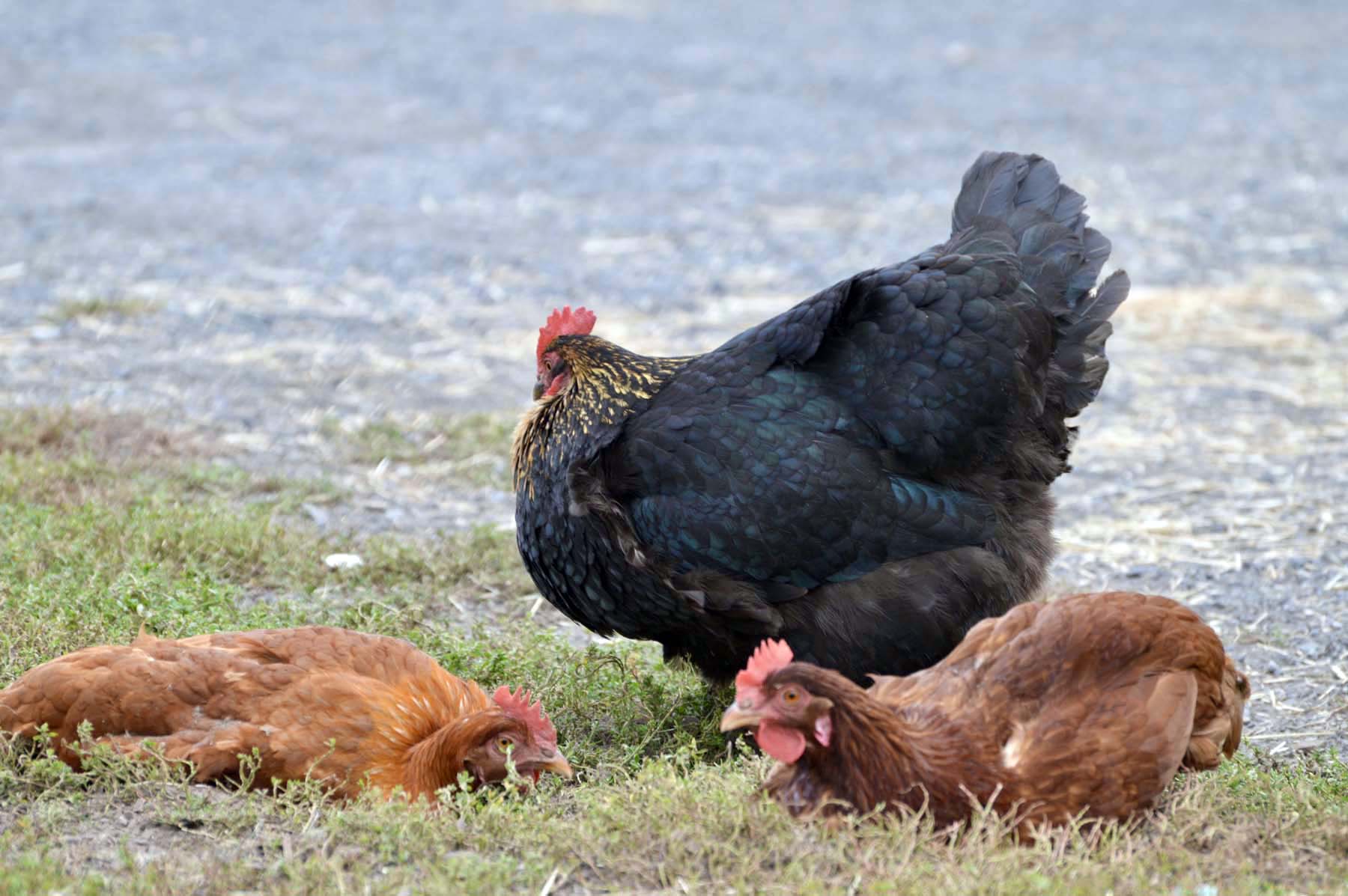
You’d think when you randomly google “chicken” you’d come up with good news, so direly needed at the end of this week. After all, a certain vice-presidential candidate claimed that his two kids eat 14 eggs every morning and then complained about the price of eggs being $4 a dozen, directly contradicted ($2.99) by the display he stood in front of while being filmed at a store in Pennsylvania. Hard to decide which of these two pieces of information is more out of touch with reality, but the latter was laid at the foot of the current administration, once again falsely blaming them.
So, chicken news. Here are literally the first 4 headlines that came up in a Google search:
Chickens are the most populous bird on Earth and are widely considered among the most abused animals on the planet. Despite their ability to think and feel, billions of chickens are raised and killed for food each year and subjected to some of the worst living and slaughter conditions imaginable to meet the increasing demand for meat worldwide.
I stopped reading after this. Remember, we want good news.
I give up. Enjoy your weekend, have brunch eating eggs Benedict, if you like them. I’ll go and see if I can find a red wheelbarrow to photograph. Maybe good thoughts will appear while staring at a “thing” rather than the news reports. After all, the poet linked below had a famous maxim, “No ideas but in things.”
The Red Wheelbarrow
So much depends
upon

a red wheel
barrow

glazed with rain
water

beside the white
chickens

BY WILLIAM CARLOS WILLIAMS
“So much depends upon “? What is referred to? Maybe my sanity depends on it – here is a red bench. Red wheelbarrow next…
Music today is Jaco Pastorius and friends celebrating Chicken.
One of the most amazing pieces of music from the romantic period is a song written by Franz Schubert ((1797-1828), The Erl-King or Elf-King. It sets a poem by Johann Wolfgang von Goethe (1749-1832) to music, words that were based on a medieval Danish ballad, Elveskud. The narrative describes the night ride of a father carrying his feverish child on his galloping horse. The child fearfully tells his father that he sees the Erl-King, a metaphor for death, but is calmly and rationally told that it is just the wind, fog, trees and darkness that scare him. The Erl-King, after trying to lure the child with promises of toys and amusement, eventually threatens to take the boy by force, and the father gets increasingly anxious, realizing that the vision is not just a hallucination. When they arrive at home, the boy is dead in his arms.
Every school child of my generation had to learn the poem by heart, having no clue what it was all about other than a horror story. It contains many of the elements so important to the Romanticists: nature, death, the supernatural. Goethe certainly knew about fear of death as a youngster – he fought tuberculosis for two long years before he even turned twenty. Schubert’s composition manages to capture dread with changes in key and tempo, as well as introducing 4 distinct voices with different melodies, ranges and key changes alternating between major and minor keys. There is the narrator who frames the story at beginning and end, and then alternating vocalizations of the father, the kid and the Erlkönig. A fifth personality – the horse – is represented by the piano with a relentless, pounding rhythm throughout for the right hand (and the score specifies every single move the accompanist has to take, incredibly thought-out and rigid. The whole things comprises three or so minutes, a good thing too, otherwise your right hand would fall off.)
To this day I know very few pieces that embody dread, particularly the dread of an innocent child that senses death, as well as this song. It gave me goose-bumps as a child. Now the fear of being a helpless parent is more prominent – trying to distance yourself from the realization that horror lurks, and wanting to protect the child (as well as yourself) from that reality, to no avail.
The photomontage is an older one that I recently added to the series of images representing music that matters to me. It captures a torso of a young child surrounded by birches and alders (the “Erl” in Erlkönig is the German word for an alder tree: Erle. Unclear if Goethe ignored the Danish “Elven”, or it was a translation error. My speculation would be that he wanted to stage the eeriness of the moors where alders grow at the damp places. But what do I know.)
I photographed these very trees on the grounds of the former concentration camp Bergen-Belsen, a camp where so many Jewish children died of disease and starvation, as did their parents, eventually. (52.000 human beings, as a matter of fact, 13.000 of those after liberation of the camp, too starved to recover.)
How does a parent, themselves aware of the inescapability of potential death, protect the last weeks of their children? The history has renewed relevance for us, given the unrestrained rise in anti-semitism, both In Germany and here in the U.S. – an unrestrained rise fueled by unrestrained language encouraging violence against Jews, preemptively blaming them for election losses, and throwing out dogwhistles (serial numbers for to-be- deported immigrants was the latest in Floridian fantasizing, evoking tattoos of the Holocaust, and publicly welcoming fascist ideologues. Here is an overview article in The Atlantic about anti-semitism of the upper echelons of the American right wing. Read it and weep.
I weep also when I think of the mothers and fathers in Gaza, the West Bank and Lebanon desperately trying to find some fashion of normal life for their children among the bombs and the hunger and the disease. It is they to whom the children turn, like the boy in the poem besieges his father, expecting comforting and protection. And it is they who cannot explain that all the laws we thought would protect us, have been cast aside, are ignored, or scoffed at, on all sides.
U.N. experts, for example, consider exploding pager and radios a terrifying violation of international law.
“Simultaneous attacks by thousands of devices would inevitably violate humanitarian law, by failing to verify each target, and distinguish between protected civilians and those who could potentially be attacked for taking a direct part in hostilities….Such attacks could constitute war crimes of murder, attacking civilians, and launching indiscriminate attacks, in addition to violating the right to life,” the experts said. Humanitarian law additionally prohibits the use of booby-traps disguised as apparently harmless portable objects where specifically designed and constructed with explosives – and this could include a modified civilian pager, the experts said. A booby-trap is a device designed to kill or injure, that functions unexpectedly when a person performs an apparently safe act, such as answering a pager. It is also a war crime to commit violence intended to spread terror among civilians, including to intimidate or deter them from supporting an adversary,” the experts warned. “A climate of fear now pervades everyday life in Lebanon,” they said.”
Legal experts in the US disagree with each other whether law violations occurred with these booby-traps (Ref.), but nobody disputes that Israel defies the orders from the U.N. top Court to halt its military offensive in Gaza, after South Africa accused it of genocide.
Many argue that targeted attacks against the militants of Hamas or Hezbollah are justified in a war. Civilian casualties are seen as an inevitable side effect and within the boundaries of international law, justified by the warring factions in pursuit of their strategic goals. That cannot, however, count for actions that affect civilian populations most grievously and indiscriminately.
The Gazan children are starving. Over 50.000 children ages 6 months to 4 years are in urgent need of treatment for malnutrition. Israel deliberately blocked humanitarian aid to Gaza, according to our own government authorities, the U.S. Agency for International Development, and the State Department’s Bureau of Population, Refugees and Migration.
“USAID had sent Blinken a detailed 17-page memo on Israel’s conduct. The memo described instances of Israeli interference with aid efforts, including killing aid workers, razing agricultural structures, bombing ambulances and hospitals, sitting on supply depots and routinely turning away trucks full of food and medicine.”
“Separately, the head of the State Department’s Bureau of Population, Refugees and Migration had also determined that Israel was blocking humanitarian aid and that the Foreign Assistance Act should be triggered to freeze almost $830 million in taxpayer dollars earmarked for weapons and bombs to Israel, according to emails obtained by ProPublica.” (Ref.)
Secretary Blinken and President Biden disregarded the assessment, since it would have stopped us from sending bombs to Israel, per the law. Here are the details from an investigation by ProPublica published yesterday. Aid organizations across the world agree with the original plea by our agencies: CARE, Oxfam and multiple others warn about a humanitarian disaster because of Israel’s obstruction of aid: food, water, medicine. The U.N. General Assembly concurs. Here is the report of their special rapporteur.
What do you tell your child, all over the world, when the Erl-King calls and there’s not a morsel to eat?
Here is a different iteration of the song – above I had linked to Ian Bostridge, here is Fischer Dieskau.
Who rides at a gallop through night so wild? It is the father with his dear child. He grips the boy firmly in his arms, He holds him safe, he keeps him warm.
‘Son, why do you cower so fearfully?’ ‘Father, the Erl-king! Can you not see? The dreadful Erl-king with crown and tail?’ ‘My son, it is mist blown by the gale.’
‘You lovely child, come away with me, We’ll play together down by the sea; Such pretty flowers grow on the shore, My mother has golden robes in store.’
‘My father, my father, oh do you not hear What the Erl-king whispers into my ear?’ ‘Be calm, stay calm, it’s nothing my child But dry leaves blown by the wind so wild.’
‘My fine young lad, won’t you come away? My daughters are waiting for you to play; My daughters will lead the dance through the night, And sing and rock you until you sleep tight.’
‘My father, my father, can you still not see The Erl-king’s daughters waiting for me?’ ‘My son, my son, I can see quite clear The moon on the willows, there’s nothing else there.’
‘I love you my boy, you are such a delight; And I’ll take you by force if you put up a fight.’ ‘My father, my father, he’s gripping me fast! The Erl-king is hurting! Help me, I’m lost!’
The father shudders, and speeds through the night, In his arms he holds the moaning boy tight; At last he arrives, to home and bed: In the father’s arms the child was dead.