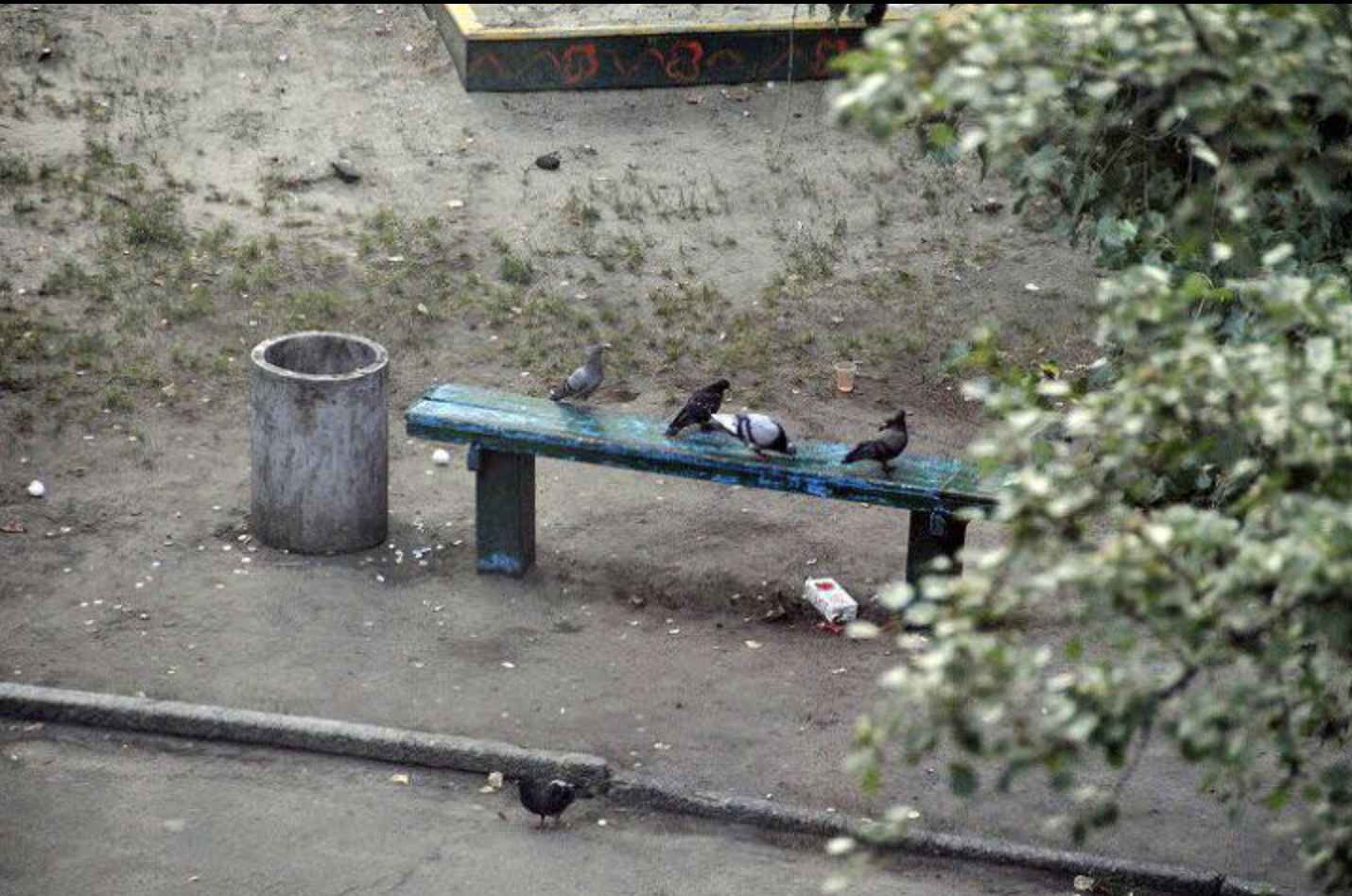
Today I am posting someone else’s photography for obvious reasons. Ukrainian photographer Yevgeniy Kotenko has captured quotidian life in a beautiful series called On the Benchsince 2007.
He photographed the view from his parents’ kitchen window in Kiev throughout the seasons.
At this very moment the images strike me as tragically poignant, wondering what all these individual people are going through, likely for years to come, if they survive.
And survival is doubly imperiled for people with life-threatening illnesses, in hospitals that are either not functioning due to dire lack of medication and supplies or being attacked themselves. The World Health Organization reports that shortages of cancer medications, insulin and oxygen supplies are reaching hazardous levels. Hospitals have been hit with cluster munition, according to the Human Rights Watch, and sick children are moved to make-shift bomb shelters in hospital basements.
Ukraine had put particular efforts into the care of sick children, beyond medical treatments. Here is a link to a project that provides children’s wards in hospital with constructed environments that support healing through play and discovery.
“The design studio Decor Kuznetsov and the Vlada Brusilovskaya Foundation have teamed up for CUBA BUBA, a project that transforms hospital rooms throughout Ukraine into sensory wonderlands for young patients. Complete with comfy seating, reading nooks, and even open-air chimes, each module is compact and intended for children to rest and relax as they undergo various treatments.The group recently installed its sixth iteration, “CUBA BUBA SUNNY,” which features a shelved room full of greenery and sculptures. Suspended below the light is an ornately carved ceiling that shines a unique pattern onto the eclectic collection. To inspire play, an earlier design’s facade is comprised entirely of holes, allowing kids to wind rope throughout the structure into a vibrant web.” (Ref.)
I lived in the first century of world wars. Most mornings I would be more or less insane, The newspapers would arrive with their careless stories, The news would pour out of various devices Interrupted by attempts to sell products to the unseen. I would call my friends on other devices; They would be more or less mad for similar reasons. Slowly I would get to pen and paper, Make my poems for others unseen and unborn. In the day I would be reminded of those men and women, Brave, setting up signals across vast distances, Considering a nameless way of living, of almost unimagined values. As the lights darkened, as the lights of night brightened, We would try to imagine them, try to find each other, To construct peace, to make love, to reconcile Waking with sleeping, ourselves with each other, Ourselves with ourselves. We would try by any means To reach the limits of ourselves, to reach beyond ourselves, To let go the means, to wake.
“A labyrinth is a symbolic journey . . . but it is a map we can really walk on, blurring the difference between map and world.” – Rebecca Solnit, Wanderlust: A History of Walking
Remember Ariadne? The labyrinth? The Minotaur, half man, half bull? Vague memories of vengeful Cretan king, Athenian hero, lovestruck princess and a ball of yarn? I could not help but thinking of the myth during my first artist visit for this year’s Exquisite Gorge II project, offered by Maryhill Museum of Art. Thirteen fabric artists, in collaboration with community partners, will portray an assigned section of the Columbia river in three dimensional form on frames. The sections will be linked in the end, forming an “Exquisite Corpse” during a public outdoor celebration at the museum in August. I hope to introduce all of them and their work with individual portraits during the next few months.
———————–
THE EXQUISITE GORGE PROJECTII
“…a collaborative fiber arts project featuring 13 artists working with communities along a 220-mile stretch of the Columbia River from the Willamette River confluence to the Snake River confluence. The project, again initiated by Maryhill Museum of Art and following the original one by printmakers in 2019, takes inspiration from the Surrealist art practice known as exquisite corpse. In the most well-known exquisite corpse drawing game, participants took turns creating sections of a body on a piece of paper folded to hide each successive contribution. When unfolded, the whole body is revealed. In the case of The Exquisite Gorge Project II, the Columbia River will become the ‘body’ that unifies the collaboration between artists and communities, revealing a flowing 66-foot work that tells 10 conceptual stories of the Columbia River and its people.”
———————–
So much to take in at Kristy Kún‘s studio in Ashland, OR. So many associations to the Ariadne myth.
A short refresher: Vengeful Cretan king subdues Athenians in war, extracts human sacrifice ever so often, feeding the youth to his hungry Minotaur, a monster conceived by the queen and an angry God because the king betrayed him with a cheap sacrifice. Half bull, half man, the creature is conveniently stashed out of sight in a labyrinth built by clever engineer Daedalus. Athenian hero Theseus vows to slay the beast. Clever daughter of the king, Ariadne, helps Theseus by providing a spun, woolen thread that allows him to navigate the steps through the maze for his return after the bloody deed is done. He takes her, as promised, away on his ship as his bride, but then dumps her on the Island of Naxos, as instructed by Goddess Athena in a dream. Marries Ariadne’s sister, no less. Depending on who you read (or listen to, lots of opera material!) and in which century, Ariadne either hangs herself out of despondence, or marries a God, Dionysus. Oh, no one lives happily after. Just saying.
Rising Sand 2018 46″ x 26” x 4″ Details below
There were labyrinthine works hanging on Kún’s studio walls or spread on surfaces, pathways ebbing and flowing with no discernible entry or exit.
There were threads pulled from materials, threads criss-crossing layers to be felted, threads waiting in skeins of wool to be pummeled.
There was instance after instance of the application of Ariadne’s thread, a problem solving method – by definition, a logical method that traces steps or takes point by point a series of found truths in a contingent, ordered search that reaches an end position. You solve a problem by multiple means, keeping a record so you can see where you dead-ended or progressed.
It might sound strange to introduce artistic work with a focus on problem solving, but the work at hand requires so many steps, so many intricate levels of processing, so much, indeed, engineering, that a logical, even mathematical mind is required.
The result, flowing, extravagant, holistic beauty belies the tight construction that goes into the creations.
Kún works with felt. Makes felt. Shapes felt. Compiles and arranges felt, with a brain trained as an engineer and the eye of a visual artist.
The matted fabric we call felt is created by binding protein fibers (wool from animals like sheep, goat, yak or alpaca) to each other in a process that involves the physical tangling of the fibers by means of special needles, or by using water and agitation that pummels the raw materials. Ever accidentally shrunk your favorite sweater by 2 sizes in the washer/dryer? That is wet felting…. the hair in the wool consists of shafts that are covered by protein scales. The water and detergents open up the scales and the agitation in the rotating drum, or rolling and rubbing and tossing, binds them together, shrinking them up to 40%.
Dry felting involves barbed needles that you stick into the raw material over and over, weaving the fiber strands together. It can be done by hand or by machine, when large projects are involved.
Felting has been around since at least the 6th century B.C., predating spinning and weaving. It likely originated with nomadic peoples in Asia, and remnants were discovered in burial places all across Siberia and Northern Europe. It was essential for shelter (think Mongolian yurts!) warmth and durability in clothing and boots, and protection from saddle burn for animals carrying loads. Ornamental uses have found their way into beautiful blankets and carpets, now extending to 2-D or 3-D sculpture.
The fabrication of today’s materials has come a long way from being coarse, wet wool stomped by camels, or pummeled by the hoofs of horses. Kún, for example, varies the kinds of fibers going into the felt. The selection involves the density of wool – wool is measured in microns, which describe the diameter of a wool fiber, the smaller the micron the finer the wool.
Micron 23
The artist also uses materials like silk that get entangled into the pressed fibers, dying the silks herself to achieve desired color gradations.
Layered wool and silk get run through the needling machine up to 6 times, then cut into strips, or fins, by a power cutter, wet felt aligned with cheese cloth, worked on surfaces that allow to pool the water.
Eventually the materials get shaped. That includes insane detail work of pulling threads out of the sides by hand to achieve a chenille-like effect that adds to the beauty.
Individual elements are stitched on, wet felt fibers shaved or torched to achieve the desired smoothness.
And then it’s time to finish the design, long planned and recorded to the tiniest detail. Some of the pieces are huge.
Photograph by Kristy Kún.
———————–
The artist with the clear face, beautiful eyes half hidden behind her glasses, is the descendent of Hungarian immigrants who settled in the Mid-West, establishing Presbyterian churches in and around Ely, Iowa, working hard to feed large families. She certainly has inherited that incessant, laser-focussed work ethic, a red thread like Ariadne’s throughout the many changes along her professional path. Trained as a construction engineer at the University of Nebraska, Omaha, she found her first real calling in wood working and furniture making. She settled in Northern California, interned and worked and learned the craft. A marriage to a fellow craftsman dissolved swiftly, leaving her as a single mother to a young daughter, trying to eke out a living in a male-dominated domain.
A side line of supplying crafts materials to her daughter’s Waldorf School led to an import business of Italian wool, selling it to spinners and felters. She got increasingly drawn into the fiber arts world, attending bi-annual workshops and camps for craft artists, the Frogwood Collective among them. Inspired by artists like Janice Arnold and Jenne Giles, Kún turned to felting in a serious way in the last decade, shifting from roles as supplier to that of artist.
It did not make her economic existence less precarious. Now located in Portland, OR, she was trying to support her family, while struggling with the illness of her new partner, who she lost to cancer in a painful battle to the end. Two years ago she moved to Ashland, leaving the familiarity and friendship network of PDX behind, to start a new life with a new love and a new studio, all during pandemic woes.
Life has felted Kristy Kún – my take, expressed with admiration. The various analogues of pummeling and stabbing, prodding and stomping have produced a tough, resistant core combined with (intellectual and emotional) flexibility like the fabric counterpart. Loose threads of flickering temper and intense empathy stick out here and there. Like the matted material absorbs water, she absorbs ideas and visions, turning amorphous input into shaped Gestalt. In addition to her raw talent, her persistence and technical skill have registered with the art world. Her work will be shown at this year’s Smithsonian Craft Show, Future Focus, and large commissions from collectors and designers across the world are regularly received.
—————————
While Kún and Lou Palermo, Maryhill Museum’s Director of Education, brainstormed over technical details of construction and placement of the frames – now stashed in her show room – within the Exquisite Corpse design, my thoughts wandered back to the tale of Ariadne, Theseus and the Minotaur. The myth has inspired countless works of art, from tellings by Catullus 64 and Ovid’s Heroides 10 in the first century B.C., to paintings spanning over 1000 years (here is a link that provides 73 of them!), to musical compositions, Monteverdi in the Baroque period, and Richard Strauss in 1916. And let’s not forget the modern version of myth telling – most recently seen in Dark, the German sci-fi thriller available on Netflix, that makes heavy use of Ariadne’s story and symbolism. A smart review of Dark in the NYT pointed out the particular theme’s relevance to contemporary history.
One of the reasons for its ongoing popularity, I believe, is that one can apply so many different perspectives to any one of the characters or actions involved. Across time you can see how interpretations of Ariadne focussed first on her passivity, her abandonment by yet another fickle male, then on her possible emancipation, her cunning in helping her lover, her ruthlessness in sacrificing a half-brother to a hero she saw as her ticket off the island – you name it. All links to shifting perceptions of gender roles.
Theseus has had his share of fans and critics too, understood as a self-sacrificing hero, or simply power-hungry. His wandering in the labyrinth has been appropriated by psychodynamic approaches in psychology, an archetypal representation of the psyche and a path to individuation, the authenticity you reach when you’ve made your way through the convoluted maze of feelings.
Comparisons to creativity have been offered as well. Serpentine windings to a goal without knowing the way, many a dead end, unclear what fates await – you get the idea. It looks to me that Kún’s creativity has not at all been impeded by labyrinthine obstacles. If anything, her work has blossomed from tightly constructed, somewhat rigid, representational beginnings to more freely flowing abstractions of natural forms that are willing to stand on their own. To link back to Rebecca Solnit’s quote at the beginning: Kún has created a bridge between map and world, walking along in its folds.
This leaves us with one final contemplation, how shifts in perspective define the Minotaur. The creature could either be seen as a bloodthirsty monster, depraved and deserving of slaughter, or as someone who in his deformity had to be hidden away as to not offend the sensibilities of the viewer(s.) Is he an enemy to the outside world? Or is his confinement an act of brutality against him? Do we project our fears of power, aggression, rage, disability and death onto this misshapen creature? Avoid the Other? Classic takes rejoiced forever in his slaying.
There were a few compassionate voices, Polish poet Zbigniew Herbert’s among them, expressed in a post-humosly published volume of essays, Labyrinth on the Sea, which described his visit to Crete in 1964. Elaborated in a later prose poem, The history of the Minotaur (1974), he sees the misshapen prince as a victim of those who insist on political, social and religious norms as defining who does and does not belong. Which – and yes, we were getting there eventually! – also applies to women and textile art.
I will talk about the history and politics of textile arts in depth at a later point in this series of essays. Let me just say here the very basics: not only were the arts and crafts divided into domains, with gender roles assigned, for centuries. Different arts were also linked to different values – male painters and sculptors scored higher than their female counterparts, the latter for the most part chained to their textile universe behind the embroidery frame. Hidden away in a maze, for all intents and purposes, forever invisible and unnamed even if they created stunning woks of art – just think Bayeux tapestries. Only in the last 40 years has textile art been given a platform, previously reserved for the male dominated, traditional fine arts field. With the help of some pioneers in the early 1920s who opened the flood gates, women have emerged to show the world how true art is independent of medium and how neglected media add novelty to the traditional canon in ways that are intensely beautiful.
Kristy Kún has to be counted among them.
It was a cold night in Ashland, sky shimmering with stars. I would not have found the Corona Borealis even if it had been present (I looked it up, it appears in July) – I barely can locate the Big Dipper. The small constellation of stars is said to represent the crown (corona) that Dionysos gave to Ariadne after she had been abandoned. It comforted me to think that, even if connected to a consolation prize, a woman with a thread is visibly remembered.
In view of the current violence unleashed unto the world, whether here or in Eastern Europe, I want to dedicate today’s poem, A Brief History of Hostility, to the victims: in Portland, and likely soon in Ukraine, in Russia. So many families losing loved ones, so many friends losing their allies, so many communities destroyed by wrath, greed and ambition.
Jamaal May’s poem appeared in “The Big Book of Exit Strategies,” published in 2016. Given its purview of themes of war and slavery, it seems a good choice for Black History month, but also relevant during a week where Europe is on the brink of war.
On Saturday here in Portland marchers had planned a protest to remember Amir Locke and Patrick Kimmons, Black men killed by police. Multiple women, directing traffic in preparation of the peaceful demonstration, were gunned down by a man living nearby, who approached them on the street and called them terrorists, killing June Knightly, a 60-year old woman walking with a cane, having just overcome cancer, and severely wounding the others. In the words of one of the victims:
“We were unarmed traffic safety volunteers who weren’t with any protestors. Four women trying to de-escalate & he unloaded a 45 into us because he didn’t like being asked to leave and stop calling us terrorist c*nts. We were in high vis and dresses. He murdered a disabled woman.”
The shooter was then shot by someone in the crowd, trying to come to the rescue of the victims. The aggressor’s name has not been released by the police while I write this, 48 hours after the event, and the Portland Police has erected a wall of silence other than calling him a home owner (code for White, or linked to castle doctrine) involved in a confrontation with armed protesters, unaffiliated with any political background. All counterfactual, as it turns out. There was no notification if he was arrested while in hospital, and his apartment was searched only after the FBI stepped in, suspecting a hate crime. Roommates, colleagues and family had testified to his links to the Proud Boys and other alt right forces, his frequent threats to shoot up Black Lives Matter folks, and the possibility that he was running unregistered guns. According to the media, virulent anti-semitic and islamophobic threats had been conveyed earlier to police, with no reaction.
(Update: he is now charged with multiple crimes. A GoPro video of the massacre, viewed by the DA, confirmed that he was the attacker. One of his victims is paralyzed from the neck down and in critical condition at OHSU.)
Meanwhile, on February 21, Russian President Putin basically said Ukraine shouldn’t exist. “A steady statehood didn’t occur.” Almost the same words that Stalin said about Poland in 1939.
He also confirmed he will recognise two breakaway Ukrainian regions as independent, a move that Ukrainian politicians see as “dangerous and a declaration of war.” It is certainly a violation of international law, the Minsk agreement. We will know, when you read this, if an invasion of (all of) Ukraine has begun in earnest. As I write this, military columns are entering Donbass.
I am linking back to an older blog here, that described the ebullient musical comedy of the Ukrainian Teatro Pralnia, a group of young musicians who are on my mind today, wondering what their future holds. You can see their 2018 full show at the Kennedy Center here.
The war said let there be peace and there was war.
The people said music and rain evaporating against fire in the brush was a kind of music and so was the beast.
The beast that roared or bleated when brought down was silent when skinned but loud after the skin was pulled taut over wood and the people said music and the thump thump thump said drum. Someone said war drum. The drum said war is coming to meet you in the field. The field said war tastes like copper, said give us some more, said look at the wild flowers our war plants in a grove and grows just for us.
Outside sheets are pulling this way and that.
Fields are smoke, smoke is air.
We wait for fingers to be bent knuckle to knuckle,
the porch overrun with rope and shotgun
but the hounds don’t show. We beat the drum and sing
like there’s nothing outside but rust-colored clay and fields
of wild flowers growing farther than we can walk.
Torches may come like fox paws to steal away what we plant,
but with our bodies bound by the skin, my arc to his curve,
we are stalks that will bend and bend and bend…
fire for heat fire for light fire for casting figures on a dungeon wall
fire for teaching shadows to writhe fire for keeping beasts at bay fire to give them back to the earth
fire for the siege fire to singe fire to roast fire to fuse rubber soles to collapsed crossbeams fire for Gehenna
fire for Dante fire for Fallujah fire for readied aim
fire in the forge that folds steel like a flag fire to curl worms like cigarette ash fire to give them back to the earth
fire for ancient reasons: to call down rain fire to catch it and turn it into steam fire for churches fire for a stockpile of books fire for a bible-black cloak tied to a stake
fire for smoke signals fire to shape gun muzzle and magazine fire to leap from the gut of a furnace fire for Hephaestus fire for pyres’ sake fire licking the toes of a quiet brown man fire for his home fire for her flag fire for this sand, to coax it into glass
fire to cure mirrors fire to cure leeches Fire to compose a nocturne of cinders
fire for the trash cans illuminating streets fire for fuel fire for fields fire for the field hand’s fourth death
fire to make a cross visible for several yards fire from the dragon’s mouth fire for smoking out tangos fire to stoke like rage and fill the sky with human remains fire to give them back to the earth fire to make twine fall from bound wrists fire to mark them all and bubble black any flesh it touches as it frees
They took the light from our eyes. Possessive. Took the moisture from our throats. My arms, my lips, my sternum, sucked dry, and lovers of autumn say, Look, here is beauty. Tallness only made me an obvious target made of off-kilter limbs. I’d fall either way. I should get a to-the-death tattoo or metal ribbon of some sort. War took our prayers like nothing else can, left us dumber than remote drones. Make me a loyal soldier and I’ll make you a lamenting so thick, metallic, so tank-tread-hard.
Now make tomorrow a gate shaped like a man. I can’t promise, when it’s time, I won’t hesitate, cannot say I won’t forget to return in fall and guess the names of the leaves before they change.
The war said bring us your dead and we died. The people said music and bending flower, so we sang ballads
in the aisles of churches and fruit markets. The requiem was everywhere: a comet’s tail disappearing into the atmosphere,
the wide mouths of the bereft men that have sung… On currents of air, seeds were carried as the processional carried us
through the streets of a forgetting city, between the cold iron of gates. The field said soil is rich wherever we fall.
Aren’t graveyards and battlefields our most efficient gardens? Journeys begin there too if the flowers are taken
into account, and shouldn’t we always take the flowers into account? Bring them to us. We’ll come back to you. Peace will come to you
as a rosewood-colored road paver in your grandmother’s town, as a trench scraped into canvas, as a violin bow, a shovel,
an easel, a brushstroke that covers burial mounds in grass. And love, you say, is a constant blade, a trowel that plants
and uproots, and tomorrow will be a tornado, you say. Then war, a sick wind, will come to part the air,
straighten your suit, and place fresh flowers on all our muddy graves.
It will come as no surprise to you that I am hooked on word games like the NYT’s Spelling Bee and Wordle. The newest one that I can highly recommend – an exercise in finding synonyms – is called Wordy Bird. Try it and rip your hair out.
Today is all about words, then. Words (and phrases) photographed across years, usable as guides to deal with stressors of the moment. For balanced reporting, however, today is also about numbers. Go figure.
Words by clever wordsmiths can be found beyond shop boards….
Take these, for example, attributed to Lewis Carroll.
A Square Poem.
I often wondered when I cursed, Often feared where I would be— Wondered where she’d yield her love, When I yield, so will she. I would her will be pitied! Cursed be love! She pitied me …
Read the lines in the normal way, then read it in columns – either way, it reads the same! words, with some quick math thrown in!
A dozen, a gross, and a score, Plus 3 times the square root of 4, Divided by 7, Plus 5 times 11, Is 9 squared, and not a bit more.
This Limerick is believed to have been written by British mathematician Leigh Mercer, known for inventing the famous palindrome “a man, a plan, a canal—Panama!” in 1948.
Tired?Stand here and activate your super powers
And then there is Miles Kington, who got away with two lines, making my morning:
A Scottish Lowlands Holiday
In Ayrshire hill areas, a cruise, eh, lass? Inertia, hilarious, accrues, helas!
This is a holorime, where both the last syllable of a pair of lines of verse rhyme with one another, as do the entire lines themselves. Best read out loud.
Finally we get to this: for some unrelated reason I slogged through a scientific article on word prevalence norms – i.e. how many people know the meaning of a given word. 5 million pages and a headache later I learned that more men know the words on the left hand of the table, more women the ones on the right. Surprise!
Ofcourse, you could have asked your grandma. She would have been perfectly able to predict and verify the statistical pattern… Do we really need the scientific seal on this kind of common cultural knowledge? Of course we weren’t taught words that did not pertain to our spheres, still rigidly divided by gender in so many areas.
One of my favorite neighborhood signs of all times in Hamburg a decade ago: Nothing works here (In German that has more than practical implications)
Hope the music delivers free happy for the weekend with every word and/or number.
When I came across Isobelle Ouzman’s project of cutting and drawing in old books my immediate association was one of contraband. Prison administrations have always claimed that drugs, cell phones, cigarettes and the like were smuggled into prison by friends and relatives, some via books, even though the evidence suggests that it is mainly prison staff who brings these things in and sells for a mighty profit (Here are the newest data.) So let’s look at prisons and books.
In case you missed it: Reading and other educational opportunities in prison reduce the likelihood of recidivism and increase the likelihood of gainful employment once you’re no longer incarcerated. Good news.
Likely you missed it: Not just prisoners, literature is locked up as well. There is an increasing trend across states to ban books in prison, often on arbitrary grounds, or make them available only at considerable cost. I am summarizing today what I learned from a PEN America report and an overview article about the state of censorship in U.S. state and federal prison. Another good source is the Marshall Project‘s collection of links to topics around book banning. Bad news.
Here is the long and the short of it. Prisons claim security concerns as the reason to ban books, and not just those with explicit sexual or violent content. Evidence that books are used to smuggle contraband is, as I said, sketchy at best. Nonetheless, over the last 5 years, many state and federal prison administrations have banned family members, charities and other outside parties from donating books, any books at all. Used books are completely prohibited. Only approved vendors can sell, and their offerings are arbitrarily restricted by decree from administrators.
“With free books banned, prisoners are forced to rely on the small list of “approved vendors” chosen for them by the prison administration. These retailers directly benefit when states introduce restrictions. In Iowa, the approved sources include Barnes & Noble and Books-a-Million, some of America’s largest retail chains—and, notably, ones which charge the full MSRP value for each book, quickly draining prisoners’ accounts. An incarcerated person with, say, $20 to spend can now only get one book, as opposed to three or four used ones; in states where prisoners make as little as 25 cents an hour for their labor, many can’t afford even that.
With e-books, the situation is even worse, as companies like Global Tel Link supply supposedly “free” tablets which actually charge their users by the minute to read. Even public-domain classics, available on Project Gutenberg, are only available at a price under these systems—and prisons, in turn, receive a 5% commission on every charge. All of this amounts to rampant price-gouging and profiteering on an industrial scale.”
If that wasn’t bad enough, prison library budgets have also been cut increasingly, making it ever more difficult for prisoners to access literature.
In states where there are no general, content-neutral bans on book donations there are still arbitrary restrictions of what type of materials are allowed in. Or perhaps not so arbitrary after all. There are blanket restrictions on books that concern Black culture, urban novels that concern African-American crime and intrigue, comics and cartoons like MANGA, and literature on the Civil Rights movement. Toni Morrison’s The Bluest Eye and Alice Walker’s The Color Purple, which won a Pulitzer Prize are banned in several states, Hitler’s Mein Kampf is not. Censored also are multiple books about learning Arabic, Japanese and American Sign Language, instruction manuals about learning to be an electrician or computer programmer. (Here is a typical list of all the technical materials Oregon prisons prohibit, Windows 10 for Dummies included.)
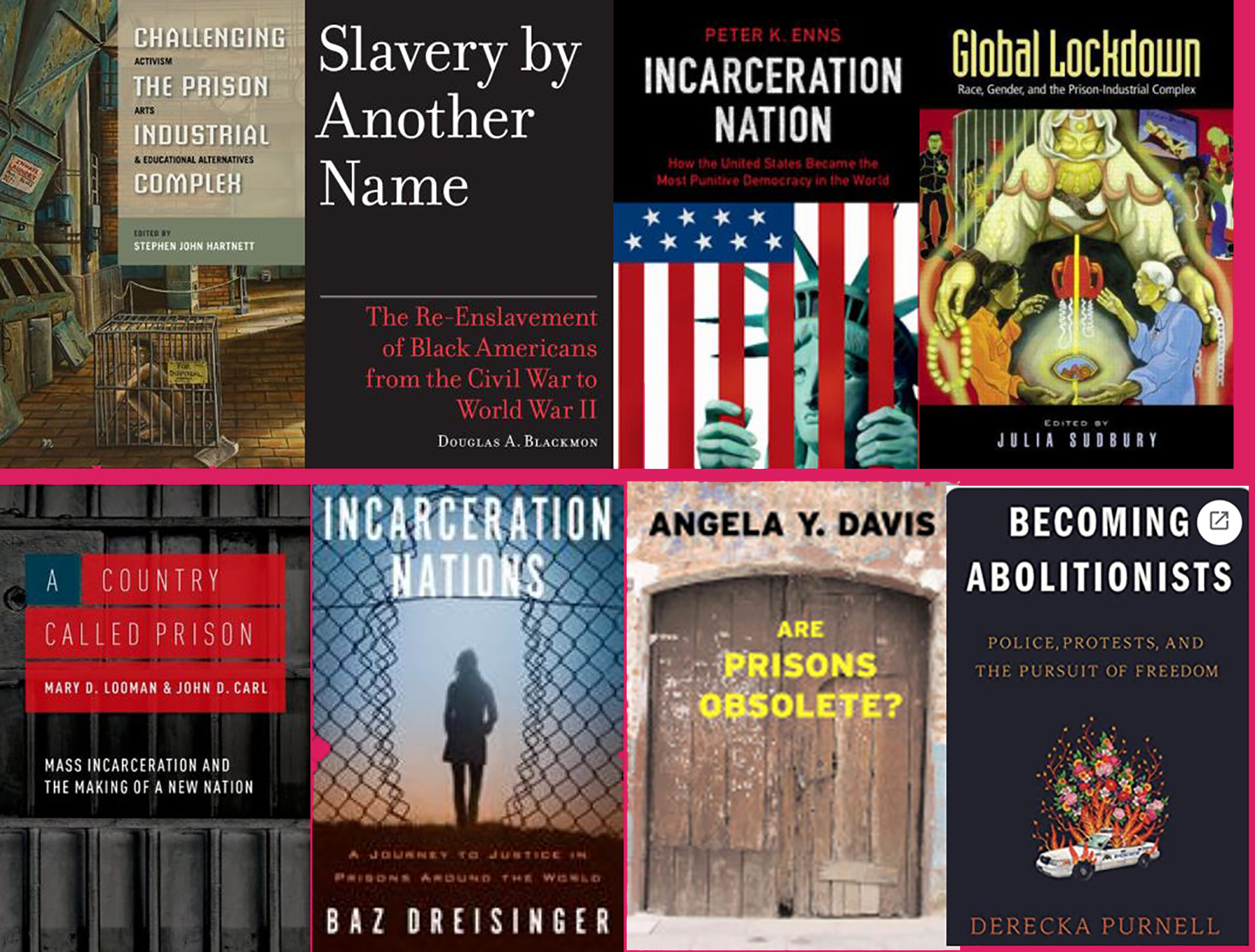
Many states do not give access to their ban lists, unless you fight for them under the Freedom of Information Act. But we do know that Texas, for example, has a list of 15.000 titles by now, Florida banned over 20.000 books, a stunning number. Racially motivated restrictions are widespread. The New Jim Crow by civil rights lawyer Michelle Alexander, for example, examines the phenomenon of mass incarceration and argues that our incarceration practices represent a continuation of our country’s racist policies of the past. After its release, the book was banned in prisons in North Carolina, Florida, Michigan, and New Jersey. Two years ago, Arizona banned Chokehold: Policing Black Men, a book on racial injustice in the criminal justice system, written by Georgetown Law School professor Paul Butler. Prison Nation, a book examining the prison-industrial complex, was banned for “security threat group/white supremacy.” The Factory: A Journey Through the Prison Industrial Complex, about a formerly incarcerated person’s time behind bars and the school-to-prison pipeline, was banned for “encouraging activities that may lead to group disruption.” Blood in the Water, a Pulitzer Prize-winning book about the Attica uprising, was banned for “security concerns-encouraging group disruption. I’m certain, the 1619 project will be next on the list.
Here is something we can do: the American Library Association keeps a list of donation programs that send books into prison libraries where still allowed.
Contributing to one, any one, is a form of mutual aid and solidarity we can all practice.
Unless we agree with ever curmudgeon-y Philip Larkin, who had nothing better to do with his Oxford degree in English Language and Literature than to write this…
A Study Of Reading Habits
When getting my nose in a book Cured most things short of school, It was worth ruining my eyes To know I could still keep cool, And deal out the old right hook To dirty dogs twice my size.
Later, with inch-thick specs, Evil was just my lark: Me and my cloak and fangs Had ripping times in the dark. The women I clubbed with sex! I broke them up like meringues.
Don’t read much now: the dude Who lets the girl down before The hero arrives, the chap Who’s yellow and keeps the store Seem far too familiar. Get stewed: Books are a load of crap.
Today’s post is dedicated to my grandfather Eduard (1894 – 1977) a musician, bird lover and gentle soul. His birthday was yesterday.
Canada Geese
Buckle up folks, it’s going to be all over the map today.
It all started with a reminder notice that one of the strangest pieces of music, John Cage’s ORGAN2/ASLSP –As SLow aSPossible – was about to change to a different tone on February 5, 2022. The longest composition ever – duration 639 years, you read that right – started in 2001, with a seventeen month-long pause before the first tone of the organ, especially built for the performance of this piece, was to be heard. Here is a video clip that shows the special organ in a small church in Halberstadt, Germany.
One particular tone emanates continually, and is changed at irregular time intervals according to the composer’s instructions. (Here is a calendar that shows the me changes and tone variations.) The current sound will last 2 years. This announcement had me wonder:
While we had to wait for more than 6 long years for the 14. sound change in 2020 , the next one is occurring only a few months hence, on February 5th. Quite a challenge for a subjective sense of time to get the hang of this. For those clinging to their subjective sense of time we might mention that the new sound will last exactly 24 months. Could very well be that those months will pass in a flash.
Honestly, I could not tell if this was meant seriously or ironically – probably a combination of my addled brain and being German. But be that as it may, it reminded me of a dominant topic in my current conversations. How is our sense of time shaped by the pandemic, the isolation, the sameness of the days and, admittedly, by aging?
Snowgeese yesterday
Snowgeese from other years
Cage’s composition was not the only reminder of the languid, unending spread of hours and days that I – many of us – feel, like time stalling. (This stands, of course, in extreme contrast to young families for whom the double burden of professional work and unrelieved childcare at home leads to a sense of having not enough time ever, time on 3x speed fast forward.)
One of the best cinematic experiences I’ve had in these last months also managed to capture a sense of time that is altered, aided by the elongated storytelling formats of TV series—those time-indulgent, episodic ways to weave a tale, unhurried by a two-hour time limit of movies. And no one knows how to unfold a plot in slow-mo better than the modern Korean film makers.
Steller’s Jay yesterday – Grey herons from other years
In Beyond Evil (directed by Shim Na-yeon, available on Netflix) it’s not just about the tempo of the narrative, though. Time itself seems to stand still in a small town haunted by age-old murders and secrets, with an unlikely coupling of 2 unmatched policemen churning the dregs and bringing new sorrow. It is not a serial murder case in the traditional sense, but rather a psychological study of a variety of characters stuck in time as flies are on those strips hanging in country kitchens. The protagonists are honing their compulsions, tending to their losses, and deciding what to sacrifice to remain on the ethical side of things. I know, does not sound enticing, but honestly, it was brilliant.
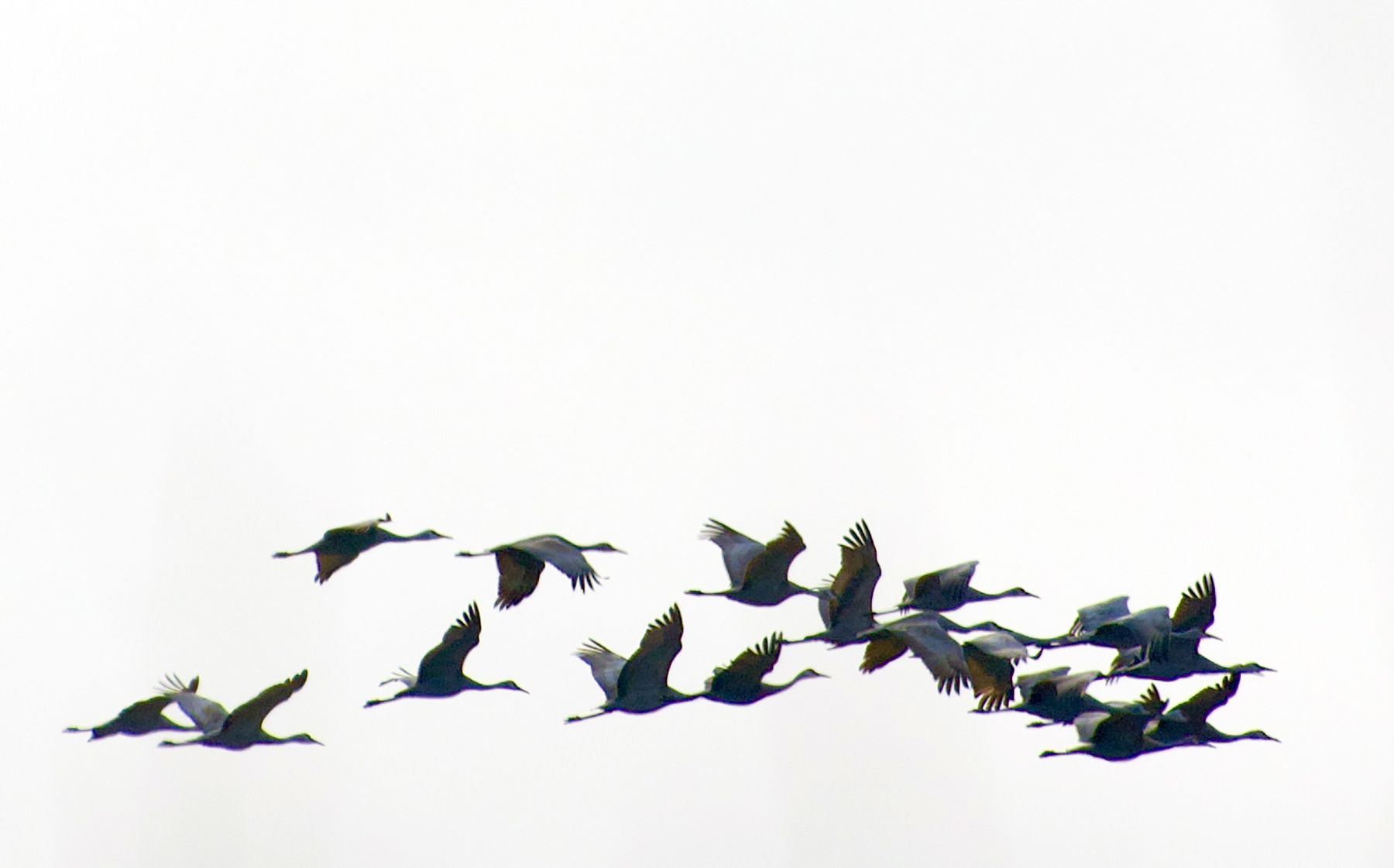
Sandhill Cranes yesterday
Sandhill cranes from other years
So, I thought, perhaps we should delve into the scientific psychology of time perception, since a lot of research has happened in the field lately. Nah, you can read up on it here. I much rather learn from poets than deal with my own field today.
Hawk from yesterdayHarrier HawkRedtail Hawks from other years
Both of the poems below managed to drag me away from moping about the altered sense of time’s passing, the feeling of being hermetically closed off from a perception of forward movement. They helped me, pushed me towards remembering what I sort of know but always forget: what matters is attention to the moment, the noticing and processing of what is afforded to you by grace of nature or the kindness of others or the tasks that give you pleasure or a sense of having something gotten done or the simple acknowledgment you’re still functioning reasonably.
Bald Eagle from yesterday
Baldies from other years
With Forever- is composed of Nows – Emily Dickinson celebrates recurrence, sameness, un-differentiation, all the while she spent her life in something akin to self-imposed lockdown.
Hummingbird (in February!) from yesterdayKingfisher from other years
Seems like good advice. I figured I’d drag a series of “nows” out of the archives, selecting samples of the last 5 years of early February photographs all taken without travel, in my immediate vicinity (2021 excluded since it was spent in hospital…) The same ducks and geese, sandhill cranes and variety of raptors, the same small folk and an occasional outlier (elk!) thrown in – a forever of joy from repeat excursions, the last one just yesterday afternoon. It helps to live in Oregon, one of the most beautiful places imaginable.
Elk from other years
You can slow down time as much as you want, if you ask me, if it still contains the possibility of momentary encounters, anchoring us in the NOW. Even robins, bushtits, woodpeckers and sparrows in the yard suffice.
Forever – is composed of Nows – ‘Tis not a different time – Except for Infiniteness – And Latitude of Home –
From this – experienced Here – Remove the Dates – to These – Let Months dissolve in further Months – And Years – exhale in Years –
Without Debate – or Pause – Or Celebrated Days – No different Our Years would be From Anno Dominies –
Rufus Towhee from yesterdayDowny woodpecker from other years
With Clocks, Carl Sandburg extends a warning that a focus on the measurement of time can distract us from using or enjoying the one we still have, since we don’t know when time will be cut short for good. Don’t focus on the perception of passage then, but what you can do to fill time with. (Never mind that that opens another problem set during a pandemic…)
HERE is a face that says half-past seven the same way whether a murder or a wedding goes on, whether a funeral or a picnic crowd passes. A tall one I know at the end of a hallway broods in shadows and is watching booze eat out the insides of the man of the house; it has seen five hopes go in five years: one woman, one child, and three dreams. A little one carried in a leather box by an actress rides with her to hotels and is under her pillow in a sleeping-car between one-night stands. One hoists a phiz over a railroad station; it points numbers to people a quarter-mile away who believe it when other clocks fail. And of course … there are wrist watches over the pulses of airmen eager to go to France…
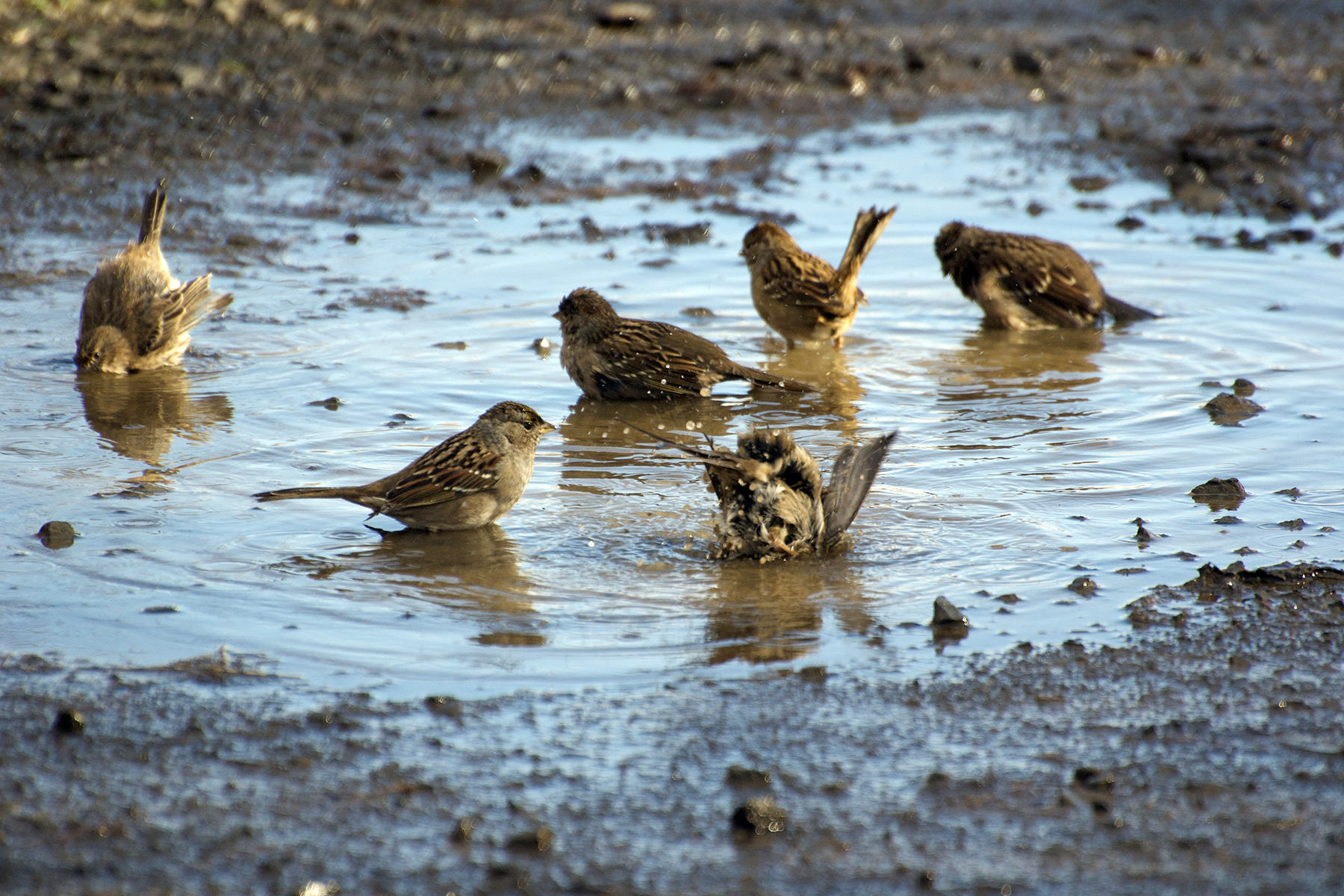
White throated sparrow from yesterday
Sparrows from other years
And for good measure, let’s throw in the advice of Vietnamese Buddhist master Thich Nhat Hanh who died last month:
“While washing the dishes one should only be washing the dishes, which means that while washing the dishes one should be completely aware of the fact that one is washing the dishes.” Why? If we are thinking about the past or future, “we are not alive during the time we are washing the dishes.” (from The Miracle of Mindfulness.)
Told you, it would be all over the map. Off to wash the dishes now.
Sandhill from yesterday. Music today in honor of my Opa who played the stand-up bass in a small-town orchestra named Fidelio. Here is a creative – and timely – version by the Washington National Opera of Beethoven’s Fidelio, with an explanation of how the new version came to be. Fidelio is a story of hope and resilience, a more desirable focus than speed of time…..
Now even the snow has grown sad – Let overwhelmed reason go, And let’s smoke our cigarettes through the air-vent, Let’s at least set the smoke free. A sparrow flies up – And looks at us with a searching eye: ‘Share your crust with me!’ And in honourable fashion you share it with him. The sparrows – they know Who to ask for bread. Even though there’s a double grille on the windows – And only a crumb can get through. What do they care Whether you were on trial or not? If you’ve fed them, you’re OK. The real trial lies ahead. You can’t entice a sparrow – Kindness and talents are no use. He won’t knock At the urban double-glazing. To understand birds You have to be a convict. And if you share your bread, It means your time is done.
Translated by David McDuff
It was one of those weeks where I seriously wondered if I should throw some crockery through a window or not leave bed ever again. Didn’t know whether to scream or to cry. I can only acknowledge helplessness in this never ending cycle of bad news or anxiety-inducing ventures into a seriously restricted world. The way we process death from Covid – or refuse to – by thinking of the thousands of daily victims as poor or POC (if you are a Trumpist) and thus not counting, or unvaccinated (if you are not a Trumpist) and thus somehow deserving, was just one of the things that had me upset.
My usual distraction, filling my eyes and brain with images of nature, did not exactly work out either. Having driven for over 40 minutes to the spot where birds of all kinds are usually guaranteed, I found none, well, just a few ducks and geese. It was as if all, in view of the ominous skies, had decided to leave or hide, exactly the hint I did NOT need. No hawks, no herons, no raptors of any kind, no shorebirds, zip.
Except a few sparrows, immature gold-crowned ones, I believe, but what do I know. Which led to locating the poem by Russian dissident Irina Ratushinskaya, imprisoned for years in a hard labor camp South East of Moscow, until she was released early for strategic reasons to affect the Reykjavik summit between then US president Ronald Reagan and then Soviet leader Mikhail Gorbachev.
Ratushinskaya, trained in physics and mathematics, had signed appeals and demonstrated for the exiled Sakharov in 1981, and was again arrested in 1982, tried in 1983 and punished with a severe seven-year labor camp and subsequent five-year internal displacement sentence. It was assumed that the persistent Christian voice in her ever more prominent poetry led to the harshness of the sanctions. After her release she joined her husband in exile in England, and later spent two yeas as poet in residence at NorthWestern University. Eventually, with Russia now led by Yeltsin, they returned to Moscow to raise their sons there. She died of cancer in her early 60s in 2017.
The poet came to mind not just because of her sparrow poem; she wrote a goose-bump-producing book on prison conditions and interactions with other political dissidents and comrades, Grey Is the Colour of Hope (1988.) That was in the 1980s. Now we have again a situation where famous people like opposition leader Aleksei A. Navalny are imprisoned (and as of Monday put on the terrorist list,) but also where an increasing number of opposition allies, rights activists and independent journalist have to choose between potential prison and exile (if they are still lucky enough to choose at all.)
And if you are still rolling your eyes over the likes of Newt Gingrich in this country threatening the members of the January 6th commission with jail time if – or when – the GOP wins the midterms, I’d advise to look at what is happening in plain sight. Independently of what the committee has – or has NOT – accomplished so far (overview here) there are real-time attacks on its members or people who favored an investigation. The Virgina attorney general, for example, just fired Tim Heaphy, University of Virginia’s counsel and member of the committee, from his post. In Texas, U.S. Rep. Van Taylor, R-Plano, is facing an unexpected number of powerful primary challenger angry over his simple vote to investigate the insurrection. I could go on.
I would not dismiss the idea of jailing opponents as a, if not plausible, at least possible fact of life under new management in 2024. After all, we have history as a guide. Which brings me back to throwing things or crawling under the covers for good. Or maybe I, too, should jump into a puddle. Which shall it be?
Alternatively, I might just run to the hills. Here are Scottish composer Sally Beamish’ Hill Stanzas. She has also set some of Ratushinkaya’s words to music, but I could not find those pieces.
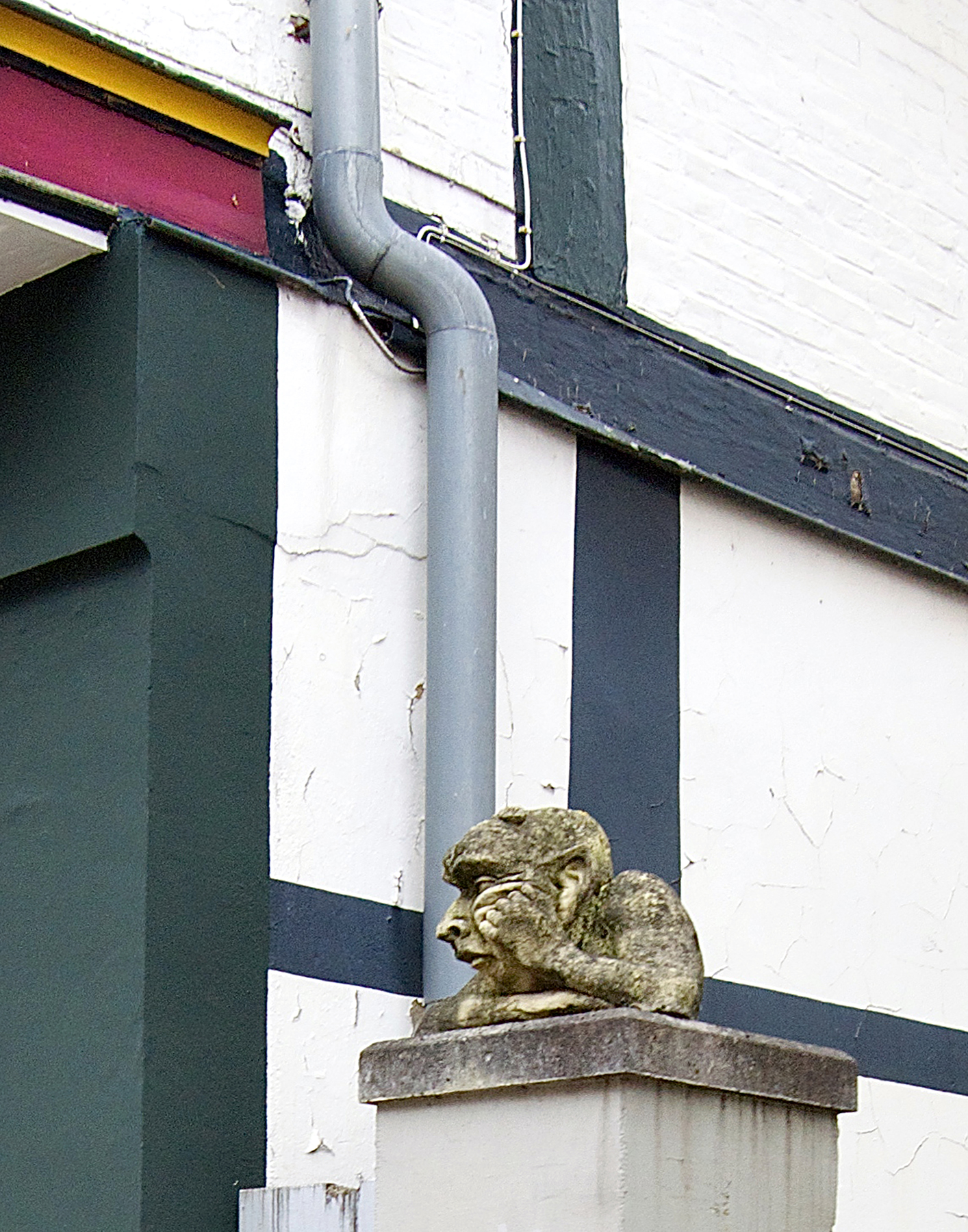
Looking into the endless gray this week, all I wanted was color. The rain hammered on my roof during the nights, with leaf-stuffed gutters overflowing, water gushing by my window. Of course! Drainpipes! The solution to filling my eyes with color and pattern and my brain with delightful memories of prior travels. Thus today’s barrage of photographs, since pipes held my interest for years on end, always with faint plans to use them eventually for abstract montages.
Of course you don’t get away today with just admiring rusting pipes. Too pressing the problem – in Portland and elsewhere – of health issues associated with lead in the water.
The nation, for the most part, knows about Flint, MI and the water troubles they experienced. The crisis there has become synonymous with environmental disaster. Turns out, Portland is worse.
Since the late 1990s, samples have shown Portland exceeding the federal safety threshold for lead 11 times. In 2017, after Portland had once again surpassed that threshold, OHA required the water bureau to build a corrosion control treatment facility, according to Salis’ letter. Water from the Bull Run watershed is naturally corrosive, which can cause lead from copper plumbing and fixtures to leech into people’s homes. By building a facility to make Portland’s water less corrosive, the bureau expects to reduce the amount of lead dissolving from old plumbing into stagnant water. The facility is slated to be completed by April. (Ref.)
Here is the water bureau’s January 2022 response after decades of complaints:
Some of the actions the Water Bureau is taking include:
Treating the drinking water to reduce lead and copper;
Offering free lead-in-water testing to all residential customers and childcare providers;
Increased education and outreach to customers through mailings to multifamily residences and all homes built between 1970 – 1985;
Actively managing drinking water in the distribution system to maintain the effectiveness of corrosion control treatment; And
Proactively partnering with the Oregon Health Authority and Multnomah County Health Department.
I leave it to you to assess the quality of government/management in this city when you consider this problem was known for 30 years now.
In case you’re worried: The water bureau offers free lead-in-water testing to all residential customers and childcare providers. People can contact the LeadLine at leadline.org or 503-988-4000 to receive a free lead-in-water test.
And since we are in a practical mood today, here are 9 gutter fails that are slowly killing your house….only half joking, a beloved neighbor of ours had utterly expensive damage from rain water making its way into the walls and house foundation.
Children are, of course, the ones most at risk. They are often exposed to multiple sources of lead contamination: the water they drink, the dust they inhale from the paint used in older houses or contaminated soil in poorer neighborhoods often build adjacent to industrial sites. Parents who work in certain industries – automotive repair shops for example – can inadvertently bring lead particles home on their clothing. Kids are also surrounded by toys that expose them to lead:
“Lead softens the plastic and makes it more flexible so that it can go back to its original shape. It may also be used in plastic toys to stabilize molecules from heat. Lead dust can be formed when plastic is exposed to sunlight, air, and detergents that break down the chemical bond between the lead and plastics.” The CDC recommends to keep plastic toys away from young children who put their hands in their mouths after or during play.
Lead poisoning has serious consequences, developmental delay and learning difficulties included. Here is a link to the Mayo Clinic site that describes what to be on the look-out for symptoms.
And if all this is not enough justification to dig into my drainpipe archives, then maybe this is: Drainpipes are having a moment after homophobic Politician arrested at Gay Sex Party. (A right-wing Hungarian politician tried to avoid being arrested at a party in Belgium during lockdown by climbing out of the windows and down a drain pipe.) Everything that puts shade on the ruling Fidesz party is welcome….. (a rival lawmaker in Hungarian parliament, Zoltán Varga, reportedly brought a drainpipe to the floor of the legislature to use as a prop in a recent speech railing against the ruling Fidesz party’s hypocrisy.)
And here is a piece of music that captures sounds of rain and multiple rhythms when it runs, or dips or plops or gushes down the pipes…beautiful composition by John Luther Adams (2009.)
Let’s end with Ford Maddox Ford. (The entire wonderfully snarky poem can be read here.)
In the Little Old Market-Place
(To the memory of A. V.)
It rains, it rains, From gutters and drains And gargoyles and gables: It drips from the tables That tell us the tolls upon grains, Oxen, asses, sheep, turkeys and fowls Set into the rain-soaked wall Of the old Town Hall.
Here’s to the next 8 days that are supposed to be entirely dry!
Today I want to introduce the poetry of someone my US readers will likely be unfamiliar with. I chose the poet and the (excerpted) poem because they represent so much of what I admire: a review of both, the good and the bad that surrounds us, a strong desire for justice or the fight for it. A will to remember history, awe of nature, and pleasure derived from language that uses patterns related to science while sounding lyrical as we expect from poetry.
It also fits with last Monday’s Jewish holiday of Tu B’Schevat, the Festival of the Trees. It’s not a biblical holiday but marks the beginning of the annual agricultural cycle for trees (and tithing.) Starting with the 17th century, the date was celebrated with a Seder meant to repair our standing in the earthly and spiritual realm. Four cups of wine are offered, from white to shades of red symbolizing different levels of creation. Foods are served that remind us of the complexity of our existence. The first fruits and nuts have inedible shells, like pomegranates or almonds, and represent the physical world in which protection and defenses are necessary. Then fruits with inedible cores like apricots or olives, to recall both physicality and inner emotions that need protection. The third group are fruits like figs or blueberries that can be fully eaten. They stand for the highest level of physical and spiritual perfection achievable in the corporeal world. The final “fruit” is not physical and cannot be eaten, standing in for the spiritual realm.
Today’s poem includes numerous fruits and trees and certainly thinks through how we can integrate, change or repair the many layers that make up our existence.
Danish writer Inger Christensen was one of Europe’s leading contemporary poets until her death in 2009. (Here is a link to a great overview of her approach to life and work.) A staunch progressive and a visionary, she focussed on community over individualism and encouraged all of us to act on our beliefs. In my more blasphemous moments I think of her as the Hannah Arendt of poetry.
I am currently reading a brilliant collection of her essays,The Condition of Secrecy, that was published posthumously. For today, though, I offer a long-form poem based on the alphabet and the pattern of the Fibonacci sequence of numbers (each number the sum of the two previous ones.) Yes, by definition it gets long – and no, I am not posting all 76 pages of it – but also ever more inclusive of the many aspects of our world. The alphabet pattern is slightly lost in English translation (a superb one) – it’s simply not possible to maintain the beginning letters. I don’t speak Danish, but I can “hear” the pattern. Here is the comparison for one of my favorite sections:
5
efteråret findes; eftersmagen og eftertanken findes; og enrummet findes; englene, enkerne og elsdyret findes; enkelthederne findes, erindringen, erindringens lys; og efterlyset findes, egetræet og elmetræet findes, og enebærbusken, ensheden, ensomheden findes, og edderfuglen og edderkoppen findes, og eddiken findes, og eftertiden, eftertiden
5
early fall exists; aftertaste, afterthought; seclusion and angels exist; widows and elk exist; every detail exists; memory, memory’s light; afterglow exists; oaks, elms, junipers, sameness, loneliness exist; eider ducks, spiders, and vinegar exist, and the future, the future
The poem gives me goosebumps every time I read it, with its intricate world-building, its ability to conjure the beauty of nature and the horror of our human potential for destruction, often in the same breath. Published in 1981, the psalm-like verses include the terror of nuclear annihilation, but the vision beneath it all really speaks to timeless ways of mankind endangering itself (and the planet) in our struggle for riches and power. It also reminds us of all that exists independently of us, to be cherished and protected.
My photographs are of some of the plants and trees she mentions.
Alphabet
(Excerpt)
by Inger Christensen
translated by Susanna Nied (1-8) and Pierre Joris (9-end)
1
apricot trees exist, apricot trees exist
2
bracken exists; and blackberries, blackberries; bromine exists; and hydrogen, hydrogen
doves exist, dreamers, and dolls; killers exist, and doves, and doves; haze, dioxin, and days; days exist, days and death; and poems exist; poems, days, death
5
early fall exists; aftertaste, afterthought; seclusion and angels exist; widows and elk exist; every detail exists; memory, memory’s light; afterglow exists; oaks, elms, junipers, sameness, loneliness exist; eider ducks, spiders, and vinegar exist, and the future, the future
6
fisherbird herons exist, with their grey-blue arching backs, with their black-feathered crests and their bright-feathered tails they exist; in colonies they exist, in the so-called Old World; fish, too, exist, and ospreys, ptarmigans, falcons, sweetgrass, and the fleeces of sheep; fig trees and the products of fission exist; errors exist, instrumental, systemic, random; remote control exists, and birds; and fruit trees exist, fruittherein the orchard where apricot trees exist, apricot trees exist in countries whose warmth will call forth the exact colour of apricots in the flesh
7
given limits exist, streets, oblivion
and grass and gourds and goats and gorse, eagerness exists, given limits
branches exist, wind lifting them exists, and the lone drawing made by the branches
of the tree called an oak tree exists, of the tree called an ash tree, a birch tree, a cedar tree, the drawing repeated
in the gravel garden path; weeping exists as well, fireweed and mugwort, hostages, greylag geese, greylags and their young;
and guns exist, an enigmatic back yard; overgrown, sere, gemmed just with red currants, guns exist; in the midst of the lit-up chemical ghetto guns exist with their old-fashioned, peaceable precision
guns and wailing women, full as greedy owls exist; the scene of the crime exists; the scene of the crime, drowsy, normal, abstract, bathed in a whitewashed, godforsaken light, this poisonous, white, crumbling poem
8
whisperings exist, whisperings exist harvest, history, and Halley’s
comet exist; hosts exist, hordes high commanders, hollows, and within the hollows half-shadows, within the half-shadows occasional
hares, occasional hanging leaves shading the hollow where bracken exists, and blackberries, blackberries occasional hares hidden under the leaves
and gardens exist, horticulture, the elder tree’s pale flowers, still as a seething hymn; the half-moon exists, half-silk, and the whole heliocentric haze that has dreamed these devoted brains, their luck, and human skin
human skin and houses exist, with Hades rehousing the horse and the dog and the shadows of glory, hope; and the river of vengeance; hail under stoneskies exists, the hydrangeas’ white, bright-shining, blue or greenish
fogs of sleep, occasionally pink, a few sterile patches exist, and beneath the angled Armageddon of the arching heavens, poison, the poison helicopter’s humming harps above the henbane, shepherd’s purse, and flax, henbane, shepherd’s purse and flax; this last, hermetic writing, written otherwise only by children; and wheat, wheat in wheatfields exists, the head-spinning
horizontal knowledge of wheatfields, half-lives, famine, and honey; and deepest in the heart, otherwise as ever only deepest in the heart, the roots of the hazel, the hazel that stands on the hillslope of the heart, tough and hardy, an accumulated weekday of Angelic orders; high-speed, hyacinthic in its decay, life, on earth as it is in heaven
9
ice ages exist, ice ages exist, ice of the arctics and ice of the kingfisher; cicadas exist, chicory, chrome
and the chrome yellow iris, the blue iris; oxygen indeed; also ice floes in the arctic ocean, polar bears exist, as fur inscribed with an individual number he exists, condemned to his life; & the kingfisher’s mini-drop into the ice-blue rivers
of mars exists, if the rivers exist; if oxygen in the rivers exists, oxygen indeed; exists indeed there where the cicadas’ i-songs exist, there indeed where chicory heaven exists blue dissolved in
water, the chrome yellow sun, oxygen indeed; it will exist for sure, we will exist for sure, the oxygen we breathe exists, eye of fire crown of fire exist, and the heavenly inside of the lake; a handle infolded with bulrushes will exist , an ibis exists, and the movements of the soul inhaled into clouds exist, like oxygen storms deep inside Styx and in the heart of wisdom’s landscape ice-light, ice identical with light, and in the inner heart of the ice-light emptyness, live, intense like your gaze in the rain, that fine life- iridescent rain where gesture-like the fourteen crystal lattices exist, the seven crystalline systems, your gaze in mine, and Icarus, impotent Icarus exists;
Icarus swaddled in melting waxwings exists; Icarus pale as a corpse in civvies exists, Icarus all the way down where the pigeons exist; dreamers, dolls exist; the dreamers’ hair with cancerous tufts torn out, the dolls’ skin pinned together with nails, rotting wood of the mysteries; and smiles exist, Icarus’ children white as lambs in the gray light, will indeed exist, indeed we will exist, and oxygen on oxygen’s crucifix; as hoar-frost we will exist, as wind we will exist, as the rainbow’s iris, in the shining shoots of mesembryanthenum, in the tundra’s straw; small
we will exist, as small as bits of pollen in peat, as bits of virus in bones, as swamp pink maybe maybe as a bit of white clover, vetch, a bit of chamomile exiled to the lost again paradise; but darkness is white say the children, the darkness of paradise is white, but not white as a a coffin is white, that is if coffins exist, and not white as milk is white, that is if milk exists; white is white, the children say, darkness is white, but not white as the white existing before fruit trees existed, their flowering so white, darkness is whiter, eyes melt
10
june night exists, june night exists, sky finally as if lifted up to celestial heights and simultaneously pushed down as gently as when dreams are visible before being dreamed; a space like swooned, like saturated with whiteness, a timeless
knell of dew and insects, and nobody in this gossamer, nobody understands that autumn exists, that aftertaste and afterthought exist, only these restless lines of fantastic ultrasounds exist and the bat’s jade-ear turned towards the ticking fog; never was the globe’s inclination so beautiful, never were the oxygenated nights so white,
so dispassionately dissolved, softly ionised white, and never was the limit of invisibility so nearly touched; june, june, your jacob’s ladders exist your sleeping beasts and their dreams of sleep exist, a flight of galactic germs between the earth so earthy and heaven so heavenly, the calm of the valley of tears, so calm and the tears sunk back, sunk back in like groundwater again underground; earth; the earth in its revolution around the sun exists; the earth in its itinerary through the milky way exists; the earth on its way with its load of jasmin, and of jasper and iron, with its curtains of iron, its portents of joy and random Judas kisses and a virgin anger in the streets, jesus of salt; with the jacaranda’s shadow on the waters of the river, with falcons and hunters and january in the heart, with the well of Japoto della Quercias Fonte Gaia in Sienna and with july as heavy as a bomb; with tame brains, with heart jars or heart grass or berries, with the roots of ironwood in the exhausted earth
the earth that Jayadeva sings in his mystic 12 century poem; the earth with its coastline of conscience, blue and with nests where the large heron exists, with its neck curved blue-gray , or the small heron exists, mysterious and shy, or the night heron, the ash-colored heron exist and the degrees of wing beats of sparrows, of cranes and pigeons; the earth with Jullundur, Jabalpur and Jungfrau exists, with Jotunheim and the Jura exists, with Jabron and Jambo, Jogkarta exists, with earth-swirls and earth-smoke exists with water masses, landmasses, earthquakes exists, with Judenburg, Johannesburg and the Jerusalem of Jerusalems
*
atombombs exist
Hiroshima, Nagasaki
Hiroshima 6 august 1945
Nagasaki 9 august 1945
140.000 dead and wounded in Hiroshima
about 60.000 dead and wounded in Nagasaki
frozen numbers somewhere in a distant and ordinary summer
since then the wounded have died, many at first, indeed most, then fewer, but in the end
all; in the end the children of the wounded, stillborn, dying,
many, continuously, some, finally the last ones; in my kitchen
I stand and peel potatoes; the faucet runs and nearly covers the noise of the children in the yard;
the children yell and nearly cover the noise of the birds in the trees; the birds sing and nearly
cover the murmur of the leaves in the wind; the leaves murmur and nearly cover the silence of the sky,
the sky which is light and the light which since then has nearly resembled the fire of the atom bomb
Here is a musical rendition on Soundcloud. It might cut off if you don’t have an account, alas.
As an alternative, we can listen to Danish composer Carl Nielsen’s 4th symphony, The Inextinguishable, celebrating “the elemental will to live” against the backdrop of WW I. It feels weird to write this while by all reports Scandinavian and Baltic nations are standing their defense forces at attention giving the developing situation with Ukraine.
I believe in the great discovery. I believe in the man who will make the discovery. I believe in the fear of the man who will make the …. discovery.
I believe in his face going white, his queasiness, his upper lip drenched in cold sweat.
I believe in the burning of his notes, burning them into ashes, burning them to the last scrap.
I believe in the scattering of numbers, scattering them without regret.
I believe in the man’s haste, in the precision of his movements, in his free will.
I believe in the shattering of tablets, the pouring out of liquids, the extinguishing of rays.
I am convinced this will end well, that it will not be too late, that it will take place without witnesses.
I’m sure no one will find out what happened, not the wife, not the wall, not even the bird that might squeal in its song.
I believe in the refusal to take part. I believe in the ruined career. I believe in the wasted years of work. I believe in the secret taken to the grave.
These words soar for me beyond all rules without seeking support from actual examples. My faith is strong, blind, and without foundation.
by Wistlawa Szymborska from View With a Grain of Sand Harcourt Brace 1993 translation: Stanislaw Baranczak and Clare Cavanagh
I wonder if this poem seeded the idea of a book, a remarkable book that looks at the consequences – intended and unintended- of scientific discoveries. Benjamin Labatut’s When We Cease To Understand The World is a small volume describing mathematical and scientific research, ruminating about the psychological states of those engaged in the work, and weaving fact and fiction in ways that meander between horror story and lyric poetry.
The last time I felt like this when reading a novel grounded in history, was decades ago when I couldn’t put Pat Barker’s Regenerationtrilogy down, never mind babies screaming for attention, house wanting to be cleaned, lectures needing to be written and exams to be graded. Both authors share the skill of sending readers on two parallel paths, leaving it to us to drop and pick up the strands where truth ends and imagination begins, where facts are overshadowed by psychological analysis or feelings discarded in the light of facts. Both also excel in alternations of intensity and subtlety, in itself a weird combination.
Barker succeeds in sustaining our attention to history, social structures, identity (before that became a political concept) across three complex volumes, never letting up tangential brilliant confabulation,. She thinly veils her portraits of historical people behind pseudonyms and graphically imparting on us the horrors of World War I and what they did to the soul of artists.
Labatut, in contrast, keeps it short – perhaps aware of contemporary attention spans. His subjects are famous scientists, although the pages are sprinkled with some names less familiar, and some characters are completely made up. He has a knack to impart scientific facts in ways that do not frighten even the math- or physics-phobic reader, partly because the narrative swings endlessly back to the human interest story at the heart of the tales – how do you accept the fact that your discovery brings suffering and ruin to the world? Do you continue to proceed?
Both authors do not shy away from delving into details of horrors, yet the texts themselves have a certain serenity as if we are watching our own history unfold from the safe location of a distant star. That in itself is, of course, a trick, since it indirectly suggests that our own responsibilities need not be considered when focused on those who wreaked the actual havoc, or do they? The wishful thinking of Szymborska’s lines (admitted to be without justification in fact,) should it not be headed by us, in the ways we should be willing to obstruct, to risk, to endanger our standing by unpopular but necessary actions?
Szymborska’s “I believe in the refusal to take part” is less wish than command. One that is faintly echoed in the last chapter of Labatut’s work which introduces us to a night gardener, a former mathematician who has given up on the world, too clear-eyed about the catastrophes awaiting us, in a society that uses the principles of quantum mechanics without ever truly understanding them. The very last parable of the book describes the final demise of lemon trees cut down by their own excess riches. It somehow all came together, and I felt humbled by it.
Szymborska, again, sarcastically:
“I am convinced this will end well, that it will not be too late,”
How many more reminders do we need by brilliant writers that clinging to this belief simply won’t do?
On a more upbeat note, here is a fun compilation of unintended, positive consequences of scientific discoveries.
Music today by Bartok who was enchanted with mathematical principles and symmetry, particularly the Golden Mean. The ratio appears in this piece. Give it a chance, it grows on you.