In the two previous blogs I wondered about ways to predict the future and ways to remember the past. So it seems fitting then to round up this week with a way to see the present.
I had connected the former to science, would like to introduce the latter with poetry, along the maxim lodged in my head by the unforgotten, unforgettable Ursula LeGuin (1929-2018):
“Science describes accurately from outside, poetry describes accurately from inside. Science explicates, poetry implicates.”
These lines come from an essay, Deep in Admiration, that precedes the poems in LeGuin’s penultimate book of poetry, Late in the Day. (2015.) (So Far So Good: Final Poems 2014-2018 was published posthumously). In typical fashion the small volume inspires and lifts up, even though it centers around finiteness, both personal and ecological. The poems urge us towards awareness. My mindfulness will never reach the height of observational precision and depth of forming connections among all in the natural world, as did her’s. Nor will I ever succeed in emulating the driest of dry humor that pervades so many of her writings. But it is good to be reminded to try and focus on the here and now. Since as we know it might not exist much longer. The here as much as the now.
Time says “Let there be” every moment and instantly there is space and the radiance of each bright galaxy.
And eyes beholding radiance. And the gnats’ flickering dance. And the seas’ expanse. And death, and chance.
Time makes room for going and coming home and in time’s womb begins all ending.
Time is being and being time, it is all one thing, the shining, the seeing, the dark abounding.
And here is to doing all that with elegance and gusto during advanced age…
Artemisia Tridentata
Some ruthlessness befits old age. Tender young herbs are generous and pliant, but in dry solitudes the grey-leaved sage stands unforthcoming and defiant.
by Ursula LeGuin
Photographs include sage and Eastern Oregon landscapes; music, from a collaboration between LeGuin and Todd Barton, is mind boggling.
“Music and Poetry of the Kesh is the documentation of an invented Pacific Coast peoples from a far distant time, and the soundtrack of famed science fiction author, Ursula K. Le Guin’s Always Coming Home. In the novel, the story of Stone Telling, a young woman of the Kesh, is woven within a larger anthropological folklore and fantasy.
The ways of the Kesh were originally presented in 1985 as a five hundred plus page book accompanied with illustrations of instruments and tools, maps, a glossary of terms, recipes, poems, an alphabet (Le Guin’s conlang, so she could write non-English lyrics), and with early editions, a cassette of “field recordings” and indigenous song. Le Guin wanted to hear the people she’d imagined; she embarked on an elaborate process with her friend Todd Barton to invoke their spirit and tradition.”
In other words, the music and language were invented at the same time the book was written. Listening to it while reading Always coming home was the idea. Details here.
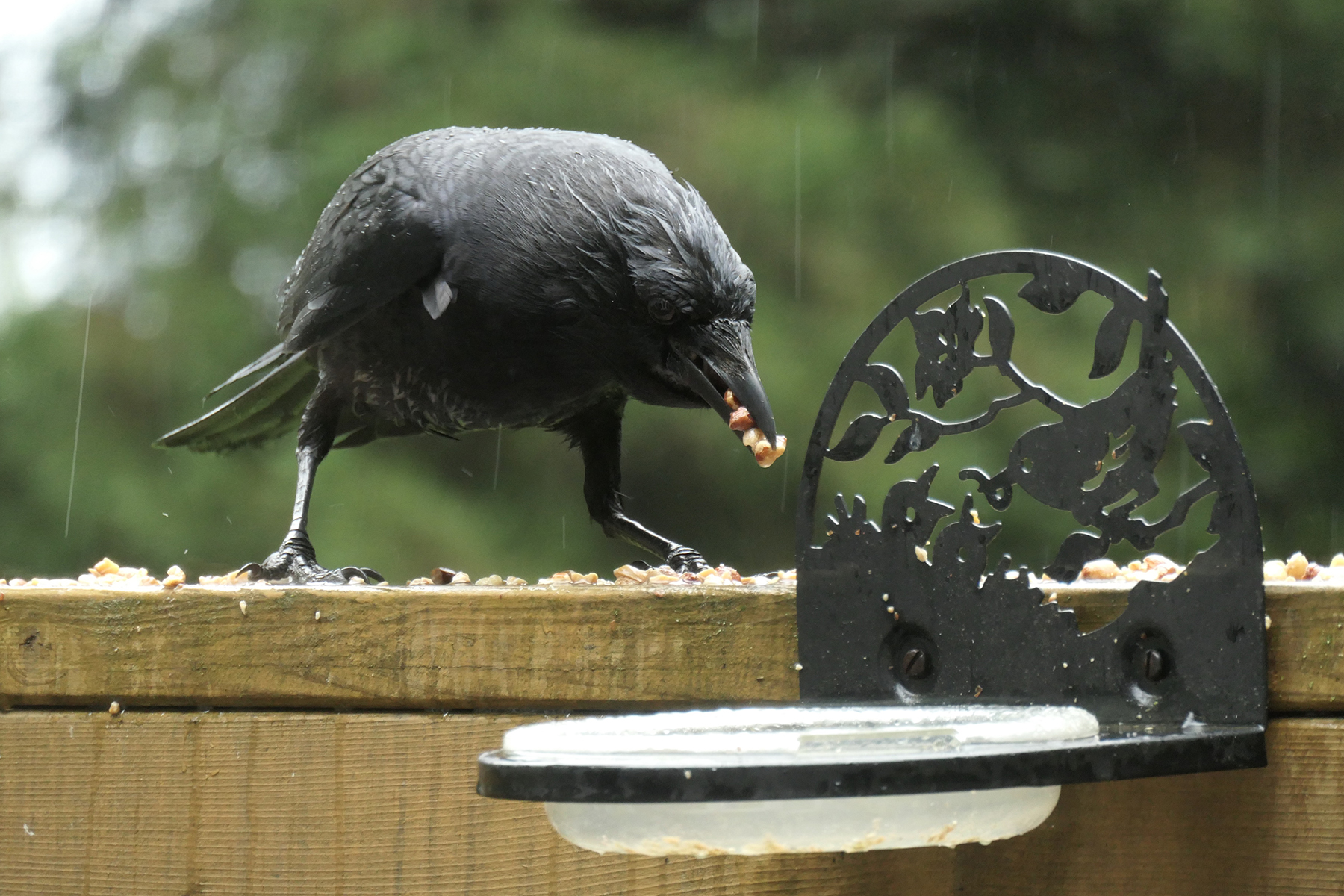
In truth, what I was looking for was simply some justification to post pictures of the crows that have joined the squirrels, doves and sparrows on the rainy balcony. Poe came to mind, his famous poem about the Raven. Before you know it, I was sucked into essay after interesting essay of Poe’s influence on French artists, in particular Ravel. The composer claimed many times over that Poe’s Philosophy of Composition (which describes the process of creating the Raven in meticulous, almost mathematical ways, and can be read in full in the link) was a key influence on his own principles of composing.
Just as the Anglo world despised Poe (Henry James wrote that “an enthusiasm for Poe is the mark of a decidedly primitive stage of reflection,” Paul Elmer More thought Poe “the poet of unripe boys and unsound men,” Yeats thought “The Raven” to be “insincere and vulgar,” and Aldous Huxley thought it “shoddy and slipshod,”) the French thinkers and artists embraced him, Ravel, Debussy and Baudelaire among the biggest fans.(Ref.)
Apparently there is debate how seriously Ravel meant it when he said that his own work in composing was built on Poe’s methods, with some convinced of it, and others claiming that he was the eternal trickster, pulling off pranks and maybe luring people in wrong directions. Unclear if their shared interest in being Dandies forged a bond. I wouldn’t know. Nor do I care.
I do care for the music and everyone agrees that some of Ravel’s compositions are in direct reference to some of Poe’s writings. “A Descent into the Maelstrom” was among them, an inspiration to La Valse in 1920, for example.
What is also established, and that is interesting to me, is that Ravel refused to be roped into the rising French nationalism and its focus on ancient and regional French music. He was open to trans-nationalist influences, and looked outwards for inspiration, borrowings, and appropriations from international sources. A good role model in times, then and now, when tribalism, insularity and traditionalism try to constrict art and education on all fronts.
In 1928, Ravel’s extended, successful concert tour of the U.S. introduced him to Gershwin who took him to hear jazz in Harlem. He also visited New Orleans. The harvest of those encounters can be found in his later compositions, the Piano Concerto in G among them. It includes some jazz elements that are profoundly beautiful. Well, the whole piece is. Played by one of my heroines. (Alas, video has ads in-between movements. My favorite is the third movement, if you have only so much time.)
For a detailed biography of Ravel’s life, sexuality, artistic output and philosophy one can turn to Benjamin Ivry’s biographyMaurice Ravel – A Life, reviewed here, or Roger Nichols’ Ravel, the most recent one.
Or one can simply listen to his music, with its many layers just like the crows feathers.
The neighborhood where I have now lived for 35 years is utterly familiar, yet also undergoing constant change. On a larger scale, there are endless trees cut for sub-divisions or single housing, people leaving, people moving in. Families with young children are a welcome addition, and you now hear other languages than plain English on your walks. On a smaller scale, my garden surprises me every year with unpredictable change. This year there’s nary a blueberry on the bush that bent over with them last year, tons of foxgloves have self-seeded, brought in by the wind or the deer, attracting a plethora of bees. The daisies have finally outnumbered the buttercups in the lawn, which took only about 5 years, and the fuchsias have decided to become trees, in full bloom already. It all provides a sense of place.
Italy
It is much harder to get a true sense of place if you only visit, and that for short amounts of time. What will define it when you travel? Your visual impressions? Your interaction with the locals? The landscape that defines the surrounds or the climate? The history that you read up on, maybe? Are you a better able to “get” a place, if you have widely traveled and so can make comparisons? If you go in utterly naive or geared by expectations based on external introductions? Will coincidences play a role, an aversive experience at the hotel, or an unanticipated encounter with the nicest people? These latter events might shape, perhaps, whether you like a place or not, which is different from having a sense of place.
BelgiumHolland
Here is the cause for these musings: Anastasia Savinova, a Ukrainian artist based in Sweden, has generated some creative photo collages, trying to extract a sense of place – Genius Loci – from a large scale entity, a city or rural area, and then injecting it into a small scale object, a building. Guided by architectural cues, visual details, a good sense for local prevalence of certain colors, she constructed these buildings into formations that capture the shapes or ornamentation or idiosyncrasies of places like Paris, Bruxelles, Berlin, and cities in Italy and Holland. I had immediate recognition, before reading the labels for most cities, from my own travels which are guided by visual exploration more than anything else, which meant she really captured something that is specific to each place. Pretty nifty.
ParisBerlin
The most successful montages, less compressed and calmer, are, in my opinion, the ones that depict places in her geographic vicinity, the Scandinavian countries she lives in or has often visited. Perhaps longstanding exposure. living in a place, leads to true familiarity. This in turn allows you to distill an essence after all, not just a jumbling of multitudinous elements that caught your attention on the road, no matter how much they are part of the reality of those cities. Whatever one thinks of the printed works – they might speak more to those who have the lovely jolt of recognition – the idea itself is creative.
Will I ever travel again? Will the experience change after this eternal time of confinement? Why can my desire to roam not be stilled, even when I have the perfect model right in front of me, a wonderfully snippy ode to small scale familiarity by Billy Collins?
A Sense of Place
If things had happened differently, Maine or upper Michigan might have given me a sense of place–
a topic that now consumes 87% of all commentary on American literature.
I might have run naked by a bayou or been beaten near a shrouded cove on a coastline.
Arizona could have raised me. Even New York’s Westchester County with its stone walls scurrying up into the woods could have been the spot to drop a couple of roots.
But as it is, the only thing that gives me a sense of place is this upholstered chair with its dark brown covers, angled into a room near a corner window.
I am the native son of only this wingback seat standing dutifully on four squat legs, its two arms open in welcome,
illuminated by a swan-neck lamp and accompanied by a dog-like hassock, the closest thing a chair has to a pet.
This is my landscape– a tobacco-colored room, the ceiling with its river-like crack, the pond of a mirror on one wall a pen and ink drawing of a snarling fish on another.
And behind me, a long porch from which the sky may be viewed, sometimes stippled with high clouds, and crossed now and then by a passing bird– little courier with someplace to go–
other days crowded with thunderheads, the light turning an alarming green, the air stirred by the nostrils of apocalyptic horses, and me slumped in my chair, my back to it all.
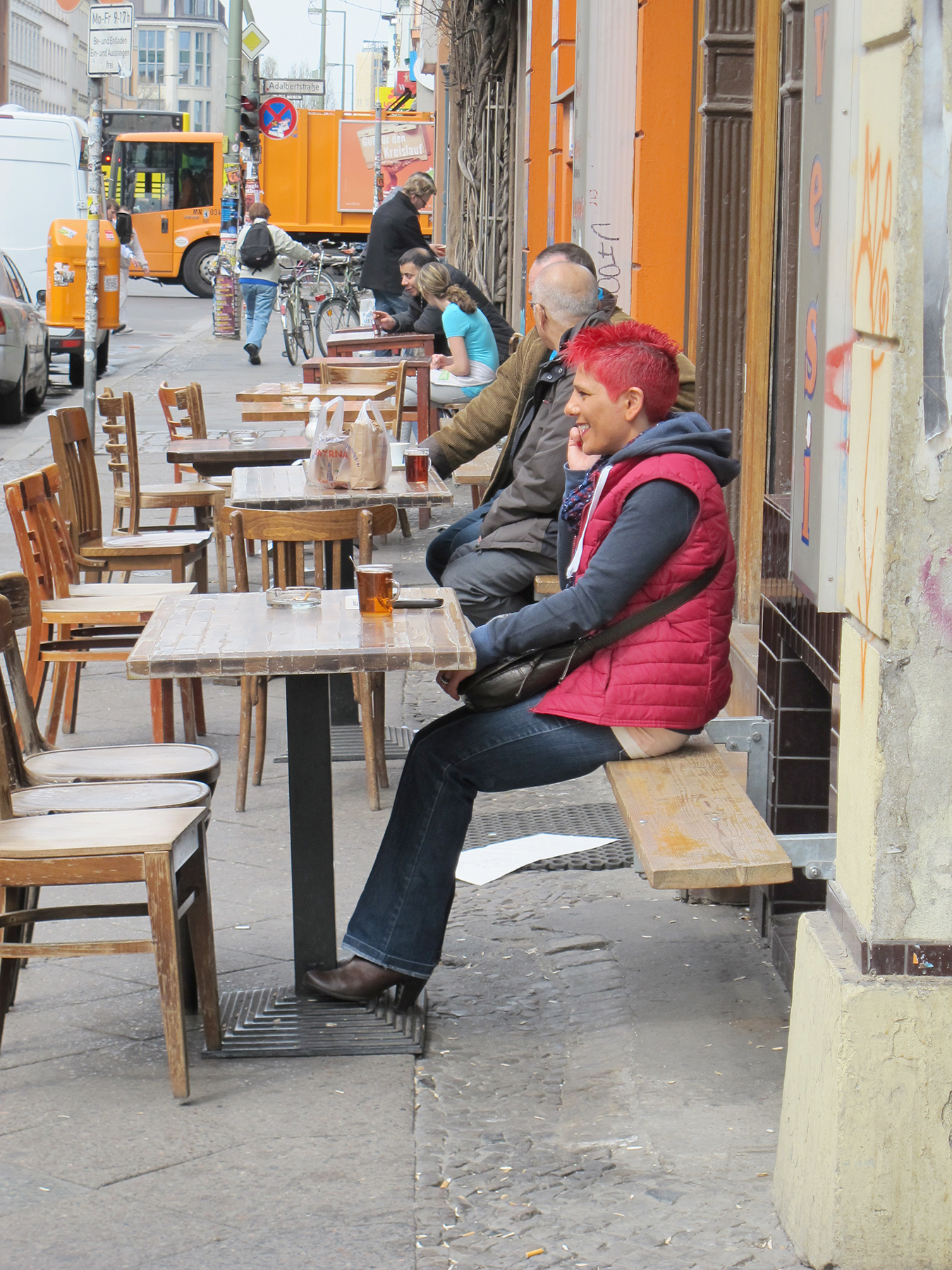
Photographs were chosen to add life to the depicted places – people I photographed in the cities captured in the collages.
Music will stretch our brain a bit, a beautiful performance by the Kronos Quartett. I figured a focus on the planet is needed to balance out a focus on an armchair….
I am generally not a fan of Charles Bukowski’s writings. A thought-provoking essay on the man, his life and his work, some years back in the New Yorker, pretty much summed it up for me: “Bukowski’s poetry,… is at once misanthropic and comradely, aggressively vulgar and clandestinely sensitive.” The underground poet was born in 1920 in Germany and moved as a three-year old to Los Angeles where he died of leukemia in 1994. He has one of the largest following of readers in contemporary American poetry although he was never accepted into the official canon. He lived a rags-to-riches life, fueled by drugs, alcohol, and general defiance of societal restrictions, prison stints included. “The secret of Bukowski’s appeal: he combines the confessional poet’s promise of intimacy with the larger-than-life aplomb of a pulp-fiction hero.“
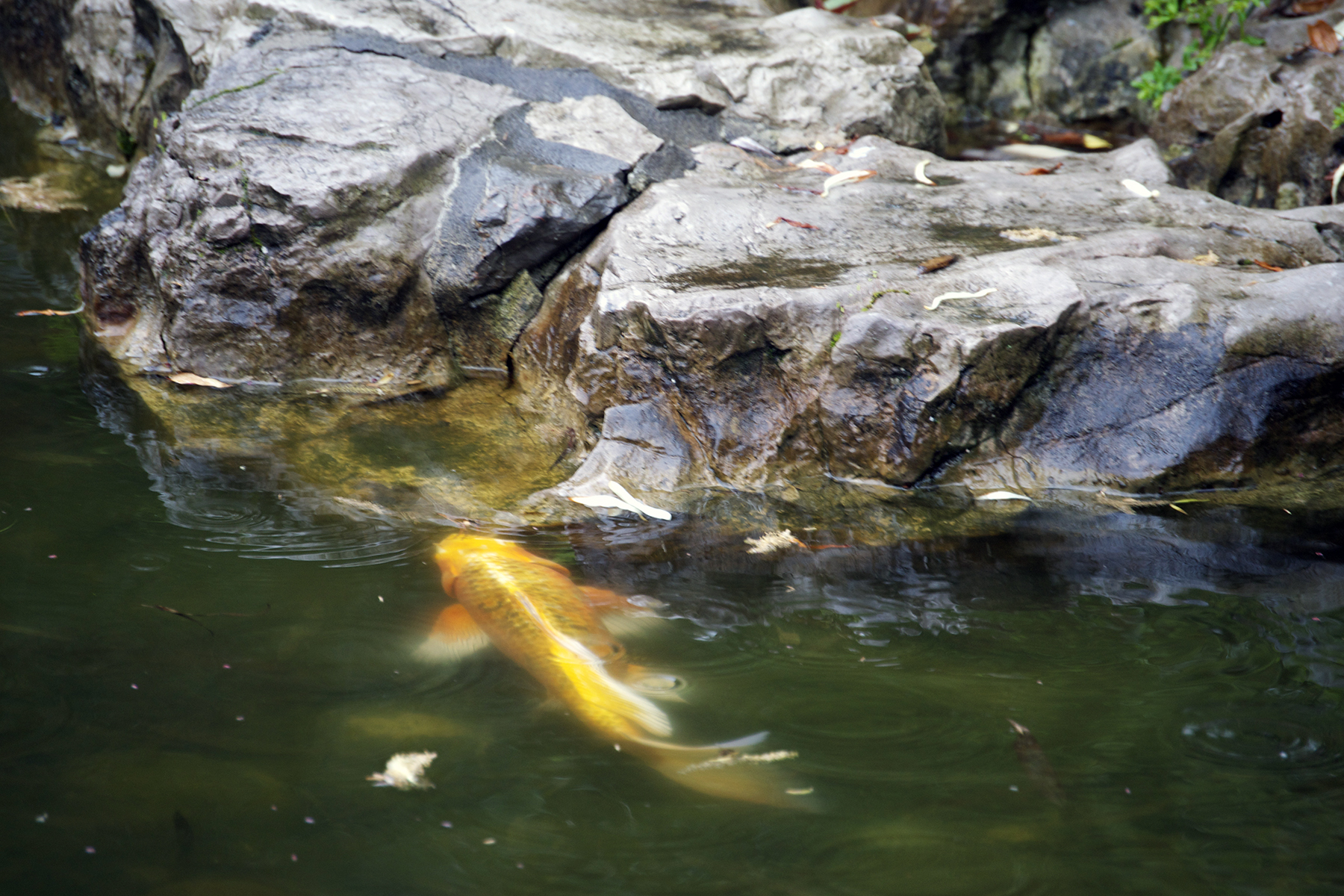
However, the poem I would like to introduce today is one I rather like: The Man with theBeautiful Eyes is from the poem collection, The Last Night on Earth. It raises questions that are important, and points to facts that are rarely openly discussed.
The poem is read in the short film clip below, the latter itself a work of art by Jonathan Hodgson and Johnny Hannah. They adopted the style of revered socialist-realist painter Ben Shahn, creating the film with paint, ink and collage rather than digital means and providing visual details that reinforce the ideas – both the direct expressions and the subtle implications – of the poem.
View it here – and then I’ll share my observations.
The poem introduces a group of young boys, told by their parents to stay away from a house with shuttered windows and a gold fish pond hidden behind a bamboo hedge. The film starts out with a view of a poster of a missing child – clearly there is danger in the world and kids do better to listen to their parents. Kids, of course, are drawn to the opposite of what they’re told to do: and so these boys regularly play in the forbidden territory, imbuing it with exotic ambience, Tarzan around the corner. No, they are Tarzan! Unrestrained rulers of the jungle!
One day, and only once, a man appears from the house, with foul mouthed, misogynistic swearing, a bottle of whiskey in hand, a cigar in his mouth, looking completely disheveled. Not only is he friendly, he addresses them in respectful, if mocking (?) terms “little gentlemen,” and hopes they enjoy playing in his run-down realm. They are in awe. They think him, his wildness, enticing. They adore everything they are forbidden to see much less to emulate. In their eyes, he is beautiful.
One day they find the house burnt to the ground, the fish dead in an empty pond, the bamboo scorched. They decide it must have been their parents who killed the man and all that was his. They fear that the future will replicate this assault on beauty, that they will never be allowed to hold it in whatever form.
The film accompanies the narration with images of a suburban father killing every weed threatening his lawn with poison. It ends depicting a storefront with a sign Chinaski‘s – the name for Bukowski’s alter ego in his writings – and a homeless man either dead or sleeping in a dark alley next to the store, people indifferently rushing by.
Do we believe the parents capable of such a crime? They surely didn’t kill a man and left but smoldering foundations? Or did they? Do parents have a right to be afraid for their kids in a dangerous world? Of course they do. Do kids intuit, even if it doesn’t reach the level of an actual crime, that parents want to kill off the other, even if the threat is not directed at their kids, but at the parents’ own well-being? To extinguish all forms of wildness that threatens to throw your own tightly held, and dearly paid-for conformity out of balance?
One of the ways that the beauty of something unruly, unruled, will indeed be taken from you is by making sure that you never trust your own perceptions. Kids intuit what is going on, but are told they are mistaken. Kids, of course, can misinterpret what is in front of their eyes, but their gut interpretation often points to a deeper truth. They, too, must conform and obey the rules (“It is for your own good!”) in preparation for their social acceptance, and if that means to discard subjective assessment of what could be beautiful, so be it.
Deviance, it is taught, is bad, might get you ultimately killed. If you violate established cultural, contextual or social norms, never mind legal ones, there will be consequences. There is not a single culture that does not have negative connotations regarding deviance (although what counts as deviance is malleable, across cultures, or across time within a single culture.) Social control ropes deviants in, maintaining social order with a system of rewards and punishments, some formal, many informal. Children don’t want to be forced into the straight jacket of societal norms, they still crave freedom, but it is a losing battle. Those, like the man with the beautiful eyes, who have not given up on a similar desire, must be wildly strong, but they will also pay a price (if only an accidental house fire caused in a drunken stupor, or the revenge of an abused and mistreated lover, that costs him a roof over his head.)
Rarely mentioned is the fact that deviance can also be positive. It has been a motor for social change through the ages, from behaviors questioning gender hierarchies (think Suffragettes, women’s liberation) to racial injustice (think norm refusals during the civil rights movement, Rosa Parks) to the fight for LGTBQ rights or the protests around fossil fuel extraction. In fact there is a whole area of study in health psychology these days, centered on Positive Deviance, on how to employ it to produce positive change.
Bukowski might have pleaded for acceptance of a self-destructive life style, not exactly an example of constructive change to society’s norms. But the larger truth, that deviance can contain beauty and is a threat to imperative conformity, was clearly understood by the kids in the poem, and feared by their parents. It’s all in the eye of the beholder.
Music has had its own encounters with the label “deviance.” Norm promotion has led to labeling certain composers or styles of music as negatively deviant, not worthy of being considered the future of music, a threat to culture, to religion, politically unacceptable, or evil. This has, of course been particularly true if the music was associated with other categories that threatened the status quo, race being among the strongest. The Blues comes to mind. Here are some favorites.
Today is all about music, a new album that I find singularly graceful, or, more precisely, full of grace.
The real thing, in all of the word’s connotations: smooth, elegant movement, thoughtfulness, and the favor extended from up high. Not that I know much about Sufism’s relationship to Allah, beyond the definition that “it is a mystical Islamic belief and practice in which Muslims seek to find the truth of divine love and knowledge through direct personal experience of God.”
Vulture Prince was released a month ago by singer, composer and producer Arooj Aftab and has been finding its way into my soul. Labeled as neo-sufism, it creates modern versions of age-old Pakistani music – classical or semi classical ghazal, thumri and qawwali music – none of which I am familiar with. Of course I do not understand the language either, some of which uses words from 18th century Urdu poet Mirza Ghalib and 11th-century Persian poet Jalāl ad-Dīn Mohammad Rūmī. It speaks to the universal power of music, and the gift of this particular artist, that it is nonetheless impossible not to get what is expressed: longing, seeking, devotion, grief and love.
Aftab has Pakistani roots and came to the US to study music and engineering at the Berklee School of Music in Boston. She now lives in New York City, having published her first album in 2015, and since also recorded together with brilliant jazz musician and Harvard professor Vijay Iyer and bassist Shahzad Ismaily in a jazz trio called Love in Exile. Here is how Iyer describes their working relationship:
“Music can be a way of holding and being held by other people, and that’s how it feels like when we play together,” he says. “She has this deep reservoir of emotion that’s coming from a haunted place. She makes something beautiful, but it’s not just beauty for its own sake. It’s actually beauty as a form of care.”
I wish I had thought of that sentiment, that formulation, it is perfection.
In her mid-30s Aftab has already experienced the recent death of her younger brother and a close friend. That grief permeates some of the music, but the best analogy for the experience of listening to her that I can come up with can be found in the translation of the artist’s name: Rising Sun. Shrouded in lingering darkness, feeling swallowed by these hard, dark times, we nonetheless are gifted light, inevitably, every morning, the first rays bringing a semblance of hope. Color unfolding. Restoring a waning belief in grace.
I have tried to find a collection of samples of the variety of her music, and the growth curve from her Bird under Water album all the way to Vulture Prince. I can even tolerate the use of harp, an instrument I do not particularly like.I hope this unfamiliar beauty eases your way into the new week.
Lullaby
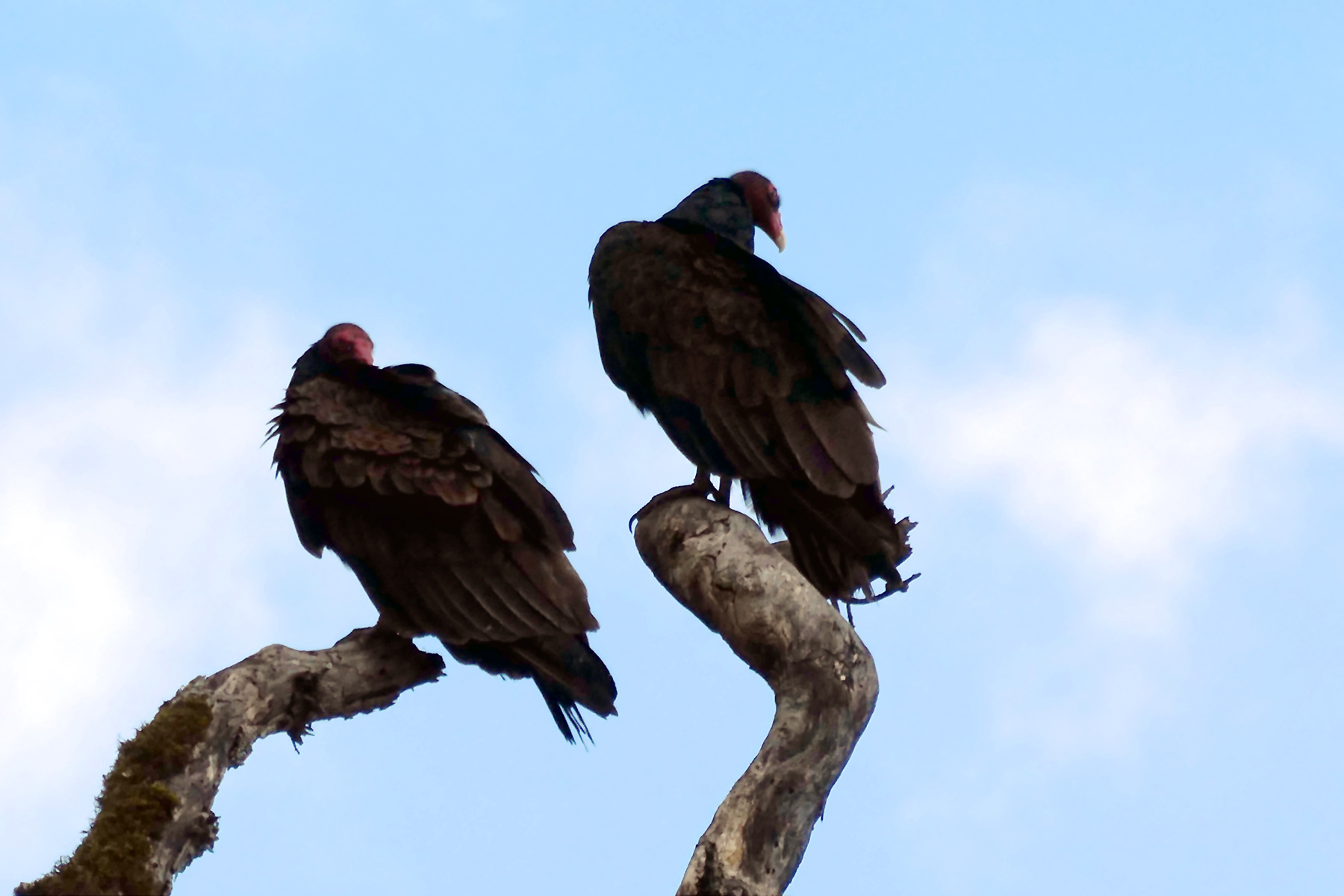
Photographs of vultures from Sauvie Island some years back. And here is a poem by Mirza Ghalib, one of the great poets of the Mughal empire. His ghazals, many set to music and sung by the most popular South Asian vocalists, were part of Aftab’s childhood – and used on her new album as well. This was one of the few I could find in English translation.
When I did my reading last week for Earth Day it struck me how the topic of environmental harm can be traced back across centuries. Poets as diverse as William Blake, Wordsworth, Larkin, to name just a few Brits, wrote about the dangers of industrialization and the destruction of the English countryside – man-made dangers, just as climate change is a result of man-made fossil uses on a larger scale.
Going back in time even further, Ovid told the tale of Phaeton, retold below by one of our own outstanding poets, Eliza Griswold.
The power of this poem, for me, lies in the fact that it manages to outline the psychological mechanisms that can lead to destructiveness, a destructiveness that ultimately affects so many more than the individuals involved, changing the course of the world.
The original myth had Phaeton, mobbed for being fatherless, seek out his father Apollo, the sun god. His father feels guilty for having abandoned him and wants to prove his love by granting him a wish, any wish. Kid asks for the most powerful thing to make up for his feeling of being an outsider (or maybe the potentially most destructive one to exert his revenge?), to drive his father’s chariot of the sun. Catastrophe ensues when Phaeton, as was predicted, cannot control the powerful horses, freezing the earth when he veers from the path, then scorching it when he comes too close, making peoples’ blood boil through their skin which turns them Black, a race created. Zeus intervenes, seeing the havoc reeked, and kills Phaeton by throwing him off the chariot. Apollo’s mourning throws the world into darkness for days on end.
Bastard, the other boys teased him, till Phaethon unleashed the steeds of Armageddon. He couldn’t hold their reins. Driving the sun too close to earth, the boy withered rivers, torched Eucalyptus groves, until the hills burst into flame, and the people’s blood boiled through the skin. Ethiopia, land of burnt faces. In a boy’s rage for a name, the myth of race begins.
A boy’s rage for a name? Or an ancient example of what maligning implies – the polarization of in-group to out-group that leads to both, hate and power grabs. The poem perfectly closes the circle by starting with one divisiveness (social ostracism) and ending with another (racial disparity.) Contained within: catastrophe.
It is a reminder that crises, be they global warming, pandemics, homelessness, wars are not some outside events that happen and have to be dealt with. They are created in the ways we manage our desires, our hurts, our greed, our guilt (Apollo knew of the impending doom but could not renege on a guilt-driven promise.) That is true for both, individuals and societies at large.
Our inability to see the urgency of needed action or hesitancy to commit to it, given the frightening implications, are perhaps the result of paralyzing anxiety, as discussed a few days ago. But they might also be partially driven by our reliance on all the myths forever told – there will be a Zeus who last minute comes to the rescue, or science or any other God resigned to saving humanity, the planet. Wishful thinking, if you ask me…..
Here are some Greek dances that will liven up this Monday morning …..
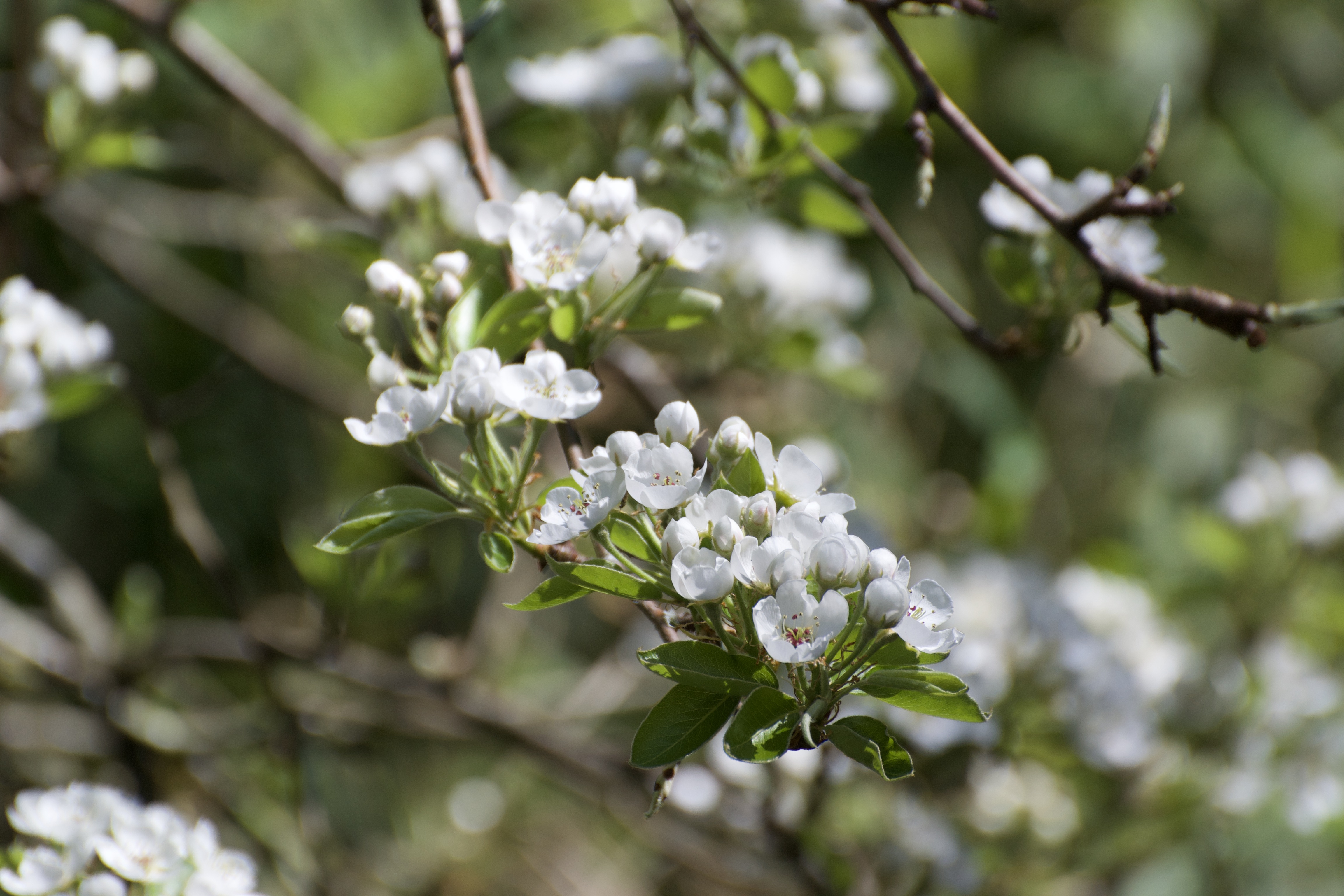
Over the last 2 weeks or so I have occasionally photographed the buds that were sprouting on the pear tree in front of my window. Growing at record speed they finally opened into the most luminous blossoms when the weather turned warm this weekend. Photographs today are in order of dates taken.
When searching for an appropriate poem to go with the images, I came across the words below, by a poet who, I admit, I’d never heard of. Before you yell at me how I dare to offer something that contains an offensive term for the deaf and hard of hearing community in the title, bear with me. The words used have a rhetorical purpose – they activate commonly held negative stereotypes before the poem forces us to completely shift perceptions.
His clumsy body is a golden fruit pendulous in the pear tree
Blunt fingers among the multitudinous buds
Adriatic blue the sky above and through the forking twigs
Sun ruddying tree’s trunk, his trunk his massive head thick-nobbed with burnished curls tight-clenched in bud
(Painting by Generalíc. Primitive.)
I watch him prune with silent secateurs
Boots in the crotch of branches shift their weight heavily as oxen in a stall
Hear small inarticulate mews from his locked mouth a kitten in a box
Pear clippings fall soundlessly on the ground Spring finches sing soundlessly in the leaves
A stone. A stone in ears and on his tongue
Through palm and fingertip he knows the tree’s quick springtime pulse
Smells in its sap the sweet incipient pears
Pale sunlight’s choppy water glistens on his mutely snipping blades
and flags and scraps of blue above him make regatta of the day
But when he sees his wife’s foreshortened shape sudden and silent in the grass below uptilt its face to him
then air is kisses, kisses
stone dissolves
his locked throat finds a little door
and through it feathered joy flies screaming like a jay
From The Glass Air: Selected Poems.– 1985
Deaf and dumb used to be one of the earliest of all the negative associations with those who cannot hear or use spoken language. It was coined by Aristotles, who believed that the absence of hearing implied the absence of learning, leaving the person unable to reason, thus dumb. The phrase was later intended to describe not hearing and not speaking, eventually changed to deaf mute, with identical definition – much to the justified ire of the deaf and hard of hearing community who points out how many ways of communication their members have, including their very own language. The horrid associations for those who live with deafness as being not quite right can be found across cultures and religions – an informative source for historical tidbits can be accessed here, famous rabbis and Martin Luther among the more rabid lunatics when it came to stigmatizing the other.
The poet obviously moves from the introduction in the title to further negative descriptions of the man in the pear tree. His body is slightly misshapen, his fingers stubby, his head massive, his utterances the mewing of a kitten and his movement of the slowness of oxen in the barn – suggesting some chromosomal mishap, if not proximity to animals more than humans.
But then something shifts. He does delicate work with the secateurs, and even though a stone clogs his ears and weighs down his tongue, he has other modes of perceptions, highly sensitive. He feels spring’s life pulse through the tree with his touch, he smells the future in whiffs of sap, and he sees a world of sunlight and blue sky translated into summery panoramas, freely sailing off.
The joy is multiplied when his wife on the ground tilts her face at him, and his love for her enables an articulated response, pure happiness. He is loving and beloved, the healthiest, most human state of all. How many readers can remember a time at all where we screamed with joy at the closeness of a loved one? What is wrong with US?
There remains one riddle: (Painting by Generalíc. Primitive.) What does that line seek in the poem?
Ivan Generalic was Page’s contemporary, a Croatian farmer and autodidactic painter, among the most famous in the European Primitivist movements. Page was a painter herself, and I wondered if she was drawn to one or another of his paintings that would deliver the template for the imagery. All I could find was a couple underneath a pear tree. Maybe the poetic imagination described what unfolded before that reunion.
Or, alternatively, she is using the coinage of primitivism to have us look at something that is not primitive at all. Generalic’s work was suffused with critical political commentary of farmers’ and workers’ lots, superstitions in rural areas, the burdens of religion and so much more. The analogy of taking a second look behind what is perceived as primitive at first glance, and correcting our assumptions, is a tempting interpretation of the poem as well.
Hold fast to dreams For if dreams die Life is a broken-winged bird That cannot fly.
Hold fast to dreams For when dreams go Life is a barren field Frozen with snow.
Holding on to our visions, hopes and aspirations for what could be is important. Goals help to resist the multitudinous influences that try to deprive people of hope in order to keep them in “their place,” an antidote to stasis and death. This is as much the case in 2021 as it was when Langston Hughes first published the poem in 1922. It is of course particularly true for those who are the victims of ingrained racism, but also true for other populations – women, people living with disabilities, people outside of binary gender categories, to name just a few – that threaten the power status and comfort zones of those at the top of the societal ladder.
The function of these diurnal dreams is to motivate resistance and action, to acknowledge one’s own right to a just future.
What is the function of nocturnal dreams? There is, wouldn’t you know it, no consensus on the answer to that question. And more suggestions than I care to count, varying across cultures and eras. For the curious, here are a few of the models that you find discussed in the psych literature.
The Freudian model of dreams revealing latent content of your emotional landscape, or the Jungian one relating them to gateways to archetypal knowledge are no longer receiving much attention. These days researchers focus on the role of dreams in processing information and consolidating memory, in reflecting emotions, and contributing to creative problem solving. Some researchers are also pursuing the idea that dreams help to prepare and protect us from dangerous situations in waking life. All of this is open to debate with lots of scientific disagreement.
Here is what we do know for certain: dreams are reported by the dreamer – as with all self-reports, it is hard to discern what was actually dreamt and what is interpreted through the understanding of the dreamer. That said, dreams often seem to reflect what is prominent in the waking thoughts of the dreamer, things they deal with in their present life. A typical example: Chinese and German students report most frequent dreams around stressors of education, Canadians, on the other hand, do not.
General themes emerge, though, across cultures: fear of violence or running away, fear of falling, fear of public embarrassment are prevalent.
During dreaming the amygdala is active, the brain site associated with emotions. This is particularly true for people living with PTSD, anxiety or depressive disorders, which are reflected in their frequency of anxious dreams. The visual cortex is active as well, not surprising given the visual nature of dreams. On the other hand, the prefrontal cortex, responsible for pursuing goals, structuring our thoughts, inhibiting impulses, is less active during dream states, which explains the jumbled, incoherent nature of dreams.
Then how do we solve problems in dreams as so much famous anecdotal evidence suggests? It is likely than random combinations in dreams offer solutions because they allow us to veer away from the path we pursued that got us stuck in the first place. For all the reported “AHA!” moments in dreams there are probably millions that didn’t lead to anything because of their indecipherable jumbling.
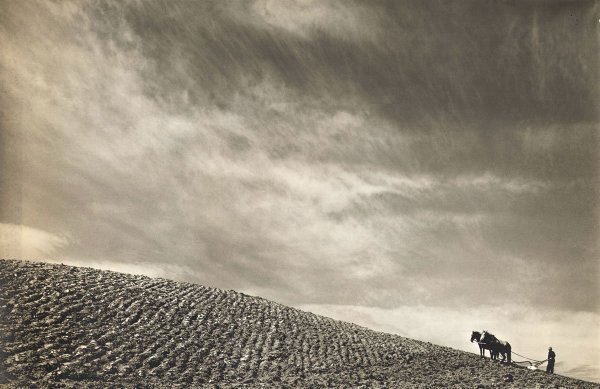
Photographs today, a rare exception, are by the brilliant Margaret Bourke-White, whose dreams as photojournalist were put on hold by early onset Parkinson Disease which she fought tooth and nail for 18 years. The images are a good reminder of the relevance of Hughes’ poem.
And here is a bonus. Hughes’ poetry read aloud by himself.
“Years ago, a poet friend showed me a photo of her cat, taken on the spur of the moment, with a cigarette in her furry chops. The cat was walking across a thick springy lawn. If I hadn’t trusted my friend, I would have shrugged and said, ‘I don’t believe it for one second—get me another beer, please.’ This poem of mine is all about the unbelievable, which visits me in dreams, with the help of godsend Polish poet Wislawa Szymborska.” —Gary Soto
Two days ago I shared Szymborska’s 1996 poem In Praise of Dreams. It was picked up last year, almost a quarter century later, by a poet of Mexican-American descent who grew up in the barrios of Fresno, CA, doing child labor in the fields and vineyards of California. When he was 5 years old, his father was killed in a work accident at the Sunmaid Raisin factory and the family faced extreme poverty.
Gary Soto has become a major voice for describing the experience and plight of Mexican American communities, both as a poet and a children’s author. His accomplishments as both author and educator have led to numerous awards, including a nomination for the Pulitzer prize.
He is, true to his roots, also an ambassador of the United Farm Workers of America (UFWA), which means that during his visits to libraries and schools, he introduces kids to the legacy of the United Farm Workers organization. The UFWA is the largest organization of farm workers in the United States.
In my dreams, I lasso a wild steer on the first try.
I chauffeur Picasso To meet up with Dali— None of us is happy about this summit.
After licking my fingertips, I play guitar masterfully.
I use index cards to make sense Of the universe.
I discover my childhood cat in the neighbor’s tree— So that’s where you’ve been, you little rascal.
I beg the alligator, por favor, To make a snap judgement, Will it be my leg or my arm?
Picture me swimming with dolphins. Picture me with these dolphins Sitting in lawn chairs.
I’m full of gratitude— The lightbulb comes on When the refrigerator door is opened.
Yes, I’m the scientist who solved laryngitis— Now all of us howl at our own pleasure.
I get to throw a trophy from a moving car. When I park my car, I’m awarded another trophy— Someone above is giving me a second chance.
Going out on a limb here, figuring these words are not all about the unbelievable, but a reflection of lived experience. None of the omnipotence of its Polish counterpart – none of the rigid structure either, stanzas varying in length, statements diverting from the “I can do this or that” on multiple occasions, making it somehow more conversational.
Here is the longing of a kid, stuck scraping beets in the fields, to work with cowboys, a moot desire.
Here is the servant to the narcissistic master painter(s), not a genius himself, just a chauffeur, as would be likely.
Protecting roughed up fingertips to play guitar, not unbelievable.
Using index cards to make sense of the world – show me an English as a Second Language speaker, I’ll show you the cards.
Time travel back to childhood, not ancient Greece, remembering the cat.
No invincibility when facing harm – just hoping it’s going to be an arm or a leg, not and arm and a leg as the loan sharks would extract.
The dolphins? No clue. Yes, unbelievable, unless they are fat tourists at the Gulf of Mexico.
Now gratitude for a working fridge, a sentiment never expressed or even hinted at in the preceding poem by Szymborska. Acknowledgment of plain necessities.
Solving a medical condition, a feat enabling universal howling: the state of the world that causes grief remains untouched.
But there are second chances – and explicit reference to a power above rather than the mastery of one’s own fate.
Belief in that is up to the beholder.
These remind me so much more of real dreams, allow for feeling closer to the dreamer, convey a modesty and realism that make this poem speak to the heart, where the original one spoke to the head. Both have their role, of course. But even poems deserve their second chance!
On days like this I go for the humanity rather than intellect. No trophies needed.
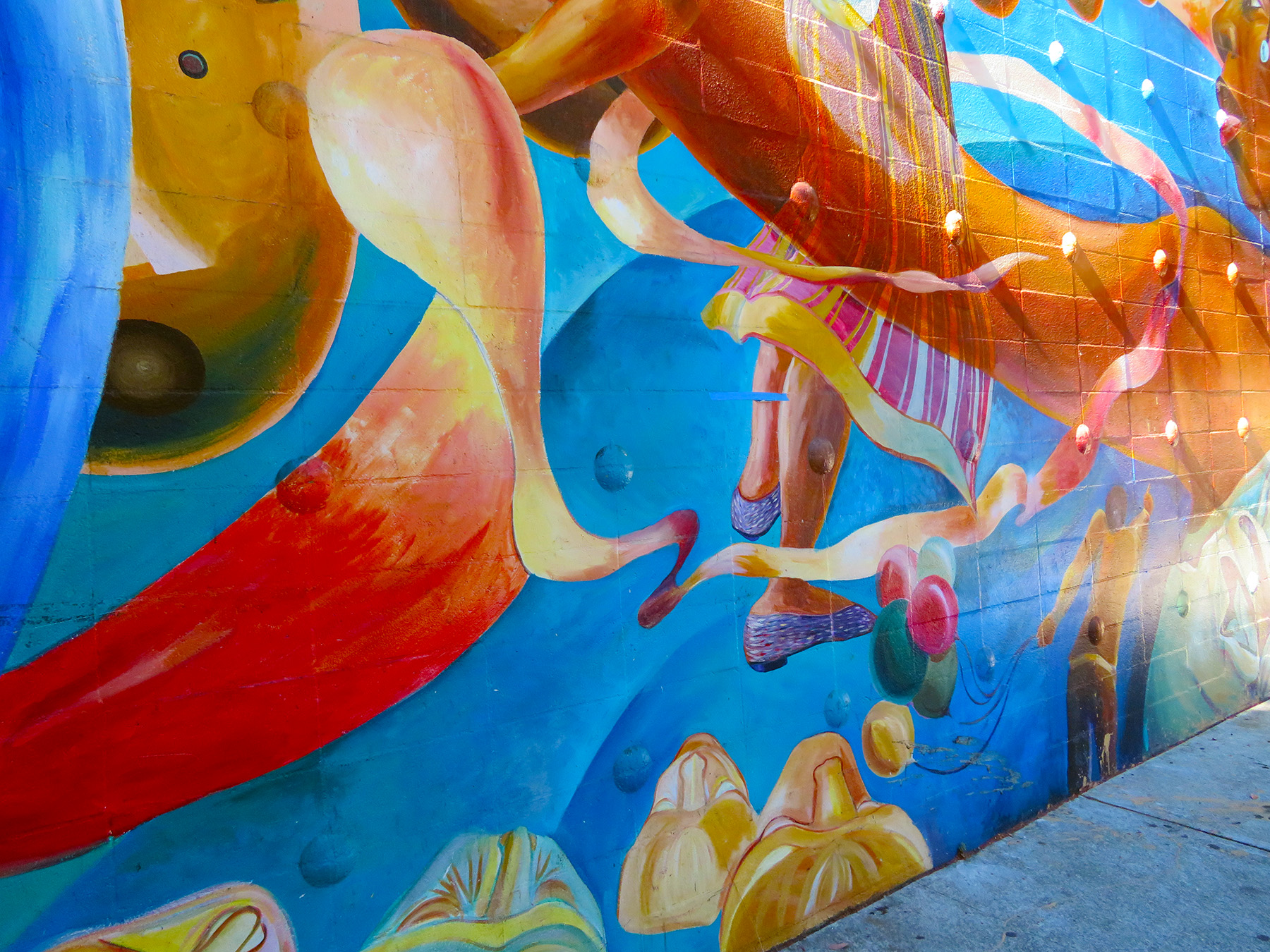
Photographs today are from Chicano Park at the Barrio Logan in San Diego.
Admittedly it’s not a random sample, but many of those who I talk to or correspond with these days relate how much they are inundated with bad dreams. Personally, I’ve had dates with full-blown nightmares way too often in the last year, but that could be explained by illness. The general increase in harsh nocturnal screenplays is surely related to the state of the world, the state of our lives in these strange times.
The poem I am introducing below struck me as all the more remarkable when read against this backdrop.
In Praise of Dreams
In my dreams I paint like Vermeer van Delft.
I speak fluent Greek and not only with the living.
I drive a car which obeys me.
I am talented, I write long, great poems.
I hear voices no less than the major saints.
You would be amazed at my virtuosity on the piano.
I float through the air as is proper, that is, all by myself.
Falling from the roof I can softly land on green grass.
I don’t find it hard to breathe under water.
I can’t complain: I’ve succeeded in discovering Atlantis.
I’m delighted that just before dying I always manage to wake.
Right after the outbreak of war I turn over on my favorite side.
I am but I need not be a child of my time.
A few years ago I saw two suns.
And the day before yesterday a penguin. With the utmost clarity.
So is this poem from View with a Grain of Sand (1996) a description of a person who comes into her own in her nightly dreams? More than that, really – is it a boast that she excels, displays mastery, is in full control over life and death and obviously dreams, can decide when and where to focus attention, to partake, to belong?
But for a few stanzas, everything starts with “I” – the narcissistic focus of an imagined parallel life? Or the determination to have some agency in dreams, when deprived of it in real life? Is it an invitation to focus on the positive, as exaggerated as can be, to set lofty goals instead of enduring what’s on offer here and now?
The poet is a real magician in how she draws us in – starting with a painter’s name that triggers something visual, just like in a dream, perhaps a painting that most people have a vague memory of – didn’t the girl with the pearl earring or something related pop up just now? Progressing to some auditory bits (speaking Greek, hearing Saints,) with a side dish of time travel, just like in dreams that move so fluently between the past and present, the worldly and the otherworldly realms. She’s in control – of cars, of flying, of outcomes – no broken bones from falls, no drowning episodes, no futile pursuits – hey, there’s Atlantis after all! She’s no less than a master in everything she touches, from visual art, to music, to writing, and you would be amazed – calling in the recognition that’s deserved by addressing us directly. The prevalence of falling in dreams is acknowledged, a stanza that does not begin with “I”, though it, as well, ends up with dreamt invincibility.
So what happens in the end? A clear memory of a real dream which contains nothing of the professed wizardry, but instead simply two suns. A double dose of light to illuminate the futility of wishful thinking? A symbol for another universe, one where the gap between reality and wishful thinking can be bridged?
A penguin dream, the other day. Getting cold feet, waddling on thin ice? Or the ability to perceive possibilities, strange creatures, with clarity, even if they exist as far removed from us as they currently do? Your guess is as good as mine.
The whole thing requires some serious thinking. Turns out that’s just the thing that will defeat bad dreams.
I am not just saying that. Scientific data are truly reassuring: we can influence our dreams with thinking, even post-traumatic nightmares. Here is a good, easily read introduction to the findings and methods.) Go ahead, practice!