Browsing Category

Politics

Gratefulness

For the week of Thanksgiving I will list some of the things I am deeply grateful for. As per usual, they are all over the map, which is reflective, I believe, of an interesting life rather than a scattered brain. Or so I tell myself.

I’ll start with the folks at Dark Inquiry who are living proof that you can marry arts and politics in ways that matter (one of my own quests). They are models for applied activism, not just for moving something in our heads.

They set out with a project called White Collar Crime Risk Zoneshttps://whitecollar.thenewinquiry.com 

It took the fact that police departments across the US use software to anticipate hot spots of street crime and turned the concept on its head for us to anticipate where white collar crime might occur. The police software is, of course, guided by algorithms that use biased data sets focussed on poor communities and communities of color. Dark Inquiry reappropriates this algorithm applying it to the community at large. If you click the link above, and allow access to your geographical location, the map will provide white crime targets in red. It is funny, cynical, thought-provoking – and based on the systems art of Hans Haacke, who did something along those lines tracking a particular NYC slumlord in the early 70s. Here is the map that came up when I engaged with the website.

Today’s photographs are of some of the PDX sites above in deep red…

The collective has now turned to a practical, political matter – the fact that multitudes in this country cannot put up bail and so linger in jail before their trials. https://bailproject.org/the-approach/

The new app designed by them and offered as rhetorical software, is called Bail Bloc, conceptual art linked to digital activism.If you sign up to the app, a complicated process is started, all out of your sight, not interfering with what you do on the computer, but using its space for complex computations. Your donation of that computing power earns cryptocurrency that is pooled by the collective, exchanged into real money that is donated to the bail project.

The exact details, about the open source process and the collective, can be found here: https://www.newyorker.com/culture/culture-desk/can-a-social-justice-app-be-art?utm_source=Narratively+email+list&utm_campaign=ccb4f74bd3-EMAIL_CAMPAIGN_2017_06_25&utm_medium=email&utm_term=0_f944cd8d3b-ccb4f74bd3-66322689

Full disclosure: If you are like me it will take some time to overcome a hesitancy to sign up for this app, since I have no clue what powers I really support in this process, what entry holes into my computer I offer. But I love – and am grateful for –  the idea that folks are trying to open-source help for those who need it most. I ask myself what is different for me who constantly answers to kick starter projects or some such? Fear of novel concepts like cryptocurrency or just being digitally vulnerable?

Thoughts to be mulled over while preparing the feast.


Der Anschluss

Since Sunday you could not open the US or European newspapers I read and not find some speculative commentary about the  election results in Austria. A 31 year-old and his conservative party ÖVP won, closely followed by the neo-Nazi populist party FPÖ with whom they are in conversation over a coalition/majority government. Babyface Sebastian Kurz led his party into this win by aggressively pushing an agenda that focussed on anti-immigrant sentiment, Islamophobia and the restriction of refugee influx, including the closure of the Balkan routes which are safer escape routes for Syrians than crossing the Mediterranean. (Here is a profile published before the election. http://www.spiegel.de/international/europe/sebastian-kurz-hitting-the-austrian-election-trail-a-1172254.html

Add to that a decidedly anti-Semitic bend, overt racism and an anti-European agenda and you have Heinz-Christian Strache and his minions the FPÖ, now potentially governing with increased power. The FPÖ was already deeply ingrained in communal governments – their work there boasted of the fact that they refused housing for refugees unless the latter demonstrated fluent German, shortened any grants or expenses for cultural organizations that were deemed non-traditional, and established educational regulations that promoted exclusively Christian goals and information. Despite multiple scandals during their reign the people of Austria flocked to give them their vote.

Austrians have demonstrated an affinity for populist “values” before – when Hitler annexed the country in 1938 they were out in force welcoming him, and they ratified the annexation shortly thereafter with more than a 2/3 majority (the official NS version of over 90 % was debunked as falsified.) Much work has been done to show that later exculpatory attempts of historians around the Anschluss, claiming that the Austrians were forced into this mindset, were politically motivated and not true to the facts.

Here is a press photograph of the two women partnered with the respective election winners, doing a victory lap Sunday night – Blondies rule once again.

Attached are two good sources that describe the history in detail, with the Holocaust Museum providing background history.

http://www.independent.co.uk/news/world/europe/anschluss-and-austrias-guilty-conscience-795016.html

https://www.ushmm.org/collections/bibliography/anschluss

What gets to me is the new normal: when the populist Right got elected in 2000, the Israeli government threatened to recall its ambassador. Avraham Burg, the speaker of the Knesset, warned: “It’s very sad that 50 years after the Holocaust, the people of Austria are reluctant to understand the awful tragedy that the Nazi party brought to the world,” said Mr Burg. “We call on the world not to be silent and to strongly condemn the fact that a party which is very right wing and racist is going to be a legitimate part of the parliament in Austria.”https://www.theguardian.com/world/2000/feb/03/austria 

Action, not just words.

And today: we wake up in our own country to the following tidbits: Right-wing twitter accounts associated with Scaramucci (remember him and his 15 seconds of fame?) post the following:

A Halloween costume manufacturer offers the following:

https://www.haaretz.com/world-news/1.817676

And then there is this:

 https://www.adl.org/news/press-releases/us-anti-semitic-incidents-spike-86-percent-so-far-in-2017

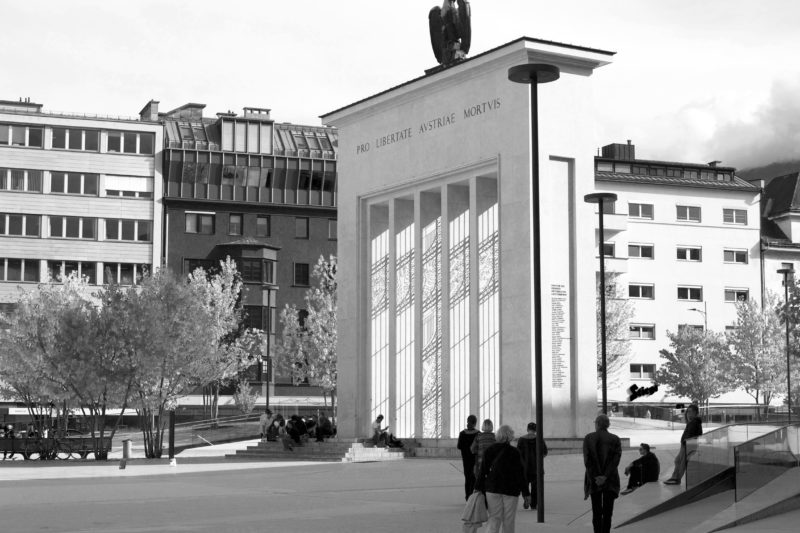
The rot refuses to die, no matter how much we want to tear it all down. Having been underground in the dark with optimal conditions for growth it is now an exploding fungus. The pretty surfaces of Innsbruck, one of Austria’s picturesque cities, cover harsher realities.

The monument below was built just after the war by the French, as a memorial to her fallen soldiers. Eventually it acquired the words “Pro Libertate Austriae Mortuis,” to honor all of  the war dead.
Close to the war memorial stands a much smaller memorial in shape of a Menorah for the victims of Kristallnacht, November 9 1938, initiated in 1997 (in a school contest!) The right-leaning Kronenzeitung came out with a complaint, predictably prefacing its concerns about money and questions about ulterior motives with “Nothing against memorials, but —.” The memorial features a menorah design, and a separate sign nearby with the details of the pogrom in Innsbruck. I unfortunately don’t have a photograph.

Art and Politics (2)

Yesterday I mused about museums; today I’m thinking about artists. There is so much written about how artists engage in the political process that it is hard to choose what to highlight. In the end, I’ve decided to focus not so much on the making of art with political content, but the ways artists actually influence politics by entering into the public sphere.

My earliest awareness of artists’s political actions was in the 1960’s and 70’s around the persona of Joseph Beuys who taught and worked close to where I then lived. Among other things he was a co-founder of the Green Party, and his lectures focused on the need for space for creative thought which would help bring about structural change in society. His vision of the artist as a social actor has been enormously influential.

Here are some examples of others following later: As mayor of Tirana, Albania, Edi Rama, a former painter, decided to change the city with color (as well as a huge project of planting new green spaces.) The TED talk below has a short video on the project, and it is amazing. It changed the urban, the social and eventually the political landscape, quite literally. https://www.ted.com/talks/edi_rama_take_back_your_city_with_paint

Then there is Tania Bruguera, who announced that she would run for President of Cuba in 2018. Never mind that you can’t run for that office in Cuba…it is the political gesture of entering the public sphere as an artist to promote change. The link below gives an interesting overview of a life devoted to political rebellion.

http://www.aljazeera.com/indepth/features/2016/10/tania-bruguera-cuban-artist-fights-free-expression-160930124023219.html

An important support network for artists as activist is provided by the Creative Time Summits, annual conventions that gather international artists, writers, philosophers and political activists for thematically structured conferences. Their goal is to promote social change through art activism. Last year they met in D.C. before the election, inviting input to the theme Occupy the Future from citizens and grass root movements working within as well as disrupting the electoral process.  This year they met in Toronto to discuss Of Homelands and Revolutions, with a particular focus on indigenous people leading ongoing movements across continents.

The link gives a programmatic overview http://creativetime.org/summit/toronto-2017/

Here is one of their (timely) projects that caught my attention. It’s called Pledges of Allegiance – a serialized commission of sixteen flags, each created by an acclaimed artist. “We realized we needed a space to resist that was defined not in opposition to a symbol, but in support of one, and so we created a permanent space. The flag seemed an ideal form to build that space around both practically and symbolically,” says Creative Time Artistic Director Nato Thompson. Each flag points to an issue the artist is passionate about, a cause they believe is worth fighting for, and speaks to how we might move forward collectively. Conceived in response to the current political climate, Pledges of Allegiance aims to inspire a sense of community among cultural institutions, and begin articulating the urgent response our political moment demands.   

Pledges of Allegiance officially launched on Flag Day, June 14th. Each month a new flag will be raised on a flagpole atop Creative Time’s headquarters at 59 East 4th Street, and at partner sites nationwide. Here you can see the different flags so far and learn about the contributing artists:

http://creativetime.org/projects/pledgesofallegiance/


Art and Politics (1)

Wouldn’t you know it. I thought I knew every major museum in NYC after having lived there for years and visited for many more. Turns out, I don’t – I have never been to the Queens art museum. This is a particularly regrettable fact given that the director of the museum is a woman of courage and deeply held convictions.

http://www.queensmuseum.org

Unlike almost all of her contemporary counterparts she is willing to engage in open politics – more power to her. The link attached below describes the role she has played in the last years and the causes she has fought for since Trump’s inauguration, the plight of the DACA recipients in particular. She is clearly paying a price for her outspoken involvement; although her Board seems to support her, various City councilmen are out to have her removed.

.https://www.nytimes.com/2017/10/08/arts/design/queens-museum-laura-raicovich-daca.html?_r=0

I know of only one other group of museums who were willing to step up and question the artificial separation between art and reality; see link below.

http://www.latimes.com/entertainment/la-et-entertainment-news-updates-march-museum-directors-react-to-proposed-1489682884-htmlstory.html

One can debate if the role of museums should be one of neutrality, as many insist, particularly the folks at the Smithsonian. The argument for taking the long view, letting art speak for itself rather than the museum speaking for or against political causes seems empty to me, when almost all museums show this or that work of political artists anyhow. If you curate shows that have political content, you might as well be open about where you stand regarding those contents. The viewers are smart enough to form their own assessments, as long as the opportunity to be exposed to differing points of view exist.

There will always be pressure from interest groups to have art suppressed – that has been true for as long as art exists. Just ask around Jewish museums in this country or in Germany, as one example. Or the Guggenheim, recently.

http://www.chicagotribune.com/news/nationworld/chi-spertus_21jun21-story.html

What we need now, in times where the role of art is undermined by those who have lots to loose with a more educated public, is individuals who stand up and speak truth; truth through the selection of what they are willing to show, as well as through directly addressing the relevant issues. Laura Raicovich is one of them.

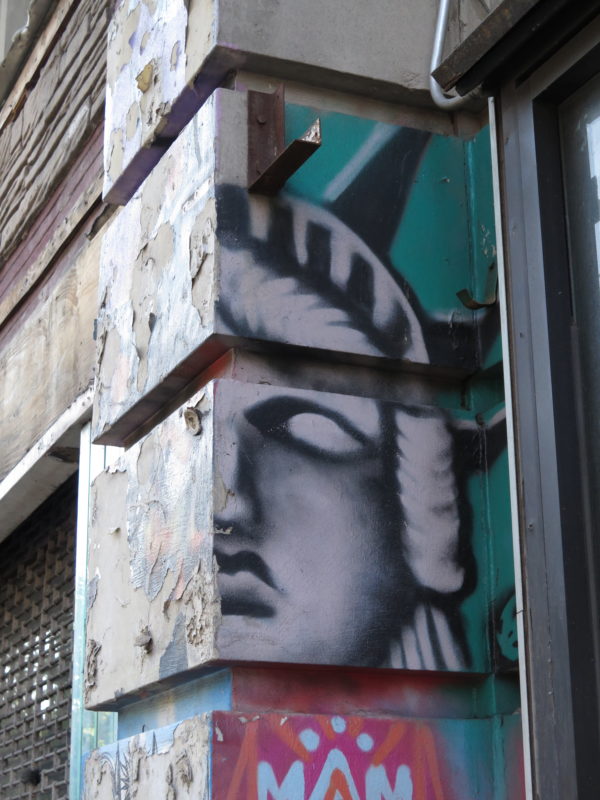
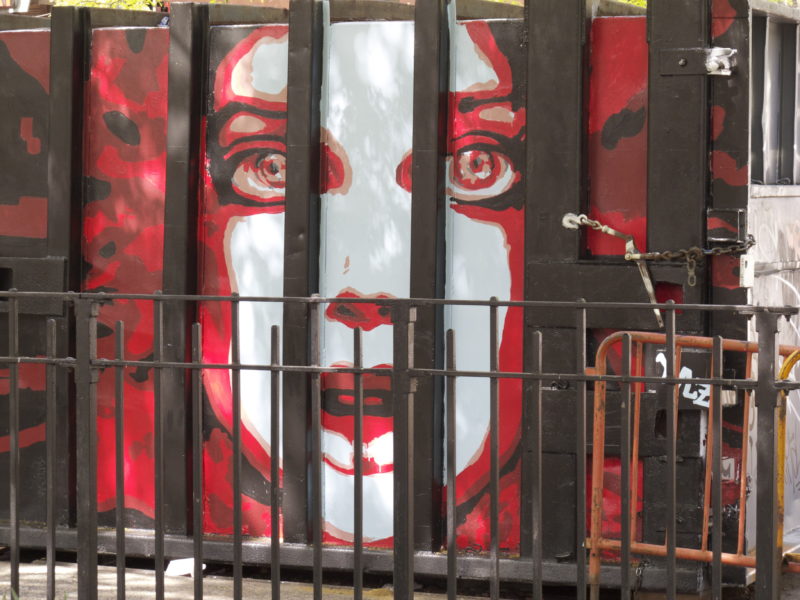
Photographs are of street art found in various boroughs in NYC, most Bed-Stuy.


The Rev. Billy and the Stop Shopping Choir

Show me someone’s blog that opens with an Emma Goldman quote, consider me hooked. If that quote refers to small communal interactions forming the kernel of possible societal change, consider me sold. Let me introduce you to the Reverend Billy and his Stop Shopping Choir.

Who am I talking about? A group of activists/artists who do both concert stage performances and agitprop actions to raise awareness of how we are mistreating our planet and our neighbors. They fight for earth justice, against consumerism, for first amendment rights and much more. Their recent visit to Portland was once again a coup by Boom Arts – bringing progressive artistry to an audience that is in need of and grateful for cutting edge theatre.

The NYC-based troupe is led by Billy Talen, an actor who uses comic theatre and music to get out the message – in ways that often risk persecution by the powers that be who are quite aware of how he lifts the veil on capital’s agenda. The link spells it out in more detail:

https://www.theguardian.com/business/2015/nov/27/reverend-billy-church-of-stop-shopping-black-friday

On Sunday night the artists met with members of our community, including Portland Resistance and Portland Tenants United for a community supper.

And since this week’s blog is dedicated to women’s issues, let’s focus on the women I encountered.

There were young women of the choir who managed to travel across time zones with infants and toddlers, putting in full performances, and still had the energy to meet new folks; young women who sang with beautiful voices.


There was the director of the company, who writes beautifully and provides organization and structure. There was her daughter who clearly shared her mother’s fierceness as well as the theatrical brilliance of her father.

http://www.revbilly.com/about_savitri_d

There were the Portland activists who lead the cause;

There were the folks from Boom Arts who surprise me every year with procuring ever better acts; doing their magic in getting people to return, fostering relationships, helping to keep the company afloat –  a special welcome here to the recent NYC transplant!

And then there was the kind of woman who models for all of us how to bring more peace and justice to the world in everyday life, managing the Sunnyside Community Center. She was celebrated and shown expressions of gratitude that her kind deserves and yet so infrequently receives.

It was an evening that conveyed energy, activism, community and above all hope – so direly needed in these times.

The troupe is off to England for their next adventure – friends over there, be on the look-out. These are performances you might not want to miss.

On Lace and Limitations


I had never visited a bridal store until last Friday. My own wedding dress was bought off the rack at a Laura Ashley’s. The pastel flowery concoction received the dry comment of “You look like Alice in Wonderland,” from one of the more observant wedding guests.

(Yes, we do like jokes in our family…even for the official wedding picture)

Judge for yourself, but it is true that I was looking for adventure and I certainly share Alice’s curiosity and willingness to go to strange places.

Hilary Schor who teaches English and Comparative Literature at USC argued that Alice in Wonderland  can be read as a feminist text. Alice went underground to question the rules, is not punished for her refusal to obey commands and above all, gets away with her curiosity. Curiosity did not just kill the cat – think about all the stories where it was cause for the downfall of women – Eve, Pandora, Lot’s and Bluebeard’s wives – you name it. Curious women can, after all, acquire knowledge which in turn could threaten patriarchy.

Well, here it’s 2017 and it seems we are all going down the rabbit hole, encountering people as rabid as Carrol’s anthropomorphic counterparts. Just think of the debate around issues of equality in large corporations, or congress men calling for women to go back to being mothers and housewives, or women being advised by a female (!) Fox host “to engage in a little horizontal hula and then make him a sandwich,” or urged to be “the beta in a marriage…by Phyllis Shlafley’s daughter

https://www.rawstory.com/2017/02/is-this-the-most-sexist-fox-news-clip-ever-natural-state-of-women-is-to-be-the-beta-in-marriage/

I felt like an old grouch thinking these thoughts while photographing a radiant, beautiful young bride trying on her wedding gown. Her thoughts were on anything but the future of feminism, and of course they shouldn’t be. She was surrounded by lace, and satin, and pearls and all things glittery, clad in a modern gown equally romantic and sexy.

There will be time to think about it later. When the moment arrives, there will also be good books to read: the attached review spells it out in detail.

The future of feminism

And as a bonus we can throw in some thoughts on fake feminism.


The Sculpture of a “Fearless Girl” on Wall Street Is Fake Corporate Feminism

For now I wish the young couple all the best, and the kind of happiness I felt for 31 years now in a truly egalitarian marriage. (Do I hear someone muttering in the background that he’s doing all the cooking?)


The Dead Life

One chapter of Thomas Mann’s novel Magic Mountain is titled The Great Stupor. He refers to the years before the onset of the great war, perceived by his protagonist to be “life without time, without care or hope, life as a stagnating hustle-bustle of depravity, dead life…. There is an atmosphere of uncanniness, maliciousness and aggression. A love of quarrels. Acute petulance. Nameless impatience. A universal penchant for nasty verbal exchanges and outbursts of rage, even melees.” Some of the conflicts eventually end in death (altho in the absence of automatic weapons not in those of hundreds of random victims…)

What so perfectly described that epoch is equally applicable for our times as well, I believe. That sense of “dead life” is likely experienced both by a large part of the Germans who voted for the populist AfD, whether as a protest vote or in desperate search for new meaning, as well as by the masses which support an American populist agenda. They see their old identities  threatened by globalization, cultural changes, the influx of immigrants, and their old standing within a hierarchy of power undermined by those who attempt to achieve more equality for the races and genders. It is not so much an economical issue – data in both countries confirm that those who tend toward a new extremism are not the poor – but an issue of feeling left behind and/or no longer valued and fallen down a few rungs on the pecking order ladder.

There is a longing for a structure that promises continuity, a structure that has disappeared with the opening of family, neighborhood, work place or politics to the unfamiliar. There is a longing to belong to a place that is known and which conveyed advantages to white males: AfD honcho Gauland put it precisely: the AfD voter wants his/her country back. The way to appeal to these voters is by appealing to emotions, stoking the fires of discontent and rage, as the historical example of the rise of the Nazis taught us all too well. And the best way to construct an emotional bond is by creating a common enemy: the Jews in the 1930a, Muslims or other immigrants in our time.

The new synagogue

Not all people who voted early  for the NSDAP were racists or antisemites. It was more of a collective protest vote against the status quo in the beginning. Not all AfD voters should be seen this way either. People in East Germany have still not fully processed the changes that came with reunification, changes that were not all for the good and certainly destructive to the familiar structures that ensured a certain safety net and standing. However, the AfD has components that make it a direct heir to the fascist ideology. One should be worried that its election success is not simply a German version of the increasingly prevalent populist movements across Europe. We have to be alert to the possibility that there is an unchecked, deeper

continuity to German history in its worst form.

It did not take 5 minutes for the Central Committee for the German Jews to comment on the election results about their deep fears of the implications of the vote. The head of the concentration camp memorials pleads not to have an AfD representative to chair a culture committee in parliament because holocaust denial has been publicly uttered by some, and a fight over the memory culture shared by many (not unlike what we here see in the confederate flag debate.) http://www.independent.co.uk/news/world/europe/germany-afd-bjoern-hoecke-berlin-holocaust-memorial-shame-history-positive-nazi-180-turnaround-a7535306.html

The hard work that has to be done, then, is to find a way to offer alternative identities, a sense of belonging, to those Germans who have given in to populism’s lure. It won’t help to announce that change is the way of the future, so just buckle up. It won’t do to just praise a vague promise of European citizenship without the specifics of how one can be anchored. I certainly don’t know how to do this – and I honestly believe almost all of us are clueless, otherwise it would have been done. If we want equality and integration, openness and justice, then those who benefitted fron inequality and racism are guaranteed to loose.

And here in the US?  Let me just point out that our racism, as instantiated by law and regulations, served as a template for the Nazis, eagerly studied and emulated at the time. The link below spells it out, brilliantly.  How distant are we from that, can you tell me?

https://www.theatlantic.com/magazine/archive/2017/11/what-america-taught-the-nazis/540630/

Photographs are of Dresden, hotbed of neo-nazi activities, stronghold of the AfD and its precursor, PEGIDA. I have reported on the beauty of Dresden before, the art that you breathe in with every step, the left-0ver scars from the tragedies of the allied fire-bombings, the resilience of the people and their reconstruction efforts. It is hard to believe that it has been the breeding ground fore the brown menace.

And here are some ads from the AfD:

New Germans? We make them ourselves. – Burka? I prefer Burgunder (red wine). – Islam: doesn’t go well with our cuisine.

Have the guts, Germany!

German Election Statistics

I am forcing myself to write today after the ongoing wave of horrendous news, millions of people in Puerto Rico threatened with death and disease, 9 million children having lost their health insurance this weekend when congress let CHIP lapse, and now, of course, the mass murder in Nevada.  So I am compromising: I will post some statistics today on the German election, and leave the harder part – the analyses – for later.

The table below (source: Spiegel.de) shows Merkel’s CDU on top, the social democrats next, then 2 leftist parties; the FDP is a deregulatory party of upper middle class business interests which came back into parliament; the AfD, Alternative for Germany, is the far-rift populist party that garnered almost 13% of the votes, bringing neo-nazi paroles, anti-immigrant, nationalistic sentiments into the government for the first time since WW II. The rest did not make it – note that we have 6 parties who will share in governing, and 42 parties that wanted to get votes. 61,5 million people were asked to vote.

The traditional big parties lost heavily; Merkel will only be able to find a majority vote in a coalition, which will no longer include the social democrats; they, after years of governing with her, now feel the need to regroup in opposition. The coalition that is discussed is nicknamed Jamaica for the assigned colors of the triad: Black (CDU), Green (the greens) and Yellow (FDP). Much talk about the curse of the caribbean (and not only in one of Germany’s most respected weekly’s.) 

The distribution of votes differed, as to be expected, according to region, but the percentages were astounding when you look where the AdD was elected – the further East you go, the more they scored, up to almost 36% in some of the districts.

Men are over-represented in AfD voters, as are middle-to low education groups, workers and the unemployed. Of the three million people who voted for the first time, the AfD also got a larger than expected share. And so they went from zero representation to 94 seats in parliament with the representatives on average being much more educated than those who voted for them and on the whole middle-aged white men.

Photographs (2013) today are from a small town East of the border that divided East and West for so many years, Salzwedel, in the state of Sachsen-Anhalt. The city is part of the Hanseatic League, the trading and seafaring conglomerate of yore, which always meant a bit more openness for the world. Its election results (district Altmark) mirror the average for Germany in %, with the exception that die Linke and the social democrats both got 19%; the CDU won, but lost almost 10 point compared to 2013, and the AfD scored 16.5%. It is a region that has been economically not as depressed as areas further to the East, and large gas reserves were recently discovered, promising some economic gain. (You can see how nicely the old house have been restored, for the most part.)

Sachsen-Anhalt, home to 2.277 million Germans, has about 9000 registered refugees. 80% of the citizens do not belong to a religious group, potentially a long lasting effect of GDR ideology condemning churches. About 16% are registered Christians, mostly protestant; in 2016 there where 1340 Jews (down from 1800 10 years earlier) who belonged to synagoges, so 0.06 % of the state population.There are no state numbers for Muslims; for Germany as a whole estimates are that  they comprise around 5.4 % of the population.

http://www.mdr.de/sachsen-anhalt/religionen-in-sachsen-anhalt-100.html

Karl Marx’ wife Jenny was born and is remembered here:


And if you think it all looks picturesque and romantic, think again.  The link below details some of the positions of those AfD representatives who got elected, Martin Reichardt for Sachsen-Anhalt. Read it and weep.

https://www.haaretz.com/world-news/europe/.premium-1.813852

Or join the resistance:

(Nazis f…k off, this is our home.)

Safety before Profit

If you asked me last week what I think when I hear the word Oklahoma I’d say: State in the mid-West and a hit musical by Roger and Hammerstein.

This week, on the other hand, the dominant association to the word Oklahoma is earthquakes. Maybe I’m reading too much for my own good. But the story about what’s happening in Oklahoma really exemplifies my quest as to what we as a nation should resolve for the New Year: listening to science – and act on what we learn –  to avoid disaster.

The links below provide details, but here is the rough version: By the end of 2014, 567 earthquakes of at least magnitude 3.0 were recorded in Oklahoma, more than the number of 3.0+ magnitude earthquakes from the previous 30 years combined. In 2014, there were over twice as many earthquakes recorded in Oklahoma as in California, making Oklahoma the most seismically active state in the contiguous United States by a substantial margin. In the last two years that number increased even more as did the magnitude of the quakes: the largest one recorded as 5.8.

The attached article spells out the consequences if we reach the magnitude of 6 on the Richter Scale in particularly sensitive locations, like Cushing, OK where 14 major oil pipelines intersect and hundreds of tanks holding 60 million barrels of unrefined oil are sitting targets (tanks are not subject to federal safety regulations, wouldn’t you know it.)

And I quote: if there were a major one that broke pipelines and split, say, half those tanks, the environmental disaster would make the Exxon Valdez spill of 260,000 barrels of oil near the Alaska coast nearly three decades ago look like the results of a kid knocking over her uncovered juice cup.

https://www.dailykos.com/stories/2017/9/14/1698565/-A-big-earthquake-could-turn-Cushing-Oklahoma-into-one-of-the-worst-oil-related-eco-disasters-ever

So what do we think causes this strange increase in earthquakes?

In one word: greed, in multiple forms.

Large companies drill for oil and gas in Oklahoma, making tons of money where labor is cheap and regulations scarce. The drilling process involves a lot of waste water that needs to be disposed of. For that purpose they create deep disposal wells even below the levels of oil and gas extraction and then pump the brine – now a mix of water and chemicals – into those wells. The EPA says there are about 40,000 disposal wells nationwide. The water that hits lower strata deep in the earth can set off seismic activity – after years of denial now even State regulatory agencies acknowledge the causality. After the 2016 earthquakes you saw 37 wells shut down because they were deemed too risky. Which is, of course a drop in the bucket.

That water could be recycled. People do it all over the States, but not in Oklahoma. The oil companies claim: “underground wastewater disposal is currently the safest and most cost-effective way to dispose of produced water.” Drillers also argue that recycling is more expensive, in part because they must pay to transport the wastewater to recycling facilities. But they promise they’ll check for safety gaps more frequently…..

The New Yorker story below is an in-depth description of what is happening. It also mentions that much of what you see when driving through Oklahoma is starlings and cows, which prompted the photo selection. And a goose, because they are everywhere, and I like them…..

https://www.newyorker.com/magazine/2015/04/13/weather-underground

We all know the writing on the wall, but we do not act in time – we should change that, as a country, putting our citizens’ safety before the profit garnered by the energy giants. And this concludes our New Year’s resolution – l’Shana Tovah!

Earthquake Map

Defiance

Yesterday I mused about how we can influence people’s attitudes by selectively presenting bits and pieces of photographed reality – leaving out the ones that would wake people up. Today I am turning to creating reality with pictures, a.k.a Hollywood movies.

I have talked before about the Implicit Associations Test – IAT –  the psychological measure that confirms how many of us hold stereotypical assumptions associated with racism. It is a test that looks at the strength of associations between concepts and even the most liberal takers have gasped at their scores.  Mind you, it does not mean you are a racist; it just tells us that we have all learned associations between concepts that involve negative stereotypes associated with Blacks. https://en.wikipedia.org/wiki/Implicit-association_test. 

Where did you pick up these stereotypes, assuming you were not raised in a white supremacist household, taught by bigots, hired by the KKK? Most answers involve some vague pointing in the direction of our culture. Of how movies represent Blacks, how colors are weighted with negativity/positivity, how the media (over)represent crime statistics, how sound-bite hits like “welfare queens” take root in our minds. And then there are serious analyses, that are required reading like this article by Ta Nehisi Coates:

https://www.theatlantic.com/magazine/archive/2017/10/the-first-white-president-ta-nehisi-coates/537909/?utm_source=fbb

All this comes to mind because I have been in bed with a nasty virus and indulged myself with watching even more inane movies than usual. Having now gotten into episode 4 of a sci-fi concoction called Defiance I thought the least I could do for my brain is to check for stereotypes. The story is structured like a good old Western: stranger comes into a town that valiantly struggles for survival and rescues it single handedly from attack(s.) Stranger is appointed sherif, torn between the desires of the flesh and purer feelings of the soul when engaging with two sisters. They, in turn, are a raven- haired beauty who runs the local brothel and a blond haired beauty who happens to be the mayor. Even her outfits of white blouses and breeches make her look like the plucky ranch wife out of a John Ford movie. Our hero is the rugged looking B-version of Indiana Jones, except that all this plays in St. Louis, altered by alien invasion, so let’s call him Missouri Jones.

8 (alien and human) races live in relative peace in the remnants of St. Louis with a token agreement that they can all preserve their traditions. Except when the humans decide they do not like something, like torture, and intervene and, since they are the good guys, sort of get away with it. There is a Romeo and Juliette subplot with, I swear, two 14 year-olds, from the two most powerful families in town. One that is human and looks slightly hispanic or native American, can’t tell. And one that is of an alien race  that goes for all white all the time, preferably shot with a softening lens. They are the bad guys. Hm, you say, white=bad, that is progress. Not so fast. They are so white that they almost seem like albinos, and act so weirdly that they can more easily classified in the zombie family. Fear not then, the claim of white=good pretty much is untouched. Particularly when the white Missouri Jones displays knowledge of all kinds of alien technology that he scavenges from crashed spaceships and then uses as weapons against the primitive hordes attacking the town. Must have taken a long-distance course while slumming in the bad lands.

The number and variety of alien creatures threatening humankind must have had special effects guys drooling for months.

But the darkest danger comes from – hello – an old white woman, the ex mayor. I guess misogyny topped racism in this one, using every evil queen formula in the book. And, any Blacks? Yes, a token one, a single young, earnest guy whose role is mostly confined to being the love/hate interest of our hero’s alien sidekick, a young girl he rescued and raised.

My photographs will surround the isolated young Black deputy with a family today.

New Year’s resolution #3: We, as a nation, should do everything in our power to acknowledge the existence of racism, explicitly or implicitly expressed, and the hold it has on our society, preserving inequality and power structures.Then fight it. I am grateful for those who give much in this struggle.

Can Black Lives Matter Win in the Age of Trump?