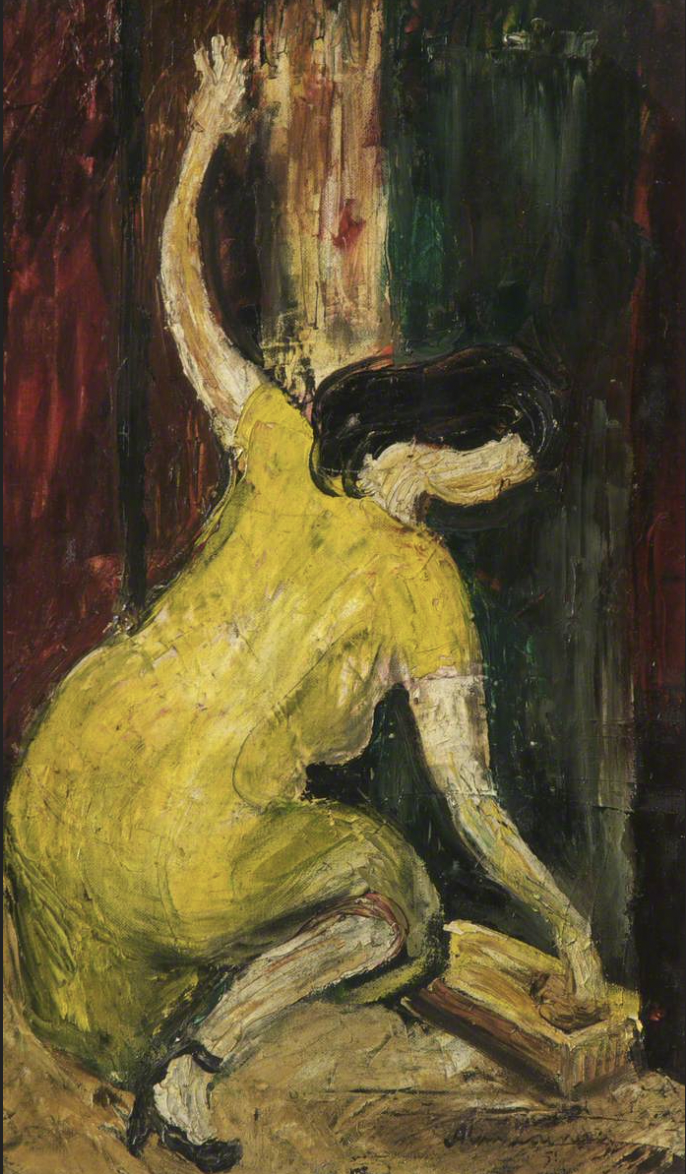
When I came again across Helga Stentzel’s whimsical laundry lines this week I thought of one of the very first blogs I had written here some 6 years ago with a message that deserves recycling.
It was about “The Right to Dry,” the name of a movement that fights against state laws and community bans on drying your laundry outside. “Officially more than 60 million Americans are prohibited from hanging their laundry outside, in their own yards or balconies and porches. This 2 minute video clip is a poignant introduction to what served the interest of the electricity industry (with former President Regan and Nancy as their spokespeople!) and those selling dryers.”
By 2012 the ban was voided (or made it unenforceable) in 19 states (including Oregon) by referral to solar access laws. Many of these are from the 1970s and comprised of hidden clauses in state property laws. A 1979 Oregon Law, for example, says any restrictions on “solar radiation as a source for heating, cooling or electrical energy” are “void and unenforceable.” Clotheslines appear to fit under the umbrella of Oregon’s and other states’ solar rights because systems for hang-drying rely on the sun’s radiation to evaporate water in wet laundry.
***
It is winter. No-one hangs their laundry outside now. Those who are privileged to have dryers or basements with laundry lines have no worries. I am thinking, though, about what happens when poverty and restriction of energy sources soar, like now all across Europe.
Eugene Boudin, 1824-1898 Women Washing on the River Bank, n.d. Oil on panel,
Most severely in Ukraine, of course, where the war destroyed most electricity grids and basements are used as bomb shelters. Besides individuals for whom all reliable daily functions have been bombed out, think of institutions. Hospitals, for example. Can you imagine the volume of laundry that is now to be washed by hand and dried – where? And the implications of soiled linen for (re)infections?
Anton Mauve Woman at a Washing line in the Dunes/ Woman at a Washing line (both undated watercolors)
It is tempting to think of war as happening primarily on the battle field, soldiers and their families the visible victims, but the impact on civil society goes so much further than our imagination provides. Hunger, cold, unsanitary conditions fostering more disease are all cards played by the invaders.
Paul Gauguin Les Lavandières à Arles I 1888
And speaking of imagination – today’s paintings of washer women often repeat the tradition of depicting them as a busy bunch, happily doing their work outside, or in the calm of their yards.
Left to right: Edgar Degas The Laundresses (c.1884) – Hubert Robert Ruins of a Roman Bath with Washerwomen (after 1776) – Pierre-Auguste Renoir Washerwomen (188)
The more likely reality is captured here.
August Sander Waschfrau NB VI/42/14 CTC — ASA 3/42/17
Tourist snaps of pittoresque Italian laundry lines non-withstanding, laundry has been a hard and dirty business.
“What are the chances…” was the beginning of a sentence that cropped up with astonishing frequency this week.
“What are the chances, seriously, that more people voted for Walker than the Rev. Warnock?” was me fretting half-way through the evening when election statistics had the former ahead of the latter for a short amount of time. Still in disbelief after all these years in this country that it could even come close. The good guy won, eventually, but the margins were too close for comfort.
***
“What are the chances that Sinema leaves the Democratic Party before Manchin?” High, it turns out. Her voting behavior cost us higher minimum wage, extended child tax credits, and voting rights protections. Seems there is little variability in her moral compass – it’s stuck on amoral.
***
“What are the chances, that I would find myself in any way connected to one of the right wing extremists arrested in Germany during a nationwide raid this week?” Low, really an outlier. 25 people (with more assumed to be associated) are accused of plotting a coup to overthrow the state with armed attacks, former members of congress and military and ex-military para-trooper members among them. Many are now in pre-trial detention, suspected of forming a terrorist organization. The defendants are closely linked with the Reichsbürger movement, who believe that the 1871 borders of the German empire are still in effect, tend to be far-right extremist, do not accept the legality of the Federal Republic of Germany, and, according to the prosecutor, “followed a conglomerate of conspiracy myths consisting of narratives of the so-called ‘Reichsbürger’ as well as QAnon ideology.”
New “head of state” was supposed to be Heinrich VIII Prince Reuss, a 71 year-old of aristocratic lineage, and one of the purported ring leaders. Here’s where six degrees of separation makes an appearance, however: as an 18-year old I was invited to visit a branch of the Reuss family for Easter. For the life of me, I can’t remember why I scored the invitation or why I accepted it (certainly no romantic involvement) from Heinrich IX Prince Reuss (must have been a cousin), they all get the same name, just numbered in succession…
We drove south in a car from Hamburg to his parents’ castle (literally) near Frankfurt. Arriving too late for dinner, we were led to our rooms. I appeared, starving, the next morning, Good Friday, in the breakfast hall. The horror! I was not dressed head-to-toe in black, mourning garb required for this Holy Day, apparently, in arch-conservative households. Back to your room, have the maid rummage for a fitting outfit! Well, it was off to a train station for me.
***
“What are the chances“, I thought, when following the complicated Supreme Court hearings about the Independent State Legislative (ISL) theory on Wednesday, “that I’ll be able to write about that in ways that get the legal details and importance of the Moore vs Harper case across?” Slim, as it turns out, even with the example of an iceberg….
In a nutshell, the case is about extreme gerrymandering, the possibilities (or not) of stopping excesses, and, more generally, the power of state courts and/or legislative bodies to shape aspects of federal elections. SCOTUS heard plaintiffs’ arguments that under the Elections Clause of the U.S. Constitution, state legislatures retain exclusive power over federal redistricting and election rules, while state constitutions, state courts, governors, or voter-approved ballot measures have no power to check, balance or even review those laws. Yup. -. It is, as legal observer and author Elie Mystal pointed out, all about trying to take power away from non-partisan state actors and putting it solely into the hands of partisan state actors.
That’s as far as I can go – the rest of the arguments, delivered in detail, clarity and with focus on the implications to what remains of our democracy, can be found in VOX, the Atlantic, Mother Jones, the NYT, and the National Review. Take your pick – any one but the last helped my understanding of the matter.
And since we’ve landed on the topic of relative probabilities, we might as well end the week with my favorite poem about Statistics. Chances are, you’ll like it, on average.
A Word on Statistics
Out of every hundred people, those who always know better: fifty-two.
Unsure of every step: almost all the rest.
Ready to help, if it doesn’t take long: forty-nine.
Always good, because they cannot be otherwise: four — well, maybe five.
Able to admire without envy: eighteen.
Led to error by youth (which passes): sixty, plus or minus.
Those not to be messed with: four-and-forty.
Living in constant fear of someone or something: seventy-seven.
Capable of happiness: twenty-some-odd at most.
Harmless alone, turning savage in crowds: more than half, for sure.
Cruel when forced by circumstances: it’s better not to know, not even approximately.
Wise in hindsight: not many more than wise in foresight.
Getting nothing out of life except things: thirty (though I would like to be wrong).
Balled up in pain and without a flashlight in the dark: eighty-three, sooner or later.
Those who are just: quite a few, thirty-five.
But if it takes effort to understand: three.
Worthy of empathy: ninety-nine.
Mortal: one hundred out of one hundred — a figure that has never varied yet.
Photos today from Frankfurt and environs, in honor of another weird episode in the life of Heuer, filed under Frequency Distribution.
Statistics? No Problem. (Sorry for the annoying ads interrupting today’s music, could not find an alternative.)
Chances that this photograph relates to today’s text? Nil. I just love it, the matching colors, the symmetry and patterns of vertical lines, the contrast of work boots and fur jacket, this stranger’s strutting towards the center of the gate posts in completely empty space. It happened to be shot near Frankfurt.
There are days when the universe throws a gift into your lap, or has it flutter into your inbox, as the case may be.
Last week I had one of those days. A new acquaintance sent me a link to his website of photographs taken in the 1960s, capturing everything from agricultural workers, navy wives, political figures, to some of the great musical artists of the times. Maybe I reacted so strongly because it was a stroll down memory lane, but I think my appreciation was equally if not more driven by the quality of the portraiture across the board – mastery of candid shots.
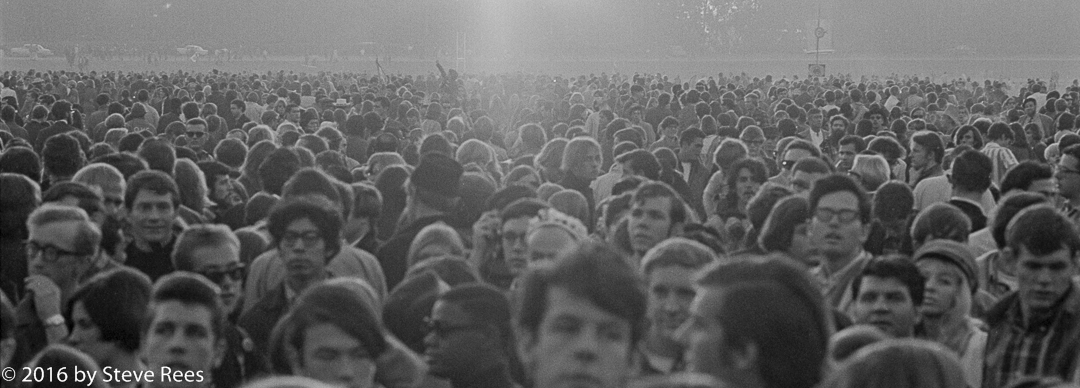
Here is the link to the Steve Rees’ site Music and Mayhem, so you can see for yourself. I recommend you look at all of the subcategories in the header bar, much to explore.
I figured I’ll pick some of Rees’ musicians’ portraits and match them with songs that comment on the events of last week, which turned out to be a pretty momentous ones both here and in Ukraine.
Let’s start with the prediction business, prognoses, manipulations and wishful thinking around the Midterm Elections in the U.S. November 8th turned out to be a surprise, defying many voices and many agendas. What better fit than Jefferson Airplane‘s White Rabbit. Remember? “Logic and proportion have fallen softly dead…. “
Signe Anderson (left), Jorma Kaukonen (center) and Paul Kantner (right) at the Monterey Jazz Festival, 1966
One pill makes you larger And one pill makes you small, And the ones that mother gives you Don’t do anything at all. Go ask Alice When she’s ten feet tall.
And if you go chasing rabbits And you know you’re going to fall, Tell ’em a hookah smoking caterpillar Has given you the call. Call Alice When she was just small.
When the men on the chessboard Get up and tell you where to go And you’ve just had some kind of mushroom And your mind is moving low. Go ask Alice I think she’ll know.
When logic and proportion Have fallen softly dead, And the White Knight is talking backwards And the Red Queen’s “off with her head!” Remember what the dormouse said: “Feed your head. Feed your head. Feed your head”
Of course all these predictions were accompanied by endless requests for donations – I stopped counting how many folks asked for money in the run up to the election. Time to answer with the Grateful Dead in Build to Last
Bob Weir, Phil Lesh, Ron McKernan, Jerry Garcia at the Human Be-In 1967
There are times when you get hit upon Try hard but you can’t give Other times you’d gladly part With what you need to live
Don’t waste your breath to save your face When you have done your best And even more is asked of you Fate will decide the rest
In the end, November 8th produced some serious tears – of rage, I guess, and narcissistic insult. Cry Baby, by Janis Joplin comes to mind, although, if up to me, they can all stay out in the cold…
Janis Joplin at Monterey Pops (With Big Brother and the Holding Company.)
Then there was the takeover at Twitter, reminding us of Big Mama Thornton‘sDown Home Shakedown. Of course it will end in tears, his hopefully – as hound dogs deserve it.
Big Mama Thornton at Monterey Jazz Festival 1966
And here is Eric Burdon, with the classic “Got to get out of this place.” It was the song played throughout the Vietnam years for soldiers yearning to make it out alive. I am sure the cannon fodder in the current war feels no different. May the retreat from Kherson be the beginning of the end of the invasion.
Eric Burdon at Monterey Pops.
I’ll leave you with an album that was one of the earliest ones I bought Eric Burdon’s War. (Frank Zappa’s Burnt Weeny Sandwiches was the first ever.) I’ll be humming right along.
1. Stop here and now with the fall clean-up of your garden, should you be lucky to have one. Leaf blankets, flower stalks, withering vines all provide much needed survival help to pollinators and birds, many of whom have not had the easiest of times. (One exception: clean vegetable patches IF they had some serious pest issue. You don’t want to give those critters a chance to overwinter in place.) If you don’t trust me you can read more professional explanations here and here. “Wild” gardens provide many more food sources and places for shelter to the birds in winter. Drop the rake until February…
2. Besides the avian beneficiaries of inaction we humans benefit as well. Here is a neat study showing that the exposure to the sight and sound of birds improves our wellbeing. In case you need scientific evidence for that.
3. All this came to mind when listening to a podcast about birds. A special bird, in this case who turned out to be a hybrid between two different bird species, a truly rare event. Hybrids occasionally happen between close cousins (1 in 10 000,) but the two parents of the bird under consideration hadn’t shared a common ancestor in over 10 million years. The specimen was a mix between a rose-breasted grosbeak and a scarlet tanager (whose song he sang, while the looks were more like the grosbeak mom.)
The scientific assumption is that these “evolutionary experiments” confer a survival advantage to the hybrid, which in turn might shore up an avian lineage that is endangered. (Contrary to popular belief, hybrids can breed – if the hybrid mates with another hybrid, or with the same species as one of its parents.)
“It allows… independently evolved groups to share, that they’re, you know, sort of trading information back and forth on solving problems that the environment presents to them. So this might actually be important for adaptation to climate change, for example.”
4. Which brings us – you must have been waiting for it already if only as proof that my brain is back in action – to hybridization as a religious and political issue. As any number of nationalist Christian websites will tell you (and no, I am not linking to them) G-d does not want animal species to mix, or human bloodlines to merge in ways of racial intermarriage. This Divine command is found, they claim, in verse after verse in the bible – all conveniently and selectively cited – and originated as a punishment for transgression against Noah by one of his sons, the dark Ham, who in perpetuity is condemned to be inferior and whose descendants are to live in slavery. Japheth, the second son, is an idealized and blessed form of humanity superior to Ham in every conceivable way, representing Whiteness, and Shem is an archetype in between. In one foul swoop you have: an established hierarchy between White and Black, the former superior, prohibition of intermarriage, and a justification of slavery on divine authority. (In fairness many other Christian websites point out that this is false biblical interpretation.)
Note, these are not considerations of the American Antebellum South, when they were prominent. Or occurrences of the 1950s and 60s, like Senator Robert Byrd of West Virginia citing the Bible in opposition to the Civil Rights Act of 1964, or Reverend Jerry Falwell attributing the Brown v. Board of Education desegregation decision to Chief Justice Warren’s failure to know and follow God’s word, or Mississippi Senator Theodore G. Bilbo explaining that “miscegenation and amalgamation are sins of man in direct defiance with the will of God.” Ref.)
Race separation as a Divine decree and the dominion of Whiteness are making a comeback in ever louder public voices and votes here and now in 2022. Consider the issues of the constitutional right to intermarriage: some weeks ago, 157 House Republicans voted against the Respect for Marriage Act, which would enshrine marriage equality in federal law. Senator Mike Braun of Indiana explicitly stated that not banning interracial marriage was a mistake. Regulating racial boundaries has been a main topic for international right wing forces, as heard in Hungarian PM’s Victor Orban’s speeches against mixing races, which were loudly welcomed by right wing audiences in the U.S. As the conservative legal movement grows more emboldened, are there any protections that we can unquestioningly rely on?
5. I am writing this on the day this Supreme Court is hearing arguments about Affirmative Action at a Public University. You can figure out for yourself why that came to mind in my hybridizing thoughts.
The idiom “Pig in a Poke” refers to a person making a purchase sight unseen and getting something inferior to expectations. It’s assumed to come from butchers wrapping lesser cuts of meat in a sack—a “poke”—for unsuspecting customers.
This came to mind when learning about recent deliberations of the Supreme Court in a case brought on by the National Pork Producers Council (National Pork Producers Council versus Ross – (Ross is the Secretary of the California Department of Food & Agriculture.)
At stake here is the 2018 California Ballot Initiative 12 that required bigger cages for certain farm animals, including breeding pigs, veal calves and egg-laying hens on moral and health related grounds. People overwhelmingly approved the measure which prohibits sales of pork meat in CA if it was raised outside the standards set by morality and health considerations, whether inside or outside the state. (To give a sample argument: the way sows are raised now in cages in most parts of the US would be like a human spending their entire life span more or less in an air plane seat.) In effect voters decided by a large majority that the half million pigs slaughtered each day in the US should have better lives before their demises, across the country, if they wanted to be sold in CA.
Big Meat sued, arguing that since 99% of the pork sold in CA comes from outside its borders, California was essentially imposing its laws on other states in violation of the U.S. Constitution, specified in the Commerce Clause. Their argument was supported in court by the Biden Administration: it would throw “a giant wrench into the workings of the interstate market in pork.”
So what is this (dormant) Commerce Clause invoked by the pork producers?
“It is basically a principle that the court has implied from the text and the structure and the history of the Constitution that is understood to limit states ability to burden interstate commerce. So specifically, states under the dormant commerce clause are not supposed to be able to discriminate against out-of-state commerce.”(Ref.)
As an example, Oregon could not prohibit sales of goods imported from Texas that are not produced with Union labor. Texas could not prohibit sales of fruit raised and harvested by undocumented labor in California. Political standards couched in morality issues, in other words, are not legitimate to justify disruption of commerce. Goods and commerce cannot be discriminated against by one state imposing their preferred regulations on another.
Hm. How do we think about this specific case? Should the voters’ will to protect animal rights be upheld? I predict most of us would spontaneously say, of course! I don’t want to participate in animal cruelty and so I don’t want the proceeds of that being available in my state, if only to force pork breeders across the nation to improve their practices. I will not be complicit in immoral activity!
It is more complicated than that, though. (When is it not?)
If we open the door to allowing our moral considerations to impinge on other states, then the reverse is also true. Their’s can affect us. The most obvious issue is abortion as a health care right. The sales of abortion pills sent from one state to another, abortion travel to abortion providing states, criminal pursuit of abortion providers across state lines are all potentially affected by a SC ruling that would affirm the law’s constitutionality. So would be measures concerning climate change (a law preventing, for example, any sales of goods that produce pollution, on the basis that it is immoral to burden future generations with our planet’s destruction.) Or state legislation involving union busting, immigration, LGTBQ rights, gun control, you name it. Once you open the door to using immorality as a path towards prohibition, you enable all kinds of political maneuvering.
And who is to say which morals are superior? If a pork producing state says our moral imperative is to provide affordable protein to people which involves producing on the cheap (that includes tight caging,) is that preferable to the moralism concerning animal welfare? The fact is that we see ever increasing disagreements on what is and is not immoral. The culture wars have divided the country. For every Texas that allows private citizens to sue anyone who “aids or abets” an abortion after about six weeks of pregnancy there is a California that allows any citizen to sue anyone who manufactures, distributes or sells certain illegal firearms. And in fact, during the oral proceeding in last weeks SC deliberations, the justices from both sides of the political spectrum were concerned with “Balkanization” of the country, something the Constitution worries about. Is legislation really about protecting your citizens, or is the intent to force your own values on other states?
What further complicates this case is the fact that Californians voted in this ballot measure on both morality and health regulations, and we’ll never know what mattered for what proportion of the voters. Health issues could confer a real justification to ban unhealthily raised pork – we know that disease flourishes in overcrowded pig factories and the rise in zoonotic diseases under those conditions is becoming more evident. The Justices asked questions about this as well. Justice Jackson suggested that a labeling of pork not raised under desirable conditions might be a way to warn CA citizens without forbidding sales outright – after all we have all kinds of labeling that warns about health related issues already on meat and other alimentation products.
And just in case you want to consider added complexity: here is a short but interesting introduction to the issue of Ballot Initiatives (like Prop. 12 was in CA) across the country for the midterms. Ballot Measures are tools that allow voters to pass our own laws directly, often with a simple majority of votes (not in Oregon, mind you,) not surprisingly adopted dring the Progressive Era. It is direct democracy, sometimes going over the heads of the states’ legislatures like when Maine, Idaho, Missouri, Nebraska, Oklahoma and Utah voters, for example, expanded access to Medicaid via ballot measure.
Pushback ensued. These days, many states are trying to make ballot initiatives harder to pass, by changing rules of the number of signatures required, or the qualifications of those collecting signatures, and now by direct vote on restricting ballot measures themselves, almost all of them in Republican held states. Critics of (democratic)California’s penchant for direct democracy also say it has led to higher taxes and a not-in-my-backyard mind-set, exacerbating a housing crisis and driving away businesses.
A ruling on the pork case is expected next summer. It might be a pig in a poke – a win for California could open the lid of Pandora’s box: allowing the growing ideological divide between the states to regulate — and respond to — actions in other parts of the country.
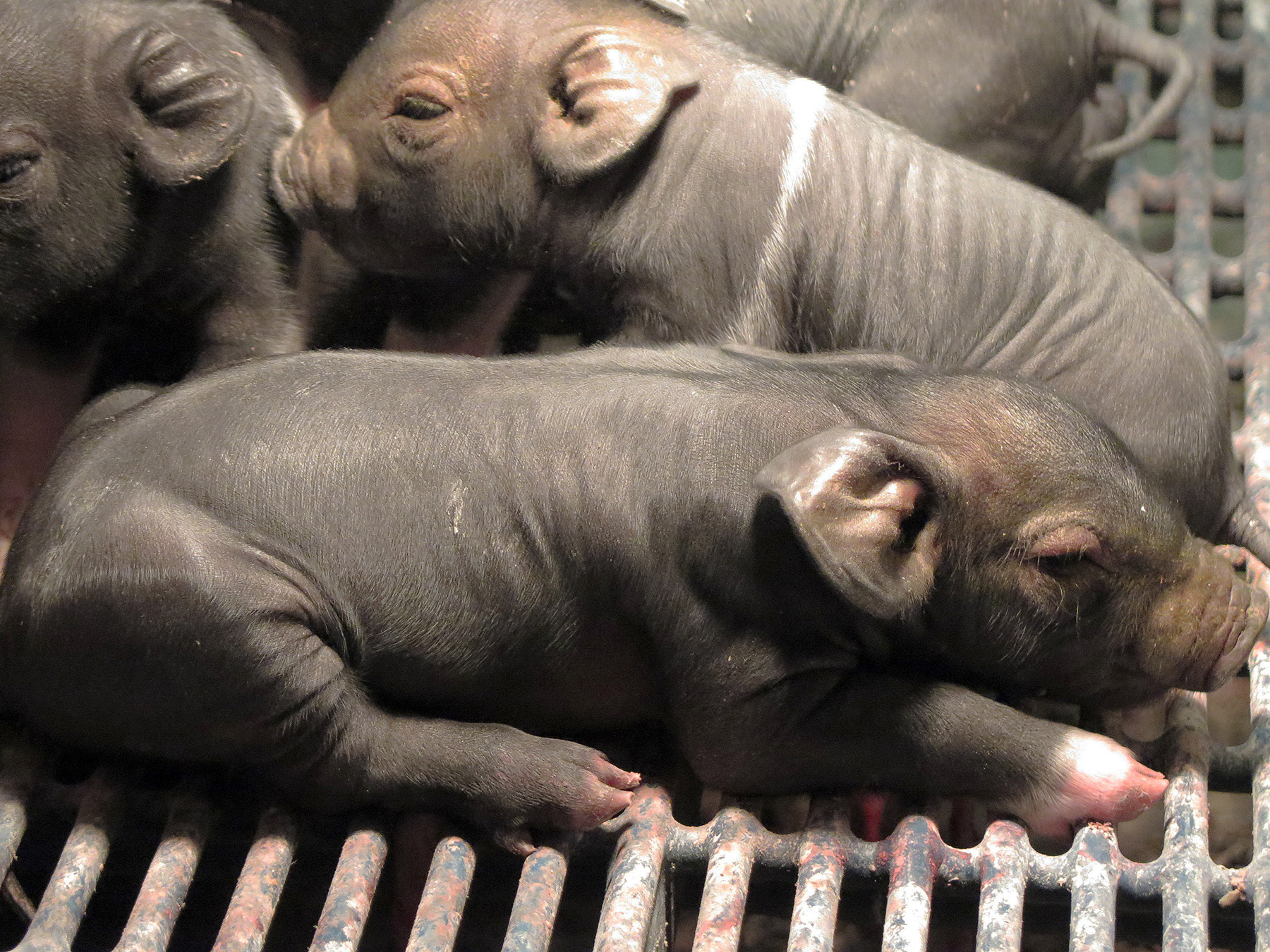
By the way, today’s photograph are from a pig farm that only cages the nursing sows when safety issues demand it. The pigs have plenty of inside and outside room to roam.
Here is Hausegger’s song about his piggy….. based on a Robert Burns poem.
What will I do gin my Hoggie die? My joy, my pride, my Hoggie! My only beast, I had nae mae, And vow but I was vogie! The lee-lang night we watch’d the fauld, Me an my faithfu’ doggie; We heard nocht but the roaring linn, Amang the braes sae scroggie.
PS: My computer needs maintenance – if I don’t post in the next days it’s under repair. Too many cookie crumbs…..
Igor Levit, a gifted pianist of Russian Jewish descent who lives, works and engages politically in Germany made me half laugh half cry with his recent sketch:
Project Proposal:
One million Variations with infinite Fugue about (German) fascism
Variability: endless
Duration: open
Reception: mostly empty phrases
Effect: renewed frustration, every single time.
Warnings and criticism falling on deaf ears, or being waved off with a shoulder shrug. Echoed by official reporting in yesterday’s NYT that “Voters See Democracy in Peril, but Saving It Isn’t a Priority.” Some weeks ago NY Magazine had an in depth article on how the GOP surrendered to Antisemites. That was before a former president openly called for American Jews ” to get their act together” (and support him) “before it is too late.” Jewish voices in both Israel and the United States denounced “a former US president using threatening language about American Jews at a time when antisemitism is on a global rise.” Notably, Biden said nothing. The administration has been slow to condemn the remarks of Trump, waiting 24 hours after Trump’s online warning to “US Jews” before saying anything. And this was only in answer to a question asked of White House Press Secretary Karine Jean-Pierre in the routine daily press briefing Monday. There was no public statement.
On the other hand, we had a tempest in a teapot about two Just Stop Oil activists throwing tomato soup at the glass of a van Gogh painting to protest the other existential danger to human kind – climate change. The Washington Post mused on climate protests tactics getting weirder, or stranger, or any number of words that minimized the urgency of the affair. You might argue that attention seeking of this kind (for a valuable goal, you readily admit, of course) gets you nothing. If anything it puts people off, right? Support their cause, but not their methods?
May I remind you, gently:
“I have almost reached the regrettable conclusion that the Negro’s great stumbling block in his stride toward freedom is not the White Citizen’s Counciler or the Ku Klux Klanner, but the white moderate, who is more devoted to “order” than to justice; who prefers a negative peace which is the absence of tension to a positive peace which is the presence of justice; who constantly says: “I agree with you in the goal you seek, but I cannot agree with your methods of direct action”; who paternalistically believes he can set the timetable for another man’s freedom; who lives by a mythical concept of time and who constantly advises the Negro to wait for a “more convenient season.” – Martin Luther King Jr.
By the way – the video of the activists got over 50 million views by now, the one introducing their concern substantively almost 4 million, as one of the women explains here.) Something to think through, on this Wednesday morning. While you do you can listen to Levit’s playing, it will recharge you.
And here in a more informal setting at the NPR’s tiny desk concerts.
A new documentary about him can be currently watched in cinemas by my German readers.
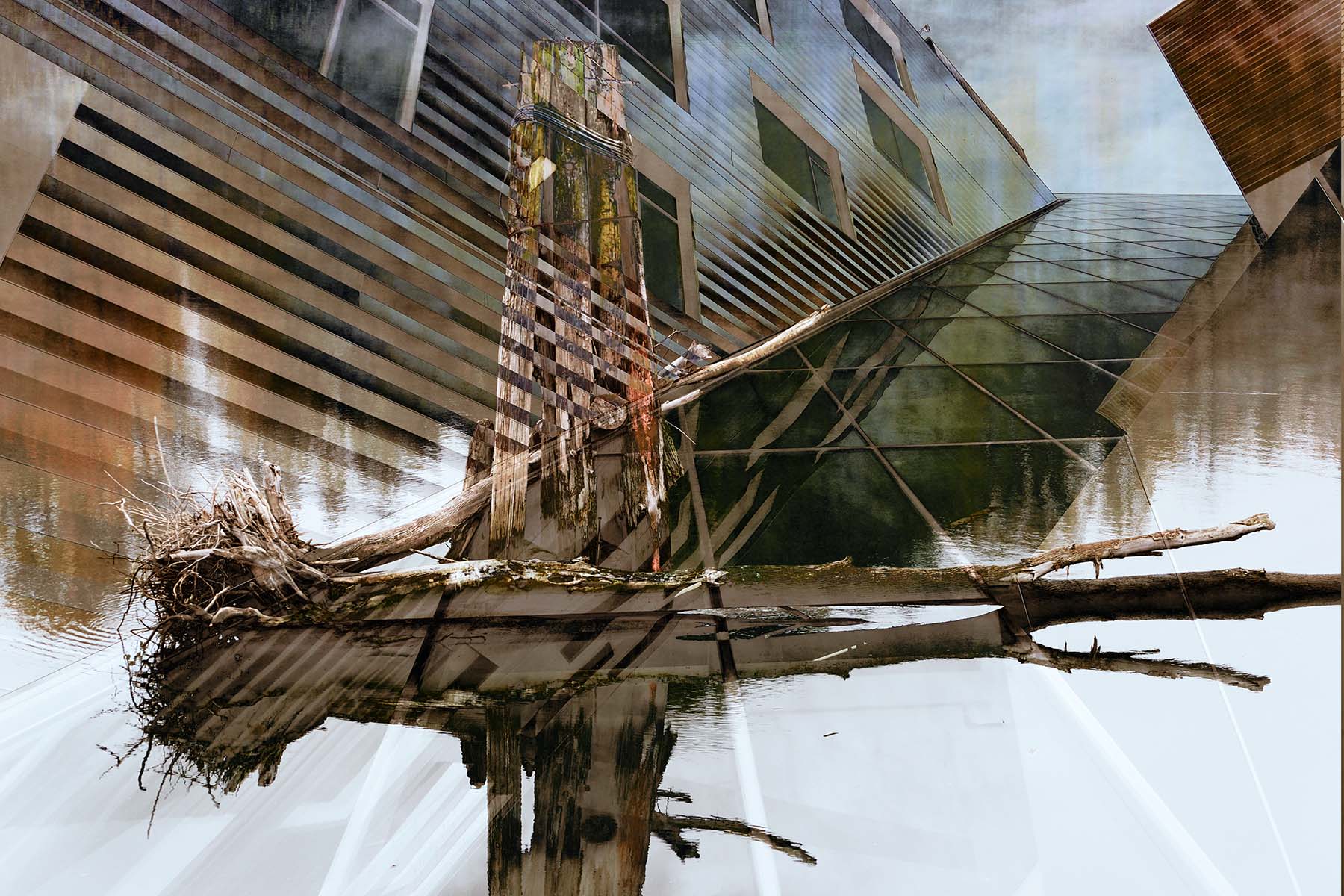
Photomontages today from my series On Transience shown at the Oregon Jewish Museum years ago, considering issues connected to Jewish immigration. (Description of the project here.)
(The staircase in this montage is a photograph of the emergency exit in the Jewish Museum Berlin. There might be a “too late” after all, never forget.)
In memory of Alice Meyer (z”l) who fought the rising dark forces to the end.
Tiresias:” You mock my blindness? Let me tell you this: You with your precious eyes,you’re blind to the corruption of your life, to the house you live in, those you live with – ” (415) – SophoclesOedipus the King, translated by Robert Fagles.
DO YOU REMEMBER the unfolding of this famous tragedy? A priest implores the mighty Oedipus, the king of Thebes who rescued all his people once before, to stop the plague that’s ravaging the land. The ruler eagerly agrees, but when he starts intuiting the truth that after all might save them, he does not want to see it – just as the blind prophet Tiresias, who knows and was commanded to reveal it, has trouble naming it for fear of wreaking havoc. The truth, once it’s acknowledged, will lift the plague but also devastate the king, and his desire to remain unseeing does end up leading to his ultimate demise, including gouging out his eyes himself. Blind, after all, for real.
Perhaps you share with me a sense of needing to protect ourselves from ever more bad news, unending, constant, one development more dire than the next. It feels like our sanity depends on turning our eyes and ears away from yet more fear-inducing bits, just like the king of Thebes. Pandemic(s), the rise of authoritarian regimes drifting into fascism, wars and the ultimate threat to our existence, the devastation of our planet through self-inflicted climate change: plagues, all.
So why expose yourself to looking at depictions of the Holocaust, no matter how compelling, how educational, how directly speaking to the human heart? Won’t looking at the Oregon Jewish Museum and Center for Holocaust Education‘s current exhibition, Harley Gaber’s Die Plage (The Plague) depress us even more?
We must. We must engage because we’ve known since Ancient Greece, if not before, that blind passivity does not end well. We must, because the medium that carries the message, in this case walls and walls of 390 assembled, collaged, sometimes manipulated archival photographs from 1918-1945 Germany and other objects, is more effective than a thousand words or numbers. It conveys that plagues will haunt us unless we fight them and uproot the seeds that have been lying fallow, not destroyed. And if you argue I should skip the guilt trip, since all your life you’ve faced the issues of the Holocaust to utmost saturation, I get it, but I disagree.
The only way to fight the plague is to name, to depict and educate. It requires from all of us a willingness to be confronted with the history, our part in it, its implications for the world we live in right this moment. Even when looking is hard.
A close inspection of Gaber’s installation might reveal some parallels to social and political developments right here and now. It reminds us how authoritarian mindsets are fostered and how right wing structures are organized from scratch, with the support of protofascistic organizations. We live in a time where authoritarians get increasingly elected into office internationally, like Meloni in Italy, Orban in in Hungary, Erdogan in Turkey, Duterte in the Philippines, Putin in Russia or are hovering in the wings, like Le Pen in France, the Partij voor de Vrijheid, (party for Freedom) PVV in Holland, and the Sweden Democrats, a right wing, Islamo-phobic populist party that won in recent elections as part of a coalition with centrists. Yesterday holocaust survivor #LilianaSegre (a victim of Mussolini’s race laws) handed over the Presidency of Italy’s Senate to Benito La Russa, a man who wants to be an heir to Mussolini, gives the fascist salute, and collects fascist memorabilia.
Just last weekend, the far-right AfD (Alternative for Deutschland) doubled their votes in state elections to over 10%. One of their politicians, Holger Winterstein, publicly danced on the slabs of the Holocaust Memorial in Berlin this week, spouting phrases about the rebirth of the German Volk.
Memorial to the Murdered Jews of Europe, Berlin – Photo Friderike Heuer
Many characteristics of fascism can be found in the platforms of all of these leaders, including racial purity as a basis for national belonging, a fear of White-replacement, anti-feminism, a cult of leadership and worship of the military, a rebirth narrative, suspensions of democratic freedoms, and attacks against the press. I need not spell out how all of this applies to what is going on closer to home.
***
“Perhaps the belief that consciousness permeates everything and transcends – by that I mean encompasses – the cyclic nature of living and dying, would allow us to accept the inevitable beginnings and endings of things as part of a meaningful continuity, not just a tragic aberration” – Harley Gaber, September 2010 as related in the Interviews by Robert Reigle.
HARLEY GABER (1943 – 2011) was born in Chicago into a Jewish-American family. Until the 1970s he was trained and worked as a composer, studying with Horace Reisberg in high school, then Kenneth Gaburo at the University of Illinois, Champaign-Urbana, and later Darius Milhaud, among others. His minimalist work is hailed as among the most distinctive of post-World War II American music. (The link leads to a detailed review of the artist’s music.)
His interest in artistic abstraction had started early with a fascination of Jackson Pollock’s painting, which he claimed influenced his music. So did Morton Feldman‘s elegant 1963 chamber work dedicated to the painter “De Kooning,” by all reports. The cross-over between music and visual art was present then, from the beginning. So was the tendency, in both art forms, to alternate between sparseness – compression, exigence, selection – and abundance, with the former more characterizing the music, the latter the visual onslaught of the montage motifs. Major compositions include Sovereign of the Centre (1972-74),The Winds Rise in the North: String Quintet (1974), I Saw My Mother Ascending Mt Fuji in 2009, The Realm Of Indra’s Net and InMemoriam 2010.
Harley Gaber in front of one of his photomontage panels in 2000 – Photo courtesy of Christina Ankofska
In the late 1970’s Gaber moved from NYC to California, leaving music behind for a time, devoting himself to playing and teaching tennis, taking care of his aging parents, and eventually the montage work across a decade that resulted in Die Plage. Several trips to Germany were undertaken for archival research and exploring historic places, Weimar and the concentration camp Buchenwald memorial site in Weimar’s suburbs, among them.
KZ Buchenwald Memorial Site – Photos Friderike Heuer
By 2002 he returned to composing, as well as some forays into film-making. His view of music shifted in perspective, former technical musical tools and conceptualization of consciousness replaced by a focus on the complexities of the heart. In a profound crisis, wrecked by insomnia, he took his own life in 2011 two weeks after his last composition, In Memoriam 2010, was published, a piece commissioned by the Dan J. Epstein Family Foundation, dedicated to Nancy Epstein, who passed away in 2010 and was a close family friend of the Gabers.
***
“Eine neue Kunst muss endlich angeben müssen wozu sie gebraucht werden will. ” (It’s about time that a new form of art declares what it wants to be used for.) – Berthold Brecht, Schriften zur Literatur und Kunst.
FOR SOMEONE INTERESTED in quantum physics and in the art of the Weimar Republic, as Gaber was by all reports, photomontage seems ideally suited as a visual medium. The combination of intimate scale and monumental extent, with ever smaller units affecting each other across space, in some ways mirrored his approach to musical notation. He drew parallels between our insights from physics to how he perceived humanity to function. In quantum entanglement you cannot describe the state of one of the quanta without the state of the other one. They can only be apprehended as a unit, even if they are far apart. Gaber’s montages gave visual life to this concept: the distinct groups of a society only to be understood in their linkage to each other. Perpetrator and victim, oppressor and oppressed part of the same system under the umbrella of a deadly ideology.
Photomontage basically refers to collaging with photographs, creating new and different wholes from altered parts, telling a story. It used to be a dark room, paper, scissors and glue affair. These days computer technology allows seamless merging and alteration of digital images where all evidence of historical reality of the components disappears. At the heart of it is fragmentation and construction, playing with perspectives that encourage or prevent a subject’s visibility. The use of scale can obscure – sometimes smaller segments can distract from the larger picture, sometimes grand expansions blur your ability to see detail. Visibility, of course, will matter only if you are inclined to look. The switching back and forth between micro, macro or intermediate levels can be in itself demanding.
Then there is the matter of representation: who is represented, how do we represent? Are we manipulated by caricature, or surreal additions, by use of symbolism and/or text? If our hold on reality is ridiculed by including absurd juxtapositions, are we turned off enough to turn away? The question every artist needs to struggle with is how to represent a topic so over-saturated in visual memorial culture like the Holocaust. How do you prevent archival photographs of boots and soldiers, trains and camps and swastikas in endless repetition from being seen as overly familiar tropes, sparking associations only to a concept, safely relegated to the past?
In Europe between the wars, photomontage techniques were used by many artists who were part of the Dadaist movement, protesting against the First World War. The surrealists soon grasped this tool that lent itself to their exploration of consciousness and free association – with quite a few women as path breakers: Emila Medková, Claude Cahun, Dora Maar, and Hannah Höch. But the real surge of photomontage could be seen when first Russian constructivist artists applied it regarding issues of social justice and then the Neuer Deutscher Verlag (New German Press), run by Willi Münzenberg, committed itself to photomontage as a propaganda tool, most famously in its flagship periodical Die Arbeiter-Illustrierte Zeitung (or AIZ) (Worker’s Illustrated), which it began publishing in January 1925. By 1930, artist John Heartfield, clearly a model for Harley Gaber, began to contribute his intense montages to the AIZ, attracting yet more readers. The new art form had signaled its intentions: agit-prop.
In 1931, one of my favorite montage artists, César Domeal-Niewenhuis, curated the very first exhibition devoted solely to the new art form – Fotomontage – under the aegis of the Berliner Kunstbibliothek, in Berlin. Raoul Hausman opened the event, and the montages were displayed in sections divided between advertising and political art, with John Heartfield and the Bund revolutionärer bildender Künstler Deutschlands (The league of revolutionary German visual artists) dominating those exhibits. Experimental works by Lászlo Moholy-Nagy and Hannah Höch, among others, had their own corner. I do not know if Gaber saw the catalogue or was familiar with this work, but it likely would have resonated. A fascinating retrospective of the history of art during the Weimar Republic opened in Berlin at the Staatliche Kunsthalle in 1977 – Wem gehört die Welt: Kunst und Gesellschaft in der Weimarer Republik (Who owns the World: Art and Society in the Weimar Republic). It might have been an impetus for Gaber’s new dedication given that the exhibition focused on the ways in which the artists related to the people, how they attempted to contribute to changing the world and how those actions were received. The anti-war photomontage work of his U.S. contemporary, the brilliant Martha Rosler, devoted to exposing the failure of our political class to learn anything from history, might also have been of interest to him. We will never know.
Then again, the desire to create this monumental work might have come from a uniquely Jewish-American perspective trying to map the universal principles that emerge when humans embrace or are exposed to the maelstrom of ideology and desire for dominion. By deconstructing the specifics of that moment, or of the era that produced the horror, Gaber hoped, perhaps, to lay bare mechanisms that translate generally. As a humanist he certainly acknowledged the agency of human beings, respecting moral values, but was also quite aware that living up to our potential is contextually shaped.
***
“Here the ten plagues will be enumerated, and it is a widespread—though not particularly old—custom to remove a drop of wine from the cup for each plague. This strange practice was explained to me, when I was still a boy, that wine is a symbol of joy, and because each plague caused our tormentors to suffer on our account, the joy over our own liberation is diminished…Whether this explanation may make claim to historical truth may remain unanswered, but one must recognize the poetic truth in it, because it breathes the spirit of Judaism.”Rabbi Eduard E. BanethDer Sederabend: Ein Vortrag, (A Lecture on the Pesach Seder) published in Berlin in 1904.
ONE OF THE HIGHLIGHTS of the Passover Seder is the recitation of the plagues sent by G-d to punish the Egyptians who enslaved the Jews – that is if you share the table with young kids. With glee and abandon they dip their fingers, fling the drops of grape juice, yell the names of the afflictions, vermin among them. (Bonus: throwing the plastic frogs and locust used for decoration at each other.) The plagues seem far away, the threats averted. But much history is learned during this annual event, oral transmission linking generation after generation.
Harley Gaber did not grow up around a seder table, the household culturally Jewish, but he intuitively understood the role of children in societies that try to relate their history and, for some, keep their power hierarchies intact.
The montage display contains numerous single images of children and also groups them in ways that form more cohesive narratives. You have the (pre)-teens of the Hitler Youth right next to their Jewish age mates, ready for the trains to be transported. The uniforms of the Hitler Youth (an early unit of the Storm Troopers, mandatory participation for all youth) prepared for the soldierly character of the NSDAP, signified in-group membership, and conferred status. They had to be bought by the parents and many boys were keen on them, thinking it was cool. Children learn the values early, but also understand the power distribution, growing right into docile and willing soldiers, as long as they are not the bottom of the heap.
Top and bottom, after all, a major concept in fascistic thinking, which denies the truth that all of usare equal. In their twisted ways, race, religion, gender, sexuality, physical and mental health were markers of the hierarchy. The spatial word “unter” (below) an important suffix for power relations: there was the Untertan (imperial subject,) the Untergebene (subordinate) and eventually the Untermensch (subhuman), denying Jews and Roma their humanity.
One of the prominent texts in Gaber’s installation reads: “Wir fahren nach Polen um Juden zu versohlen.” (We’re traveling to Poland to give the Jews a good hiding.) The German verb is mostly used in the context of teachers beating their students, something children could easily comprehend. Now they weren’t the targets, but someone else was. It was not just the teaching that violent persecution of minorities was ideologically justified. Children learned early on that hatred, anger or resentment – the whole range of anti-humanistic feelings – were acceptable and even desirable, as long as they found their targets in convenient scape goats. Rote expression of loyalty in these paramilitary youth camps eventually turned to the real thing. Belonging felt good, de- individuation in those group settings eased remaining conscience.
Wir fahren nach Polen um Juden zu versohlen
Parallel to spending afternoons and evenings in these organizations (divided by age groups and gender,) indoctrination became part of the school day as well. It was not just what was NOT allowed to be read or learned, (book banning, anyone?) but importantly how curricula and instruction materials were centrally under the complete control of the party apparatus, as were the hiring and firing of (dis)loyal teachers and professors. Education was no longer geared towards the development of personality and learning, but forced the kids to put on mental blinders, uncritically digesting what was offered, a reduction to the atavistic stages of development. I see Harley Gaber’s work as enormously prescient in that the indoctrination of youth, so prominently displayed in his montages, is to be feared, and easily accomplished when education becomes usurped by those in power and ideologically or religiously driven. We see it, here and now.
***
“The purpose of art is to lay bare the questions that have been hidden by the answers.”– James Baldwin, The Price of the Ticket: Collected Nonfiction, 1948-1985
GABER’S INSIGHT about the interconnectedness of a nation’s strata can be found in his depictions of ordinary Germans going about their lives in union with the rising fascists, as well as conservative politicians, who engaged in Faustian bargains with the Nazi representatives in order to hold on to power. At least that was my interpretation, thinking that perhaps one of the photographs portrayed Kurt von Schleicher, the last chancellor of the Weimar Republic, eager to keep oversight over the military and appeasing his rival Hitler, eventually murdered by the Nazis during the Night of the Long Knives.
Top row, 6th panel from the left – portrait of someone reminding me of von Schleicher.
We often forget that during the rise of radical forces more moderate political parties are willing to form alliances with them in order to achieve or stay in power, with the strong belief, if one is generously speculating, that they might keep them in check and under influence within their power arrangements.(A good introduction to this topic can be found here.) That certainly was the case with Hindenburg and Hitler, or Emperor Emanuel and Mussolini, catastrophic miscalculations, both.
Just looking at the current gubernatorial race in Oregon, we have reports that one of the candidate has tied herself to “multiple far-right extremists, including a militia leader, a financial backer of the January 6th insurrection, and a Q-Anon conspiracy theorist.” Another one is reported to have sought the endorsement of the Timber Unit, a group full of extremists, and accepted their award. She lamented to The New York Times: ‘You can see the deterioration of the beautiful City of Roses, now the city of roaches.’ Some people have interpreted that as a de-humanizing reference to Portland’s many unhoused people (a claim denied by the candidate), and a dog whistle to the far right that calls them pests. Roaches. Pest. Plague.
It is not only politicians, though. When celebrities, like Kanye West this week, spout unequivocally anti-Semitic statements on Twitter to their 30 million followers (there are roughly 14.8 million Jews alive) and are welcomed to the platform by the richest man in the world in short succession, it opens more space for resonance for poisonous beliefs and strengthens those who already agree. In Germany, 36.000 people marched in the state of Thuringia alone, at the beginning of October, called by the AfD to protest political conditions, with far-right extremists joined by many ordinary citizens in fear of deteriorating economic conditions due to the war in Ukraine and other political decisions around immigration and environmental protection. When right-wing extremists take to the streets together with the supposedly “middle class,” when there are no longer any fears of contact, the citizenry acts like a sounding box for the Neo-Nazis, amplifying the message. It normalizes anti-democratic positions. Harley Gaber warned us.
***
“Memory, the mind’s power of having present what is irrevocably past and thus absent from the senses, has always been the most plausible paradigmatic example of the mind’s power to make invisibles present.” –Hanna Arendt,The Life of the Mind (1977)
HARLEY GABER’S PHOTOMONTAGES attempted to make the invisible present through creative juxtapositions. He was keenly aware that only testimony, in this case a visual, constructed epic, can keep the past and its lessons alive. In that way, this installation could not be more timely for Jewish museums and institutions in a day and age where the memory of the living is receding, given that the last survivors of the Holocaust are passing on. Memory can only be kept maintained, if we transmit it, true for German and U.S. history of fascism alike. We owe a debt of gratitude to individuals as well as organizations who engage in that task.
From left to right: Melissa Martens Yaverbaum, Steve Gaber, Harley’s brother, Christina Ankofska. Harley Gaber installing one of his panels. photo on right courtesy Christina Ankofska.
After Gaber’s death, his friend Dan Epstein, President of the Epstein Family Foundation that sponsors this exhibition, and Steve Rees, a close friend of the Gaber family, organized the preservation of the work. Much time and resources went into digitizing, cataloguing and storage of 4.200 (!) montages (the 390 on exhibition are a subset based on prior selections by the artist.) This will enormously help curations of this body of work in the future.
Alerted by an article in the NYT about new and diverse approaches to Holocaust and genocide education at Jewish museums, Epstein and Rees (the co-manager of the project) approached a number of them to discuss the possibility of exhibiting Gaber’s work. OJMCHE, under the leadership of Judy Margles, decided to host the project. Margles was able to secure the talents of Melissa Martens Yaverbaum, Executive Director of the Council of American Jewish Museums (CAJM) to act as guest curator who extended the scope of the project beyond the photomontage work. You will find interesting materials that allow glimpses of the musician and philosopher as well. Yaverbaum, in turn, received support from Gaber’s brother Steve and Harley’s former partner Christina Ankofska in exploring the art and life of Gaber.
Christina had accompanied Gaber on one of his research trips to Germany, and was present for much of his work creating his montages and preparing them for one of the few exhibits he lived to see. She told me a story that she thought encapsulated his humanism, as much a part of him as were his visionary and creative talents. They left the installation of Die Plage in L.A. (LA Times review from the year 2000 here,) long after midnight, starving. Miraculously they came upon a hot dog cart, amidst a group of unhoused people. Gaber decided: “Hotdogs for all!” and they found themselves happily gorging in famished company now generously treated in the early morning hours. A Mensch, in other words, whose memory should be a blessing. It is up to us to keep his memory and that of all who perished under fascist rule, alive. Gaber’s montages will be of great assistance in that effort.
Memorial marker at the concentration camp Buchenwald memorial site. Part of the inscription for the victims, women and girls in this case, reads: “But you live as long as other humans keep you in their memory.” Many other markers are spread across the site for specific groups of victims. NON OMNIS MORIAR – I shall not wholly die. Photo Friderike Heuer
____________________________________________
Harley Gaber: Die Plage
October 7, 2022 – January 29, 2023
OREGON JEWISH MUSEUM AND CENTER FOR HOLOCAUST EDUCATION 724 NW Davis Street Portland, OR 97209
Let me explain why I chose photographs of glorious sunflowers as an antidote to today’s musings about Fascism 101.
The term fascism is a derivative of fasces, a bundle of reeds that stand stiff when bound together while flailing alone, containing an axe, symbolizing the state’s power over life and death.
It was a logo for fascism in the early days. Meloni’s FdI uses a tricolor burning flame, which can be found on Mussolini’s tomb. And closer to home, a lot of neo-Nazis and other modern white supremacists have adopted the symbol of a sun wheel or black sun, used by Nazi Germany, the Nazi Party, the SA and the SS as “Sonnenrad” in their time. I figured real sunflowers, with their life-affirming color, their petals like flames, their meaning in the struggle against oppressors (think Ukraine,) and their ability to brighten our mood in dark days, would be the perfect counterbalance.
Given my mental preoccupation with the Italian elections and their potential implications for Europe, never mind the vulnerable sections of society in the country itself, I went back to Robert O. Paxton‘s 2004 book The Anatomy of Fascism. It explains the distinctly 20th century political innovation (with some hints at precursors like tyranny, dictatorship and despotism) and its shapeshifting nature. Fascism has no constant doctrine, no core principles, adopting many forms to reach and exercise power, an absolute power affecting individual freedoms. The good news: he conceptualizes the rise of fascism as requiring a run through 5 stages – and only twice have all 5 been reached: in Mussolini’s rise to power and in Hitler’s regime. All other attempts have failed, and not for lack of trying.
The first stage is Protofascim. Movements arise that promise change when the population is disillusioned or upset with the failures of government and has lost trust in current leadership. Para-governmental organizations are founded that lure with a promise of brotherhood and power to make things right. Ideas often center around purity, a mythological past, and belonging. Typical examples include: encouragement of of racism which establishes an “us vs. them” (belonging and status,) touts purity (superior vs. inferior genetics,) stokes anti-Semitism which serves to establish scapegoats (international financiers…) or xenophobia (those immigrants are going to replace you) and often pursues a radical ideology regarding reproduction (more -white- babies) to enlarge a power base.
Stage 2 is Rooting. The proto-fascist movements now seek to gain footholds in local politics (School boards, Governor Races,) promising help for the disadvantaged and those who feel demoted or excluded. Eventually fascists enter national politics, making use of democracy to get voted in. Taking advantage of gridlock within 2 or more party systems in liberal democracies, the newcomers step in and are often supported by the conservative right who is willing to form alliances with far right parties in shared opposition to the dreaded Left. (Remember the very first victims of the Holocaust were persecuted Marxists.)
Stage 3 is the Acquisition of Power. It has never happened though a military coup, but through alignments and alliances with the conservative bloc within liberal democracy. The center-right underestimates the power of the far-right wing, thinking of extremists as clowns, fools or idiots, convinced they can control them. (Ask President Hindenburg or King Emanuel about that…) Before the traditional powers know it, they will have been subverted.
Stage 4 refers to the Exercise of Power. Fascists gain power through alliances with different groups, the military, parties, the church, and business leaders. As such they compromise their own “ideology,” the prior promises to help the powerless, but that does not disturb them. One of the hallmarks of fascism is that its proponents laugh at principles, much less uphold them. If working with capitalist interest or conservative elites wields power, so be it. Denial, redirection and confusion are part of the playbook.
In the interest of intermittent levity, here is a short clip of a German satire with English translations. You’ll see in a minute why I chose it.
Stage 5 is defined as radicalism or entropy – Hitler radicalized, overstretched his empire with the invasion of Russia which lead to the eventual collapse of the Reich. Mussolini could not deliver on his promises and was run out of office after the allied invasion of the South of Italy.
In Italy, but also in the US, we are seeing some of these stages unfolding in real time. Individual freedoms – bodily autonomy, the ability to choose who to have sex with or marry, when to abort, how to define ones own gender – are under attack. Racial differences are put in the spotlight and claimed to hurt the traditional segments of the population that believed itself to be at the top of the hierarchy: Immigrants are coming to take your jobs, your women, Blacks are rivals via affirmative action, usurping your college placements, etc. The radical Right is allowed to agitate against Muslims, and the media, with a wink and a nod from the center right parties for whom this serves a purpose.
A German article in the weekly Die Zeit, Boomer Fascism, alas not translated, warns of trivialization of the current developments we are seeing in Italy, Hungary, Sweden and the US. Beginning with the fact that fascism is not named, he compares the situation to a smoldering fire, with the underground ideology erupting in flames once conditions are right. According to the author, Georg Diez, the cause for these recent rightward swings lies in the long-lasting effects of the 2008 financial crash and recession, which, among others, led to unchecked privatization and subsequent obscene increases in inequality.
"As a reminder: the crisis was caused by radical deregulation, by artificial bubbles in the real estate sector, for example, by fraudulent practices, speculation, profit-seeking, greed - and the solution was to provide existential help to those who were to blame for the whole thing, while those who were the victims of the charades had to foot the bill. It was all a form of expropriation after 2008, the most massive bottom-up redistribution in such a short time. With low interest rates you couldn't help but get richer and richer in the decade that followed - if you already had money beforehand. The others sagged, more and more and more, the lower classes anyway and increasingly the middle class. Fear and tension were the result, aggression and aversion increased."
(The link to the article contains a number of books and scholarly treatises he cites, dealing with the consequence of Austerity, the hallmark of political decision making that was profoundly undemocratic. Many of the books are in English, if you are interested in further reading.)
It’s not like we shouldn’t know better. Watch (again, I presume) this American educational propaganda clip from the 1940s).
In memory of all those who knew to accept the suffering and death with courage and dignity.
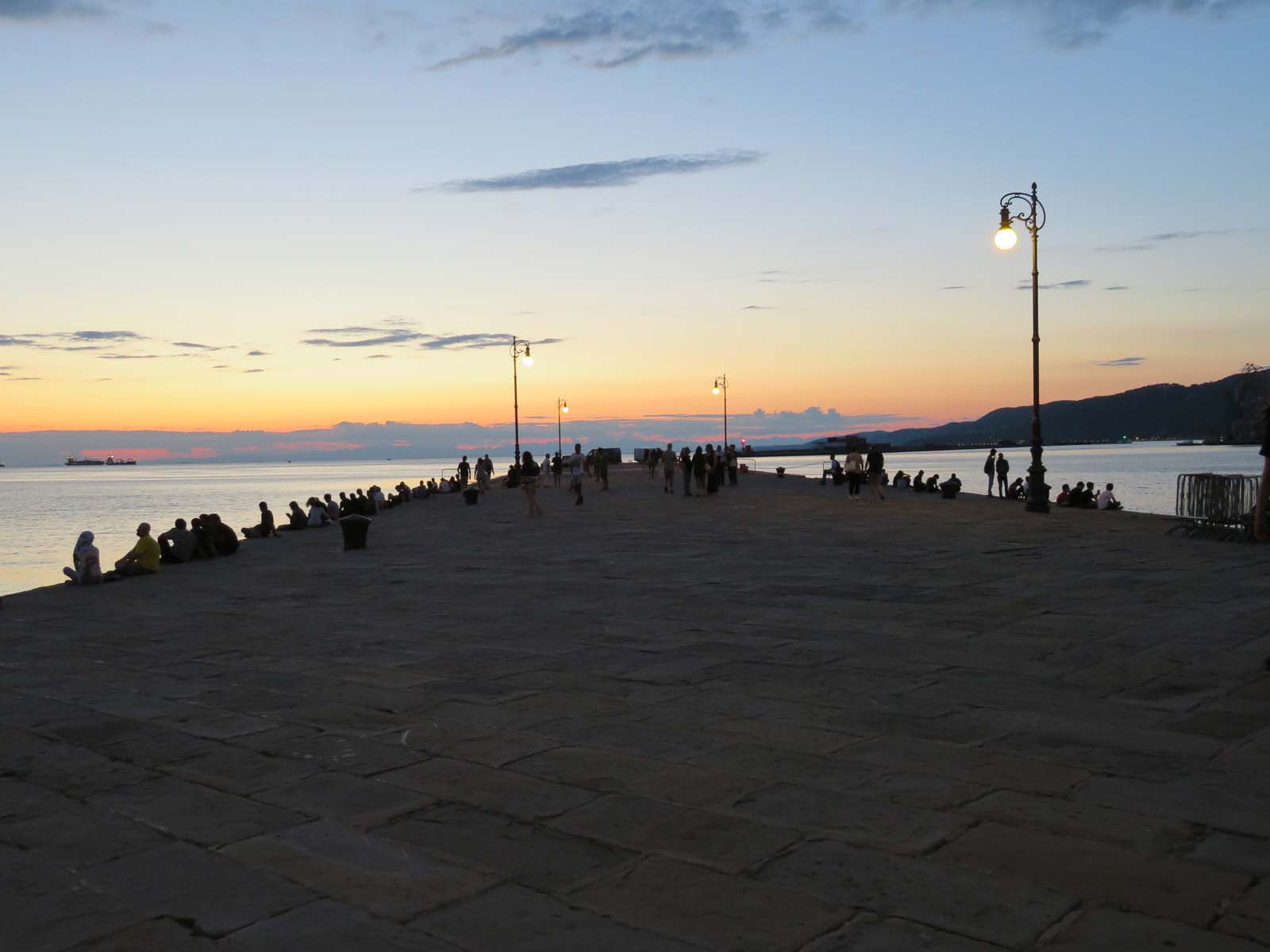
This plaque hangs on the wall of the Holocaust museum at the site of the former Concentration Camp Risiera de San Sabba, in Trieste, Italy. I don’t have to tell you why I am thinking about it and all the other impressions gained during my last visit to Italy in 2018. We owe the victims of fascism to sound the alarm.
I am not sure what is worse, the outcome of this weekend’s Italian elections, with historically low participation due to bad weather as much as disillusionment by younger voters who stayed home, or the white-washing of the result we see in the international media. The right-wing bloc composed of the far-right Fratelli d’Italia (FdI), the right-wing Lega and the centre-right Forza Italia performed as predicted, with FdI leader Giorgia Meloni likely to become the next prime minister.
Meloni is a true heir to Mussolini, and no claims of “post-fascism, breaking the glass ceiling as a woman, she is no tyrant, nothing much will change for Italy since they always vote out those who underperform,” or any of the other softening assurances can hide the factual truth: the Italian voters opted for a self-proclaimed fascist, surrounded by other extremists and abetted by a center-right coalition that wanted power. I think the worst statements for me were by those who had always insisted that there is no chance for a revival of fascism (in Europe or elsewhere) and then, seeing the results, refer to the democratic process that led to right-wing power, essentially saying: “Deal with it.”
In her acceptance speech Meloni used anti-Semitic dogwhistles about refusing to be slaves to international financiers. Yesterday she proclaimed that she considers banning same-sex couples from adopting children, and possibly dissolving same-sex couples’ legal parentage over the children they’ve already adopted. Her program includes disappearing the Sinti and Roma from the street, guarded camps for illegal migrants, incarceration of leftist, and destroying the union offices. Here is an in-depth description of her rise to power and her goals.
In general, Italy is the Western country that has suffered the most severe and prolonged economic decline over the last decades other than Greece. There has been a severe downslide since the 1980s. Italians are earning less in real terms than they did in the 1990s, and large number of scientists and others in the STEM field have left the country due to lack of support. The resulting lack of development and economic stagnation is one of the key conditions that we know leads to people embracing political extremes.
Bread for the Poor
The Italian left has been fighting against each other instead of forging a coalition that would have provided a chance to garner enough votes. It is also the case that the Italian roots of fascism have not been historically worked through, in contrast to, say, Germany, which has tried to analyze and understand the causes for the catastrophe the nation unleashed on the world. Italian voters might have opted for change, rather than the ideology underlying Meloni’s power book. But that does not solve the problem that once in power, these ideologies can quickly turn the world into chaos. Particularly when they are part of an international alliance that mutually reinforces each other, with Victor Urban and Steve Bannon, for example, being declared allies of Meloni.
Trieste itself has a complex history, a place apart under various occupiers, and one that had a complicated relationship with its Slovenian neighbors and part-time occupiers, with lots of anti- Slav sentiment held up to today, as part of a general anti-immigrant movement that the FdI stoked and exploited. The town and harbor were a pivotal part of the Austro-Hungarian Empire, a link between Italy, Central Europe and the Balkans. There were violent liberation movements at the beginning of the 20th century, and the US and Britains who controlled Trieste after WW II only gave it back to Italy in 1954, when they were sure it would not fall in then Communist Yugoslavia’s hand.
Trieste was a magnet for intellectuals, with James Joyce, who lived and wrote here for years, still reigning supreme on the literary tourist circuit, next to Italo Svevo. Their commemorative busts have recently gotten dubious company: in 2019 the city erected a statue of Gabriel d’Annunzio, a nationalist who openly inspired fascism and is claimed as a hero by the extreme right. Last year, Trieste was a hotbed of Covid-deniers and demonstrations against vaccination. As a consequence, the city suffered a large number of infected and a serious crisis at the local hospitals.
Historically the city was a symbolically crucial site for Italian nationalism as a laboratory and showcase for fascism, with new buildings erected on a massive scale and fascist agitators shipped in from other parts of the country to encourage the movement’s development there in the 1930s. The central part of the town is a tourist hub, with loads of visitors from cruise ships roaming the small streets and large plazas; the neighborhoods up the hills get quickly less picturesque, with poverty visible in the outskirts.
Mussolini himself visited in September 1938 and announced in a rousing speech, delivered at the Piazza Unità, the promulgation of the racial laws.
He sanctioned the complete expulsion of Jewish citizens from civil society. In 1943, he was toppled after the successful Allied invasion of southern Italy, but the northern half of the country was now occupied by its Nazi “allies.”
Trieste and the province of Fruili became part of the Reich, forcibly tugged back into their pre-1918 alignment with central Europe. It was the Nazis who converted an urban rice processing plant, the Risiera di San Sabba, into a transit camp, with indications that it was also intended from the start as a death camp, the only one actually inside an Italian city, within earshot of the population. Ovens designed for drying rice provided a ready-made infrastructure for a new, grimmer, purpose.
Prisoners held at San Sabba – some to die there, some on their way to other camps across occupied Europe – ranged from local Jews to people with learning disabilities to other members of the area’s resistance to fascism, including the writers Boris Pahor and Giani Stuparich. In charge of the camp was one of Austria’s most notorious Nazis: Odilo Globočnik, the man responsible for the liquidation of the Warsaw Ghetto and the beginning of the ethnic cleansing of Poland, among numerous other appalling crimes.(Ref.)
Here are some photographs from the memorial site – the sculpture in the right upper corner stands in place of the crematorium chimney. The torture cells were directly adjacent to those housing the inmates, leaving them exposed to the screams that would soon be their own. The majority of over 5000 deaths were cause by beatings. Beaten to death, yes. Some prisoners were shot. The neighborhood was directly adjacent, the population fully aware of what was happening. Many of those neighbors and other collaborators of the Nazis were killed and thrown into mass graves in ravines of the area by Tito and his partisans who sought revenge for the thousands of killed Slavs after 1945. The region has clearly experienced the horrors and consequences unleashed by fascism. And yet.
In last week’s elections, the Trieste region voted for the right wing bloc (FdI, League and Forza) by close to 50%.
We can’t despair, but we can’t ignore the developments either. Here is the partisans’ song.
Note to Self: The strength of right wing movements in Hungary, Sweden, and now Italy (and potentially in our own country come election time) should propel us to examine the link between fascism and capitalism. Can’t do that in the framework of a blog, alas. But will write about the stages of fascism next time.
Looks like I always come back to dragonflies at this time of the year, an unending fascination with their beauty and evolutionary prowess – look at the size of those eyes alone. Dragonflies don’t sting, bite, pollinate – they simply eat bugs that might otherwise do harm, an all important evolutionary role!
I had written about the biological facts of the species here some years ago and provided somewhat sarcastic musings when looking at them last year.
This time around they reminded me of aliens, no surprise given that my mind was preoccupied with thoughts about potential scenarios for humanity’s future, the colonization of space included. Looks like I always come back to politics as well. At this time of year, or any other time, come to think of it. Missed it? “No,” mumble the honest among you, “but did miss the photography.” Oh well.
As is often the case when I learn something new, it all of a sudden pops up everywhere, after decades of (my) ignorance. So it was when I encountered the concepts of Effective Altruism (EA) – a morally inspired way of doing good in the most rational, effective and ambitious way – and its adjoined movement of Longtermism – affecting our species’ survival by economic, scientific and political action that reduces existential risk to humanity, protecting future generations. The New York Times, The New Yorker, Vox, Salon, are suddenly all reporting (and referenced below.)
Let us assume we all agree that doing good is desirable, the morally right thing to do. Why not do it in a fashion that is most effective, literally yielding the most bang for the buck? How would we know how to do that? Rational analysis of the evidence: what amount does it take to save a life or relieve suffering, by what means is that reliably accomplished? It became clear very quickly, that helping people in developing nations, particularly Africa, saved more lives per dollar, and engaging in projects there that use donations cost-effectively saved more lives overall. Sounds good, right? Particularly when we know that empathy is often reserved to those who most resemble us ( I STILL can’t get over how Ukrainian refugees are treated by European nations, compared to their Black or Middle-Eastern Counterparts this year, for example, with my full solidarity to all) instead of redistributing our wealth to those most in need, far away and unfamiliar.
The Effective Altruism movement was started by Toby Ord and philosopher Will MacAskill in 2009, with a group called Giving What We Can promoting a pledge whose takers commit to donating 10 percent of their income to effective charities every year. Not only that – people were encouraged to choose high-paying professions or jobs instead of hands-on occupations, so that they could donate more. (Be a bit-coin speculator, not a country doctor!) Multiple smaller organizations worked towards the same goals, soon to be joined by multi-billionaires donating to the causes: estimates are that the movement has roughly $46 billion at its disposal, an amount that had grown by 37 percent a year since 2015. (A detailed, sympathetic overview of the evolution of the movement can be found here.)
Fighting global poverty and evaluating the charities that commit to that fight have been to some extent superseded by a recent focus on protecting lives that do not yet exist, concentrating on the long term. The alleviation of present suffering is eclipsed by worries that we, as a species, might not have a future at all. At least that is the perspective held by the many extremely wealthy donors, tech bros included, and MacAskill himself, all of whom have led Longtermism from obscurity to relative power. (Elon Musk linked to MacAskill’s new book, “What We Owe the Future,” with the comment, “Worth reading. This is a close match for my philosophy.”) Longtermists are eager to invest in projects that reduce the risk for humanity to become extinct and increase the possibility for trillions of future humans to be born and colonize other stars. Indeed, they are also committed to transhumanism, believing with its prominent proponent, Nick Bostrom, that we can create digital people living in vast computer simulations millions or billions of years in the future. Yes, no kidding.
The main threats to our future are assumed to be global pandemics, potentially created by our very own, bad-actor scientists, nuclear extinction (note: not climate change) and first and foremost Artificial Intelligence (AI). These threats cannot be faced with simple evaluations where to best spend limited resources. They require political solutions across the board, and they entail unknown or unknowable risks. We don’t really know if our interventions will make things better or worse. ( I know not enough about how dangerous AI might indeed be – I do acknowledge that scores of people unfamiliar with nuclear power ended up with radiation poisoning – just one example that lack of technological knowledge can have horrid consequences. (Here is a warning from a thoughtful perspective just last week.)
We might quibble, then, whether it’s better to save millions of people now or devote our resources to saving unimaginably large numbers later – or we might take a deeper look at what EA and Longtermism actually entail.
Private compassion – even when it provides organized distribution of billions of dollars – is a band-aid for wounds caused by a system that lacks societal and political solidarity. If we do not change the modes in which resources generally are distributed, we are forever looking for remedies that simply patch up the most grievous harm. If wealth is generated socially but appropriated privately, no amount of empathy will suffice to protect most of humanity. And the more conspicuously we demonstrate our compassion the more we will feel we have done our part, rather than tackling the more complicated efforts to change a structurally unjust system. Compassion IS important, but it is no replacement for political advocacy.
Longtermism is a whole different kettle of fish, something we need to be aware of given its increasing influence of businesses and even governments. (Ref.) Proponents, as mentioned above, often adopt transhumanist ideals, the hope to reengineer humanity with brain implants and life extension technologies, making post-humans that are “far superior.” And speaking of superiority: one of the existential risks that longtermists fear are “dysgenic pressures” as an existential risk, whereby less “intellectually talented” people (those with “lower IQs”) outbreed people with superior intellects. (Ref.) Straight out of classical Eugenics teachings. The next logical step then is to save not the poor in developing countries (as EA proposed) but to transfer wealth to already rich nations since they more likely provide innovations that could help with technological advances and space travel. And these advantaged nations should also fight underpopulation by focussing on increasing birthrates (of the “right people,” mind you) because more minds imply more potential innovations.
It gets worse. Robin Hanson, for example, an economics professor on board with the Future of Humanity Institute where many of these ideas are hatched, believes, like many longtermists, that in the event of a civilizational collapse humanity will have to re-enact the stages of our historical development. In order to facilitate that evolution, he suggests we should create refuges — e.g., underground bunkers — that are continually stocked with humans. But not just any humans will do:
“if we end up in a pre-industrial phase again,it might make sense to stock a refuge [or bunker] with real hunter-gatherers and subsistence farmers, together with the tools they find useful. Of course such people would need to be disciplined enough to wait peacefully in the refuge until the time to emerge was right. Perhaps such people could be rotated periodically from a well-protected region where they practiced simple lifestyles, so they could keep their skills fresh.”
Possessive colonial mind-set, anyone?
I guess what I am trying to say today can be summarized such: whenever you think, hey, smart altruistic giving is a good thing or protecting humanity from risks of extinction is desirable, think further. Are the ways these things are advertised based on something much darker? Are they effective agents of change or actually tools to leave the status quo of distributions of power and wealth mostly untouched? Are they making us feel good, and thus complacent? Are they expressions of grandiosity to curate future lives?Food for thought. Provided by time to read on vacation!