Here are some skies. The painted ones reflect the landscape of Northern Germany, up at the North Sea. The photographed ones were all taken while looking at the Pacific, a century later. I loved the painter, Emil Nolde (1867 – 1956), for much of my early life, being drawn to the color work, his expressionism, an unmatched intensity in his paintings – and the myth that he was the courageously resisting victim of Nazi terror, re-told in a famous novel by Siegfried Lenz, The German Lesson.
Emil Nolde, Meer (hoher Himmel, dunkel-grünes Wasser, qualmender Dampfer) 1946–1947
I am still fascinated by the evocativeness of his colorization, the way it makes me ask is this really how the maritime sky looks? Indeed, it does! But everything else has collapsed, the beliefs that were so carefully instilled in post-war Germany, and the admiration that had been based on false premises.
Emil Nolde, Dampfer unter rot gelbem Himmel, circa 1935
Nolde was a man who was energetically and successfully building legends around his status as an artist, from day one. He was the misunderstood genius, the martyr at the hands (depending on the era in question) of the Jewish cabal dominating the art market who would not allow a true, pure nordic German to be successful, or at the hands of the Nazis who suppressed his art.
Emil Nolde, Dampfer unter gelbem Himmel, circa 1946
As it turns out, he was an ardent National Socialist himself (as was his wife Ada), a virulent anti-Semite, who even after the war did not change autobiographical writings depicting his loathing for Jews, and who stopped painting religious motifs because he could no longer stand painting “Jews.” Letters from him to Goering and Hitler contained suggestions as to how to rid Germany of “that race.” His subject matter shifted over to painting Vikings and other nordic mythology in the belief he could this way participate in forming the national-socialist art canon.
Emil Nolde, Rote Wolke, circa 1930
In 1933 he admired the writings of fascist Julius Langbehn(Rembrandt as Educator) who claimed that “a pure German art was needed to counteract modernist malaise. He deplored internationalism, mass culture, big city life, argued against specialization, knowledge, a culture of enlightenment, and called for a return to an education of the heart, based on character and individualism, the root of all German art.” Nolde loved this image of a national redeemer, the artist as a German quasi-religious idol. His unmet craving for recognition morphed into a sense of mission that he saw matched by the Führer’s plans. Alas, the admiration was not mutual. Hitler was rejecting the modernism exhibited by Nolde and assigned some of his work to the degenerate art exhibitions (soon to be removed from them by some high-up Nolde admirers in the 3rd Reich administration.) He was, however, sanctioned not with a prohibition to paint (as his later legend has it) but by restrictions on his possibility to freely seek and/or exhibit his art.
Emil Nolde, Herbsthimmel am Meer circa 1940
After the war Nolde carefully crafted the story of himself as a secret resister, having painted 1000s of small works (the unpainted pictures) while being checked on by the Gestapo (a lie.) The paintings date back to almost a decade before he was told to desist sales, and include topics that expressed alliance to the Nazi cause. Here is the interesting thing: much of German society was all too eager to join into this myth building, desperately needing a collective moral saga that matched each person’s need to absolve themselves from accusations of conformity if not collaboration, showing a way out: they had all gone into some kind of inner emigration. The Foundation archiving his work refused all access to incriminating written materials, benefitting from the myth making themselves. Nolde became a figure of cultural identification in post-war Germany, where clean heroes were desperately needed to regain a sense of identity and self-esteem. He was deemed the modern martyr who relentlessly served his art, regardless of defamation and persecution, helping people to redefine their own roles during the 3rd Reich.
Emil Nolde, Landschaft mit hohem Himmel und roten Wolken circa 1930-1935
Last year saw the first comprehensive revision of the legend around this painter at a retrospective exhibition in Berlin, with a catalogue exploring the true history. The Nolde foundation is now under new leadership and fully participant in the research efforts.
Here is a fabulous review that offers more detail.
Music today from another Northern-born German, Johannes Brahms. No conflict between self presentation and content here, or between his art and his identity. Sigh of relief.
Last year the Centre Pompidou did a retrospective of Victor Vasarely’s life works, titled Le Partage Des Formes, Shared Forms. I only read about it, but the title stuck in my head. It probably referred to the repetitive, grouped forms in his paintings. I, on the other hand, often see forms in nature which remind me of abstract art, and I always wonder what unconscious influence is extended by having been exposed to these patterns across a life time. Art offering its share of nature.
As a little exercise, then, I tried to come up with photographs I took on my walks and match them up with art works that they reminded me of. I’ve added a short description of the painter’s life, keeping us as far away from discussion of politics as possible. I think it helps to look at something beautiful, just to keep our spirits up.
Georges Braque, Still Life with Metronome, 1909
Vasarely’s work might, in individual instances, fit the bill for today’s nature photographs, but overall his op-art paintings are just too regular and bent towards creating visual illusions. Someone else, however, hits the jack pot: Georges Braque.
Georges Braque, Bottle and Fishes, 1910-1912
Born in 1882 in France, he was a trained as a house painter, but interested enough in fine art that he pursued an education. Originally influenced by Fauvism, he soon struck up a friendship with Picasso. (In his own words, they were tied together for some time like mountain climbers on a rope.) The two revolutionized painting by developing Cubism in parallel. The first, Analytical phase of Cubism was dominated by slab volumes, somber colouring, and warped perspective.
“The colours are brown, gray, and green, the pictorial space is almost flat, viewpoints and light sources are multiplied, contours are broken, volumes are often transparent, and facets are turned into apparently illogical simultaneous views.”
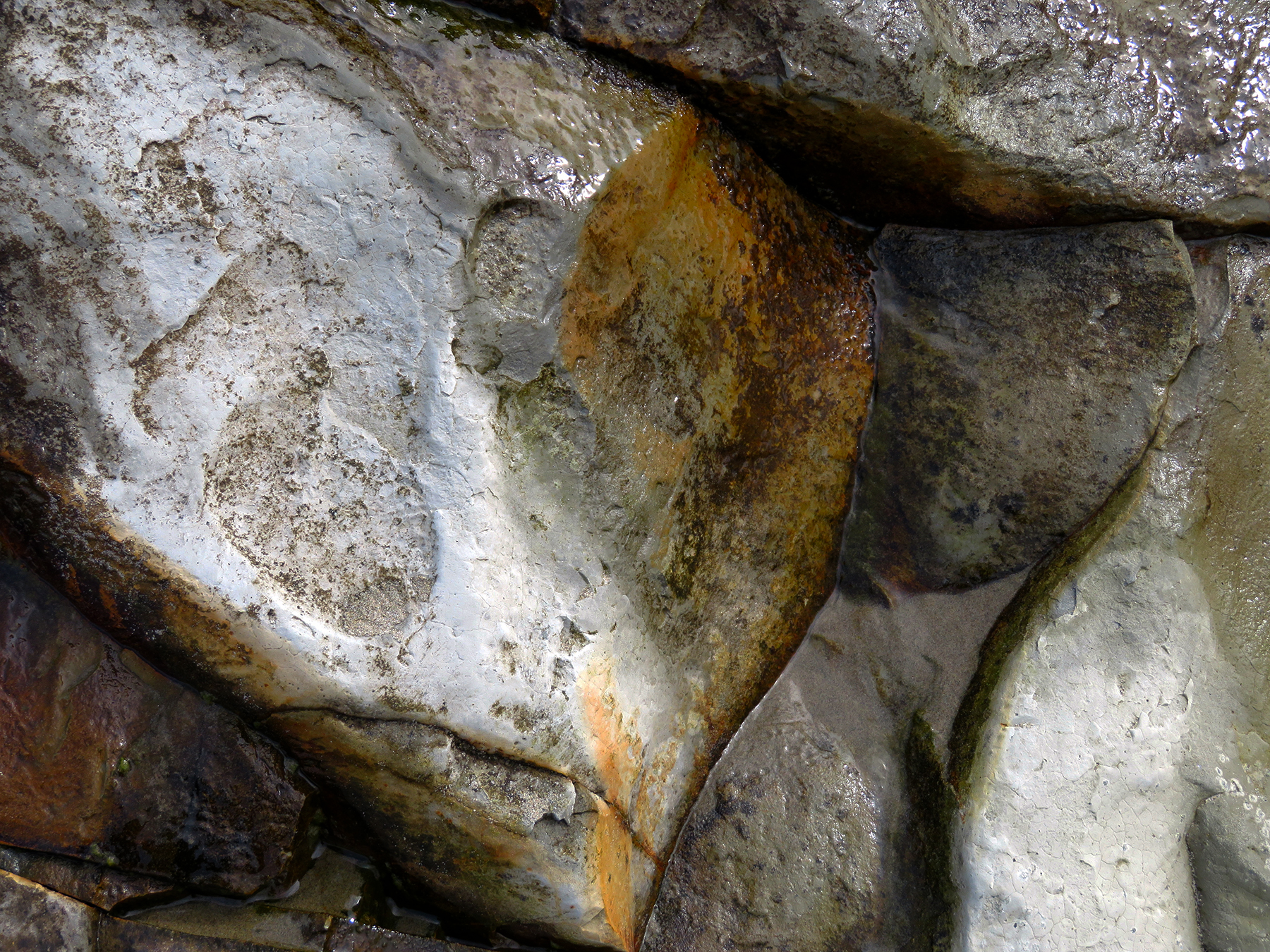
Exactly the kind of view of sandstone and basalt cliffs when you inspect them closely.
Georges Braque, Piano and Mandolin, 1909
Braque became famous and well-to-do during his life time. He served in WW I with distinction, incurring a serious head wound that required multiple surgeries and months of recuperation. He had but one wife, and eventually separated from Picasso who chose a very different path. He died in 1963, with the last years of his life devoted to more figurative painting and subjects of Greek mythology.
Georges Braque, Le Sacre Coeur, 1910
Of particular interest to me is his development of collage work; he was one of the first to add paper and other substances to his paintings in his later career. He wrote much about the fact that paintings should no just be the representation of an anecdote, but an independent object. That is the inherent joy for me, of course, when I make montages: creating something that is in itself new and non-existent in reality from something as reality-based as possible: photographs. A representational illusion.
Here, however, is the representation of the real thing!
And here is the website of contemporary Oregon artist Lee Musgrave, who has a penchant for echoing nature in his abstract art or find abstraction in nature, depending on where and when the muse strikes him.
Music today is a 1917 ballet with cubist influence, Parade, composed by Eric Satie for a one-act scenario by Jean Cocteau, original costume design by Picasso. For the overlapping fragments, Satie uses jazz elements, a whistle, siren, and typewriter in his score.
For something a little bit more melodious: Here are the piano works.
So here is a dilemma: do I listen to the advice of my Beloved who insists that art shouldn’t come with an instruction manual? Or do I listen to the urging of friends to provide extensive explanations for my, admittedly, often complex photomontages? Do I tease with titles? Rely on short introductory artist statements? Write up lengthy descriptions of individual works?
Montages today from an old series (S)Elective Affinities Here: Water Rats
It is not just a theoretical question. I have two exhibitions coming up, with two very different series, and quite a body of work. (Details attached below.) With no introduction whatsoever you can have the most personal encounter with an image possible, defined by your own visual pleasure or your own thoughts evoked by the piece. Will you miss something? Perhaps. Will you understand what I was trying to accomplish? Maybe. Will your reaction be influenced by some extraneous manipulations? Definitely not.
On the other hand, does it help to understand the context of the larger body of work to decipher this or that meaning? You bet. Do textual references enable you to understand the framework and relations to art-historical elements? I’d say. Can I smuggle concepts and ideas into your head that guide your perception? Count on it.
La Couturière
It is all about manipulating attention.
I’ll save the truly fascinating, larger topic of attention research for some other day and focus on the basics today relevant to the questions above.
In the simplest of terms, attention is a mechanism that relies on multiple control mechanism. The exogenous control of attention comes from stimuli in the environment that trigger your attention automatically – the streaking movement perceived from the corner of your eye that has you look to where it came from. The piercing noise that alerts you whether your like it or not. A sudden burst of color that grabs you. A design of a page that draws your eye to a certain position. Something is literally grabbing your attention, hard, if not impossible, to resist.
Parallel to that we can control much of our attention endogenously, choosing where to look and what to process on the basis of what holds meaning for us, what we are trying to find, or what we expect to see or when to see it. (This, by the way, is what makes experts so good at perceiving in their field of expertise: they know where to attend at what point in time, which is crucial for events unfolding in time – think referees at a sports competition or mothers catching the kid at the moment where it falls off the play-structure.
The Analysis
Back to art: If I put a concept into your head, by alluding to something, or simply asking a question, or showing you hints that trigger stereotypes, you will attend to the work in front of you trying to integrate what you see with what you ponder. Here is the classic demonstration (Yarbus, 1967) by a Russian psychologist who used one of the very first eye trackers to check where people attended when moving their eyes to various locations on a given stimulus.
He asked subjects to look at a reproduction of a Russion oil painting An Unexpected Visitor painted by Ilya Repin in 1884, with different questions in mind, provided by the experimenter. The conditions included [1] examine the painting freely. [2] estimate the material circumstances of the family. [3] assess the ages of the characters [4] determine the activities of the family prior to the visitor’s arrival. [5] remember the characters’ clothes. And [6] surmise how long the visitor had been away from the family.
As you can see the patterns of eye movements (the black lines going back and forth) to explore the painting was dramatically different from condition to condition, with your “set” or assumptions about the potential discovery guiding your attention.
Here is an overlay of 2 question conditions and the recorded eye movements onto the actual color reproduction, making the differences even clearer (work by Sasha Archibald) (free examination at center, question about material circumstances of the family to the right.)
And here is of course the trick: only those things you attend to will get fully processed in your visual system, and potentially put into your memory stores. Unattended input might linger on some low levels of the processing hierarchy but will soon end up in the dustbin with all the other junk our brains discard. Details that might have significance will be simply overlooked if we were not conceptually driven to check them out. That might be of crucial importance if you are called as an eyewitness. But it also might affect how you embrace or understand a work of art, particularly if it is detailed and representational.
The Director
Then again, you might share the opinion of one half of our current household: I either like it or not!
Exhibit 1: Tied to the Moon
Stevens-Crawford Heritage House Museum 603 6th St, Oregon City March – June 2020 Open: Friday – Saturday, 11:00am – 4:00pm Admission: $5
Artist Reception on March 21st – 11:00 am – 1:00 pm
This 2019 photomontage series describes some of the common experiences of women across centuries. Just like our physiologies are tied to the phases of the moon so are we tied through shared life events and states connected to our lives. A lot has changed for women; not enough has changed for women. Giving birth, raising children, aging, being loved or abandoned, being controlled or forging our own path has always been basic to the female experience. Finding solace among sisters or competing for scraps as rivals was often part of our existence. Curiosity, skepticism, learning and rebelling had to be fought for. Longing, dreaming and hope were part of the way.
Exhibit 2: Postcards from Nineveh
Oregon Coast Council for the Arts
Newport Visual Arts Center – 777 NW Beach Drive, Newport, OR 97365
March 7 – April 25, 2020
Artist Reception March 14, 1:00 – 5:00 pm, talk at 4:00 pm
On display is a new (2020) series of works that combine photographed snippets of 17th-century Dutch paintings of whaling expeditions along with contemporary environments. It calls for attention to environmental stewardship at a time where nature is under threat. The title is a play on Jonah (the one swallowed by a whale) who was a reluctant prophet, ignored by the people of Nineveh. We, on the other hand, should listen to clarion calls about the need to protect our oceans and fish populations.”
There is an Outside spread Without & an outside spread Within Beyond the Outline of Identity both ways, which meet in One: An orbed Void of doubt, despair, hunger & thirst & sorrow.
– William Blake, Jerusalem (1818).
Let me not mince words: I despise the term outsider art. Yes, I know the definition is loose – it can refer to anything, from art by those not trained as artists, or not affected by a particular culture, or living on the margins of society, or living with a disability or mental illness – often in any possible combination of all of these. And yes, I know we are stuck with the term, since it has taken on a life of its own ever since people started collecting this art. It is part of a commodity market always on the look-out for something new, something striking, something that money can be invested in.
Marker work by Lindsay Scheu
Lindsay Scheu
The very fact that you call some artists “outsiders,” (including those living with disabilities, who are our family, our neighbors, our clients and, yes, our friends,) perpetuates a tendency toward segregation rather than integration, to the loss of all involved. All, that is, but cutting edge curators and collectors who boost their bottom line, staging art fairs and exhibitions of the few among the legions of creative “outsiders” who somehow make it to the top of the art market.
Shannon Anderson
One might argue – and people do – that the invitation to show and sell outsider art removes some of the stigma that is associated with being different from societal norms, and alleviates the poverty that is often correlated with the struggle to make it as a person living with disability. Well, if the art is good enough to break through, why add to it a diagnostic label, triggering stereotypes of illness which we know to be still so pervasive? A bit of frisson? A bit of a kick that you are now leaving the comfort zone? Why invite the demarcation painfully experienced in real life at the boundaries between norm and not-norm into the language, perpetuating it?
*
In the 19th century they called people like William Blake, one of the first and finest protagonists of this art genre, “madmen,” or eccentrics, not outsiders. They still used those words in the 20th century when psychiatrists started to write about the art produced by their patients in asylums. Walter Morgenthaler’s A Mental Patient as Artist (1921) and Hans Prinzhorn’s Bildnerei der Geisteskranken. Ein Beitrag zur Psychologie und Psychopatologie der Gestaltung (Artistry of the mentally ill: a contribution to the psychology and psychopathology of configuration) (1922) made a splash in their time, leading to some cross fertilization with the emerging art movement of Surrealism.
Ceramic Studio – Mask by Mathew Spencer
Painters Jean Dubuffet and André Breton coined the term Art Brut, Raw Art, collecting innovative and sui generis works of art of those outside the mainstream. (A more detailed definition and a treasure-trove of art can be found at the Collection de l’Art Brut at Lausanne, CH.) It was not until the 1970s that the term Outsider Art was introduced, in a pathbreaking book with same title by Roger Cardinal. These days, variations abound. Marginal Art, or Art Singulier, are terms applied to anyone who is not fully included and shows novelty of expression or culture-independent vision. Closer to home we often find self-taught as a term being used to describe art produced by the above populations. In a society that values educational achievement as much as our’s, this seems to replace one stigma with another, but perhaps weaker one.
Caitlin Pruett
*
Luckily, there are places of art being made and displayed, where terminology is of no interest, and where the creative experience of singular human beings rules the day. It was one of the most pleasurable moments in recent weeks when I discovered just one such place close by: The Portland Art and Learning Studio (PALS) in NE Portland. PALS is a program of Albertina Kerr—a local nonprofit that empowers people experiencing intellectual or developmental disabilities, mental health challenges, and other social barriers to lead self-determined lives and reach their full potential. The program is made possible by gifts and grants of the community. Check it out here: PortlandArtAndLearningStudio.com.
PALS Building on MLK
The building alone is inviting, and the staff, from a genuinely friendly receptionist, multiple instructors and interns, to the intensely engaged and perceptive Ass. Director Chandra Glaeseman, serves some 90 clients with visible dedication. Both Chandra and instructor Malcolm Hecht took time out to introduce me to the program and the participants and show me around the space.
Instructor Malcom Hecht
A large, industrial hall is divided into multiple work stations that offer about any creative activity you can think of. Ceramics, painting, fabric arts, digital art, music, writing, beading, you name it. Tables provide spaces to interact, have lunch or snacks, and be creative. Some corners allow for more uninterrupted time to make books, or paint. A 1:4 or 5 ratio of staff to clients allows for individualized attention. A loudspeaker system helps to remind people that their transportation has arrived and they independently move about.
Brian Moran in conversation with Quinn Gansedo Ed Case, Terrie Bush and Ed Papst enjoying lunch
The place is open to the public who can come and visit a brightly lit gallery that displays art both of local participants and traveling exhibits from allied organizations, like the Land Gallery in New York City, Creative Growth in Oakland, CA and Creativity Explored in Richmond, CA. Visitors can also peruse the works at the different artists stations and purchase them directly from the artist or craftsperson.
Gallery Space in the Building
*
PALS was opened some 19 months ago and still has capacity to accept more clients. Glaeseman is an engaged, hands-on leader of the program. Educated at the Maine College of Arts, she went on to receive her MFA from the Rhodes Island School of Design in 2008, including a Sculpture Magazine Outstanding Student award and RISDY’s Award of Excellence, juried by Ian Berry of the Tang Museum. During stints as adjunct faculty at PNCA, Lewis&Clark College and Willamette University she added teaching experience to her artistic practice. I am glad she did not waste resources to pursue additional achievements in social work or clinical psych, since from everything I observed, interacting with people in a genuinely caring and simultaneously pragmatic eye-to-eye fashion comes natural to her.
Director Chandra Glaeseman
Chandra (a truly apt name, I thought, when I learned it means bright star in the sky) has multiple goals for the growth of the organization, goals that are actively supported by management, in particular CEO Jeff Carr at Albertina Kerr. Her vision, for one, is to help clients increase their autonomy, and to provide tools via any kind of creative practice, not just visual art, to achieve more independence. In her experience making art provides a skill set that is transferable to everyday problem solving, however non-lineal the process might be.
Jeanette Mill, concentratingJames Enos
Secondly, she also promotes an attitude towards risk taking which signals that failure is acceptable, even welcome. Providing a safe space to fail, a space free from judgmental criticism, secures learning. Best case scenario, it also increases self confidence and the tools to take on real jobs in the community that recognizes the ability levels achieved at PALS.
Ginger Matthews
Last but not least, the hope is to connect PALS’ artists to the outside world, participating, for example, at the Outsider Artfair in NYC, where progressive studios have national representation and organizations can network to support each others’ work in the field.
“Museums are managers of consciousness. They give us an interpretation of history, of how to view the world and locate ourselves in it. They are, if you want to put it in positive terms, great educational institutions. If you want to put it in negative terms, they are propaganda machines.” – NYC-based German artist Hans Haacke, (2019)
Who needs NYC when we have Gallery 114 in Portland, OR, not a museum but an artist collective that was founded in 1990. Haacke’s views of the role of art institutions, and his artistic focus on the social, political, and economic structures in which art is produced, exhibited and purchased, seem to be a good reminder what progressive galleries can and should do: educate.
Ebullience – Getting ready for opening night at Gallery 114Gallery member and curator Diane KendallGallery members and curators Joanie Krug and David Slader in back
Gallery 114’s dedication to inclusion of less-represented populations is remarkable – whether they open their space to poetry readings by Street Roots vendors, or hang exhibitions like the one this month on display. The current show, Ebullience, presents the diverse creative outpouring from PALS’ artists. The title couldn’t be more fitting – the work on display lights up the gallery’s rooms that are tucked in the Souterrain.
Judy Nuding, Brian Beckham, Alister Bond, Jamond Williams, Steven Jean-Marie. Acrylic, Oil-pastel, and Paper Collage on Canvas. Detail below.
Sculpture, weaving, drawing and painting all hold their own, thoughtfully curated in cooperation with PALS staff, by artists Diane Kendall, David Slader and Joanie Krug (who as a volunteer at PALS saw the potential and made the connection.)
Endale Abraham, A Palacefit for a King, Acrylic and Graphite on CanvasLindsay Scheu Untitled Marker on Matte BoardRicky Bearghost, Untitled, woven Plastic, Wooden and hand-made Ceramic Beads, Leaves, AcrylicPaint. and Pom-Poms. Detail below,
The work might open new perspectives on how to view the world, a world not necessarily familiar. Viewing this world might shift the rigid boundaries between “us” and “them,” locating all of us on a continuum, rather than in disparate regions, inside for some, outside for others.
David Hunt Untitled (Waterfalls) Watercolor and Markers on PaperPALS Collaboration with EATCHO, Acrylic on CanvasJamond Williams Untitled, Watercolor, Graphite and Markers on Paper
Make time for a visit, in the gallery or at PALS’ studio space, it will brighten your day. There is an effervescent mood at both places right now that gives rise to hope: hope for more empathy, more understanding, for unbridled joy in making art and, importantly, for inclusion.
Gallery 114 – Ebullience
1100 NW Glisan Street Portland, OR. 97209 503-243-3356
Thu, Feb 6, 2020 to Sat, Feb 28, 2020
Hours: Thursday – Sunday, 12pm – 6pm
——————————-
Portland Art and Learning Studios Mon.-Fri., 9 a.m.-2 p.m. 4852 NE Martin Luther King, Jr. Blvd. Portland, OR 97211 503-528-0744
“What do I want? Why do I want it? And how do I get it?” – Stacey Abrams, in a TED talk shortly after she lost in the 2018 midterm elections.
AS SHOULD BE OBVIOUS by now, I rarely review exhibitions that I don’t like. The world doesn’t need more negativity and I don’t need the emotional aggravation. It is therefore with some trepidation when I accept invitations to review something I have not yet had a chance to see. I will only do so if I am deeply committed to an institution and usually trust their choices, as is the case with the Oregon Jewish Museum and Center for Holocaust Education (OJMCHE.)
Felicia after the Black Prom, Vidalia, Georgia, 2009. Photographed by Gillian Laub.
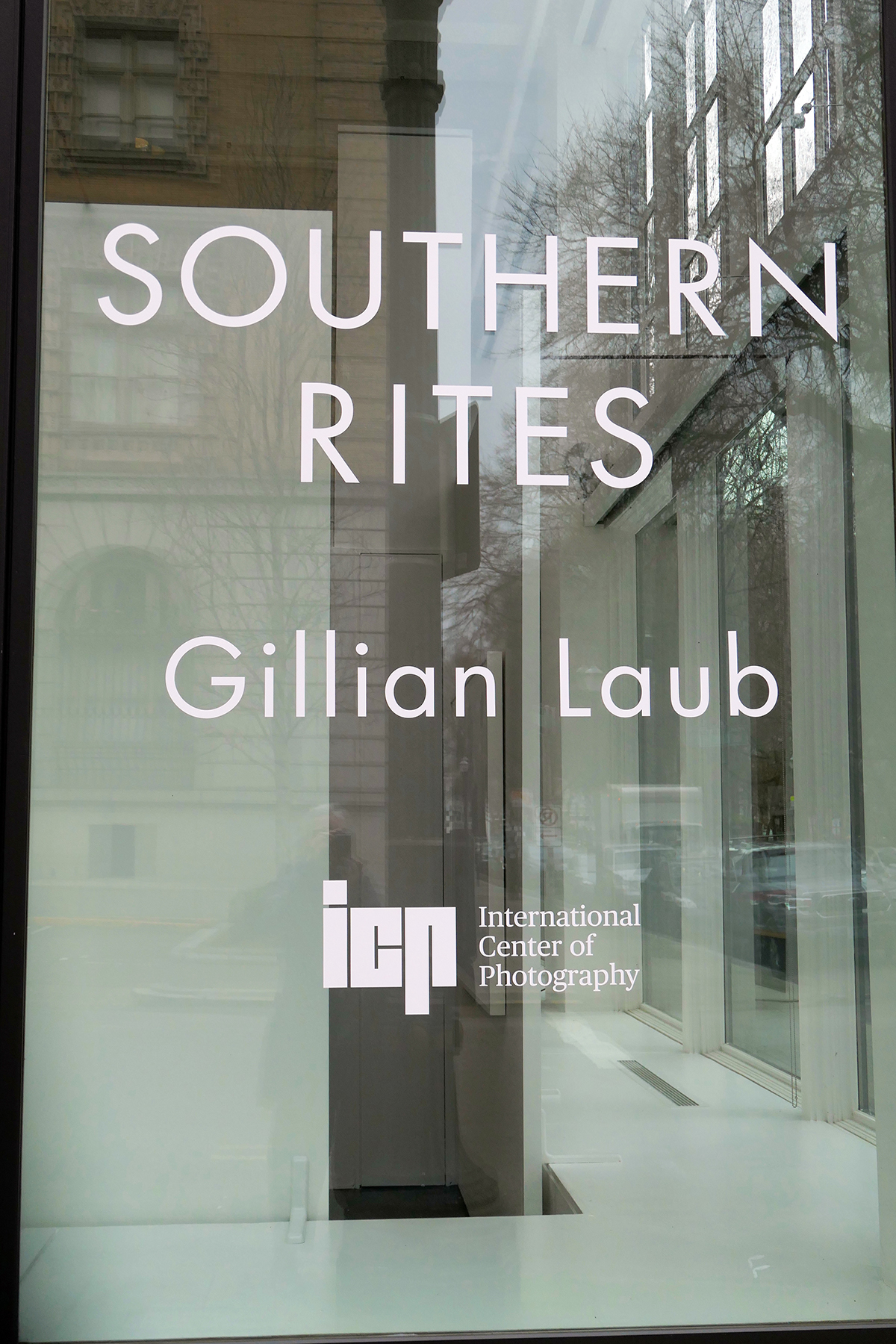
No need to fret: OJMCHE’s newest exhibition, Southern Rites, is one of their strongest yet, a moving and thought-provoking tour de force about race relations and racism in contemporary America. Organized by the International Center for Photography and judiciously curated by Maya Benton, the exhibition of photographs by Gillian Laub is visual activism at its best: perceptive, engaged, critical photography of human beings in a context that defines them. Did I mention beautiful? Beautiful!
Artist Talk at OJMCHE before the official opening of the exhibition
It is not the beauty that matters here, though. It is the package of three elements that make this not just an artful, but an important exhibition: a longitudinal project executed with skill and courage in the light of tremendous obstacles, for one. Secondly, a slew of smart curatorial decisions how to present that project, equally important for creating a narrative. And finally, the flexibility of a Jewish museum bent on going beyond the traditional role of keeper of memory, whether Holocaust-related or preserving the history of the local community.
Museum Director Judy Margles welcomes the artist.Bruce Guenther, frequent guest curator at OJMCHE, attends the opening
OJMCHE’s invitation to have difficult conversations about racism and relations between African Americans and Whites — at a time when this city is, again, in the midst of a murder trial for someone accused of hate crimes and where the weekend brings marches by the KKK and their allies in close vicinity of the museum — provides the very model of inclusivity that is a prerequisite for change. To hark back to Stacey Abram’s questions (and potential answers): if it is change that we want, and if it is justice that demands it, then to get there we are helped by the kind of art Gillian Laub creates and museums like OJMCHE that channel it.
Qu’an and Brooke, Mt. Vernon, Georgia, 2012. Photographed by Gillian Laub..
*
“I am an invisible man…I am a man of substance, of flesh and bone, fiber and liquids—and I might even be said to possess a mind. I am invisible, understand, simply because people refuse to see me.” –Ralph Ellison (1952)
GILLIAN LAUB IS A STORY TELLER. I cannot tell whether the New York-based photographer and film maker intuitively grasps the effectiveness of a human interest narrative, or if her projects are the results of intellectual decisions to employ a certain method – probably both, but in the end it doesn’t matter. Her work delivers a comprehensive view into the lives of other human beings, the way that they are shaped by their environments. Her interactions with her subjects elicit an openness and willingness to communicate that are rare for documentary photographers. The fact that she graduated from the University of Wisconsin-Madison with a degree in comparative literature before studying photography at the International Center of Photography, clearly exerts an influence. At her best she makes the invisible visible.
Gillian Laub, photographer and film maker
The images that you encounter at the museum depict the African-American and White High School seniors of small towns in Montgomery County, Georgia. The towns had segregated Proms way into the 21st Century. Laub visited, on assignment for he NYT, after a high-schooler had sent a cry for help to Spin Magazine in the early 2000s. Not only was she escorted out of the White Prom, chased out of town, car tires slashed, but repeatedly so, across several years that she returned, even when the Prom was now officially integrated some time later.
Yearbook of Segregated Prom
The topic of Prom politics – and the eventual accumulation of Prom photographs – was soon superseded by a tragic death in the community: in 2011 one of the young men associated with all the teens she had been photographing, was murdered by the father of a girl who had invited Justin Patterson and friends to come at night to her house. He shot at several of them several times. Originally charged with seven offenses, among them murder and false imprisonment the man was offered a plea deal and spent a year in a State detention center and some years probation. The victim’s parents’ claim that the shooting was racially motivated, went unheard. In later interviews, once freed, the shooter showed no remorse. In addition to portraits of the involved people, the exhibition shows a tape of the 911 call that is hair raising in its lack of humanity.
Curator Maya Benton in front of a photograph of the shooter and audio tape of the 911 call
A detailed HBO documentary of the Patterson killing, filmed by Laub, can be seen at the museum every Wednesday at 2:00 pm and on demand on the weekend.
Documentation of the Town’s Coping
The third part of the show consists of a large number of B-roll footage, glimpses of workers in the onion fields of Georgia, the town, the churches, and, fascinatingly, the many church signs and billboards that display evangelical messages. Most of the churches are still segregated by choice. Yet you cannot tell by eyeballing which constituency posted the religious slogans. A shared appeal to fear of Divine punishment for your aberrations, however, does not translate into anything much else that’s shared, it seems.
Noted.
*
MAYA BENTON, EDUCATED AT BROWN, Harvard University and the Courtauld Institute of Art in London, was faced with a tough choice for this exhibition. Many of the questions and subject matters raised by the extensive body of images and their implications had to be sifted through to cull a manageable display. More importantly, how do you tell a story that is not entirely your own? How do you document reality without appropriating someone else’s history? I have previously asked these questions here for other visual artists.
Maya Benton, Curator, Lecturer and Writer
In the current exhibition the decision was made – successfully – to let the subjects of the portraits speak for themselves, with transcriptions next to the images. It is then equally important to look at the photographs AND read the accompanying texts, particularly in instances where Laub had repeated contact with individual students across time, allowing us to be witness to changes in perspective caused by concurrent events. Believe me, it does not feel like the usual chore of digesting endless artist statements. These are living testimonials of voices that we rarely get to hear, and help to do both for us: to acknowledge stereotypes and perhaps to combat them.
A substantial amount of general information about the history and politics of segregation in our public school systems is displayed in additional showcases. Getting a refresher about the path from Plessy v, Ferguson to Brown v. Board of Education doesn’t hurt. What does hurt is reading the evidence of communal complicity in maintaining segregative practices even during the years of the Obama Administration: teachers’ comments on students’ essays bemoaning the divided Proms, classmates notes decrying calls for change as in the face of Southern tradition and so on. The displays are superbly assembled.
Note from classmate
*
“One wants to break free of the past: rightly, because nothing at all can live in its shadow, and because there will be no end to the terror as long as guilt and violence are repaid with guilt and violence; wrongly, because the past that one would like to evade is still very much alive.” –Theodor W. Adorno, (1959)
WHEN ADORNO WROTE in 1959 about the (refusal of) working through the past, he had fascism and in particular the guilty German people foremost in mind. OJMCHE is on target when the museum allows us to see how some of this can be translated to the memory culture of slavery and racism in this country as well, I believe. What is striking though, and that is what this exhibition certainly has made me think about, is how much those who used to enjoy the advantages of segregation and relative power in society, want return to the past, rather than forget it, never mind come to terms with it.
Public Shaming, Vidalia, Georgia, 2013. This Country. This Century. Photographed by Gillian Laub.
For large groups of Whites, power is perceived to be a birthright, and resentment surges when one sees one’s own displacement or descent as directly caused by the ascent of specific others – women who work, migrants who come into the country, African-Americans who take over the Prom. Unfortunately, these emotions are often stirred by easily manipulated beliefs rather than facts: if your job is gone, it is easier to blame the women who you see working all around you for displacing you, than questioning an economic system that relies on automation and outsourcing to continue to reap profits. If you believe that South American migrants will deprive you of your share of limited resources you don’t even look at the facts that show this to be untrue.
Those emotions mobilize: You see yourself attacked as a class, no longer as a failing individual, and that unites you with the many who share your view. Rather than apportioning blame to yourself as not being competitive, you can blame a shared out-group enemy – making for these dangerous movements that are now sprouting across the US, movements that are willing to consider even violence to defend what they believe is ripped from them.
Scientific studies have shown this to be true nowhere more so than in the American South. In their book Deep Roots: How Slavery Still Shapes Southern Politics Avidit Acharya, a political scientist at Stanford, Matt Blackwell, a professor of government at Harvard and Maya Sen, a professor of public policy at the John F. Kennedy School of Government at Harvard, link current conservative attitudes towards gun rights, death penalty and racial resentment in parts of the South directly to a slave holding history.
In a nutshell: Southern Cotton and tobacco industries thrived on chattel slavery, since those crops were extremely labor intense. After the Civil War, those regions’ economic survival depended on finding ways to continue to exploit Black labor. Anti-Black laws and practices, from Jim Crow to the undermining of education and participation in the political sphere, served that purpose. But there is another important mechanism at work, called behavioral path dependenceby the authors: Generation after generation passes down and reinforces beliefs about racial inequality and the need to impede progress of those deemed inferior. Children learn from their parents and teach their own children, all the while being backed up by local institutions that echoe the value judgments and create spaces for segregation. After slavery was abolished and with it Ante Bellum Laws, the subjugation of Blacks now relies increasingly on cultural mechanisms.
“…things like racialized rhetoric from the top down can have really, really damaging and long-term impacts. So things like talking about people in dehumanizing language, institutionalizing policies that treat people as less than human. Those things can really create attitudes that then persist for a long time.
.. to be able to kind of preserve the same structure, economic structure that we had with slavery it required a lot more kind of local vigilance to kind of enact these policies. So you had a kind of creation of a culture, a maintenance of a culture that required things like extrajudicial violence, it required basically training and indoctrinating young children into thinking about the world in certain ways.“
Shelby on her grandmother’s car. Mount Vernon, Georgia, 2008
And this culture is incredibly resistant to change, proceeding at a glacial pace. In other words, federal interventions, like the Civil Rights Act or the Voting Rights Act (or what’s left of it) can address behavioral discrimination, but they do nothing with regard to attitudes. Children who are indoctrinated from an early age will carry their parents’ attitudes to the next generation.
For change to happen, we must pursue the one public cultural mechanism at our own disposal: education. This is whatSouthern Ritesdoes on so many levels and so successfully.
Gillian Laub, artist, Maya Benton, curator.
In the true tradition of concerned photography, the early documentary approach to describing the injustice of the world, it educates through imagery, through text, through augmenting materials. It does so effectively because it taps into something beyond our thoughts. Show me one person who is not going to leave that exhibition emotionally riled, to varying degrees. It elicits empathy, pure and simple, an opening to relating in new ways. I just hope every high schooler in town has a chance to visit!
Southern Rites
From the International Center of Photography Photographs by Gillian Laub
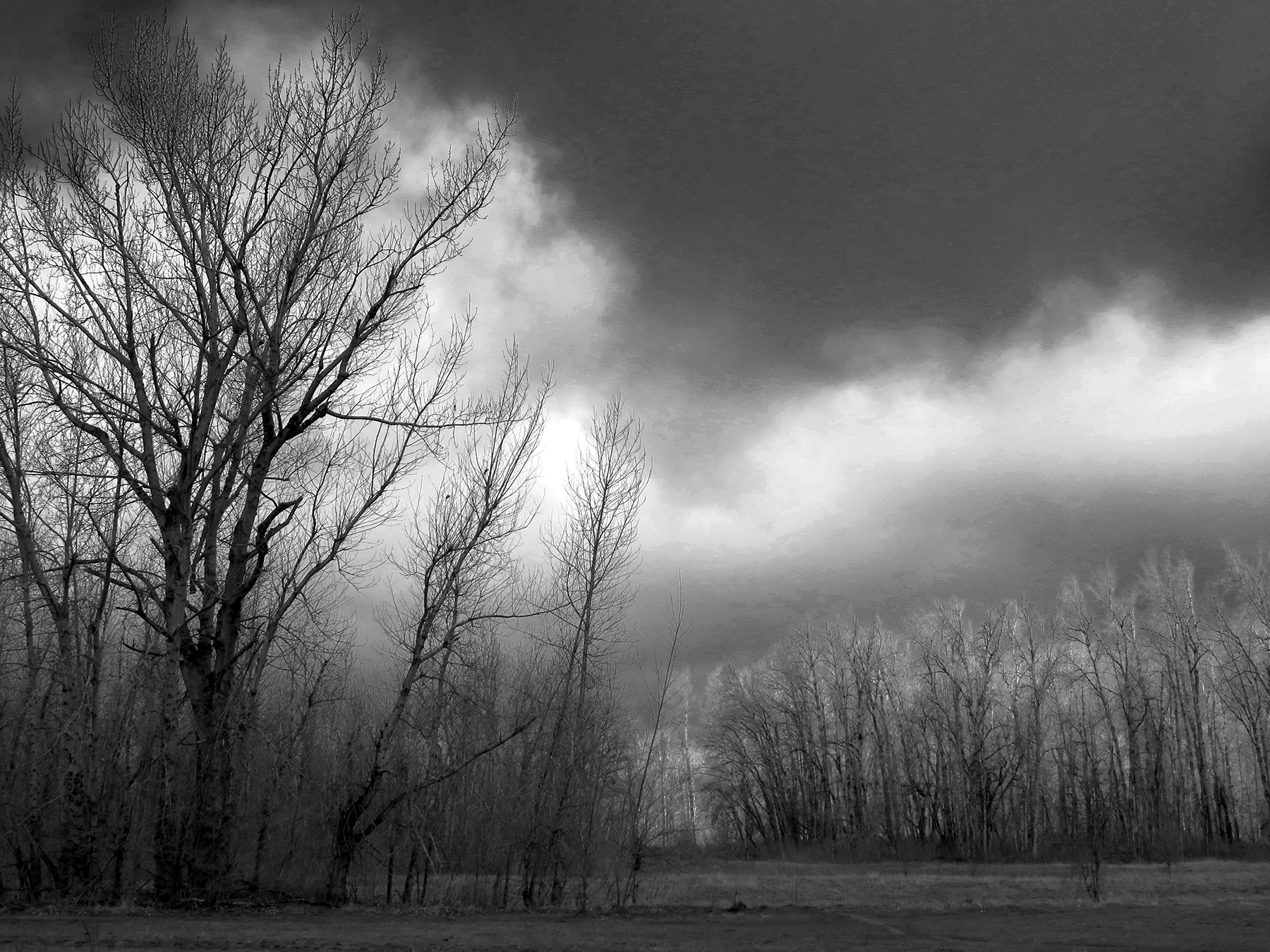
Let’s just look at the BRIGHT side. That’s what the views suggest – there are so many spots lit up. That was true for the landscape as photographed 2 days ago, which had this weird partial lighting when the sun peeked through the clouds.
But it is also present in what is on offer this week in the cultural landscape – I will post longer essays in days to come on two of the three things I urge you to visit, and photographs for the third. Each one in its own right is a testament to resilience, finding joy in hard places, fashioning the world with new perspectives and refusing to give in. In other words, they help us look at the bright side.
For now I recommend, highly, a visit to OJMCHE to see their new exhibitionSouthern Rites. The expressive photographs of Gillian Laub, thoughtfully and confidently curated by Maya Benton and The Center for International Photography, introduce us to a new generation of young Black people living in the American South, their losses, challenges and perseverance. The exhibition also offers welcome education on some of the legal issues involved with inter-racial relations.
February 5, 2020 – May 24, 2020 724 NW Davis Street Portland OR 97209 Opening on First Thursday.
*
Also of interest, starting First Thursday as well, is an exhibition at Gallery 114 that will communicate joy. Ebullience, initiated by Gallery 114 member Joanne Krug and her husband, displays both 2D and 3D art created by artists living with intellectual or developmental disability. The artists have found a place to be creative at the Portland Art and Learning Studio, part of Albertina Kerr, under the caring and smartly involved directorship of Chandra Glaeseman. I can’t wait to report in detail on the work that is done there, and the art that will be on display at 114.
*
The third recommendation regards two 50 minute-long performances this weekend of How to Have Fun in A Civil War, created and performed by Ifrah Mansour (Somalia/U.S.). Offered by Boom Arts in conjunction with the 30th Annual Cascade Festival of African Film, the multimedia performance event will make your heart softer.
Mansour revisits her childhood memories during the 1991 Somali civil war to confront violent history with humor, and provide a voice for the global refugee stories of children. How to Have Fun in a Civil War, is a one-act multimedia play, which explores war from an idyllic viewpoint of a seven-year-old Somali refugee girl. The play weaves puppetry, poetry, videos and multiple oral stories taken from community interviews to tell a captivating story about resilience while pushing the audience to engage in a healing process that is still raw for survivors of the war.
Here is a more detailed review. And here is a video of her explaining her project.
February 8th at 1:00pm & 9th at 5:00pm – PCC Cascade, Moriarity Hall Theatre, on the corner of N. Killingsworth and Albina ( enter on Albina)
The role of the artist is exactly the same as the role of the lover. If I love you, I have to make you conscious of the things you don’t see. –James BaldwinThe Creative Process (1962) (from The Price of the Ticket: Collected Nonfiction, 1948-1985.)
ONE OF THOSE WEEKS. Unrelenting, miserable downpours, not the drizzle Portland usually knows. Unrelenting, horrid news, death calling with helicopter crashes, earthquakes, viral lung disease. And then three art encounters that stretched the brain and filled the soul with smatterings of joy. Softened the week around the edges.
Details from Amanda Triplett’s studio.
The thread that ran through these encounters was literally that: a thread. Or, more precisely, multitudes of them, fabrics, textiles, hair and other palpable materials fashioned into something different and new. To stay within the textile metaphor, the warp running the lengths of the works were clever, clever ideas about our place in the world, crossed by the weft of invitations for multiple interpretations.
Wool, cotton, fabrics of all sorts used to have a purely functional existence in my universe. One of my earliest memories is that of large groups of German women workers walking to and from work at the factory on the outskirts of the village, chatting and simultaneously knitting, wool skeins held in the front pockets of their aprons. Socks, hats and mittens mostly, easy to transport, the larger sweaters waiting at home. (The factory was aptly called Glanzstoff, shiny fabric, a regional employer for over a thousand workers spinning artificial fibers and Viscose.)
One class up, the ladies met for tea and crochet sessions, producing intricate lace doilies, scoffed at as kitschy by my generation, shamefully ignorant of the enormous skill and creativity displayed. The melodic humming of the Singer sowing machine, pedal-powered by my mother’s feet, was a constant childhood background noise. I can still feel the yearning for store-bought clothes, a half century later…..
That art could be involved did only dawn on me much later. Visits to Bayeux put tapestries on the mental map, and later, post-war exhibitions of the Bauhaus weavings put an end to my stupidly snobbish attitudes towards “crafts.” In the U.S. you still have a chance to see a stellar Bauhaus-weaving – related exhibit at the Chicago Art Institute until middle of February.
*
CLOSER TO HOME a visit to the Portland Art Museum proved the first eye-opener of last week. Diane Jacobs‘ work Global Inversions (2008) literally makes us, in keeping with James Baldwin’s admonition, “conscious of the things we don’t see.” A large panel shows an inverted map of the world, with felted wool indicating oceans and hair defining land masses. It looks amorphous, vaguely familiar when you approach it before knowing what it is. Recognition is achieved by means of a small, transparent, acrylic globe suspended in front of the panel: it reverses the directions of the map into the ones familiar to us.
Diane Jacobs Global Inversion (2008)
Substances from the world that is – animal and human hair – depict a world imagined upside down, containing allegoric truth within a geographic lie. Our world, of course, IS upside down, out of balance, careening into places unknown. The many suffer, the few make the decisions, and economic motivation often supersedes morality. We do not have to see that truth as long as we embrace our looking glass (that little ball) which mirrors the status quo, a comforting illusion for us on top of the world. Or maybe if we see it as a crystal ball we glimpse a future that is rightsize up, a world where justice guarantees more even distributions.
Acrylic ball inverting the perceived display
As I said, open to multiple interpretations; the artist’s goals, to have “the viewer investigate her or his own relationship to the given topic,” was, in my case, met. Wool on the panel sabotaging efforts of the ones in power to pull wool over our eyes. Art making us conscious of things we didn’t see, fighting our ignorance.
Auch das erotische Kunstwerk hat Heiligkeit. – Egon Schiele, Sketchbook entries (1911)
Erotic works of art as well contain some sanctity.
WHEN I FIRST MET Amanda Triplett at an art auction and opening which displayed one of her pieces, I knew nothing about her other than that she makes sculptural fiber works and installations from salvaged textiles.
Amanda Triplett, textile sculptress and installation and performance artist.
There was something distinctly puckish about her, a delicate elf, a teasing sprite, right out of the cast of a Midsummer Night’s Dream (that is if she had stuck with her passion for theatrical performance before she switched to visual art.) Enough to trigger my curiosity, in any event, and so last week I visited her studio.
Triplett in her studio with interactive structural nest.
Little did I know. This young mother of two has a laser-sharp eye on our preoccupation with our bodies, society’s ways of manipulating female (and increasingly male) confidence through issues of body image and function. A devotee of the erotic expressionism of Austrian painter Egon Schiele (1890 – 1918), her sculptures lack any of the shyness associated with the elfin folks.
Nor their diminutive size, which Shakespeare hints at:
“they do square, that all their elves, for fear, Creep into acorn cups, and hide them there.”
The works do have a puckish wit about them, though. How else would you describe a series of imaginary female organs, including Hysteria and Plasma, the former appropriately shaped like a giant vibrator?
Or the tactile, sculptural nest (maybe an acorn after all, if not the womb) that invites visitation? A hint of veneration of the sanctity of female function right next to pointers to the harm inflicted by misogyny.
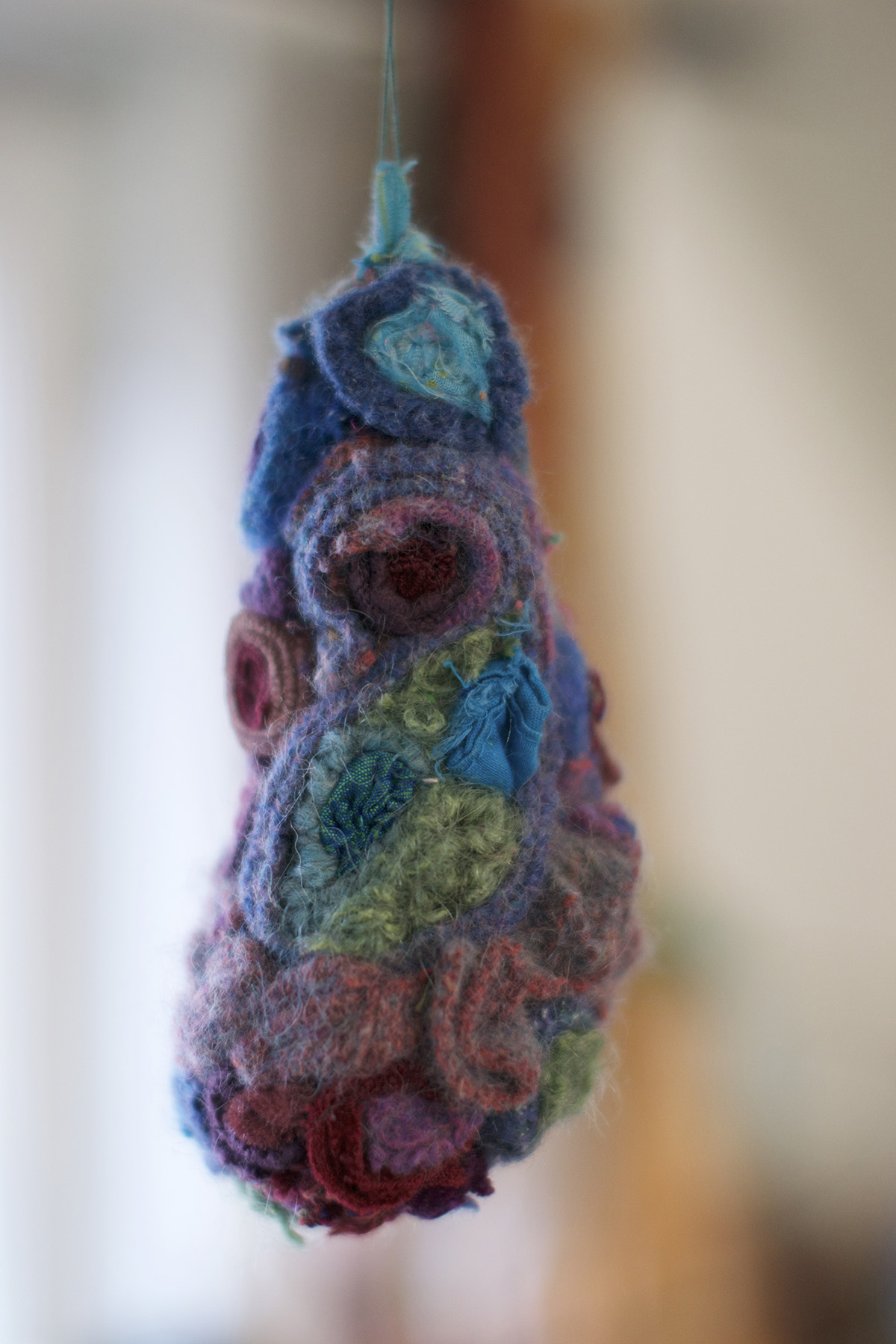
The striking ambiguity in surface and form allows for multiple interpretations. If you didn’t know the intent behind some of these works, you might just look at them as intricately sewn sculptures, with frequent reddish color combinations, the occasional shocking pink aside. They invoke some vaguely biological forms, patterns that can be equally associated with tide pools, oceanic life forms, or even cellular biology.
Which takes us back to our own bodies. Recent larger works represent imaginary layers of skin, their lace-like perforations raising questions about directionality of flow.
Do they allow the poisonous pressure of body image-standards to be absorbed, or do they allow parts of the self to flow out towards connection with the other? No blood-brain barriers here, but rather contemplations about our relative place in the world.
*
TRIPLETT HOLDS A B.A. IN Art and Art History from Sarah Lawrence College in NY. Starting out as a performance major, she soon switched to visual art, mostly focussed on drawing and other works on paper.
She credits the fact that she was raised in fabric-rich societies like Egypt and Taiwan, with parents later living in India, with her eventual settling on fiber sculptures. Her intention to work with discarded materials found the perfect source: Shortly after she moved to Portland from California in 2016 she was awarded one of the artist-in-resident spots at Glean, “a juried art program that taps into the creativity of artists to inspire people to think about their consumption habits, the waste they generate and the resources they throw away.” They work in partnership with Recology Portland, Metro, the regional government that manages the Portland area’s garbage and recycling system and crackedpots, a nonprofit environmental arts organization.
The two strands of environmental consciousness and gender issues run in parallel, just as the sculptress’ work is alternating between small and large, universal and/or site specific.
Amanda Triplett Earthen Body, Auburn WA, Art on Main, January 18th – April 5th, 2020
Lately she has begun to incorporate some performance aspects into her shows, sewing herself in into a sculpture in front of audiences, and then cutting herself out again, adding rings and layers of fabric per performance.
An element of chanting, coming out of her meditative praxis, is explored as well, guided, as she frequently repeats in our conversation, by the heart. It might be a big and busy heart, but it is matched by an incisive brain.
*
“The past is never dead. It’s not even past.” – William Faulkner, Requiem for a Nun (1951)
OF COURSE NOT, all we have to do is re-invent it. Just ask Triple Candie. Their current exhibition at the Portland Art Museum, Being Present – Revisiting, somewhat unfaithfully, Portland’s most experimental art experiment, the Portland Center for the Visual Arts (1972-1987) does just that.
The duo of Shelley Bancroft and Peter Nesbett (collaborating for this exhibit with Sara Krajewski, the Robert and Mercedes Eichholz Curator of Modern and Contemporary Art) creates exhibitions about art without art, their statement reads. I beg to differ. There is a lot of artistic creativity involved in the way they problem-solve around issues of representation. How do you, after all, depict what went down across two decades at an art hub founded by three artists/academics, Michele Russo, Mel Katz and Jay Backstrand who had the vision to bring avant-garde, contemporary art to Portland? In particular, how do you represent the performance history ushered in by Donna Milraney in the 1980s, which superseded the focus on painting and sculpture in the 1970s under Mary Beebe’s leadership?
One of the ways that people solve problems includes the use of analogies. As it turns out, that only works if people do not cling to superficial features, but focus on the structural aspects of a problem, the underlying dynamic that needs to be captured in an appropriate analogy. Triple Candie did just that when using carefully crafted, individualized tapestries that are analogies of the PDX appearances of post minimalist dancers, jazz and electronic music musicians and performance artists. (In the context of today’s focus on textiles, this is the part of their exhibition that I’ll describe.) Small accompanying plaques inform the viewers about the name of each performer, the date of their performance, their artistic approach and a bit on their life story.
Details from the tapestries
Mounted on walls and suspended from up high across a large space in PAM’s Contemporary Art wing above an orange stage, these fluttering, somewhat insubstantial fabric rectangles hint at the impermanence of single performances. Each one was carefully designed to bring out dominant characteristics of the performing artist they represented. What would I have given to be a little mouse in the room where the curators brainstormed for ideas of typicality, and then set out to transform them into surrogates with wit at times bordering on sarcasm, at times on idolatry! Lovingly detailed, patterned textile portraiture. You should go and give that exhibition a look. Some of it might have you in stitches.
Was glänzt, ist für den Augenblick geboren, Das Echte bleibt der Nachwelt unverloren.
That which glitters is born for the moment; The genuine remains intact for future days.
Johann Wolfgang von Goethe, Faust eine Tragödie, Kapitel 2: Vorspiel auf dem Theater (1808)
I was so cold when I left Dorothy Goode‘s studio after a visit last week that I could barely get the key into the car ignition. During our first ever encounter we had huddled, both in down jackets and hats, in front of a little electric stove in her unheated ware-house abode. The space had beautiful views, brilliant light and a damp iciness that crept into my arthritic bones. I could not help but think of Frans Hals, that radical observer of humanity, who was so impoverished at the end of his life that in the Dutch winter of 1664 he accepted three loads of peat on public charity, otherwise he would have frozen to death. (Of course he then had to portray the administrators of said charity, the Governesses of an Alms House in 17th century Haarlem – those faces all-telling.)
Dorothy Goode, painter
Not that Goode would accept alms. Ever. Fiercely independent, proud, accomplished and not at all risk-averse, she’ll probably persuade you rheumatism is the price you pay for pursuing your art. Or so I wager. After all, I have to run on the impressions of 2 hours of conversation with an artist intensely protective of her inner life.
Wager I shall. Our conversation led my thoughts back to the cautioning words of one of Hals’ landsmen, Vincent van Gogh. In a letter to his brother Theo, he was acutely aware of the temptation to exchange security for creative independence, mediocrity for daring. “How does one become mediocre? By going along with this today and conforming to that tomorrow, as the world wants, and by not speaking out against the world and by only following public opinion!” He compared himself and his brother “so the one, “a certain position or affluence and a businessman,” the other “poverty and exclusion, painter.”… “I feel that the future will probably make me uglier and rougher, and I see “a certain poverty” as my lot — but — but — I will be a painter … in short a being with feeling.” (Letter by Vincent van Gogh to his brother Theo on or about Sunday, 16 December 1883)
Studio Floor
Plus ça change plus c’est la meme chose – if you follow your own path, defy convention, are immune to Zeitgeist and pursue what you – and not the world- want, and if there’s no trust fund carefully hidden in the wings, you do lack security to a degree that can veer into the frightening.
Forget talent. Forget vision. Forget skilled craft. I think John Berger put it best in Ways of Seeing (1972): “Capitalism survives by forcing the majority, whom it exploits, to define their interests as narrowly as possible.This was once achieved by extensive deprivation. Today in the developed countries it is being achieved by imposing a false standard of what is and is not desirable.”
Gesso covered hand
*
The pressure to conform to “desirable standard” – dripping paint today, identity politics tomorrow, or was that yesterday? – is intense. Opting for shimmering instead of genuine is only increased by structural factors beyond your personal recognition as an artist. The number of failing galleries, often due to higher real-estate cost, means fewer options for representation, and the surviving ones will understandably select with an eye on their own bottom-line. This includes factoring in the taste of potential patrons and the artists’ ability to draw collectors in with personal connections and the like. Add to that the fact that new generations of buyers, who should replace the older ones now downsizing to their retirement homes, are exceptionally burdened with educational debt, have little homeownership that opens up space for collections and, importantly, tend to spend on experience rather than objects. The perfect storm, if you were not one of the rare break-out artists during the last few decades.
*
Dorothy Goode Transfixed No. 14 (2019) Egg Tempera on Panel
Conforming she ain’t. Mediocrityis the last term that would come to mind when perusing the body of art in her studio or assessing the richness of the conversation. True to a vision, the first.
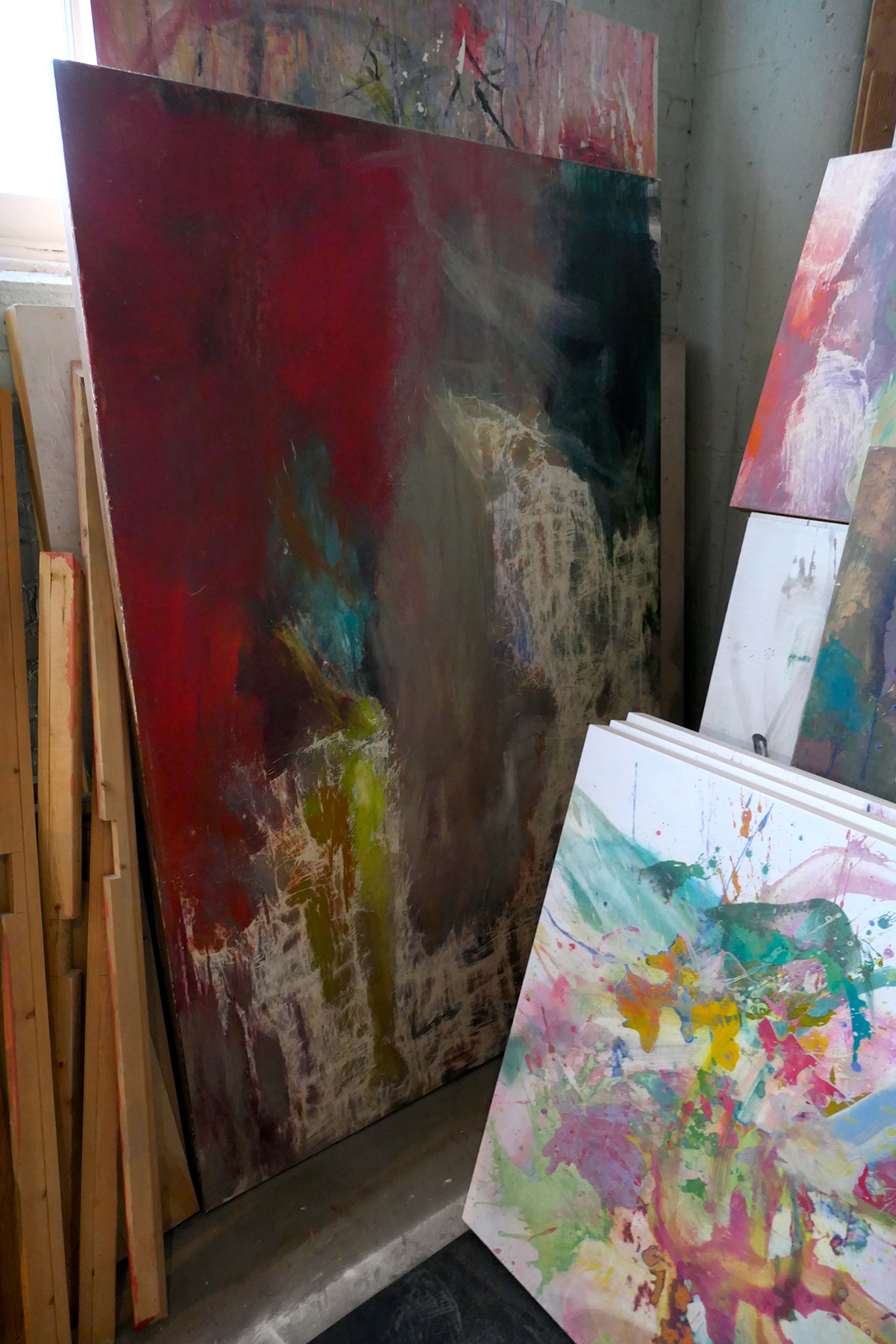
I had seen and liked Goode’s work across the last decade at Butter’s when the gallery was still a brick & mortar enterprise. A recent show, Transfixed, at Augen, rekindled my interest and led to my request for an interview. What drew me in was what I perceived to be exuberance in these paintings, and the sense of something moving. In fact they recalled one of Piet Mondrian’s claims (I seem to be stuck on the Dutch today!) he made about his work in response to the suggestion by Calder that some of their parts should be made to move: “Well, I think my paintings are fast enough already.”
Dorothy Goode Transfixed No 1 (2019) Egg Tempera on Panel
The perceived speed of Goode’s recent paintings seemed to me in equal part giddy and compulsively driven, a perfect tension between lifting your soul up and weighing your heart down with the emotional valence behind those expressions. One part that helps evoke a sense of lightness is the medium: egg tempera painting (mixing egg yolks with paint pigments and a liquid agent) feels inherently less heavy and foreboding compared to oils, tempera don’t darken over time and they often resemble pastels, in their thin layers and matte finish. Brushstrokes have to be fast and precise with the quick-drying tempera, and crosshatching carefully thought through. It is not a forgiving medium compared to oil, requiring years of practice for the skill levels seen in the exhibits at Augen.
Dorothy Goode Transfixed No 17 (2019) Egg Tempera on Panel
The part that alludes to heaviness lies in the medium as well: heavy wood panels are the base substrate, covered with an absorbent ground, often Italian gesso, that requires tons of physical labor in cooking it up and applying it to the board. Overall, of course, it is the expansiveness of the gesture, and then the unexpected, strange stopping short in those abstracts that is the catalyst for the psychological impact.
Gesso PreparationPigments
*
“Mir liegt das Gefühl des sich Ineinander-und Übereinanderschiebens der Dinge. ”
(I cherish the sense of things merging and overlapping.)
Paula Becker Modersohn, in a letter to her friend Clara Westhoff Rilke, 1903.
As German art critic Adolf Behne pointed out in 1923, Paula Modersohn was not yet familiar with the concept of abstractionism since she died much too early, in 1907, with her pathbreaking work left unfinished. But the concept of constructivism that was so central to her art already contained the idea of abstraction in embryonic form. (Paula Modersohn und der Uebergang zur Bildkonstruktion. In: sozialistische Monatshefte 60 (1923). S. 294-299)
Detail from Scarcity Series (2014)
Things merging and overlapping have blossomed into full form in Goode’s abstractions, who also frequently experiments with flat fields of colors and strong contours, as did Modersohn Becker. It is not where she started out, though. Raised in rural locations in California, a life often defined by scarcity of cultural stimulation and uprooting, she graduated college from Northern Arizona University, strongly attached to representational drawing and illustration. The pursuit of a higher degree in art hit numerous obstacles, some unpreventable, health related, and never came to fruition.
Not that that stopped her. She has been painting ever since, the love for representational human form soon succeeded by increasing abstraction, freeing her perfectionist self from too many constraints imposed by reality that wanted a mirror image.
Drawing Three (1989)
Like her painter sister, 130 or so years ago, she chose art to dominate her existence, with relationships at times subservient, and rules of social commerce or politeness disbanded. Like with her forbear, the life events of psychological importance willed themselves into the paintings, in Goode’s case often in diaristic fashion, with language serving as the underpainting for 144 panels, for example, documenting the dissolution of a relationship. The women painters also both seemed to have a hunger for experience, and openness towards it, while at the same time retreating into intensely needed private isolation and withdrawal. They would have gotten along fine. (A decent biography in English of Paula Modersohn by Diane Radycki can be found here.)
Dorothee Goode in conversation.
*
Of all the work I saw that morning while shivering away, I was most drawn to paintings that had an added element to the fine and precise layers of tempera. The artist uses a tool that adds three-dimensionality to the flat color gesture, scratching finely grained patterns into the surface of the painting.
Scratching ToolPaint Brush
It struck me as joyful, in the Nabi tradition of embracing something decorative as having the right to exist, belonging in “high” art. Playful beauty.
And it was that playfulness, that geometric lightness in 3D that brought me back to Alexander Calder now talking about his own art, not Mondrian’s. In what is as close to an artist statement as you ever got out of him, he wrote to the abstraction-creation folks in 1932:
Merging. Overlapping. Nothing at all of this is fixed – certainly not how art relates to the rest of life, how varying events – or brushstrokes – bond to ever shifting constellations, how an artist’s growth becomes manifest in her choice of direction. The only thing I see as unmovable is that Goode’s art will out. If she doesn’t freeze to death in the meantime.
Jugaad: Originally from Hindi, Bengali, Marathi, Punjabi, and Urdu
Definition in the Oxford English Dictionary: “a flexible approach to problem-solving that uses limited resources in an innovative way”
One of the side effects of being German is that everybody always comments on the weird words your language generates, and in particular their length. Yes, it’s strange to have (real!) words like Rindfleischetikettierungsüberwachungsaufgabenübertragungsgesetz (loosely translated as the law for the task assignment of monitoring beef labeling,) but then again their length is proportional to the length of German sentences that extend across half a page. There are other languages, less often mentioned, that engage in similar stretching exercises, Turkish, Greenlandic and Finnish among them. How is this for a lingual marathon? Ymmärtämättömyyksissäni suuntautumisvaihtoehtoni opintotukihakemuskaavakkeeseen kuulakärkikynällä kirjoitin is a Finnish statement, I am told, that translates into “In a state of not fully comprehending, I wrote my major thesis on the form for financial aid provided by the state using a ballpoint pen.” Just saying….
In reactive fashion, I have become very fond of truly short words that convey incredibly complex meanings. Jugaad is one of them. Fully aware that I might engage in inappropriate cultural (mis)interpretation, the word implies making do with very little, salvaging what can be salvaged, miraculously coming out ahead. Or, as the Harvard Business Review defines it: “the gutsy art of overcoming harsh constraints by improvising an effective solution using limited resources.”
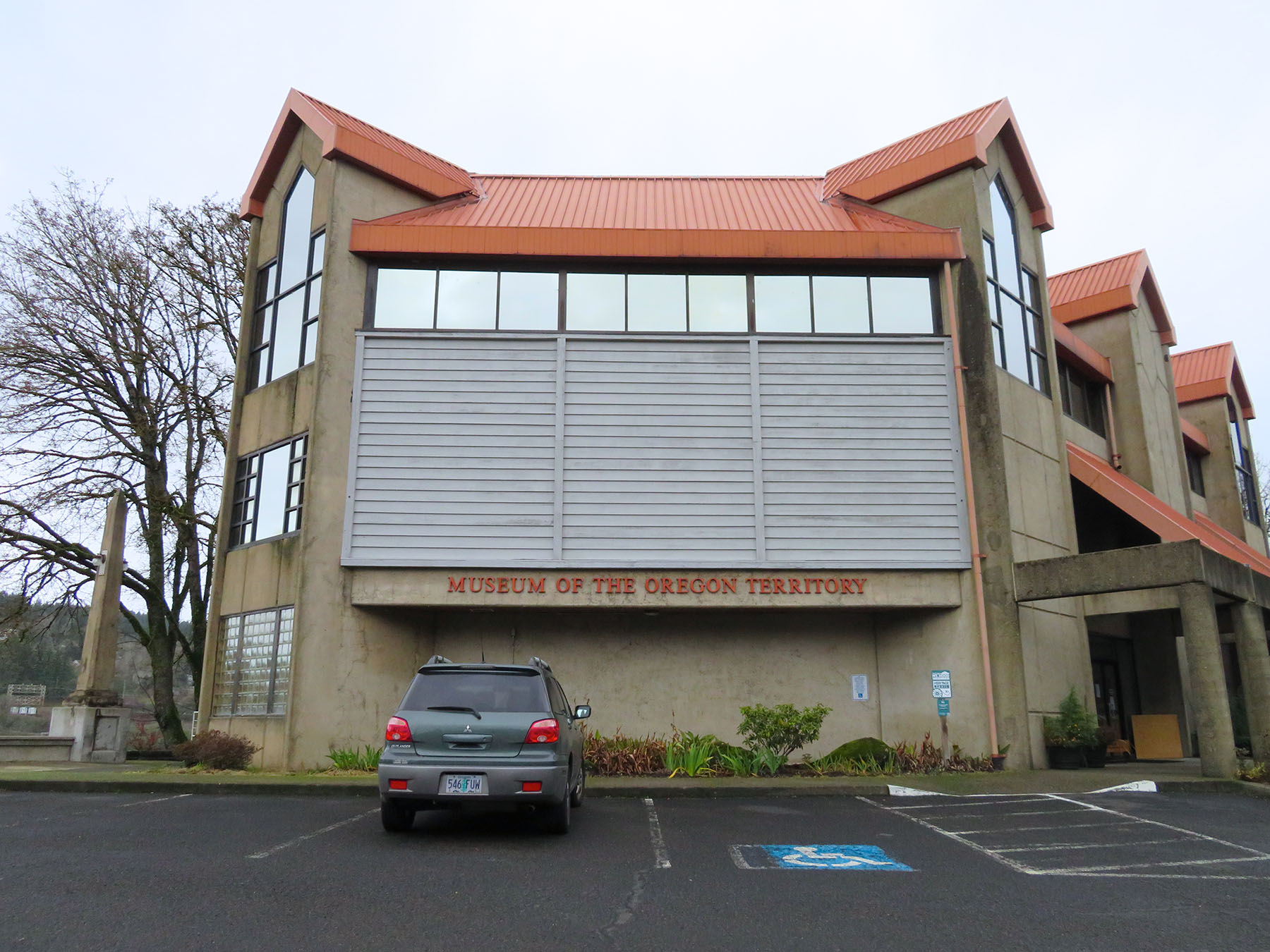
The word came to mind when visiting the Museum of the Oregon Territories (MOOT) in Oregon City last Saturday, to meet with executive director Jenna Barganski and Tammy Jo Wilson, president and co-founder together with Owen Premore, director, of Art in Oregon.
Jenna Barganski, executive director of MOOT and Tammy Jo Wilson, president of Art in Oregon
Art organizations, particular those only arriving recently on the scene, are struggling. Small museums are fighting for survival. Historical societies are not exactly showered with financial support. The need to improvise is paramount and dependent on the creativity of approaches, skill in networking and envisioning of possible resources – all clearly evident in the two young women who are embarking on a shared fundraiser for their organizations, an art auction and exhibition, Art Makes History.
This coming Friday, January 17th, there will be a preview party of art work donated by numerous and diverse local artists, exhibited in the Tumwater Ballroom, the museum’s event space overlooking the Willamette Falls, displayed and lit on a hanging system also provided by a generous donor. Art Makes History will then be open for silent auction bidding (online here) and the winners will be revealed at the closing event, an auction dinner party on February 29th (reservations here.)
*
The Museum of the Oregon Territories is one of those cultural institutions that run under the radar, even though it can be reached in less than half an hour’s drive from Portland. Part of the Clackamas County Historical Society, established in 1952, its collection has steadily grown, and is now housing some 30.000 artifacts, including more than 10.000 digitized photographs, a treasure cove. Its mission includes but is not just restricted to preserving and interpreting the County’s history, including the native peoples’ communities, life in the territories with the advent of the pioneers, or industry’s role in the development of the dam and power generation, a family history archive.
Jenna Barganski
With the leadership of executive director Jenna Barganski, who received her B.A. in Art History from Northern Arizona University and M.A. in History/Public History from Portland State University (and also curates he occasional art exhibit) MOOT will open its newest exhibit: Lines on the Land: Mapping Clackamas County at the end of January. Also on offer is a monthly lecture series, the Murdock Talks, that range from local historical topics to cowboy poetry to a history of Oregon’s women murderers, to cite just a few. A new book club aimed at people interested in history meets monthly at the other cultural site of the CCHS, the Stevens-Crawford Heritage House. And now there will be art on view, reflecting a broad cross- section of artists in the community.
It will have to compete with the extraordinary view from the museum’s windows…..
View of Willamette Falls
*
Just as historical societies are rooted in community, Art in Oregon (AiO) is focused on building bridges between artists and communities. The non-profit wants to link artists, businesses, educational spaces and community spaces to promote art patronage and, importantly, access to art for people who do not necessarily visit museums and established art galleries on a regular basis.
Tammy Jo Wilson
I met Tammy Jo Wilson this summer as one of the participating artists in the Exquisite Gorge project (I wrote about her here) and was impressed by her vision. A gifted artist herself, I think she and her co-founder, sculptor Owen Premore, have put their fingers on the pulse of the current art scene and found it to be, shall we say, erratic. It beats too rapidly when in the presence of the big and shiny, the arrived or the cool, however you want to put it, parts of the established elite. It slows down to a faint murmur, when it comes to local artistic expression, which marches to different standards, perhaps in skill, perhaps in focus of expression, but still pumps the necessary blood to the heart that is community.
AiO wants to change that and offers an on-line database of Oregon artists with their Art Shine Project. Artists can apply on-line to be added to the roster; they can also respond to calls for curated exhibitions. Public venues can easily peruse the offerings and pick what’s appropriate for their needs.
“The Art Shine Project is a grassroots venture which builds relationships between Clackamas County artists and local establishments (i.e. businesses libraries, schools, museums, etc.) and facilitate placement of artwork by regional artists in highly visible, public spaces through a micro-grant program. This project increases investment in local artists and expansion of cultural assets throughout the county.”
Jugaad. Instead of brick and mortar galleries, of art dealers and agents of exclusivity, you have an effective solution based on local talent and local interest matched at an electronic site that makes art (and artists) visible, with little cost involved.
*
The artists who donated work for the Art Makes History auction and exhibition are a representative sample of what you can find in the data base, from emerging artists to those who’ve already made their mark in the art world.
There are some lovely pieces hanging on the walls of the museum, some traditional, some funky, some abstract, multi-media creations, photographs, collages. Bidding prices start at comparatively low levels, given the sums some of these pieces fetch at galleries around town.
There was fabric art by Amanda Triplett, a piece that should be snatched up in a second, reminding me of Oregon Coast tide pools with their otherworldly creatures, all from recycled materials to not add more burdens to the environment. A watercolor by Bethany Hayes caught my eye for its unsentimental elegance, and a mix of pastel, graphite, charcoal, acrylic paint, colored pencil, silkscreen and conte’ crayon on paper in three works by Kathryn Cellerini Moore was exquisite. And I, full disclosure, splurged on a whimsical oil-on-panel piece with the buy now option which allows you instant gratification. Hey, there have to be perks if you trudge out on a weekend morning to gather materials for a review. Early bird and so on…
Here is the full list of artists on display: Ronald Bunch, Douglas Burns, Kathryn Cellerini Moore, Tamara English, Dotty Hawthorne, Bethany Hays, Sue Jensen, Kendra Larson, Katherine McDowell, Veronica Reeves, Amanda Triplett, Elo Wobig, Natalie Wood, Beth Yazhari – you see what I meant by variety!
Many of us bemoan the reduction in arts funding, the decreasing role art is afforded in educational settings with tight resources, the lack of inexpensive real estate that would provide gallery space for emerging artists. Here is an opportunity to act on those concerns and support one old and one new organization that try to remedy these failings. Make it a night (or two) out in Oregon City, check out the art, or bid from the comfort of your computer desk chair, just get engaged with your art community – otherwise it might soon be history.
ART MAKES HISTORY
Art Exhibition & Silent Auction
January 17, 2020 6:30 – 8:30 pm Preview Party
February 29, 2020 6:00 – 10:00 pm Dinner Auction
Museum of the Oregon Territory
Tumwater Ballroom – 211 Tumwater Drive, Oregon City, Oregon
“The only dream worth having is to dream that you will live while you are alive, and die only when you are dead. To love, to be loved. To never forget your own insignificance. To never get used to the unspeakable violence and vulgar disparity of the life around you. To seek joy in the saddest places. To pursue beauty to its lair. To never simplify what is complicated or complicate what is simple. To respect strength, never power. Above all to watch. To try and understand. To never look away. And never, never to forget.” ― Arundhati RoyThe Cost of Living (1999)
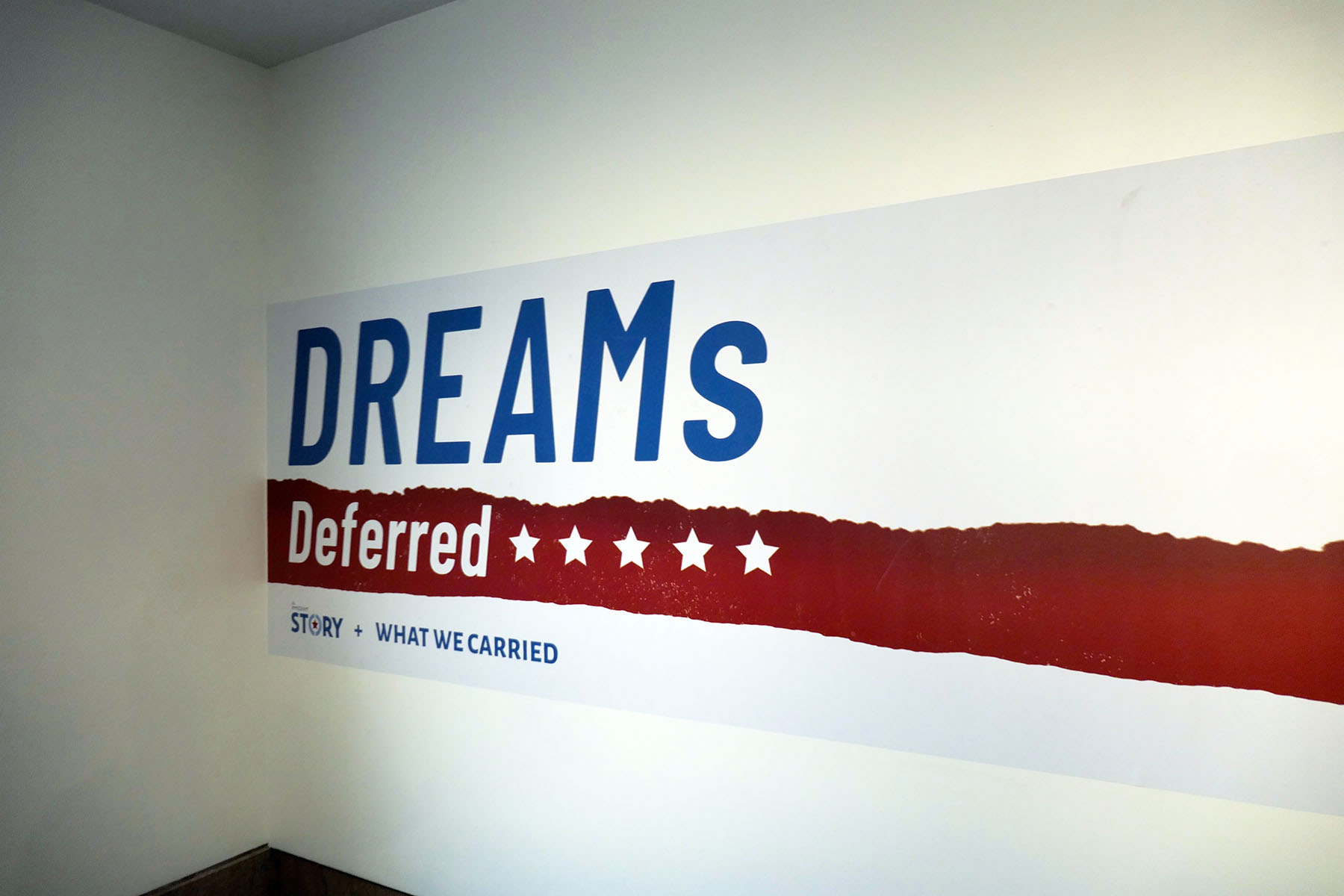
If it weren’t for that pesky number at the end of the quote, dating it some 20 years back, you might as well imagine that Arundathi Roy crafted that paragraph with an eye on the exhibition currently on display at the Oregon Historical Society, DREAMs Deferred.
Roy frequently writes about the fate of minorities, refugees or displaced people on the Indian subcontinent. The focus of the DREAMs Deferred exhibit is somewhat closer to home, asking what happens to those who came to our country from Mexico or Latin America as young children of undocumented parents. The collaborative work on display shows a combination of six portraits and short-form narrative accounts of young undocumented immigrants, joined by photographic documentation of some treasured objects that were chosen by them be taken on the hazardous journey. The thrust is indeed: Watch! Try and understand! Never look away! These are your neighbors. These are people who just like the rest of us seek love, overcome obstacles and indescribable challenges, pursue a simple life and do not confuse the things that matter with those that should be ignored.
Portraits of DREAMERS combined with narrative and object description
The dream, the aspiration, is to live while you’re alive – something not guaranteed in the places that were left behind, with often existential threat forcing parents to bring their children to an unknown country that then was not known for its hospitality if you were non-white and poor, and is even less so today. DREAMERS, as these young people are known, existed in a legal limbo until the Obama administration in 2012 announced the DACA (Deferred Action for Childhood Arrivals) policy, which brought a pause to potential deportation if you qualified. You had to be younger than 16 upon arrival to the US, lived here (endless documentation needed) for at least five years, be between 15 and 30 year old and either in school, or graduated, or a veteran of the Army or the Coast Guard, and have no convictions for felonies, significant misdemeanors (DUI included) or multiple misdemeanors. (Here is a small window into the insane bureaucracy involved for (re)application.)
Yessica Perrez Barrios, portrait by Sankar Raman
Approximately 700.000 people were protected by DACA until the Trump administration decided to rescind the policy in 2017. Their fate rests now with the US Supreme Court, with cases to be decided this June. Add to that the fate of 250.000 offspring of those Dreamers, who are US citizen because they were born here, but would be separated from their parents if deportation ensued. The Supreme Court cases also reach potentially beyond those young people now involved and living in limbo – there is the distinct possibility that any future President will be denied the right to implement progressive immigration reform through executive action. (Legal details can be found here.)
Opening of the exhibit. Sankar Raman, left, with guests.
*
The small, beautifully curated exhibition provides an intimate window into the lives, thoughts and emotions of six very different undocumented people from Mexico and South American countries, made possible with support from the Zidell Family Foundation. The concept was developed by The Immigrant Story (TIS,) a local non-profit organization which is playing an important and increasingly visible role in capturing our attention about the plight of those in our community who do not have the legal protections the rest of us enjoy. “The right to have rights,” to use Hannah Arendt’s phrase from “The Origins of Totalitarianism (1951), is, after all, restricted to citizens, and according to the United Nations, there are a record 65.6 million people who have been forcibly displaced; 22.5 million are considered refugees; ten million people currently stateless, all deprived of basic rights you and I take for granted.
Folks at TIS, guided, pushed, prodded and supported, if my intuition is correct, by founder and Board president Sankar Raman, understand the persuasive power of narrative relative to the value of statistics. If you aim for empathy and inclusion, as their mission statement implicates, storytelling is essential. Trained as a physicist, Raman holds a Ph.D. in Engineering and retired from the High Tech industry some years back, with an arsenal of skills when it comes to the technical challenges of organizing multi-pronged, group-based work. He arrived in the US from India in the beginning of the 1980s, just as I arrived from Germany. Given our similarity in age and comparable levels of education, I could not but wonder, while in conversation with this passionate man, how the difference in the color of our skin affected the process of immigration and integration.
Sankar Raman, President of the Board at THE IMMIGRANT STORY, photographer.
*
By the time you leave the exhibition you have become if not familiar, then somewhat connected to those who shared their thoughts, joys and fears. Partly that has to do with the quality of the portraits, photographed by Raman. Larger-than-life faces all with eyes directed straight at the viewer express a range of emotions across subjects. Whistfulness alternates with exuberance, pensiveness with caution. There is a naturalness to them, even though they are obviously staged, that speaks to both the skill of the photographer and, more importantly, to the trust established between artist and subject. There is a poise that reveals these young people know that what they are doing is important. Telling their stories cannot be an easy thing even for the more gregarious among them. The use of a color palette focused on optimism rather than foreboding also draws you in. Strong work.
Ivan Hernandez, portrait by Sankar Raman
*
“Strong work” is probably the weakest of the descriptors used in evaluation of photographer Jim Lommasson’s output. He is something of a role model if not a hero to many local and national photographic artists both for the quality of his workmanship and the choice of subject matters. A demonstrably humble man, he likely grimaces at such a label, but that is how the community sees him. As does the jurying set who decides to award grants and prizes, including the Dorothea Lange-Paul Taylor Prize (2004) a coveted recognition from the Center for Documentary Studies at Duke University.
Jim Lommasson, photographer.
Lommasson does not shy away from difficult topics, or political discourse transmuted into emotionally charged images and text. The artist somehow manages to communicate the raw essence of his subjects, their suffering and their triumphant survival no matter where he directs his lens. From American boxing rings, to the postwar existence of wounded veterans of the Iraq and Afghanistan wars, to documentation of mementos of generations of Holocaust and genocide survivors in his most recent project: What we carried: Fragments from the Cradle of Civilization, the work invites us to think about our shared humanity. Us and hundreds of thousands of viewers nationally, given that his work has been displayed at numerous museums, including the Ellis Island Immigration Museum, which alone has half a million visitors come through on an annual basis.
Judge Torres’ passport. One of the objects carried to the US.
Invite is perhaps the wrong term. Lommasson forces us to engage with the images, objects – in the DREAMs Deferred display as well – that were selected by those who had to leave home, not just because of their poignancy, captured without any sentimentality in the photographs. We are forced to engage because of the platform given to the voices of those who carried these objects into the unknown: the images provide the surface on which the explanatory narratives unfurl, in the handwriting of the refugees.
What they carried and what it meant to them.
I forget where I picked this up, but the artist from the very start of his career as a photographer was motivated by a child’s question on viewing (bland) images: “So what?” Not for a moment does his documentary work afford this sentiment. No “So what?” possible in the presence of the anguish, grit and will towards survival in his depictions. Lommasson’s desire to show that at the core we are all one, in our vulnerability, in our hopes, in our rights to have rights, finds the perfect expression in his art. In this focus he reminds me of Anjum, the central character in Arundathi Roy’s newest novel The Ministry of Utmost Happiness, who lives in a deserted Muslim graveyard just outside New Delhi. She is able to make borders disappear between men and women, animals and humans, life and death. As the author herself (approximately) put it in her PEN America Arthur Miller Freedom to Write lecture last May – we turn to people like these when seeking shelter from the tyranny of hard borders in an increasingly hardening world.
Sankar Raman and Jim Lommasson, collaborating on this exhibit.
*
How would it feel, if you were ripped out of your teenage universe at age 15, mourning the loss of the all-important cohort, forced to study in a foreign language and live in a foreign country, constantly worried about your ability to put down some roots? What would it take to have great academic success while fearing you will be denied access to college? And now, less than a decade after your arrival, you own a flourishing practice as a family therapist, helping, among others, Spanish speaking clients to deal with the existential strain of displacement, or the hardship of living with uncertainty? Liliana Luna, who I met at the exhibit opening, can tell you all about it.
Liliana Luna, one of the people portrayed in this exhibition.
How would one cope if being sent back to a country that you last saw as a toddler? Having to leave a close-knit community of co-workers in case of deportation, evidenced by many of the OMSI staff who came to the exhibit opening to celebrate their colleague? Miguel Rodriguez is out of the woods in this regard, having been granted legal status.
Miguel Rodriguez, one of the participants, in front of Judge Torres’ portrait.
Given his work in the community through his non-profit engagement at Through a Latinx Lens, he would be able to tell you, however, countless stories of those out there living in constant fear of what the future holds. Dreams deferred, indeed.
It is upon all of us to make sure they do not shrivel, fester, or explode.
DREAMs Deferred: January 10 – April 12, 2020
Oregon Historical Society 1200 SW Park Ave Portland, Oregon 97205
There will also be a Live event at Lincoln Recital Hall, Portland State University 1620 SW Park Avenue, Portland OR 97201.
Saturday, April 11, 2020. 7 p.m. to 10 p.m.
DREAMs Deferred Live kicks off at 7 p.m. with a culturally specific musical performance from this region. Afterward, from 8:30 p.m. to 10:00 p.m., six different storytellers from Mexico and Central America will share unique stories about the arduous and frequently dangerous journeys that brought them across the border to the United States.