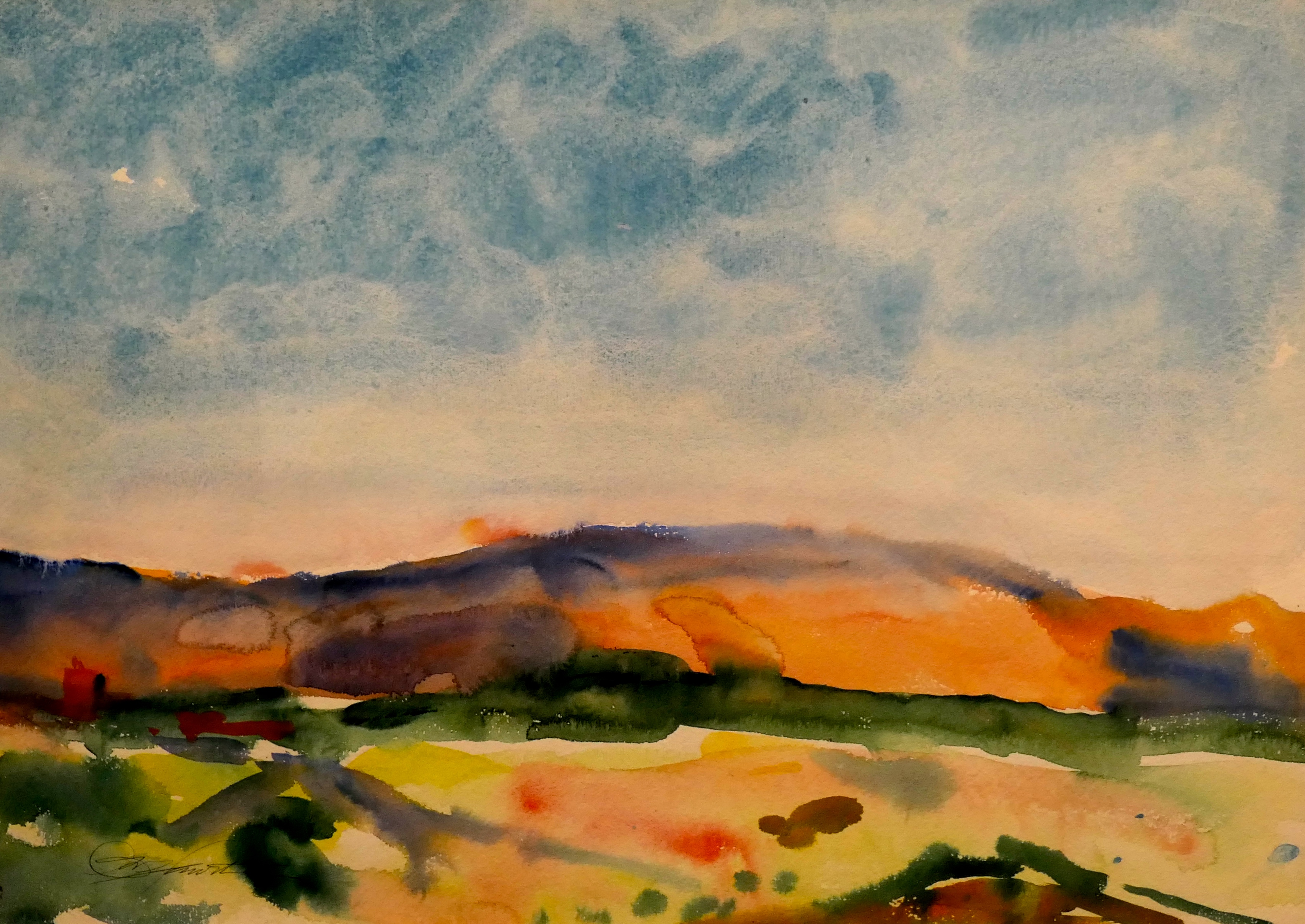
You have a number of options interpreting today’s photographs.
A) This is what my brain looks like when trying to write not one but two really long and involved reviews during a single week. And now darkness descends and all that’s left are the photographs.
B) This is what my cerebrum looks like (the part of the brain that handles some aspect of language) when desperately trying to find words that can be printed in a family friendly blog in reaction to the outcome of Great Britain’s election. Darkness descends there, too.
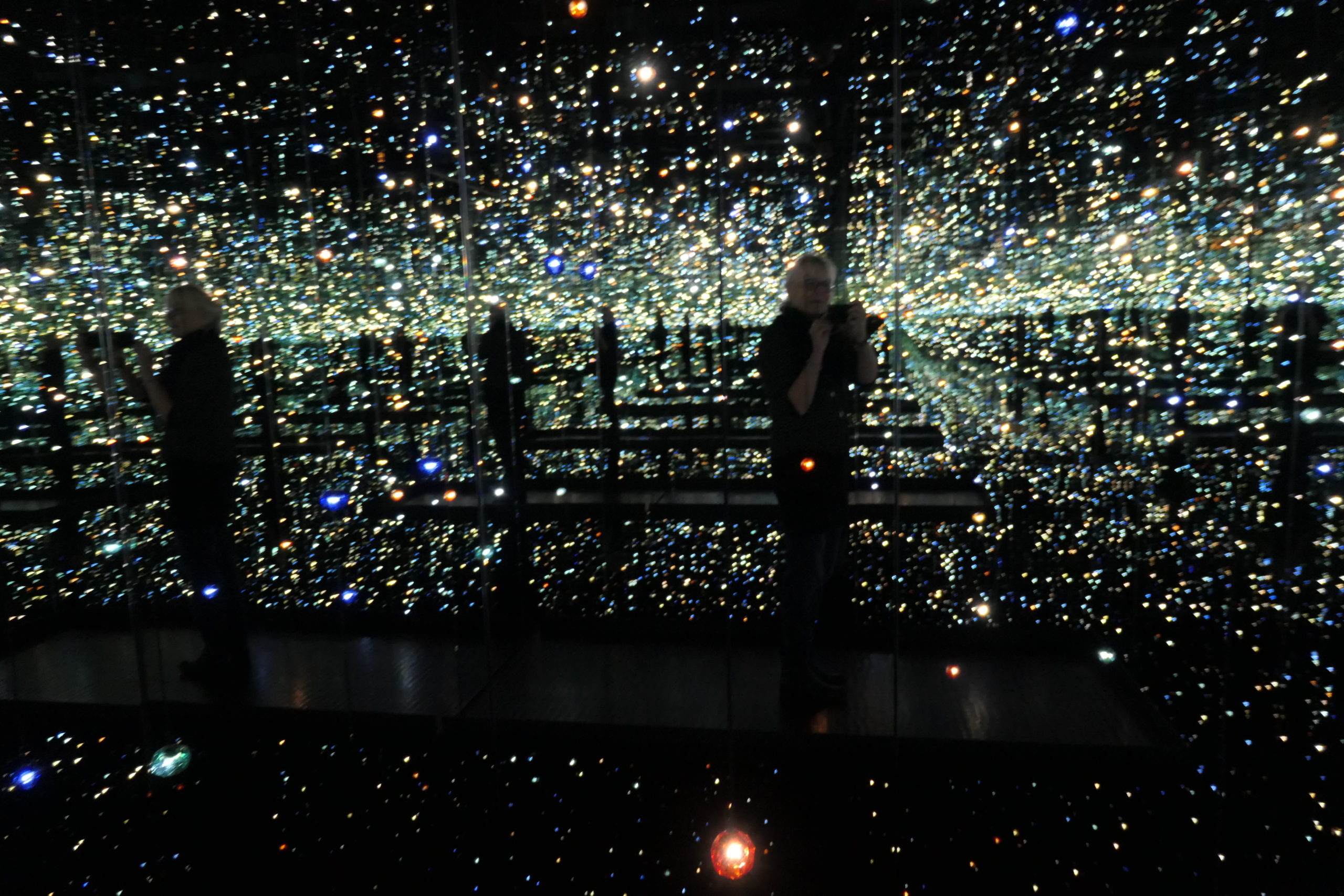
C) This is what an infinity mirror room looks like when created by a nonagenarian artist obsessed with polka dots, fully insisting that we all are same, connected souls in the world.
If you picked: Yayoi Kusama, you won. If you guessed Brexit, you sort of won. If you said braindead, you are my friend.
C, in other words, rules the objective world. A, B and C, however, are not mutually exclusive…..
The Souls of a Million Light Years Away is currently on exhibit at The Broad and each visitor braving the lines to get in is accorded exactly 45 seconds to explore the experience. Guard with stop watch on hand standing outside and calling you out.
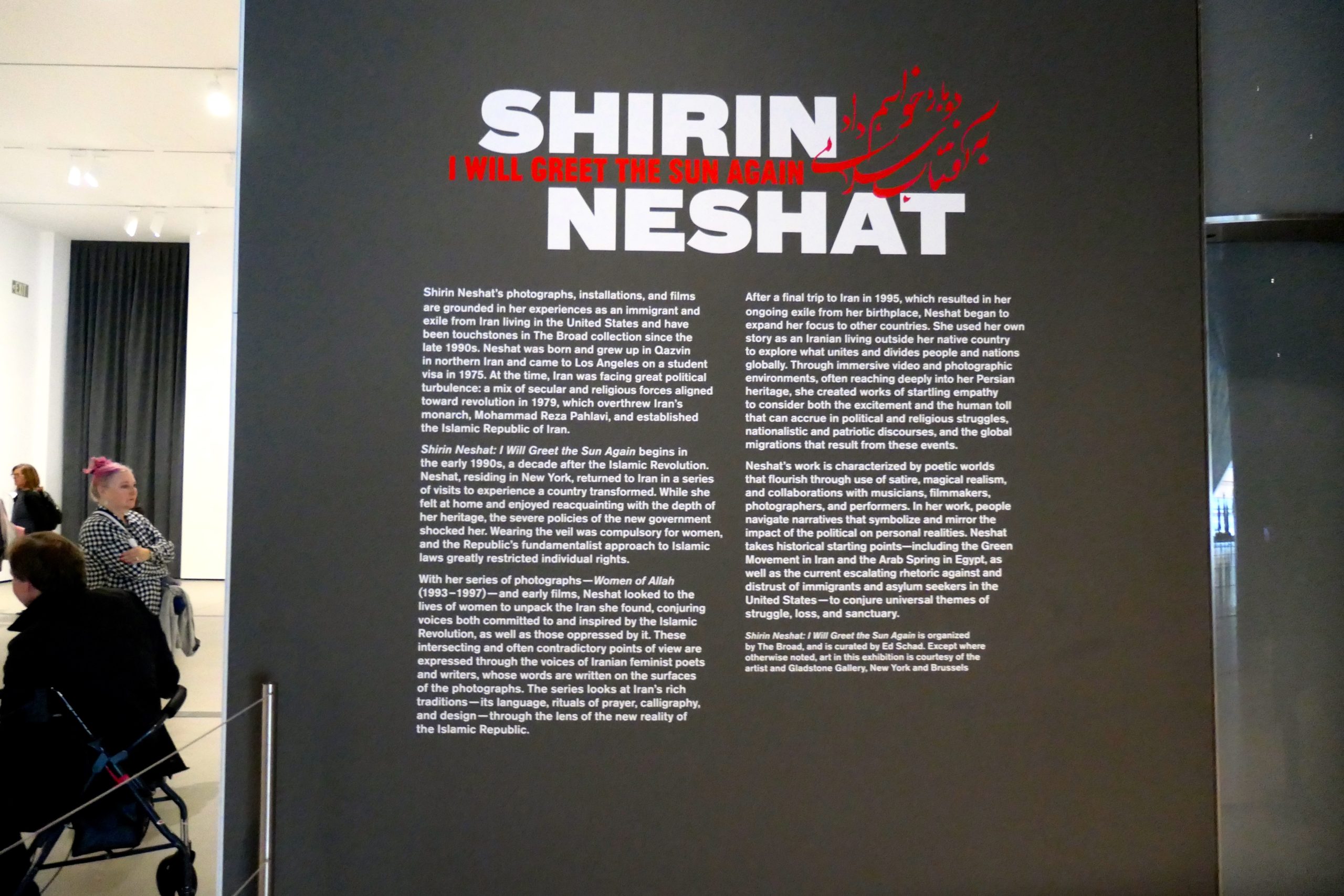
There could not have been a better introduction to Iranian-born, US artist Shirin Neshat than watching one of her videos, Rapture (1999) early on in the extensive retrospective of 30 years of her work, currently on exhibition at The Broad in L.A.
Whispers (1997) (Women of Allah)
Everything, but everything was binary in that experience. You sit between split screens, having to turn your head to the left to see one part of the video installation, to the right to see the other and never the twain shall meet. The left side depicts hundreds of women, the right the equivalent number of men. The females, cloaked in black hijab or chador watch, often passively, pray, are mostly silent except for an occasion of ondulation, disperse and eventually send a few of their own on a rickety boat into the depths of the Atlantic ocean (filmed in Morocco.) The men, in identical black pants and white shirts, run the length of a citadel, canons and all, climb to the roof, sing, feast, display some hierarchical order and are generally active, eventually waving en masse to the departing women from afar.
Think of it as Buñuel meets Herzog, and I mean that as a compliment. Sort of. It was visually dramatic, exquisitely staged and choreographed. The binary themes of female/male, activity/passivity, departure/arrival, even a dreamlike state vs reality that are central to all of her work, were right upfront. The video brought the issues of gender differences and religious intolerance to the fore with a sledge hammer, black and white for all to see, and yet leaving enough room for ambiguity that even the most fervent feminist could leave the screening room with an inkling of hope. Maybe.
There was that nagging thought – and one that repeatedly crept into my brain while taking in this comprehensive exhibition – as to whether we have made any progress away from the orientalist lens applied throughout history to members of non-western cultures, those exotic figures from a different world. The forced head movements between screens had me wonder about disconnection, the separation of them vs us, but also about how our gaze is steered, often away from taking in the whole picture; the staged costuming and movement of the people evoked a sense of directorial control that was reminiscent of its colonialist counterpart, chador replacing the nude bodies of those Seraglio paintings of yore as a mirror image of exotic otherness.
Don’t get me wrong: I think Neshat is superb in the way she creates visual scenarios, employs melodrama to make a point, ingeniously cashing in on our fascinations. She is powerful in her story telling and quite sensitive to contemporary concerns with exile, gendered existence, the interplay between political power and religious fervor. And she has whatever it takes to become a successful female artist in a male dominated world, never mind her exceedingly dainty, feminine appearance, dangling designer jewelry, heavy make-up and all. More power to her!
*
She also has a story that is carefully tailored to underpin her art. Raised in Iran in a middle-class family in the 1950s, sent to catholic boarding school in Tehran to get a westernized education, she came to the US at age 17 in 1975 to go to college and later grad school to get her MfA. Discontent with her attempts at making her own art, she moved to New York city and worked at the side of her partner for over 10 years, tending to a cultural meeting point The Storefront for Art and Architecture. Those years were not exactly exile – that only began with the political changes in Iran prohibiting her return, and she has certainly refrained from visiting there for the last decades, now openly declaring that she never wants to go home, even if it were politically possible, and intends to leave nostalgia for the place behind.
Women of Allah series 1993-1997
Her first large project in the 1990s after a visit back home after years that included the revolution, the hostage crisis, and the Iraq war, propelled her like a rocket into the successful realms of the art world. The photographic series Women of Allah depictedveiled women with guns in various positioning, often looking directly at you in regal and defiant ways, overlaid in carefully applied calligraphy citing Farsi poetry, often by women poets. No longer object of stares but agents of their own gaze, these women, photographed between 1993 and 1997, projected strength, particularly in the juxtaposition of tenderness, when coupled with children, with rawness, when harnessing the weaponry, another one of those binary plots.
Bonding 1995 (Women of Allah)My Beloved (1995) (Women of Allah)
The writing across the bodies of the subjects felt like a membrane to me, a distancing device in the sense that the language cannot be deciphered by this Western viewer, but also as a protective barrier against too much exposure of the body parts it covered. If we could read Farsi, we would learn that two very contrasting poets are projected onto the different subjects:
“Farrokhzad’s imagery from the pre-revolutionary Iran, controversially sexual, Western, a modern rebel thirsty for life—and Taherzadeh, the new regime’s idol, utterly alien to the artist, Muslim, traditional, Eastern, revolutionary, daydreaming about martyrdom. In Untitled (1996), the woman is the object of desire, her face covered with Farrokhzad’s text. In Speechless (1996) and others employing Taherzadeh’s text, the woman willingly becomes the revolutionary sacrifice: motherly, subjugated, utterly secondary.”
Untitled (1996) (Women of Allah)Speechless (1996) (Women of Allah)
While I looked at these determined faces I wondered about how the historical development in the 30 years since these photos were taken would change our reaction: if I knew these women were involved with ISIS, would I see a triumph in their courage to join the fight? If I was a Kurdish female fighter, now raped and killed for participation in a singular social experiment of gender equality, would my Iranian sisters, fighting for the right to veiled themselves again, feel like enemies or allies? Does a change in contemporary context alter the poignancy of contemporary art?
Does a change in politics alter the way we describe a country? I was reminded of one of my favorite travel books of all times, Terence O’Donnell’s Garden of the Brave in War, that describes life in pre-revolutionary Iran in the countryside, introducing world views quite different from our Western perspective and yet assuring a sense of shared humanity. How would he have depicted the contemporary state of affairs?
(Women of Allah)
*
Neshat has won countless awards for her work, among them the First International Prize at the Venice Biennale (1999), the Grand Prix at the Kwangju Biennale (2000), the Visual Art Award from the Edinburgh International Film Festival (2000), the Infinity Award from the International Center of Photography in New York (2002), the ZeroOne Award from the Universität der Künste Berlin (2003), the Hiroshima Freedom Prize from the Hiroshima City Museum of Art (2005), and the Lillian Gish Prize in New York (2006). Her contributions to important collections can be found here.
The early photographic explorations were soon joined by videos and feature films, media that I find frankly much more interesting and a better match for her strength of creating visual drama, and also requiring deeper thinking than her portrait work. The exquisitely mounted exhibition at The Broad meanders from room to room, large spaces that provide breathing room for the XL portraiture. There is something about the size (and the repetitious use of calligraphy obscuring faces across 30 years of work) that eventually strikes as dangerously close to gimmicky.
Corridors at The Broad
The strong emotional impact of the first series, in other words, was not matched for me in later work, now staging subjects from other countries, often by major commissions, in Egypt and Azerbaijan. People propped up in studio arrangements with photographers present (Larry Barns being a frequent and outstanding collaborator), lighting assistants bustling, and Neshat directing pose, are asked how they feel about poverty or what home means to them (the little things like mother’s food, it turns out to little surprise.) Capturing their tears in front of the recording group feels invasive to me, if not exploitative, and the size of the portraits prevents any sense of intimacy with the subjects.
Our House is on Fire (2013)The Book of Kings (2012)The Home of my Eyes (2015)
Much more impressive is work that contrasts the smallness of humans, almost always women, with the largeness of landscapes or architectural molochs. The stills anticipate what the video installations confer: a striking sense of visual exploration of psychological states.
Soliloquy Series (1999)Soliloquy Series (1999)
The Broad excels in placing the small auditoriums where the videos are shown in-between the spaces for photographic work – it is almost like breathing room provided, except that your breath is sucked in and held from the tension elicited by these films. It is as director that Neshat succeeds most, on both the emotional and intellectual level. (Unclear, why that did no transfer to her first major directing role in an operatic setting – she was called to direct Aida at the Salzburger Festspiele in 2017, an opera with a love triangle and political and religious oppression, right up her alley, one would think. The showcase production with Muti conducting and Netrebko in the main role was lauded, but Neshat’s directing ruthlessly panned by the critics.)
*
Neshat does not consider herself a political activist. Politics affect her, though, and she talks freely about being exposed to racial profiling immediately after 9/11 and then again since the 2016 election that confronted her with more explicit racism in her own private experience. Her recent work (Roja and Land of Dreams) turns to explorations of living as an exile in the US, providing astute social commentary on trauma and war as experienced by all sides, but also linking to her feeling that she is not welcome in either culture or place.
When asked if she considers herself a feminist she answers indirectly: “If someone asks me that and they often do, I give the question back to the audience. Do they think I am? Yes they do, so I take that, it’s ok with me.” Her recurrent emphasis on the dichotomy of women being extremely fragile and vulnerable vs extremely strong and defiant might need a closer look in the context of feminist theory. The implications of gendered realities in her work, however, are fascinating and if you have a chance to see this exhibition, make sure you do!
Shirin Neshat: I Will Greet the Sun Again
Oct 19 – Feb 16, 2020 The Broad, Los Angeles, CA
I Will Greet the Sun Again
I will greet the sun again and the little river that once ran in me and the clouds that were my ruminations and the aching blooms of poplar trees, my companions in those seasons of drought.
I will greet the crowd of crows again, who brought me their rich perfumes, gifts from gardens of the night, and my mother who lived in the mirror and whose shape was the shape of my own old age.
I will greet the earth again, who in her lust to create me again, fills her fiery belly with seeds of green.
I am coming, I am coming, I will come again, with my long hair dripping the scent of dirt, with my eyes inflicting the density of darkness, with brambles I’ve picked from the far side of the wall.
I am coming, I am coming, I will come again, and the doorway once more will be filled with love and I’ll greet the lovers standing in the doorway, and the little girl there still standing in love.
Husband: “You really are drawn to dark art, aren’t you? Who is she?” Me: “What do you mean? We have a print of her’s hanging on your side of the bed.” Husband: “Print? What print? ”
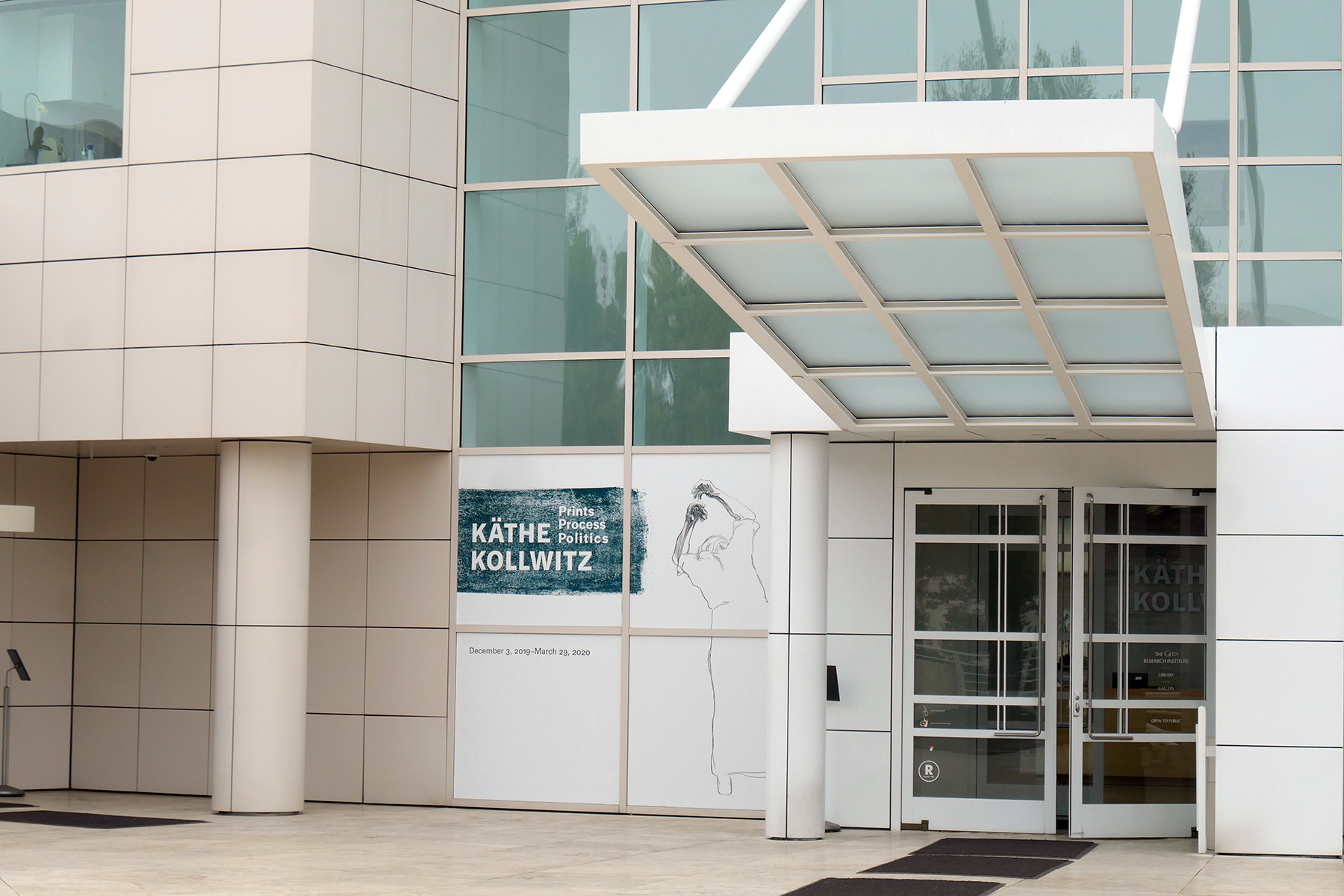
Thus I offer you a slice of typical conversation overheard in our household, while dragging my beloved to a striking exhibition of works by Käthe Kollwitz (1867–1945,) one of the icons of German modern art, currently shown at The Getty in L.A.
Entry to the Exhibition with an enlarged excerpt from Charge (between 1902 and 1903)
While he was muttering about the absence of visual memory, my brain was frantically searching for a translation of an untranslatable German term that is often – and mistakenly, oh so mistakenly – cited in connection with Kollwitz’ art: Betroffenheitskitsch. Betroffenheit can be translated as shock, dismay, consternation, sadness. But in this context it is probably meant to describe too much empathy verging into Kitschiness.
Self-Portrait in Profile toward the Right ca. 1938 Chalk transfer lithograph, printed in black ink on buff paper State III of III; printed in 1946
It was the kind of condemnation you heard from a younger generation of German artists, Martin Kippenberger among them, after over-exposure to the works of this celebrated artist who was claimed, for one, by the left (communists, socialists, feminists, you name it) for her anti-war stance and her artistic exploration of themes of social justice. Yury and Sonya Winterberg, authors of a Kollwitz biography (2015), speculate that Kollwitz’ emotional response to proletarian misery and the consequences of war was incompatible with the ironic if not sarcastic self-image that many more recent German artists have come to identify with.
The biography shines new light on her life and work. New to me, anyhow. Painstaking archival work and interviews with three of her surviving grandchildren reveal a complex story. On the one hand, she was preoccupied with death, growing up in a household that saw three of her siblings perish young. On the other hand, she possessed an extraordinary life force, was sensual, and openly acknowledged her bisexuality. The love for her children, it is hinted in the narrative, was overbearing bordering on abuse when it came to interacting with her sons in sexualized situations. Her self-assurenedness made her a center of her social circles, and many a famous artist, including Ernst Barlach and Berthold Brecht adored her. Her membership in diverse women’ organizations can be counted as early feminist engagement.
Woman with Dead Child 1903 Etching, drypoint, sandpaper, and soft ground with the imprint of laid paper and Ziegler’s transfer paper, printed in black ink on copperplate paper A warning: I tried my best to match my photographs with the given iteration of a print during the evolution to the final version – I might have messed up on occasion. All the more reason to go and see the exhibit for yourself: There the annotation is flawless!
Germany has not one but three museums dedicated to her, the Käthe Kollwitz Museum in Cologne which has a marvelous collection of her works, the Käthe Kollwitz Museum in Berlin where she lived for much of her life, and the Käthe Kollwitz Haus in Moritzburg, where she rented two small rooms at the estate of friends after having been bombed out in Berlin in 1944 and where she died a year later.
Kollwitz was also hailed by the right as a safe bet of someone who had been unfazed by Nazi condemnation and offered sufficient pathos in her sculptures to serve as memorials for those killed in war and by Nazi persecution, needed when Berlin emerged as the German capital again. (None other than Chancellor Helmut Kohl ordered her work for the Central Memorial of the Federal Republic of Germany to the Victims of War and Dictatorship a few years after the wall came down.)
*
So who was this woman? Someone who blazed a path into the Berlin academy at a time when males almost exclusively dominated, who won prizes, who was a sufficient threat to the Nazis to be banned from showing her work – and who simply observed everyday life, refining her skills in perpetuity to depict human suffering of the working class, the poor, and those sent to die for national ideals and imperialistic strivings. She lost a son in WW I, a grandson in WWII; she saw close friends murdered by paramilitary forces after the short-lived November revolution and the Spartacist uprising in January of 1919.
She observed, she depicted. She bore witness.
Various iterations of Woman with dead child 1903
She also made it very clear that she resented being co-opted by any kind of political movement, across decades of diligent diary entries stating that she was not a political artist. She wanted to address political and social issues with her art, but from a humanist perspective, one that did not shy away from the sadness, the futility and misery that surrounded her.
Vienna Is Dying! Save Its Children! January 1920 Crayon transfer lithograph, printed in black ink on light-brown machine-made paper State I of II
Käthe Kollwitz: Prints, Process, Politics is allowing us a hard look at what she really accomplished. The exhibition features etchings, lithographs and woodcuts, from every phase of the artist’s career, alongside related preparatory drawings, proofs, and rejected versions of prints. It is a terrific learning experience, beautifully curated to showcase the evolution of some of her print cycles. Early etchings are delicate, later woodcuts become darker, more streamlined, expressionistic, although she never joined the expressionist movement per se. The viewer is expertly guided through multiple iterations of one image with explanatory pointers to what was changed and why by the artist.
The Ploughmen ca. 1906 Preparatory drawing for The Ploughmen Charcoal, graphite, and white chalk on blue-gray laid paper
This includes one of her most famous print cycles, Peasants’ War, producedacross 6 years until completed in 1908. Its seven prints are eerily prescient of the tragedy about to unfold in 1914, repeating the human suffering that happened during the Bauernkrieg in 1524, a year-long revolt by poor farmers, ruthlessly crushed by the aristocracy, with over 100 000 farmers slaughtered. It was the largest and most devastating, futile uprising before the French Revolution.
Ploughmen and Woman Before June 1902 Rejected second version of sheet 1 of Peasants’ War Crayon and brush lithograph with spatter and scraping on the drawing stone, printed in dark-brown ink, with a tone stone in orange-brown ink, on light-brown paper State I of IICharge Between 1902 and 1903 Sheet 5 of Peasants’ War I unfortunately did not record which version of the many on offer.
*
From the catalogue: According to exhibition co-curator Louis Marchesano, “Kollwitz is known for her powerful social commentary but what people often don’t fully appreciate is that the immediacy and expressive clarity of her images belie the efforts behind the works, which are products of a deliberate and measured artistic process.”
Exposure to process aside, one of the most moving contents for me was the depiction of mourners around the murdered friend and revolutionary Karl Liebknecht lying in state. As these things sometimes happen serendipitously, the very next day I came across a tattered copy of Alfred Döblin’s novel Karl and Rosa: November 1918, A German Revolution, a book I had read some 40 years ago. The novel by the same author as of Berlin Alexanderplatz describes the fragmentary revolution and the bloody terror that Kollwitz observed as well, so shortly after the horrors of the great war had ended. Here is a terrific review of the book that goes beyond Liebknecht’s and Luxemburg’s fate to sketch a crucial part of German history.
In Memoriam Karl Liebknecht Before October 1919 Rejected first version Etching, aquatint, sandpaper, lift ground, and soft ground with the imprint of laid paper, printed in black ink on copperplate paper State II of VII
The novel was for sale as a fundraiser at the Southern California Library in LA. The library’s archive has an extensive collection of pamphlets and political ephemera from social justice causes. Among its substantial holdings are hallmarks of local activism, such as primary documents of the Black Panther Party and the Los Angeles Protection of the Foreign Born, which were saved by local residents during the 1992 Los Angeles Riots. I happened to come by when local organizers wrote postcards for prisoners for the holidays.
The community garden attached to the library is open and welcoming to the many homeless along Vermont Ave. The murals outside depict the history of women in the labor movement, among others.
Kollwitz would have felt right at home.
She was strong, demanding, ahead of her times and probably hard to live with. Her art work is extraordinary (over 100 self-portraits alone) and what is shown (and how it is shown) at The Getty provides much insight into her artistic prowess and her humanistic passions.
Käthe Kollwitz: Prints, Process, Politics – December 3, 2019–March 29, 2020, GETTY CENTER, Los Angeles, CA
Music today is a song about the movement to honor Liebknecht and Luxemburg.
For my German readers there is a fascinating find – a former GDR children’s magazine had a record attached with an educational audio play on the imperialism, communist honor and Liebknecht’s revolt.
“It is curious that physical courage should be so common in the world and moral courage so rare.” Mark Twain – (Mark Twain in Eruption: Hitherto Unpublished Pages About Men and Events. Edited with an introduction by Bernard DeVoto. 1940)
IF YOU ARE CURIOUS about the world, have the privilege of meeting a lot of different artists, and risk tackling things that are not exactly central to your own expertise, you’ll expand your horizon. When I set out to portray people with my camera and my writing, the encounters are as varied as the artists who I meet. Some evolve into friendships, others are puzzling, some demand hard thinking, many provide nothing but pleasure. The last year alone introduced me to classically trained musicians turned Ukrainian girl-band, puppeteers from Chile, wheelchair-bound choreographers, Mexican political theatre activists, female conductors of sacred music, and numerous printmakers from around the nation. All offered glimpses into worlds different from my own, and in one way or another challenged the way how I view art or the process of creating art.
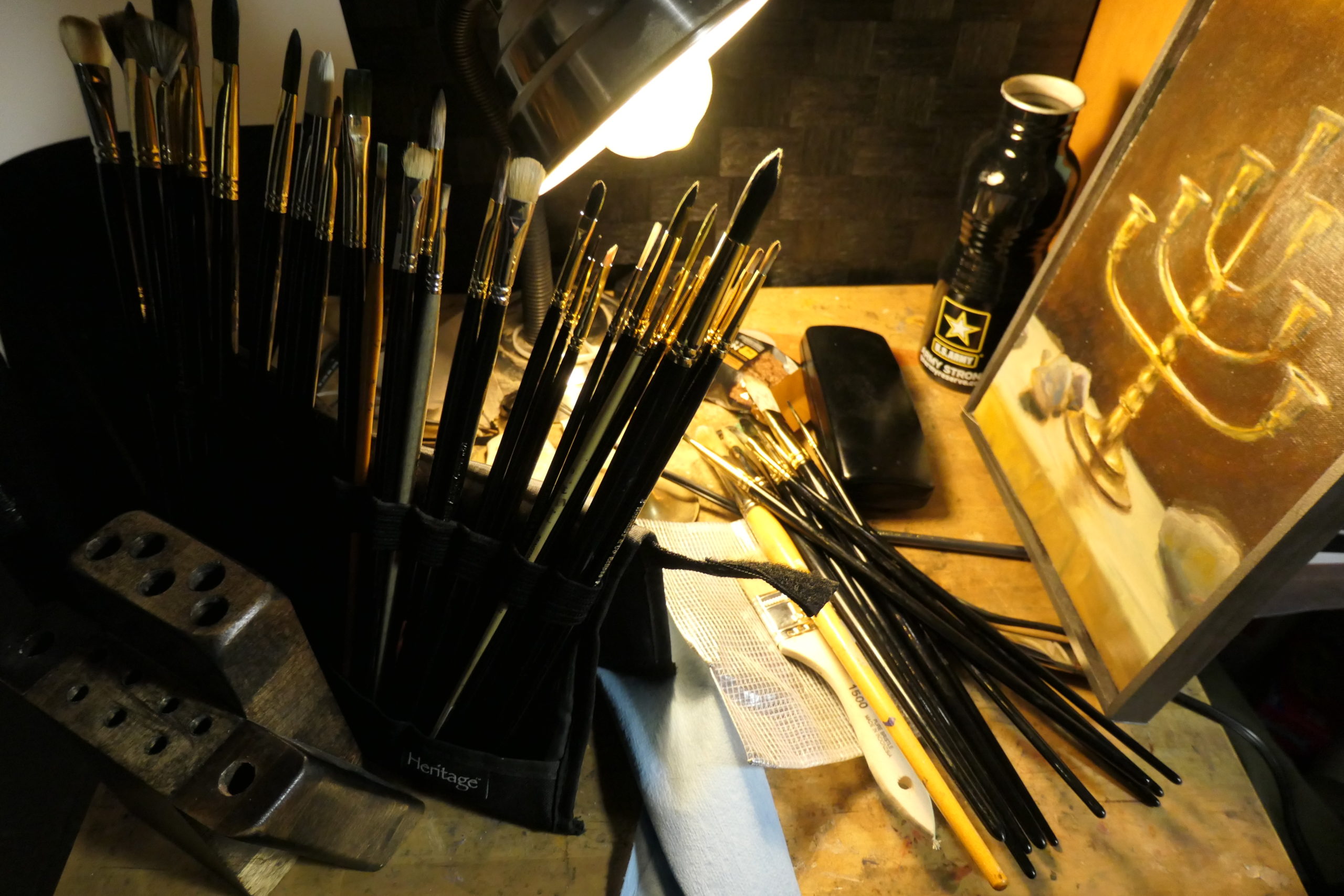
This has never been more true than for my most recent conversation with a man who has lived in worlds so distant from mine that they might as well exist in a different universe. I met him by chance in a museum cafe. He had come to Maryhill Museum to pick up paintings that had been on display in a group exhibition of, among others, student work of the Seattle-based Gage Academy of Art, his included. I was there because of my interest in the Exquisite Gorge Project that was in progress across the summer months. We started to talk and agreed to a studio visit, something I finally managed to set up last week.
Charles Burt, artist
*
PLATOON SERGEANT FIRST CLASS Charles Burt joined the army when he was 18 years old. He spent more than half of his life there, with a distinguished career in the tank division, multiple deployments to war zones and eventually operating as a drill sergeant and recruiter. The duties of an SFC typically include managing soldiers and tanks in a combat arms role, with responsibilities such as tactical logistics, tactical casualty evacuations, and serving as the senior tactical adviser to the platoon leader.
Born in Michigan, he moved to Texas at age nine, shunned in his middle school years as a “Yankee” in an environment where the Civil War had seemingly never ended. His love of drawing and art in general sustained him throughout his childhood. His mother, struggling after a hostile divorce, found a spiritual home in a fundamentally Christian, evangelical church which became to dominate Burt’s belief system during his formative years.
Charles Burt RespectPreparation of the correct blue for the American Flag
One of the hallmarks of his religious eduction was the demand for literal interpretation of the bible. If the world was created from scratch but some 10.000 years ago, then any science telling us otherwise was a work of the devil, meant to distract us. Dinosaurs did not exist. The concept of evolution was a satanic mirage. Heaven and hell were real places, and anyone not born into or converted to Christianity condemned to fry in the latter for all eternity.
Fast forward to Operation Desert Storm in reaction to Saddam Hussein’s invasion of Kuwait threatening US oil demands in 1991, with Burt deployed, now in his early twenties. The GulfWar casualties were enormous. Assumed numbers vary, with Les Aspin, then chairman of the House Armed Services Committee, estimating at the time that “at least 65,000 Iraqi soldiers were killed,” and later sources reporting one to two hundred thousand casualties. MEDACT reports on civilian casualties estimate the number of Iraqi deaths caused directly and indirectly by the Gulf War to be between 142,500 and 206,000.
Charles Burt Tank
Burt could not wrap his mind around the fact that all of these people, many innocently caught between the warring parties, would be condemned to eternal life in flames. It seemed amoral to decide that the element of chance – where you were born or what information you had access to – would determine your fate. Cracks appeared in his armor of evangelical convictions, leading to extensive reading and listening to other views offered by the varied mix of people he met in the army and his exposure to a foreign world. Being religious turned to being interested in religions, with faith eventually discarded and the emerging hole filled with learning about science and philosophy. A turn-around requiring enormous amounts of moral courage – matching his physical one – since it meant to leave behind everything that had been a constant in his life, everything that had been his ethical yardstick. Everything, that is, except his interest in art.
*
“All sorrows can be borne if you put them into a story or tell a story about them.” Hannah Arendt The Human Condition (1958)
WE TALK A LOT that morning we meet at the Atelier where Burt currently finishes his 4th year of art education, after retiring from the army in 2013. At times I find myself holding my breath at the intensity of what he experienced, how every sensory detail is etched into his memory.
“One of the toughest things I had to deal with while in the Army was a Bosnia rotation in 1997. We had to do patrols around towns and weapons inspections as well as patrol the mass grave sites so the UN soldiers could remove the bodies without getting harassed by those who did not want us doing that. I was the gunner on a High Mobility Multipurpose Wheeled Vehicle (HMMWV) and so I rode in the turret on top, and on our way to one of the mass grave sites I can smell that we were getting close. We had to go through an abandoned demolished village and our interpreter would talk to us about how this was one of the towns where the Serbian army went through and committed their mass genocide. They would drive-through with tanks blasting through houses and she showed us the large holes that were blown through different houses. In the middle of the town is the largest building which was the school and she explained to us how children were brought outside of the school and the Serbian soldiers would pull them out one at a time and she showed us a large indention in one of the walls outside where the children would get executed. The parents would try to come down and then they would shoot the parents that were trying to save the kids. It was a tough thing to hear about and be at this place. We had passed that town so many times and never gave it one thought until our interpreter told us about it. I never looked at the abandoned buildings around the country the same way again. It’s something that still haunts my dreams I am really glad that I did get to experience that and be a part of that. I met some wonderful people while I was there and learned a lot.”
Charles Burt Self Portrait (Reflection in the window of his tank, looking out)
I hear about how it felt to be under mortar attack while stationed in Ramadi Iraq in 2006 during the Sunni Awakening, the Iraqi revolt against al Qaeda in Iraq (AQI) in which Sunni Arabs partnered with U.S. forces to fight a common enemy. It was a bad place at a bad time. Burt’s small Forward Operating Base (FOB or camp) was under constant sniper and mortar attacks, often so close that the building would rattle and the noise could be heard by his wife with whom he was on the phone; he tells her white lies to protect her, about the generator blowing up or the gas tank rumbling, while his own men sit with pale faces pinned against the shaking walls.
A subsequent PTSD diagnosis captures the horrors of what was lived. His loving, remarkably kind and supportive wife, eases the re-entry.
*
GAGE ACADEMY OF ART is a non-profit, extended-learning and contemporary art center, that has provided community-based art instruction for some 30 years in Seattle. It offers public art events, lectures, youth programming and exhibitions, but central to its educational mission is the Atelier program. It promises a path to mastery in drawing, painting or sculpture in a deeply immersive environment under the tutelage of internationally renowned teaching artists.
Live Drawing Class before the lecture begins
The first year of instruction is entirely devoted to drawing, mostly with charcoal. The second year introduces but two colors in oil, and in the third year painting with the full palette is encouraged. The fourth year is dedicated to developing your own portfolio, which will be critiqued at the end of the year by the entire faculty, not just the specific Atelier head who guided you through the years.
Burt did his research well and chose wisely: he joined Juliette Aristide‘s Atelier which offers fundamental drawing and painting skills with a strong emphasis on observation from life in the tradition of American Classical Realism. Her own description:
“Like the great studios of the past, working from the human figure in life drawing and painting forms a pillar of our program. With that in mind we spend every morning throughout the year in the life room. The afternoons are spent in your studio working through the atelier’s curriculum of cast drawing, master-copy work and still life painting in a step-by-step progression. As you acquire each skill, new and more challenging projects are assigned. Aristides Atelier students are also provided additional classes in perspective, anatomy, composition, painting techniques and color theory.”
The term Classical Realism was coined by Minneapolis painter Richard Lack who founded the first studio patterned after the 19th-century French ateliers in 1967. By the 1980s a significant number of young artists emerged from this educational setting, continuing to spread the tradition. No-one seemed to mind the contradiction in terms: Classicism, after all, is devoted to subject matters, highly idealized, from ancient Greece and Rome. Realism, on the other hand, is devoted to common objects and themes, beautification be damned. No-one cared about the many voices in the art world either, who heaped scorn on what they perceived to be a reactionary movement.
Study objects at the Atelier
Classical Realism has become a living tradition. It finds its roots in both the techniques and the training approaches of the past: deep immersion in technical skill, draftsmanship and composition. A focus on honing perceptual sensitivities, representational devices and creation of harmonious beauty.
Charles Burt, Drawing of Moses Sculpture
Whatever one’s ultimate judgment of the Classical Realism movement, there surely could not be a better fit for Burt than it. For one who’s life has been a continual experience within structure, be it the stark religious corset of the evangelical movement, or the rank and file hierarchy and code of the military, a highly structured teaching of means and methods, now in a nurturing environment, provides some continuity.
Charles Burt Deployment
More significantly, a life once pressed into the scaffold of literal interpretation of imaginary worlds is now devoted to the literal observation of the real one, the here and now in front of our eyes. Burt’s choice of subjects for his portfolio concern two topics, both helping to externalize the internal struggles: objects associated with military and with religious service. While observing him at work in the studio I was reminded of Monet’s phrase linked to Impressionism: “To see we must forget the name of the thing we are looking at.” An inversion seems apt here: To look allows the painter to forget (for a few hours) the things he has seen.
*
THE US DEPARTMENT OF VETERAN AFFAIRS has a category of injury sustained in war related to, but distinct from PTSD: Moral injury.
Like psychological trauma, moral injury is a construct that describes extreme and unprecedented life experience including the harmful aftermath of exposure to such events. Events are considered morally injurious if they “transgress deeply held moral beliefs and expectations”. Thus, the key precondition for moral injury is an act of transgression, which shatters moral and ethical expectations that are rooted in religious or spiritual beliefs, or culture-based, organizational, and group-based rules about fairness, the value of life, and so forth. In the context of war, moral injuries may stem from direct participation in acts of combat, such as killing or harming others, or indirect acts, such as witnessing death or dying, failing to prevent immoral acts of others, or giving or receiving orders that are perceived as gross moral violations. The act may have been carried out by an individual or a group, through a decision made individually or as a response to orders given by leaders.
I could not, of course, ascertain if or to what degree moral injury was sustained above and beyond PTSD. But I saw moral courage in Burt’s creation of paintings that confront his experiences directly and simultaneously slow us down and force us to contemplate parts of someone’s experience with war and the shattering of faith.
The paintings do tell a story, many stories. One series, for example is constructed within a light box with light shining onto the tableaux from different angles. I forget the exact order, but a grouping of Judaic objects is centrally lit, objects related to Christian worship will be lit from a left angle, and those associated with Islam correspondingly from the right. A shared source of light for these Abrahamic religions, tilted into different perspectives.
Life Tableau in the Studio
Military boots serve as a reminder of deployment, now wiped from all traces of foreign contaminated soil, brushed to full shine. Working boots, by tradition put outside the door of the many wives and families waiting for their soldier to come home, alive and limbs intact.
Charles Burt Tanker BootsCharles Burt WorkBoots
Whether these stories will help to bear the sorrow is a question I cannot answer.
*
“I love the man that can smile in trouble, that can gather strength from distress, and grow brave by reflection.” Thomas Paine, The American Crisis, No. I (1776)
CHARLES BURT HAS BEEN DIAGNOSED with early-onset Parkinson Disease (PD). Many of the early symptoms of this disease overlap with those of Post Traumatic Stress Disorder (PTSD). Tremors, difficulty sleeping and poor emotional regulation, including anger and/or depression, can be evidence of either PD or PTSD. Parkinson Disease is a neurodegenerative disorder that affects predominately dopamine-producing (“dopaminergic”) neurons in a specific area of the brain called substantia nigra. Eventually the limbs will be rigid, the gait changes, there will be sensory loss, and cognitive impairment.
Charles Burt’s hands, steadying each other
Parkinson Disease cannot be cured, although science has produced an arsenal of interventions, from dopaminergic medications to surgical treatment providing deep brain stimulation. These treatment options provide symptom relief, but do not cure or halt the progression of the disease. They also need to be carefully timed across an expected life span, since they loose efficacy over time. Science has been dangling alternative approaches – gene therapy, immunotherapy, and cell transplantation, but so far they have not moved beyond the infancy stages of experimentation.
Recent studies point to the possibility that people diagnosed with PTSD have an increased risk of developing not only neurodegenerative disorders like Alzheimers, but also Parkinson Disease. The exact causal mechanisms are not yet known. The VA, for lack of causal documentation during his service years, has not acknowledged responsibility for Burt’s condition. There will never be proof that exposure to multiple IED explosions hurt neuronic pathways. There will never be a way to determine if the poisonous air inhaled from the oil fires in Kuwait acted as a precursor to nerve degeneration. Burt certainly remembers how they would be finally served a hot meal out in the open after a sortie and the plate would be covered with black soot particles before they reached the tables, the food inedible.
Charles Burt in front of Easel
Imagine what it means for someone in the early years of their painting career to face this affliction. To wonder when the ability to draw realistically will be impaired by uncontrollably shaking hands, when it will be impossible to paint for lack of coherent, fluid motion. How it will affect growing into a mature artist with a developed style.
Burt lives in the moment. His urge to build a body of work is unstoppable. His passion for the beauty of the world undiminished. “Science is my new religion,” he says, with a gentle smile full of optimism, “something will come along.” Thomas Paine’s words float in my brain, about gathering strength from distress and growing brave from reflection. No reflection needed: this man is a paragon of bravery. Sustained by art.
“One can resist [oppression] only in terms of the identity that is under attack.” Hannah Arendt Men in Dark Times, 1968.
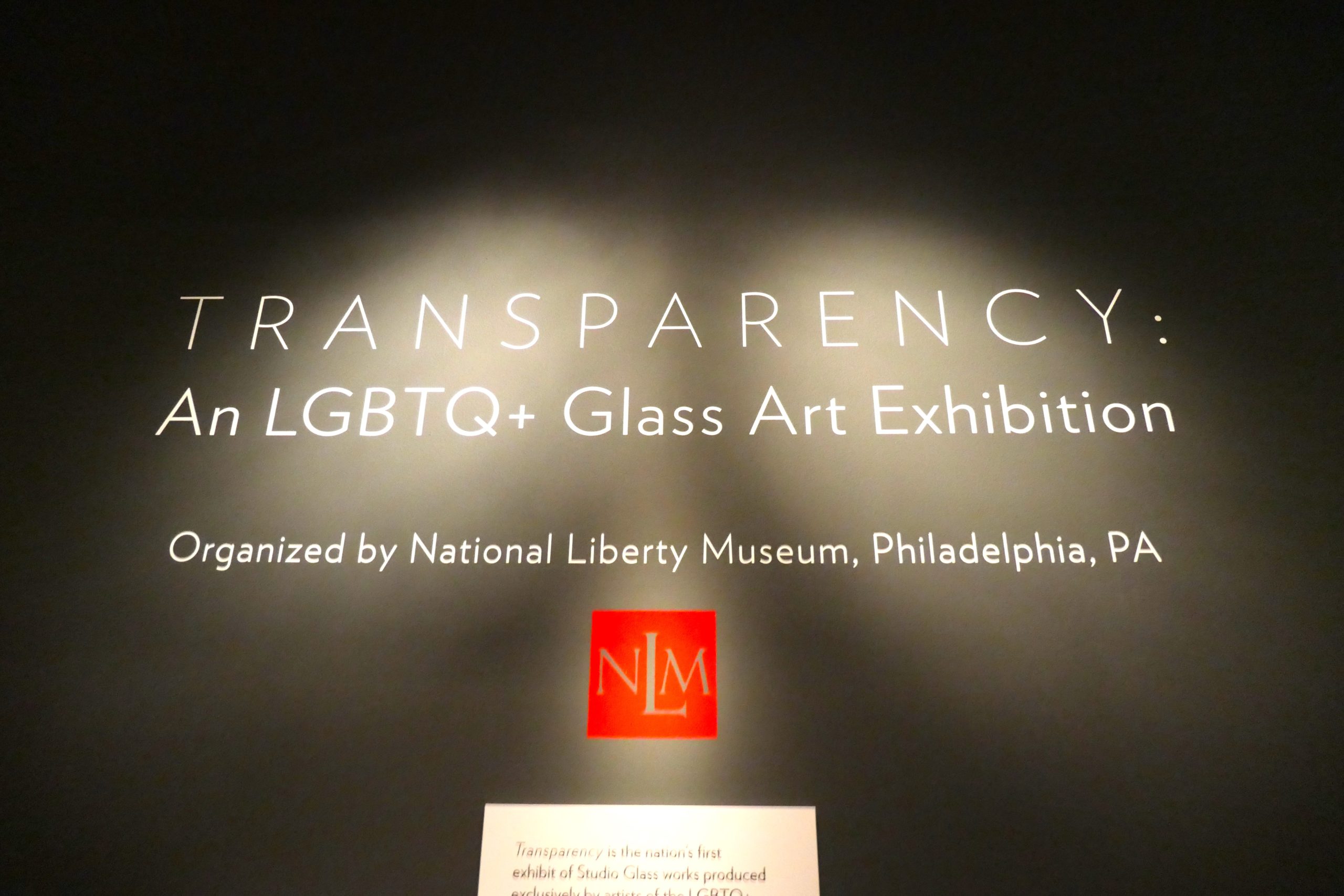
The title alone made me curious. Was Transparency a less than original descriptor of works made of glass? Was it an absolutely clever pointer redressing the invisibility of members of the LGBTQ+ community, who were the sole artistic contributors to the current exhibition of that name at the Museum of Glass (MOG) in Tacoma? Was it an invitation to shine the light on preoccupations and concerns of this particular community, only to reveal that these are often shared by us all, no matter what community we identify with? Was it a play on the fact that transparency is successfully used for purposes of camouflage in nature, as exquisitely demonstrated by jellyfish, South American glass frogs and clear wing butterflies?
The exhibit, first presented at the National Liberty Museum in Philadelphia during Pride month in 2017, will be on display in Tacoma until September 2020. It celebrates a wide range of subjects, methods and styles equal to the variability within the artistic community that produced these works. I counted the fact that the title alone made me think before I even physically entered the exhibit, as a success. As it turns out, one of many that this show delivers.
*
One of the first pieces you encounter is a large disc heavily ornamented with white roses, reminiscent of a flowery Victorian doily. You see an eye, somewhat off center, which, eerily, begins to move, to blink, quite clearly spying on you. Where we Hide from No One (2017), a glass, Poly Vitro and video sculpture by Tim Tate, is part of a series that he connects to issues of commercial surveillance, a balancing act between needs for privacy and protection from threat, and as a reminder “that we are united in Orwellian defiance.”
Tim Tate Where We Hide from No One (2017)
Alternative interpretations readily come to mind. Peering out from behind an opaque surface to see if it is safe to come out, is reminiscent of what so many generations of the queer community had to do from hiding, just as the peeping Toms who did not dare to live their fantasies, peered in reverse. The saccharine display of clouds of little roses obscures the harsh reality underneath, just like seemingly frivolous costuming hides the hardness of lives often exposed to condescension if not outright condemnation.
Tim Tate, We Rose Up (2017)
Tate, Mount Rainier’s Washington Glass School Co-Director had his work The Endless Cycle from a different series represent the US at this year’s Glasstress, the adjunct event to the Venice Biennale. It elicits an illusion of infinity, also found in the piece specifically created for Transparency: We Rose Up (2017). The optical manipulation, looking from afar like the crown of a martyr, draws the gaze in, at times mesmerizing. It is a memorial to the legions lost to AIDS/HIV infections. Whether with mirrors, or more cutting edge videos, Tate’s incorporation of technology into a millennia-old medium creates striking effects, linking aesthetic form to social substance in innovative ways.
Tim Tate, We Rose Up (2017)
The tragedy of AIDS with its loss of an entire generation of men in the 1980s and 90s, appears in several works. Particularly moving was Jeff Zimmer‘s The Presence of Absence (2016) which depicts a skull overlaid with red crosses symbolizing AIDS and an etched phrase: “Your search – John Miles and Jeff Zimmer – did not return any documents.” Googling his formative first lover who died of the disease in 1995, the artist found no trace of him in the digital universe that contains multitudes of the rest of us.
Jeff Zimmer, The Presence of Absence (2016)
One of the strengths of this show is derived from the fact that it is not just about loss somewhat specific to the LGTBQ+ community, like AIDS. All of us can relate to the mourning of lost loved ones through any kind of illness, most beautifully represented by Eric Hess who lost his husband to cancer. Swings (2017) depicts one intact, one broken swing, with its shadow resembling the shape of a chemotherapy infusion bag. The commonality of shared experience in some way magnifies the fact that there are additional burdens carried by this community that many of us who are not part of it are spared. I only wish that the existential threats to transgender people had also found their way into this display – the most recent statistics of their murders, 22 in 2019 alone, are staggering.
Eric Hess, Swings (2017)
*
Tales of loss and longing recur in this quiet show, told at times with wit and sometimes wistfulness. Take Joshua Hershman‘s Derealization (2017) for example. A panel of photographs, partially obscured by opaque glass, in front of a pin hole camera made of glass (Obscura, 2017), is open to multiple takes. On the one hand, it stands in mocking contrast to the Transparency title of the exhibit. On the other hand, it describes the clinical disturbance that many people who have been exposed to trauma or suffer from PTSD experience. Fogginess of surroundings and a sense that things are not real pervade the sensory up-take of those who have been severely harmed.
Joshua Hershman, Derealization (2017)
Somewhat explicitly sexual works are few and far between, cautiously stashed in corners. One wonders why, given that they exhibit the same dignity present in so many other strong pieces in this show. Whether they deal with ways to explore the malleability of the male gaze, as Amanda Nardone‘s Shatter (2017) does, or carefully tease the viewer’s obliviousness as to what the title could possibly imply, as does Walter Zimmermann‘s Pick of the Litter (2017), they make you think. My measure of success, as should be clear by now.
AmandaNardone, Shatter (2017)Walter Zimmermann, Pick of the Litter (2017)
Works that focus on issues of gendered experience are also on display. What it means for women to break into the male dominated glass blowing world – I’ll spare you puns about glass ceilings – is beautifully captured in Kim Harty‘s To Signal to Summon (2016) which she describes as “ambiguous: A sparkling object trying to seduce or a reflective warning, signaling danger.”
KimHarty, To Signal to Summon (2016)
Pink as in Revolution (2019) from The Wheel of Liberation Series by Sabrina Knowles and Jenny Pohlman is a circle of double-headed spears that evoke imagery of totem and power, of prayer wheels and meditation. Knowing that throughout their 25 year collaboration the two artists traveled wide and far, always searching for inspiration from women throughout time and civilizations, helps to trace the influences. As the artists explain: “Regarding the symbology of our spears: to us they represent self-empowerment and freedom from oppression and were born from learning about the story of Nehanda during our 1997 Zimbabwe journey.”
Sabrina Knowles and Jenny Pohlman, Pink as in Revolution (2019)
*
Washington State is often considered a LGTBQ+ friendly state. LGTBQ people are legally protected from discrimination; Washington enacted LGBTQ protections in 2006. Same-sex marriage has been legal since 2012, and same-sex couples are allowed to adopt. Conversion therapy on minors has also been illegal since 2018. The state has a new LGTBQ commission with Manny Santiago as executive director, the was created by the Legislature and signed into law by governor Jay Inslee in April 2019. The commission will identify the needs of and advocate for the lesbian, gay, bisexual, transgender and queer communities. The immediate goals are directed at assessing the laws that product this community, to establish a resource guide that can be easily accessed across the state, and to understand the needs of the various sub-segments of the population.
High on Santiago’s list is also education. The Museum of Glass’s current exhibition is certainly a step in that direction. Transparency teaches without ever sliding into didactic boredom.
Joshua Hershman, Obscura, (2017)
*
There is an ongoing discussion among producers, exhibitors and consumers of art regarding the role of identity politics. It is about more than “just” people of a particular race, ethnicity, gender, or religion forming alliances and organizing politically to defend their group’s interests. Hannah Arendt’s principle that one can resist only in terms of the identity under attack points to an important insight: people are not statistically, historically, or economically interchangeable. An economically secure White woman has a different existence from a poverty-stricken Black one. A CIS person is not exposed to the abuse and persecution that those labeled sexually deviant often were across history and cultures. Identity, when under threat, IS political. And the political space to explore the consequences of life as a minority and the implications of discrimination needs to be granted in public – even when it also invites ethnographic-nationalist identity politics that are currently sprouting like poisonous mushrooms on the fertile grounds of European and American right-wing movements.
To pinpoint a political identity that is under attack is a way to fight oppression, rather than a danger to inclusive, democratic values. Calls for a “shared humanity,” then, need to be heeded with caution, if they try to blot out what is the specific fate of a minority. On the other hand, demonstrations of what we all share can open the borders between groups, invite less defensive reflection and exploration. And this, I think, is what Transparency pulls off when it’s at its best.
Pearl Dick, Us (2017)
For one, there is a focus on the human figure in gender-neutral or abstracting ways, whether we are looking at the work by Pearl Dick or Drew Mattei (I could not find a website, alas.)
Drew Mattei, Mask (Self Portrait) (2017)
For me, the most successful pairing was an installation of multiple abstracted figures, Transparent (2017), again by the perceptive team of Pohlman and Knowles, against a paint marker – mural by Natalie Hope McDonaldThe Line of Beauty (2019.) The figures, from the duo’s Hommage series, display fluent movements of necks, heads and shoulders, as if to turn to us or each other to form connections.
Jenny Pohlman and Sabrina Knowles Transparent (2017) NatalieHopeMcDonald The Line of Beauty (2019.)
Connectedness is also the first impression you have when looking at the web of lines across the wall behind the installation. The intersections are sometimes in focus, sometimes partially obscured by the glass figures, and only eventually reveal the strong triangular elements that hold them together, a motif that is not only common in modern LGTBQ iconography, but was also used as identifier in Nazi persecution of members of this community.
The title of this piece by Niki Hildebrand, What affects one affects us all (2014) summarizes it perfectly: understanding, accepting and embracing connections allow us to act in solidarity with human beings whose identity was the source for persecution. MOG’s exhibit Transparency paves the way for such connection.
NikiHildebrand, What affects one affects us all (2014)
On Sunday I walked in Tacoma, the second biggest city and urban area in the state of Washington. It has a large working port, created in 1918 on Commencement Bay, in South Puget Sound, known as the “Gateway to Alaska”.
It also has a beautiful museum dedicated to glass – Museum of Glass a.k.a. MOG – and the largest hot shop on the West Coast where you can sit and observe glassblowing in action.
I will report on the exhibit I had come to explore and write about later. Today I just want to share the photographs from the outside around the museum, and the bridge that connects it, across a highway, to downtown.
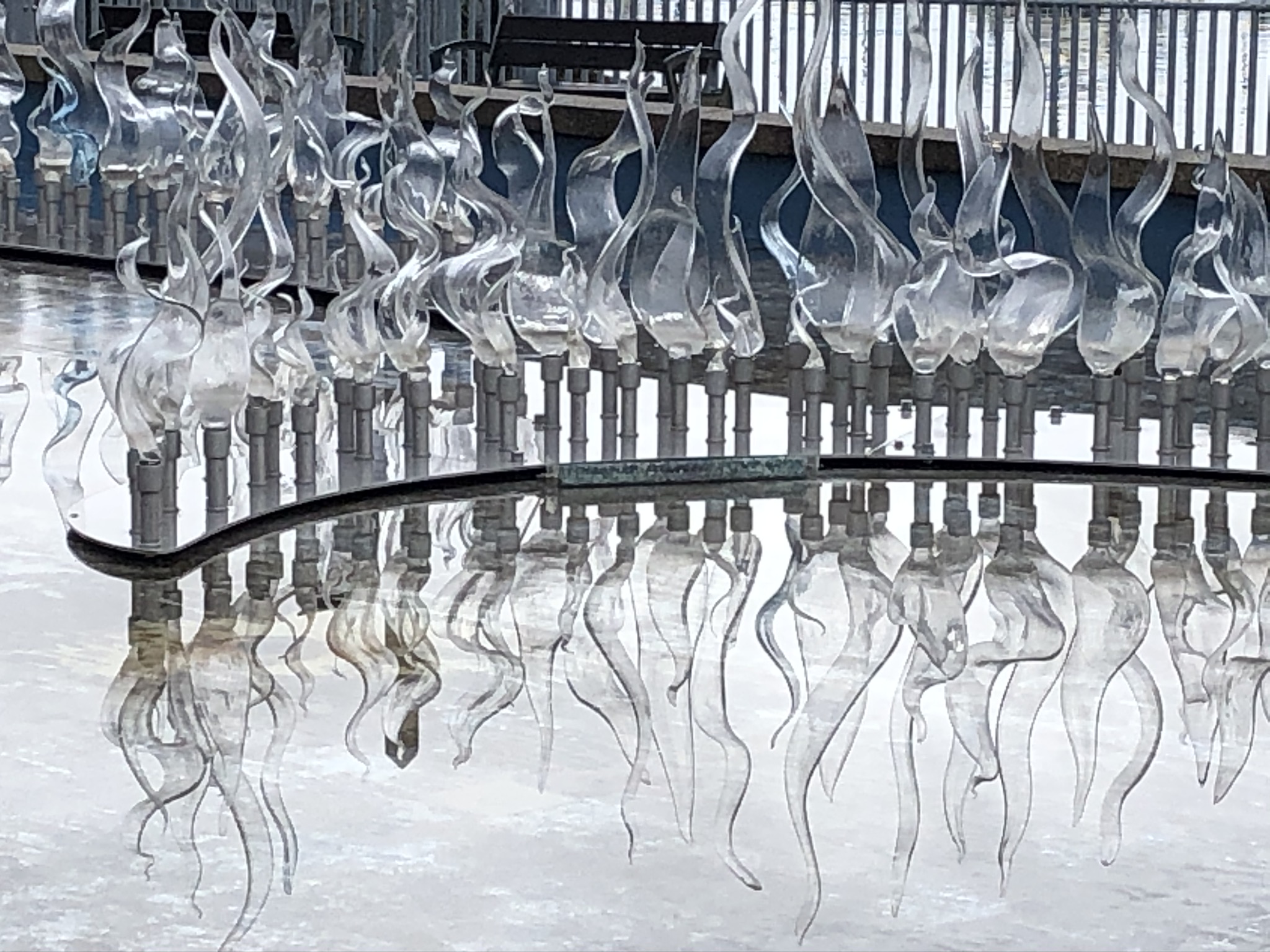
It was a moody day as far as the sky was concerned, which made for perfect light being reflected by the glass installation located outside in the museum’s courtyard. A bit of rain, a whisper of wind, and later the sun breaking through the clouds on this November morning.
The display was under renovation, which meant that the water that usually covers the steel columns holding up the glass had been drained from the basin.
The emerging peeling blue paint was the perfect foil for the glass. The few places where puddles covered the cement were terrific for reflection. The water was too low and shallow to be ruffled by the wind, so that it offered a still mirror surface.
I had not seen any of this before, it was my first visit to Tacoma. I assume there is a symmetry to the installation when the basins are filled that was absent on Sunday. But the sense of slight decay and roughness in the cement surface really enhanced the impression of pieces and shards and crumblings of glass, rather than the perfect flow perhaps intended.
It probably did not look like the vision of artist Martin Blank who conceived of this installation called Fluent Steps, but I was impressed – and I seemed to be the only one around on a Sunday morning at 11:30 (the museum opened at noon.) I could barely stop looking at all this shiny beauty, the rain softly glittering where it hit the surface. You can find a detailed description of the installation and the artistic process here.
*
The bridge of glass, free to walk for all, is located on the other side of the large architectural cone that airs the hot shop inside the museum and has a lattice pattern found in much of NW blown glass art. The bridge displays a large percentage of the Chihuly collection that it MOG’s hallmark, with a “Venetian Wall” that is an 80-foot-long installation housing 109 individual showcases. I am, truth be told, not a fan of his work, but walking along these many pieces, backlit by the light that was occasionally peeking through the rain clouds into the cubicles that housed them, was quite delightful.
What stopped me dead in my tracks, of course, was the gift of daily wildlife: a flock of starlings that fluttered about and made its home, on and off, telling by the masses of bird poop, on the top of the sculptural columns at the center of the bridge. The “Crystal Towers,” two 40-foot-tall structures on either edge look like gigantic pieces of turquoise rock candy. The towers are made from 63 pieces or “crystals” of Polyvitro, a polyurethane material known for its durability. The Polyvitro has a strange way with light, not quite reflective, not quite absorbing, altogether mysterious.
The starlings congregating on the various candy pieces, on the other hand, were as shiny as can be, their oily feathers insulating them against the Northwest rain and making them look like little dark pearls on the turquoise surfaces. Busy, chattering, fluttering pearls, I might add.
It was the perfect morning.
Music today, how can it not be: Glassworks by Philip Glass
Really, the precise formulation should be divination producing geometric art used in faith healing – too clunky a title of course. But that is exactly what Emma Kunz is about. The woman who lived in Switzerland until her death in 1963 considered herself a researcher, but is described by seemingly everyone else as a telepath, prophet and healer, whose powers of intuition (according to the website of the Emma Kunz Zentrum) “achieved successes through her advice and treatments that often edged on the limits of miracles.“
Add to that: artist. Kunz produced close to 500 large – astonishing – drawings across her lifetime, which are finally receiving the recognition they deserve – as long as crankily rational people like me blot out the knowledge of how they were conceived: by means of a divining pendulum. She had retrospectives at the Kunsthalle Düsseldorf and the Musée d’Art Moderne in Paris, and was part of the the Kunsthaus Zurich’ 1999 show “Richtkräfte für das 21. Jahrhundert”, which was dedicated to her, Joseph Beuys and Rudolf Steiner. From March 2005 to April 2006, she could be seen at the Drawing Center New York, the Santa Monica Museum of Art and finishing at the Irish Museum of Art in Dublin. In 2012, her art was displayed at the Paul Klee Centre in Bern, followed by exhibitions at the New Museum of Contemporary Art in New York, at the “La Caixa” Foundation in Barcelona and in 2013 at the Biennale in Venice.
This year, 40 of her drawings were exhibited at the Serpentine Gallery at Kew Gardens, London. You can see a video of that show and experts talking about her work here. Benches made of a special material were placed in front of her drawings and described by participating sculptor Christodoulos Panayiotou as “interrupted sculptures.” The material came from a “mystic grotto”, the place near Zürich where Kunz once found a healing powder she dubbed Aion-A in the stones, and where the current center devoted to her memory (and selling her products, including said powder) is situated. The gallery’s assumption was that seated visitors would absorb some of the healing properties of the rock (claimed to affect rheumatism and inflammation if consumed) while looking at the art.
From what I learned (a wonderfully informativeinand beautifully written essay on her life and work, Emma Kunz: Art in the Spiritual Realm, can be found here) she asked her pendulum, hung over graph paper, a specific question and then would mark the points it swung to as co-ordinates, use the next extended swings as energy lines, and eventually fill in the rest with geometric forms and fields of color in a process that sometimes took up to 48 hours non-stop, with sleep and food rejected. She was convinced that these works would be fully interpretable in their cosmological depth for people in the 21st century.
No interpretation from this here 21st century writer ignorant of transcendentalism. Admiration, though, for the beauty the drawings convey, and the passion obvious in their execution which must have involved incredible patience, acuity and steady hands. A mathematical power really seems to emanate from these geometric forms.
*
As to alternative healing practices, it is interesting to follow current debates in Germany, Switzerland’s neighbor. Homeopathy, invented by Samuel Hahnemann in Germany 200 years ago, for example, was boosted by Nazis like Hess and Himmler. Industry, media and politicians all promote it to this day, you find it in any pharmacy and health insurance pays for it and the public is wildly embracing it – despite the fact that “homeopathy is neither biologically plausible nor scientifically proven to produce more than placebo effects – and therefore an expensive, potentially harmful waste of money that makes a mockery of evidence based medicine.”
So strong is the public belief in it that the German government decided not to follow the example of the French, who will cease to support payments for this treatment in 2021, so as not to create an uproar. This is even true for Germany’s Green Party, which is having a screaming debate over the nature of homeopathy (and the belief in scientific research in general, as linked to genetically altered food sources etc.) They decided to avoid having the controversial topic overshadow their national convention next week, and parked it in some expert committee. Magic (or political pragmatism) beats science. Again.
*
Photographs today are from New Mexico. A group of artists there, calling themselves the Transcendental Painting Group and active at the same period as Kunz was in Europe, tried to move art into something more metaphysical, using abstraction and borrowing a bit from everywhere – the Cubist down to Kandinsky. They ignored landscape in favor of documenting their inner experiences. You get instead my own more quotidian lines.
I had let my membership at the Portland Art Museum lapse. Too much of the programming was, at best, not particularly interesting, at worst, block-buster annoying. I guess I’m not the kind who is fascinated by the history of luxury cars….
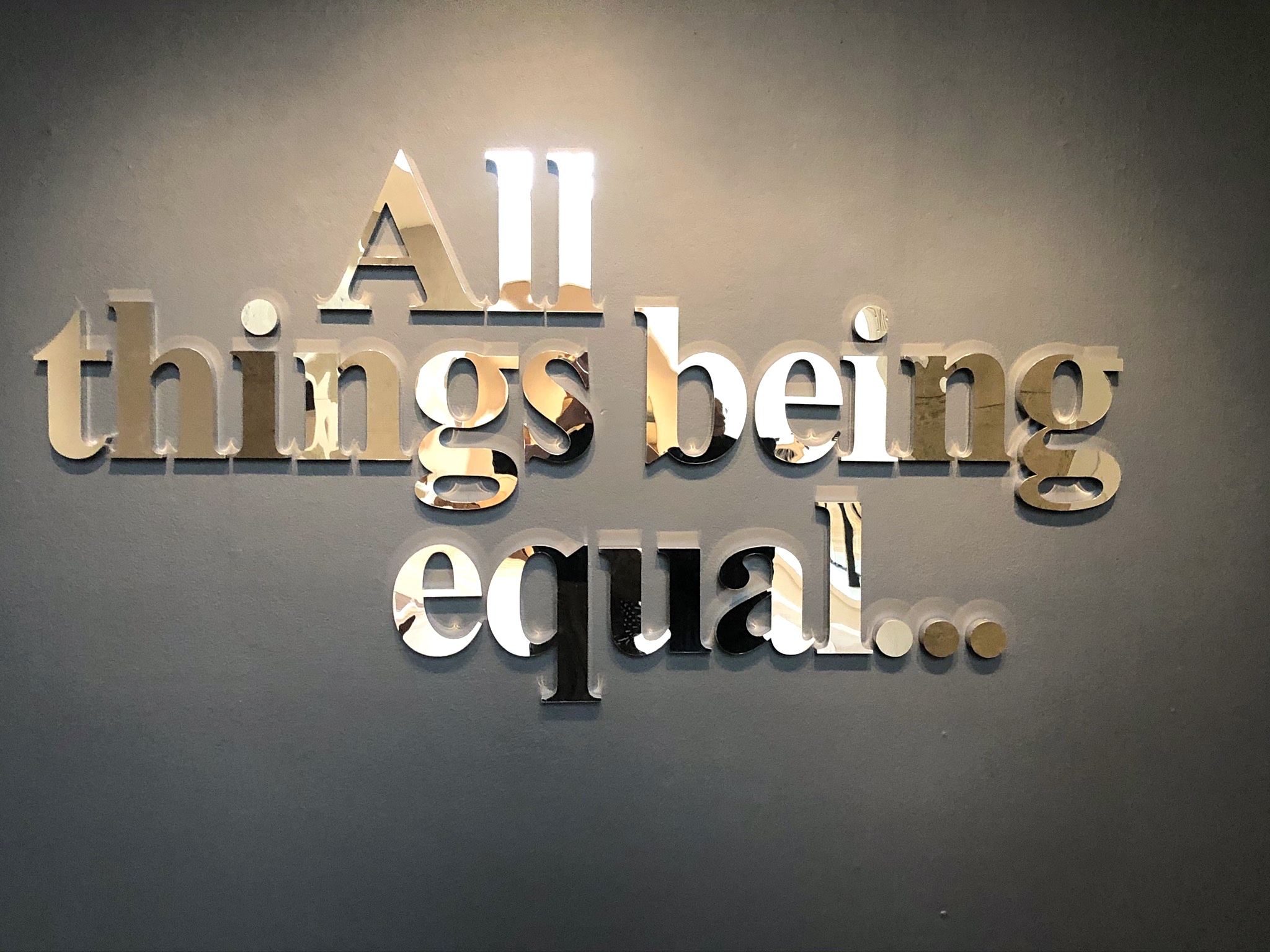
That said, there are always exceptions, some truly terrific exhibits slated, and I have always tried to report on those. Currently on show is an exhibit by 43-year old Brooklyn-based artist Hank Willis Thomas called All Things Being Equal…” I am happy to join the seemingly universal chorus of admirers singing the praises of this retrospective of profound work.
The reviews, for the most part, focus on much of what you expect about contemporary conceptual art dealing with issues of racism, sexism, violence and, yes, capitalistic oppression and exploitation. The New York Times tries to make it all about personal experience motivating art, the Guggenheim artist description focusses on “issues of identity, politics, popular culture, and mass media as they pertain to American race relations” which reappear in many evaluations of the current show, more or less verbatim (and with the word “intersection” frequently added…. ) Essays on art websites hone in on Thomas’ self description as a visual cultural archeologist. There is Cameron Hawkey’s assessment of the Portland show in our very own Portland Mercury, with enthusiasm that I share and with adjectives of tragic, intense, sincere, and slick, that I find overall fitting. Everyone agrees: the work is perceptive, incisive, historically relevant and innovative. What can one possibly add?
I have written about the general identity and politics focus in contemporary art by non-White artists for OregonArtsWatch when describing the Whitney Biennial (as it turns out, Rujeko Hockley who, together with Jane Panetta, curated the 2019 Whitney Biennial, is married to Willis Thomas.) So today I want to describe something different that struck me at the core of his work: the way he invites, if not forces, the viewer to interact with the art in ways that deepen an understanding of the issues at stake, or teach something about perspective, or lend a sense of agency that can be both, empowering and shaming. But first a (partial) outline of what is displayed.
14,719 (2018) 2019 Embroidered fabric panels Courtesy of the Artist
There are some 90 pieces of his art on view at PAM. When you enter the sculpture hall at entrance level you are facing a circular arrangement of 16 28-foot -long ceiling-to-floor banners with appliquéd stars. Titled 14,719 and resembling the American flag (minus the stripes) each of these stars represents someone killed by gun violence. In 2018, mind you, a single year. You wouldn’t know that, of course, save for reading some statement in small print, or having gathered info about the exhibit beforehand. I assure you, most visitors don’t.
And yet, there is something so imposing, almost majestic about these banners that few people enter into the chapel-like interior. I waited patiently upstairs to get a shot, and finally asked painter Henk Pander who was my companion during this visit, to go downstairs and go inside after long minutes of observation with no one entering. Reverence is elicited even without knowledge of honoring the dead – is it reverence, then, for our national symbol?
Here is Thomas talking about his intentions: (the work was previously exhibited at FRIEZE 2018.)
*
On the second floor, there are displays of photographs of African Americans that originated in professional advertisement; the images are cleaned of any text revealing what was up for sale, and the titles are changed in ways that use irony to direct the viewer to question what the true intentions and manipulations could have possibly been in that glitzy stock collection serving up cigarettes or the like. The series of digital prints elicits both a sense of familiarity (Oh, I remember those Virginia Slim ads!) and a double take when the new title opens a different perspective. The series called Unbranded: Reflections in Black of Corporate America 1968-2008)
Unbranded: Reflections in Black by Corporate America, 1968-2008
A similar series, Unbranded: A Century of White Women 1915 – 2015 this time tackling the role of white women in advertisement, had less of a impact on me. Same set-up, original photos appropriated, text removed, titles invented. Perhaps it moved me less because there was a huge emphasis on preoccupation with beauty, which made these women seem equally victim to their own vanity as well as society’s sexist or misogynistic norms. Images that stressed white supremacy also assigned these women both victim and perpetrator status, when you were still reeling with what you had seen in terms of racist stereotyping and clear power differential in the first section. Here is the artist talking about his approach of reframing the images.
There’s no hiding from it, 1982/2015 (2015) Chromogenic Print
And yet, here I was thinking about branding for women, when I later encountered the gold-framed Feminist tote bag (for over $30 no less…) in the gift shop.
*
Indeed much of what is on display seems at first glance reminiscent of commercial work to those of us exposed to ubiquitous advertisement throughout our life times. Branded, as the series is called, draws us into something utterly familiar and then upends the notions we carry into viewing the work. For example, there are numerous resin-enclosed credit cards – only closer inspection reveals them to be sarcastic riffs on the banking slogans, now switched to historic names, places and dates that link economic enrichment to exploitation of slaves and peoples of origin. In the artist’s own words:
Afro-American Express, 2007 Chromogenic prints and epoxy resin
“Increasingly in our society you need a credit card even if you don’t use it, and you get billed for it, so I started thinking about credit as a form of indentured servitude, because of the way we’re conditioned to buy into this and to carry around all this debt. And so one of my friends, Ryan Alexiev, who is a graphic designer, and I started thinking about credit cards, and we made the Afro-American Express thinking it would be an interesting way to speak about this form of indentured servitude, using imagery from the abolition movement.”
Further in, huge photographic boards at first glance seem to depict the type of black athlete who many of us root for. On closer inspection there are multiple manipulations linking these images to symbols of slavery – branding into the skin, demands for physical capabilities to the point of exhaustion and injury, ownership of your talents, and the preempting of (other)potential with the false promise of a professional sports career (which is achieved only by a minuscule number of athletes.)
The most jarring image is one of a basketball player hanging from his hand with a noose above, titled Strange Fruit, in reference to Abel Meeropol’s poem about lynching. The invisible link between black bodies from the past and present ones, both under threat to their existence in literal or figurative ways is powerfully suggested.
Strange Fruit, 2011 Chromogenic print
Sports as a war-like activity was also captured in a quilt loosely designed after Picasso’s Guernica, made out of sports jerseys from different professional teams.
Guernica, 2016 Mixed Media and Sports Jerseys
The use of advertisement-like enactments was most shocking in a piece that was prohibited to be photographed. Thomas photographed his relatives at the funeral of his cousin, 2 decades ago, who had been murdered as a bystander in a robbery over a $400 gold chain. The funeral image was overlaid with the typical structure of a MasterCard ad. Socks: x$$, new shoes y$$, and eventual: selecting a casket for your son: priceless! When this image was projected on the exterior walls of the museum in Birmingham, who had acquired the work, it led to huge controversy. People mistook it for the real thing and thought it was insanely disparaging of African Americans.
Something similar happened when the artist put up political billboards across the nation in 2016, part of the For Freedominitiative that he founded together with other artists. “Make America Great Again!” superimposed on an image from Bloody Sunday’s civil rights march in Selma was a huge billboard erected in Mississippi. It was enough to have both the political right and left go ballistic.
*
Which brings me back to the point of interaction with the viewer. His works are not introducing something radically new or ephemeral enough that you need an art history background to decipher it, instead his projections capitalize on our familiarity with a medium which is then reframed in ways that hit us over the head. Clearly this artist is not shy to elicit confusion, to involve us almost as confederates – I know, a dangerous term in this context – in our familiarity with cultural archetypes that are then promptly stood on their heads. He goes beyond where it really starts to hurt in revealing the manipulation we subject ourselves to, by those who want to sell us something and by him, who wants us to wake up.
He is able to drive home the point that our perspective is malleable – nowhere better than in some of his lenticular pieces that reveal different vistas depending on where you stand, physically, and your point of view when you take action to activate some of the display. (The link describes the process of how this is technically accomplished.) One minute you see a portrait that is crystal clear, yet as you move around it, the image becomes increasingly blurred, what’s black or white ends up as: gray.
Image from the series of Sanford Biggers portraits. Crossroads, 2102 digital c-print and plexi with Lumisty film Hank Willis Thomas in collaboration with Sanford Biggers.
The Portland Art Museum is sensitive to this point of desired dialogue: many of the written comments next to each art work are from a diverse set of viewers, young audience members included, and not the typical curatorial didactics.
Willis Thomas is committed to exchange: here is a short clip of another project recently enacted in Brooklyn that actively invites dialogue. And today he will introduce new work at the Gordon Parks Foundation, Exoduster, about the framing of historic events and the power of story telling, in this case the story of escaped slaves and those trying to help them to freedom captured in Park’s seminal film The Learning Tree. It is a dialogue of a different kind, a response to a revered artist of whom but his work lives on.
Thomas’ twitter handle says: Artist at Large. Man on the street. Strikes me as half coy, half extraordinarily true: he is interested in walking among us, forcing reaction. In that, he succeeded.
“It is in collectivities that we find reservoirs of hope and optimism.” –Angela Y. Davis, Freedom is a Constant Struggle – Ferguson, Palestine and the Foundations of Movements.
The first time I set foot into an American jail happened in New York City in 1978, while accompanying lawyers from the Center for Constitutional Rights during a visit to a city jail with their clients. My familiarity with the German prison system had not prepared me for what I encountered on US soil in that and later visits, starting with the physical factors of overcrowding and horrid sanitary conditions alone and amplified by reports of continual violence both among those who were incarcerated and from those who guarded them. The memory was triggered, for one, by the fact that the New York City Council voted this week to close the abominable Rikers Island Jail complex, and secondly by a visit inside a prison, this time in Oregon, but for all intents and purposes on a different planet from Rikers.
View from the Parking Lot at Columbia River Correctional Institution
Bureaucratic hurdles to enter the Northeast Portland minimum-security prison were surprisingly few; my pre-approved camera was checked both at entry and upon leaving, and the dress code requirements (no blues allowed, lest you couldn’t be differentiated) were minimal. For this one-time visit I did not have to undergo volunteer training, thus being spared the instruction not to be open to manipulation from prisoners, an aspect that always struck me as sowing suspiciousness and bound to instill an us vs them attitude right from the start.
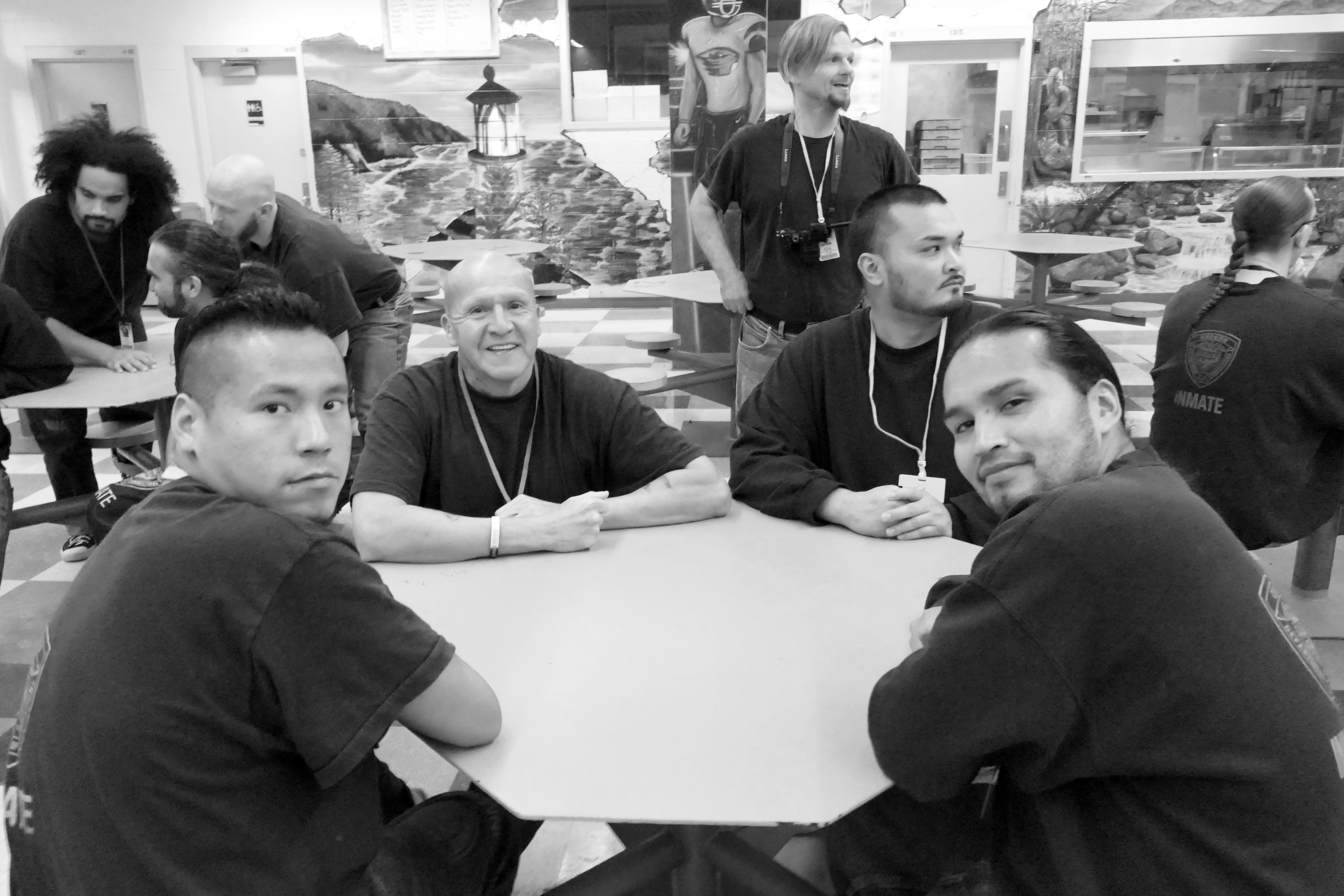
Inside the Mess Hall
What brought me to the Columbia River Correctional Institution (CRCI) was an invitation to attend the premiere of a video of The Inside Show, a variety show that was created, performed and filmed this summer by the men serving time at CRCI. The project was the brainchild of a gifted young woman, (Salty) Xi Jie Ng, a recent graduate of PSU’s Art and Social Practice Program, who directed, edited and co-produced (with Jacob Diepenbrock and Spencer Byrne-Seres) The Inside Show. The PSU program has been involved with bringing art and artists to prison through Columbia River Creative Initiatives, a series of artist run programs and classes held at this minimum security prison in Northeast Portland, Oregon.
Group shot of several of the participants in the Inside Show – overall hosts, performers, writers, interviewees and set assistants included: Aaron Joe, Andrew “Turbo” Reeves, Antonio BDS Gonzales, Carlos Cotto, Chris CB Elliott, Christian Scotty Freeman, Colby Cruikshank, David “Homer” Edmunds, David “ohio” Phipps, David Ponce, Edward Jones, Eugene “Scooby” Brown, Gabriel “Chino” Whitford, Irvin Hines, Jason Melcado, Jeff Kenton, Jeffrey Dahl, Jeremy Downing, Joe Sumner aka Durt McGurt, Jonathan Balderas, Joshua “lone Wolf” Tonkin, Logan Winborn, Mark Arnold, Mario Perez, Michael “HM” Lovett, Philip Delater, Raymond Rabago, Red Corn, Robert “Bobby” Saint, Robert “Flex” Gibson, Scott Austin, Sheldon Scott, Sonny, William Dillan.
I cannot think of a better example of collectivity, defined as the experience or feeling of sharing responsibilities, experiences and activities, than the one provided in this collaborative effort between those imprisoned, those who come in from the outside to volunteer, those who deliver material support from the outside (the media arts center Open Signal and PICA, the Portland Institute for Contemporary Art, among others) and an inside administration that sees the value of creative engagement and makes it possible. The notions of hope and optimism derived from collectivity were surely echoed in the conversations I had with those on the inside as well as with one man who is currently on a re-entry path on the outside who agreed to be interviewed after a second showing of The Inside Show, this time at PICA.
XI Jie Ng, Cash Carter and Mark ArnoldXi Jie Ng, performers and writers Cash Carter and Mark Arnold, Spencer Byrne-Seres
*
“The chronicle of a man, the account of his life, his historiography, written as he lived out his life formed part of the rituals of his power. The disciplinary methods reversed this relation, lowered the threshold of describable individuality and made of this description a means of control and a method of domination.” ― Michel Foucault, Discipline and Punish: The Birth of the Prison
The mess hall was filled with a big crowd, consisting both of those who had participated in the project and their friends, and those who were curious. There were certainly nowhere close to the 600 men currently serving time at CRCI (usually the last 4 years of a sentence,) but I cannot tell if for lack of interest or some administrative safety rules given limited space in the mess hall. Once the video was introduced by the hosts Christian (Scotty) Freeman, David (Ohio) Phipps and director Xi Jie Ng, the mood that seemed relaxed to begin with became truly upbeat. The hall was filled with loud laughter, mine included, since many of the skits were truly funny.
Hosts David (Ohio) Phipps (left) and Christian (Scotty) Freeman
The variety show consists of five episodes that will be published via You Tube across the span of the next months. Central is a repeated segment, Microwave Magic, that deals with recipes that can be prepared with available ingredients from the commissary. It’s pretty ingenious with what talented cooks come up with under such restrictions; it is more poignant when you consider that food is one of the few “legal” sensory experiences available to those in prison, food that is not exactly meeting anything other than nutritional needs when delivered from institutional kitchens.
Host Christian “Scotty” Freeman, who has a quick wit if there ever was one, ably assisted by Martha Stewart (cutout…) Commissary shopping list
A sketch about carrots, Pocket carrots, also poked fun at the availability, or lack thereof, of food when you crave it.
Mark Arnold and his sidekicks in Pocket CarrotsRobert “Flex” Gibson talking about Pocket CarrotsJacob Diepenbrock, co-producer, camera, sound
Aspects of prison life are frequently targeted in those skits, in ways that make you wonder should you laugh or cry. Guest star Fred Armisen, who you might remember from SNL or Portlandia, for example, participates in a fashionshow that drives home the point of prison dress code which eliminates all possibilities of individual expression.
David “Homer” Edmunds, Logan Winborn, Fred Armisen as fashion show judges
There are musical interludes with pieces written and performed by the men,
Joe Sumner singing his song Cellophane SkiesJoe Sumner watching the video
interviews between buddies about the effects of military deployment in war zones and PTSD,
Scott Austin interviewed by Jeff KentonJeff Kenton watching the video
funny sports roundtables, stand-up routines with robots, and explanation and performance of Native-American drumming circles.
Members of the Native American Drum Circle, (among them were Sonny (Dakota Sioux ) and Aaron Joe (Klamath) Center: Drum Circle host Joshua (Lone Wolf) Tonkin from the Black Feet Nation, with Scotty on left, Ohio on right
During the braiding demo – different styles of braids are preferred by different individuals – the barber made a point that was echoed by several men who talked to me about the art project: “I meet all kinds of people who I would otherwise have no contact with: Native Americans, African Americans, Latinos, Asians, they all come to get their hair done.”
Barber Raymond Rabago with model
Even though segregation among different prisoner populations is much less pronounced at CRCI than, say, the Oregon State Penitentiary, the maximum security prison in Salem, OR, it still exists. Sign-up for participation in the production of The Inside Show crossed those self-selective barriers. That kind of collective integration was perhaps not the main goal, but surely counts as a positive side effect.
Christian Scotty Freeman, Jason Melcado, Robert “Flex” Gibson, David “Ohio” Phipps, Michael “HM” Lovett, Salty Xi Jie Ng from the back
*
Mark Arnold is a man so filled with ideas running at hypersonic speed in his head that he practically vibrates. Recently re-established outside prison walls, facing severe restrictions still for the next 4 months, he nervously paces before his Q&A performance at PICA, wondering how it would go in front of a live audience. His explanations of his creative process, the way the project came together, the impact it had on those involved turn out to be fluent, persuasive, emotionally touching.
Born and raised in Portland, he has by his reports filled many roles in life, as a sergeant in the National Guard, a general manager at McDonalds, a welder, a participant in radio broadcasts at KVAN in Vancouver, WA, and more. He was one of the main writers for TheInside Show, ideas flowing and put into form that were then meticulously rehearsed. The pure volume of output is matched by astute observation.
The day after the show’s outside launch, his stress now dissipated, Arnold returns over and over during a long phone conversation to what he considers the most important point. “There are many programs at CRCI helping to pass time, or encouraging you to do this or that with a particular rehabilitation goal in mind. THIS project allowed you to be creative in a way that expresses yourself, the way you are, and being seen for who you are. Having your humor or ideas acknowledged by others boosts your self-esteem. That matters, particularly when you are fighting life-long addiction.”
Xi Jie Ng and Mark Arnold
Agency, accountability, and the politics of responsibility come up a lot in my conversation with Arnold, and also in the short comments made by CRCI residents during the show’s premiere. The idea that people chose to commit crimes for which they will be locked up, and can learn to make better decisions to avoid recidivism in the future, puts the stress on individual behavior. What it omits is that structural obstacles interfere with the best of intentions, not to say justice. I, as an educated, older white woman, am less likely to be imprisoned than a young, poor person of color for the same crime. More importantly, if conditions at post-release do not provide necessary access to regular employment, safe housing, medical care that includes continued addiction prevention and/or treatment and re-integration into a community that is itself healthy at its core, re-offending is a statistically likely outcome for people with few means. To paraphrase Michelle Alexander from her book The New Jim Crow, the criminal justice system will be primarily concerned with the management and control of the dispossessed.
*
Art as a vehicle to regain individuality and establish personhood lost in the eyes of a society that stares at the crime, but not the person behind it, is a focus not just of the incarcerated men, but also of those bringing art to prison in the first place. Harrell Fletcher, MFA Art & Social Practice Program director and Ausplund Tooze Family Professor of Art and Social Practice at PSU, is instrumental for the Columbia River Creative Initiatives. He’s been involved with numerous projects at the prison in the last few years, bringing his students into the process, starting comedy classes, and advising Answers without Words, a year-long collaboration between artists at CRCI and photographers around the world, initiated by German artist Anke Schüttler. In addition, The Inside Show co-producer Spencer Byrne-Seres has led a collaboration with Outerspace Gallery and Erickson Gallery to program group exhibitions and projects from artists both inside Columbia River and outside of the prison (the program is supported by the Regional Arts and Culture Council).
Gabriel “Chino” Whitford, Harrell Fletcher discussing Marcel Duchamp….
Fletcher is part of a skit trying to introduce conceptual art, quickly followed by one of the funniest bits of the evening, “art teacher” Ohio introducing a version of painting by numbers of Teenage Mutant Ninja Turtles. With his self-deprecating wit and warmth, and quick retorts always at the ready, that man could hold his own at any given SNL performance.
David “Ohio” Phipps critiquing paintings of Teenage Mutant Ninja Turtles
The driving, powerhouse force behind it all is Xi Jie Ng. Salty, as she is known, was born and educated in Singapore, to parents who valued rationality, tradition and caution – not necessarily in that order. The current detente between them and their daughter, an artist and rebel since childhood, is quite a remarkable achievement, with love extended from both sides. Salty applied to the PSU program three years ago after simply having googled art programs in the USA. Her accomplishments as a communications major and photojournalist assured acceptance into the program, which takes only about five students per year. As I write this she is on her way to an invited artist residency at UMass at Dartmouth, having graduated from PSU this year with an MFA in Art and Social Practice.
Xi Jie Ng introducing the performers at PICA
As director of the variety show, she had to be able to connect to the performers but also to call the shots in an environment that was often full of tension. As editor of the videos, she had to deal with a huge amount of material and cull it into something that was representative: not too sleek, but also providing evidence of the capabilities of those on the inside. The crediting process, listing all of the varying roles that contributed to the show’s success, will hopefully enhance the CVs of those soon to be looking for employment. In her words: “By pretending we were a functioning production team, we soon became one.”
Xi Jie Ng, artist, director, editor, co-producer of The Inside Show.
I am always drawn to people who exhibit unusual combinations of traits. Salty scores high on that assessment scale. A tendency toward deep self-reflection is counterbalanced by a steely determination to guide her projects to success, unearthing and pursuing every resource possible, with promotional skills that equal her artistic creativity. Without a smidgen of savior syndrome or do-gooder mentality, she possesses a passion for working with populations who have reached the bottom rung of society’s normative scaffold. A serious, self-contained demeanor alternates with giddy bouts of participation in some of the show’s funnier skits. If she doesn’t burn out with her candle lit at both ends, she will go far. Can’t wait to see what she does next.
*
“I have laughed, in bitterness and agony of heart, at the contrast between what I seem and what I am!” ― Nathaniel Hawthorne, The Scarlet Letter
Caught in my very own stereotyping, I am surprised to hear Nathaniel Hawthorne referenced by a prison administrator when I try to get some answers to my questions. To use CRCI’s rehabilitation manager James Hanley’s own words:
“I think about Hester Prynne and Nathaniel Hawthorne. She was required to wear a scarlet “A” for the rest of her life in Hawthorne’s A Scarlet Letter. In his novel the “A” stood for adulteress. Our society places a scarlet “F” on felons. It’s hard for someone to rebuild themselves and their relationships with such a stigma.”
A writer and poet himself, Hanley is convinced that the arts help people learn to navigate the world. He associates the opportunity to express oneself through art, music, poetry, comedy, and film with people’s ability to stay in touch with who they are, or in most cases, to find themselves. His own experience with art as a source of power and purpose is something he hopes the incarcerated men will come to share. The institution itself, with new leadership under Superintendent Nichole Brown, tries to provide community connections through a variety of programs that often depend on volunteers, including Arts in Prison, Living Yoga, Music Studio, Liberation Literacy, SAGA (Sexuality and Gender Awareness), Men’s Circle, AA & NA meetings, and Inside/Out classes.
James Hanley, rehabilitation manager and executive producer of The Inside Show
The Inside Show was a core program – and the connectedness between Hanley (who is credited as executive producer) and the men he manages was palpable. They freely gave respect and gratitude to him, not just in public but also in the non-public conversations I had with them. This image among the performers describes it well.
James Hanley, center, among the crew of performers
*
Countless films and TV shows are re-enacting prison experiences. Autobiographies by former residents of prisons tell their stories. I know of at least one film made in prison, Madeleine Sackler’s O.G.., using those serving time as actors, narrating a story that describes familiar experiences in a penitentiary.
There is writing from poets who were sentenced to life without parole at age 16, like Oregon’s own Sterling Cuneo, who is a 2019-2020 PEN America Writing For Justice Fellow, a 2019 Oregon Literary Arts Fellow and a two-time PEN America Prison Writing Award winner for his essay Going Forward with Gus (2018); he is also co-author of the play The Bucket (2018.)
There are podcasts, like Earhustle, that describe daily realities of life inside prison by those living it, as well as stories from the outside, post-incarceration in St. Quentin.
The Inside Show differs in the sense that it communicates visually between actors and viewers, expressing ideas coming directly from the performers, not a film script written by someone on the outside.
Carlos Cotto watching his video performance of his incredible poetry slam
Seeing and hearing a real person who resides on the inside while we are on the outside creates a relationship, however fleeting. It might challenge our stereotypes, reframe our perceptions and perhaps ease a path to engagement or a willingness to use our political clout to help change and improve society’s post-release conditions. This kind of communal involvement is expressed in the words of the American activist Eugene Debs:
While there is a lower class, I am in it, while there is a criminal element, I am of it, and while there is a soul in prison, I am not free.
Just remember: Some of us can walk out of there. Others can’t.
Let’s face it: when I visit a museum showing contemporary art these days I might be challenged, made to think, dumb-founded, or roll my eyes – but uplifted I ain’t.
So it is all the more noteworthy when I stumble into an exhibit that elicits unadulterated joy. And this I did last week when visiting the Provincetown Art Association and Museum (PAAM.) Located in a building that is itself a calming environment full of light, and architecturally clever in providing small spaces without seeming small, I saw Color Beyond Description – the Watercolors of Charles Hawthorne, Hans Hofman and Paul Resika.
The title might contain the word color but really the impression was one of all light. And lightness. The watercolors floated on more than the paper, they emanated a joy about connection to the landscape they depicted – or so it seemed to this mind, itself primed by the beauty of the Cape Cod surrounds.
Charles Hawthorne, The Pasture, Provincetown, (1927/30)
Hawthorne and Hofman both were part of the early Provincetown Art Colony, with Hofman teaching at his own school from 1935 to 1958 when he summered at the Cape. Landscape and nature-inspired abstraction were a main focus for him (and later his student Resika, a painter of the New York School. Here is an enlightening review of the latter’s contemporary work.)
Paul Resika Three Figures and Fire (2002)Paul Resika Figures on Beach, Cliff # 2 (1966)
Use of light, and even more so of abstraction, changes how we are able or encouraged to perceive the familiar in new fashion. Keyword here, though, is familiar: I think work that is descriptive of or alluding to something we know resonates in special ways. Instead of working on deciphering we can give ourselves to the joy of recognition, placing a bit of ourselves into the percept, forging a relation.
Hans Hofman Midday (1943)
And play with light is particularly possible for those who KNOW the landscape, intimately and across time and season. I have been thinking about the concept of “the local” recently, spurned both by travel and by input from other domains: A recent reading at OJMCHE by Judith Arcana from her biography of Grace Paley revealed the latter to be determined to cling to the local: as a community organizer, an anti-war activist, and, eventually, a story teller. That decision made her effective in these various compartments of her life, even though it meant national recognition as an artist was late in coming.
Hans Hofman Untitled (ca. 1943)
The focus on the local cannot be defined too narrowly – both Hofman and Resika were living in multiple locales, and Hofmann’s European background surely influenced his explorations. It is more that familiarity with a given subject leads to expertise in this subject and thus fluidity in describing it, reflecting the changes it can undergo. Well, I am speculating. For an in-depth, knowledgeable and incisive review, you best go here. Clement Greenberg rules!
Hans Hofman Untitled (ca. 1943)
I am back in the landscape familiar to me, noticing the changes brought on by the season. I am working through the tension how I can always get so excited about all the new I experience, hear and see during my travels, and be equally thrilled when I encounter the familiar, be it of landscapes I frequently visit, or my very own at home. I guess, in the end, a sense of belonging trumps all. But excitement is next best!
And here is a special shout-out to the curator of PAAM who worked a miracle in creating a clever and actually coherent display of completely disparate art slated to be auctioned off for fundraising in early October. The museum deserves support.