Browsing Category

Art

Exquisite Gorge 5:The Alchemist

Alchemy – nouna power or process that changes or transforms something in a mysterious or impressive way.” (Merriam-Webster) 

The English word alchemy has its historical roots in the Greek term chēmeia (the Arabic article al was added later when the word traveled across the Mediterranean world) referring to fluids and pouring. Long before the science of chemistry entered the scene, alchemists mixed liquids to create gold or cure diseases, seeking some sort of transformative power.

Mike McGovern, Printmaker and Professor in the art department at PCC Rock Creek Campus

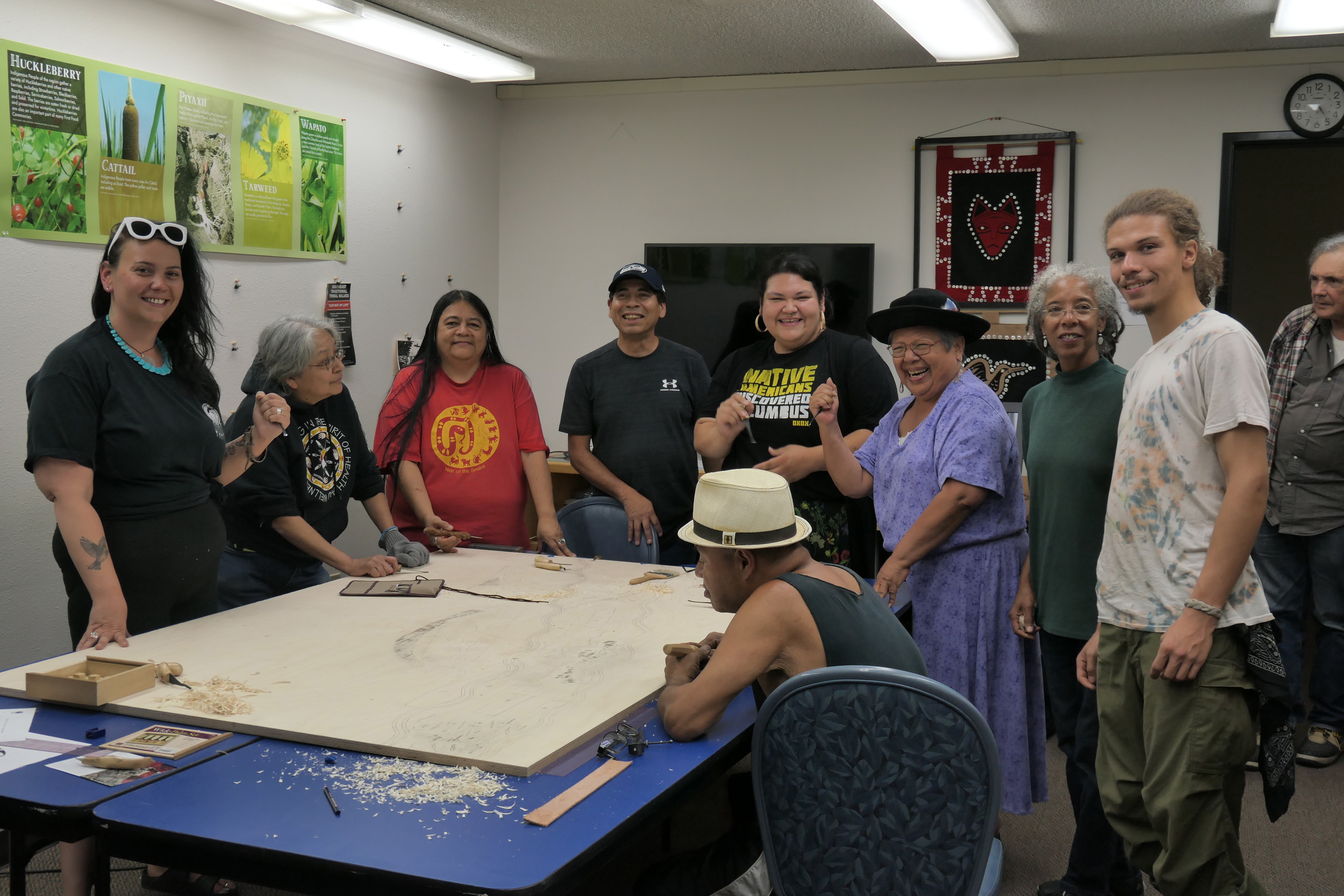
The term came to mind when I visited with Mike McGovern, yet another artist selected by the curatorial committee at Maryhill Museum for the Exquisite Gorge project, tasked with providing a wood block print representing a particular part of the Columbia Gorge. He will be among all those who gather on August 24th at the museum for the public printing of the aligned 8×6 blocks by means of a steamroller.

Mike McGovern

______________________________________________________________________________

THE EXQUISITE GORGE PROJECT

“…a collaborative printmaking project featuring 11 artists working with communities along a 220-mile stretch of the Columbia River from the Willamette River confluence to the Snake River confluence to create a massive 66-foot steamrolled print. The unique project takes inspiration from the Surrealist art practice known as exquisite corpse. In the most well-known exquisite corpse drawing game, participants took turns creating sections of a body on a piece of paper folded to hide each successive contribution. When unfolded, the whole body is revealed. In the case of The Exquisite Gorge Project, the Columbia River will become the ‘body’ that unifies the collaboration between artists and communities, revealing a flowing 66-foot work that tells 10 conceptual stories of the Columbia River and its people.”

 Louise Palermo, Curator of Education at Maryhill Museum

______________________________________________________________________________

McGovern sure mixes it up. Not liquids, mind you, but everything else you can think of. Snippets of words, bits and pieces of sounds, slivers, shreds, scraps, slices, segments, morsels and fragments of ideas or visual impressions, all bent into new configurations. The evolving amalgam could be a page out of a graphic novel (on steroids, given the size of his work) with a large inventory of ideas, but also an invitation to detect the various style elements derived from generations of prior artists. Add to that aesthetics borrowed from his more contemporary passions, the world of heavy metal, skateboarding, tattoo and graffiti – and voilà, there emerges a transformation that is indeed, if not mysterious, quite definitely impressive.

Section 8 of the Exquisite Gorge Project

*

Born in Portland, OR, as one of 9 children into an artistically inclined family, McGovern attended the Pacific Northwest College of Art where he studied photography and printmaking and earned a BFA in photography in 2004. He graduated in 2009 with his MFA in printmaking from Northern Illinois University where he studied under Michael Barnes and Ashley Nason. For the last 10 years he has been teaching art at PCC Rock Creek Campus and spent summers in residencies working, among other things, with young people from under-served populations.

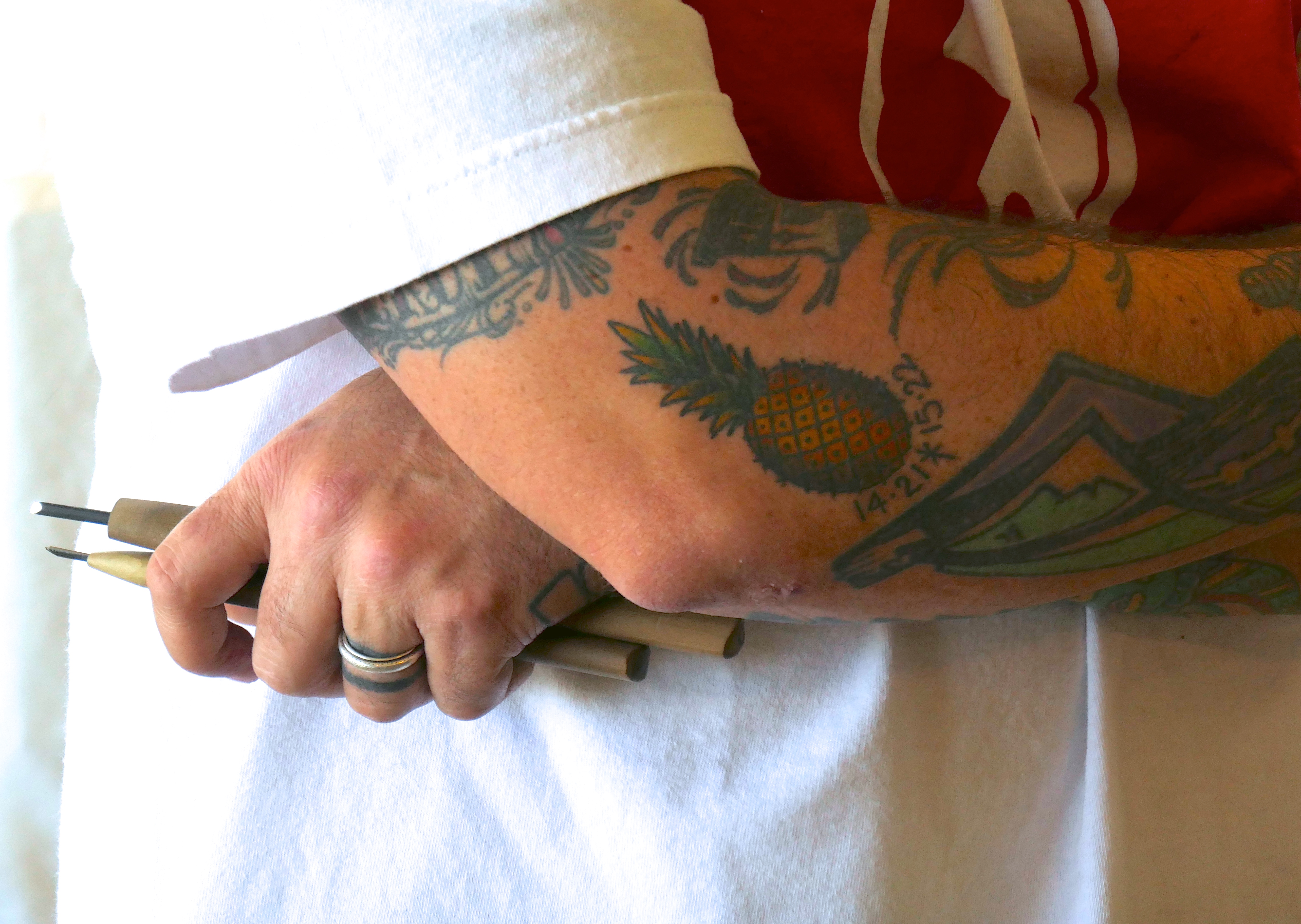
Carving Tools

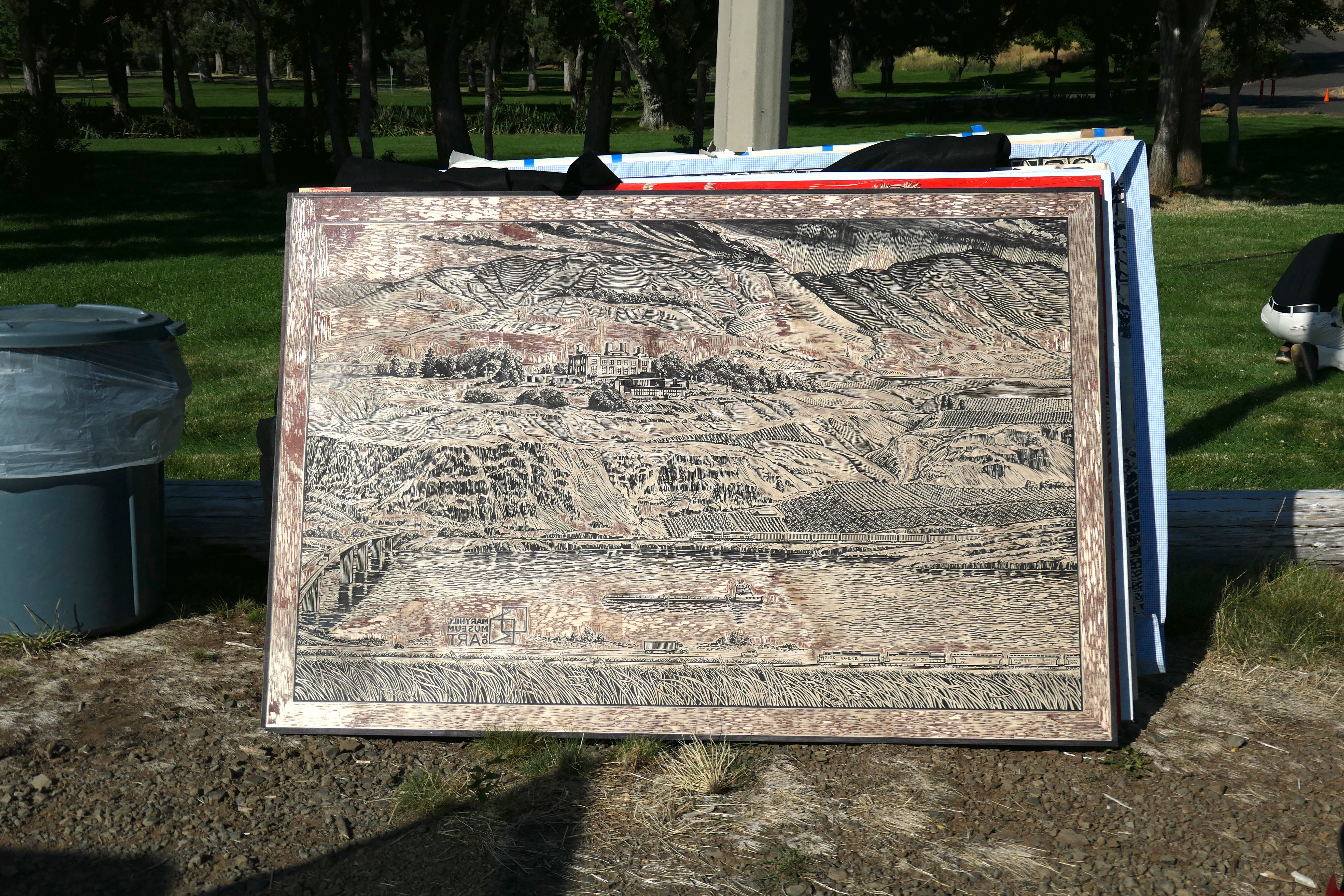
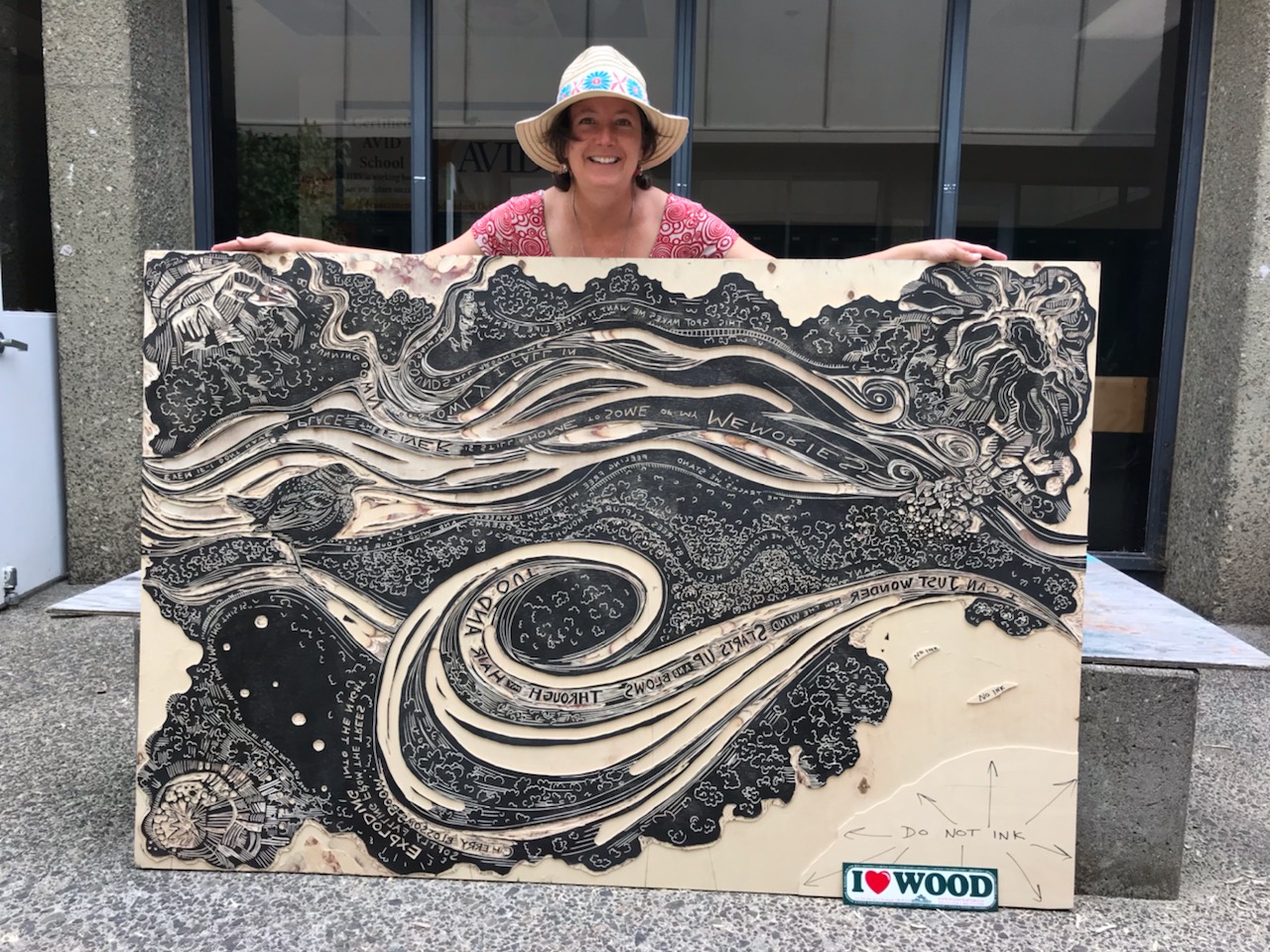
His board, covering the Columbia River section 8 from John Day to Arlington, is highly stylized. Part of that can be traced back to the earliest influences on him as a budding artist. From his father, Donlon McGovern, who carved wood since he was initiated into the craft by native American artists, McGovern adapted a version of the Northwest style that finds its place in a border pattern. His mother’s influence reveals itself in repeated work with linear demarcations, absorbed when watching Jean McGovern make stained-glass windows during his childhood.

Wind Turbines and Smoke from the 2018 Substation Fire

Imagery gleaned from the Gorge, the wind turbines, the smoke from last year’s substation fire that he happened to be witnessing during a residency in The Dalles, fill the board. Representations of quails, raptors, sturgeons, cherries and wheat form a rough-hewn quilt.

Witty representation of a cherry sizer, the real thing shown above – I was first perplexed thinking it was about sizing giant knitting needles – shows you where I come from….

A bee, a moon and a sunflower are adapted from drawings by Sebastian and Issa, students at Wahtonka Community High School which is a community partner in the project.

Carvings from designs made by students from Wahtonka Community High School

The school approaches education for some 60 9-12th graders with a hands-on, project-based learning environment, a strict code of rules and clear behavioral expectations, providing a chance to gain a regular Oregon State Diploma when other avenues of education have been closed off for good. McGovern must be a good fit with the reportedly intensely dedicated teachers and staff, having much to offer that the teenagers can relate to.

*

In addition to the images, there are ubiquitous words carved all across the board. Many of them emerged from conversations with the students. Others came about as free associations while starting to carve, dipping into a stream of consciousness bubbling up from the immersion in the Gorge environment.

Central is, of course, the river that runs through it all. It contains two faces or masks that seem to be breathing important words across the water: confluence; trust; voice; community. I don’t know if this was intended, but they struck me as the essentials that one wishes could re-define relationships among the diverse populations of the Gorge in light of a difficult history – if that history can be overcome at all.

The Columbia River in blue with sturgeon below, raptor and quail above

*

McGovern is fascinated with masks, both prevalent in Native American and indigenous Polynesian art, and also feels a strong affinity to the work of another European group of artists: the German expressionists, first and foremost Max Beckman, Karl Schmitt-Rottluff, Emil Nolde and Käthe Kollwitz.

Faces are a recurring pattern in McGoverns print making

The influence of a movement devoted to convey subjective experience rather than to copy reality is clearly visible in McGovern’s work. The Expressionist method of using lots of contrast, flat shapes and jagged contours is echoed in his style of carving: a raw treatment of the material rather than traditional refinement, chunky slashes rather than subtle illustration.

Within the context of their time, the first decades of the 20th century, Expressionists were set on reflecting the political reality of the European suffering associated with the war that was and the next war yet to come. At the same time they were set on distorting reality in their art, focussed on emotional reaction instead.

Printmaking lent itself to the political aspect of the Expressionists’ work: it was cheap, quick, and posters could be easily multiplied and distributed. Pictures combined with words were thus spread amongst a population that had no access to the floods of imagery that we are overexposed to these days. It was a tool for information, for warning about war mongering, for calling on solidarity during a time where nationalism in the service of fascism was on the rise. As a means of communication to promote or condemn political causes it went beyond the original goals of the artists who rejected naturalism and impressionism in their predecessors: the goal to delve deeply into the emotional core of human experience beyond the surface of aesthetics. (Here is a link to a comprehensive introduction to Expressionism published in the context of the 2011 MoMa exhibition German Expressionism: The Graphic Impulse.)

Words appear all over McGovern’s wood print (I inverted the photograph to make them legible)

Perhaps it is no coincidence that printmaking experiences such a revival in our own political times, with artists willingly resuming the burden of all those who undertook protest against forces that were overwhelming and seemingly invincible.

Drawings in preparation for the carving

*

There is, of course, always the question of appropriation: where does one cross the line from affinity to copying, from reverence to disregard for ownership? The question has actually become much less of an issue for me after a visit earlier this month to another printmaking show at the Rhode Island School of Design: Vision and Revision, at the RISDMuseum in Providence, RI. Brilliantly curated and thoughtfully explained, the exhibition presents work of printmakers and those in their footsteps, delineating the ways old work has been adapted to new times. I learned much. Here is the blurb from the catalogue:

Visions and Revisions tells the story of the invention, reuse, and revival of traditional printmaking techniques throughout the history of that groundbreaking medium. From the very beginning, printmakers have been keenly aware of their artistic lineage, repeatedly confronting and transforming earlier achievements. In addition to emulating their contemporaries, printmakers have consistently revived historic techniques, often overcoming considerable technical challenges to adopt an established aesthetic and adapt it to their own needs. With artists ranging from Albrecht Dürer to Mary Cassatt, from Rembrandt to Kara Walker, this exhibition highlights the astonishingly creative results of repeated encounters with authoritative precedents, celebrating the enduring dialogue between “old masters” and modern and contemporary artists.

Francisco Jose de Goya Y Lucientes The Men in Sacks (Los ensacados) plate 8 from the series The Proverbs or The Follies (Los Disparates) 1816-to 1824, printed 1864 (the white dots are reflections on the glass)
Enrique Chagoya
The Men in Sacks (Los ensacados), 2003

Adopting an aesthetic while mixing it up with a modern twist or contemporary content, envisioning, revisioning, – there’s alchemy for you!

*

In the late 1970s some friends and I regularly fled the harbor city of Hamburg to take up residence on a working farm in Tating (pop. 983), a hamlet near the North Sea. In exchange for serious labor, on the fields and milking cows – yes, I once milked cows, and no, it’s not romantic – we were fed and housed for days on end by the aging parents of one of us, who direly needed help. The woman of the house was goddaughter to Emil Nolde, the expressionist painter. Several of his oil paintings hung in the entrance hall and living room; because insurance costs were astronomical, the uninsured art was tied to nails in the wall with heavily knotted metal wire to prevent theft. When the thatch-roofed farmhouse went up in flames in the early 80s, few of them could be rescued because the wires could not easily be disentangled.

I don’t remember the paintings in detail, just that I was in awe of the emotional power of the color; I was also, at the time, completely unawares of the fact that Nolde was a Nazi and anti-Semite notwithstanding the fact that his own work had been banned as degenerate. New scholarship around his political stance recently led German chancellor Angela Merkel to dispose of two of his paintings that hung in the chancellery and to return them to some museum when an occasion arose to do so without too much fanfare.

I do remember clearly, however, how restorative it was to spend time at a place filled with beauty, away from the daily stress of my professional life.

Dylan McManus, the artistic director for the Exquisite Gorge Project, provides exactly that opportunity for artists who need time to focus and immerse themselves without distractions. He and his wife and children live on a working cherry tree farm in the hills above The Dalles. His LittleBearHill studio offers residencies to printmakers and other artists, enhanced by the fact that they can not only work in peace with the relevant equipment but also have the chance to talk to a like-minded artist. It was here where I met with McGovern to talk about his approach to the wood print.

View of the Gorge from the Cherry Farm

McManus’ work has focused on how perceptions and expressions of masculinity are shaped by culture, how self-image embraces attributes that are seemingly demanded by the stereotypes we absorb, and how behavior is ruled by cultural expectation. Exploration of violence is a topic of great interest to him.

The artist’s father worked for long stretches in Africa and reports of atrocities committed even by under-age soldiers preoccupied McManus from early on. His series on child soldiers uses ground diamond dust as a medium reflecting back on one of the many sources of internecine violence. In other work, he has portrayed war veterans, often using gun powder that he sets on fire to accentuate contrasting edges and fields.

Dylan McManus Child Soldier
Dylan McManus Portrait of a Veteran

McManus’ interests and knowledge of the world of printmakers, his facility with the craft, his hospitality and the way he is deeply tied into many aspects of the Gorge community make him really a linch-pin to the Exquisite Gorge project. In my two short visits out at LittleBearHill I experienced him as a tender and attentive father to his young children. The same can probably be said for his shepherding the project along.

*

On my way home after the interview I decided spontaneously to stop by at the Bonneville Power Dam and take a close look at the locks and the Columbia river. It had, of course, to be the day where my old vacuum cleaner was stashed in the car boot – having been declared defunct that very morning at the repair shop by a depressed looking clerk eager for a sale. The security guard at Bonneville looked annoyed with me wanting in some 20 minutes before closing time. Then he had to check out that my old Shark was not a drone in disguise, despite my emphatic denial that I transported either those or weapons. He eventually waved me grudgingly through when vacuum-hood was securely established.

His suspiciousness, my amusement: The river didn’t care.

The river doesn’t care if we are a violent species, or an industrious one, or one that makes art. The river doesn’t care about what we do to it, or how we represent it or exploit it or guard it, what we feel towards it or how we write about it. The river will run, dammed or not, for much longer than we all will be around. It will seek its course, it will face sunrise in silver and sunset in gold, no alchemy needed. It will echo the seasons, it will rise and fall, it will nourish.

What a comforting thought.

Columbia River at Sunrise looking East
Columbia River at Sunset looking West

RISD adventures

A few weeks ago I went to the museum of the Rhode Island School of Design in Providence, RI. I had never been to the state before and the city was appealing – I can only imagine how it looks even more attractive when all the college and art students are back in town.

RISD is, I think all agree, one of the best art schools in the country. The current exhibit of select members of the 2019 graduating class delivered proof of that.

The show was fresh, irreverent, thought provoking and testament to a lot of technical skill in addition to a lot of creative ideas. Works with and on paper, glass, installations, fabric arts with some phenomenal weaving, painting, and photography – all convinced. Here are some samples. (I was bad, I did not record titles and names, put it down to jet lag. Here is an overview.)

For me the most impressive work (and that name I noted) was a wall of large photographs hung in a floor to ceiling grid, all 15 seemingly depicting the same head and neck, photographed from the back. Only on closer inspection did you realize slight variations, like, for example, a different necklace, or the absence of the necklace. More minute variations revealed themselves only if you kept staring and comparing and evaluating.

Stephen Foster Azimuth 2019

Note it is the head of a Black person. The back of the head of a Black person. The fact that we don’t easily recognize people cross-racially (Whites are horrible at correctly identifying Blacks, and vice versa, and true for other cross racial identification as well) is brought home in spades. It is conveyed by the fact that we have to look really hard to proclaim they “Don’t look all alike to me.” The real-life implication are of course most painfully felt in the legal system, where mistaken identifications lead to verdicts that incarcerate innocent people.

We also, ironically, feel free or even compelled to look at the back of a head, we are in a museum after all and searching for meaning or understanding of the installation, when in real life we do not look, sometimes actively avoid looking. Staring at a person is not socially acceptable and staring at a person of a different race can be misinterpreted and lead to tension. “Made you do it!,” I could almost hear the artist muttering in the wings…

The face is never revealed, another representation of the chasm of not knowing between viewer and subject, the mostly White museum patron and the Black model. Why should he look at us when we don’t look at him?

The name Azimuth is also in no way explained. I hope it is an art history joke (it would be exceedingly clever) referring to two artists who for a short while in the 1960s published an art review called Azimuth and ran a gallery called Azimut. For these two, Piero Manzoni and Enrico Castellani, White was central to their art, in color and materials. 4 years ago an exhibit at the Peggy Guggenheim Collection in Venice revived the work. (Details here.)

In any case, I had a blast being challenged by this work. The photographer is surely a young man we do want to keep an eye on – his ships will come in.

Weaving by one of Foster’s class mates.

Music today shall be by offspring of the city of Providence: a Roomful of Blues

L’Art et la Réalité

The single museum I had time to visit during my days in Montreal was chosen because of its location. It was at 25 minute walking distance from Concordia University where the circus conference took place that day and thus could be explored during the lunch break. Turns out, it was the perfect choice, for the building alone.

Arsenal Art Contemporain is located in a former 19th-century shipyard, that measures over 80,000 square feet. The building was erected in 1846 by the entrepreneur Augustin Cantin for the Montreal Marine Works and by 1857 was deemed the biggest shipyard in Montreal employing between 150 – 250 employees and producing steamboats for close to a hundred years before closing its doors. In 2011, Arsenal Contemporary took over, making just minor architectural adjustments.

The vastness of the halls lets the art breathe, unfold without crowding and bathe in light at least in some of the halls. On offer was an exhibit called Alternate Realities which was in turn wickedly sarcastic and delightfully funny, at least for this viewer, who once again ignored the demands of serious art criticism and just had a blast with a crop of younger artists who went for the jugular.

These were the only other visitors in the entire space, happily taking pictures of each other inside art….

From their catalogue: “At a time where the virtual collides with the real world, reality multiplies itself. In a world of accelerated mediatization where images are everflowing, the truth becomes increasingly hard to decipher.”

Nathalie Quagliotto Friend, 2019
Says the curator…..

And here is someone we miss:

Many Obamas……
Eric Yahnker The Long Good Bye, 2017 Pastel on Paper

Here is something altogether different:

Xu Zhen Under Heaven, 2015

Same curator, I suppose. Note that this artist was already in the Venice Biennale in 2001, at age 24!

More wisdom from the curator:

John de Andrea Cierra, 2003

I was even drawn into a piece by Anselm Kiefer, who I usually don’t take to, given his loose relationship with the truth and his self aggrandizing. His painting fascinated me in this single instance perhaps because of or perhaps in spite of its German connotations and reference to religion. Here is an older review of Kiefer’s work that expresses some of my reservations in ways that are more eloquent than what I deliver.

Anselm Kiefer Der brennende Dornbusch, 2007 Mixed Media

And speaking of Germany:

Dorian Fitzgerald Haecker-Pschorr Bierhall, Oktoberfest Munich 2005 Acrylic and Caulking on Canvas

This is what it looked when you went closer to this humongous painting that went floor to ceiling.
———————-

Sculpture reigned on the upper floor –

David Altmejd Man with Black Sweater 2018 Too many media for me to write up…..rhinestones included.

My favorite was a piece by Corwyn Lund called 40 years that displayed seemingly identical round mirrors along a hallway, which, on closer inspection, reflected an ever more faded image of the viewer. My immediate question was, of course, how would it look by age seventy? And is the increasing vagueness an outcome of loss of vision, or lack of being seen?

I had no time to watch the videos, but given how much food for thought was already provided it did not seem like a big loss. I highly recommend visiting this museum if you are in Montreal – heads up, though, they have quite limited hours, 4 days total. As long as you supply the art interpretation/statement by yourself you should have quite an interesting time. That said, reading the official statements made for an amusing time as well. I certainly can’t quibble with the choice of what was displayed – a mix that made you think.

Music today is by two blind singers from Mali who have been romantic and musical partners since they met in school. Here they are describing a different reality:

Exquisite Gorge 4: The Bee Maven

The bees build in the crevices
Of loosening masonry, and there
The mother birds bring grubs and flies.
My wall is loosening; honey-bees,
Come build in the empty house of the stare
.”

W.B. Yeats wrote these words in the sixth section of his poem Meditations in Time of Civil War, longing for bees. The structures were crumbling, symbol of the destruction wrought by Ireland’s civil war in the 1920s, and rebuilding was direly needed. I was reminded of this poem and the restorative role it assigns to bees, when meeting with Steven Muñoz last week for a studio visit and an art talk in White Salmon, WA.

Steven Muñoz, Print Maker and Director of the Lee Arts Center, Arlington, VA

The print maker is the fourth of several artists who I visited during their participation in the Exquisite Gorge project which accumulates individual wood prints for a final printing by a steam roller in late August at Maryhill Museum. If the wait until then seems too long, you can attend an earlier opening of what promises to be a different, extraordinary print exhibition on July 13th at the museum.

———————–

Muñoz is a man who walks, talks, breathes, and, for all I know, sleeps and dreams bees. A mere century after Yeats’ lament, with the structures crumbling again, this time destroying the very fabric of nature on which the bees and all who rely on them depend, his work is a call to action.

Steven Muñoz

The artist grew up in New Mexico, exposed to cultivating nature from an early age on at his grandparents’ Alfalfa farm. He received a BFA with a concentration in printmaking from American University in DC in 1998 and is currently the Director of the Lee Arts Center, a program of Arlington Cultural Affairs. As chair of the Board of City Blossoms, a nonprofit dedicated to fostering healthy communities by developing creative, kid-driven green spaces in neighborhoods that would not otherwise have access to gardening, Muñoz nurtures not just plants – although he does that, too, as a master gardener.

Steven Muñoz Four Color Reduction Woodcut Monsanto is the Devil (2017)
At work in his studio

His love for bees has organically grown in the context of seeing what damage non-organic farming and commercialized apiculture has wrought. In the age-old tradition of print makers everywhere who serve as clarion calls for things amiss in the social or political fabric of their time, he draws our attention to what we are about to lose. In turn, the insects themselves attend to him – multiple photographs confirm that the artist attracts them, being literally, physically, peacefully visited by bees.

Muñoz showing images of bees landing on his hands

Muñoz’ approach to his section of the Columbia River Gorge (Browns Island to Miller Island,) involved meticulous research of the flora that is endangered by the decline of pollinators. As it turns out, the widespread meadow death camas (Toxicoscordion venenosum) is dependent on a sole insect that can pollinate it: a mining bee called Andrena astragali. If this species is destroyed by agricultural chemicals or changes in climate that affect reproduction or survival, the game is over for the plant as well. I do not have to spell out the chain reaction for any of the imaginable similar scenarios involving all bees as pollinators.

Steven Muñoz’ Wood Block depicting a Miner Bee

His woodblock depicts this mining bee about to approach the plant; it took over a month and a half for the drawing alone to be executed. He then spent several week in White Salmon, away from his patient husband, dogs and East Coast bees, to undertake the carving of the woodblock.

Preparatory Drawing for the Wood Cut

.—————–

The importance of bees has been known since time immemorial. Well, spelled out at least since Virgil told us about the God Aristaeus. Responsible for the cultivation of bees, wine and olives, he was punished with the death of all of his bees for coveting Orpheus’ wife Euridice and causing her death when she stepped on a poisonous snake while fleeing Aristaeus’ advances.

We might also want to think through the rest of that myth: Orpheus thought he could rescue his beloved from the underworld, restoring her to life. No such luck: man’s impatience and doubts destroyed one last chance for a happy ending. Parallels to our current trajectory, anyone?

Steven Muñoz,Four Color Reduction Woodcut Danger Lurks (2019)

Here is Virgil’s Georgics, Book IV with details on ancient beekeeping that might be of interest. Less poetic in style, but rich in scientific substance are the writings of a more contemporary champion of bees, Thomas Seeley. A biologist at Cornell University, he is the ultimate authority of swarm intelligence, the pooling of individual decisions that, in some form of distributed process, produces a collective outcome that is beneficial to the group. Aptly, he calls it Honeybee Democracy.

Steven Muñoz Woodcut Devil’s Helmet and the Bee (2018)

Some simple principles underly the emerging wisdom of the group, for instance when they try to find a new home each year which needs to have both, an appropriate size and appropriate levels of protection. The first principle concerns enthusiasm, which in turn triggers attention. Bees who come home from exploration of potential sites display differing levels of enthusiasm, expressed by dancing with differing degrees of passion. The more passion the more fellow bees will go out to inspect the site. The second principle is flexibility. There are rules of communication through dance that allow second wave scouts to make up their own minds and contribute to the collective decision that way. In the end whoever recruits the most bees to be excited about a single site will maneuver the swarm in that direction.

Muñoz giving a lecture

————————

I cannot judge how much distributed decision making led to the engagement by Muñoz’ community partner in the print project, the White Salmon Arts Council. I can vouch, however, for that group’s enthusiasm and flexibility. Their support for the artist ranged from housing him for weeks on end, lending him a studio to work in, taking care of everyday needs, providing a space to show and sell some of his other work, and invited him to give a talk to the community to alert one and all to the cause. They were flexible when I showed up and certainly welcomed me in and helped me gather essential information.

The range of creative focus was definitely distributed, from print makers to weavers, jewelry makers to ceramic artists, painters and more. I have photographs and glimpses of the work of only a few but they are indicative of the variety I mentioned.

Gathering for the Art Chat with Steve Muñoz

The evening was moderated by Sally Gilchrist, whose prints brought “saftig” to my mind – the German “saftig” refers to something juicy, the yiddish “zaftig” refers to voluptuous round curves, both often used in reference to something quite appealing. I had coincidentally seen her work on the walls of Henni’s Kitchen and Bar in White Salmon a week earlier and it remains a mystery if my discreet drooling was induced by coveting the art or the best Burger I’ve had in a long time….

Sally Gilchrist

Sarah Morton-Erasmus is currently president of the Arts Council and the jewelry she makes has etherial qualities. In contrast, her organizing is pragmatically down-to-earth and geared at increasing the public representation of the group, from Art Walks, to Art Chats to mentoring programs for local High School students and further artist residency programs.

Sarah Morton-Erasmus

Kristie Strasen has done some remarkable work as a textile designer and colorist, but I was very much drawn to her weaving which brings elegance to the home-spun material. She was by all reports an especially kind host to Muñoz as well.

Kristie Strasen

Others who could not attend the Art Chat but were described as instrumental for the public work of the Arts Council are Meg Bradford, an art collector and owner of Cor Cellars, who according to Morton-Erasmus puts on some of the best events in the Gorge at her winery, Chelsea Heffner, the owner of Wildcraft Studio School, Ben Berger, an art enthusiast and a financial planner with a back ground in the tech industry and last but not least Charlie Kitchings, who is an art dealer and solid resource with connections to Seattle and Los Angeles. 

Art Chat Participant
Lisa Commander, Director of the Columbia Gorge Veterans Museum, with the perfect bee earring!

I mention all these individuals because of my stern conviction that individual engagement is the glue that holds communities together. Particularly in times of absence or decrease of public support for the arts the resources, connections, help and input provided by groups like these matter ever more. The role played by community partners in the Exquisite Gorge project cannot be overstated even if attention is geared towards the artists who provide us with much food for thought and the museum which had this terrific idea in the fist place. Three cheers for volunteers!

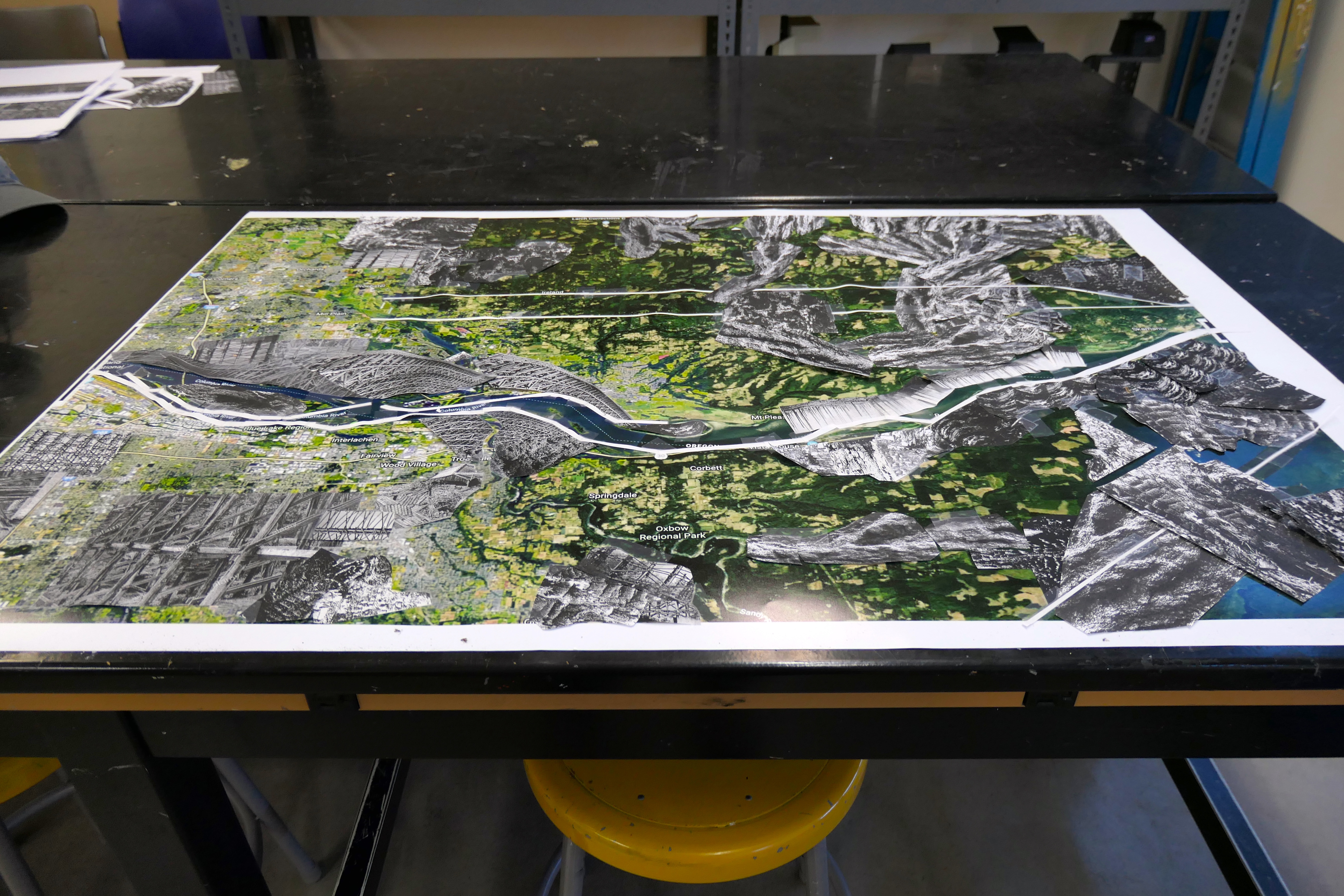
Make-shift demonstration of the Columbia River Gorge Sections

River Map with designated sections

————————–

On my way back from White Salmon in the evening, I got stuck, seemingly for hours, on I84 because of a crash in Troutdale. Mahler’s 1st symphony, conducted by Kalmar, was playing on the radio and in the lane next to me was a trailer filled with frightened calves. Between the bovine stench, the overly accentuated cuckoo calls coming from the clarinet, and the calves’ all but rhythmic banging against their trailer walls, oh, did I long for softly humming bees. My thoughts were drawn back to Yeats and his assessment of what the world needs in his poem:

We had fed the heart on fantasies,
The heart’s grown brutal from the fare,
More substance in our enmities
Than in our love; O honey-bees,
Come build in the empty house of the stare.

Muñoz’ art serves as a timely reminder of what is needed to repair the world. We, just like Orpheus, might not get a second chance.

Exquisite Gorge 3: The Listener

How does an artist decide which questions to raise and which, if any, answers to provide? How does an educator reach their audience and communicate innovative ideas hoping to stir up responses that foster curiosity and open or change minds?

Neal Harrington, Print Maker, Musician, Associate Professor of Art and Gallery Director at Arkansas Tech University

I wondered about this when meeting Neal Harrington, the third of the print makers to be portrayed for Maryhill Museum’s Exquisite Gorge project: To recap, he too is one of 11 artists who in collaboration with community partners are carving woodblocks filled with ideas about individual sections of the Columbia River. All of the blocks will be aligned and printed by a steam roller at the museum on August 24.


THE EXQUISITE GORGE PROJECT

“…a collaborative printmaking project featuring 11 artists working with communities along a 220-mile stretch of the Columbia River from the Willamette River confluence to the Snake River confluence to create a massive 66-foot steamrolled print. The unique project takes inspiration from the Surrealist art practice known as exquisite corpse. In the most well-known exquisite corpse drawing game, participants took turns creating sections of a body on a piece of paper folded to hide each successive contribution. When unfolded, the whole body is revealed. In the case of The Exquisite Gorge Project, the Columbia River will become the ‘body’ that unifies the collaboration between artists and communities, revealing a flowing 66-foot work that tells 10 conceptual stories of the Columbia River and its people.”

 Louise Palermo, Curator of Education at Maryhill Museum


Neal Harringto and Louise Palermo, Curator of Education at Maryhill Museum

I visited with Harrington at the Farmers’ Market in The Dalles last Saturday where he, together with folks from his project community partner, The Dalles Art Center, made it possible for the public to catch a first glimpse of his wood block. He is both an educator and an artist, dual roles that can compliment each other but might also compete with conflicting goals or resource allocation. He is also a musician in a band named Black Sabbatical. No wonder I was hooked.

With an MfA from Wichita State University, and tenured faculty at Arkansa Tech University in Russellville, AK, Harrington exhibits several of the hallmarks that make, in my mind, for a great teacher.

He has an easy way with jokes (Hey, kiddos, let me grab your attention…)

He is deadly passionate when it comes to conveying substance (Think, folks, think!)

And, importantly, he knows how to listen (Tell me again?).

The last one matters enormously – it allows you to gauge the status quo of those who want or need to learn, and to respond at the appropriate level, easing their load or equipping them with challenges. (Mind you, my criteria are derived from a small sample, but then again, how many great teachers do you encounter in your lifetime?)

Visitors at the booth engaging with Lou Palermo, left, and J.Scott Stephenson, Executive Director of TDAC center.

Member of The Dalles Art Center helping with the booth.

Harrington certainly listened to the community feedback in his conversations at The Dalles Art Center and elsewhere about what people wanted to see in his representation of Section Five of the Gorge: Rowena to Browns Island. “Don’t just focus on the usual, the cherries, the grapes, the wheat barges, include what matters for the future!”

Part of the future arrived in The Dalles in 2006 when Google opened their first data center, joined last year by a second one, providing direly needed employment opportunities. They have invested $1.8 billion in their facilities and have been a generous neighbor:

In their own words: “Since 2008, we have awarded nearly $2.5 million in grants that impact Wasco County and more than $10 million in grants to Oregon nonprofits and schools in areas that we’re passionate about, including science and technology education, carbon reduction, and access to the internet.”

Detail from the Exquisite Gorge Woodcut

Harrington listened and came up with a wildly imaginative design that married the past to the future, leaving us grinning in the present: Columbia River Gorge fauna and flora are represented within an arrangement that echoes old canned salmon-tin labels, with one of the ospreys ubiquitous to the region at the center of the block, taking off with a mouse in its talons: a computer mouse that is connected to a mother board.

Detail from Exquisite Gorge Woodcut

Once you get over the surprise and amusement, you can go on to appreciate the intricate nature of the intertwining parts, the respect for both history and nature, the sheer richness of the drawing. It is a sight to behold.

Exquisite Gorge Woodcut

_____________________

As an educator you should listen to others. As an artist you have to listen to yourself, often ignoring extraneous demands or Zeitgeist pressures. It helps when the inner voice is deeply rooted in preoccupations or beliefs that shape your view of the world and are longing to be externalized. Harrington’s passions were built on exposure to Greek mythology and American Roots music.

What is it about small town boys and girls and Greek mythology? I envision Rapid City, SD, where Harrington grew up, not exactly as a teeming cultural hotspot. Forgive my stereotyping, it was encouraged by a look at the city’s website where next to Mt. Rushmore a cement dinosaur park and a reptile garden were announced as the main attractions. The same – somewhat small-town, isolated location – was true for the men who really brought Hellenism with all of its facets to renewed prominence in the West many centuries ago, in far away Germany: Johann Joachim Winckelmann and Heinrich Schliemann. I have written about them here and here respectively. It was true for me, too, growing up in a middle-of-nowhere German village after WW II and for several of my philhellenic artist friends across the globe.)

My theory (again with small sample bias) is that Greek mythology delivered the equivalent of what Lord of the Rings, or Harry Potter, or, in the gaming and cinematic realm, the Legend of Zelda or the entire Marvel enterprise currently provide: fully structured universes with a set of characters, a set of rules, daring breaking of rules, magical powers, and importantly, unhappy endings, all of which allow you to escape, to adopt a different cultural identity and to engage in downward comparison. (Hey you might be bored to death, but at least you didn’t have to roll that boulder up a mountain or have your liver pecked for all eternity…. ) Of course that German preoccupation with tragedy, and the associated emergence of German idealism did not end well: cultural historians like Fritz Stern argued that it paved the way for the success of fascism. A story for another day. But, oh, how mythology can be harvested for print making!

Pandora – Woodcut, 42″ x 48″, 2013 

———————-

Harrington listens. He listens to music that is another font of inspiration for his art. Growing up with friends whose names were James Poor Thunder, Lawrence Ironcloud and Tammy Little Bear, he was early on exposed to different perspectives of the American Dream. American Root music clearly provides a narrative that Harrington’s art picks up and renews. Series like his Bootlegger Ballads or Hard Travelin Man are testimony to my point.

Possession Day Blues
Woodcut with India Ink Washes, 24″ x 24″, 2015

He listens to his 13-year-old daughter who cannot live without once seeing Ariana Grande live in concert, and chauffeurs her for that trip which turns from three to seven hours in the car, being held up by recent floods in the Midwest. He listens to and comforts his young son whose mom is Chinese, coming home from school perplexed that his classmates mistake him for a Mexican and nudge him to speak Spanish – apparently that particular Arkansas slice of the world is divided into Whites and Hispanics only.

Carving the Exquisite Gorge wood cut

And then he listens to Woody Guthrie, Bob Dylan and preferably Todd Snider (born in Beaverton, OR no less, and for me a new discovery.)

Finding inspiration, sorting out questions and answers.

He listens. We should look.

Exquisite Gorge 2: The Witness

How do you tell a story that is not necessarily your own? How do you draw a landscape that did not always belong to you? How do you document reality without appropriating someone else’s history? These questions pose themselves to any artist, anthropologist, historian who is aware of limitations of their own perspectives.

These kind of of questions also arise for me when constructing profiles of people who I find interesting, whose work I admire, whose politics I likely share and who I get to talk to only once.

Roger Peet, print maker and muralist

Case in point is today’s portrait of one of the artists chosen for Maryhill Museum’s Exquisite Gorge project: print maker and muralist Roger Peet who I met last Saturday during a public woodblock carving session at the Goldendale Public Library. He is one of 11 artists who in collaboration with community partners are carving woodblocks filled with ideas about individual sections of the Columbia River, all of the blocks to be aligned and printed by a steam roller at the museum in August.

During our short conversation before the public portion of the event, I was quickly convinced that the artist is someone who would ask himself the questions outlined above. His section of the river ranges from the Deschutes River to John Day, including The Dalles Dam, one of four dams built along this stretch of the Columbia between the 1930s and 1970s that displaced Native American communities and wiped out traditional fishing grounds. We ended up in no time discussing the historical, political and environmental implications of that structure as well as other effects of human interference with nature. Yet we also talked about whose story this truly is, embedded in the context of all other assaults on Native American rights, and how one cannot usurp that telling.

Peet is a reserved man, by temperament probably more so than by the stereotypical gage of nationality (he hails from Great Britain and arrived here in the late 80s.) No self-promotion from his end, despite a pretty insane list of accomplishments, from exhibitions to publications to awards, and a range of interests that spans a political universe. Just check the link to his CV on his website, which exhibits a sly sense of humor as well. I warn you, though, that you might be left, as I, forever wondering what differentiates his proclaimed interest in “civilized bad ideas” from uncivilized ones….

A major focus of his work is the Endangered Species Mural Project associated with the Center for Biological Diversity. He created more than 16 larger-than-life paintings of at-risk animals and plants indigenous to communities across the United States, often collaborating with local artists and scientists. Murals depict flying squirrels in Asheville, North Carolina, and a jaguar in Tucson, Arizona, to monarch butterflies in Minneapolis, Minnesota, white fringeless orchids in Berea, Kentucky and cuckoos in LA all bear witness to the fragility of our environment.

(You can read more about it here. Published this January in the National Wildlife Federation magazine, the article was called: Art of the Possible. I wonder if the staff author was familiar with the original source of that quote, Otto von Bismarck, the stern, conservative Prussian chancellor of the German empire from 1871 -1890. In its entirety it read “Politics is the art of the possible, the attainable — the art of the next best.” I wager von Bismarck and Peet would not have formed a mutual admiration society. I certainly believe Peet would not likely settle for the next best. But then again, all I can do is infer, claiming no privileged access to his story.

———————-

During our conversation I could not help but think of another lover of nature, Lage Wernstedt, the famous surveyor of the North Cascades in WA in the early part of the 20th Century. He mapped both the Mt. Baker National Forest and the Okanagan National Forest and inventively named a range of mountains, coming up with Mt. Despair, Mt. Fury, Mt. Terror, Mt. Challenger, Inspiration Peak, and last but not least Mt. Triumph (not that he climbed many of them, by all reports. Stellar photographer, though.)

Well, I don’t know about terror, but the remaining attitudes seemed to smolder under the smooth Peet surface, except that nature was allotted the part of triumph when eventually “calling a day of reckoning in response to our abuse,” to quote the artist.

I surely documented inspiration, the will to bear witness with his art to the parts of the story that belong to all of us: just look at the design on the baltic birch wood block that alerts to what we have diminished and what we have already lost. The big horn sheep and fish have been greatly reduced in numbers (this year’s salmon run alone were so reduced that they barely filled tribal sustenance needs, much less the commercial quota due to, it is presumed, overheated water in the Pacific spawning grounds.) The California condor in the design has long absconded our regions and the Columbia River Tiger Beetle has gone the way of the sandbars that were its home – submerged by the human alteration of the landscape for industrial interests, be they (now defunct) aluminum plants or commercial barge traffic.

————————–

Inklings of challenge, fury or despair all but vanished with the onset of the carving sessions, and what emerged was a gentle, attentive mentor who guided young and old participants alike with passionate explanations and much practical advice.

The Goldendale Community Library courtyard was the perfect setting to allow patrons to participate. A historic Carnegie library, it serves as much as a library as a community center, supporting local arts and artists, according to library manager Erin Krake, who gave a warm introduction to the afternoon’s proceedings.

Erin Krake, Library Manager
Lou Palermo, Curator of Education at Maryhill Museum (center) with Erin and her library colleague Susan.

——————

Soon people of all ages carved merrily along, none with more concentration than Joseph Bookmyer who turned 6 years old that very day and whose Dad was happy to have him enjoy this event.


Joseph Bookmyer

————————

I left with a restored sense of hope that this kind of educational project put on by the Maryhill Museum and enhanced by the curators’ pick of engaged, thoughtful and conservation-oriented artists will have an impact. Each mind reached, each perception sharpened, any one consciousness shaped by those who bear witness, it will eventually make a difference.

In Roger Peet’s own way of telling the story:

Relief Print
Cranes Lettra 100lb Printmaking Paper
signed/numbered edition of 25
9″ x 11″
23cm x 27cm

Art on the Road: Exquisite Gorge (1)

I have on previous occasions written on this or that aspect of Maryhill Museum in WA which I like to visit as often as I can. An eclectic collection of paintings, fashion, artifacts of some Eastern-European aristocracy (Queen Marie of Romania), chess sets, native American basketry, 80 or so works of art by Rodin, displayed in an old Manor house with a fascinating history of its founder, beautiful grounds and a sculpture park – it has all drawn me for many a decade. In fact I remember when they still had peacocks roaming the manicured lawns and discreetly placed signs, warning you of rattlesnake danger, should you step off the paths…

This summer I have the best ever justification for more repeat visits, carbon footprint be damned (it is a 2 hour drive from Portland after all): the museum has a fascinating project called Exquisite Gorge under way which promises both, a distinct process and an exciting outcome for all of us interested in learning about as many local artists as we can and celebrating the history and beauty of the Gorge and its people. Here is the description of the brainchild of Lou Palermo, curator of Education at the museum, who has been instrumental in connecting artists and communities throughout the Columbia River Gorge.

Louise Palermo, curator of Education at Maryhill Museum

“…a collaborative printmaking project featuring 11 artists working with communities along a 220-mile stretch of the Columbia River from the Willamette River confluence to the Snake River confluence to create a massive 66-foot steamrolled print. The unique project takes inspiration from the Surrealist art practice known as exquisite corpse. In the most well-known exquisite corpse drawing game, participants took turns creating sections of a body on a piece of paper folded to hide each successive contribution. When unfolded, the whole body is revealed. In the case of The Exquisite Gorge Project, the Columbia River will become the “body” that unifies the collaboration between artists and communities, revealing a flowing 66-foot work that tells 10 conceptual stories of the Columbia River and its people.


I plan to visit with as many of the contributing printmakers and communities involved in the process as is feasible between now and August 24, when the collaborative efforts will be revealed and united via a giant steam roller at Maryhill Museum. I hope my reports will allow glimpses into the diverse, creative power all around us that we so rarely have a chance to observe directly, documenting the thinking about and carving of each of the 10 segments allotted to the individual artists. And of course I can’t wait to be part of that grand finale in August, interviewing Palermo in depth on her curatorial vision and her ability to forge alliances across diverse populations.

———————

Last week was off to a great start: I got to meet Jane Pagliarulo in her beautiful Atelier Meridian in North PDX which she co-owns with Barbara Mason (with whom she also shares a leadership role in Print Arts Northwest (PAN) a non-profit that has advocated the art of printmaking through exhibitions, professional development, and educational programs for almost 40 years here in Portland. (Photographs throughout are from the Atelier.)

Pagliarulo is a Master Printer with a life history that could fill several life times, or be made into one of those movies where you long to be the heroine – except you don’t have a smidgen of the energy displayed by this artist, or the courage to try so many independent ways of living – well, I don’t in any case. Educated at UMass at Amherst and Exeter in England, she traveled and worked extensively in Europe and eventually did fine art printing in Santa Fe, NM.

Jane Pagliarulo, Master Printer, in her studio

Before you know it, she was an outdoor guide and independent survey forester in OR where she also taught printmaking as an Artist in Residence in Hood River County schools. She co-founded a printmaking workshop in the Alpinee Hut in Hood River from 2000 to 2006. And now she manages the studio here and prints for other people as well as her own art while donating time, knowledge, materials and skills to various education projects, and raising a 12 year old. No wonder she recently received an award that was established in honor of a truly generous person and has been given to those acknowledged to contribute deeply and freely to community.

Ray Trayle Print Prize 2017

Her fierce devotion to nature and her extensive skill with a variety of printing techniques – lithographs, woodcuts, etchings, and photogravures – as well as her connection to the Hood River community, made her the perfect choice for being assigned that section of the river. The baltic birch panel is ready and set to be carved at the shop – I will report back when the design materializes!

————————-

Bitty Bugs

Walking through my garden towards dusk this weekend, watering can in hand for the new plantings, my eye was drawn to numerous small creatures. Oblivious in their own small universe, perhaps tired, they did not budge when I moved the iPhone directly above them, my watering task all but forgotten.

In the mysterious ways memory works, I suddenly recalled a miniature landscape I had encountered years back in the middle of Manhattan, to be looked at through a glass embedded in, I don’t know, a construction fence? Some office wall? No, I checked: Wall of the Museum of Arts and Design, on Broadway.

The artist, Patrick Jacobs, builds pseudoscientific dioramas using paper, styrene, acrylic, vinyl, neoprene, wax, and hair, and photographs among other materials, viewing them through lenses as he works, using tweezers and brushes. They are lit from within and exhibit incredible depths. Below are links to some of his typical work. If you are in Italy, you have a chance to catch his most recent exhibit until June 9th…..

You look at the panoramas through circular shaped lenses, which reminded me of the Claude glass, an optical device used by 18th century landscape painters. The convex black mirror allows you to asses tonality and light and shade ratios in its reflection. I have always thought it would be interesting to do a landscape photography project with one of those things – probably done already by numerous photographers. Nonetheless, it would fit into the themes of reflection and distortion so much part of my montage work. Which reminds me: I have finally re-designed my art website – give it a look, feedback appreciated!

And for your Monday morning jolt, here is another insect-related masterpiece….gives you a crunching start into a hopefully bug-free week:

Spitbugs!

Unless you want to end up like Rothenberg who does all this interspecies music.

He has shifted from insects to whales now…..

Community Memory

One of the regrettable side products of a society on the move – whether moving is voluntary or not – is the loss of historical knowledge. If you grow up in a place and stay there for most of your life you are usually familiar with the history of your surroundings. You relate facts and stories to the next generation and you recognize them in the art that surrounds you, if it is focussed on any of these issues.

None of that is true any longer when you move to another area, another part of the country, another country. You have to do painstaking work to put all the pieces together and even then you might not have the information that comes with narratives handed down from generation to generation.

I found myself reminded of that twice lately. Once when exploring some non-touristy areas in Santa Fe and seeing a lot of murals and graffiti that clearly spoke to some issues related to New Mexico, or so it seemed. I had, of course, no clue. Photographs today are from those jaunts.

The second time it happened when I read this ArtsWatch piece by Bob Hicks yesterday, describing the work of Henk Pander (full disclosure, they are both friends of mine) that relates the history of the Vanport flood. An exhibit of new work around this topic opens here. There has been a festival since 2015 that commemorates annually the 1948 accidental flooding of Oregon’s then second largest city and its horrific destruction of lives and housing in a predominantly black neighborhood. It took an artist and an art critic, however, to get through to people like me with the story.

Why should we care about knowing the history of any given place? For one, I believe it connects us to prior generations, increases an understanding of the place and provides a sense of belonging, which in turn makes it more likely that we stand up for “our” community when that is required. Secondly, we might learn from what has happened in the past to protect us against similar mistakes in the future. That covers about any area I can think of, from awareness of the fragility of an eco system, the perils of building in potential floodplains, preparedness for earthquakes, to the more sociological issues of housing segregation and so on. And, come to think of it, the folly of war.

And since this week was Malcom X’s birthday, here is a master story teller when it comes to drawing the arc of history from past to present, offering alternative visions, warnings and hope: the compilation of speech excerpts is exquisite.

And music? Turns out people use music, big time, to teach history….

Here is Malcolm’s Gone – performed by Leon Thomas.

Community Action

18.248 – that is the official number of refugees who during the last 5 years drowned or went missing in the Mediterranean, according to the newest report by the United Nations. The dark figure is likely much higher. Organizations like Sea Bridge have been trying to rescue as many as they could, but their work has been made increasingly difficult by the political right wing forces in Europe.

The official E.U. Marine rescue boats were already withdrawn when the new Italian government refused to allow any more refugees on land. The E.U. states could not agree on a distribution quota that would have swayed the Italians. Now private rescue operations are brought to a halt as well.

People who use their own boats to fish drowning refugees out of the water are threatened with up to 20 years in prison and insane fines for supporting “illegal immigration.” Last Tuesday the captain of the boat “lifeline” was sentenced to a 1o.ooo Euros fine in Malta for rescuing 230 migrants and bringing them on land.

That same approach to “deterrence” is of course also happening here in the US: the criminalization of humanitarian aid has progressed under the Trump administration to destroy potentially the lives of those trying to prevent deaths along the Southern Border. Whether you leave water for those trying to cross the desert, or pick them up in your car to bring to social services, you can be charged with federal crimes like trafficking. (This last article on the treatment of organizations that try to save lives is frightening.)

——————————–

In a statement last year the European rescuers declared: SEEBRÜCKE is an international movement, supported by several civil society alliances and people. We declare our solidarity with people who are forced to flee their homes. From German and European policy makers, we demand the establishment of safe routes for refugees, to stop the criminalisation of sea rescue and to receive them in a humane way whilst respecting their rights.

Last year, protest actions organized by Seebrücke were held in Greece and several German and Swiss cities. This week, there was a protest in Berlin.

One of the city’s landmarks, Molecule Man by Jonathan Borofsky, was clad in an orange life vest and black blindfolds by art activists. The 30 meter high sculpture was installed in 1999 and strategically placed in the river Spree where the former East and West Germany met. Refugees had sewn the huge (48 square meters) life vest by hand according to a pattern devised by a Syrian mathematician, also a refugee. Banners along the bridges proclaimed: Build Bridges not Walls!

Aktivist_innen der Seebrücke befestigen am 17.05.2019 ein riesiges Transparent in Form einer Rettungsweste am Molecule Man, einer Skulptur die sich in der Spree zwischen Elsenbrücke und Oberbaumbrücke in Berlin befindet. Foto: RubyImages/F. Boillot

Here is a fascinating, short video documenting the action.

—————————–

“Molecule Man” (1981) by Jonathan Borofsky

Here is another of Borofky’s Molecule Man, this one located in L.A. Any clever suggestions how to decorate that one to draw attention to the plight of those crossing the Sonoran Desert? And those trying to prevent them from dying of thirst? Garments of canteens, anyone?

Photographs today are of desert plants I’ve encountered in the US.


And here is some desert music although from a desert in a different continent.