 April 1, 2026
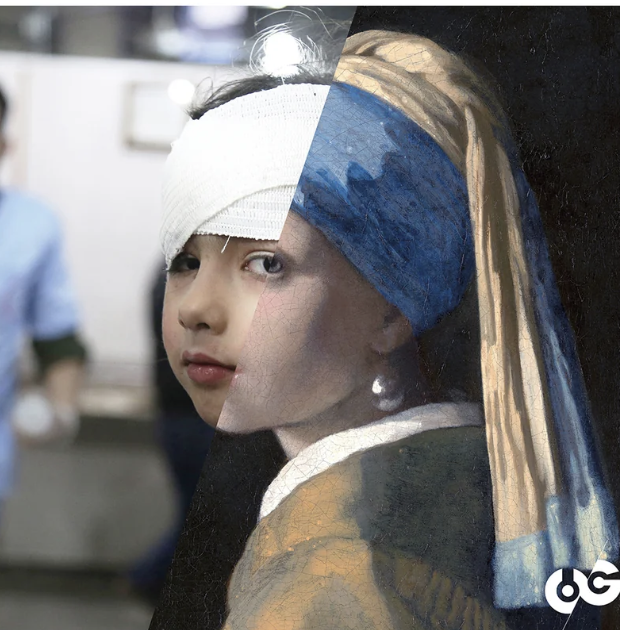
I have been thinking about children again. This time cued by the work of a Turkish photographer, Ugur Gallenkus, who won the International Photography award for his book Parallel Universes of Children.
The artist creates photomontages that combine photographs of children from affluent, safe environments with those less fortunate – children living in war zones, filled with threat of instability, physical harm and starvation. The juxtapositions expose the reality of war, exemplified by its most innocent victims.

The images fit seamlessly with other thoughts on Passover, our holiday about to begin tonight. This year there will be heavy hearts around the Seder table, and there is much conflict and tension in larger Jewish communities as well. Intense disagreement about what has become of Israel, of the U.S., of all involved in the wars in Gaza, Lebanon and Iran, is driving entire congregations apart.
People cannot agree on what is just, what is moral, or if we see the beginning of the end of a (claimed) democratic project in the Middle East. Jews themselves cannot agree if anti-Zionism must or must not be equated with anti-Semitism. Jews see shadows on the wall, when U.S. courts force academic institutions to provide the administration with lists of names of all Jewish students and staff, the same institutions that stifle dissent.

Many of us speak of genocidal wars against Palestinians, others cheer the likes of Israeli National Security Minister Itamar Ben Gvir. He pushed through the death penalty by hanging for Palestinians convicted of having intended harm or committed terrorism against the state of Israel. Look at his lapel pin.

The new law, passed by the Knesset this week, is discriminatory in so far that non-Palestinians are exempted, widening racial discrimination already present in the state. (61 of 120 members in favor, 48 abstaining…)The UN Human Rights office is one of many voices strongly opposed to the death penalty, and points out that there are hundreds of Palestinian children in Israeli prisons, often for years without trial; just last week, a 17 year old died of starvation in prison in the West Bank. Will they face the death penalty as well?
Extra-legal killings have been occurring in the occupied territories for a long time (and now see a flare up in the West Bank where settlers are on a rampage.) Legalizing the killing of (only) Palestinians, as this law does, creates a new status quo: the entire Israeli people are now involved, since the penalty is legitimized and executed by the state by which they are represented, creating a form of Apartheid. The dehumanization of Palestinians progresses when it is formalized and integrated into the system in this way.

Which brings me back to Passover: it is a holiday that educates younger generations about the history of the Jews and their relationship to their G-d and the land they call their own. More importantly, though, it is an essentially biblical holiday. Here is what that means, best explained by Rabbi Dr. Ismar Schorsch, chancellor emeritus of The Jewish Theological Seminary (JTS).
“There are two strictures on Passover. Passover, as you know, is the moment when the clan becomes a nation. It is a momentous transition, but that national identity is not without its constraints within the biblical context. I will dwell for a moment on the origin of Egyptian slavery. Why didn’t our patriarchs end up in Egypt to begin with? And it seems to me that the structure of Genesis makes it very clear that before Israel could become a model nation-state, it had to go through the bitter experience of slavery. Granted that slavery and suffering does not necessarily translate into virtue, but it is a hopeful context for the structure of a better political society. (…) So, the first stricture that Israel faces is to remember its slavery, remember the cruelty and the political oppression which you suffered, for that is the polar opposite of the kingdom that I want you to create.
And the second stricture on this political entity coming out of Egypt is Mount Sinai. Mount Sinai follows the Exodus. The Exodus is not an end in itself. The Exodus confronts lawful behavior. Mount Sinai is the giving of the Torah. It is the giving of commandments. It is the imposition of principles and values that are to guide this political entity. The political entity created after the Exodus is not to be driven by greed; it is to be driven by constraints, morality, and fundamental principles. So, the nation to come out of Egypt had quite severe constraints placed upon itself in order to help it become the model political entity that might inspire the ancient world.” (Ref.)
If we juxtapose those strictures with what is currently done in the name of religion (different ones, no less, if you look at the American Secretary of Defense Hegseth’s emphasis on evangelical Christianity), the disparity between what is morally demanded of us, and what is actually unleashed upon the world, couldn’t be more obvious. No wonder, that even the mass media now shower us with headlines or opinion titles like America is Abandoning Morality, or America is now a Rogue Superpower.

The children, of course, are most likely to get harmed in the long term, if they are not outright killed to begin with. (The February 28 strikes in Iran hit two schools, using a new, untested weapon made by Lockheed Martin that unleashes an explosive barrage of tungsten pellets on its targets.)
As of 3/28 the US and Israeli military killed more than 230 kids. Children will also be disproportionally hit by the environmental damage produced by all the noxious metals and oil smoke from the burning tankers. In particularly small babies crawling close to the ground will absorb toxins both through skin and airways. Schooling is disrupted for long stretches, and access to medical care becomes close to impossible under live fire, as still in Gaza and Lebanon as well.
Hunger is harder on small bodies who succumb earlier, particularly when clean water is not available. (85% of all sewer treatment plants have been bombed to smithereens in Gaza and Israel opened dams that allow sewage to flood Gaza.)

None of that even includes the psychological damage from living under constant fear, losing parents, facing a future with no security guarantees and most likely living in refugee camps for years on end.
CHILDREN. Include them in your prayers around the Seder table.

Chag Sameach.
Music by Ernst Bloch.


Lou
This is so powerful…
Jorge tacla
Thanks for your thoughts and support dear friend.
Jorge
Cherry
The images are gut-wrenching! We’ve made it so complicated, but it needn’t be.