Please join me for the opening reception of Fragility, a series of photomontages in dialogue with Lacing Communities Together at the Columbia Gorge Museum.
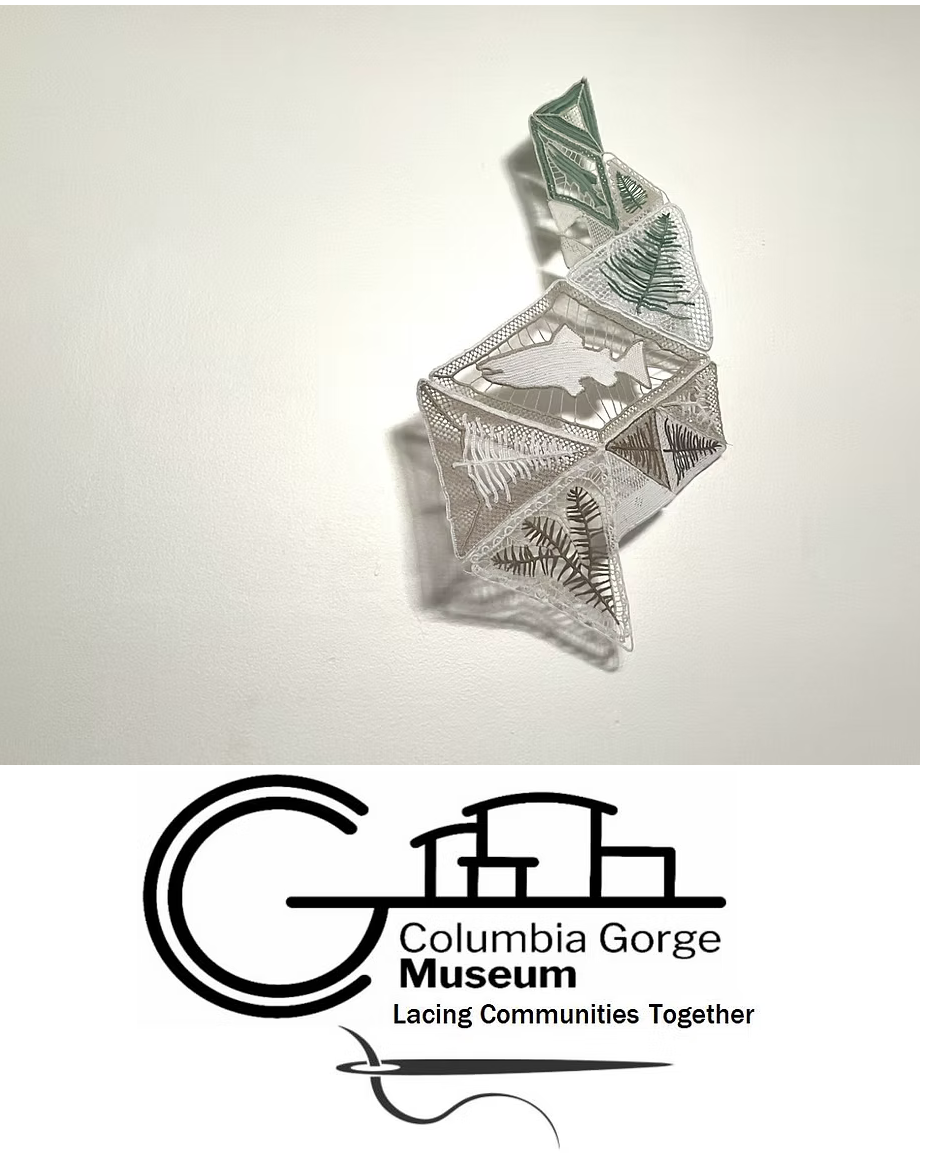
The Lace project celebrates both, the heritage art form of lacemaking and a community of people dedicated to preserving traditional skills and/or elevating them to new forms fit for this century. Under the auspices of Australian artist Maggie Hensel-Brown, lace guilds in the PNW, and the engaged team at the Columbia Gorge Museum, a lace installation will be revealed in September.
People from all over the world have sent lace triangles to be included in a huge compilation – as of this point, there are over 380 of them to be sewn together…. Local libraries in WA have offered workshops and get-togethers, for people to learn the art form and find community with others around them. Details can be found here.
My contribution to this communal effort, other than a wonky little triangle,
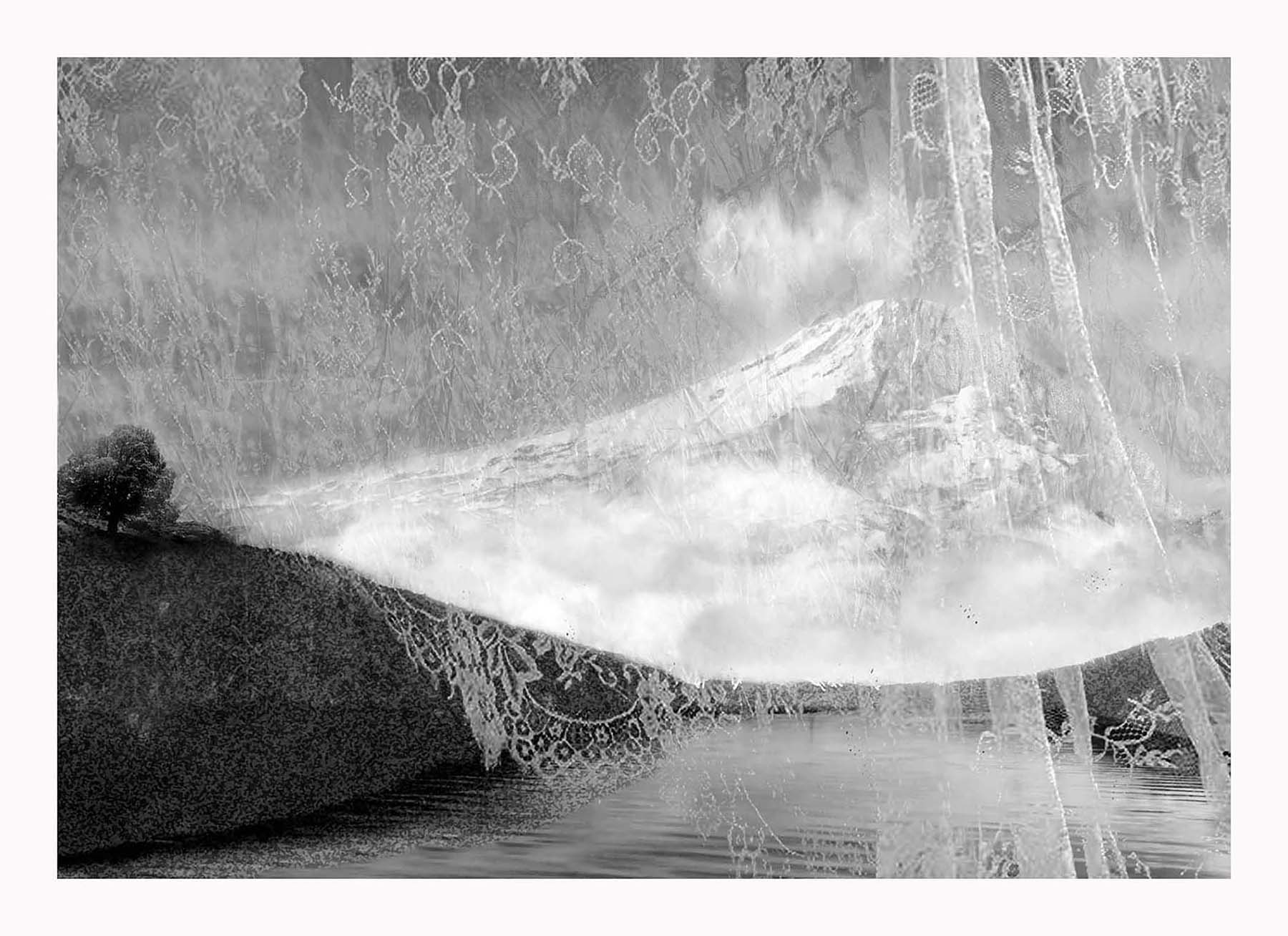
was the inclusion of lace of all kinds into photographs of landscapes.
“Fragility: This 2025 series of photomontages grew out of ongoing concern about insufficient environmental protection. Fauna and flora in these landscapes – photographed predominantly in the Pacific Northwest – are endangered. Climate change and the renewed threat of industrial extraction of resources, forests and minerals alike, will do irreparable harm. I thought the ephemeral nature of clouds and the fragility of lace were fitting symbols for why we need step up in our efforts to turn things around.”
The photographic exhibition is on view now, ongoing through late fall.
The joint opening reception with the Lacing Project will be
Friday September 11, 2026 5:30 – 7:30 pm.
Columbia Gorge Museum
990 SW Rock Creek Dr, Stevenson, WA 98648 (near Skamania Lodge)
A lot of eggs popped up last week. First a nest with duck eggs right off the footpath – unclear who was more startled, the duck who sat on them when I walked by, or I, when the duck flew up in a panic, practically fluttering into my face. (If s/he does that every time someone walks by, I predict there will be zero ducklings hatched…)
Next I saw a number of eggs or egg-shaped forms of various materials arranged in the house of a friend. A ceramic artist herself, she creates beauty with whatever she finds.
We shared the excitement of seeing bushtit parents flying in and out of a nest next to her kitchen window. Alas, the very next day the nest was destroyed by predators. Another generation lost.
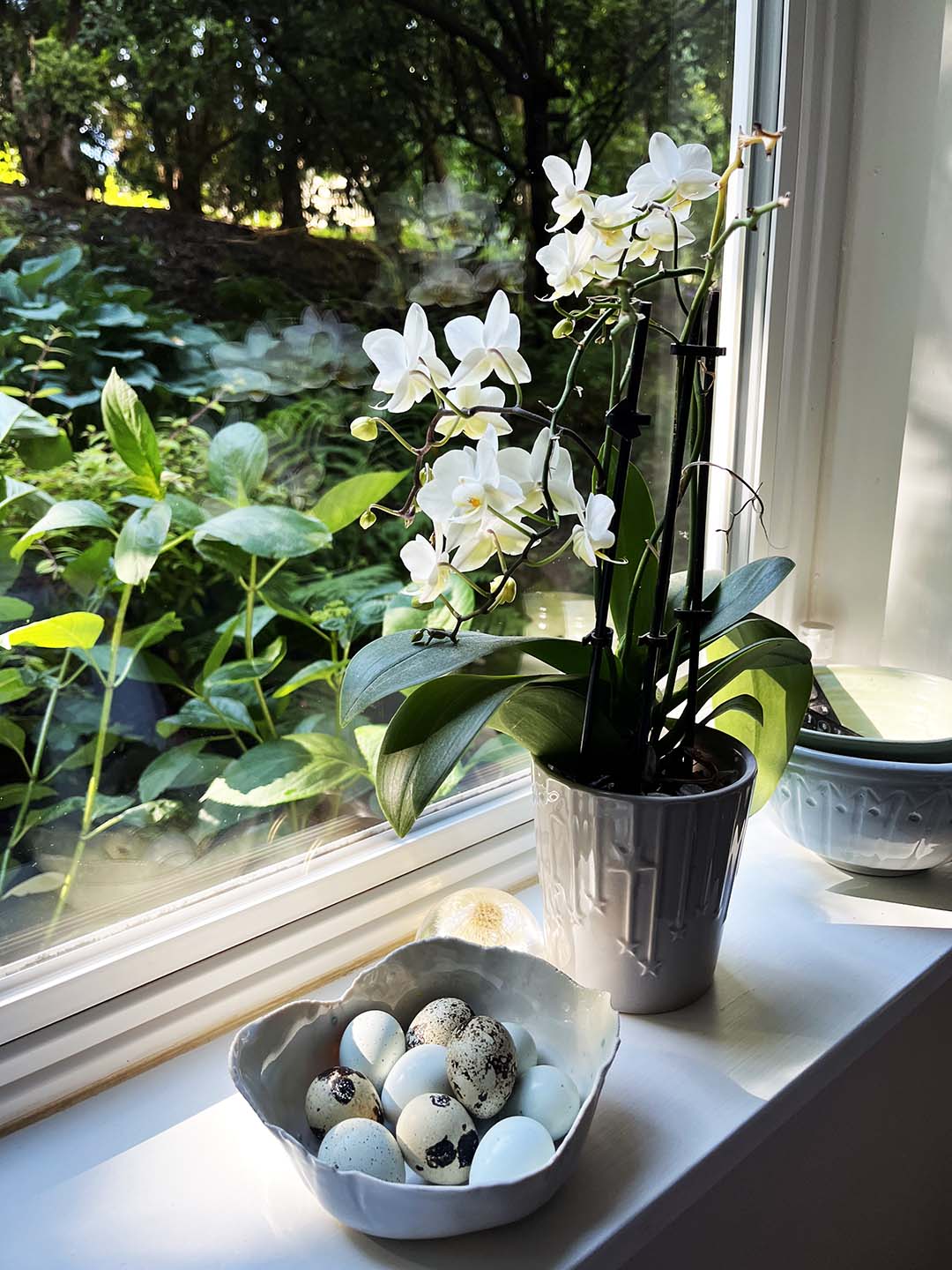
My friend sent me home with a bag of quail eggs which are now on my windowsill until they, predictably, rot and start to smell up the kitchen. The eggs, in turn, triggered thoughts about genetics, since I had just read Brian Klaas’ fascinating essay about research into genetics and the question who owns your genome. If researchers discover information about our genome that contradicts everything we believe to be true about ourselves, should we be allowed to interfere with publication of that knowledge? Should they be allowed to withhold that information from us? And how are those questions linked to potential abuse by people with racist agendas? If you find the introduction below of interest, here is the link to the whole piece:
“…..Thus began a descent down a fascinating rabbit hole into the thorny philosophical debates that define modern research into population genetics. What happens when longstanding historical narratives of identity collide with hard genetic evidence? Should DNA scientists always publish findings that could destroy a population’s sense of itself? And, if not, who gets to decide which kinds of scientific research are too sensitive to release?”
Science caught my eye, or my brain, as the case may be. But so did poetry – again related to stories of origin, linkage to tribal membership as juxtaposed to “others,” and, of course, quail eggs. The lines below were published in 2022 (link in the title.)
1. Seventeen months after I moved off the reservation, I traveled to London to promote my first internationally published book.
2. A Native American in England! I imagined the last Indian in England was Maria Tall Chief, the Osage ballerina who was once married to Balanchine. An Indian married to Balanchine!
3. My publishers put me in a quaint little hotel near the Tate Gallery. I didn’t go into the Tate. Back then, I was afraid of paintings of and by white men. I think I’m still afraid of paintings of and by white men.
4. This was long before I had a cell phone, so I stopped at payphones to call my wife. I miss the intensity of a conversation measured by a dwindling stack of quarters.
5. No quarters in England, though, and I don’t remember what the equivalent British coin was called.
6. As with every other country I’ve visited, nobody thought I was Indian. This made me lonely.
7. Lonely enough to cry in my hotel bed one night as I kept thinking, “I am the only Indian in this country right now. I’m the only Indian within a five-thousand-mile circle.”
8. But I wasn’t the only Indian; I wasn’t even the only Spokane Indian.
9. On the payphone, my mother told me that a childhood friend from the reservation was working at a London pub. So I wrote down the address and took a taxi driven by one of those London cabdrivers with extrasensory memory.
10. When I entered the pub, I sat in a corner, and waited for my friend to discover me. When he saw me, he leapt over the bar and hugged me. “I thought I was the only Indian in England,” he said.
11. His name was Aaron and he died of cancer last spring. I’d rushed to see him in his last moments, but he passed before I could reach him. Only minutes gone, his skin was still warm. I held his hand, kissed his forehead, and said, “England.”
12. “England,” in our tribal language, now means, “Aren’t we a miracle?” and “Goodbye.”
13. In my strange little hotel near the Tate, I had to wear my suit coat to eat breakfast in the lobby restaurant. Every morning, I ordered eggs and toast. Everywhere in the world, bread is bread, but my eggs were impossibly small. “What bird is this?” I asked the waiter. “That would be quail,” he said. On the first morning, I could not eat the quail eggs. On the second morning, I only took a taste. On the third day, I ate two and ordered two more.
14. A gathering of quail is called a bevy. A gathering of Indians is called a tribe. When quails speak, they call it a song. When Indians sing, the air is heavy with grief. When quails grieve, they lie down next to their dead. When Indians die, the quails speak.
(Alexie has acknowledged sexual misconduct allegations in 2018, and apologized. Many of his prizes and fellowships were rescinded or renamed. I do not know if he has written a novel since then, but his short writings appear on his substack. As always, we can debate if you can separate the person from the work, but I often go back to reading his words.)
May the quails be silent this weekend, and may lots of eggs hatch….
***
Speaking of hatching: PLEASE SAVE THE DATES:
I have two exhibitions coming up. One will hang at the Columbia Gorge Museum in Stvenson, WA, starting June 24, 2026 with a reception on September 11th, 2026 ( a combined celebration of lace artist Maggi Hensel Brown and community lace makers and my photographic work.)
Fragilityis a 2025 series of photomontages that grew out of ongoing concern about insufficient environmental protection. Fauna and flora in the depicted landscapes – photographed mostly around the Pacific Northwest – are endangered. Climate change and the renewed threat of industrial extraction of resources, forests and minerals alike, will do irreparable harm. I thought the ephemeral nature of clouds and the fragility of lace (superimposed on the landscapes) were fitting symbols for why we need step up in our efforts to turn things around.
Collective Effervescence brings together the work of Diane Jacobs, Susan Murrell and my own to explore our evolving relationship with the natural world. Rooted in shared energy, connection, and interdependence, the exhibition examines how human actions shape and destabilize the landscapes we inhabit. Through painting, photography, printmaking, and mixed media, we create environments that are at once familiar and altered. Together, we invite viewers to look closely, to explore and perhaps share the artists’ fervent belief that we can have a positive impact on preserving nature, once we shift from individual awareness to shared responsibility, and from observation to action. My contributions come from a new series When We Broke the World.
I will post more detailed information closer to the dates – just put them in your calendars for now!
Music today is from all around the world, I guess every shared gene pool! A collection of modernized folksongs. A beautiful album by Marisa Anderson.
Sometimes, when you look back, you can point to a time when your world shifts and heads in another direction. In lace reading this is called the “still point.”
The words above come from a recent novel where a particular make of lace plays a key role in the plot. (Historical murder and mayhem, inter-generational strife, an imaginative, fun, and occasionally overwrought romp.)
The first part of the quote felt timely in describing a turning point in the world, this March of 2026. The second part referred to something that sprung from the author’s imagination: descendants of the Salem witches divining the future from lace. So not a real thing – lace reading – that I naively assumed did exist. After all, people read tea leaves, crystal balls or cowry shells, why not lace? A “still point” seemed such an intuitive concept.
Our world is shifting and heading in another direction, though, isn’t it? So why do I turn to the topic of lace today, and not to other alternatives? I could think through how we should deal psychologically with our worries and fears, or how to seek community as to not face a crumbling world alone?
As you will see, lace, as introduced today, will speak to all of it.
Burratto Lace Grapevine Motif Italy 17th C
Lace is going to be at the center of this summer’s exhibition and activities at the Columbia Gorge museum. Executive Director Lou Palermo builds on the ideas and successes of previous projects for which she was instrumental during her time at Maryhill Museum. As I reported then, the Exquisite Gorge I and II programs collected the works of PNW printmakers and fabric artists, respectively. All of them celebrated aspects of the Columbia Gorge associated with a particular region. They were eventually displayed on the museum grounds in installations that preserved the geography of the river and its surrounds.
One of the most exciting part of these enterprises were the ways community was involved – community partners were called, and answered with extreme generosity, creativity, in-kind and financial support for all that was happening. Workshops involved library and schools, field trips allowed other artists to learn during master classes, people donated materials, opened their studios. From kids to grown-ups, participation was key – from learning to make prints, to how to weave, or do silk screenings; from studying natural dyes collected from native plants, bee keeping, to learning about Native-American symbols and history associated with the Columbia Gorge.
It was this aspect that Palermo and her great team at the Columbia Gorge Museum wanted to make central in this year’s adventure: lacing communities together. They are encouraging engagement with a heritage art form that will create samplers devoted to core aspects of the region, the trees and the salmon. Under the guidance of a remarkable contemporary lace artist, Maggie Hensel-Brown, everyone who is interested can learn and contribute, not just select artists. By the end of August, the museum will have collected regionally, nationally and internationally stitched lace samplers that will be arranged into beautiful installations reminding us of the value and beauty of the landscape surrounding us.
Czech Lace Emilie Palickova (Detail) mid-1900
Multiple organizations have already pledged their collaboration. From Skamania Lodge, multiple library districts, the History Museum of Hood River County, to several lace and fiber arts-oriented organizations, like the Columbia Fiber Guild, Portland Lace Society, Lacemakers of Puget Sound and not least, the Arts in Education of the Gorge, all will help this project along. Local libraries will even hand out kits with all the necessary materials for making a small lace triangle to contribute to the installation to those interested.
Flanders Lace (Detail) 1700 – 1750
Are you among the many currently grieving the dissolution of the social fabric? That will be counterbalanced by fabric, holes and all, that was produced by a diverse community united in the hope they could deliver a thing of beauty, or at least an attempt to get there – you should see my first needle stitches. Not to worry, Hensel-Brown absolutely encourages imperfection, as long as you have fun trying. Huge relief, if you ask me.
She also provides step-by-step instructions for those new to the art form, both on video and as PDFs. She explains how you can gather the simple materials needed, and what to be on the lookout for, or practice with care. Her instructions are easy to follow, which does not mean that the first steps into needle lacing are a breeze. The needle work requires serious attention. I consider that one of the best ways to distract yourself from other thoughts, mind you. I am grateful for any half hour these days when I am not thinking about what is going on in the world, and strict attention protects my thoughts from straying.
I also found that the repetitive motions, once you have learned the one simple stitch involved in it all, can be extremely meditative. The kind of meditation that stills you and silences the worries for a while in this world that has shifted to yet another war. Check it out – you might find yourself as a part of a community that is learning and connecting while celebrating nature. Just what so many of us currently need.
Here are all the instructions helping with the Community Lace-Along.
Lace has had a complex history, influenced by diverse cultural backgrounds, and dependent on how it was created. Needle lace was started in the 15th century, made by women in Europe, popularized for the next 200 years. That lace is made entirely with a needle using a single thread on a temporary backing, wich is later removed. I love its name: Punto in Aria, stitches in the air. Angry at the world? Stab the air… a peaceful and productive way of letting off steam.
Lace can also be made with bobbins, a technique derived from braiding, developed pretty much in parallel to needle lace, using multiple threads. You can also create lace patterns with crocheting or knitting, but none as fine as the traditional techniques.
The art form and geographically refined patterns spread from Italy to Spain, France, Flanders and England. Lace makers fleeing religious conflicts often settled in other lace producing regions, interchanging patterns and techniques. Lace was a time-consuming art form, much prized as a status symbol for aristocrats or rich merchants. It certainly drew the attention of European painters of the Golden Age who left us with detailed examples of what their patrons wore. In fact, when I hear the word “lace,” it is these paintings that come to mind, long before thinking of fancy underwear, or bridal veils, or prayer mantillas, all commonly associated with the fabric.
Thomas Gainsborough Portrait of Mary Countess Howe (1760) Detail.
Eventually machines took over the jobs. The manual production knowledge might as well have died out with the professional lace makers after the industrial revolution, had it not been for artists who picked up on lace, and designers who saw its potential. Since the 1970s, there has been an explosion of interest in contemporary lace making, with societies founded to celebrate and educate about lace, museums established to preserve the history, and exhibitions devoted to many aspects of lace production, not least last year’s DesignBiennial in Venice.
How things are depicted changed with ever improved or altered techniques. What it is that was expressed in lace changed as well. Earlier simple geometric designs gave way to representations of nature. (The many gorgeous examples of trees shown on lace were of particular interest to Palermo, given the intended celebration of nature found in the Gorge.) Depictions of nature gave way to whole narratives, with human figures in cultural or political contexts, entire stories implied on small lace tableaus.
***
Here are just two striking examples of contemporary perspectives – Maggie Hensel-Brown‘s work and that of Agnes Herczeg which I find equally thought-provoking.
Some three years ago, Hensel-Brown gathered community to create an incredibly beautiful accumulation of leaves that were then conjoined. Over 400 participants, some 700 leaves, instilling a sense of fragility and resilience at the same time.
The artist’s individual work is characterized by story telling. She takes everyday scenes and infuses them with magic, via a pattern defined by negative space, all with a needle and a single thread. The portraits capture emotions, anchoring those universals in the specifics of our Covid- or Internet-driven times. Details abound, asking us to explore deeper and deeper into the fray.
Maggie Hensel-Brown Quarantine Self Portrait I (2020) (all images from her website)
Maggie Hensel-Brown Sheets (2022)
Maggie Hensel-Brown Not useful, not beautiful (2023)
Maggie Hensel-Brown January 24th (2024)
I cannot wait to see her work in person.
***
Herczeg is a Hungarian artist who combines lace creations with branches and sticks she finds along the local beaches of the river Danube.
The juxtaposition of the airiness of the lace and the hardness of the wood creates a sculptural effect, with each medium competing for attention, yet emerging as an organic whole. I am particularly drawn to her hand coloring of the lace once the needle work is done. It provides additional depth to the configurations, further strengthening the sense of sculpture.
Agnes Herczeg: The resting place, 2019, 5 cm high, Needle lace with silk thread and thin wire contour combined with poplar branch, hand-painted
Agnes Herczeg: The tree, 2019, 9 cm high, Needle lace with silk and juta thread with thin wire contour, combined with beech bark, hand-painted. (Source)
We’ve come along way since the 14hundreds. It is glorious to think that the heritage is preserved and continues to be handed down to each next generation, with ever new twists and turns, not only of needles. Much to look forward to this summer, when the Columbia Gorge Museum will display lace variations and a renowned artist available on location.
“I like maps, because they lie. Because they give no access to the vicious truth. Because great-heartedly, good-naturedly they spread before me a world not of this world.” – Wisława Szymborska
This stanza from Szymborska’s poem Map, the last one she wrote before she died, loomed large in my head when I drove home after a conversation with a local artist who had invited me for a studio visit to explore the project she is currently working on.
Kristie Strasen is a renowned colorist and textile designer, with numerous awards under her belt, and, more importantly, decades of experience in creating pattern and color schemes for high end textiles where execution matches her original visualization. In the decade or so since she relocated from New York City to the Columbia Gorge, she has infused her creativity, her skill set(s) and her curiosity about the history of her new home into ever more ambitious projects at the loom.
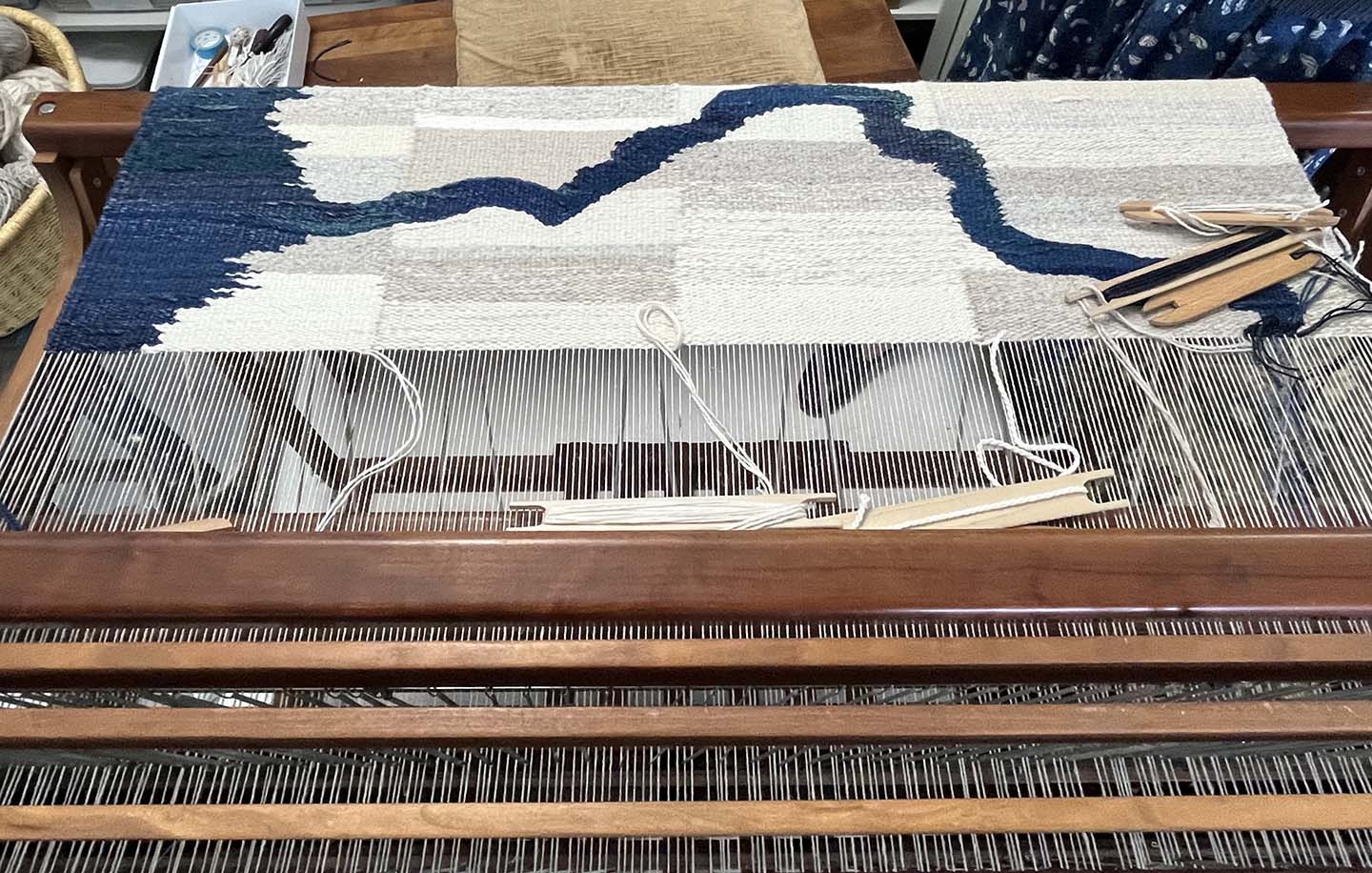
Her current endeavor can be described as a work of cartography, in the widest sense. The weavings model reality in the most abstract ways, combining scientific inquiry, aesthetics and technique, as all map making does that tries to capture reality in spatial form.
River Stories will depict the entire course of the Columbia River from the Canadian headwaters to the mouth where it enters the Pacific Ocean, some of the tributaries, like the Klickitat and the White Salmon river, and several sections of the Columbia Gorge Scenic Area.
It is technically a complex endeavor. Strasen enlarged maps that show the geographic features of the river course, bends and all, partitioned the sections into grids and then traced the river course, eventually with dots under the warp of her loom.
With free hand weaving she delineated an exact depiction of how the river runs, through six sections, with background colors reflecting the tone of the respective landscapes, the forests, the cliffs, and the eventual softness at the confluence. The color choices required more than just her perfect eye – because the wool in the requisite colors was of different weight, the straight edges, pride of accomplished weavers like Strasen, had a tendency to be less than perfectly straight, once off the loom. Probably only detectable for experts, but something the weaver had to grapple with given her high standards.
All I can say: The tapestries are a beautiful, but I equally marvel at the way Strasen transforms her curiosity about the world into a specific work of art that shares some of her insights with the viewer.
Curiosity about the world: in addition to a longstanding fascination with maps, the artist devoured the literature about the history of the Gorge, the consequences of Western expansionism, and the effects of human intervention on nature, once she had arrived in White Salmon, WA and made it her home. She felt called to draw our attention to both, the consequences of our meddling with nature, as well as the preservation of it, the latter largely due to early efforts of individuals like Nancy Neighbor Russell, who was instrumental in rescuing the Columbia River Gorge in Oregon and Washington, threatened by commercial interests. Russell founded Friends of the Columbia Gorge in 1980, working to protect the Gorge from development and secure it for federal protection, th Columbia River Gorge National Scenic Area Act, passed by the U.S. Congress in 1986.
***
Maps express particular viewpoints in support of specific interests.They can shape our view of the world and our place in it by selectively presenting information. This can be bad when the purpose of persuasion is manipulation. I had written about this some years ago in the context of another map making and art project:
“The goal of suggestive mapping was to achieve political objectives (while avoiding lies, which could be easily exposed) by appealing to emotions and rigorously excluding anything that didn’t support the desired message. Its maps were intended specifically to engage support from the general population, and they were often “shamelessly explicit. Cornell University has a wonderful introduction and collection of maps all sharing the purpose of persuasion. The topics range from religion, imperial geopolitics (think colonialism), slavery, British international politics, social and protest movements to, of course, war. The goal was made explicit in the 1920s (and later taken on in force by the Nazis) when in reaction to the shameful defeat in WW I German cartographers decided to go for the “Suggestive Map,” cartographic propaganda which they thought had given the British a strategic advantage.”
But the way information is presented can also have the positive impact of a warning or an invitation to think things through critically. A selective tool used by Strasen is the color she chose to mark the various dams blocking the natural flow of the river. In my interpretation, bright red bars signify the danger, the concept of halting, the possibility of destruction and the ongoing heat of the discussion around the justification (or absence thereof) of dam removal. These visual magnets emphasize obstructions that we now know had ongoing disastrous consequences for fish populations, never mind the trauma of displacement for the Native American tribes affected by the dam construction. They remind us how much the lifeblood of the Pacific Northwest, this river and all who it serves, are endangered by efforts towards relentless extraction, a view shared with the Columbia River Keeperswho are passionately engaged in its protection.
***
Maps in art have been around for some time (for a short history of this intersection, go here.)
Art, like maps, can be a tool of persuasion, doubling the force of that intention when utilizing maps’ suggestive power, which can be done in a number of ways.
Mona Hatoum, born in Lebanon to Palestinian parents and living in England, for example, took copies of the flight route maps you find in airplanes, and added hand-drawn designs in ink and gouache. Rather than focussing on geographic borders, she delineated the movement across the globe, leaving to us the decision if that movement was voluntary or not. She herself describes the paths she drew to be “routes for the rootless.”
Mona Hatoum Routes II (2002) Photo Credit: MOMA
Later work employs sculpture, with red neon outlining the continents, representing a globe riddled by hot spots, places of military or civil unrest, a world aflame.
Mona Hatoum Hot Spot III (2009) Photo Credit Agostino Osio.
Closer to home, artist Mark Bradford has made his mark with his large-scale mixed-media works that combine representations of geography and the ruinous fate of residents of depicted areas. The artist models the streets and buildings of specific neighborhoods with string or caulk, layering scavenged paper on top and cutting and peeling away layers to both conceal and expose the geography. Some of his map paintings refer to areas in L.A. shaken by violence in the 1992 riots. Others refer to scorched earth, referencing the Tulsa Race Massacres of 1921 which wiped out Oklahoma’s Black Wall Street.
Mark Bradford Black Venus (2005)
Mark Bradford Black Wall Street (2006)
Mark Bradford Scorched Earth (2006)
Not all art is, of course, explicitly political. Some, like Juan Downey‘s Map of America, draws swirls of color to stimulate the imagination.
Juan Downey Map of America (1975)
Then there is Maya Lin’s Pin River project – sculptures depicting river courses with pins or marbles, up to 20.000 in this rendering of the Hudson river watershed. She also uses installations created from more than 200 bamboo reeds in the form of a 3D drawing of the Hudson River basin,
Maya Lin Folding the Hudson (2018)
Maya Lin Pin River—Hudson Watershed (2018) detail.
Maya Lin Map of Memory, Hudson River (2018)
All of these works, in their own way, demonstrate that maps can be used for more than an efficient way to communicate spatial information.
This is also the case for Strasen’s tapestries, which are surely more than a tool to help us think about our physical surroundings. Her unapologetically reductive maps offer less context and more of a sense of wonder for a particular place, a particular beauty and history. A world not of this world, and yet.
The blue band of the river, set against an immense backdrop of diffuse landscape coded only in color, gives us a figure/ground constellation that tells a story emphasized by this degree of abstraction: the centrality of a river shaped by forces larger than us, defining a region, essential to its – and our own – survival.
The work will be completed in June when it will be inaugurated during a solo show at the Columbia Gorge Museum.
I cannot wait to see it hung!
Columbia Gorge Museum E.D. Lou Palermo, inspecting a finished section of the tapestry.
October, time for my annual sharing of the recent beauty I found in the woods.
I’m clearly not the only one preoccupied with mushrooms at this time of year. This coming Saturday, October 19th, Stevenson, WA offers its inaugural Mushroom Festival. In their words: “Whether you’re a seasoned mycologists, blossoming enthusiast or simply fungi-curious, don’t miss this unforgettable weekend in Stevenson, Washington.”
Loved that. Call me Fungi-curious!
There will be culinary attractions, lots of vendors for all things mycological, and workshops and demonstrations, including plenty of kid activities. Details here.
With perfect timing, the Columbia Gorge Museum opens its doors to the community once again with particularly interesting offers. Currently on exhibit is artist Julie Beeler, with works directly and indirectly driven by her passion for mycology. Symbiosis features, according to the exhibition announcement, “immersive ‘tree totems’ showcasing the vibrant hues derived from regional fungi, alongside textile pieces, mono prints, and photographs that illustrate their connection to the environment.”
Photo Credit Columbia Gorge Museum
Beeler derives dyes from mushrooms, forty varieties of fungi to create 825 vibrant natural pigments, dyes, and paints by some count, and creates sometimes wondrous textile configuration that capture the essence of the PNW landscape colors and configuration.
In addition, she conveys all that knowledge in a recent published book, illustrated by Yuli Gates, The Mushroom Color Atlas. The interactive feature on the link allows you to pick any specific color and then learn which mushroom provides that kind of dye. The book, overall, teaches us about the mycological world, drawing people into exploration of our natural environment.
The artist will be giving a hands-on pigments, paints and inks demonstration at the museum on Saturday. Columbia Gorge Museum | 990 SW Rock Creek Drive | 1pm – 2pm.
It will be followed, at 3:30 pm by Mycophilia In This Now, a presentation by mycology educator and facilitator Jordan Weiss. The educator will feature spectacular mushroom photography and explore the emerging use of technology for fungi as well as information about psilocybin. Weiss has been sharing his knowledge of fungi for decades, working with groups such as the Oregon State University Extension Master Gardener program and Telluride Mushroom Festival as well as mushroom clubs in Salem, Estacada and Bend.
If you can’t make it out to the Columbia Gorge Museum (it is a 50 minutes, beautiful drive, with easy parking, but I get it…) there is another opportunity to dive into the world of mushrooms. The Oregon Mycological Society offers its annual Mushroom Show at the World Forestry Center in PDX on October 27th, from 12 – 5 pm.
Photocredit: OMS website
Yours truly will seek the pleasure of the solitary (photographic) mushroom hunt instead. Blissfully ignorant about their classification, usage, or poison power, just attracted to their spectacular visual beauty, iPhone in hand, composing the next photo montage in my head.
Music today is the latest installment of DJ Farina’sMushroom Jazz, compilations started many years ago. One more delightful than the next.
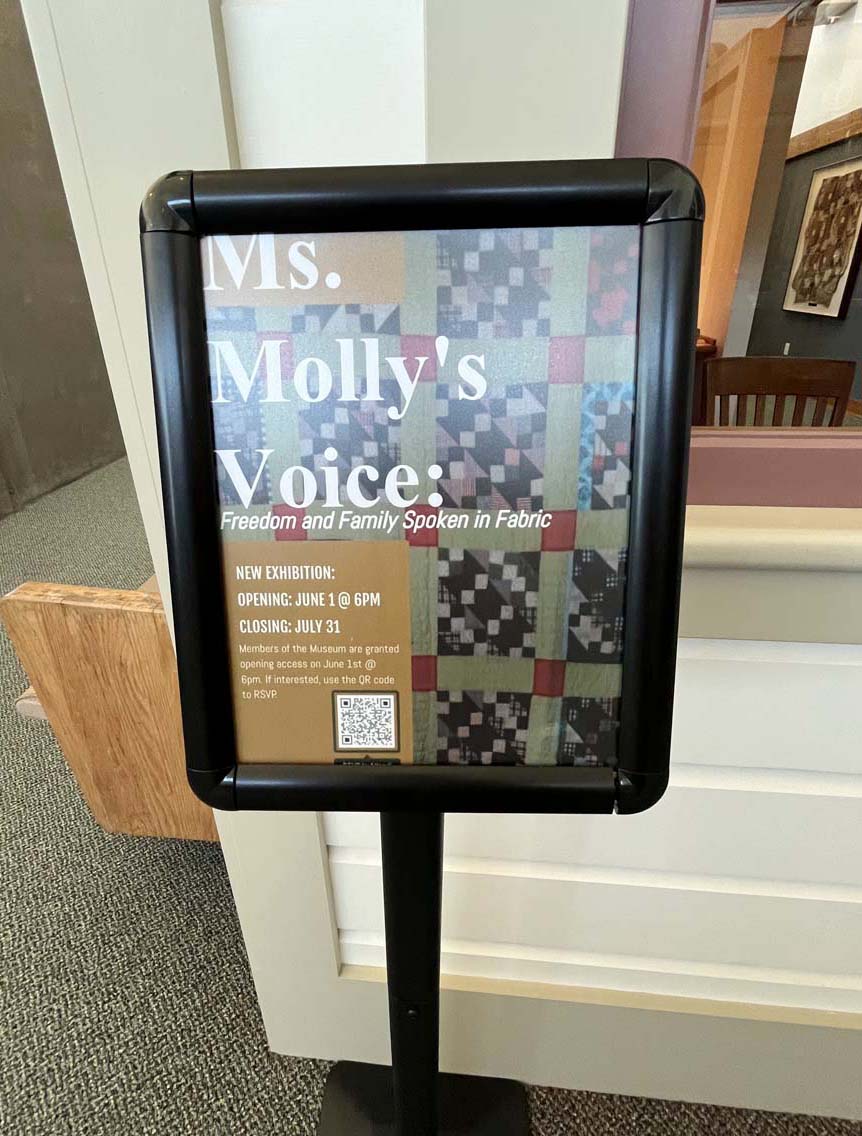
Just a 50 minute drive from Portland, OR, you enter an entirely different world – old growth forest covering the mountains, steep cliffs, the majestic Columbia slowly making its way through a gorge that was carved millennia ago into the landscape. If you happen to visit the Gorge Museum in Stevenson, WA on your way East, you can currently immerse yourself in yet a different world still – a collection of quilts that witness the life, skills and wisdom of a 19th century slave, handed down to next generations. Named the Hartsfield Collection after the family who preserved the legacy of one of their ancestors, a former slave, it serves as an entry into the patterns of both slave life and quilting.
Crossroads Quilt, Late 19th Century
The accumulated heirlooms are part of a collection created and persevered by a family dedicated to witnessing history, including that of their very own ancestor(s.) The current generation is represented by Jim Tharpe, who realized that the quilts, made by five different seamstresses across four generation from 1850 – 1960, were of enormous significance and able to tell a story that resonated beyond what we know theoretically about quilting during slavery. His insights and persistence to bring something of significant historical value to our eyes made it possible that these quilts are now making their rounds in museums keen, among others, on teaching history.
The exhibition is expertly guided by signage that tells you about the provenance and meaning of each quilt (as displayed in my photographs.) You can learn even more detail in a book written by Tharpe and available at the museum, that explains the family history, the creation of the collection and his purpose in investing his passion, time and energy into the preservation of the collection.
The earliest quilt, the Slave Quilt (1850), was made as personal bedding by a thirteen-year old slave, Ms. Molly, who was sold away from her family to a plantation in Whitlock, Tennessee. Close inspection reveals not just use and tear, but also bloodstains. We will never know if from the whip, rape or childbirth – she bore two sons to her Master, who were fortunately not sold away from the household. Faded, easily overlooked, they nonetheless instill a sense of the horrors of the life that then-child must have experienced.
She taught her skills to her own children and in-laws after the Civil War was won. Eventually the family relocated North, but still trecked to Tennessee many years later to visit relatives that remained there, often under the shadow of racism that put travelers in danger.
Danger while traveling was, of course, one of the hallmarks of the Underground Railroad movement, helping slaves to escape their masters and start a new life somewhere supposedly more safe, if not free. One of the ways to prepare, or to warn, or to help people finding their ways and supportive allies, was a language of communication contained in quilts. Specific patterns indicated specific requirements or signals to those on the move.
Expert quilters might be well aware of this history, lots written about it. For the rest of us, even though we are aware of forms of communication not contained in written words – just think of the knotted messages of the Incas, Semaphore or Braille, sign-language or Morse code – we might not know about the meaning of patterns around in quilts. I certainly had no clue, even though I count two expert quilters among my friends.
The exhibition then, really opened my eyes not just to the creativity of individual seamstresses and the beauty of their resulting work, but the meaning behind much of what was in front of me, guiding me into a world that lacked all the privilege of my own and that holds historical lessons we should well heed.
In general, there were ten quilt codes to be used for the journey, with just one displayed at the time. A sampler with all the codes in small form, secretly passed around, served as a teaching device for memorization of the patterns. The quilts were displayed in windows or hung out with the washing to inform the travelers. The backs and fronts were joined by twine tied two inches apart, with patterns of knots mapping the existence and distance of safe houses along the route. (Ref.)
Here are some of the patterns used in the quilts on exhibit (note, there are variations in names across states, not captured here):
The variety of the artistry shown is helpful for us to understand how form, function and aesthetics go hand in hand. The dedication of this family to relating the skills to subsequent generations and preserving, despite many moves across the U.S. what is a treasure, makes it very clear that they know about the importance of history, and the ways its official telling needs to be supplemented by people who’ve actually experienced it from diverse perspectives.
I was particularly moved to see the oldest and most recent of the quilts exhibited in juxtaposition. The latter was a graduation present to Jim Tharpe, with an inconspicuous love letter stitched into the sidebars, just as the blood stains were inconspicuous on the former. It brought home to me that it is not enough to be exposed to something in order to witness. You have to look. Look carefully. Not leave it to those lying at the bottom of the ocean.
The effort to bury parts of our history, efforts yet again sweeping our country in the form of curriculum changes, prohibition of certain books, elimination of programs dedicated to Black History studies and the like, is hopefully counter-acted by exhibitions like the current one. It brings history alive in front of your very eyes and encourages conversations with those you bring to this show, children included, about what is contained in these beautiful quilts and why it had to be kept secret.
Columbia Gorge Museum
Ms Molly’s Voice: Freedom and Family Spoken In Fabric
June 1 – July 31st, 2024
Open Everyday: 10:00am – 5:00pm
990 SW Rock Creek Dr, Stevenson, WA 98648
Special Event:
“In celebration of Juneteenth, the Columbia Gorge Museum will be hosting an open event where attendants will focus on creating quilt patterns in a dialogue with the patterns and skill of Ms. Molly. Take a guided experience through the quilt exhibition and thanks to some amazing Columbia Gorge quilters, create your own family document in a quilt square.
This event takes place June19th between 2 p.m. and 4 p.m. All are welcome!
If you would like to attend this event, simply RSVP here!“
Here is the full poem from which I took the quotation at the beginning of the review.