Browsing Category

Nature

Respite

Need respite from too much food, too much company, too many balls in the air, from recycling gift wrapping paper, never mind the ongoing harangues over social justice issues? Do I have the thing for you!

On this 5th night of Hanukah my present to all is a pretty remarkable audio work based on ultrasound and echolocation used by bats, dolphins and other creatures who operate beyond the range of human hearing – ‘seeing’ with sound, or perhaps ‘hearing’ objects. Added to that are “real” sounds, those that we can hear without them being stretched in time to be made audible.

“The mix for the piece is based on ultrasound, hydrophone recordings below the water and also of echolocation sound within audible range. The recordings were made in various locations in Central Park and East River in New York, USA, a forest outside Kaliningrad in Russia, Regents Park in London, UK, and various locations in Norway, Denmark and Sweden. The ultrasound is time-stretched to bring it into a frequency range audible for human beings. Recordings were made on a Pettersson Ultrasound Detector D1000X, Reson 4032 and DPA 8011 hydrophones and 4060 dpa microphones onto a Sound Devices 477T hard disk recorder.”

*

I started to listen to Jana Winderen at the beginning of December, when I came across the article attached below. The Norwegian scientist turned artist makes field recordings and then creates audio collages in her sound studio. When she at times composes immersive installations for specific places, like the Wuzhen Contemporary Art Exhibition in China, the Thailand Biennial, Oslo’s Kunstnernes Hus, and Art Basel, she checks out the acoustics, temperature, and air quality of the hosting location, talks to local technicians, and gets a feel for the architecture of the space, all of which gets integrated into the compositions.

Sitting and listening in a quiet place, uninterrupted, preferably with head phones, these compositions invariable generate a sense of peace and inner quietude that those of us who are meditation-challenged can otherwise only dream of. Your music for today.

And here are words capturing the sounds that the earth makes, as well.

Anchorage

By Joy Harjo

 for Audre Lorde

This city is made of stone, of blood, and fish.
There are Chugatch Mountains to the east
and whale and seal to the west.
It hasn’t always been this way, because glaciers
who are ice ghosts create oceans, carve earth
and shape this city here, by the sound.
They swim backwards in time.

Once a storm of boiling earth cracked open
the streets, threw open the town.
It’s quiet now, but underneath the concrete
is the cooking earth,
                                 and above that, air
which is another ocean, where spirits we can’t see
are dancing                joking                   getting full
on roasted caribou, and the praying
goes on, extends out.

Nora and I go walking down 4th Avenue
and know it is all happening.
On a park bench we see someone’s Athabascan
grandmother, folded up, smelling like 200 years
of blood and piss, her eyes closed against some
unimagined darkness, where she is buried in an ache
in which nothing makes
                                       sense.

We keep on breathing, walking, but softer now,
the clouds whirling in the air above us.
What can we say that would make us understand
better than we do already?
Except to speak of her home and claim her
as our own history, and know that our dreams
don’t end here, two blocks away from the ocean
where our hearts still batter away at the muddy shore.

And I think of the 6th Avenue jail, of mostly Native
and Black men, where Henry told about being shot at
eight times outside a liquor store in L.A., but when
the car sped away he was surprised he was alive,
no bullet holes, man, and eight cartridges strewn
on the sidewalk
                        all around him.

Everyone laughed at the impossibility of it,
but also the truth. Because who would believe
the fantastic and terrible story of all of our survival
those who were never meant
                                                to survive?

No Turkey to be seen

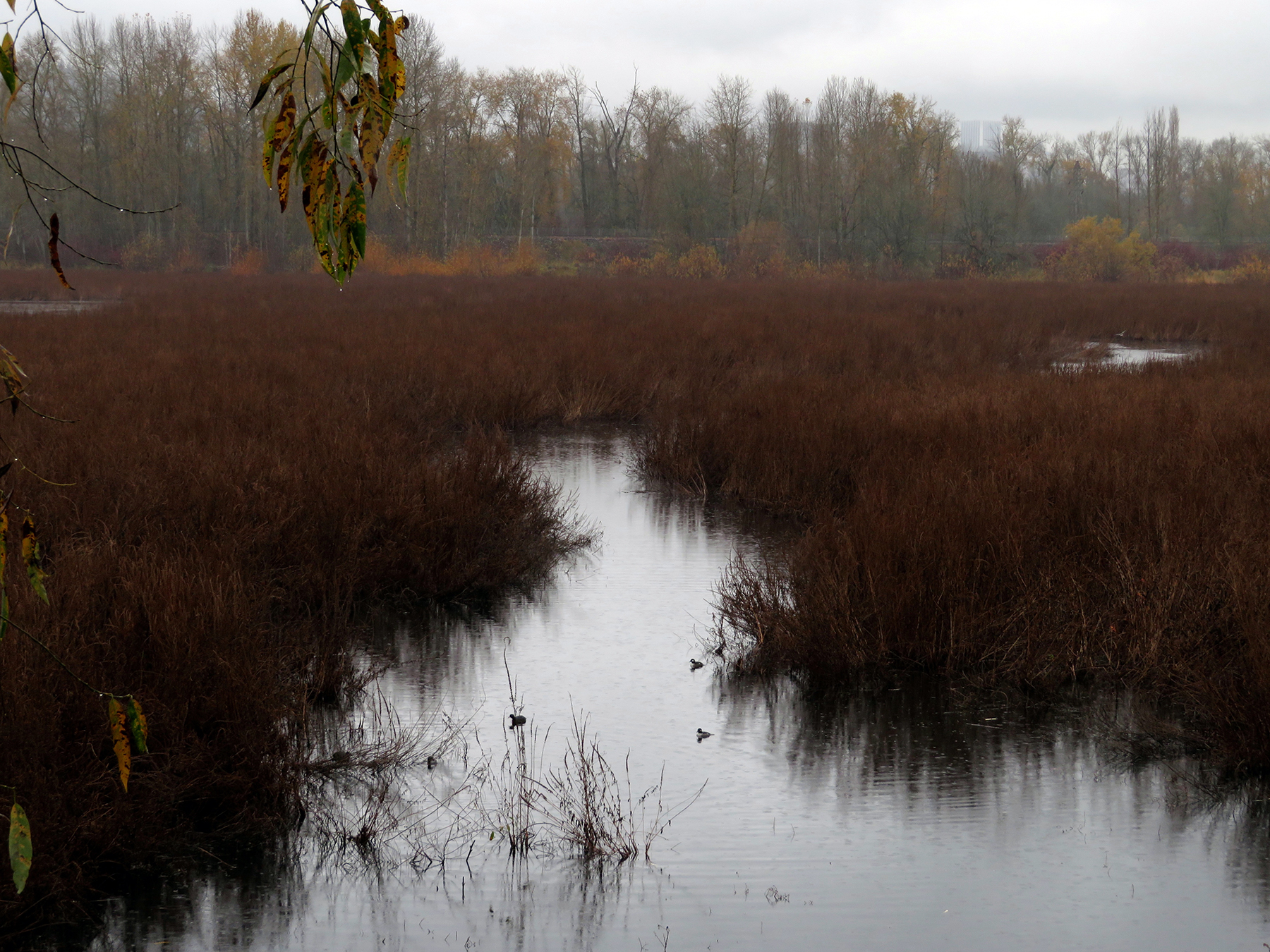
I went on a turkey hunt yesterday, under a dark sky, with rain steadily falling, nature quietly preparing for the impending storm. Did I find any? Of course not.

I did find solace – the grey above had almost a greenish tinge which in turn enhanced the reds of the sprigs and branches of the shrubbery stripped of leaves. The colors were harmonious rather than melancholy, and the rain almost cheerful in its relentless drip.

Bald eagles were crossing the river, alighting eventually on some boulders in the middle of the stream, usually covered by water at this time of year. Not after this dry summer.

Ducks were cruising, up and down the rivulets running through the marsh. I heard red-winged black birds sing; that, too, rather late this year.

True thankfulness on this walk, on many walks, on almost every occasion of this vibrant life of mine. Thankful for my family, my friends, my readership, slowly growing and making me feel connected.

I’m signing off for the rest of the week, for some needed rest and recuperation. Wishing you all a Happy Thanksgiving! With music to lift heart and spirits (while bellies sag from all the food – I assume the missing turkeys can be found in your various kitchens…)

Crisp

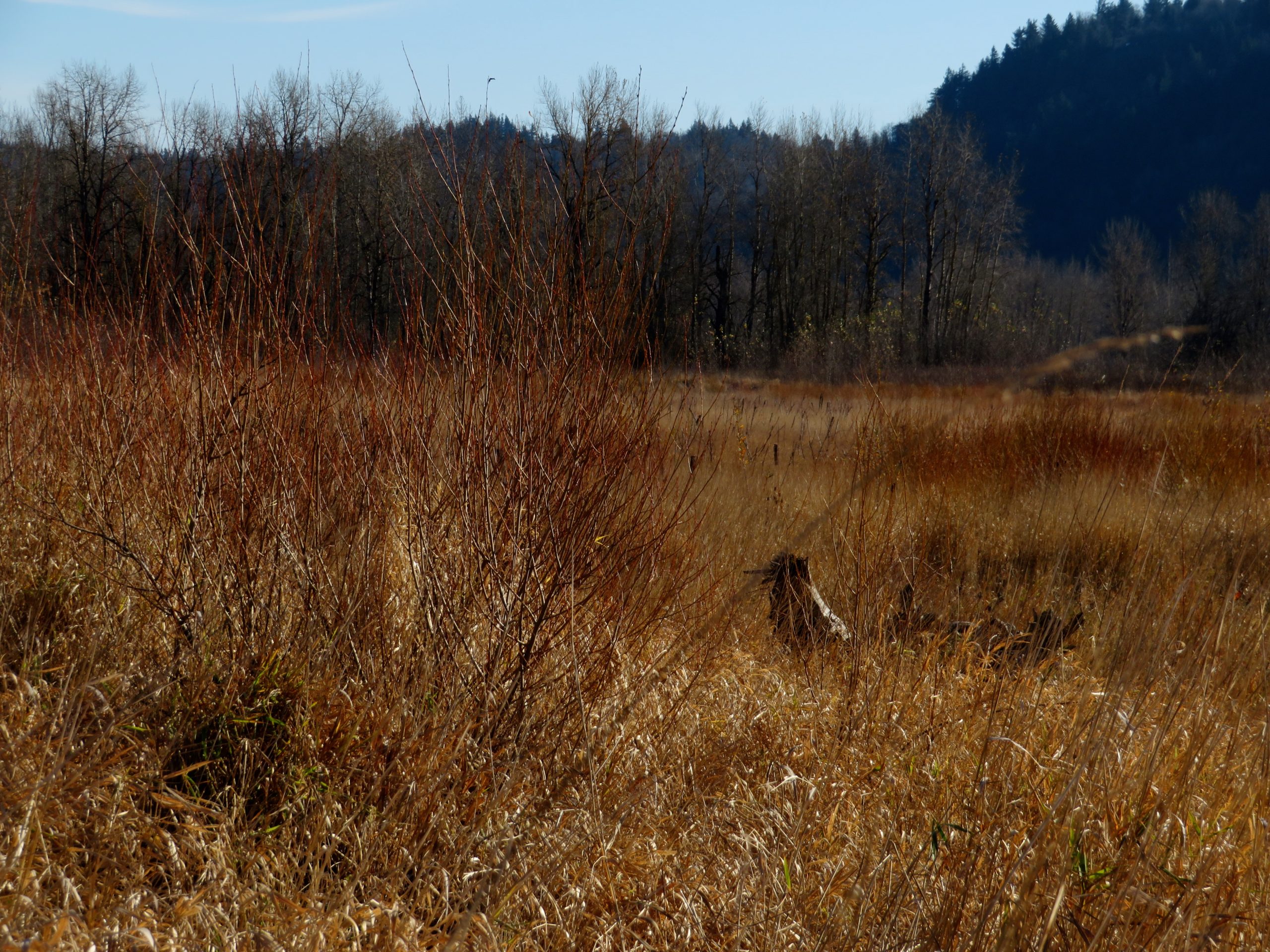
Just so you see the rest of my week’s ambling, here are photographs of yesterday’s walk at the Sandy River Delta, a half hour’s drive from Portland.

Not a cloud in the sky, thin, cool air, the mountain visible and the dog happy. The human too. Color palette went from red to gold to blue, reflecting sun off the water. Hard, clear November light.

I am pairing this with a poem by Thomas Hood (1799–1845) titled No! or alternatively November about this month. Unless you think he saw into a future where global warming has brought dystopia on all of us, here is a hint.

Hood wrote from London, a city heated by coal during the first cold waves of November. The sulphuric smog, paired with fog rolling in, obscured everything, made it hard to breathe, and blocked out traffic, including movement of needed goods.

November

No shade throwing on my part – just a reminder, sensed during every minute of that walk, that we still inhabit a beautiful world an need to fight hard to keep it.

Music today is about the last of the falling leaves.

To Autumn

John Keats (1795-1821)

Season of mists and mellow fruitfulness,
  Close bosom-friend of the maturing sun;
Conspiring with him how to load and bless
  With fruit the vines that round the thatch-eves run;
To bend with apples the moss’d cottage-trees,
  And fill all fruit with ripeness to the core;
    To swell the gourd, and plump the hazel shells
  With a sweet kernel; to set budding more,
And still more, later flowers for the bees,
Until they think warm days will never cease,
    For summer has o’er-brimm’d their clammy cells.

Who hath not seen thee oft amid thy store?
  Sometimes whoever seeks abroad may find
Thee sitting careless on a granary floor,
  Thy hair soft-lifted by the winnowing wind;
Or on a half-reap’d furrow sound asleep,
  Drowsed with the fume of poppies, while thy hook
    Spares the next swath and all its twined flowers:
And sometimes like a gleaner thou dost keep 
  Steady thy laden head across a brook;
  Or by a cider-press, with patient look,
    Thou watchest the last oozings, hours by hours.

Where are the songs of Spring? Ay, where are they?
  Think not of them, thou hast thy music too,–
While barred clouds bloom the soft-dying day,
  And touch the stubble-plains with rosy hue;
Then in a wailful choir the small gnats mourn
  Among the river sallows, borne aloft
    Or sinking as the light wind lives or dies;
And full-grown lambs loud bleat from hilly bourn;
  Hedge-crickets sing; and now with treble soft
  The redbreast whistles from a garden-croft,
    And gathering swallows twitter in the skies.

Written September 19, 1819; first published in 1820. This poem is in the public domain.

And here is, in addition to the bounty, to the wistfulness of October…..

Fall Color

Peak foliage color is later this year than what used to be the norm. The rise in average temperatures affects this process of nature as well. Not only is the onset of color change delayed, but the colors themselves are changing – the intense oranges and reds of autumn will become more and more rare, giving way to muted yellows and browns.

I learned this from an article about interactive maps that point travelers to where to go for the best colors at any given moment in time, something I had been curious about. It is, to put it mildly, dispiriting when you try and read up on nature and can’t avoid bad news even with the simple inquiry about the timing of fall colors….

So let’s balance that out with some good news, at least for us here in town. Last year’s Lenny Bernstein craze around the centennial of his birth led to an explosion of Bernstein-related musical programs but also a traveling exhibition about the composer/ conductor’s life curated by the GRAMMY museum. After previously having been shown at the John F. Kennedy Center for the Performing Arts, the Skirball Cultural Center, and the New England Conservatory, among others, it has now reached its 9th stop: the Oregon Jewish Museum and Center for Holocaust Education.

OJMCHE will have the exhibit of 150 artifacts on display until early January, but, importantly, will augment what’s there to see with some promising events linked to the show. Among others, there will be a story swap between musicians from a variety of genres, reaching from classical music to ska-punk. 45th Parallel will offer two concerts of Bernstein’s chamber music at the museum. Fall might be colorful, after all, if only in musical modulation.

What’s likely not covered in the exhibit (I have yet to visit) are the less public and darker aspects of the maestro’s life. A short and sensitive summary can be found here.

For music it shall be a symphony often connected to autumnal moods: Brahm’s No.4 in E minor. Conducted by Bernstein, of course.

Contemplation

Animals have a great advantage over man: they never hear the clock strike, however intelligent they may be; they die without any idea of death; they have no theologians to instruct them…Their last moments are not disturbed by unwelcome and often objectionable ceremonies; it costs them nothing to be buried; no one starts lawsuits over their wills.

—Voltaire

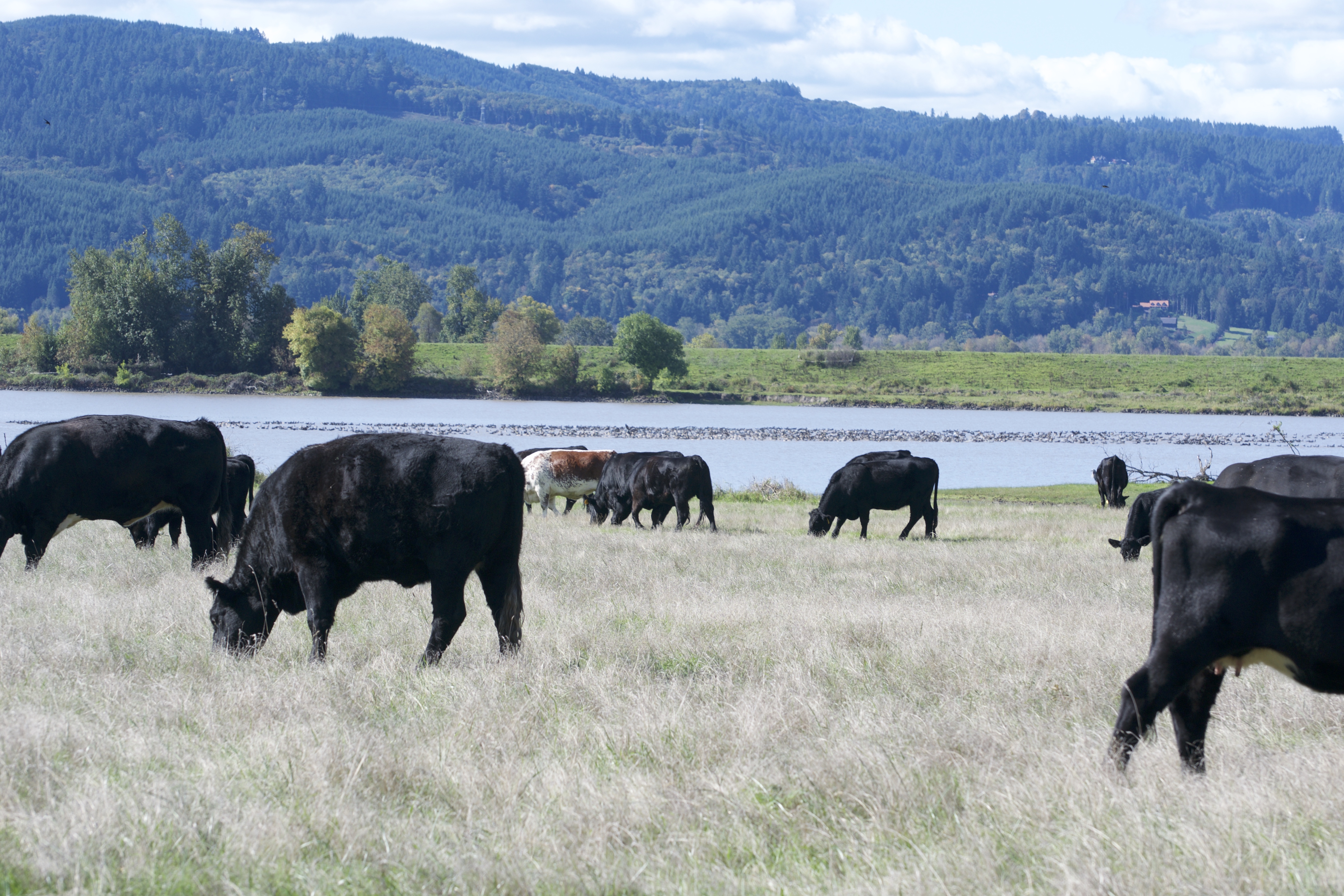
Who can say what cows feel, when they surround and stare intently on a dying or dead companion?

—Charles Darwin

It was the last day before the cows would be herded to different grazing grounds. Hunting season begins October 1st, and they have to be out of the way. It was thus also the last day for a walk around this particular area of Sauvie Island. From now until April 1st hikes are severely restricted.

I have no clue what cows feel. Does the possibility of not knowing about death outweigh the burden of not knowing that pain ends, either? Be it the fleeting pain that you and I know will be gone either by passage of time or the next dose of Ibuprofen? Or the chronic pain that we know will end with the loss of our current consciousness?

I have also always wondered about the fact that cows look at you. Ever noticed? Other animals out in the open might strike you with an evaluative glance before they decide to scurry to safety. Maybe your domesticated friends look at you when they want food, a walk or are simply bored or proud to show off a trick – but that prolonged stare of interest that you get from cows who don’t expect anything from you? It is puzzling.

Of course the premise that animals don’t know about death itself – still prevalent in the early 1970s, when anthropologist Ernest Becker wrote in his Pulitzer Prize–winning book Denial of Death that nonhuman animals know nothing about dying: “The knowledge of death is reflective and conceptual, and animals are spared it” – is questionable. Scientists now believe that at least some species recognize the special nature of death, elephants and chimpanzees among them. There is certainly some form of grieving in evidence, when loss occurs.

*

You might wonder why the theme of death pops up a second day in a row: it is the season in the Jewish calendar where thoughts of life and death (as well as our personal behavior and responsibility for our actions) is writ large. The days between the New Year and the Day of Atonement are meant to be days of contemplation, days of fear of punishment but also of hope that repentance and change is possible and able to avert divine retribution. The core of the message – independent of religious belief – speaks to me: annual re-assessment of our own moral compass and conscious decisions to try to do better is a valuable thing.

The poem that is recited on the High Holidays, the Un’taneh tokef, captures it aptly, with looming threats and the possibility of getting it to the point.

Here is an excerpt:

Let us now relate the power of this day’s holiness, for it is awesome and frightening. …….All mankind will pass before You like a flock of sheep. Like a shepherd pasturing his flock, making sheep pass under his staff, so shall You cause to pass, count, calculate, and consider the soul of all the living; and You shall apportion the destinies of all Your creatures and inscribe their verdict.

On Rosh Hashanah will be inscribed and on Yom Kippur will be sealed – how many will pass from the earth and how many will be created; who will live and who will die; who will die at his predestined time and who before his time; who by water and who by fire, who by sword and who by beast, who by famine and who by thirst, who by upheaval and who by plague, who by strangling and who by stoning. Who will rest and who will wander, who will live in harmony and who will be harried, who will enjoy tranquility and who will suffer, who will be impoverished and who will be enriched, who will be degraded and who will be exalted. But Repentance, Prayer, and Charity annul the severe Decree.

……

Here is a traditional recitation by a Cantor.

And here is a Leonard Cohen songs that riffs of the poem:https://www.youtube.com/watch?v=EgMaBreDuF4

Tomorrow is Yom Kippur – I will be off-line.

And thus the inevitable question if cows like music has to wait for another day.

Back by popular demand: Nature!

Time to regroup and visit my regular landscapes where fall has made such a sudden entrance.

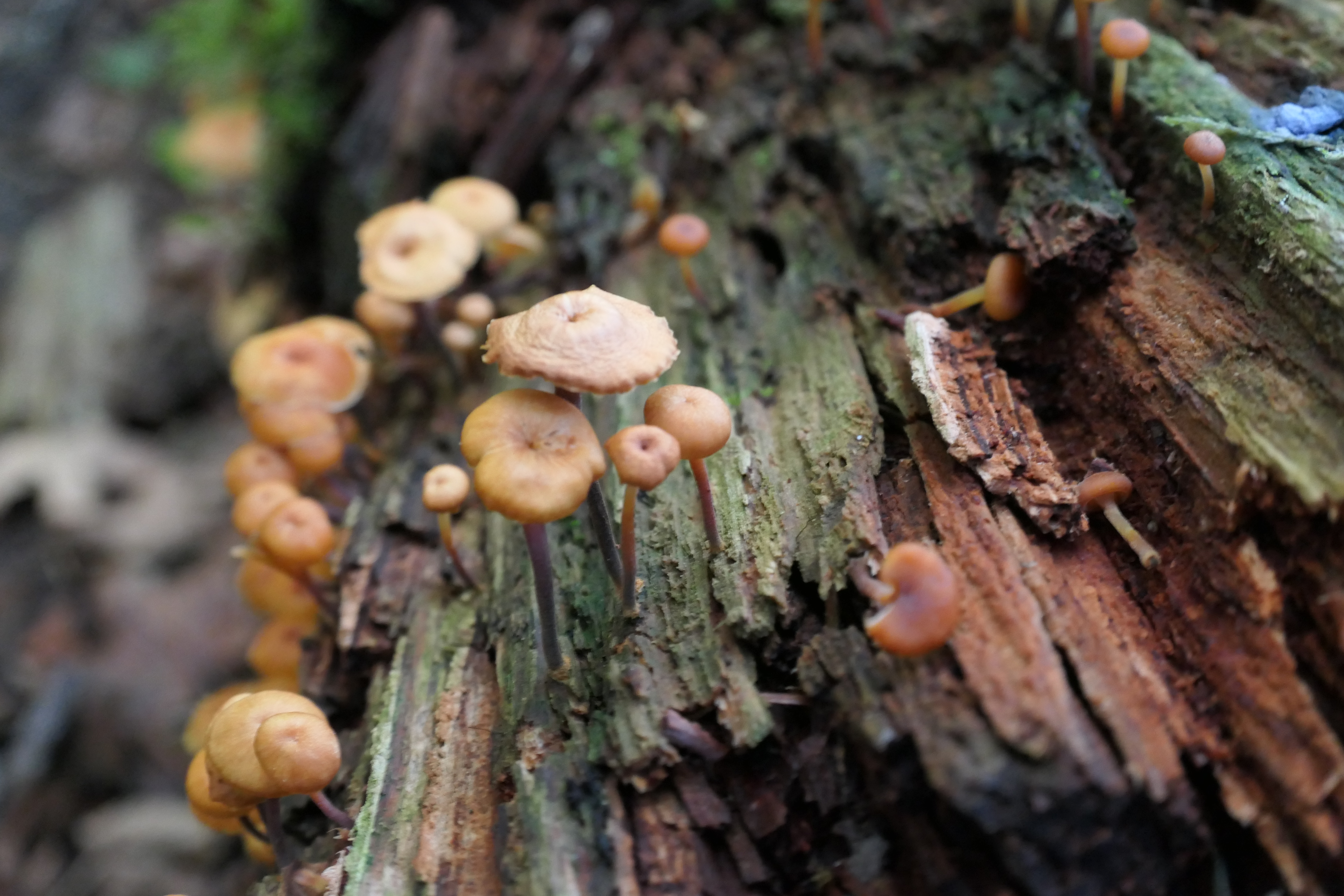
My first foray into nature this week was inspired by having my body and my mind fed by two beloved friends: a mushroom soup to die for, last month, and a book recommendation last week, added to the mile-high pile of books to read: Long Litt Woon’s The Way through the Woods – on Mushrooms and Mourning.

It is a widow’s description of working through her bereavement after the sudden and untimely death of her husband by becoming an authority on mushrooms; I cannot wait to read the book which received rave reviews – the anthropologist is said to be able to explore both the world of mushrooms (a somewhat random subject matter that helped focus attention) and the emotional travels through recovering from grief with passions and humor in equal parts.

Perfect timing, too, given that mushrooms are sprouting everywhere right now, with the dampness acting as catalyst to their emergence. All the photographs (some with iPhone, some with camera) were taken in the woods in an approximate one mile radius from my house within the last 8 days. Jealous yet?

And time for some amusement as well! It arrived when I went on a hunt for the appropriate music. The first thing that came up when typing in music for mushrooms was an article titled Science says this playlist is a must listen when tripping on mushrooms. Rest assured, that is not the activity I had in mind.

“Science” turns out to be one researcher who specializes in psilocybin experimentation and therapy. Psychologist Bill Richards, Ph.D., a researcher at Roland Griffiths’s lab at Johns Hopkins University and an expert in the field of hallucinogens claims to have the perfect playlist for those using (magic) mushrooms outside of mushroom soup or other culinary apparitions.

And I quote:

“…the order of songs is vital in crafting the right atmosphere, specifically during the “onset, peak, and post-peak phases”. The onset music should “supportive, unfolding, forward-moving”, like H.R. Reynolds’ arrangement of “O Magnum Mysterium”and Edward Elgar’s “Nimrod”. But once the peak sets in, things need to slow down a bit.

“At a trip’s peak, music becomes a mirror of transcendental forms of consciousness that may not even be registered in unitive awareness, but is present if needed—like a net below a trapeze artist,” Richards says. This cocktail includes multiple inclusions from classical luminaries like Brahms, Bach, Beethoven, and Mozart, along with a few dashes from other composers from a variety of cultures.

As the trip’s effects begin to wear off, the playlist can enter a more free-form state, tagging in tracks that are more familiar and sources of positivity and inspiration to the consumer. Interestingly enough, it’s also at this very end that lyrics really make their first appearance, and there’s good reason for their absence.”

Brahms as a net below a trapeze tripper? Beethoven, the security blanket? Bach, catcher of the fall? Okayyyyy….. And where are the Russian composers, their cuisine so dependent on all things fungal? No slavic mycelium dreams?

Well, let’s listen to Russian folk music instead which, if you’re tripping, might make you trip over your own feet: https://www.youtube.com/watch?v=SZcmI8FXW38

Let’s hope the scientific research on magic mushrooms is not an echo of the musical recommendations. It is certainly sprouting in the most unexpected places – just like mushrooms – lately in Jamaica, where a Canadian start-up is trying to study everything from the genetics of magic mushrooms to how best to extract their psychedelic compounds. These goals have both scientific and financial value. And there is sure competition around: Johns Hopkins just received a multi-million dollar donation to fund psychedelic research. Part of the research is devoted to figure out if psilocybin works as a treatment for a panoply of disorders and conditions: anorexia, opioid addiction, Alzheimer’s, chronic Lyme disease, post-traumatic stress disorder, and alcohol addiction.

I will, however, not be a participant in studies at the new Center for Psychedelic and Consciousness Research……I like my brain the way it is. A champion of champignons, at times morose like a morel, inclined to trifle with truffles, a brain as mucilaginous as a mushroom cap!

Collecting wonder

“Give it a rest,” screamed my shoulder this weekend,”after a day of photographing art you should put the camera down. Nature can wait!”

I couldn’t – the wondrous landscape around me begged to be documented, for the 100th time that I’ve walked these hillsides. And also, there is always Ibuprofen…

The essay attached all the way below points to something that we should keep in mind, though: finding succor in the beauty of our surrounds should not be reserved for the awe-inspiring vistas. We should also attend to things that are small, or familiar, or habitually by-passed.

Poore’s essay riffs off Annie Dillard’s question: How blind are we? How resistant to wonder have we made ourselves, and how unaccommodating of the universe’s gifts? As Dillard phrases it: “Who gets excited by a mere penny?”

She goes on to distinguish between environmental conservation’s focus on wilderness, prized environments in distant regions, instead of applying efforts to protect what we have in our neighborhoods, on a small scale. Your garden, my yard, this little city park. The need for being astute observers rather than starry-eyed adventurers, as she puts it.

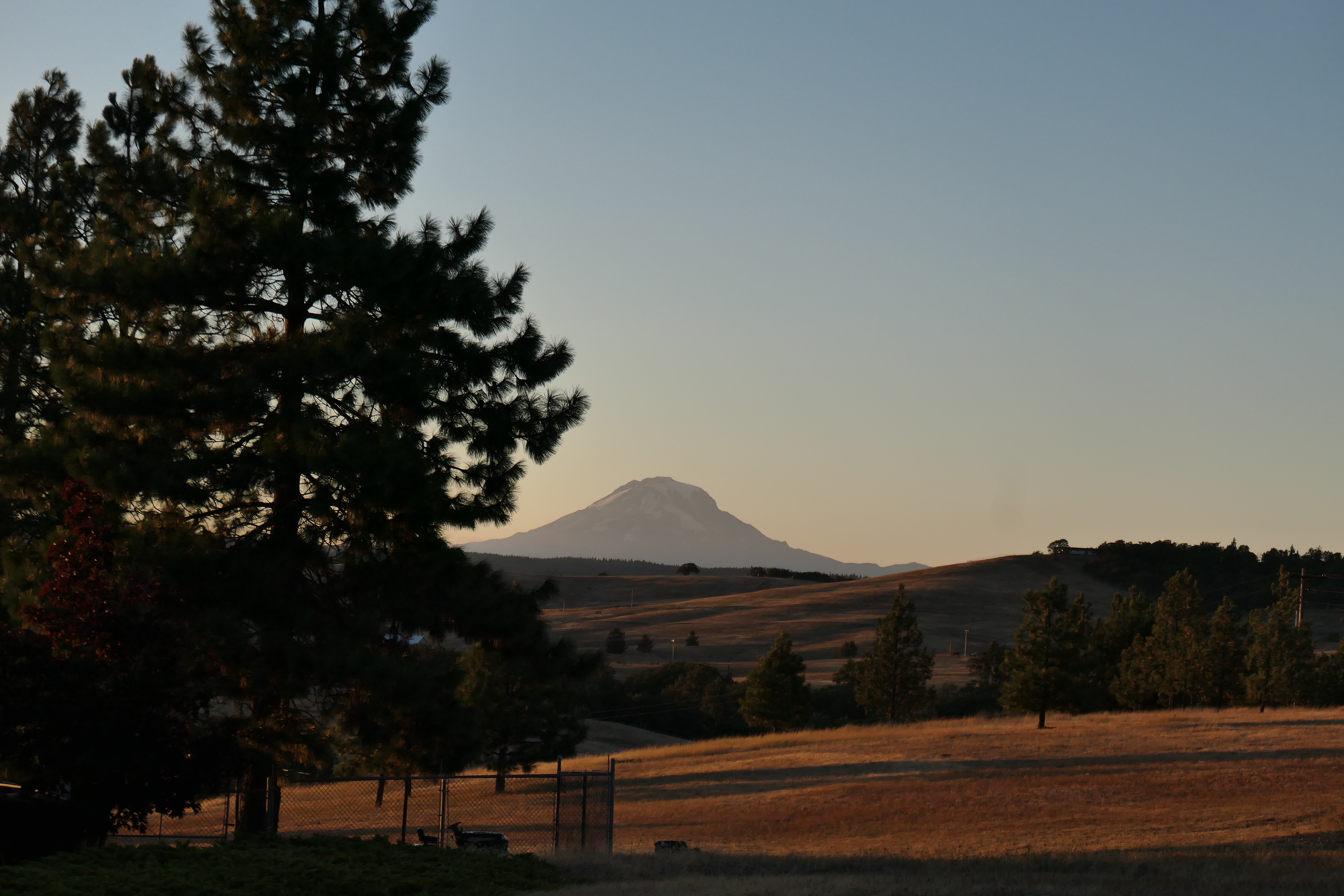
The Columbia Gorge in today’s photographs is, of course, full of grandeur, as are the views of Mt. Adams at sunset – all experienced on Saturday. But as you know, if you’ve followed my stories, I can get just as enthusiastic about the bees in my garden, or the little birds in Eastern Oregon.

From my Denizens of Climate Change series, (2017)

I truly believe it will make us better environmental stewards.

In the end, I dropped the camera after all – the sight of this mouse-catcher who appeared out of nowhere in the middle of the meadow made me laugh so hard I could not longer photograph. Shoulder was happy.

Music today is a 1943 orchestral concerto by Bela Bartok, who stayed pretty close to the ground as well, incorporating quotidian folk tunes.

Be still my Brain

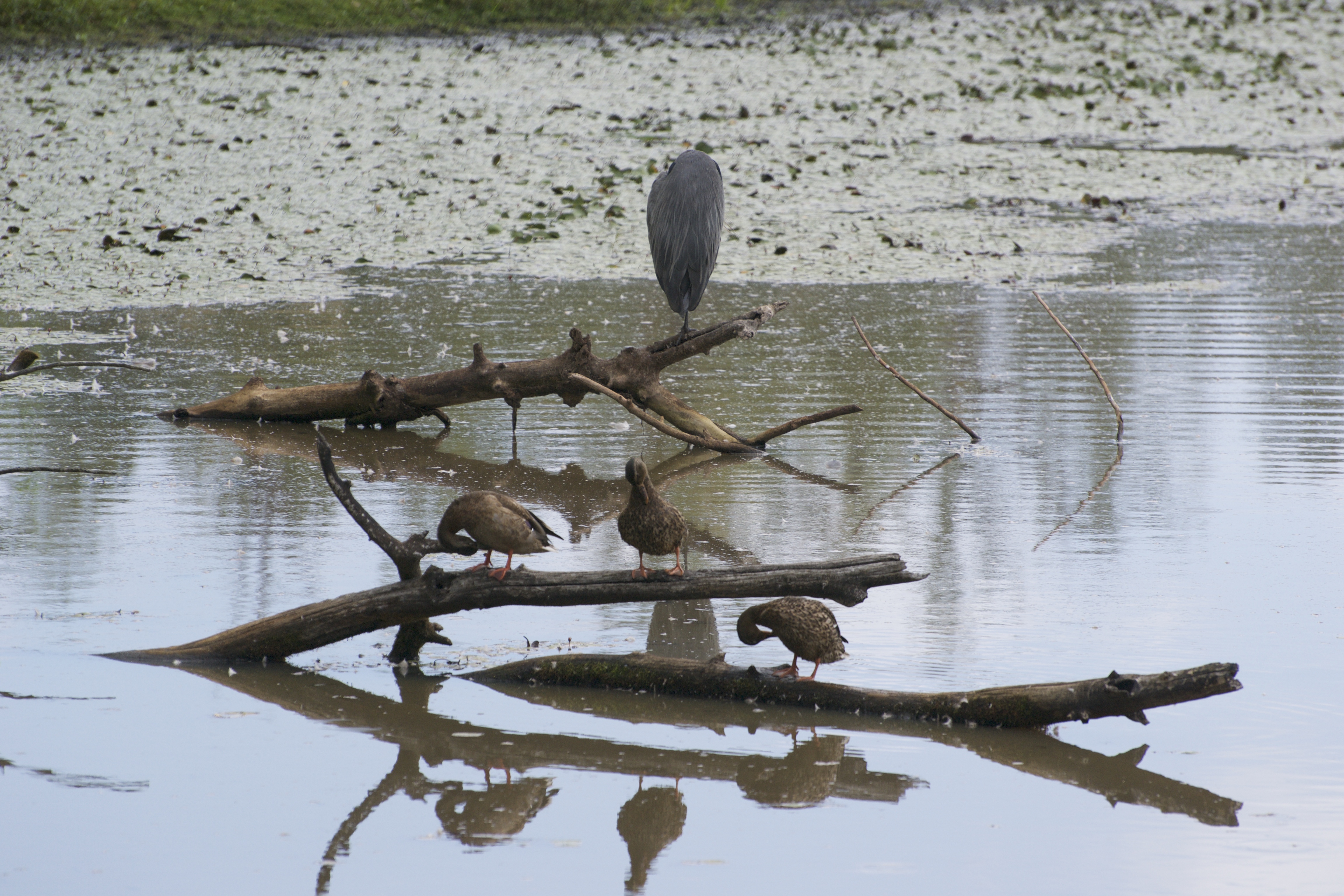
In desperate need for some calming vibes I went for a long walk along the Columbia river on Sunday. Want to join me to listen to what nature had to offer, again? And again? And again?

A leaden, quiet sky. Brain starts calming.

Shshhhh, said the heron, or I’ll stick out my tongue.

Shshhhh, said the nutria, need to get going…

Shshhhh, said the frogs, we are preparing for a concert

Shshhhh, said the thistles, we are listening to the wind

Shshhhh, said the shrub jay, I’m trying to focus on the berries

Shshhhh said the Kestrel, you’ll scare away the bugs

Shshhhhh said the grasshopers, we’re trying to hide

Shshhhhh said the butterfly, you don’ talk with your mouth full

Buzzzzzz said the bumblebee. There went my brain again…….

And here is a musical nature walk: