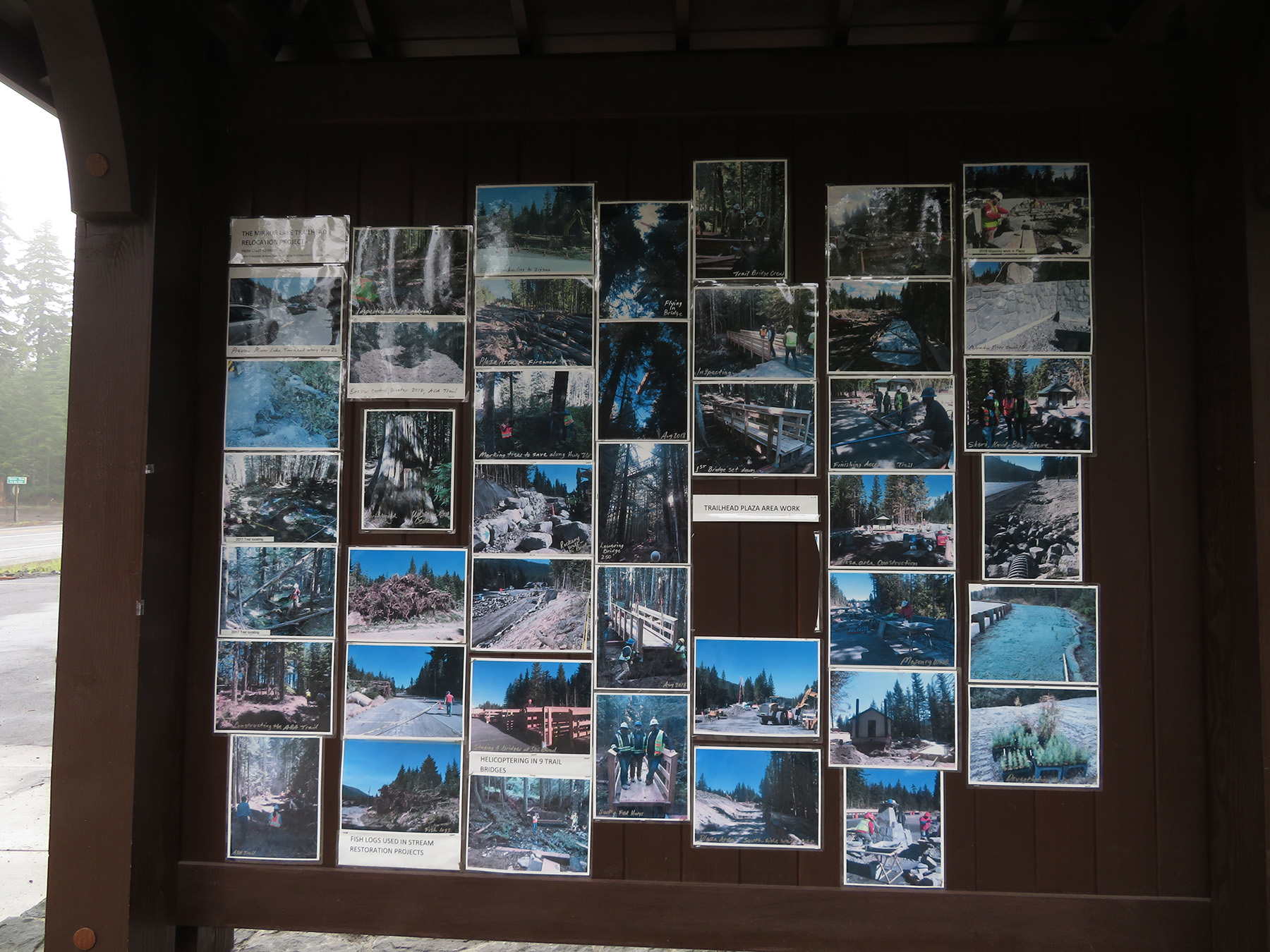
I had to think about this amusingly sarcastic poem, Breaking Silence, by Whitby yesterday, when a gorgeous hike along Mirror Lake trail and up to Tom, Dick and Harry mountain yielded all kinds of beautiful vistas – but no silence. The car noises carried heavily over from US 26, and the trail was populated by all kinds of not so silent people, some blaring loud music no less. Kids happily screaming at the lake
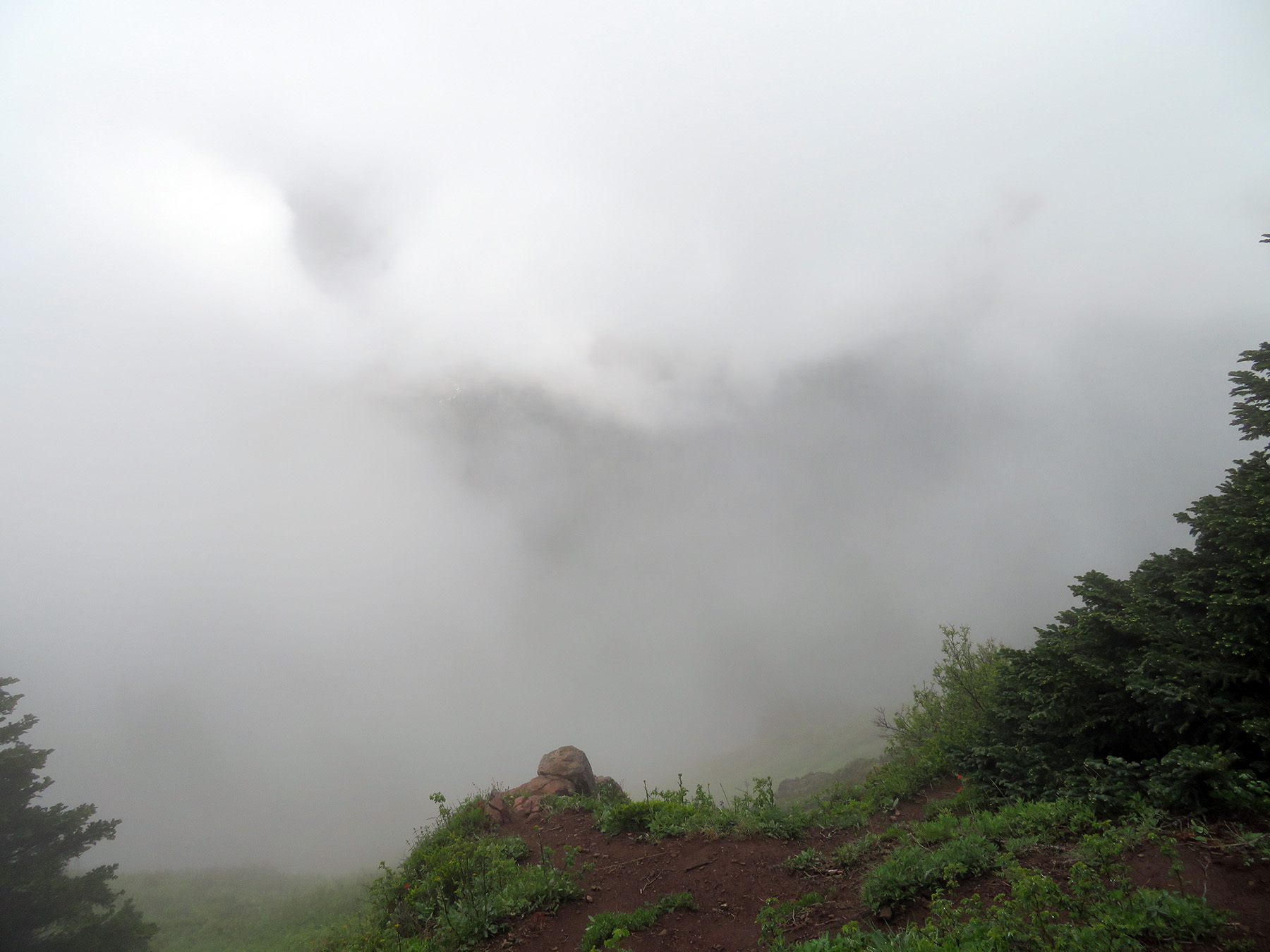
shrouded view in the morning clear in the afternoon
found their counterpart in screeching Gray Jays, also known as Canada Jay, Camp robber, and Whiskey Jack, as I learned yesterday.
We made our Goretex exodus through ascending crowds of people in flip-flops and slippers later in the afternoon…. no longer silenced, in some fashion, by masks, which had been rigorously worn by the early morning hikers we encountered during ascent at 8 am.
The trail is probably the most heavily trafficked wilderness exposure close to the Portland area, and many conservationists are eager to develop alternative plans to protect the environment in the long run while allowing people to hike along these vistas.
The brooks gurgled, branches made the occasional odd noise when moved by a bit of wind, leaves shaking off the raindrops from previous showers.
The crinkly plastic paper from a devoured power bar rustled in my pant pocket, annoying enough that I had to transfer it into the backpack.
Loose boulders along screes rumble under your feet, and you wonder what the one large rock cairn you encounter would sound like if climbed. I could not figure out, after the hike, who built that cairn, or the rock stacking walls on the overview. Native Americans used cairns either for religious purposes, or as markers to show the way, but there is no information to be found if this cairn comes from a time before their land was stolen.
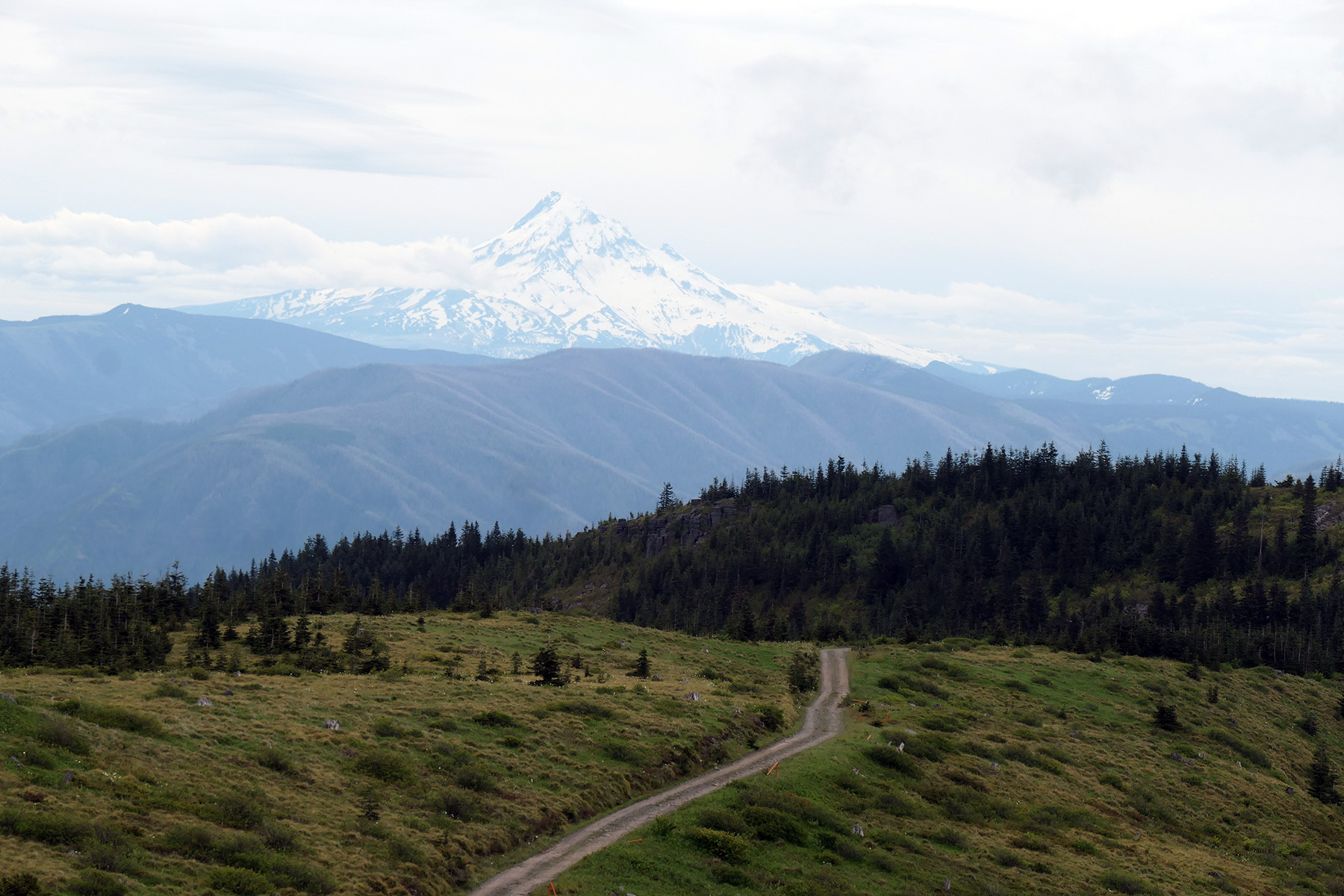
On top the clouds provided a bit of eeriness, no views of Mt. Hood. The mountain only appeared later in the day.
Even the chipmunks started to vocalize, when chasing each other in competition for the crumbs of my lunch. Rapid, high cadence sounds of chip-chip and cluck cluck in alternation, it seemed. Here is the real thing from National Geographic.
My knees creaked.
Only the raven on the summit kept his silence. A blissful day.
And since it was such a popular and populated trail, let’s have some popular classical music guide us into the weekend, inspired by landscapes, forests, and a river coming down from the mountain, Ma Vlast.
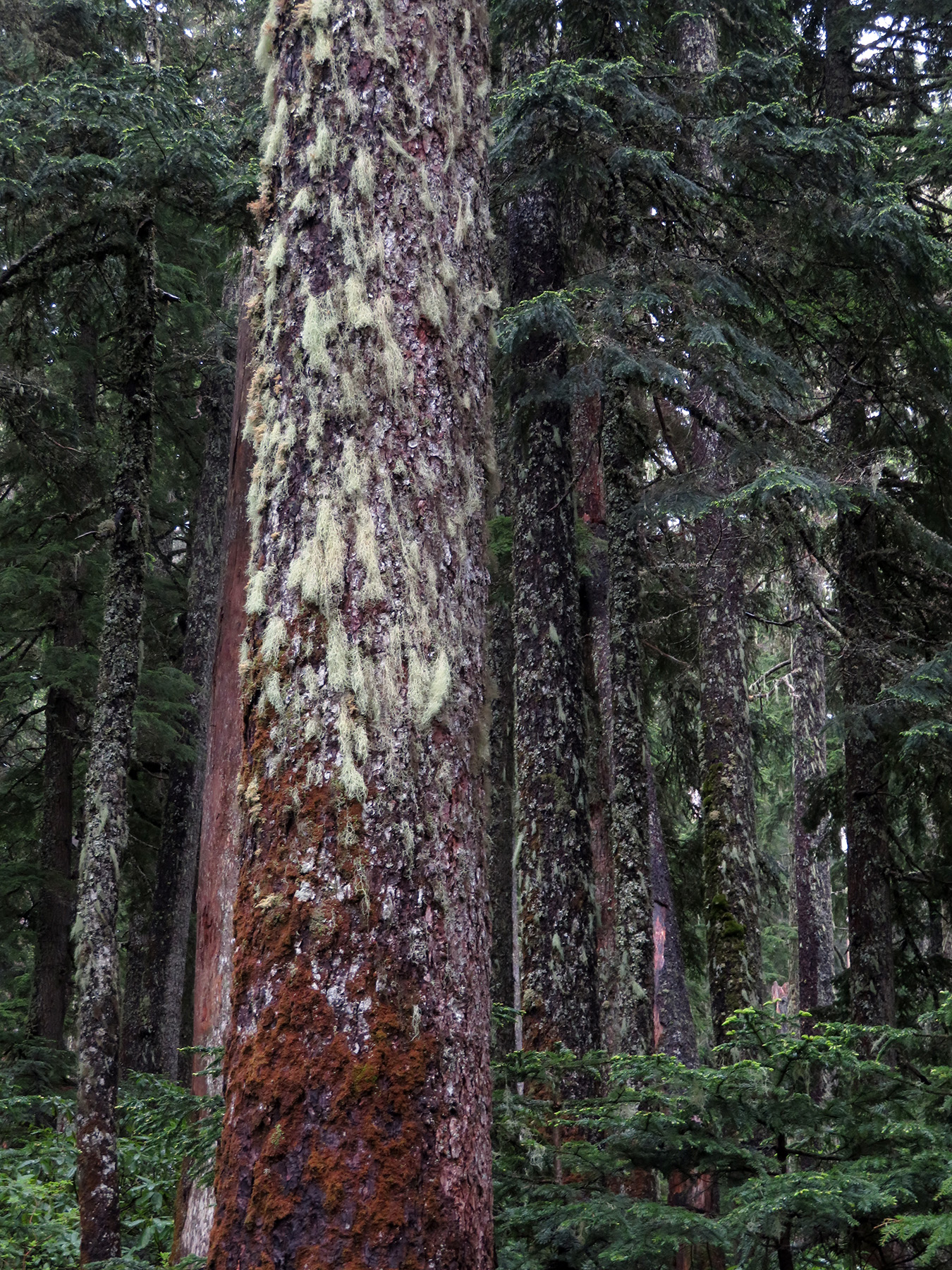
For the Lobaria, Usnea, Witches Hair, Map Lichen, Beard Lichen, Ground Lichen, Shield Lichen
by Jane Hirshfield
Back then, what did I know? The names of subway lines, busses. How long it took to walk 20 blocks.
Uptown and downtown. Not north, not south, not you.
When I saw you, later, seaweed reefed in the air, you were grey-green, incomprehensible, old. What you clung to, hung from: old. Trees looking half-dead, stones.
Marriage of fungi and algae, chemists of air, changers of nitrogen-unusable into nitrogen-usable.
Like those nameless ones who kept painting, shaping, engraving, unseen, unread, unremembered. Not caring if they were no good, if they were past it.
Rock wools, water fans, earth scale, mouse ears, dust, ash-of-the-woods. Transformers unvalued, uncounted. Cell by cell, word by word, making a world they could live in.
I wrote about lichen and moss about a year ago, unaware of this poem then, otherwise it would have been added.
In some ways fortunate, because it gives me opportunity today to bring together those words with new pictures. I have, of course, no clue what the lichens are called that I saw this week, much less do I know if any of them appear in Hirshfield’s listing. But I love the sentiment of her words, the observation that a world can be made to live in, where life is possible, and that not all agents of transformation call for recognition – they just provide.
Fungus for good measure
Music today celebrates a master of (thematic) transformation: Liszt.
Here is another take, by a master of (Liszt) interpretation, Lazar Berman.
Leave it to me to choose a title that in itself is easily disproven: it IS clear, that speaking in absolutes soon forces you to make room for exceptions.
It was just what I was thinking when we approached the Pacific Crest trailhead yesterday on Lolo Pass for a hike up Bald Mountain.
Dennis the fearless leader …
“Nothing is clear…” the valleys and peaks around us were shrouded in fog and mist.
“Nothing is clear,” again when we reached the top, looking into a bank of clouds, ragged breath from the last bit of steep ascent joining the universe of damp droplets around us. The promise of views of Mt. Hood in all its glory, once the sun lifts the veil, empty. Or more precisely, filled with swaths of white and grey, moving, stretching and consolidating with the bit of wind.
Oh, but everything WAS clear, once you stepped closely, within the woods. Some things were clear along the ridges as well, if you waited patiently, as long as budgeted time allowed, for warmth to rip the clouds apart and offer glimpses.
In sum, we saw the forest AND the trees, all just a matter of proximity and time.
Perhaps it is a helpful analogy to our current circumstances. We have a choice of perspective. The future is diffuse, in some ways shrouded. We can focus on the things at hand, though, revealing beauty, or sustenance, or at least things tolerable, rather than dwelling in fear of being swallowed by the clouds. Shifts, brought on by winds of science, will rip the fog apart, at least in places, allowing clearer views.
And if you want to roll your eyes or slap me for waxing philosophical right now, too bad. It is what nature does to my head. When I see usually domesticated flowers in the wild, spreading with abandon,
when I see new life ignoring all the devastation wrought before,
Charlie the human yardstick in front of a rootball of a fallen tree
when I see hues of nature’s coloration that put any human paint collection to shame,
I cannot help but feeling I’m instructed to take home a lesson. (Particularly on the day before summer solstice, filled with snow and obstacles….)
If you stare at all that’s hazy, blurred, opaque and cloudy, murky, gloomy, foggy, dark and dim – of course nothing is clear.
Feel free to remind me, next time I’ll mope. Or better still, sent me off on the next hike. I know my own cracked imperfections.
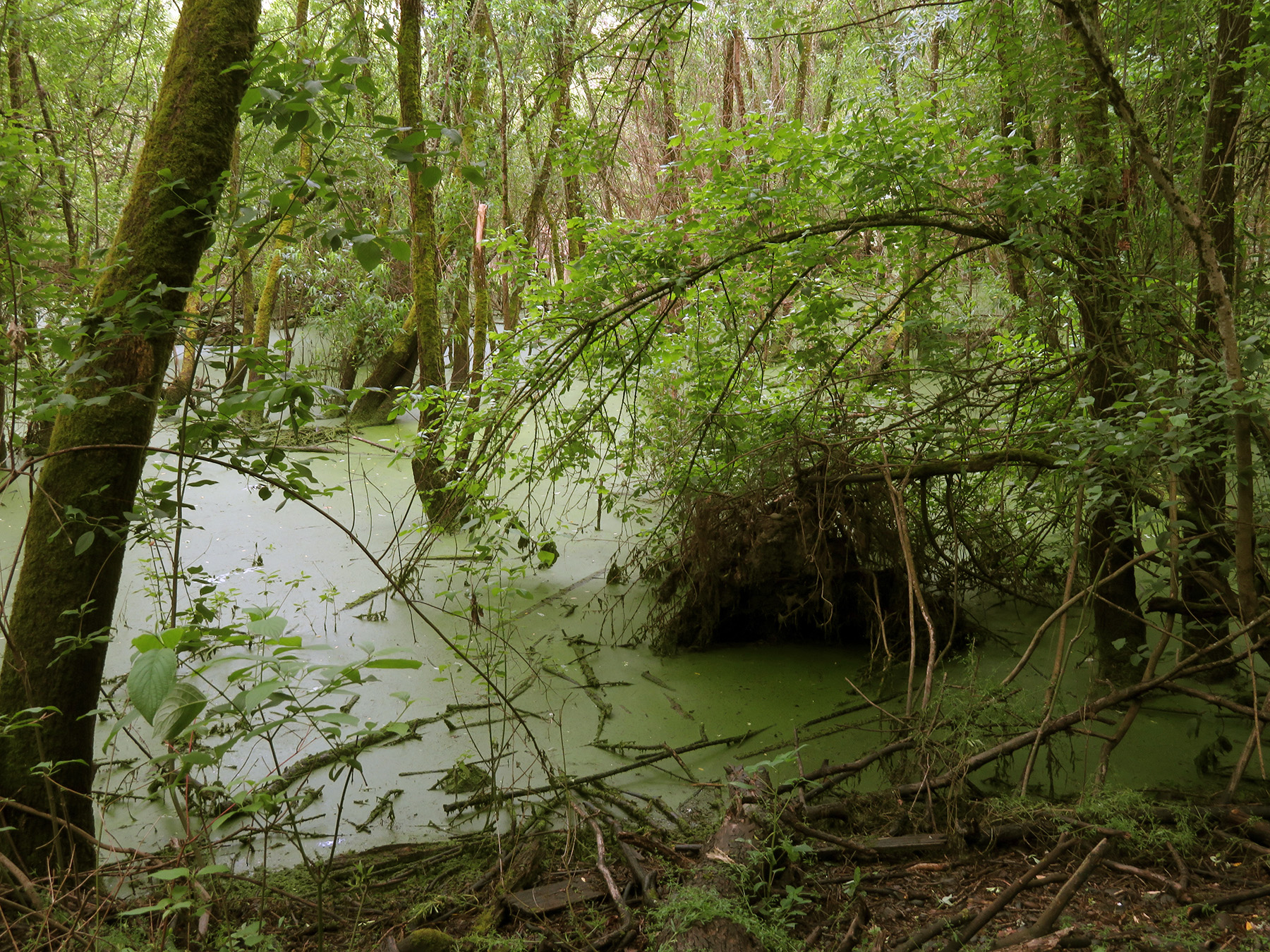
I am not exactly a creature of habit but I do like the contentment that comes from frequent and regular visits to specific places, like my once-a-week walk at Oaks Bottom. This week it offered a rhapsody in green. The water did not just reflect the canopy of green above it, with trees and bushes having long grown all their leaves. It had developed its own thick coat of paint, a saturated green layer of duck grit.
The migratory winter water fowl were gone, the geese and herons stayed put. It is lovely to see change, experience surprise a n d feel the warmth of familiarity, all in one fell swoop.
That said, in my next life I would like to combine my Wanderlust and artistic preoccupations along the lines of the life and work of the duo Karoline Hjorth and Riitta Ikonen. I had introduced them earlier here, with their project Eyes as Big as Plates, portraits of older people in their natural environment. Alas, the book has sold out on Amazon.
A different project, stretched out over four years, can be explored here.
The project’s title, Time is a ship that never casts anchor, is derived from a Sami proverb which implies that it is better to be on a journey than to stay still. It is wonderfully descriptive about the longitudinal nature of their work.
Sami culture is, like so many indigenous cultures, severely threatened by both climate change and political forces bent on exploiting the Arctic. Here is a guide to the basic facts of Sami lives and customs now under attack as well as the legal means to defend themselves. Worth a look, particularly in view of the horrendous fuel spill last week that is now contaminating the Siberian rivers flowing into the Arctic ocean, blamed on climate warming, but likely also caused by human greed, indifference and ineptitude.
The two photographers explored the transformation of Kirkenes, a vast region at the north-eastern Norwegian border with Russia and Finland. They documented the construction of a new hospital and in the process visited with and photographed hospital personnel and consultants, Sami reindeer herders, detonation workers, midwifes, wrestling coaches, taxi drivers and local peace workers and the local supporters from electricians to the mayor. The completed artworks were eventually on display at the finished hospital.
“…joined a round-up with Sami reindeer herders and learned how to make our arctic charr sushi dance. We’ve taken the mayor to a bog, manned a taxi station in Båtsfjord, wandered ancient cemeteries with academics and archaeologists, driven to the bottom of an iron-ore mine to find a turquoise lake, wrestled with a peace worker at the border and drunk black coffee with a sound recorder in many living rooms, hyttas, cars and offices to better understand the Jack-of-all-trade Finnmarkings.”
Detonation master Pål
Doesn’t this sound like something I would have fun with?
Seriously now, I do find the dual nature of their work extremely appealing. On the one hand they are documentarians in an anthropological sense, concerned with the cultural diversity, the history of the place and the customs of the people they connect to. They invest time and resources in learning about place, seeing things grow, following the path, not without obstacles, around these kind of huge community projects.
Taxi driver Arne
On the other hand they are painters – with a camera, not a canvas and a brush, but still. Their innovative costuming, sensibility for color and form, the intensity of creative use of natural materials for staging all mark them as gifted visual artists. And none of these images are slick or even tinged with a hint of fashion portraits, like I might have argued (on a mean day) for other photographers I introduced previously.
Thus the repeat performance – they deserve every bit of exposure we can provide. I’ll make it a routine, like my Tuesday walk.
Music today is by a Sami woman, Mari Boine, who is a professor for musicology in Norway. She has a strong, openly anti-racist stance, and, for example, refused to perform at the 1994 Winter Olympics in Lillehammer, because she perceived the invitation as an attempt to bring a token minority to the ceremonies.
Here is her single hit Recipe for a Master Race that deals with the racism against the Lapps, and here is a beautiful entire album.
Alas, often interrupted by advertisement. If you don’t have the patience for it, just listen to the third track, starts a bit before 12:00 to get a sense of the language.
“Vorsicht, Kindchen, Vorsicht!” (Careful, kiddo, careful…) was a constant refrain in the household of my childhood, outnumbering even the “Straighten your back!” and “Darling, would you fetch me my cigarettes….”invocations.
Vorsicht – care, caution, precaution, restraint – built an invisible fence around a child’s desire and need to explore, to risk. For my war-traumatized parents, danger (understandably) lurked in shadows and around every imaginable corner. “Don’t jump off that swing, don’t race your bike, don’t hitchhike, don’t spend time to travel abroad instead of proceeding straight to your clerkship,” the variations were endless. Physical danger, psychological danger, danger to the vision of an unencumbered life in a straight line from school to university to career to marriage to happily ever after. Anticipatory fear was literally a cloud forming a cage.
Steep Creek Falls
Except that we escaped through the invisible bars, at every possible turn, skimmed knees, black&blues, twisted ankles, tropical diseases be damned. I never felt more alive than when climbing prohibited trees as a kid, when sleeping rough on the beaches of Morocco in the early 70s, or hunting for orchids in the temperate rainforests of Venezuela. In fact, lovingly imposed constraint continually incited the opposite: a yearning for risk taking, a struggle with conformity, a will to disobey.
All this is on my mind because in some miniature ways I still thrive on adventure, even when it is now limited to scrambling up and down a pile of rocks on an otherwise moderate, although insanely beautiful hike.
Luckily someone lend me gloves…The top
No more solo hiking for me, like last year in New Mexico. Photographs today are from an outing last week where two kind souls invited me sight-unseen (regarding my physical condition) to explore with them a tiny slice of the Pacific Crest Trail (Rock Creek Pass). Am I ever grateful they took me with them – Charlie and Dennis, I owe you!
Wildflowers abounded, water rushed down the outcrops, lichen glowed in the diffuse light, snakes saw no reason to scurry away, rock wrens serenaded us and old growth forest calmed the soul along the way.
*
Risk taking, of course, also figures in the larger picture of deciding how to approach life while the country re-opens. We are no longer talking about thrill seeking, but a real and present danger to our lives, if we risk infection with Covid-19.
Any decision has to be based on an assessment of the probabilities of both the danger levels in situations we might seek out or avoid and our own specific vulnerabilities. Outside differs from inside, crowdedness differs from emptiness, duration of encounter with others is a huge factor, as is the presence or absence of masks. Your age and your health status has to be part of the equation.
Indian Paint BrushPenstemonBalsam Root (I think)
For me, there is also the question of why. It is not just going to be what am I doing, but why am I doing it? What are the reasons that justify for me to take risks? Do I go back to work, because I and my family could not survive otherwise? Am I truly needed for something, or am I too compliant to simply refuse? Am I staying away from the outside world because I let irrational fear rule me or because I legitimately cannot afford to risk infection? Is there such inherent meaning to be part of a community, or not being idle, that it justifies tolerating moderate risk at my work or the market place? Has fear become a mistress that we need to find the will to disobey?
Bleeding Hearts at the Bottum Pioneer Violet Arnika
The same is true for the larger question of risk and civic participation, when you decide the time has come to protest even in the face of radicalized police- and state action, perpetuation of historical injustice.
It is even a question when you contemplate actions often associated with protests, rioting and looting. Asking ourselves why people are doing that might provide surprising insights. One of the best explantations, both in content and rhetorical skill, that I have come across is in the attached short video. Note I have not linked to any other reading today, just so you have time to listen to a powerful voice. (Bonus: you will never play Monopoly again….)
And for music today one of the best choirs in the country with a familiar encouragement:We are not AFRAID today! Let that guide us, within reason.
I rarely regret my habit of discarding mementos. No kids’ kindergarten drawings clog my drawers, no receipts for memorable journeys, few letters. Except on days like these, when I have to reconstruct what I was told, in a poem no less, by a lover half an eternity ago.
It had to do with cornflowers. My blue eyes? My toughness? (Not only did the plant invade the farmers’ fields taking up valuable nutrients, but it blunted the hand sickles with its tough stems – Thou blunt’st the very reaper’s sickle and so in life and death becom’st the farmer’s foe….) The intensity of blues, found in flower and my moods alike? Honestly, I forget. I do remember, however, that he left me for a violinist, and ended up, despite a brilliant dissertation on Trotsky in exile, teaching Spanish to 6th graders. She switched from concert hall to babies. I wonder what became of them.
Cornflowers are on my mind because of seeing too many images of people’s burnt and swollen eyes from tear gas or other noxious substances. Distilled in the right way, like the famous French concoction of the title, they can calm inflamed ophthalmic surfaces, work as anti-inflammatories and anti-irritant on lids, and as a decongestant for swollen mucous membranes. No use to put it on the officially permitted medic stations helping protesters with water and first aid, though, when even those get destroyed by police in sheer spite like yesterday in Ashville, NC.
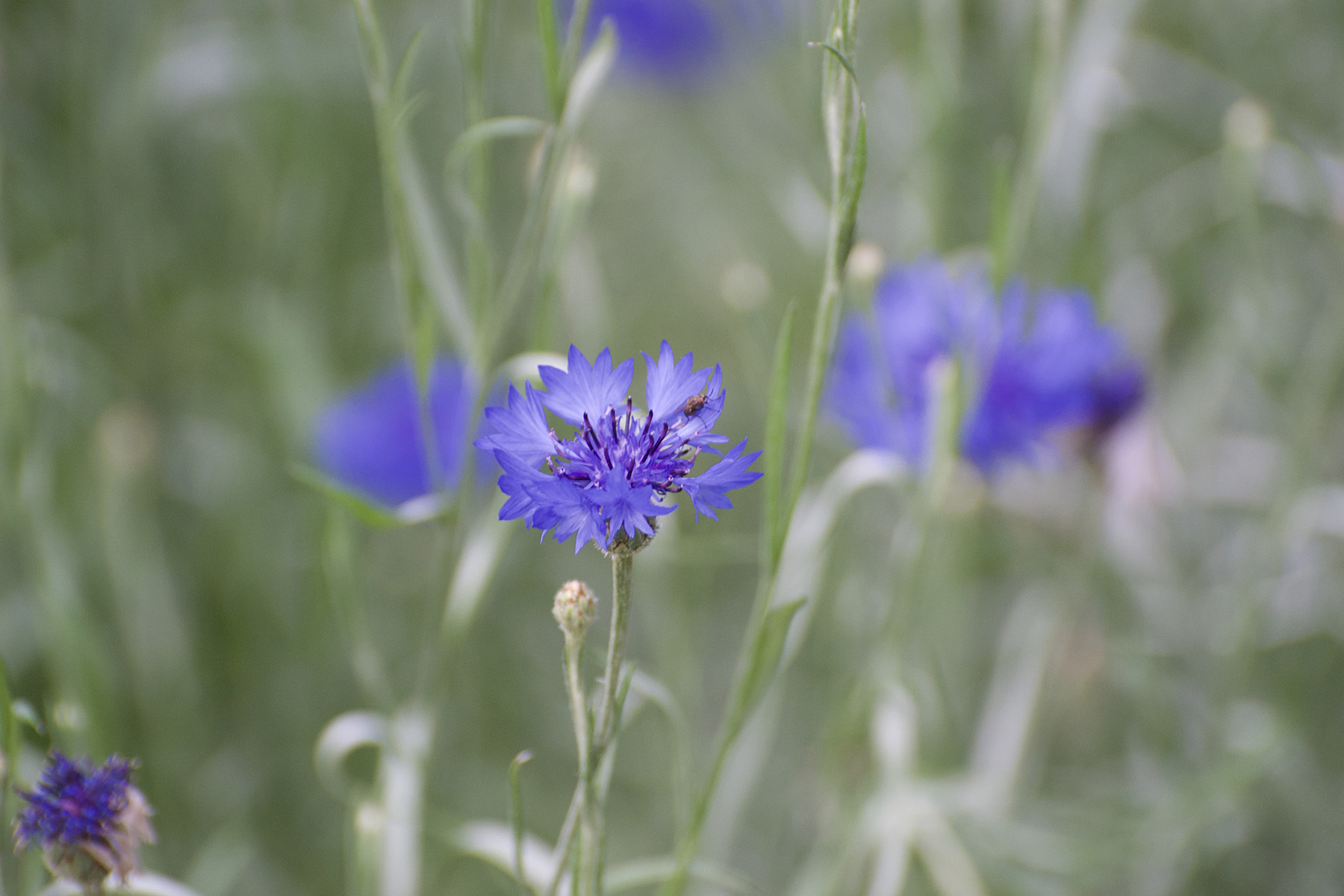
I have always been partial to cornflowers (Centauria Cyanus). They grew wild, together with poppies and chamomile, in the fields around our village. We picked them, and they actually lasted in the vase for quite some time. I was fascinated by the story in my book of Greek Mythology in which Cyanos, the child poet, sang the praises of nature so well that the goddess Flora transformed him into cornflower so that we remember him every year anew. Well, these years we lack reminders: the industrial agricultural use of land with its systemic herbicide and pesticide application, has driven the plant pretty much out of our view, other than in ornamental gardens. No swaths of blue alongside and within fields of oats, wheat, barley and rye for us.
*
In ways, however, that remind me of the dilemma of how to approach art you love when you despise the artist who creates it, I have had mixed feelings when I look at cornflowers ever since I learned that is was a secret symbol for the Austrian Nazi part in the 1930s. Wouldn’t you know it that some of the contemporary German neo-Fascists took up the symbol used by the then-banned National Socialists in 1930s Austria before the Anschluss of 1938 brought the Nazis to power in the country?
By obvious chain of association, I have been unable to stop thinking about how political change can creep up on you when disbelief has kept you for the longest time in a state of denial. One of the things that matter and that I have certainly underestimated, is the degree of contemporary conformity – or complicity – despite all historical warnings, that allows the poisonous elements to gain power and solidify it. I hope you have the time to read a rather long, but perceptive case description of personalities who shared beginnings, but ended up in very different positions when it came to stand up against evil. Anne Applebaum’s essay on complicity and its consequences is informative in its detailed description of the process; I am not sure I learned enough to understand the causes that differentiate the psychological profiles of those who resist complicity and those who embrace it. But much food for thought in a week where I think we are so overloaded on emotional facts that counterbalancing it with thinking about underlying patterns is perhaps helpful. If only to distract us.
And if your eyes are strained from all that reading – there’s always Eau de Casselunettes! Or a bit of art to restore you.
Music today is Mahler’s first song cycle of the wayfarer – Lieder eines fahrenden Gesellen. The wayfarer would have seen cornflowers along the fields while traveling, thinking of the blue eyes of his beloved. She dumped him, too, provoking much baritonal despondency…
Yesterday I wrote about Hemlock, a poisonous plant that can kill. In the interest of fair and balanced reporting – and no, no false equivalencies here – I will today introduce a plant that heals, in ways just called for by our current times where war-like action by state and military forces start to dominate our streets, tear gassing peaceful protesters, if only to create photo-ops near churches.
The outside beauty of Borage, Borago officinalis L., is matched by the positive effects of the chemical properties contained inside. The leaves, flowers and seeds of the plant stimulate the adrenaline gland when ingested, helping to produce adrenaline which enables flight or fight responses in times of stress. In fact, Roman soldiers prepared themselves for battle by drinking Borage wine, claiming: “Ego borago gaudia semper ago” – I, Borage, will always bring courage. Both ancient Greeks and Romans also believed that it was useful as an anti-depressant, or, as they put it, cheer the heart and lift melancholia. Aren’t we in dire need of that? Courage and less sadness, so we can resume to act rather than feel paralyzed?
Liquid distilled from the leaves helps with the damage of steroid therapy (often use while fighting cancer,) alleviates dry coughs (lingering effects from Covid-19 infections,) and eases the effects of menstrual disorders. Borage poultices can help with inflamed skin and eczema.
Throughout the centuries, healers and now contemporary naturopathic practitioners all incorporated Borage into their arsenal of medicines. Eventually, science caught up: Borage is used by pharmacological industries as an antioxidant due to its bioactive compound content, called phenolics. These acids exert antioxidant and anti-inflammatory properties, and, as it turns out, anti-carcinogenic effects. Put simply, both wild and cultivated Borage provides chemical blueprints that can be used in the fight against cancer, infection and improve the immune-system.
And if that isn’t enough to lift your spirits, the plant also makes for one of the best sauces around – the traditional green sauce of the region around Frankfurt am Main. Here is the recipe. ( I assume it’s a sauce. Or is it gravy? Or dressing? How many more decades do I need to live here to figure out the difference? For once German is simple: it uses one word for all three! Soße.
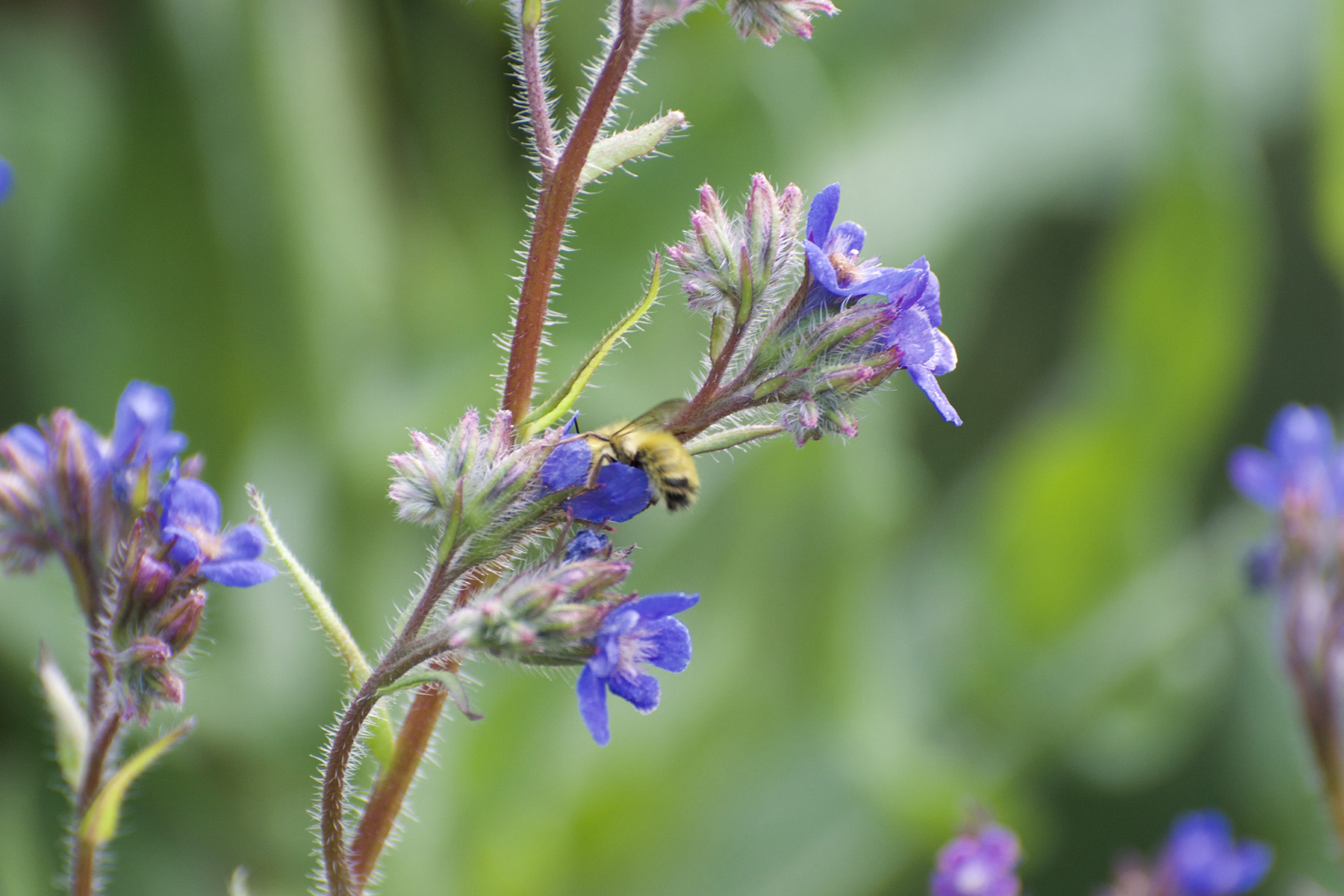
And here’s the last bit of cheery news: Borage is quite effective to protect neighboring plants in your garden from pests and diseases. It attracts a lot of bees (as you can verify in the photographs) which also helps to pollinate your vegetable patch.
People have obviously always known it for its value – if you look at 17th century flemish paintings, for example, you find quite a lot of Borage blossoms mixed in with the other flowers that signify importance, either in terms of economic or religious value (tulips, lilies, carnations.) I am posting a few samples here but encourage those who love a good still life to check out the National Galleries’ recent exhibition. There is barely a flower painting that does not have Borage flowers peek through here or there.
Insects with Creeping Thistle and Borage Jan van Kessel the ElderBouquet in Clay Vase Jan Brueghel the Elder (Excerpt)
Flowers in a White Stone Vase, Dirck de Bray (Borage on the marble slab)
Bonus: here is a clip of how British florists recreated a Dutch masterpiece with real flowers, in huge dimensions, in honor of the exhibit.
And if you think we should not spend time with trifling issues like beauty while our country burns – I politely disagree. We need to preserve our sanity, keep our mental resources together, and that can only happen if we look at beautiful and hope-instilling things as well. That is how other generations survived far worse as well. Here is a reminder: Shostakovitch’s Symphony #11, commemorating the violent crushing of the 1905 uprising, Bloody Sunday, in Russia (and also hinting at the Hungarian Uprising in 1956.) (Music starts at 5:48)
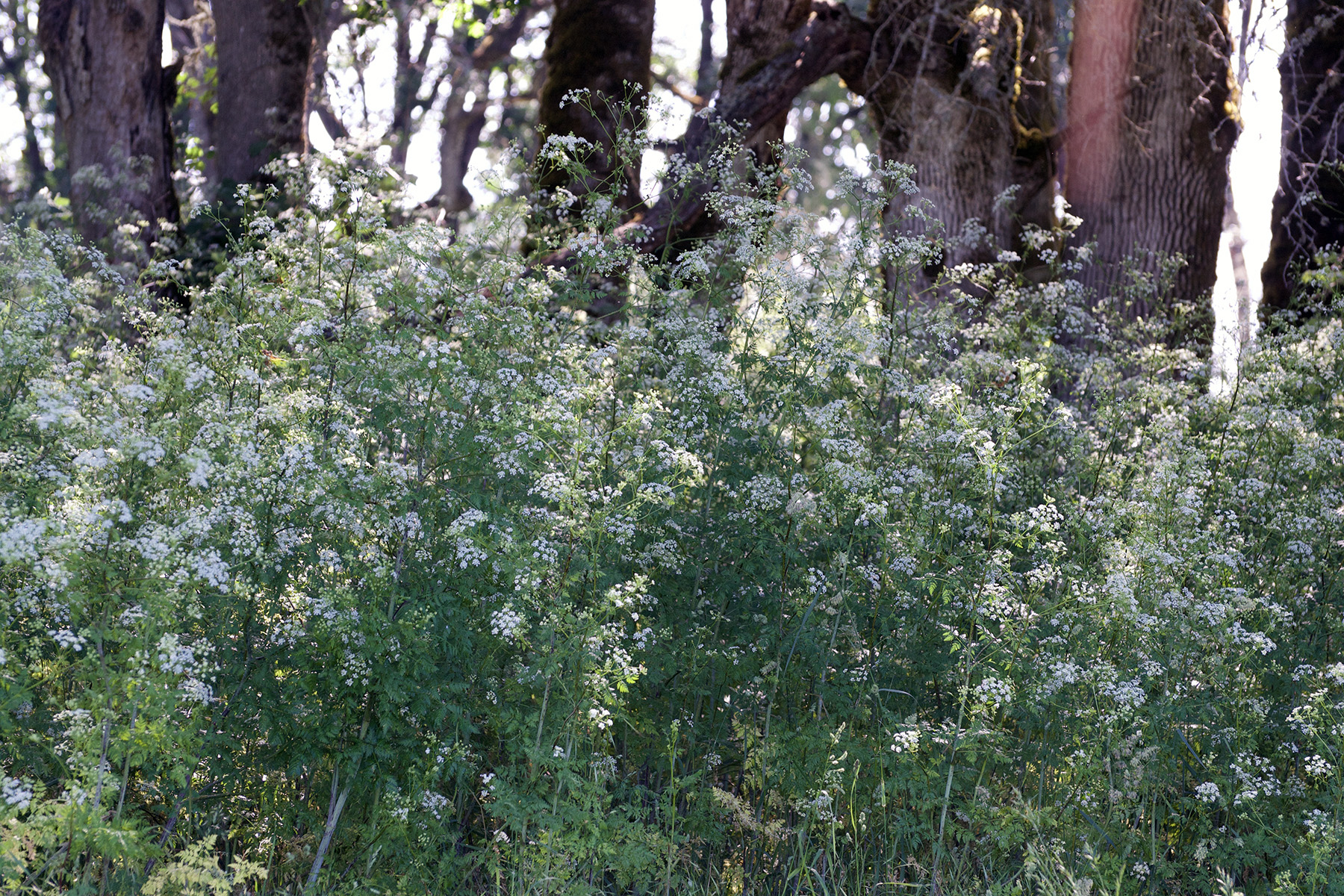
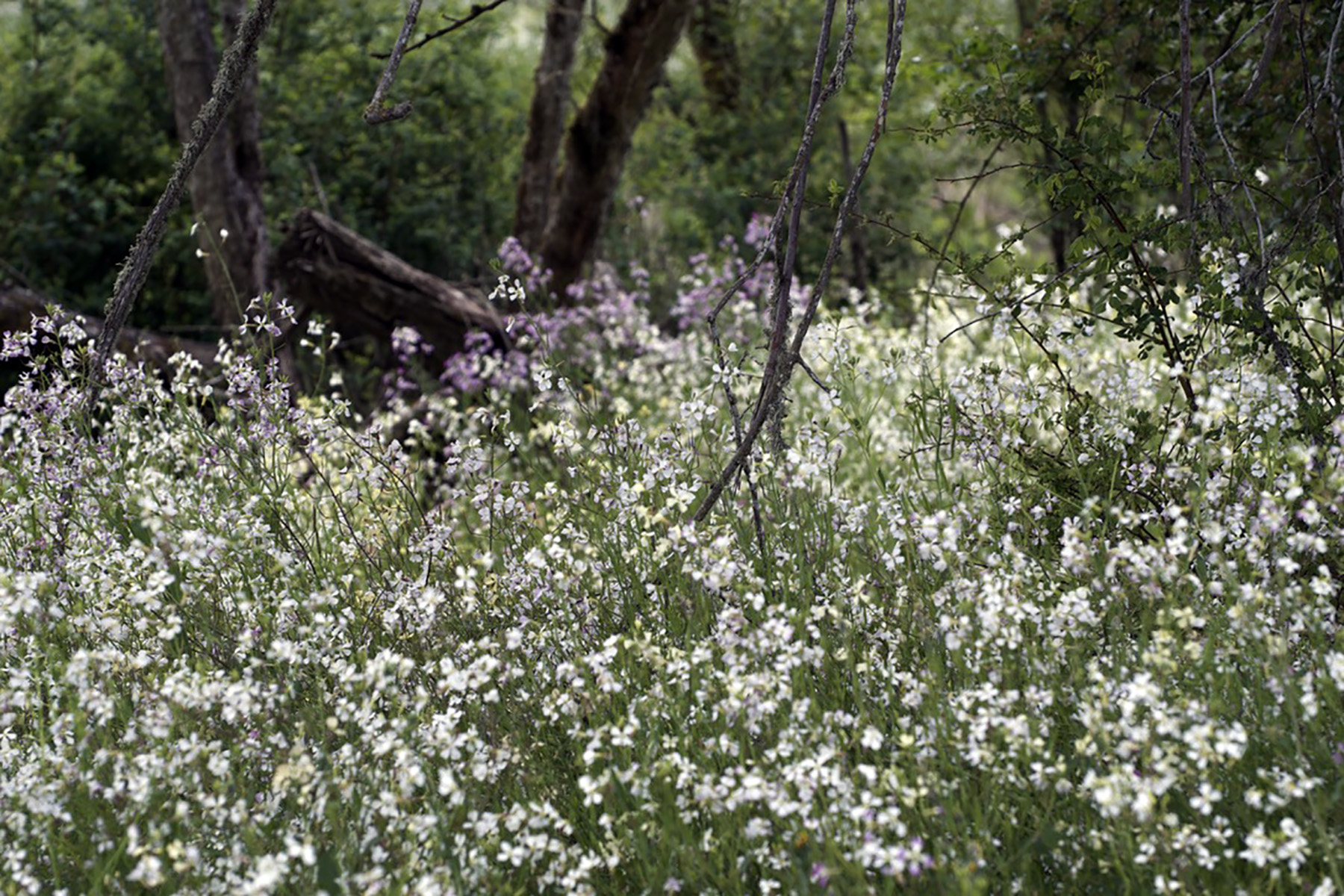
As with so many things in life, where poison or rot is only revealed by a closer look beneath the beautiful surface, so it was when I hiked among this fairy-tale landscape of a sea of white blossoms last Friday, an incandescent lace pattern against the fresh spring greenery.
What you expect to see in meadows or at the edges of woodlands is cow parsley, Anthriscus sylvestris. What I found was its rather more famous cousin hemlock (both are in the families of carrots,) Conium maculatum, which looks almost identical, but is highly toxic, even deadly. It grows tall, sometimes over 5 feet, with leaves that are triangular and lacy, and little flowers clustered im umbels – just like cow parsley. The only way to figure out which is which for the lay botanist not schooled in subtle variations, is to look closely at the stem: if it has blotches of purple or dark red color, it is hemlock.
Medieval lore insisted that hemlock grew on the hills of Golgatha and Christ’s blood touching it upon crucification – the purplish spots – made it forever toxic.
Those crucified die by asphyxiation – they cannot breathe.
Death by hemlock comes through lack of air as well. Hemlock contains a poisonous alkaloid named coniine, which has a chemical structure similar to nicotine. This poison disrupts the central nervous system—a small dose can cause respiratory collapse. Death can result from blockage of the neuromuscular junction caused by coniine. In practice, it eventually stops your ability to breathe, causing you to suffocate.
We all know why I am thinking of this right now: the killing by police of George Floyd, another suffocation of an unarmed Black man, and poisonous state violence, from up on high through the ranks of the police who wield teargas, nightsticks, rubber and pepper projectiles with abandon, having people gasp for air. Or the smoke from the fires that are erupting in the course of the protests, set by those enraged, or those intent to provoke and instigate blame, manipulating the racial divide. Or breathless, distracting focus on property destruction, so we can maintain a state of denial about police violence against human bodies. Or Covid-19 which makes it impossible for drowning lungs to provide you with oxygen, or hard to breathe through masks that are a necessity to prevent the spread of the disease.
Bushtit parent with chicks lined up above the hemlock
It is more than that, though: as Dahlia Lithwick points out in one of the most thoughtful short pieces I’ve seen in recent journalism, you can’t breathe when you are unable to stop screaming in anger or frustration or plain fear. You can’t breathe when you are sobbing or terrified. You can’t breathe, or breathe with shallow intakes, when you are forced to be in public or work in places where you are not protected and surrounded by potential spreaders of a lethal virus. We will also not be able to breathe if clean and cool enough air is no longer available due to the climate catastrophe, at least for most of humanity stuck in the places where it will unfold in first extremes.
“To be dying of a lack of air is a powerful symbol; it’s a metaphor for scarcity, for insufficiency. It’s a marker for ways in which the “richest country in the world,” the “most powerful nation in the world,” and the “leader of the western world” somehow finds itself gasping. Fighting for what should be plentiful….. We can’t breathe, and the words “last gasps” seem to have taken on a new force as we contemplate the stunning fact that we all breathe the same air, whether we like it or not, and that a nation in which only some people can draw breath safely is not a nation, but rather a tenuous hostage situation.”
To be confronted with or dying of a lack of air is a traumatizing experience. I was 13 years-old when first put on a post-operative ventilator, after 9 hours of lung surgery, and then again at age 16. It is drowning with full consciousness, the very essence of life, of living somehow clogging your throat, unable to get in or out, accompanied by ever rising panic. I do not wish that on my worst enemy. Much less on all those who are exposed to variations of that experience now, due to no fault of their own other than having been born into a certain race or class or circumstances beyond their control.
And yet here we live in a country and a time where it is inescapable. Imagine to be a person of color, or their parent, the horror of slavery encased in your DNA, venturing out daily into a world that disrespects you, denigrates you, debases you, discriminates against you. A world where you are deprived of opportunities or dispossessed if you grabbed them. A world where physical harm awaits you to the point of being killed when you encounter those who, stoked by group mentality in their like minded corps, empowered by weapons, sheltered by partial immunity, and fortified with the knowledge that historically they never ever had to bear the consequences for unlawful, excessive violence, can decide to make you gasp for your last breath. It is a life of trauma.
How can you breathe?
*
You might vaguely remember that Socrates, the famous Greek philosopher, chose a cup of hemlock as his execution method when sentenced to die for religious disobedience and corrupting the young. Officially he was condemned for his teachings, but political motivations were behind it, since he quite literally engaged in civil disobedience (Martin Luther King, Jr. would cite it in his “Letter from a Birmingham Jail.”)
Through the reports of his students (he never wrote anything himself) we know that one of the questions that concerned him was personal ethics. Why do we do wrong when we genuinely know what is right? He believed that we go wrong when the perceived benefits seem to outweigh the cost. We have not developed the right “art of measurement,” correcting the distortions that skew our analyses of benefit and cost.
In line with Socratic method – instilling knowledge through a questioning dialogue, rather than provide answers directly – I ask those of us who are White, privileged, living in relative security from state violence or racist encounters in public for our own measurement:
What kind of civil disobedience is appropriate when all other peaceful methods have failed to right a wrong?
What kind of actions are needed to stop racially motivated killings?
What means do we have to shift the value attached to preserving property compared to the value of preserving human health and life (on all fronts, not just the direct killing through police, but the endangerment through exposure to to lethal diseases or hunger, poverty, environmental degradation, lack of education, science phobia etc etc.)
How do we become conscious of language that uses a passive mode for protestors gettin hurt (the journalist lost her eye when struck by a projectile,) versus an active mode when protesters act (they laid a dumpster fire)?
How do we change the fact that we judge the protestors by the most violent elements among them (those rioting looters), versus allowing the “a few bad apples” schema application for structural police violence?
What price are we willing to pay for changing a system that is inherently unjust? What are our personal ethics when it comes to giving up privilege?
Some of the answers can be found here: I have recommended Kendi’s book before. (#HowToBeAnAntiracist by @DrIbram is sold out on Amazon and third party sellers on that site are engaging in major price gouging. Please order on @Bookshop_Org or from any indie such @PoliticsProse or @Shakespeare_Co.)
Some of the answers can be found by honestly looking into the mirror; a closer look might reveal a paper-thin membrane between the truth and denial, one that could easily be ripped off to allow living up to our purported ethics.
Here is Lianne La Havas singing Paperthin. I chose this music because it is about human connectedness, not afraid of strong emotions, and as immediate, un-artifical a musical experience s we can have right now.
And here is evidence of a red thread through history, particularly for minority groups who always suffered from state-sanctioned prosecution.
I cannot think of another time of the year when the landscape around us is as intensely, profusely patterned as it is now. Billowing patches of wild flowers, carpets of fresh grasses and nettles, whole seas composed of lupines and chamomile, color and form and bees wherever you look. Blooming,buzzing confusion comes to mind, when you blink at it, but that is of course a quote by William James published in his 1890 Principles of Psychology and referring to babies’ perception. (And boy, did he get it wrong, as we now know 130 years later. Infant perception is fit from the get go.)
I know, I know, some will argue that the color carpets of autumn’s fallen leaves match the spring profusion, or that the geometric lines of wintery, stark, leaf-less branches are prime examples of pattern – please don’t. Just leave my May enthusiasm unchallenged! Uncurbed enthusiasm is what I need right now. Lest you want me to resume uncurbed wailing about politics and administrative utterances of human capital stock ready to work... No? Thought so.
I do not know some of the plants I photographed last week, identification welcome. But I thought it would be fun to juxtapose the billowing forms with art that is the opposite – exacting geometric lines, connected to nature as well, in some ways, or just connected to the world as photographed.
I am talking about the embroideries of Dutch-born, California-based Natalie Ciccoricco, who has a wonderful eye, a steady hand and in some of her work a deft sense of humor (as well as on her website where she goes by Mrs. Ciccoricco. At least I assume that is meant as a joke.)
Her most recent series of embroideries on recycled aper used found twigs and branches, encasing them in geometrically refined line patterns with a remarkable sense of balance. Here is a page where you can see the diversity within that body of works (Nesting).
I had first seen her images of circles – a series called color holes – embroidered on old photographs or landscapes, vintage postcards, images of SF houses etc., which struck me as creative in the radial pick-up of the color palettes.
They are also artful in the sense that they shift the spatial relationships while adding an eerie artificial element. Fabric artists are really seeing a renaissance, don’t they.
So, juxtaposing the straight with the diffuse, the carefully selected palette with the organically haphazard one, craft with nature – I think we have busied our eyes enough to allow ourselves to forgo reading the news. (Ha, got the hint at politics in twice!)
And music, what else could it be, will juxtapose the violin with the piano, in Beethoven’s Spring sonata (# 5, Frühlings-Sonate.)
One of my favorite outbursts in my ongoing battle with the deer in my garden is: “Have you no shame?” Preferably yelling it loudly, as much as my grumpy lungs allow, or my consideration for my lovely neighbors who don’t need more of my screeching. Not that the deer react – they go on munching on my rose buds, my pink wild-geranium flowers, my columbines, their business – you name it.
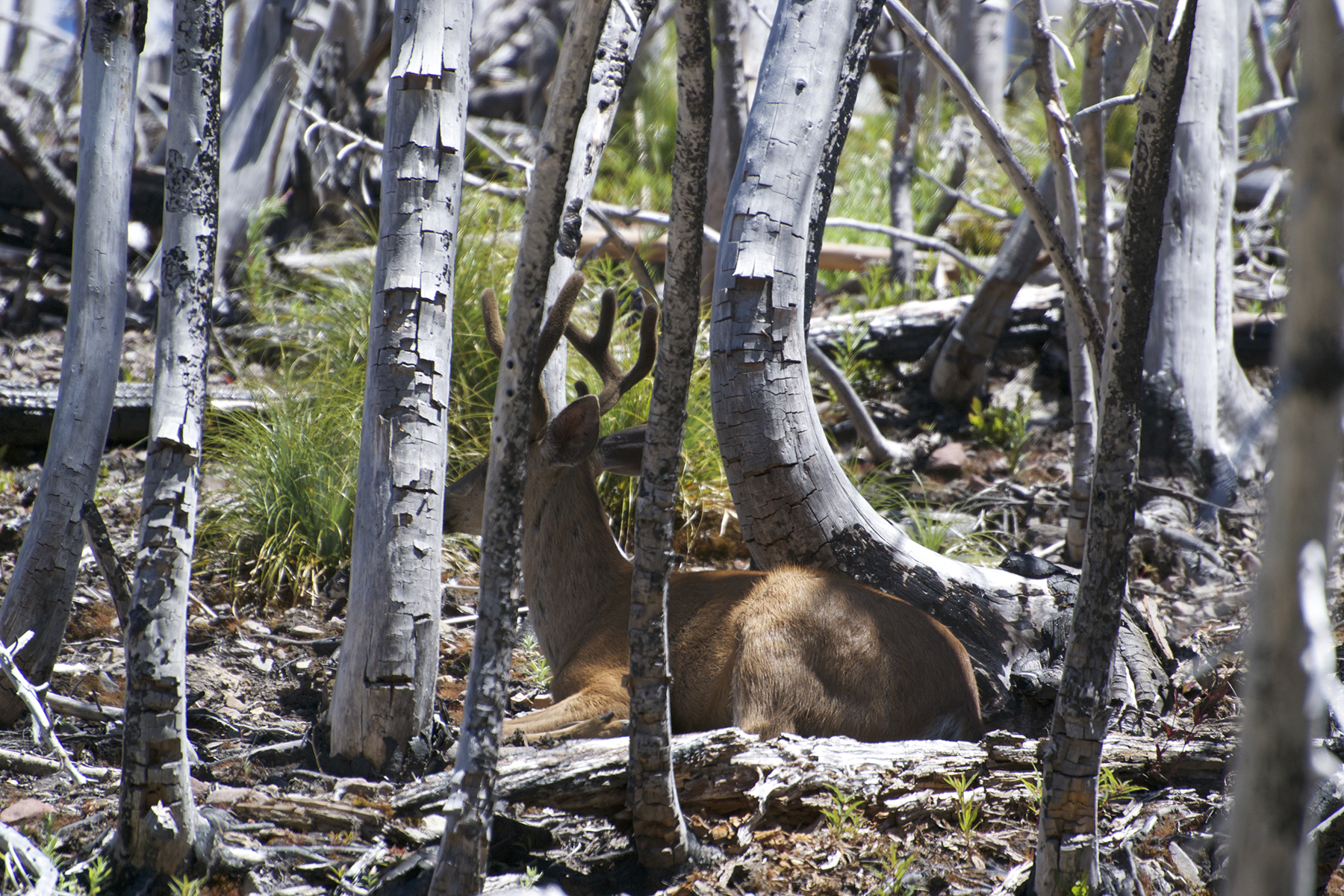
Even in the wild, well, in the wilds of Tualatin, where they should be less accustomed to human/deer interaction they do not budge. Photographs from Monday’s walk are evidence that I could approach them to up to 2 meters with my small point&shoot camera. Then again, I did not yell, because I was happy to see them anywhere but in my stripped-down flowerbeds.
Much to know about deer, including the fact, among others, proclaimed by a science site: “The Chinese water deer is the only species that doesn’t shed its antlers, because it doesn’t have any.” Glad that could be added to the canon of irrelevant but funny bits in my brain.
Levantine Cave Painting Art, dated from the end of the Mesolithic Age and during the Neolithic Age at Valltorta-Gassulla Cultural Park in Spain near Valencia.
*
I’m actually more interested in talking about shame rather than deer today, since the absence of the former, whether among those cloven-hoofed ungulates or certain members of the political sphere, has significant consequences for our well-being. Thoughts about shame were triggered by a book review of a book by Ute Frevert, managing director of the Max Planck Institute for Human Development in Berlin, and director of its Center for the History of Emotions.
Lucas Cranach the Elder (1472-1553), Adam and Eve, (1526)
The Politics of Humiliation: A Modern History, now translated from the German by Adam Bresnahan, concerns the relationship between power and shame, shaming, or humiliation. Three areas of interest are used to explain the psychological mechanisms: shaming as punishment for individual transgression in the political, public sphere, humiliation online and in school, and foreign policy between countries. I look forward to reading about the history of how shaming developed across the centuries. “It is the story of the democratisation of the right to dignity and honor, which at different times were regarded as belonging only to the aristocracy and not to commoners, to adults and not to children, to men more than women, to a sovereign and not to a people. ” It is certainly interesting to think that not only the display rules of emotions differ between cultures, or genders, but that there were differences, across time, in who had a right to a particular feeling, or the power to induce it.
Attributed to JOHN FERNELEY JR. (British 1781-1860) The Stag Hunt
The ever looming memory of Nazi public shaming of women married to Jews, (or Norwegian public shaming of women in love with German soldiers) also raises questions about gendered approaches to shame: women often had their hair cut forcibly and in public, humiliation always directed at their bodies, in war (ancient and recent) often through the ultimate humiliation of rape.
Frida Kahlo The Wounded Deer (1946)
Found this stag on a hike on Mt. Hood near Paradise Meadow two years ago
As a cognitive psychologist I am of course most interested in how an emotion can be utilized to enact power or manipulate people, mechanisms spelled out in a 2018 interview with the author here. The distinction between shaming and humiliation is important. Shaming was always used as punishment for a norm-defying person to get them to repent and then back into the fold. Humiliation, on the other hand, has the goal to stigmatize the person and set them apart from the group. The state or political actors historically used these mechanisms, but nowadays on-line platforms have joined in, with body/fat-shaming just one example (which reminds me: I did NOT find Speaker Pelosi’s fat shaming of a certain monster appropriate, in fact it irritated me to no end. You can’t join the gutter.)
Here is the contradictory part: on the one hand we, as a society, value honor and respect (and rightfully decry its absence), but on the other hand we show increasing appetite for public humiliation, just look at all those reality shows. The psychological mechanisms seem to point to a gain in self esteem or sense of group membership when we berate and belittle others, openly and in front of everyone. If we are part of the group that is humiliating rather than humiliated, it gives us a sense of security and belonging, as well as power. And if we create specific out-groups through acts of humiliation we can utilize their status for our political purposes, directing and displacing anger at those victims. (Although seemingly, if we are paid enough, we are also willingly complying with a potential state of humiliation – just look at the lines of the casting show. Honor has a price, after all, as Frevert puts it.)
Franz Marc Crouching Deer (1911)
I think, well, I hope that knowing about the mechanisms of how humiliation works enables us to inoculate ourselves against related attempts to employ it as a tool, attempts surely to increase in the context of the election campaign. If humiliation thrives on having a public participate, it is up to us, the public, to refuse to be participants in the spectacle. We can turn away.
Now all I wish is for the deer to do the same.
Today you have a choice between Mozart’s The Hunt and Haydn’s (The Hunt) and Cesar Franck’s Accursed Hunter – maybe the latter felt some shame….