Browsing Category

Nature

Migration (3)

Happy sloths. Happy storks. Happy Cows. Unhappy whales. At least some of them. (And yes, you only get the jokes if you regularly read the blog when it resorts to the to be continued mode….)

This week was devoted to looking more closely at nature and in particular at migration. Whales, of course, are among the most familiar species doing an annual trek, and we would be remiss not to mention some of the scientific findings around their existence. (I wrote a bit about them last year here.)

So why describe them as unhappy? Well, several of their kind are severely endangered, and not just because the whale oil industry of yore pursued them to the brink of extinction.

Take right wales, for example, who once roamed the Atlantic and whose numbers are dwindling. In the last 10 years the number of calves born to them have dropped tremendously. And when a calf is born it rests for some 5 months with the mother at the ocean’s surface – completely at risk to be stricken by shipping vessels, or caught in fishing gear. Mariners cannot detect them with listening devices, to avoid collisions, because the instinctual behavior is NOT to make sounds, to avoid natural predators. Between declining fertility and rising accident mortality, they are at risk of extinction. Only 400-500 of them remain in the Atlantic and fewer than 100 in the Pacific.

Sei whales? Endangered. Blue whales? Endangered. Sperm and fin whales? Vulnerable. Any tidbits that can distract us from getting too depressed by these facts? The tongue of a blue whale alone is equivalent to the weight of an elephant! They migrate from the polar and subarctic regions in summer to the tropical and subtropical waters in winter, some of them are over 150 years old – which means they actually were alive during commercial whaling times and might remember being hunted by whalers. Autopsies on dead sperm whales revealed up to 65 pounds of plastic in their stomachs, leading to blockage and causing lethal peritonitis. Ok, not helping with the depression, is it.

I can do better. Humpback whales are thriving after coming close to extinction! Scientists stress the role of proper management for the recovery (details here) but also warn that the food for which whales and so many other marine animals compete, namely Krill, is strongly affected by global warming, getting increasingly scarce. If more whales feed on it, there’s less to go around for the ones lower in the food chain….
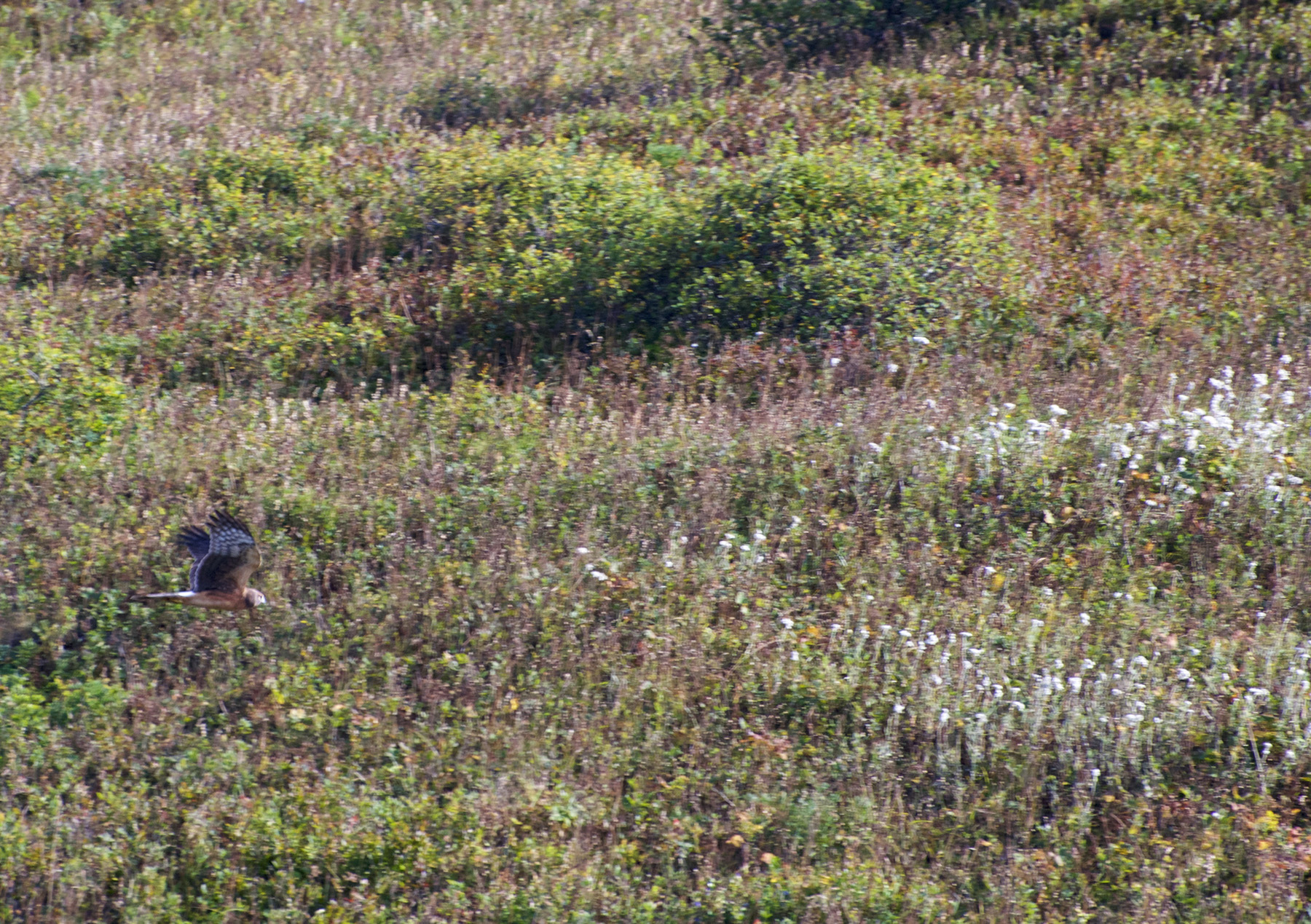
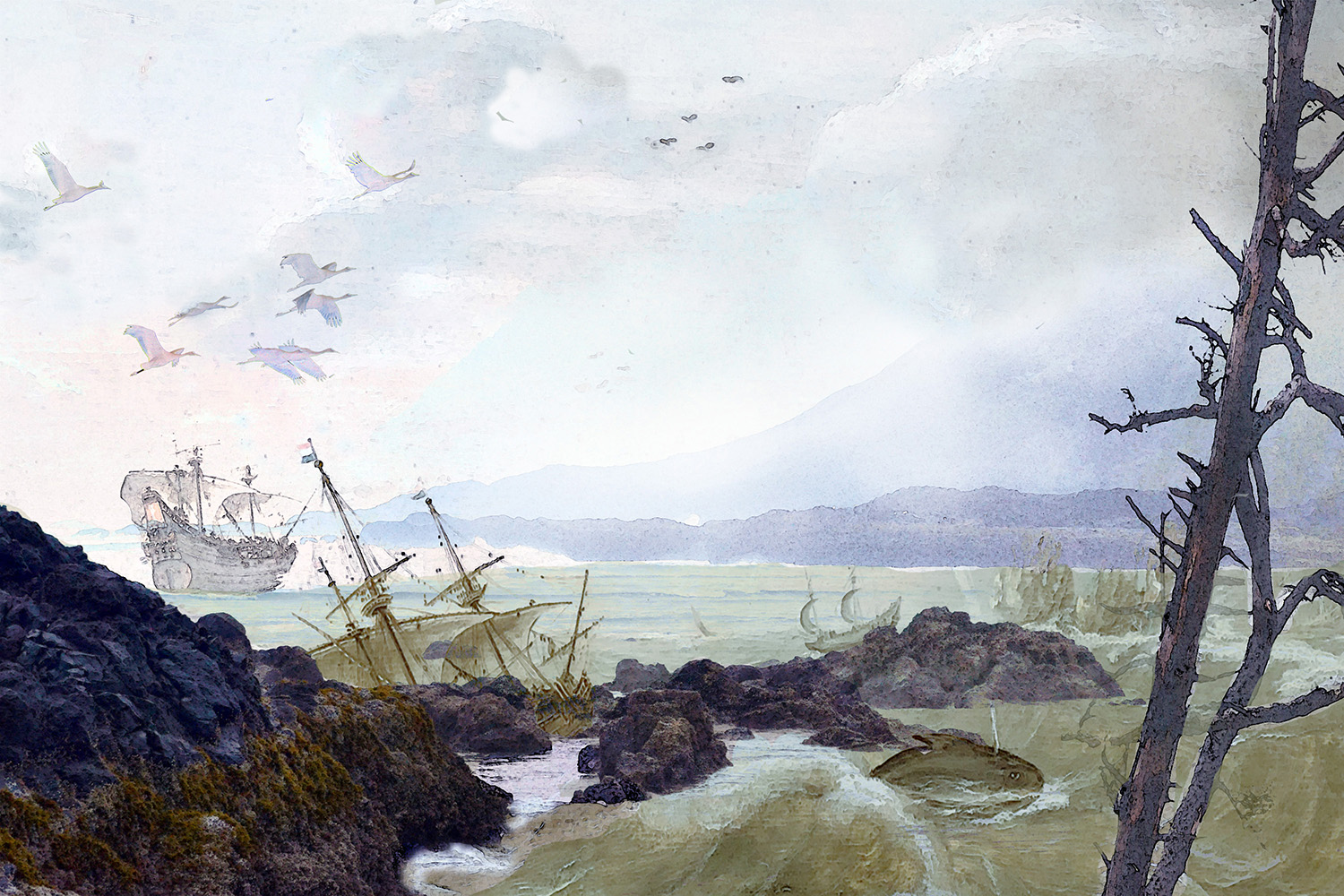
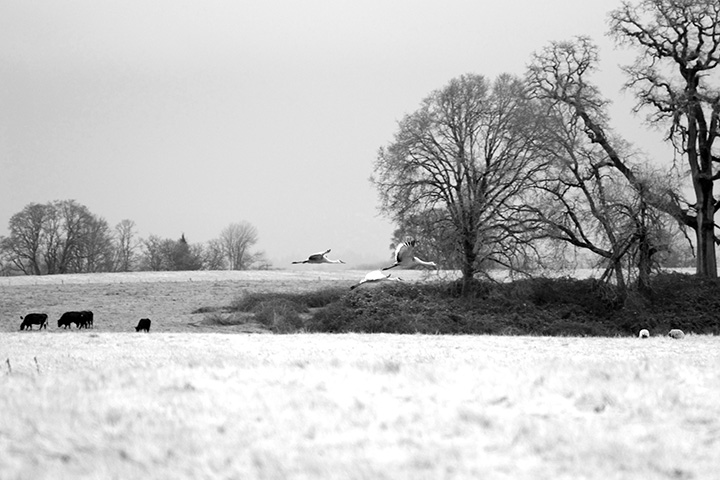
Ok, I give up. All these facts are part of why I currently have turned to working on an art series that uses (partial) 17th century dutch paintings of traditional whaling expeditions, combined with my photographs of contemporary Northwest landscapes and birds, as an example of the consequences of ruthless environmental exploitation to both nature and humankind. Today’s images are the latest examples in that endeavor, I had, after all, promised some art as well.

And here is a tone poem by Alan Hovhaness performed by the Seattle symphony.

Migration (2)

Yesterday I introduced the happy sloths of Panama. Today, let’s turn to happy cows. Doing whatever cows do in the Bavarian country side, they were unperturbed when a flock of large, strange white birds descended, alit on their backs and began nit-picking bovine fleece. Maybe there is something stronger than alkaloid compounds in the Bavarian water. In any case, it was enough of a strange sight that a young birder-in-training rushed to the relevant experts trying to find out what on earth had just happened.

It was a flock of unfamiliar cattle egrets who had made a wrong turn during their migration.

Some decades later, our observant youngster Martin Wikelski has become the director of the Max Planck Institute for Ornithology in Radolfzell, Germany, after teaching stints that included years at Princeton. He is still interested in birds, and now in general migration patterns as indicators of disease spread, disaster detection, and global change. He is spearheading ICARUS, (International Cooperation for Animal Research Using Space) a program connected to the International Space Station as a tracking site for interacting animal migrations, installed last summer. (Equally impressive, in my book, is of course the fact that this guy lists adventurer in first place on his CV, scientific grandeur notwithstanding.)

He stuck with birds, but cows have not disappeared either. They are currently part of a research program that has fitted sensor-studded radio transmitters in quake-prone regions around the world to various birds and mammals, trying to pick up earthquake warnings from changes in the animals behavior and physiology (a controversial project, one might add, with geologists not convinced that animal behavior changes around the timing of an earth quake. But that will be obviously explored now.)

*

What do we know about migration, though? Take one short minute and check out this video, which shows you the flow of movement across the globe. It is astounding.

We know that they move and where they move, at least for some of the species. We do not quite understand why they move such huge distances and, when finding a place that is perfectly suited, regularly leave it nonetheless to make the long trek back home. Home being not just a general area, but a specific tree in a specific forest, a distinct chimney, church tower or other nesting sites. Sometimes the specificity is encoded across generations, so that some butterflies return to exact places where their great-grand parents came from, not more immediate forbears.

We know that migration serves not just the migratory animal populations, but others along their routes, who feed on the carcasses of those who didn’t make it, or live on lands fertilized by the droppings, or cleared of pests, insects that are devoured by the birds in flight (swallows, or more precisely, swifts, fly for six months (!) non-stop, and are eating insects en route and apparently sleeping while flying as well…)

We cannot yet explain why migration happens to such far away places as the Amazon, when Ft. Lauderdale is just around the corner, equally warm and comfy, say… and why distances increased across the millennia. And in particular we have not yet figured out why on average each species follows its particular migratory routes, but then there are always outliers, who do not comform.

Leave it to our intrepid ecologist and adventurer to follow exactly these non-conforming individuals, trying to figure out if it was disease that stopped them, or external forces or something else altogether. Pursuing a stork he had named Hansi, he jets to Turkey, awaits once-daily radio transmissions to narrow the distance to the subject, and eventually finds Hansi perfectly happy and healthy gorging on frogs in some field near the Syrian border.

The hypothesis is that natural selection programs some section of the progeny to wander farther afield. That innovative individual will be important for the species to thrive, to survive when aggregate flows are threatened by disaster, by pathogens, or by obstacles put in their way by human activities. (This reminds me of a nasty fight going on between two factions of German environmentalists right now. Some want to erect wind turbines to curb carbon emissions, others fight against them to protect wetlands and birds. The laughing third is of course the oil and coal industry.)

We’ll see what the research data will reveal. In the meantime I decided to pull some hang-gliding photographs from the archives in Wikelski’s honor. He reports that he has become an avid hang glider in order to explore how it must feel to be a bird (his words.) Well, he won’t be up there for 6 months at a time…… and I also hope he is never the parent of a kid who does this – cost me many an anxious moment in my lifetime. Then again, it also took me on some pretty spectacular hikes, like the one shown here at Silverstar Mt.,WA.


Migration

There’s always Panama. If we get too overwhelmed by the insanity of the contemporary world we could migrate to some island near Panama joining a troupe of exceedingly happy, permanently stoned sloths. You read that right: the moss there, and the water infused by the moss, has an alkaloid- based chemical composition that is also found in Valium…. much appreciated by an already slow-moving species.

Canada Geese, who no longer migrate

I picked up this comforting tidbit of information from a radio show that taught me a lot about migration, something I’ve been again wondering about last week when I found myself amongst hundreds of visiting white geese, Canada geese and sandhill cranes during my walks. Below is the condensed version of what I learned.

Sandhill Cranes

Questions like why does migration happen in general, and where do these birds come from or where do they go, how do they know the travel routes and/or final destinations, have been asked for 1000s of years. We have now answers for some of the questions, and are still surprisingly clueless about others.

White Geese

Aristoteles – is there any subject he didn’t tackle, ever? – suggested three possibilities to explain the disappearance of birds during the Greek winter months. One was the speculation that they traveled to other places, one was the suggestion that they might hibernate (behavior that people had observed in bats around Athens) and the third was transmutation. Wish that were true – let’s just all transmute into happier forms when we are bored with our worm pecking, grub searching existence…. let’s become sloths!

The migration hypothesis was elevated in the 17th century with the (re)invention of the telescope by Hans Lippershey in the early 1600s. (He applied for a patent (!) thus outsmarting a local competitor who claimed it was his design – but that is a mystery story for another day.) Peering into the sky and seeing all those lunar hills and craters suggested perfectly sensible travel plans of birds: they go to the moon! It took until 1822 to dislodge this human projection of our own dream, when some hunting Count von So and So returned with his kill from the heaths of Northern Germany: a stork. A stork with a spear embedded in his neck, that had not prevented him from traveling North. A weapon that was, according to the consulted German luminaries in the university ethnology departments, of African origins. (You can read more about the “Pfeilstorch” here.)

Care to try flying with that thing in you for 2000 miles? At least you’re not a tern – they have a round trip of 60 000 miles!

Across the next years about 25 individual birds were collected that had somehow managed to migrate from one continent to the other with a piece of ebony poking through their necks… Mystery solved – birds migrated South. Scientific insight gained beyond the migration destination: some form of marking allows us to identify the birds and tracking their routes. Banding was born. Nowadays it comes in more sophisticated forms of transmitters and receivers. And it does not just apply to the field of ornithology, but people research the migration patterns of everything, from wildebeests, caribous, whales, to turtles and butterflies, to name a few.

More on the specifics of these patterns tomorrow. They do matter, beyond feeding into the passions of your friendly bird photographer, for our understanding of nature as a system, as it turns out.

And here is a gem sent by a friend.

Choices, Choices…

Happy New Year to one and all. And what should it be, dear reader, the first weekly topic of 2020? What is the appropriate choice for a year looming in front of us like an iceberg, with the distinct options of either collision or rapid melting, not sure which one would be worse?

Should it be art? Politics? Literature? Nature? A snippet of them all, in combination? I’ll see what I can do.

What I can easily do is recommend a writer, Barry Lopez, who does it to perfection, creating that amalgam of politics and nature in his most recent book Horizon. Others agree:  It’s a beautiful, sorrowful autobiographical epic that feels like a final reckoning of sorts: with the difficulty of living a moral life today, with our estrangement from nature, and with the spectacular mess we’ve made of things. There’s not an iota of righteousness or judgment, but instead, abundant reminders of human possibility in desperate times. (You can find the whole conversation between John O’Connor, a journalism professor at BU and Lopez here.)

Lopez has excelled at both fiction and non-fiction writing that concerns the interface between nature and the more domesticated world, with his two early non-fiction works probably known best, Of Wolves and Men (1978) and Arctic Dreams (1986)—the latter a winner of the National Book Award. His writing is valuable for both the explanations he offers as to how we got to where we are, but also for the suggestions, both practical and political, of how we might handle what is in front of us – (which is why I was thinking of him when facing the calendar page with its fresh round numbers…)

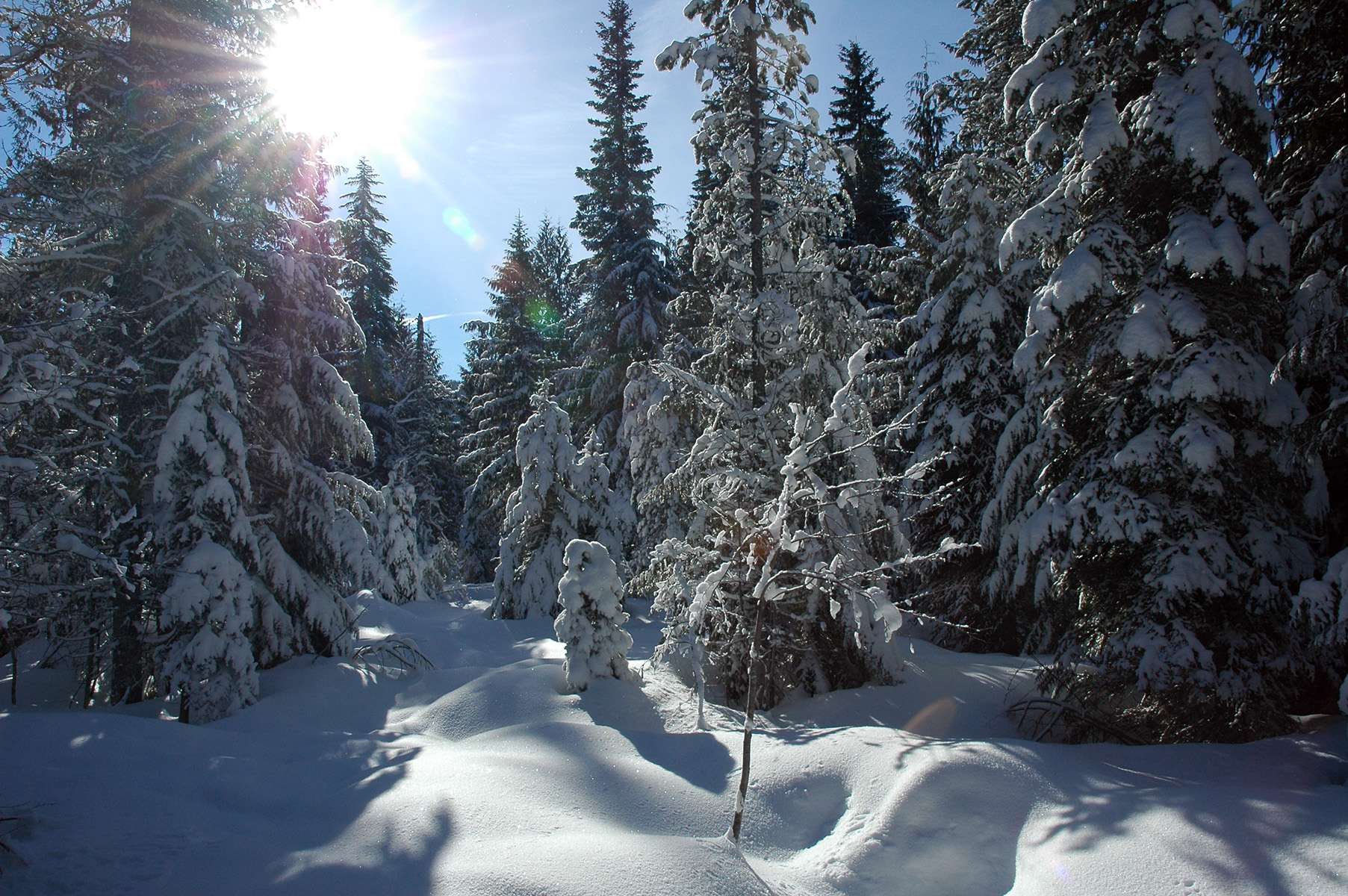
I have been using the week between the years, my time “off,” for extended walks in the woods, all around Portland, in contrast to Lopez’ extensive travels to the less explored corners of the earth, but I think the conclusions are the same, no matter where you are: to connect to nature you need to stop controlling it, you need to stop talking and start to listen, start shifting the focus of your attention. This is one of the reasons why I photograph such a variety of things on my walks – not “just” the birds, but the trees, the plants, the vistas, the rivers, with widely distributed attention.

Found this garbage receptacle with sticker at the entrance to Forst Park on Firelane 1

Connecting to nature, to understand what is at stake as well as what can heal, is one of the greatest demands of our time. We might think we are far enough away from the fiery catastrophes unfolding in Australia, or the traumatic floods engulfing Indonesia, but the planet is connected. What we do matters, even in minute ways.

And no, this is not Cassandra Heuer speaking, this is a determined, energized and hopeful citizen of 2020, looking forward to summoning all in solidarity with the goal of protecting what needs protecting. If you don’t have the time to tackle the 500+ pages, here is a lovely comprehensive review of Horizon ending with these words:

Horizon is long, challenging and symphonic. Its patterns only disclose themselves over the course of a full, slow reading. Rhythms rise and surge across 500 pages; recursions and echoes start to weave. This is a book to which one must learn to listen. If one does, then – to borrow phrases from Lopez – “it arrives as a cantus, tying the faraway place to the thing living deep inside us”. He has given us a grave, sorrowful, beautiful book, 35 years in the writing but still speaking to the present moment: “No one can now miss the alarm in the air.”

And talking about something symphonic, here is Dvorak to guide us to a new year, making a new world.

Lopez lives along the McKenzie river in Oregon’s Mt. Hood State Forest. Photographs are from that forest photographed during bygone trips.

And this is me in my rain pants in the new year:” Stay intrepid!” is my resolution.

Respite

Need respite from too much food, too much company, too many balls in the air, from recycling gift wrapping paper, never mind the ongoing harangues over social justice issues? Do I have the thing for you!

On this 5th night of Hanukah my present to all is a pretty remarkable audio work based on ultrasound and echolocation used by bats, dolphins and other creatures who operate beyond the range of human hearing – ‘seeing’ with sound, or perhaps ‘hearing’ objects. Added to that are “real” sounds, those that we can hear without them being stretched in time to be made audible.

“The mix for the piece is based on ultrasound, hydrophone recordings below the water and also of echolocation sound within audible range. The recordings were made in various locations in Central Park and East River in New York, USA, a forest outside Kaliningrad in Russia, Regents Park in London, UK, and various locations in Norway, Denmark and Sweden. The ultrasound is time-stretched to bring it into a frequency range audible for human beings. Recordings were made on a Pettersson Ultrasound Detector D1000X, Reson 4032 and DPA 8011 hydrophones and 4060 dpa microphones onto a Sound Devices 477T hard disk recorder.”

*

I started to listen to Jana Winderen at the beginning of December, when I came across the article attached below. The Norwegian scientist turned artist makes field recordings and then creates audio collages in her sound studio. When she at times composes immersive installations for specific places, like the Wuzhen Contemporary Art Exhibition in China, the Thailand Biennial, Oslo’s Kunstnernes Hus, and Art Basel, she checks out the acoustics, temperature, and air quality of the hosting location, talks to local technicians, and gets a feel for the architecture of the space, all of which gets integrated into the compositions.

Sitting and listening in a quiet place, uninterrupted, preferably with head phones, these compositions invariable generate a sense of peace and inner quietude that those of us who are meditation-challenged can otherwise only dream of. Your music for today.

And here are words capturing the sounds that the earth makes, as well.

Anchorage

By Joy Harjo

 for Audre Lorde

This city is made of stone, of blood, and fish.
There are Chugatch Mountains to the east
and whale and seal to the west.
It hasn’t always been this way, because glaciers
who are ice ghosts create oceans, carve earth
and shape this city here, by the sound.
They swim backwards in time.

Once a storm of boiling earth cracked open
the streets, threw open the town.
It’s quiet now, but underneath the concrete
is the cooking earth,
                                 and above that, air
which is another ocean, where spirits we can’t see
are dancing                joking                   getting full
on roasted caribou, and the praying
goes on, extends out.

Nora and I go walking down 4th Avenue
and know it is all happening.
On a park bench we see someone’s Athabascan
grandmother, folded up, smelling like 200 years
of blood and piss, her eyes closed against some
unimagined darkness, where she is buried in an ache
in which nothing makes
                                       sense.

We keep on breathing, walking, but softer now,
the clouds whirling in the air above us.
What can we say that would make us understand
better than we do already?
Except to speak of her home and claim her
as our own history, and know that our dreams
don’t end here, two blocks away from the ocean
where our hearts still batter away at the muddy shore.

And I think of the 6th Avenue jail, of mostly Native
and Black men, where Henry told about being shot at
eight times outside a liquor store in L.A., but when
the car sped away he was surprised he was alive,
no bullet holes, man, and eight cartridges strewn
on the sidewalk
                        all around him.

Everyone laughed at the impossibility of it,
but also the truth. Because who would believe
the fantastic and terrible story of all of our survival
those who were never meant
                                                to survive?

No Turkey to be seen

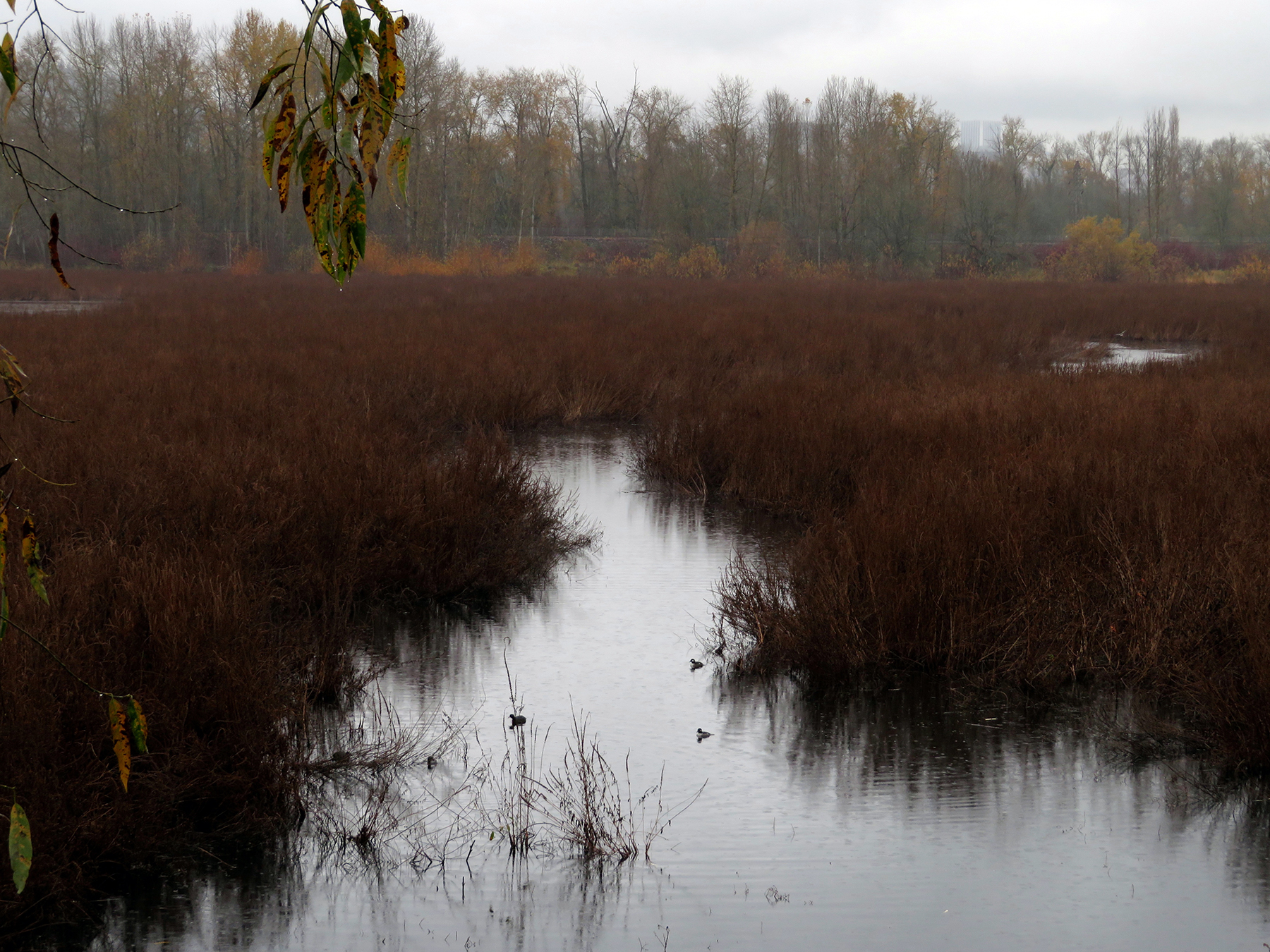
I went on a turkey hunt yesterday, under a dark sky, with rain steadily falling, nature quietly preparing for the impending storm. Did I find any? Of course not.

I did find solace – the grey above had almost a greenish tinge which in turn enhanced the reds of the sprigs and branches of the shrubbery stripped of leaves. The colors were harmonious rather than melancholy, and the rain almost cheerful in its relentless drip.

Bald eagles were crossing the river, alighting eventually on some boulders in the middle of the stream, usually covered by water at this time of year. Not after this dry summer.

Ducks were cruising, up and down the rivulets running through the marsh. I heard red-winged black birds sing; that, too, rather late this year.

True thankfulness on this walk, on many walks, on almost every occasion of this vibrant life of mine. Thankful for my family, my friends, my readership, slowly growing and making me feel connected.

I’m signing off for the rest of the week, for some needed rest and recuperation. Wishing you all a Happy Thanksgiving! With music to lift heart and spirits (while bellies sag from all the food – I assume the missing turkeys can be found in your various kitchens…)

Crisp

Just so you see the rest of my week’s ambling, here are photographs of yesterday’s walk at the Sandy River Delta, a half hour’s drive from Portland.

Not a cloud in the sky, thin, cool air, the mountain visible and the dog happy. The human too. Color palette went from red to gold to blue, reflecting sun off the water. Hard, clear November light.

I am pairing this with a poem by Thomas Hood (1799–1845) titled No! or alternatively November about this month. Unless you think he saw into a future where global warming has brought dystopia on all of us, here is a hint.

Hood wrote from London, a city heated by coal during the first cold waves of November. The sulphuric smog, paired with fog rolling in, obscured everything, made it hard to breathe, and blocked out traffic, including movement of needed goods.

November

No shade throwing on my part – just a reminder, sensed during every minute of that walk, that we still inhabit a beautiful world an need to fight hard to keep it.

Music today is about the last of the falling leaves.

To Autumn

John Keats (1795-1821)

Season of mists and mellow fruitfulness,
  Close bosom-friend of the maturing sun;
Conspiring with him how to load and bless
  With fruit the vines that round the thatch-eves run;
To bend with apples the moss’d cottage-trees,
  And fill all fruit with ripeness to the core;
    To swell the gourd, and plump the hazel shells
  With a sweet kernel; to set budding more,
And still more, later flowers for the bees,
Until they think warm days will never cease,
    For summer has o’er-brimm’d their clammy cells.

Who hath not seen thee oft amid thy store?
  Sometimes whoever seeks abroad may find
Thee sitting careless on a granary floor,
  Thy hair soft-lifted by the winnowing wind;
Or on a half-reap’d furrow sound asleep,
  Drowsed with the fume of poppies, while thy hook
    Spares the next swath and all its twined flowers:
And sometimes like a gleaner thou dost keep 
  Steady thy laden head across a brook;
  Or by a cider-press, with patient look,
    Thou watchest the last oozings, hours by hours.

Where are the songs of Spring? Ay, where are they?
  Think not of them, thou hast thy music too,–
While barred clouds bloom the soft-dying day,
  And touch the stubble-plains with rosy hue;
Then in a wailful choir the small gnats mourn
  Among the river sallows, borne aloft
    Or sinking as the light wind lives or dies;
And full-grown lambs loud bleat from hilly bourn;
  Hedge-crickets sing; and now with treble soft
  The redbreast whistles from a garden-croft,
    And gathering swallows twitter in the skies.

Written September 19, 1819; first published in 1820. This poem is in the public domain.

And here is, in addition to the bounty, to the wistfulness of October…..

Fall Color

Peak foliage color is later this year than what used to be the norm. The rise in average temperatures affects this process of nature as well. Not only is the onset of color change delayed, but the colors themselves are changing – the intense oranges and reds of autumn will become more and more rare, giving way to muted yellows and browns.

I learned this from an article about interactive maps that point travelers to where to go for the best colors at any given moment in time, something I had been curious about. It is, to put it mildly, dispiriting when you try and read up on nature and can’t avoid bad news even with the simple inquiry about the timing of fall colors….

So let’s balance that out with some good news, at least for us here in town. Last year’s Lenny Bernstein craze around the centennial of his birth led to an explosion of Bernstein-related musical programs but also a traveling exhibition about the composer/ conductor’s life curated by the GRAMMY museum. After previously having been shown at the John F. Kennedy Center for the Performing Arts, the Skirball Cultural Center, and the New England Conservatory, among others, it has now reached its 9th stop: the Oregon Jewish Museum and Center for Holocaust Education.

OJMCHE will have the exhibit of 150 artifacts on display until early January, but, importantly, will augment what’s there to see with some promising events linked to the show. Among others, there will be a story swap between musicians from a variety of genres, reaching from classical music to ska-punk. 45th Parallel will offer two concerts of Bernstein’s chamber music at the museum. Fall might be colorful, after all, if only in musical modulation.

What’s likely not covered in the exhibit (I have yet to visit) are the less public and darker aspects of the maestro’s life. A short and sensitive summary can be found here.

For music it shall be a symphony often connected to autumnal moods: Brahm’s No.4 in E minor. Conducted by Bernstein, of course.

Contemplation

Animals have a great advantage over man: they never hear the clock strike, however intelligent they may be; they die without any idea of death; they have no theologians to instruct them…Their last moments are not disturbed by unwelcome and often objectionable ceremonies; it costs them nothing to be buried; no one starts lawsuits over their wills.

—Voltaire

Who can say what cows feel, when they surround and stare intently on a dying or dead companion?

—Charles Darwin

It was the last day before the cows would be herded to different grazing grounds. Hunting season begins October 1st, and they have to be out of the way. It was thus also the last day for a walk around this particular area of Sauvie Island. From now until April 1st hikes are severely restricted.

I have no clue what cows feel. Does the possibility of not knowing about death outweigh the burden of not knowing that pain ends, either? Be it the fleeting pain that you and I know will be gone either by passage of time or the next dose of Ibuprofen? Or the chronic pain that we know will end with the loss of our current consciousness?

I have also always wondered about the fact that cows look at you. Ever noticed? Other animals out in the open might strike you with an evaluative glance before they decide to scurry to safety. Maybe your domesticated friends look at you when they want food, a walk or are simply bored or proud to show off a trick – but that prolonged stare of interest that you get from cows who don’t expect anything from you? It is puzzling.

Of course the premise that animals don’t know about death itself – still prevalent in the early 1970s, when anthropologist Ernest Becker wrote in his Pulitzer Prize–winning book Denial of Death that nonhuman animals know nothing about dying: “The knowledge of death is reflective and conceptual, and animals are spared it” – is questionable. Scientists now believe that at least some species recognize the special nature of death, elephants and chimpanzees among them. There is certainly some form of grieving in evidence, when loss occurs.

*

You might wonder why the theme of death pops up a second day in a row: it is the season in the Jewish calendar where thoughts of life and death (as well as our personal behavior and responsibility for our actions) is writ large. The days between the New Year and the Day of Atonement are meant to be days of contemplation, days of fear of punishment but also of hope that repentance and change is possible and able to avert divine retribution. The core of the message – independent of religious belief – speaks to me: annual re-assessment of our own moral compass and conscious decisions to try to do better is a valuable thing.

The poem that is recited on the High Holidays, the Un’taneh tokef, captures it aptly, with looming threats and the possibility of getting it to the point.

Here is an excerpt:

Let us now relate the power of this day’s holiness, for it is awesome and frightening. …….All mankind will pass before You like a flock of sheep. Like a shepherd pasturing his flock, making sheep pass under his staff, so shall You cause to pass, count, calculate, and consider the soul of all the living; and You shall apportion the destinies of all Your creatures and inscribe their verdict.

On Rosh Hashanah will be inscribed and on Yom Kippur will be sealed – how many will pass from the earth and how many will be created; who will live and who will die; who will die at his predestined time and who before his time; who by water and who by fire, who by sword and who by beast, who by famine and who by thirst, who by upheaval and who by plague, who by strangling and who by stoning. Who will rest and who will wander, who will live in harmony and who will be harried, who will enjoy tranquility and who will suffer, who will be impoverished and who will be enriched, who will be degraded and who will be exalted. But Repentance, Prayer, and Charity annul the severe Decree.

……

Here is a traditional recitation by a Cantor.

And here is a Leonard Cohen songs that riffs of the poem:https://www.youtube.com/watch?v=EgMaBreDuF4

Tomorrow is Yom Kippur – I will be off-line.

And thus the inevitable question if cows like music has to wait for another day.