Browsing Category

Nature

Desert Beauty

· Exploring Anza-Borrego Desert State Park ·

Certain desert areas have a distinctive and subtle charm, in part dependent on spaciousness, solitude, and escape from the evidence of human control and manipulation of the earth, a charm of constantly growing value as the rest of the earth becomes more completely dominated by man’s activities. This quality is a very vulnerable one …. Nowhere else are casual thoughtless human changes in the landscape so irreparable, and nowhere else is it so important to control and completely protect wide areas.”

Frederick Law Olmsted, Jr in a 1928 survey for the California State Park Commission.

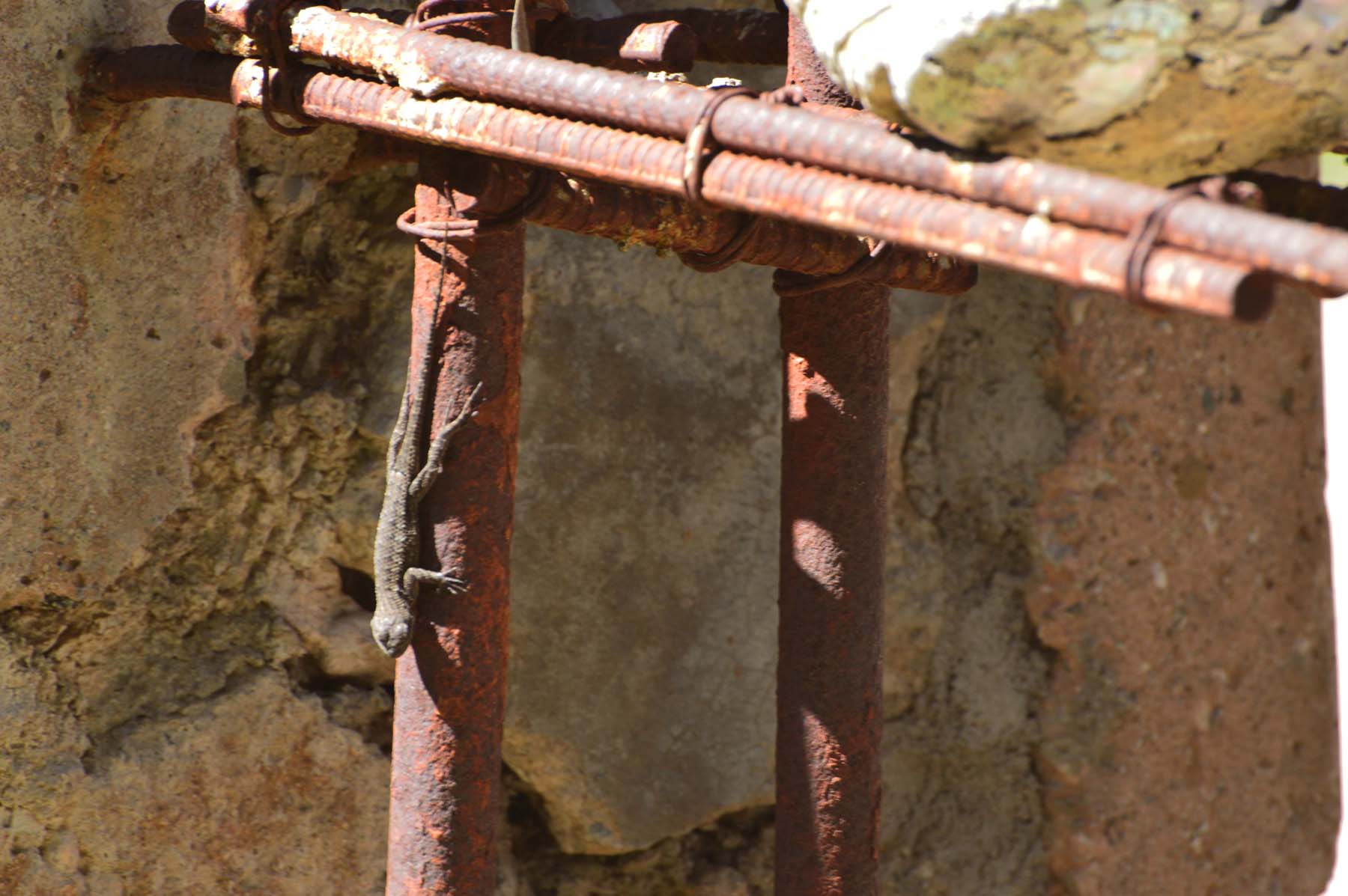
And here I thought almost 5 hours in the car to get from Los Angeles to Borrego Springs, CA, was a long stretch. Take the amount of time – decades and decades – it took to establish the nation’s second largest state park, the Anza-Borrego Desert State Park, and the drive was but a blink of an eye. Beginning in 1927, a group of visionaries tried to protect several desert areas for future generations, alert to the destruction of natural habitats by encroaching civilization that parceled up open spaces. Fierce opposition by many interested in economic development stretched out the process across years and years. For once, those concerned with environmental and ecological preservation, prevailed. Since 1974, some 585,930 acres (237,120 ha) of the Colorado Desert, located in San Diego County, are now protected. (For a riveting account of the history of the fight to create this marvel, go here.)

The desert lies along the western margin of the Salton Trough. This major topographic depression with the Salton Sink having elevations of 200 ft (61 m) below sea level, forms the northernmost end of an active rift valley and a geological continental plate boundary (Lots of earthquakes with high magnitudes, every 5 years or so.) (Ref.) 

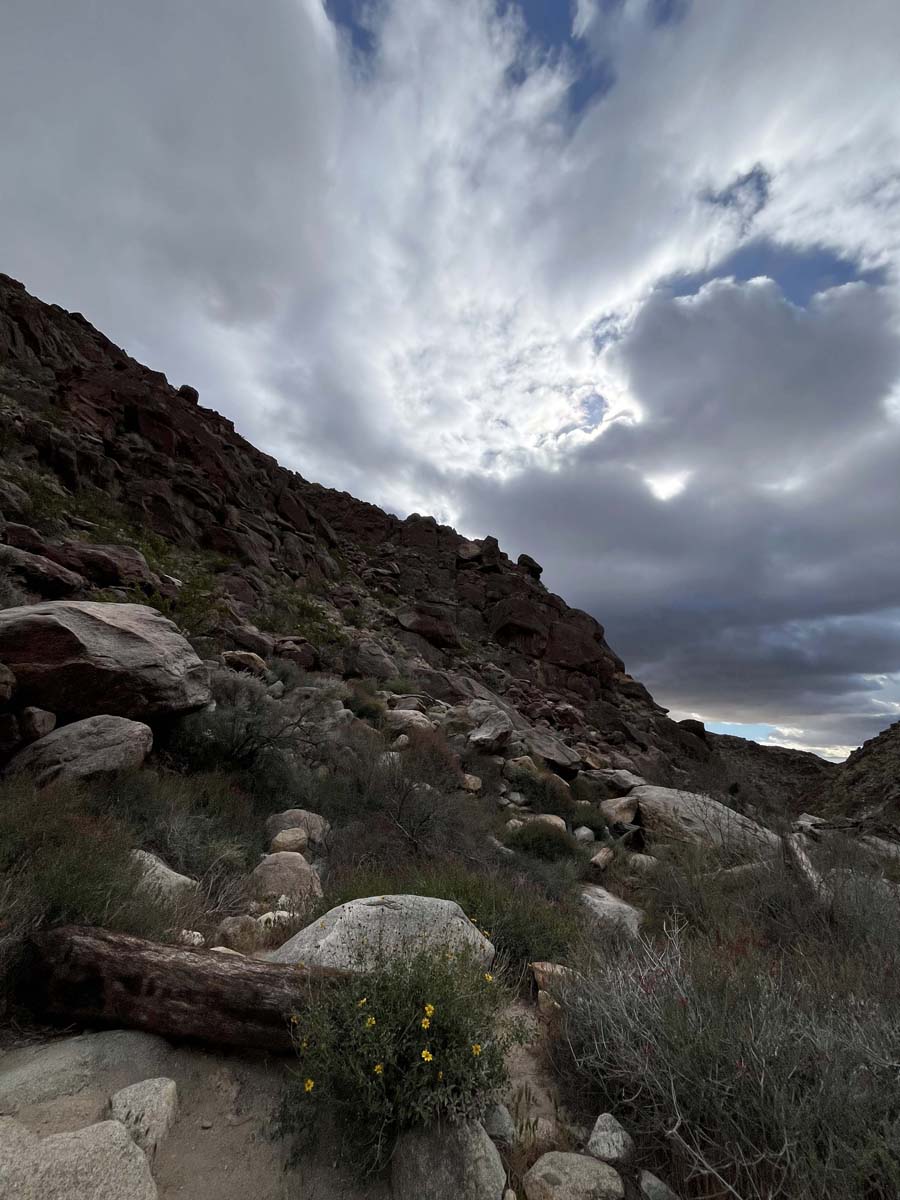
Imagine a large bowl of badlands, surrounded by mountains, with the Vallecito Mountains to the south and the highest Santa Rosa Mountains to the north. The badlands, ancient lake basins, are the result of both, erosion and sediment deposition over 5 million years. what you are seeing is literally what the Colorado river excavated from the Grand Canyon. The eroded and pretty much plant-less areas make it easy to see the dipping layers of siltstone and sandstone. They are filled with fossils, and populated by big horn sheep, neither of which I glimpsed during my visit. What I did see was breathtaking beauty of wide open land, cloudy sunrise, and the tail end of the wildflower bloom, providing endless delight to the searching eye.

No wonder that eco-tourism flourishes here at this time of year: the population of Borrego Springs, where I stayed, increases by about 580% in peak wildflower superbloom season, an increase from around 3400 long term residents to around 200,000 tourists. According to the government’s park survey, 932 plant taxa belonging to 387 genera in 98 different families documented within the park. The plant family Asteraceae (sunflower) is most abundant with 135 taxa identified. Rodents, hares, rabbits, fox, coyote, mountain lion, bighorn sheep as well as many species of snakes make up the fauna.

The region was home to two Native American groups, the Kumeyaay and the Cahuilla for thousands of years, semi-sedentary residents of certain favored locations or base camps. From there they would travel to outlying areas seasonally to harvest food resources and to avoid inclement weather, like winter snows. Leave it to the forces that be to name the park instead for sheep (Borrego) and a colonizing explorer, military officer and politician, 18th century Juan Bautista de Anza.

The progressive vision to protect open spaces was not matched by progressive visions in other domains either: when César Chávez came to Borrego Springs to support local workers who wanted the National Farm Workers Association as their union in 1966, they tried to chase him out of Borrego Springs by not allowing lodging or camping in the usual spaces. He and the union organizers eventually camped at Borrego Palm Canyon Campground, the start of my hike last week, with a lone supervising ranger defending their rights against the town folks who loathed the idea of unionizing workers. 

The hike, starting at 7 am with an otherworldly light bathing the landscape, went up to the palm canyon, at my speed taking about 4 hours there and back.

That left a spare hour to visit some additional strange sights, before the threatening rain storm set in. (It dropped over 2 inches in 24 hours for the L.A. region.) In reversal to my earlier complaints about the length of time, these 5 hours felt way too short!

The clouds formed an appropriately dramatic background for an unexpected piece of art, a humongous, corrugated steel sea serpent crawling through the desert. I could not but marvel at the strangeness of the sight and, truth be told, at the skill of the designed and steel welded creation by sculptor Ricardo Breceda. However, there was something odd about plopping some 130 creatures in to the landscape, with people and cars crawling around them like ants, with few of the sculptures true to this natural environment. I mean, elephants and camels? Dinosaurs and tigers? The whole thing was the idea of Dennis Avery, the late land owner of Galleta Meadows Estates in Borrego Springs, adding free standing art to his property and, I guess, attracting tourists this way. and if that’s what draws people to the region, exposing them to the barren beauty of the desert for most of the year, more power to them!

Music reflects John Luther Adam’s view of the desert. Quails and sky reflect mine.

Coming and Going

You have to be on the lookout – otherwise you miss all the action!

Going: yours truly, driving to L.A. for the next month or so. Dispatches are in the cards, but not on a regular basis! I am hoping for a few Art on the Road adventures, though.

Coming: spring.

At least that’s what it looked and felt like yesterday near the Columbia river when the sun finally broke through, and little puffy clouds made the sky delectable.

Lots of kestrels,

other birds pairing up, or calling for mates

Buds and first shoots emerging,

and the landscape on the cusp of exploding into color, with a few saturated spots already showing off.

Hard to imagine California can beat that. But then again…… stay tuned.

Since I didn’t burden your brain with much text today, we might as well stretch it with some unusual music from Australia. The album title translates as Now; the singer is one of few remaining Butchulla songmen, singing in their endangered aboriginal language.

Diversion

Today is International Women’s Day. I should probably be writing something about the rights women fought for, gained, have threatened and lost. About women in Gaza who lose more than just whatever rights remain to them, losing their families or even their lives. The women in Afghanistan who no longer have access to education, much less choices to thrive in anything other than the domestic sphere, if there. The women of America whose reproductive rights and bodily freedom are under an ongoing assault. And then we are faced with a reply to the SOTU address by a Republican Senator from Alabama, who sits at her kitchen table (where women belong ?) with a cross studded with diamonds around her neck (in case you forget the goal to make this into a Christian nation after all), all drama queen, stage whispering with fake tears in her eyes, how” illegal” immigrants are murdering our wives and daughters, painting a picture that might as well have come right out of The Handmaid’s Tale.) One might wonder how someone who says sexual assault is the worst thing that can happen to a woman, is encouraging Americans to vote for a convicted sexual predator.

For the sake of sanity – yours as well as mine – I will instead write about the most glorious sights I encountered this week, providing some diversion from our political reality. Some 40 minutes north of Portland, in the state of Washington, runs the Lewis river, emptying into the Columbia which in turn joins the Pacific. At this time of year there are runs of smelt that make their way from the ocean, up the rivers, to their spawning grounds. These small fish from the family Osmeridae live most of their lives in the sea, and when I consulted wikipedia to learn more of them I encountered this: smelt tastes like smelt. Good to know.

The runs vary in size, with climate change making a large, negative impact already. Across the last years, recreational fishing for them in many regions of the Pacific Northwest was severely regulated, they were so scarce. This year the Fish and Wildlife Administration offered people permits for their dipping nets that were only open for a couple of single days.

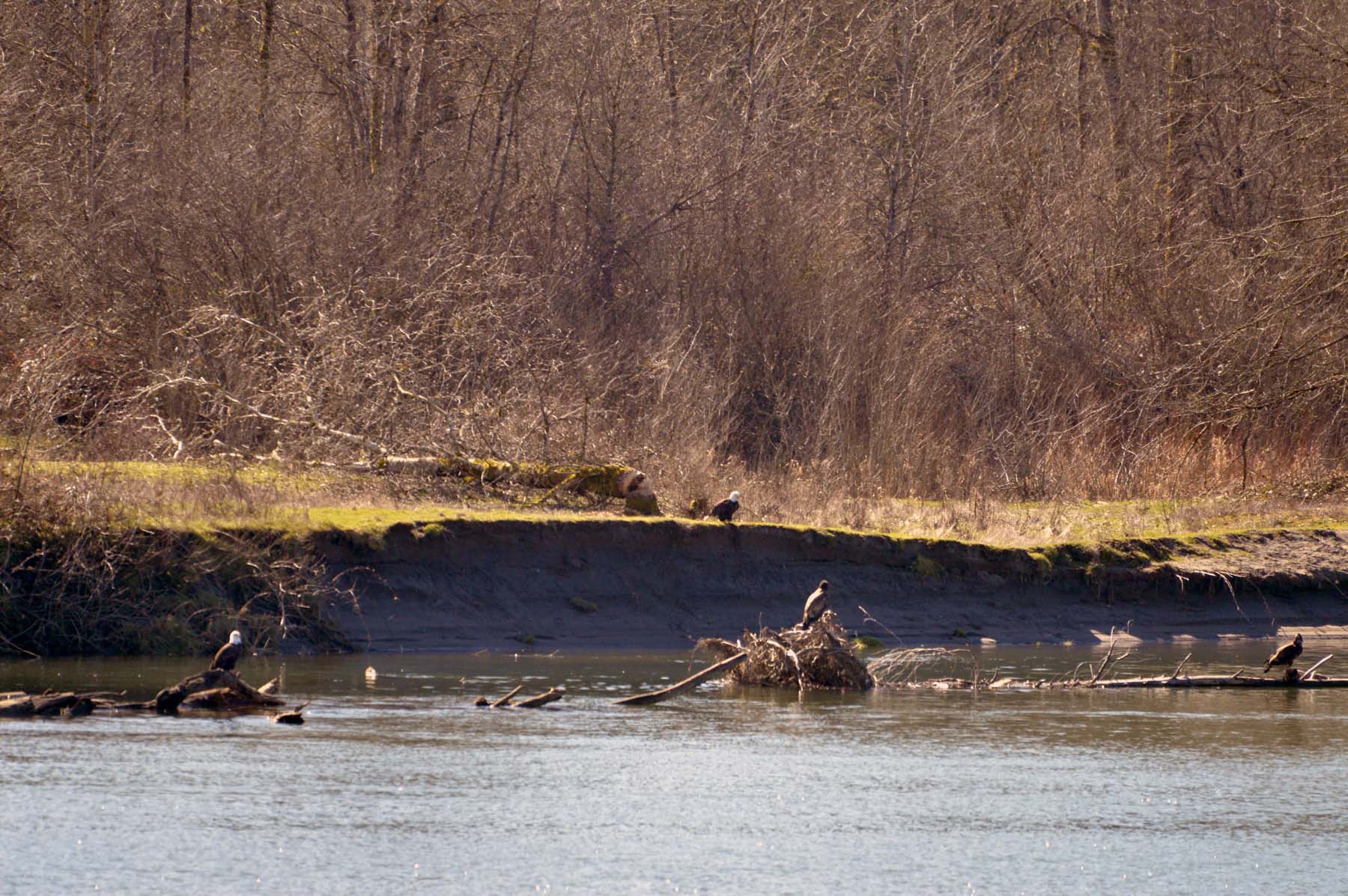
The bald eagles who congregate at the confluence of the rivers benefit, of course, when they don’t have to compete with fishermen for the increasingly smaller number of prey. The sight was spectacular. In a landscape straight out of a 17th century Flemish painting, they congregate on trees by the hundreds. A steady coming and going, dipping in the water, then hanging out with their lunch on various snags or branches.

Many of them circling higher than I had ever seen them. I first thought those were vultures, joining the feast, but no, all eagles, many of them juvenile who still have brown feathers instead of the symbolic white heads and tail feathers. Lots of courtship acrobatics in the air, with males and females, mating for life, eventually tumbling down in pirouettes, gripping each other’s talons before landing for the fun to begin.

To see the most amazing close up shots, done with professional equipment that I cannot match, by a nature photographer, Mike Schultz, who really stands out, look here. The pictures are from 2021, when the smelt run was bigger than today.

Images by Mike Schultz

My equipment might not live up to these standards, but my enthusiasm sure did. Standing in sunshine, if cool, listening to the sounds of these birds, as well as the sea lions joining the hunt, my heart simply lifted. There was no pretense, no play acting, no hidden agenda, no political manipulation – just nature doing what it does, surviving the day, planning for future generations and protecting them, being in the moment, rising.

A gift.

Music today is Chopin’s Heroic, dedicated to all women who are, having no other choice. And fitting for the eagles as well…..

Migrating Magnolias

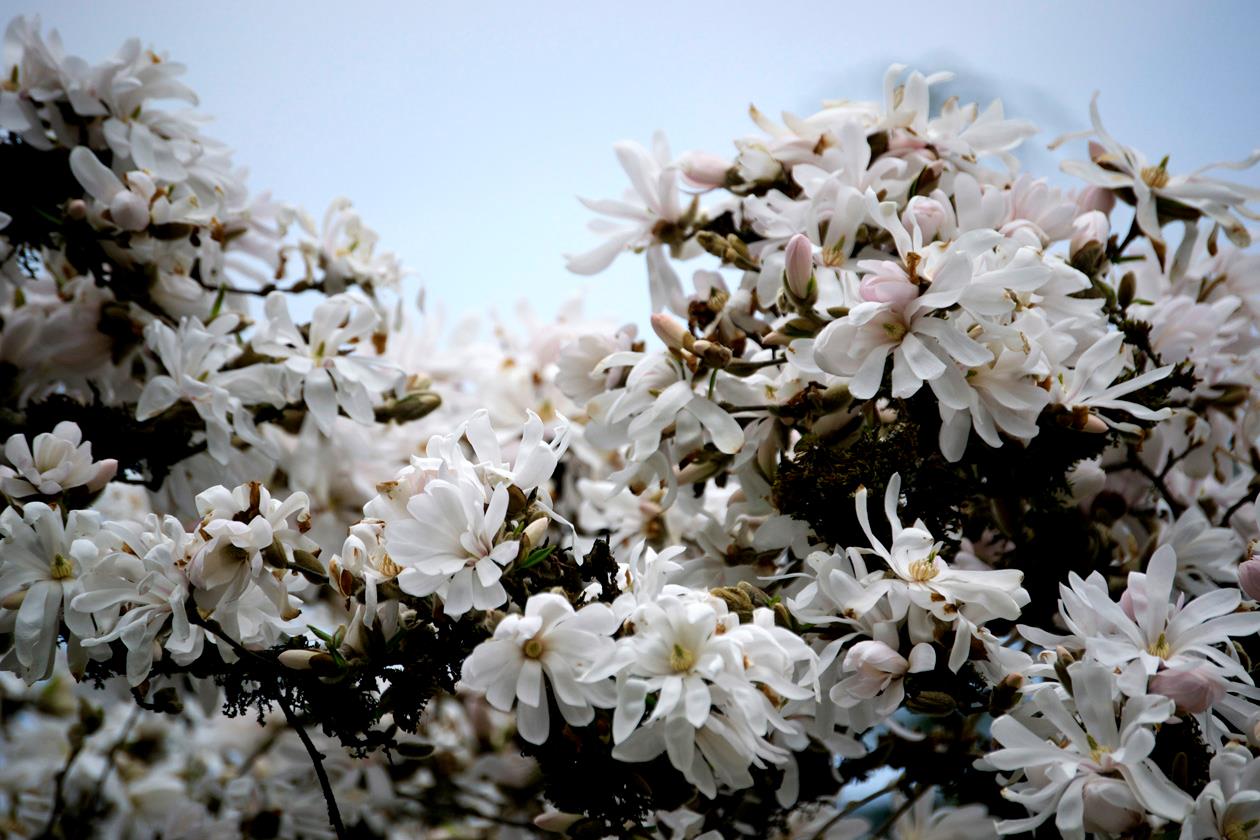
I so, so, so long for spring. I guess I have to wait for April…. when in other years magnolias were already in bloom in early March.

Morning – is the place for Dew –

Morning – is the place for Dew – 

Corn – is made at Noon – 

After dinner light – for flowers – 

Dukes – for setting sun! 

 by Emily Dickinson                                                           F223 (1861)  197

Magnolias, not unlike those captured in the photographs, were planted in Dickinson’s garden over 150 years ago, species not native to the region. By now they have migrated, to neighboring towns and from there up North, with climate change making it possible for them to survive in habitats not native for them.

Looked at it the other way around, should gardeners help non-native species to survive by adding them to regions that now have temperatures and water conditions suitable for them? They are doomed to die in their original habitats, after all?

Natural range shifts have certainly been documented by living beings that are able to move to preferred locations, like birds, insects and mammals. Historically, those migrations would have brought plants with them, in the form of seeds traveling via droppings, or clinging to fur and the like. But the species that would have dispersed the magnolias – the mastodons, giant ground-sloth and other mega-fauna – are extinct.

Here is the dilemma: on the one hand you might cheer the survival of a species under changing climate conditions, and go all in to give it a horticulturally helping hand. On the other side, though, many new species might then contribute to the decline and disappearance of those that are truly native to a particular region, themselves stressed by the new climate conditions. After all we know from biology research that a species’ risk of becoming invasive increases with the distance of its historic native range from the region it is colonizing. (Ref.)

I have no solution. Let’s just look at these pictures from other years, harbingers of spring, and enjoy them. We have to take joy were we can find it in these dark, wet days, and blooming trees are among the most joyful things I can conjure.

Music offers a spring song from Dvorak’s Poetic Tone Pictures – with a few others from that Opus thrown in as a bonus for being brave and cheerful!

Afresh, afresh, afresh.

Some folks by the name of Chad Crabtree and Brandon Woods in Eugene, OR, founded a small literary magazine last year, fittingly called Arboreal. Their titular choice was linked to their own names, but also to the notions of “going out on a limb” – presenting new and surprising work, and “evergreen” – the idea that art is timeless. I have found the occasional interesting new voice there, but also benefitted from the editors’ knowledge of poetry in general. A real enrichment for the literary landscape.

Today’s selection of poems, for example, came from one of Crabtree’s recent essays, called Rooted in Verse: Our Favorite Poems About Trees which I went back to after I had seen an unusual tree last week, a 300 year old Sitka spruce that is called the Octopus tree for its shape that lacks a center trunk but has unfolding tentacle-like limbs.

I picked the Brooke and Larkin poems because they both dwell on the fragility of life, the darkness that is impending, the hopelessness that sneaks up on you when you consider the fleetingness of it all, loss and mortality – but then they both rise to a version of hope, the possibilities of peace or new beginnings. I think that’s what we need: hope and the possibility of dawn or spring (or even a permanent cease fire), even if they are delivered by the minor poet, but golden poster boy of romantic lyricism, Brooke, or the major poet of dark snakiness and sarcastic leanings, Larkin. On average, they got it right this time!

Pine-Trees and the Sky: Evening

I’d watched the sorrow of the evening sky,
And smelt the sea, and earth, and the warm clover,
And heard the waves, and the seagull’s mocking cry.

And in them all was only the old cry,
That song they always sing — “The best is over!
You may remember now, and think, and sigh,
O silly lover!”
And I was tired and sick that all was over,
And because I,
For all my thinking, never could recover
One moment of the good hours that were over.
And I was sorry and sick, and wished to die.

Then from the sad west turning wearily,
I saw the pines against the white north sky,
Very beautiful, and still, and bending over
Their sharp black heads against a quiet sky.
And there was peace in them; and I
Was happy, and forgot to play the lover,
And laughed, and did no longer wish to die;
Being glad of you, O pine-trees and the sky!

by Rupert Brooke

The Trees

The trees are coming into leaf 
Like something almost being said; 
The recent buds relax and spread, 
Their greenness is a kind of grief. 

Is it that they are born again 
And we grow old? No, they die too, 
Their yearly trick of looking new 
Is written down in rings of grain. 

Yet still the unresting castles thresh 
In fullgrown thickness every May. 
Last year is dead, they seem to say, 
Begin afresh, afresh, afresh.

by Philip Larkin

Music today by Brahms, son of the Northern European landscapes where I photographed these trees.

Down // Up

Climb with me over the fallen trees in my immediate neighborhood, the park where I walk every day. Sink your boots with the most delicious sloshing sounds into the mud of the holes that the root balls left, and once again realize the power in nature. Bringing it all down.

Several speculations have been making the rounds why this particular ice storm did so much damage, and the given reasons probably overlap or interact. For one, the drought of the last several years has really stressed the trees and their root system. Secondly, the heavy rains in late fall saturated the ground, leaving the roots in unstable earth. Lastly, the storm that arrived two weeks ago had winds with gusts of up to 60 mph, winds that spiraled for some reason, encircling the trees, rather than swaying them back and forth, which apparently has more power (with even higher speeds those would be tornadoes or hurricanes, with a rotating function.) The ice then did the rest, its weight on the trees felling those that were unstable.

Hundchen not so sure about all of this

For counterbalance, here are a few of the soaring creatures that I photographed on Tuesday – with some others thrown in from previous January/February visits to Sauvie Island, just to marvel at the diversity of migrating visitors. Up they go….

Pelicans, Geese, Swans, Sandhill cranes, buzzards, kestrels. And then there were the bald eagles, cavorting, resting, chasing each other again, and finally getting some lunch.

That really is all for today, I simply do not have much stamina after these outings. But I do have an up & down song by Blood, Sweat and Tears from a looong time ago……

And since we’re already on memory lane, here is Earth, Wind and Fire I guess all we’re missing is the ice that the storm brought.

Winter Ponder Land

When you are iced in for pretty much a full week, as we were last week, there is a lot of time to ponder disaster scenarios.

If 200 ft (61 meters) sequoias topple in your yard (sparing your house with a stroke of luck, while many others in the Portland area saw their houses destroyed or even human life taken) your vulnerability becomes even more the center of attention.

Several trees came down, this the largest – about half of it in view here.

When you have no power for 4 full days, as we did during temperatures in the teens, you focus on what can be done during even worse scenarios: the mega earthquake that is looming on the time horizon for the Pacific Northwest.

I am talking about all this for another reason as well: somehow the prolonged shut-in has also frozen my brain, and so I have no capacity to write about something more interesting. Humor me then with reading a few suggestions for disaster preparedness, and store the links to more detailed instruction for a time when you have room and interest to act on them.

Wrens in action (Zaunkönig)

The most essential needs will be water, food and warmth (See the FEMA instructions for quantities, per head.) Energy bars will do for a few days if you have no means to heat up other dried food. If you have pets remember some emergency rations for them as well (and have a sticker at your door that informs rescue personnel what animals live in your house – they can be ordered on line.) Camping stoves will be useful if a major disaster cuts you off for weeks on end. (And yes, I realize, it is hard to stash all that stuff if you live in an apartment.)

Robins (Rotkehlchen)

Having a bag that contains solid shoes, a change of warm clothes, basic toiletries, first aid kit and some spare meds that are essential, water and energy bars, is helpful if you need to leave for a shelter in a hurry. Flashlights that wrap around the head are useful since they keep your hands free. Include a whistle, so search teams can find you. Matches or lighter. Stash in it photocopies of your drivers license, your insurance name and number, and your prescriptions for medications. Spare power blocks and charging wires for your cell phone should be included.

Thrushes (Drosseln)

If you can stay in your (damaged) house, a cheap tent and sleeping bags come in handy to preserve body heat. We stayed warm(ish) this week and had no water pipes break because we have a wood stove in the basement that heated the adjacent area and kept the house overall in the 40s. Having a crowbar available helps with earthquake debris. A fire extinguisher is helpful.

Sparrows (Spatzen)

Here is the FEMA safety preparation booklet.

Here is a website that offers the FEMA recommendations, with a few highlights for preparing the house/apartment, some relevant links for insurance and building codes, and a detailed listing of the risk to the PDX neighborhoods where we live.

Junkos and Towhees (Winterammern und Grundammern)

This week was a reminder that nature should never be underestimated. And now I’ll go and check out ads for generators…..

Photographs are self explanatory.

Chickadee (Kohlmeise)

Let’s make the music equally melodramatic as the weather: Sviridov’s Snowstorm.

A Breed unto Themselves

The Mushroom is the Elf of Plants – (1350)


The Mushroom is the Elf of Plants –
At Evening, it is not
At Morning, in a Truffled Hut
It stop opon a Spot

As if it tarried always
And yet it’s whole Career
Is shorter than a Snake’s Delay –
And fleeter than a Tare –

’Tis Vegetation’s Juggler –
The Germ of Alibi –
Doth like a Bubble antedate
And like a Bubble, hie –

I feel as if the Grass was pleased
To have it intermit –
This surreptitious Scion
Of Summer’s circumspect.

Had Nature any supple Face
Or could she one contemn –
Had Nature an Apostate –
That Mushroom – it is Him!

-by Emily Dickinson

At no time in the year is the concept of “fleeting” more realized than now. Thoughts are drawn to the nature of time, the passing of yet another cycle around the sun, when we approach New Year’s Eve.

Nature, as well, basically screams about transience. One day you see the mushrooms firmly planted on logs and soils, the next day they’ve disappeared. When you walk the same route, as I do, several times a week, it is almost spooky how the fungi jump into your field of vision or vanish, almost while you look.

The Thesaurus definition of the verb to mushroom – as in sprout or grow quickly – confirms that aspect of mycological nature:

Strongest matches

Strong matches

Weak matches

Their transient nature extends to my ability to remember the classifications, despite the fact that the five Phyla in the kingdom of fungi have such wonderfully strange names.

There are Chytrids, who live in water. There are the Zygomycota, also called the conjugated fungi, known to us more familiarly as bread mold. I can just see my self sighing at the breakfast table: “oh no, conjugated fungus again…”

Sac fungi, where did I put you?” wonders the baker, looking for the package of yeast, or the cook looking for morels and truffles. These belong to the Phylum of Ascomycota, and can have horrid consequences for people with compromised immune systems, inducing fungal pneumonia, for example, as well as being harmful to multiple crops.

What you buy in the store, or collect in the woods to cook with your pasta are Basidiomycota, the club fungi, which often have gills under their caps. However the shelved creatures you see on trees also belong to this Phylum.

The imperfect fungi flourish in imperfect households, or suitably moist and dirty conditions in nature: the common mold are part of the Phylum Deuteromycota. Their reproduction is strictly asexual. Which is weird, given how fast they spread – all without fun?

And here we demonstrate the fleeting nature of intentions: all I wanted to do today was show off the beauty seen in the woods this week and the persistent cleverness of Dickinson’s observations. Had to yield to the desire to learn more, once more. Well, at least I can now be brilliantly exclamatory when I open the bread drawer – should I be able to remember conjugated fungus for more than two minutes…..

We’ll hear today from a composer who fell for fungi, John Cage. (The link is to an article that lays out Cage’s passion.) Here is one of his Piano pieces in a strange arrangement for Thai gongs and electric bass – why not, we’re dealing with strange nature, after all.

Mothers and Daughters

Walk with me. No, scratch that. Stand with me. Because that is what I have been doing, standing, ever so slightly frustrated, at the edge of flooded roads, hiking paths, and wetlands, with no way in. This is what the start of the rainy season looks like in Oregon. By February, if the winter has average amounts of precipitation which you never know these days, it will be worse.

Still plenty of landscape, fall color and birds there for appreciation. Photographs from 3 outings combined across this week. The herons and egrets sure loved the flooding.

Happy to have you around today, particularly the literary types, since I need help to understand something. A title that I have trouble with, of a poem by Andrea Cohen that was first published in 2012 in the ThreePenny Review. I rather like it and think I’ve have a handle on it overall, if not the issues it raises. Yet, the title???

The Committee Weighs In

I tell my mother
I’ve won the Nobel Prize.

Again? she says. Which
discipline this time?

It’s a little game
we play: I pretend

I’m somebody, she
pretends she isn’t dead.

—Andrea Cohen

The waterway on the left is a footpath, usually!

A seeming interaction between mother and daughter ends with the revelation that the mother is no longer alive. With that new perspective we understand that an issue of self-worth, expectations, and appreciation (or lack thereof) continues to be salient for the daughter even after the source of those sentiments is no longer around.

It begins with achievement and why not go for the top of the heap, the Nobel Prize. Will receiving the prize satisfy a parent? Will receiving it for the umpteenth time make a difference? No word of praise, no explanation of delight, no pride expressed towards the achieving daughter. Just a matter-of-fact question about the discipline, as if to check that in the hierarchy of the Nobel you’ve climbed the ladder. Maybe physics is more important than literature, maybe the Peace Nobel Prize is the epitome? Is anything ever enough?

That sense of having to perform, yearning for acknowledgement is so ingrained that the game has to be played with an imaginary parent, or one that only carries on in one’s imagination, in perpetuity.

Duckies!

One the one hand, it is scary to think that we, the parents, who inevitably have messed up across our children’s life time, will have made such an impact that it cannot be shaken, even if that impact is based on perceptions that don’t need to be entirely true. Maybe our children assumed us to be much more demanding than we actually were or meant to be.

Goldfinches

Brown creeper and downy woodpecker

Flicker

On the other hand, it is frightening that we, the children, will never be free of these psychological binds, conjuring our parents up in endlessly empty gestures of imagined appeasement. And then encounter repeat performances of lack of appreciation. In essence telling ourselves in this inner monologue/dialogue that we are simply never good enough.

This image has an empty alt attribute; its file name is DSC_0045-2-1024x681.jpg

But then again, maybe the desire to please speaks of love, of a connection that we thought would hold if we are mutually recognizing players. The poem certainly gives agency to both, daughter and mother, in the sense that both are presented as “pretending.” Yet the expressed sense of inadequacy, framed by a mother’s refusal to recognize, overshadows, for me everything else.

Or maybe it all means something completely different, what do I know.

But who is the committee that weighs in? Nobel prize is associated with committee, but don’t we assume “weighing in” refers to the current vignette of mother-daughter interaction? Is she awarded a prize for keeping the memory of her mother alive, warts and prior hurt and all? Help me out!

Turned color of blackberries, hazelnuts, wild currants, hawthorn and dog roses.

Here are some comforting thoughts about remedying what we’ve wrought, (or at least acknowledging that sometimes remedy is necessary,) words encountered in a post by a friend of LeGuin’s:

I think that when I die, I can breathe back the breath that made me live. I can give back to the world all that I didn’t do. All that I might have been and couldn’t be. All the choices I didn’t make. All the things I lost and spent and wasted. I can give them back to the world. To the lives that haven’t been lived yet. That will be my gift back to the world that gave me the life I did live, the love I loved, the breath I breathed.”

~Ursula K. Le Guin

(From: The Other Wind)

Fish for lunch…

Music today is a sweet debut album of a young singer, Kara Jackson, who reminds me of Joni Mitchell half a century ago. The topics, if you listen closely, are very much concerned with self worth, fearing or defying expectations set by society, struggling as a woman to find her own personae. But there is also a song about the loss of a loved one (unfortunately over-orchestrated/ Why does the earth give you people to love) that is quite moving.

Music during Times of War

Less reading, more listening today. That is, if you’re inclined to follow me down the rabbit hole that opened up when I searched for sounds relevant to today’s images of the Pacific ocean at Malibu Beach, CA.

I came upon the field recordings of Sam Dunscombe, who mixes his music with environmental sounds collected across the world. If you click on the link, an album appears that has one track of forest noises and one of oceanic sounds.

The second one (O) is the one you want to listen to while perusing the photographs, oceanic sounds that calm (unless you cannot stop thinking about what a Tsunami or rising sea levels would do to the beach houses, or about the yellow line on the horizon that is light reflected in thick bands of pollution. (I know, can’t I just simply enjoy a sweet day at the beach? You know me.)

In any case, I read up on Dunscombe and encountered the musical concept of Just Intonation a phrase that sounded lovely. No worries, not trying to explain it, it’s too hard for my tired brain (here is an introduction, if you are curious.) Suffice it to say there is a community of researchers, composers and musicians who explore this specific way of notating music by giving pitches as fractions and focusing on pure, natural harmonics, and he is actively part of such a group in Berlin.

While trying to wrap my mind around it, I learned that this tuning system was used in medieval music that used melodies only, but proved impractical for polyphonic music that we’ve enjoyed for the last many centuries. Yet composers are aware of it, and that, in turn, led to a pointer that mentioned Benjamin Britten, who had written a piece that in its prologue and epilogue uses the horn’s natural harmonics. I had never heard this Serenade, and was bowled over while listening.

The Serenade for Tenor, Horn and Strings, Op. 31 is not just musically riveting in its marriage of tenor and horn, but the lyrics of the song cycle are also timely: six poems, ranging from an anonymous 15th-century writer to poets from the 17th, 18th and 19th centuries, describe aspects of the night: from serene setting to the horrors emanating from the dark. Written in 1943 during World War II, with bombs raining down, the darkness of night took on a different weight, and the sinister feelings are conveyed to perfection. Once again I am struck by how words depict, while music expresses, making the layers that are indescribable felt nonetheless.

This music transcends into our own time of war, even for all of us who sit in the safety of our homes, and it should help to raise levels of empathy. Night invoking sleep, the final sleep brought by war to its victims, their souls in flight, in contrast to those who profit from it in so many ways in broad daylight, unimpeded.

Here is one of the poems Britten used. (I picked William Blake, since I had just reviewed his work in these pages a couple of weeks ago.)

Elegy

     O Rose, thou art sick;
     The invisible worm
     That flies in the night,
     In the howling storm,

     Has found out thy bed
     Of crimson joy;
     And his dark, secret love
     Does thy life destroy.

William Blake (1757–1827)