Browsing Category

Psychology

Thoughts on Change.

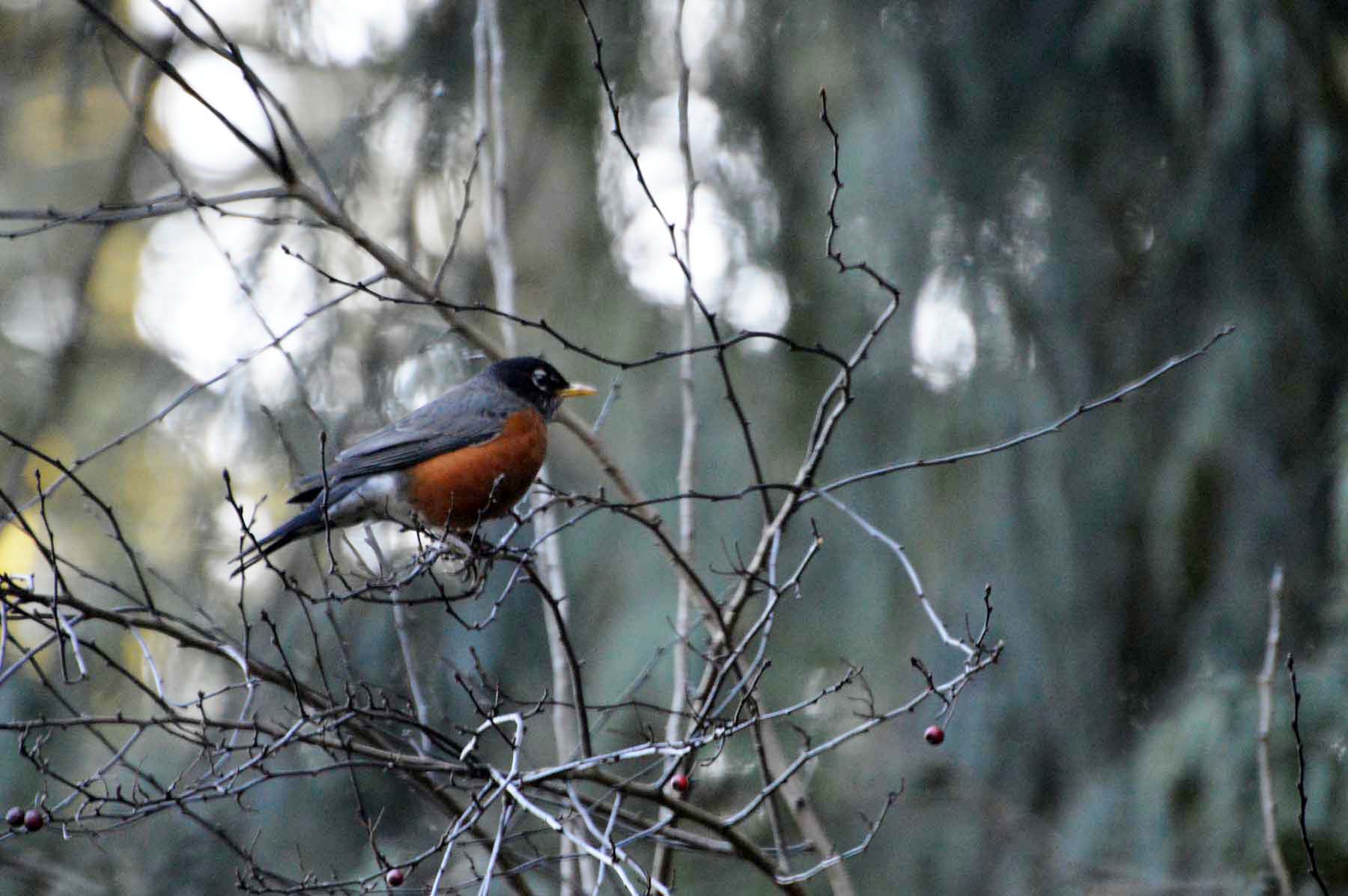
A friend sent me an essay from the New Yorker this week – I somehow managed to avoid subscribing to the magazine for all of my decades on American shores. Lessons for the End of the World is a moving, lyrical piece by poet and MacArthur fellow Hanif Abdurraqib. It braids together strands of reactions to loss, material and immaterial. I read it as a flock of robins descended on the Hawthorne tree in front of my window, in search for the last remaining berries.

I agreed with the author’s acknowledgement that the loss of personally meaningful, irreplaceable objects requires psychological adjustment, regardless of the ways things get lost, accidentally dropped at an airport, or violently destroyed by all-consuming fires. The essay embeds his reactions within a tapestry of reminders about women’s writings on trauma and loss, Nikki Giovanni and Octavia E. Butler among them. Butler’s Parabel of the Sower is currently making a come-back in public discourse, its seemingly prescient descriptions of a society destroyed by fiery climate catastrophe and held in the thralls of authoritarian violence a detailed narrative, all too fittingly depicting this moment.

As I wrote 2 years ago (see below,) many of her novels manage to make the grief attached to loss, particularly traumatic loss, astoundingly explicit. We mourn what is taken from us, often irreplaceably so, whether destroyed heirlooms, or body parts, no longer being physically whole. Simultaneously, though, if more implicitly, she points us to the psychological opportunities attached to new beginnings. Loss raises awareness of our ability to make choices, how to deal with the loss itself, how to move forward both as individuals and with regard to the structures that surround and constrain us. Living through existentially hard times can produce new ways of thinking, acting and re-acting, a shift in values that could lead to favor mutual aid and empathy.

Abdurraqib’s essay focuses on that as well, Butler’s prescription for looking at change as the ultimate power, “the innovation and adaptation required to survive the unsurvivable.” He quotes Butler:

“There’s no single answer that will solve all of our future problems. There’s no magic bullet. Instead there are thousands of answers, at least. You can be one of them if you choose to be.”

In this regard, she is a beacon of hope, believing in our potential to grow new life out of the ashes, a radically changed life enabling us to survive the ways this planet, our nations and all of us contained within it, will continue to be harmed.

The graveyard with so much old growth burnt as well a month ago, but her grave is unharmed. The bookstore Octavia’s Bookshelf in Pasadena has become a hub for mutual aid after the Eaton fire, just as she would have envisioned.

***

I wonder. There might be one aspect of losing irreplaceable things that helps, in some paradoxical ways, to move from grief to renewal: centering, retroactively, human connectedness.

As a personal example, I lost a number of things in the Eaton fire that originated in my own history, things I had given the kids as tokens of their belonging to a loving network of generations of people they never had a chance to meet. (Let me hasten to add, they are inconsequential compared to what others have lost, more closely connected to their current lives.)

For one, there was a garment my mother had knitted, a beautiful cape for a baby in blue and purple hues. Honestly, it had been waiting in a closet for decades, out of awareness, and once delivered to the young family, I never thought of it again. Until now, when I try to remember the pattern and constantly think of my mother knitting, a craft we have in common (I might go as far as calling it a shared form of therapy). Not only was the cape something she physically touched, but its loss is now a reminder, very much at the forefront of my daily consciousness, of how she taught me, with much patience, something beneficial and creative, knitting – a lasting connection, despite her early death in 1983.

A previous version of this hat for an owl-loving toddler burnt as well – but I was able to knit it again. Somehow the ability to replace things is wonderful but also highlights the inability to retrieve others.

Secondly, I had, quite literally a week or so before the fire, sent an old photograph of my grandfather to the kids. It had languished in a box, not even an album, for decades, must have come down to me when my father died in 2002 and I took a few of the things he had saved back to the U.S. It was taken in the battlefield trenches in France during WW I, on his (and coincidentally my mother’s) birthday on February 8th, with my Opa holding a guitar, at the center of a group of painfully young, thin and empty-eyed soldier. I have so many questions. Would you bring your instrument, as a musician, to the front? Was it provided as some sort of means to distract the company? Was music what allowed him to survive two world wars unscathed, as a peaceful, curious, nature-loving, gentle human being? These questions did not preoccupy me until the burning of the photograph.

The losses force us to remember the people attached to the items, and, in turn, our attachment to them. Maybe that focus on relationships, on belonging even after death, signals the way to adapt and move on. Just as Octavia Butler spelled out, the secret to survival lies in communal embeddedness and reciprocity. The love we received and that we can now pay forwards will never be contained in objects only, it exists independently, inviolable by flood and fire. That solace might help staunch the grief.

In honor of my Opa’s real love, the double bass, here is a beautiful rendition of a Bottesino concerto.

After the Fire.

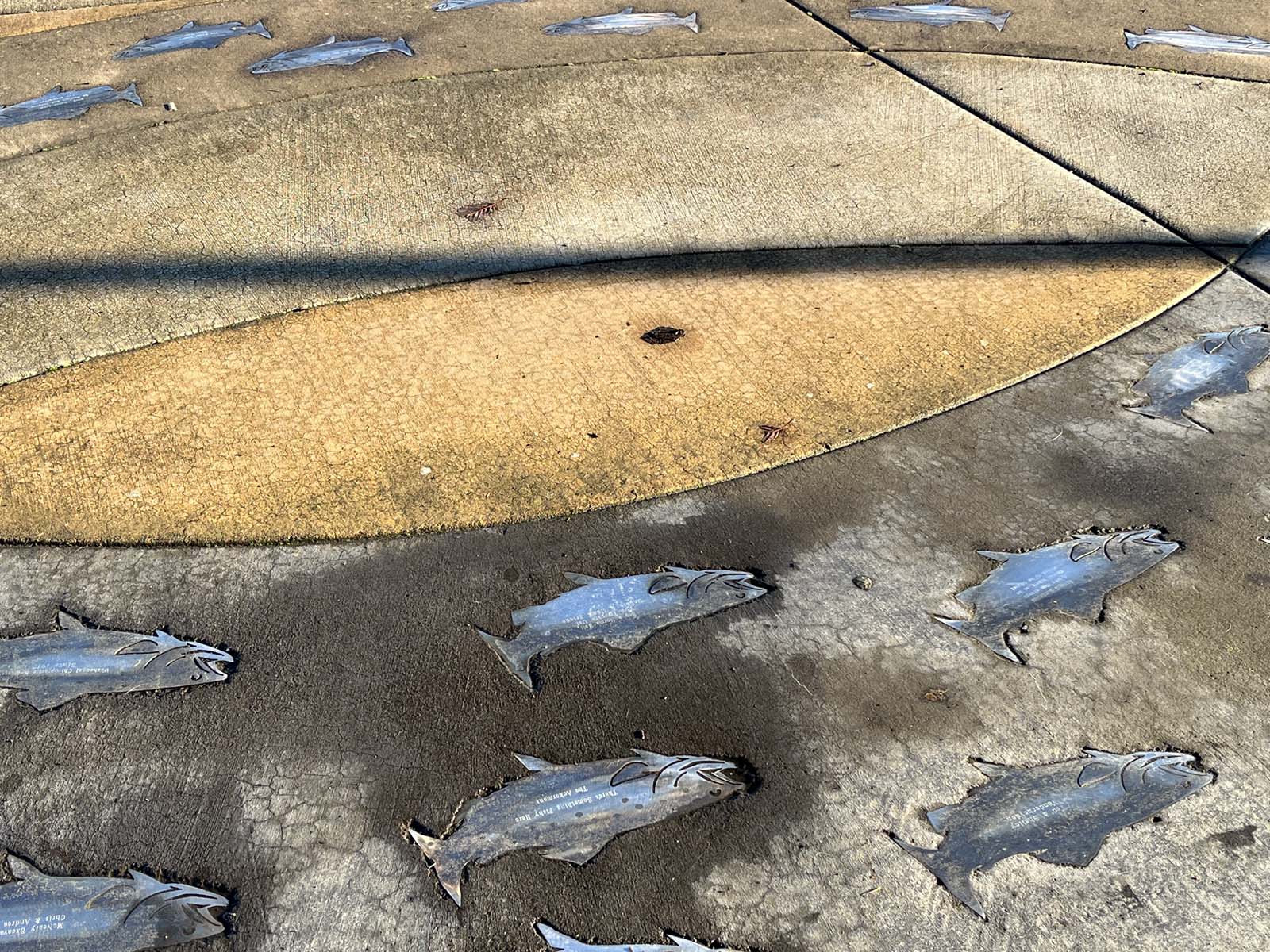
Here they were, salmons “singing in the street,” in Northern morning light that favored gold and blues. Right out of an Auden poem that stirred in the recesses of my brain, vaguely remembered. Had to dig it out, oddly relevant to our times when Southern light is dimmed by black smoke, or flickers as burning embers. Like all truly meaningful poetry, his poem captures universal truth, models defiance and stirs hope.

Malo Hasselblad Metal Fish Walkway at Washougal, WA waterfront Trail

***

As I Walked Out One Evening

As I walked out one evening,
   Walking down Bristol Street,
The crowds upon the pavement
   Were fields of harvest wheat.

And down by the brimming river
   I heard a lover sing
Under an arch of the railway:
   ‘Love has no ending.

‘I’ll love you, dear, I’ll love you
   Till China and Africa meet,
And the river jumps over the mountain
   And the salmon sing in the street,

‘I’ll love you till the ocean
   Is folded and hung up to dry
And the seven stars go squawking
   Like geese about the sky.

‘The years shall run like rabbits,
   For in my arms I hold
The Flower of the Ages,
   And the first love of the world.’

But all the clocks in the city
   Began to whirr and chime:
‘O let not Time deceive you,
   You cannot conquer Time.

‘In the burrows of the Nightmare
   Where Justice naked is,
Time watches from the shadow
   And coughs when you would kiss.

‘In headaches and in worry
   Vaguely life leaks away,
And Time will have his fancy
   To-morrow or to-day.

‘Into many a green valley
   Drifts the appalling snow;
Time breaks the threaded dances
   And the diver’s brilliant bow.

‘O plunge your hands in water,
   Plunge them in up to the wrist;
Stare, stare in the basin
   And wonder what you’ve missed.

‘The glacier knocks in the cupboard,
   The desert sighs in the bed,
And the crack in the tea-cup opens
   A lane to the land of the dead.

‘Where the beggars raffle the banknotes
   And the Giant is enchanting to Jack,
And the Lily-white Boy is a Roarer,
   And Jill goes down on her back.

‘O look, look in the mirror,
   O look in your distress:
Life remains a blessing
   Although you cannot bless.

‘O stand, stand at the window
   As the tears scald and start;
You shall love your crooked neighbour
   With your crooked heart.’

It was late, late in the evening,
   The lovers they were gone;
The clocks had ceased their chiming,
   And the deep river ran on.

by W. H. Auden (1907 – 1973)

From Another Time by W. H. Auden, published by Random House. Copyright © 1940 W. H. Auden, renewed by the Estate of W. H. Auden. Used by permission of Curtis Brown, Ltd.

The poem is disguised as a traditional ballad, filled with cliches which altogether take on different meanings when read in the context the poet builds around them. The message is as serious as it gets.

Our narrator is out on an evening stroll amongst the sea of humanity, fields of harvest “wheat,” that might soon meet their reaper. He overhears a lover singing, near a brimming river and the train tracks that could quickly carry one away, looming disaster and flight metaphors in one simple verse.

The lover borrows every available absurdity to express the strength and longevity of his sentiments, with love lasting until the impossible happens, physically, geographically, biologically, metaphorically – in other words, lasting forever. The depth of love is expressed in fertility symbols (said singing salmons and the rabbits.) The allusion to disaster and flight is repeated in the image of the seven stars, squawking like geese. It refers to the Pleiades, a star cluster that played a major role in Greek mythology. Like migrating geese, the seven daughters of Atlas fled from place to place for many years pursued by Orion, until Zeus turned them into a constellation as he did with Orion, who still hunts them across the sky.

The lover’s song expresses the belief of singularity: the first love of the world, flower of the ages. But, more importantly, an unshakable faith in continuity, or even permanence. This is of course, a core belief that keeps us all going. Not just for love, but for life plans, for the existence of what and who we know and hold dear.

An unshakable faith, until it is shaken, or burnt to ashes, as the current case may be.

Such relentless optimism awakens the malevolent clocks: Time will have none of it, our lovers soon be disabused of their notion of eternity. Physical decline, material worries and economic stress (icebergs in the cupboard,) the eventual abating of sexual desire (desert in the bed) all putting cracks in the vessel once thought to last forever. Time manages to put the very notion of fairy tales onto its head: the presumed innocents prove to be lascivious, and relationships revert in unexpected ways. Why should “happily ever after” be the one to survive?

Looks like an inevitable ride downhill towards impermanence or even death. But now Auden rescues us with some strangely placed exhortations that are subtly encouraging.

‘O plunge your hands in water,
   Plunge them in up to the wrist;
Stare, stare in the basin
   And wonder what you’ve missed.

Could be washing your hands free from guilt of having been so naive, mistaken about continuity, or unable to live up to the promise of eternal love. But could also be a suggestion that you interrupt the narcissistic admiration of your Self in the basin, by making waves that destroy the image, pushing the focus on something else. That would make sense given how much Auden had embraced Freudian theories. It would also very much explain the next command:

‘O look, look in the mirror,
   O look in your distress:
Life remains a blessing
   Although you cannot bless.

YOU might have failed in your naive or misdirected optimism, but LIFE remains a blessing. I read this as such an important reminder to be grateful. There is stuff out there, even if not what you hoped for, even if you lack agency, even if you dropped, or were dropped by a lover (a repeated theme in Auden’s personal life, made more complicated by being gay in times where it was illegal.) Even if you incurred unimaginable losses, there is a world out there. (One, I might add, shouting for us to find ways to protect it.)

And significantly:

‘O stand, stand at the window
   As the tears scald and start;
You shall love your crooked neighbour
   With your crooked heart.’

Look out towards the world, no matter how rotten you feel, and remember the commandment to love your neighbor like yourself. They might be crooked, so are you. The whole idea is about goodwill/love towards others, a form that is not necessarily the sexual rush of the lovers we encountered in the first part of the poem, but the notion of Agape, the “unselfish loyal and benevolent concern for the good of another, “as the dictionary defines it. Reaching out towards humanity as a whole, engaging in brotherly love, might protect from time’s relentless drag.

***

We are experiencing Agape at this very moment. The love and support extended towards the displaced by the Eaton Fire is beyond description. I cannot thank everyone personally, but am deeply grateful for the outpour regarding my kids. From what I hear, mutual aid is generally flourishing in Altadena, trying to soften the blows while everyone is still in a state of shock, where even finding a meal or a change of clothes can become an overwhelming task. The fire is forging an already tight community into a whole, held by concern for each other.

In our personal case, it feels like a small child is at the protected core of concentric rings, reaching ever further outward. Fiercely shielded by parents, who are supported by grandparents, aunts and uncles, then friends, then acquaintances, then friends of the older generations – a whole network of emotional sustenance, physical comfort, shared expertise and financial generosity.

The Greek word apocalypsis actually means not so much doomsday, but revelation or unveiling. The fires reveal humanity’s fragility and the consequences of ecological overshoot – using more than the planet can sustain. But they also reveal something essential: We cannot count on permanence, but we are here and now surrounded by love.

You don’t know how much of a difference that makes at this very moment.

Auden wrote this in 1937, unsettling times in Europe with rising fascism, not unlike our own – he soon after emigrated to the U.S., having had a harrowing time when traveling to Spain to report on the Civil war. I think it is a poem to be bookmarked for the year(s) to come.

Here is Auden reading his poem.

And here is a song cycle by Benjamin Britten. “Our Hunting Fathers, Op. 8, was first performed in 1936. Its text, assembled and partly written by W. H. Auden, with a pacifist slant, puzzled audiences at the premiere.”

Fluke

You never know. Here I was planning a quiet walk in one of my favorite places on earth, the place where I go to air out my soul. It reminds me of the landscape of my childhood, flat as a pancake, skies low, agricultural fields and watery flats seamed by alders and willows.

A landscape best caught in black and white for its riches of patterning and contrasts of shadow and light. A reminder, too, that black and white belongs to photography and not thinking, the need to fight rigidity of both, really, thought and feeling. A landscape that has changed across the decades of my visits without losing its essential beauty, a pointer towards aging gracefully. A place you all know by osmosis, given how often I have posted from there throughout the seasons.

Weeping Willows

I meant to contemplate 2024, in all its horrors as well as gifts, its losses and riches, and above all this sense of “What now? How do I meet the challenges before us, without losing a sense of hope and integrity? How to combat the worries that tend to overtake me? The irritability with my uncooperative body? “

It was not to be. The minute I hit the footpath on Monday, usually a solitary walk towards a dike, I saw throngs of people, strangely moving at speed back and forth, as small groups, excitedly chattering. What was going on?

A field sparrow! There’s supposed to be a field sparrow! The chance of a life time to scratch if off a Western birder’s life list, since the bird resides in the Eastern US and must have made a wrong turn. Or two. Is it here, in the blackberry patch? It is there, hiding among the reeds?

What’s a field sparrow, you ask? Beats me. It looks (and I never saw it live, had to look it up in my guide book) like a million other sparrows, even when I learned to watch for the eye rings and the pinkish beak.

But you know what? It completely changed my mood, my outlook that day, this fluke of a bird appearing out of nowhere, this fluke of me arriving at the island at just that time. It was invigorating to see people as a community, whipping out their phones to call birder friends to come on down, people showing each other photos they had taken half an hour earlier, discussing the rarity of the event, people carefully placing their tripods for heavy cameras as not to interfere with their neighbor’s, and a general sense of camaraderie, excitement and passion suffusing the air. Most importantly, regardless of the current fires sweeping the world in all their manifestations, there was this bond to nature and the wonders it offers, the willingness to stand or run in the damp cold for hours on end to catch a glimpse of a TLB (tiny little bird in my “couldn’t identify it for the life of me” vocabulary.) To be free of worry for a small window in time.

The excitement was contagious and I kept smiling for the rest of my walk, long after leaving all of them behind, entering the wetlands and communing with slightly larger birds instead.

Tuesday a library book arrived from the longish wait list, Fluke: Chance, Chaos, and why everything we do matters, by Brian Klaas. I had ordered it after reading an essay (today’s Long Read) by him that hooked me, and that you might find thought-provoking. Judging by the first half read so far, the book is interesting, written in ways completely graspable for the layperson, filled with fascinating examples, but also slightly too repetitive for this reader who likes to roar through new information.

Mist in the air

Take a typical example: Stimson, U.S. Secretary of War in 1945, persuaded President Truman not to drop the nuclear bomb on Kyoto, much against the resistance of the military brass who believed it to be the ideal target, not least because its university was the intellectual center of Japan. Why did he care? He had had a wonderful visit there with his wife in the fall of 1926, seeing it in all its historic and seasonal beauty and felt that it needed to be preserved. A total fluke. He fought for the city being spared on multiple occasions until Truman relented. It had to be Hiroshima and Nagasaki instead.

The upshot, so far, is this: we need to revise our thinking about issues of chance, the order of things, and our ability to control the way life unfolds. Infinitely complex systems like our interconnected world can be affected by minute changes, as chaos theory predicted (think butterfly effect). Every one of us should likely take less pride in our accomplishments and feel less guilty about our failures, because pure luck (the very definition of chance) affects any old outcome. It’s hard to accept the notion of random drift – then again, maybe it’s liberating? Just think of the possibility that something completely random could happen that shifts the world’s current embrace of war and authoritarianism…

As the Kirkus Review observed: The book can provoke existential unease, but it also helps explain the cockamamie nature of the way things are, and it’s an always-interesting read.

That about captures it!

And who knows, maybe the fluke of my encounter led to eating less junk food that day since I was feeling more upbeat. That in turn might improve my immune system, leading to more cancer fighting power. A random bird the cause for added years of blogging…. I’ll take it.

Long live the field sparrow!

Music today adheres to the more traditional views of orderly, controlled and willful creation with the representation of chaos at the beginning: Haydn’s Die Schöpfung.

Urban Myths

Morro Bay is a touristy little spot on coastal Highway 101 winding its way north along the Pacific beaches.

It has two landmarks, an enormous dome-shaped rock and massive chimneys from a power plant, long since decommissioned and just blighting the landscape.

The rock is actually a volcanic plug, what’s left of an extinct volcano when its ash and lava are eroded away, magma that stuck in the throat of the volcano once it cooled. It is protected as a State Preserve, but linked by a causeway to the mainland, so you can walk around there and ponder people’s indelible desire to leave their marks on the landscape…

The small town is filled with tourist shops, restaurants and motels, but also has a working harbor, with the fishermen happily throwing tidbits to the seagulls and sea lions too lazy to even move, sleeping it off on the rocks circling the moored yachts.

It is also a short, 30 minute drive away from a major tourist attraction: Hearst Castle. If willing to pay a mere $35 per person, you can visit the estate of the former media tycoon William Randolph Hearst in a 127 acres garden, a minute part of the 250.000 acres he acquired in the region. My severe allergy against tycoons prohibited me from exploring, but it served as a reminder of the fate of Patty Hearst, the magnate’s granddaughter, which brings us to today’s topic.

As a 20-year old college student, Patty Hearst was kidnapped by the Symbioses Liberation Army and went on to commit several crimes with them, for which she was later sentenced and eventually pardoned with the understanding that she might have been brainwashed to commit to the goals of the radical organization.

The term bandied around was “Stockholm Syndrome,” coined originally by a psychiatrist after an earlier kidnapping scenario in a botched Swedish bank robbery, where the hostages were claimed to develop psychological bonds with their captors and agree with their agenda and demands. It was even insinuated that they formed romantic attachments.

You can imagine my surprise, or dismay, when I learned from a recent Radiolab Podcast (verified when I did some more research) that the whole concept is based on someone’s imagination, not facts. The psychiatric assessment was originally made without ever talking to the hostages, something that did not stop the concept’s adoption into our arsenal of cultural assumptions, (here, for example is the Encyclopedia Brittanica defining it,) including the training of some 7000 police and FBI agents on how to deal with hostage situations regarding this aspect. Of note is, of course, that it never made its way into The American Psychiatric Association‘s Diagnostic and Statistical Manual of Mental Disorders (DSM). “It’s never met the strict review requirements to be included; in fact, it seems that no one ever submitted it for inclusion in the first place. That means there are no identified diagnostic criteria at all for the alleged condition.” (Ref.)

If you are like me, we assumed it was something that is indeed happening when captors exert power over people fearing for their safety, turning them into acolytes. Yet, when you look at the actual unfolding of the original bank robbery, it was clear that it was the bank and the police that so completely mishandled and botched the operations, that it was no surprise the captives felt safer with the captors than with the institutional responses, without forming attachments whatsoever. There is now a whole literature that has debunked the case.

For the most part, it is women victims who are pathologized, with a focus on their “crazy” reactions, rather than the perpetrators’ arsenal of threats. No surprise, then, that the concept is often extended to domestic violence cases as well.

Canadian psychologist Allan Wade, who interviewed the original victim deemed pathological in her appeasement of the kidnapper in Stockholm, phrased it this way:

Stockholm Syndrom is “one of a whole network of concepts that … shift focus away from the powerful role of … institutional responses… Such concepts also tend to protect offenders because, instead of looking at strategies used by perpetrators to suppress victims, resistance theories such as Stockholm Syndrome and others (there’s a long list of them: identification with the aggressor, infantilization, traumatic bonding, learned helplessness, internalization, false consciousness, it goes on and on) don’t evolve focus on how victimized people have responded to and resisted violence. Rather, they assume that they did not...It’s part of a family of notions that stem from hyper-individual, problematic notions in psychology and psychiatry, rather than careful analysis of circumstances on the ground.

These practices of implanting pathologies in the minds, brains and bodies of oppressed people, they’re inherent to what we might call colonialism, patriarchy, different forms of racism, different forms of violence and oppression,” he says. “So this is not sort of an accidental or uncommon problematic way of thinking; rather, it is endemic.” (Ref.)

Before wandering off into Morro Bay’s spectacular sunsets, let me point out how easy it is to create and/or fall for these kinds of urban myths, when the concepts align with other things you believe to be true. It is also the case that we need to distinguish between misinformation (inaccurate info), disinformation (deliberately gaslighting) and conspiracy theories, which encompass the idea that malicious actors are engaging in a secret plot that explains an important event (Jewish space lasers or the government covering up an enormous death toll from vaccines, etc.) And last but not least, we have to be aware that there are those of us who are perfectly willing to admit they fell for a myth, and henceforth let the facts rule, compared to others who will cling to prior held beliefs even if it involves ignoring the facts and instead coming up with substitute justifications.

Music today from Swedish composer Hugo Alfven, his Symphony #5.

For informative readings today on the topic of how to undermine conspiracy theorizing:

https://www.scientificamerican.com/article/how-can-you-fight-conspiracy-theories

On the topic of how misogyny increasingly affects our lives (and, alas, that of future generations,) including the pathologizing of women in violent situations:

https://www.theatlantic.com/magazine/archive/2025/01/america-misogyny-gender-politics-trump/680753

Highly recommended. Gilbert is one smart writer.

And if you are more in the mood for black comedy/ entertainment, here is a film about one of the criminals involved in the Swedish hostage situation.

https://www.netflix.com/watch/81215890?trackId=255824129

A Strong Beginning

We do not know what will happen. But we can know who we can commit to be in the face of what happens. That is a strong beginning.” – Rebecca Solnit

So who do we want to commit to be in view of being surrounded by voters willing to tolerate or invite fascism, voters manipulated into ignorance about the consequences of their actions, or non-voters indifferent enough to fail to prevent it? (I think it is important to remember how many people did not vote at all.) Who do we want to commit to be in anticipation of the catastrophes brought to our neighborhoods (and the world) by agents of hate, retribution and lust for power?

In my own case, I want to commit to nourish community, in my real as well as my digital life, as expressed here on the blog. I will stand on principle and not make compromises halfway between the truth and lies, as appeasers in the media would like to have us. I will continue to use the tools I have, to stimulate thinking about politics and history, to use my background as a scientist to educate about the domains of psychology, health and climate change. I will also add a new feature once a week, Does this makes sense?, linking to one or two long-form pieces of writing that were particularly thought-provoking in my perusal of the week’s publications (and not necessarily something I agree with), perhaps prompting a community discussion in the comments. I will post reading recommendations from people who are smarter and more organized than I am, geared towards the issues at hand. You’ll find some at the end of today’s blog. Solnit’s encouragements are a good way to start. Mind you, I completely understand if reading is too much now, or ever; it’s just my frantic default option….

I will commit to balancing the reports on the frightening with all that we can still be grateful for, the beauty around us, nature that models resiliency, indigenous wisdom that guides us, art that encourages resistance, poetry that fortifies us. Today’s choice, written during the horrors of the Civil War, describes adaptation as a form of resilience, not defeatism. Let that be the manner in which we tackle our current universe!

We grow accustomed to the Dark-

We grow accustomed to the Dark –
When light is put away –
As when the Neighbor holds the Lamp
To witness her Goodbye –

A Moment – We uncertain step
For newness of the night –
Then – fit our Vision to the Dark –
And meet the Road – erect –

And so of larger – Darknesses –
Those Evenings of the Brain –
When not a Moon disclose a sign –
Or Star – come out – within –

The Bravest – grope a little –
And sometimes hit a Tree
Directly in the Forehead –
But as they learn to see –

Either the Darkness alters –
Or something in the sight
Adjusts itself to Midnight –
And Life steps almost straight.

by Emily Dickinson

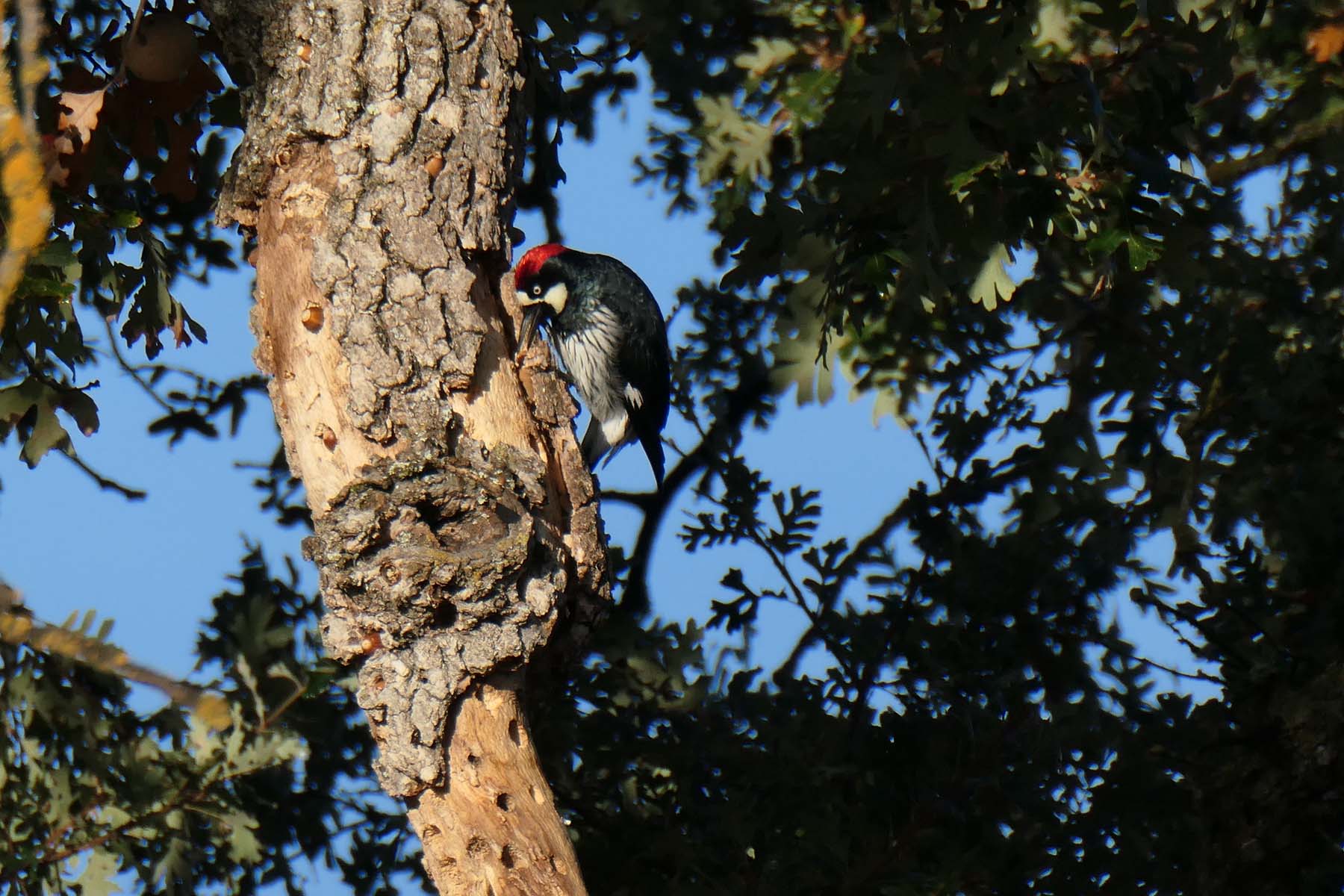
I am currently in Southern California, surrounded by nature in the foothills of the San Gabriel Mountains. The noisiest birds that visit me are the California acorn woodpeckers. I wrote at length about this fascinating species here two years ago. They are perfect models for what we have to learn: to live in “bushels” of community, tending to our broods and granaries as a cohesive group, rather than fixating on individual success. They are a prime example of the evolutionary benefits of cooperation, across many generations, both with regard to breeding patterns, raising the young and creating, using and restoring granaries for acorns, riddling oak trees with custom-sized holes which provide storage for food during winter. Cannot think of a better symbol for the road ahead.


Music today is Mahler’s Resurrection Symphony. Feel it.

Reading Recommendations (some might be of interests to book groups that don’t shy away from difficult conversations):

Hope in the Dark by Rebecca Solnit

On Tyranny by Timothy Snyder

Autocracy, Inc. by Anne Applebaum

Surviving Autocracy by Masha Gessen

Let This Radicalize You. by Kelly Hayes and Mariame Kaba

Strongmen by Ruth Ben-Ghiat

How to be an AntiRacist by Ibram X. Kendi

Several of these come with work books helpful to guide group discussion or offering further action proposals.

Here is a compilation of analyses of how we got here:

https://sarahkendzior.substack.com/p/ten-articles-explaining-the-2024?ref=organizingmythoughts.org

Here is a road map from Choose Democracy founder Daniel Hunter:

https://therealnews.com/10-ways-to-be-prepared-and-grounded-now-that-trump-has-won

Here are ten currently free e-books around dealing with times of crises.

Yesterday’s sunrise:

Cat Propaganda.

Two days ago I mentioned that I would write about the spread of falsehoods regarding the consumption of stolen pets by Haitian immigrants in Springfield, Ohio. Little did I know that everybody and their uncle would jump onto the lie after it was uttered by a former President during the Trump/Harris debate (and is now repeated during campaign rallies as we speak.) Whether you read the NYT, The Washington Post, the Atlantic, Vox, Politico, the Guardian, the Wall Street Journal, or countless essays on Substack, people express horror, disgust and step deep into analysis, why this kind of lie is spread, believed, and exceedingly dangerous.

What can I possibly add? Maybe a basic primer on the function and use of memes? A check on historical sources that understood the value of propaganda? Lucky for me, all of that is spelled out in detail in the teaching materials of the U.S. Holocaust Museum, which I will summarize, applied to the case in point.

Here is where we stand right now: the rumor started in late August during a march staged by the nearby neo-Nazi group Blood Tribe and a diatribe in front of the Springfield city commission about the savagery of the Haitian immigrants. It was posted on Facebook.

A flood of memes followed (created by Republicans and their wing men), many indirectly alerting to the issue by making Trump the heroic rescuer of barnyard menagerie. J.D. Vance then spread the lie via tweets, careful to insert an “if rumors are true” in the margins, not so the House Judiciary GOP, and Elon Musk tweeting to his million of followers. Trump locked onto it, publicly disseminating it during the debate. He was fact checked, at the debate, (and again during the last two days when he continued to utter the claim during rallies), by multiple official sources from Springfield, including city hall and the police, that the rumors are not true.

(I have consciously left out the memes that depict Blacks in the background in more savage fashion than the one above. They are horrifying in their attempt to ride on stereotypes of black violence.)

Meanwhile, Vance insists on keeping the memes coming.

And wouldn’t you know it, threats of violence against multiple actors in Springfield have multiplied as of today. Bomb threats against administrative offices (the one who denied the veracity of the claims), the media, threats against schools, now sending kids home early. Fear is spreading among the Haitian population, called on keeping their kids inside and not expose themselves to potential harm at night.

Rightwing extremists are stoking the potential for violence by announcing bounties.

NONE OF THIS IS NEW.

Propaganda is a truly terrible weapon in the hands of an expert.—Adolf Hitler, Mein Kampf (1924).

And the more cruel and politically expedient, the more it is employed. By definition, it is biased or untrue information intended to shape people’s beliefs and behavior. In racist societies propaganda plays a major role in establishing who is included and who either belongs to the margin, or should be irrevocably excluded. The means by which propaganda is applied, and the receptivity of the audience are both factors that shape how successfully the manipulation proceeds. For the Nazis, rallies, print material, the radio and film were all used to spread the message.

These days, we also have so-called memes that are disseminated across the internet. Like all propaganda, memes simplify complex issues, and speak to emotions. Moreover, they help to construct collective identity, give us a feeling we belong because we “get the joke.” They grab attention, they establish or prolong a cultural discourse. (In fact, the term was coined by Richard Dawkins some 50 years ago; he believed that cultural ideas, like genes, can spread and mutate, fostered by a surge of dopamine when we recognize what is expressed and emotionally react to it.)

In societies as divided as our’s, these seemingly humorous images act both as a formation for in-group belonging (remember the meme of Bernie sitting with his hand in mittens, transported into all sorts of weird situation, and we smiled every time?) and as a jab at the other side, which is ridiculed for its ignorance or negative reaction.

Memes are not inherently bad, depending on content. But memes breed partisanship, and when they gleefully ignore the absence or distortion of facts, in fact are passionately indifferent to truth, and open the gate wide to racism, they do harm. Trump himself posted this today.

They fall on fertile ground, since the slander that immigrants have unacceptable dietary habits is as old as this country. Across the ages, Asian immigrants have been accused of eating dogs. Jews, of course, have been accused of eating something altogether different and more heinous.

Haitian immigrants are particularly vulnerable, however. They immigrated en masse in the 1980s, and were treated as economic migrants despite fleeing the repressive rule of the Duvaliers. In the 90s they were stashed in a camp at Guantanamo to process asylum claims. David Duke and Pat Buchanan railed against the immigration of non-Whites, and reports on high numbers of HIV infections among the Haitian refugees elicited panic in the American public. Extremists had picked a definable out-group and today’s heirs to this thinking pursue it without remorse.

Legal immigrants have massively contributed to the American economy ever since. Temporary Protected Status Holders from Haiti, Honduras and El Salvador contribute a combined $4.5 billion annually to our GDP. Some 15,000 Haitian immigrants have moved to Springfield, helping revitalize the local economy and filling the pews of local churches.  They came legally and are doing all the right things, but are the perfect target for dishonorable smears, however far fetched.

It is hard to deny that once again things boil down to the color of skin, and gleeful racism amuses those who found what looks like an easy target. As Ken White, a first amendment litigator and criminal attorney points out:

Engaging on the same level cannot be the answer. How can you reach across the divide, though, when it all boils down to beliefs and emotions, rather than on a willingness to establish facts?

What should the answer be? You tell me.

Music today from Haiti.

Killer instincts

Nope, not talking about the absurd claims that Haitians are feasting on neighbors’ cats and dogs. That will be discussed in the next round.

I’ll report instead on a walk the morning before the Presidential Debate, trying to shed irritated thoughts. It was actually quite serene in the wetlands, with a hint of fall, cooler temperatures and sparks of coloration pointing towards the blazing beauty to come.

Various pieces of news have combined to trigger thoughts about violence. You will read this after the debate has happened, with no current prediction from my end of what will be or won’t be said.

I still reel from the fact that during the most recent campaign stop, Florida man uttered the words, with glee, that the planned rounding up and deportation of 20 million immigrants “will be a bloody story.” At an earlier rally in Ohio, the former President stated that “there will be a bloodbath” if he does not win the election. It is all couched in terms of righteous violence, including his persecution of political adversaries that are suggested more and more frequently, setting a stage with thinly veiled stochastic terrorism.

With that topic hanging in the air, some data mavens at the Washington Post had nothing better to do than analyzing data from Google searches across two decades about what Americans want to kill. How to kill time, wouldn’t you know it, is a favorite search question on the internet.

As it turns out, searches about how to kill ants score high, closely followed by fleas and flies, with mosquitoes surprisingly low on the list. However, they are shockingly topped by searches about how to kill cats or dogs. Crabgrass, mold, and ivy, amongst other invasive species, are the most frequently searched organisms beyond fauna. Horrifyingly, on top of the pyramid used to be searches for means of suicide, but the search for how to kill another human being has now merged to that level (we are talking peek month of searches in the graph.)

We know, of course, what factors promote violence in a political context and how desensitization contributes to disinhibition towards harming others. Re-summarizing from my many previous musings: when societies are politically divided, particularly with an emphasis on identity, the potential for violence goes up. If we don’t interact with people who are different from us or hold different beliefs, and instead stay in partisan bubbles (aided by geography here), vilifying and dehumanizing the unfamiliar others is easy. That becomes, in turn, a gateway to accepting that they deserve harm, righteously meted out by us. What we are seeing is a call for partisan violence in these rallies, really. This is particularly the case when we fear loss of status, rights, or access to resources (realistically or just imagined, won’t make a difference), while political radicalization is touted by the politicians we align with or by the in-group that surrounds us. Planned or condoned state violence interacts with individual political violence, mutually reinforcing each others’ belief that it is all justified.

“Righteous” violence is, alas, not exclusive for the political arena. The Pacific Northwest is now on route to killing close to half a million barred owls across the next 3 decades. The U.S. Fish and Wildlife Service has approved that plan in order to protect spotted owls, threatened by territorial take-over from their larger cousins.

“The shooting will be conducted in forest habitats spanning 24 million acres, including six national parks, 17 national forests, and thousands of pockets of private lands. It will, as planned, be the largest massacre of birds of prey ever attempted by any government.” (Ref.)

Scores of wildlife protection groups are protesting the decision, claiming that the plan makes no sense. For one, barred owls are being punished for human actions (climate change, deforestation, urbanization etc.) that pushed them, as well as the spotted owls, into new territories. Expanding their range, as a species native to North America, is a normal survival strategy, and will not be stopped by culling. The surviving owls will just return to the territories that sustain them under new climate conditions, with the competing spotted owls ultimately having little chance. That is what ecological systems are all about, with our interference perhaps just changing the allotted time for a single species (a species that we put into harm’s way in the first place….) Barred owls are also notoriously difficult to hunt and easily mistaken for other species that could be hurt.

Here is the detailed list of complaints and suggestions by the wildlife organizations.

The government argues that the cull, by licensed hunters only, ” will remove less than 1% of barred owls’ predicted U.S. population during the proposed time frame, resulting in fewer casualties than other, more aggressive management options proposed by the FWS, which suggested culling almost twice as many of the birds. The cull will also be limited to around half the areas where barred and spotted owls overlap, and intends to safeguard California spotted owls as well.”

“It’s not about one owl versus another,” Kessina Lee, an FWS state supervisor in Oregon, said in a statement.

It sure is about a lot of dead birds, if you ask me, killed with the righteous justification of protection of an endangered species. Now where have we heard that argument before? They shall not replace us?

Yes, I am sarcastic and you don’t have to tell me that these are two very different cases. Just soooo much violence in the air. Locally, nationally, world wide. How can we take a step back?

Music today a beauty by Elgar, considering owls…

Getting rid of the Junk.

I did not publish a blog on Monday because I spent my entire Sunday on the phone and on text messages, processing the momentous shift in our political landscape, instead of writing about how our brain works – the initial plan. My friends’ comments ranged from “Just resign yourself to a Republican win, the world is going up in flames everywhere, so try to enjoy your last year(s) to “Why are you so pessimistic about the chances of a new candidate to infuse life into a shriveling campaign?” and everything in-between.

I had been squarely in the “It’s safer if Biden stays” contingent, and was emotionally rattled with his withdrawal. My fear had been (and to some extent still is) that abandoning the boat this late in the game would lead to an onslaught of ever more open racist and misogynistic attacks which, in turn, model for those in everyday life to go after people in vulnerable populations, and that we lose the ever important mid-western Independents. I had also worried that there would be no circling of wagons around Harris and thus a danger of losing the Black and women’s vote, fears now allayed.

I had once again forgotten Uruguayan writer Eduardo Galeano‘s insistence: “Let’s save pessimism for better times.” Was shaken enough, though, that I felt physically ill on Monday. So much at stake, so little margin for error, so many unpredictable variables. Even my go-to soporific Venn-diagram didn’t work.

I feel better today, given the barrage of positive reports on youth engagement, and statistics showing that the millions of $$ sent by small donors were 60% from first time donors (!). 39% of poll respondents said that they are now more likely to vote (and 49% equally as before.) Vote.org saw over 38.000 new voters sign up in the 48 hours since Harris’ announcement.

It will be an uphill battle, nonetheless, but I am willing to concede we have a chance. Particularly if we are able to filter out the junk that is already descending in waves on social media and talk shows, etc. Here is a truly informative piece of research from the Wilson Center that makes it clear how women politician are denigrated and what one can do to identify and confront the accusations. Malign Creativity: How Gender, Sex, and Lies are Weaponized Against Women Online is a valuable read at this very moment.

And speaking of filtering out the junk, let us at last turn to the brain and its mind boggling ways of accomplishing just that, not just metaphorically. (I’ll summarize what I learned here.)

Scientists have figured out the process that allows the brain to push its waste, a byproduct of our 170 billion cells doing their work, from deep within to the surface, where it gets picked up by the bloodstream in a nifty interface, which brings it to kidneys and liver for removal. Slow electrical waves set that process in motion while we’re fast asleep, pushing the debris within some fluid to the brain surface where the bad stuff gets sorted and flushed away.

Understanding this process has been of great interest to researchers concerned with Alzheimer disease. A lot of the debris that needs to get disposed of is amyloid, a substance known to form plaques in the brain associated with that form of dementia. There are reasons to believe that a malfunctioning waste removal system could be at the root of the disease. Thus, understanding how stuff gets removed might be a valuable step towards figuring out where things go wrong with this glymphatic system and how to fix it.

We know that our bodies get rid of problematic substances with the help of the lymphatic system, where tubes transport the waste to the bloodstream. Th brain, however, lacks these tubes. Here is what scientists discovered:

“By measuring the wave, we are also measuring the flow of interstitial fluid, the liquid found in the spaces around cells. It turned out that the waves were acting as a signal, synchronizing the activity of neurons and transforming them into tiny pumps that push fluid toward the brain’s surface.”…. Tests showed that the waves increased the flow of clean cerebrospinal fluid into the brain and the flow of dirty fluid out of the brain. They also showed that the fluid was carrying amyloid, the substance that builds up in the brains of Alzheimer’s patients.” (Ref.)

Let sleep find us and the dance of electrical waves begin! Maybe a junk-free brain has more time to remember the important stuff:

Here is to joyful candidates, and power regained. Here is to having a brain fit enough to learn about youth culture, brats, coconut trees and other memes associated with our new nominee. We’ll go there some other time. For now, we understand our assignment.

Today, 7/24, is a virtual meeting organized by Showing up for Racial Justice (SURJ) at 4pm Pacific time (7 EDT) for White women to learn how to show up for the moment. You can sign up for the zoom call here or follow on FB livestream if they reach capacity.

Music today was sent to me by my dear friend Leila – and it’s perfect.

Self-Deception and Denial (2)

Today’s images were made by a young photographer from New York City. Ben Zank was on a meteoric rise as an artist until the beginning of the pandemic. After a stretch of five years without exhibitions, as far as I know, he is now reentering the world of photography with a book of his photographs of staged compositions, performances that are enigmatic and technically exquisite. I thought the string of self-portraits in Nothing to See Here would be the perfect complement for the topic before us: an essay on self-deception by philosopher Amélie Oksenberg Rorty.

We can probably all list numerous self-deceptions that we detect in ourselves or others. They can be as trivial as thinking that the expenditure of frequent visits to a hair dresser is worth it because we now look more desirable (hah!) or as consequential as turning our eyes away from behavior that signals abuse by someone we love. They can be harmless, when we tell ourselves we are really interested in some boring activity, in order to keep someone’s affections, or they can be deadly, if we wishfully look away from physical signs that would require prompt medical attention before becoming lethal. Given that self-deceptions are not just quirks, I wanted to learn more about them.

User-friendly Self Deception, published in 1994 is a fascinating foray into a corner of moral philosophy about questions that heavily overlap with cognitive psychology, my own neck of the woods, and of course older varieties of psychoanalytic thought. I found Rorty’s essay wonderfully informative about what we need to think through when concerning ourselves with the issue of self-deception. And her writing is delicious – just look at sentences like these:

We draw the lines between self-deception and its cousins and clones—compartmentalization, adaptive denials, repressed conflicts and submerged aggressions, false conscious- ness, sublimation, wishful thinking, suspiciously systematic errors in self-reflection….The question is: how can we sustain the illusions essential to ordinary life, without becoming self-damaging idiots? Are there forms of user-friendly self-deception that do not run the dangers that falsity, irrationality and manipulation are usually presumed to bring?”

One of Rorty’s fundamental claim is the fact that we cannot avoid self-deceptions and that they can have positive results, until a certain line is crossed. Rather than condemning them – something that I habitually do, thinking that any kind of lying, even lying to oneself, is morally objectionable and functionally disabling in the long run – she urges us to be ambivalent. We should acknowledge the value self-deception can bring to both self and communal life, but also know where to draw the life when it becomes self-harming.

The essay is structured around a discussion what self-deception is and what it is not, and what strategies we use to perfect it – a helpful tool when we try to understand how the process of deceiving ourselves unfolds. She then turns to the benefits of this psychological manipulation, both globally and locally, and eventually wonders how we can prevent self-serving strategies to become a folly with serious consequences. I will report on the key points, and leave out the philosophical frameworks which I would surely screw up, given my layperson’s extent of knowledge. Or lack thereof. You might have better luck reading the essay yourself.

Rorty defines self-deception as a species of rhetorical persuasion driving us away from rationality and transparency. Like for all forms of persuasion, the processes involved are complex, dynamic and necessitate co-operation – among the different parts of our own selves, as well as between us and our social surround. They imply various mechanisms, including perceptual, cognitive, affective and behavioral dispositions. Concretely, what we (don’t)see, where we (don’t) direct out attention, what feelings we decide (not)to allow and which actions we (don’t) take all interact to sustain the desired state of belief.

I’lI try to translate this into an example of parenting – assume you suspect your teenager to have turned to shoplifting designer clothes (or taking drugs, or stealing cars – you name it.) You don’t want to face the reality. In order to maintain your self-deception of “my daughter would never do this,” you can ignore that the kid sneaks stuff into the house, believe her lies that items are borrowed from friends, avoid inspecting the closet for new merchandise, tell yourself she has gotten a lot of tips at her summer waitressing job, and never ever join her at trips to the mall, or open her mail from the court system. Note that self-deception is not necessarily about yourself, then. It can be about the honesty of other people or some such, as well.

More often than not, this self-deception is sustained by social support. Your friends tell you, should you dare to mention your suspicion, that it can’t be, your daughter is such a good kid, or that it was a momentary lapse on her part, or a quick phase that teenagers go through, not evidence of a larger underlying problem.

Many kinds of self-deception occur within social interactions, and Rorty argues that without them “our dedications, our friendships, our work, our causes would collapse.”

It is virtually impossible to imagine any society that does not systematically and actively promote the self-deception of its members, particularly when the requirements of social continuity and cohesion are subtly at odds with one another and with the standard issue psychology of their members. Socially induced self-deception is an instrument in the preservation of social co-operation and cohesion.

Self-deceptions can protect us from an overload of despair, or the burden of constant skepticism, or the stress that comes with acknowledging a true rupture in personal relations, or having to give up self-harming behavior that we are addicted to.

A further benefit from deceiving ourselves can come when we pretend to have confidence or skills in order to acquire them. When the world reacts positively to our mimicry, we might find ourselves very well in position where it becomes reality. On the other hand, deceiving ourselves about the value of our roles in society, or the amount of respect we deserve, or that hierarchical systems are justified, are, of course, contributing to societal peace as well. One might ask who is paying the price, though…. (I am thinking here of the resurgence of the tradwife (traditional wife) movement and its horrifying consequences of women insisting that (economic) dependency on their partner is the best choice in life, smartly explained here.)

Rorty ends her considerations by noting that “Self-deception does not monitor its own use: it doesn’t know when or where to stop. It is specifically constructed to ignore and resist correction. The danger of self-deception lies not so much in the irrationality of the occasion, but in the ramified consequences of the habits it develops, its obduracy and its tendency to generalize.”

For each instance we have to ask the question of who eventually benefits from the manipulation and when will it be self-defeating. We have to inspect the details of our psychological contortions and be willing to ask within every context and occasion who is trying to persuade whom to what benefit within the circle of our various parts of self.

Honestly, I find that a bit unsatisfying, just as her suggestion to be mindful of the company we keep, company that might collude with and incite self-deception. For one, it seems an elitist approach – how many people have the analytic wherewithal required by such introspection? And when does a commitment to constant analyzing one’s states and motives switch over to a kind of hyper vigilance that detects fault everywhere? Feeds into narcissistic tendencies towards continual preoccupation with self? And, most importantly, If it were as easy as asking ourselves questions and following a moral and pragmatic compass, why are the habits so damn entrenched? Any suggestions?

Music today is about the self-deceptions around departed loved ones….

Self Deception and Denial (1)

When I talk with my friends we often circle back to the question of finding the right balance: When is it ok to stick our head in the sand against world news in order to cope, and when does that reaction become self defeating in the long run? We are obviously not alone with that worry: just last week two eminent researchers, a sociologist and a psychologist, raised a warning flag in the Scientific American about “peak denial,” and the ways it manipulates our take on reality. Newspapers of record also start voicing concerns about the consequences of societal denial.

Independently, dictionary in hand, I stumbled my way through a brilliant essay on self-deception by a philosopher. I thought maybe you might be interested in a condensed version of these assessments of public and personal approaches to psychological (self)control. I hope that I caught some, if not all, of the complexities. We start with public denial. The next blog will focus on self-deception. And for balancing out the heavy topics, today’s photographs will tackle Big Foot denial, since I can provide proof of existence from my hikes in the Cascades….

Marianne Cooper, a senior research scholar at Stanford University and Maxim Voronof, a professor of sustainability and organization at the Schulich School of Business at York University, are interested in what happens when overlooking and tolerating greater levels of harm becomes a shared cultural habit.

Like the proverbial frog in boiling water, we acclimate to ignoring more and caring less at our own peril. In the short term, living in a state of peak denial helps us cope. In the long run, it will be our undoing. Because the danger here is desensitization: that we meet this unprecedented litany of “wicked problems,” from climate change to the rise of fascism, with passive acceptance rather than urgent collective action.”

How did we get here? What do we know about denial and the processes that lead to our “reality-adjacent” lives where serious problems are made to seem normal? The researchers focus on how threatening information is neutralized or evaded (Bonus: they link to two accessible books that look at these techniques in detail: Living in Denial – Climate Change, Emotions, and Everyday Life by Kari Marie Norgaard, and Never Saw It Coming – Cultural Challenges to Envisioning the Worst by Karen A. Cerulo.)

Using COVID as an example, the authors explain how these strategies work. (Given that I am convinced that we will be thrown into another pandemic, variants of the even more deadly avian flu, sooner rather than later, I find this case study particularly worthwhile to think about. But we could also look at climate change, nuclear warfare, or the rise of authoritarian regimes across the world.)

One way of neutralizing a problem is by making it hard to hear or learn about it. You can restrict efforts to look into it, keeping information inaccessible or not collecting it in the first place. The CDC scaled back Covid tracking for example, requiring increasingly less reporting from hospitals or other institution, until they stopped all together. The government also refuses to alert the public about danger levels (the second highest surge happened only 6 months ago, last winter, knowledge not distributed by the White House.) Tracking and warning are replaced by no monitoring or mentioning – allowing things to seem back to normal.

Minimizing the problem is a successful strategy as well, when you want a public ensconced in denial. This can be done by neutralizing language: “endemic,” or “during COVID,” “lower hospitalization rates than last year,” all suggest the main danger is behind us. Establishing laws that prohibit mask wearing make it seem like the danger of getting infected is tiny compared to the cost of having purported criminals be unidentifiable. I wrote about my disgust with the North Carolina bill to ban masks, now adding my disbelief that New York’s Governor Hochul wants to ban masks in the Subway.

One particular consequence of COVID infections was met with early institutional silence: long Covid. The U.S. National Academies of Sciences, Engineering and Medicine announced the definition for long COVID only now June 11,2024. Early on, sufferers of this disabling condition were accused to be hysteric or generally anxiety-driven, making it hard for them to access care. Never mind that long Covid can be acquired by even the mildest Covid infection, is associated with autoimmune diseases, triggering Type 1 diabetes, cardiovascular risk as well as cognitive dysfunction for the individuals, and a societal economic cost that rivals the Great Recession, and has no easy treatment options. People’s behavior would surely be affected if they knew about this threat in all of its complexity. Both neutralization and minimizing are obviously at work here.

Cooper and Voronof point out that in addition to revising the present, we also tend to rewrite the past when that helps with public denial of a problem. The cultural amnesia about the extent of the pandemic is striking. “In burying the past, we sidestep accountability for what went wrong and preserve the status quo by failing to implement lessons learned from our own history.

And woe to the voice that pipes up, calling us to acknowledge or remember the actual facts. Threats against truth tellers loom large, as do actual retaliations against whistleblowers. We are so used to conspiracies of silence, and so in need of positive illusions, that we don’t want to break the patterns that sustain them on all levels of society, ranging from small groups to large corporations, from personal friendships to politics.

How do we escape this cycle? How do we prepare ourselves for what’s on the horizon by breaking through our patterns of denial? The authors summarize:

We need to stop enabling it. This starts by being more attuned to our “everyday ignoring” and “everyday bystanding”—like that pinch we feel when we know we should click through a concerning headline, but instead scroll past it.

We need to work harder to catch ourselves in the act of staying silent or avoiding uncomfortable information and do more real-time course correcting.

We need to guard against lowering our standards for normalcy. When we mentally and emotionally recalibrate to the new normal, we also disassociate from our own humanity.

We need to demand that our leaders give the full truth and hold them to account. We must stand up for the silenced and stand with the silence-breakers.”

This seems easier said than done, but Stanley Cohen’s 2001 seminal book, States of Denial: Knowing about Atrocities and Suffering, delivers the goods. Cohen was a sociologist and criminologist, Professor of Sociology at the London School of Economics. His research focussed on “emotional management”, including the mismanagement of emotions in the form of sentimentality, overreaction, and emotional denial, spelling out in great detail what we have to do to be effective witnesses. Strongly recommended.

I know I am coming back to that term, over and over. It probably allows me to combat the general feeling of helplessness in the face of world affairs, as if witnessing is a significant contribution. But I think if there are enough of us who continue to look rather than look away, perhaps it will make a difference.

Denial, however, does provide some serious succor, when it comes to politics and economics – science denial is for many an expression of identity, used to shore up polarization within the electorate. And a humming economy needs workers as well as consumers. If either stay home for fear of infection, the system will crash. Self-deception provides similarly important protections for individuals. More on that next time.

Music today echoes foreboding and rebirth, both possibilities when thinking about denial, which can, after all, be abandoned. Beautifully captured by Shostakovich after verses by Pushkin.