Das doppelte Lottchen was one of the most famous children’s books of all time in Germany. It was written by one of my favorite authors as a child, Erich Kästner, and my American readers know it as The Parent Trap. Since we are doing movies this week, here are the links to an early version made by Disney and the 1950s German original underneath, with the author himself as the narrator.
The literal translation of the title is “Little Lotte, doubled.” I cannot help but think of Erich Kästner now as Erich, doubled, since I have recently learned a lot about the man I revered as both a politically progressive journalist and writer in the first half of the last century and a man who intuitively understood children well. He wrote the most unimaginably inventive literature that guided them through the difficult years of growing up. One of his most famous books, Emil and the Detectives, was a lesson about what can be achieved with solidarity when individualism fails.
What I learned shifted the picture in a not too positive direction. He was a deeply troubled soul, drowning his sorrows in alcohol and dying, eventually, a miserable death of esophageal cancer after life time of smoking. Those self-regulating habits covered a long, complicated history with women, who he betrayed, exploited, cheated on and eventually dumped – all, but his overly dominant mother. In some ways even she was kept at a distance after a childhood enmeshment that lasted into adulthood – they wrote each other daily, and his letters were full descriptions of his sex life in every sordid detail, reports on his adventures and the Vd he contracted, and regular proclamations that no one mattered more to him than she. But he lived far enough away that it was only letters. All this accompanied by his dirty laundry that she washed and sent back until he was in his 50s.
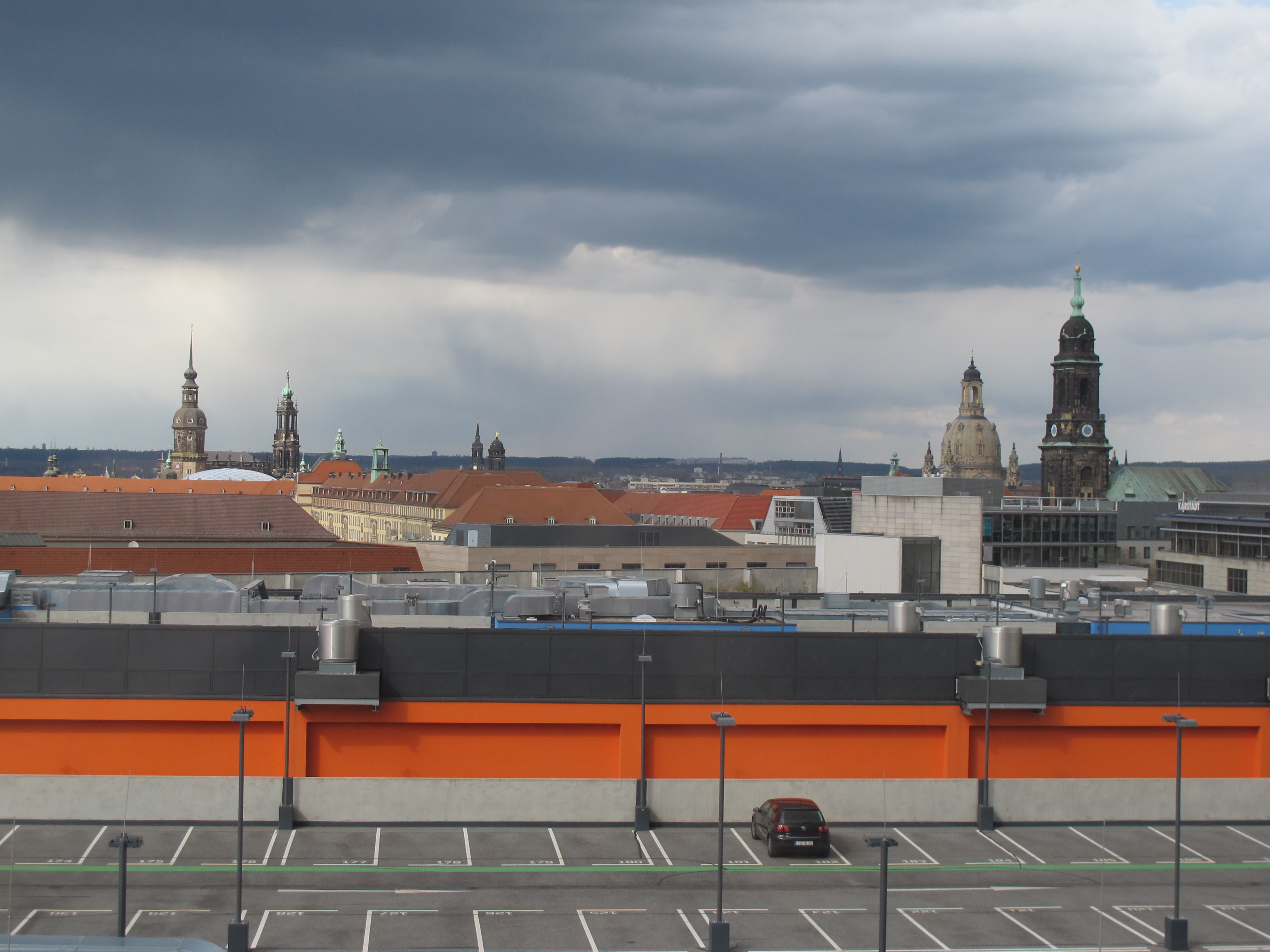
Born in Dresden in 1899 he would have been 100 years old last Saturday. His mother pushed him to excel, often threatening suicide and having him drag her back from the bridges;
It is rumored that his real father was a doctor in a household where she worked as a domestic; his official father seems to have been in the picture only by name, excluded by the folie á deux of mother and son. Gifted, precocious, Kästner went on to receive a doctorate in literature and worked in Berlin as a journalist, writer and poet during the Weimar Republic. As a representative of the Neue Sachlichkeit his poetry combined distancing, satire and a sharp eye for the political developments of the day.
His progressivism did get him in trouble, in some ways. He was arrested twice by the Gestapo, his books were publicly burnt – and yet….. He stayed in Germany for all of the Nazi rule, saw his friends emigrating, incarcerated and committing suicide or being killed, while he had some understanding with Goebbels that he was to engage in a large movie project to distract the masses: the Tales of the Baron von Münchhausen. Which he did.https://www.dailymotion.com/video/x101n37
After the war he became a newspaper editor in Munich, had a secret relationship and child with someone while being officially together with his companion from the Berlin years. His output dwindled, he never wrote poetry again and refused to discuss what had happened during the 3rd Reich. He even limited the contact to his mother who did not live to see her only grandchild.
Then again, he was a committed pacifist and actively fought, demonstrated and agitated against a re-armament and military build-up of the new German Republic. Marching in the streets, if need be. As I said, Erich, doubled.
Here is one of his poems that I have always liked. It riffs off a Goethe verse from Mignon’s Lament: Kennst Du das Land wo die Zitronen bluehen? You know that land where lemon groves bloom?
You know that land where canons bloom was a devastating parody of the German predilection for militarism.
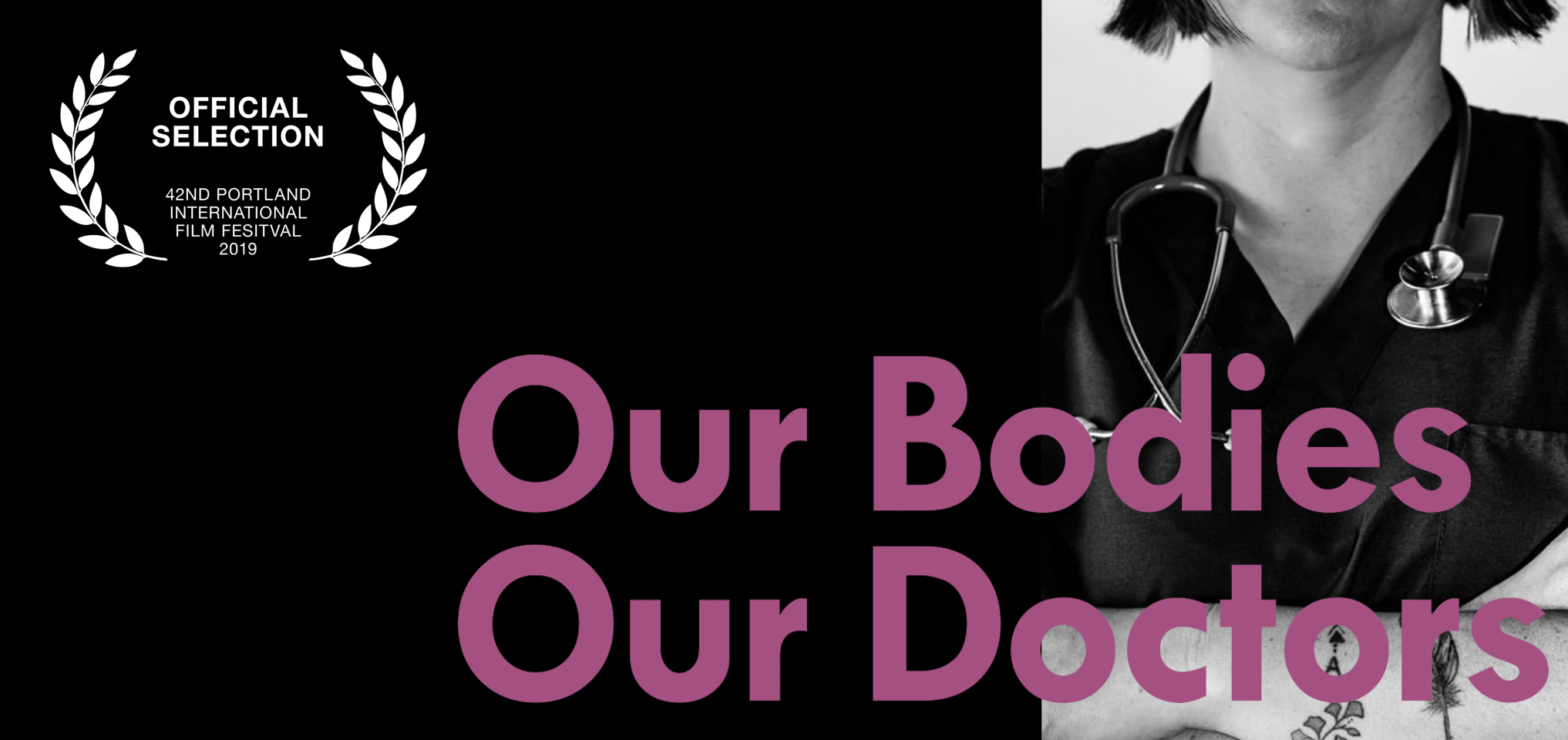
The Portland International Film Festival – PIFF – has a long (42 years and counting) and honorable tradition of focusing on controversial subjects. This year is no exception. On March 8th, International Women’s Day no less, it features the world premiere of Our Bodies Our Doctors, a documentary film by Janice Haaken exploring the experiences of contemporary abortion providers.
The team: Director Jan Haaken front center; from left to right: Katrina Fairlee, Sound Recordist, Timothy Wildgoose, Photography, Caleb Heyman, Co-director of Photography, Samantha Prauss, Assistant Director. Not featured: David Cress, Producer.Eric Edwards, Co-Director of Photography and director Jan Haaken
Last Saturday the nation was called “to rally for a Day of Mourning at the epicenters of infanticide…”by evangelical Christians urging all to wear black, refuse to shop and repent for the sin of abortion. (I believe same-sex marriage was thrown in for good measure.)
And we are in a position where handbooks appear that give practical advice to those in need of reproductive services, presuming the end of Roe vs Wade is coming. Activist and writer Robin Marty guides readers through various worst-case scenarios of a post-Roe America, and offers ways to fight back, including: how to acquire financial support, how to use existing networks and create new ones, and how to, when required, work outside existing legal systems. https://www.sevenstories.com/books/4159-a-handbook-for-post-roe-america
Security Measures at Clinics
*
The documentary, Our Bodies Our Doctors, provides a fascinating window into the many ways that contemporary abortion providers see their work endangered, undercut and complicated, even before potential Supreme Court decisions alter our legal history.
“This is a film that truly SHOWS truth to power, exposing the daily realities of performing procedures from providers POV and why they fight for reproductive justice.”— Gloria Steinem, writer and activist
It tells the rarely-discussed story of what it means to be confronted by threats of violence and facing intensified political threats and efforts to criminalize abortion. It opens a window into the lives of these doctors, nurses and other personnel who have devoted their careers to ensuring women have access to skilled, compassionate care. The film also features Portland providers, often unsung heroes, who have taken national leadership roles in the fight for reproductive justice. It really provides insights that are hard to come by otherwise and makes them available to those who choose to go to one of the two screenings at the Whitsell Auditorium.
“This film feels nothing short of revolutionary. The experiences of abortion providers have for too long been left out of the pro-choice vs. pro-life debate, and presenting these doctors with honesty and compassion will have a profound impact on the discourse around abortion in this country.” — Grayson Dempsey, Executive Director, NARAL ProChoice Oregon
Office Decor
*
As a still-photographer on the set of the film, able to follow many of those interviewed at a close distance, I was struck by what preoccupied the thinking of many of the providers: concern for the lives and well-being of their clientele. Here is a doctor making breakfast on the run for her young kids before she hops on an airplane to be of monthly service in areas that no longer have abortion providers, wondering if she packed her bullet- proof vest. She really is concerned, though, about the fact that the lack of access to information, care and providers, the lack of money to undertake long travel or take days away from work all lead to much more advanced pregnancies in the patients she’ll be seeing, potentially precluding help for those women.
Here is another doctor who relates how the increasing rates of catholic-owned hospital beds in any given city, all of whom deny abortion care and employment for those who want to offer it, affects where you live and work and which patients are likely to be underserved even more than they used to be.
Then there are the young medical students who decry the ever diminishing opportunity to be actually trained as abortion providers.
Lecture and Lecturers at OHSU
Or the independent feminist reproductive health centers who have to close shop because of the current situation.
One of my favorites was the doctor who found her participation in roller derbies the best medium to release the accumulated stress and tension brought on by the daily misery she is seeing, difficulties based on economic issues just as much as the assault on reproductive rights.
And I could certainly relate to the reproductive justice warrior – cum – poet, (or should it be the other way around?) Judith Arcana, who spent much of her early life engaged in educating about the legal and health related issues, wondering why we at our age have to go back to the bad old times. As a member of the pre-Roe Chicago-based underground abortion services collective JANE she had an unobstructed view into the problems of that era. http://www.juditharcana.com/home
Judith Arcana
It doesn’t really matter that concerns about unwanted pregnancy have given way to longing for grandchildren, as in my case, when you see reproductive rights, fought for with sacrifices by so many generations of women, have come back under full frontal attack.
*
In this context, it is probably valuable if we re-familiarize ourselves with what the legal issues are. A recent, informative summary can be found here:
The decision guaranteeing abortion rights in the United States, found in Roe v. Wade (1973), was based on a right to privacy, which the court found to be primarily protected by the Fourteenth amendment’s “concept of personal liberty and restrictions upon state action” and the Ninth amendment’s “reservation of rights to the people”. Religion really played no role in it, although it did in Planned Parenthood vs Casey (1992) There the woman was granted the right to her own conception of her spiritual imperatives. As Justice Kennedy wrote, “At the heart of liberty is the right to define one’s own concept of existence, of meaning, of the universe, and of the mystery of human life.”
Contrast this with the Right to Life Act (2007) co-sponsoredd by Tom Price and Mike Pence, and similar ones introduced later as The Life at Conception Act in 2013 and 2015which would in effect outlaw all abortions.
The original 2007 text reads in full:
To implement equal protection for the right to life of each born and preborn human person, and pursuant to the duty and authority of the Congress, including Congress’ power under article I, section 8, to make necessary and proper laws, and Congress’ power under section 5 of the 14th article of amendment to the Constitution of the United States, the Congress hereby declares that the right to life guaranteed by the Constitution is vested in each human being.
The terms “human person” and “human being” include each and every member of the species homo sapiens at all stages of life, including, but not limited to, the moment of fertilization, cloning, or other moment at which an individual member of the human species comes into being.
Not only do these principles equate a few cells clustered together at fertilization with a fully cognizant person, providing the same rights to both. More importantly the principles are based on the underlying assumption that G-d provides the zygote with an immortal soul at the moment of conception – and that makes it a person. I am attaching a link to a speech by Vice President Pence so you can hear for yourself the kind of arguments that are shaping the beliefs of the evangelical base:https://www.youtube.com/watch?v=s2s9YTswNUs
You might privately hold this belief; but the constitution’s non-establishment clause demands that no private religious beliefs are enshrined in law. A legal proscription regarding abortion based on belief in immortal souls would really establish a kind of State religion, something clearly unconstitutional.
We do need both – a strong defense of what our constitution is all about provided by lawyers who are able to uphold women’s rights; but also an introduction to the human side of abortion, provided in this case by a film maker like Jan Haaken, who creates an unflinching portrait of the kinds of players and dilemmas involved. Her film-making generates empathy which results in better understanding of the issues. This, in turn, might lead to actions supporting those who fight a pretty lonely battle at the frontiers of the current conflict zones, sometimes literally.
Add puzzlement to the topics of anger, laughter and tears of previous blogs this week when discussing movies/performance art. Your puzzlement since today’s title suggest that I am talking about a movie I cannot possibly have seen. My puzzlement about what possibly to expect from a director who manages to either really hit or really miss in whatever he produces.
I am talking about Alfonso Cuarón whose movie Roma is about to arrive in Portland in early December, and also to be launched on Netflix at the same time. The film is a portrait of a maid’s life in an upper-class Mexican family against the backdrop of the 1970’s, a psychological study of human relations. It also is:
“…. a kind of snapshot Marxist adventure told from a family-eye view. It takes us to a corrupt hacienda at Christmas time, with “Jesus Christ Superstar” on the turntable, where the decadent bourgeois swells toasting their good fortune seem to be whistling past the graveyard of the land grabs that are being whispered about; or out into the streets on June 10, 1971, with the audience plunged into the roiling fear and bloodshed of the Corpus Christie Massacre, the state-sanctioned attack on student demonstrators that heralded a new era of clampdown in Mexico.”
Seems to be an Oscar contender, according to the reviews below.
I will report, when I’ve seen it, but here is my real question: Have you watched some of Cuarón’s movies before?
Great Expectations (1998) was a failed film (unless you like the color green which suffused it to no end), an assessment notably shared even by the director.
“Y Tu Mamá También” (2001) was brilliant brilliant, brilliant. If you ever need a spark to feel alive, go see it.
Gravity (2013) really re-inforced gender stereotypes despite Sandra Bullock’s heroine being hailed as an exceptionally strong woman. It was an inane, sappy, boring, sentimental movie. One could say I didn’t like it.
And now comes Roma, which everyone is hyping to the high heavens.
How to account for such a trajectory? You tell me! If a surgeon would show an equal distribution of one death per life saved, or an engineer had one building collapse for everyone that stands, they’d be soon disbarred, or whatever the equivalent professional demise is called. How can an artist survive this?
Photographs were taken in Mexico City, from the Colonidad Roma neighborhood of the movie’s title and adjacent quarters where I stayed last year.
Yesterday I wrote about laughter, today it shall be tears. Rest assured not mine, or at least not publicly.
I will discuss them in the context of the confession of a Netflix addict, yours truly, who has been hooked on a Chinese Soap Opera for the last several weeks. The Rise of the Phoenixes has me mesmerized and I am trying hard, and largely unsuccessfully, to figure out why exactly.
A word of warning, you don’t want to start watching this, unless you care to waste 45 minutes x 70 (no typo) episodes of your life’s time. Even I will not make it to the last episode, particularly since it doesn’t have a happy ending. (How do I know? Why, I do the same for Tv that I do for books, I always check the ending out first, and don’t even think about calling me on this, I’ve had that debate too often…)
My entire knowledge of China consist of having read Clavell’s Tai Pan and other such beach novels, and a serious perusal of The Selected Works of Mao Zedong in an equally serious book group of my first year at university, aged 17. Man, were we naive.
So why am I glued to a historical drama, whose every allusion (as critics claim) to contemporary Chinese society escapes me? The story has a few main strands. There is the old emperor who’s 10 sons fight for succession, with every court intrigue imaginable, killing each other off if need be. There is a rival empire trying to restore past glory and usurp the current realm. There is boy meets girl mixed in (in sort of a Chinese variation on taming of the shrew), with girl having to pretend to be a boy until another scheming courtier unravels the secret and has her (almost) executed.
There is no other way than to describe the visual experience as Vermeer meets Dior meets Monet meets Eisenstein. The colors and lighting are straight out of the old Dutch Masters. The costumes are exquisite, ever changing, subtly matched in color to amplify the gilded surroundings and intricate carvings of the palace interiors. The (rare) outdoor shots along willowy waterways or bridges are reminiscent of french impressionism. And the battle scenes choreography would make Sergey Eisenstein proud.
The intellectual experience, if you dare to call it that, is one of extreme gendered display: with few exceptions, all the background women are scheming, nasty, power hungry or push-overs who spend 18 years parked in cold corner of the imperial palace, waiting for a turn as concubine. They all have secrets in their past, and are meeting sordid fates, never being shown in positive relationships. Then there are the men, spread across a much larger canvas of possible qualities, and often in buddy relationships or with side kicks, blurring the lines between servant and master, teacher and friend. Our hero stands out as breathtakingly beautiful (a 42 year old actor playing a prince in his 20s and you believe it in a second) and smart and just and beloved by all, including our heroine who, alas, can’t marry him. As long as she plays a man, she also has friends and social contacts and guards that adore her (the kind that can fly through the air in true Chinese martial arts-movie fashion.) And she manages to rescue our hero multiple times, while serving as the smartest scholar in the land at the side of the emperor. Almost impressive enough to let you forget the negative portrayal of the rest of the fair sex…..
The emotional experience, then, must be what draws me in. For one, the pace is glacial, as to be expected when you fill 70 episodes, which means lingering camera shots, endless scene changes that allow you to take in the sets, instilling a sort of meditative trance while being awash in all that color, particularly if you let the Chinese rush over you and ignore the subtitles (which translate the same word in 100 different ways…) Secondly, there are the tears – I knew I was getting to them eventually. There are harsh ones, copious ones, silent ones, noisy ones, forced ones, spontaneous ones, fearful ones, enraged ones, elegant ones, swallowed ones, single drops to flowing streams, nose running and all: and they are primarily displayed by all the men! I have never seen so many men crying with abandon around every corner! Yes, the women cry as well, but the real focus is on all those machos, dissolving. Throws out of the window everything I ever learned about emotional display rules in collectivist cultures.
And now I better get back to episode 21 to see who rescues whom from the next looming palace intrigue, leaving someone in tears before being thrown into the dungeons.
It ain’t for the faint of heart. The movie Widows by Steve McQueen, contains some intensely violent scenes. It ain’t for the feeble of brain, either. The plot is complex, as is to be expected from a script that originates from a mini-series. And the film might be overwhelming for those who grieve, since its depiction of grief is so visceral it makes your chest hurt.
Nonetheless, I recommend Widows as a must-see if you are at all interested in several main themes of our political times and revel in glorious cinematography. The movie touches on political power, racism, police shootings, organized crime – all in the guise of a high-adrenaline, often funny heist movie that contains all the familiar elements of that genre, from clever planning to unexpected obstacles to car chases to plot twist that leave you reeling.
Most importantly, though, it tackles the issue of women’s anger in a non-condescending way that goes beyond the familiar trope of “allowing a few strong women to get even.” Oscar-winning filmmaker and director Steve McQueen (“12 Years a Slave”) shows once again why he is currently one of the best in the field, able to make the audience think about gender relations and power without falling into the platitudes of some of the “Me Too” movement.
The plot – and I’ll try not to provide too many spoilers – centers around a heist gone wrong that leaves the male partners of 4 women dead. The widows face serious dangers from the victim of the heist who asks for his stolen money back or else. The women who did not know each other previously, and each of whom suffered emotional or physical abuse or other problems in their relationship, get together and plan a heist themselves to get out of their predicament. They are all destitute and have little to loose by taking enormous risks, but some are also mothers who would leave yet another orphan or two if things go bust.
All this is put into the context of Chicago politics, race relations, and more betrayals on more levels than you can count. Complexity is added by the fact that bad guys are to be found among both Blacks and Whites, rich and poor, women and men. The cast is superb, Viola Davis, Liam Neeson, Daniel Kaluuya, Elizabeth Debicki, Michelle Rodriguez, Brian Tyree Henry, Carrie Coon, Robert Duvall, Jacki Weaver, Colin Farrell and Cynthia Erivo all impressive, although Debicki’s and Kaluuya’s performances stood out for me, given that I had never seen them before and they surely held their own against the heavyweights. With one exception the women look normal, not the Hollywood glamour you are used to, and that makes the film even more interesting. Add stunning visuals and you’ve got the almost perfect Saturday matinee.
I say almost, because one can quibble with this or that weakness found in this – like any other – film. Let me relate some thoughts on the issue of women’s anger instead, so prominent in the movie because of they way they were abused, since I write these words on the UN’s International Day for the Elimination of Violence against Women. Saturday saw over 30.ooo people demonstrate in Paris against violence against women (independent of the other yellow vest demonstration about gasoline prices and Macron’s policies.) Sunday saw thousands demonstrate in Spain, and many more across all of Europe. Women have found a voice and organized to amplify that voice by numbers. Their anger motivates, gives energy and propels to action despite the fact that historically women’s anger has always led to backlash against them, individually and as a group.
If you have time and inclination, below is a very smart essay on exactly that issue, pointing the way how to support social movements that are propelled by female anger, while also flagging potential pitfalls. If, on the other hand, you could use some first-class entertainment that’s not dumb either, go get tickets for Widows!
Consider Terry Castle, the Walter A. Haas Professor in the Humanities at Stanford who has widely published on female homosexuality and 18th-century English literature. Many smart people judge her as one of the sharpest, most insightful, wittiest literary critics alive. She has also been involved, for all I can tell, in an extended cat fight with Susan Sontag, who she simultaneously reveres and competes with, even after the latter’s death.
In her essay Desperately seeking Susan she describes this scene: Having been promised a “real NY evening” in a loft with dinner guests like Laurie Anderson and Lou Reed she finds herself at the margins. “Yet it wouldn’t be quite right merely to say that everyone ignored me. As a non-artist and non-celebrity, I was so ‘not there,’ it seemed—so cognitively unassimilable—I wasn’t even registered enough to be ignored. I sat at one end of the table like a piece of antimatter.” Sontag’s brief attempt to introduce me —“with the soul-destroying words, Terry is an English professor”—only made things worse: “I might as well not have been born.” Just after coffee, with Sontag oblivious and sleepy in her chair, …. exit “back to the world of the Little People.”
Clearly she is no stranger to the concept and experience of exclusion; the way she describes her awakening to and living the life of a lesbian for decades also implies a knowledge of what it means to navigate non-mainstream terrains.
Imagine then how I almost choked when I read these words in one of her lauded essays in the London Review of Books on outsider art:
Lunatics. Appalling. Whacked out. Disconcerting. Disorienting. Repelling. Crazy. Nothing but judgmental, violent, denigrating terms written in 2011.
Words matter. I remember drumming into my graduate students in a clinical program the necessity to shift language from the disorder to the person. The condition is NOT the person. No talking about a schizophrenic, but someone who has schizophrenia (and not suffers from it necessarily either, as so many project.) That was hard even for those who would never dream of uttering abasing terms like the ones mentioned above.
I ask myself how can we ever become a more inclusive society, combating stereotyping, ableism, all these deeply ingrained negative associations about people who have a neurological, mental or physical make-up that does not conform to the norms society proscribes? When even the educated upper 1% cling to their ignorance, per chance even getting a kick out of their perceived superiority? And occasionally collect outsider art which makes the collectors, per definition, insiders? What does it mean to have to move amongst the prejudiced on a daily basis, if you are neuro-diverse? Or not move, as the case may be, since wheelchair accessibility is still such an issue in the world at large? Or you are deprived of your freedom to move in the confining net of rules of foster care?
I am bringing this up because I had the privilege – and pleasure – to photograph artists and their performances (presented by Boom Arts) who are exactly the kind of people Castle seems to shun. I saw brilliant stand-up comedy by British Jess Thom, Touretteshero, who uses the platform of her non-stop – laughter-inducing monologues to educate about the neurological disorder. Thom uses a wheelchair, dons protective gear for uncontrollable tics that might make her hurt herself and belongs to the few % of those who have Tourettes whose uncontrollable utterances often contain 4 letter words.
She is brutally honest in describing the effects of the disorder, and in her humorous and wickedly smart way of showing how a life need not be constrained by disability (defined within a social model where society is inducing this state rather than the neurological diversity per se: https://en.wikipedia.org/wiki/Social_model_of_disability)
she is about the most successful educator and role model one could imagine.
Her eyes were steel grey in the stage light, luminous, expressive and for me representative of her steely determination to bring the issues into public consciousness.
Then there is the Wobbly Dance project, based in Portland, that a few years back made an experimental film Waking the green Sound about dancing while physically constrained to what movements a given body allows.
A stirring piece of art, which has you see the magic of creativity and the physical beauty of the artists, Yulia Arakelyan, Erik Ferguson and Grant Miller (the latter of the daring fashion sense and the angelic face that recedes into the background when you hear them speak in measured, eloquent, non-shaming and yet devastating words on what prejudice does to the lives of the neuro-diverse.
Then there is Cheryl Green’s tender and incisive portrayal of some members of the Wobblies, and their fears of being institutionalized, robbed of the simplest freedoms the rest of us don’t even give a second thought.
The film maker acquired a brain injury some years ago and has since devoted her talents to documenting a community that needs to be known and understood beyond the ignorance at best and prejudicial thinking at worst that is so commonly displayed in all of us.
And finally there is Lara Klingeman, part of the Echo Theater Community, who is often surrounded and at times assaulted by voices in her head and is anchored by the constant presence of a support animal. She created a soundscape of many overlapping voices telling her what (not) to do, think, feel, interspersed with sounds from the radio or street life, an ebbing and flowing cacophony at times unbearably loud, that is generated by a brain wired differently from our own. Connect to her and Levi, the dog, while this is played to the audience, giving us a glimpse of neuro-diversity that we can actually there and then experience ourselves.
You can be stripped of your rights, being forced into institutions, and, in the case of the 1930s fascistic regime of my own country, Germany, being imprisoned and killed. In fact, Operation T4, the forced sterilization and later starving, injecting or gassing people with disabilities to death, was the earliest planned action to “cleanse the Aryan race”, long before Jews became the focus of annihilation. In all a quarter million people with mental or physical differences were systemically murdered between 1939 and 1945.
In the bit I cited on top, Castle proudly proclaimed that hers’ were not Wordsworthian encounters with people with disabilities. Indeed they weren’t, if you understand his poetry as embracing encounters with disability as a tool that can promote moral growth for the rest of us through reflection.
I think we should all have a dinner party, every one of the photographed performers, the ever-moving ASL translators and folks from Echo Theater joining
the rest of us in celebration of diversity – and the likes of Terry Castle do not just have to sit at the end of the table – I’ll refuse to invite them altogether.
Producer Ruth Wikler-Luker will point the way (which she has done this season in more than one way,)
and Levi has to come as well!
Jess can bring the flowers. As can Grant. They make our world whole.
During the last couple of months I had the opportunity to take a lot of portraits while on the job documenting this or that event. I will present some of them this week, while linking to the work of others who have caught my interest.
We will start with Soft Shells, a portrait series by Canadian photographer Libby Oliver. For this series, Oliver turns the notion of portrait upside down. The portrayed people are actually hidden, quite literally under heaps of their own clothes, with only this or that body part peeking through. Ranging in age from 4 to 88, selected from a wide variety of backgrounds, through internet calls in addition to family and friends of the artists, the subjects were picked for their wardrobes. Oliver intended to present as many styles as possible – not to accuse of consumerism, but to demonstrate how personality can be expressed through choice of clothing.
I am not sure that a pile of jumbled and amassed clothes can necessarily reveal the owner’s personality, since much of that might only emerge in the conscious and/or clever pairing of dress items. I think, though, Oliver is on to something with this idea of hiding behind the outfits in a portrait session in your own bedroom. Good portraits hint at something with something, rather than plainly depict. They catch your attention and ask you to provide interpretation – that act of thinking brings you closer to the portrayed person (or your assumptions of who s/he is, whether they are true or not,) and establishes thus a connection. In that way good portraits mimic the process of real life encounters with someone, relating to them in the moment, being curious about them, or wanting to gauge them, anticipating interaction.
In addition to making us think about these people, the technical aspects of Oliver’s photographic work are stellar. She obviously had an environment where she could control the lighting, the exposure, the posing etc. None of that was true for the situation I found myself in, working on a movie set recently in Astoria.
I was documenting the behind-the scenes work of members of a film crew that was shooting The Mortuary Collection, a Gothic Horror Anthology; it revolves around an eccentric mortician who spins 4 interconnected tales of madness and the macabre in weird surrounding. Some of it was filmed at Flavell House, a land mark Victorian house in this coastal town.
But the days I was there were spent in an old gymnasium, now used for roller-skate derbies, with suboptimal lighting and chasing after a crew that was bustling with activity. Needless to say, I savored every minute of it. I also have a newfound appreciation of how hard people work when making movies. The sheer act of organizing 100s of people on a set, not get in each others’ ways, spending hours in cold, cramped conditions repeating necessary work over and over until it finds satisfaction with the director, is daunting. The workdays are by fiat 12 hours long, with meals sneaked in on set (much depends on the quality of the hired cook) and much of the labor is intensely physical because the machinery and sets are heavy. No wonder the crew is young, given the stamina that is required. And it is not just physical stamina – the producer has to spend years of finding funding, organizing continuity, keep the ball rolling until the final product emerges in all its glory. Or gory – I wouldn’t know, am waiting to see the final version, but it is a horror anthology after all.
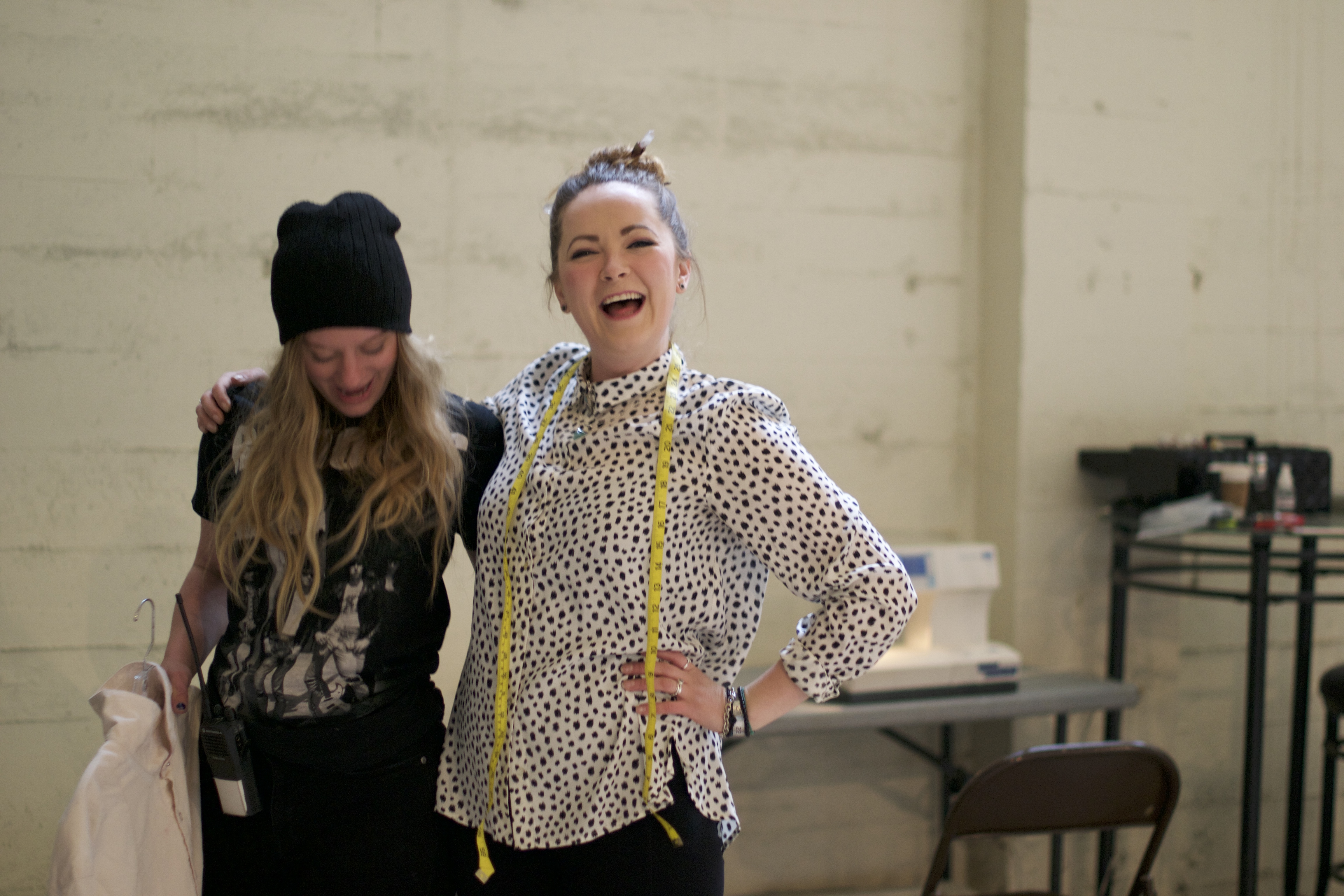
My choice of portraits today from that film set are partially tied to Oliver’s wardrobe theme; the young women you see here were responsible for tailoring, dressing, costumes in general, make-up, acting and set-design. The men were responsible for filming, directing, moving the set around, sound recording and the like. Gender difference, anyone?
A friendly and lively bunch who graciously gave me a few extra minutes of standing still in their mad work day. I certainly will happily do this again.
Two of the things important to me are: a) ways to contribute to political causes that resonate with me and b) to break out of my isolation, working alone as a visual artist, by joining projects that are carried by like-minded people.
Both goals have been realized in working with a documentary film team that is just now putting the finishing touches to a film to be released later this year. Conceptualized and directed by Jan Haaken, Professor Emeritus of Clinical Psychology at Portland State University, the film investigates how stigma is attached to being an abortion provider and how a new generation of gynecologists and family medicine practitioners handle the challenges of their profession. Among them was Dr. Willie Parker, who is probably the most famous of the bunch given his visibility. Click on image to get his NYT profile by Nicholas Kristof.
It is, however, not just the federal government or the courts who impede self-determination. There are other, insidious way to undermine the ability to obtain or provide abortions. If your city’s hospitals are run by administrations associated with religious institutions, their choice to deny services trumps those of women who seek them. In Seattle, for example, now more than 50% of all hospital beds and associated medical doctors are in the hands of the catholic church.
In many mid-western and southern states there are no longer a n y functioning clinics that women seeking an abortion can turn to. They have to cross state lines to find help, an impossibility for those who are poor due to associated travel cost and loss of wages. Often doctors from other states have to fly in on a weekly or monthly basis (including some of the docs we filmed in the NW.)
The film describes the status quo and how those working in the field experience the obstacles put in their way. These include not just what I described above, and the constant sense of threat to one’s personal safety when encountering protesters, but also the increasing refusal by many medical training institutions to teach the required skills and to ostracize those who chose this specialty.
In addition, may of the small, progressive women centers who were at the core of protecting women’s right face closure because larger institutions like Planned Parenthood dominate the market place.
I worked as a production photographer for the project, and chose for today’s blog some of my favorite portraits of the many courageous people, doctors and nurses, I encountered.
What would I do without my friends? They open up my horizons, over and over again. Just last week a dear one dragged me into the Portland Art Museum to an exhibit that I would have never, ever visited on my own: the show about LAIKA, the PDX-based animated movie producers.
I don’t watch animated movies, never have. And so I never thought about what goes into them, except some kind of trickery of animation, probably computer-based now, via filmed drawings then. What I now learn is that the folks at LAIKA actually build models, in 3D, creating entire worlds, that are the basis for their magic.
The exhibit at PAM shows some of these models, elucidates the technical processes, gives behind the scene glimpses of the core mechanisms, materials and tools used. All of which was rather interesting, but paled in comparison to some visions inside my head: what would it be like to go to work and everyday create a world in full detail. Sort of like being a minor god, who has the choice to supply or withhold. To let whimsey dictate some of the details, or full understanding of an artificial, agreed upon universe command the ways to fill it.
And, importantly, a work that unites thoughts and ideas with working with your hands. Someone builds all these models, cuts and saws, flattens and glues, scrapes and irons, sews and hammers, and puts it all together to create a world. Mind boggling.
Not that I have the talent for handiwork, or, these days, the flexibility of joints and fingers. But it speaks to me, and makes me want to get into the artisan’s minds of how it feels to make something, rather than sit at a computer and write, or take pictures with my camera. Well, for occasional change, anyhow……
This week, then, I’ll focus on things that are made or tools that are used. And might even watch a Laika movie to see the model worlds come to live.
Our last installment of timely entertainment celebrates Great Britain. How can we not after last night’s glorious showing by Labour under a radical ‘nobody thought he could pull it off” leader?
For your viewing pleasure here is one of my favorites, at full length, so save it for a rainy day when you are in desperate need for cheering up. It comes with my personal guarantee that it will ! And since we’re out of rabbits today, you’ll get some deer….












 Photographs here and below are of Jess Thom (Touretteshero)


 Yulia Arakelyan
 Erik Ferguson









 For your viewing pleasure here is one of my favorites, at full length, so save it for a rainy day when you are in desperate need for cheering up. It comes with my personal guarantee that it will ! And since we’re out of rabbits today, you’ll get some deer….
