I had meant to offer a new Art on the Road episode, having finally made it to a museum during this California sojourn. Well, the museum was WILD – but art was not exactly how I would describe it.
If I ranked the weird museums visited across my life time, the Black Hawk Museum in Danville, CA would definitely make it into the top three. It is certainly worth a visit, mind you, if only to figure out the strangest thing among the many you will encounter. It was voted Best East Bay Museum in 2026 by the East Bay Times – which turns out to be a daily broadsheet in Walnut Creek, a small locality in Contra Costa County, which reports mainly on local highlights and is a reliable source of obituaries…


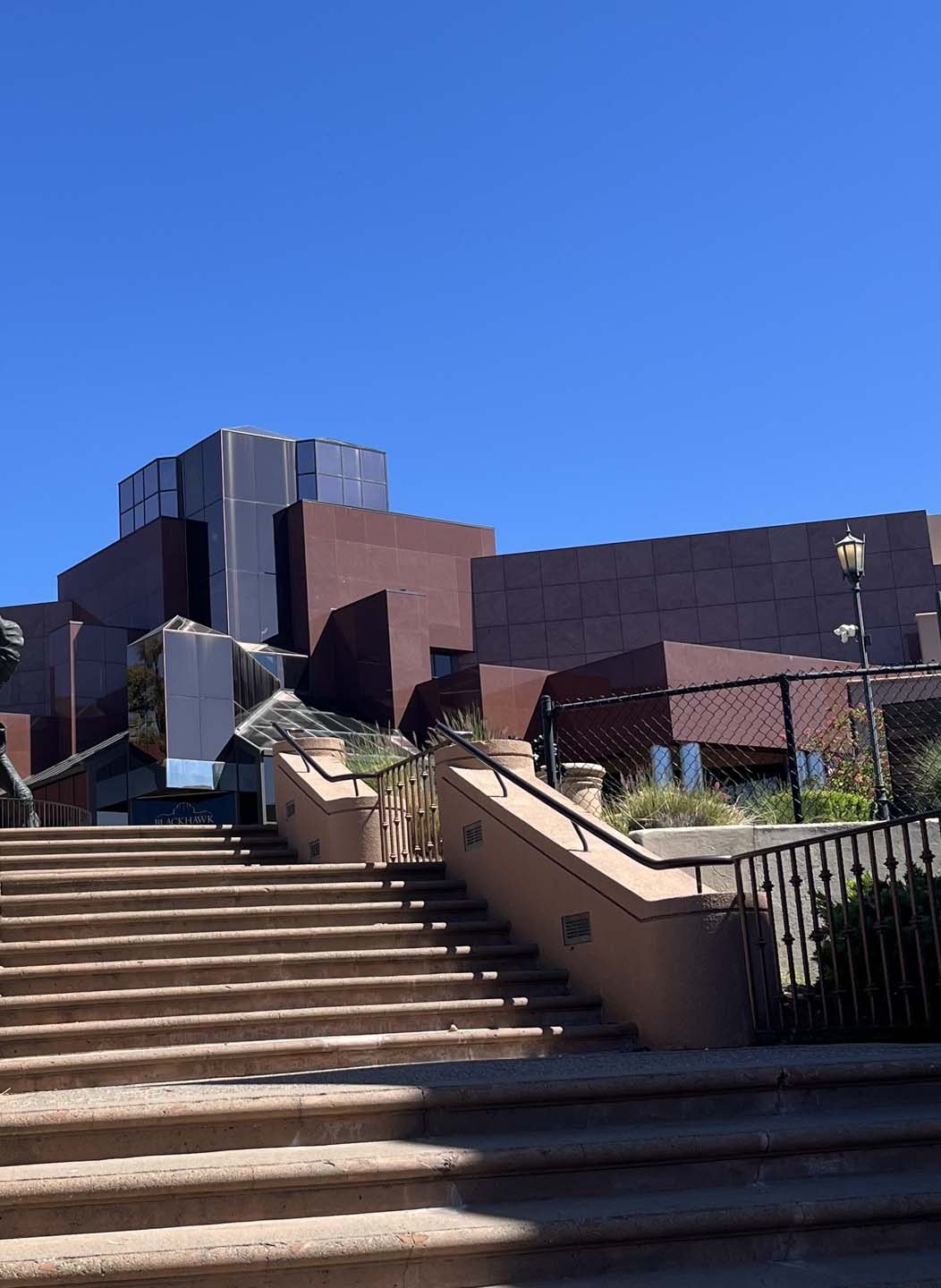
The museum is situated on top of a hill occupied by an originally posh strip mall, now in various stages of decay, stores closed down, fountains turned off, ponds dried out.

You climb steep staircases, approaching an imposing building that in no way reveals how much space it actually covers, burrowed into the hill. You are greeted by a humongous elephant and various African wildlife completely out of context on the front plaza. Ubiquitous signs inform you that the museum is independent of the plaza, as if it has to ward off that sense of impending closure.


Originally meant to house a vintage car collection offered by co-founders and owners Ken Behring and Don Williams, it opened in 1988, amidst a controversy about the tax exemption they received for donating the cars to the museum. The exhibition of some 90 spiffy old timers amidst old gas station props is indeed extraordinary. Many of those were in private ownership by the founders, but others have been added from owners whose famous names draw many visitors. They are housed in pitch-black rooms, with lots of tiny sparkling lights and spotlights that bring out the color and the shine of the various chassis. Signage is excellent, informing you about every detail of each car you’d ever want to know – or not.


The same can’t be said for the rest of the exhibitions – and the “rest” is an inexplicable hodgepodge of thematically focussed displays around various parts of the world and some natural history. There is so much to see that I did not even get to all of it. I missed The Spirit of the Old West and the World of Nature, spending as much time as my tired feet allowed looking at the Art of Africa and Into China, never mind a collection of powder compacts (culled from 1000s of such objects accumulated over the decades by Patricia Behring, the founder’s wife.) At least for this exhibition the signage was informative.


Once you step “into” China, you get statements like: multiple artists worked on this for 20 weeks or some such, no names, no information about time frame or regional location.


Porcelain swans resembling bathroom lighting fixtures greet you at the entrance of yet another cavernous room,

and “dream landscapes” line the walls depicting what I assume is a stereotypical country side.

A few pieces of solid China, vases and plates compete for attention with a carved buddha.


A recreation of the forbidden city had me longing for a miniature train, since the whole set up was reminiscent of those miniature affairs.

Replicas of a Golden Throne and some of the Terracotta Warriors are eye catchers, all of the installations dramatically lit with purple, red and golden lighting.


Ivory carvings abound, some recreating famous battles, others just hovering around. The one thing that spoke to me (and where I learned something) was an assemblage of historic musical instruments, in the farthest corner of the rooms, of course.


The Art of Africa should be more realistically called Sub-Saharan, Tanzanian or Serengeti Carvings, given the limited selection from an entire continent. There were some interesting carvings of wild-life migrations as well as masks, but also what you’d expect in a tourist market, selling stereotypical versions of what Westerners would count as authentic – not even clear what material used as the base of the carvings. Some of it look pretty plastic to me, but that might be my ignorance.


Supervised by stuffed leopards, and surrounded by wall paintings of African wildlife which really lacked but one thing – a velvet canvas – the exhibition mostly spoke to the interest of hunters.


That is no coincidence, given the passions of the museum founder, Ken Behring (1928 – 2019). His was one of the actually true rags-to-riches stories so prevalent in American mythology. Born to working class parents in Illinois, he made is way as a salesman and eventually real estate magnate, becoming one of the richest men in the US. You might remember his name as the one-time owner of the National Football team the Seattle Seahawks. His 9 year tenure was quite controversial – he tried to move the team to Southern California when he failed in a bid to get a new stadium built to replace the Kingdome. The NFL did not allow that move, and, after much strife with coaches and team members, Behring sold the franchise, once acquired for $80 millions, for $200 million to Paul Allen. The fans counted him as one of the worst pro sports owners in their history.
He was no stranger to controversy in general, including numerous accusations of sexual harassment, all settled out of court. A generous philanthropist, he established programs to donate needed wheelchairs across the world, and supported the Smithsonian to the tune of over $100 million. The first recipient, the Museum of Natural History, was supposed to also display his trophies from big game hunting expeditions – he was passionate about trophy hunting on African safaris and shot sheep in Kazakhstan a few weeks before they were put on the endangered species list. Much protest ensued with accusations of poaching and unethical hunting methods. – Later, a group of curators and scholars at the Museum of American History expressed concerns about Behring’s gift and worried that that he had been given too much power to “dictate the nature and content of the museum’s exhibitions. Yet today the Smithsonian’s National Museum of American History bears the subtitle “Behring Center” and his requirements were fulfilled.

The museum understandably focuses on the positive aspects of their founder rather than inform about the raging Smithsonian (or other) controversy at the time. Given his wealth, one wonders why he did not find some more appropriate painters for the family portraits that are hung in the entry halls.


Then again, a curatorial team up to the task of somehow linking these diverse exhibitions and providing some signage backbone would have been a good place to spend some of his resources. Be that as it may, a visit to this place is certainly an eyeopener how private interests, the drive to collect and a good tax accountant can combine to provide some stimulating sights.
Art on the Road has to wait for another day.

Music today is a complex new album called Hellbent Daydream, I leave it to you to imagine what mine might be….