Browsing Category

Religion

The Fate of Rebels

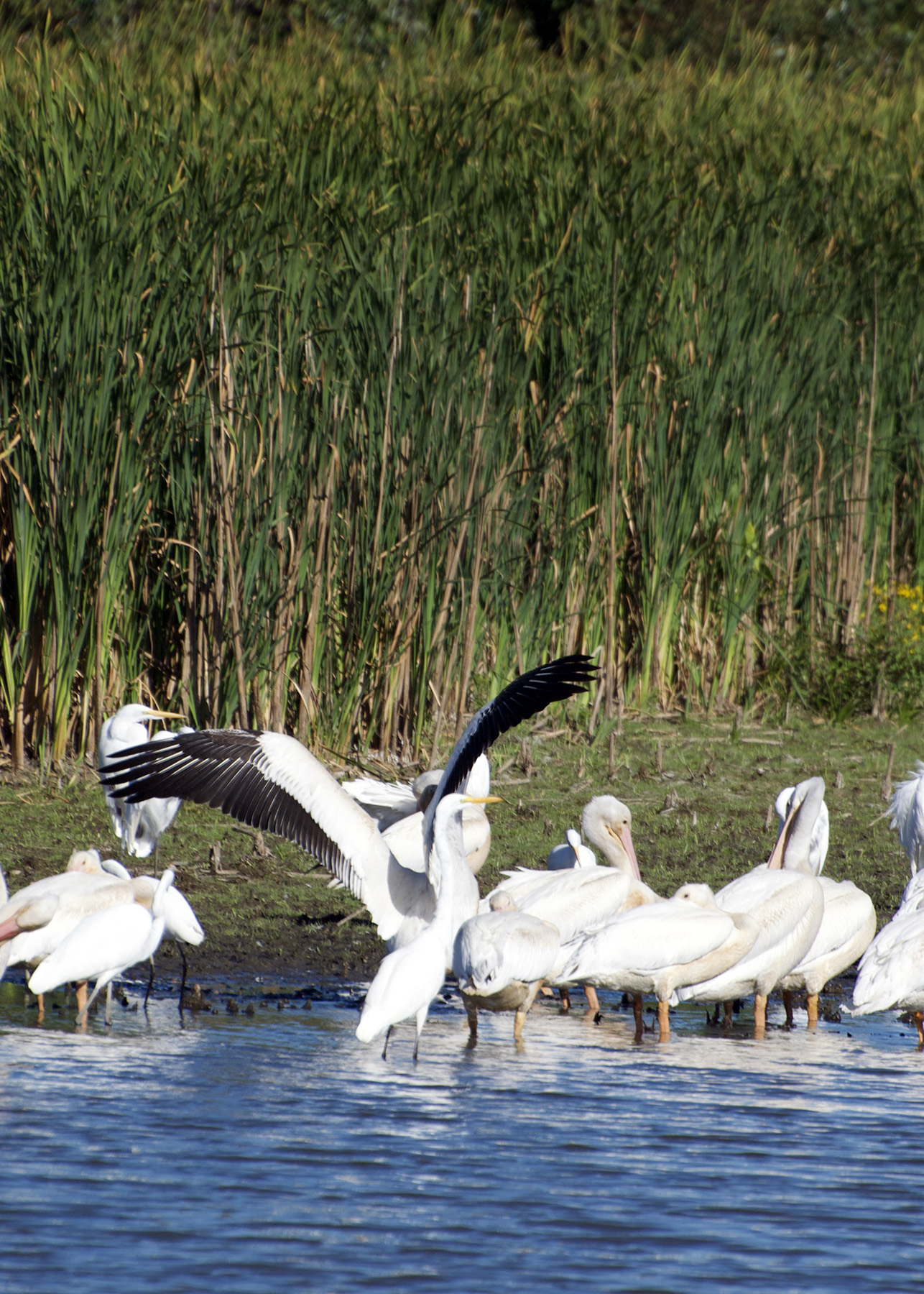
I could not believe my eyes. I had stumbled upon a pod of pelicans in Forest Grove, not just in the air on their southwards migration, but actually resting among the unperturbed egrets.

Here they were preening, snoozing, fishing as a fleet. Their large beaks can be adjusted in size not to hold food, as is erroneously presumed, but to serve as a kind of fishing net, which is not exclusively used for fish, by the way. Pelicans do eat smaller birds as well, including pigeons…

Pelicans have played a role in Christian iconography ever since the 3rd century. Some strange story, in a tractate called Physiologus, started to make the rounds: pelican mothers were claimed to kill their rebellious offspring, and then pecking their own breasts to revive them with their blood after three days. Comparisons to salvation history ensued, human kind being punished by G-d for its disobedience, but then the Son redeeming folks with his blood.

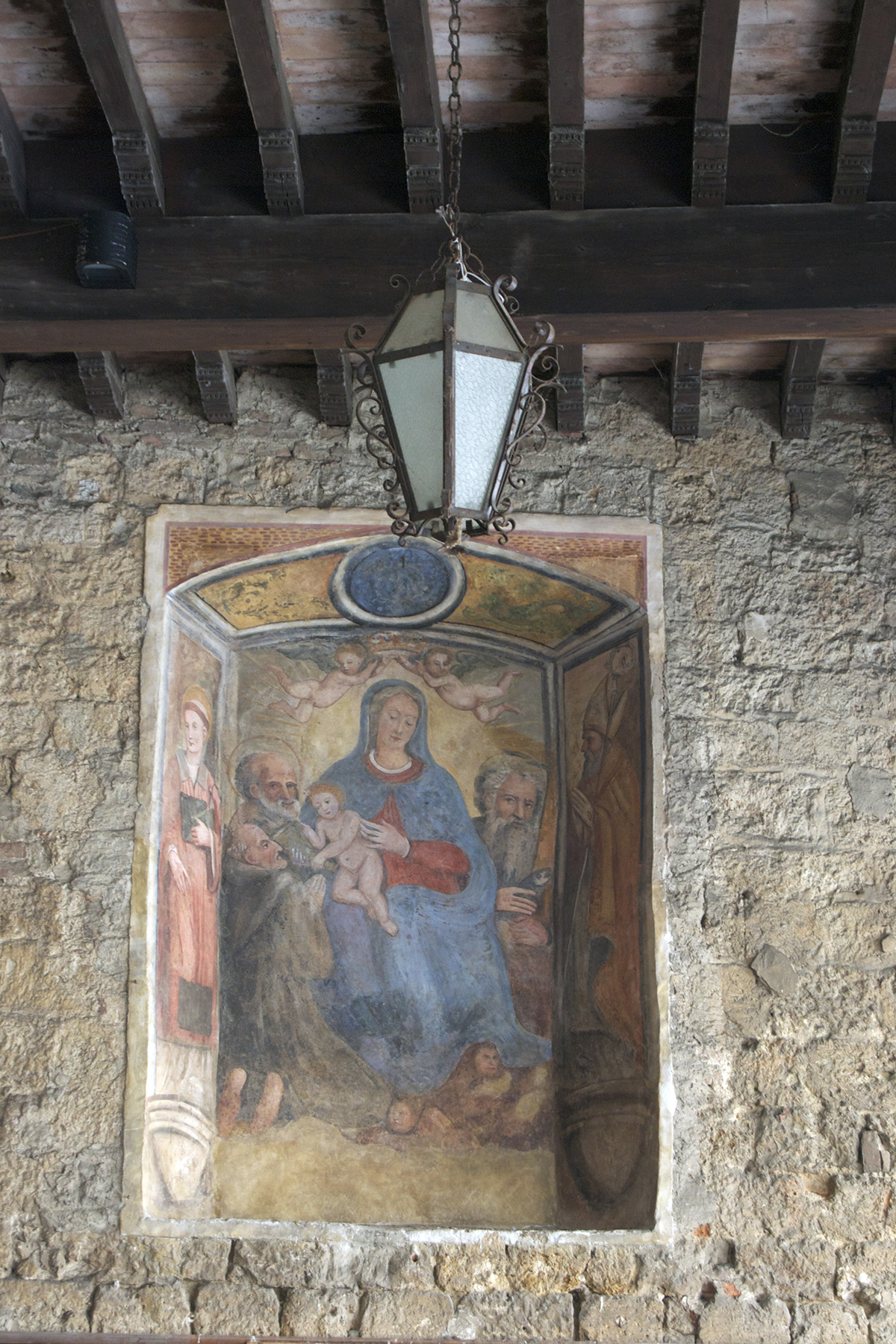
Detail from the Salimbenis’ Crucifixion: The Pelican

The punitive part of the story was eventually dropped, and the redeeming part enhanced. The narrative influenced art throughout the Middle ages, with images of pelicans feeding their chicks as a symbol of G-d’s sacrifice for his flock. The paintings could be found on tabernacles and the top of crosses, as well as frescos of Crucifixion scenes.

“These legends may have arisen because the pelican used to suffer from a disease that left a red mark on its chest. Alternatively it may be that pelicans look as if they are stabbing themselves as they often press their bill into their chest to fully empty their pouch. Yet other possibilities are that they often rest their bills on their breasts, and that the Dalmatian pelican has a blood-red pouch in the early breeding season .” (Ref.)

The point, though, is that rebellion was flagged, punished, and resolved with the pointer to salvation through religious adherence.

The Pelican Symbol

Christianity was not the first religion to imbue pelicans with symbolic meaning. In Egypt the birds were thought to be divinity and guide the passage of lost souls through the underworld. However much they were worshipped in those ways, their treatment on earth was not exactly preferential. Pelican populations in this country have been endangered in a variety of ways since the 1880s in competition for fish. “They were clubbed and shot, their eggs and young were deliberately destroyed, and their feeding and nesting sites were degraded by water management schemes and wetland drainage. Even in the 21st century, an increase in the population of American white pelicans in southeastern Idaho in the US was seen to threaten the recreational cutthroat trout fishery there, leading to official attempts to reduce pelican numbers through systematic harassment and culling(Ref.)” Pesticides and oil spills affect them as well, as do hooks of discarded fishing lines.

I hung out with the birds for a while, watching how comfortable they are with each other and how quiet (it is only chicks who vocalize during nesting seasons.) Pelicans are quite social, they have communal courtship rituals, they nest in colonies, they hunt together and they often fish as a fleet.

They eventually took off, single birds rising, then forming groups, circling in formation trying to find the thermals that would lift them to traveling height.

The circles reminded me of another iconography of rebellion, one probably approved by pelicans prone to comradeship. I learned about these solidarity circles which somewhat protected rebels from persecution from comments by Nick Kapur, a Professor of History at Rutgers with a focus on Japan and East Asia.

“In Japan’s Edo Period (1603-1868), when impoverished peasants finally couldn’t take it anymore and decided to revolt, they would sign their list of demands with all their names in a big circle. They had specific reasons for doing this: First, this format expressed their solidarity and commitment to each other, like an endless ring that cannot not be broken.

But perhaps more importantly, the usual way daimyo lords dealt with peasant revolts was torturing and executing the ringleaders but letting everyone else live. After all, they needed peasants to till the fields! By signing in a circle, nobody could tell who the leaders were.”

Apparently, these kinds of circular documents – now known as Round Robins – could also be found in 17th century French petitions to the Crown, in the British Royal Navy when sailors petitioned officers, and in the Spanish American War with demands that embarrassed then President McKinley.

Here’s to pelicans’ unity, robins’ evasiveness, to solidarity and rebels of all kinds! And nature’s endless ability to lift my spirits with surprises.

Music today by an adventurous young artist who is performing Edward Lear’s poem about pelicans (Pelican Chorus) in a Hungarian bath house.


L’Shana Tova

May the New Year (5782) be one where justice, kindness, rationality and health prevail.

I usually make a photomontage that captures the sweetness of apples and honey – a traditional food for Rosh Hashanah. I was unable to come up with an idea this year, too depleted by all the endlessly depressing news, in both our public and personal lives.

Got lovingly scolded by many a friend for allowing hopelessness to sneak in and settle. So, in defiance of the darkness around us, I photographed bees in the light – there’s at least an indirect connection to honey…

I will take a break for the High Holidays and resume my observations after Yom Kippur.

Shanah tovah u’metukah – wishing a good and sweet year for those who celebrate,

and wishing everyone else goodness and sweetness without a special occasion. You WILL miss out on the honey cake, though!

Stay safe. Stay strong. Stay kind.

Music is by Ernst Bloch, one the orchestral version of Jewish Life, the other a version with cello and piano of the Prayer movement.

Plagues Be Gone

As we enter Passover I am fondly remembering the glee with which the kids recited the 10 plagues at the annual Seder table. That part of the service is accompanied by dipping your finger into red wine and, if you’re 8 years old, wildly flinging the drops across the table instead of gently letting them fall onto your plate. Washer women (well, people) of the world unite!

Remembering the plagues that befell the Egyptians who held the Israelites in slavery – water turning to blood, frogs, lice, flies, livestock pestilence, boils, hail, locusts, darkness and the killing of firstborn children – is an important part of Jewish tradition, mindful of suffering and existential threat across history, as well as the belief that G-d’s protection will eventually come through.

I was reminded of the plagues when I ran across new research that claims to affect the breeding and feeding behavior of disease-transmitting mosquitos, by blasting them with techno music. Apparently the dub beats interfere with wing beat synchronisation of the mating couples necessary for success. Wouldn’t that be a grand alternative to chemical eradication? The video in the link above shows the lab work, short and fascinating.

Do those plague narratives, faithfully handed down from generation to generation, have any grounding in fact? Archeological research offers some options.

  • The first suggests that the volcanic eruption on the island of Santorini in the south of Greece around 1620-1600 BCE sent ashes to Egypt. They included the mineral Cinnabar which would have turned the rivers red. The generated acidity would have made the frogs jump to their death. Insects buried larvae in dead bodies which increased the noxious insect population. Acid rain could have caused the boils on people, poisoning the grass and in turn the livestock, with hail increasing humidity that fostered locust breeding. Volcanic eruption would also account for the many days of darkness that we hear about.
  • The second theory suggests red algae as the causal culprit.

“Red algae could have sucked oxygen out of Egypt’s waterways, killed the fish and turned the water red. Just as in the volcano theory, frogs then leapt out looking for food, and died. Without frogs to eat the insects, the pests proliferated and feasted on corpses, a feeding frenzy for flies and locusts. The paper argued that the lice could have been a type of insect called culicoides, which can carry two diseases that could explain the livestock deaths: African horse sickness and Bluetongue. The boils on humans could have been caused by glanders, an airborne bacterial disease spread by flies or tainted meat.”

In this theory the darkness was coincidentally caused by a sandstorm. It would have left the crops moldy, which could have produced airborne toxins that might explain widespread childhood death.

  • The third claim concerns climate change. Research on stalagmites —elongated mineral deposits that form out of calcium in precipitation — suggested that there had been a dry period towards the end of the rule of Pharaoh Ramses II. That change would have dried up the Nile and significantly slowed down the flow of water, ideal conditions for red algae to develop.

The central religious message of punishment for the oppressors’ reluctance to abandon slavery does, of course, not care about scientific models. The core insight that people cling to their power, their advantage, their “traditional rights,” at the expense of those they harm, exploit, abandon is a universal one, true for us today as much as for those 3500 years ago. The desire to believe that the harm that befell the Egyptians was G-d given punishment is, in my view, our clinging to the ideal of a “just world.” I’m convinced it takes our own actions to ensure that justice is restored – and this year we might as well start by eliminating a source of enacted racism and reluctance to yield power: the Filibuster. 11th plague, be gone!

Music today is one of the most transcendental movements I know, written in Bartok’s last year of life while dying from leukemia. It has insects chirping in the middle, thus the connection, but it also radiates a kind of grounding that religious tradition can install.

Chag Sameach to all who celebrate Pesach, Happy Easter to others and Happy Spring to the rest!

Photographs are of butterflies rather than creepy crawlers. I assume you’ll thank me.

Of Presepi and Snark and Pique

I got scooped by the New York Times. Well, I had started to write about a tempest in a manger on Thursday and then this article about it appeared in the NYT on Friday: uproar over the Vatican’s choice of a publicly displayed Nativity Scene.

The Italian word for creche or nativity scene is presepe, Italy the latter’s place of birth, as well as the place where controversy erupts over the Vatican’s annual choice of what they display in St. Peter’s Square at this time of year.

The 2020 scene is made up of large, somewhat abstract, cylindrical ceramic figures made by high schoolers in the late 1960s to early 1970s. Displayed are a few pieces of a 54-statue collection which include a blonde Mary, the Magi, a bagpiper, an executioner, a shepherdess holding a jug and even an astronaut, meant to reference the history of ancient art and scientific achievements in the world. (All images of the creche are from the articles below.)

The Vatican has called the Nativity scene “contemporary and unconventional,” hoping it would entice viewers to dig deeper into their faith and understanding. The presepe is “infused with contemporary events from recent years” that include “setting foot on the moon, the Second Vatican Council and the abolition of the death penalty” (the latter two themes reflecting matters being close to Pope Francis’ heart). (Ref.)

The “milder” criticisms attack “its post-modern artistic look, which critics say radically breaks with traditional Nativity scenes and fails to evangelize or inspire others about the mystery of the Incarnation.”  (It sure inspires about the mysteries of high-school art, though, don’t you agree?)

Others complain that in this year of all years we need something traditional and tender to counteract the constraints on Christmas as usual.

Then there are those who assume the negative reactions are simply the result of not understanding the Nativity scene: “this was something that Pope Francis commissioned. And obviously, the whole anti-Francis brigade went berserk.” (Details in the link below)

None of these compares to our very own Breitbart News, though, linking to a website Now the End Begins, which calls the Pope the anti-Christ:

“THE NIGHTMARE BEFORE CHRISTMAS: VATICAN UNVEILS VISUALLY REPULSIVE 2020 NATIVITY SCENE THAT WOULD BE RIGHT AT HOME IN ANY HORROR MOVIE”

The Bible tells us in Isaiah 14 that Satan wants to be just like God, wants to take everything God has, pervert it, and present it as deception. If Satan was to design a nativity scene, it would be unsettling, repulsive, ghastly, creepy, and it would stand in utter opposition to Almighty God. This is exactly what Pope Francis and the Vatican have given the world, a nativity scene that glorifies the Devil in this crazy year of 2020 where the Devil has been given a charge to begin preparations to rule the world for 7 short years during the time of Jacob’s trouble.

Still read by millions of people. I must admit this was the first time I actually went to a site like this, and felt like I landed in a truly unknown world.

Unknown to me is also the Abruzzo region of Italy where the traditional pottery, developed by Benedictine monks in the middle ages, is centered around the town of Castelli. It is where this year’s presepe was created at the local art school, Liceo Artistico F.A. Grue some 50 years(!) ago, trying to educate kids in the traditional crafts of the region.

Maiolica, a ceramic bathed in a tin-based opaque white glaze and painted with bright colors became a trade mark by 15oo. The town made a name for itself with “historiated,” or story-telling ceramics decorated with popular scenes from religion and mythology.

(This plate could be yours for a trifling $3,321….)

Watercolor-like landscapes that treated the white glaze like a blank canvas also delighted the noble classes who consumed these pieces.and is now collected in museums around the world, The Met in NYC, the Hermitage and the Louvre included. (Links lead to display of their maiolica exhibits.)

A far more extensive and perhaps informative collection can be found in the local museum, Castelli Museo Ceramiche which was luckily spared by the 2016 earthquake.

Back to the presepi, though, in this week’s quest for seasonally appropriate cheer. They light up in some parts of Italy, and include tons of references to present-day issues and stars, from Milan to Naples. Here is a lighting ceremony in Liguria.

Photographs today try to capture the range of Nativity scenes I encountered in Italian churches across my travels. Cylindrical they ain’t….but they all stand for something that still carries with it a sense of hope.

Decoy

I haven’t touched politics on this blog in a while, partly because my brain’s average speed is slow-motion these days, and partly because I wanted to counterbalance the woes of our world with something more positive, viz. poetry.

However this weekend I came across an article that taught me something new, and I think in the context of Amy Coney Barrett’s Supreme Court nomination and the sly refusal to say the quiet parts out loud by certain members of the current administration and Congress, it’s worthwhile reporting what I learned.

Randall Balmer, an eminent historian of religion who holds the John Phillips Chair in Religion at Dartmouth at Dartmouth College and is also an Episcopalian priest, has extensively written on religious subcultures and politics in the U.S., his most recent book Evangelicalism in America. Much of his work teaches us about the history of evangelicalism and the fact that it was not always allied with the Religious Right, but instead had progressive historical roots which saw a remarkable resurgence in the 1970s, after evangelicals had withdrawn into a more isolated subculture during midcentury, fearing the corruption of their children by the world at large. Last year he wrote,

“evangelicalism, in contrast to the Religious Right, has a long and distinguished history. Evangelicals set the social and political agenda for much of the 19th century. They advocated for the poor and the rights of workers to organize. They supported prison reform and public education. They enlisted in peace crusades and supported women’s equality, including voting rights.”

Here is the, for me, new and interesting fact of how evangelical leaders and the Religious Right joined forces in the 1970s, ousting one of their own, Jimmy Carter, and forming the basis of the movement that in 2016 had sworn allegiance to our current president – 81% – 4 out of 5! – of evangelicals voted for Trump in 2016.

Although Falwell and his minions claim that coalitions were formed around the issue of abortion, the inconvenient truth is that they mobilized politically to defend the tax exemptions of their racially segregated schools, including Bob Jones University. The tale that the U.S. Supreme Court’s 1973 Roe v. Wade ruling outraged enough Christians to the point where they joined the Religious Right, Balmer claims, is just that: a convenient tale around an easily communicable issue of morality. If you look at the early reactions among Evangelicals to the Roe ruling, there was either silence, or approval, or at most mild criticism of the ruling.

Instead, it was another court decision that lead to the jointly organized political power we see on the Right today: it was about segregated schools and their tax exempt status as charitable institutions. In the aftermath of desegregation of public schools, the number of private schools that enrolled only White kids exploded. It was all about keeping Blacks out and preventing White children from being influenced by a worldly culture that questioned traditional norms and the tenet of the separation of the races.

On June 30, 1971, the United States District Court for the District of Columbia issued a ruling Green v. Connally that upheld a new IRS policy instituted by Nixon:

“Under the Internal Revenue Code, properly construed, racially discriminatory private schools are not entitled to the Federal tax exemption provided for charitable, educational institutions, and persons making gifts to such schools are not entitled to the deductions provided in case of gifts to charitable, educational institutions.”

Eventually in 1983, the US Supreme Court, in an 8-1 decision (those were the days) ruled against Bob Jones University as a tax exempt institution. The Moral Majority wouldn’t have it – but was also clever enough to know that it could not run publicly under the banner of racial discrimination. What standard to rally around then? Religious freedom? School prayer? Hey, legalized abortion! The perfect decoy.

If representatives of the Religious Right, of which Barrett surely is one, are to become Supreme Court Judges at a time where racism, racial segregation and voter suppression along the lines of race are central to the body politic, it seems to me that this is what needs to be explored in the nomination proceedings, rather than allowing abortion – and obfuscation on positions regarding abortion – to be dominantly used as a screen issue.

To end on a slightly comforting note, here are some encouraging thoughts, although they might involve a time horizon that is too late for many of us:

Yet that same conservative court majority may also serve to isolate and limit the Republican Party’s appeal in a country growing more racially and religiously diverse. Already, according to Public Religion Research Institute data, fewer than three in 10 adults younger than 30 identify as White Christians. The GOP is installing a court majority whose views may collide explosively over the coming decade with the dominant perspective among millennials, Generation Z and the younger generation behind them on questions ranging from abortion to racial justice, climate change and gay rights. Replacing Ginsburg with Barrett on the Supreme Court represents a triumphant moment for the conservative social and legal movements. But if the court majority cemented by Barrett alienates the rising generations who will represent the nation’s largest voting bloc by the middle of this decade, that judicial victory could turn to electoral ash.

Now why does that bring Actus Tragicus to mind? Bach will help us start the week….

Photographs today are mostly from my outer Sunset working class neighborhood.

Closing the Circle

Yesterday we observed Yom Kippur, a day that always strikes a strange balance between finality and renewal. The end and the beginning of a circle. Much to be pondered, between the call for atonement and the tenet that on this day your fate is sealed for the next year. What happened to the promise that if you try harder, things might change? If the outcome is preordained on this day, why try at all? Can your honest remorse move the outcome, just a little bit?

These are, of course, the naive questions of someone not particularly educated in the interpretations of Judaic commands, but they are questions any person should ask themselves in general. What is the relationship between redemption and effort? How do you motivate yourself to be and do good, regardless of reward that might or might not be dangled in front of you? Why do different religions take such different views of predestination – some as fatalistic as Calvinism, where everything is believed to be immutably preordained?

How do you function if there is no hope for forgiveness or change, no acknowledgment of agency? Is there a connection to the attempts of many religions that appease you with promises for a better time in the after life or during the next one? A successful attempt to square the circle?

I can’t provide satisfactory answers. I can, however, show you why circles were on my mind to begin with.

The recently opened basketball arena for the Golden State Warriors, Chase Center, is a singularly unimaginative building (at least from the outside,) in my opinion a squandered opportunity to build something new and exciting in a marvelous location overlooking the bay, for $500 million no less. Many longtime residents also felt that constructing a new arena for the Warriors is a manifestation of the phenomenon of gentrification. Additionally, many who supported the Warriors throughout their years at Oracle Arena feel betrayed by the team’s decision to relocate to San Francisco. There is also the issue of public costs associated with the new arena, both in San Francisco and Oakland. Or so Wikipedia tells me.

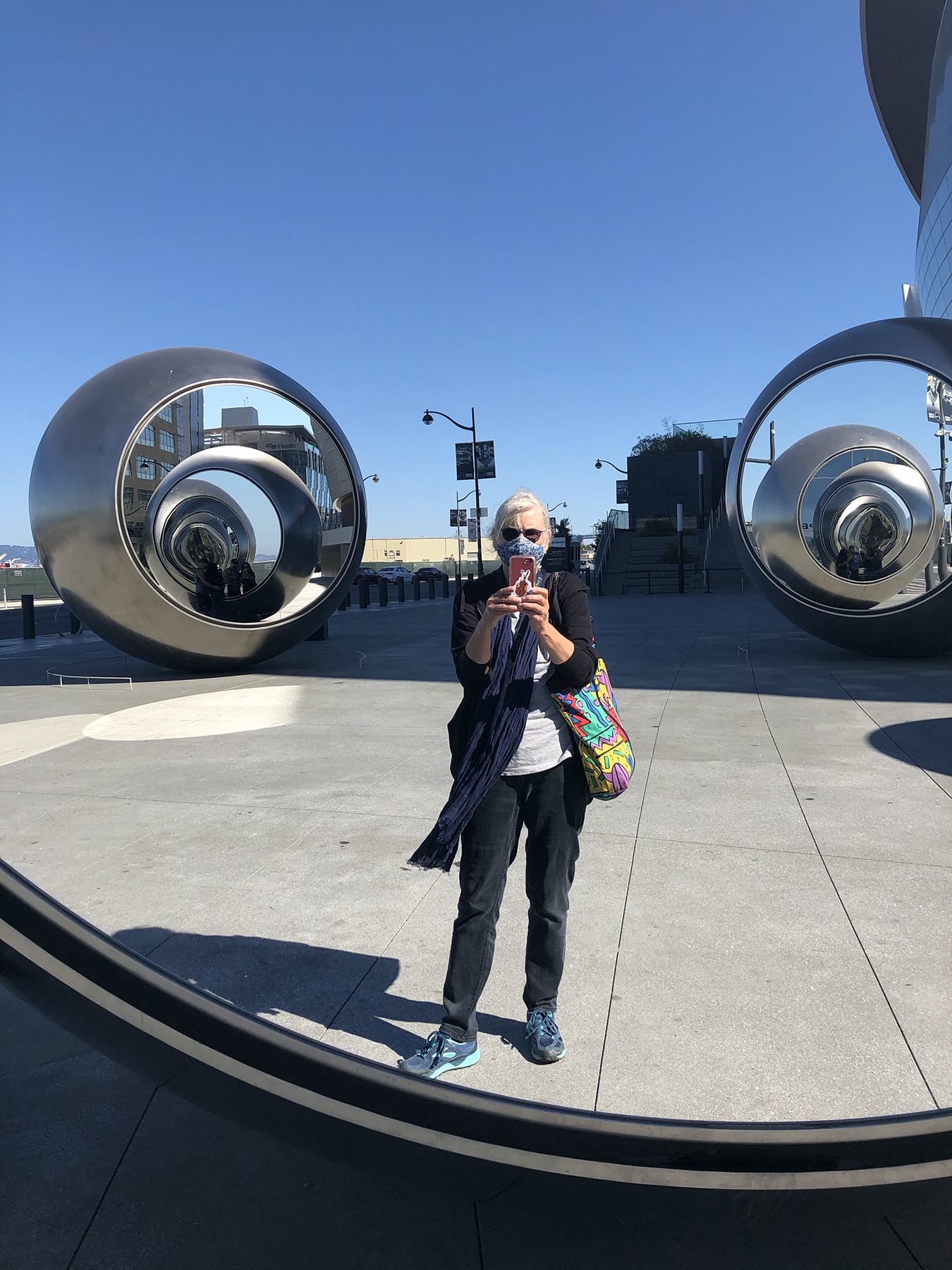
In front of the entrance are huge mirrors, art work by olafur eliasson which consists of five fifteen-and-a-half-feet-tall polished hydro-formed steel spheres that stand in a circle around a central space. Seeing Spheres (2019) double and redouble the reflections around them, making the space look larger than it is and drawing the Instagram crowd and other photographers, your’s truly included.

Associations to Paul Klee’s work with circles were one of the things that came to mind when I looked at myself in those circles with their conic sections, looking not a day under 90 when the skies were colored by fire, aging like the person in his 1922 portrait Senecio (BaldGreis.) The title is believed to refer to a medicinal plant Senecio Vulgaris, also known as Old Man in the Spring, and is also a pun in German, literally translated along the lines of soon to be senile.

The painter has not only done wonders with wit, circles, squares and lines, echoes of which I saw all around me when staring into the Eliasson spheres. He has also left us with a map to understanding the strategies, methods and insights leading to his creative output – his notebooks (Bildnerische Form- und Gestaltungslehre) document 10 years of lectures at the Weimar Bauhaus. They are available in their completeness with transcriptions, drawings and references here (not sure if translated into English, though.)

Gaze, 1922
Gaze, 2020

Now where can we find an equally detailed and instructive map for figuring out how to lead a morally and ethically sound life in the Jewish year 5781 without being inscribed for an immutable outcome? Or any old year?

Music today is an homage to Klee, a concert with pieces that show parallels between his visual art and music. Some educational talk in-between, but worth listening to the pieces!

L’Shanah Tovah

“ARMENIANS AGAINST HATE” it says in fat letters on a large banner hoisted in front of an Armenian Community Center. I drive past that center twice daily, since arriving in San Francisco a month and a half ago to tend to my son, severely injured from a catastrophic paragliding accident. It is located between the Beth Israel Judea Synagogue and the Holy Trinity Greek Orthodox Church on the aptly named Brotherhood Way.

I can never predict when the banner is up, its appearance sporadic. But my mind is glued to the statement whenever I drive by, searching for interpretation. What hate are they against? The one extended towards them by their genocidal persecutors, or the one they feel towards their historic enemy? The hate in the world, bubbling up wherever we look in these desperate times? Are they really able to speak for the group at large, a uniform Armenian mindset?

My mind roils, the topic of hate of personal relevance. I find myself caught by hate these days, an emotion I despise and have rarely given into across my lifetime. I hate the cruel twist of fate that destroyed my kid’s body in a nanosecond of miscalculating height and wind speed. I hate the medical system that is unable to provide pain relief for crushed spinal nerves, phantom pain and abdominal spasms. I hate the war with insurance companies trying to duck out of obligations. I hate the way the urban environment is set up, making it hard to push the wheelchair.

On a more universal level, I hate the way the pandemic is allowed to rage, adding isolation to someone confined to a sickroom to begin with. Hating the tragedy of unnecessary deaths for those exposed to the dangers of the virus for lack of economic security, the drama of all these generations of children missing out on equal education. I hate the system that allows climate change to go unchecked, leading to fires that bring untold suffering to mankind and nature. I hate the way I see the poorest of the poor, the unhoused, crowd the sidewalks unprotected from the ashy air, cough shaking their emaciated bodies.

I don’t want to be consumed by hate. In some ways I cling to it, however, as a protective measure. If I peeled back the layer of hate, like peeling back the layers of an onion, I’d come to layers so suffused with grief and fear I might not function. Just like thinking about the riddle of hate-opposed Armenians protects me from thoughts about my helplessness in view of suffering for yet another day, week, month, year, the anger protects me from far more painful feelings.

Yet today, according to the Jewish Calendar, we end this year and start off fresh. A period of contemplation invited to draw parallels with what people lived through and survived for thousands of years, putting personal hardship in perspective. Reflection on right and wrong instills a sense of obligation to go beyond individual tragic times and focus on communal effort to improve the world as a whole against the forces of darkness that currently surround us.

I will peel the onion. Tears will flow. May they cleanse the way to the promise of sweetness still contained in a possible future. L’Shanah Tovah.

Consider the Lilies of the Field.

And why take ye thought for raiment? Consider the lilies of the field, how they grow; they toil not, neither do they spin: Matthew 6:28 (King James Version (KJV) of the New Testament.)

In a week where a bible was used as a prop and a dogwhistle, let us actually open one. You don’t have to be Christian to be familiar with these words from the Sermon on the Temple Mount; nor do you need to be religious to understand the meaning of the entreaty: there is a higher power that provides for you, do not spend your life in fear.

In general, I’m all in favor of being counseled not to fret. I do start to get suspicious, though, when it becomes an admonition for those worried about their existential conditions, asking for help only to be quieted by vague references to a God who will provide, rather than to be allowed to demand a share of the pie.

A God, in the case that I am trying to think through today, that is also known as the free market. Before you judge me blasphemous, I am just using the metaphor as a pointer to the economic concept of all-knowing, invisible forces that regulate our society for the good of all, rising tides carrying little ships, trailing freedom in their wake. Or so they say.

Funny thing is, while we all are told not to worry, there are others who systematically, sometimes clandestinely, work hard on being protected from anything that could make them worried. They do so by shifting risk to those who cannot easily defend themselves. I believe knowing some of the history of our economic system in this regard is essential to understand why we see such concentrated, pent-up rage (beyond the injustices of racism) of large parts of the population in the course of the pandemic.

My (by necessity simplified) summary today is derived, among others, from articles I read by Jacob Hacker, Professor of Political Science at Yale University, and Edward A. Purcell, Joseph Solomon Distinguished Professor at New York Law School, both not exactly hotbeds of anti-capitalist insurgency, last I checked. The worries, in other words, are described by people who are generally in favor of a market economy.

There have, at the ideological extremes, always been two views about capitalism. For some it produced freedom, opportunity, economic growth and ultimately led to prosperity, democracy, and international cooperation. It linked your risk taking to your reward. For others it created massive inequalities, political oppression, and international rivalries and ultimately led to fascism, imperialism, and war. It saw no reward for those who shouldered most of the risk. Yet all agree that our economic system has always bent towards methodical risk calculation. You could make money with it: think Life Insurance. Or bets on the stock exchange. Or risking a fortune to develop a medicine that in turn made you even richer. Yet in addition to calculating risk to create value, e.g. take risk as an entrepreneur or corporation, those who had the means have managed to shift anticipated risk to weaker parties.

“Releases” from workplace or consumer injuries, “independent contractor” agreements, anti-union policies, race- and gender-based wage discriminations, and the use of part-time employees and unpaid interns shifted operational costs onto the weak, uninformed, and vulnerable. On a more sophisticated level investment banks, brokerage firms, and credit agencies used risk analysis to design complicated financial instruments that generated huge fees and profits while shifting the risks of those instruments onto distant, ill-informed, and often misled investors.” (Ref.)

Some general form of risk shifting has forever dominated our system: we historically asked our government (the taxpayer, all off us) to shoulder the greatest risks for the benefit of private profiteers. The government was called to build and maintain massive infra- structure, invest in institutions that secured order, like “courts, postal services, and police and military protection to highways, canals, railroads, and facilities for air travel to the internet, cybernetics, digitalization, and nanotechnologies, government investment and leadership underwrote economic growth, spurred ever more efficient methods of transportation and communication, and generated stunning new technologies that entrepreneurs exploited to create new products and industries. “(Ref.)

Industries also exploit risk by selling you things to “reduce risk,” (AK-15s , anyone?) or lie about the danger of products to continue selling them (cigarettes, anyone?) Risk assessments are used to discriminate against certain groups of customers (higher interest rates or premiums) etc.

Importantly, businesses avoid risks of liability for the wrongs they cause by adopting legal devices that make it impossible to sue them. We are seeing a clear case of that now in what is discussed around Covid-19 related infections, industry liability laws and Trump’s Executive Order. If your unemployment benefits run out and you HAVE to go to work to put food on the table, into an environment that does not protect you from infection, you have no recourse if you get sick. Which also means employers will have ever less incentive to make the work place safe. We are worse off than before the 1920s, after which ultimately workers’ compensation programs were passed to help with death and disability. Even though these programs are still around, they only compensate for documented injuries incurred on the job – virus transmission on the job cannot be easily verified. It looks like organizations are succeeding in pushing us back into early industrial America, before (socialized) safety-nets were established.

In other words the original link between risk and reward, the historical justification for the way our economic system works, is broken. The increasing demand for ever less interference in “free market” regulations, calls for less taxation and fewer social welfare programs add to the destruction. We see the consequence of this anti-government sentiment clearly: tax-cuts brought huge deficits and reliance on foreign investment. Budget cuts led to decline in services and safety-net measures. Our infrastructure is crumbling. Public education is undermined. And wealth inequality is rising to proportions that were unthinkable during the early, enthusiastic days of capitalism. And now we have 40 million people without a job, and consequently without health insurance, with no end in sight. Economists predict that up to 40% of the lost jobs will never be reinstated and we are facing long-term unemployment worse than that of the Great Depression, all while awaiting the announcement of the first ever trillionaire.

We started with Matthew. Let’s end with Proverbs. 31:9, to be precise (KJV):

“Open thy mouth, judge righteously, and plead the cause of the poor and needy.”

Check.

Music today is mix of protest ballads. Here and in Germany.

Invented Words

“My task, which I am trying to achieve is, by the power of the written word, to make you hear, to make you feel–it is, before all, to make you see.” –Joseph Conrad

Yesterday I wrote about Ida B. Wells’ intention and ability to make the world see with her words, see the disgrace, the horrors, the inhumanity on one side, but also the innocence, the courage and the determination on the other. It brought to mind, don’t ask me why, the power of another unusual woman who tried to make the world see, with new words, an entire new language in fact, focussed on the beauty and blessings of the world around us.

No clue, what propelled Hildegard von Bingen (1098-1179) into my consciousness, other than perhaps a chain of associations to remarkable females, particularly those who lived in times where everything but everything was stacked against their ability to leave a mark. (Times that lasted – it took more than 800 years for the church to canonize her, in 2012, finally.)

We generally know her as a 12th century Benedictine Abbess, a mystic, a composer, a scientist, poet, writer and artist, who had visions, most likely induced by severe migraines. We might remember that she founded two monasteries, in the Rhineland, a fertile part of Germany, and flew, for the most part, under the radar of Church authorities with her unorthodox teachings, since they simply took her not seriously as a woman.

We don’ think of her as the tenth child in her family, brought into an isolated monastery as a gift to the church as an 8-year old, confined to a stone cell with a small window for most of her life, with one meager meal in winter, two in summer. Or as a crafty rebel. I remember a story in my childhood “Famous Women in History” primer that had her act more like an Enid Blyton heroine than a nun:

“A man who had been excommunicated for involvement in revolutionary activity died, and she gave permission for his burial in the abbey cemetery. With the local bishop absent, the canons of the church demanded Hildegard exhume the body from consecrated ground. She refused, claiming she knew the man’s sins had been forgiven. So the canons authorized civil authorities to dig up the body. On the evening before their arrival, Hildegard, vested in her attire as abbess, went to the grave, blessed it, and then, with the help of her nuns, removed all the cemetery markers and stones, so the plot of the excommunicated man could not be identified. The irate canons placed the abbey under interdict; Mass, sacraments and the singing of the divine office were forbidden on its premises. Still, she would not yield. Church authorities finally lifted the interdict.

I had no clue that she invented an entire language, Lingua Ignota, that was likely intended to make the holiness in all things visible, acknowledging how a higher power shapes our existence. The Lingua Ignota can be found in the Riesen Codex (Wiesbaden, Hessische Landesbibliothek, Hs. 2, ff 461v-464v), also called the Giant or Chain Codex, a compilation of Hildegard’s theological writings that were collected near Hildegard’s death. The language consists of about 1000 words, introduced with but one sentence, who appear in the hierarchical order of her medieval world: God and angels, then humans, then animals, then plants etc. The words are entirely new, but shaped by German and Latin roots and pronunciations, though apparently having a sing-song feel, which, of course, ties into her extraordinary musical gifts.

Here is a sample:

  • Aigonz – God
  • Aieganz – Angel
  • Inimois – Human
  • Korzinthio – Prophet
  • Peueriz – Father
  • Maiz – Mother
  • Sciniz – Stammerer
  • Kaueia – Wife
  • Ornalz – The hair of a woman
  • Milischa – the hair of a man
  • Pusinzia – Snot
  • Zizia – Mustache
  • Fluanz – Urine
  • Fuscal – Foot
  • Sancciuia – Crypt
  • Abiza – House
  • Amozia – Eucharist
  • Pereziliuz – Emperor
  • Bizioliz – Drunkard
  • Haischa – Turtle Dove

Only for the curious (and those with expendable time) here is a video that explains the details – high speed talk and thought of a Jewish scholar, who draws interesting conclusions.

Here is another Jewish scholar of mysticism:

“Speech has power. Words do not fade. What starts out as a sound, ends in a deed.” –Abraham Joshua Herschel

For Hildegard von Bingen the deeds envisioned to spring from her words were perhaps acts of faith. For Ida B. Wells it was political action aimed at ending racism. Which words will WE choose today to act on?

Photographs are from Heinsberg, a small town in the Rhineland, where I went to school and which had symbols of the catholic faith distributed everywhere. (Incidentally it is also the place where one of the first serious Covid-19 outbreak in Germany occurred – during the gregarious, touchy/feely times of the annual carnival before Lent.

Happily ever after?

Several large wedding ceremonies were held over the last weeks in New York City in the Orthodox Jewish Community, despite the city’s requirements of social distancing and federal recommendations to avoid large groups. As of last Saturday more than 240 participants registered as fallen ill, in three clusters in Borough Park and Williamsburg. Not only is this a tragedy for the families and neighborhoods involved, but the insistence on large communal events is also sparking fears of anti-Semitic reprisals.

Blaming the Jews is, of course, nothing new. (I am not endorsing holding mass weddings right now, mind you, even if religious laws are cited to justify them. Last I looked, a primary pillar of Judaism is the value of life, which allows all kinds of abandoning of rules associated with Shabbat, fasts, etc., when a life is to be protected.) I am more interested in the fall-out from irrationality and behavior in the face of looming, uncontrollable diseases.

Here are some of the historical facts. Jews were persecuted in huge numbers, whole communities, whenever epidemics broke out (and particularly through out the mid-1300s with the first wave of the Black Death), accused of malevolent well-poisoning. This was done by the local gentile populations even if the Church or the worldly rulers warned against it, partially driven by the convenient fact that the confiscated belongings of the murdered would be distributed among the villagers. Hundreds of Jewish communities were massacred, even though as a group they had been harder hit by the plague than most. Their constrained living quarters in ghettos and lack of access to clean water made them a sitting target for the fleas that brought the disease.

*

Blaming the Other is, however, not a preoccupation solely reserved for non-Jews. There is plenty of evidence of irrational accusations to be found in Jewish history as well. Natan M. Meir, the Lorry I. Lokey Professor of Judaic Studies at Portland State University, is about to publish a book that lays out in great detail how Eastern European Jewry resorted to fear management via scapegoating marginalized figures in their own communities. Stepchildren of the Shtetl, The Destitute, Disabled, and Mad of Jewish Eastern Europe, 1800-1939 will be published in July, 2020. Assuming we are still home-bound by then, it might be just the right thing to read when we need to convince ourselves that things could always be worse….(Having spent some time with Natan when we were both panelists discussing text and translations of Jewish sources, I can vouch for the passion and learnedness he brings to everything he tackles.)

It seems that during the 1866 cholera epidemic, some Hasidic communities “declared that Jewish women wearing crinolines and earrings were to blame for the epidemic,” with physical attacks on them following in short order. More generally, Rabbis blamed adultery as causal factors with some stories told that adulterers, reported by community members, were killed to help abate the disease.

And then there was the magical thinking tied to a completely different approach: the cholera wedding also known as the black wedding, believed to mitigate the impact of the scourge. (Excerpts from a review of the upcoming book here )

“The cholera wedding generally involved finding two of the most marginal residents of the town (whether orphans, beggars, or the physically handicapped) and forcibly marrying them, usually in the cemetery. The cholera wedding, also known as a shvartse khasene (black wedding) or mageyfe khasene (plague wedding) was presented as an ancient Jewish rite, but Meir argues, it was a newly invented, modern response to what was then a newly arrived disease. Because it was a late-developing belief and not textually based, the mechanism by which it was believed to work is open to interpretation.

The last one we know of over here, happened during the flu epidemic 1918, in Winnipeg, “at one end of the Shaarey Zedek cemetery in the city’s North End, a ceremony that drew more than a thousand Jewish and gentile guests, with a minyan of 10 Jewish men conducting a funeral for an influenza victim at the other end of the graveyard.”

The cholera wedding didn’t have one single interpretation. For example, some rabbis felt it was efficacious because helping to marry off a needy bride was a great mitsve that would please God, all the more so for the marginal of the community who were unlikely to marry in any case. However, what comes across in many of the appalling descriptions of the forcibly married, and their reactions to each other, is that the act was far more callous than charitable. But it was enabled by traditional attitudes around communal charity. Those who had relied on it were seen as being, quite literally, property of the townspeople and thus had no say when their (previously reviled) bodies were needed to protect the town.”

Who owns whom, and who owes what is a topic that really emerges in many contexts in these pestilential times, beyond issues of magical thinking, religious beliefs and despairing search for ways to ward off the worst. We’ll look into more of that during this week in the context of economy and power structures. At least that’s the plan.

Music from London-based She’Koyokh which will bring a spring into your step on another lonesome Monday.

If I could only visit to photograph you all dancing while liberally applying disinfectant to the surfaces of your homes….