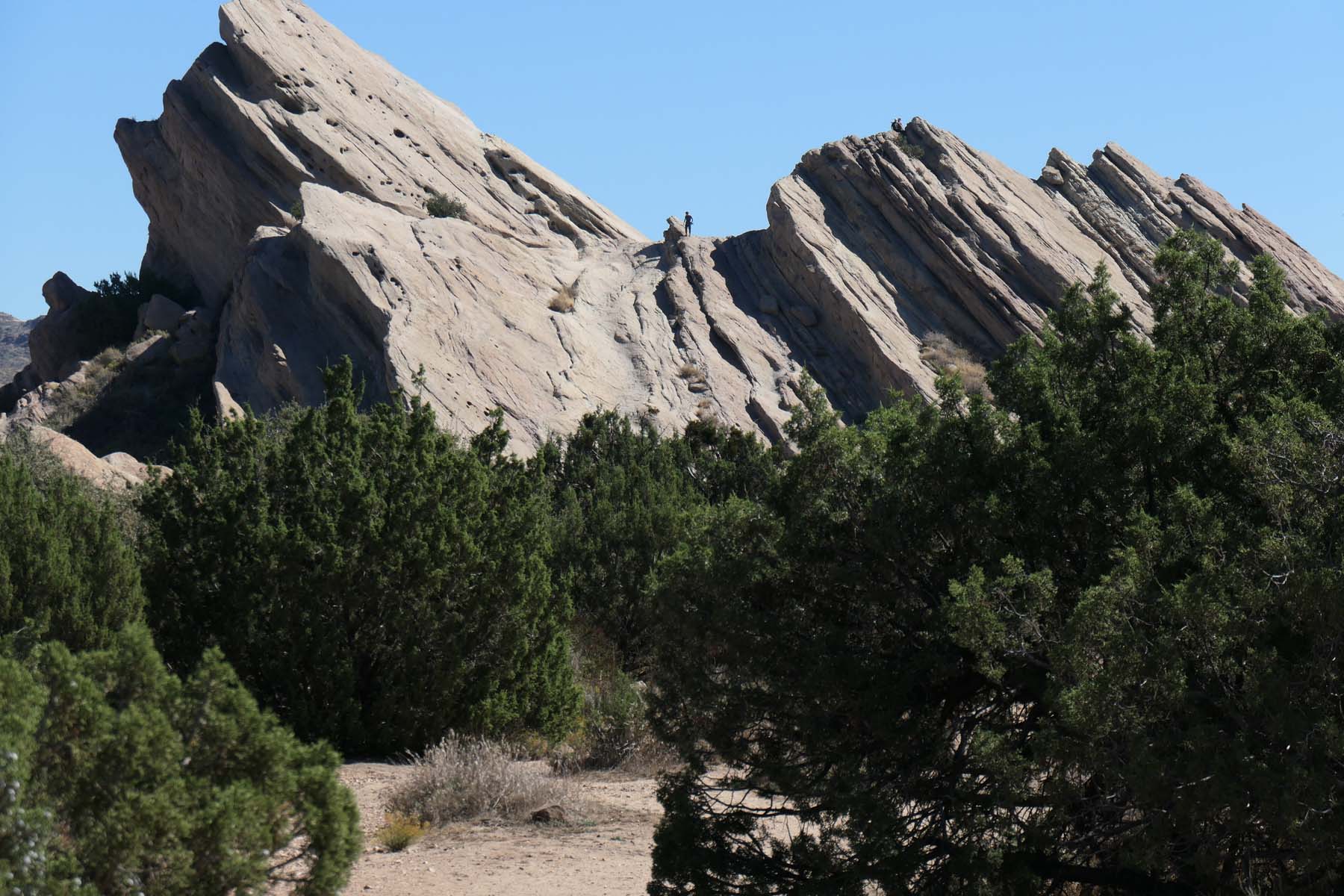
As hide-outs go, you could do worse. Particularly when you have attempted to escape prison four times, sentenced for stealing horses, and finally succeed, in 1862, with ten men dead in the process. When you are a poet at heart, you’re surely sensitive to the indescribable beauty of your surrounds.
Who and what am I talking about? Tiburcio Vasquez, son of a founding family of San Francisco, born in Monterey, and drawn to Southern California in the wake of the gold rush. He wrote poetry, he operated a gambling saloon, and eventually he robbed stage coaches when he wasn’t seducing everyone with a skirt on, married or not, apparently quite generous with the spoils of his thefts to those in his crew and needy people in the region.
Eventually he was caught, after multiple feuds and shoot-outs, hanged in 1875 after spending time in San Quentin. He might or might not have been the Robin Hood-like figure who Zorro was modeled after, but he was the one from which the otherworldly landscape neighboring the small town of Aqua Dulce derived its name.
The strange formation of sandstone is a park today, some 45 minutes north of L.A. off Highway 14. You drive through the Sierra Pelona into Santa Clarita valley, then through Aqua Dulce, a small town advertising the high school Fall Festival,
and then reach Vasquez Rocks where the Pacific Crest Trail intersects with multiple other hiking loops, all opening to awe inspiring vistas.
The rocks were formed by runoff from higher mountains, dirt, sand, plant remnants and so on, layer after layer for millions of years – 25 million, I believe – compressed by the weight of each additional layer, compacted into sandstone. Underneath it all runs the Elkhorn Fault which was actively shifting tectonic plates, thus elevating the rocks into angles as steep as 40 – 50 degrees (and pushing some of them up to 4 miles underground, in equally angular formations, it is believed.)
The main rock formations within the 932 acres of the park can be divided into those that are hard and brittle, called hog back ridges and others that are soft and round, full of holes (often occupied by owls!), eroded across time. There are also grinding holes to be found in these rocks, signs of the presence of the Tataviams (originally linked to the Shoshone) who inhabited the region for some 1300 years, from 450 BC until the 1800s.
When the Spanish missionaries arrived and founded the Mission San Fernando Rey de España some 20 miles away, a lot of them were brought in, converted, and forced to labor for their colonial masters. Within a few generations their language was lost. Today, the Fernandeño Tataviam Band of Mission Indians instruct us about their history and heritage and are working towards official recognition by the federal government.
There was much archeological evidence that informed about the Tataviams’ lives as gatherers, hunters and traders, including pictographs. Near the nature center where you enter the park, you can see exact replicas of many of them, all in one place. The original pictographs are in a section of the park that is closed to the public so they will not be destroyed. The originals have been there since 450 AD.
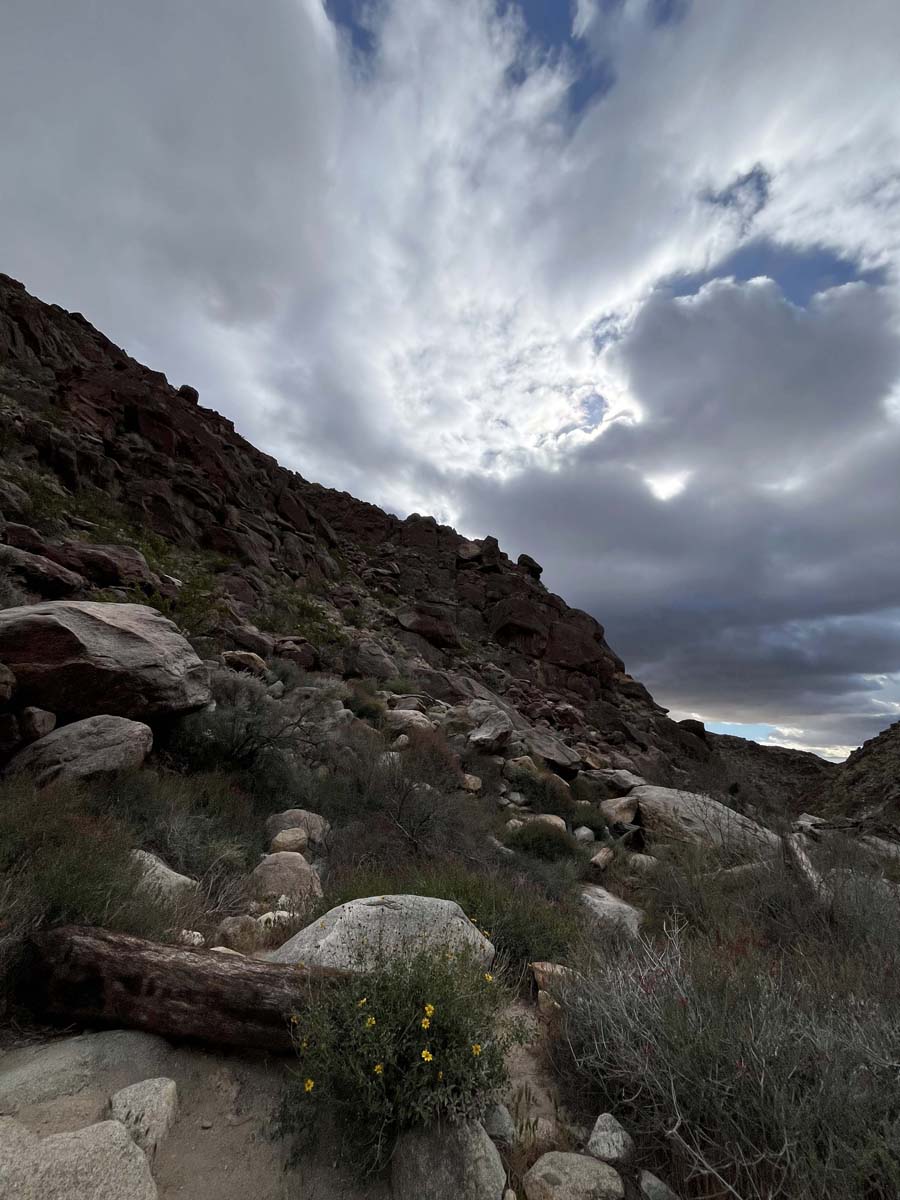
When I visited, the area was dry, suffused with light, filled with shrubbery that tenaciously clung to rocks, and a shining color palette from the greens and reds of the lichen to the orange glow of some of the boulders.
It was also relatively empty, not too many people hiking mid-day, but some climbing the formations, which provided perfect scale for the photographer.
At other times the landscape was booming with people: it has been used as a backdrop for Hollywood films since the 1920s, when it was still private land, leased to the film industry. Below is the list from Wikipedia, and that does not even include a far longer one for TV shows….
It was a perfect day. And here is locally sourced music….
“At its outset in the mid-1960s, the historic preservation movement contributed to the racial splintering of the nation’s urban fabric. It denied the freeway’s entry into communities deemed historic while granting its passage through communities judged differently. It empowered some communities in their fight against the freeway while putting others at a disadvantage. In the disproportionate number of black communities that bore the brunt of urban highway construction, the preservation strategy had no chance, leaving displaced residents with a meager set of resources to recuperate their connection to the past. This is why we need to pay attention to murals, festivals, autobiographies, oral histories, and archival efforts. In the high-stakes struggles over the fate of the American city, these were the “weapons of the weak,” the tools invented by displaced communities to fight the forced erasures of their past.” ― Eric Avila, The Folklore of the Freeway: Race and Revolt in the Modernist City
WHEN YOU ARE NEW to a city, like I am to Los Angeles, one way of exploration is to hit the history books. I had described my early mapping of the city onto Mike Davis’City of Quartz: Excavating the Future in Los Angeles in April here, while reviewing an exhibition from the LACMA archives, Pressing Politics: Revolutionary Graphics from Mexico and Germany.
This time, I brought Weimar on the Pacific: German Exile Culture in Los Angeles and the Crisis of Modernism by Ehrhard Bahr, thinking I might follow in the footsteps of my exiled Landsmen during the 1940s, artists and intellectuals fleeing Nazi persecution. The book’s introduction contains the following description: “Los Angeles has occupied a space in the American imagination between innocence and corruption, unspoiled nature and ruthless real-estate development, naïveté and hucksterism, enthusiasm and shameless exploitation.”
I don’t know about the American imagination, but those of us who devoured Berthold Brecht’s California poetry 20 years later as German teenagers obsessed with America were undoubtedly influenced by his assessment:
Contemplating Hell
Contemplating Hell, as I once heard it, My brother Shelley found it to be a place Much like the city of London. I, Who do not live in London, but in Los Angeles, Find, contemplating Hell, that it Must be even more like Los Angeles.
Also in Hell, I do not doubt it, there exist these opulent gardens With flowers as large as trees, wilting, of course, Very quickly, if they are not watered with very expensive water. And fruit markets With great leaps of fruit, which nonetheless
Possess neither scent nor taste. And endless trains of autos, Lighter than their own shadows, swifter than Foolish thoughts, shimmering vehicles, in which Rosy people, coming from nowhere, go nowhere. And houses, designed for happiness, standing empty, Even when inhabited.
Even the houses in Hell are not all ugly. But concern about being thrown into the street Consumes the inhabitants of the villas no less Than the inhabitants of the barracks.
Bertolt BrechtNachdenkend über die Hölle, 1941, translated by Henry Erik Butler
Mural and Paintings by Devin Reynolds on the walls of the Hammer lobby. Contains references to John Milton’s Paradise Lost, displacement from a beautiful home acting as a red thread through the histories of many Angelenos.
Many decades later I wholeheartedly disagree with Brecht’s description – I find L.A. vibrant and fascinating – though not his political analysis. He knew class divisions and precarity when he saw it. By all reports, he clung to negative emotions as a motor driving his writing. But his ability to pick up on what makes this city thriving, underneath capitalistic excess or popular culture driven by interests to keep racial segregation intact, might have been curbed by what was then and still is not easily visible to the outsider. At least that is my speculation after chancing on Eric Avila’s The Folklore of the Freeway: Race and Revolt in the Modernist City, from which I cited at the very start of these contemplations.
Knowing the history of a place is essential to understanding its character. Who rose to the top and who was pushed to the bottom will define the nature of both the lay-out, the (d)evolution of neighborhoods and the way power hierarchies are distributed. My hometown of Hamburg, Germany, for example, needs to be read in the context of its merchant marine and membership in the Hanseatic League, its intermittent warfare with Scandinavian neighbors, and its destruction under Allied firebombing during World War II.
There are ways of learning about the past of a city and her people that are not found simply by looking in all the traditional places. Clearly, mainstream historians have little incentive to document attempts towards self-empowerment or organized resistance by those not among the ruling classes. Facts about the past are instead often woven into the fabric of experienced daily life, painted on neighborhood walls (I had written about Pacoima, for example, here,) told during story time in corner libraries, experienced during Saturday’s soccer matches at the local park, found during celebrations of special days for different nationalities. Not just the past, I’d add, but the present, as it resurrects what was to be extinguished. Not exactly easily accessible to a foreigner like Brecht, struggling with the language, not particularly mobile, traumatized by persecution and exile, and facing the fact that there are 88 cities, approximately 140 unincorporated areas, and communities within the City of Los Angeles.
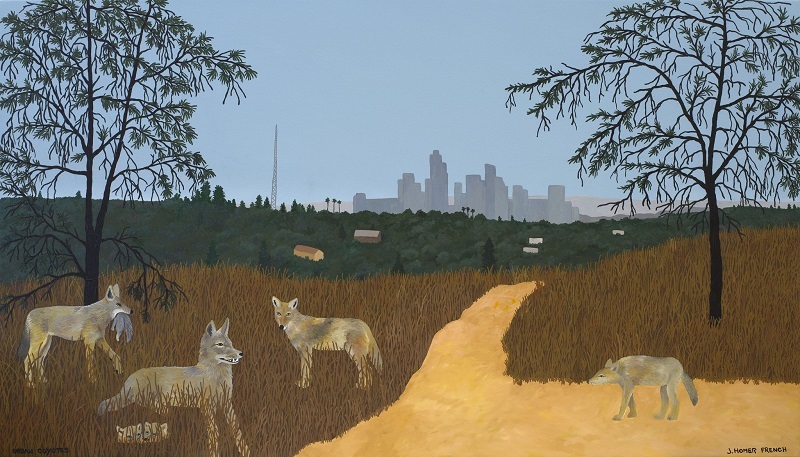
Jibz Cameron Cops, Coyotes, Cars, Crows (2023) Watercolor, Correction Fluid and Graphite on Paper
We, on the other hand, are lucky enough to find quite a bit of it all in one place, a weave that is compact as well as sprawling, screaming as well as whispering, consciously representing or intuitively describing, like L.A. itself. It’s made possible by curators who brought a cross section of yet undiscovered stories into an exhibition that in many aspect mirrors the city it drew from.
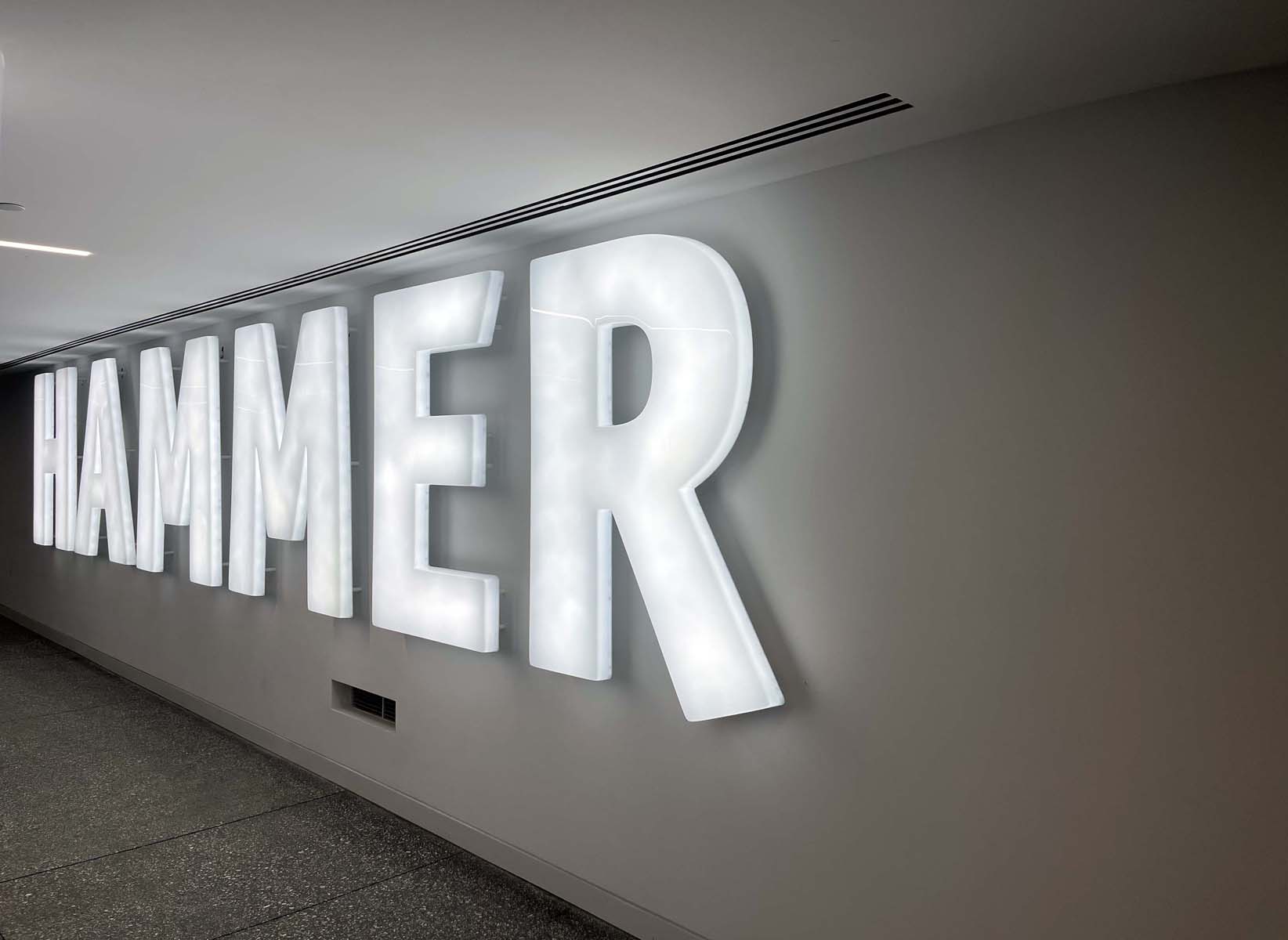
At least that is how I experienced the Hammer’s current exhibition Made in L.A. 2023: The Act of Living, an iteration of its biennial attempt to showcase new talent, unknown or underrepresented artists, providing access to what is likely hidden to most of us from different cultural enclaves. Guest curator Diana Nawi and Pablo José Ramírez, who joined the Hammer museum full-time in June, and Ashton Cooper, Luce Curatorial Fellow, have assembled some 250 works of 39 locally based artists, challenging us to confront our stereotypes and navigate an abundance of thought-provoking art. I come back to what I had written about our own Portland’s current art extravaganza, Converge 45: perceptive curation is a mystery to me, like herding cats, but when it succeeds it is a gift to the community (never mind an intellectual feat.)
Their guiding principles can be found in their statement above.
***
AT RISK OF FALLING for surface rather than structural characteristics, here is an analogy I can’t resist: as L.A.’s neighborhoods differ along multiple dimensions, so does the chosen art in this show. By size, by spacing, by density, by degrees of familiarity. Just as I like some neighborhoods more than others, some leaving me cold, some moving me to the core, some eluding my comprehension, some dull, some riveting, some evoking scorn, and others longing or admiration, so it is for much of the work on display. What registered most deeply was the fact that many of the exhibits taught me something I would not have otherwise known, and how much, sometimes viscerally, texture ran as a common theme through the galleries. Texture, indifferent to past, present or future, is, of course, a stand-out characteristic of Southern California’s nature for this Northerner, with its unusual mix of desert and tropical plants, all ridges, grains, thorns, spines and spikes, peeling bark, twisted fronds, and leathery surfaces.
Kinetic sculpture by Maria Maea“Lē Gata Fa’avavau (Infinity Forever)” (2023) including parts of palm trees, car parts and feathers.
Really, I think there are few materials known to man not included in this biennial. Natural materials like wood, bones, wool, cotton, pearls, wax, mica, graphite, dirt, salt, limestone, copper, leather, feathers, palm fronds, sea shells, corn, corn or other plant based substances. Fabricated materials like acrylic, plastics, paper, forged metal, glass, lead alloys – you name it, it was affixed or served as a constituent even in the context of more traditional forms of painting. Some assemblages consisted of more material detail than you could possibly take in at a single visit. Videos were (blissfully) few and far in-between, although demonstrations of octogenarian Pippa Garner triggered some giddiness.
What follows are some photographs to relate the overall variety of art on display, not necessarily work that I liked, but work that speaks to the range of cultural production, the focus on texture, as well as entryways into histories new to me. I will then turn to my absolute favorites, both artists I had never heard of. In one case, apparently, the same was true for the curators, who only met the young painter upon recommendations of other studios.
Beautiful weavings by Melissa Cody, Scaling the Caverns (2023) at center, detail below
Sensuous configurations of leather, painting- or quilt-like, by Esteban Ramón Pérez,
Esteban Ramón PérezCloud Serpent Tierra del Fuego) (2023) Leather, rooster-tail feathers, urethane, acrylic, nylon, jute wood.
Disquieting collages by King Seung Lee,
Kang Seung LeeUntitled (Chairs) (2023) Graphite, antique 24-k gold thread, same, pearls, 24-k gold leaf, sealing wax, brass nails on goat skin parchment, walnut frame.
(Aside: what it is with chairs that can so easily register as ominous? Look at Tadashi Kawamata‘s currently exhibited at Liaigre’s building in Paris: Nest at Liagre. Or is it just me?)
Photo creditL Sylvie Becquet
From the younger set:
Michael Alvarez 2 Foos and a Double Rainbow (2019) Oil, Spray Paint, Graphite and Collage on Panel
A reminder for those of us who vicariously experienced the AIDs epidemic as young adults when living in NYC, with friends dying:
Joey Terrill works, the selection depicting formative memories and daily experience in queer communities.
The Munch-inspired scream on steroids below attracted a lot of attention, justified, in my opinion, only if you looked more closely on the backside of the sculpture that provided a narrative worth the attention grabbing. The sculpture was co-created by numerous Native Americans.
Runner-up to the works below that inspired me most, was this assemblage using a silk parachute. Talk about texture!
Erica MahinayLunar Tryst (2023) and Details. Acrylic, raw pigment and aluminum leaf on half-silk parachute, lead, ostrich feathers.
And here are Kyle Kilty’s paintings, as vibrant, patterned, and hibiscus-colored as L.A. itself, capturing the imagination with abstractions that turn representational upon closer inspection – just about the same process the traveler experiences when getting to know and learning to navigate this moloch of a city.
For some reason I was reminded of Paul Klee, had he lived in another century, under the California sun and caved to demands for size. (The Phillips had an informative exhibition on Klee’s lasting influence on other American painters, some years ago.)
Kyle KiltyIt could be, Frankly (2022) Acrylic, mica flake and oil on canvas.
Kyle KiltyIt Could Get the Railroad (2022) Acrylic, oil, and graphite on canvas
Kyle Kilty Arranging (2019) Acrylic, oil, and gold leaf on canvas
And here, finally, is the essence of story telling about the facets of this city here and now, its hidden treasures and traditions, the diasporic nature of its people due to displacement from their home countries and/or the grid of highways, literally embedded in the substance of L.A. county itself: the soil collected from its various neighborhoods, mixed with salt, rain, limestone and masa. Jackie Amézquita’s 144 slabs are testament to the unwritten history of the many unseen people who constitute the lifeblood of L.A., the embedded drawings representing typical sights during quotidian encounters.
Jackie Amézquita El suelo que nos alimenta (2023) Soil, masa (corn dough), salt, rain, limestone, and copper
Here you can see her at work and hear her explanations of the artwork. It is terrific on so many levels.
***
THERE IS CHANGE AFOOT at the Hammer. This week we learned of the planned retirement of long-time director Ann Philbin, with a search for a replacement underway. It will be difficult to fill those shoes. Hopefully, the core of her focus will endure, a commitment to contemporary art with a focus on emerging artists and social justice. The 2023 biennial certainly can serve as a model: reconsidering the past in the sense that it paves the way for grasping a more equitable future, but then moving on, creating our own utopias.
Started today with an incisive German voice. Might as well end with another one. If you replace the words “(social) revolutions” with “art,” and “19th” with “21st” century, the museum might eventually follow this model:
“The social revolution of the nineteenth century cannot take its poetry from the past but only from the future. It cannot begin with itself before it has stripped away all superstition about the past. The former revolutions required recollections of past world history in order to smother their own content. The revolution of the nineteenth century must let the dead bury their dead in order to arrive at its own content.”
Karl Marx The Eighteenth Brumaire of Louis Bonaparte. 1852
“History is who we are and why we are the way we are.” – David McCullough, American historian (1933- 2022)
***
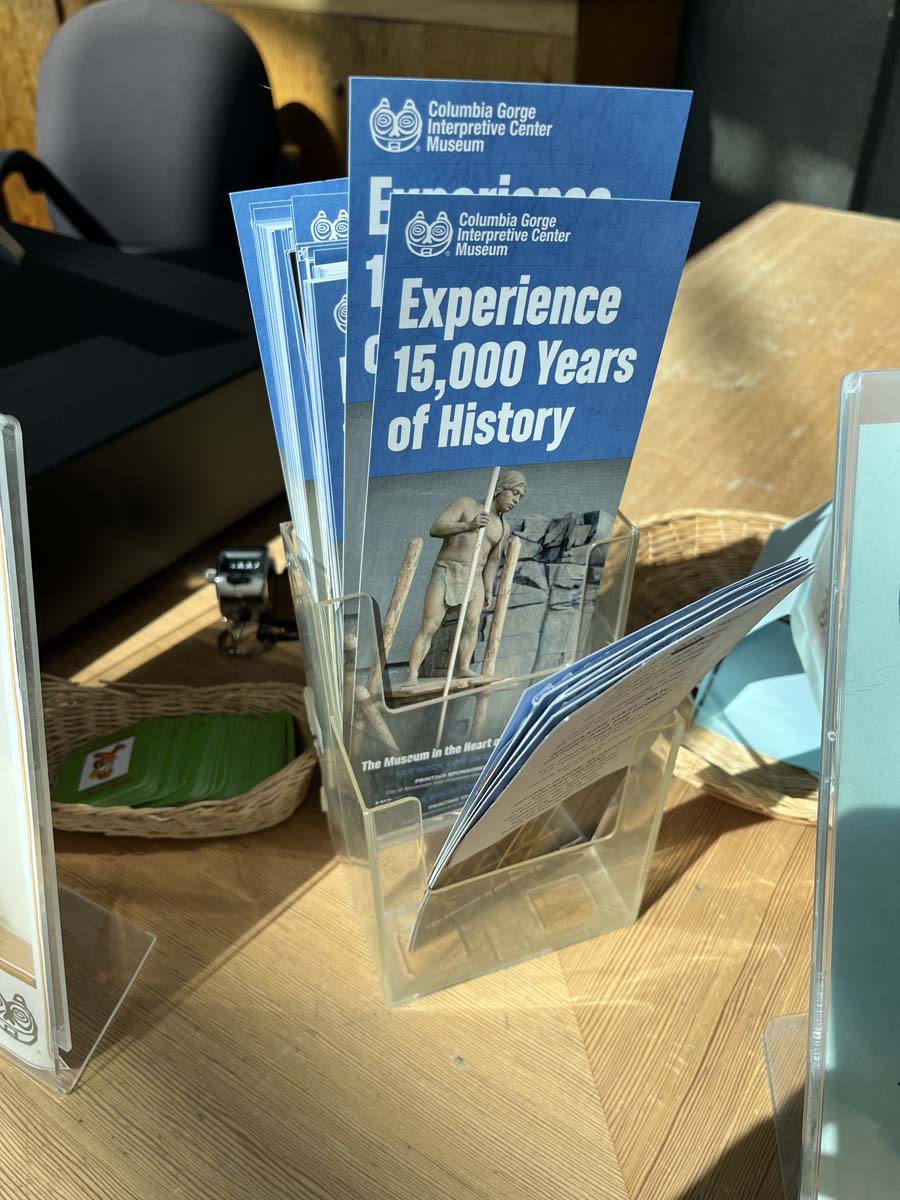
I’m curious: how many of you have ever visited the Columbia Gorge Interpretive Center Museum in Stevenson, WA? A mere 50 minutes from Portland, the drive there takes you through beautiful scenery and ends up at a multiple-acres piece of land adjacent to Skamania Lodge, alongside a small lake dotted with islands and views of the Columbia and the mountains as backdrop. A compact, modern building made of glass and concrete overlooks the property, with some rather large wood carvings and a collection of historical tools and machinery outside, and multiple exhibitions dedicated to the history of the region displayed on the inside.
I had never known the museum existed, much less visited there, until recent changes at the institution brought it onto my radar. That might have simply been my ignorance – wouldn’t be the first time – or it might have had to do with lack of outreach or appealing programming. That is in the process of changing now, under a new executive director, Louise Palermo, who is very much engaged in putting this hidden jewel onto the map beyond its familiar supporters and viewership of long-time residents of the Gorge. (And a heads-up: a new website, reflecting changes, is in the process of being installed and will be up in a few days. Information about location, opening hours and directions have, of course, not changed.)
The building houses numerous collections across two floors, conveying the history of the land and the people, from First Nations to modern settlement, forestry and industrialization of the region. A small theatre shows documentary films, some exploring the geology of the Gorge. There are a few quilts exhibited, and there is an unexpected, one might say quirky, collection of thousands upon thousands of rosaries, spiking my curiosity how some of these, donated by famous people – Lawrence Welk, Al Smith, the first Catholic to run for the office of president in 1928, one donated in memory of Robert Kennedy, who had left it in a small church in Bavaria; and one donated in memory of Dag Hammerskjold, Secretary General of the United Nations from 1953-1961, and one donated by President John F. Kennedy – ended up in cupboards in the Gorge.
You enter the museum through two rooms of exhibits describing the ways of life and fates of the tribal populations of the region.
Much needs to be done, I suggest, to bring this collection and particularly the explanatory signage up to date. Some of the language obscures the consequences of settler colonialism. Pretty much the rest of the museum is teaching us about how the settlers lived and thrived and changed the land, including the rationale for building dams and their fateful consequences.
The Grand Gallery focusses on the way wood was harvested and processed from the surrounding forests down to the mills, much to the delight of visiting school classes who get to see moving and noisy machinery, once you lure them away from the stuffed mountain lion overseeing it all,
or unexpected signs of Big Foot in the corners.
To my delight as well; I had no clue about the complex processes involved and was fascinated by the traditional steam engine, the Corliss, providing power needed to run sawmills. Harvesting of fish is shown by juxtaposing mechanical methods, a fish wheel, and Native American techniques, represented by the model of a native dip netter, at a water feature. This alone would be an interesting starting point for a conversation about extraction and preservation, particular if there were youth programs that would seed not just a love of history but an understanding of each person’s possible role as a steward of the resources of the Gorge.
Louise Palermo instructing 3rd graders
There is also a gift shop that carries arts and craft by local providers in addition to the usual fare. A small gallery offers the opportunity for changing exhibitions, with the current one, Women Artists of the Gorge, being the reason for my recent visit of the place.
PhotoCredit: Kristie Strasen
***
“If you don’t know history, it’s as if you were born yesterday. If you were born yesterday then any leader can tell you anything.” – Howard Zinn, American historian (1924-2010)
I don’t know if these things existed in the U.S., but in my German childhood one of the highlights were the trips to the country fair or the green grocer were you could plunk down your 10 Pfennig and receive a tiny paper packet stuffed with miniature toys, colored puffed rice and small candies. It was called a Wundertüte, a “wonder packet,” full of surprises. (Of course it was also a way to assure that young kids got used to return customer – consumerism, given the inclusion of collectibles, cards or toys.)
The current exhibition Women Artists of the Gorge, brought the analogy to mind. Here is a collection of incredibly varied works hung in a small space, with many of them delectable and some eliciting, well, wonder. Shout out to Jen Smith, who artistically hung a show that ranged across so many dimensions, type of media included, paintings, prints, photography, collage, macrame and woven tapestries in this tight space. Shout out to the folks at the White Salmon Valley Community Library and the White Salmon Arts Council, Ruth Shafer and Kristi Strasen respectively, who had originally conceptualized an exhibition of regional women artists in honor of Women’s History month, from which a subset followed the invitation to show their work at the Columbia Gorge Interpretive Center. Shoutout to the staff who kept the daily visitors happy and helped with the pragmatics of mounting the exhibition. The loudest shout out of them all, of course, goes to the artists:
Julie Beeler, Jillian Brown, Janet Essley, Sally Gilchrist, Daiva Harris, Kristine Pollard, Autumn Quigley, Jacqueline Moreau, Cathleen Rehfeld, Ana Rugani, Jen Smith, Kristie Strasen, Cyndi Strid, Kelly Turso and Jodi Wright.
Their work teaches us history in different, more personalized ways, through love of place and depictions of its beauty up to warnings about environmental protection and the need for inclusion and conflict resolution.
I can obviously not review each and every one of the works, so know that my selections are based on personal interest or curiosity, and not at all linked to the quality of the work. As a photographer, I was drawn to one of the photographs on exhibit which anchored the entire show for me in its depiction of female family members capturing a moment of laughter and joy. For many decades, San Francisco-born Jacqueline Moreau‘s work has documented the lives of Native American peoples along the Columbia River, and their fight to secure the rights afforded to them by a provision in the 1855 (Confederate Tribes of Warm Springs) treaty. The intimacy of this photograph is evidence of how integrated a photographer can become with a subject if respect, empathy and shared values overcome outsider status, enabling new forms of community.
Jacqueline Moreau The Spino family (Mona, Geneva, Andrie, Joyce, and Delores.)
As someone who has worked on documentary film projects about the fossil fuel industry, I was moved by the portrait of an Alaskan native whose land, heritage and fate is intrinsically connected to the future of drilling and pipelines and the havoc they can wreak. Janet Essley, a muralist, teaching artist and activist for justice used dabbed motor oil on paper for the portraits in her series Endangered Species (2004), which features people across the world (Columbian, Indonesian and Tajikestani natives among them) whose lives are touched by oil extraction and production.
Janet Essley Alaska
Two depictions of wildlife caught my attention – Autumn Quigley‘s for the wit and thoughtfulness that went into the collage, which seamlessly combined spring’s trilliums and fall’s seed pods and fallen leaves, and Jen Smith‘s for the obvious concern how shared space can be made a reality for creatures that are still truly wild. Ever encroaching human construction is a true threat to habitats, at the same time that we are in such dire need to provide more housing for ever growing populations.
Autum Quigley Windfall
Jen Smith Queen of the High Country
Last but not least there were tapestries that impressed with motion (the strong Gorge winds, swaying the grasses and echoing the waves of the river, were palpable in the one depicted below,)
Jodi Wright Mount Adams
and coloration, the subtle and beautiful gradations of which could not be fully captured under the light conditions.
Kristie Strasen River Tryptich
(I got a better shot at the intricate color play when I visited Strasen in her studio to learn more about the origins of this communal exhibition that she originally co-mounted. Let me share the beauty.)
A set of pillowcases and a collection of small works done during pandemic isolation, defiantly exuberant.
Sometimes I learned interesting backstories that helped to appreciate a work even more. Driven by her passion for mycology, the science of mushrooms, Julie Beeler, together with some collaborators, created a Mushroom Color Atlas which “is a resource and reference for everyone curious about mushrooms and the beautiful and subtle colors derived from dyeing with mushrooms.” People around the world can use this on-line resource, learning and experimenting with it, being drawn into a growing interest for our natural environment. Beeler also teaches in person in various workshops around the nation and lectures at scientific conferences. The best part: not knowing ANY of this would make no difference for the appreciation of the sheer beauty of her pieces. Well, for this viewer, in any case.
Julie Beeler Fungi Bedrock
***
I photographed the show when it had been hung on the day before before opening night, and so worked in an empty room bereft of people. Yet a sense of community was palpable, since the accumulated works really seemed representative of so many different artists, stages of experience, cross section of interests. By all reports that experience of community was present in squares during the opening reception, with a lot of people attending, fortified by wine generously provided by Domaine Pouillon, and interested in getting to know each other.
In some ways that seems to me an important part of the mission this museum under new leadership could adopt: providing a commons, a platform where people with shared interests or concerns, for that matter, can meet, mingle, learn and exchange ideas. One of the definition of commons is “natural resources that groups of people (communities, user groups) manage for individual and collective benefit.” Here it could simply be the offer of a cultural space, shared by the the many of us.
Artists play an important role in this endeavor. Knowing history is surely something that most people see as important. Yet we live in a time of increasing restrictions on teaching history, at all or in specific ways, depending on who you ask or in which state you live. Teaching the history of a place – here the Columbia Gorge – cannot come from a single source, however richly endowed with objects and artifacts to support a particular claim. It has to be provided with the help of different perspectives, and who better equipped than visual artists to relate something in non-didactic, vivid, personal ways that might register much more easily than dry facts or official story lines. I am not implying that the artists in this show intentionally set out to convey insights about history. But the accumulative power of much of the work suggests something about what it means to live in the Gorge, be exposed to both its beauty and its hurt, its past and its present, its nature and culture that needs stewardship and protection.
If the museum opens a commons, inviting and presenting diverse voices easily found in the rich tapestry of the Gorge population, during fun events or serious shows, it will establish its place on the map in no time, an invaluable resource for all of us.
WOMEN ARTISTS OF THE GORGE
June 17th – September 5th, 2023
Columbia Gorge Interpretive CenterMuseum 990 SW Rock Creek Dr Stevenson, WA 98648
Just a short walk, if you want to join, another one to bring home the immense variety of what L.A. has to offer, one neighborhood at a time. Highland Park has two dubious distinctions: for one it was the very first suburb of L.A. proper until 1895, when it was annexed after the community pleaded for incorporation, by all reports to assure increased police presence in a flourishing red light district. It took but two days after annexation, that the police chief and his posse came in and literally burned down all the brothels and gambling saloons. Maybe not a coincidence that L.A.’s Police Museum is located in this neighborhood. I did not inquire. Or set foot in it. Surprise.
Secondly, Highland Park has had the highest speed of gentrification of all small L.A. neighborhoods in recent years, which can be a good thing or a bad thing, depending on your perspective and the size of your wallet.
Lots of stuff that is too hard to move or had to be sold, ends up in second hand stores that line the streets.
As does the stuff itself.
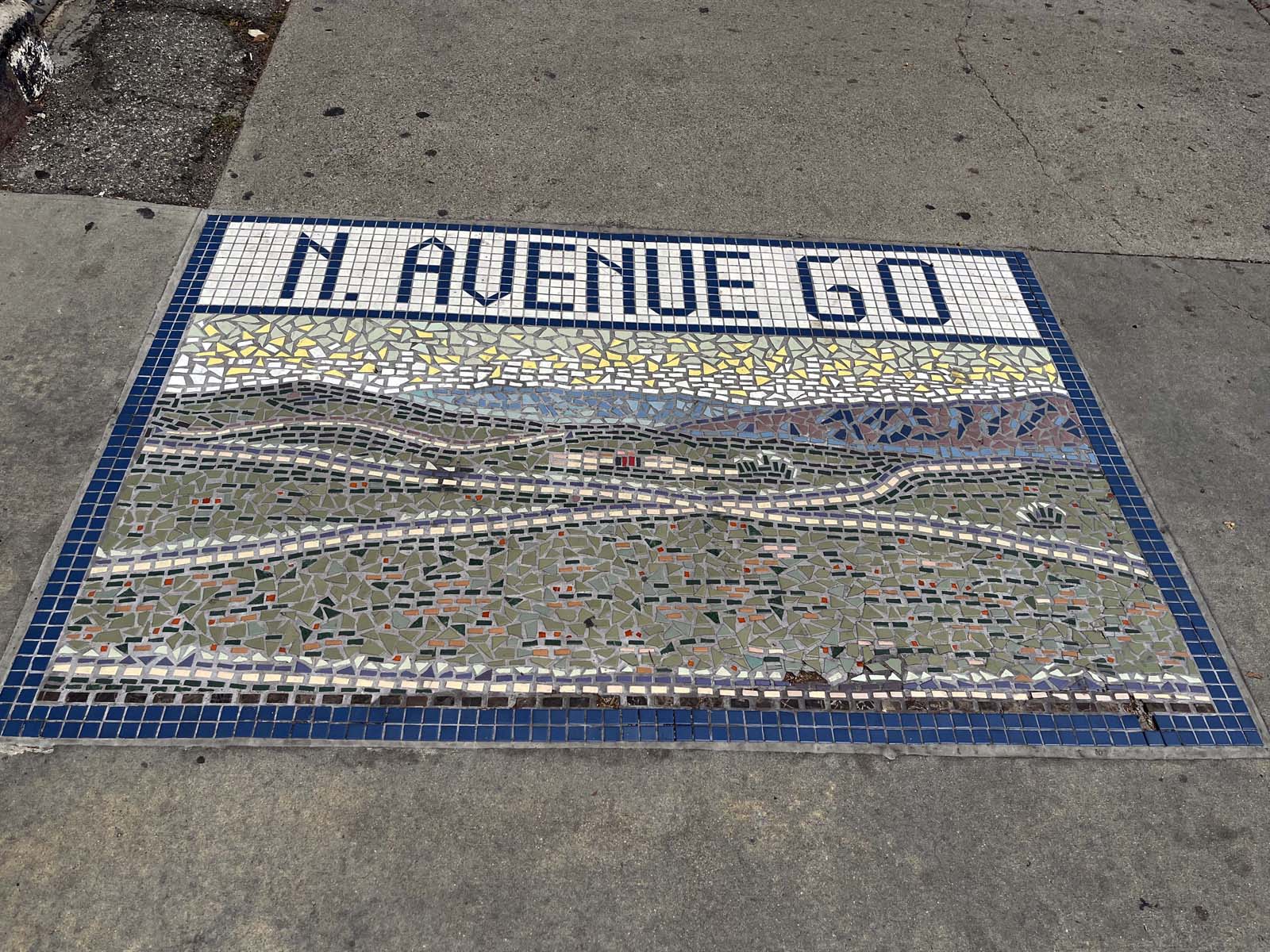
The neighborhood is situated between central L.A. and Pasadena alongside the Arroyo Secco. Much of its history is commemorated with sidewalk mosaics and information columns that display archival photographs and explanatory texts, quite informative.
Highland Park started to flourish with the arrival of the San Gabriel Valley Railroad which opened a station in 1885, followed by the Los Angeles and Pasadena Electric Railway that laid down the first interurban electric railway in Southern California in 1895, helping people to commute. Today you find suicide prevention signs at every crossing.
Image courtesy of the Los Angeles Public Library
Occidental College, established by the Presbyterian Church, opened its campus in the early 1900s and has been serving generations ever since.
Image courtesy of the USC Digital Library
Many of the public buildings from the time have been preserved, but are no less exposed to change. A historic landmark, the nearly century-old Highland Theatre building on Figueroa Street, one of the two main drags through the area, was up for sale as of last August, since its 99 year lease, signed in 1924, will expire. It was the last of 4 theaters along this street to survive, including the historic Sunbeam Theatre. The facade will have to be preserved, but the function and lay-out inside is the new investors’ domain.
Some public buildings are well maintained, other establishments show the ravages of the economy. Here is the public library
and the municipal water building.
The minute you venture off the main thoroughfares you find small, well maintained bungalows and funky gardens or wall paintings. But also signs of distress.
Lots of color to be found on the major streets as well, tempered by the presence of police in front of swank new shops and restaurants, though absent at the traditional stores.
Someone chose aphorisms for public utility meters,
And murals commemorate the history of the place.
And sometimes color just pops up unintentionally….
Lots of eateries behind screens on the sidewalk, filled with young people enjoying lunch – the place is clearly vibrant, with traditional mini-malls sharing space with new upscale boutiques.
I must say, I will miss the diversity of it all when returning to PDX. Then again, it will be good to be home after such a long stretch. Just think of all the bird pictures you’ll be getting…..
Since it’s been a while, we’ll do two hikes instead of one today. Walk with me, if you are willing to brave potential flash floods or almost guaranteed heat stroke, if the warning signs of the CA governmental LA county parks website are to be trusted. We’ll do Altadena’s Eaton Canyon in the morning, and El Prieto in the afternoon. Bonus appearance by some daily wildlife sightings hopefully satisfies readers’ yearning for the obligatory nature shots…
Eaton Canyon is easily accessible, has plenty of amenities for picnic gatherings and the like at the park’s entrance and a parking lot that is so overcrowded on the weekends that everyone recommends to hike only during the week. Follow that recommendation and you’ll be rewarded by beautiful landscapes, including oak groves, a (currently) flowing stream, cacti oases, wildflowers and eventually chaparral dotted hills.
These hills are now green – a very unusual sight, I am told, related to the torrential rains coming down across the last months. The river that you have to cross to get to a longer portion of the trail could not be forded when I visited, unless willing to hop barefoot across slippery boulders and shores. I erred on the side of caution, and still had a nice walk on the southern side of the stream.
Here, and in so many other locations, birds and lizards can be found if you approach quietly.
***
An equally, if differently, beautiful walk yielded some fascinating history ( I learned much of it here.) Altadena’s “El Prieto” (meaning “the dark man”) was also known as Black Mountain for its resident, Robert Owens who had bought his own freedom from slavery and came to the free state in the early 1850s. According to the census, there were only 12 African Americans in Los Angeles at the time. Someone (eventually) more famous settled on this mountain in the late 1800s, Owen Brown, son of John Brown – yes, that John Brown – a white man whose attempt in 1859 to spark a slave rebellion at the Harper’s Ferry, West Virginia arsenal resulted in his hanging for the crime of inciting violent rejection of slavery.
Owen, the only Brown son to survive participation in the Harper’s Ferry raid, was a fugitive for 2 decades before he made it out West, where his sister had settled in Pasadena. He homesteaded on the mountain, now dedicated to his father’s name and legacy, and was buried on a plot of land that was part of the homestead, in the foothills of the San Gabriel mountains, after more than 2000 people, both black and white, had paid their respects during the funeral to this staunch believer in racial equality.
Photograph from the Altadena Historical Society/
His grave site in the Altadena Meadows attracted 1000s of visitors across the years, contemplating what the concrete headstone stood for. It read, “Owen Brown son of John Brown The Liberator, Died Jan. 9, 1889, Aged 64 yrs.”
Not everyone shared the admiration, however. Private landowners hated the intrusion and tried to keep people out with No Trespassing signs, eventually losing law suits to prohibit access. Early attempts to make the site a historical monument failed as well.
The gravestone went “missing,” twice as it turns out, rolled down the ravine by vandals or opponents of the preservation society. By sheer coincidence it was found the second time around, having been missing for a decade, during a 2012 hike by artist Ian White, son of Charles White, the Los Angeles painter who had only painted two portraits of White men, Abraham Lincoln and John Brown, among his vast portraiture oeuvre.
Shown at the Charles White Elementary School, L.A.
Things have improved since then. An (independent) dispute over land rights and zoning issues for a near-by gated community of pricey homes produced unlikely allies. The developer has become a supporter of the preservation efforts, helping the community to protect the grave and access to it, getting some of his needs filled in turn. All agree that no visitor center will ever be build for the grave site or parking provided for busloads of people. You have to find neighborhood parking and hike up, which will only happen if you are really determined. The historians involved in the process, USC historian Bill Deverell and Michelle Zack are “...planning to help develop curriculum and train teachers to integrate Brown’s story into the Civil War, its aftermath and westward expansion. Charles Thomas of Outward Bound Adventure plans to develop a lesson that includes discussion of slavery and the black wilderness experience, according to the project proposal.” (Ref.)
I was hot when hiking the short but steep trail uphill. Blooming Ceanothus dotted the hills with blue clouds, the sweet smell of wild sage suffused the air. The grave marker is re-installed, and someone had spread wildflower seeds. The view over the valley was unobstructed by clouds or smog, just beautiful. You could do worse for resting places! Well deserved by a man true to justice. May his memory be a blessing.
***
Music today by Pete Seeger, appropriate for the grave site of an abolitionist.
When you travel, even for longer stretches of time, you have to make choices. So much to explore, to learn in Los Angeles, this behemoth of a city – there has to be some selectivity, since not all can be fit in. My own selections are usually based on two basic considerations: get familiar with the history of the place and, of course, seek out stuff that feeds my specific interests, art and politics, as you well know.
I lucked out last week with these endeavors in more ways than one. To understand the history of the greater Los Angeles area, I had read Mike Davis‘ City of Quartz: Excavating the Future of Los Angeles (1990) and slogged through his last book, Set the Night on Fire. L.A. in the Sixties (2020), published before his death in 2022 and co-authored with Jon Wiener. Both are seminal works about the urban history of the place and the powers that shaped it since its inception. Cultural critic, environmental historian and political activist Davis described the intersection of land development and legal or functional racial segregation in Southern California in ways quite accessible to uninformed readers like me, basing his account on interdisciplinary sources, including American history, environmental history, Marxist philosophy, political science, urban geography, architectural and cultural studies. Both books introduce the forms of resistance to segregation in housing and education, from peaceful demonstrations to riots to the engagement of artists and other intellectuals, side by side with famous civil rights fighters, political organizations, union representatives, the ACLU and uncountable numbers of students as young as high school freshmen.
88 cities, approximate 140 unincorporated areas, and communities within the City of Los Angeles.
The author introduces us to the political economy that shaped the urban sprawl, the landscape transformation, resulting in increasing inequality of living conditions and incarcerations rates, making it a dystopian place for those who fell off the wagon of the American Dream, or shall we say, were pushed off by the interest of those defending Fortress L.A. from any influx of non-White and/or poor populations. Land, seemingly endless land was the commodity, providing the base for residential neighborhoods, industry, strip malls and freeways. Richer neighborhoods, in fear of losing their exclusivity, the down-town commercial district’s business owners and realtor- and home owners’ organizations collaborated with investors, local and state politicians, and even Roman Catholic church leaders to make decisions about land-use that protected the interest of the monied classes and ended up with unimaginable sprawl.
Even though fair housing laws existed, racism won when Proposition 14 was adopted by an overwhelming majority of California voters in 1964, scorning equality and discriminating against “undesirable” homeowners and renters who were now easily excluded. The vote allowed prior law, the California Fair Housing Act of 1963, also known as the Rumford Act, to be voided, creating a state constitutional right for persons to refuse to sell, lease, or rent residential properties to other persons. (The Supreme Court declared the Proposition unconstitutional in 1967. The current legal status can be found here.) It was a pivotal moment that brought the efforts of many organizations and individuals fighting for civil rights to a screeching halt at the time.
Later decades saw more subtle ways of achieving the same goals of segregation: zoning laws and security measures kept the poor away from affluent districts. Relentless and cruel, often violent policing kept particularly Black citizens and other POC in their allotted places, both literally and metaphorically. Zoning was also causal for pushing the non-White and poor populations to the perimeters of the county, within or adjacent to more dangerous environments when it comes to pollution, water shortage and now fire danger given climate change-enhanced droughts. I am summarizing these aspects of Davis’ books because it was striking for me to see the described social stratification play out in real space during a drive to East Los Angeles College, a public Community College in Monterey Park, CA.
East Los Angeles College, Monterey Park, CA.
I started in the heart of Pasadena’s historical district, a place full of beautiful, gorgeously maintained and lovingly restored mansions, then drove through the picture book landscape of Pasadena’s craftsman bungalows. 15 minutes later you come through small townships that still have single-lot houses, but now run down and clearly showing signs of economic distress. Another 20 minutes along, and you are surrounded by low income housing apartments. I parked in a strip mall adjacent to the college and was immediately taken in by a striking building that stood out against the dilapidated background: the Vincent Price Art Museum. Part of a Performing and Fine Arts Center that opened in 2011, the museum holds a permanent, major collection of fine art, with substantive work initially donated by actor Vincent Price (he of Hollywood Horror Movie fame, among others, but also a true friend to the arts and the educational efforts required to bestow knowledge of art and art history onto future generations.) By now the museum holds over 9000 objects and has hosted more than 100 shows, singular for a community college, its exhibitions thoughtfully and smartly curated.
I came to see one of them that seemed particularly aligned with the museum’s expressed mission and issues close to my own heart concerned with cultural diversity and critical thinking:
“The mission of the Vincent Price Art Museum at East Los Angeles College is to serve as a unique educational resource for the diverse audiences of the college and the community through the exhibition, interpretation, collection, and preservation of works in all media of the visual arts. VPAM provides an environment to encounter a range of aesthetic expressions that illuminate the depth and diversity of artwork produced by people of the world, both contemporary and past. By presenting thoughtful, innovative and culturally diverse exhibitions and by organizing cross-disciplinary programs on issues of historical, social, and cultural relevance, VPAM seeks to promote knowledge, inspire creative thinking, and deepen an understanding of and appreciation for the visual arts.
What Would You Say?: Activist Graphics from the Los Angeles County Museum of Art presents a selection of political prints from LACMA’s vast archives. The exhibition, which opened March 25th, is free of charge and the visitor gets gifted with a high-quality brochure, covering some of the art with prints and explanatory (bilingual English/Spanish) text that I found helpful.
Graphic art has traditionally been a vehicle for change, challenging as well as influencing political moments. Rather than just depicting, the combination of image and word can inform, comment, persuade or be used for propaganda. It has been a key player in protests against injustice and oppression; the fact that it can be easily, widely and cheaply created and distributed has made it a form that helps to connect to people and promote social change. In the late 19th century, the technology for lithographic printing advanced, and the new power-driven presses, practical techniques of photoengraving and mechanical typesetting devices helped the medium to progress. We have now added photo-typesetting, offset lithography, and silk screening to the repertoire. It has also often been a communal effort, linking artists and participants with shared goals and interest, helping to organize and to educate.
The graphics on the wall ranged from the mid 1960’s to the 2020s, covering the Black Panther’s fight against police brutality and for the empowerment of poor Black neighborhoods,
Left: Emory Douglas Untitled (Sin Titulo) 1970 – Right: Rupert Garcia Libertad para los prisoneros politicas! 1971
the issues of incarceration of innocent people and Latino activism,
Yolanda M. López Free Los Siete 1969
Jessica Sabogal Walls can’t keep out Greatness 2018
the struggle of women and immigrants for equality,
Clockwise from upper left: Yreina D. Cervantez La Voz de la Mujer 1982 – Sheila Levrant de Bretteville, Women in Design: The next Decade 1975 – Yreina D. Cervantez Mujer de mucha enagua 1999 – Krista Sue Pussy Power Hat Pussy Hat Project 2016 – Ernesto Yerena Montejano and Ayse Gursoz We the Resilient 2017
and eventually the protests over the murders of Breonna Taylor, George Floyd and other Black people by police.
Jesus Barraza and Melanie Cervantes of Dignida Rebelled and Mazatl My Name is Trayvon Martin and my Life Matters. 2013
The most dominant topic, however, is expressed in posters and prints protesting war; surprisingly, I could find the issues of racial segregation and land development, so central to the history of L.A. and S.F., only peripherally – one poster about evictions, and one about the displacement of first native people and then a Mexican American community from Chavez Ravine, land appropriated to build the beloved L.A. Dodger stadium.
Favianna Rodriguez Community Control of the Land 2002 – Vote Ik We are still here 2017
The reality of racism, however, is captured by several of the works in ways that hit you hard.
Archie and Brad Boston For a Discriminating Design Organization 1966
David Lance Gaines Qui Tacet Consentit (Silence Gives Consent) 1969
The reality of the price of war, on the other hand, is brought home most strikingly in a print by one of the most famous of the artists in this exhibition, Sister Corita Kent, a member of the Immaculate Heart of Mary (IHM) before she was driven out by Cardinal Francis McIntyre (as were later 90 percent of the order in L.A, some 150 IHM nuns kicked out. According to a report in the Times, the Cardinal, by the way, uttered these words when confronted with his stand on segregation: “…it is not a racial or moral issue. A reason for discrimination is that white parents have a right to protect their daughters…”)
Corita Kent manflowers 1969
Corita Kent’s early silk screenings used bright colors, modulating the style and objects of advertising as stand in for religious concepts. They were shown in galleries and museums across the country, the MET, MOMA and LACMA included. She later moved to political topics, with more muted colors, including the Watts Rebellion and, after multiple encounters with anti-war activist Dan Kerrigan, the Vietnam War. The poster here shows two blinded soldiers, using Peter Seeger’s song lines in despair. Man-power is broken into two words, drawing attention to the single man, all the individuals that made ups the military power, paying with their bodies or their lives.
Posters on video display. The last one above: Primo Angeli/Lars Speyer The Silent Majority 1969
***
I wondered, a few days later, if the choice of concentrating on so many war/peace posters in the VPAM exhibition was perhaps linked to the choices made in another, simultaneous exhibition of graphics from the LACMA archives: Pressing Politics: Revolutionary Graphics from Mexico and Germany.
This exhibition is also shown in a gallery incorporated within an educational setting, this time the Charles White Elementary School on Wilshire Blvd. It presents political imagery that grew out of the reaction to war and revolutionary movements, from Germany’s political developments starting in 1918, to Mexico’s 1930s formation of the Taller de Gráfica Popular (People’s Print Workshop) in Mexico City.
For me it packed an additional emotional punch – I have grown up with the art of Kollwitz, Grosz, Pechstein etc. in post-war Germany and the familiarity and reminiscence of what they meant then added a layer to taking the show in. To look at the warnings expressed by art in the 20s and 30s, to know that the world was dragged into the next war regardless, and to see all this while we are witnessing another contemporaneous war on European soil was unsettling. The unsparing depiction of oppression, violence and human suffering is also strikingly different from most of the American poster selection in the show discussed above.
Some of the graphics would benefit from explanations regarding the relevant language. Take Grosz’ Gesundbeter, for example, which has three titles in different languages (he used these inscriptions fully knowing that they were not translations but expressed different thoughts.) Crucially, though, the obscenity of the action becomes clear when you understand the acronym KV, central to the image. It stands for the German word Kriegs-Verwendungsfähig – literally usable for war or fit for action, applied by the Local Board, desperate for canon fodder, obviously even to corpses.
George Grosz Die Gesundbeter 1918
Here is another title – the German says sunshine and fresh air for the proletariat (a demand by labor unions and social activists for better housing and healthier working conditions,) depicting incarcerated people walking the prison yard.
George Grosz Licht und Luft dem Proletariat 1919
The parallels we see in the German and Mexican depictions originate both from shared experiences, but also an overlap of artists in each others’ spheres. Colonialism led to an entangled history in general, but during the 1930s many German artists associated with the Staatlichem Bauhaus Weimar emigrated to Mexico, welcomed by the government of Lázaro Cárdenas del Río (1934–1940) which built the most democratic state historically experienced in Mexico until the 1990s.
Clockwise from upper left: Alfredo Zalce En Tiempos de Don Porfirio 1945 – Alfredo Zalce La Soldadera 1947 – Käthe Kollwitz Losbruch 1943 – Leopoldo Mendéz Asesinati de Jesus R. Menendez en Cuba 1948 – Käthe Kollwitz Gedenkblatt für Karl Liebknecht 1919-20.
The Cárdenas government sponsored educational program for workers and peasants, led by the Liga de Escritores y Artistas Revolucionarios (LEAR), an association of revolutionary writers and artists that grew out of the “cultural missions” charged with propagating the revolution’s objectives in murals, graphic art and theater productions. The Taller de Gráfica Popular (TGP) came out of this association, and was revitalized by the many migrants that came from Europe, other Latin American countries and the U.S., all adding their own cultural experiences, artistic styles, and preoccupations. In fact, Hannes Meyer, second Bauhaus director, was appointed as head of TGP in 1942.
Erasto Cortez Juarez, Jesus Escobedo, Leopoldo Mendez, Francisco Mora Calaveras aftodas con medias naylon 1947
Leopoldo Mendez En manos de la Gestapo 1942 – Constantin von Mitschke-Collande Freiheit 1919
Arturo Garcia Bustos La industrialización del país 1947
It is a stunning exhibition, offering diversity of depictions balanced by homogeneity of concerns. I was the only one there on a beautiful Saturday afternoon, except for a friendly guard, which was just as well given the tears that welled up. The reality of war, the repeat of history’s darkest moments seemingly unavoidable, some already here, some looming, the resurgence of fascistic ideas and methods seemed to pull the rug out from under the efforts of earlier artists to warn us of dangers and call for change.
Erich Modal Revolution 1920 – Max Pechstein An die Laterne 1919 – Unknown artist: So führt euch Spartakus. Brüder rettet die Revolution. 1919
And yet. There is reason to remain optimistic. Individual commitment to social change still exists. But not just that – in L.A. alone, there have been significant collective successes across the last years. In 2006, 500.000 people protested on Wilshire Blvd. demanding rights for undocumented immigrants, a march called by labor unions, endorsed by catholic Cardinal Roger Mahoney and Antonio Villaraigosa, the city’s first Latino mayor. In January 2017, 750.000 congregated downtown L.A. for the Women’s March. And in 2019, large coalitions of communities and classrooms, teachers and students joined in the successful teachers’ strike that focussed on overcrowded schools, educational disinvestment and drainage of resources to charter schools.
Leopoldo Mendez Retrato de Posada en su taller 1956
Elizabeth Cattle Sharecropper – 1952 – Alberto Beltran El problema agrario en América Latina 1948 – Käthe Kollwitz Poster excerpt
Max Pechstein Dont strangle the newborn freedom through disorder and fratricide, or your children will starve 1919.
Walking around the neighborhood after I left the exhibition, the occasional public or street art made it clear that activism is alive and well. A work in progress, standing on the shoulders of the many activist artists who came before. Grateful that decisive museal curation introduces and reminds us of the modernist vanguard.
Walk with me, if you can stand driving with me first, on L.A. highways that challenge even the most ardent motorist (and I count myself among those.) Someone called the experience soul crushing. I wouldn’t go that far, but it’s pretty insane if you add the difficulties with finding parking, or, as a friend more aptly phrased it: crazy insane.
However, I made it to the northern edge of L.A. in one piece this Sunday, ready to check out a Japanese enclave, Little Tokyo, that existed since the beginning of the 20th century. The roughly 5-block district was home to some 10.000 Japanese immigrants by the early 1900s, a market place and cultural hub that nowadays offers a mix of traditional stores and restaurants next to tourist traps and skateboard businesses.
On a sunny, windblown Sunday, the place was jumping, throngs of people standing in line in front of various shops, sushi-joints and Karaoke studios, mostly ignoring the multiple reminders of the district’s history, spread throughout.
Sculptures tells stories, as do wall plaques and photographic mosaics.
Junichiro Hannya Ninomiya Kinjiro (1983) – It is actually a controversial sculpture, see details here.
Ramon G. Velasco Chiune Sugihara Memorial, Hero of the Holocaust 2002.
As the Japanese Vice-Consul for Lithuania, Sugihara helped over 2000 Jews to escape Nazi Germany by handing out transit visas that allowed them to flee through Poland and Russia. He did so against the explicit instructions of the Japanese Foreign Ministry.
JANM’s renovated Historic Building was formerly the Nishi Hongwanji Buddhist Temple, the first Buddhist temple building constructed in Los Angeles in 1925.
“From the plaque for the camera sculpture: First-generation Japanese American photographer Toyo Miyatake (1895) opened his photography studio in Little Tokyo in 1923 and spent the rest of his life documenting his community’s life on film. When Miyatake, his family and 120,000 Japanese Americans were unjustly incarcerated by the U.S. government during World War II, Miyatake bravely smuggled a camera lens and a film plate, considered contraband, into the Manzanar concentration camp in California. Using a secretly-constructed camera, he captured everyday life in Manzanar. Artist Nobuho Nagasawa created a three-times-as-large bronze replica of the Miyatake camera in homage to Toyo Miyatake. The sculpture projects slides of Miyatake’s work onto a window of the Japanese American National museum each evening. This sculpture was commissioned by the Community Redevelopment Agency and was first installed in 1993.“
***
The Japanese American National Museum was surprisingly airy and empty, and everyone was wearing masks, which made me comfortable enough to meander through both, the permanent exhibit that describes in detail the traumatic experiences of immigrants even before they were rounded up and incarcerated in concentration camps in 1941, and the current exhibition, Don’t Fence Me In, that traces the coming of age of so many young people in the camps during these horror years with superb archival photographs and other objects. (Details here.) Thoughtful curation throughout. The museum is the largest of its kind in the U.S. and holds over 60.000 artifacts. Hello Kitty included…
The OOMO Cube by photographic messaging artist Nicole Maloney was installed near the main entrance of the JANM Pavilion in 2014. OOMO stands for “Out Of Many One” and Maloney conceived of her installation as a giant Rubik’s cube with five sides filled with photographs and the sixth side as a mirror.
Maloney explained that people are often identified through five different characteristics: race, religion, gender, socio-economic status, and sexual orientation. The cube allows visitors to JANM to have interactions with it by rotating the sections into different configurations. Maloney hoped that those interacting with her cube will be reminded that everyone belongs to one world and one humanity and that it will encourage people to “stand in awe instead of judgment of one another.” (Ref.)
Also located on that plaza is the Geffen Contemporary at MOCA, an outpost of downtown L.A.’s Museum of Contemporary Art. The doors were locked, despite regular business hours. Just as well, I would not have been able to process two museums in a day.
Barbara Kruger’s imposing 30 by 191 feet red, white, and blue mural mural, Untitled (Questions), provided enough to look at and think about.
An installation of airplane parts was home to quite a few birds, coming and going and disappearing inside – urban nesting of the finest.
Nancy Rubin Chas’ Stainless Steel, Mark Thompson’s Airplane Parts, About 1,000 Pounds of Stainless Steel Wire (2002)
Wandering around, I was struck by the absence of graffiti – there were a few commissioned, professional murals and the usual plastering of electric cable boxes, meters or some such.
Katie Yamasaki Moon Beholders (2014)
The mural is intended to represent, celebrate, challenge, and preserve different concepts within the Japanese American culture, both contemporary and historic, while connecting with the diverse community around JANM. The mural depicts a young girl, clothed in several furoshiki, a traditional Japanese cloth often used to carry, cover, and protect objects, most often gifts.
The mural also depicts lanterns or akari, representing light or illumination and displays a haiku poem by Basho, a famous Japanese poet from the Edo period. (Ref.)
I will have to figure out where to find it, but that is for another outing. Should I survive the maze of freeways yet again.
The Home is Little Tokyo (2005) mural depicts present-day life in Little Tokyo with vibrant images reflecting Little Tokyo’s revitalization and the community’s strong personal ties to the district. The brightly-colored mural spans 40-feet along the wall fronting Central and is 16-feet tall. Artists Tony Osumi, Sergio Diaz and Jorge Diaz involved community members in the mural design process through open meetings to discuss and collect ideas. The process of creating the mural took three years. (Ref.)
Music today needs a bit of attention. It is a beautiful act of story telling with music.
The Nikkei Music Reclamation Project, in their own words, aims to (re)imagine Nikkei (Japanese American) musical identities and to examine pre- and post-WWII Japanese American political history and music. The goal of the Nikkei Music Reclamation Project is to bring together multiple generations of musicians in extending this legacy and envisioning new directions for Nikkei musical culture in Little Tokyo.
Today’s musings will be all over the map, geographically, emotionally and with regards to content that has preoccupied my brain for a while. It all leads back to Octavia E. Butler, a writer who I admire for her exquisite, creative world building, her focus on in/justice, and her ability to transcend genres. I am even more grateful for all of her modeling of what it means to have courage and persistence, to stick to goals defying racist, patriarchal, professionally closed systems, while skirting existential poverty and loneliness during formative years.
Mural at the Octavia E. Butler Magnet School in Altadena, CA.
All over the map: Let’s start with Trieste, Italy. Why Trieste? I was somewhat condescendingly amused during my 2018 visit there to see flocks of fans follow the footsteps of their hero, James Joyce, who lived and wrote major works in Trieste for years. Selfies with his statue, tour lines in front of his lodgings, photographs of the multiple plaques conveniently placed by the Bureau of Tourism: Joyce walked over this bridge here! More than once!
Well, I was wrong, I’ve joined the multitudes and never should have sneered. Not pursuing Joyce, nor taking selfies, but I am now trying to walk along the paths of someone I wish I’d understand, taking in the neighborhoods and buildings that were part of her daily life, reading about her struggle, and visiting places that keep her memory alive.
Pasadena, CA, then, is next. No plaques here, but a helpful map laying out routes frequently taken by Butler, prepared by people at the Huntington Library which holds the author’s archives. An even more helpful book by journalist Lynell George, A Handful of Earth, a Handful of Sky – the World of Octavia E. Butler, which introduces the canvas on which Butler drew both herself and the worlds she constructed from the insights captured by her daily struggles, the physical environment in which she labored, and the mental landscapes that she traveled while growing into the writer some of us now devour. George describes the author with exceptional sensitivity and intuition, during the years before Butler would go on to become a MacArthur (Genius) Fellow and win a Pen Lifetime Achievement Award, as well as Hugo and Nebula Awards for her trailblazing work in science fiction—the first Black woman to win both awards.
Butler was born in 1947 in Pasadena, CA, to a mother who worked as a maid and a father who was a shoe shiner and died when she was very young. She was dyslexic, isolated in school and not particularly supported by the majority of her teachers. Later she turned to menial jobs, often physical labor, that did not require much thought so she was free to do her own thinking, and could use the rest of her time to walk or visit libraries, some involving hours on the bus.
Historic center Pasadena, including the post office where checks, manuscripts acceptance or rejection letters might have arrived in her P.O.Box.
Lynell George’s account of these early years is, among other things, based on archival items that Butler saved over the years: lists. And lists. And lists. On scrap paper, or any other expandable surface she could write on, perhaps compulsively constructed to organize and likely ward off a flood of fears that might otherwise prove overwhelming. Shopping lists. To-do lists. Lists to evaluate what could be pawned to head off starvation. Lists of goals. Lists of dreams. Lists of exhortations or promises to Self, or incantations about how the world should be and how to make it so.
An eternally slow start to find her way into publishing, with 2 small manuscripts sold in 5 years, interminable stretches of professional drought, and yet this author went on to write and publish over a dozen books, with artists, play-writes, musicians and film makers increasingly inspired by the work since her death from injuries sustained in a fall at the age of 58 in 2006. Her novels are taught at colleges and universities around the country (well, where there are not yet banned, I should hasten to add…) and you can now watch adaptions of her books on TV. (Coincidentally, this weekend’s NYT listed an introduction to some of the essential works, so you can see for yourself how much ground was covered or where to start.)
***
Many of Butler’s books can be found in a small book store on North Hill Avenue in Pasadena, Octavia’s Bookshelf. It opened about a month ago and offers a range of works by BIPOC writers, and a welcome space to sit down and explore.
Here I meet Nikki High, owner of the store, who is helpful in recommending books when I approach her to pick her brain and perfectly happy to spend some of her valuable time chatting with this stranger. Which brings us to the Republic of Ghana, the west-African country where sociologist and Pan-Africanist civil rights activist W.E.B. Du Bois resided during the last years of his life and is buried. He died on the eve of the civil-rights march in Washington,D.C., where Dr. Martin Luther King Jr. gave his “I Have a Dream”speech and where Roy Wilkins of the NAACP announced Du Bois’s death from the podium. I mention to Nikki that I am currently reading a thought provoking, beautiful novel by Honorée Fanonne Jeffers, The Lovesongs of W.E.B. Du Bois, and she tells me about her recent travels to Ghana to visit Du Bois’ grave and the house he lived in, visibly moved by the reliving of that memory.
Jeffer’s novel revolves around the concept of Double Consciousnessthat Du Bois introduced in his seminal book The Souls of Black Folk (1903.) So does Kindred, (2003) Butler’s historical fiction/fantasy novel introducing a heroine who time travels between the 19th and 20th century, between the slave plantation where her ancestors suffered and her interracial marriage in 1976 L.A.. The novel has become a cornerstone of Black American literature.
Du Bois argued that living as an African American within a system of White racism leads to a kind of fragmented identity. The double consciousness refers to “the sense of always looking at one’s self through the eyes of others.”
“It is a socio-cultural construct rather than a baldly bio-racial given, attributed specifically to people of African descent in America. The “two-ness” of which it is a consciousness thus is not inherent, accidental, nor benign: the condition is presented here as both imposed and fraught with psychic danger.” (Ref.)
The socio-cultural existence is defined by a racial hierarchy that includes hostility and suspicion, subtle or outright exclusion, a life lived in uncertainty and guardedness. The individual’s identity, both novels argue, is also affected by the historical fact that harm extended beyond the individual to whole family structures and networks of kin. Only when you understand the legacy of historical trauma and merge it into your own sense of self will it cease to afflict you. Past and present need to be integrated to mend a disjointed self.
***
As luck would have it, the Octavia E. Butler Magnet School‘s library celebrates an OEB science fiction festival the next day. Previously Washington Middle School, the institution’s new name (since Fall 2022) honors its famous alumna. Since I have to avoid crowded indoor settings during the pandemic (it is NOT over, folks!), I cannot join the activities, but manage to get a few photos in a ventilated hallway. New generations are introduced to a role model that leaves you in awe for the obstacles overcome.
On to Mountain View Cemetery in Altadena, CA, where Butler is buried. It is a peaceful place with beautiful old tree growth, als long as you ignore the coyotes that they warn you about, patrolling in packs, by some reports.
Butler’s grave marker is unobtrusive, not easy to find. The inscription is one of her most frequently cited insights, from the book The Parabel of the Sower (1993), where she turned her attention to climate catastrophe and the subsequent militarization of state and rapidly shrinking chances of survival. Set in 2024, it seems utterly prescient in retrospect, its descriptions outlining the contours of our lived or soon to be lived reality.
Allow me one short digression, and some speculation, you’ll see why in a minute. Butler’s last resting place sports numerous strange grave stones, if you can call it that, artificial tree stumps carved with the emblems of a maul, wedge, axe and dove, as well as markers inscribed with repeat phrases, the Latin motto “Dum Tacet Clamet” which translates to “though silent, he speaks.” A bit of research brought me to Omaha, Nebraska, where one Joseph Cullen Root founded The Woodmen of the World (WOW) in the early 1890s. It was essentially a mutual aid society, a beneficiary order that provided death benefits and grave stones to its members by essentially passing around a hat.
That turned out not to work exactly, and so shifted thirty years later to become a regular life insurance company. By 1901 it was the largest fraternal organization in Oregon with 140 camps and a membership of 15,000. Membership conditions: you had to prove yourself in various ways, be older than 16 and – White. A subdivision, Women of Woodcraft, is captured in this photograph.
Women of Woodcraft (likely a drill team), ca. 1910. Object ID: 2011.033.001; Copyright Royal Gorge Regional Museum & History Center
Would Butler be turning in her grave, surrounded by valkyries like these? Likely not. She would point to the importance of the idea of mutual aid, and to change: if you look at the website of the WoodmenLife Insurance Company that grew out of WOW, you find images of Black, Asian, Brown and other faces among the White beneficiaries, carefully assembled to stress diversity. It might only be on the surface, who can tell, but change nonetheless. And in any case – she might stay silent, but her work speaks to millions, in contrast to the wood people of the world….
***
This brings me to the reason why I, an old White European woman who can take privilege seemingly for granted, am so preoccupied with a Black writer who envisioned change and imbued her heroines with strength and refusal to give up, forever pursuing humanistic goals. She instills hope.
I feel like living in an era where, here as well as internationally, change is pursued or co-opted to move us backwards. The powers that be (or wannabe) want to affirm or re-install structures – and I mean STRUCTURES – that go beyond individual racist impulses or acts, to dominate on top of a hierarchy and use that dominance to extract riches and suffering. These forces are insisting that “differences”exists, be they racial, religious, gender, sexuality or simply cultural. Don’t ever believe in equality! Put a value label to these differing categories, with some “better,” others “worse,” with the dominant category, of course, being the superior one. This valuation is extended to an entire group, depreciating not just single humans, but a whole category. “Negative valuation imposed upon that group becomes the legitimization and justification for hostility and aggression. The inner purpose of this process is social benefit, self-valorization, and the creation of a sense of identity for the one through the denigration of the other. And as is evident, the generation and expression of hierarchy run through it from beginning to end.” (Ref.)
Whether you look at the Nazi play book, present-day Hungary, Russia, India or other authoritarian movements, these principles are at work every single time, with the content attached to the “difference” changing according to local need du jour and historical hierarchies, including colonialism. In addition, progressive movements so often weaken themselves by intra-group strife instead of collaborative fighting against a common enemy. I can think of no better explanation of those principles than in Arundhati Roy’s speech last week at the Swedish Academy.
It is so easy to lose hope, to withdraw by feeling overwhelmed, helpless, powerless to achieve true equality. And yet there was a person who faced obstacles beyond description, who believed in hope and the power of community.
Here is someone who put it in words better than I ever could, Jesmyn Ward, a formidable writer in her own right:
“This is how Butler finds her way in a world that perpetually demoralizes, confounds, and browbeats: she writes her way to hope. This is how she confronts darkness and persists in the face of her own despair. This is the real gift of her work… in inviting her readers to engage with darker realities, to immerse themselves in worlds more disturbing and complex than our own, she asks readers to acknowledge the costs of our collective inaction, our collective bowing to depravity, to tribalism, to easy ignorance and violence. Her primary characters refuse all of that. Her primary characters refuse to deny the better aspects of their humanity. They insist on embracing tenderness and empathy, and in doing so, they invite readers to realize that we might do so as well. Butler makes hope possible.”
Against the backdrop of a legacy of trauma she provided us with a legacy of optimism, that the lessons of successful collective action and resistance in the past will guide us to the right kind of change in the future, with the help of courageous and resourceful Black women.
“Our mission is to collect, preserve and share the stories, oral histories and artifacts of Portland’s Chinatown as a catalyst for exploring and interpreting the history of past, present and future immigrant experiences.” – Portland Chinatown Museum (PCM) Mission Statement
The Lunar New Year – The Year of the Water Rabbit – started yesterday and the Chinese government expects about 2.1 billion journeys to be made in Asia during a 40-day travel period around the celebration as people rush back for the traditional reunion dinner on the eve of the new year. I took a short trip to Portland’s Old Town Chinatown instead on Friday, an annual pilgrimage to admire the beauty of Lan Su Chinese Garden with its festive decorations for the occasion.
This year I added a second stop, a first visit to PortlandChinatownMuseum (PCM,) which is just a block away on NW Third Ave, and not too far from the Chinatown Gateway. The museum opened in 2018 and did not appear on my radar during the pandemic years. I cannot recommend a visit strongly enough: opening hours are limited from Friday to Sunday, and the current temporary exhibition will close on January 29th. So if you can, make it down there next Friday or Saturday between 11 am-3 pm, there is some revelatory art on display.
The history of the museum’s founding can be found here. Like other Old Town institutions devoted to collecting and preserving immigrants’ histories, the Japanese American Museum of Oregon and the Oregon Jewish Museum and Center for Holocaust Education among them, PCM offers a permanent exhibition depicting the lives and plight of the Chinese immigrants. Beyond the Gate: A Tale of Portland’s Historic Chinatowns provides a comprehensive look at historical artifacts, some arranged in diverse dioramas, and guides you through the various aspects of the immigrant experience with informative exhibition texts and archival photographs.
***
Two separate galleries provide space for the work of contemporary Asian American artists, currently showing Illuminating Time, installations by three different artists-in-residence working with different media. The exhibition is exquisitely curated by Horatio Law, one of the PNW’s premier public art and installation artist who serves as the Artist Residency Director. It echoes the permanent exhibitions’s themes of loss, hope and belonging, so familiar to all immigrants.
___
一方有难,八方支援 “When trouble occurs at one spot, help comes from all quarters.” – Chinese Proverb
The theme of community, integral to collectivist cultures and so prominent in the museum’s permanent exhibition of historic Chinatown’s structural support systems, is picked up by Alex Chiu. Known to many of us for his vibrant murals that can be found across PDX, he undertook a series of ink drawings of community members that are displayed in the entrance hall of the museum. Placed against the backdrop of a stylized rendering of the Chinatown gateway, they depict a range of characters of all ages and degrees of visibility, pointing to the diversity of Portland’s Chinese population. Expressive and detailed, these portraits are a lively counterpart to the archival photographs of the Chinese ancestors who set foot here in the 1800s.
The juxtaposition between the traditional valuing of community and the artist’s modern ways of portraying individuals reminded me of the current trends in social psychology exploring the status of young Chinese who grow up in a world where the traditional collectivism of their culture and the modern demands and offers of Western individualism intersect. It is interesting work, based on spontaneous recollection of Chinese proverbs by these college students, reflecting which values come to mind first and how they are weighted. A changing world, yet heavily anchored still in tradition.
Clockwise from upper left: Portland Chinese Community Portrait Series: Billy Lee, Beatrix Li, Roberta Wong, Terry Lee.
***
“Take care of each other. Take care of the soil.” Shu-Ju Wang, in conversation.
Off to the side of the front venue is a room dedicated to Shu-Ju Wang‘s exploration of the history of Tanner Creek and its connection to the Chinese laborers and farmers who tended to its surrounding fertile soil to grow vegetables for both, sale and consumption. Her installation consists of multiple parts, prominently displaying a wooden slide constructed to represent the topography of the waterway with its angles and gradient. It is actually a marble run, and visitors are invited to play around, connecting through interaction. Above it hangs a mobile, made from silkscreen and gouache with a top part that was embroidered on paper tinted with gouache as well. It represents rain drops, a sense of fluidity enhanced by the aqua color range and the lightness of the material that slightly trembles in the draft. The sturdiness of the wood and the fragility of the paper assembly complement each other, rather than being opposed, representing aspects of nature that remind us of its power as much as its vulnerability.
Wang’s interest in and facility with science is evident in the exhibition posters that provide facts about the history of the creek within the build-up of Portland, the encroachment endangering the creek’s initial free run and displacing those human communities that had respected natural cycles of flooding necessary for fertile ground. Creatively, these narrative are told in letters from the creek to us, making a personal statement in a voice that I can see as particularly effective for young minds, children feeling addressed and drawn in. That said, it sure got my attention. The remaining walls are hung with the artist’s recent paintings and printings of nature-related topics, the theme of the need for environmental stewardship pervasive, meticulously and insistingly expressed.
Left to right: A fold-up book Castor and Sapient; A Study of Home (2021) Silk screen, pressure print and collage; a basket by Sara Siestreem (Hanis Coos) woven from native plant materials to catch the marbles.
I walked out with a plant cutting in hand, small annuals which are offered for free – by March, when this part of the exhibition is likely still on, it will be vegetable plantings to connect to the Chinese farmers’ history at Tanner Creek.
If we link the immigrant experience to the past, present and future, as the museum intends to do, then Wang’s depiction of the past and Chiu’s capture of the present is joined by Roxas-Chua’s work incorporating the future. That might seem counterintuitive given the prevalence of allusions to memory, including the title for some of the major works.
Yet I was flooded with an impression that the work was about opening towards something, with the release that comes with the acknowledgement and acceptance of grief.
Detail: Gold Lighting and Lullaby Scripts
Part of that might have been triggered by the realization of the ephemeral character of both materials used and conceptual expression. The artist will destroy all that was presented by the end of the exhibition’s run and bury it at its source, the places in nature from which materials for the ink and paper were borrowed, and from which the inspiration was drawn. What is gone makes room for the new.
Left and RightL Gold Lighting and Lullaby Scripts. Center: Stone Satellites over an Excavation Site in John Day, Oregon.
Part of it can be found in the way Roxas-Chua’s calligraphy is open to interpretation. The technique of asemic writing that he uses is a form of communication that is unconstrained by syntax or semantics, an aesthetic rather than a verbal expression. It is the perfect medium for someone who is overburdened by the demands of too many languages (In Roxas-Chua’s case four) or too little rootedness in each.
Excerpt: Three Oranges and Blue Mountains Moon
For the viewer this opens space to connect to the calligraphy in ways unrestricted by formal demands. Unsurprisingly for me, who has spent her scientific research years studying memory, the art appeared as patterns of synaptic connections, but also of plaques causing retrieval failure, of parallel processing and encoding bias. The malleability of memory was perfectly caught in the flow of these marks, the way how present context is re-shaping, even altering what is remembered, ultimately influencing an assessment of the future.
How we approach the future is not just guided by how much our memory has changed over time, shifting away from facts and towards a narrative that helps emotional adaptation. How much any of us can remember the specifics of our past also plays a big role.
In many realms, all of our thinking about the future is rooted in memory. Policy planners, for example, routinely contemplate past patterns as a way of anticipating things to come. At a much more personal level, researchers suggest that a sense of hopefulness, or its lack, depends on how specifically we remember the past. Think about someone saying, “I cannot see how that could possibly happen,” or the opposite, “I can easily imagine how that can come to be.” That step of imagination is arguably central to how hopeful someone will be about the future, or not. And that ability to project is clearly linked to the specificity of your memory of how things unfolded in the past. Remembering opening the path to hope.
Excerpt: Three Oranges and Blue Mountains Moon
For the artist it was perhaps a way of connecting to the various landscapes and human sources that linked to the past of Chinese immigrants, from John Day to Astoria, where he interviewed people and recorded soundscapes of the environment (QR codes direct you to a listening experiences that captures these sounds, or music, or the artist’s poetry, providing additional levels of experience of the Gesamtkunstwerk, the totality of each artwork.)
Loss and re-emergence are central to the work. It was, I believe, most urgently captured in The Weeping Script.Please Be Guided Accordingly, the poem that accompanies the calligraphy, seizes the stages at which death rips a loved one away from you, bit by bit. There’s a release provided by inklings of hope and uplift in the future, though tempered by the knowledge that it will be a cold, lonely run. Maybe not the entire three year mourning period proscribed by Confucius, but the concession that grief exists and yet can be turned around. It calmly points to opening of new horizons.
For anyone mourning it will be brutally moving, and yet it is incredibly beautiful, hopeful work.
***
And now we turn to the elephant in the room. If the consummation of loss is part of the art inside the museum, wait until you see it instantiated in the suffering of the houseless in real life outside. The many houseless in the neighborhood, their tents, their misery, their detritus, are something the Old Town businesses are trying to deal with.
City plans almost a decade in the making have not yielded visible results, even though the mayor’s office claims progress. In October 2021, spurred by the rise in crime, violence and public camping in the Old Town neighborhood, the leaders of four cultural institutions — Lan Su Chinese Garden, the Japanese American Museum of Oregon, Oregon Jewish Museum and Center for Holocaust Education and Portland Chinatown Museum — wrote a joint open letter asking each city and county commissioner for immediate help. In March of last year, Old Town Community leaders unveiled a plan to repair and reopen the neighborhood, which included goals like reducing 911 call answering times, improving lighting in the area, and reducing tent camping by one-third.
The right words were said: “As Portland’s oldest neighborhood, home to immigrants who overcame decades of discrimination and indignity, and today, home to so many who are fighting just to stay alive, we must to whatever we can to respond to the crisis of humanity unfolding around us. And we must do it today,” said Elizabeth Nye, the executive director of Lan Su Chinese Garden, “the local government’s inability to safeguard Old Town disrespects its history.It is particularly devastating to our houseless neighbors who deserve more from their government.”
Mural on NW Davis St
The subsequent reality, however, amounted to an exponential increase in sweeps of the neighborhood. The 90-day “re-set” led to a particular form of camp removal, structure abatement sweeps, that can be ordered by the police chief or engineers in two different bureaus overseen by city commissioners. The standard Homelessness and Urban Camping Impact Reduction Program, or HUCIRP, sweep provides at least 72 hours’ notice to unhoused Portlanders so they can gather their belongings and voluntarily move before city contractors remove them from a given area. The structure abatement approach extends 1 hour warning, if that. If you happen to be away from your tent or belonging, all is lost. (For a detailed description of the way things unfolded last summer, here is a report by advocates from Streetroots, an organization where I taught writing workshops for the houseless until the pandemic started.) Shelter referrals given during or after sweeps are not enough – you can stay for one night, after having been completely uprooted. Many feel unsafe in shelters even for that one night, or can’t apply because they have pets.
Mural on NW Davis St depicting the view South on NW 4th Ave
Do these sweeps help solve the situation? Of course not. They clean up the streets for a short time or for a particular event, while making people less stable, re-traumatizing them, and shifting the entire problem just to a different location. Mayor Ted Wheeler and Commissioner Dan Ryan’s five October 2022 resolutions on homelessness included a ban on unsanctioned camping and the construction of compulsory mass homeless encampments, which would host up to 250 people. This can only be seen as a way to circumvent the Supreme Court decision letting the 9th Circuit Court of Appeals re Martin v. Boise decision stand, stating that a houseless persons cannot be punished for sleeping outside on public property in absence of alternatives.
Mural on NW Davis St
Of the six promised safe-rest villages only 2 have opened so far. Evictions from rental properties have skyrocketed since the renter protection during the pandemic was lifted – in the first 10 months of 2022 alone there were 18.831 evictions, as reported by a PSU research group. According to the 2022 Multnomah County Point-in-Time Count report, 24% of those experiencing unsheltered homelessness reported COVID-related reasons as the cause, adding to increased inflation and rising rent costs. Despite the stereotype, these are not all people with criminal records, or mental illness, or living with substance abuse problems. And even if they were, they would have the same human right to shelter as we all do. On top of it all, Senator Wyden’s DASH Act, (Decent, Affordable, Safe Housing for All) languishes in committee, even though it has support from all sides, business owners, land lord organizations and advocates for the houseless included.
I completely understand the need for businesses and institutions to be able to function in a safe environment and one that does not interfere with business under the specter of violence and crime. But let us acknowledge that the reaction so far has been to try and disperse the unhoused, without providing sufficient, actual housing, the only permanent solution to homelessness.
Archival photograph of NW Fourth Avenue
Until something changes structurally and expediently, I fear museums like the Portland Chinatown Museum will not get the exposure they deserve because many people hesitate to visit Old Town. It is truly sad, given what is on offer. But it is heartbreaking to see the suffering and loss in the surrounding streets, with poverty levels probably comparable to those experienced by the very first Chinese immigrants that came to seek a better life in a new home, leaving famine and disease behind. Past, present and future connected at the most basic level of human experience, daily survival.
Portland Chinatown Museum
127 NW Third Avenue Portland, OR 97209
Friday – Sunday 11:00 AM – 3:00 PM
Docent-led group tours are Friday through Sunday by reservation only.
Current exhibition Illuminating Time closes on January 29th.
Join the museum on Saturday, January 28 at 10:00 a.m. for the seventh annual Lunar New Year Dragon Dance Parade and Celebration, presented in partnership with the Oregon Historical Society.
The 150-foot dragon will be celebrating the holiday with lion dancers, performers, and a lively community parade through Old Town, Downtown, and up to the Oregon Historical Society Park
As per usual, a far-fetched analogy ruled my brain: the various sizing of Christmas decorations reminded me of the variability in the length of book reviews. Some reviews are short and non-demanding, some medium length and inviting, some are long and challenging. And then there are the XL ones which function almost as gate keepers: only those of us who are willing to slog through them might have the energy to also read the book.
Small: decorations in the window of our local toy shop.
I am very partial to XL reviews, even though I mostly end up NOT reading the XL books they discuss, acknowledging that my attention span these days has been severely curtailed. The reviews at least give me an insight into the questions people ask, and if the review is good, it alerts to some of the answers that have been given. I think that is extremely valuable in and of itself, reviews as introduction to new ways of thinking.
Medium: Rudolf the Red-nosed Lion? Glittery Reindeer?
David Waldstreicher is Distinguished Professor of History at the Graduate Center of the City University of New York, Horne holds the Moores Professorship of History and African American Studies at Houston University. His work is centered on racism, now extended to where it intersects with fascism, which is, of course, where my interest peaks.
The holes in my knowledge of American History, large enough to drive a truck through, are slowly being filled. One of Horne’s previous books that I read, The Counter-revolution of 1776 – Slave Resistance and the Origins of the United States of America, argues that the “so-called Revolutionary War was in large part a counter-revolution, a conservative movement that the founding fathers fought in order to preserve their liberty to enslave others–and which today takes the form of a racialized conservatism and a persistent racism targeting the descendants of the enslaved.”
Large: Santa looks to be in need of AAA…
According to Waldstreicher’s review, the new book explores the circumstances of Texas’ secession in 1836, when Mexico abolished slavery, and the consequences of subsequent increase in slavery, slaughtering of indigenous people, violent repression: all leading to present-day Texas leadership in ultra-right forces.
Something that Ursula LeGuin once said, came to mind:
“One of the functions of art is to give people the words to know their own experience. There are always areas of vast silence in any culture, and part of an artist’s job is to go into those areas and come back from the silence with something to say.”
Slightly altered, the sentiment might very well be applied to progressive historians.
“One of the functions of historians is to give people the facts to know their own experience. There are always areas of vast ignorance in any culture, and part of a historian’s job is to go into those areas and come back from the silence with something to teach.”
So it is with book reviews.
Note that I am not referring to “objective (factual) truth” here, since history, like art, is a form of story telling rather than provider of scientific facts. But changing the framing, exactly like a good writer does, allows to deepen or radically revise our understanding of history.
Extra Large – what can I say…. but evoking the Nutcracker ballet, it happily called to mind another XL, learned review of teaching in that domain by one of my friends and fellow Oregon Arts Watch writers, ballet critic Martha Ullman West.
***
My own reviews of books this year have been scant, as far as I remember. The one book-related blog I consider important was Of Books and Jailers, which was directly tied to structural racism, and the issue of obstructing resistance. Maybe worth a re-read.
Still need to choose a last minute Christmas gift for the politically curious book lovers in your circle? Here is a list of recommendations from people who’ve read way more than I did this year.
Merry Christmas!
And here is Corelli’s Christmas Concerto – never understood why it is not in a major key.