Browsing Category

History

Art as Witness.

These are the woes of slaves;

They glare from the abyss;

They cry, from unknown graves,

“We are the witnesses!”

– Henry Wadsworth Longfellow, The Witnesses

Just a 50 minute drive from Portland, OR, you enter an entirely different world – old growth forest covering the mountains, steep cliffs, the majestic Columbia slowly making its way through a gorge that was carved millennia ago into the landscape. If you happen to visit the Gorge Museum in Stevenson, WA on your way East, you can currently immerse yourself in yet a different world still – a collection of quilts that witness the life, skills and wisdom of a 19th century slave, handed down to next generations. Named the Hartsfield Collection after the family who preserved the legacy of one of their ancestors, a former slave, it serves as an entry into the patterns of both slave life and quilting.

Crossroads Quilt, Late 19th Century

The accumulated heirlooms are part of a collection created and persevered by a family dedicated to witnessing history, including that of their very own ancestor(s.) The current generation is represented by Jim Tharpe, who realized that the quilts, made by five different seamstresses across four generation from 1850 – 1960, were of enormous significance and able to tell a story that resonated beyond what we know theoretically about quilting during slavery. His insights and persistence to bring something of significant historical value to our eyes made it possible that these quilts are now making their rounds in museums keen, among others, on teaching history.

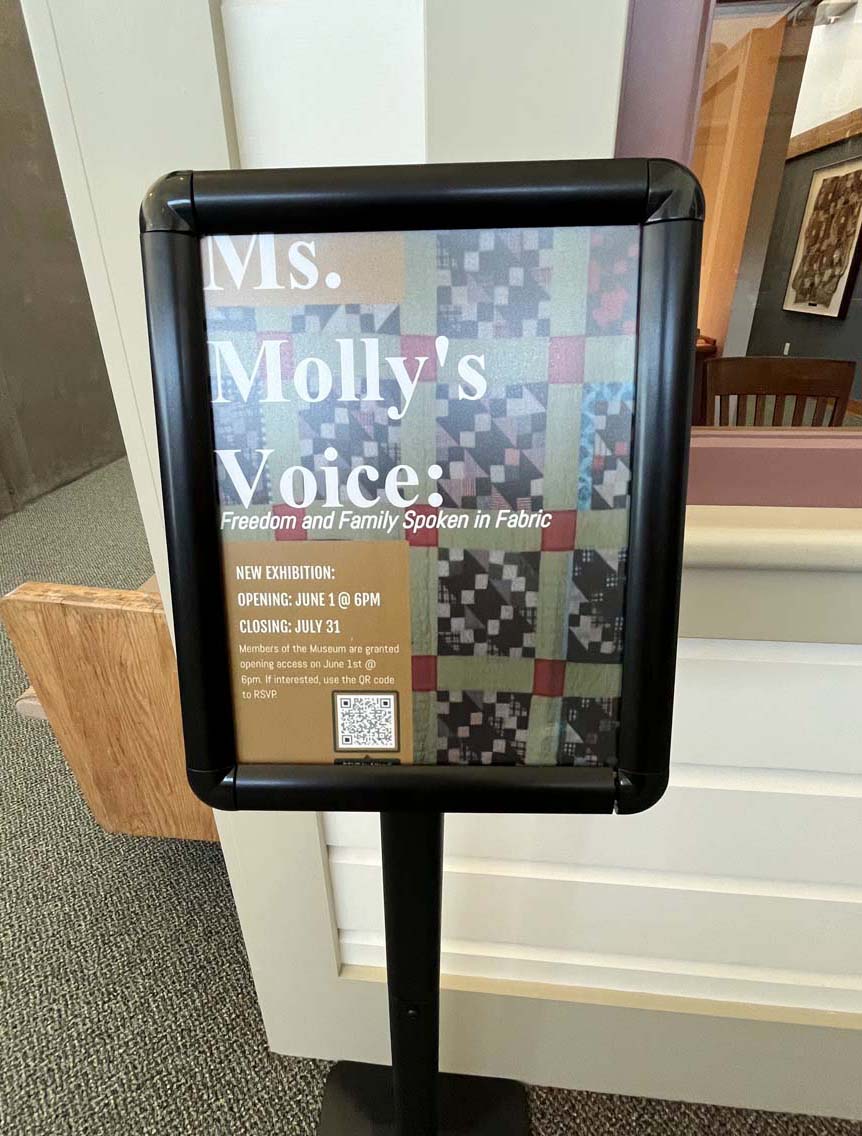
The exhibition is expertly guided by signage that tells you about the provenance and meaning of each quilt (as displayed in my photographs.) You can learn even more detail in a book written by Tharpe and available at the museum, that explains the family history, the creation of the collection and his purpose in investing his passion, time and energy into the preservation of the collection.

The earliest quilt, the Slave Quilt (1850), was made as personal bedding by a thirteen-year old slave, Ms. Molly, who was sold away from her family to a plantation in Whitlock, Tennessee. Close inspection reveals not just use and tear, but also bloodstains. We will never know if from the whip, rape or childbirth – she bore two sons to her Master, who were fortunately not sold away from the household. Faded, easily overlooked, they nonetheless instill a sense of the horrors of the life that then-child must have experienced.

She taught her skills to her own children and in-laws after the Civil War was won. Eventually the family relocated North, but still trecked to Tennessee many years later to visit relatives that remained there, often under the shadow of racism that put travelers in danger.

Danger while traveling was, of course, one of the hallmarks of the Underground Railroad movement, helping slaves to escape their masters and start a new life somewhere supposedly more safe, if not free. One of the ways to prepare, or to warn, or to help people finding their ways and supportive allies, was a language of communication contained in quilts. Specific patterns indicated specific requirements or signals to those on the move.

Expert quilters might be well aware of this history, lots written about it. For the rest of us, even though we are aware of forms of communication not contained in written words – just think of the knotted messages of the Incas, Semaphore or Braille, sign-language or Morse code – we might not know about the meaning of patterns around in quilts. I certainly had no clue, even though I count two expert quilters among my friends.

The exhibition then, really opened my eyes not just to the creativity of individual seamstresses and the beauty of their resulting work, but the meaning behind much of what was in front of me, guiding me into a world that lacked all the privilege of my own and that holds historical lessons we should well heed.

In general, there were ten quilt codes to be used for the journey, with just one displayed at the time. A sampler with all the codes in small form, secretly passed around, served as a teaching device for memorization of the patterns. The quilts were displayed in windows or hung out with the washing to inform the travelers. The backs and fronts were joined by twine tied two inches apart, with patterns of knots mapping the existence and distance of safe houses along the route. (Ref.)

Here are some of the patterns used in the quilts on exhibit (note, there are variations in names across states, not captured here):

The variety of the artistry shown is helpful for us to understand how form, function and aesthetics go hand in hand. The dedication of this family to relating the skills to subsequent generations and preserving, despite many moves across the U.S. what is a treasure, makes it very clear that they know about the importance of history, and the ways its official telling needs to be supplemented by people who’ve actually experienced it from diverse perspectives.

I was particularly moved to see the oldest and most recent of the quilts exhibited in juxtaposition. The latter was a graduation present to Jim Tharpe, with an inconspicuous love letter stitched into the sidebars, just as the blood stains were inconspicuous on the former. It brought home to me that it is not enough to be exposed to something in order to witness. You have to look. Look carefully. Not leave it to those lying at the bottom of the ocean.

The effort to bury parts of our history, efforts yet again sweeping our country in the form of curriculum changes, prohibition of certain books, elimination of programs dedicated to Black History studies and the like, is hopefully counter-acted by exhibitions like the current one. It brings history alive in front of your very eyes and encourages conversations with those you bring to this show, children included, about what is contained in these beautiful quilts and why it had to be kept secret.

Columbia Gorge Museum

Ms Molly’s Voice: Freedom and Family Spoken In Fabric

June 1 – July 31st, 2024

Open Everyday: 10:00am – 5:00pm

990 SW Rock Creek Dr, Stevenson, WA 98648

Special Event:

“In celebration of Juneteenth, the Columbia Gorge Museum will be hosting an open event where attendants will focus on creating quilt patterns in a dialogue with the patterns and skill of Ms. Molly. Take a guided experience through the quilt exhibition and thanks to some amazing Columbia Gorge quilters, create your own family document in a quilt square. 

This event takes place June19th between 2 p.m. and 4 p.m. All are welcome!

If you would like to attend this event, simply RSVP here!“

Here is the full poem from which I took the quotation at the beginning of the review.

The Witnesses

BY HENRY WADSWORTH LONGFELLOW

In Ocean’s wide domains, 

   Half buried in the sands, 

Lie skeletons in chains, 

   With shackled feet and hands. 

Beyond the fall of dews, 

   Deeper than plummet lies, 

Float ships, with all their crews, 

   No more to sink nor rise. 

There the black Slave-ship swims, 

   Freighted with human forms, 

Whose fettered, fleshless limbs 

   Are not the sport of storms. 

These are the bones of Slaves; 

   They gleam from the abyss; 

They cry, from yawning waves, 

   “We are the Witnesses!” 

Within Earth’s wide domains 

   Are markets for men’s lives; 

Their necks are galled with chains, 

   Their wrists are cramped with gyves. 

Dead bodies, that the kite 

   In deserts makes its prey; 

Murders, that with affright 

   Scare school-boys from their play! 

All evil thoughts and deeds; 

   Anger, and lust, and pride; 

The foulest, rankest weeds, 

   That choke Life’s groaning tide! 

These are the woes of Slaves; 

   They glare from the abyss; 

They cry, from unknown graves, 

   “We are the Witnesses!” 
Kairos

Kairos: a time when conditions are right for the accomplishment of a crucial action : the opportune and decisive moment. – Merriam-Webster Dictionary

A video has been making the rounds in Germany for the last few days, depicting a group of wealthy young people at one of the country’s most exclusive bars engaged in laughing, singing and shouting racist, nationalistic and even fascist paroles, one of the revelers seemingly giving the Nazi Salute, filming themselves with glee and later posting the recordings. (I refuse to share, giving them more exposure…)

Most commentators remark on this as something that is not novel for the sentiment depicted. What is new is the pride accompanying a brazen openness about one’s ideology that was previously subterraneous in a country blanketed with shame over past sins. There is also a shift regarding who comes forward with explicit racism – once a province of beerhalls and most often associated with lower-education populations mainly in the East, it now seems to be fashionable among the elite. Think a five star drinking hole in the Hamptons, visited by Nepo-babies and their entourage. For Germans who were happy to assign Nazism to poor yokels, this is an unwelcome occasion to have to admit extremist sentiments in all sectors of society across the nation.

Of course, we see an inclination towards unapologetic flaunting of ideologies previously kept close to the chest and only revealed in like-minded company here in the U.S. as well. Just think of Justice Alito’s various flag demonstrations. Or that of evangelical House Speaker Johnson, who displays the Christian nationalist flag in front of his office, signaling his theocratic agenda. The Appeal to Heaven flag is part of the symbolism of the far-right New Apostolic Reformation, a movement fighting for a hegemonically Christian America.

Apparently it is a crucial moment in time, propitious for the public flaunting of racist and nationalistic agendas we thought banned for good. Or at least hoped. It signals a qualitative shift, in my opinion, fostered by increasing desire for and acceptance of authoritarianism colored by religious fervor, whether Christianity or Hinduism as just two example, internationally.

Crucial moment in time is also the title – Kairos – of Jenny Erpenbeck’s novel, translated by Michael Hofmann, that won this year’s international Booker Prize. You can read ubiquitous reviews here, here and here. Be warned, though. It is an incredibly sad, cruel, and bitter tale that is unfolding, both in descriptions of a May/December love affair, and a reckoning with German history set at the time of approaching reunification of East and West in the 1980s.

I was grateful to read the original language, having always thought the author has an incredible skill with words to both lure you and distance you at the same time to and from her preoccupation with time. Much of her work is concerned with how time takes things -as well as bodies – apart. Now she shifts to the concept of time as that moment that changes everything, and it dawns on you, slowly, eventually, that we willingly overlook the signs that point to that moment of change, until, basically, it will be too late. True for relationships as much as politics of nations.

By all reports, the English translation is formidable. I, on the other hand, have been struggling to find the right word for an adjective I associate with the author, who was by the way, trained as a director of opera: unerbittlich. In English it is translated as unrelenting, but the German word has more of sense of “without mercy” attached. Not just not giving in to pleas, but exhibiting a punitive streak. She mercilessly holds the mirror to German society preoccupied with “Vergangenheitsbewältigung,” a reckoning with the past, showing how often we still look away, or keep things at a surface, too fearful to look deeper. Exactly the situation that the reactions to the video alluded to above seem to reflect. The same pattern emerges for acknowledging signs of domestic violence and abuse. We ignore the creeping signals around us as long as we can, since it can’t be true what we don’t want to be true.

This might not be the moment in time to focus on entropy, Erpenbeck’s continual concern. Do we really want to burden ourselves with yet another downer, a hair-raising, deeply sad tale, when we are so emotionally vulnerable from all the trauma around us?

But if not now, when? Disentangling the lessons of history from wishful thinking will always be hard. Her writing is as brilliant a guide as any. Maybe this novel rises to prominence with the Booker Prize at exactly a propitious moment, before it is too late.

Kairos.

Music by John Dowland today.

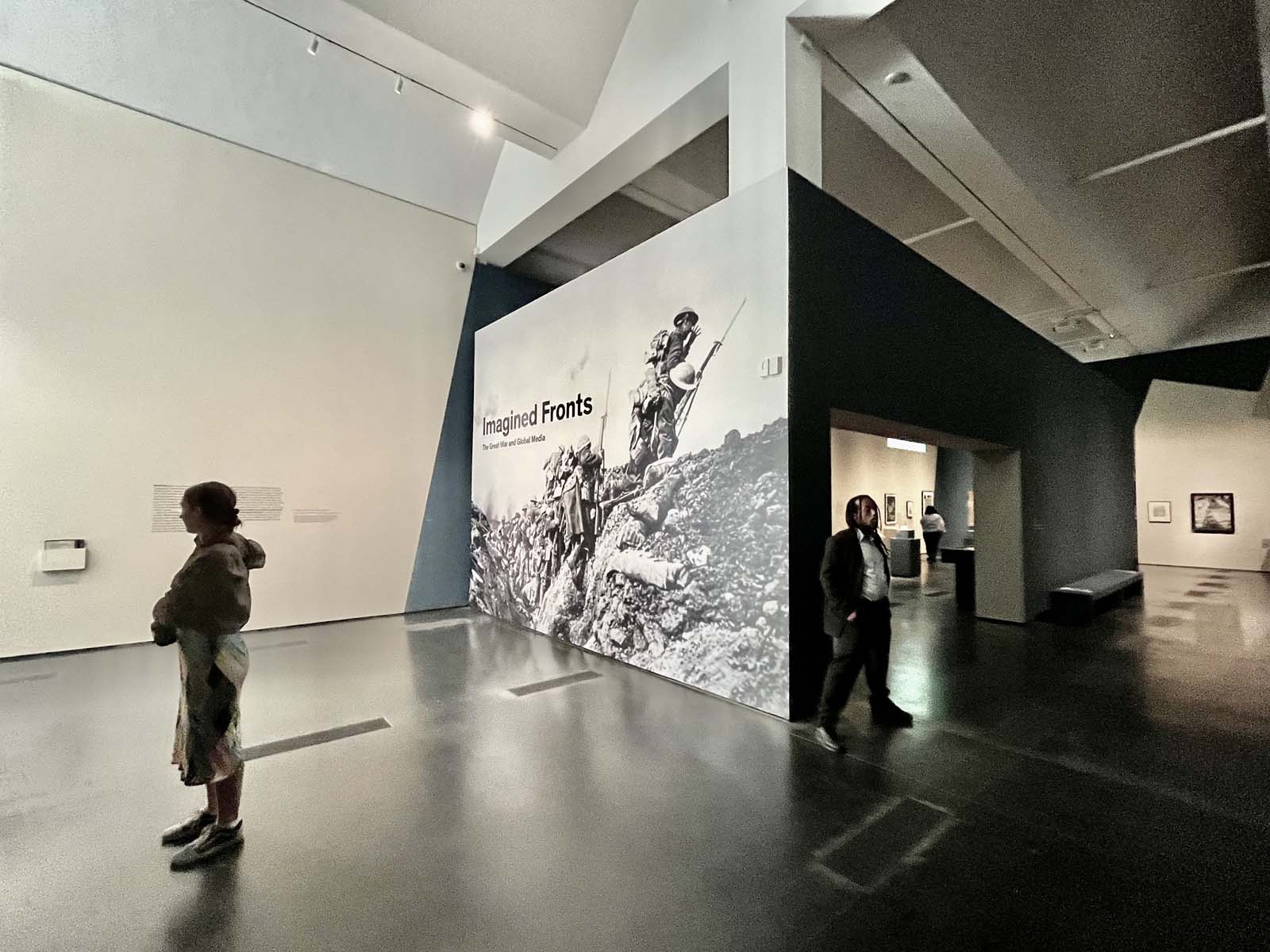
Art On the Road: Imagined Fronts – The Great War and Global Media at LACMA

“You may not be interested in war, but war is interested in you.” – Quote attributed to Leon Trotsky but actually coined by Fanny Hurst in 1941 while addressing a rally in Cleveland, Ohio.

“First time I wore thermal underwear and a down vest to work in April,” said the museum guard standing outside Michael Heizer’s Levitated Mass—a 456-foot-long concrete slot constructed on LACMA’s campus, topped by a 340-ton granite megalith. I had not expected such detailed response to my friendly “It’s cold, isn’t it?” directed at the shivering man.

Two views of Michael Heizer Levitated Mass (2012)

Glorious blue sky and sunshine were deceptive. It was cold and extremely windy when I started my visit to LACMA, exploring the grounds first, evading palm fronds flying through the air. Crazy weather, with a few of Ai WeiWei’s zodiac creatures ignoring it all and the lamps standing like frozen tin soldiers..

The shivering, alas, did not end once inside. Not due to the temperature, though, since it was quite toasty in the Resnick Pavilion. Rather, it was induced by the realization that we simply have not learned the lessons from the past – or, alternatively, have learned them all too well: media manipulation plays a significant role in preparing people for war, luring them into support for war efforts, and pulling the wool over their eyes with regards to the consequences of war. Pretending that we can know war by imagining it, is, of course, one way to sell it to the public. We might make very different decisions if we lived through the actual experience which is never matched by the most vivid imagination based on media representations. Watershed events like World War I that changed the course of history, are these days remembered as statistics – if they are remembered at all. 20 million deaths, 21 million wounded, in the span of four years (military personell and civilians combined.) Hard to intuit the nightmare that was, when only thinking about numbers.

“Imagined Fronts: The Great War and Global Media,” offers some 200 exhibits chosen by Timothy O. Benson, curator of the museum’s Robert Gore Rifkind Center for German Expressionist Studies. Posters, books, rotogravure graphics, prints and excerpts from films combine to show the extent to which the public’s perception of World War I was shaped in ways beneficial to war efforts by state and private media. Inexplicably, one of the very few paintings on display was chosen to head the exhibition announcement and subsequent reviews, of which there are remarkably few. (You would think in our own time of war, the atrocities in Ukraine and Gaza, an exhibition about the interaction between media and war would be of heightened interest.)

Félix Edouard Vallotton Verdun (1917)

Maybe there is a pragmatic explanation for the choice, after all: Félix Edouard Vallotton’s Verdun (1917) spares you the reality of the slaughter that was unfolding across a full year in the French trenches (where my own grandfather fought.) It immediately lifts the gaze from the bilging smoke and fires to a bright blue horizon, as if there’s hope, something more likely to draw exhibition visitors than horror, I presume. A much more remarkable painting, Gino Severino’s Armored Train in Action (1915) is also reviewed with regularity. Based on a press photograph of an armored train, the museum signage tells us the painting is: “a celebration of a mechanized war, typifying the Italian Futurists’ extolment of the dynamics of energy and destruction.” What is conveniently left out is Severino’s eventual full-fledged support of Mussolini’s fascism.

Gino Severino Armored Train in Action (1915)

The exhibition wanders across four sections, roughly focusing on war propaganda (Mobilizing the Masses,) battle field representations (Imagining the Battlefield,) exhibits introducing the number of international forces involved (Facilitating the Global War,) and a few instances of the attempts to integrate the damage that was wrought between 1914 and 1918 (Containing the Aftermath.) Nestled in between are a few displays of those who made art or comments opposed to the war.

Overall the organization worked for me, but I found the fact that multiple movie screens, mounted up high and continuously rolling cuts of both documentary movies and propaganda films, incredibly distracting. Some of them were, as good propaganda tends to be, almost hypnotic. A German businessman encounters a woman who sells him a magic potion that will reveal “the truth” if poured on paper, before she vanishes into thin air. What appears on the previously blank page: a tank threatening armed Germans, persuading the business guy, visibly moved, to invest immediately in war bonds, so he contributes his bit as well….

The posters on display are probably familiar to many of us. Neither witty nor subtle, they capitalize on installing fear or indignation, or appeal to your compassion.

The photography section gets more interesting. There are a few memorable photographs documenting the war efforts, and the pride in new technology.

Clockwise: William Ivor Castle Canadian Troops ging over the top – James Francis Hurley Death the Reaper (ca 1918 )and Over the Top – (ca 1918.)

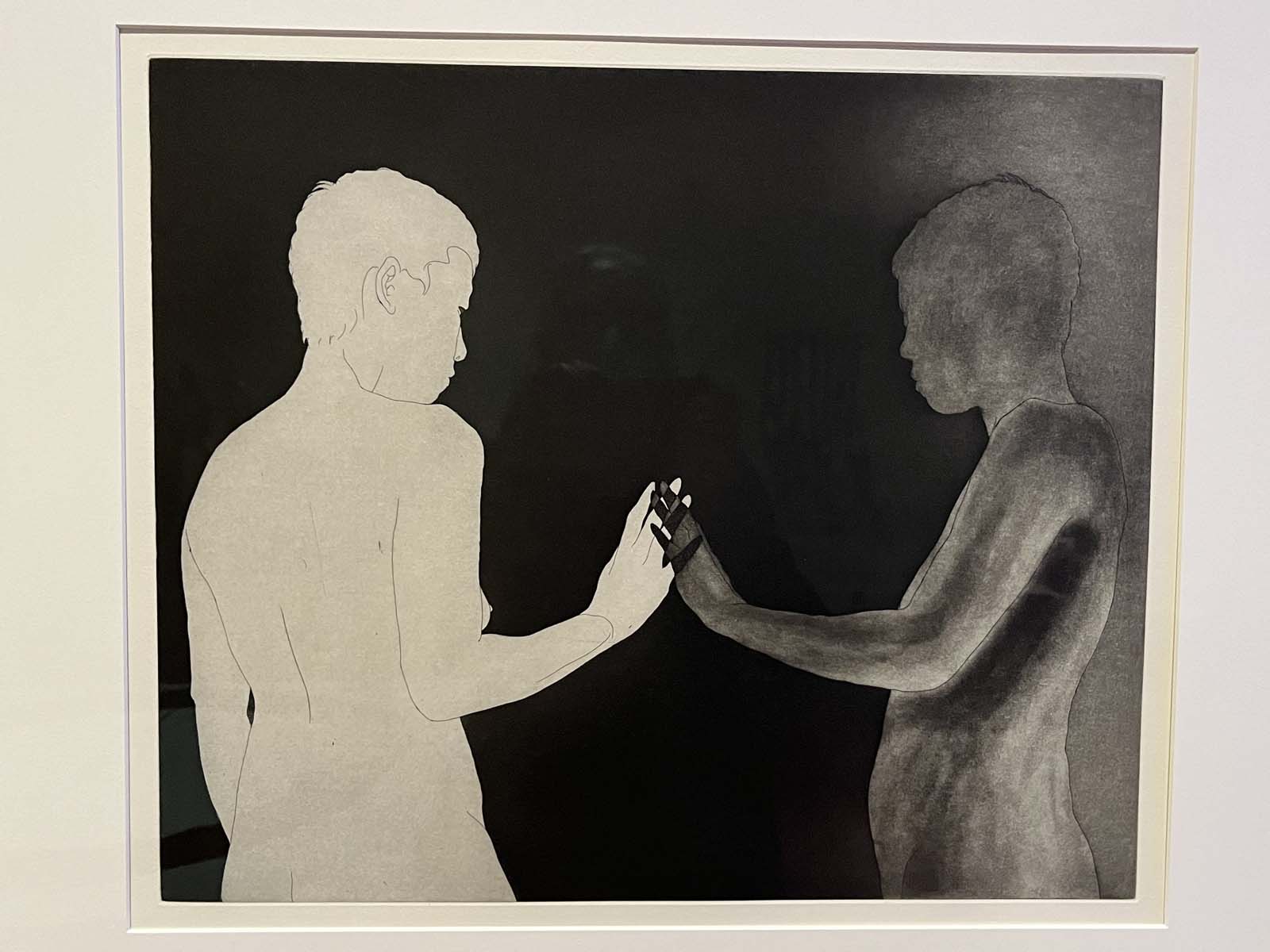
For me, the truly gripping parts of this exhibition were the lithographs and drawings. They can be roughly divided into those that educate, often by means of satire or inclusions of script, and those that speak to our emotions, depicting experiential suffering in hopes that it comes across.

George Grosz The Voice of the People (1927. (Money paid for the following propaganda: Hurray, Hurray!! every shot a Russian, down with Serbia, God punish England, and every Bayonet a Frenchman.)

Georg Scholz Newspaper Carriers (1922).

Otto Dix The Cardplayers (1920)

Käthe Kollwitz The Widow (1922) and The Survivors: War against War (1924)

Both trigger empathetic imagination, something that could provide a fertile ground to change views on war, realizing its futility and injustice.

Willie Jäckel Memento (1915)

“Memento 1914/15,” a blistering portfolio of 10 lithographs by Willy Jaeckel, made in 1915 when he joined the Berlin Secession to oppose artistic suppression by bellicose Kaiser Wilhelm II. (Jaeckel was just 27.) Inspired by Goya’s “The Disasters of War,” it features a reclining severed head on the cover page — the “sleep of reason” made permanent, its unleashed monsters manifold in subsequent sheets. (Ref.)

Of course, the very same mechanism, as used by propaganda posters, helps to sell war.

In some ways, this makes the exhibition thought-provoking: how easily can our imagination, needed to approximate a close representation of the war experience, be manipulated? How do propaganda posters, retouched photographs, censored prints affect our imagination? It is not just the official propaganda machine by governments, military and states, however sophisticated. It is also the art that tries to elicit compassionate imagination that played a role mostly in anti-war directions – and managed to be distributed, for the first time, in large quantities, made accessible through the modern printing presses.

ERNST FRIEDRICH WAR AGAINST WAR (1924)

The show is timely. The use of both, image manipulation for propagandistic purposes, and the employment of censorship to prohibit artists from eliciting sympathetic imagination that helps to support just causes, is ubiquitous across the world right now. Just a few days ago, the NYT reported about the chilling effects of the Gaza war on artistic expression and censorship in Germany. NPR reported on the use of misleading videos (old or from video games) flooding the social media to escalate tensions between Palestinian and Israeli supporters, just a few days after the horrific Hamas attacks. Pro-Israel sources claim “Pallywood Propaganda,” accusing Palestinians of staging or faking their suffering.

El Dschihad, no. 25, January 25, 1916, in German prison camp created for muslim soldiers – Raoul Dufy The Allies, (c. 1915) – Lucien Jonas African Army and Colonial Troops’ Day, (1917)

Our increasing awareness of AI’s power in creating deep fakes leads us to discount the veracity of purported eyewitness accounts, sent via videos out of the war zones, with few means of assessing what is real and what is false. That uncertainty, in turn, can lead to a general disavowal of visual reports, a lack of trust that opens doors to political manipulations by those who claim they, and they alone, can guide us to “the truth.”

Art is related to conflict in so many ways – during wars, art is looted as a trophy, art is destroyed as a way of demoralizing opponents, it is used, as mentioned before, as a tool of propaganda in order to generate both psychological and material support for the war effort. Can art that opposes war, as expressed in writing, visual representations, music, really make a difference in our day and age, given our distrust, our being overwhelmed, our dire need to avoid being flooded and wanting to distance ourselves from war imagery? When war defeats the imagination, can art rekindle it? Can it cut through hate, anger, resentment, violence and destruction, change minds? The debate is ongoing.

Sergio Canevari The Russian Peace (1918)

I have no definitive answer. This exhibition’s imagery most meaningful to me, a pacifist, namely the depictions of suffering and the satirical stabs at those who financially gain from war, will likely not speak to those eager to go to war, just like racist propaganda posters embraced by them do nothing for me. Maybe our ideological or political divisions prevent us to think through art that does not confirm our preexisting beliefs. To that extent, art will not be able to produce change, given the strength of our biases. (I have written about this at length recently, as you might remember.)

Pierre Albert-Birot Final study for The War (1916)

However, if I consider what happens when I share the art that appeals to me with other people who are open to it, it surely creates a sense of solidarity and feeling of belonging to that group. Maybe it guides you to find your kind, to strengthen a movement, to empower you to speak up for shared values. If controversial art models courage, it might spark you to be brave and resist, as well. Not a small feat.

Johannes Baader Dada-Dio-Drama (1920)

Right now we look from afar at wars in Ukraine, in Gaza, in Tigray, in Sudan, Syria, in Lebanon, with more on the horizon, should Iran, China, Russia, North Korea, the U.S. or Nato advance to increasing military action. We might not be interested in war, but war will be interested in us. And at that moment we will need allies to resist its pull, some of whom, just maybe, can be found through a shared appreciation of the relevant art as well as shared forms and intensities of imagination, allowing us to keep a critical perspective and fight manipulation.

Am I optimistic about this? Not really.

Hopeful? You bet.

Otto Schubert Watercolor, pen. and pencil on postcards he sent to his future wife. Off to War, November 18, 1915, Fire, Explosion, December 1, 1915 Evening Mood at the Front, January 24, 1916 Argonne, French Prisoners, April 1, 1916 Hot Day at the Front, April 7, 1916

Imagined Fronts: The Great War and Global Media

December 3, 2023–July 7, 2024

Resnick Pavilion

Los Angeles County 
Museum of Art

5905 Wilshire Blvd. 
Los Angeles, CA 90036

Edward Kienholz The Portable War Memorial (1968-70)


Desert Beauty

· Exploring Anza-Borrego Desert State Park ·

“Certain desert areas have a distinctive and subtle charm, in part dependent on spaciousness, solitude, and escape from the evidence of human control and manipulation of the earth, a charm of constantly growing value as the rest of the earth becomes more completely dominated by man’s activities. This quality is a very vulnerable one …. Nowhere else are casual thoughtless human changes in the landscape so irreparable, and nowhere else is it so important to control and completely protect wide areas.”

– Frederick Law Olmsted, Jr in a 1928 survey for the California State Park Commission.

And here I thought almost 5 hours in the car to get from Los Angeles to Borrego Springs, CA, was a long stretch. Take the amount of time – decades and decades – it took to establish the nation’s second largest state park, the Anza-Borrego Desert State Park, and the drive was but a blink of an eye. Beginning in 1927, a group of visionaries tried to protect several desert areas for future generations, alert to the destruction of natural habitats by encroaching civilization that parceled up open spaces. Fierce opposition by many interested in economic development stretched out the process across years and years. For once, those concerned with environmental and ecological preservation, prevailed. Since 1974, some 585,930 acres (237,120 ha) of the Colorado Desert, located in San Diego County, are now protected. (For a riveting account of the history of the fight to create this marvel, go here.)

The desert lies along the western margin of the Salton Trough. This major topographic depression with the Salton Sink having elevations of 200 ft (61 m) below sea level, forms the northernmost end of an active rift valley and a geological continental plate boundary (Lots of earthquakes with high magnitudes, every 5 years or so.) (Ref.) 

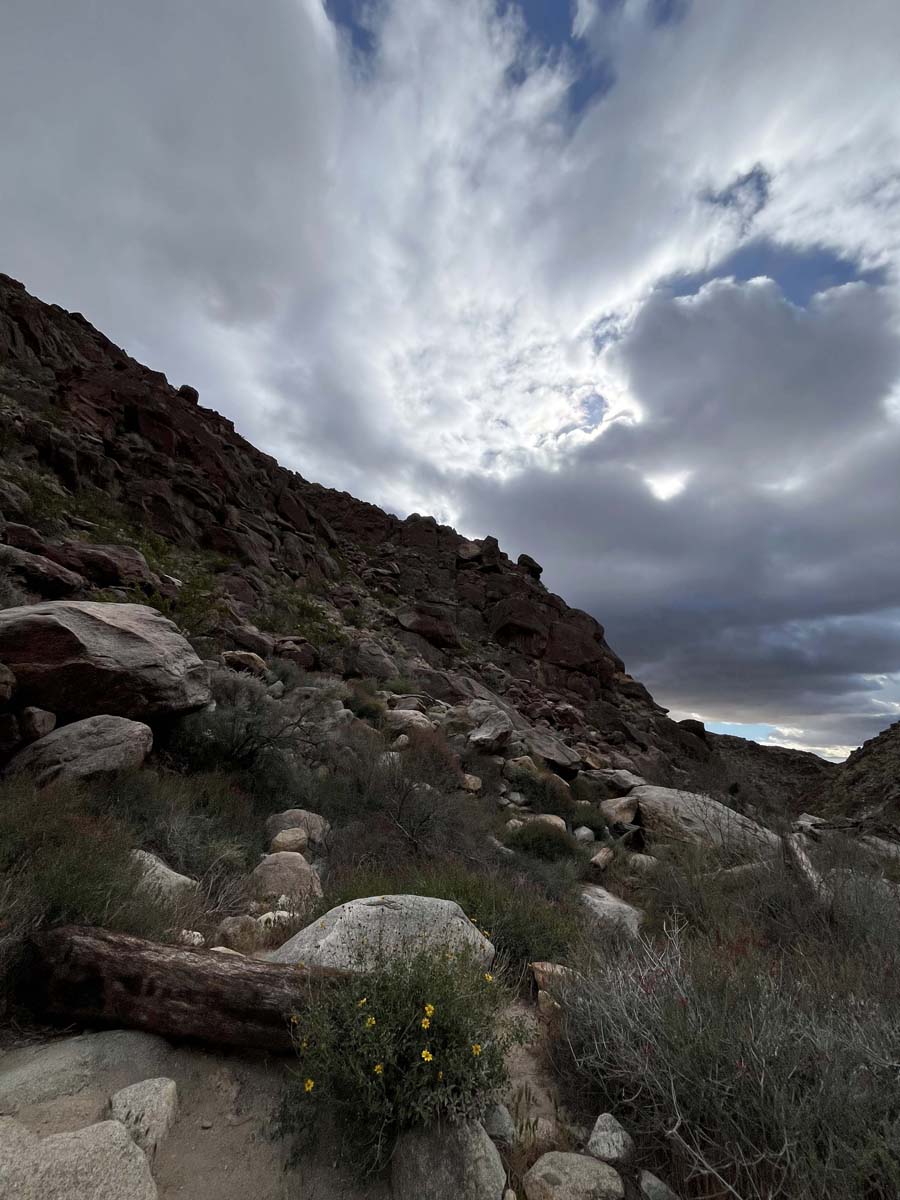
Imagine a large bowl of badlands, surrounded by mountains, with the Vallecito Mountains to the south and the highest Santa Rosa Mountains to the north. The badlands, ancient lake basins, are the result of both, erosion and sediment deposition over 5 million years. what you are seeing is literally what the Colorado river excavated from the Grand Canyon. The eroded and pretty much plant-less areas make it easy to see the dipping layers of siltstone and sandstone. They are filled with fossils, and populated by big horn sheep, neither of which I glimpsed during my visit. What I did see was breathtaking beauty of wide open land, cloudy sunrise, and the tail end of the wildflower bloom, providing endless delight to the searching eye.

No wonder that eco-tourism flourishes here at this time of year: the population of Borrego Springs, where I stayed, increases by about 580% in peak wildflower superbloom season, an increase from around 3400 long term residents to around 200,000 tourists. According to the government’s park survey, 932 plant taxa belonging to 387 genera in 98 different families documented within the park. The plant family Asteraceae (sunflower) is most abundant with 135 taxa identified. Rodents, hares, rabbits, fox, coyote, mountain lion, bighorn sheep as well as many species of snakes make up the fauna.

The region was home to two Native American groups, the Kumeyaay and the Cahuilla for thousands of years, semi-sedentary residents of certain favored locations or base camps. From there they would travel to outlying areas seasonally to harvest food resources and to avoid inclement weather, like winter snows. Leave it to the forces that be to name the park instead for sheep (Borrego) and a colonizing explorer, military officer and politician, 18th century Juan Bautista de Anza.

The progressive vision to protect open spaces was not matched by progressive visions in other domains either: when César Chávez came to Borrego Springs to support local workers who wanted the National Farm Workers Association as their union in 1966, they tried to chase him out of Borrego Springs by not allowing lodging or camping in the usual spaces. He and the union organizers eventually camped at Borrego Palm Canyon Campground, the start of my hike last week, with a lone supervising ranger defending their rights against the town folks who loathed the idea of unionizing workers. 

The hike, starting at 7 am with an otherworldly light bathing the landscape, went up to the palm canyon, at my speed taking about 4 hours there and back.

That left a spare hour to visit some additional strange sights, before the threatening rain storm set in. (It dropped over 2 inches in 24 hours for the L.A. region.) In reversal to my earlier complaints about the length of time, these 5 hours felt way too short!

The clouds formed an appropriately dramatic background for an unexpected piece of art, a humongous, corrugated steel sea serpent crawling through the desert. I could not but marvel at the strangeness of the sight and, truth be told, at the skill of the designed and steel welded creation by sculptor Ricardo Breceda. However, there was something odd about plopping some 130 creatures in to the landscape, with people and cars crawling around them like ants, with few of the sculptures true to this natural environment. I mean, elephants and camels? Dinosaurs and tigers? The whole thing was the idea of Dennis Avery, the late land owner of Galleta Meadows Estates in Borrego Springs, adding free standing art to his property and, I guess, attracting tourists this way. and if that’s what draws people to the region, exposing them to the barren beauty of the desert for most of the year, more power to them!

Music reflects John Luther Adam’s view of the desert. Quails and sky reflect mine.

Songs from the Congo

· Black Artists of Oregon/Africa Fashion at Portland Art Museum ·

““I am black; I am in total fusion with the world, in sympathetic affinity with the earth, losing my id in the heart of the cosmos — and the white man, however intelligent he may be, is incapable of understanding Louis Armstrong or songs from the Congo.”

– Franz Fanon Black Skin White Masks, 1952

Last week I visited Africa Fashion and Black Artists of Oregon at the Portland Art Museum, downstairs and upstairs in the main building, respectively. Downstairs was empty, upstairs was jumping, middle of a weekday, for a show that has been open since September. I started my rounds on top and my eye was immediately caught by a group of young women motionless, except for their heads.

What were they staring at? Bent over, studying, then four heads lifting in unison, looking at each other, then bending again, back and forth, like a silent dance. Once the young women left, I walked over to see for myself and found this:

damali ayo Rent a Negro.com (2003) You can listen to the artist explain the evolution of this work here.

What reaction would an interactive piece like this, riffing on the commodification and objectification of Black labor, elicit in high school students who are most likely not (yet) too familiar with conceptual art? One of the first satirical pieces of internet art, damali ayo‘s Rent-a-Negro is an ingenious take on the system that has progressed from purchasing and owning the Black body to leasing it (although prison labor needs to be considered a form of slavery, if you ask me,) to using token Blacks to satisfy demands for “diversity.” How would it be processed by the Black high-schoolers in contrast to those like me, old White folk? Rage and revulsion by those whose ancestors were subjected to exploitation and oppression, ongoing even? Shame and sorrow by those whose forbears might have wielded the whip and ran the auctions, with patterns of discrimination not a thing of the past?

Julian V.L. Gaines Painfully Positive (2021)

Ray Eaglin Maid in USA (1990)

Fanon’s insight that someone like me will not be able to understand certain forms of art as they would be by those from whom it originates, popped up in my head with urgency. And this leads to one of the elephants in the room that needs to get aired: how does a White woman review exhibitions of Black art with the depth and understanding they deserve, while aware that the racial, potentially distorting, lens cannot be abandoned? It is naive, bordering on ignorant, to assume that art can be seen, understood, felt in some neutral fashion, when our implicit stereotypes guide our interpretations, and when our lack of knowledge specific to the history of a community affects our comprehension.

Tammy Jo Wilson She became the Seed (2021)

Al Goldsby Looking West (ca. 1970)

Furthermore, any reviewer aware of their implicit biases and wishing to be an ally to those who are burdened with historical or ongoing discrimination, will walk on eggshells. You want to avoid harsh criticism, or piling onto stereotypes, or being overly deferential, despite all of that being already a form of unequal treatment, born from awareness of culture constructed around race. You so want to avoid putting your foot in your mouth and appear arrogant.

Or racist.

Thelma Johnson Streat Monster the Whale (1940)

Mark Little Despondent (1991)

Isaka Shamsud- Din Land of the Empire Builder (2019)

I vividly remember a lecture I gave about the psychology of racism on invitation by PAM in the context of a Carrie Mae Weems exhibition over a decade ago. I talked about the Implicit Associations Test – IAT –  the psychological measure that confirms how many of us hold stereotypical assumptions associated with racism. It is a test that looks at the strength of associations between concepts and even the most liberal takers have gasped at their scores.  Mind you, it does not mean you are a racist; it just tells us that we have all learned associations between concepts that involve stereotypes associated with Blacks. Some in the audience erupted in anger, astute, educated, intelligent docents among them. That could not be true! They fought against racism all their lives! I clearly failed in getting the point across: there is a difference between consciously acting on your stereotypes and unconsciously being affected by them. But even the latter was denied by these well-meaning citizens.

Jason Hill Lion King (2019)

In any case, one can have read brilliant work like Franz Fanon’s about the Black psyche in a White world, racial differences, revolutionary struggle and the effects of colonialism until the cows come home, it will not ease the task of reviewing exhibitions like the one currently on view. Not that that has kept me from doing so, most recently with Dawoud Bey and Carrie Mae Weems in Dialogue at the Getty and Red Thread/Green Earth which showed work of several members of the Abioto family at the Patricia Reser Center for the Arts.

But it has made me aware of how much I already censor in my head, how worried I am about the reception of my takes, and the damage they could do, how my approach to work are colored by the political context, something that would not happen if I just walked into any old show of a collection of artists, race unknown.

Ralph Chessé The Black Women Work (1921)

Bobby Fouther Study in Black (2023)

***

The current exhibition was curated by Intisar Abioto after years of research into the spectrum of Black artists in Oregon, some famous, some locally known, some hidden in the embrace of their community. She put together a remarkable show, and her line of thinking as well as the expanse of the art is fully explained in a in-depth review by my ArtsWatch colleague Laurel Reed Pavic, who talked to the curator and listened to her podcasts about the exhibition. (You can listen to the podcasts yourself – they range from general introduction to a number of interviews with individual participating artists.)

My first association to the upstairs show was the contrast to what is exhibited downstairs, African Fashion. Previously shown at London’s Victoria and Albert Museum and the Brooklyn Museum, the latter was hailed as a vital and necessary exhibition by eminent art critics. It felt to me, however, like one of those luxury fruit baskets filled with luscious and exotic goods, wrapped in cellophane with a glittery bow – something that often does not live up to its visual promise when you are actually starting to peel the fruit.

Contrast that with the show upstairs: like a farm-to-table box dropped off at your doorstep, stuffed to the brim, packed to overflowing, with produce you sometimes don’t even recognize, but all locally grown and, most importantly, invariably, truly nourishing.

Katherine Pennington Busstop II (2023)

Latoya Lovely Neon Woman (2019)

Packed is the operative word here, 69 artists and over 200 objects, sorted into categories like “expanse, gathering, collective liberating, inheritance, collective presence, and definitions. The art is competing for space, focus, time and attention, with those limited resources not meeting demand. I assume it was a conscious curatorial decision. If you have, finally, a public space willing to open up to a neglected or even excluded collective of artists (collective in the sense of a shared history rather than a shared goal,) you might as well grab the opportunity and allow every one in the community a shot. This is particularly true when you don’t know what the future holds and which opportunities emerge in times where the racial justice backlash is raising its ugly head ever more prominently. Yet you do early-career artists, no matter how promising, no favor when placing them among the hard hitters.

Henry Frison African Prince (1976-79) with details

Alternatively, the inclusion of so many art works might have been a conscious attempt to demonstrate the diversity that is offered by a community long segregated from traditional art venues, never mind neighborhoods. It might be an attempt to shift what psychologists call the outgroup homogeneity bias, our tendency to assume that attitudes, values, personality traits, and other characteristics are more alike for outgroup members than ingroup members. “They are all the same! Know one, you know them all!” As a result, outgroup members are at risk of being seen as interchangeable or expendable, and they are more likely to be stereotyped. This perception of sameness holds true regardless of whether the outgroup is another race, religion, nationality, and so on.

That bias certainly affects what we expect (particularly, when our expectations are driven by other cognitive biases as well.) Our unconscious expectation of less diversity in the creative expressions of the art were certainly put in doubt with the plethora of work put up by Abioto. In confirmation of the bias – and thus the value of her curatorial decisions – I certainly caught myself regularly looking for a common thread of political statements, however indirect, commenting on the experience of being Black in Oregon, a notoriously racist state.

MOsley WOtta Baba was a Black Sheep (2023)

The history can be found here in detail. Simply put, Oregon had not one but three separate Black exclusion laws anchored in the Oregon Constitution and it took until 2001 to scrap the last bit of discriminatory language from the records.

We are one of the nation’s whitest states, and had at some point the highest Ku Klux Klan membership numbers nationally. Of our 4.2 million Oregon residents only about 6% are Black, and many of these have been displaced within the state over and over again, making room for construction projects and/or gentrification of neighborhoods. Nonetheless, Black leadership and organizations providing support for education, including the arts, are resilient and effective. (A recently updated essay by S. Renee Mitchell provides a thorough introduction to these achievements. Another informative article about Black pioneers can be found here.)

Arvie Smith Strange Fruit (1992) Detail below

Much of the art reflects the history, referencing the pain and injustice of lived as well as inherited experience. But there were also pieces that simply depicted beauty, documented landscape, revered what is. No message necessary or intended. It is a conversation I would love to have about all art, at this moment in time, how our ability and willingness to make art outside the need to bear witness, or instruct, or frighten, or alert to social change needed, is obstructed by multiple internal and external forces – but that has to wait for another time.

Sadé DuBoise Collective Mourn (2023) with detail

For this exhibition there was more art on display than could possibly be processed during a single visit. But all of it was nourishing, even in passing, as I tried to express in my initial description – food for thought, yes, as well as a feast for the eyes.

Natalie Ball Mapping Coyote Black, June 12 and 13, 1987 (2015)

Natalie Ball Mapping Coyote Black , June 12 and 13, 1872 (2015) (Artist new to me, enchanted by the work.)

I felt at times as if I was, if not an invited, surely a tolerated guest at a family reunion – meeting of long lost friends and relatives, happy to run into each other, artists introducing each other. It was a vivid, social experience during a time where I am still socially isolated due to the pandemic, even if I was standing double-masked at the margins, observing so many people truly engaging with art, potentially new to them. Twice (!) I was asked to take photographs of people who had met at the museum by chance and talked to each other in front of this or that piece.

I left the museum more hopeful than after any of the recent shows I’ve been reviewing (and the last year included some real winners!). The vibrancy of the work on the walls and the liveliness, even giddiness of the social interactions of many visiting generations all conveyed a sense of resilience and optimism that somehow rubbed off onto me. I might not get the songs of the Congo, but I do have an inkling, provided by this exhibition, of what local Black art stands for: a community that refuses to let go of history, no matter how painful. A community that believes in a more just tomorrow as well, forever willing to fight for it, no matter how hard that is made by the rest of us. A community standing its ground, with art that reflects that strength.

Ralph Chessé Family Portrait (1944)

From Grapes to Gentrification: L.A.’s Art District.

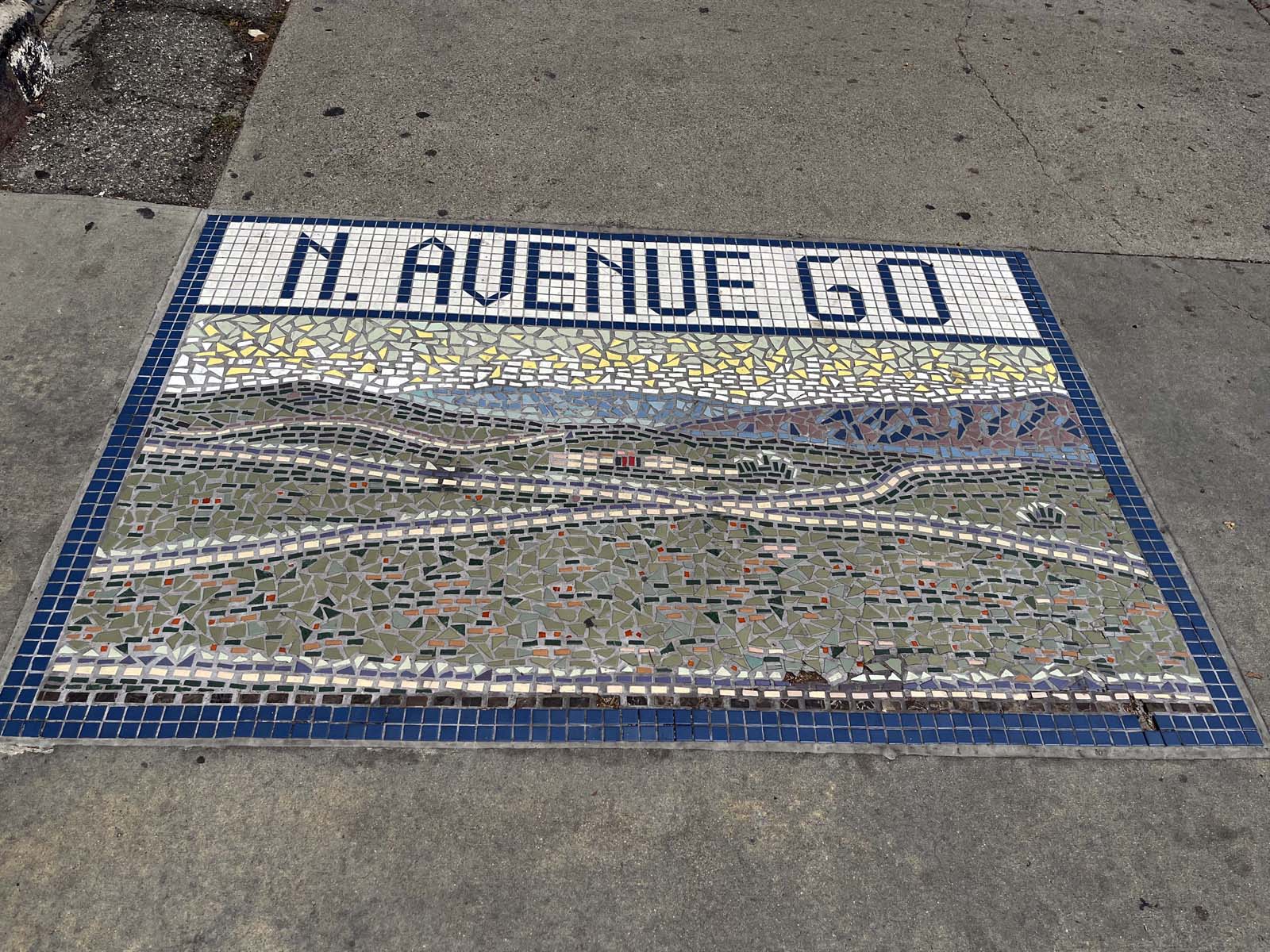
Walk with me. A slow amble under a hot November sun through strangely empty streets in central L.A. on a Saturday morning, with visual input galore.

Where are all the people? This was around 11.am.

Frequent stops for photographing – not enough, as it turned out, or not always focused enough.

As is my wont, I went into a neighborhood without having read up on it, always hoping to have a fresh eye. More educated now, I wish I’d had added stops for this or that landmark, oh well. Still captured the essence, I think.

A lonely tagger.

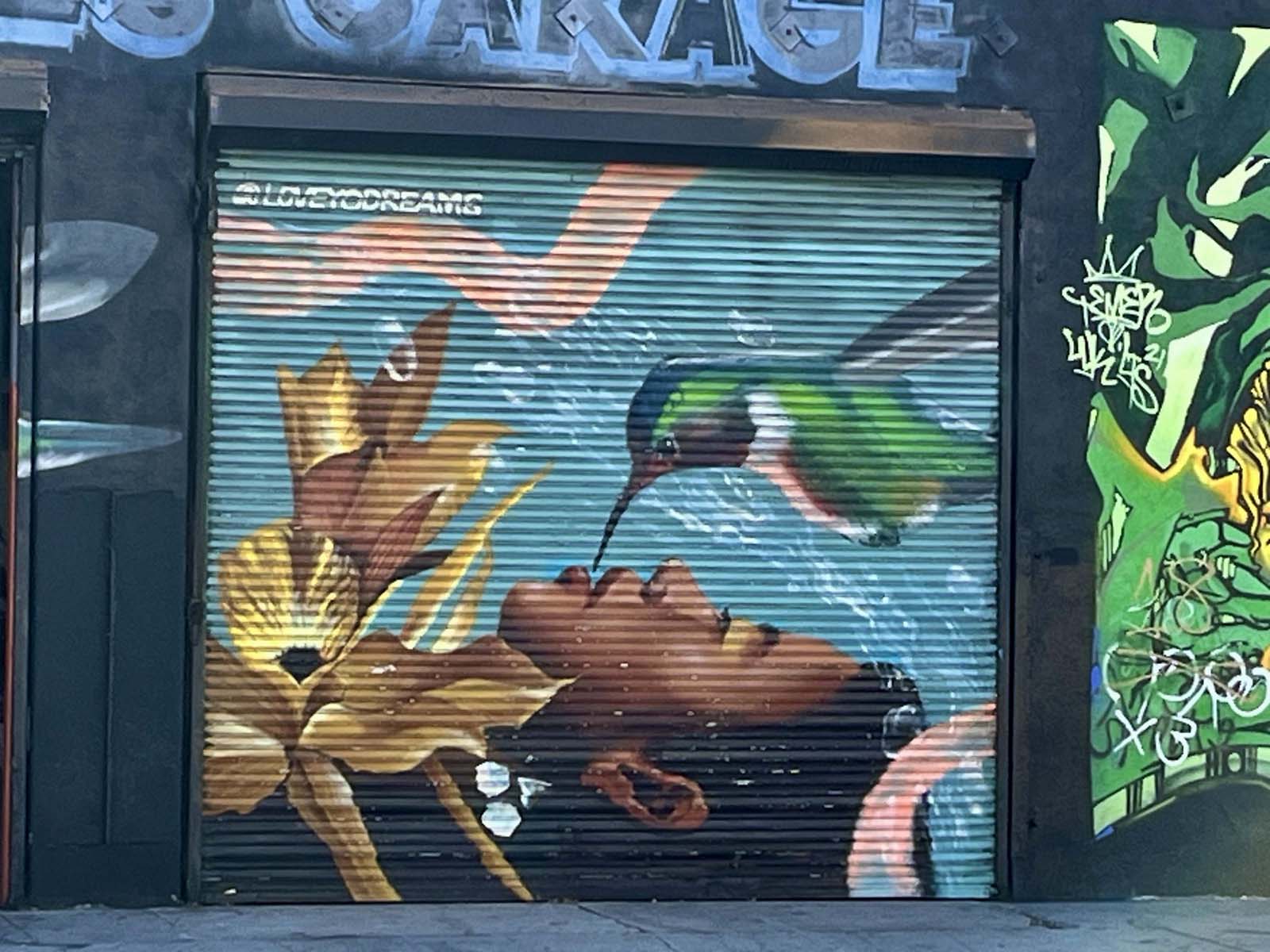
I had chosen L.A.’s art district for my outing because it is generally advertised as a haven for graffiti, and it did not disappoint. Its history, now that I have read up on it, is generally more interesting than most of the murals, however. More distressing as well. Much of the graffiti is simply tame.

The area was actually the center of California’s wine industry in the 19th century, L.A. then known as the City of Vines. Not only were the vineyards located on land taken from the indigenous Chumash, Tongva, and Tataviam tribes, but tribal labor was used to build the business in systems not unlike slavery. When native Americans came to the mission and were lured in baptism it brought with it a bidding contract that they could not leave. They were forced into indentured labor, including winemaking, and lived in subpar conditions that introduced and spread European diseases. When the mission systems were secularized, their land was given to white settlers instead.

The Earth Crew mural, a community mural from the 1980s, renovated 5 years ago.

Displaced, they roamed the area and many of them turned to alcohol to drown their sorrows, which led to horrid consequences.

(Ref.) 

Eventually the vineyards gave way to the citrus industry, which was later destroyed by treatment-resistant parasites. During its heyday, it needed a shipping network, provided by the railroad that arrived in 1876. First Southern Pacific, then the Atchison, Topeka, Santa Fe Railroad and finally the Union Pacific. By 1905, Los Angeles had become the western terminus for three major transcontinental railroads. All three railroads built depots, transportation buildings, warehouses, and rail yards in and around the Arts District. Many cheap hotels providing single rooms for the workers followed. Some of the photographed buildings capture the old architectural structure.

By WW II the rail system was replaced by the trucking industry, with the industrial nature of the area permanently ensconced until the 1960s or 70s, when artists moved into many warehouse now vacant, because smaller businesses had been absorbed or displaced. The alleys had also become too small for ever increasing truck sizes. By all reports the urban environment was decaying and dingy, but increasingly dedicated to art- making and -living spaces, once the City of Los Angeles passed the Artist in Residence ordinance in 1981, which allowed artists to legally live and work in industrial areas of downtown Los Angeles.

Looked to me like the little scooters were longingly staring at the mega truck…

Some 50 years later, gentrification rules the neighborhood. There is enormous loss of inexpensive lofts to developers who have converted some former loft and studio buildings into condos. 

New high-rises change the character of the neighborhood.

The district is still one of the most filmed locations ever, with as many as 800 filming days a year. The movie industry knows a good thing when it sees it. Chic bars and restaurants around many corners. Weed dispensaries everywhere.

Privately run and decorated dog parks as well – probably a good thing, for dogs and neighborhood alike.

Some landmarks remain, but are also undergoing changes, something that was true through the centuries for the American Hotel. That building and its occupants alone is a living testament to the changing times – a fascinating, detailed summary (with a link to a documentary movie) can be found here. It was the first hotel that was legally open to Black people, with a bar that was shut down in 1914, when it became obvious that Whites and Blacks mingled and partied together.

Ownership changed hands, and was Japanese, as were most of the guests, until they were brought into the camps after Pearl Harbor. A Mexican immigrant bought and operated hotel, bar and market in the mid 80s, and the artists moved in, using the exterior for murals as well. Here are the current ones:

 “La Abuelita/Má’sání” (2015)(Portrait of a Navajo weaver by El Mac. The geometric pattern above Abuelita was painted by Augustine Kofie and the lower left portion was painted by Joseph Montalvo AKA Nuke One of the UTI Crew.

White paws below on the other side of the building.

A pioneering social activist, Joel Bloom, opened a General store on the ground level in 1995 and fought for years against the forces of gentrification before he died in 2007. It looks like 16 years later that battle is still ongoing.

Lots of buildings are shuttered and For Lease signs everywhere – prices waiting for investors, I suppose.

Part of the attraction of the Art District is/was the music, always at the cutting edge before commercial appropriation. The only music related mural I found, though, commemorated murdered rap artist Nipsey Hussle, shot in front of his store in 2019 in a gang dispute. He was a rising musical talent and also revered as someone giving back to his community and trying to revitalize the neighborhood.

Mural by Mister Alex, Biganti26, Hufr – Hussle and Motivate (title of a track)

And memorialization of Kobe and his daughter is found here as well, as so frequently across this city that still mourns the loss, the sun providing a kind of halo.

Not much political art that I came across, maybe that needs to be explored in different neighborhoods.

But there was plenty of reference to comics and a certain affinity for portraits.

My eye, of course, was over and over caught by the saturation of the colors, even those in the pastel range. The light here is so different from up north, and it affects everything.

.

Yup, a lot of visual load. Don’t say I didn’t warn you!

Music today is by L.A. music ensemble Wild Up, playing a rousing piece by Julius Eastman.

Bold Bandits and Breathtaking Boulders

As hide-outs go, you could do worse. Particularly when you have attempted to escape prison four times, sentenced for stealing horses, and finally succeed, in 1862, with ten men dead in the process. When you are a poet at heart, you’re surely sensitive to the indescribable beauty of your surrounds.

Who and what am I talking about? Tiburcio Vasquez, son of a founding family of San Francisco, born in Monterey, and drawn to Southern California in the wake of the gold rush. He wrote poetry, he operated a gambling saloon, and eventually he robbed stage coaches when he wasn’t seducing everyone with a skirt on, married or not, apparently quite generous with the spoils of his thefts to those in his crew and needy people in the region.

Eventually he was caught, after multiple feuds and shoot-outs, hanged in 1875 after spending time in San Quentin. He might or might not have been the Robin Hood-like figure who Zorro was modeled after, but he was the one from which the otherworldly landscape neighboring the small town of Aqua Dulce derived its name.

The strange formation of sandstone is a park today, some 45 minutes north of L.A. off Highway 14. You drive through the Sierra Pelona into Santa Clarita valley, then through Aqua Dulce, a small town advertising the high school Fall Festival,

and then reach Vasquez Rocks where the Pacific Crest Trail intersects with multiple other hiking loops, all opening to awe inspiring vistas.

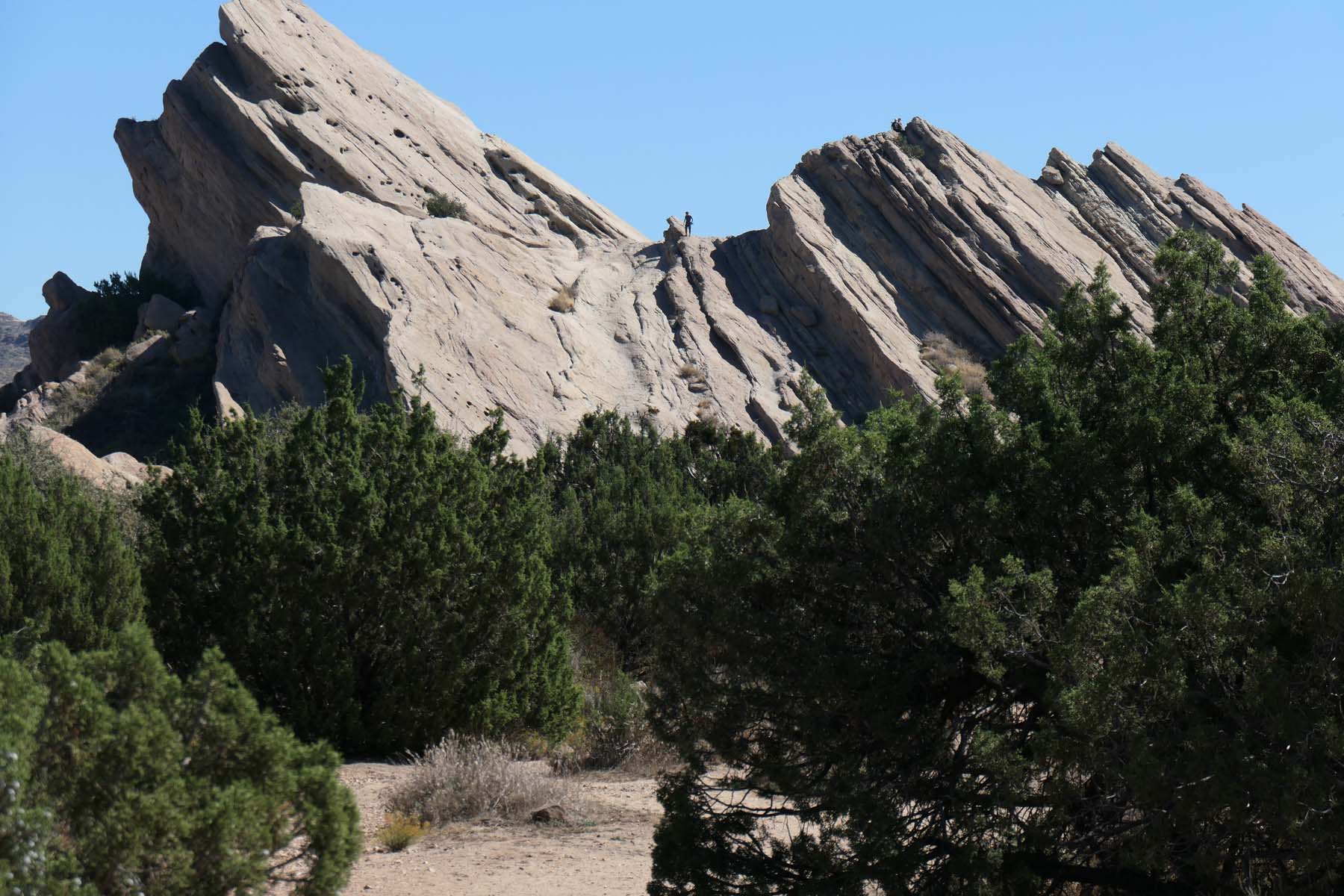
The rocks were formed by runoff from higher mountains, dirt, sand, plant remnants and so on, layer after layer for millions of years – 25 million, I believe – compressed by the weight of each additional layer, compacted into sandstone. Underneath it all runs the Elkhorn Fault which was actively shifting tectonic plates, thus elevating the rocks into angles as steep as 40 – 50 degrees (and pushing some of them up to 4 miles underground, in equally angular formations, it is believed.)

The main rock formations within the 932 acres of the park can be divided into those that are hard and brittle, called hog back ridges and others that are soft and round, full of holes (often occupied by owls!), eroded across time. There are also grinding holes to be found in these rocks, signs of the presence of the Tataviams (originally linked to the Shoshone) who inhabited the region for some 1300 years, from 450 BC until the 1800s.

When the Spanish missionaries arrived and founded the Mission San Fernando Rey de España some 20 miles away, a lot of them were brought in, converted, and forced to labor for their colonial masters. Within a few generations their language was lost. Today, the Fernandeño Tataviam Band of Mission Indians instruct us about their history and heritage and are working towards official recognition by the federal government.

There was much archeological evidence that informed about the Tataviams’ lives as gatherers, hunters and traders, including pictographs. Near the nature center where you enter the park, you can see exact replicas of many of them, all in one place. The original pictographs are in a section of the park that is closed to the public so they will not be destroyed. The originals have been there since 450 AD.

When I visited, the area was dry, suffused with light, filled with shrubbery that tenaciously clung to rocks, and a shining color palette from the greens and reds of the lichen to the orange glow of some of the boulders.

It was also relatively empty, not too many people hiking mid-day, but some climbing the formations, which provided perfect scale for the photographer.

At other times the landscape was booming with people: it has been used as a backdrop for Hollywood films since the 1920s, when it was still private land, leased to the film industry. Below is the list from Wikipedia, and that does not even include a far longer one for TV shows….

It was a perfect day. And here is locally sourced music….

Art On the Road: Made in L.A. 2023

· The Act of Living at the Hammer ·

“At its outset in the mid-1960s, the historic preservation movement contributed to the racial splintering of the nation’s urban fabric. It denied the freeway’s entry into communities deemed historic while granting its passage through communities judged differently. It empowered some communities in their fight against the freeway while putting others at a disadvantage. In the disproportionate number of black communities that bore the brunt of urban highway construction, the preservation strategy had no chance, leaving displaced residents with a meager set of resources to recuperate their connection to the past. This is why we need to pay attention to murals, festivals, autobiographies, oral histories, and archival efforts. In the high-stakes struggles over the fate of the American city, these were the “weapons of the weak,” the tools invented by displaced communities to fight the forced erasures of their past.” 
― Eric Avila, The Folklore of the Freeway: Race and Revolt in the Modernist City

WHEN YOU ARE NEW to a city, like I am to Los Angeles, one way of exploration is to hit the history books. I had described my early mapping of the city onto Mike Davis’ City of Quartz: Excavating the Future in Los Angeles in April here, while reviewing an exhibition from the LACMA archives, Pressing Politics: Revolutionary Graphics from Mexico and Germany.

This time, I brought Weimar on the Pacific: German Exile Culture in Los Angeles and the Crisis of Modernism by Ehrhard Bahr, thinking I might follow in the footsteps of my exiled Landsmen during the 1940s, artists and intellectuals fleeing Nazi persecution. The book’s introduction contains the following description: “Los Angeles has occupied a space in the American imagination between innocence and corruption, unspoiled nature and ruthless real-estate development, naïveté and hucksterism, enthusiasm and shameless exploitation.”

I don’t know about the American imagination, but those of us who devoured Berthold Brecht’s California poetry 20 years later as German teenagers obsessed with America were undoubtedly influenced by his assessment:

Contemplating Hell

Contemplating Hell, as I once heard it, 
My brother Shelley found it to be a place 
Much like the city of London. I, 
Who do not live in London, but in Los Angeles, 
Find, contemplating Hell, that it 
Must be even more like Los Angeles. 

Also in Hell, 
I do not doubt it, there exist these opulent gardens 
With flowers as large as trees, wilting, of course, 
Very quickly, if they are not watered with very expensive water. And fruit markets 
With great leaps of fruit, which nonetheless 

Possess neither scent nor taste. And endless trains of autos, 
Lighter than their own shadows, swifter than 
Foolish thoughts, shimmering vehicles, in which 
Rosy people, coming from nowhere, go nowhere. 
And houses, designed for happiness, standing empty, 
Even when inhabited. 

Even the houses in Hell are not all ugly. 
But concern about being thrown into the street 
Consumes the inhabitants of the villas no less 
Than the inhabitants of the barracks.

Bertolt Brecht Nachdenkend über die Hölle, 1941, translated by Henry Erik Butler

Mural and Paintings by Devin Reynolds on the walls of the Hammer lobby. Contains references to John Milton’s Paradise Lost, displacement from a beautiful home acting as a red thread through the histories of many Angelenos.

Many decades later I wholeheartedly disagree with Brecht’s description – I find L.A. vibrant and fascinating – though not his political analysis. He knew class divisions and precarity when he saw it. By all reports, he clung to negative emotions as a motor driving his writing. But his ability to pick up on what makes this city thriving, underneath capitalistic excess or popular culture driven by interests to keep racial segregation intact, might have been curbed by what was then and still is not easily visible to the outsider. At least that is my speculation after chancing on Eric Avila’s The Folklore of the Freeway: Race and Revolt in the Modernist City, from which I cited at the very start of these contemplations.

Knowing the history of a place is essential to understanding its character. Who rose to the top and who was pushed to the bottom will define the nature of both the lay-out, the (d)evolution of neighborhoods and the way power hierarchies are distributed. My hometown of Hamburg, Germany, for example, needs to be read in the context of its merchant marine and membership in the Hanseatic League, its intermittent warfare with Scandinavian neighbors, and its destruction under Allied firebombing during World War II.

Left: Marcel Alcalá Right: Emmanuel Louisnord Desir

There are ways of learning about the past of a city and her people that are not found simply by looking in all the traditional places. Clearly, mainstream historians have little incentive to document attempts towards self-empowerment or organized resistance by those not among the ruling classes. Facts about the past are instead often woven into the fabric of experienced daily life, painted on neighborhood walls (I had written about Pacoima, for example, here,) told during story time in corner libraries, experienced during Saturday’s soccer matches at the local park, found during celebrations of special days for different nationalities. Not just the past, I’d add, but the present, as it resurrects what was to be extinguished. Not exactly easily accessible to a foreigner like Brecht, struggling with the language, not particularly mobile, traumatized by persecution and exile, and facing the fact that there are 88 cities, approximately 140 unincorporated areas, and communities within the City of Los Angeles.

Jibz Cameron Cops, Coyotes, Cars, Crows (2023) Watercolor, Correction Fluid and Graphite on Paper

We, on the other hand, are lucky enough to find quite a bit of it all in one place, a weave that is compact as well as sprawling, screaming as well as whispering, consciously representing or intuitively describing, like L.A. itself. It’s made possible by curators who brought a cross section of yet undiscovered stories into an exhibition that in many aspect mirrors the city it drew from.

At least that is how I experienced the Hammer’s current exhibition Made in L.A. 2023: The Act of Living, an iteration of its biennial attempt to showcase new talent, unknown or underrepresented artists, providing access to what is likely hidden to most of us from different cultural enclaves. Guest curator Diana Nawi and Pablo José Ramírez, who joined the Hammer museum full-time in June, and Ashton Cooper, Luce Curatorial Fellow, have assembled some 250 works of 39 locally based artists, challenging us to confront our stereotypes and navigate an abundance of thought-provoking art. I come back to what I had written about our own Portland’s current art extravaganza, Converge 45: perceptive curation is a mystery to me, like herding cats, but when it succeeds it is a gift to the community (never mind an intellectual feat.)

Their guiding principles can be found in their statement above.

***

AT RISK OF FALLING for surface rather than structural characteristics, here is an analogy I can’t resist: as L.A.’s neighborhoods differ along multiple dimensions, so does the chosen art in this show. By size, by spacing, by density, by degrees of familiarity. Just as I like some neighborhoods more than others, some leaving me cold, some moving me to the core, some eluding my comprehension, some dull, some riveting, some evoking scorn, and others longing or admiration, so it is for much of the work on display. What registered most deeply was the fact that many of the exhibits taught me something I would not have otherwise known, and how much, sometimes viscerally, texture ran as a common theme through the galleries. Texture, indifferent to past, present or future, is, of course, a stand-out characteristic of Southern California’s nature for this Northerner, with its unusual mix of desert and tropical plants, all ridges, grains, thorns, spines and spikes, peeling bark, twisted fronds, and leathery surfaces.

Kinetic sculpture by Maria Maea “Lē Gata Fa’avavau (Infinity Forever)” (2023) including parts of palm trees, car parts and feathers.

Really, I think there are few materials known to man not included in this biennial. Natural materials like wood, bones, wool, cotton, pearls, wax, mica, graphite, dirt, salt, limestone, copper, leather, feathers, palm fronds, sea shells, corn, corn or other plant based substances. Fabricated materials like acrylic, plastics, paper, forged metal, glass, lead alloys – you name it, it was affixed or served as a constituent even in the context of more traditional forms of painting. Some assemblages consisted of more material detail than you could possibly take in at a single visit. Videos were (blissfully) few and far in-between, although demonstrations of octogenarian Pippa Garner triggered some giddiness.

What follows are some photographs to relate the overall variety of art on display, not necessarily work that I liked, but work that speaks to the range of cultural production, the focus on texture, as well as entryways into histories new to me. I will then turn to my absolute favorites, both artists I had never heard of. In one case, apparently, the same was true for the curators, who only met the young painter upon recommendations of other studios.

Beautiful weavings by Melissa Cody, Scaling the Caverns (2023) at center, detail below

Sensuous configurations of leather, painting- or quilt-like, by Esteban Ramón Pérez,

Esteban Ramón Pérez Cloud Serpent Tierra del Fuego) (2023) Leather, rooster-tail feathers, urethane, acrylic, nylon, jute wood.

Disquieting collages by King Seung Lee,

Kang Seung Lee Untitled (Chairs) (2023) Graphite, antique 24-k gold thread, same, pearls, 24-k gold leaf, sealing wax, brass nails on goat skin parchment, walnut frame.

(Aside: what it is with chairs that can so easily register as ominous? Look at Tadashi Kawamata‘s currently exhibited at Liaigre’s building in Paris: Nest at Liagre. Or is it just me?)

Photo creditL Sylvie Becquet

From the younger set:

Michael Alvarez 2 Foos and a Double Rainbow (2019) Oil, Spray Paint, Graphite and Collage on Panel

A reminder for those of us who vicariously experienced the AIDs epidemic as young adults when living in NYC, with friends dying:

Joey Terrill works, the selection depicting formative memories and daily experience in queer communities.

The Munch-inspired scream on steroids below attracted a lot of attention, justified, in my opinion, only if you looked more closely on the backside of the sculpture that provided a narrative worth the attention grabbing. The sculpture was co-created by numerous Native Americans.


Ishi Glinsky Inertia – Warn the Animals (2023)

Runner-up to the works below that inspired me most, was this assemblage using a silk parachute. Talk about texture!

Erica Mahinay Lunar Tryst (2023) and Details. Acrylic, raw pigment and aluminum leaf on half-silk parachute, lead, ostrich feathers.

And here are Kyle Kilty’s paintings, as vibrant, patterned, and hibiscus-colored as L.A. itself, capturing the imagination with abstractions that turn representational upon closer inspection – just about the same process the traveler experiences when getting to know and learning to navigate this moloch of a city.

For some reason I was reminded of Paul Klee, had he lived in another century, under the California sun and caved to demands for size. (The Phillips had an informative exhibition on Klee’s lasting influence on other American painters, some years ago.)

Kyle Kilty It could be, Frankly (2022) Acrylic, mica flake and oil on canvas.

Kyle Kilty It Could Get the Railroad (2022) Acrylic, oil, and graphite on canvas


Kyle Kilty Arranging (2019) Acrylic, oil, and gold leaf on canvas

And here, finally, is the essence of story telling about the facets of this city here and now, its hidden treasures and traditions, the diasporic nature of its people due to displacement from their home countries and/or the grid of highways, literally embedded in the substance of L.A. county itself: the soil collected from its various neighborhoods, mixed with salt, rain, limestone and masa. Jackie Amézquita’s 144 slabs are testament to the unwritten history of the many unseen people who constitute the lifeblood of L.A., the embedded drawings representing typical sights during quotidian encounters.

Jackie Amézquita El suelo que nos alimenta (2023) Soil, masa (corn dough), salt, rain, limestone, and copper

Here you can see her at work and hear her explanations of the artwork. It is terrific on so many levels.

***

THERE IS CHANGE AFOOT at the Hammer. This week we learned of the planned retirement of long-time director Ann Philbin, with a search for a replacement underway. It will be difficult to fill those shoes. Hopefully, the core of her focus will endure, a commitment to contemporary art with a focus on emerging artists and social justice. The 2023 biennial certainly can serve as a model: reconsidering the past in the sense that it paves the way for grasping a more equitable future, but then moving on, creating our own utopias.

Started today with an incisive German voice. Might as well end with another one. If you replace the words “(social) revolutions” with “art,” and “19th” with “21st” century, the museum might eventually follow this model:

“The social revolution of the nineteenth century cannot take its poetry from the past but only from the future. It cannot begin with itself before it has stripped away all superstition about the past. The former revolutions required recollections of past world history in order to smother their own content. The revolution of the nineteenth century must let the dead bury their dead in order to arrive at its own content.”

Karl Marx The Eighteenth Brumaire of Louis Bonaparte. 1852

Mirrored in installation by Guadalupe Rosales.

———————————————

Made in L.A. 2023: Acts of Living

OCT 1 – DEC 31, 2023

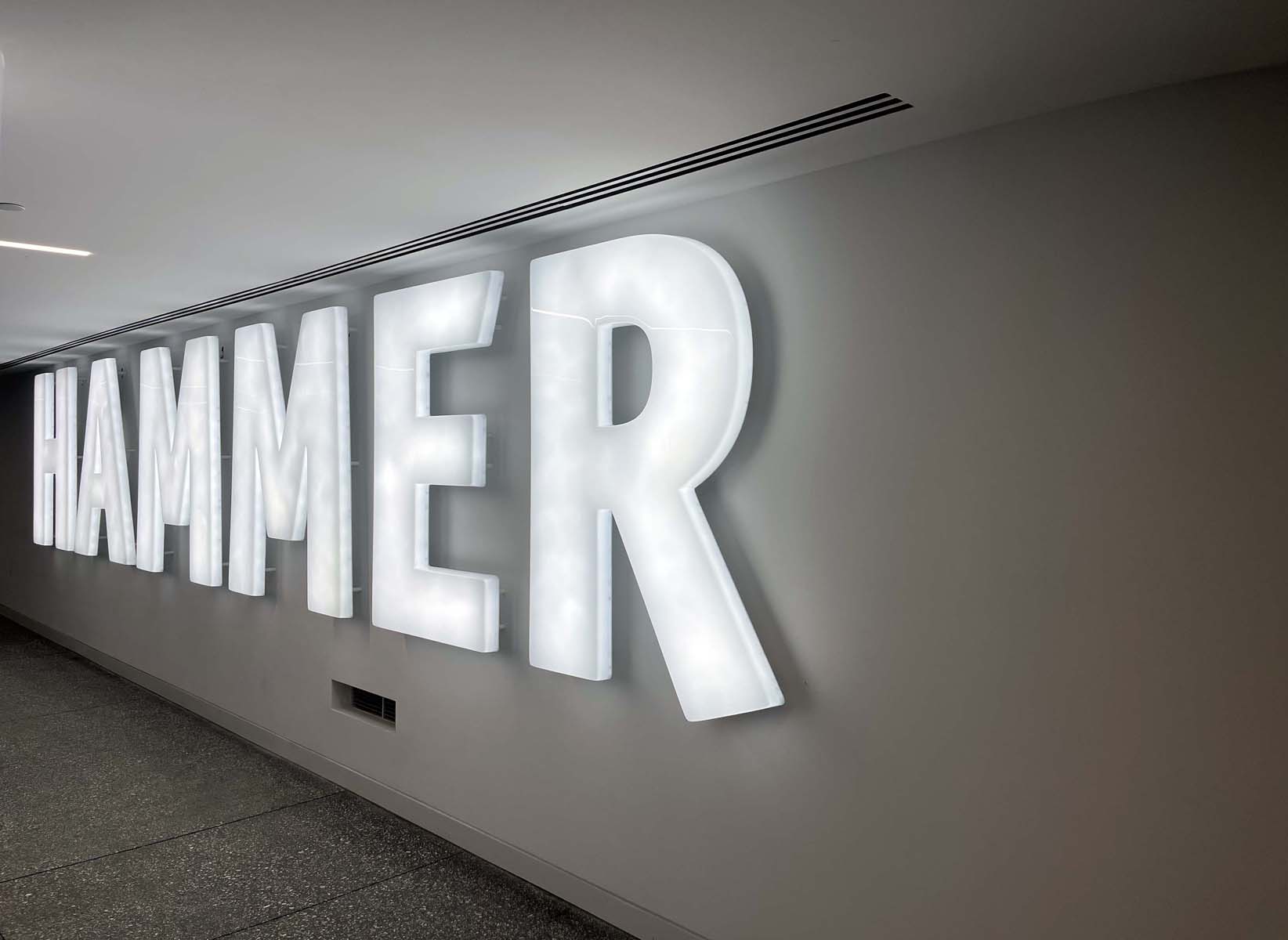
HAMMER MUSEUM
Free for good

10899 Wilshire Blvd.
Los Angeles, CA
90024

Call for a Commons: New Directions at the Columbia Gorge Interpretive Center Museum

“History is who we are and why we are the way we are.” – David McCullough, American historian (1933- 2022)

***

I’m curious: how many of you have ever visited the Columbia Gorge Interpretive Center Museum in Stevenson, WA? A mere 50 minutes from Portland, the drive there takes you through beautiful scenery and ends up at a multiple-acres piece of land adjacent to Skamania Lodge, alongside a small lake dotted with islands and views of the Columbia and the mountains as backdrop. A compact, modern building made of glass and concrete overlooks the property, with some rather large wood carvings and a collection of historical tools and machinery outside, and multiple exhibitions dedicated to the history of the region displayed on the inside.

I had never known the museum existed, much less visited there, until recent changes at the institution brought it onto my radar. That might have simply been my ignorance – wouldn’t be the first time – or it might have had to do with lack of outreach or appealing programming. That is in the process of changing now, under a new executive director, Louise Palermo, who is very much engaged in putting this hidden jewel onto the map beyond its familiar supporters and viewership of long-time residents of the Gorge. (And a heads-up: a new website, reflecting changes, is in the process of being installed and will be up in a few days. Information about location, opening hours and directions have, of course, not changed.)

The building houses numerous collections across two floors, conveying the history of the land and the people, from First Nations to modern settlement, forestry and industrialization of the region. A small theatre shows documentary films, some exploring the geology of the Gorge. There are a few quilts exhibited, and there is an unexpected, one might say quirky, collection of thousands upon thousands of rosaries, spiking my curiosity how some of these, donated by famous people – Lawrence Welk, Al Smith, the first Catholic to run for the office of president in 1928, one donated in memory of Robert Kennedy, who had left it in a small church in Bavaria; and one donated in memory of Dag Hammerskjold, Secretary General of the United Nations from 1953-1961, and one donated by President John F. Kennedy – ended up in cupboards in the Gorge.

You enter the museum through two rooms of exhibits describing the ways of life and fates of the tribal populations of the region.

Much needs to be done, I suggest, to bring this collection and particularly the explanatory signage up to date. Some of the language obscures the consequences of settler colonialism. Pretty much the rest of the museum is teaching us about how the settlers lived and thrived and changed the land, including the rationale for building dams and their fateful consequences.

The Grand Gallery focusses on the way wood was harvested and processed from the surrounding forests down to the mills, much to the delight of visiting school classes who get to see moving and noisy machinery, once you lure them away from the stuffed mountain lion overseeing it all,

or unexpected signs of Big Foot in the corners.

To my delight as well; I had no clue about the complex processes involved and was fascinated by the traditional steam engine, the Corliss, providing power needed to run sawmills. Harvesting of fish is shown by juxtaposing mechanical methods, a fish wheel, and Native American techniques, represented by the model of a native dip netter, at a water feature. This alone would be an interesting starting point for a conversation about extraction and preservation, particular if there were youth programs that would seed not just a love of history but an understanding of each person’s possible role as a steward of the resources of the Gorge.

Louise Palermo instructing 3rd graders

There is also a gift shop that carries arts and craft by local providers in addition to the usual fare. A small gallery offers the opportunity for changing exhibitions, with the current one, Women Artists of the Gorge, being the reason for my recent visit of the place.

PhotoCredit: Kristie Strasen

***

“If you don’t know history, it’s as if you were born yesterday. If you were born yesterday then any leader can tell you anything.” – Howard Zinn, American historian (1924-2010)

I don’t know if these things existed in the U.S., but in my German childhood one of the highlights were the trips to the country fair or the green grocer were you could plunk down your 10 Pfennig and receive a tiny paper packet stuffed with miniature toys, colored puffed rice and small candies. It was called a Wundertüte, a “wonder packet,” full of surprises. (Of course it was also a way to assure that young kids got used to return customer – consumerism, given the inclusion of collectibles, cards or toys.)

The current exhibition Women Artists of the Gorge, brought the analogy to mind. Here is a collection of incredibly varied works hung in a small space, with many of them delectable and some eliciting, well, wonder. Shout out to Jen Smith, who artistically hung a show that ranged across so many dimensions, type of media included, paintings, prints, photography, collage, macrame and woven tapestries in this tight space. Shout out to the folks at the White Salmon Valley Community Library and the White Salmon Arts Council, Ruth Shafer and Kristi Strasen respectively, who had originally conceptualized an exhibition of regional women artists in honor of Women’s History month, from which a subset followed the invitation to show their work at the Columbia Gorge Interpretive Center. Shoutout to the staff who kept the daily visitors happy and helped with the pragmatics of mounting the exhibition. The loudest shout out of them all, of course, goes to the artists:

Julie Beeler, Jillian Brown, Janet Essley, Sally Gilchrist, Daiva Harris, Kristine Pollard, Autumn Quigley, Jacqueline Moreau, Cathleen Rehfeld, Ana Rugani, Jen Smith, Kristie Strasen, Cyndi Strid, Kelly Turso and Jodi Wright.

Their work teaches us history in different, more personalized ways, through love of place and depictions of its beauty up to warnings about environmental protection and the need for inclusion and conflict resolution.

I can obviously not review each and every one of the works, so know that my selections are based on personal interest or curiosity, and not at all linked to the quality of the work. As a photographer, I was drawn to one of the photographs on exhibit which anchored the entire show for me in its depiction of female family members capturing a moment of laughter and joy. For many decades, San Francisco-born Jacqueline Moreau‘s work has documented the lives of Native American peoples along the Columbia River, and their fight to secure the rights afforded to them by a provision in the 1855 (Confederate Tribes of Warm Springs) treaty. The intimacy of this photograph is evidence of how integrated a photographer can become with a subject if respect, empathy and shared values overcome outsider status, enabling new forms of community.

Jacqueline Moreau The Spino family (Mona, Geneva, Andrie, Joyce, and Delores.)

As someone who has worked on documentary film projects about the fossil fuel industry, I was moved by the portrait of an Alaskan native whose land, heritage and fate is intrinsically connected to the future of drilling and pipelines and the havoc they can wreak. Janet Essley, a muralist, teaching artist and activist for justice used dabbed motor oil on paper for the portraits in her series Endangered Species (2004), which features people across the world (Columbian, Indonesian and Tajikestani natives among them) whose lives are touched by oil extraction and production.

Janet Essley Alaska

Two depictions of wildlife caught my attention – Autumn Quigley‘s for the wit and thoughtfulness that went into the collage, which seamlessly combined spring’s trilliums and fall’s seed pods and fallen leaves, and Jen Smith‘s for the obvious concern how shared space can be made a reality for creatures that are still truly wild. Ever encroaching human construction is a true threat to habitats, at the same time that we are in such dire need to provide more housing for ever growing populations.

Autum Quigley Windfall

Jen Smith Queen of the High Country

Last but not least there were tapestries that impressed with motion (the strong Gorge winds, swaying the grasses and echoing the waves of the river, were palpable in the one depicted below,)

Jodi Wright Mount Adams

and coloration, the subtle and beautiful gradations of which could not be fully captured under the light conditions.

Kristie Strasen River Tryptich

(I got a better shot at the intricate color play when I visited Strasen in her studio to learn more about the origins of this communal exhibition that she originally co-mounted. Let me share the beauty.)

A set of pillowcases and a collection of small works done during pandemic isolation, defiantly exuberant.

Sometimes I learned interesting backstories that helped to appreciate a work even more. Driven by her passion for mycology, the science of mushrooms, Julie Beeler, together with some collaborators, created a Mushroom Color Atlas which “is a resource and reference for everyone curious about mushrooms and the beautiful and subtle colors derived from dyeing with mushrooms.” People around the world can use this on-line resource, learning and experimenting with it, being drawn into a growing interest for our natural environment. Beeler also teaches in person in various workshops around the nation and lectures at scientific conferences. The best part: not knowing ANY of this would make no difference for the appreciation of the sheer beauty of her pieces. Well, for this viewer, in any case.

Julie Beeler Fungi Bedrock

***

I photographed the show when it had been hung on the day before before opening night, and so worked in an empty room bereft of people. Yet a sense of community was palpable, since the accumulated works really seemed representative of so many different artists, stages of experience, cross section of interests. By all reports that experience of community was present in squares during the opening reception, with a lot of people attending, fortified by wine generously provided by Domaine Pouillon, and interested in getting to know each other.

In some ways that seems to me an important part of the mission this museum under new leadership could adopt: providing a commons, a platform where people with shared interests or concerns, for that matter, can meet, mingle, learn and exchange ideas. One of the definition of commons is “natural resources that groups of people (communities, user groups) manage for individual and collective benefit.” Here it could simply be the offer of a cultural space, shared by the the many of us.

Artists play an important role in this endeavor. Knowing history is surely something that most people see as important. Yet we live in a time of increasing restrictions on teaching history, at all or in specific ways, depending on who you ask or in which state you live. Teaching the history of a place – here the Columbia Gorge – cannot come from a single source, however richly endowed with objects and artifacts to support a particular claim. It has to be provided with the help of different perspectives, and who better equipped than visual artists to relate something in non-didactic, vivid, personal ways that might register much more easily than dry facts or official story lines. I am not implying that the artists in this show intentionally set out to convey insights about history. But the accumulative power of much of the work suggests something about what it means to live in the Gorge, be exposed to both its beauty and its hurt, its past and its present, its nature and culture that needs stewardship and protection.

If the museum opens a commons, inviting and presenting diverse voices easily found in the rich tapestry of the Gorge population, during fun events or serious shows, it will establish its place on the map in no time, an invaluable resource for all of us.

WOMEN ARTISTS OF THE GORGE

June 17th – September 5th, 2023

Columbia Gorge
Interpretive Center
Museum
990 SW Rock Creek Dr
Stevenson, WA 98648

Glimpses of Highland Park, L.A.

Just a short walk, if you want to join, another one to bring home the immense variety of what L.A. has to offer, one neighborhood at a time. Highland Park has two dubious distinctions: for one it was the very first suburb of L.A. proper until 1895, when it was annexed after the community pleaded for incorporation, by all reports to assure increased police presence in a flourishing red light district. It took but two days after annexation, that the police chief and his posse came in and literally burned down all the brothels and gambling saloons. Maybe not a coincidence that L.A.’s Police Museum is located in this neighborhood. I did not inquire. Or set foot in it. Surprise.

Secondly, Highland Park has had the highest speed of gentrification of all small L.A. neighborhoods in recent years, which can be a good thing or a bad thing, depending on your perspective and the size of your wallet.

Lots of stuff that is too hard to move or had to be sold, ends up in second hand stores that line the streets.

As does the stuff itself.

The neighborhood is situated between central L.A. and Pasadena alongside the Arroyo Secco. Much of its history is commemorated with sidewalk mosaics and information columns that display archival photographs and explanatory texts, quite informative.

Highland Park started to flourish with the arrival of the San Gabriel Valley Railroad which opened a station in 1885, followed by the Los Angeles and Pasadena Electric Railway that laid down the first interurban electric railway in Southern California in 1895, helping people to commute. Today you find suicide prevention signs at every crossing.

 Image courtesy of the Los Angeles Public Library

Occidental College, established by the Presbyterian Church, opened its campus in the early 1900s and has been serving generations ever since.

Image courtesy of the USC Digital Library

Many of the public buildings from the time have been preserved, but are no less exposed to change. A historic landmark, the nearly century-old Highland Theatre building on Figueroa Street, one of the two main drags through the area, was up for sale as of last August, since its 99 year lease, signed in 1924, will expire. It was the last of 4 theaters along this street to survive, including the historic Sunbeam Theatre. The facade will have to be preserved, but the function and lay-out inside is the new investors’ domain.

Some public buildings are well maintained, other establishments show the ravages of the economy. Here is the public library

and the municipal water building.

The minute you venture off the main thoroughfares you find small, well maintained bungalows and funky gardens or wall paintings. But also signs of distress.

Lots of color to be found on the major streets as well, tempered by the presence of police in front of swank new shops and restaurants, though absent at the traditional stores.

Someone chose aphorisms for public utility meters,

And murals commemorate the history of the place.

And sometimes color just pops up unintentionally….

Lots of eateries behind screens on the sidewalk, filled with young people enjoying lunch – the place is clearly vibrant, with traditional mini-malls sharing space with new upscale boutiques.

I must say, I will miss the diversity of it all when returning to PDX. Then again, it will be good to be home after such a long stretch. Just think of all the bird pictures you’ll be getting…..