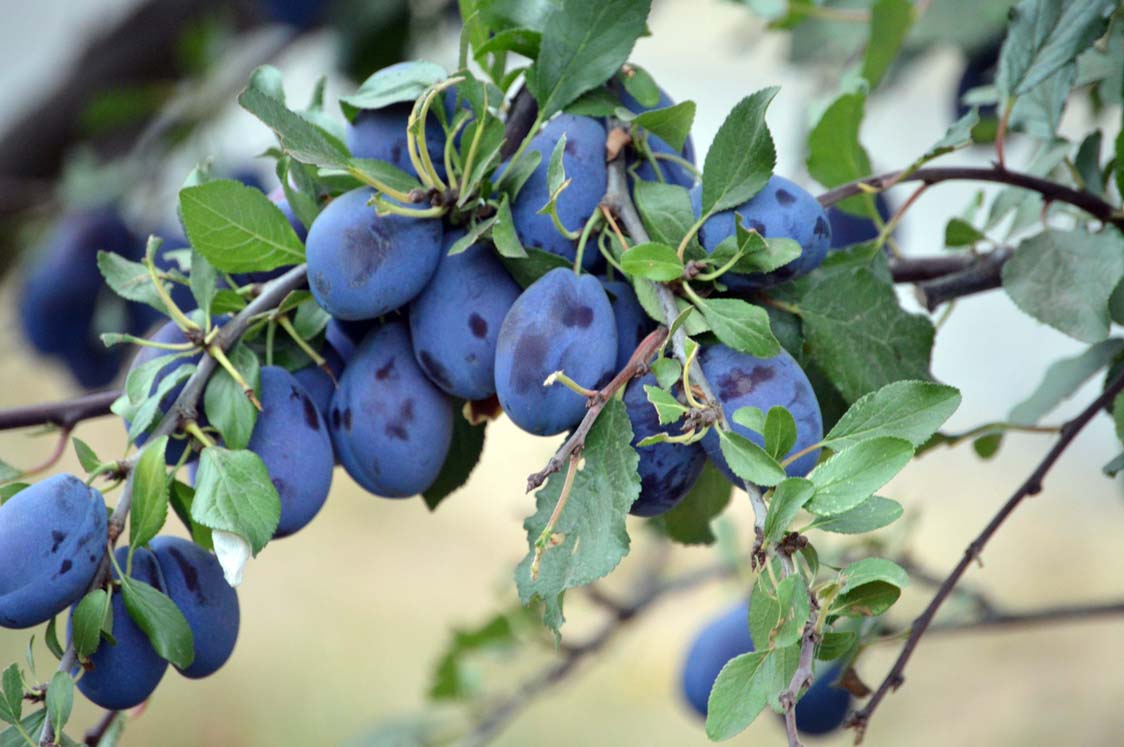
We went plum picking this week before the rains set in. An afternoon as good as it gets – with a happy three-year old bouncing around the orchard,
a happy baker filling her bags with ripe, juicy fruit,
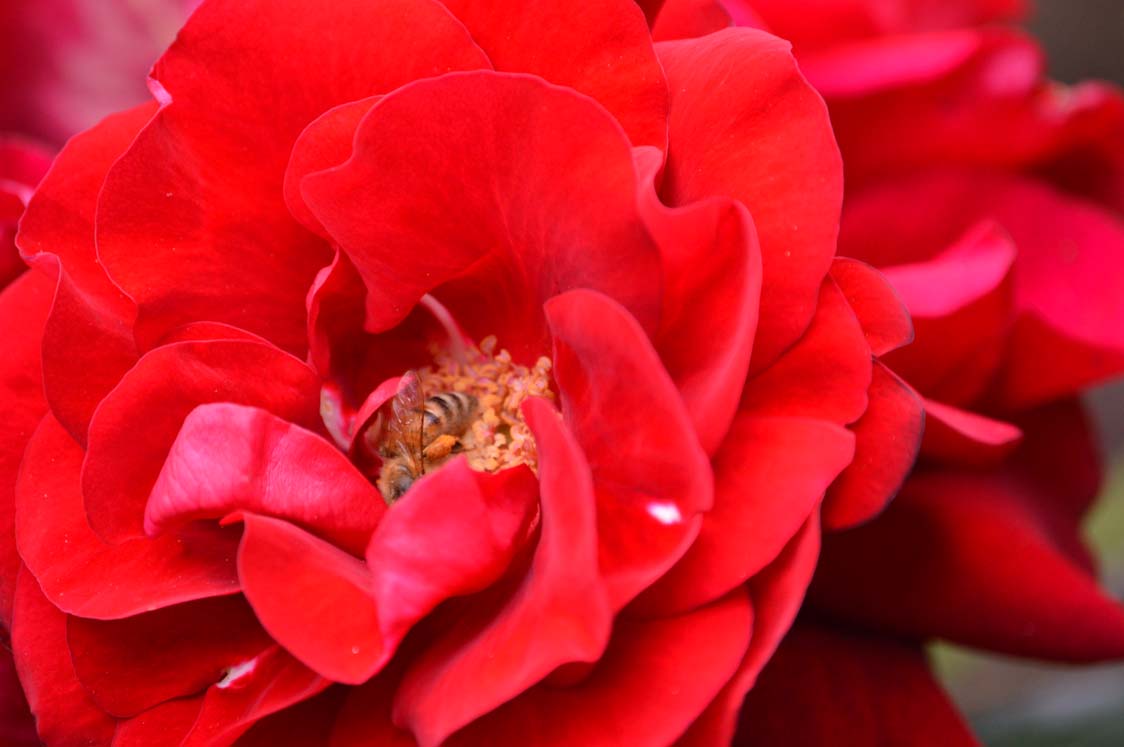
a happy photographer relishing saturated colors, happy bees and wasps providing constant noise in the background, late summer sounds.
Some of the fruit trees not so happy, alas, the heavy load ripping branches right off the stem. What got flung into the nearby grass looked like late season Easter eggs.
Plums are one of the earliest fruit domesticated by humans, over 2000 years ago in both China and Eastern Europe. They can be dried and thus kept for lean times. Both fresh and dried plums have enormous nutritional value and are helpful for digestion. They are filled with antioxidants which helps combat inflammation in the body and also protects against cancer. They contain quercetin, a type of polyphenol that can improve heart health and brain function related to memory. They are also packed with potassium which helps bone health. A study of postmenopausal women who had prunes in their daily diet found lower rates of bone loss and improved overall bone health. Plums against osteoporosis! They do contain a lot of sugar, but apparently also a chemical that prevents sugar spikes in your blood.
And, of course, their beauty provided models for painter throughout the ages, as you can see below.
Lest you think I have changed and stick to the happy stuff – here are some thoughts that occurred to me after our outing, elicited by an article in Vox that I’ll summarize below.
The urge to eat locally produced food – and what is more local than U-pick farms? – has increased, given the many food-borne illnesses we have witnessed blossoming under the Trump Administration. There isn’t a day where there is not another food recall. Since May, the United States has seen more than 17,000 lab-confirmed cyclosporiasis cases, likely a huge undercount of what is happening in the general population. People have died from listeria infection brought on by cottage cheese, salmonella outbreaks originated in eggs and jalapeños. Frozen blueberries have been contaminated with e-coli, leading to highest warning level recall last week. Alfalfa sprout sickened people, contaminated with salmonella AND e-coli.
There are several factors contributing to these outbreaks, not just the administration’s decision to sharply curtail its ability to monitor for and respond to these outbreaks. Between the FDA and the US Department of Agriculture, which also oversees food safety, and several related agencies, more than 11,000 workers have been lost. The CDC, which helps respond to outbreaks once they start, has lost about a quarter of its workforce from January 2025 to October 2025. The federal government also shut down several national monitoring programs for foodborne illness in 2025—including for the cyclospora parasite specifically. The state and local agencies that surveil for and respond to food outbreaks have also faced staff cuts because they depend on the federal government for their funding.
The more general factors for the increase in illnesses we are seeing, are related to climate change, however, and the fact that we rely on globalized food chains. Warming temperatures across the globe increase humidity which helps both salmonella and e coli to thrive. Cyclospora has historically been found in subtropical climates, but now it grows inside the US as well. With warmer temperatures in more northern regions, it is likely to become epidemic here.
In addition, “the sometimes international trip from the farm to the store for a bagged salad kit offers multiple moments for potential contamination, including tainted irrigation water, local wildlife excrement, and poor storage practices, making it possible for dangerous pathogens to take hold before a person even buys their groceries.”
Carefully choose where you get your lettuce from, then, and buy full heads. Better still, get your vitamins with grilled vegetables, with heat putting an end to the offensive buggers. Best: live on prunes! Oh, I wish we could.
Jacob van Hulsdonk Still life with grapes, apricots and plums 17th Century
William Henry Hunt (1790 – 1864) Plums Date unknown by me
HENRY ARCHIBALD MAJOR Plums 1883
Jean-Simeon Chardin Still Life with Plums (1730)
Louise Moillon Still Life with Plums 17th Century
Unknown Early 20th century
Sasja Wagenaar Plums (2022)
Postcard from Provence
Music today is by Dvorak, celebrating natural beauty.
Last week I was invited to photograph my favorite garden, once again. So much in bloom, but for today I want to give the roses place of honor. Just wish I could send the scent(s) as well – they were as enticing as the visuals.
Roses need a lot of care and attention, being susceptible to soil and light conditions, in need to be fed, appropriately watered ( which can differ from species to species) and protected from pests. That about sums up my reading recommendations for today: a lot about attention, the existence of pests, and food for our brains….
I’ll start with a link to a wonderfully introspective piece (easy to read, too) that alerts us to how our attention is manipulated these days and the cost attached to this inflicted dispersion. Chloe Hope once again moved me to tears, when she describes the mining of attention:
“Poets, mystics, children and sages have, for centuries, pointed towards our attention as being inseparable from our love. They noticed how, in the presence of what we cherish, we gather ourselves in—how the fractured, weather-like self draws together and briefly becomes whole, before it’s offered out, towards our devotion. I doubt that any of them thought that, one day, it would require defending. That our species would come to tolerate a culture in which attention is mined for profit….Predatory capitalism mines our attention so it can sell us things we don’t need, so it can tell us that nothing is precious but that everything is urgent, and that the ache we collectively feel can be soothed by some new, shiny thing. It needs us looking towards its wares and away from the global damage it inflicts…”
Let’s gather our attention and look towards the things that matter, the protection of who and what we love.
Hard to do, of course, when my attention is drawn to the pests of the world, be they screwworm making a reappearance after the Trump administration canceled the relevant protection programs, or Ebola rushing forwards, with this nation unprepared for a major catastrophic outbreak, again due to cancelation of the relevant security measures. Never mind the less obvious (presidential) kinds, that make major policy decisions by consulting their dead dog (by now cloned into at least 4, maybe 5 other copies.) He welcomed a prominent American oligarch into his Argentinian realm this month, sharing the passion for discussing the Antichrist and humanity’s future (bleak, if these kinds of people’s vision blooms, mind you.)
However, if you read one piece today and are not afraid of length and careful attention requirements, I recommend this one: Nancy Fraser discusses Gaza as world event. The focus is on our moral treatment of this ever complex situation, with special attention to Germany, America and Japan. I was, of course, interested in the German part in particular, but the entire essay was more enriching than much of what I read all month long.
For those of you who are interested in psychology, trauma research and politics (bundled, no less) I would also urge to read Jon Danforth-Appell’s article in the Jewish Currents: Does the Jewish Body keep the Score? He dissects the myth of body memories (in those not directly born to survivors who might transmit a heightened sensitivity or reactivity to their offspring). He also tackles the fact that biological explanatory models are used to exculpate violent and aggressive behavior when applied to the survivor narrative. A must read for all those involved in or concerned by the antiZionism = antiSemitism debate.
Last but not least, the visit to the garden produced a special find: a crow nest from last year came down from a tree, showing a lot of duct tape woven into the twigs, clever recycling. It reminded me of the new kinds of birds’ nests found these day in Ukraine: they are constructed of discarded drone fiber-optic cables. Our’s to frame: Apocalyptic vision or wildlife, ever adapting.
I lied. It’s time for two regulars: sun flowers, which I perennially photograph during August, and my usual rant against the perversion of scientific findings.
You might or might not have heard about an increasingly hostile debate around the health effects of seed oils. Oils extracted from canola, soybean, corn and, yes, sunflowers, are common cooking staples in American kitchens and the fast food industry. Fitness gurus and other influencers on the internet are claiming that these oils are the source of our deteriorating health and the obesity epidemic, responsible for inflammatory processes in our bodies and even diabetes. The most powerful among them, our very own Secretary of Health and Human Services Robert F. Kennedy Jr., claims we are unknowingly poisoned by these seed oils and demands a return to beef tallow or rendered animal fat in cooking.
Many Americans are already reducing their use of seed oils in their own kitchen, and so are restaurants and fast food chains on a larger scale, with real economic consequences for many farmers invested in seed crops. What does science say about the “bad for your health” allegations?
In short: BS.
The main claim of seed oil opponents states that seed oils’ high omega-6 and low omega-3 composition causes an imbalance that may increase the risk of chronic conditions by boosting inflammation in the body. Scientific studies show no impact of increased intake in omega-6 on inflammatory processes. With regard to obesity, note that seed oil-fried foods are also high in refined grains, added sugar, and sodium. If you eat fast food, it is the combination that leads to adverse health, not an isolated ingredient. and of course almost 75% of the American diet consists of ultra-processed foods…
Further, seed and plant oils reduce “bad” cholesterol, thus lowering the risk of stroke and heart attacks, according to the American Heart Association. It also looks like swapping less than a tablespoon a day of butter for equal calories of plant-based oils could lower premature deaths from cancer and overall mortality by 17 %. Beef tallow, of course, is much higher in saturated fat, it has 109mg of cholesterol per 100g. So adding it to your diet will heavily impact heart disease. But that is not the only problem.
If we look at the large picture (why has that become so difficult???) beef tallow generates 11.92kg of carbon per kg, on the top end of the list of foods with the highest GHG emissions. “Beef itself is the most heavily polluting food group on the planet, emitting twice as many greenhouse gas emissions as the next on the list (dark chocolate. Hmmm.) Cattle ranching causes the highest amount of destruction of rain forests, with deforestation from cattle ranching releasing 340 tons of CO2 annually, making up 3.4% of global emissions. Pasture-raised cows that feed on grass account for 20% higher GHG emissions than grain-fed cattle. Further, when accounting for soil carbon sequestration and carbon opportunity costs, the total carbon footprint of pasture-raised operations is 42% higher.” (Ref.)
For now, we still have choices. We can avoid fast food, no matter what it is fried in, if we have the time and energy to cook and the money to buy healthy ingredients with the same calorie load, still finding seed oils or olive oil (which really is the healthiest way to cook) in the store. Consider how many people’s lives actually don’t fit those requirements.
***
We do not have choices for other decisions made by this disaster of an administration. In May, they canceled the financial support for the development of bird flu vaccines. This week, it was announced that one of the greatest discovery in all of science was going to be terminated.
Kennedy offered the – FALSE – rationale that “that mRNA vaccines do not protect against respiratory illnesses like Covid and the flu, and that a single mutation in a virus renders the vaccine ineffective.” Here are counter arguments offered by multiple scientists in the NYT yesterday. Please realize that these arguments are supported by a body of science, studies with hundreds of thousands of people (and in case of older vaccines with decades of experience). They are not selectively picked, they are peer-reviewed and replicated.
Millions of people were saved from Covid deaths by the fast development and flexible adjustment of these vaccines, which have far fewer side effects than traditional ones. In addition, that technology offers real promise for cancer patients, colon and pancreatic cancer high on the list, with break throughs on the horizon. Its inventors won the Nobel Prize in 2023. And lest you think, other nations will pick up the slack, that won’t be easy given the financial limitations and number of researchers familiar with the domain.
Not developing these vaccines will kill people who could otherwise live. Simple as that.
And as Jamelle Bouie put it succinctly, “I think it is hard for some people to really their heads around the reality that Kennedy is staunchly anti-vaccine and thinks that people should suffer through disease and that those who die deserved it and that those who survive are a better order of human being.”
( I’ll add, this is the guy who talks about Miasma theory as a valid explanation of illness (the idea that it is bad air around you that causes disease, not the microbial germs that get you.) And he doesn’t even get that right – claiming “that Miasma theory emphasizes preventing disease by fortifying the immune system through nutrition and reducing exposures to environmental toxins and stresses,” which it never did.
I am also reminded of something that French-Algerian galleries Sabrina Marami said about one of Jorge Tacla’s paintings, commemorating the 7.0 earthquake that struck Haiti some years back. “Structural vulnerability amplifies disaster. The invisible architecture of inequality determines the scale of loss.“
Jorge Tacla 7.0 (2011)
We all need relevant structures in place before disaster strikes, whether natural or man-made catastrophes, pandemics or diseases. Inequality, however, affects outcomes even worse for disadvantaged populations.
If you have education, you can make healthy choices. If you have money, you can buy healthy food and live further away from pollutants. If you can follow the science, you can make informed decisions about what is recommendable and what not. If you have the funds, you can go abroad and take care of your health care needs there or have the relevant medications shipped to your home. Masses and masses of people lack all of that, for no personal fault, but an education system rigged to keep them either in the dark, or open to propaganda that falsifies claims in pursuit of ideology. One that certainly keeps them poor.
Kennedy, in complete contradiction to his assurances during confirmation hearings, gutted the CDC vaccine committee, replacing the 17 nonpartisan medical experts with eight individuals who Democrats say were handpicked to advance an anti-vaccine agenda. A group of Senators is now launching a partisan probe of Kennedy’s vaccine policies. In a letter to Kennedy, they demanded answers about the process behind Kennedy’s gutting of the CDC’s vaccine committee and other policies.
“As your new ACIP makes recommendations based on pseudoscience, fewer and fewer Americans will have access to fewer and fewer vaccines,” the senators wrote. “And as you give a platform to conspiracy theorists, and even promote their theories yourself, Americans will continue to lose confidence in whatever vaccines are still available.”
With regard to infectious diseases this vaccine denialism is particularly worrisome. Fewer vaccinations means less herd immunity, something which protects all those who cannot be protected through vaccinations: newborn babies and the elderly, people with compromised immune systems, or those undergoing chemotherapy. Herd immunity is achieved when a sufficient number of people is vaccinated against a particular virus – for measles that means 95% of the population, for polio 80%. (Ref.) The mNRA vaccines were promising agents to reach the goal intended by herd immunity: to slow down the spread of infection, protecting people who had no other chance to protect against the disease.
I cant help but think of Goethe’s description of the devil in Faust (I): “I am the spirit that negates….”
(Except Mephistopheles was smart.)
Mephistopheles: I am the spirit that negates. And rightly so, for all that comes to be Deserves to perish wretchedly; ‘Twere better nothing would begin. Thus everything that your terms, sin, Destruction, evil represent— That is my proper element.
– Kaufmann, Walter (1963). “Introduction”. Goethe’s Faust : part one and sections from part two (Anchor books).
Mephisto: Ich bin der Geist der stets verneint! Und das mit Recht; denn alles was entsteht Ist werth daß es zu Grunde geht;
Drum besser wär’s daß nichts entstünde. So ist denn alles was ihr Sünde, Zerstörung, kurz das Böse nennt, Mein eigentliches Element.Faust. Eine Tragödie von Goethe. (Part 1 about line 1340)
Here is (yes, difficult but interesting) music that offers a lot of Mephisto’s original lines from Faust. I’ll go eat sunflower seeds now, forgoing the dark chocolate….
It’s Friday – and all I have to say is: “Stay away from bagged lettuce!” Seriously, change your habit of purchasing bags to buying full heads and cleaning and chopping them yourselves. Read this – the only thing to read today! – and you’ll understand. Prechopped lettuce is a serious threat to your gut and kidneys with potential E. coli infections – one infected head in the chopping machine can infect thousands of bags.
“Chopping romaine makes the lettuce more susceptible to pathogens. One study that tested the growth of E. coli on purposefully infected romaine found that within four hours of cutting the lettuce into large chunks, the amount of E. coli on the plant increased more than twice as much as on the uncut lettuce. Shredding the lettuce was even worse; the E. coli on that plant increased elevenfold over the same time period. The theory for why this occurs is similar to the reason cuts make people more susceptible to infection; essentially, cutting romaine breaks the outer protective layer of the lettuce, making it easier for bacteria to proliferate.”
Washing the prechopped lettuce will make no difference – the pathogen would only be killed by cooking. Romaine mush, anyone?
Add to this the “see no evil, hear no evil, speak no evil” approach to food safety by the administration, not collecting or withholding information about outbreaks, and you understand why you are on your own.
(Here is a non-governmental site you might want to bookmark – it informs about current food recalls…)
Now to the good news: Leo XIV is the new Pope. He is a progressive in the mold of Pope Francis. First American Pope being a man with Black ancestry born in Chicago by way of New Orleans by way of Haiti. Names himself after the Pope who condemned slavery. The last Pope Leo was the workingman’s pope, pro union and pro labor. Another good sign. The Nation has a good summary article. And here are some tweets from him:
and a retweet concerning George Floyd.
Let’s hope the power of his new office does not change the man.
***
In any case, let’s start the weekend with a smile or two, when looking at cartoonists’ take on the current state of affairs.
Election outcomes:
Economics:
Education:
Rule of Law:
Music today a reminder of Charon’s ferry, although I am sure Rachmaninoff was not thinking about chopped lettuce….
I know, it’s Friday. Week was long and hard for many. You need some things to smile about, and I will comply with cartoons that landed in my inbox. Well, may be more grimace than smile. Also a reminder: today is the day of Economic Blackout that intends to make our voices heard. Raid the pantry, avoid the stores.
I will also list some of the facts, undisputed by Republicans, that came into view this week, facts relevant to science and healthcare, as we had agreed would be my focus. Well, maybe you didn’t agree, and wished for all art all the time. Not going to happen. We need documentation when we talk to our grandchildren about the speed at which things changed in ways that would endanger them all in the long run.
Healthcare issues directly related to us:
According to the Washington Post, the most upsetting news to the population in general, are the elimination of cancer research and treatment programs, both at the NIH and the VA. It makes no sense to even the most devoted Republicans. In other health news:
Measles epidemic amongst unvaccinated populations led to first deaths. Since the incubation time is about two weeks, we will see an explosion of cases overall in the coming weeks – our HHS Tsar JFK Jr. flicked it off with a comment that these epidemics are not out of the norm.
A) not true. B) Easily fixed if we had programs to encourage and normalize vaccinations.
The meeting to decide which flu vaccine to produce for the fall was called off by same anti-vaxxer health Tsar. Mid-March is the time when people discuss the recommendations for vaccine choice by the WHO (which we have left) and then pharma organizations start production which will need about 6 months to be ready for early flu season. Here are the pitfalls of his decision: if we don’t produce vaccines at all, for fear their approval might be killed by anti-vaccination sentiment from said Tsar (with investment in the production then a total loss), we will have a harrowing epidemic. If we go ahead and make a best guess as to which strains to target, given that official information channels are now foreclosed, we might have a vaccination campaign in the fall, but it might be useless, since vaccine ineffective. “See?”The Tsar can then claim, “Vaccinations don’t work.” – I, by the way, as many of my elderly friends, have a huge stake in this – the flu could simply kill me, given the state of my immune system. The CDC says, for the US in 2023-2024: “Flu vaccines prevent about 9.8 million illnesses, 4.8 million doctor visits, 120,000 hospital stays, and 7,900 deaths.”
According to WSJ, HHS weighs rescinding Moderna bird flu vaccine contract: The Trump administration confirmed it is reevaluating a $590 million human bird flu vaccine contract awarded to Moderna in the waning days of the Biden administration.
Rest of the world:
Musk and Trump terminated 5800 USAID contracts – more than 90% of its foreign aid programs – in defiance of the courts.
All malaria supplies protecting 53 million people, mostly children, including bed nets, diagnostics, preventive drugs, and treatments – terminated.
All tuberculosis programs, including the Global TB Drug Facility – terminated. – This will lead to treatment resistant strains that will hurt US citizens as well.
All supplies of US-manufactured emergency food packets for starving children on the brink of death – terminated. newrepublic.com
USAID’s contract for supplying essential medicines for maternal and child health in countries worldwide – terminated.
Services from the Elizabeth Glaser Pediatric AIDS Foundation – just one organization – reaching 350,000 people on HIV treatment, including nearly 10,000 children and more than 10,000 HIV-positive pregnant women – terminated.
Every USAID program in the former Soviet countries in Central Asia, including health programs to combat tuberculosis, along with agricultural programs – terminated. www.voanews.com.
The Ebola programs were terminated, “a mistake” according to Musk, that he said was rectified. A bold lie, responded the director of the program. A few staff were given waivers to return to work, but the funds remain cut, and the office leases terminated, making the work impossible.
And regarding our health, if not lives, impacted by fire:
Musk’s Department of Government Efficiency, or DOGE, has made steep cuts to the Bureau of Land Management (BLM), which is under the umbrella of the U.S. Department of the Interior. This reportedly impacts funding appropriated to fight wildfires across the country. The most significant budget cuts is setting the limit for BLM firefighters’ credit cards and travel credit cards to just $1, making it impossible for them to buy supplies or travel to wildfire sites. Additionally, the Trump administration froze the disbursement of approximately $3 billion in wildfire mitigation-related funds. This includes things like clearing dead branches and undergrowth that can help wildfires spread quickly if not removed ahead of time. (Ref.)
Over 1000 staff has been shrunk from NOOA, leaving us without weather warning and maritime predictions. The majority of staff at the only two Tsunami Warning Centers in the US have been fired.
Again, please explain to me what the goal of this is. The remaining people cannot do the work alone. The dire consequences will hurt the population in unimaginably deep ways- what is the possible justification for this?
Music today was written during (and about) the Influenza (Spanish Flu) epidemic in 1918. Darius Milhaud was greatly influenced by the horrors he witnessed. The Sonata’s final movement, “Douloureux,” is perhaps a funeral march. The deadliest flu epidemic, before vaccines, cost, in a range of estimates, between 25 and 50 million lives.
When I wrote about my worries regarding the novel Corona virus in early (!) January 2020, I got some push-back. Did I have to be catastrophizing all the time? Couldn’t I provide a bit more levity or at least some art? 1.9 million U.S. deaths later, much as I’d like not to, I am back in Cassandra mode.
I’ll provide art (a poem below), all right, and photographs that I took at beautiful Point Lobos, CA last November, but today’s focus are issues related to the bird flu. Don’t yell at me. I am as sick, literally, as the next person, under the barrage of bad news. And today’s musings are as bleak as they come. But we must think things through to reach some kind of preparedness. That much we’ve learned from the last epidemic.
Let’s try a thought experiment, given that the Republicans’ slashing of NIH/NSF grants by more than half curtails actual scientific experimentation. (Here is a detailed, excellent review of the new rules.) Assume you learn the most important facts and statistics about the new H5N1 virus. Why assume? Well, since last week, many official publications of information about infectious diseases have disappeared from government websites. Data that briefly appeared on a C.D.C. website were gone a short time later, irretrievable despite scientists begging for a full report. For example, according to the NYT, “Cats that became infected with bird flu might have spread the virus to humans in the same household and vice versa, according to data that briefly appeared online in a report from the Centers for Disease Control and Prevention but then abruptly vanished. The data appear to have been mistakenly posted but includes crucial information about the risks of bird flu to people and pets.”
So what facts do we actually know? The disease originated in Asia, almost 30 years ago. It spread among poultry farms, caused some 400 deaths in humans across these years, but rarely spread human-to-human. The virus started to explode exponentially since 2020, when it did not simply jump from poultry farms to wild bird populations, but when the latter started to disperse it along migration routes, spreading from flock to flock. It arrived on our shores in 2021, with 148 million poultry alone ordered to be euthanized since 2022. More than 5 million egg-laying chickens died in the first 16 days of 2025. (Ref.)
From North America it jumped to South America where it traveled 6000 km in just 6 months. It caused mass mortality, not just in birds, but in infected mammals as well, with elephant seals, sea lions, porpoises, dolphins and otters all affected. Almost 50% of the Peruvian pelican population succumbed. The ecological consequences are still up for grabs but likely devastating up and down the food chain.
Deceased elephant seal pups line the beach at Punta Delgada in Chabut, Argentina, along with a bird carcass. Cause of death: bird flu. Ralph Venstreets/University of California, Davis
Now cows are infected with the virus. As of last week almost 1000 herds across 16 states in the U.S. tested positive. In fact, cows in Nevada exhibited a new variant of the virus which has scientists alarmed for its potential to trigger a pandemic in humans. The genotype, known as D1.1, contains a genetic mutation that may help the virus more easily copy itself in mammals—including humans. This D1.1 version of the virus is the same variant that killed a man in Louisiana and left a Canadian teen hospitalized in critical condition. (Ref.) The real worry: with each genetic mutation, so easily accomplished since this virus mixes with other flu viruses quite rapidly, we might see increased severity of the disease and increased probability for human-to-human infection.
Back to our thought experiment. You now know that the virus is around us, mutating, and you start seeing people felled by it (by current expectations, it has a mortality rate between 40 and 50%. Compare that to Corona Disease mortality rate: about 1%. Imagine the hospital overload, increasing otherwise preventable deaths outside of bird flu mortality as well.) Let’s assume that scientists do find a vaccine (we have to be optimistic until the last minute!), just like they did for Covid, and it proves to be safe and effective in tests done outside of the U.S., since stateside we no longer support much contagious disease research. And now factor in the fact that you have an anti-vaxxer health tzar voted into office by a Republican Senate, instructing the FDA not to approve the vaccine. (You can still write to your Senator about Kennedy’s confirmation… their websites have a contact me link.) Fantasy? Read the proposed law debated on Friday in Montana (House Bill 371) that would ban the use of mRNA vaccines – you know the ones used to treat tuberculosis, malaria, zika, the rapidly mutating influenza viruses, hepatitis b, HPV, Covid 19 and in treatment of pancreatic, lung, prostate, and brain cancer.
What would you do?
Rich folks traveling abroad to inoculate themselves and their families? Would foreigners even be served if there are limited quantities available? What about poor folks?
Stock up on masks? There are already 16 states with masking prohibitions in effect, with more legislation in the works. And always think of the babies and toddlers that can’t be masked…
What will we do?
I can’t help but wonder about questions raised a decade ago by America’s smartest Cassandra, Sarah Kendzior, who has previously predicted everything we have seen unfolding since January 20th, 2025. in great detail.
***
Omnicide
And when our children ask, Why did you do nothing as the world was dying? what will we tell them?
Will we say, We didn’t know how sick it was, or admit that We gathered our rosebuds while we could,
Old Time was still a-flying—? It’s now the end of everything, our children will say, go crawl
into your arks and sail off destitute into your doom, and leave us only your shadows. And our children
will light candles across seven continents empty now of lions, kangaroos, ravens, squirrels, javelinas, pelicans—
devoid of praying mantises, koalas, ants, cobras, snails, Doberman pinschers, pigs, vultures, lizards, and alley cats.
Our children will hide in caves with blind cockroaches, together feeding on the algae glowing in neon greens and blues
across dolomite and limestone walls. They’ll leave no pictographs behind, no sprayed handprints, no artful gods.
Such silence now, they’ll say, this you’ve bequeathed us, this human indifference. And we’ll beg them, Survive.
After the catastrophe in Fukushima, Germany’s governing parties, abiding by a societal consensus reached as early as Chernobyl, decided in 2011 to phase out the last remaining nuclear reactors. It finally happened exactly a month ago, on April 15th, 2023.
Nuclear Power in Germany: Finally History!
Not so for the rest of Europe, where 12 of the 27 EU-nations insist that nuclear power is the way to go. They prolong the run times for old power plants and build new ones, with Poland planning to react 6 new reactors, and Holland, Great Britain Hungary and Slovakia not far behind. The largest producer of nuclear energy, 2nd only to the U.S., is, of course, France. They have 56 reactors, with 14 new ones in the planning stages.
This is all the more astounding since France has been facing a fiasco: they do not have enough electricity to meet domestic needs, much less export for economic gain, since in 2022 more than half of its reactors had to be shut down, at least temporarily, because of grave cracks, corrosion and general decay in its aging facilities, and because the summer heat and drought affected the cooling towers, with not enough water available, forcing them to be turned off. They are also grappling with political scandals around the falsification of documents that assured the safety of faulty construction materials for new reactors.
The fact that one clings to a path once chosen even if it makes no longer any sense is called “escalating commitment.” If done by you or me – “hey I stick with a job I don’t love, because I invested so much to get to this position in the first place” – it will only harm ourselves. Done by governments, it can harm a nation, or more.
Here in the U.S. we are seeing a version of this, with people granting that the old nuclear plants were bad, but also loudly proclaiming that the new small modular reactors (SMRs) will solve our energy crisis and propel us into a cleaner, cheaper future.
It ain’t so.
To find out why, you can watch Atomic Bamboozle at the Hollywood Theatre or at the Kiggins Theatre in Vancouver, WA, in case you missed the showing at Cinema 21 that I also advertised, some 2 months earlier. Highly recommended, given my vested interest in this film as part of the production team. The documentary will be shown in conjunction with PORTRAIT 2: TROJAN, a meditative short film on the day that the Trojan Nuclear Plant was imploded and decommissioned, by Portland-based artist and filmmaker Vanessa Renwick. In case my recommendation isn’t enough, here’s on from a more familiar name:
Of particular interest for the upcoming showings are several speakers, Joshua Frank and Kamil Khan among them, who will, in turn, introduce the project, and participated in a panel discussion.
Joshua Frank wrote Atomic Days – The Untold Story of the most Toxic Place in America. The book conveys the calamitous risks and staggering costs attached to nuclear power. The author is emphatically describing the threats implicit to all forms of nuclear energy production, not just from the left over underground tanks iat Hanford, currently corroding during ever delayed clean-up activities tagged at $677 billion and growing, tanks that are leaking radioactive broth from its 56 millions of radioactive waste into the ground water and Columbia river at Hanford, and that before the damage from a potential catastrophic earthquake.
There are also related, but perhaps less familiar perspectives that need to be amplified. Here is one of the relevant commentaries on the book:
Frank, by the way, will be also on site for a discussion/community reading of his book on Saturday, June 10th 3:30 – 5 pm at the Goldendale Community Library in the context of one of the most interesting and effective programs offered by the Fort Vancouver Regional Libraries: Revolutionary Reads. (Details in link.)
Kamil Khan is the new executive director of Oregon Physicians for Social Responsibility, who just recently moved to Portland. Hailing originally from Pakistan, a nuclear-capable power, he is, in his own words, aware of some of the implications of its use.
“What those celebrations of (underground nuclear testing) did not factor was the environmental and social costs of testing, maintaining, and expanding the nuclear arsenal. I firsthand saw the ramifications of a bloated military budget and the divestment from necessary social programs as a result. I was also privy to the lack of political stability and scapegoating of “enemy” countries; this nuclear flexing was a compounded abomination to the very real human suffering occurring on the daily.”
Other speakers and panel discussants are
• Jan Haaken, director and documentary filmmaker • Samantha Praus, producer • Lloyd Marbet, executive director Oregon Conservancy Foundation • Patricia Kullberg, Oregon Physicians for Social Responsibility, moderator.
Photographs today are from the Hanford site and region, where the documentary film crew spent time last summer. Music is self explanatory…
Walk with me. Make sure you bring the rubber boots which I, as per usual, forgot on Monday.
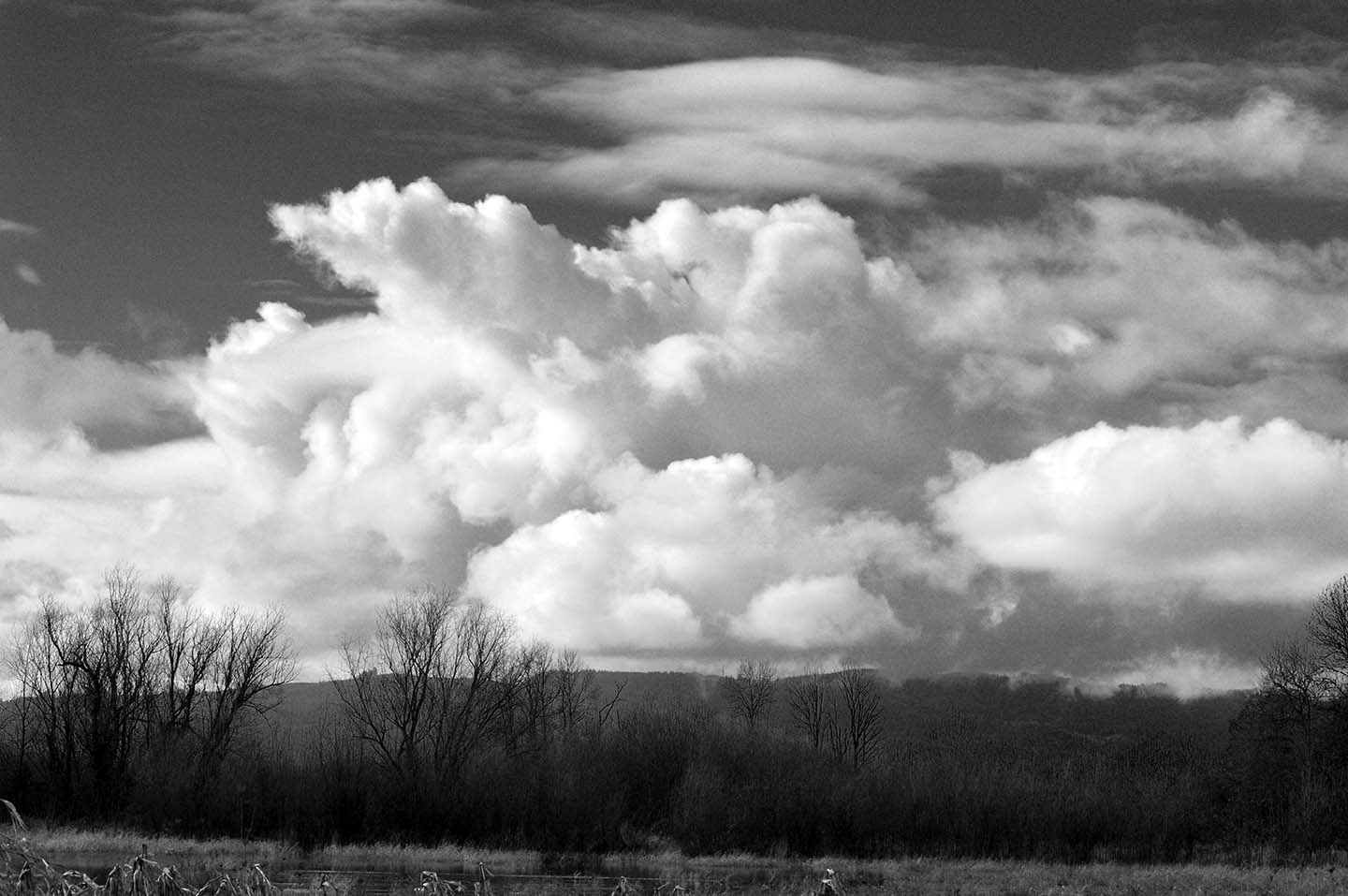
It was a spectacularly beautiful day along the Columbia river, with cloudscapes encouraging all kinds of fantasies and re-interpretations. They also made you wonder what would appear if you lifted them. Were they hiding Mt. Hood, or Mt. St. Helens, or would a peek of Mt. Adams appear? Those speculations relied, of course, on the general knowledge that those mountains are situated in the approximate location you were staring at.
What happens when you lift clouds without having the faintest idea what the background will reveal? Pleasant surprise, useful information, or a wish they’d hung in the air forever given what you discover?
These thoughts were rumbling since I had just read a fascinating new paper by two Yale psychologists, Woo-Kyoung Ahn and Annalise Perricone. In essence their research looks at the consequences of providing genetic information to people, information concerned with their potential susceptibility to mental disorders like depression, Alzheimer’s disease, alcohol abuse or eating disorders. (I’m summarizing below.)
Would you like to receive that information? Hand it over, hey, all knowledge is good! Allows for personalized treatments, specific interventions! What could possibly go wrong?
A lot, as it turns out, and not always what you’d predict. Information can harm you, and curiously enough, both the kind of information that confirms genetic susceptibility to a disease or its opposite, the reassurance that you don’t have the genes that might contribute to a problem.
Let’s say you learn that you have an elevated genetic risk of living with depression. Would you change your behavior in ways that might affect the emergence or severity of the disease? As it turns out, people generally don’t. That failure to do so is closely connected to our general misunderstanding of how genes work: most of us think they are immutable, that we can’t change anything about their expression. “Genes are destiny,” is the assumption. This mistaken belief is called psychological essentialism, where genes are believed to provide the essence for the characteristics observed in a person. Take height, for example. People tie a person’s height to their genetic make-up – never mind that an environmental manipulation, the absence of presence of sufficient nutrition, can stunt growth in any given individual.
Now add prognostic pessimism, our general belief that mental disease is pretty resistant to treatment.
“The extent to which one believes that one’s mental disorder has a genetic origin is positively associated with the extent to which one believes that mental disorders are untreatable or inevitable . For instance, the more individuals with depression attribute their symptoms to genetic factors, the more pessimistic they are about their own prognoses.”
Once you’re in this loop – knowing you have an elevated genetic risk and doubting treatment efficacy, the clinical consequences are dire, since your negative expectations will affect the treatment course.
However, we are able to intervene if we teach people about the malleability of genes, and how genetic expression can be counteracted, even shut down, with environmental interventions. Learning about this, people actually become more optimistic about the prognosis. Lots of clinical programs now use that kind of education to help people understand that genes do not mean a certain destiny.
Unfortunately, even if we are able to help people look more confidently at a future where their genetic risk is not all that counts, we have so far no comparable mediations of how they look at the past. When people learn that they have a genetic predisposition for depression, for example, they start to interpret their experienced symptoms as much worse than they actually were. Study after study show memory distortions of the severity of symptoms once you learn about your genetic risk. That exaggerated belief, of course, affects one’s expectation in therapeutic efficacy, a self-fulfilling prophecy.
___
What about learning that you do not have an elevated risk for a particular condition?
That, too, can produce harm. Let’s say you enjoy drinking, or eating, in ways that border on abuse, or so you fear. Receiving the results from your genetic test that you do not have an elevated risk for Alcohol Abuse Disorder or Eating Disorder can now become a risk factor, as you think you’ve been given green light to continue or even increase your behavior. The feedback affects your interpretation of the seriousness of the harm you might expose yourself to, a false reassurance that can have disastrous consequences.
Lifting the clouds of ignorance? Maybe not.
The birds didn’t care, one way or another. Flocks of snow geese huddled in great masses against the wind.
Sandhill cranes starting their track north.
Harrier hawk, hungry as always,
bald eagle surveying his kingdom,
and ibis and herons doing their thing,
all just on autopilot as their nature demands. No mediations required. No pessimism to optimism. Just BEING.
(Welcome to the new subscribers – come for the nature, stay for the rest!)
Want to come on a hike with me? Follow along, explore the beauty of the Lacamas Heritage Trail!
At least that’s what I thought two weeks ago when we still had night frosts and the mornings were cold, with brilliant light. All long shades, blues and golds, a balm for the eyes.
Some source – PDX Monthly or The Mercury or some such – had recommended the hike as an easy start to hiking season. Located in WA, some 40 minutes north by car, it’s not exactly around the corner but I thought, give it a try!
As the photographs will show you, looking on one side of the trail, there’s plenty of beauty to see. The path winds along a small lake through some old growth forest, including Madrona trees, and occasional glimpses of Mt. Hood on a cloud-free day.
What they don’t tell you: on the other side of the trail, you pass right by a golf course, plenty of condos and then McMansion after McMansion overlooking the water, with fences and signs for private property, both sheltering the property owners and their access to private docks for water sports. I don’t call that a hike. The seven miles (it’s a there and back) really are a stroll through suburbia on steroids, although a nice one if you live close by and want your daily exercise. Which countless people did, so that it was more like a group walking event. Not my idea of a day in nature. (Note, though, the path was so groomed that it is really wheelchair accessible and easy for people with limitations on walking, a big plus.)
The whole concept of what we see and what we don’t, or what we don’t know if the telling is in the fine print or there’s no telling at all, was on my mind this week for a number of reasons.
Take data protection, for example.
In general, we have little protection against the abuse of private data. Just last months, three state A.G.s brought a lawsuit against Google that claims the company deceived customers into giving up sensitive data. While customers were told they could avoid location trackers by choosing the right account setting, their data were nonetheless syphoned through a backdoor. In addition, rules favoring the company are often hidden in legalistic language that no-one bothers to read, or provided with opt-out options for notice and consent that are often obscured enough that the average consumer doesn’t have a clue.
I don’t know if you use a health app, for instance, one of those things that track fitness, nutrition, sleep and other health-related metrics. According to a Gallup poll conducted 2 years ago, in the United States about one in five women between the ages of 18 and 49 currently use them. At this point the numbers might even be higher. Some of the most widely used tools are apps that track your menstrual cycle – period trackers like Flo or Clue, which have 50 million and 10 million downloads respectively. Apple has its own cycle tracking for the iPhone and the Apple Watch.
The advantages of these tracking systems are obvious. You can track fertility if you want to get pregnant, you are warned about missed periods, you might discover patterns to be discussed with your doctor, and so on.
What they don’t tell you, though, is that there are huge red flags regarding your privacy. Generally, and this might surprise you, consumer health apps do NOT have to comply with a federal privacy law called the Health Insurance Portability and Accountability Act, known as HIPAA, which specifically covers patient data collected by and shared among doctors, hospitals, labs and health insurers in the U.S. Europe, by the way, is way ahead of the game, they have stricter controls. (Ref.)
Many of these apps tell you, indeed, promise you, that your personal data will be protected. Yet the Federal Trade Commission has revealed how many of the data collected by these firms are nonetheless illegally shared with third parties. Once received by Facebook or Google, these data are used to send specifically targeted ads to you. Pregnant? Buy maternity clothes! Oily skin around your period? Buy this pimple cream!
Ok, maybe being showered with cringe-inducing ads is the price you’re willing to pay for having the practical advantages of health apps. What about this, though? In 2019 the state of Missouri monitored the Planned Parenthood health apps, looking at women’s menstrual cycle to identify those who had (failed) abortions. In a world of changing laws, data might very well be used for surveillance of criminalized behavior. Reproductive surveillance is theoretically and practically as possible as contact tracing or any other set of data used by agencies that you never dreamt would get their hands on your information.
And just yesterday we learned, that women’s most personal data, their DNA, collected to help solve a case when they were the victim of a rape crime, has been used, without any information or permission, to identify them if there is suspicion that they themselves were involved in a crime at some point.
San Francisco’s DA Chesa Boudin made it clear that if DNA from a rape kit was used without consent for purposes other than investigating the underlying rape case, it may be a violation of constitutional protections against unreasonable searches and seizures as well as California’s Victims’ Bill of Rights. As of now, nobody has a clue how often and how long this has been going on.
Rape is one of the most underreported crimes of all. Women are hesitant to come forward for numerous, justified reasons, shame, vile treatment in trials, dreaded accusations of being a liar if the defendant is not convicted, among them. If you add to that the possibility that the preservation of your DNA opens you to arrest in an unrelated situation, it functions as a huge deterrent to reporting and cooperating with law enforcement.
It really is no longer just about what they don’t tell you, or in such small print that it is easily overlooked. We have to decide, fully aware that data might be illegally distributed or analyzed, if we really want to share them at all. Reverse from a what they don’t tell you to a determined: What I won’t tell you!
Music today are the energizing four seasons by Piazzolla – getting ready for spring hikes on this end!
It was difficult not to think about reproductive rights across the last few days. Besides the looming Supreme Court decisions or Texas laws, there was the NYT featuring two films about abortion and the Jane Collective over the weekend. Among others, they interviewed Judith Arcana, a member of the Janes, a group based in Chicago providing help with abortions before it was legal. I had portrayed her when she participated in our own documentary, Our Bodies our Doctors, some years back.
Two minutes later, an invitation arrived from the National Council of Jewish Women to join in the upcoming ReproShabbat(1/28/2022), celebrating the critical importance of reproductive health access, reproductive rights, and reproductive justice, and to learn more about Judaism’s approach to these issues.
And then I chanced on an article in The Nation featuring Portland’s Queen of the Bolsheviks, a lesbian medical doctor and reproductive rights activist in the early 1900s. Hah! Instead of complaining about the miseries of 2022 I could write about a fighter, Marie Equi, a colorful figure and tireless organizer, defying the laws of her (and, as it looks, soon our) times as an abortion provider. Besides, it gave me opportunity to walk the city and photograph the places where she had lived, practiced and is buried (with a bit of other city scenery thrown in. Of help was a nifty if dated walking tour guide to PDX’s gay history.)
Corner of 11th and SW Stark – Used to be the Norton Hotel where Equi lived for some time. Is now the Mark Spencer.
How can you not be intrigued by a woman who used a whip on a wage-withholding employer of her girlfriend, only to have friends auction the thing off when he fails to pay and take that money in compensation? A woman who was one of the first medical doctors in the U.S. and pioneered a sliding scale of payments for her patients according to their ability to pay? A woman who traveled to San Francisco after the 1906 earthquake to help victims? Who was arrested multiple times as a labor organizer, a pacifist and a political opponent, spending hard prison time in San Quentin State Prison?
SW Broadway and Stark – used to be the Hotel Oregon where she rented, now Hotel Lucia.Medical practice at 6th and SW Washington.
Dr. Marie Equi was a firebrand, born in New Bedford, MA in 1872 and died in Portland in 1952.
She moved to The Dalles in 1893, then San Francisco, then to Portland, having relationships with a number of different women, all interesting and progressively fighting for women’s empowerment in their own right, among them likely Margaret Sanger. She lived and co-parented an adopted daughter for many years with Harriet Speckart, the niece of Olympia Brewing Company founder Leo Schmidt, who did not abandon the relationship despite various threats by her family to revoke her inheritance.
729 SW Alder used to be the Medical Building holding her office. Later known as the PArk Building.current visitor to the neighborhood….
I learned much from an article on reproductive justice published by the Oregon Historical Society and written by Oregonian historian, Michael Helquist. He also wrote a biography of Equi’s life, published by OHSU press, Marie Equi – Radical Politics and Outlaw Passions. It reminded me how so much of the abortion laws had their origin in turf wars – the male medical profession trying to dislodge the traditionally female providers like midwives and nurses from gynecological care around the turn of the century, and the White, Christian population fearing minority status with an influx of immigrants. It became a fight for White babies to be born.
Pioneer Court House, Sixth and Morrison where Equi’s sedition trial took place.Building adjacent to Pioneer Square
Equi fought – for suffrage (Oregon instituted the right to vote for women in 1912, eventually,) for labor rights, for birth control. She got into physical altercations with the police or other doctors, and was claimed to have had enough insider knowledge to blackmail people so that she got off on several trials. Eventually she got caught. It was a speech protesting WW I which had her convicted of sedition and put into prison, where she suffered from recurring bouts of tuberculosis.
President Woodrow Wilson commuted her sentence after a year and she returned home to Portland.
Old Weinhard’s Brewery, 1908, where she walked by on Burnside StU.S. National Bank Building opened in 1917, close to where Equi worked.
The years after her return were devoted to her medical practice and a life with IWW leader Elizabeth Gurley Flynn until the latter returned to the East Cost. Equi suffered a heart attack in 1930 and sold her practice. In 1950 she fell so badly that she had to spend a year at Good Sam, the local hospital, and then retire to a nursing home in Gresham, a suburb of Portland. She died in 1952 and is buried next to Harriet Speckart at Wilhelm’s Portland Memorial. (Photograph is the backside of the Mausoleum.)
The backside of the Mausoleum, as seen on my frequent walks at Oaks bottom.In the meantime, there is a building boom and wall art crops up in unexpected locations.
The woman probably never moped once in her life – engaged in intersecting political movements for women’s rights, free speech and pacifism, while juggling lovers, dealing with the competition and providing hands-on help for countless patients. Remind me of her when next my kvetching gets onto your nerves, I might stop… also, unicorns.