Browsing Category

Politics

Science Denial

It was infectious. The laughter of a tiny Russian grandmother, loud, unabashed, unceasing, first made me smile, then laugh as well. I was standing next to her and her family, all of us marveling at the antics of an Orangutan who was trying on various blankets to protect himself from the rain, finally settling on a tartan throw. I so miss laughter. I so miss regular interaction with strangers, if only via glances or smiles or a kind word. That whole social scenario when you take the bus, or stand in line, flirt with the waiter or encounter people in museums.

In any case, I had made it to the zoo, now requiring on-line tickets for a particular time-slot to be reserved in advance, and I happened to be standing at the primate enclosure outside when the family with young kids and grandma in tow arrived. I relished the laughter. I also admired how the dad was reading and sometimes translating for the kids the signs that describe scientific information about the animals, their habitat, their characteristics and so on.

Here is a question: why do people unfailingly accept scientific knowledge presented to us by some experts, zoologists for example, learn about it with pleasure and expose our kids to it? Yet invariably reject other scientific information that happens to be in domains equally unfamiliar as the mating rituals of the rhinoceros, but could save our lives if we only listened? Virologists’ insights, for example?

This question looms particularly large when scientists are thrown into the middle of political conflict, unable to avoid their unfortunate position because their knowledge is required to make administrative decisions. How do scientists not loose the public trust, how do they avoid becoming targets of aggression because their claims collide with vested interests or different world views? Issues in which these conflicts have become quite visible concern everything from the danger of tobacco consumption, the safety of nuclear power, the long term predictions for the climate crisis if fossil fuel use is not reduced, and, of course, the approach to handling the current pandemic.

For every you and I who think scientific input should shape policies, there are two others out there (if not more) who do not believe scientists, or assume they have nefarious motives, or believe in a different “scientific” truth. Public opposition to science-based governing can come in one of two versions. There are those who are motivated by disinformation or plain old conspiracy theories, disseminated by crack pots or those who have a political ax to grind (or both…) There are, however, also those who offer justified opposition on the basis of legitimate value judgments. The trick is to know the difference and react, as a scientist, accordingly. (I am summarizing today a longish article by a group of scientists that is in press Ref.)

The tobacco- and fossil fuel industries aside, we have individuals in, for example, the U.S. Senate who are torpedoing household resolutions to protest against scientifically recommended mask or vaccination mandates by the administration. Do they have vested interests, signaling to their constituencies who have been blasted by misinformation from partisan media sources that they are on their side, or signaling to their (former) leader that they still toe the line? Are they correct in claiming that scientific proscriptions created policies that limit individual liberties and impair economic activities in unprecedented ways, without proof that public health required it?

Isn’t it also true (spoiler, science agrees it is) that social restrictions like lock-downs have also negatively impacted mental health at scale and have disproportionately impacted women, single parents, young people, minority groups, refugees and migrants, and poor people who cannot afford to buy basic personal protective equipment? (Not that said senators would care.)

Frustration with, and opposition to, social restrictions are therefore potentially legitimate grievances that deserve to be heard in democratic public discourse.”

The problem is how to distinguish between science denial due to politically motivated misinformation, and legitimate disagreement with governmental policies. One way is to spot how people diverge from a scientific consensus. Here are some pointers of what is usually present for those motivated by ideology:

Fake experts: Using doubtful/questionable/discredited/fake experts.

Logical fallacies: patterns of reasoning that are invalid due to their logical structure.

Impossible expectations: The act of demanding undeniable proof beyond what is scientifically feasible.

Cherry-picking: Regarding and disregarding pieces of evidence such as to advance one’s point.

Conspiracy theories: Explaining evidence by means of an evil conspirator, while consecutively expanding the theory to defend against challenging evidence.

A FLICC of the tongue, and you have your misinformation….

Contrast this with people whose lived experiences might make them averse to accepting scientific insight. If the history of your people was one where scientists harmed you or lied to you (see experimentation on POCs,) why should you trust science? If “denial” of the severity of Covid outcomes helps you not to lose your mind, but remain optimistic, shouldn’t scientists take that into account? Denying the effectiveness of social distancing might be an adaptive strategy if isolation would increase your sense of loneliness and depression. Denial can also be a protective mechanism against fear. If you HAVE to use public transportation and work surrounded by sick people, denial of Covid facts might be the only move you have not to break down in fright for what might happen to you.

In short, before we condemn any and all people who question science and scientists’ motives, let’s look a bit closer and figure out how to help those who are not conspiracy theorists to overcome their hesitation to accept scientific knowledge. If it could just be as easy as outlining the dietary habits of the Rocky Mountain goats….

Accosting scientists is, of course, not new under this sun.

Music reminds us. Some clips from the Galileo project concert.

Vaccination Refusal

In this country, partisanship, age and level of education are predictors of who refuses to get a vaccine against Covid-19 in all its variants, or who is skeptical about the severity or the danger of the disease. Even though more people are now willing to get the shot, attitudes have hardened among those who don’t, encouraged by a never-ending stream of conspiracy theories or ideological battle cries by influencers on the far Right and conservative media. Refusal has also intensified for many during recent discussions of vaccination mandates, with multiple law suits filed against the Biden administration’s vaccination requirements. Deeply republican states have imposed policies that ban vaccine mandates or prohibit requiring proof of vaccination.

Vaccination levels are also low among those who have difficulties accessing vaccination opportunities in rural areas, who lack transporation or time off from work because every penny of income is essential and cannot be endangered. So there are structural variables of access and economics, independent of ideological considerations.

The third group of unvaccinated people are those among us who have no choice due to pre-existing conditions or compromised immune systems. If you consider that 15% of the world’s population lives with disabilities (some of which preclude vaccination) according to the World Health Organization, we are taking huge numbers of people whose only protection can come from those who surround them and behave accordingly. And that number does not even include those under active treatment for cancer or other life threatening diseases at any given point in time.

Those who refuse vaccination on ideological grounds often insist that they have a “natural right” of self determination and if that freedom includes the endangerment of others, so be it. Conspiracy theories about “chip implantation” or some such aside, there is an underlying agreement among vaccine skeptics that disease is a process of natural selection, where the strong will live and the weak will be culled. No need to listen to the (deeply mistrusted) science selling the advantages of vaccination. Solidarity with the young, the old, the sick is simply off the table in groups that believe in nothing but individualism and the “survival of the fittest.” In some cases religious considerations about G-d’s will or beckoning paradise add to the determination to carry vaccination refusal as a political flag. Above all, it is about “freedom” to reject the state’s interference with your own body (unless you are a woman, when decisions about bodily integrity are ripped out of your hands in case of pregnancy. Yesterday’s opinion piece by Michelle Goldberg in the NYT (linked above) was brilliant in showing the contradiction.)

In Europe we see additional variants on the theme. Within the far Right there is an explicit anti-Semitic streak that associates vaccinations with sinister Jewish plans for world domination, making an extra buck or at least a push away from the “natural.” Cartoons like the one below are from another era (published by 3rd Reich vaccination opponents in The Stürmer in 1933)), yet deeply embedded in contemporary neo-Nazi discourse.

I feel uneasy, since poison and Jews never add up to anything good.

There is also, however, a different group of German, Swiss and Austrian vaccine deniers who have previously not allied with the far Right. These are often educated middle-class citizens (more than half of them have finished their university education, and 67% consider themselves to be middle class, 23% of the surveyed said they had cast their ballots for the Greens in Germany’s 2017 federal election. Eighteen percent voted for the Left party and 15% for the far-right Alternative for Germany (AfD) and they are in their 40s and 50s.(Ref.)

There are many educators and medical professionals among them, who swear by homeopathy or are adherents of the Rudolf Steiner/ Waldorf School movement around anthroposophy. The German South-West is a stronghold of the anthroposophical movement.

Officially, educators and administrations of Waldorf Schools are not prohibiting inoculations; however if you look at the rates in which kids in these institutions are inoculated for dangerous childhood diseases like the measles or whooping cough, you find the numbers way below the national average.

What lies beneath their vaccination refusal, now extended to the current Covid pandemic? Historically (and particularly during the third Reich) people considered a strong immune system to be sufficient to ward off disease, and that system was created and sustained by a romanticized “natural living,” a diet free of poison, physical exertion in sunlight and fresh air. All things modern – large cities, poor immigrants, technology and mass culture were seen as the enemy of health, external agents poisoning the immune system and sickening the body.

Rudolf Steiner added to that a theory rooted in occultism. He preached that humans reincarnate in ever new bodies. (Note, I do not judge the belief held by billions on this planet that reincarnation is part of the life cycle. I do have problems with the specifics touted by Steiner attached to his philosophy.) Only high fever in a child’s body allowed reincarnated kids to take root in that new space, which until then was dominated by the mother’s “protein” which needed to be replaced by the child’s own “protein.” Only then could emerge a true representation of this new person’s identity. Furthermore, illness has special meaning in this never-ending cycle of re-incarnation. It educates us to the fact of what has gone wrong in a previous life and provides karmic balance for earlier misbehavior. (Steiner even named specific illnesses for specific misdeeds – I’m not going there.)

There was an additional racist element present in his theorizing as well. Bacteria and viruses were considered of demonic nature, specifically the astral demons and putrescence of earlier, “inferior peoples” – the Mongols, for example, who carried their foul nature to the Germanic nations in their mass migrations. (No, I am not making this up. (Ref. To find his own words, go here.)

The new version for the current epidemic, in its extreme form, states that vaccination prevents you from receiving the karmic insights brought by the messenger disease. You might protect your body, but your soul will not be able to grow. Should you die, the healing experience for your soul will put you on fast track in the next life, so nothing is lost. Healing is all well and good, but suffering has a place in the world that is irreplaceable for spiritual growth. (Note, this approach is a legally recognized field of study in Germany for medical doctors who want to specialize in this sub- discipline.)

And before you shake your head and wonder who would subscribe to this, demonstrations against vaccination have drawn up to 40.000 people in individual cities on a given weekend, mixing Querdenker (the equivalent of Qanon), neo-Nazis and Steiner adherents. A useful article from the Council for European Studies (in English) on the history of the movement can be found here. Generalized science aggressions has morphed into increasingly violent behavior – hospital personnel, schools, doctors who offer inoculation, and even bystanders have been attacked and in one case killed.

I find it remarkable how in times of crisis all the long-held prejudices, stereotypes and nationally rooted beliefs make an outspoken come-back. Anti-Semitism and stereotyping esotericism, buried deep after 1945, are raising their ugly head. Racism in this country is no longer subdued, but proudly presented in calls for a return to the good-ole-times, with racial hierarchies re-established and intact. Simply asking people to put their beliefs aside is not going to cut it. If the only way out from the danger of the pandemic and new viral mutations is world-wide vaccination, then countries have to come together and impose vaccination mandates, legal requirements that no-one can escape other than for medical reasons. It has been done before. (Since 1809 in the U.S., 1807 in Germany.) It can be done again.

There’s a Drop of Hope, though, from the Francis Crick Institute in London. Their vaccination center had 12 international artists in residence who wrote poetry about inoculation collected under above title. You can find the poems here and the intro explains the interactive poetry project. Sensible, moving and perceptive takes on vaccination.

1807 was also the year this Beethoven piece was written (or transcribed from his violin concerto op. 61.)

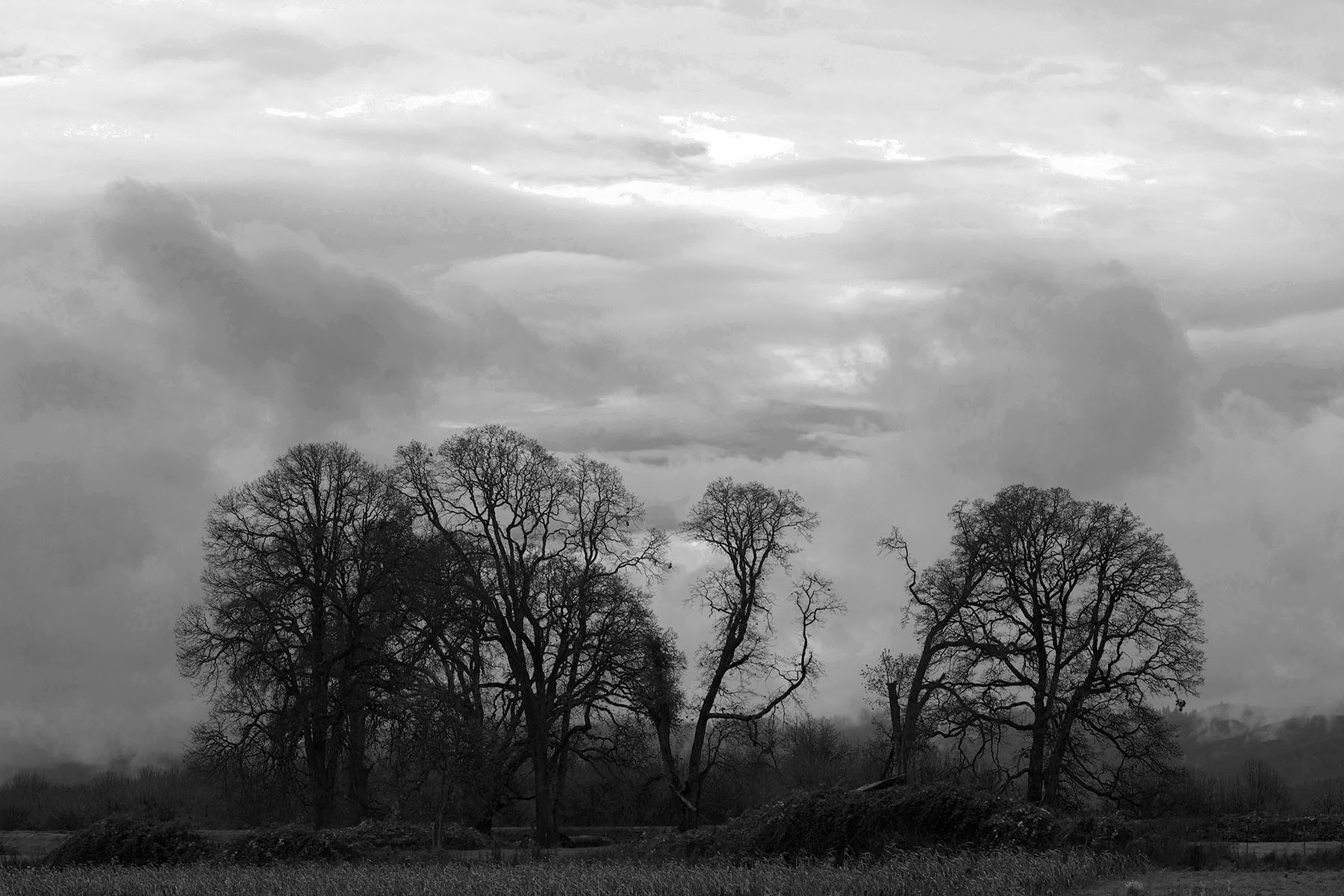
Brooding photographs were taken late yesterday. Should reincarnation occur against scientific odds, I’ll put in a request to be a tree. Preferably not at aspen, though, I’ve done enough trembling in this life time. Red chestnut would be nice. Oak will do, too.

Historic Parallels

Imagine a flood of young men who are uprooted, lack perspective, unable to find employment, frustrated by promises of improvement that never materialized, psychologically fragile because they feel displaced by others who they deem less deserving, and burdened with shame for an uncontrollable situation. Provide them with weapons, and encourage them to band together for ideological causes that clearly identify an “other,” a defined enemy, a target in a deeply divided country. Provide them with markers that signal belonging (to an in-group) like hats, or insignia. What have you got?

No, wrong, country, wrong century, not the Proud Boys and their ilk.

I want to talk today about the German Freikorps, armed paramilitary groups that wreaked havoc in the the years after WW I, from 1918 to about 1923 during the Weimar Republic. About 3 million soldiers returned to Germany from Belgium and France after the armistice in November 1918, experienced by them as a shameful loss. The treaty of Versailles reduced the numbers of German soldiers in a standing army to 100.000 down from a total of 6 million before the war. Many of the former soldiers, in fact almost half a million, kept their weapons after formal decommissioning, and were soon organized into militias that were financed by the government interested in defending Eastern borders, in Poland and the Baltics, and crushing sectarian uprisings in Germany itself.

In a starkly polarized country where the left as well as strongly reactionary forces hoped for political change (and the right-wing myth that the left had betrayed the army stoked hatred,) the armed members of these right-wing militias started to kill members of the opposition, both everyday Germans and famous political players. Leftists Karl Liebknecht and Rosa Luxemburg were among them because they had been publicly anti-war. The Bavarian Senat president Kurt Eisner was killed because he was a pacifist. Matthias Erzberger (from a centrist party) was murdered because he had signed the armistice of Compiègne as a government representative. Foreign minister Walther Rathenau was killed because he was Jewish. The militias supported (failed) coups, like the Kapp-Lüttwitz Putsch where reactionary forces under Kapp tried to destroy the government. Anti-semitism became a battle-cry, Jews being even more abhorred than communists who were active participants in the struggle for political representation.

Fearing a civil war, the government did not punish the Freikorps members who had supported the coups and let them retreat, and even paid their wages. Many of these now floating veterans organized themselves loosely afterwards and eventually drifted into a growing Bavarian party: the NSDAP. In total, and that in itself a frightening fact, in a few years about 354 radicalized right wing killers where systematically protected by the German legal system, getting away with murder without punishment, while 10 of the 22 leftist killers received the death penalty. (Ref.)

That’s a political assassination every four days or so in a country smaller than Montana across the span of four years. We are not living in these times.

Born of war, defeat and compromise, the new German republic was reeling from the effects of wartime rationing, material deprivation and the millions killed or wounded. The horrors of the Somme, the Marne and Verdun did not end so much as trickle back into whole towns, villages and cities, which had to accommodate the countless returning invalids, with their missing limbs and gashed faces, their damaged psyches and shell-shocked nerves.….more than four million people died as a result of armed conflicts throughout Europe in the first five years after the war, a number greater than the combined wartime casualties of France, Britain and the United States. Vicious cycles of civil war, revolution and counterrevolution meant that, between 1918 and 1923, the European continent was “the most violent place on the planet.” (Ref.)

But there are parallels that we ignore at our own peril. We do see numerous electoral successes by right-wing and authoritarian candidates in the United States, Britain, Poland, Hungary, Italy, India and countries in South America. The resentment towards globalization and cultural pluralism, combined with racist and anti-semitic ideas attitudes, echo the invective aimed at the Weimar Republic by nationalists and conservatives during the 1920s. We also face a disturbing increase in right-wing political violence across the world. A long but brilliant description by Anne Applebaum of the current slide towards autocracies can be found here.

In our own country cries for violence to be permitted are on the rise. So are little veiled comments by politicians that foment chaos and violence – just look at the January 6th evidence. And we have no way yet to measure the psychological ramifications of a pandemic that has blanketed us with death and given further rise to political division around the (enforced) mechanisms to combat the scourge.

Without invoking an analogy, we can still learn from the mistakes that were made in the 1920s, (in)actions that promoted if not installed a dictatorial regime that claimed to provide a way out of the chaos and reinstate power hierarchies of yore, so desperately longed for by the shaken German people. We can look at the role of the legal system.

“One of the most crucial failures of the Weimar Republic was the failure of its courts to uphold and defend the constitution. Court judges and state prosecutors tended to side overwhelmingly with right-wing offenders; the Kapp Putsch of 1920, for instance, in which right-wing nationalists attempted to overthrow the government, resulted in just a single conviction.”

I don’t know if the train has left the station already. The appointment of ideologically biased judges, the vagaries of the American Jury system that is so open to manipulation, the fact that politicians get away with explicit calls for violence without major legal ramifications, are cause for worry. As congress-woman Ocasio-Cortez, after being the target of a video from a republican congressman depicting her being killed, said: “core recognition of human dignity, value and worth is a line that cannot be crossed.” If we forgo accountability, we open the floodgates.

This point is acknowledged even by some truly conservative thinkers. Aaron Sibarium, associate editor at the Washington Free Beacon, writes about the “Weimarization of the American Republic” here. I don’t agree with his both-sides are extremist approach, but he has interesting things to say about the fact of and mechanisms towards polarization that are implicated in rising threats of violence, the judiciary included.

Not mentioned, of course, is the very pragmatic, rational first step a country could take: curtail the absurd amount of lethal weapons that have deadly consequences in political violence. For all we know, our very own Supreme Court will march in the opposite direction come June. As I said: look at the legal system…the parallels there are frightening. Germany turned brown, the signature color of the Nazis. We know who contributed.

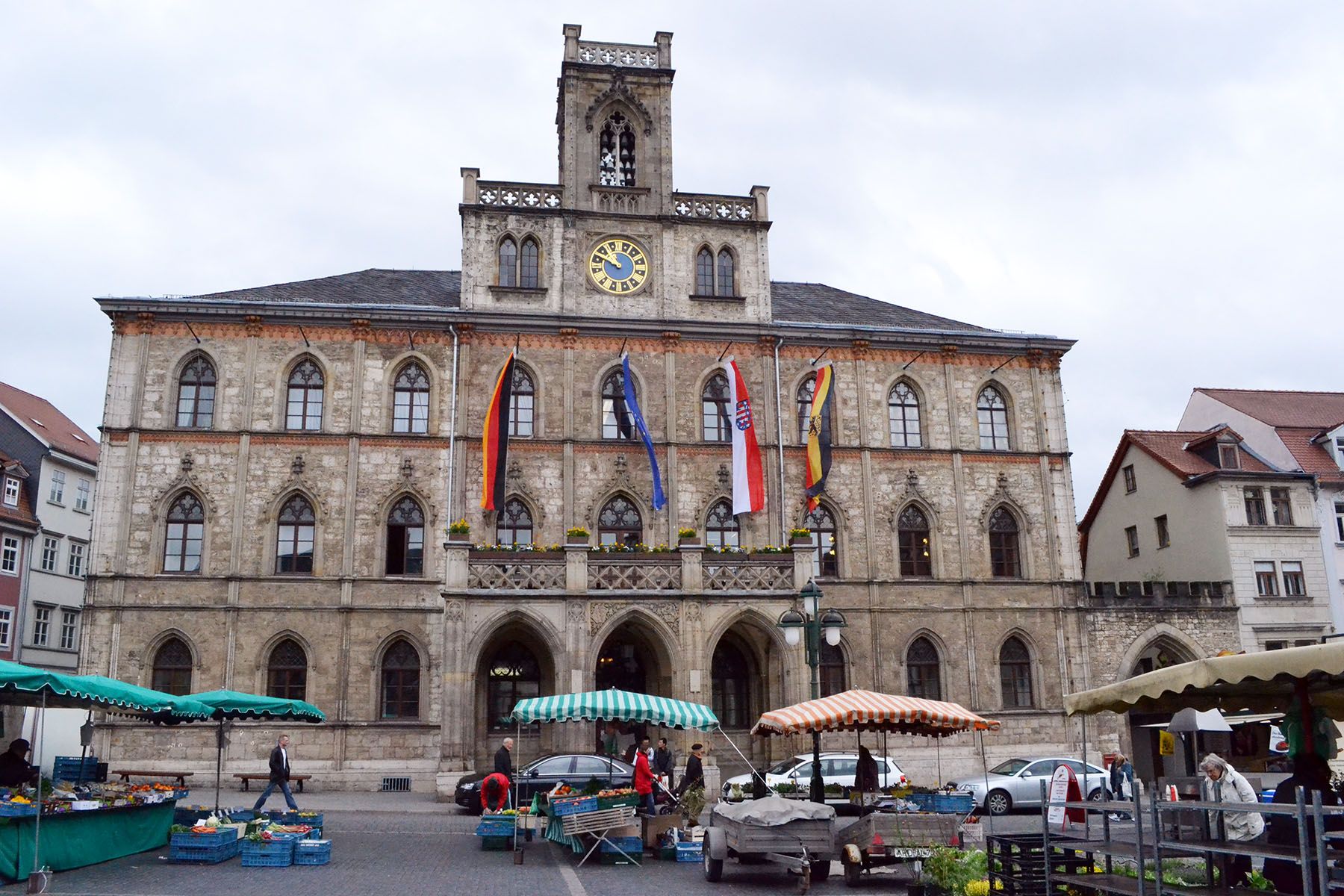
Photographs today are from the city of Weimar, from a trip I took there some years back.

The LA Philarmonic had a program last year called “The Weimar Republic: Germany 1918-1933″, selected by Esa-Pekka Salonen. Here are two of the pieces that were part of it (I only found them performed by other companies.) Kurt Weill’s Berliner Requiem and Hindemith’s strange one act-opera Mörder, Hoffnung der Frauen.

Stones on the Heart

Once you have crossed Portland’s Burnside Bridge you will encounter a building on the Eastside that has large sheets of paper hanging in its windows. They are printed with a poem by Oregon’s current poet laureate, Anis Mojgani. It is an appeal which addresses us with loving flattery, perceptive about potential burdens we might carry, and enthusiastic in its belief that there are remedies that can help you drop the stones of your heart, as he puts it.

The suggestions made me smile, made me frown, made me feel seen as one of the multitudes who experience themselves these days as “dark and angsty” as he says. (The word angsty, by the way, from the German word Angst (anxiety) was introduced as early as 1849 by English writer George Eliot. But it became popular in the 1940s when translations of Freud’s work promoted it in the context of neurotic fear, guilt and remorse.)

I was in a dark mood indeed, having been accused of neurotic fear, well, not in those words, but in a closely related term, namely being prone to conspiracy theories. Heated voices had been raised over an essay that I tried to summarize and that found nothing but scorn in the ear of my listener. The essay was published by Timothy Snyder, author of an interesting series of essays currently on the web, Thinking Aloud. He teaches history at Yale, and is a tenured fellow at the Institute for Human Sciences in Vienna. His work concerns East European history, the Holocaust, the history of the Soviet Union, and the history of Ukraine, and he has been published in the NYT, the L.A.Times, the Guardian, Christian Science Monitor and many more. I dwell on the pedigree so we can agree this is not some random fantasist, dabbling in pseudo-Freudian analysis, or simply a moron (one of the less condescending terms emerging in our “debate.”) Not that learned people cannot be idiots, but I think there is something else going on here. Hear me out.

The essay is titled Killing Parents in Bad Faith. – How historians will remember the pandemic.The main argument offered is that reckless behavior of maskless younger people endangering their older relatives, or reckless refusal of politicians to implement measures that protect the elderly and anyone else against the ravages of the virus is not simply based on stupidity. Instead it is a return to the (falsely applied) maxim of the survival of the fittest with the added benefit that it triggers wealth transfer that is direly needed by a younger generation who has seen the promise of upward mobility ground into the dust by decades of Republican politics. The author goes so far to talk about elder cleansing and generational harvesting, which would be clearly revealed in retrospect by future historians.

An extreme position, not backed up by empirical evidence, yes, I understand the varied reactions ranging from crap to idiocy I have heard when I talked about it with people. So why do I, not the most irrational person on the planet, see reason to keep an eye on the argument with a possibility that it might be true? Why do people who fully acknowledge that Republicans have embraced Social Darwinism, have refused vaccinations on the basis of non-scientific, ideologically driven beliefs, have shown publicly a willingness to sacrifice older generations, can’t go as far as acknowledging that there might be a condoning acceptance of lethal consequences when younger folks expose their elders to the virus,(if intentional parricide is a step too far?)

I wonder if Snyder’s arguments are deeply influenced by his immersion into Holocaust research, and my openness to them affected by being German. The US Holocaust Memorial Museum has a whole section devoted to the way Nazism, German people, average citizens like you and I, betrayed people deemed unworthy of life in ways that insured economic benefit to the perpetrators. As early as 1933, laws were established to force the sterilization of all persons who lived with diseases considered hereditary, such as mental illness, learning disabilities, physical deformity, epilepsy, blindness, deafness, and severe alcoholism. These people were colloquially called useless eaters.

Daily cost of feeding a disabled person and a healthy family.

The program escalated but 6 years later with Operation T 4, which instated “mercy death” of non-Jewish German and Austrian citizens by gassing. By the end of the war an estimated 275.000 people living with disabilities had been murdered. These included people who were brought to the authorities by their families for no other reason than being “difficult” spouses or defiant daughters (blamed to have mental illness) or elders who did not want to dish out an early inheritance. The euthanasia program explicitly included incurably ill, physically or mentally disabled, emotionally distraught, and elderly people.

There has been a lot of psychological research looking at how the elderly are valued over younger lives, with decisions made by participants across the world that IF they have to sacrifice some life, it will be the elderly over the teens. Those sentiments are enhanced during times of crisis. Public discourse during the epidemic (social media content analyzed by scientists) showed an increasing amount of ageism with some proportion alluding to senicide (the killing of or abandoning to death of the elderly.) Real life scenarios certainly happened in several countries across the pandemic where a lack of ventilators forced doctors to do triage with a cut-off of age as low as 65 in some places where you were no longer eligible to have your life saved. Princeton Psychologist Susan Fiske who studies prejudice and ageism finds in her surveys that “younger people want to be sure that the elderly don’t hog a disproportionate amount of time and resources. Older people are expected to step aside.” The only American cultures that have consistently positive views of the elderly are African Americans and Native Americans.

Prejudice against old people is of course a far cry away from stepping up and actually killing the old by active measures. One can look at the moral deprivation of murder at one extreme of the scale. On the other end of the continuum would be the morally justified decisions by doctors to grant survival to those who benefit most of it, the young, when means to ensure survival are limited. Then there is the vast area in-between. There is morally unacceptable action – the decision to expose vulnerable populations to maskless visitors, say or state decrees forbidding mask mandates. Or equally debatable inaction of the authorities to demand protective devices or order vaccinations mandates for people who come in contact with vulnerable populations, or the personal decisions by police, firefighters or nurses not to get vaccinated.

To get back to Snyder’s Covid scenario, yes, it might be .0002 % or whatever tiny proportion of maskless visitors to retirement homes who have consciously nefarious motives. Bad apples, etc. pp. Once a political administration justifies the sacrificing of this or that constituency under the mantle of Social Darwinism, however, personal motives can find political backing, ruthlessness can be uncorked, as history has shown. And we are very few steps away from such an administration in the years to come. Looking at some State governments, we are there already.

Stones on my heart, indeed.

Music more representative of fall than spring, but there’s still hope that spring might be rushing back….

Unimaginable

The light was strange. I walked the Sandy River delta for the first time since January, so grateful to be back and a bit worried if I had the strength for the full round in the 90 degree September heat. Thoughts of the fragility of existence, my companions for too long, were underscored by the wind that came down from the mountains, making the dry branches and grasses bending and trembling, the poplars noisy with their rattling silver leaves, upended by the gusts.

Claude Monet Haystacks 1885

The gusts were hints of colder times, easily ignored during this endless summer, perhaps perceived only because my thoughts were swirling around the essay I’ll urge you to read today, if you have time to read anything (I’ll keep my own remarks correspondingly short.) Robert Kagan, senior fellow at the Brookings Institute and a neoconservative scholar, lays out what quite likely might be ahead for us as a country, and it is frightening to hear its measured analysis by a conservative, no less.

Ermenoville, Department Oise

Yes, politics. Yes, more bad news. Yes, I know the feeling of not wanting to hear one more scary thing in a world full of them.

Claude Monet Poplars at Giverny 1887

Do read it.

Camille Pissaro Poplars, Eragny 1895

You want to be prepared for what one might once thought unimaginable. Even though it is tempting to ignore that there is always a second act in the wings. One we might not like.

I might mention the German election results in passing…. major parties had a head-to head competition with a razor thin edge going, for now, to the Social Democrats – a centrist party who will need to form a coalition with any number of smaller parties to govern, an unwieldy moloch marked by political compromises. All signs point to continuation of the familiar paths rather than radical re-orientation in view of the needed actions for climate change. For me the most frightening number was the fact that among those voting for the first time a higher number picked a business friendly, conservative party (FDP) over the Green Party – so much for the “youth will save us.” And two large states in the Eastern parts of the country, Thuringia and Saxony, went all in for the right-wing extremist AfD. Berlin will have a mayor whose phD title was rescinded for plagiarism and who gave up her ministerial seat as minister for family in the wake of the scandal, now to oversee the government of the capital.

Claude Monet Wind effect (Poplar Series) 1891

I’ll sweeten the reading assignment with some classic paintings of poplars that were brought to mind by the beauty in front of my eyes – in black and white to emphasize the structure and pattern (and similarities) of these wispy trees.

Vincent van Gogh Poplars at St. Remy 1889

Maybe the river will have water again (photograph of the tree lined water is from 2 years ago around this time) – right now it is unimaginably low.

Claude Monet Poplars at the Epte 1891
Vincent van Gogh Poplars near Nuenen 1884

Soon the trees will shed their leaves, and the scent of decaying silver and gold will emanate from the layers and layers that soften your step. I’ll be out there again, soon.

Paul Gauguin Landscape with Poplars 1875

Today’s music acknowledges that somehow most of these paintings seem to have originated in France, even though Germany and the PNW is full of poplars as well. The selection of pieces by Ravel is quite representative of his best work.

Sue Darius Lombardy Poplars

And here is a poem from the late 1800s :

Binsey Poplars

BY GERARD MANLEY HOPKINS

felled 1879

My aspens dear, whose airy cages quelled, 
  Quelled or quenched in leaves the leaping sun, 
  All felled, felled, are all felled; 
    Of a fresh and following folded rank 
                Not spared, not one 
                That dandled a sandalled 
         Shadow that swam or sank 
On meadow & river & wind-wandering weed-winding bank. 

  O if we but knew what we do 
         When we delve or hew — 
     Hack and rack the growing green! 
          Since country is so tender 
     To touch, her being só slender, 
     That, like this sleek and seeing ball 
     But a prick will make no eye at all, 
     Where we, even where we mean 
                 To mend her we end her, 
            When we hew or delve: 
After-comers cannot guess the beauty been. 
  Ten or twelve, only ten or twelve 
     Strokes of havoc unselve 
           The sweet especial scene, 
     Rural scene, a rural scene, 
     Sweet especial rural scene. 

Rebels Welcome

The time between Rosh Hashanah and Yom Kippur is supposed to be one of of taking stock of one’s actions. Contemplation of right and wrong, of divine judgement and human repentance, might guide an annual reset. Not a bad idea given that we could all improve on ourselves, even if I don’t buy into the belief that some higher agency will dish out consequences (the concept of hell is conspicuously absent in Judaism but there is a judging G-d.)

I have my own do’s and don’t’s list, in addition to the usual ones that define a moral person. One of the don’ts is to post poems that I fail to understand, necessitating spending the better part of a day to read up on possible meanings. One of the do’s is to break my own rule when what I learned really fits with the focus of the week, defining good or bad, as well as how what we know shapes our beliefs and subsequently actions.

The cryptic poem can be found at the beginning of William Blake‘s book The Marriage of Heaven and Hell, introduced as “The Argument.” (The full version of the short book, without the engravings, can be found here.)

What I knew: Blake was an exceptional artist with a visionary mind. He was a poet, a painter, an engraver, combining his skills to produce works that were multilayered, drawings interacting with the text. I was also aware that he was, in the context of the revolutionary movements of his time (we are talking the late 1700s,) a strong voice for change and breaking up patterns dictated by church and state.

What I learned about this particular poem: it was a parody directed at the religious cult around a philosopher guy named Swedenborg (never heard of him.) It used imagery directly derived from the Old Testament (who knew) and is populated by characters that are interpreted in 100 different ways by Blake scholars (and there are many – how would I choose?) It also tries – that’s where it gets interesting – to break up the dichotomy between angels and devils, the meek, rational, obedient good people, and the energetic, sinful, creative, rebellious bad ones. If you can figure out how that can be inferred from the lyrics you have a clear advantage over me. Something about the meek and the wild switching habitats? Crossing over?

The text goes on with prose, which makes it a little bit clearer:

Without contraries is no progression. Attraction and repulsion, reason and energy, love and hate, are necessary to human existence.

From these contraries spring what the religious call Good and Evil. Good is the passive that obeys reason; Evil is the active springing from Energy.

Good is heaven. Evil is hell.

Blake insists that our existence depends on a combination of forces that move us forward (the marriage of the title.) It might be in the interest of those in power wanting to the retain the status quo, to designate us into “Team Good” and “Team Evil,” but for progress to happen we have to acknowledge that we are “Team Human,” as someone cleverly said. (My main source for what I learned was an issue of Image/Text (3.2) entirely devoted to scholars of the artist.)

Being human is not either/or, all good or all vile. We are complex enough to accommodate impulses from all directions, to heed some more than others, or do so in different contexts or different times. We might be the just (wo)man at times, or the sneaking, snaky villain at others, going from meek to enraged or in reverse. Change, both in the personal and the political realm, depends on it. Change, in the New Year, will depend on embracing all of what makes us human, and not waste energy to isolate bits and pieces at the expense of others. Intellect and sensuality, rationality and emotionality, acquiescence and rebelliousness can and must coexist.

Blake delivered this progressive message in a time of political upheaval both in the Americas and during the aftermath of the French Revolution, and I would never have known, if not for those who teach this stuff. Which brings me to a contemporary essay, also with a focus on the relative merits of acquiescence and rebellion, that outlines the danger of selective telling of history (in this case linked to the celebration of Labour Day.)

Adam Johnson, one of the most incisive young writers around, and Sarah Lazare deplore in The Column how even seemingly “progressive media outlets minimize radical elements of American history and recast liberal reforms as the primary movers of justice and political change.” It’s a short read and worth your time, providing food for thought why the establishment clings to meek(er) agents of change and prefers them to the call for more energetic rebellious action in Blake’s terms.

Let’s read up on our history!

Images today are selective Plates of Blake’s book, from an exhibition at the Morgan Library & Museum, some years ago.

Here is some of Blake’s work set to music by Benjamin Britten.

This Bunch or That?

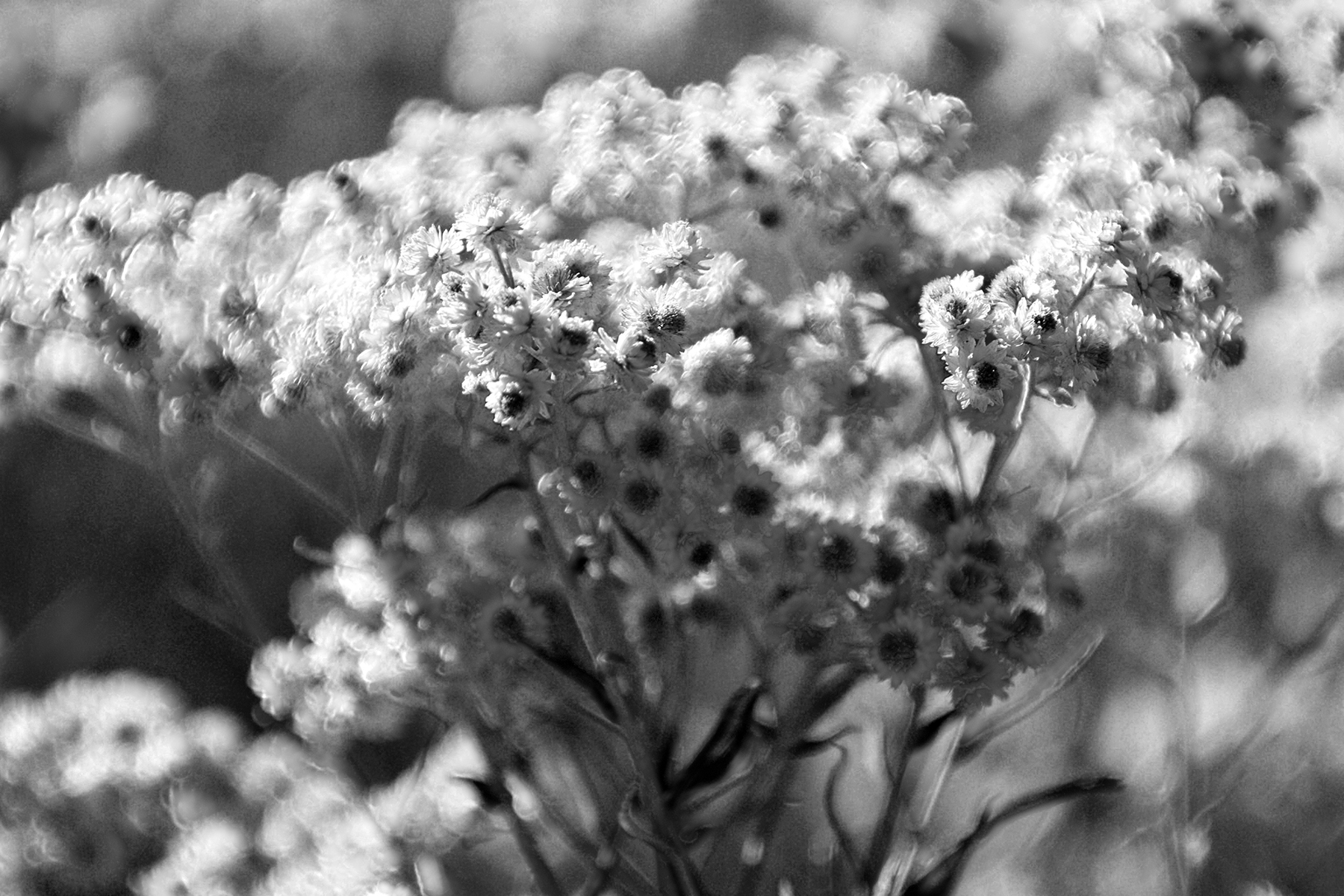
It is the season for bunches, bands and batches, swaths and clusters of flowers in the meadows.

Yesterday’s photographic harvest was mostly common tansy, yarrow and goldenrod, all seemingly humming, which on closer inspection was, of course, the music of the bees.

The tightness of the clusters, the masses of plants all bunched together, reminded me of the polar opposite, isolation, and how that term (or state) has become such a focus for explanatory models of people willing to join groups or cults, when otherwise they’d never would have.

What do we know about that? Researchers have shown that people in places with high “social capital”—relationships and networks that connect us and enrich our lives – are more immune to being lured into cult-like groupings than those living in regions with low social capital.

And if you are lonely, belonging to the MAGA crowd has immediate rewards: you have an instant community, can travel with like-minded friends from rally to rally, feel connected through inside jokes and swag, just like following your favorite bands in days long gone. As one recent author, writing in the context of Trumpism preying on an emotional void, put it:

“There’s a reason vulnerable people are drawn to street gangs. There’s a reason Charles Manson preyed upon teenage runaways, and there’s a reason why so many poor Black women died in Jonestown. When you are down-and-out and lonely, you cling to the people who care enough to give you hope.”

Given the situation that we now face, I really want answers to the more immediate question, namely what it takes to get people out of cult-like existences. We cannot easily fix the causal societal ills of anomie and isolation and lack of community, although efforts in that direction have to be strengthened. Even if we did, there are reasons to fear that it would not necessarily make people leave Trumpland, and simply make a U-turn.

A convincing explanation for that sad fact, along with helpful suggestions, can be found here. Ruth Ben-Ghiat’s essay focusses on witness testimony of people who lived under historical authoritarian strong-men. She observes:

Just as cultivation and conversion leverage strong positive emotions (belonging, inclusion, safety, rapture), so does disengagement evoke strong negative emotions (shame, humiliation, abjection) that many wish to avoid.

Shame and fears of punishment, ridicule, and loss of status can motivate individuals who have been victims of con men to stay silent. They can also lead people who start to realize that they have been misled by authoritarian propaganda to double down on their convictions out of pride. 

Saving face can seem like a psychic necessity as it becomes increasingly difficult to deny the leader’s untruths and destruction, and individuals may feel betrayed as well as humiliated.”

We need to add to that list the fact that psychological losses loom larger for us than potential gains, something called loss aversion (part of the psychological literature since Kahneman and Tversky published their seminal work in 1979.) Even if I start doubting the wisdom of the Elders of Trumpland, I would still loose the community I’ve just found, the sense of belonging that I so yearned for, if I were to leave now. It seems also to be the case that cultures that favor individualism and masculinity, like our’s, tend to display a higher degree of loss aversion. (Ref.)

Ben-Ghiat concludes:

This is why experts emphasize the importance of avoiding judgmental attitudes when dealing with people disengaging from cults. We should also resist the temptation to present individuals with evidence of the failure, corruption, or nonsensical nature of the cause they embrace. Such evidence will come from sources that are still tainted for them, and likely makes use of  language and reasoning they have been taught to distrust.

That is, of course, more easily said than done. How can you not try to reason? Never mind assumptions about blood-slurping pedophile rings in the subterranean regions of the White House…. how can you not confront (dis)beliefs with visible, undoubtable facts of close to a million people dead in this country from a disease that could have been conquered with timely and appropriate measures? Do you really have to “empathize” with Covid-deniers, as the National Review suggested?

Some people furiously disagree, sociologist Brooke Harrington among them. Here is a drawn out thread on her argument. She summarizes:

“The “moral failure” of the COVID+ pandemic deniers & anti-vaxxers ranting from ICU beds is to prioritize saving face over saving other peoples’ lives. They could do the latter by telling the truth & exposing the con, saying “COVID is real, get vaccinated.” But they don’t.…. Since they’ve chosen moral failure, & now endanger us all with their face-saving maneuvers, the pragmatic question is: How do we keep them from killing the rest of us?

As it turns out, she believes (on the basis of sociological science) that only people who are trusted, family and former fellow cult members or current leaders associated with it, are in a position to help change minds, minimize shame and need for face saving for cult members trying to turn around.

Which means, most of us get a pass, right?

Not much going to happen, either.

The flowers didn’t care. They just radiated warmth and color and purloined sound, making me happy, willing to forget about politics and psychology for an uplifting hour.

You should experience the same by listening to this music: Mahler’s 4th which describes heaven through a child’s eye.

Where next?

This week I reported on the willingness of large swaths of the population to blind themselves against the facts of science for reasons of tribal loyalty. I am afraid I have to add to that report describing the willingness of many other people to remain blind to the futility of voting rights legislation. Democrats assume that if the voting rights bills in question are thoughtful and fair (and miraculously passed, a whole other story,) they will not be rejected by the Supreme Court. This, of course, is a belief born out of despair over how far we’ve sunk, and in no ways supported by anything we know to be true of this Court – read the not-so-fine print of the decisions of the last years. A concise and non-technical analysis of the status quo of voting rights and the future of the American experiment can be found here. The essay is a short, worthwhile read, ending with the observation that nothing but an expansion of the Supreme Court is potentially going to rescue our democracy.

I am bringing all this up because I have had churning reactions to two books I read this week, one that came highly recommended and that I intensely disliked (why, so often?) and another that I chanced upon and devoured. They both made me think about what affects change and the scale of personal involvement, from ethereal withdrawal into a universe of feeling (if that) to the justification of taking personal action, violence included.

What are you going Through by Sigrid Nunez and White Tears by Hari Kunzru have one thing in common: they both integrate a systemic conflict, the climate crisis for the former, racism and exploitation of Blacks for the latter, into the narrative.

Nunez uses it as a cardboard foil for her larger subject of presence or absence of hope and empathic attachment. Her story is told by a woman who is asked by a distant friend facing terminal cancer to accompany her on her last weeks before actively ending her life with pills. The narrator is all over the map, in a dithery fashion mostly describing other women, from close friends and relatives to mere acquaintances or public figures in faintly, irritatingly misogynistic ways. She herself remains a stick figure, not imbued with any reason for us to root for her, least of all a deplorable tendency to name drop literary greats, with paragraphs of precise quotations.The only names, by the way, offered at all. The story’s inhabitants are all nameless, a successful distancing device. Well, that’s how I reacted. Others disagree (the linked review is typical of the praise the novel received.) In fact, Nunez conveys less a woman racked by feelings – the break-up with an ex-husband, a life without children, the newly blossoming attachment to her friend overshadowed by the impending suicide – than a woman trying on those feelings for size to see how they can be told as stories. An eternal distancing, from the fragility of close human interactions to the large scale one of the intensity of the climate threat. Drifting with willful oblivion along in the wake of death.

Kunzru’s novel is the polar opposite. The characters are so vividly drawn you might as well have met them in real life, even though for most of us they live in a realm somewhat outside our comfortable White middle-class existence. Two young people embark on a search for musical authenticity that leads one of them from New York City to the South, get into huge problems along the way, drawn into events of the past that reverberate into the present and future. The story evolves in ways that manage to surprise and shock, and hook you onto empathizing with the narrator(s) in a way that lures you into a complete understanding of their decisions even thought these eventually include unjustifiable acts.

Bits of magic realism seamlessly fold into a contemporary setting. The deeper issue, the systemic exploitation of Blacks through slavery, prison labor and a music industry commodifying traditional Black music, emerge as a core challenge to our thinking, rather than a foil. It is a novel that explores the toxicity of White appropriation, of the systemic degradation of anything Black – which is of course why it links back to my musings at the beginning of this blog on the chances of a voting right act to come into existence as one of the many ways needed to change race relations. Every page contains complex psychological material, an invitation to think difficult things through while simultaneously offering a grand mystery and real action, compared to the flat vignettes of observed fates in the first book. Here is an insightful review that provides you with details of the narrative.

Neither protagonist, the passive narrator of Nunez’ novel, suffused by diffuse reactions to the world around her, floating in a private universe of sadness, or the active protagonist of Kunzru’s tale, driven into mad acts by a revenge fantasy fed by assumed guilt and responsibility, can be our role models. The question of personal agency and efficacy towards bringing about change, if “only” to the size of the Supreme Court, remains unresolved. More books to read. And this.

Music today is the Blues, given its huge role it plays in White Tears. Photographs from South Carolina, providing a glimpse of the South now.

No good guys. None.

“So who are the good guys?,” my Beloved asked. “What do I know,” was my response, having only vague associations with Haiti, Papa Doc and Baby Doc, paramilitary violence of the Tonton Macoute, and devastating earthquakes. Crash course in history ensued, immediately regretted, given the revelation of nothing but horrors.

The small French-Creole nation occupies the western third of the Caribbean Island Hispaniola. Its inhabitants are the poorest in the Western hemisphere, with ⅔ of its children malnourished, and 1 out of 5 dying before the age of six. 60% of Haitians live on fewer than $2 a day. About half the population does not know how to write or read. How did it get there?

The island was claimed by Columbus for Spain in 1497, but the French took over in the 17th century and soon colonized it as a slave state raising sugar cane. Hard labor, torture and tropical disease ravaged the slave population, with endless slave ships arriving from Africa to keep the required numbers up around 800.000 slaves working for the French colonial masters. Definitely not good guys. In fact, really bad guys, because after a successful slave rebellion in 1804, they “negotiated” for years with the help of war ships to be paid reparations for their lost colony and human capital, eventually settling Haiti with a crushing debt of 150 million Francs to achieve indemnity, the acknowledgement of independence. With interest the debt was paid off finally in 1947. By then the necessary borrowing to be able to make the installments had undermined any chance to build a functioning educational and health system or public infrastructures. Details can be found here.

So the slave rebels were good guys? Hm, not entirely. The consistent rape of Black slave women by White slave owners had led to a separate class of Mulattoes who sought domination over the Black population after the uprising. Long story short, much infighting ensued between groups that really should have united forces against the colonial masters. The Mulattoe elites often used Black generals or politicians as puppets or their interest. Eventually the country divided in North and South being ruled by two different factions. The South clung to the ideal of the French revolution, with land being distributed to the poor. There, the average Haitian was an isolated, poor, free, and relatively content yeoman. In the north, the average Haitian was a resentful but comparatively prosperous laborer under restrictive rule of a royalist king.

Continued factional fighting and bloodshed eventually led to an occupation by US forces in 1915. Good guys? Ahem. Occupation was driven by interest in access to the Panama canal and vying for control of the Caribbean over European, particularly German interests. The occupation lasted until 1934.

Fast forward to 1957 with the election of Francois Duvalier, Papa Doc, who installed a regime of terror with the help of paramilitary executioner forces, the Tonton Makoute. Evil guy. More than 30.000 Haitians considered opposition were killed during his reign. His son, Jean-Claude Duvalier, Baby Doc, took over after his father’s death but had to flee to France when the extent of his kleptocracy, his regime’s theft and corruption became public. The role of the US? Bad guys. In the course of pursuing cold war interests, they did nothing to stop the atrocities or persecute those responsible later on, not even during human rights-focused administrations such as Jimmy Carter’s. “Butch Ashton, a business man who made his fortune during the Duvalier dictatorship by establishing corporations such as Citrus (a fruit exporter) and the Toyota dealership in the country’s capital, vehemently claims that the Tonton Macoute militia was trained by the U.S. Marine Corps and that the highest levels of the American government were complicit in this arrangement.” (Ref.)

And here we are in demand again, or so it is claimed by political observers who suspect that Haiti’s elite was behind last week’s murder of the current president, hoping to stave of a brewing revolution by the ever more impoverished population, suppressing it with the potential help of an American military intervention alongside Colombian and Honduran forces. Who was President Moïse, assassinated by a tightly organized group of paramilitaries pretending to be US Drug Enforcement agents, Americans and Columbians among them, apparently supported by Columbian ultra right-wing President, Iván Duque Márquez, bosom buddy of Brasilian president Bolsanero? (Particularly bad guys.)

Moïse a good guy? Nope. He had been clinging to the presidency even though his term was over; he had been syphoning away the money given through the Venezuelan funded program Petrocaribe to offset the devastating effects of the 2010 earthquake – 300.000 dead eventually and over a million Haitians made homeless, migrating to the cities in search for escape from starvation. Mass demonstrations against corruption and repression, urging his removal stoked fear in the 12 or so elite Haitian families who indirectly control the country.

There is clearly increasing rebellious fervor coming out of the millions of people cooped up in Haitian shantytowns. Marauding forces (no good guys either) were for the last decade a scourge on both the rich and the poor, with indiscriminate kidnappings and murders. Some of these gangs were hired by the business- and landowning mid- and upper class to protect their interests. Others formed as a response to the increasing poverty, particularly after the earthquake. Enter Jimmy Cherizier, a cop with an elite unit of the Haitian National Police called UDMO, the Departmental Unit of Maintenance of Order, who has organized many of these “gangs” into a G9 unit of vigilance on steroids and the expressed goal of cleaning up the rot of Haitian elites’ repression and extortion.

Moïse’s assassination might very well have been a means to an end to invite Columbian, Honduran and, in the end, UN or US forces, as a powerful barricade against a threatened revolution from below. In the meantime people starve to death, die of Covid-19 (inoculation has not even started,) and are kidnapped for ransom on random bases. No-one official coming to their rescue, as far as we can see, certainly no functioning government. Ariel Henry, the man who Moïse appointed prime minister just before the assassination claimed the right to lead Haiti, pitting him against acting head of state Claude Joseph, whose government has so far managed the response to the killing. Head of the Supreme Court, Judge René Sylvestre, who could have been Moïse’s successor, died of Covid-19 last week. No-one is certain who is in charge, when the next election will be, how to get a handle on the proliferating violence.

Repeat: no good guys. No easy solutions, either.

Music is a medley of Haitian musical styles from a recent performance at the Kennedy Center.

Montages are from my 2020 art series Setting Sail.

Cross Roads

If you had asked me some months ago what Critical Race Theory is, the likely answer would have been, “Huh?” These days, there isn’t a news outlet that doesn’t engage the term on a daily basis, with emotional appeals to ward off the Right’s attacks on racial reckoning, or accusations of Leftie indoctrination of blessed little school children (let’s equip teachers with body cameras so we can control if they are indoctrinating!, let’s pass state laws that prevent school curricula from teaching CRT,) or scholarly treatises that try to explain why this or that approach to teaching history must not/must include this or leave out that.

I figured we could use a most basic description of the issues in order to understand where the roots for the mobilization of the current hysteria about the evil of Critical Race Studies lie. And I mean basic. The long versions from which I summarize, can be found here and here.

Critical Race Theory is a body of work that is anchored in legal scholarship, with three complex principles under constant evaluation (certainly not found in any primary school curriculum!) The debate established three main principles: that there is a Constitutional Contradiction, an Interest Convergence, and the Price of Racial Remedies. The Constitutional Contradiction, scholars argued, describes the framers’ choice to privilege the rewards of property over justice. Interest Convergence refers to the demonstrable fact that Whites will promote racial advances for Blacks only when they also promote white self-interest. The Price of Racial Remedies assumes that Whites will not support civil rights policies that may threaten white social status.

More generally, these days we see a lot of scholars, historians and journalists engage in Critical Race Studies, which basically try to teach us why the undeniable inequality, the ongoing differences in experienced violence and trauma for Blacks is not just an outcome of racist acts committed by some biased, racist people. Instead, they argue, the roots for the differences in lived experiences between Blacks and Whites, lie in systems that perpetuate the original power differential and beliefs in the supremacy of one race over the other – systems that include parts of our culture and the way it teaches history, parts of the social infrastructure that allows those on the top to stay there and prevents others to get a leg up, and institutional set-ups that perpetuate a certain order.

According to the Right, slavery, racial subjugation, segregation and inequity did (or might have) existed, but that’s a thing of the past. We now have – at least theoretically – equality before the law, they say, and so any differences in economic or educational attainment, in longevity or susceptibility for diseases etc., is due to personal choices, engagement, or absence thereof. No need to bring the subject of racism into the classroom, where it makes white children feel bad, raises ugly memories of a Civil War, and subverts the origin story of this proud country from individual freedom and initiative to a nasty tale of the original sin of slavery.

Not so, counter the progressives, we have an ongoing process of racial discrimination that can only be changed if we tackle the origins and point to the continuity built into our institutional systems, from prisons to schools to banks. We are at a cross road. The rising awareness of parallel lives in our society, embodied most dramatically in the killings of Blacks by police in recent years, have alerted and concerned enough people that a more truthful debate about our history can begin and should be carried into the schools.

History is mobilized, then, for political purposes, on each side. That is nothing new, of course, except that the dominant class, those in power, always had a monopoly on what and how history was taught, at least officially. With the ability to access other sources, for both students and teachers (who, for example, can benefit from the NYT’s 1619 project’s syllabi) that exclusive right is now under attack. Having lost other battles in the culture wars,(the majority of Americans now thinks positively of same-sex unions, for example,) CRT is the perfect new bogeyman that can whip the base into a frenzy, race having always been an attractive issue for conservatives to mobilize around, given how it can be used to stoke white resentment. Nothing more threatening than losing control over what your children think, or how critical thinking is encouraged in the first place.

Of course, if you intentionally and repeatedly misrepresent and distort the facts of what the engagement with our racist history in schools implies, if you lie about the present-day existence of racism and its systemic roots, you do not just undermine any possible objective discussion, but you endanger the entire democratic project that the founders tried to establish.

That said, making history culpable for the present, singularly dwelling on it instead of looking how to fight for a better future is to be avoided. As Frederick Douglass said in his Speech for the 4th of July: “We have to do with the past only as we can make it useful to the present and to the future.”

Or as Princeton historian Matthew Karp put it (from whom I also borrowed above quote):

The past may live inside the present, but it does not govern our growth. However sordid or sublime, our origins are not our destinies; our daily journey into the future is not fixed by moral arcs or genetic instructions. We must come to see history… not as “what we dwell in, are propelled by, or are determined by,” but rather as “what we fight over, fight for, and aspire to honor in our practices of justice.”

And while we’re at it, one of the most accessible books about how the history of slavery is transmitted these days, is Clint Smith’s How the Word is Passed. Written at times poetically, always absorbingly, it is a must read. Review can be found here.


Music is by the Fiske Jubilee Singers.