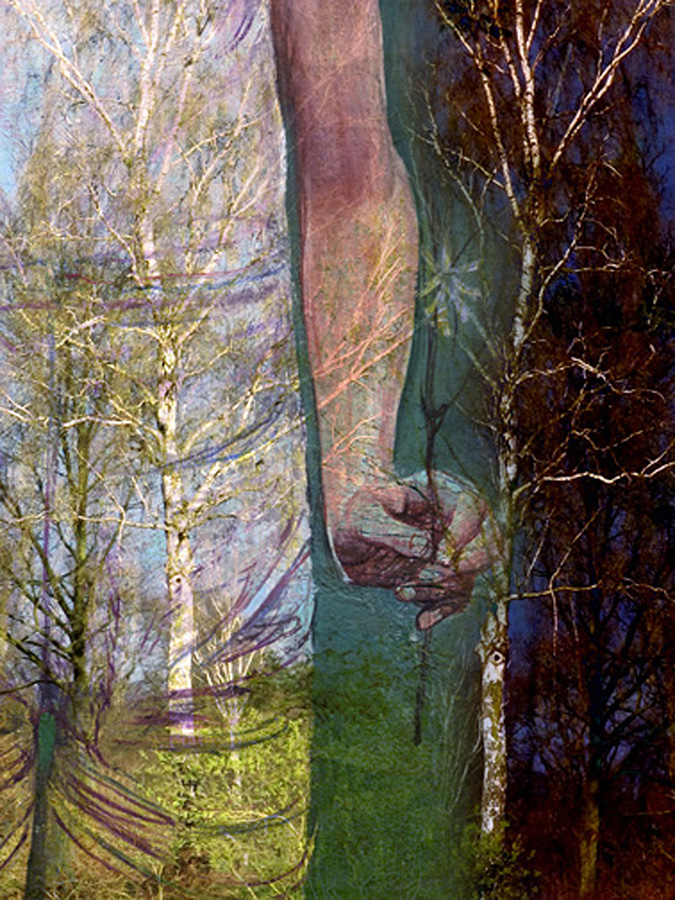
There’s a place between two stands of trees where the grass grows uphill
and the old revolutionary road breaks off into shadows
near a meeting-house abandoned by the persecuted
who disappeared into those shadows.
I’ve walked there picking mushrooms at the edge of dread, but don’t be fooled
this isn’t a Russian poem, this is not somewhere else but here,
our country moving closer to its own truth and dread,
its own ways of making people disappear.
I won’t tell you where the place is, the dark mesh of the woods
meeting the unmarked strip of light—
ghost-ridden crossroads, leafmold paradise:
I know already who wants to buy it, sell it, make it disappear.
And I won’t tell you where it is, so why do I tell you
anything? Because you still listen, because in times like these
to have you listen at all, it’s necessary
to talk about trees.
Adrienne Rich, “What Kind of Times are These” from Collected Poems: 1950-2012.
So let’s talk about trees, or rather let’s look at them.
What was:
***
What is:
The fires are, of course, every where and getting worse. Not natural but man made disasters, if we consider them a consequence of climate change that we elicited. As I write this, the McKinney fire is growing rapidly in Northern California. It has grown to more than 51.000 acres in the last two days and cost lives, with thousands fleeing and losing their homes. Montana lands and people are afflicted by the Elmo fire, and Idaho residents are under evacuation orders since Saturday as the Moose Fire in the Salmon-Challis National Forest charred more than 67.5 square miles (174.8 square km) in timbered land near the town of Salmon.
Last month, the Pipeline Fire on Nuvatukaovi (Hopi) or Dookʼoʼoosłííd (Navajo) — the San Francisco Peaks — ripped through Arizona forests desiccated by the worst drought in 1,200 years. Thousands of people evacuated and major traffic ways closed for all. New Mexico has unprecedented fires as well, with two of the largest fires on record burning at the same time: The Hermits Peak/Calf Canyon blaze and the Black Fire, approaching 350.000 acres.
Alaska is burning, some 55 fires across the region, active since June.
Here in Oregon, according to the official state website announcing current conditions and evacuation orders, we counted as of yesterday 19 fires.
And if you think there is some stark beauty captured in all of this devastation, I suggest you think about the toll to other living beings, and not just in terms of immediate death through burning or asphyxiation.
Short version of a long research report (with the table below laying out the framework): fires change population dynamics and environmental make-up in a way that affect immune responses and exposure to things that make animals, and eventually humans, sick. One major factor is an increasing contact with select parasites. Fire alters the exposure to parasites (habitat destruction, mortality, host movement, and community alteration)and also changes immune-mediated susceptibility (stress or injury and pollution). your immune system is simply not up to task if it has to fight on multiple fronts. If animals, including parasites, loose their habitat, they come in closer contact to human populations. Fires also shift the balance of a system of parasites, so that if some species are killed other species go unchecked, grow rampantly and are thus bringing more disease into mammalian populations.
So by all means, let’s talk about trees as well as the many, many other complex topics, from general climate to specific fire threats, so we can prepare adequate responses.
Here are the Sighing Firs, from Stanislaw Moniuszko’s HALKA.
“If it is true that all thought begins with remembrance, it is also true that no remembrance remains secure unless it is condensed and distilled into a framework of conceptual notions within which it can further exercise itself.”- Hannah Arendt, On Revolution
IMAGINE BEING A YOUNG CHILD ripped out of your familiar surround, transplanted into a world completely foreign to you, including a new language. Imagine being raised Jewish and now settled in a Christian school. Imagine being entrusted with an adult secret, urged not to tell that you will be leaving, unable to fill in the gaps about the reasons, a dark cloud over your mind too young to understand the facts, but old enough to pick up the feelings: pure fear. Your guess: Germany late 1930s? Guess again: America, during the McCarthy era in the 1950s.
She told me
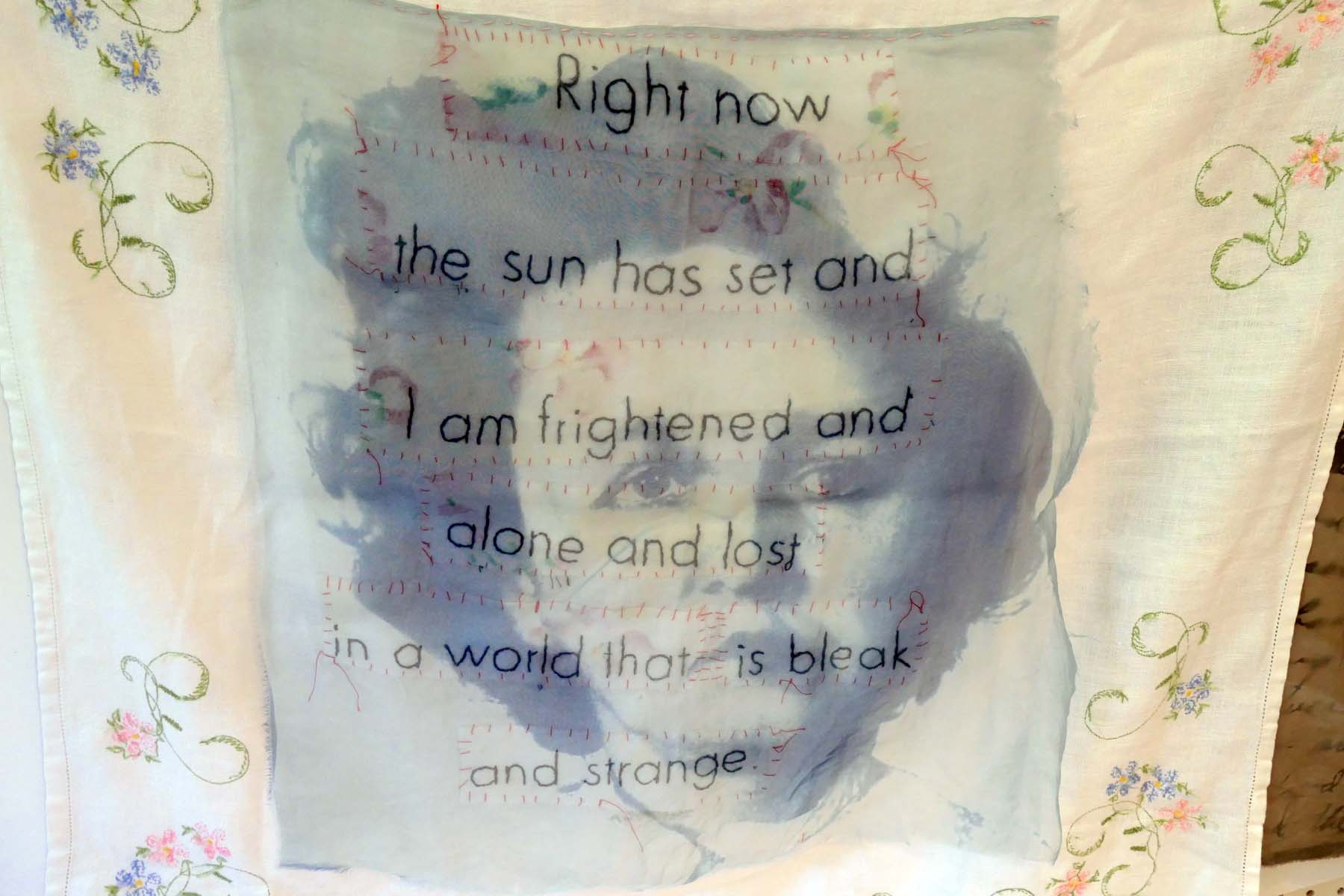
I had a chance to talk to artist Ruth Ross, for a preview of her upcoming exhibition, Red Scare, at Gallery 114 in August, and look at her beguiling work – fabric collages, cyanotype photography and embroidery – which deals with that childhood trauma at the same time that it provides a memory cue for all of us to think back to the days of communist witch-hunts, and perhaps forward to possible witch-hunts of our own now and in years to come.
Ross was born to a young Jewish couple, Ethel and Eli Ross, both members of the Communist Party of the United States, deeply engaged in the fight against racism and the struggle for social justice and improvement of the lives of workers. Their social circle, and indeed close friends, included many such idealists, some compelled to fight fascism in Spain, sacrificing their lives to combat that scourge. Their circles overlapped with those of Ethel and Julius Rosenberg, accused and convicted of espionage for providing the Soviet Union classified information on the Manhattan Project, executed by electric chair in 1953, leaving two young boys orphaned. Insisting on their innocence to the very last, it was later confirmed that Julius had indeed handed over some secrets, though less crucial ones than was claimed, and an innocent Ethel was convicted on false testimony of her brother-in-law who tried to protect his own family.
June 19th, 1953 – Date of Execution
The artist’s parents were shellshocked and decided to leave the country to where their meager funds would take them and their 2 children, ending up in Puerto Rico. What do we know about the times that would warrant such a life-changing decision? Was it based on justified fear or mired in hysteria? What could compel a couple deeply entrenched in their Brooklyn, NY neighborhood, their work, their organizations, their family, comrades and friendships, to choose displacement?
Arise, you prisoners of starvation! Arise, you wretched of the earth! For justice thunders condemnation. A better world’s in birth.
Ethel and Eli Ross
The 1950s American psyche was accosted with the Red Scare, with powerful political forces inciting widespread fear of a potential rise of communism, anarchism or other leftist ideologies. Fear of hostile outsiders was, of course, nothing new to Americans. Starting in colonial times until the early 19th century it focussed on Catholics, who were seen as inferior and unassimilable, stoked further by mass immigration of Irish Catholics in the 1830s and 1840s. The arrival of Italians, Slavs, and Jews from Southern and Eastern Europe prompted a new nativist upsurge – by the 1920s the Ku Klux Klan had gained hundreds of thousands of members, with their membership exceeding 4 million people. Fear mongering worked: new federal immigration laws severely dented the numbers of people allowed to immigrate. Fears of foreign ideology – fascism, anarchism, Marxism, undermining American ideas of exceptionalism and manifest destiny, eventually culminated in decrying the specter of communism during the times of the Cold War.(Ref.)
People who are afraid often seek a protector. If protecting allows you to yield power, then it is in your interest to feed fear, particularly in those who are not (yet) aligned with the Zeitgeist or the desired ideology. If instillation of fear squashes dissent and weakens both individuals and organizations that threaten your power or the profits you derive from the system that you support, then you become pretty good at figuring out what scares people.
In the 1920s, during the first Red Scare following the Bolshevik revolution and during a strengthening of the labor movement, it was often mob rule and mob violence that affected union members or other progressives, with one particularly horrid example close to us geographically, in Centralia, WA. A detailed description and analysis – not for the faint of heart – can be found in Cal Winslow’s When Being a Red Meant Risking your Life. During the second Red Scare in the 1950s, Senator McCarthy’s and friends’ approach to generating and sustaining anticommunist actions welcomed more allies in their fight against those who threatened old regimes or existing local hierarchies, be they class, religion, race, or gender. If you wanted to bust unions that organized labor across racial lines, fight pluralism, undermine civil rights organizations offering critiques of capitalism, racism, and gender oppression, or silence writers, artists, and journalists who advocated internationalism and peace, or oppress gay people who were seen as a threat to American masculinity, you needed loyalists in place to help with the task: in the administration, in law enforcement, in the court system, with neighborhood snitches and the occasional violent mob.
Letter to Eli from Abe Schwartz I and II – I hope the comrades are proving to be good Bolsheviks.
So what did Ruth Ross’ parents face, as members of a despised and feared political party? Or if labeled as Rosenberg acquaintances? They knew about the fate of some of the latter – Joel Barr, a college friend of Rosenberg, disappeared in Paris. Another college friend, MortonSobell, went to Mexico (and was later extradited), where another, Alfred Sarant, had already gone into hiding. William Perl was convicted of perjury .
Clockwise from Left: Arraignment. Rosenberg Boys at Sing-Sing. We are young, too young for death.
The more likely scenario, though, was what tens of thousands of leftist or progressive people faced in those years:
You were called before the House Un-American Activities Committee (HUAC), with but a few unsavory options. As Benjamin Balthaser wrote in a March 2022 essay for Jacobin, reviewing the book In Contempt: Defending Free Speech, Defeating HUAC:
“If you testified, you would be called upon to publicly denounce communism and then “name names” of other Communists and former Communists, then subjecting them to the same investigation. If you refused to testify, then you could be cited under the Smith Act, which effectively banned membership in the Communist Party. If you were not a citizen, you could be further indicted for failing to register as a Communist. … if appearing at the hearing and refusing to answer questions on the grounds of the First Amendment right to free speech and free association, then you could be indicted and sent to prison for contempt and noncompliance with a congressional committee.”
“The other punishments of the Red Scare were less legalistic but no less devastating. As the Supreme Court ruled, Communists and former Communists could be legally denied jobs, fired from jobs they had, denied federal student aid and research funding, and denied a place to live. There were no rights a Communist had that the state or a private citizen was bound to respect.”
“And in many cases, vigilante violence solved what the state could not: torchings of Communist and left-wing summer camps, labor halls, personal homes, and public beatings, most famously at Peekskill, New York, were common.” (Ref.)
No wonder, then, that many, like the Ross’, decided to start over, with so many activists silenced and organizations weakened.
At home, labor unions could often not be counted on as allies in either antiwar or student struggles. The energetic Jewish left, as well as African-American civil rights fighters had lost access to progressive institutions and could not longer trust many in their communities, with both the American Jewish Committee and the NAACP backing the Red Scare and even the execution of the Rosenbergs. (They tried to score political victories in a Cold War milieu by rejecting and denouncing “communist” allies who’d helped make those victories possible.)
No surprise, either, that the situational causes were too complex to explain to a child. A child that could only try and comfort her mother with the plea to stop crying on the day of the execution of an innocent acquaintance.
Mom cried on Execution Day.
***
MEMORY IS A STRANGE BEAST. Composed of actual facts, revised notions after a change-in-circumstances, integration of facts supplied by others or derived from non-memory sources like dreams and suggestions, conceptually geared towards helping us function in our worlds, it cannot always be trusted. Unless we are on the witness stand, though, veracity of fact does not exactly matter.
What matters is the construction of a narrative that helps us understand our world, our reactions, our path and our sorrows. In a funny way that is the opposite of the Arendt quote I prefaced these thoughts with. Her assertion”... that no remembrance remains secure unless it is condensed and distilled into a framework of conceptual notions…“referred to the assessment of the historical role played by the American and the French revolution in securing a memory true to fact. I had chosen the quote because I believe we must accurately remember the role that red baiting or any kind of baiting (I’ll get there in a moment) plays in a democracy or any system that aspires to uphold democratic values – a topic brought to the fore by Ruth Ross’ work that made me think about politics and justice (incidentally topics that loom large in a relatively recent biography of Ethel Rosenberg, Ethel Rosenberg – An American Tragedy, by Anne Sebba, a book that inspired Ross to dedicate herself to this project.)
Ruth Ross
Yet what Ross’ art does, in particular her depictions of her personal odyssey and that of her parents, is to create a narrative that considers the world from a perspective all her own, the emotional lessons learned and worked through from painful experiences, a personal, not necessarily factual truth. In some way, the entire project reminded me in this regard of Louise Bourgeois‘ often quoted phrase that “sewing is an act of emotional repair.” (I have never been able to find the actual reference, alas.) With all of her embroidered and collaged imagery, Ross walks a path brilliantly laid out in a different aspect of Arendt’s work, her use of non-standard mechanisms to help us see old assumptions with new eyes. (These mechanisms are summarized in a riveting book by Marie Luise Knott, Unlearning with Hannah Arendt, who describes them as laughter, translation, forgiveness and dramatization.)
The artist includes, for example, some black, black humor when she embroiders, on quotidian kitchen towels and old tablecloths, the image of an electric chair right among the symbolism of various identifiable parties, as if it belongs into a national gallery of power symbols. However shameful, I had to laugh, distancing myself enough from the upsetting thoughts so that I did not have to turn away from them completely to preserve emotional equilibrium, thus allowing the Rosenbergs to be remembered.
Quilt for a red diaper Baby – detail below
Forgiveness lingers over the inclusion of letters from a fallen friend to the artist’s father. She is able to acknowledge her father’s role, his losses, his motivating fears, despite the fact that he was a difficult man and turned his back on some of his more youthful political passions, much less his family. Ross attributes her own emotional recovery to time spent at an upstate NY summer camp, theLincoln Farm Work Camp, where hands-on physical work, art and politics united a group of youngsters from predominantly leftie and Jewish families, who found a place and a community there. She spent numerous years with her mother who had, for an interim time, left Puerto Rico to work in San Francisco and nurtured her daughter’s ambitions. Ross eventually graduated Parson’s School of Design in New York City with a degree in Graphic Design and worked for almost two decades as an Art Director at Random House, all the while pursuing her art.
On top: Eli Ross is a Commie. Bottom: Details from Letter to Eli from Abe Schwartz, who died in the Spanish Civil War.
The notion of translation as a tool to provide new ways of seeing old things captured my interest in multiple ways. The artist translates some of the ideas of disrupted lives, harmed existences, a demise by electrocution into visual symbols. The fabrics are frayed, some holes seem to be burnt, but above all there are loose threads hanging wherever you look, broken, ripped or snipped, if you will. I could not avoid thinking of the thread of life, so brutally cut. Yet there was also another word floating to the surface, the German compound noun Fadenriss, literally translated as ripped thread, a rupture. It is the little sister of amnesia, the inability to remember for a short while until you pick up the thread again. It is more than losing your thread of thought, in colloquial English, and less than a total black-out that comes with the biological system’s alarm reaction to overbearing trauma.
Ross’ installations acknowledge the lack of remembering, the desire to forget and the need to return to remembrance, all encapsulated in Fadenriss/ torn threat. They cover both, the personal and the public realm, which makes it very strong work indeed.
Left: Ethel Ross and her Firstborn. Right and Below: Ethel Rosenberg in her Kitchen. Ethel Ross.
Remembering our past is surely important in the face of a resurgence of political movements that use baiting to establish a new enemy, justifying the protection by a strong man and the establishing of legal and administrative structures that undermine pluralism. Calls for loyalty and “cleansing” (feel free to explore the Schedule F plans devised by the previous administration for a future term, with the suggestion to purge tens of thousands of “disloyal” people from government positions) have become louder. A return to traditional, rigid gender roles is openly demanded, including calls for control over female bodies. Any non-traditional gender- or sexual orientation is not only vilified as dangerous, but legally challenged, and certainly not given equal rights. You have trans bans on athletes and in the military already. Schools and curricula are affected with more than a dozen bills introduced across the country to ban teaching of certain topics, specific books or specific sources, among them the Zinn Education Project. Ross’ project reminds us that public memory is short and that will not serve us well. But maybe that is my interpretation of her work, aligned with my own interest in a Jewish approach to fascist stirrings.
Julius’ Tallit (Prayer Shawl) Front and Verso
Which brings me to the last technique on our list, dramatization.
“Arendt came to see human existence as a stage. The job of a writer, she came to understand, didn’t involve making an argument aimed to force the reader, through logic, to change his or her mind and come to accept what the writer had written. She wanted to spark a discussion in which readers were invited — indeed, expected — to take part…. The goal was to present a variety of ideas, perspectives and insights for the reader to sift through, evaluate, compare and contrast and, in his or her mind, synthesize into a new and personal understanding.” (Ref.)
Ross’ fabric works – her cyanotype photographs beneath semi-transparent veils, her curious dedication to feminine attributes from lace, to shoes, to flowers covering the image of a doomed life, her depiction of domestic closeness with hints of nightmare lurking in the back, death all pervasive from a Manhattan prison chamber to the dying fields of the Spanish Civil War – all ask us viewers to decipher the narrative meaning.
It demands that we provide our own answers about the nature and the consequences of an intentionally designed scare, be it about communism or whatever else is handy as a useful specter.
My take? Ripped threads will be all that remains if the civil fabric is once again frayed and broken apart.
Ruth Ross August 4 – 27 1st Thursday, August 4, 6 to 9.
with guest artist Diane Kendall showing Harpies Furies Mercies.
Poetry Reading: Friday, August 19, 6:30 PM Hear award-winning writer Leanne Grabel read poems inspired by Ross’s work.
Gallery 114 1100 NW Glisan Street, Portland, OR 97209
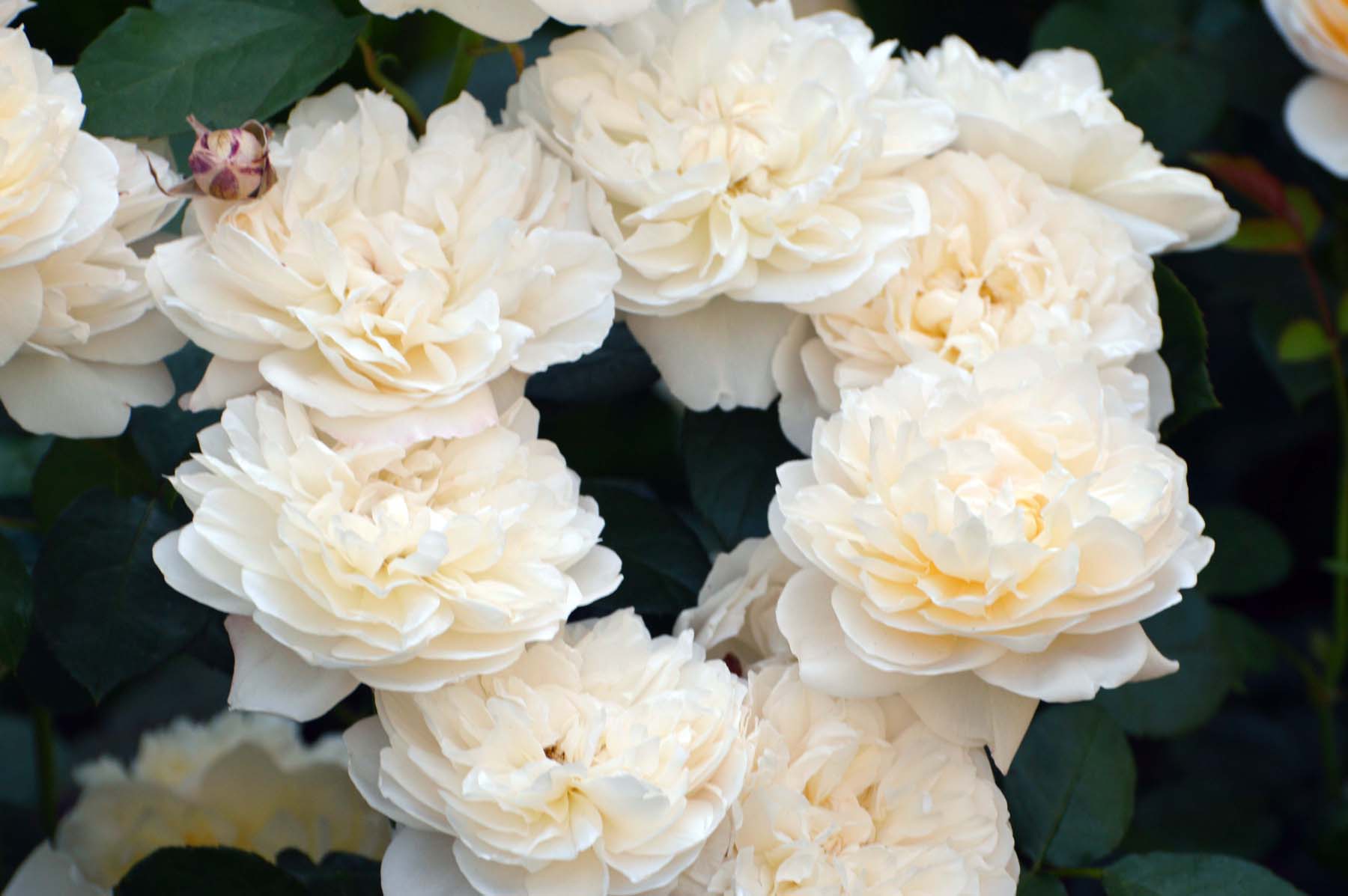
I am knee-deep in several independent writing projects and so, this once (or once again?) I will cheat and put someone else’s review of a book (Orwell’s Roses) I recommend up here, instead of my own. You still get the photographs of last week’s wonders in the mystery garden, though. And, in case you missed it, here are my own thoughts on Orwell, gardening and the disappearance of marital labor, from some time back.
Here is the link to the review of Rebecca Solnit’s Orwell’s Roses by Gaby Hinsliff. I am attaching the full text below for those who do not have access to The Guardian where it was published last year. If you have read it already, you might also be interested in the 2022 winner, announced yesterday, of The Orwell Society‘s Political Writing award: Sally Hayden’s My Fourth Time, We Drowned. Here is a review from March.
Orwell’s Roses by Rebecca Solnit review – deadheading with the writer and thinker
Inspired by George Orwell’s love of gardening, Solnit’s suitably rambling book should appeal to the green-fingered and the politically committed alike
The roses are in dire need of pruning. My rambler in particular is getting very tangled; too many whipping tendrils snaking out haphazardly at all angles. But it’s so pretty it’s hard to be properly brutal with it, even though it would probably benefit from some judicious thinning. And yes, it is the experience of reading Rebecca Solnit’s Orwell’s Roses that has jogged my memory.
The book simultaneously is and isn’t about George Orwell, just as it is and isn’t about roses. It belongs in a whimsical category of its own, meandering elegantly enough through lots of subjects loosely connected to one or the other; more of a wildly overgrown essay, from which side shoots constantly emerge to snag the attention, than a book. But at its root is the fact that in 1936, the writer and political thinker planted some roses in his Hertfordshire garden. And when Solnit turns up on the doorstep more than eight decades later, she finds the rose bushes (or at least what she takes to be the same rose bushes) still flowering, a living connection between past and present.
From this blooms the most enjoyable part of the book – a reflection on what gardening may have meant to Orwell, but also what it means to gardeners everywhere; beauty for today, hope for tomorrow, and a desire to create something for those who come after – all of which find an echo in the best of politics.
To make a garden is to feel, in Solnit’s words, more “agrarian, settled, to bet on a future in which the roses and trees would bloom for years and the latter would bear fruit in decades to come”. By the time Orwell’s roses flowered that summer, the Spanish civil war had broken out. As they grew, Europe spiralled closer to conflict. But the buds would still swell and the petals would still fall, and in the midst of death there would be new life, a cycle that helps explain why gardens and nature more generally have been such a comfort to so many through the grief and loss of the pandemic.
But roses, in Solnit’s story, don’t merely symbolise the eternal. They also symbolise joy, frivolity and a kind of sensual pleasure not always associated with Orwell, so often presented as a rather dour and austere figure; a chronicler of hardship in his writings on the low-paid and exploited, and in his fiction a prophet of doom, warning against the evils of totalitarianism. By choosing to focus on the gardens he planted – in Hertfordshire and, later, on the farm he bought on the Scottish island of Jura – and the happiness they brought him, Solnit restores something often missing not only from Orwell but from the political tradition of which he is part.
But not all the branching diversions of this book are so successful. A chapter on coal, which ends by arguing that Orwell’s planting of a garden half a century before climate change entered the public consciousness could be interpreted as the nurturing of “a few more carbon-sequestering, oxygen-producing organisms”, feels at best tortuously grafted on to the rest. I could have happily taken the secateurs to Solnit’s musings on the coincidence between being served Jaffa Cakes on her British Air [sic] flight to Britain and then reading an article about Palestinian children visiting the beach at Jaffa – an anecdote that tells the reader nothing of any significance about either.
But then into every garden a little bindweed creeps. The green-fingered and the politically committed alike will want to curl up with this book as the gardening year draws to a close and we reflect on a time during which nature has been more of a solace than usual. It’s been a good year for the roses, at least.
“A rose is a rose is a rose,” said Gertrude Stein. Well here is a musical bouquet of a rose and a rose and a rose. Fauré, Schubert in a Fritz Wunderlich performance, and Berlioz.
A perceptive friend remarked that I have been offering much contemplation on nature when not writing about the larger art projects across the last months. It is true, I have been using nature to distract myself from politics, the relentless onslaught of bad news, piling up like yesterday’s clouds, pictured below.
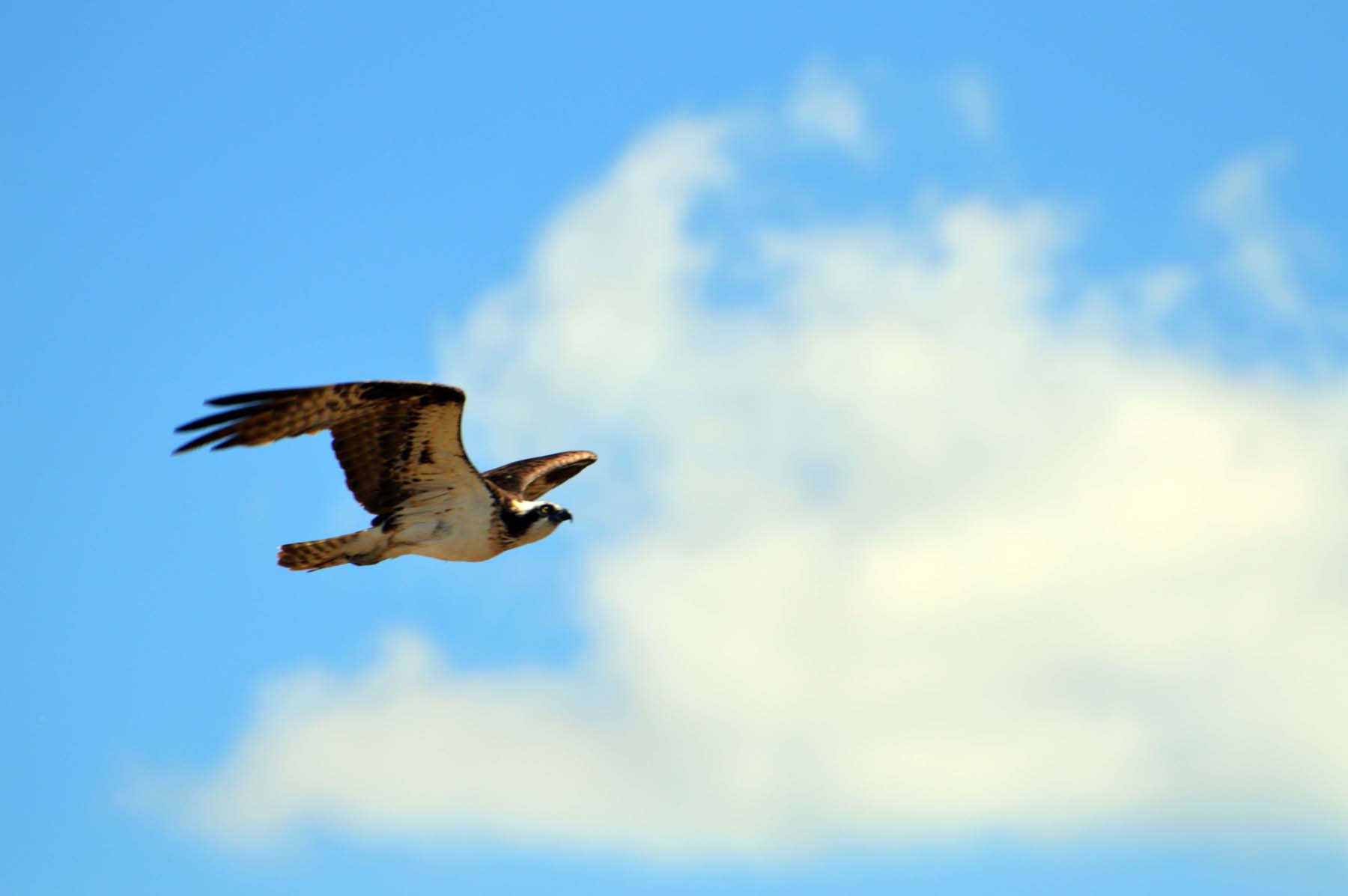
So it was yesterday when I hung out with a number of ospreys. Or so it was supposed to be. Alas, the politics refused to leave my head. While the birds circled, hunted, tended to their brood, I thought about how the accumulation of shootings not only numbs us, but makes the average citizen more eager for strongman or authoritarian protection. The repeated shocks drive the last ones away from our attention, to be replaced by the newest massacre.
Remember the supermarket shooting in Buffalo, mid-May? The school shooting in Uvalde, some weeks back, now Highland Park during the 4th of July parade? So far, in the U.S. this year, we have had 322 mass shootings, (defined as 4 or more dead, excluding the wounded.)
And then this:
” the shootings were “designed” to get Republicans to support gun restrictions. Here’s what I have to say. I mean. Two shootings on July 4: one in a rich white neighborhood and the other at a fireworks display. It almost sounds like it’s designed to persuade Republicans to go along with more gun control. I mean, after all, we didn’t see that happen at all the pride parades in the month of June,” Greene said.
“But as soon as we hit the MAGA month,” she continued, “as soon as we hit the month that we’re all celebrating, loving our country, we have shootings on July 4. I mean, that’s … oh, you know, that would sound like a conspiracy theory, right?”
So spouts Congress woman Marjorie Taylor Greene, conveniently forgetting that just a few years back 49 people were killed at an Orlando gay bar. This month police in Idaho foiled an attack by affiliates of a white supremacist group on a Pride celebration in a park. A scooting scare at the SF Pride Parade sent the crowd running (evidence was not found.)
And then there was the Las Vegas shooting in 2017, that killed 60 people and wounded over 400. At a music festival, not during “MAGA” month….
Kathy Fish wrote her most widely anthologized piece to date in response to that murderous act.
“It was first published in Jellyfish Review. It was then chosen by Sheila Heti for Best American Nonrequired Reading 2018 and by Aimee Bender forBest Small Fictions 2018. Variously described as a poem, flash fiction, prose poem, or flash essay/creative nonfiction, this hybrid piece has also been selected for Literature: A Portable Anthology (Macmillan), Stone Gathering: A Reader (French Press Editions), Humans in the Wild: Reactions to a Gun Loving Country (Swallow Publishing), Advanced Creative Nonfiction: A Writer’s Guide and Anthology, (Bloomsbury), and the newly released 15th edition of The Norton Reader (W. W. Norton).“
Collective Nouns for Humans in the Wild
A group of grandmothers is a tapestry. A group of toddlers, a jubilance (see also: abewailing). A group of librarians is an enlightenment. A group of visual artists is a bioluminescence. A group of short story writers is a Flannery. A group of musicians is — a band.
A resplendence of poets.
A beacon of scientists.
A raft of social workers.
A group of first responders is a valiance. A group of peaceful protestors is a dream. A group of special education teachers is a transcendence. A group of neonatal ICU nurses is a divinity. A group of hospice workers, a grace.
Humans in the wild, gathered and feeling good, previously an exhilaration, now: a target.
A target of concert-goers.
A target of movie-goers.
A target of dancers.
A group of schoolchildren is a target.
by Kathy Fish
I have no use for conspiracy theories, from any faction. The facts speak for themselves. The number of available guns needs to be reduced. Gun laws need to be reformed, waiting periods initiated, background checks performed. Large capacity magazines need to be prohibited. Politicians need to be prevented from benefiting from lobbyists’ largesse. As long as we do not acknowledge these facts, children remain targets. Or their parents. Or anyone else in the fabric of things.
Come on ospreys, do your thing. Distract me.
Here is a beautiful album that might do the trick.
I was thoroughly bummed. A friend had reached out if I could resume photographing one of his Master Classes, this time at BodyVox and on-line, offering a Dance Workshop on July 8th and a Drum Workshop on the 9th. How I would have liked to do that, but of course I can still not attend inside sessions. It’s been almost three years since I’ve documented those African drummers and I miss it (wrote about them last here.) Check it out – it’s open to all and an exhilarating experience.
My mood did not exactly improve when I tried to soothe my irritation with a walk. The extent of the damage that last summer’s drought and this spring’s cold floods did to the trees at the Oak Bottom nature preserve is now evident, and it is considerable. Worse, there are open fire pits to be found in the park, a clear and present danger to the old growth around it, never mind the trash. I so understand the houseless pitching their tents away from dangerous highways, or sidewalks where the next forced removal is around the corner. But my heart fears for the safety of the forest when fire becomes involved.
Fire ring ashes above, Cottonwood tree fluff lying around like tinder below.
In case we’d forget, someone spelled out the systemic root causes, adding cries for help.
“Capitalism ruined everything.”// Save Kids.
Read by me during a month when the Supreme Court had revoked women’s constitutional rights to bodily autonomy, decided that Miranda rights aren’t really necessary, declared that states can’t regulate firearms, assured that the EPA cannot regulate assaults on our – and the world’s – environment, but states can use new powers in “Indian Country,” not just further diluting Native American sovereignty, but also opening an avenue to criminalize and punish any non-native protesters who come to states that go ahead with drilling and pipelines. Mood further deteriorating.
As Vox Senior Correspondent Ian Millhiser remarked: “The United States has three branches of government, the Judiciary, which makes laws. The Executive, which sends a lawyer to the Supreme Court to argue in favor of laws. And the Senate, which blocks Democratic nominees to the Judiciary. Oh, and the House which asks for campaign donations.”
Still, wildflowers, chicory and sweet peas, morning glory and jewel weed among them, lined the path.
Ducks went about their business, watched over by a solitary heron (where did all the others go?)
Raccoon and I exchanged meaningful glances before we parted.
And the birds ignored it all and just trilled out their song. Or foraged for lunch. Or fed their fledgelings, closer to home. At the equal opportunity bird feeder in front of the study window.
This is about 5 meters from the road which she regularly crosses to get to my roses and hostas….whatever small fruit had managed to set on the apricot trees are gone as well.
Daily practice of hope? Turn to British writer and poet Tom Hirons. How can you not seek help from a poet who describes himself on his website as:
Essentially a cheerful fellow driven to apoplexy and grief by the madness of our times, Tom is calmed most effectively by walking on Dartmoor, by sleeping in the deep greenwood and by the sound of true words spoken.
Holding each other fast against entropy was likely the principle behind this tagger’s planting of joy, which ultimately cheered me up – a distributed garden of flowering hearts, specimens all photographed at Oaks Bottom on this one round yesterday. Grace occurs in unlikely places.
Here is a recent performance of Sekou, his mates and the young dancers at a Blazers game.
Disaster-porn: “to satisfy the pleasure that viewers take in seeing other people’s misfortunes, as by constantly repeating vision of an event, often without commentary or context”. – Australia Macquarie Dictionary
My morning readings include the news from Europe, brought to me among others by Der Spiegel, a German weekly and the country’s largest news platform on the web. All photographs but one today were seen on their site last week, and elicited decidedly mixed feelings. They lure with beauty while depicting disaster, simultaneously drawing attention to human suffering as well as away from it.
An ice vendor waiting for customers during the worst heat wave in decades. In neighboring Nawabshah (Pakistan) the highest value ever recorded: 128.7 F on May 1st.
Somehow the term disaster-porn came to mind. It is a phrase often used to define depictions of suffering in the developing world, but also applied to the increasing number of end-of-world or other catastrophe movies coming out of the film industry, and not just in Hollywood. Is it ethical to depict, create and watch all this stuff? Let me put the answer right in front: it can be, theoretically. At least this was what I concluded after reading the essay that I am summarizing today while trying to solve my dilemma.
The remnants of a container depot in Bangladesh that stood in flames and then exploded, throwing heavy objects through the air for hundreds of yards. Dozends dead, hundreds injured. Foto: picture alliance / dpa / AP
The term disaster-porn can be found as early as 1987 when a Washington Post editorial about the stock market crash. It described that those of us doting on the disasters in cinematic action dramas are lured into believing that it is either all fake, or that we personally will escape bad fate in the end, never mind the millions we watch dying in catastrophic scenarios. The term has been popularized ever since, sometimes in specific ways, like in Pat Cadigan’s 1991 Sci-Fi novel Synner which used “porn” as a suffix denoting an excessive, overly aestheticized focus on a single topic. (The award-winning novel, by the way, envisions a world where the line between machines and reality becomes porous, a possible disaster scenario now in the real-life news 30 years later…just google AI.) The phrase is thus applied not just to fictional descriptions of disasters but also to round-the-clock depictions of round-the-world catastrophes by the media.
Iraqi boys herding sheep in a sandstorm. They are not allowed to enter into the province of Najaf, to avoid spreading the Crim-Congo fever. They are stuck at the border in the middle of the storm. Foto: Quassem Al-Kaabi / AFP
What is the problem? On the one hand, in an ever more interconnected world where we might be called on or able to help with disasters even at distant locations, information about them helps our collective mind to make decisions. In other word, the depictions might elicit empathy and understanding, which can turn into human solidarity.
On the other hand, there are multiple problems. Disaster-porn can be gratuitous and exploitative – published to sell clicks, or used as justification to simplify complex geopolitical realities, and thereby encourage military operations under the guise of humanitarian action.
In addition, over-exposure to images of doom can lead to a muting of your reaction, draining our reserves of pity, desensitizing us to others’ pain. It can be experienced as damaging our own sense of well-being, thus having us turn away from the suffering in the world. Compassion fatigue elicited by a pity crisis.
Boy amidst storks sifting garbage in the Indian province of Guwahati. Dangerous because of the extreme heat – several garbage dumps have spontaneously caught fire and combusted. Foto: Biju Boro / AFP
There is some inherent psychological truth to the fact that we better protect ourselves from too much exposure to bad news. If we feel that there is absolutely no way we can interfere with the starvation, drowning, imprisoning, wounding, torture, and killing of people, seeing them exposed to these situations will create a sense of anxiety that we will try to resolve by averting our eyes. A barrage of doom scenarios leads to feelings of hopelessness and helplessness, both associated with depression, and subsequent paralysis when we think about possible action – just no sense left, that we could make a difference. Here is just one of the studies that lays out that scenario.
Another way to cope with extreme heat across Asia.
And yet…
“Disaster porn, then, in all its iterations and for all its flaws, is a vital political terrain in which publics are at least implicitly asked to struggle with the social significance of the suffering of others. It connects public issues like war, famine, earthquakes, and terrorist attacks to the private lives of those they affect, and shows us how disruptions of social structure become disruptions in individual biographies. This is the case in even the most seemingly stereotypical news reports of suffering in the developing world, and in even the most outlandish Hollywood disaster epics as well.” (Ref.)
Literature and disaster movies contribute in an odd way: they do describe the role chance plays with some people being more endangered than others, some surviving when others don’t. Yes, there are heroes (or villains) who manage to suggest that with some amount of smarts and vision you can still control the outcome (echoing our sense of exceptionalism in U.S. culture), but there are all the others who are not so lucky, because it is often determined by the vicissitude of geographical location alone, rather than specific talents or skills. Chance confers the privilege of survival. It might make us think about our own privilege and so raise compassion, since so far chance has spared us, amidst the forest fires, or floods or infectious diseases.
The Clark Ford River flooded the houses of many of the inhabitants of Fromberg, MO. This is a lawn ornament submerged in the waters. Foto: David Goldman / AP
Leave it to me to read and watch these kinds of novels and films, if only to spare you to have to do it yourself…..
My current target is a 1973 science fiction novel by Sakyo Komatsu, Japan Sinks, which took 9 years to write.It has been made into numerous films, a highly praised animé version among them. Some had altered endings, some were withheld during certain time periods because they were too close on the heels of real life disasters in Japan, given the exposure to earthquakes and the Fukushima catastrophe. The latest, a Netflix production, is so bad that I recommend it on a day where you need help to erupt in laughter – the acting – if you can call it that – guarantees that you will.
The book, however, is worming its way into my brain. The basic story concerns a scientist’s discovery of the likelihood that all of Japan, the entire archipelago, is going to go under due to earthquakes, ocean floor faults, and what not. One of the narrative lines concerns how the government is handling the crisis, from negligence to obstruction to panic. Don’t look up, this year’s U.S. disaster movie that I discussed here, probably took a page out of that book. Another line focusses on the distribution of millions of people around the world, with nationalist impulses against immigration vying with empathy for a drowning people. The philosophical question it raises, though, is one that we will have to think through in climate change migrations to come: what does it do to your identity, as member of a nation, or a tribe or a culture or a language group, when the place that defines you ceases to exist? Literally is no longer there to return to? Is it destructive to lose that connection to place which is a base for underlying sense of self, or is it empowering because you can shed the debt you incurred as a member of the nation (say of an imperialistic or fascistic past) and start from scratch?
Think it through – time not spent doom scrolling…
We could also focus on the message conveyed by a random stranger who was kind enough to let me photograph her t-shirt 2 days ago.
I take my victories where I can find them. Two days ago I won a staring contest with a coyote. The bunny, paralyzed with fear between us, lived, too. I stood still for what seemed half an eternity, he approached a step or two but then reconsidered. Time enough to take the photographs, and for a Painted Lady to land on the scat he left behind. No matter how often I feel blessed by nature, some encounters are unexpected, as if by magic, and make my heart race. With joy more than fear.
It had already been a morning filled with sweet encounters. The hungry scrub jay fledglings waiting for their mother,
other mothers readjusting worms in beaks.
Egrets hanging out, with a cacophony of their screaming offspring in nests in the woods behind them.
Glimpses of snowcapped Mt. St. Helens in the distance.
I had come to photograph something altogether different, though. I wanted to capture the star-like flowers of hemlock or cow parsley, you choose. (I have written about the distinction between these two, the former highly toxic, the latter good for making soup, previously here.) I needed a stand-in for stars, since they play such an important role in the poem attached below, not having images for the real thing since I rarely see them these days. Either it is too cloudy, or I am in bed already.
I don’t know why I had not come across this poem earlier – it has been around for a long time. Since 1977, to be precise, in a volume called The Hocus-Pocus of the Universe. The author, Laura Gilpin, had received the Walt Whitman Poetry award the previous year. She died, not yet age 56, barely 6 months after a diagnosis of cancer, in 2007.
The Two-Headed Calf
Tomorrow when the farm boys find this freak of nature, they will wrap his body in newspaper and carry him to the museum.
But tonight he is alive and in the north field with his mother. It is a perfect summer evening: the moon rising over the orchard, the wind in the grass. And as he stares into the sky, there are twice as many stars as usual.
by Laura Gilpin (1950- 2007)
The poem hit me at gut level, about the precariousness of life, about “othering,” and the hope one can find when staying in the moment, if only for a moment. It also fascinated me with a level of writing skill that manages to suggest so many different scenarios in so few lines.
What do we have here? Immediately we get introduced to the derogatory term freak. Wrapped in newspaper (a calf with two heads? Large newspaper…) reminiscent of ways to discard refuse like stinking fish. It will be displayed, gawked at, the museum replacing freak shows of yore on the circus circuit.
“...a term used to describe the exhibition of exotic or deformed animals as well as humans considered to be in some way abnormal or outside broadly accepted norms. Although the collection and display of such so-called freaks have a long history, the term freak show refers to an arguably distinct American phenomenon that can be dated to the 19th century.”
Promoted by P.T.Barnum, people raved about the entertainment delivered by watching disfigured animals or humans with disabilities, weight and height differences, dwarfism included, absence or increased presence of limbs, vitiligo, and persons with ambiguous sexual characteristics including hermaphroditism. Given how indefensible and indecent amusement at the sight of human abnormalities is, it is no surprise that the world saw a “Revolt of the Freaks” in 1898, when a collection of the 40 or so most-famous performers in the world staged a labour strike while on tour in London, demanding that the management of the Barnum and Bailey circus remove the term freak from promotional materials for their shows. To no avail. It took until the middle of the 20th century for these shows to be abandoned.
What is unfortunately alive and well, though, is a (religious and ideological) movement that defines “non-normative” people as freaks, abnormalities to be eradicated from a healthy societal body, and threatens to, at best, exclude them and force them into hiding, or punish them and those who support them, or, at worst call for their extermination. From a church pulpit, no less.
In this year alone, more than 240 bills have been introduced directed against LGTBQ people, most of them trans, and the year isn’t half over. The Human Rights Campaign reports that last year, 50 transgender and gender non-conforming people have been killed in the U.S., 14 so far this year. That is not counting the suicides of mobbed or despairing trans teenagers. According to NPR, a third of the known trans-youth, 58.000 people, are in danger of losing gender affirming health care. Actually, newest statistics show that the U.S. has about 1.6 million people who are transgender, 43% young adults or teenagers.
Gilpin draws a scenario in the second stanza that shows the domesticated framework of a summer evening at the farm. North field, like a neighbor’s address, with mother, a loving family then, mellow conditions lit by the moon, soothing noises by soft wind, the mention of an orchard promising the sweetness of fruit. All is right here, as long as the cruel world can be kept at bay, and the fate of non-conforming to norms, or of disability, postponed for just a few hours longer. It is inevitable, but in the meantime there is beauty to behold. And here is a glint of magic: four eyes in two heads see double the beauty, a privilege not granted to the rest of us.
Yet the added shimmer is no compensation, in my mind, for the lack of a glimmer of hope that people will attempt to integrate physical or mental disability without prejudice, or accept gender non-conformity (not a disability!) as a human right. Or stop using it as a wedge issue in a war between polarized ideological factions.
Gilpin worked for decades on a second volume of poetry, finished shortly before her death and published posthumously, The Weight of a Soul. Mine was left less heavy by the thought that poetry can still help us think things through, sort out who is discriminating and who needs protection. My soul was also made lighter by the hocus-pocus of nature, creating every variability imaginable, shimmering in the light.
Here is some beautiful music from Australia Superclusters. More stars, for your ears this time.
1: a sudden spasmodic effort that accomplishes nothing
2: one that appears promising but turns out to be disappointing or worthless – Merriam Webster
William Merritt Chase Peonies 1897
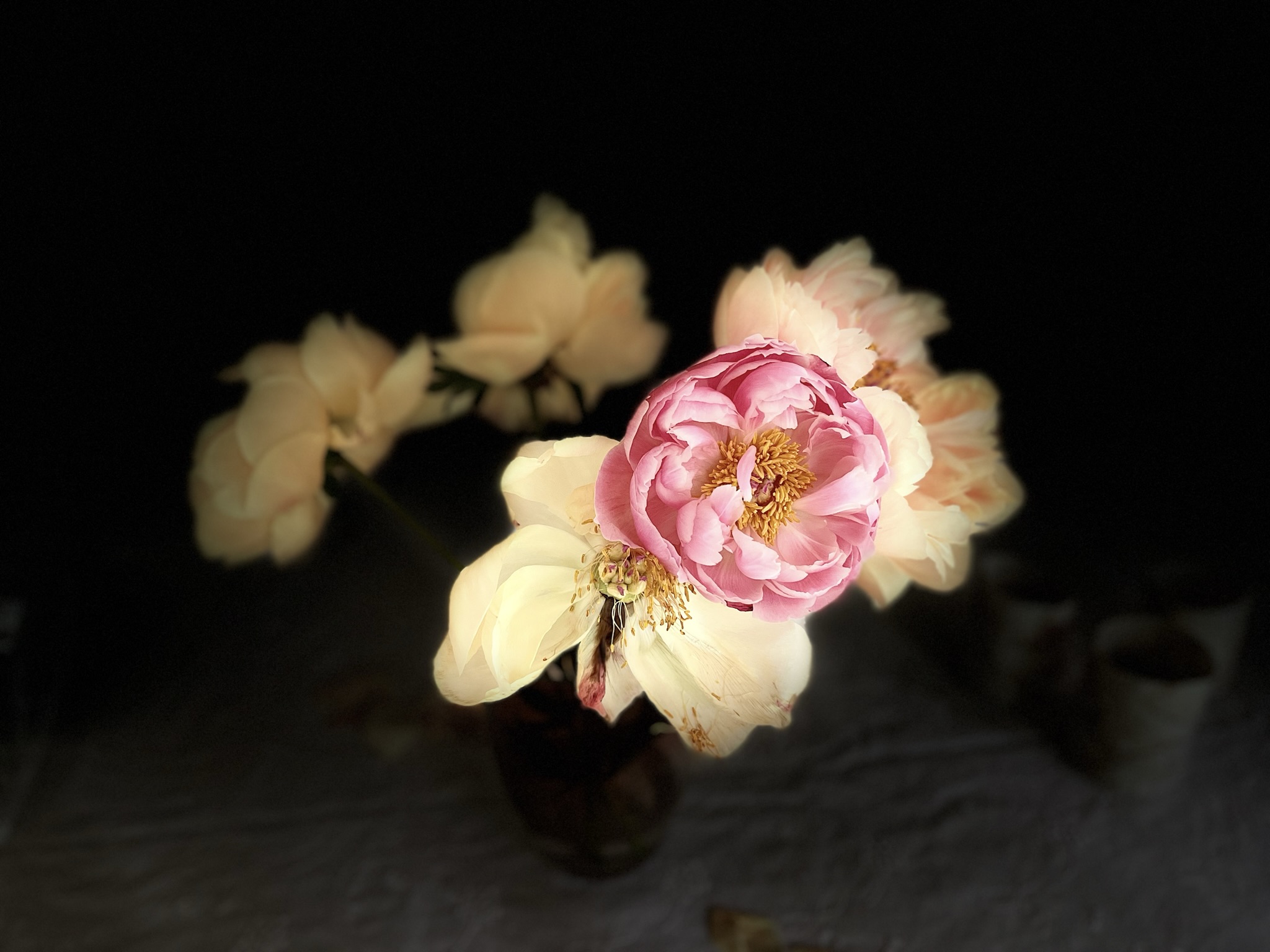
This was me, last week. Sort of. Make the hair white, make the peony bouquet more modest, make it camera in hand instead of fan, and you’ve got the picture. Peonies have been a magnet for visual artists across centuries. They are lush, come in a range of colors, can be arranged in dramatic tableaux. And when the petals fall, they serve as a perfect memento mori. It doesn’t hurt that they last in the garden only for a short time. The fleetingness spurs desire to create something more lasting.
Here are some of my favorite paintings, as per usual the European fare I grew up with, Dutch, Russian and French masters.
Vincent Van Gogh Roses and Peonies (1886)
Pierre Auguste Renoir Peonies (1880) Eduard Manet White Peonies (1864)
Henri Fantin-Latour Vase of Peonies (1881) Alexander Gerasimov Still live with peonies (1950)
No massive bouquets for me, at $3 per stem, but the five I ended up with held a wonderful surprise in store. I had unwittingly bought Paeonia Coral Charm, a peony variety known for its color transformation while blooming. (Photographs are all of the same bouquet, across a week or so.)
The variety was registered in 1964 and colors switch from coral to cerise, orange and, finally, white across its lifespan, in the vase as much as on the stem in the garden. Quite a spectacle to behold.
Peonies are a flash in the pan – they come and go in the garden in the blink of an eye. That phrase, flash in the pan, has its origins debated. Some say it originated in the 17th century when Flintlock muskets held small amounts of gunpowder in a pan. When the power flared up without a bullet being fired, it was called a flash in the pan. Others claim it has to do with the experiences during the Gold Rush of the 19th century. Prospectors’ excitement when they saw something glint in the pan was dashed when it did not turn out to be gold.
In any case, for a moment I had had high hopes that one could use the phrase regarding UK Prime Minister Boris Johnson – alas, he did survive the no-confidence vote on Monday, albeit facing a substantial rebellion and a weakened leadership position. I’m not going to bore you with details of my distaste for the man (and his party’s politics) but instead share something that brightens my days occasionally.
There is someone on Twitter called “Shakespeare Replies” – @TheBardAnswers.
He or she provides appropriate citations from Shakespeare’s works for current political situations and is about as much a fan of Johnson as am I…
I have collected some of the ones that made me laugh across time – hope you enjoy them as well.
And secondary commentary on Nadine Dorries’ support’
Alas, not always are the text sources referenced, but it is just fun to anticipate when the next one will come along.
Or this one:
And finally, other targets as well:
Shakespeare, of course, wrote about practically every plant there is, except for peonies – at least I could not find anything in my go-to-guide,Botanical Shakespeare, which lists and cross-references the names of plants with the plays, sonnets and everything else. Best of all: they offer planting instructions of the flora appearing in any given play. For June you could chose A Midsummernight’s Dream, for example, and learn which of the mentioned plants are good for your zones, how to plant them and a lot of biological information about them. (All contained in link above.)
Might as well go plant some peonies, given that I cannot use Sonnet 29 for a certain Prime Minister quite yet…
Sonnet 29: When, in disgrace with fortune and men’s eyes
When, in disgrace with fortune and men’s eyes,
I all alone beweep my outcast state,
And trouble deaf heaven with my bootless cries,
And look upon myself and curse my fate,
Wishing me like to one more rich in hope,
Featured like him, like him with friends possessed,
This is for the kids who die, Black and white, For kids will die certainly. The old and rich will live on awhile, As always, Eating blood and gold, Letting kids die.
Kids will die in the swamps of Mississippi Organizing sharecroppers Kids will die in the streets of Chicago Organizing workers Kids will die in the orange groves of California Telling others to get together Whites and Filipinos, Negroes and Mexicans, All kinds of kids will die Who don’t believe in lies, and bribes, and contentment And a lousy peace.
Of course, the wise and the learned Who pen editorials in the papers, And the gentlemen with Dr. in front of their names White and black, Who make surveys and write books Will live on weaving words to smother the kids who die, And the sleazy courts, And the bribe-reaching police, And the blood-loving generals, And the money-loving preachers Will all raise their hands against the kids who die, Beating them with laws and clubs and bayonets and bullets To frighten the people— For the kids who die are like iron in the blood of the people— And the old and rich don’t want the people To taste the iron of the kids who die, Don’t want the people to get wise to their own power, To believe an Angelo Herndon, or even get together
Listen, kids who die— Maybe, now, there will be no monument for you Except in our hearts Maybe your bodies’ll be lost in a swamp Or a prison grave, or the potter’s field, Or the rivers where you’re drowned like Leibknecht
But the day will come— You are sure yourselves that it is coming— When the marching feet of the masses Will raise for you a living monument of love, And joy, and laughter, And black hands and white hands clasped as one, And a song that reaches the sky— The song of the life triumphant Through the kids who die.
I had said I’m taking the week off, and I am. But could not think about yesterday’s massacre in Texas without thinking of this poem, and the insistence on life triumphant in the last lines, a defiant – helpless- cry, wrapped in hope. Needed to share it.
The powers that be in this country tolerate that guns are the highest cause of death for kids in this nation. 27 school shootings in the first 5 months of this year alone. The powers that be are content to see money from weapons flow into certain coffers, their own included. I am not even listing the ones that got NRA donations in the tens of thousands, just the ones overt a million.
But the powers that (want to) be are interested in more than money, and that is important to remember. We will not see any significant change because mass death primes for authoritarianism. As Ruth Ben-Ghiat explains, systemic gun violence is part of a Republican political design to destabilize American society. Her recent essay in the Washington Post spells out in great detail how transforming public schools into death traps is tolerated as part of a deliberate strategy to create an atmosphere of fear and suspicion conducive to survivalist mentalities and support for illiberal politics.
Let Langston Hughes be right, a day will come where the song of life triumphant will rise to the sky, a monument to all the lost kids. But in whose lifetime?
“Hope doesn’t preclude feeling sadness or frustration or anger or any other emotion that makes total sense. Hope isn’t an emotion, you know? Hope is not optimism. Hope is a discipline… we have to practice it every single day.”
— Mariame Kaba
You are getting two for one today. I wanted to post a piece of music, Our Phoenix by Mari Esabel Valverde, because it is a heartbreakingly beautiful reaction to the white-supremacist incited and enacted violence and terrorism in this country, Buffalo, NY as the most recent instance. The words are from a poem (full text of Our Dangerous Sweetness in the link) by Amir Rabiyah, who was born in London, England, to a mixed Cherokee and white mother and a Lebanese and Syrian father and who, as a trans poet, explores living at the margin.
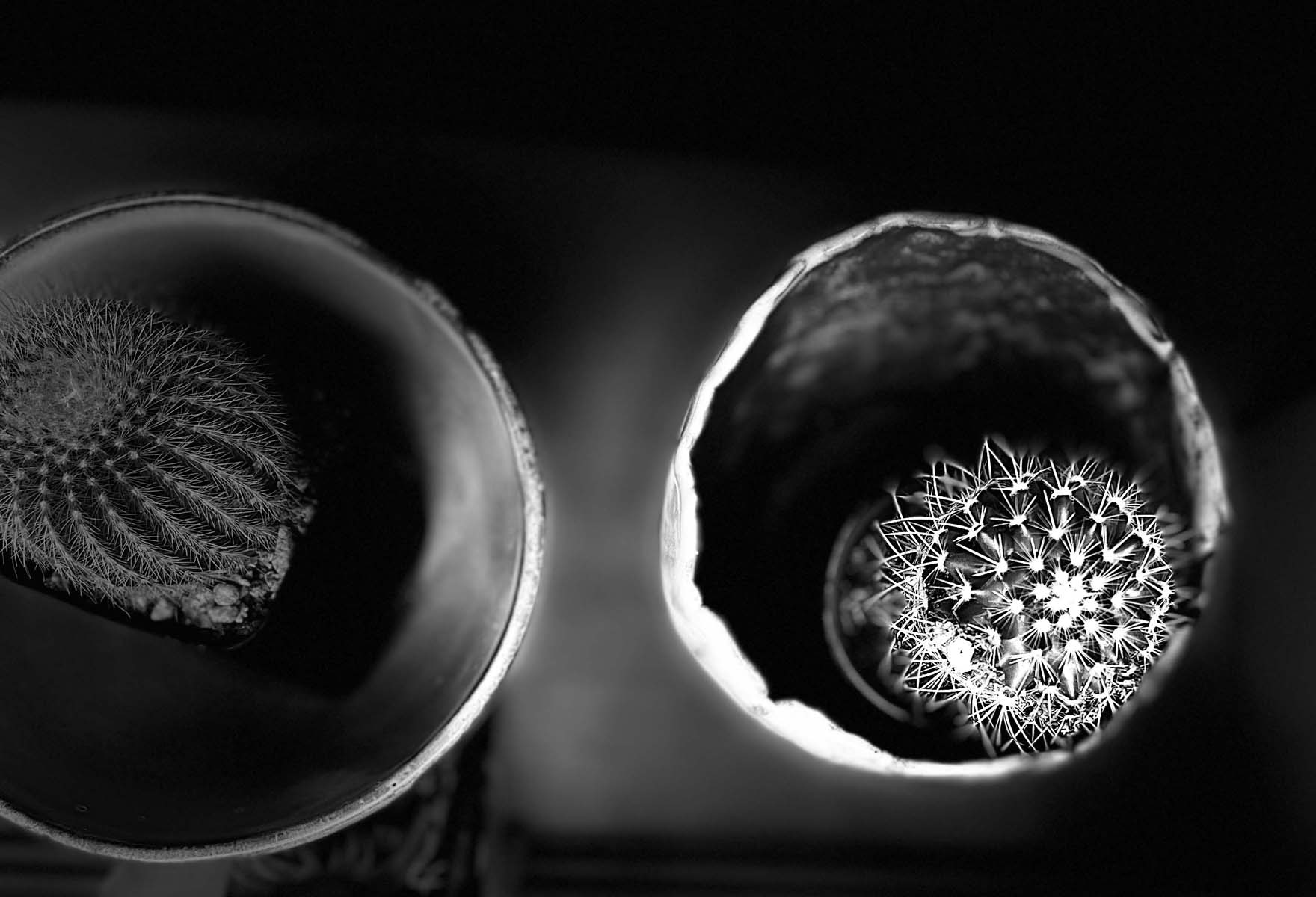
I thought, though, that another one of their poems is more powerfully hopeful, needed in a world and era where positive thinking is ever harder to conjure, as well as gloriously full of double-meaning. So here’s my daily dose of practicing hope. And besides, I can show you what’s currently on my kitchen windowsill, glittering in the darkness …still waiting for blossoms, though.
Cactus Flower
We flash victory signs in the darkness, so the darkness may glitter. — Mahmoud Darwish
As the sun sets—we set our plan into motion. Our sole purpose to overthrow
any assumptions, to change the course of ordinary thinking.
Our work begins by speaking to darkness and telling darkness soon :
we will demonstrate through the secrecy of stars,
earth’s magnetic embrace how we can be many things at once.
So much of the work we do is internal, goes unnoticed, uncompensated.
We get written off or not written at all, labeled freakish, prickled, rough around the edges.
We learn to thrive in the dry humor of soil; carry water in our bellies to quench our own thirst.
We survive, over again. Adapt. Even after being carried in the beaks of birds, dropped elsewhere,
far from our roots, we grow. We flourish. And when least expected, when histories
not told by us, for us, claims we are defeated,
we gather our tears as dew. We release our anguish, intoxicated by our own sexed pollen. We burst,
displaying the luscious folds of our petals.
by AmirRabiyah
And if you you are in the mood for analysis rather than poetry, read this. Or this from the Jewish perspective. Or this from an economic-systems approach.