Browsing Category

Politics

Stick-People against Nazis.

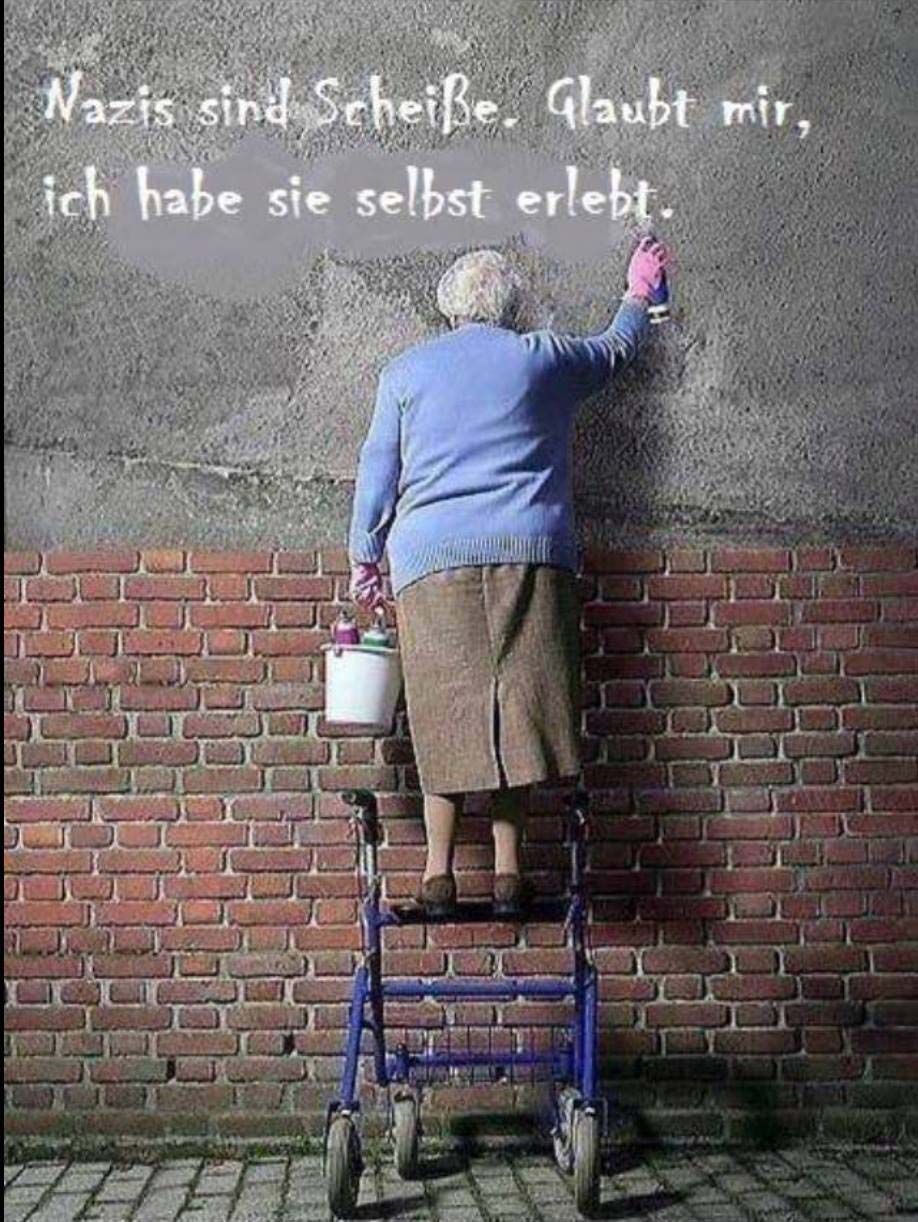
I found today’s title photo years and years ago on the net. The little old lady’s tagging says: “Nazis are garbage. Believe me, I have experienced them myself.”

It is somewhat ironic that I now AM that old woman and can report that the experiences are no longer just in the past. How dreadful is that. Luckily there are plenty of people resisting.

German cartoonist Tobias Vogel, known under the tag name @Krieg Und Freitag, is in the middle of a fundraising campaign to support an organization that fights Nazis. (The name translates as War and Friday, and was coined when the artist looked for war and peace on his phone and mistyped Frieden – peace – as Friday.)

Vogel has created a signature collection of little stick people who comment on the travails of everyday life and politics online and with prints that can be purchased. He received multiple prizes, including the Grim Online Award, for his work across the last years.

Gallery exhibition of Tobias Vogel at Affenfaust

The current project raises money for a non-profit with the name of Kein Bock of Nazis (KBAN, No Desire for Nazis.) Since 2006 they support, network and inform adolescents and young adults on the topic of the extreme right, racism and the Neo-Nazi scene.

” In recent years, we have distributed hundreds of thousands of free youth magazines and more than one million information flyers. We organize concerts and protest actions, and we continuously provide initiatives, groups and individuals who are committed to fighting the right with information material, posters and stickers. Through our social media accounts, we help to mobilize protest actions. We finance our work exclusively through donations.”

Here is the idea: A little stick person appeared on social media with a sign: Stick-People Demonstration against Nazis – where are all the others?

For each $5 donation, one stick-person gets added to the group, and there will be a life session of the artist drawing all these “participants” across the span of several days in an art gallery, Affenfaust Gallery, in Hamburg. The drawings will be projected against the walls, and there is a live stream of the event at https://www.twitch.tv/affenfaustgalerie, starting on July 12, and the mural can be visited during the following week. (The name of the gallery is a pun: monkey’s fist refers to a nested knot used in merchant shipping to weigh down the sweatline during mooring of ships. They see themselves as knotting art and culture together creatively.)

Gallery at Paul Roosen Str.

So far, they have collected over 6000 “people” for the anti-Nazi demo, and I wonder if the artist will get severe tendonitis from drawing them all live. All proceeds go to the non-profit. I just marvel at the conceptual cleverness of having people create a visual mass, representing what it could look like if we all got our act together and ourselves out into the streets.

I contributed two litte stick-people at the link below, who I will never be able to identify, but then again that is a good thing during political demonstrations, ain’t it? https://www.betterplace.org/de/fundraising-events/47070-strichmenschen-demo-von-kriegundfreitag

Music today: The Revolution will not be televised – perfect call for action, and perfect foil for the fact that the stick-people WILL be televised.

From my Hamburg Series (2018) Seeing Strange. Those containers are water recycling plants in the harbor, colloquially know as rotten eggs. Wish Nazis old be described as a few rotten eggs, but there are just too many and counting…

You up there – We down here.

A German author and an investigative journalist teamed up in 1973 to publish their experiences after prolonged interactions with the very rich and with members of the working class, respectively. Bernt Engelmann and Günter Wallraff wanted to shed some light on the sizable discrepancy of accumulation of riches and power on one side, and the dependency and exploitation of workers on the other side. It was called You Up There – We Down Here, and the title came back to me when thinking through today’s blog observation, half a century later when that discrepancy has reached unimaginable proportions

(Wallraff went on to write one of the most famous and all-time translated non-fiction books in Germany a few years later, in 1985. Lowest of the Low (link leads to free English translation) describes his years of working disguised as a Turkish guest worker and the racism and unequal treatment he experienced, like for example not being provided with safety gear while working in a nuclear plant, even when his German colleagues did. He provided shelter for Salman Rushdie when the novelist was threatened, and is still actively doing undercover investigations, now in his eighties.)

“Up” and “Down” were prominent when I chanced at a perfectly beautiful spot at the North Umpqua River recently, looking for a break off I 5 on my drive to Southern California. A dam created a rushing waterfall, with a smooth lake on top and the entrance to a fish ladder on the bottom, presumably helping fish to get to their spawning grounds upstream.

You could watch the fish and read about fish counts, with some educational bits around you to inform about the life cycle of the salmon, should you have forgotten your 5th grade curriculum. 80.000 visitors a year pass through here. One wonders how many of them hear about the real story. As always, it pays to look a bit closer.

Winchester Dam was built in 1890 as a hydropower dam to provide hydroelectricity to the city of Roseburg. Fish and tribal nations be damned. The dam changes hands among various power companies, with a fish ladder being built in 1945. In 1969 the dam is sold for $1 (!) to the Winchester Water Control District (WWCD) owned by private citizen and offering no transparency for their decisions and meetings despite being required by law. Condemned in 1976, the dam provides no hydropower, irrigation, or flood control. Its sole purpose is to create a private water ski lake for the 99 members of Winchester Water Control District (WWCD), some of the state’s wealthiest citizens and owners of the condemned Winchester Dam.

DEQ inspects over and over and finds multiple hazards, leveling fines for millions of dollars and insists on an emergency plan. After 34 years of stonewalling, WWCD comes up with one three years ago. The dam is now rated “high hazard, a rating based on downstream hazard to people and property, not just on the condition of the dam. 

Calls for removal are ignored, even though the dam poisons the drinking water for Roseburg and impedes migratory native fish, the fish ladder being rated one of the worst in the country. One of the owners of WWCD was paid $ 3.000.000 to do the repairs for the leaking structure required by the Oregon Department of Fish and Wildlife last year. He made grievous mistakes when draining the lake for the repairs (Ref.), with ODFW watching and not interfering (the agency director was forced to resign due to his mismanagement this April). Water was released way too quickly from the lake, killing 550,000 Pacific lamprey. There is speculation that the faulty drainage was undertaken to remove evidence of illegal application of herbicides to the lake, toxic to fish and the humans (!) downstream, to kill plants that obstruct waterskiing. The repair disaster resulted in an unprecedented $27.5 million fine brought by the Oregon Department of Justice (DOJ) on October 7, 2023, against the Winchester Water Control District and their contractors. Since this is now a lawsuit, ALL discussions of the future of the dam, including possible removal, are tabled.

If anyone of us from below tries to contact the Oregon Department of Fish and Wildlife, the Oregon Water Resource Department, or the Oregon Department of Environmental Quality, with concerns about the Winchester Dam, agency officials respond by explaining that, because of the DOJ’s $27.5 million lawsuit, they cannot questions pertaining to the condemned dam or discussing the matter.

Those above have years of waterskiing safely ahead of them.

Roseburg is located in Douglas County, considered to the right of Attilah the Hun, when it comes to politics. Further South is Josephine County, competing for the description. You might not have heard of Josephine Country, but you have heard, I presume, of Grants Pass, the city that has been given green light by last week’s decision of the Supreme Court, to criminalize public sleeping by those who are houseless, even if no shelter or other options available. Talk about the lowest of the low. And yes, it is ambiguous if I am referring to the houseless or the radical majority of the Supreme Court.

In a 6-3 decision written by Justice Neil Gorsuch, the Supreme Court ruled that cities enforcing anti-camping bans, even if homeless people have no other place to go, does not violate the Eighth Amendment’s prohibition on cruel and unusual punishment. Gorsuch was joined by the rest of the court’s conservatives, including Chief Justice John Roberts.”

For the history of how we got here and the future implications, read here.

Grants Pass has a larger than life cave man statute. I assume those were permitted to sleep outside without being condemned to life in a hole….

Three things stand out for me: By criminalizing people now, people who have nowhere to sleep other than the park or the street, you will make it harder for this population to land housing at any point in the future, given their criminal record. So the claim that it is about decreasing homeless populations is logically fallible.

Secondly, if you have the option to crack down punitively, you will likely ignore more structural remedies, since they would cost you more money. Building housing, the ONLY way out of the catastrophe we are experiencing here on the West Coast, will take a backseat. So will upping universal rental assistance, repairs to public housing, and funds for eviction prevention.

And last but not least: this is about the ability to make our city centers attractive for business and commerce again, with people feeling free to spend and consume without the – however irrational – fears for their safety, and with pleasant views that don’t disturb their curbside dining.

Here is the website of the National Homeless Law Center where you can find more details.

Music today is a song from the Three Penny Opera, sung by Brecht himself. Text translated into English on the video, not the best translation, but you get the gist.

I just bought a screen print at Just Seeds about one of Brecht’s lines I have cherished my whole life: In the dark times will there also be singing? Yes, there will also be singing. About the dark times.” (Two PDX artists I have reviewed before, Roger Peet and Thea Gahr, are members of this cherished artist cooperative as well.)

A good daily reminder of practicing hope. If we sing together, we are not alone in this. And France has just shown us that coalitions can still hold the bad guys at bay. At least for now!

Juneteenth 2024

Today is Juneteenth. We mark the day in 1865 when the last of enslaved Black Americans in Texas first learned of the Emancipation Proclamation – more than two years after it was issued. It is a day that reminds us that change is not just desirable, but possible. That liberation is to be celebrated as a shift from a status quo – slavery – to a goal, however compromised in its evolution: freedom and equality for all.

Photographs today were taken 10 years ago when I still worked as a volunteer photographer with dance groups for teaching kids African dance, drumming and customs.

Seems like the perfect day to ask the question why so many powerful forces in this country, most densely represented in the current Supreme Court constellation of judges, want to revert from the change that we celebrate to a situation that enshrines the status quo at the very time when slavery was alive and well.

I am, of course, talking about the embrace of Originalism, the legal theory that judges should interpret the Constitution exclusively in ways the Founders meant it.

Let me count the ways in which this approach, heavily promoted by right wing forces across the judiciary, is problematic. For a more in depth discussion of the issues I strongly recommend a new book by Madiba K. Dennie, The Originalism Trap. The legal commentator, previously a counsel at the Brennan Center for Justice and professor at New York University School of Law, is now a deputy editor and senior contributor at the critical legal commentary outlet Balls and Strikes, which I follow closely. Her new book reveals the many inherent faults of this supposed intellectual theory that treats civil rights gains as categorically suspect, eager to roll them back, reverting the country to the inequitable version of the past.

Here are the bullet points as expressed by her:

  • Originalism is the idea that the meaning of the Constitution is fixed in time, locked in when the Constitution’s provisions were ratified. If you asked an originalist how you should interpret the Constitution today, they would tell you there’s only one way you can legitimately interpret it: the way it was interpreted 200 years ago. Originalism is ostensibly tied to a single point in time, and as a result, it bakes the biases and bigotries of that time into constitutional interpretation. 

  • Even if there was a single objective historical meaning of the Constitution (and there isn’t), and even if the Court relied on the finest historians to unearth that meaning (and it doesn’t), it would still be irresponsible to cast aside all the ways democracy has evolved in the intervening centuries and relinquish our right to self-governance. A well-intentioned liberal originalist would still be outsourcing constitutional interpretation to 18th century men who couldn’t possibly imagine a modern pluralistic society. That does a disservice to the whole nation, and poses an unique threat to historically marginalized people.

Dennie favors an alternative approach dubbed inclusive constitutionalism. It focusses on the fact that our nation adopted the Reconstruction Amendments in the wake of the Civil War. The 13th, 14th and 15th amendments were added to the Constitution and abolished slavery, granted equal rights to formerly enslaved people, and enshrined the right to vote for people of all races.

In the scholar’s words:

“They instruct us to create an equitable multiracial democracy in which everyone can live freely, equally, and with dignity. Inclusive constitutionalism argues that the whole Constitution must be interpreted through that lens. Legal interpretation should be guided by the Reconstruction Amendments’ expansive principles and their unfinished mission to foster a democratic society with equal membership for all.

Inclusive constitutionalist courts would protect people’s right to make decisions about their own bodies and to live with dignity. They would protect people’s right to make decisions about their communities and participate in the political process. And they would recognize all people as legitimate members of their communities.”

Of course all 300 million of us are currently ruled by nine unaccountable people, the majority of whom want to turn back the clock and have the power to do so for the rest of their lives. There will have to be structural reforms like court expansion and term limits as some limitations on the court’s authority in addition to demanding a retreat from originalism as selectively applied as it is right now. It would truly be in the spirit of Juneteenth, or the promises of democracy, providing equal rights to all marginalized or hierarchically locked in place groups.
Happy Juneteenth! A federal holiday. Never mind that in Alabama, Arizona, Arkansas, Florida, Idaho, Iowa, Louisiana, New Hampshire, Oklahoma, South Carolina, Tennessee, and Texas, Republicans have passed laws to prevent teachers from teaching kids why. It’s not just the Judiciary …..

Ok, time to turn away from doom and gloom to celebrate the spirit of Juneteenth: here is Jean Baptiste to the rescue, with music to dance to!

Tales from the Backyard

Yesterday I had a few visitors in the backyard, which suited me just fine. I figured ending the week with tons of pictures rather than ever more words would do us all good.

You know me, though. Words snuck back into my head – words, alas, that refuse to make their way into print in this family friendly blog. So use your imagination as to what I was thinking when I learned that the North Carolina Senate voted along party lines Wednesday to ban anyone from wearing masks in public, even for health reasons. House Bill 237 would extend to everyone, not just protesters towards whom this ban is of course directed, to wear medical masks.

A proposal to amend the bill to ban hate groups — explicitly the Ku Klux Klan and Proud Boys — from being allowed to wear masks in public, which the law currently allows them to petition for (!), was shot down by Republican lawmakers with no debate or explanation, as were calls by Democratic lawmakers to amend the anti-mask bill to protect people who want to wear masks for health concerns. So for immune-compromised people like me there is now the additional worry to either be arrested for wearing a mask or risking infection that can basically kill you. Not that I will ever see North Carolina again, but how many people who live there and can’t leave will be affected? and how does that not violate Federal laws, like the Americans with Disabilities Act?

“The federal disability law requires governments to provide people with disabilities equal access to government programs, services and activities — including public transportation, schools, voting precincts and town meetings. Banning masks could diminish access to those kinds of services to people who are covered under the ADA, such as cancer patients who may need to wear a mask due to a weakened immune system, disability rights advocates say. It could also limit their day-to-day activities.” (Ref.)

I wasn’t the only one watching the deer decimate the apple trees and then leisurely chew cud while resting on the grass, ignoring a cacophony of noises – my dog barking his head off, the Thursday Pickup garbage trucks circling the neighborhood, and my neighbor using a chainsaw to deal with the winter windfall. Be glad to have these pastoral scenes without the sound track!

The crows watched as well, eventually doing some up and down flying maneuvers to get their own luncheon, served on my balcony. Up and down triggered the notion of upside-down, another image eliciting a number of words in my head, “We’re living in a FARCE,” among them.

The upside down flag, a symbol for “Stop the Steal!” used by Trump supporters, was apparently flying in front of Justice Alito’s home. According to the New York Times, the flag was up in January 2021 for multiple days, while the court was still contending with whether to hear a 2020 election case. We are, of course, still waiting on two other cases to be decided by the Supreme Court, involving the storming of the Capitol on Jan. 6, including whether Mr. Trump has immunity for his actions. So far, no recusals.

Concerned neighbors took the photos and informed the Court at the time – what say you, Justice Roberts? We do know what Justice Alito had to say:

“I had no involvement whatsoever in the flying of the flag,” Justice Alito said in an emailed statement to The Times. “It was briefly placed by Mrs. Alito in response to a neighbor’s use of objectionable and personally insulting language on yard signs.”

Isn’t it funny how Supreme Court Justices are completely fenced off against the dealings of their wives, while the sitting President is supposed to be responsible for alleged misdeeds of his adult son? Just wondering.

Here is a crow’s reaction – you may use your imagination once more.

If your blood pressure reacts like mine to these news, here is the perfect music to bring it down.

Mothers’ Day Revelations.

Mothers’ Day is a fraught occasion for many. Those who want(ed) children but are unable to have them, might suffer. Those who don’t want to have children but were forced to carry them, might feel rage once again. Those who are mothers estranged from their children, might re-experience the pain. Those who lost their children to illness and death will freshly mourn. And those who lost beloved mothers will be raw with longing, at times. Loss through natural death is one thing, loss through forced family separation or violence another. Think of the tens of thousands of orphans currently surviving in Gaza and Ukraine, who will face a life without their mother.

Those who rejoice in being remembered by their loving kids, like I did this Sunday, have that nagging feeling that they are privileged, compared to those who feel particularly alone that day. Come to think of it, the only one who currently completely capitalizes from the occasion, is the flower- and greeting-card industry.

“Silent sentinel” Alison Turnbull Hopkins at the White House on New Jersey Day.

Imagine my surprise when I learned from historian Heather Cox Richardson this Saturday, a day before Mothers’ Day, that the origin of this celebration had nothing to do with familial relationships, but was instead a political movement started in the 1870s by Julia Ward Howe. The reformer had enough of the carnage produced by wars, the Civil War and Franco-Prussian War among them, and felt women needed to gain power to affect some change.

Mary Winsor (Penn.) ’17 [holding Suffrage Prisoners banner]

When the 14th Amendment was added to the Constitution without allowing women to participate fully in the political (or for that matter, economic) arena in 1869, Howe and like-minded women soon founded the National Woman Suffrage Association and the American Woman Suffrage Association, respectively, to promote women’s right to participate in American government.

It was first about the desire to counterbalance what they perceived to be male lust for war, power and aggression, with a female focus on peace. Howe called for a “festival which should be observed as mothers’ day, and which should be devoted to the advocacy of peace doctrines.”

It soon became clear that that could only be achieved if there was a movement towards equal rights for all. This included a change in how women were treated, among others, when they desired to leave abusive relationships, which at the time resulted in them losing all access to their children. And, at the core of it, it included the right to vote. The Suffragette movement was born.

Women marching in national suffrage demonstration in Washington, D.C., May 9, 1914.

As Richardson relates:

Howe had a new vision, she said, of “the august dignity of motherhood and its terrible responsibilities.” She sat down immediately and wrote an “Appeal to Womanhood Throughout the World.” Men always had and always would decide questions by resorting to “mutual murder,” she wrote, but women did not have to accept “proceedings which fill the globe with grief and horror.” Mothers could command their sons, “who owe their life to her suffering,” to stop the madness.

“Arise, women!” Howe commanded. “Say firmly: ‘We will not have great questions decided by irrelevant agencies. Our husbands shall not come to us, reeking with carnage, for caresses and applause. Our sons shall not be taken from us to unlearn all that we have been able to teach them of charity, mercy and patience. We, women of one country, will be too tender of those of another country, to allow our sons to be trained to injure theirs.’”

I was looking at the historical photographs of women protesters I found at the Library of Congress archives and wondered what they would be thinking if they could see how the spirit of their path blazing efforts is systematically undermined today.

There are increasing demands that women should not be allowed to vote, or that it would be better to go back to a time where women lacked that right, as per Lt. Gov. Mark Robinson  after earning the Republican nomination for North Carolina governor, for example. John Gibbs, a Michigan candidate for the US House backed by former President Donald Trump railed against giving women the right to vote, arguing that America has “suffered” since women’s suffrage. He praised an organization trying to repeal the 19th Amendment which also argued that women’s suffrage had made the United States into a “totalitarian state.”

Party watchfires burn outside White House, Jan. 1919.

Rights to bodily self-determination that we had finally gained, have been taken away. It is not just about abortion per se, mind you. Birth control in all forms is the next target. There are also new Republican proposals on the table for a federal bill that establishes a registry for pregnancy. There are state law requirements that ask people about the dates and other statistics around their periods (often in the context of admission to a sports team.) There are serious concerns around period tracking apps which can be used by third parties to detect pregnancy and abortion, hence putting women at risk of being prosecuted. There are worries by Senators like Ron Wyden (OR) and Ed Markey (MA) that computerized car location data are freely shared by car makers with law enforcement (requiring only a subpoena, not a warrant signed by a judge.) If you are traveling in your car across state lines for medical treatment, you can be stopped or legally pursued. Privacy principles completely shattered.

No-fault divorce, a huge step towards women’s independence and ability to get out of a relationship that no longer work for them, is under threat as well, just look at legislative proposals in Texas, Nebraska, Louisiana and South Dakota. Details here, but the most extreme danger is for women in abusive relationships. If victims of domestic violence need to go through the lengthy and expensive process of court proceedings proving that they are being harmed, they will be exposed to prolonged and even aggravated abuse during the time it takes to get a verdict, or face prohibitive costs that will silence them. This affects not just the spousal victims, but also the children.

Of course the backlash against women’s rights is not restricted to the Western world. Women in Afghanistan or Iran have seen what few rights they had gained virulently taken away, with widespread discrimination and violent human rights abuses the order of the day. UN Secretary-General Antonio Guterres bemoaned just 2 months ago about the ruling Taliban having barred girls from education beyond sixth grade, from employment outside the home, and from most public spaces.

Women Ask President for Equal Rights Legislation. Fifty prominent members of the New National Woman’s Party called at the White House today to ask the president’s aid in passing an “Equal Rights Bill” in the next Congress. The bill would give women full equality in the government

Over 30 years ago, Pulitzer prize-winning author Susan Faludi wrote a book about Backlash. Much of what was discussed then is still an issue, or has become even worse, including the fracturing of a feminist movement that limits how much we could act and vote as a strong, united block.

At the time she observed: “In the past, women have proven that they can resist in a meaningful way, when they have had a clear agenda that is unsanitized and unapologetic, a mobilized mass that is forceful and public, and a conviction that is uncompromising and relentless.”

We will see how the absence of an organized mass movement will shape the November election. I hope we will nonetheless make our historic protesting sisters, the ones that initiated Mothers’ Day, deeply proud.

Help us to win the vote. George Grantham Bain Collection, 1914. 

Music about the Suffrage movement and the 19th Amendment.

Dilemmas

Imagine waking up from a dream with nagging questions. This happened to me a few days ago, when I dreamt that a full headshot of me was plastered across the front side of the New York Post (!) with the caption, “Retired professor admits: I should have said freedom, not …”

Not what? What did I say instead? What was I talking about? Why did I make my way into a conservative tabloid? Then an immediate association to a German idiom, “nicht jedes Wort auf die Goldwaage legen,” “Don’t put every word onto a gold scale,” best captured as “Don’t take everything so literally or with a specific meaning.”

I guess the dream pointed to a deeper issue for me right now, the fact that I am hesitant to write about politics and the unfolding catastrophes caused by political and military decision making in Israel, Gaza and their proxies. The overriding reason for my silence is that I cannot face the horrors on a daily basis and so don’t gather the information necessary to write something sufficiently informed. I have also gotten a lot of feedback that readers could use some cheer in these dark times and so are perfectly excited to see yet another photograph of nature.

But another reason has to do with the choice of words and how much they weigh – a certain amount of censorship in my own head. If I’d commit to a particular vocabulary – genocide, apartheid, anti-zionism, zionism, etc. I would need to write at length how these terms are defined, and how the various, differing definitions are (un)acceptable. It’s too much for me, during times of emotional upheaval. What I have done instead, just so I don’t drift into apathy, is to establish a file where I am collecting many different voices that have thoughtfully and passionately argued about the issues around the student protests and the perspectives of both Israelis and Palestinians on what is unfurling in the aftermath of the Hamas attacks and the now 7 months of war. Maybe there comes a time when we can dig into these sources together. Not now.

That said, I do have one political beef I need to get off my chest. It concerns our upcoming local elections. Specifically, I am aghast at how information that might very well influence our vote, can be hidden until it is too late, if you, like I, vote when your ballots arrive at home, long before the actual election date, 5/21. Portland has a few hotly contested races this year, among them a competition for the 3rd Congressional District in the Democratic primary (not my district, btw.) Former Multnomah County Commissioner Susheela Jayapal, a progressive, runs against Maxine Dexter, a state representative and medical doctor, who all of a sudden received financial support to the tune of $1.7 million, from a 314 Action Fund.

The fund, claiming to want to support science backgrounds for office, conveniently waited to donate until April. Why? That makes it legal to delay the disclosure of its donor until May 20th, a day before the election. Now, if you are like me, wouldn’t you want to know WHO funds certain candidates? What if we learned that those organizations to whom the candidate is obliged pursue politics incongruent to our own goals? Or that we realize someone we agree with stands firmly behind one of the candidates? (As it turns out Dexter’s campaign is financed by the American Israel Public Affairs Committee, or AIPAC, which funneling money into the race through 314 Action Fund.) (Ref.)

For some strange reason, in another critically close race, for Multnomah County District attorney, we have heard a lot about the funding for the progressive incumbent, Mike Schmidt, who I – could you guess? – support. Headline in The Oregonian 2 days ago: Multnomah County DA Mike Schmidt campaign gets boost from progressive philanthropist George Soros. If you take the effort to dig into the article, you learn a bit more: it’s $213.000 in in-kind contributions, by the working families party of Oregon. They, in turn, received money from the Working Families Party National PAC, who in turn was given money by the Democrat PAC, which was given funds for its first quarter by Soros’ Fund for Policy Reform, Voila, Soros supports Schmidt!

Schmidt’s challenger, a DA who is campaigning against his own boss, and who used to be a Republican until he became an Independent in 2017 and has registered as Unaffiliated since 2023, endorsed no less by Portland’s police union, has raised much more money than Schmidt. Do we hear much about his sources? Rhetorical question. A hunk of his funding comes from Portland’s business elite, including Nike co-founder Phil Knight, Columbia Sportswear’s Tim Boyle, and Schnitzer Properties. His largest contributions come from Leadership PACs, as opaque to me as the 314 Action Fund mentioned above.

Maybe it was all about freedom of information in my dream.

Better back to pigeons …. who were courting with abandon yesterday at the park,

the river slow and steady,

Public art glowing with light,

and the young sunbathers, blooming like flowers on the grass, oblivious to the damage done to their aging skins. Then again, maybe they were all covered in SPF 70 sunscreen and just eager to escape the ravages of the real world. Let’s end on that positive thought!

Music for the mood….

Only if we let them…

This week I received an email with one of the irregular posts by the Public Professor, whose writing I cherish. Akim Reinhardt, whose shifts in careers and locations exceed even mine, has the gift to combine learnedness with humor and a way of simplifying complex issues in his writing so that pretty much everyone gets it. What could be easily didactic and preaching, instead often elicits a “Man, so clever and so true!” reaction in me.

When I saw the title – The Barbarians Won – I immediately thought of one of my favorite poems, C.P. Cavafy’s Waiting for the Barbarians, prescient lines written in 1898. The poem inspired Waiting for the Barbarians (1980) a novel by South African novelist J.M. Coetzee, winner of the Nobel Prize for Literature in 2003. Both poem and novel are considered crucial metaphors in literary reactions to western colonialism and the war on terror.

But Cavafy’s poem was sardonic, while Reinhardt’s latest musings seemed atypically pessimistic (and they were written even before the abysmal farce happening at the SKCOTUS (Supreme Kangaroo Court) hearings this week.) He grants the Barbarians their overall victory and ends with a line, “I should leave.”

I agree that an occasional time-out, a pause to replenish, is restorative and necessary to keep up the good fight – to wit my last month which filled me with joy, among others, watching the ravens. But leave?

The Barbarians Won

The barbarians have won.

The barbarians and their fascination with gadgets have won, the newest one appearing daily.  Our eyes forever fixed on blinking toys.

The barbarians and their craving for the now have won, clocks all clicking in time.  We march, bedraggled, to the sound of clanging bells.

The barbarians and their printed words have won, page after page stacked and bound.  No matter what we want, they cite a passage of denial; no matter what we avoid, they read a mandate.

The barbarians and their lust for shiny trinkets have won, their new world a wasteland of flashy baubles.  The stars are washed out above us.

The barbarians and their cars have won, sleek tonnage racing along endlessly.  Road kill marks the miles.

The barbarians and their lines have won, squares and rectangles laid about and stacked all around.  The circle of life has been shaved and shoved into corners.

The barbarians and their foods have won, boxed mac n cheese and flour tortilla tacos washed down with Diet Coke.  We check our cholesterol and blood sugar.

The barbarians and their fashions have won, fast and ready to wear.  There’s elastic in our jeans and advertisements on our shirts and hats.

The barbarians and their time have won, clocks spinning and blinking and buzzing.  We march on their schedule.

The barbarians and their bar-bar talk have won, countless languages stricken from mouths and ears.  We can think only this way.

The barbarians and their arrogance have won, their shouted assertions offered up as commandments.  No one can be right who disagrees with them.

The barbarians and their freedom have won, forever doing whatever they want.  Individuals left alone to fend for themselves, to decide what miseries they will inflict upon others or endure alone.

The barbarians and their colors have won, white and gold exalted.  The black and brown discarded.

The barbarians and their bureaucracies have won, victory in triplicate.  We stand in line, waiting to fill out forms and be bound in red tape.

The barbarians and their erasures have won, clean scrubbings of the past.  Can we still remember what the barbarians did?

The barbarians have won, and now we are waiting for them to leave.

I should leave.

Generally, I think departing and declaring victory for the bad guys is premature. Let’s focus on some positive occurrences across the last weeks to keep us from despairing:

  • Ukraine Aid made it through congress, better late than never.
  • More student loan forgiveness
  • The FTC banned the use of non-compete clauses, huge bonus for labor.
  • The DOL strengthened overtime rules
  • The FCC restored net neutrality
  • The DOT expanded protections for airline passengers
  • The School Voucher scam in TN failed to make it through this legislative period.
  • The Arizona house repealed the 1864 law (even if it took three tries to get there.)
  • Major American Unions endorsed the democratic Presidential candidate.
  • Trump LOSES his bid for a new trial or a judgment overturning the more than $80 million verdict for E. Jean Carroll in the second trial.
  • Even though it looks like a majority of SC judges are perfectly happy to reinstall a monarch (as long as he is not a Democrat) the proceedings in other law arenas seem to indicate that accountability is still on the table. An Arizona Grand Jury charged 11 AZ Republicans and seven former Trump aides with felonies around a fake elector scheme. In NYC, the trial proceedings reveal a flailing, shrinking, feeble defendant – regardless of outcome, the image of a cult leader is starting to crack.

If you have time to read, here is a fascinating essay by John Ganz on the ways Trump embodies two different personae – the actual banal criminal (as seen in the Manhattan proceedings), and the sovereign king with impunity for all crimes (as discussed in the SC proceedings.) The man will eventually succumb, but the idol might very well be enshrined into our laws, if the extremist have their way.

If this is not enough of cheer leading, we can always turn to Marc Aurelius, who was born on this day in 121 AD: “If you are distressed by anything external, the pain is not due to the thing itself, but to your estimate of it; and this you have the power to revoke at any moment.”
― Marcus Aurelius, Meditations

I’ll go watch the birds some more…. while listening to music about ravens.

Seeing and (Dis)Believing.

Changing times and changing technology can sometime steal from us things we once had. And sometimes what they steal is hard to replace. Consider the means we have all had and used for knowing the world, and knowing what is real. The common expression is “seeing is believing.” The courts rely on witness testimony and reject as hearsay second-hand evidence. And in a range of moral and religious settings, we emphasize the importance of bearing witness.

Photographs today are from my favorite Chilean Puppet Theatre Group SILENCIO BLANCO. Make believe where it belongs: in art and on the stage.

There is surely no question that first-hand viewing of an event or a situation is enormously compelling. Consider a peculiar Gedanken-experiment: imagine that we have you stand at the edge of a roof, blindfolded, and we urge you to step off the edge. We race to reassure you, though, that you will fall only 18 inches, because there is a safe and secure net positioned so that you are in no danger. We tell you this. We arrange for your best friend to tell you this. We arrange for your spiritual advisor to tell you this. But no matter who tells you, surely you would be more comfortable if you could lift the blindfold and inspect the safety net for yourself. There really is no substitute for first-hand, visual evidence.

This reliance on first hand-experience, and the powerful visual evidence it provides, is at risk from multiple threats. In a recent NYT editorial on partisan perception, Paul Krugman lamented that in our insanely polarized world, we have to reverse the original aphorism, because now “Believing is Seeing.” In other words, people’s opinions and beliefs are so heavily entrenched that they are ready to discount, or reinterpret, or flatly refuse the evidence of their own eyes. We see this, for example, in people’s refusing to acknowledge the videos by eyewitnesses documenting the horrors and war crimes happening in Gaza, or the carnage wrought by Hamas on October 7th.

In some cases, people are so committed to their views, that they refuse even to consider, even to look at visual evidence that will challenge their view. In other cases people choose not to look, because seeing would be too painful. This is understandable, but means people underestimate, or fully fail to understand, the extent of the horrors. Importantly, in many cases, people flatly deny the truth of what they see and declare it faked. In still other cases, people are not permitted to see the visual evidence – a state or an agency monitoring what gets published, fully aware of the impact the prohibited visuals might have.

All of these points are fueled by the rapid advances in digital photography. Speaking as a well practiced montage artist, I, of course, have a sense of how easily images can be manipulated to make them show what you want to show. But what artistry allows is dwarfed by what digital technology makes available to anyone who wishes to manufacture bogus evidence for almost any claim they wish to advance.

Here is a short list what bad actors using AI have already managed to fake in order to influence the 2024 elections. We are stuck with a situation where multiple factors combine: videos are either true or false, and we are told that they are either true or false (irrespective of their actual truth content) and we ourselves have to decide if we trust them or not- a difficult task, magnified by our desire to believe those we generally trust and who tell us to adopt their claims.

(If you are interested in a deeper exploration of the legal issues around regulating media deep fakes in the political arena, the Brennan Center for Justice has a great overview here.)

What to do? The power and immediacy of first hand experience is likely hardwired into us, making us appallingly vulnerable to things like deep fakes. The apprehension that we encounter fake input and fall for it can lead to a different disaster, however: to avoid being duped, we end up trusting no input. The solution may require a set of new habits. When you encounter information, do what you can to check it against other independent sources. (This is, of course, increasingly difficult as Murdoch and Sinclair take over more and more media outlets.) When you encounter information, do what you can to scrutinize who it is that is supplying the information. Be wary of “semi-anonymous” reporting, with entries like “a new study has shown…” or “it is reported that.”

The deepest problem here, though, is that many people don’t have the skills, resources or the inclination to take these cautionary steps. And so instead, they simply latch onto a single source that they deem trustworthy. Unfortunately this choice may lead them to rely on lunatic propaganda. Furthermore, selecting different sources of input as trustworthy, with the young relying on social media videos coming directly out of Gaza, filmed by eyewitnesses, and the old relying on Fox news, or the main stream media that avoid showing videos of the suffering unfolding in Gaza in the first place, further feeds the political polarization (one only has to look at the generational divide in people’s taking sides in this conflict, which doesn’t come out of nowhere.) “Propaganda!” each societal subset shouts against the other.

The habit of seeing is believing cements in place views that may be based on incomplete or distorted input. Something that once was a valuable capacity can these days become an obstacle to the truth. I wish I had a solution.

Music to day is Quieter than Silence.

And here is a short clip of the puppetry, a performance called Pescador.

Not all is doom and gloom.

As an antidote to my habitually bleak news these days, I thought I’d collect and present what brought me fun, knowledge and/or encouragement across the last week.

HOPE:

In Germany literally millions of people marched against the far right now for two consecutive weeks, with demonstrations particularly strong on Holocaust remembrance day. “Germany’s constitutional court stripped a neo-Nazi party of the right to public financing and the tax advantages normally extended to political organizations, a decision that could have implications for countering the Alternative for Germany, a far-right party whose growing popularity has caused concerns among parts of the population.”

Below is what demonstrators got to see on a high-rise in Düsseldorf.

“The difference between 1933 and 2024? You!”

EDUCATION:

And also this…..

I did not know that.

RELIEF:

The International Court of Justice in The Hague walked a fine line in their ruling on the genocide case against Israel brought by South Africa; here is a compilation of short, informative expert opinions on the implications, offered by the Atlantic Council (not exactly a hotbed of progressivism). Here are the take-aways from The Guardian, slightly more to the left. And here the ruling is declared a historic victory for the Palestinians by The Intercept. Then again, Israeli Minister of National Security Itamar Ben-Gvir declares it: Hague Shmague. Fact is, the case is taken up, will stretch out for years, but importantly for now, the court ordered Israel to “take all measures” to avoid acts of genocide in Gaza, a ruling that is, however, unenforceable.

FUN:

I discovered a site, Artbutmakeitsports, that manages to combine knowledge of art and sports in ways that had even me, the least sportive person in the world, laugh with delight.

Autumn, by Mikhail Larionov, 1912

The Harvesters, by Pieter Bruegel the Elder, 1565.

Last, but not least,

CONTENTMENT:

I finally managed to bring some of my affairs in order, figuring out what to do in the case of eventual demise. Unlike those whose adherence to religion faiths proscribes what to do, I had to make difficult decisions myself. I’ve never wanted to imagine myself cooped up in a coffin. I did not like the idea of cremation due to its horrid environmental impact. They now offer an alternative, where your remains get literally composted and then, except what urns relatives might claim, gets used to fertilize reforesting projects in the PNW forests. “Mami Mulch!” as my beloved declared. And now I don’t have to think about it ever again…

When I am Among the Trees

 
When I am among the trees,
especially the willows and the honey locust,
equally the beech, the oaks and the pines,
they give off such hints of gladness.
I would almost say that they save me, and daily.
 
I am so distant from the hope of myself,
in which I have goodness, and discernment,
and never hurry through the world
but walk slowly, and bow often.
 
Around me the trees stir in their leaves
and call out, “Stay awhile.”
The light flows from their branches.
 
And they call again, “It’s simple,” they say,
“and you too have come
into the world to do this, to go easy, to be filled
with light, and to shine.”

By Mary Oliver

I might not shine in this world, but I can sure make it grow!

And here is sunlight and a breeze flittering through the tree canopy – Liszt‘s music at its best.