Browsing Category

Art

Paris-Match (1)

So it goes. You learn some interesting things from a book you received for Hanukkah, and then you get caught up in much more fascinating questions about the book’s author. Let me report on both, today and tomorrow, respectively.

The book, Photography and Society, by German-French photographer Gisèle Freund, is a seminal study of the relationship between photography and society, including its political implications.

Freund had to flee Germany in 1933 where she was involved in political resistance against the rise of the Nazis. Finding shelter in Paris, she studied at the Sorbonne and began to photograph an ever widening circle of cultural icons and famous literary types, later published in Paris-Match, and Life Magazine, among others.

The book is an assessment of photography’s role up to the late 1970s, when the book was first written (published in translation in 1980). Freund could not have been more visionary in what was yet to come in the next half century than she was on those pages.

What could I, a photographer who is often thinking about politics, find more fascinating? I’ll get to that in tomorrow’s installment.

Here’s the Heuer’s Digest review:

Freund, using the dissertation she wrote at the Sorbonne in the 1930s, first lays out photography’s history, including how it was invented and how it displaced the many artists who had come to serve the demands of a growing and ever wealthier bourgeoisie for portraits: painters, engravers, lithographers. Originally hailed as an advancement to serve science, it soon dominated in the social realm as a token of status or a means of remembrance. The early phases of artistically creative photography were soon superseded by adjusting to the mediocre tastes of those who paid for the pictures. Eventually professional photographers, a trade that had grown like wildfire due to demand, were sent packing when do-it-yourself photography took over.

The second part of the book relegates the big question Is photography art?, to the dust bin where it belongs. Of course, it can be. Why not ask the much more relevant question instead, What is photography for?

For one, as a means of reproduction, it has been a wonderful tool to disseminate art (painting and sculpture included) – just think postcards in museum stores, or books that open the minds of generations to visual art otherwise confined to museums.

Secondly, there are many types of photography that impact society in other ways. There is “concern” photography, the documentation of suffering in poverty and war and general social justice issues, photography as personal artistic expression, photography as photojournalism, as a propaganda tool, and last but not least, its commercial aspects in the advertising industry. And, of course, always, always self-representation – although the term Selfie did not yet exist when she wrote.

Freund provides memorable examples of how the “objectivity” of photography is laughable, given how what you select can shape an impression, how captions under a given image can completely change its meaning, or how juxtaposition of two photographs can manipulate opinion. For example: take a photograph of a Russian tank sent to squash the Hungarian uprising. Consider caption 1 vs. caption 2:

1. In contempt of the people’s right to self determination, the Soviet government has sent armored divisions to Budapest to suppress the uprising.

2, The Hungarian people have asked the Soviets for help. Russian tanks have been sent to protect the workers and restore order.

Freund concludes her book with thoughts roughly summarized below: What began as a means of self representation has become a powerful tool that penetrates all aspects of society. Yet finding photographs that go beyond representation, some that are truly art, is rare. The tool has democratized mankind’s knowledge and built bridges between people by providing a common language in civilization, but has also “played a dangerous role as an instrument of manipulation used to create needs, to sell goods and to mold minds.”

How was Freund’s life and photography influenced by these insights? Stay tuned.

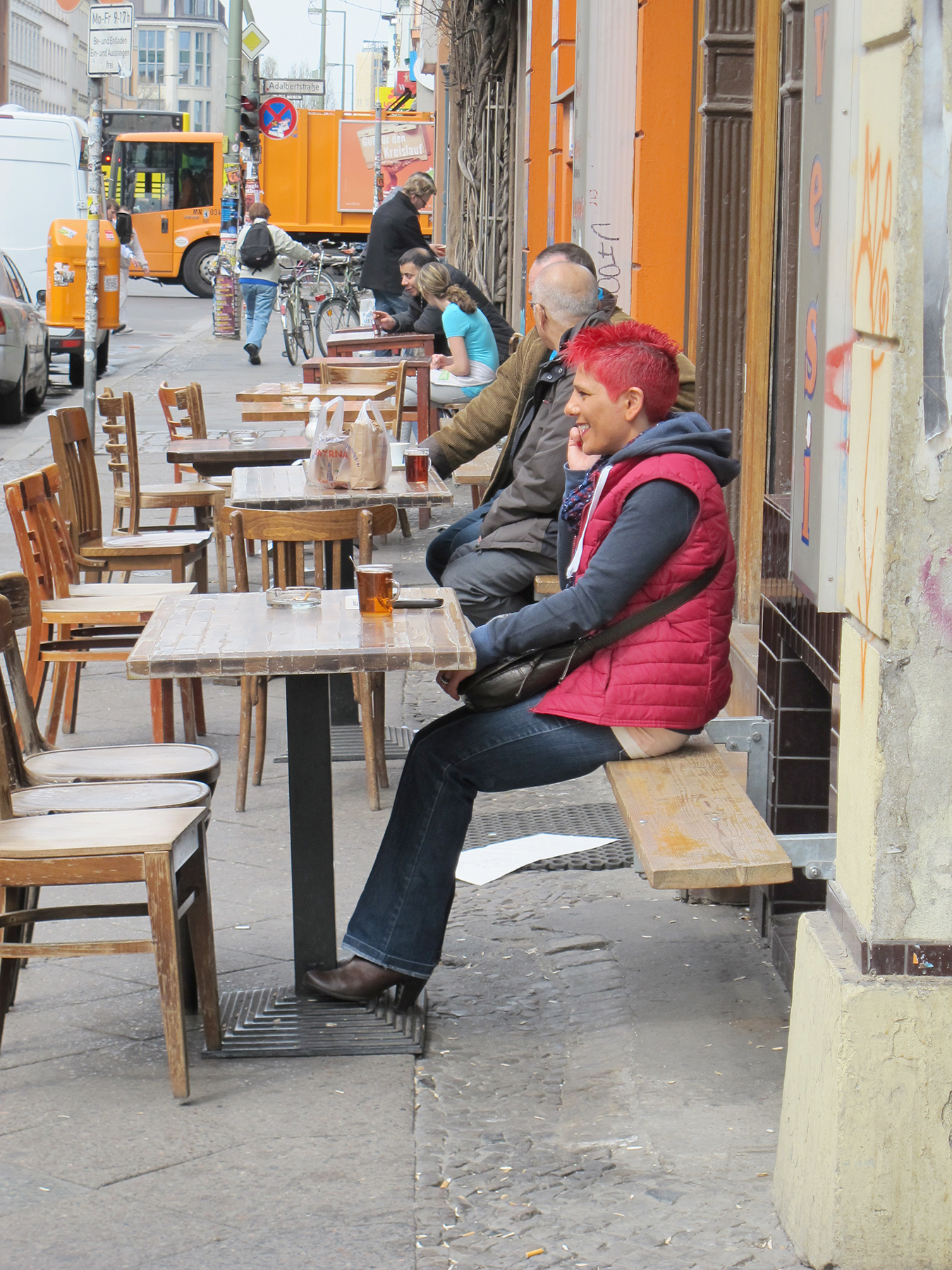
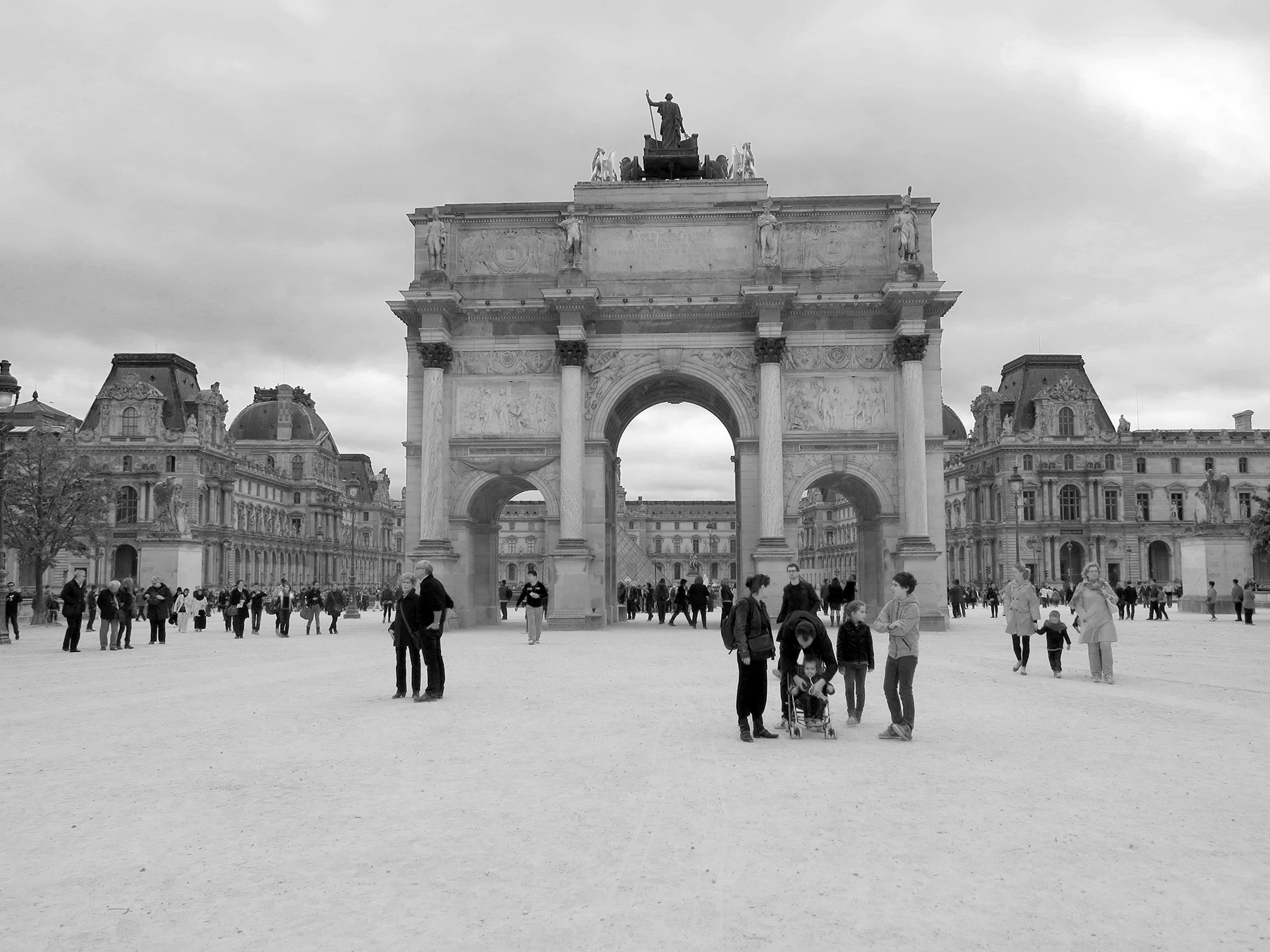
Photographs today are street photography from my 2014 visit to Paris, Freund’s chosen home.

Music is mainly interesting for the vintage film clips of Paris in the background.

Re-Flecting

Hanukkah begins tonight, a minor Jewish Holiday morphed into a major one in cultures competing with the magnetism of Christmas for children’s souls – or for consumers’ wallets. A story of a light lasting beyond its life span, a miracle celebrated, and one of civil war, conveniently ignored.

Before we settle on sarcastic, let’s celebrate what these holidays during dark times – both by calendar and by historical era – have in common. They do bring light and its cousin, hope, to our lives. Hope for what could be, if enough energy, faith and grace can be mustered or bestowed. Survival, peace, redemption, all on the list.

I thought it would be appropriate to look at light, then, to brighten our day. Much to chose from. Here is an installation that I like watching because it has historical roots in the history of the whaling community of New Bedford, the city of light given that its port harbored the whaling ships that provided the blubber for America’s lamps for centuries. Hope for survival is surely invoked by the art work, given the fate faced daily of the seamen (many escaped Southern slaves among them.)

Here is a light installation that in some ways expressed for me the hope for peace. Peace AMONG us, in mutual aide and recognition, an effort to build community.

Marinella Senatore’s neon colored installation at Florence’s Palazzo Strozzi’s open-air courtyard provides uplifting pointers. We Rise by Lifting Others, draws on the popular southern Italian luminaria or ‘artist’s lighting’ tradition. Comprising hundreds of LED lights, the ten-metre-high installation becomes the monumental heart of the palazzo’s Renaissance courtyard. The words she chose remind us of community and participation: ‘The world community feels good’, ‘Breathe you are enough’ and ‘We rise by lifting others’.The installation will be up until 7 February 2021. 

And in case you already heaved a sigh of relief – no politics today! – fooled you. Here is the video of a light installation that speaks to the truth, and the lies, of our times. The work was erected, in timely fashion, on election day.

Stefan Brüggemann‘s project’s detailed evolution and commentary on its goals can be found here.

The artist insists that ‘the intention is not for the work to offer a conclusion, but to open up a question and place a doubt.’ Still, given the choice of location and the extent to which immigration has been politicised in the US, it is difficult not to read this as an indictment of the Trump Administration. One can only hope that, by the time the installation is taken down – shortly after Inauguration Day in the US – our society will have begun to move on from the gaslighting that Brüggemann has so succinctly decried. (Ref.)

One can only hope…

Hope for redemption, I tell you, has to start with our very own acknowledgement that it will not come from above. We have to earn and fashion it ourselves.

Happy Hanukkah!

Photographs today of my favorite source of light. Music by Max Richter on the nature of day light.

Re-Imagining

When I think back to my time in Venice during the Biennale in 2015, snugly lodged in the attic of some decrepit Palazzo, exploring exhibit after exhibit during the days, I feel nothing but gratitude. Such visual riches, such food for thought. Such freedom to explore at my own pace, such amusement at the gradient from Kitsch to Kunst, as they say in German.

For me the most memorable and admired exhibit was shown at the cloisters of the Madonna dell’Orto church: Emily Young’s Call and Response. Here is a description of the work of who is called Great Britain’s greatest living sculptor: 

Using rock from quarries near her studio in the Etruscan hills, Young’s work fuses the age-old principles of stone carving with a progressive, widely informed approach to form and composition. The contemporary and ancient are united in these sculptures, creating a rare and poetic presence that is amplified by the atmosphere of the tranquil Venetian cloister, which is part of the Madonna Dell’Orto church favoured by the Italian painter Tintoretto. Monumental yet strongly individualised, static yet expressive, these sculptures encourage the deep contemplation on mankind’s relationship with stone and its source of origin; the Earth.

In the artist’s own words:

“Every moment of every day and every night humankind is called to by the Earth, and we respond to her, our mother planet, our creator. She is our maker, and we her dependents… These are things I think about when carving these stones which the local volcano has thrown out in some eruption, or the wind and rain has exposed over thousands of years, or a river has rolled and smoothed around, for me to find and work into a semblance of me, a conscious human. Throughout our human history we’ve acknowledged nature’s great powers in this way.

When I carve the stones I wait to see what the stone and I arrive at together. I think: these stones can easily carry my call back to the Earth, of sorrow and the knowledge of tragedies unfolding, along with gratitude and delight in the beauty of unpolluted night skies. I add my voice to the stone’s, one made in Earth’s history, in violence and stillness and endurance, born of their ascent out of and descent back to dusty origins. They can last at least as long again as they already have done, millions upon millions of years.” 

The work is ravishingly beautiful. As is the sentiment.

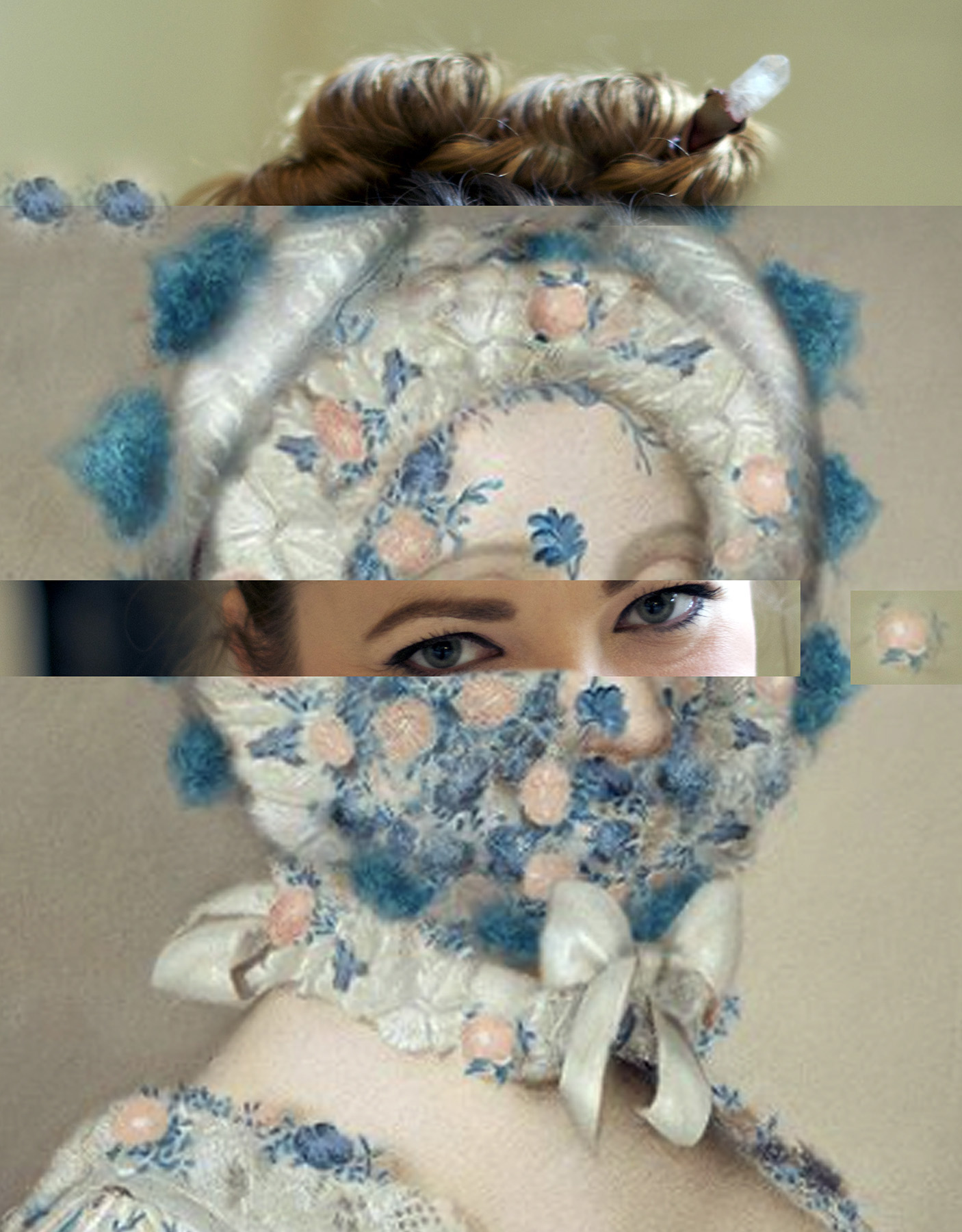
It also inspired playfulness in me upon my return to the States, a tongue-in-cheek exercise trying to add something to this arc from antiquity to the present. Taking snippets of paintings ranging from 17th century to 19th century works that I had photographed during my various travels, I provided some relief for eyes sore from all the incoming brilliance. The title of the project was Augentrost (the German name for the plant Euphrasia which was used in the middle ages to treat eye ailments.)

It feels like an eternity ago. Which, wouldn’t you know it, is another subject taken up by Emily Young and many an artist preceding her. If I could travel now this would be my sprint to take in before it closes this month:

and here is Eternity’s Sunrise ….

Re-emergence

Riddle me that: Switzerland is supposed to have the largest number of satirical publications per capita. There’s a stereotype-defying fact that will evaporate from my brain as fast as you can say yodel (defined as practicing a form of singing or calling marked by rapid alternation between the normal voice and falsetto.)

One of these publications, the oldest in fact, is Der Nebelspalter (The Fogsplitter) which in 1920, exactly 100 years ago and still under shock of the carnage produced by the Spanish Flu, published a poem that could be written for all of us, today. Looks like what goes around comes around – true both for pandemics and also the way people react to them.

I have translated the bitingly sharp verses, but of course had to do without rhyming since I am not a good enough translator for that. It was hard enough as is, since the German was quite old-fashioned. I thought, however, the gist would suffice to have us all feel like someone just put a century-old mirror up to our faces, with nary an occluding patina softening our recognition.

The Flu and the People

A slayer traveled through the land
with drums and with a scythe
with gruesome drumrolls from the band
shrouded in black, the flu arrived. 

She entered each and every house
and reaped the sheafs in full - 
many pink cheeked maidens died
and strapping young men were culled.

The people in their anguish called
loudly for the public authorities:
What are you waiting for? Protect us from death - 
Whatever shall become of us?

You have the power, the duty too,
show us what you can do - 
We'll warn you, don't dodge it now,
what else are you good for?

It's a scandal, the way it's handled,
where are the prohibitions - 
there's singing, dancing, partying and bars,
haven't enough people died already? 

The governors had puzzled thoughts 
traversing through their brains,
how to combat this adversity
their brows were deeply furrowed. 

Hark, their efforts found reward,
their thoughts were indeed blessed;
Soon prohibitions, harsh and unfamiliar,
rained down onto the land.

The flu ducked deep and timidly
and was about to disappear,
when the people newly clamored
in a chorus of a hundred thousand voices:

"Government, hey!  What are you, nuts?
What's this supposed to mean?
What is all this stuff that oppresses us,
you wisest of the wise?

Are we only here to pay taxes?
Why do you deprive us of all joy?
Particularly now with MardiGras upon us - ha!
The masses bellowed and blustered.

You can prohibit church and all,
the singing and the praying.
But regarding the rest, 
we refuse to be shackled!

That was not really what we wanted, 
allow us dancing and boozing,
otherwise the people  - listen to their grumbling - 
will march on the city in hostile mobs.

The flu, already on its last leg,
squinted quietly,
and said, " Finally -  after all!"
And laughed maliciously.

"Well, well, it never learns
that old humanity!"
She unfurls, grows, is pale
and sharpens the scythe anew.


Sounds familiar?

I have a lot of positive associations with Switzerland. I learned how to ski there, something I loved if only because I scared everyone around me with my speed, inappropriate for a wobbly beginner.

I improved my French there, when farmed out to a family in Neuchatel for months on end, being left to my own devices which included hours on end spent in movie houses watching Brigitte Bardot in her prime.

I met an old lady in Lausanne who had spent her youth at the Russian Tsar’s Court before the revolution and had sketchbooks, shown to me at length, that documented every outfit she ever wore to any occasion at the palace, in watercolor no less. Since I was exactly in-between being starstruck with royalty (age 13 – 15 ) and devoting my life to being a revolutionary (age 16 to 16. 5) I drifted on a cloud of deliciously ambivalent reaction.

Add to that now the admiration for a satirical poem that describes ageless human behavior, when confronted with a pandemic, to perfection.

The viral form anticipated???

Re-emergence is, of course, not just reserved for viruses and human behavior, but exists in art as well. Case in point is captured in today’s photographs, chosen for their fit with the topic (and also, truth be told, because I have no photographs of Switzerland.)

The intricate glass objects were part of Glasstress 2015, an exhibition in conjunction with the Venice Biennale, titled Gotica. Curated by he State Hermitage Museum of St. Petersburg and Venetian glass blowing studios like Berengo, it explored how “medieval ideas and communication methods have imperceptibly crept into our modern conscience despite our technological advances and how the Gothic concept influences contemporary art.” Fittingly, it was on display in the neo-gothic Palazzo Franchetti, which in late September I had practically all to myself.

Venice itself is of course a city deeply imprinted with gothic and neolithic architecture. But its artists, or so the exhibition notes state, are also reclaiming medieval themes and styles, if not processes. Some of the works took themselves too seriously, some were witty, all were superbly crafted and some linger with meaning, even now, years later. My kind of show.

The artists used the vernacular, referred to exorcism, eschatology, death and resurrection, alchemy and the search for the Holy Grail. They asked, and I quote, the Gothic question: Are we about to enter the new Middle Ages?

Are we any closer to an answer now, five years hence?

Music today from the time of plague and courtly love…

Thoughts on Late Bloomers

This week I went to the Visual Arts Center in Newport, OR to pick up my work that had been there since March, the exhibition promptly available for view on their website only due to Covid-19 closures. Art institutions – for all the arts – are truly hard hit, particularly when they cannot fall back on large endowments, and need income from art sales or attendance sales. Hard to wrap your head around how many individual lives are affected, from artists to staff.

My series Postcards from Nineveh had used a mix of contemporary landscape photographs and old Dutch paintings of whaling and war ships to speak to issues of environmental degradation and protection. I looked at my montages with fresh eyes after this long hiatus, and also with a new thought picked up while reading up on today’s artist of interest, painter Alfred Wallis.

Now where do you put all that stuff?
Some gets hung in the gallery aka my living room

Wallis painted mostly ships that could not have been more different from the ships painted by Dutch maritime artists of the earlier centuries. The latter exhibit dominance, power, brinkmanship, while Wallis’ boats look more like streamlined, abstracted toys, mercilessly exposed to the power of the elements, escaping wrath by sheer luck.

Shipwreck 1, the wreck of the Alba, 1940

I wondered if these differences have to do with the ideological role maritime commerce, exploration, colonialism and war readiness played for a small nation entirely dependent on it, as the Dutch were. Or if it had to do with the fact that Wallis, unlike many of the Dutch artists, spent a large hunk of his childhood and adulthood as a common sailor, risking his life sailing from Cornwall to South America and back many times over, fully aware of the existential danger of the trade.

Voyage to Labrador, 1936

Wallis’ life story (1855-1942) certainly reads like something out of a novel, a Dickensian one at that, except with no happy end. Orphaned as a young child he started working as a cabin boy on a schooner at the tender age of nine. Eventually he advanced to full seaman, teaching himself how to read, never having set foot into a school.

When on land, he was taken in by Susan, the mother of his only friend and lived with the family. 23 years his senior, Susan nonetheless agreed to marry him in 1875, when he was 20. She had until then given birth to 17 children of whom five survived, a fate not granted to the two babies she had with Wallis. By 1890 he moved the family to St. Ives, and gave up seafaring for a scrap metal collection business instead, accruing the nickname of Old Iron. That business ended with the decline of the Cornish fishing market due to rapid industrialization and capital acquisition by larger companies.

Bark with a Man at the Wheel on a Stormy Sea, 1938

He and his beloved wife tried to scrape by, with various trade adventures, including making and selling ice cream on the streets of the small town that had become an artist colony, all amounting to nothing. When she died in 1922, her children purportedly stole their small savings, and abject poverty set in. To deal with his loneliness, Wallis took up painting at age 70 or so around 1925, using scraps of cardboard and wood and a very small palette of only 5 colors, most of them quite muted.

Five Ships, Mount’s Bay, 1928

With no prior training he set to it quite productively, drawing and painting what was familiar, the ships, harbor, landscape and houses of St. Ives. He refused to join the ever growing colony of artists around him, and made a point of using only paints that were meant to paint ships and machinery, not artists’ oils or watercolors. Two notable artists,Ben Nicholson and Christopher Wood, claimed to have found another “Cézanne,” when they happened to pass by his cottage, and they started to buy some of his work and send others to people in the art world.

Small Boat in a Rough Sea, 1936

His growing success developed parallel to increasing signs of mental illness. Wallis isolated himself more and more, became paranoid, feeling persecuted, and had visions of the Devil invading his house. He was so debilitated that he could not keep up an independent life, squalor and disease taking over, and was eventually committed to a poorhouse – his largest fear in life – where he died. More details can be found here.

His work is as original as anything can be when done at your kitchen table, with no education or training, focussed on the things you know or that are meaningful to you. Others can talk about the stylistic inventions, his creativity in assigning spatial relations, his willingness to bend reality even when reality was what he cared about. Not clear to me if he tore up the rule book when he never knew what the rules were.

But I want to point out how much these small paintings speak to emotions, how the world that was closing in on him, existentially, mentally, physically is reflected in the feelings these art works evoke. There is something foreboding or dangerous that seems to hide behind the sails or the next corner, or in proportionally huge fish, at the same time that there is an energy that seems pushy and determined.

Nothing playful here, certainly nothing referential to art history, nothing trying to prove to an art world that you belong. All his very own vision, derived from 70 years of looking at the world, with no need for approval so important for the young, no thoughts of selling (he was shocked when the first sales occurred and ask the buyers to set the price – obviously not enough to prevent his trajectory towards the poorhouse.)

Land, Fish and Motor Vessels, 1937

Starting late, blooming in your own four walls while in the process of disconnecting from society, putting personal expression it its purest form onto a surface seems both miraculous and also enviable. I assume there are millions of Wallises around the planet, almost none of them ever discovered, leaving a visual testimony of how they saw the world, while the world dims around them. Nothing naive about them, even when they get classified this way, and not much of Outsiderism either, given how they might be among us in multitudes. Art wills out, even when it gets late.

Or it ends up in your bedroom closet….

Some Shanties to go along with it all.

Move over, Mondrian.

A sentiment that questions Piet Mondrian‘s (1872 –1944) status as the master of modernism is, of course, offered in jest. I was just thinking of him when looking at today’s topic, Dutch painter Jan Mankes, (1889 –1920) who lived and worked during Mondrian’s life time, though only for a short 30 years before tuberculosis felled him in 1920.

Some of Manke’s landscapes are of the same subjects, trees, polders, wintry estates, and share some of the same aesthetic. But where Mondrian is intense and penetrating, Manke’s work is some of the most tranquil you’ll find among the modern Dutch masters. It has a porcelain quality, soft brush strokes, and invites lots of introspection. It also allows people into the landscapes.

The quietude, seemingly part of his personality from what I learned from a short biography in a documentary video, (alas not translated into English from the original Dutch, but worth watching for the painting collection on view,) stood in sharp contrast to the personality of his wife: a firebrand.

Anne Zernike (1887 – 1972) who came from a wealthy Amsterdam family of academics and intellectuals (her brother received the Nobel Prize in Physics,) was the first female ordained Protestant minister in the Netherlands. She joined the Mennonites because they were the only ones accepting women in that role. Later, after receiving her doctorate in the same time frame where she had a baby, where her husband died and she needed to move back to the city from their country idyll in Friesland, she attached herself to a more progressive church, the Dutch Protestant Association (NPB.)

Portrait of the painter’s wife, Anne Zernike (1918)

Zernike was a pacifist, a radical liberal and staunchly convinced that theology and the arts had to be taught in tandem. After marrying Mankes in 1915, they moved to The Hague where their lives focused on participation in the artistic environment, including literature, painting and poetry; theology, including explorations of Christian Socialism, Taoism and theosophy and vegetarianism. Two years later, in 1917, they relocated to Eerbeek, a small village away from the sea climate which was believed to worsen Manke’s illness. Zernike, while pregnant, wrote her thesis On historical materialism and social democratic ethics there. Beint, their son was born on 1 March 1918 and that same autumn she received her doctorate in divinity from the University of Amsterdam. Jan died about a year and a half later. Here is a similar Dutch video about her life, a sort of docudrama that gives you lovely glimpses of the landscape.)

Mankes was quite successful as an artist during his lifetime, with several collectors supporting his work and sales of both paintings and drawings flourishing. One of his patrons sent him an owl that he frequently painted and kept in the house. Animals fascinated him and he studied them for long periods before painting them from memory. I wonder what would have happened to the odd and intense couple after the five short years granted them in marriage before his death. I wonder if his name would have become known beyond the Dutch borders – he is revered in Holland, but few know of him here.

Self Portrait with Barn Owl (1911)

I think my mother, whose Jahrzeit is this week und who loved owls, would have been a happy camper in that household, sister-in-arms with revolutionary Anne and impressed by the devotion to the winged and other critters present in the studio. Owl photographs in her memory, taken in my very own garden this year.

I am wishing you all a meaningful Thanksgiving, with loneliness converted into feelings of agency: we are all doing our part to get this world back on track until a vaccine is available. I am grateful for the fact that I am in the thoughts of family and friends, as you are in mine, closely held to my heart and in my esteem as warriors in crisis times. I’ll see you back next Monday!

Music is by Elgar, about an owl No. 4 (An Epitath) from the 4 Part Songs, Op. 53 (1907,) dedicated to none other than his pet rabbit! Pietro D’Alba….

Jan Mankes, white Rabbit, Standing (1910)

Dreaming, while snared, of murmurations.

I have been working on a project that, once again, tries to express the feelings associated with our current predicament: longing for freedom of movement and togetherness with others while being forced into spatial isolation. (I wrote about my last one along those lines here.)

The most recent exploration was initiated by watching a clip about those eerie kinetic artists, starlings, swooping through air in energetic and coordinated murmurations. The freedom of movement combined with a sense of communal action seemed like the perfect symbol for all that we deprived of right now during (in)voluntary quarantine due to Covid-19.

Artists have, of course, taken an interest in starlings for centuries. A contemporary one is photographer Søren Solkær who has observed the flights for many years now and published the images in a series called Black Sun. It’s worth clicking on the link below (Colossal) to see a spread of what he captured, some etherial beauty of stark landscapes in addition to the murmurations.

This project has taken me back to the landscape of my childhood and youth in the marshlands of Southern Denmark. A place where as many as one million starlings gather in the spring and fall, prior to onwards migration, and set the stage for one of nature’s most spectacular phenomena. As the countless birds congregate in large murmurations before collectively settling in the reeds at dusk they put on an incredible show of collaboration and performance skills. And now and then, by the added drama of attacking birds of prey, the flock will unfold a breathtaking and veritable ballet of life or death. The starlings move as one unified organism that vigorously opposes any outside threat. A strong visual expression is created – like that of an ink drawing or a calligraphic brush stroke – asserting itself against the sky. Shapes and black lines of condensation form within the swarm, resembling waves of interference or mathematical abstractions written across the horizon. At times the flock seems to possess the cohesive power of super fluids, changing shape in an endless flux: From geometric to organic, from solid to fluid, from matter to ethereal, from reality to dream – an exchange in which real time ceases to exist and mythical time pervades. This is the moment I have attempted to capture – a fragment of eternity.

One of my favorite paintings of a young starling is by Dutch painter Jan Mankes (1889 – 1920) who, come to think of it, deserves his own YDP one of these days.

Starlings are often snared – they are perceived as a nuisance when they descend in great numbers onto cities, Rome being a case in point, where 5 million of them spend the entire winter before flying to Scandinavia to nest in spring. The city, no longer allowing nets, now has taken to releasing falcons to hunt them and places loudspeaker with starling distress calls and calls by other predatory birds near their roosting sites. Why such efforts, you wonder? In one word: Poopocalypse….. More than a nuisance are starlings at airports, endangering safety when they get caught in the jets of planes – Seattle’s airport SEA TAC catches over a thousand each year.

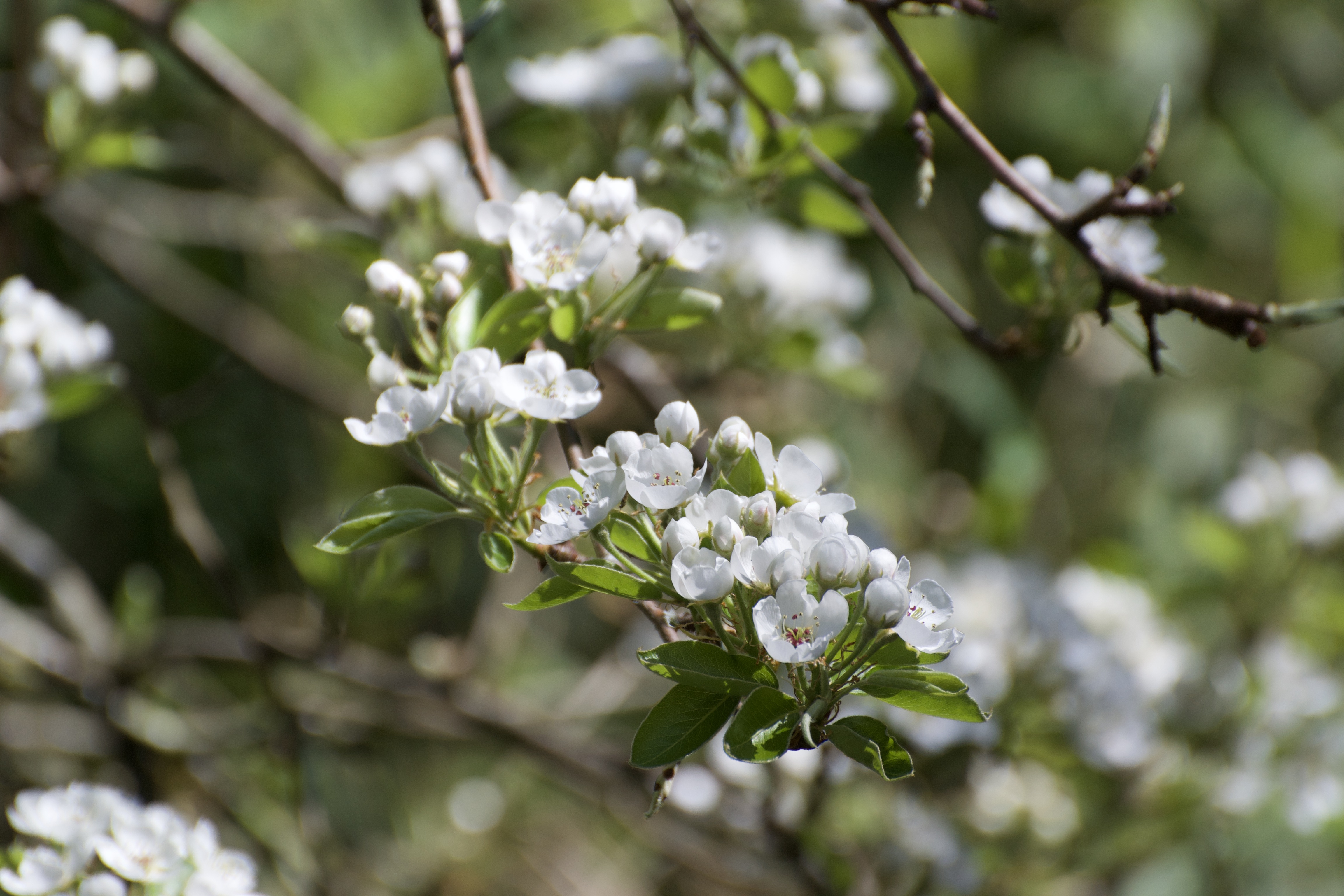
In any case, I had to combine, for my own Covid response purposes in my montages, a sense of being snared with a sense of symbolic murmuration. You tell me if the sentiment is adequately captured.
Music today is in honor of Mozart’s starling – a bird he held as a pet. Details on that in an interesting interview here. Apparently Mozart’s piece Musical Joke was part of their collaboration….

Mozart’s Musical Joke was completed very shortly after his starling died in 1787. And I’m not the first to make the connection between this starling and this piece of music. That was Meredith West in a 1990 piece for American Scientist magazine [co-written with Andrew King]. She noticed that musicians hated this piece because it made them sound really bad — a lot of disharmony, fractured phrases, very odd key changes. Finally, she noticed that if you overlaid some of the most disconcerting parts over the song of a starling, there are a lot of similarities. You find the same kind of fractured phrases and general playfulness.”

Leaves, Folded

If Nari Ward, who I introduced yesterday, is a master of conceptual installations, Sam Gilliam stands out with his abstractions. I say that not because his name is all of a sudden popping up everywhere, as if he had just emerged, early notable successes non-withstanding, but because his art is a love sonnet to color. Except it doesn’t keep to the 14 lines rule – or any rule at all but free flow of hues.

I picked a vicarious visit to his works because they instill joy in me; equally importantly, though, I took a few minutes to listen to an interview with him that floored me for its energy of this 87-year old. Do yourself a favor and watch. His paintings are represented also with much better light in the video than in the photos below that I found on the web.

Never mind that the guy represented the US as the first African American at the Venice Biennale almost half a century ago. Forget that he showed at the Tate Modern exhibition Soul of a Nation: Art in the Age of Black Power, or that he was commissioned for a piece by the National Museum of African American History and Culture in his hometown of Washington, DC, prominently hung in the lobby. The piece was inspired by a poem, and named after it, Yet Do I Marvel by Black poet Countee Cullen, celebrating the resilience of creativity.

Photographic source here

All eyes are upon him because he now has an inaugural exhibition, Existed, Existing, with a posh New York City gallery, Pace. An informative and comprehensive review of the present works in the New Yorker can be found here. It also educates about the artist’s evolution from color field to lyrical abstract painter to something all his own.

What do you make of an introduction, presented on the gallery’s exhibition website, that reads: Sam Gilliam’s inaugural exhibition with the gallery, Existed Existing debuts new works and artist-led installations that reflect the culmination of his six-decade-long career with color?

Career with color? Sounds like one of those self-help booklets, or a sample binder at the paint store. Artist-led installations? Led? What does that mean? Disciple-followed? Assistant-produced? Directing the movers? Could anything be more vague? No hint at any of his revolutionary moves, or the inclusion of politics, or the race-specific aspects of his work that make it special, never mind his genius with color, career be damned.

The new work includes “pyramids, and circle made from stained plywood and aluminum, which evolved from Gilliam’s exhibition at the Kunstmuseum Basel in 2018. There he observed the city’s growing population of African immigrants, and was inspired to revisit ancient African architectural forms.” (Ref.) In contrast, I want to show samples of the earlier paintings that so strongly appeal to me, known as drape paintings.

This was the painting that inspired today’s photographs of drooping leaves.

The canvas is taken down from its stretcher, poured and stained with acrylic and metallic paints that spread and mingle while the artist manipulates the fabric. Gilliam drapes the canvas from a wall or a ceiling, allowing it to hang, fold or move in ways not previously conceived. The result is a curious mixture of painting and sculpture, tricking us into multiple ways of perceiving shifting picture planes. While the overall first impression might hint at tie-dyed projects from your youth, a closer inspection reveals insane combination of colors, sparkly detail, and allusions to forms with meaning for the Black artist: the laundry swinging on the lines in front of his D.C. apartment window, looking at the backyards of the projects, or the hoods of KKK members, the way the peaks of the paintings are folded and tied.

Gilliam considers abstraction to be just as political as conventional represential art might be: “It messes with you. It convinces you that what you think isn’t all. And it challenges you to understand something that’s different… Just because it looks like something that resembles you, it doesn’t’ mean that you have an understanding.” (Ref.) Of course that implies that people are willing to open their minds to art as such to begin with. Here is a depressing recent psychological study, that used one of Sam Gilliam’s drawings to look at correlations between people’s willingness to consider it art and their approval of Trump’s politics. You can guess the outcome.

Some of the work is directly tied to political themes, as for example the series about the fate of Martin Luther King, Jr., which includes green and red April in commemoration of the date of assassination.

Gilliam’s work is, in his own words, also influenced by music, in particular Jazz with its ever changing variations on themes. The Music of Color was perhaps the perfect title for his recent European show. The influence is captured in some of the titles he gives his paintings, but also by the fact that any one piece of drape painting is never folded the same way twice across exhibitions. The flux and variability is an important aspect of the power inherent to these canvases.For me, in the end, there is something intensely alive in the abandon to color, color mixes, and wild pattern that reminds me of nature, an association helped by the natural forms of the folds of the materials he uses.

Here is some of the music Gilliam likes to listen to. Ornette Coleman, Charlie Parker, and more recently Beyoncé covering Ettas James.

If only…

“If only I could….” must be one of the most frequently uttered sentence fragments of this constraint- and fear-ruled year. If only I could see my children, if only I could travel, if only I could go to museums and fill my heart with art. Those wishes pale, of course, in comparison to the “if only I still had a job, if only I could feed the kids, if only I could pay the rent, if only I could say Good Bye to the loved one dying alone in the ICU,” that are existential worries most of us are spared. Or so I pray.

My frivolous wishes pale in particular when things like travel and museum visits can be replaced by virtual experience, looking at art and places through the caleidoscope of the internet. That said, there is nothing wrong with a bit of vicarious joy and so parts of this week will be devoted to joyful or uplifting or thought-provoking art I wish I’d had had the fortune to see in the flesh.

I missed Nari Ward‘s first retrospective exhibition, We The People, at the New Museum in New York City last year by only a couple of months. I was too late, as is so often the case…. and bummed about it. The exhibition surveyed 25 years of the artist’s work: sculptures, large-scale installations, paintings, and videos created between 1992 and 2019. I had never seen any of the work of this Jamaican-born, Harlem-based artist and was made curious when I read that his visual art accomplishes what Walter Benjamin’s Arcade Project did for writing: “echoing the features of a cityscape (Paris) with textual passages resembling it in pace and structure – the passages of urban exhibition halls, arcades, and train stations cloned in immaterial fashion.” How do you echo the pace and structure of Harlem visually?

What are we looking at? I’ll pick a central piece, Amazing Grace (1993), because it speaks across time and place, a brilliant combination of locating something within a specific history and a specific place – and not.

Ward has worked for most of his career by using discarded objects he found on the streets of NYC. He collected, combined and choreographed these items into political meaningful assemblages that speak to issues that concern us all with historical references that might be understood only by some. Amazing Grace was an installation in direct reaction to the crack epidemic and devastation from AIDS in the 1990s, a memorial to a community in crisis.

Some 300 dilapidated, broken and bent strollers are arranged in a circular fashion around a central piece that also contains many of them, intersected by firehoses on the floor, producing an uneven surface that affects balance when you walk. My first thought when I looked at the photographs was that it resembled a church congregation of mourners surrounding the central coffin.

The artist found all of these strollers discarded across Harlem, abandoned by either the families who no longer needed them or the unhoused who use them to transport their remaining worldly goods. Mahalia Jackson’s voice carries Amazing Grace like a beacon of hope across the scene of devastation.

What happens to the children, once snug in these strollers, growing up into communities ravaged by disease, poverty and resulting addiction? What happens to the people who lose their housing when illness or addiction take over and carry their belongings in shopping carts or strollers? When your entire already precarious universe becomes unstable? How is it related to the original sin of this nation (note the shape the fire hoses hinting at the hull of a slave ship?) How is it related as the artist noted in an interview here, to community narratives that saw the epidemic as an intended tool for the forces of gentrification?

“The one material that was so ubiquitous and so dangerous that I did not touch because it was so charged was the crack vial. It was everywhere, almost like pebbles. Because it was such a devastating epidemic, I did not feel I could address it at the time. But I do think about those vials and what having collected them would mean today, as they were so much about what they represented in terms of loss, but also in terms of greed. There’s a whole narrative that considers that this was a kind of expulsion to clear out the inner cities for what’s happening now with gentrification, because immediately after this happened the government stepped in and created empowerment zones where they dictated who was going to develop these neighbourhoods. It was almost like dropping a bomb on these poor neighbourhoods and then going back in and reforming it, all within 20 years. It really makes you think about the other narrative that is not in the mainstream, and it still seems to somehow resonate today.”

Loss. Greed. A racist history. And now think how this installation might fit the 2020 mold. Empty strollers could represent all that’s left behind when children are separated from their asylum-seeking parents, many of whom will never be reunited again. Firehoses might be echoing the water canons used against protesters who demand respect for Black lives, or the futile attempts to douse the fires incited by ever progressing drought and winds from climate catastrophe, destroying homes and all that’s in them, strollers included.

This is what I find essential in truly successful art – it is anchored in its own time as a reaction to the answers needed, but it is also reaching back into a past that paved destructive paths and a future that contains variations on a theme – in our case the devaluing of human life in the interest of preserving established economic and power structures. The music, of course, is about redemption and hope. That is what art does as well: it can lift our spirits into a realm where we still see the possibility for change. If we look hard enough and not away, if we act on what we see. Which is why I chose this vicarious visit today!

Photographs are from Harlem last year.

As an aside: I have always thought that people’s claim that music is the truest, highest form of art relates to the fact that it elicits emotion, pure subjective reactivity, and is protecting us from the worry that we might not “understand” the message communicated by a piece of art. I mean, how often have I stood in front of something visual and rolled my eyes, sometimes frustrated, sometimes embarrassed, that I simply did not “get it.” (Well, of course I also often roll my eyes when I do get it….)

So much work needs to be done to read up on what people more educated or more insightful than I have said about that art. Sometimes the reading elicits a lightbulb moment, sometimes you just feel like a dumb outsider. No deeper understanding will change the crucial emotional tone of your experience when you listen to music, this one in particular, on the other hand.

Doing the Heavy Lifting

Who should do the heavy lifting? Preferably someone else other than yourself, it seems, when you look at how people generally are willing to give up thinking for themselves and buying into whatever seeming authorities tend to sell them.

I had touched on that issue in yesterday’s musing about one of Remedios Varo‘s most famous paintings, The Juggler (The Magician), 1956. Longing for enlightenment, or just simple instructions of how life should be handled, as a matter of fact, could lead the masses to become enchanted with a charlatan, and willingly give up personal identity to do so.

Today I want to turn to a specific case, one of existential importance for all of us: the acceptance of millions of people of Trump’s pandemic response. (You are getting the summary argument of a long and informative essay by James Hamblin in The Atlantic, that can be found here.)

I will not go into statistics of the disease, I’d rather try to stick to the psychological mechanisms that make us fall for the kind of false promises, outright lies and suggested solutions that ask for unthinkable sacrifice, all presented by a President who saw the pandemic as more threatening to his economical fortunes tied to re-election than to the fate of the nation.

His claims about the virus and the ways to attack it were not just false and/or self-serving. They were accepted or even approved by millions of voters who did not punish him for the failures that are responsible now for a system break-down. The nature of the claims, not rooted in science and fabricated out of wishful thinking, are similar to those that we see in faith healers, cult- and authoritarian leaders. What makes us buy into them?

When we feel threatened, we tend to accept promises of relief, clinging to wishful thinking. When authorities disagree (science: it takes time and it’s complicated – charlatan: do this now and simply don’t worry) we are persuaded by the more attractive option of help, now. The disease is not that bad! You can’t get easily infected! If you don’t believe me and go with the science crowd, your jobs are in jeopardy! We’ll have a vaccine soon! Who does not want to hear that?

There is, however, another element at play as well, the possibility of identity fusion, when you subsume your personal identity under something larger, a social group, or the person of a charismatic leader. This kind of alignment allows you to improve your sense of self, providing a feeling that the leader’s or the group’s good fortunes extend to yourself. It also allows you to work less hard on thinking for yourself or doing the work of critical analysis, since the word of the leader is good enough for you, in all its glowing conviction.

And when is a positive sense of self particularly needed? In times of doubt, of threat, of fear, whether in regards to a concrete present danger, like Covid-19, or a longer-term sense of deprivation, be it economic decline, or status loss in a society that does no longer grant you special privileges with changing population compositions. Fusion, importantly, is not just blind fellowship. It is an engaged process in which you adopt the values laid out to you, no longer evaluating your own, because it makes you feel valued, important, and belonging. And so you buy quackery hook, line and sinker.

How can we turn things around? Hamblin says it most eloquently:

“There are ways to serve as a confident, optimistic leader without making up nonsensical promises. Hope can be conferred with promises to take care of people, and to be there for them. Reassurance can be offered by guaranteeing that no one will go into debt because they had to go to the hospital, and that people will have paid sick leave and job security so they can stay at home when necessary. If the public-health community does not do more to give people hope and reassurance in the face of this disaster, it will see people defect to those who will—even when they know the promises are too good to be true.”

Varo had a solution as well, not surprisingly for a woman whose life had been touched by fascism, forcing her to flee France when the Nazis invaded and prohibiting her from retuning to her native Spain ruled by Generalissimo Franco. In her 1960 painting Woman Leaving the Psychoanalyst we see a woman outside the dark corner office tagged Dr. FJA (Freud, Jung, Adler) approaching a courtyard well. An ominous sky threatens to descend and whispers of fog on the bottom seem to cling to her leg, not ready to let go.

In one hand she holds a basket with psychological detritus (thread, a key, a pair of glasses and a clock – I leave the game of interpretation within the context of the therapeutic session to you…) in the other hand she holds the head of a patriarch by the long beard, about to drop him like a discarded condom into the depth of the well. A father figure, a ruler, an autocrat, a charlatan, off and away with his head, now that she can see clearly.

The part of her long cloak that covered her face has slipped down, after all, the blinding mask just dangling. The hair freed – oh, that hair! – forming horns becoming any old Pan…

One promise of much of analytic therapy is, of course, that you discover your true identity, a sense of self no longer ruled, through unconscious mechanisms, by authority figures or our relation to them. (In)sight arrived! Independence it shall be!

Now just be willing to think independently as well, to do the work of informed choice. You might just stay healthy.

Photographs are from the San Francisco Bay waterfront at the newly opened Crane Cove park.

Music presents many of Varo’s paintings. I swear, I’ll be a painter in my next life….