Browsing Category

Art

Just Playin’ Around.

· Exhibition at the Jordan Schnitzer Museum of Art at PSU ·

Man only plays when he is in the fullest sense of the word a human being, and he is only fully a human being when he plays.”  – Friedrich Schiller (Schiller’s Werke, Nationalausgabe, Vol.20, pg.359.)

You don’t have to buy into the absolutism of Schiller’s proclamation to acknowledge that the 18th century poet, playwright and philosopher was on to something with his theories around a human play drive. He believed that play allows an escape from the rigid structures provided by societal expectations, and in some ways melds our sensual experience with rationality, providing a path to both, appreciation of aesthetics and critical thinking. Ultimately he saw play as an expression of freedom.

During the 200 years since, we have seen repeated waves of interest in the relationship between play, or playfulness, and the aesthetic experience as well as the production of art. Freud connected childhood play to creativity in ways that influenced generations:

“Should we not look for the first traces of imaginative activity as early as in childhood? The child’s best-loved and most intense occupation is with his play or games. Might we not say that every child at play behaves like a creative writer, in that he creates a world of his own, or rather, rearranges the things of his world in a new way which pleases him ? It would be wrong to think he does not take that world seriously; on the contrary, he takes his play very seriously and he expends large amounts of emotion on it. The opposite of play is not what is serious but what is real.” (Ref.)

The Surrealists embraced both his notions about what drives child play and his concept of the “uncanny,” so often associated with dolls. The Expressionist artists of The Brücke proclaimed that you had to return to seeing the world through a child’s eyes. The movement towards “Primitivism” included not just a focus on cultures untouched by technology and modern civilization, but on childhood productions of art as well. In 1948 a group of French artists formed CoBrA, which publicly claimed the drawings of children as their inspiration. A child-like aesthetic was on the rise, although its content was very much about the existential sorrows of a post-war society. More recently, you have artists like Cy Twombley, Jean Tinguely, and Jean-Michel Basquiat, to name a few, whose creativity is informed by the processes, forms of expressions or materials involved in childhood play. And now we can engage with work by Ai Weiwei, whose most recent exhibition, Child’s Play, at Vito Schnabel Gallery in NYC ends this week. Using Lego Bricks exclusively, he translates art-historical canvases, famous portraits and political news images into the medium of play.

Child’s Play. It’s your turn to play! Serious Play: Translating Form, Subverting Meaning. Prototyping Play. Push Play. Play Well. Playing Rules! (a weird translation from the literal German show title Playing means Changing.) These are all titles of exhibitions across the last years, some with formidable collections, others with brilliant ideas, most of them with an interactive component that hopes to increase cultural engagement.

***

Play we shall. The Jordan Schnitzer Museum of Art at PSU offers the opportunity to play while exploring art (or vice versa?) with its current exhibition Just Playing around. Lucky for us, and unsurprisingly, given the caliber of the curator duo Nancy Downes-Le Guin and Theo Downes-Le Guin, the work on view provides much more than the opportunity to take a break from the real world. There are serious issues to be thought through, new insights to be gained, novel connections established – in other words, reality and critical thinking intrude on the unstructured spontaneity so desired. The show is thus something of an articulation of Schiller’s concept of play: a synthesizing, through contradiction, of the human experience of sense and reason.

The exhibition stretches across two floors, walls painted in saturated primary colors that echo kids’ rooms of yore before the current vibe of sad beige children (a fun meme that is mocking trendy design ideas for pastel environments reflecting parental rather than kids’ tastes.) Exhibits span a range of modes – sculpture, installation, video reels, paintings, and costumes, featuring the work of Derrick Adams, Calvin Chen, Jeremy Okai Davis, Latoya Lovely, Jillian Mayer, Takashi Murakami, Jeremy Rotsztain, Heidi Schwegler, Joshua Sin, Matthew Earl Williams, and Erwin Wurm. The displays are very clearly marked for presence or absence of interaction, with the signage continuing the bubbly graphics of the hand-outs and announcement posters. Playful, perhaps, space-saving for sure – the spatial arrangements allow for introduction of and extended commentary by the artists in tight construction.

Joshua Sin Power Up (2024)

The entrance hall displays two columns made out of furry toys which artist Joshua Sin found in the bins of Good Will stores. These are the kinds of soft companions embraced in the cribs and strollers of the younger set. They are the perfect metaphor for this exhibition, if you consider them transitional objects: a link to  D.W. Winnicott’s ‘transitional object’ theory, which maintains that adults transfer their childhood engagement with toys to art and cultural artifacts. During childhood they form a bridge towards growth. The artist, however, reflects on what we loose in the transition: “innocence, imagination and unbridled joy.” Have to disagree – innocence lost, perhaps, but imagination and unbridled joy are available still, and in fact captured by quite a few items within this show, or the reaction of this viewer.

That said, I was quite taken by the other sculpture Sin created: a hundred or so of small, mass-produced Beanie Babies, tightly encased in acrylic boxes, forming columns. They reminded me of display cases in airports or department stores, where merchandise is aimed at customers, young and old; the collectible quality of these creatures lures kids into a mode of amassing toys rather than forming a relationship with a few individualized ones. Creating want, rather than protecting from a world of commerce, shaping future consumers, fixed on brand. A poignant reminder how even play can be devoured by market mechanisms.

Joshua Sin Boxed Dreams (2024)

And speaking of brand, that is how one of the, if not most, famous contemporary Austrian artists is sometimes labeled. Erwin Wurm is represented at PSU with two instantiations of his One Minute Sculptures. This is a series that integrates time into the art work, as well as interaction with the viewer, by offering basic materials, often casually collected as found objects, placed on a pedestal and provided with simple instructions: do this or that with it for a minute, or as long as you can. Photos can be taken and archived, prolonging the otherwise short-lived sculptural constellation of a toy dog hanging on your shoulders. He has been doing this for almost thirty years, restricting displays to galleries and museums for fear of it becoming a gimmick, and proudly announces that “only” 129 or so exist. Define gimmick again?

Erwin Wurm Theory of Hope (2016) (One minute sculpture)

An ongoing retrospective of his life’s work at the ALBERTINA in Vienna (which also shows other, equally identifiable series) at the occasion of Wurm’s 70th birthday, sees the artist expand. The One Minute Sculptures are now rid of pedestals, come without instructions and provide abstract sculptures we are supposed to interact with. It was “too clean” up until now, according to Wurm. Mostly, though, the idea is to undermine the pathos elicited by so many high-brow, serious works of art, and engage the viewer with whimsey, fostering connection by playful interaction.(Ref.) And to be perfectly honest, an installation of his, an upside down truck made into a platform inviting you to peruse the Mediterranean that I saw at an earlier Venice Biennale, was a striking commentary on the movement of goods and bodies across that body of water at a time where the refugee crisis changed political constellations in Europe. More thought, less play. For me, memorable.

***

A video screen spanning the entire back wall of the gallery displays a loop of an azure sky with little white clouds and some inverse sky-writing in child-like script, slowly fading into oblivion. Maybe you can’t access your inner child – but you surely can still be treated like one, with the reassuring message that you’ll be ok (where is the pat on the back?). The mirror-image distortion of the words questions said sentiment, of course. What can we trust in a world where up is down or left is right, truth made ephemeral? Where assurances disappear while we are still trying to decipher them? Clever and beautiful work by Jillian Mayer.

Jillian Mayer You’ll be okay (video 2013)

Speaking of inner child, it surely helps to get back into play mode if the appropriate environmental cues signal the possibility of immersion in child-oriented environments. Latoya Lovely provides an inviting installation that is dominated by color, geometric murals, familiar books and object, artificial trees that hold clothes for (encouraged) dress up, and supersized magnetic wall puzzles that multiple people tried to re-arrange during my visit. Environmental immersion is clearly en vogue, and people are willing to wait in line for hours to enter spectacular playgrounds that mix art and playfulness, like Meow Wolf in New Mexico (where I stood in said lines, dished out unspeakable sums of money, and still wonder why,) or now Hopscotch here in Portland. The small scale and appreciated calm of Lovely’s installation somehow made a much more important point than the circus-like atmospheres mentioned above, bent on sating our unquenchable yearning for spectacle: Play (just like art) consists of making, taking apart and crafting back together, transforming space, and improvising, and so on. All of these processes are enabled or fostered by appropriately child-friendly environments where the materials themselves speak of playfulness and encourage reorganization.

Latoya Lovely On a Lovely Sunday Morning (2025)

***

There is playfulness and then there is playing games, both an important aspect of experiencing the world through the lens of play. One is aimless, rule-free, independent. The other is often goal oriented, bound by rules, and certainly open to or even in need of repetitive, practiced sequences rather than spontaneous moves. (Practice those scales and those pitches! Memorize those opening gambits in chess!)

Think of board games, Mahjong or Back-Gammon, or playing a musical score, or competitive games in sport. Jeremy Okai Davis’ paintings on the lower gallery level offer depictions of sports figures who surmounted obstacles and succeeded in a racist world, intentionally questioning the rules of the (larger)game.

Jeremy Okai Davis Crown (Althea Gibson) (2023

His work is well rooted in a long line of art works that made the game, and the social structures surrounding it, itself a topic, starting with the preoccupation with card playing in the 16th/17th century. Lucas van Leyden’s The Card players, Carravagio’s The Cardsharps, LaTour’s The Cheat with the Ace of Clubs are all examples where issues beyond play were slickly introduced: who wants to have fun, who is competitive who likes to take risks or is cautious, who is strategic, who is willing to cheat, and who is good or bad at losing the game. And who is, we can now add, included or excluded, by invisible rules reaching back to Jim Crow. Play and the fate of players as a metaphor, then, representing social conditions.

I am not a gamer, but the role that video games have come to play around the world cannot be underestimated. There are whole museums now dedicated to video game art, offering exhibitions concerned with all the questions I’ve raised so far, applied to the artificial screen. The British National Video Museum, for example, right now offers an exhibition, The Art of Play, that focuses on how artists create the mood and textures of the video scenes. Video games are the perfect template to create or enhance myths, through world building and often sly ideological influence. They can be a vehicle to allow people to tend to baser instincts without real life consequences, but they can also be the seed for incredible levels of creativity in the player who has options to design their path forward.

For me, the most intriguing and thought-provoking installation in the entire Just Playin’ Around exhibition tackles questions around the psychology of gaming. Matthew Earl Williams (Confederate Tribes of Grande Ronde) took stills of the game Red Dead Redemption 2, the successor of one of the most famous video games ever, Red Dead Redemption. Both have won critical acclaim and multiple awards, wildly successful commercially. Set in the late 1800s in the Wild West, with themes concerning cycles of violence, masculinity, redemption, and the American Dream, the role player can choose who to be and with whom to align (multi-player mode possible), making practical and moral choices that have various rewards and punishments attached. Williams created a series of tintypes, popular in the late 19th century, and got permission from various players to capture images of their avatars which they had imaginatively costumed to stay in character. He raised the question why some would wish to be Native Americans during a historical period of their extreme suffering, when most players chose to be cowboys. Alas, no answer to that, as far as I could detect.

Matthew Earl William Indians of the Uncanny Valley (2021)

But the transfer of a digital fantasy creation onto a historical medium, the tintype print, created an illusion of historicity, when it was all frictionless role play safely removed from real life massacres. Add to that the choice of framing: garish, elaborately detailed and carved gold frames, that I immediately associated with the Orientalist paintings you find in the Louvre, or other National museums. The exotic “other” is squeezed into frames representing the taste and status of an entirely different world, their brightness furthermore a visual contrast enhancement of the darkness of their subject. I have no idea if that was intended by Williams, but the association to framing of outsiders was riveting.

Alternatively, these frames could represent the high-brow art found in museum, now linked to the low-brow art of video games, which draw in millions and millions of people, something museums can only dream of. Active play, connected to aesthetic experience of the created fantasy worlds, seems to be an ingredient we should indeed have a closer look at.

***

“Art is a complete fairytale – art is an unending child’s birthday party (forever, and ever, and ever, like cookie monster.” – Jonathan Meese, Ausgewählte Schriften zur Diktatur der Kunst, Berlin, 2012, p.474. (My translation.)

The longing to live in a world of play, and the assumption that play, intent on breaking the chains of reason, will enhance creativity, often go hand in hand in the contemporary art world. There is nothing wrong to focus on escape, when life is overall hard and overwhelmingly complex. Floating 2 story-high yellow rubber duckies on European harbors, as Florentijn Hofman did, or building a pink castle inside a Danish museum, as Meese and associates were known to do, provided fun for most involved, levity that is perfectly acceptable once you relegate high-brow “art” to the background, at least for a stretch of time. Did it bring back a piece of childhood, though, as intended? Can you really reenter a child-like mode of playing, and does that have an actual effect on creativity? Is it not just appearance, a strategy, since the child-like aesthetic, and the juvenile, playful demeanor are a consciously developed style of the artist, one which they consistently extend to adulthood – or so asks art critic Larissa Kikol, who is an expert on the subject matter.

Contemporary psychologists have some answers to offer, although a core question remains unresolved. For one, try as you might, you cannot completely reenter the state of a young child that you left behind long ago. Even if I make it as easy as possible, leading you through age regression via hypnosis, for example, you will draw me a picture you think is that of a child, but which differs significantly from those drawn by actual children. We simply cannot erase all of what we have learned growing up.

In a limited way, however, play does enhance creativity. Research tells us that one of the prerequisites of creativity is to focus less on external rewards and pay offs, and to engage in activity just for the pleasure of it. A sense of play can help with this – after all you are chasing fun. Likewise, a prerequisite for creativity is a willingness to step away from patterns and customs, and explore the unknown and often ambiguous, a willingness to take risks, and free play can help here too. Note, though, that I refer to these as prerequisites. They set the table for the creative process, but there is no scientific consensus on what the process actually involves. It certainly aids creativity if you relax assumptions and ignore boundaries and let your thoughts go wherever they will. But research suggests that these steps give you more options, not necessarily better options. And the creative mind seems able to separate the jewels from the junk. It also makes someone more likely to move into the direction of the jewels. How this happens remains something of a mystery. Can play put you in the right mindset? Often yes. Is play the golden key that unlocks all doors? Likely not.

But for those of us experiencing art, rather than being called to produce it, an invitation to play is often the way to jump over barriers keeping us from enjoying something we fear we might not understand. The gallery attendants, singularly helpful, knowledgeable young people, reported that the rooms fill with students when there are larger breaks between classes. By these reports, they have not previously made much use of the gallery integrated into the PSU complex, and the nature of the exhibition clearly provides a draw. As it should, offering more than just playin’ around.

After all, we need adults in the room, now more than ever, and much of the presented work helps us to get there.

Just Playin’ Around

January 21 – April 26, 2025

Jordan Schnitzer Museum of Art at PSU

1855 SW Broadway
Portland, OR 97201

FREE ADMISSION

HOURS:

Sunday:  Closed

Monday: Closed

Tuesday:  11 AM–5 PM

Wednesday:  11 AM–5 PM

Thursday:  11 AM–7 PM 

Friday:  11 AM–5 PM 

Saturday:  11 AM–5 PM 

Shelter

You know that feeling when you think about something and all of sudden almost everything you read or see somewhat points in that direction? It’s some sort of semantic priming, and mine has been all week around the notion of shelter. How can we find shelter against the onslaught of bad news, the overabundance of worry, the intensity of stress in our personal as well as public lives?

First thing this morning, then, was a videoclip sent from Germany. Someone declared that the current mood, across the world, is like the weather: dark, stormy, and definitely cold. He then argued we all have to be like hats, or jackets, or felt-lined boots used for exactly that weather, offering shelter against what surrounds us, providing warmth for those next to us, out in the cold. I took to that mental image – you’ll be my jacket, I’ll be your hat. Protection found in mutual caring for each other, shelter in loving kindness or chesed, as it is known as a concept in Judaism.

Next thing in my inbox was this week’s Meditation in an Emergency, focused on the need for big tents, another form of shelter. Solnit argues that during emergencies like real world catastrophes people come together to support and protect each other regardless of political or religious differences that usually keep them apart, unless they reside at the absolute extreme ends of the spectrum. The same should happen during political upheavals the likes of which we are currently experiencing. There is value in alliances, then, rather than isolation, protection through coalitions, not undermined by scorn or accusations for previous mistakes. )Although some will always barred from my tent: Republican Darren Beattie, for example, appointed by Secretary of State Marco Rubio to be the acting undersecretary for public diplomacy and public affairs, a senior role that represents American foreign policy to the world. Beattie has called for the mass sterilization of “low IQ trash” and feral populations. “Could offer incentives (Air Jordans, etc.).” Nerd-Reich eugenics, anyone?)

Back to sheltering tents: Here is Solnit’s paragraph that registered most with me:

Many powerful forces–the rhetoric of mainstream politics, the framing of mainstream entertainment and news, the version of therapy that reinforces individualism as it tells us we’re here to care for ourselves, end of story–tell us we are consumers, not citizens (and here I mean citizens as members of civil society, regardless of legal citizenship status). That we are here just to meet our own needs and chase our personal desires, within the realms of private relationships and material comfort and security, and that we hardly exist beyond those small realms. It says on the one hand “go have all this stuff” while it quietly discourages us to have the other stuff that is public life, participation, and power. While pretending to point us toward abundance, it deprives us of the most expansive and idealistic versions of ourselves. And most of us really are that larger self, the version that cares about justice, human rights, democracy, equality (withering all that away is a clear part of the right’s agenda at least since Margaret Thatcher’s “There is no such thing as society”).

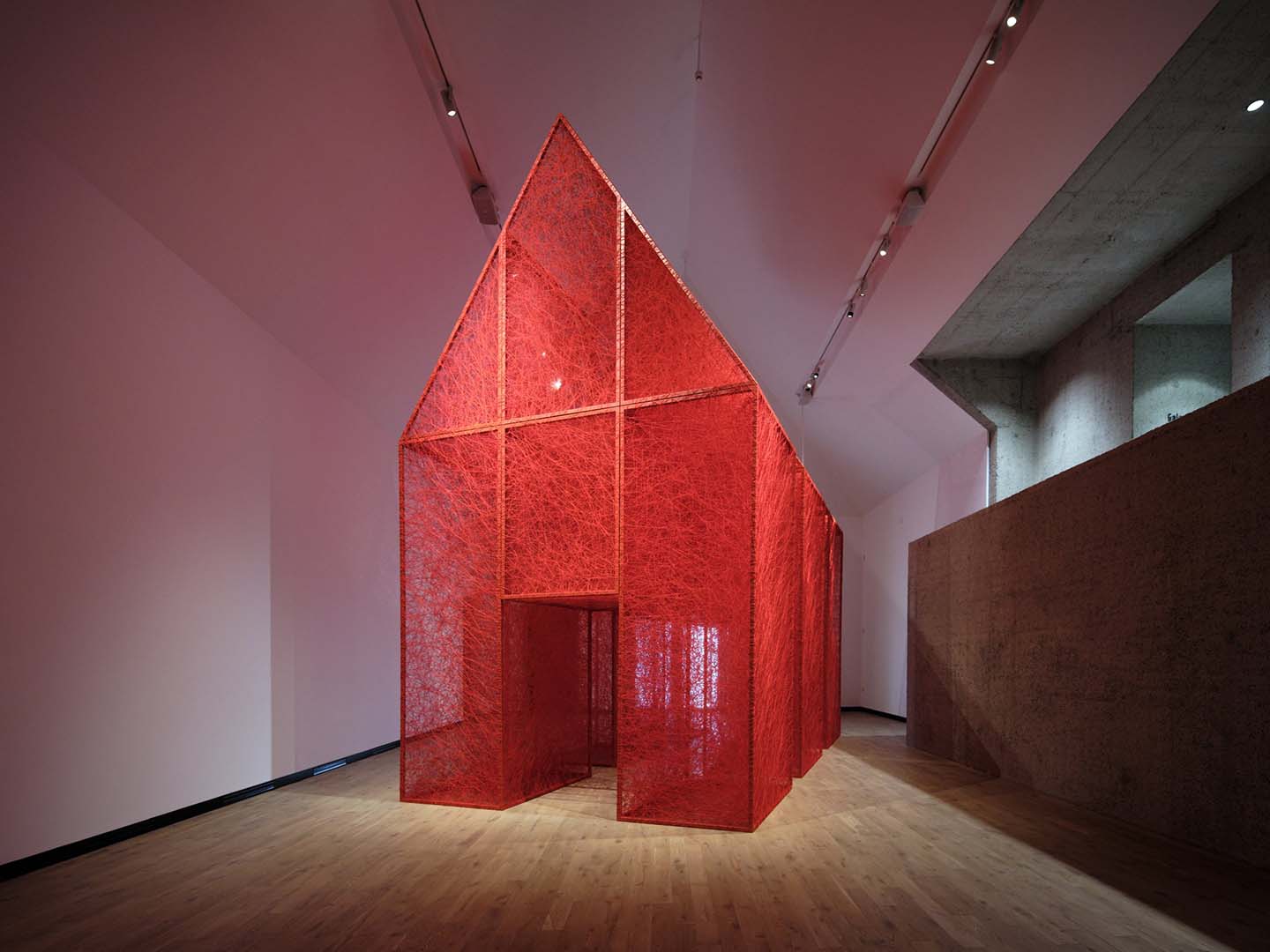
Chiharu Shiota The Network (2024) Musée du Pavillon de Vendôme; Musée des Tapisseries and Chapelle de la Visitation, Aix-en-Provence, France. Photocredir Philippe Biolatto, Ville d’Aix-en-Provence

And then I came across a mention on ArtNet about two current exhibitions of work by an artist who is everyone’s darling these days – not mine, admittedly. Chiharu Shiota’s work has been basically repeating itself for the last 25 years, and some of her installations borrow quite a bit from other people’s ideas. But honor where honor is due: She was one of the early sculptors who integrated fiber into her work, before we saw the explosion of fiber art across the last years. And the theme of interconnectedness has been a red thread (quite literally) throughout her career. (She reserves the black threads she uses for associations to the cosmos, fate, or other intangible things that surround us.) The idea of all of us being invisibly bound together by these webs made out of thousands of threads, and the visual experience of tent-like installations hanging above our heads certainly fit into the associations that came up around the notion of “shelter.” For an introduction to her work, here is an interview with the artist, a good starting point.

Chiharu Shiota Uncertain Journey (2024) Le Grand Palais, Paris, France

Photo credit: Didier Plowy

Here are selective exhibitions still on view:

until 19.03.2025
The Soul Trembles, solo show, Le Grand Palais, Paris, France [touring exhibition]

until 20.04.2025
Between Worlds, solo show, Istanbul Museum of Modern Art, Istanbul, Turkey

until 28.04.2025
The Unsettled Soul, solo show, Kunsthalle Praha, Prague, Czech Republic

Chiharu Shiota The Silent Concert (2024) – Kunsthalle Praha, Prague, Czech Republic

Photocredit: Vojtěch Veškrna

until 27.06.2025
The Soul’s Journey, solo show, Fundacion Calosa, Irapuato, Mexico

As I said, she is surely en vogue. Lots of soul in the titles, lots of wool in the air. Clearly resonating with a large, international public. Maybe it is people’s fascination with the nature of webs, strong and fragile at once. Or the rudimentary desire for cocooning. Or respect for the tremendous amount of coordinated work going into these creations. Or humans’ insatiable desire for spectacle, the bigger the better. All not mutually exclusive.

I encountered her work for the first time at the Hammer museum in L.A., when she was the inaugural artist featured in the Hammer’s redesigned lobby, for the Hammer Projects 2023.

Here is an installation in a gallery in Brussels from 9 years ago, that somehow reminded me of a painting by George Tooker, the way my brain works…

Chiharu Shiota Sleeping is like Death (2016) Installation View, photo credit Gallery Daniel Templon

George Tooker Sleep II (1959)

Last year Shiota was invited to show at the Chapel of the Visitation during the Aix-en-Provence Biennial; her installation included letters from people asked to write about their experience with gratitude (does that remind you of Yoko Ono’s installations of trees and letters for peace?)

Beyond Consciousness de Chiharu Shiota - Journal Ventilo

Chiharu Shiota Beyond Consciousness (2024) Photo credit: Pierre-Nicolas Bounakoff

Maybe the idea of gratitude is another way to find shelter: a focus on what we have that is positive. It might just insulate us, if only for short moments, from the fear and disquiet instilled by the news.

Gimme Shelter, indeed… the Stones knew.

A World growing Cold.

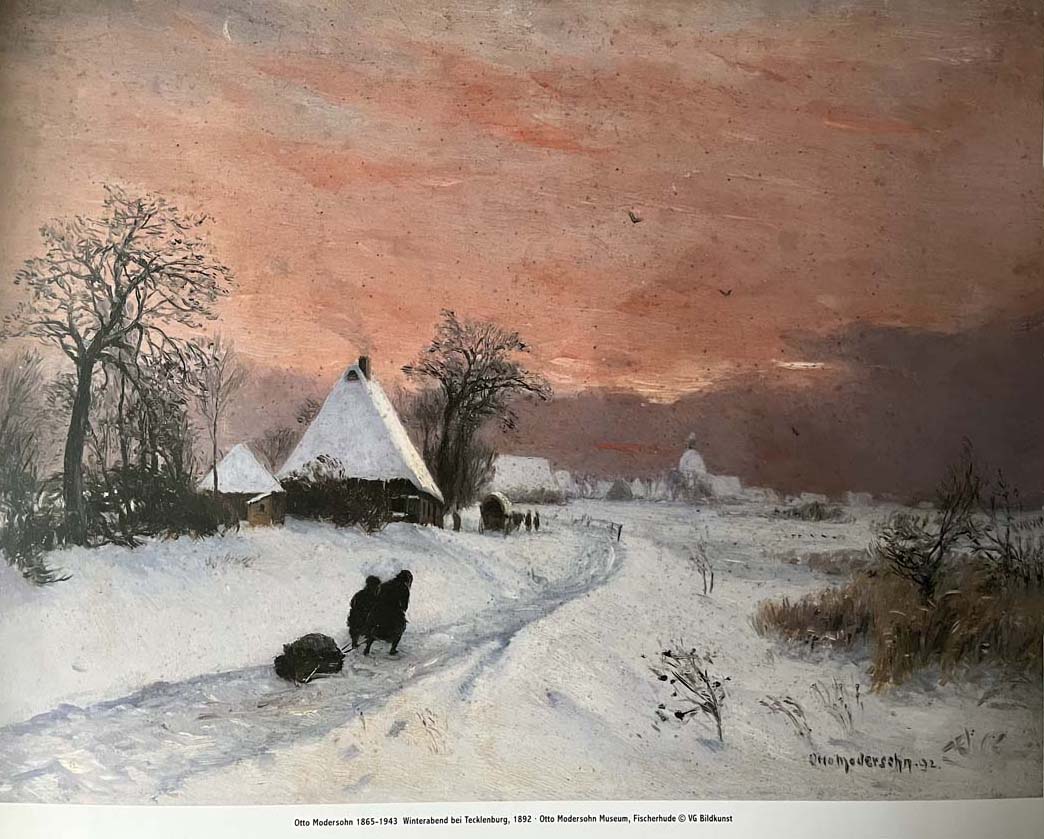
We had a dusting of snow this week, lasting not even a day. Coincidentally, I was cleaning out some closets and found a number of calendars from the 1990s, beautiful, huge art reproductions on linen paper, sent to me as gifts from Germany. Most of them were intact – I had only ripped out a few of my favorite pages to put into thrift-store frames at a time when we did not have the funds to put original art on the walls. I went to look for the winter months, and there they were – impressionistic renditions of snowy scenery.

All of the calendars featured painters from an artist colony that was established in the late 19th century in the small hamlet of Worpswede. The village in the state of Lower Saxony, close to the wealthy and bourgeois Hanseatic league city of Bremen, was a haven for young, academically trained artists trying to escape urban centers and an increasingly industrialized society, longing for a return to nature and establishing a utopia of communal living. In a way, they withdrew from reality and any attempt to use art as a means of engagement with a new technology-driven society, changing at a rapid pace. Instead they expressed longing for an ideal, intact world (heile Welt), and pursued new aesthetic criteria to express their belonging to a Germanic world, their northern roots. They hoped to mutually sustain each other pragmatically and artistically, in a region that was cheap, in fact so poor that almost every single crop sharer had multiple children emigrate to the U.S. at the time, because the land could not feed large families.

Starting in 1889, the three founders, Fritz Mackensen, Hans Am Ende and Otto Modersohn first lived with farmers, then in an inn, and eventually started to build their own houses. They were soon joined by numerous other artists, all drawn to the stark landscape of the foggy country side, dominated by peat bogs, heather and moors, a river and canals that allowed small barges to transport the peat. It was close to the sea, windswept, with annually 200 days of rain, flat as a pancake, opening endless horizons, disrupted only by the occasional birch groves and conifers thriving on the sandy loam. In 1901, Rainer Maria Rilke started to visit – you can read about his impressions of the artists and the landscape here. He developed a crush on two young women, a painter, Paula Becker (these days famous in her own right), and a sculptor, Clara Westhoff, who he eventually married since Paula had chosen Otto Modersohn, then a widower and financially secure, instead. Rilke’s essay reads like a long fare-well to a shared vision, now abandoned, since the utopia had not worked out.

It took but ten years for the idyllic artist colony to break apart. Personal rivalries played a role, jealousy about sales, exhibitions and awards. The very first group show in Bremen that exhibited some 34 work of multiple painters, had been a flop. The wealthy burgers clung to their old-fashioned tastes for genre paintings and did not like, much less purchase, the new impressionist art. A fluke visit of this show by Eugen Stieler, president of the Munich Secession, led to an enthusiastic invitation to show at the Munich Glasspalace in 1895 – and they were a sensation. From then on they met with success at all the reputable art fairs and museum shows across the county.

More importantly, the dissolution of the artist group was caused by increasing conflicts around political and ideological issues. They all had read, and were influenced to varying degrees, by a book by Julius Langbehn, Rembrandt als Erzieher, (Rembrandt as Educator) a basic, openly racist text of anti-positivist and anti-rationalist philosophy that was hugely popular at the time. It was about German art, blood and soil, rejection of science and technology (dangerously international, not “völkisch” enough!), an exhortation to any German individual to serve the German spirit and culture. (Ref.)

All should sound familiar to those who know how National Socialism coopted these positions. Several of the painters, foremost Mackensen and Am Ende, did eventually become flaming Nazis, while others withdrew, trying to stay neutral, and one courageous individual – Heinrich Vogeler – completely shifted gears, fighting the Nazi regime, changing his art from romantic Art Nouveau to political agitation prop. He paid for it with his life: he was captured and sent to a Russian penal colony when the Germans invaded Russia, to which he had fled. There he starved to death.

Heinrich Vogeler Barkenhof im Schnee (1910)

***

Heinrich Vogeler Frühling 1897

What strange paths this man trod, what encounters,
experiences, shattering upheavals it took to free him
from the rosy flower-chains of a romantic fairy-tale
world and turn him into an uncompromising fighter in
the ranks of class-conscious workers.]
— Erich Weinert, Introduction to his edition
Vogeler’s Erinnerungen (Berlin: Rütten &
Loening, 1952), p. 14.

Why am I writing about this, rather than letting us all enjoy some pretty pictures? It comes down to the psychological question of what enables people to resist propaganda, while others adopt mind sets that are flamingly immoral. The obvious parallels to our contemporary horror show make an answer to that question ever more pressing.

We are currently facing a concerted attempt to reinstall forms of segregation, assert a hierarchy of value determined by race and gender, with White males on top of the hierarchy. Forget about issues of enrichment, corruption, influence peddling, colonial longings, political persecution, science denial, or all the other things having rained down on us in the last two weeks with the advent of the new administration.There is a basic, open, systematic assault on everything the civil rights movement worked for decades, a century, to achieve. Re-segregation is the order at the federal, state, and local level, not just some purging of DEI initiatives.

Let’s call a spade a spade – you can read in detail about it in the Washington Post here and the NYT here. It is not just about “meritocracy,” the new powers are suing about the very presence of Blacks in our institutions. The US Census Bureau has taken down the statistics for age, sex and race/ethnicity, numbers needed to pursue equality. Women and POC are supposed to be driven out of the workforce – just listen to the President’s comments on the causes for aviation disaster.

Ending all Cadet Clubs and activities for POC at the United States Military Academy, while all religious ones remain, is aimed at re-segregation and elevation of Christian Nationalism.

The introduction of school vouchers that allows schools to accept/reject applicants if they are private, and hollow out the available funds for the remaining public schools, is a tool of re-segregation. Don’t forget that Trump’s judicial nominees almost always demurred when asked in their confirmation hearings whether Brown v. Board was wrongly decided. Doesn’t that make you wonder what the Supreme Court is up to next? The DOGE posse has gotten access to Department of Education data on federal student aid, including the personal information for millions who receive student loans from the government, feeding it into AI to cut funds for the majority poor and POC constituency served by that aid, eliminating thus access to education.

I could go on. We have been there before. You can learn about President Wilson’s attempts to re-segregate federal government in a fascinating book by Eric S. Yellin: https://uncpress.org/book/9781469628387/racism-in-the-nations-service/.

So how does an individual resist the flood of rising racism? For Vogeler it was, I believe, the experience of serving in WW I and realizing what the causes of war were all about, for one. He developed a strong sense of empathy with those unjustly treated in their societies. He also was extremely widely traveled, learning about the nature of hierarchies no matter what nation you looked at, in Europe or Asia, the eternal division between up and down, us vs. them, as a means to protect stratified power.

Most Americans have not served in a war, or, for that matter, left this continent. Their perception of the world is singularly driven by what they learn at home and from the selective exposure to media that knows how to manipulate mindsets. Most importantly, as I have written about in detail already five years ago, we have to look at attitudes being transmitted in a direct connection to the history of slavery. I excerpt it here. (I know, it’s getting long, but it is SO important and you have all weekend thread it….)

“Scientific studies have shown this to be true nowhere more so than in the American South. In their book Deep Roots: How Slavery Still Shapes Southern Politics Avidit Acharya, a political scientist at Stanford, Matt Blackwell, a professor of government at Harvard and Maya Sen, a professor of public policy at the John F. Kennedy School of Government at Harvard, link current conservative attitudes towards gun rights, death penalty and racial resentment in parts of the South directly to a slave holding history.

In a nutshell: Southern Cotton and tobacco industries thrived on chattel slavery, since those crops were extremely labor intense. After the Civil War, those regions’ economic survival depended on finding ways to continue to exploit Black labor. Anti-Black laws and practices, from Jim Crow to the undermining of education and participation in the political sphere, served that purpose.

But there is another important mechanism at work, called behavioral path dependence by the authorsGeneration after generation passes down and reinforces beliefs about racial inequality and the need to impede progress of those deemed inferior. Children learn from their parents and teach their own children, all the while being backed up by local institutions that echoe the value judgments and create spaces for segregation. After slavery was abolished and with it Ante Bellum Laws, the subjugation of Blacks now relies increasingly on cultural mechanisms.

“…things like racialized rhetoric from the top down can have really, really damaging and long-term impacts. So things like talking about people in dehumanizing language, extrajudicial violence, institutionalizing policies that treat people as less than human. Those things can really create attitudes that then persist for a long time.

And this culture is incredibly resistant to change, proceeding at a glacial pace. In other words, federal interventions, like the Civil Rights Act or the Voting Rights Act (or what’s left of it) can address behavioral discrimination, but they do nothing with regard to attitudes. Children who are indoctrinated from an early age will carry their parents’ attitudes to the next generation.

Education is key, and education is what they are going after.

Musik, fittingly for place and time, then, by Brahms.

The Art of Selling Lies

Someone once called propaganda the art of selling lies. It’s a catchy summary but obscures the extent to which communication can be used to influence public opinion. Sure, our beliefs can be manipulated with lies, but also with truths, half-truth, loaded language or simple omission of facts. Propaganda seeks to influence us, persuade us, and often drags us into emotional rather than rational reactions.

Now why would I want to muse about propaganda on 1/20/2025, when we should be celebrating Martin Luther King and the lives of Black Americans like Thurgood Marshall, Booker T Washington, W. E. B. Du Bois, Malcolm X, James Baldwin, Travon Martin, Breonna Taylor, Eric Garner, Tamir Rice, Kendrick Johnson, George Floyd Emmett, Freddy Gray, Michael Brown, Ahmaud Arbery? Can’t quite put my finger on it.

Propaganda is, at its best, indeed an art, but it uses art as well. You may remember my recent writings about propaganda art which blossomed in the beginning of the 20th century before WW I and then surged to power in Russia and Germany in the years to come. The mass production capabilities of printing posters and the technical advances in the movie industry made it possible to reach millions of people.

Of course, visual propaganda had been around for centuries before that, with roughly two messages, still in action today:

“Be part of the struggle! Belong to those fighting for a better future! Join!”

 Eugène Delacroix, Liberty Leading the People (1830)

-or-

“Resistance is futile! Revolt and you’ll get crushed! Withdraw!”

Two Assyrian soldiers forcing Babylonian captive to grind bones of his family, 7th – 6th c. BCE. From Nineveh palace.

The topic called me again when I came across an enticing painting last week. It was posted on social media as Paul Klee’s An Allegory of Propaganda from 1939, obviously titled about propaganda, not propaganda itself. I was not familiar with it, and puzzled about the imagery in the context of the title. Ok, I thought, what can I make of it? (Screenshot of text and image below.)

Oranges and yellow dominate in a warm color scheme, a golden era upon us, preying on our need for hope? The person’s face looks rather androgynous, but is dressed and bejeweled like a woman. (“Propaganda” was actually a term for the most male of concepts: the name for a congregation of cardinals originally, established in 1622, charged with the management of missions. But in German, the word is female – perhaps because of the stereotypes of seduction and manipulative lying associated with the gender. Just speculating.) She holds a flower, often a symbol of magic (providing mystical powers in fairy tales). Or a symbol of innocence to be taken, the veritable deflowering. The woman’s dress is strangely configured. My first association was court jester costume shapes (they are hired to tell lies, amuse, distract, but ensure allegiance to the king.) Then I thought it could be a hint at rags, in German “Lumpen,” which immediately gave rise to the idea of Lumpenproletariat. The term, coined by Marx, can be roughly translated as the mob, a class of “outcast, degenerated and submerged elements that make up a section of the population of industrial centers. It includes beggars, prostitutes, gangsters, racketeers.” (Ref.) Well, mob and propaganda make a good pairing, as recipients of same, or, racketeers and propaganda, as seen in full view at the time of this writing.

OOPS.

Started to look at the date on the canvas. 1906, not 1939. Checked the title of the work on museum sites. Klee’s Allegory of Propaganda turns out to be an altogether different painting, created the year before he died, namely this:

Paul Klee An Allegory of Propaganda or Voice from the Ether, and you will eat your fill! (1939.)

(Some serious sleuthing revealed the 1906 painting as Klee’s Hesitation, which is a far better match between content and visual imagery. )

So here I was fooled into accepting false information, mentally elaborating on it in perfectly sensible ways to make it work (note, how you can make up an interpretative narrative out of thin air as guided by a presumed title…), and only rescued by an ingrained habit to look closely and to check the facts before I disseminate them to a larger circle of readers.

The true portrait’s subject is obviously salivating at the propaganda from the radio, words promising wealth and “Lebensraum,”( eat your fill!), as the Victoria and Albert Museum describes it, having purchased the painting in 1965. Alongside a matchstick that fronts fiery clouds in the back, his hair resembles barbed wire, his saliva could be mistaken for blood, his ears are open to the SS, and his cheeks flare pink in excitement of a new dawn, and a chilly palette overall, despite the prevalence of reds and browns.

***

The voice from the ether spills words, promising or threatening, dependent on the minute of the day and the target of manipulation. One of the most famous and most reproduced “art” works of the Nazi era, in itself propaganda but also about propaganda, was Hermann Otto Hoyer’s In the Beginning was the Word (1937).

Herman Otto Hoyer In the Beginning was the Word, (1937). United States Holocaust Museum, courtesy of U.S. Army Center of Military History.

The painter drew on two sources: the Gospel of John which reads: “In the beginning was the word, and the word was with God, and the word was God.” Secondly, the word is by Hitler, found in Mein Kampf, “All great, world-shaking events have been brought about, not by written matter, but by the spoken word.”

Hitler, now as the god-like figure, uses oratorial magic that keeps the listeners enthralled. In real life as well, not just an imagined painting.

We will be flooded with words in the coming years from on high, in the form of administration pronouncements, threats, executive orders, legislative proposals, commission summaries, Supreme Court contortions, brown-shirt fashion advice and media reporting that is already bending to the will of the newly empowered (and paying into oligarchic coffers in the meantime).

Flooded with words arriving from social media that spread disinformation far faster, and in higher frequency, than any posters and art reproductions in the history of politics ever could. Words from bots that proliferate like mushrooms, for every blocked one another one popping up in the next dark, moist corner.

Words from a state that, in the wonderfully sarcastic voice of Catherine Rampell, “now owns the memes of production.” Loathsome AI will make it (near) impossible to distinguish the false from the real, creating a sense that reality can no longer be grasped, just as Hannah Arendt predicted in the words I posted at the entry of this blog.

Yet we do not have to surrender to words.

We do not have to buy into propaganda. We do not have to believe every lie, every threat, every hint, every bribe, a tsunami of misinformation to the point where we throw up our hands, withdraw in sheer exhaustion, give up the good fight and quit, walking away fearfully into a steadily hotter sunset.

We still have the power to think and judge, (and check our sources critically, I’ll add, having myself been duped not just once.)

They might win their battle to enshrine inequality and forsake justice, but at least they will have to fight, if we don’t capitulate in advance.

Music on this Martin Luther King Day is chosen to celebrate hope. Let’s be a chorus to Sam Cooke’s “Change is gonna come.”

Connecting the Dots.

Last blog for this year, looks like. I am defying the impulse to offer a balance sheet of a difficult year, or prepare a battle plan for the even more difficult one ahead. Instead, I will write about things that made me intensely happy at one point or another during the last 12 months, in hopes to get the transition into 2025 off to the right start.

Let’s begin with the fact that I am embedded in or adjacent to a ton of people who are highly creative. The range runs from (inter)nationally renowned artists, to successful local ones who can devote their life to making art. From published writers, painters, photographers, ceramicists who have shows, to all those people who pursue their urge to create regardless how unacknowledged their efforts will remain.

People who work 60 hour weeks and then come home to teach themselves how to make lace. People who lovingly and inventively design little flower fairy scenarios in their front rock gardens, enchanting the neighborhood with their creativity. People who make a house a home by determinedly finding the right way to paint the walls and hang the art. People who create native plant gardens that weave and flow from a dusty, dry cement desert. People who fabricate the most imaginative porcelain containers, dainty and elegant, with painted details. People who knit to the point of carpal tunnel syndrome, or embroider little creatures onto grandchildren’s crib blankets. People who weave, and those who quilt, adding new ideas to age-old crafts.

One of them is a friend who spends much of her time writing grants and breathing life into the finances of her organization, dealing with PR and recruiting advertisement, organizing membership drives and donor meetings, never mind keeping the books and making sure everyone gets paid.

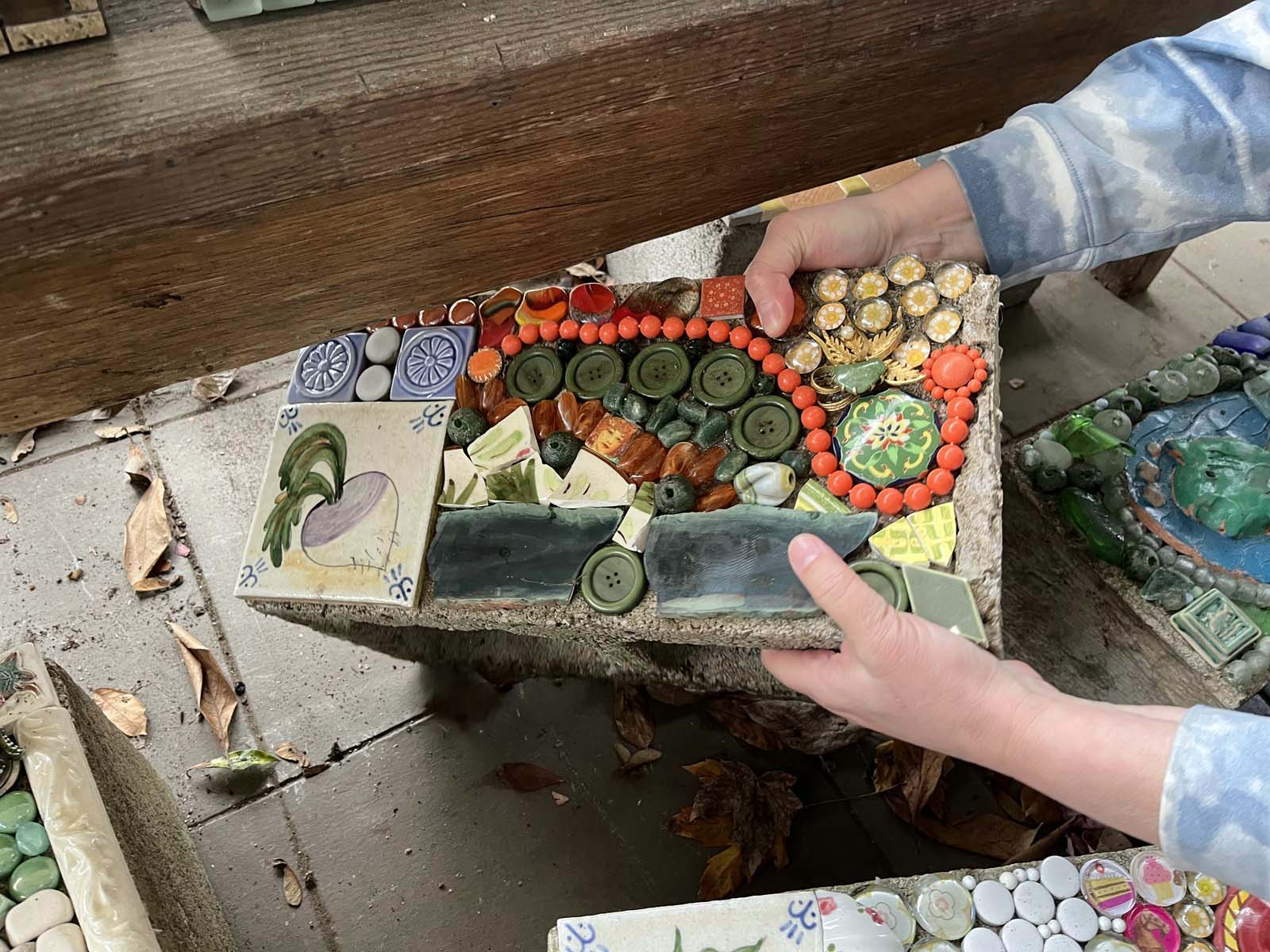
Laura Grimes needed a retainer wall in front of her house and decided it had to be more than just cinder blocks. It has become a project that is creative on many levels – constructing themed mosaics from shards, remnants, beads, toys, thrift- and dollar store finds as well as generous donations from the community of the local Buy Nothing web site. I can just envision her sitting night after night in a basement experimenting with the right cement glue, the appropriately sized cinder blocks, the arrangement of a thousand trinkets and marbles, the groupings by shape and color and category membership.

It is not Art with a capital A, and I assume was never meant to be that. It is a desire to fashion something representing joy if not beauty from lots of circles and dots, or to tell a story or two, as all creative endeavors end up doing.

Maybe all these creatives convey the history of a craft, maybe they account for the requirements of a climate zone, maybe they refer to fables in their porcelain work, or maybe they speak of birds, or mermaids, or vegetables embedded in imaginary landscapes. Maybe they depict the hard truths of our time.

All of it, however, is directed at an “other,” the viewer, establishing a connection across time and/or space, letting us “read” what they have to say, or just feel gifted by the expressions they had to bestow. Art or craft engenders curiosity, instills pleasure, perhaps even admiration, linking two minds for a moment, a first step toward community. Giving one’s imagination a creative form is an act of reaching forward, outward, the possibility of forming a bond, no matter how playful or artful the base. Nothing more important in times where loneliness and division are dark clouds threatening to engulf so many. I am so happy to be surrounded by creativity offering connectedness in this way.

***

Fast forward from dotted mosaics to dotted paintings. I have always admired the defiance of African-American painter Howardena Pindell who set herself the life-long task to decry racial segregation by using dots and circles in her art – originating in her childhood experience of red dots glued to the bottom of glasses and silver ware in public restaurants, to be served Blacks only, keeping the unmarked ones for Whites.

But recently I have been completely taken in, without ever seeing it in real life, by the dot-dominated work of a painter who started in her late 70s and whose visions exploded onto the art world horizon soon thereafter. Emily Kam Kngwarray produced about 3000 paintings during the 8 years she still lived after taking up the craft, about one a day. Those of my readers lucky to live in Great Britain will be able to see a retrospective at the Tate Modern, starting July 10th, 2025. What stirs me is not just the movement and exuberance that makes these canvases come alive, but admittedly also the very notion of “late-blooming.”

Kam Kngwarray’s works on show. Photograph: National Gallery of Australia

Installation view of Kim Kngwarray’s Batiks

Kam Kngwarray grew up in a remote area of Australia, with little contact to the outside world until she was 80 years old. She was as Anmatyerre elder, and a lifelong custodian of the women’s Dreaming sites in her clan Country, Alhalkere.

“Whenever Emily was asked to explain her paintings, regardless of whether the images were a shimmering veil of dots, a field of ‘dump dump’ dots, raw stripes seared across the surface or elegant black lines, her answer was always the same: Whole lot, that’s whole lot, Awelye (my Dreaming), arlatyeye (pencil yam), arkerrthe (mountain devil lizard), ntange (grass seed), tingu (Dreamtime pup), ankerre (emu), intekwe (favourite food of emus, a small plant), atnwerle (green bean), and kame (yam seed). That’s what I paint, whole lot.” ( Interview with Rodney Gooch, translated by Kathleen Petyarre.)”

Emily Kame Kngwarreye Summer Celebration (1991)

Kam Kngwarray Alhalkere – Old Man Emu with Babies (1989) Photograph: Courtesy of D’Lan Contemporary

The connection to place reveals itself even to the likes of me who are totally ignorant about Aborigine art. The abstracted vision, paralleling Modernism or styles found in Japanese calligraphy, grasps something universal, reverberating with many of us, lightyears removed from the artist’s existence. Universal: the concept that you can embrace place, the very part of the natural (or even built) world where you live, that informs and infuses you, providing a sense of belonging. It is there for all of us, even if Western culture during the last century has tried much to dull our sensitivity to its call.

***

From dotted paintings to pearly music: Y’Y, the new recording by pianist and jazz composer Amaro Freitas makes me goose-bump happy (here is the link). It, too, encapsulates a tribute to a place, a region, the forest and rivers of Northern Brazil, featuring legends, spirits and rhythms from the Amazon and Pernambuco, where the artist grew up. The piano score is ravishing and the way he manipulates the strings by inserting soft objects like seeds, produces a creative new sound, always echoing the water drops and rivulets of the subtropical environment.

For me the album registers on a different level as well, making it special – a link to personal history. As I have mentioned often before, I am not one to spend much time perusing the past and introspecting about how life unfolded. But occasionally some glorious moments deserve to be remembered, and the album delivers the impetus, with its compositions bearing resemblances to Armenian composer Aram Khatchaturian, and Egberto Gismonti, the Brazilian musical giant.

I swear I survived adolescence only because I could bang out Khatchaturian’s Toccata (here is the music). And I mean bang out, paying no heed to differences in dynamics, just hitting the keys with rage. And one of the best experiences of my life was a backpacking trip along the Rio Negro in Ecuador, first (and, alas, last) visit to the Amazonian rainforest, captured so well in much of Gismonti’s work, and now Freitas’. Art linking to personal history, then, invites to remember the past, which in turn contains the implication of a future, where I intend to spend my energies to help connect the dots, as best I can. Just keep the creative output coming!

Happy New Year!

And speaking of connecting the dots (since this blog is dedicated to art, nature and politics, after all): I thought we might as well end 2024 on a combination of laughing, crying, screaming, and gasping at the theatre of the absurd upon us: https://www.lrb.co.uk/the-paper/v46/n24/eliot-weinberger/incoming – courtesy of the London Review of Books.)

Orange to the Rescue.

Walk with me. You have the choice of pouring rain (Tuesday) or bright sun, unseasonably warm (Wednesday.) On both days, the highlight of the visual riches in the woods and marshlands was the color orange – in many variations, sometimes subdued, sometimes fiery, at all times enhancing the cooler hues in the landscape with a pleasing contrast effect. Ever up-lifting.

In the visual arts, orange has been around for a long time. The Egyptians used it for tomb paintings, despite the fact that the pigment they employed, realgar, was derived from monoclinic crystals and was highly toxic. Medieval monks colored their manuscripts with it as well, ignorant of its effects on health.

Orange really took off in the 18th and 19th century, after Louis Vauquelin, a French scientist, discovered the mineral crocoite, which led to the production of the synthetic pigment chrome orange. The Pre-Raphaelites paved the way, with the Impressionists not far behind. Van Gogh took it to extremes, and Expressionism pledged itself to this intensive hue. Abstract artists of our own time made good use of the color as well. Below are some of my favorite examples, paired with what nature has to offer, in every which way as visually rich as what sprang from painters’ imaginations.

John Constable The Hay Wain (1821)

Sunsets are, of course, a perennial favorite. Not to be found this week, alas.

Caspar David Friedrich Das Große Gehege (1832)

Reflections rule.

J. M. W. Turner, Fighting Temeraire (1839)

The most famous of the orange suns,

Claude Monet Impression, Sunrise (1872)

and vineyards echoing the color choice.

Vincent van Gogh Red Vineyards at Arles (1888)

Light, captured,

Emil Nolde Coastal Landscape Date unknown

landscape abstracted.

Richard Diebenkorn Berkeley No 46 (1955)

Color reduction.

Mark Rothko Orange and Yellow (1956)

The strangest of them all – the man’s head below the woman’s face detectable in her lap only with a bit of help, covered by orange tresses, that might be the burn of love or loss, who knows.

Edvard Munch Love and Pain (1893)

Music today is dedicated by me to this ill-fated couple….

In a season where light during the darkness takes on a certain symbolism, (Hanukkiahs and Christmas trees, I see you!) the brightness of orange is nature’s contribution – gratefully accepted. Even when drenched in rain.

Here is a Long Read, suggested for the weekend. Elad Nehorai, a former orthodox Jew who writes for the Guardian, The Forward and Times of Israel, asks us to think through the implications of how the American public reacted to the murder of the healthcare CEO. He offers thoughts on how we can bring about change with non-violence and what the civil rights movement had to say about the challenges with such an approach. I thought this is a worthwhile topic during a season where Christianity celebrates the arrival of someone who was supposed to bring peace on earth, no luck so far, and Judaism celebrates a miracle of sustainability during a violent civil war …. https://substack.com/home/post/p-153227333

Phantasmagoria.

Phantasmagoria
noun

1: an exhibition of optical effects and illusions
2: a constantly shifting complex succession of things seen or imagined
3: a bizarre or fantastic combination, collection, or assemblage

- Merriam-Webster

Since March of this year I have been working on an art project that tries to capture where we are as a nation, and speculate about some of the factors that led us to our current status quo. Trying to think out loud about it today, so bear with me, it’s going to be all over the map.

It started by renting a house in L.A. that had belonged to artist Jirayr Zorthian (1911-2004). The living room was lined with small prints of an originally large mural, Phantasmagoria of Military Intelligence, which he had been commissioned to paint by the OSS (Office of Strategic Services, the U. S. Intelligence Agency preceding the CIA,) during WW II. How did someone who fled the Armenian genocide at age 11, received an MFA from Yale and studied art in Italy during the late 1930s, become enthusiastic about Psy Ops for the military, serving first in the 603rd Camouflage Engineer Battalion and then at Camp Ritchie, working for army intelligence? I guess – and it is only my guess – when you have escaped a murderous regime, and encountered the stirrings of early fascism, and now see the country that gave you safe haven engaged in a war against fascism, you surely want to give back and join the forces. (He went on to be a successful muralist and painter, a bon vivant on friendly terms with many of the rich and famous of his time. He was known for bacchanalian parties on his sprawling property in the foothills of the San Gabriel mountains, and a close friendship with the physicist Richard Feynman.)

In any case, I looked at the facsimile mural each day for a month, seeing depictions of legions of young men squeezed into pipelines of preparation for masculine jobs, a surrealist depiction of a process meant to harden and prepare them, both physically and psychologically, for battle. Allies and enemies were clearly delineated and the presented tribal conformity of the young men hinted at belonging, rather than necessarily brainwashing. Not that one excludes the other, mind you. Below is a short video about the history of the mural and provides a view of the panels.

As my readers know, for much of this year, a short burst of mistaken hope in October excepted, I had feared that this country would vote for a convicted felon and usher in the beginnings of a slide towards oligarchically-led authoritarianism. The question then and now is, of course, how this could happen. The margin of the popular vote was very, very small nationally – less than 1.5%, not a resounding mandate.

But he won news desert counties by a massive average of 54 percentage points. So there is the factor of what messages get sent, who gets reached and who has managed to find means of communication that seem to penetrate more (and are believed more) than the traditional media. The role of social media, talk shows and podcasts was important, depicting or even creating realities that would not be recognized by the opposing parties.

Of course, other factors might be equally or more important. I think one has to differentiate between a loss incurred because people did not show up to vote (1), and a victory secured because new constituencies moved towards the radical right wing (2).

(1) A lot of people who used to vote for the Democratic party or would have voted as first-time voters, decided to sit this one out. Why? Let me count the ways, all connected to varieties of hopelessness which made voting seemingly irrelevant. A large basis of the Democratic party experienced some degree of state-sponsored safety net during the pandemic, which was taken away from them in the early years of the Biden administration. What seemed to be perfectly doable was now gone, government once again forsaking a struggling group of people, and yes, the price of eggs went up. More importantly, though, since the price of eggs is not existential for the larger part of the Democratic base, solidly middle class, we were seeing no intervention by the administration regarding the skyrocketing prices of housing, health insurance, child-care support. There was no accountability – not for the industries given free reign to fleece the middle class, nor for those flouting the law, our President elect among them, who got away with everything from illegal enrichment to insurrection, thanks to Republican obstruction and AG Garland’s decisive running out the clock. The dread that the majority of Americans feel regarding climate change was ignored, for the most part, by the Biden administration, an existential fear for many that increased a sense of hopelessness. What the administration did to protect the environment did not get communicated sufficiently to the base either. And then there was Gaza – with significant swaths of voters incredulous that Harris would simply adopt Biden’s support of a state they perceive to perpetrate genocide.

(2) As it turns out, the Biden administration did pass the most economically progressive legislative agenda in two generations. Why did that not score? Because study after study finds that ‘racial resentment’ is a far bigger motivator to vote for Trump than ‘economic anxiety’. Which brings us to a factor that has nothing to do with economics: the psychological need, felt, and now expressed, by many to exist within a social hierarchy where someone is beneath them. The far-Right worked hard to reinforce and establish those structures. If you look at who benefits from turning back the clock to an earlier age of White male supremacy in this nation, you find who flocked to vote for everything promised by and associated with Project 2025, including abandonment of any efforts towards equality, diversity and inclusion: male voters.

Indeed, male Black and Latino voters as well, because they, too, are happy to abandon any notion of social equality if they can find a rung on the ladder that is not the lowest one. Anti-Black racism, the strongest historic impulse in our nation’s existence, can certainly be found in Hispanics as well, not just Whites. And who might be on the bottom? Why, a small new class of people labeled as enemies of our culture, namely trans people, an easy target. Immigrants, wrapped in narratives that were misleading at best and propaganda at worst, regarding their influx, their contributions and their purported criminality, never mind their racial origins. But then there was also a much larger group, some 50% of the population: women. Women who could be and were deemed unequal to men.

Again, the added new votes that led to the victory of the Republicans were not so much votes against the neo-liberal policies of the Democrats, but votes in favor of a promised world of domination, of identification with high-status males, and in hopes of belonging to some part of a tribe that knew to keep others in their place and keep them out of the professional realm in which they increasingly and threateningly competed with men.

Women have been deprived of the right to bodily autonomy by a Supreme Court dominated by Trump-installed conservative judges. Not satisfied by that, there are now calls for the death penalty for women who have abortions and the doctors who help them. Women have died from ectopic pregnancies and miscarriages not attended to, and infant mortality has gone up in the states that ban abortion after the Dobbs decision. Doctors are leaving those states in droves, with pregnant women increasingly deprived of gynecological care. Access to contraception has become more difficult, and there are laws proposed to hinder pregnant women from traveling to states where they can obtain an abortion. Texas is now suing health providers in other states who provide Texan patients with plan B medication. A federal complete abortion plan with no exceptions for rape or the life of the mother has been called for in republican circles.

Conservative voices are calling for a repeal of the right to no-fault divorce, and some even for abandoning the constitutional amendment that gave women the right to vote. House Republicans will have not a single woman in committee leadership positions (nor any person of color.)

Last week a study identified 30 000 pieces of deepfake pornography-related content targeting members of Congress, 25 women and 1 man. 1 in 6 women are targeted compared to 1 in 386 men. The new administration has numerous members proposed for Senate approval that are associated with sexual misconduct allegations, either adjudicated as the President himself, or with non-disclosure agreements after payments, or still under investigation. This includes the Secretary of Defense, Health and Human Services and Education Department, as well as one of the advisors in DOGE.

Broader attacks on women’s rights have historically always been associated with democratic erosion.

Here is a summary from a Carnegie Democracy, Conflict and Governance program essay that tackles the linkage between misogyny and far-right authoritarianism. (It’s long, but a riveting read since it explores the issue internationally.)

” …authoritarian views—which are associated with an embrace of traditional values, submission to authority, and a perception that the world is a dangerous place—are linked to both paternalistic attitudes about women (“benevolent sexism”) and feelings of antipathy toward women who seek equality (“hostile sexism”). The same link exists for individuals who display a strong social dominance orientation, defined as a preference for inequality and group-based hierarchies.

So, voters who hold these traditional views are drawn towards candidates who espouse them, display strong masculinity, and sanction their sexist beliefs.

“..Trump made concerted efforts to appeal to young male voters especially, tapping into their economic anxiety and sense of cultural dislocation and taking advantage of liberals’ general reluctance to speak to the struggles of men.

Once elected, the leaders  push forward regressive policies and legislation on gender-related issues that are out of sync with majority opinion or threaten vulnerable minorities. They use misogyny, endorsement of gendered violence and hate speech to intimidate and silence critics and opponents.

***

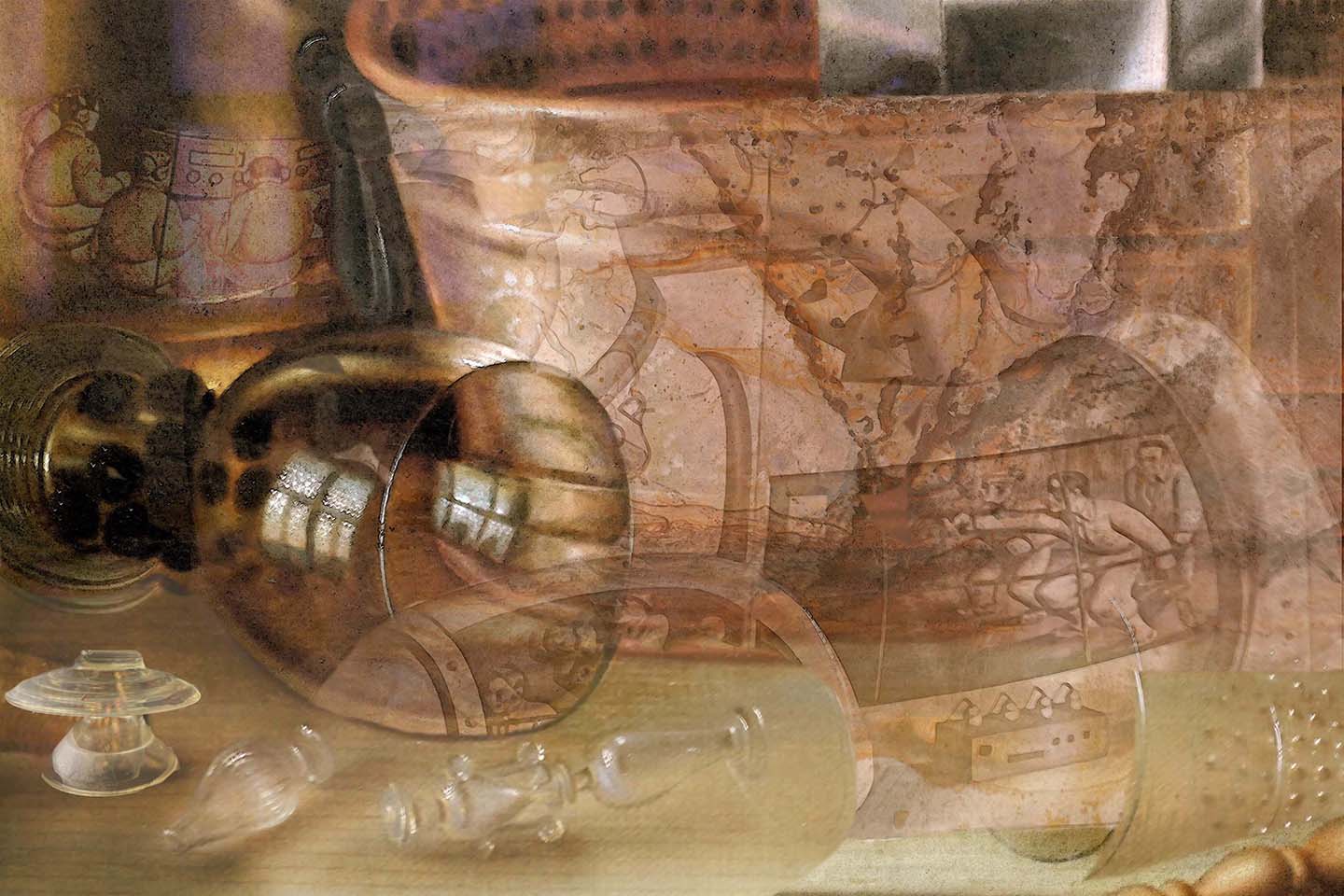
Back to my art project, then. Zorthian’s pipelines of military recruits struck me as perfectly symbolic for the scores of young men flocking to authoritarian institutions. The indoctrination by right-wing radio hosts, piping fake news and hate speech through their channels, also seemed to be captured by the convoluted apparatus. I decided to bury snippets of those murals into classical still lifes for a number of reasons. For one, I never forgot a lesson received as a 12 year-old from a Hungarian refugee, trained by Joan Miró and inexplicably ending up as an art teacher in a small German village, about the role of still lifes. Firmly established during the Dutch Golden Age, with riches accumulating from colonial exploits, these paintings provided a voyeur’s description of what the rich possessed and the poor envied. They assured the wealthy, who commissioned and paid for those beautiful renderings of their belongings, of their status and reminded those who struggled that there was something to aspire to. A notion of hierarchy, class defined.

But still lifes also remind us of domestic beauty, care of the household with the provision of food or flower arrangements, all “women’s work.” This is particularly pertinent with regard to the current fashion of “trad” wives, women who long for the traditional role assignments of earlier times, trying to serve their husbands and family and create feminine beauty round them, preferably instagrammable for lots of clicks. It is about aesthetics, but with the hidden content of ideological beliefs, just as the early still lifes were.

(Let me flag one important exception: the phenomenal 17th Century painter Rachel Ruysch who was one of the few successful women artists of the time and whose botanical still lives sprang from a distinct interest in botanical and biological sciences. My European readers can visit a first major retrospective of her work until mid-March in Munich’s Pinakothek. By mid-April it will be available in Toledo, Ohio, and by mid-August at the Boston Museum of Fine Arts. Something to look forwards to! )

The combination, then, tries to capture the horrid regression of gender-related norms, the renewed assignment of gender-specific roles (battle-field/home) and our fixation on the beauty displayed in the foreground, at the expense of hate looming in the background and violence lurking in the shadows. Whether it is ignorance, indifference or fear: we blind ourselves to new realities at our own peril.

Last but not least, I added photographs of glass and porcelain electrical insulators to some of the montages. Zorthian was an avid collector of these things, and embedded them in all of his various building projects, inside and on top of walls. When I asked his foreman, who is still alive and active on the property that houses descendants and docents, what the story was with these antique beauties, he thought they just caught the artist’s interest when he bought a bunch of telephone poles to be wired for electricity lines on the ranch and they were lying around in the scrap yard. I have no idea if that is all that’s to it. They sure are perfect phallic symbols.

But for my own purposes the idea of insulation – something being prevented from affecting something else – made perfect sense for my question about the politics of the moment. We are insulated from half of the nation, not knowing what they believe or how they could possibly believe it (and vice versa), no longer experiencing a shared reality, with large swaths of the population living in some kind of phantasmagoria, a landscape of hate, sprouting conspiracy theories fertilized by denial of and hostility towards science, extending so far to question the validity of vaccines, and religious fervor that preaches the superiority of men over women, Whites over all other races.

I was surely not the only one who did not realize how many young, disaffected, perhaps economically, but certainly socially anxious men would be ready to shout “Your Body – My Choice” after the election, freed to voice misogynistic dominance by permission (and example) of the very leader they had chosen.

Today’s images are a sampling of the new series.

Music today is from Wozzeck. That opera tells the story of an impoverished soldier, abused by his superiors and traumatized by war, who murders the mother of his child for fear that she’s cheating on him.

The latest report on domestic femicides was published by the UN less than a month ago, on November 25th, the International Day for the Elimination of Violence Against Women. In 2023, globally 140 women and girls died every day at the hands of their partner or a close relative, which means one woman killed every 10 minutes. Lives, stilled.

Fungi-Curious.

· Julie Beeler and Jordan Weiss at the COLUMBIA GORGE MUSEUM ·

October, time for my annual sharing of the recent beauty I found in the woods.

I’m clearly not the only one preoccupied with mushrooms at this time of year. This coming Saturday, October 19th, Stevenson, WA offers its inaugural Mushroom Festival. In their words: “Whether you’re a seasoned mycologists, blossoming enthusiast or simply fungi-curious, don’t miss this unforgettable weekend in Stevenson, Washington.”

Loved that. Call me Fungi-curious!

There will be culinary attractions, lots of vendors for all things mycological, and workshops and demonstrations, including plenty of kid activities. Details here.

With perfect timing, the Columbia Gorge Museum opens its doors to the community once again with particularly interesting offers. Currently on exhibit is artist Julie Beeler, with works directly and indirectly driven by her passion for mycology. Symbiosis features, according to the exhibition announcement, “immersive ‘tree totems’ showcasing the vibrant hues derived from regional fungi, alongside textile pieces, mono prints, and photographs that illustrate their connection to the environment.”

Photo Credit Columbia Gorge Museum

Beeler derives dyes from mushrooms, forty varieties of fungi to create 825 vibrant natural pigments, dyes, and paints by some count, and creates sometimes wondrous textile configuration that capture the essence of the PNW landscape colors and configuration.

Julie Beeler Fungi Bedrock (2020) Mushroom dyed wool, embroidery thread (41.75” x 28.5”)

In addition, she conveys all that knowledge in a recent published book, illustrated by Yuli GatesThe Mushroom Color Atlas. The interactive feature on the link allows you to pick any specific color and then learn which mushroom provides that kind of dye. The book, overall, teaches us about the mycological world, drawing people into exploration of our natural environment.

The artist will be giving a hands-on pigments, paints and inks demonstration at the museum on Saturday. Columbia Gorge Museum | 990 SW Rock Creek Drive | 1pm – 2pm.

It will be followed, at 3:30 pm by Mycophilia In This Now, a presentation by mycology educator and facilitator Jordan Weiss. The educator will feature spectacular mushroom photography and explore the emerging use of technology for fungi as well as information about psilocybin. Weiss has been sharing his knowledge of fungi for decades, working with groups such as the Oregon State University Extension Master Gardener program and Telluride Mushroom Festival as well as mushroom clubs in Salem, Estacada and Bend.

If you can’t make it out to the Columbia Gorge Museum (it is a 50 minutes, beautiful drive, with easy parking, but I get it…) there is another opportunity to dive into the world of mushrooms. The Oregon Mycological Society offers its annual Mushroom Show at the World Forestry Center in PDX on October 27th, from 12 – 5 pm.

Photocredit: OMS website

Yours truly will seek the pleasure of the solitary (photographic) mushroom hunt instead. Blissfully ignorant about their classification, usage, or poison power, just attracted to their spectacular visual beauty, iPhone in hand, composing the next photo montage in my head.

Music today is the latest installment of DJ Farina’s Mushroom Jazz, compilations started many years ago. One more delightful than the next.

When Hope is Hard.

· Kintsugi: The Restorative Art of Naoko Fukumaru at Portland Japanese Garden ·

From: Kawaranai Sora: Nakinagara Warainagara (The Sky Unchanged: Tears and Smiles) 

Fall has arrived at Portland Japanese Garden. Yellowing leaves and needles shine golden when touched by the sun, moss glows chartreuse in the cracks of the stones where it prefers to settle, accentuating the imperfections of the otherwise smooth surfaces. I cannot imagine a more appropriate setting for the exhibition currently on show at the garden’s Pavilion Gallery and Tanabe Gallery.

Kintsugi: The Restorative Art of Naoko Fukumaru is mirroring the sights from the fall garden – attention-grabbing gold and an openness to blemishes rather than perfection of any given object. In addition, the artist offers us much more, introducing general ideas about Japanese philosophy as well as universal approaches to healing, so direly needed in a world torn apart by division and war, in desperate want of mending.

Kin means gold in Japanese, and Tsugi refers to the joining of parts. Fukumaru takes broken vessels or other damaged objects and restores their original shape as much as possible. Rather than hiding the restorative efforts, the contours of the breaks are accentuated with gold dust, now shimmering veins traversing the pottery. The mending consists of a multi-step, time-consuming procedure, applying multiple layers of the Japanese lacquer urushi, a highly allergenic resin derived from the urushi tree, mixing it with powdered gold or silver, and eventual polishing the joined surfaces at the seam.

Some say that Kintsugi can be traced back to Ashikaga Yoshimasa, a shogun of the 15th century. He sent a favorite broken Chinese tea bowl back to China for repair and did not like the outcome at all. Japanese artisans were instructed to develop a more aesthetically pleasing way to restore broken ceramics. The result was Kintsugi.

The essence of the approach is to convey the history of a given object and the beauty found in its imperfection. Mending reconstitutes what has been broken, with visible scars a reminder of the care we extend to what has suffered, and our belief that underneath it is still whole, now even more beautiful. The technique is clearly in line with a more general Japanese philosophy, that of Wabi Sabi. In the most basic form (admittedly my level of understanding), it acknowledges three simple realities:

Nothing lasts, nothing is finished, and nothing is perfect.

Wabi refers to the essence of simplification, of cutting down the things to that which is important, whereas Sabi refers to the passage of time, and more specifically to the fact that the core of something remains the same, even though the facade or surface may change over time (Ref.).

Blue Moon (2023)

Samanid Empire, Nishapur pottery, ca. 10th -12th C. – Repaired with resin, calcium carbonate, 24K gold.

Fukumaru grew up in a third-generation antiques dealer family in Kyoto, Japan. She trained as a restoration expert for glass and ceramics in England and is in high international demand by elite institutions and museums to bring blemished pieces back to perfection. Her turn to Kintsugi happened by chance some 5 years ago, during an exceedingly difficult period in her personal life. She is now counted among the masters of the art form. Creating art that focussed on a narrative of resilience had a therapeutic effect. This is obviously true for all good therapies: we establish meaning through a close look at our history, we focus on what has been overcome, rather than what was harmed, and in the process nourish hope and emphasize strength simultaneously.

The very idea that scars can be beautiful and proud emblems of survival is empowering during times when hope is hard. However changed, the essence of us moves on.

The ceramics on display come from various parts of the world, different cultures and different time periods, all broken in one way or another, discarded from quotidian use, and now restored.

Dreaming in The Blue (2023) (detail)

Kashan Persian earthenware, ca. 11th – mid 1 4th C – Repaired with resin, calcium carbonate, urushi, and 24K gold.

Each vessel has its own story to tell, often helped by explanatory titles. The artist put some back together with added beauty,

combined others with found objects,

Born This Way – Driftwood (2023) Imari porcelain, ca. 1820-1860

Born This Way – Unwanted (2023)

Imari porcelain, ca. 1820-1860 Repaired with resin, urushi, and 24K gold

“Naturally degraded over time, unusually shaped driftwood interacts with human-made ceramics deformed from the extreme heat of the kiln. Both have undergone a journey of transformation, exhibiting an unintentional beauty forged beyond human control. Fukumaru’s Born This Way series looks into the harmony between human and nature’s creations, conveying arguments for what true beauty is in our modern world.” (Display Signage)

and experimented with more ceramic embellishments for a third grouping, adding elements of sculpture.

Beautiful Trauma – Persian Jug (2023) Persian terracotta jug, ca. 1200 – 800 BCE – Repaired with resin, urushi, 24K gold, and plaster “Crystals require high heat, pressure, and time to form. Fukumaru’s motivation behind this piece was transforming negative experiences into something empowering. Conserving the ancient and porous ceramic fragments of the Persian jug was delicate and time-consuming work to which she added dozens of individually cast crystal forms that were carefully refined, assembled, and attached. Created over many months, the process took on meaning: for each scar that heals, a crystal forms as evidence of surmounting hardship.” (Display Signage.)

Her art challenges the viewer to find meaning – as all good art does. The artist herself stresses the therapeutic value of retroactively working through trauma, and coming up healed on the other end. I could not agree more: her work exemplifies resilience. The aesthetics of scar visibility also reminded me of a related approach that we have started to see amongst survivors of surgical trauma, in particular breast cancer. Many women these days opt not for reconstructive surgery, but put striking tattoos over their mastectomy scars, a sign of acceptance of a new kind of beauty born from fear and pain that is overcome. My own relationship with scars, perhaps explaining my intense affinity to Fukumaru’s work, started early. Two symmetrical, L-shaped scars from lung surgery on my 16 years-old back were eventually accepted rather than self-consciously loathed through the beauty of healing words: a friend dryly commented, “I see, that’s where they cut off your wings.” Not that an angelic existence beckoned, but I never had problems with scars again. Embellished acknowledgment healed.

The possibility of reemergence from existential destruction is, of course, particularly poignant for a nation who lived through the horrors of Hiroshima and the 3.11 catastrophe, when on March 11, 2011, an earthquake struck off the coast of Japan, triggering a tsunami that claimed the lives of tens of thousands of residents of the Tohoku region in the northeastern part of the country, which in turn caused a partial meltdown of one of the reactors of the Daiichi Nuclear Power Plant in Fukushima Prefecture. Various forms of art revealed the perseverance of the Japanese people working through trauma. Tanka poetry proliferated, describing ordinary people’s reactions and approaches to healing. Filmmakers captured the determination to overcome disaster. Here is my favorite short by Isamu Hirabayashi, a brilliant monologue of a cicada that survived the 66 years between the two disasters. It acknowledges that nothing lasts forever in face of catastrophe, but that forward movement is required to the very last moment.

***

We live in this culture of endless extraction and disposal: extraction from the earth, extraction from people’s bodies, from communities, as if there’s no limit, as if there’s no consequence to how we’re taking and disposing, and as if it can go on endlessly. We are reaching the breaking point on multiple levels. Communities are breaking, the planet is breaking, people’s bodies are breaking. We are taking too much. – Naomi Klein  This changes everything (2014)

Back to the art on hand: the Kintsugi process does not just alert to the retroactive implications of healing, but also the proactive value of mending: preserving something in a world that is bent on overconsumption, the lure of the ever new.

Whether it is fashion or the production of cheap household goods, these days we encounter cycles of fast creation and quick discarding. We are caught in a mode of linear production. The line goes from extraction of the resources needed to manufacture a good, to production, to distribution, to consumption, and finally, to disposal. Eventually the resources we extract will run out and disposal of the evermore accumulating waste existentially harms the planet’s health.

What Fukumaru does for ceramics, many fabric artists do for those things that we consume and discard the most, clothing: rather than throwing things out, they are visibly elevated to works of art, by embroidery or other forms of visible mending. In fact the visible mending movement (the link provides multiple examples of the art form) often employs golden threads, and consciously refers to Kintsugi as a model for restoration. The Dutch fashion collective Painted Series, for example, started a non-profit clothing brand called GOLDEN JOINERY, where people were invited to repair garments with golden thread, showing the rips instead of hiding them. These fabric arts are also closely related to another gift Japanese crafters gave to the world: Sashiko, a Japanese mending technique involving a running stitch and geometric patterns.

Melting Sun (2021)

Excavated stoneware by Michael Henry, ca. 1970s – Repaired with textile, threads, and resin

“Sashiko, a traditional Japanese technique that uses embroidery to functionally reinforce fabric, inspired this piece. Fukumaru fused thousands of her hand stitches with a recovered bowl by Canadian potter, Mick (Michael)Henry. The stitches represent the manmade tension and strains on our world in contrast to the rustic clay bowl.” (Display Signage)

What we are really talking about here is a form of upcycling, when we change a linear system to a circular one, by reclaiming what already exists, and refashioning it into something that has more value: upcycling discarded clothes into new ones, or into different objects, or incorporating them into art. Upcycling broken pottery into restored vessels, or into different configurations, works of art. Fukumaru’s creative output, in other words, does not solely affect our concept of resilience, but also reminds us of the importance of sustainability.

Nothing lasts. Nothing is finished. Nothing is perfect.

Yet we can buy time, extend the life span, change our perspective on the value of imperfection. We can trust that some core will remain constant, even in the face of appearance change. This is true for pottery, for our emergence from trauma and loss, for the ravages of aging.

And it is particularly true for gardens: seasons and their respective offerings don’t last. No work is ever finished. All striving for perfection a futile exercise. Yet they are the very model of resilience and sustainability if we take care to restore them, nurture them, make the changing beauty visible for all to apprehend.

Go see for yourself. Gold awaits.

Portland Japanese Garden

Kintsugi: The Restorative Art of Naoko Fukumaru  

September 28th, 2024 – January 27th, 2025

LOCATION: PAVILION GALLERY & TANABE GALLERY

Art on the Road: A Crossover of Art and Nature.

· Pacific Threshold: Sandgren & Sandgren- Painting the Oregon Coast with Friends 1978-2023 ·

Merriam-Webster: Threshold, noun

Just my luck. The randomly picked day for a visit to the Giustina Gallery at Oregon State University in Corvallis turned out to be move-in day for the students. Go Beavers! And their parents! And about every car in Oregon clogging the streets and making parking near impossible to find. No regrets, though. I soon left the chaos and the cacophony of competing marching band practices behind, entering a world that transported me quickly to a very different place.

Erik Sandgren Wreck of the Peter Iredale and Cape Disappointment Fort Stevens State Park 2014

On display until October 25, 2024 is an extravagant collection of works by numerous artists all centered around imagery found along the length of the Oregon Coast: Pacific Threshold: Sandgren & Sandgren- Painting the Oregon Coast with Friends 1978-2023. The selected paintings, watercolors and charcoals emerged from over 40 years of summer painting sessions at the coast, organized by Nelson Sandgren, a painter and printmaker who taught at Oregon State University for thirty-eight years, from 1948 until 1986. He was joined by his son, Erik Sandgren, who continued to keep the PaintOuts alive and kicking, while he taught art at college level and established a track record as one of Oregon’s most noted and collected painters in his own right.

Dee Vadnais Ecola Arch Ecola State Park 2019

I had written about the experience of being at a PaintOut previously; Sandgren opens a window into that world in more detail here. It is worthwhile reading his description either before or after you visit the exhibition, because it puts a context around the presented art that will make it easier to grasp the variety of works on display. Some are at the threshold of notable artworks, others have long crossed that line. Some capture the threshold between land and sea, others focus on a threshold where visual objects are translated into psychological experiences, (for both painter and this viewer, I should add.)

Anthony James Cotham Driftwood Shelter at Seal Rock Seal Rock State Park 2009

Curated around the geographical locations defining the coast, the salon-style – hung works allow you to peruse familiar and unfamiliar vistas, depending on your travel habits. Much joy in recognizing familiar scenery. The fact that different media are bunched together, diversity further emphasized by individual framing choices that eventually blend together in a lively fashion, sharpens the sense that we encounter here a collective at work. They all hone in on the way nature shapes the coast, shapes our perceptions, and informs ways of expression that need not be literal, although representationalism is the most frequent mode in this show.

Here is a helpful list of those artists exhibiting as well as of participants in the annual workshops. Those showing were invited to maximize the range of styles on display. As Sandgren told me, the goal was to present all possible styles, from abstract to expressionist to impressionist and California neoimpressionist approaches, all tackling a unified subject matter. The only regret of the exposition was the lighting – the rather dark rooms have plenty of spot lights directed at the art work. Since most of it is behind glass, as aquarelle and charcoals must be, the glare is a nuisance.

That said, there are interesting observations of how the styles of the teachers influenced those of the participating students and colleagues in some cases, and how others found quite independent voices while still adhering to the shared value: the connection to, appreciation of, and love for nature. I should add that there are also a number of perceptive nods to the fishing industry,

Nelson Sandgren Summer Harboring Depoe Bay Motif Depoe Bay

Carol Norton Yates Coos Bay Boat Repair Charleston 1985 — Susan Trueblood Stuart Yaquina Harbor Newport 1985

Erik Sandgren On the Hard at Port Orford Port Orford 2017

or the visual beauty of structures that define the coastal regions, bridges and light houses.

Bets Cole Yaquina Light Yaquina Head

Netson Sandgren Cape Blanco Light Cape Blanco — Erik Sandgren Visionary Light at Cape Blanco Cape Blanco 2017

In fact, there was barely a seascape that did not have some structural element prominently in view, rather than solely waves and water. Contrast helps visual definition, I guess. Who knows, maybe there will be soon another J.M. Turner in the making…. those unmatched seascapes that transferred the threshold between land and water into that of water and sky.

Erik Sandgren Barview Jetty Tillamook Bay 2010

Nelson Sandgren Florence Dunes Honeyman State Park 2000

I was particularly drawn to the many and varied depictions of trees. The rainforests along the coast have some of the toughest conditions of survival, battered by winds, salt water and rapidly changing temperatures. Artists captured the defiant nature of these gnarly giants well.

Debby Sundbaum-Sommers Sea Dragon Shore Acres State Park 2019

Susan DeRosa Overlapping, In the Woods Neptune State Scenic Viewpoint 2017— Gretchen Vadnais Big Spruce Newport

Cynthia Jacobi Grove at Neptune State Park Neptune State Scenic Vewpoint 2023 —Sally Bolton Resting Spot Cape Perpetua 2023

Threshold is often defined as beginning, and the PaintOut gatherings were certainly something new and obviously very desirable. They gathered a community of like-minded artists, with the shared commitment likely pushing individual participants over their own thresholds of insecurity regarding their art, or their threshold of willingness to get up regularly and defy the weather, something much harder when it is just yourself out there.

Nelson Sandgren Rocky Creek Rocky Creek Scenic Viewpoint: 2000 — Humberto Gonzales Rocky Creek Rocky Creek Scenic Viewpoint: 2007

Threshold is also the point where a psychological effect emerges, if certain variables all come together. The accumulation of paintings, so many all in one spot, really enhanced rather than detracted from the appreciation of any individual one. Just like the coast surrounds you with multiple varied stimuli, the light, noise, smells and sensory experience of the wind and rain, the depictions congregated into a representational landscape of their own.

Robin Berry Tide Tossed Seal Rock State Park

Jim Shull Elephant Rock 2 Seal Rock State Park 2005

Congregation, come to think of it, is an applicable term for the community of artists who, summer after summer, spend time together painting, critiquing, encouraging and learning from each other. Not a religious fervor, but a fervor nonetheless for capturing nature, pushing an individual’s experience across a threshold into artistic depiction. Makes one jealous in a world ever more bent on isolation.

Leland John Nelson and Friends at Bandon Bandon 2002

Here they were, some time ago, painting together, and each other. I photographed subsequent generations two years ago.

At least we can share the output. If you can’t make it to Corvallis to visit and explore this treasure trove, there is a book that serves as the catalogue for the exhibition. It is available on site or can be ordered here.

————————————

Pacific Threshold: Sandgren & Sandgren- Painting the Oregon Coast with Friends 1978-2023

Exhibit Dates: Monday, September 9, 2024 to Friday, October 25, 2024

The Giustina Gallery: 875 SW 26th St., Corvallis, Oregon, 97331.

GALLERY HOURS:

The LaSells Stewart Center, Monday through Friday, 8:00 a.m. to 5:00 p.m., unless in private event use.

Please confirm your date and hours to ensure access.

Susan Rudisill Conversation on the Cobbles Neptune State Scenic Viewpoint 2016

Title image : Erik Sandgren Drift Log Fort Seal Rock State Park 2023