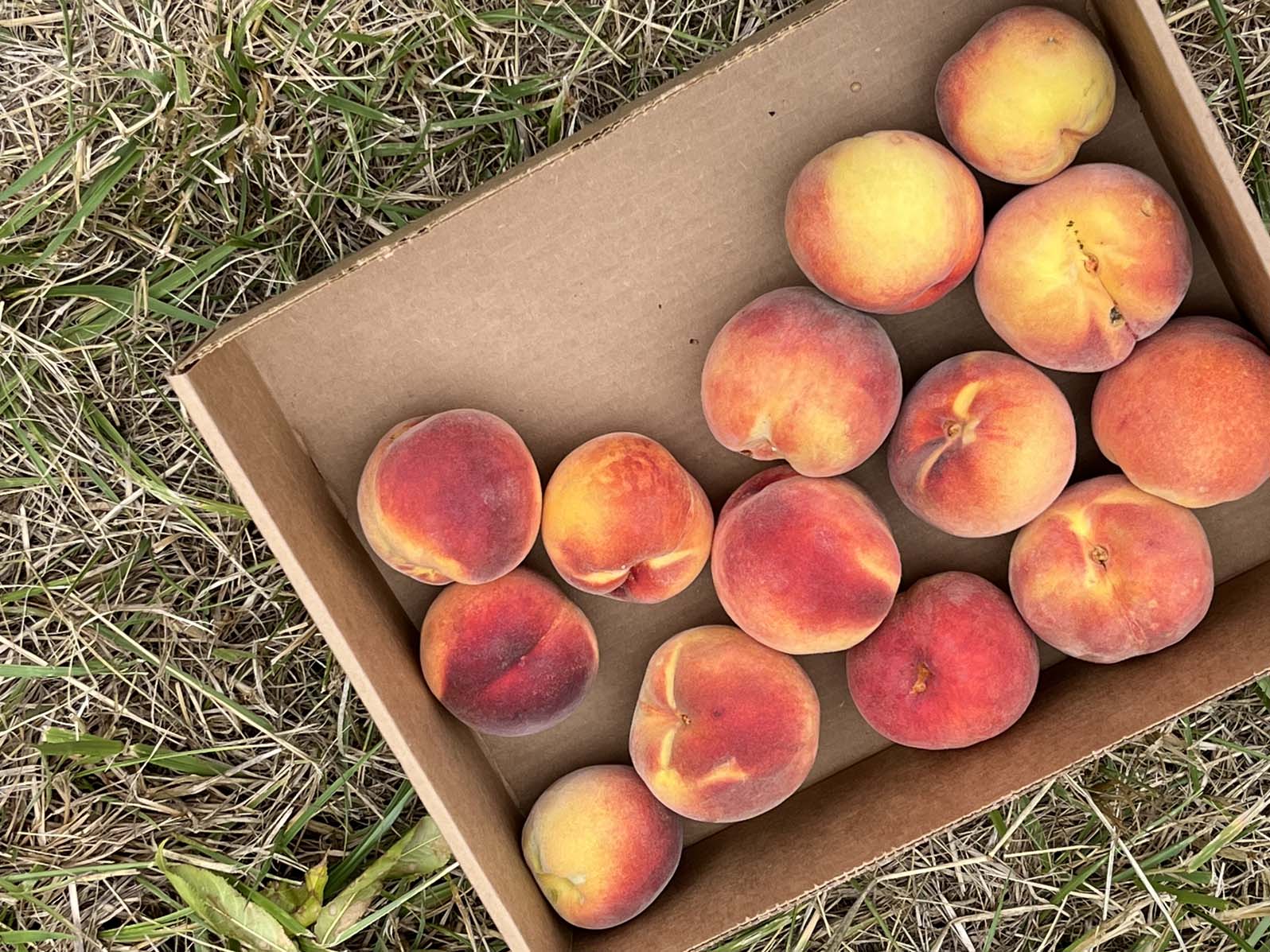
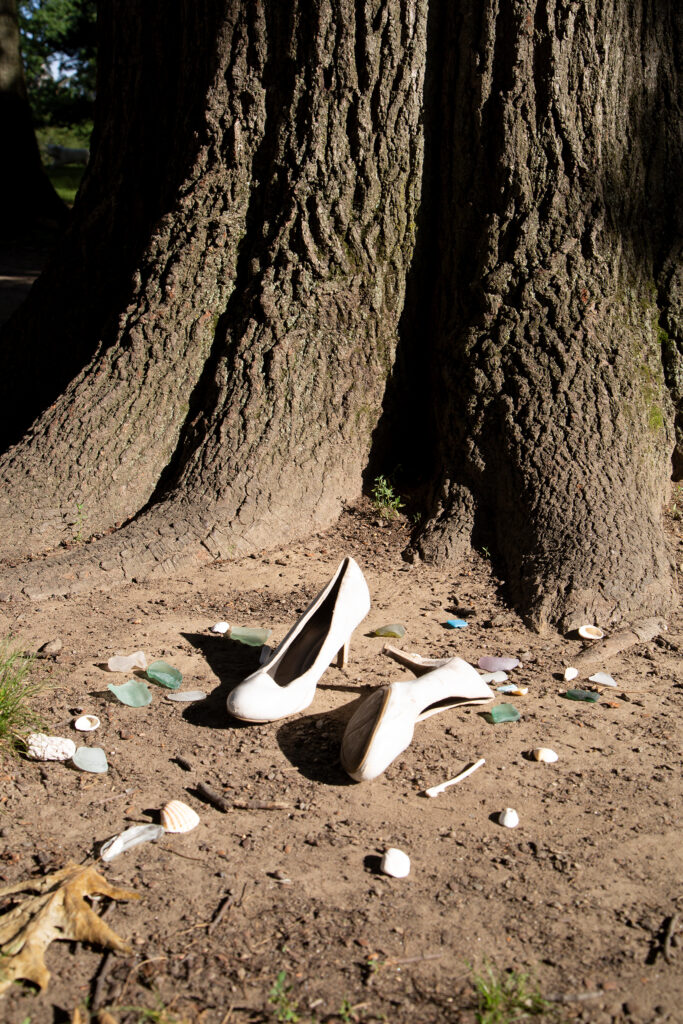
Last week I went peach picking. To reach the orchards you had to drive some miles across dusty dirt roads, arriving at a little farm stand in the shadow of a gargantuan oak tree. Acres and acres of peach trees, bending over from the weight of the fruit, to the point of boughs breaking off. A spectacular abundance.
iPhone pictures today – I did not want to be encumbered by camera while picking fruit.
I was the only one there, surrounded by the buzzing of hundreds of wasps and bees, all feasting. Was thinking about how these fruit are depicted in art, which paintings I remembered. Rachel Ruysch came to mind, her glorious still lifes, probably triggered by the fact that she has a major retrospective now traveling in the U.S. (will open August 23, 2025 at the Museum of Fine Art in Boston) and smart people writing about her life and career. This 17th century painter was more successful in paid commission at the time than many of her more famous contemporaries, Rembrandt van Rijn, Vermeer, Frans Hals and other titans of the Golden Age.
She was, however, not as free to pick her subjects as her male counterparts, constrained to painting flowers and fruit by fiat of her elders and other men in her life. Managed, though, to smuggle in the occasional reminder of the vagaries and dangers of life, in the form of sneaky salamanders, bees ready to sting, all kinds of eerily realistic creepy crawlies. And yet forgotten for the longest time, as so many other women artists.
Telling women what they can and cannot do: why would that remind me of the news that our Secretary of Defense, Peter Hegseth, reposted a preacher’s cry for the revocation of the 19th Amendment? Women should NOT be allowed to vote, was the demand. We have long known about Hegseth’s ties to Peter Wilson who advocates for a Christian nation and the need for women to be submissive to men, “head of household” in particular. According to Hegseth, women are obviously not welcome in the military, either. He has fired them left and right, all the while instituting weekly Christian prayer meetings at the Pentagon. But I digress.
If you look at Ruysch’s paintings, the peaches express hints of their extreme vulnerability, these fruits prone to bruises, splits, mold infestations like few others. Here is one she painted at the age of 19 (!): they are showing little scars and brown discoloration already.
Rachel Ruysch Peaches, grapes and plums with a dragonfly, snail, caterpillar, butterfly and other insects on a stone ledge (1683)
Rachel Ruysch Flowers in a Glass Vase, with Insects and Peaches, on a Marble Tabletop (1701)
In both paintings, she documents peach leaf curl and leaf rust; the trees are extremely susceptible to blight, which often leads to diseased fruit, rotting when still connected. At the orchard, the views of decaying fruit, on the trees and above all, or should we say below – on the ground, were upsetting. So much food gone to waste.
Some of the ones that had fallen were still perfectly intact, good for canning if not eaten fresh. I wondered, of course, if the help that used to pick these orchards in time, has disappeared for fear of deportation. A quick look at the statistics confirmed some suspicions: we have a significant shortage of peaches in the stores this year (down almost 25% from the average year), due to a combination of adverse weather conditions, labor availability and shortages, increased production costs, and economic disruptions, each intensifying the pressure on peach production in key regions such as Georgia, South Carolina, and California’s Central Valley. So could they not allow gleaners in, at least, collecting for the food bank?
***
When I perused painting of peaches, the depictions were, overall, divided. Many show the glory of the fruit on the trees or the voluptuous, velvety globules completely intact.
Wittregde Worthington Peaches (1894)
William Vareika Still Life of Peaches (1867)
Auguste Renoir Still Life with Peaches (1881)
Some reveal canning habits that seem to put the whole fruit with pit inside into the mason jars. Seems strange given the high cyanide content of those pits.
Claude Monet Jar of Peaches (1886)
Others acknowledge reality: peaches bruise all too easily.
Henri Matisse Peaches (1945)
Paul Gauguin Still Life with Peaches (1889)
And then there is Cézanne, always to be counted on when longing for transformation of a natural object into something altogether different, luminous from the inside, abstracted to its essence.
Paul Cézanne Still Life with Apples and Peaches (1905)
Compare this to D.H. Lawrence’s poem below.
The Peach
Would you like to throw a stone at me? Here, take all that’s left of my peach.
Blood-red, deep: Heaven knows how it came to pass. Somebody’s pound of flesh rendered up.
Wrinkled with secrets And hard with the intention to keep them.
Why, from silvery peach-bloom, From that shallow-silvery wine-glass on a short stem This rolling, dropping, heavy globule?
I am thinking, of course, of the peach before I ate it.
Why so velvety, why so voluptuous heavy? Why hanging with such inordinate weight? Why so indented?
Why the groove? Why the lovely, bivalve roundnesses? Why the ripple down the sphere? Why the suggestion of incision?
Why was not my peach round and finished like a billiard ball? It would have been if man had made it. Though I’ve eaten it now.
But it wasn’t round and finished like a billiard ball; And because I say so, you would like to throw something at me.
Here, you can have my peach stone.
by D.H. Lawrence, from his Birds, Beasts and Flowers collection of 1923.
In this modernist (almost) prose poem, he insist on describing the perceived features of the single fruit in verisimilitude, demanding that we ignore man’s desire to make everything perfect, without nooks and crannies, slightly misshapen, indented and heavy – let’s take the peach as is, not round and unblemished.
I wonder if there was the temptation to read slight sexualized connotation into these lines, if it weren’t for the name and thus the reputation of their author. I also ask myself why did I remember and pick this poem from an acknowledged misogynist, a man full of rage and struggle, linked to a hard life full of poverty, illness and persecution by those who did not want his truth telling and revolutionary upheaval of literature to succeed?
Here’s why. He was curious about the world and courageous, traits I value above all. His travel writing speaks volumes to openness to the new, the different, to search and exploration, a keen observer if there ever was one. And the poem itself has that wonderful sense of defiance – “Hey, wanna throw a pit at me? I’ll even provide one, but it won’t change my mind that the imperfect wins over perfection any old day! Let nature rule.”
All of this, and more, I wish for the newest member added to the family, the day after the peach picking excursion. May he be curious and courageous, open and flexible, perceptive and defiant when called for, in a life that will not all be peaches and cream in this world of climate change, wars and the rise of authoritarianism. May he enjoy music (which I listened to on the day he was born) by a composer who shares his birth date.
István Szelényi‘s Sonatina is full of energy, resolves discordances always with an element of surprise, is full of humor and deadly serious at the same time. Good things to be developed in a new life as well, don’t you think? Welcome to this world, little A.
Framing – n. the process of defining the context or issues surrounding a question, problem, or event in a way that serves to influence how the context or issues are perceived and evaluated. Also called framing effect. – APA Dictionary of Psychology
***
I have been thinking a lot about framing lately. The notion of framing plays a large role in traditional areas in psychology, judgement and decision making and cognitive behavioral therapy, respectively. In decision making, our responses are very much influenced by how a question is framed – emphasizing a gain, or a loss, for example. The very same content information can lead to very different choices, depending on the way it is phrased. We are prone to a kind of cognitive bias, where the salience of certain features, or the stress on positive or negative outcomes, influences our response. We know, for example, that framing significantly influences the choice of cancer treatment by altering how options are presented, such as emphasizing survival rates versus mortality rates. Patients often prefer a treatment framed in terms of the probability of living rather than dying, even if the underlying statistics are identical.
Framing also plays a role in visual art – affecting both, the understanding and appreciation of a work of art.
Some of these thoughts were triggered when I visited an exhibition at the Benton Museum of Art/Pomona College some weeks ago. (The show is now closed. Here are upcoming offerings, equally interesting.)
Doubles: Prints and Drawings from the Museum Collections presented paired works that had been selected by graduate students and young professionals during a seminar introducing works on paper. The approach of “compare & contrast” is a traditional one in art education, with instructions to focus on everything from compositional features, perspective, techniques to comparisons between art movements, different art historical eras, or different approaches to the same topic. What we see in one picture often frames our response to the other one.
Doubles exhibited pairs that most frequently juxtaposed different artists along the lines of either shared topic or shared visual expression. Each selection had a very short statement by the student that explained their choices, with varying degrees of success and/or sophistication. The power of the exhibition came from the accumulation of pairings that made it abundantly clear how juxtaposition can affect your own perception of each individual art work. In some instances, that is, not all of them. Graphic similarities, for example, were cleverly selected, but did not necessarily frame the interpretation of each piece.
Roger Vail Untitled (Figure in Profile) (1970 Photolithograph on paper – Kenji Ueda Untitled (abstraction) (1972) Lithograph on paper
(Be warned, most photos today have lots of reflections due to unfortunate lighting conditions in the galleries, fluorescent strips dominating the rooms.)
Robert Cottingham F. W. Woolworth, 1975 Aquatint on paper – Edward Ruscha Street Meets Avenue, 2000 Lithograph on Rives BFK paper
Thematic pairs – war, the flag, colonial oppression, then and now – came closer to having an impact on each other, although they mostly seemed to be coming from a shared viewpoint, rather than exposing a rift between perspectives.
Francisco de Goya y Lucientes Los Desastres de la Guerra, Plate 66, Extraña devocion! (Strange devotion!), printed 1863 Etching and drypoint on paper
Enrique Chagoya Homage to Goya II: Disasters of War (Plate 33: Goya conoce a Posada), 1983-2003 Etching and aquatint on paper
Fernando Marti American Flag, 2017 Serigraph on paper Barbara Kruger Untitled (Questions) from Celebrating 20 Years of Explosive Graphics series, 2009 Serigraph on paper
(Out in the real world, this photograph of LAPD units assembling to “quell the protests”, with Kruger’s Questions mural in the background (on MOCA’s wall), was taken around the same time of my visit, by Jay L. Clenendin. Pulitzer prize material, if you ask me….)
Jesse Purcell War Is Trauma Grenade, 2011 Serigraph on paper Mary Tremonte Battle Cross over Iraq, 2011 Serigraph on paper – both from War Is Trauma portfolio, Produced by the Justseeds Artists’ Cooperative
Umar Rashid (Frohawk Two Feathers) Map of the West Indies, 1790. Born Alone, Die Alone, 2024 Archival pigment print hand-finished with acrylic paint – Enrique Chagoya Escape from Fantasylandia: An Illegal Aliens Survival Guide, 2011. Lithograph and gold metallic powder on paper
(One of my favorite examples for framing that tags different perspectives instead, comes from the Virginia Museum of Fine Arts in their educational tools about perspectives in art. Their explanation is found in the link above.
***
The most fascinating double in the Benton exhibition was a juxtaposition of work by Lorna Simpson and Naomi Savage.
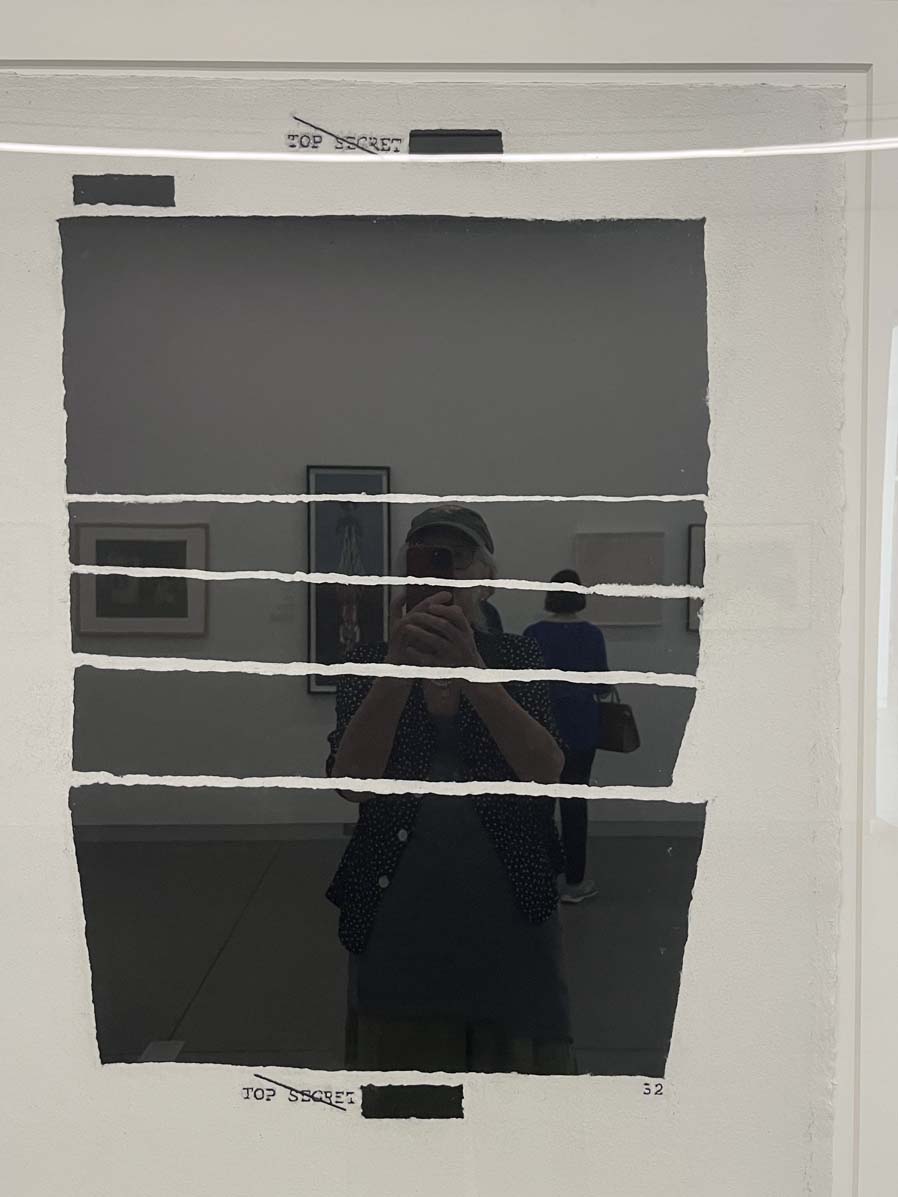
Lorna Simpson 9 Props (complete set of 9), 1995 Waterless lithograph on wool felt panel – Naomi Savage Upper Torso, 1969 Embossed paper
It was intellectually challenging on multiple levels, with the framing centered on absence rather than presence. Naomi Savage was a photographer, niece to Man Ray, who is represented here with a relief print rather than her photographic work. It was chosen with a focus on “invisibility” because the embossing technique makes the image barely perceptible at numerous angles or in different light conditions.
The usual presence of visual clarity in photography is also turned on its head by the work of Lorna Simpson. Here is The MET’s description of the work, held in their collection:
In 9 Props Simpson challenges preconceived notions about what constitutes a portrait. Rather than depicting actual people, she photographs nine surrogates—vases and bowls that are based on objects in the portraits taken by famed Harlem photographer James VanDerZee in the 1920s, 30s, and 80s. Working with the artisans at Pilchuck Glass School in Seattle, where she was an artist-in-residence, Simpson had the photograph vessels replicated in black glass. Her captions below each “prop” describe the people, clothing, and furnishings in VanDerZee’s original photographs. Unlike VanDerZee’s pictures, however, which seem tied to a particular time and place, Simpson’s conceptual portraits are enigmatic and open-ended, relying on the incongruity of her words and images to suggest meaning and context, but without providing obvious answers.
James VanDerZee 1926 photograph that is referred to. I had to dig those up, just as examples, they were not shown for comparison at the Benton.
(Here are some examples of VanDerZee’s portraiture in general.)
A contemporary Black photographer translating the portraits of well-to-do Blacks by a 20th century Black photographer into black objects that obscure any individuality, just enigmatic stand-ins. She provides narratives seemingly unconnected to the objects in view, if you do not know the history of the referent art. Something visible (mis)representing something invisible to the current viewer, framing the experience as one of searching for connections in the absence of visual clarification. Lack of knowledge of the history fundamentally defines our experience as well as our ability to interpret correctly what is in front of us.
Excerpt of James VanDerZee’s 1923 photograph that is referred to.
For me, then, the larger framing was one of the erasure of historical Black experience with the eradication of visibility. My “framing” of her art was perhaps affected by our present day experience of the obliteration of Black visibility and agency in the public sphere.
300 000 Black women alone have lost their jobs in the federal work force across the last 6 months, work that provided middle-class stability. Black top officers and other senior officials at the Pentagon, fired, historical records about Black achievement in the military, purged. The least diverse Cabinet of any in recent history.
In any case, what is visible in an image, or what needs to be imagined to make sense of it, will have large implications for our own interpretation the art. Drawing conclusions, based on our own available framing, often biased by our previous experiences, or our access or embrace of different versions of history, will guide what we see and what we feel. Pairing black and white pieces, defined by absence more than presence, was a clever, clever way to make that point.
***
Framing affects not only the appreciation of art, but also its creation. In my own case, how do I frame the intent to flag environmental fragility and the need for protection, for example, in a photograph or photomontage? Do I depict loss, or do I depict the possibility of positive outcomes? What can represent each of these states, and do they need to be integral to the landscape or can they be extraneous? Do they need to be literal or can they be symbolic, in order to create the largest affective impact? Do I frame the issues and my respective choices verbally as well for the viewer, or do I let them frame it themselves? All this has me preoccupied as we speak.
In any event, whether art or life: a reminder to those of my soulmates also prone to catastrophic thinking – framing is a choice, and there are multiple frames to choose from, most often. Pick a perspective that brings you forward, rather than holds you back in waves of anticipatory anxiety.
Let’s do a musical pairing as well, one that shows very different sonatas by the same composer, Beethoven’s Piano Sonata #1 and #32.
PS: Housekeeping: I will be down to 2 postings per week for the summer months. So the next iteration will come next Monday.
I write this while in Los Angeles, where U.S. Customs and Border Protection are flying Predator B drones (MQ-9 Reapers) overhead. Israel has launched its attacks on Iran. Closer to home, non-criminal, undocumented adults and children are snatched from homes, businesses, schools, courts and places of worship, some jailed in unapproved detainment camps, some literally disappeared by ICE. A judge has declared the administration’s mobilization of the National Guard against those protesting ICE’s actions in L.A. illegal. DHS Secretary Kristi Noem proclaimed “We are staying here to liberate [LA] from the socialists and the burdensome leadership this governor and mayor have placed on this country and this city.” When a sitting US Senator questioned this use of military force to displace a democratically elected state government, the very definition of a coup, he was forcibly removed, thrown to the floor and handcuffed. (A Senator, by the way, elected with more votes than 48 of the 53 red states U.S. Senators combined.) As of today, the Marines are deployed here. A Florida sheriff announces that law-breaking protesters will be killed. A Big Beautiful Bill threatens to cut off over 10 million American people from existential support. Hurricane season is upon us, and fire rages in the Columbia Gorge, with hundreds of households under mandatory evacuation orders, with the actual elimination of FEMA on the horizon.
The issue of safety – from war, from state violence, from racist persecution without recourse, from economic instability, from natural disaster – looms large, not just in the collective consciousness of Americans waking up to the daily news, but also in the subjects chosen by artists affected by the forces listed above. I had the chance to visit three different exhibitions that tackle the questions of how to live with oppression, instability, an uncertain future – and the ambivalence of the natural environment as both a refuge and a threat.
***
“…the distance between shortened Black lives [from toxicity and climate change] and dead Black places is farther than might be imagined. Black places are parables of the threats of industrialisation, technology, and white ideals of progress, and they are parables of adaptation, interdependence, and supportability.” – Danielle PurifoyThe Parable of Black Places. (2021)
On view until June 29th, the Benton Museum of Art Pomona College presents Black Ecologies in Contemporary American Art. Works by renowned artists, Dawoud Bey, Alison Saar, and Kara Walker among them, and those of artists less familiar to me, Tony Gleaton, Wardell Milan, depict the relationship between Blacks and the environment, urban and rural alike. The impact of climate change on more vulnerable groups, the legacies of plantation slavery, the safety of Black women in particular, are all framed in ways that invite the viewer to question their own stereotyping assumptions.
Wardell Milan My Knees aree getting weak, and my anger might explode, but if God got us then we gonna be alright (2021).
Wardell Milan The most dangerous thing about being a Black woman in America. Is being a Black woman in America. (2022)
Black ecology as a field of scientific study investigates the disproportionate environmental and climate hazards that marginalized communities experience and the politics that make them possible. Pollution and waste sites are often the focus, as is the increasing vulnerability to the threats brought by climate change. However, there is also a call for highlighting not just degradation, but positive aspects of Black ecological life as well: forms of resistance and land relations, brought to the attention of the public by artists as well as scientists.
Kara Walker Harper’s Pictorial History of the Civil War (Annotated) 2005 (Excerpts.)
One example is the epistemology of the blues, a musical form which helps understand the relations between people, land, and survival. Another is the focus on Black food movements, with farming, gardening and other forms of food provisions increasing self-reliance and the ability to withstand deprivation and maintain traditions. (Ref.) Kara Walker’s work below is a terrific example. The idea, then, is to foreground land relations not just as suffering, but as growth, self-reliance and making a safer space for oneself.
Kara Walker Preparatory Drawings for An Encyclopedia of Gardening for Colored Children (2022-2023)
***
She often spoke to falling seeds and said, “Ah hope you fall on soft ground,” because she had heard seeds saying that to each other as they passed. – Zora Neale Hurston, Their Eyes Were Watching God.
“What is a safe space for you?” was one of the question posed to more than twenty women living in L.A. by artist Tatyana Fazlalizadeh for her site specific installation Speaking to Falling Seeds at the California African American Museum (CAAM), on view until August 3, 2025.
The studio-drawn portraits resulting from these conversations were enlarged and wheat pasted on the walls of the light-filled atrium, embedded in landscapes, archival photographs and with added text.
The exhibition’s title comes from Zora Neale Hurston’s novel Their eyes were watching God, where the protagonist relates to the nature around her and draws on the concept of community that nurtures the individual. As Fazlalizadeh states, “Speaking to Falling Seeds” reflects on these Black women’s gathering of natural environments around them, as if nature is a blanket that warms, shields, and protects them.”
I was very much reminded of the experiential descriptions and philosophy displayed in another exhibition that I reviewed a few years ago in Portland, OR. A multi-media show, created and curated by Studio Abioto, a family of Black women, who affirmed how to reclaim nature, and create safe spaces combining old and new approaches to ecological stewardship and community. Safety, though, is a relative concept. Whether exploring parks in L.A. or hiking in the forests of the Pacific Northwest, Black women barely move without glancing over their shoulder or facing questioning looks, if not aggression, from those they encounter.
“I’m still learning how dogged people can be in denial, even when their freedom or their lives are at stake.”― Octavia E. Butler, Parable of the Sower
This was my first visit to CAAM. Founded in 1977, it moved into its current housing in 1984, a gorgeous 44,000-square-foot facility designed by African American architects Jack Haywood and Vince Proby. It is the first African American museum of art, history and culture that was fully supported by a state, with no entrance fees or other costs to visitors. According to their website, “the Museum’s permanent collection houses 5,000 objects that span landscape painting and portraiture, modern and contemporary art, historical objects and print materials, and mixed-media artworks. Though the collection emphasizes objects pertinent to California and the American West, it also houses a growing collection of artworks from the African diaspora as well as important works by African Americans from across the United States.”
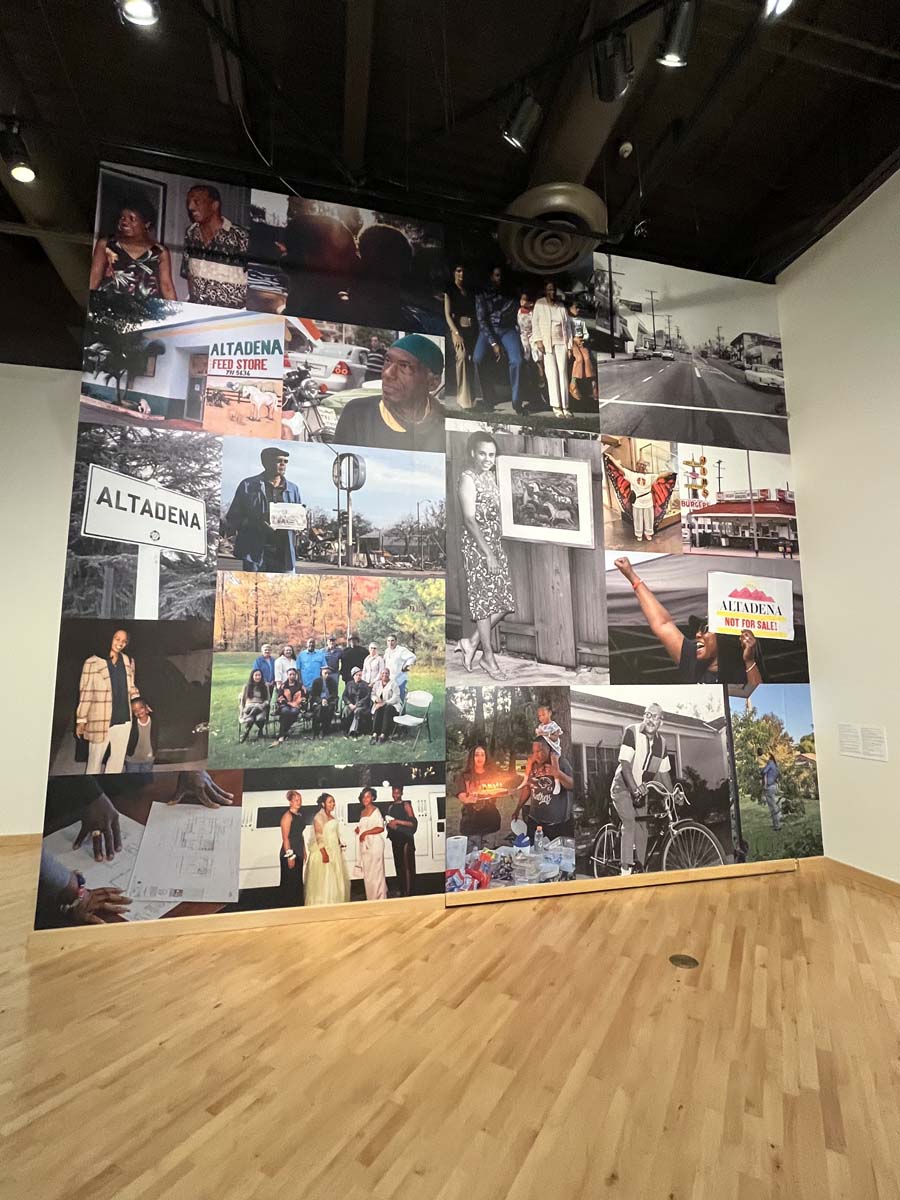
I had come to see a particular exhibition, Ode to ‘Dena, up until October 25, 2025. It honors the Black cultural heritage of Altadena, a community razed by the Eaton Fire this January, burning for a full 24 days. 18 people lost their lives, more than 9000 buildings were destroyed – my kids’ home among them – their contents lost forever. (If you are interested in a smart, perceptive and emotionally brutally honest eye-witness report of a survivor, I recommend Mike Rothschild’s essay collection on his website here. Latest essay on top, it helps to scroll back to the beginning.)
The exhibition was put together at a mind-boggling speed – opening in April, only 3 months down the road from the fire. Beautifully curated, it manages to present a variety of art and creators that reminds us of how much is lost. Irreplaceably so, when you consider that many artworks were stored in the houses that burnt, art and dwellings alike often not covered by insurance (California does not require fire insurance for housing that came down through generations, or the rates were basically unaffordable.) Not that money could restore the lost art. But lack of money forces many an owner to sell the now empty lots to developers with the full understanding that the original character of this close-knit community is going to be radically changed.
Liz Crimzon Fire Creates Art – Altadena and New York Drive – Eaton Fire (2025) Photograph
Altadena was an epicenter of Black art activity in the 1950s and 60s. As an unincorporated area it attracted homeowners that would otherwise not have found the opportunity to buy housing – the location against the foothills of the San Gabriel Mountains meant that smog collected at that barrier, and so was of no interest to wealthier folks who sought healthier places. I have written about the history of the place here and here, with the second link also depicting Eaton Canyon where the fire started. Over the decades, an incredible array of artists, musicians, teachers and activists coalesced around this very special place, leaving a distinct imprint.
Charles White Love Letter II (1977) – Sound of Silence, (1978)
Painter Charles White is one of the more renowned among them, but there is interesting work to be found all over the halls, some by members of multi-generational families all involved with different media, from prints to weaving and everything in-between.
Clockwise from upper left: Kenturah Davis Vol. V (marcella) (2024) – Altadena (2025) – Mark Steven Greenfield Budget Doll/(2012) – Betiye Saar&Alison Saar House of Gris Gris (1989)
Water colors by Keni (Arts) Davis are particularly moving, the selection spanning the years from 2016 – 2025, depicting presence before and absence after the destruction. Here is a sub set.
Keni Davis Beauty from Ashes
Famous writer Octavia E. Butler lived in Altadena and is buried there. Butler was both, a visionary and an astute chronicler of the political experience in a society governed by personal as well as structural racism, and quite aware of the impending threats of fires and floods. The exhibition presents a video outlining her legacy, with the folks at Octavia’s Bookshelf, a book store that became a center for mutual aide and community support in the aftermath of the fire. I had had a conversation with the owner just a few months earlier, when I tried to trace Butler’s footprints in her neighborhood, not just in her novels.
I have been thinking a lot about the writer’s assessment of our capacity for denial, even in the face of factual existential threat. Politics aside, there are scientific data telling us something about climate change, water availability, heat factors, increasing forces of wind and the like. And yet for many people, thrown by their losses into the impossible situation of having to make decisions where to move from here, denial is still at work. (That is if you even have a choice – many people are left so destitute that they are forced to rely on those who they know and who are willing to help.)
Chukes Protector of the Next Generation (2020) Ceramic Richmond Barthé Dr. Mary McLoyd Bethune (1975) Cast Bronze
The bond to home, to a place you know and grew up in, where your friends or family live in the vicinity, all weigh in in favor of underestimating or unconsciously ignoring the dangers the future holds here for you. I get it. I would be paralyzed myself, if attachment is strong, and the options for change so diffuse and yet manifold, that it is hard to even begin to sort it out. Where will you find work? Where housing? Where are communities that fit your needs? How do you protect your kids from too many changes, recurrent displacements? What if you are old and cannot adapt to new environs?
Which leaves the largest looming question untouched: is there any place that is safe? From the fires of California to the fires of the Pacific Northwest, from the hurricanes in the usual Atlantic vicinity to the disasters brought to states previously thought somewhat safe, like North Carolina (think Hurricane Helene), the increasingly frequent and stronger storms in the mid-West, to the earthquake danger along the pacific coast – where should one go? Where will there be enough water, food and still survivable heat for our grand children? How many will compete for those resources when climate migration begins in earnest and nation states become fortresses?
Capt. James Stovall V Blooming Duality (2024).
Some of the strongest work in the exhibition is a multi-media installation from 2002 by Dominique Moody. Her sculptures and work on paper point to our possibility to be grounded by memory as much as experience itself; her poignant characterization of her 9 siblings, strewn all over the world, seem to provide a sense of belonging, regardless of geographic closeness, relational community. The artist is probably most renowned for her project NOMAD, the enmeshment of living life and making art in her nomadic existence in a trailer that is simultaneously an exhibit. It was last shown at FRIEZE, LA, this spring. The term stands for Narratives, Odyssey, Manifesting, Artistic, Dreams – and Moody lives the nomadic life, trained early within a military family that saw constant displacement and change. She has placed herself all over the U.S., including the Zorthian Ranch in Altadena, a while back, with fruitful artistic exchange with the artists there. (I stayed there many years later, with my montage work being influenced as well. It, too, burnt to the ground during the Eaton fire.)
Dominique Moody A Family Treasure Found (2002).
There is, of course, freedom in a nomadic life, and constant stimulation for creativity, particularly if you work with found objects. It is cheap, usually, and the absence of too many belongings can be a blessing. Then again, it is a choice individuals can more easily make than entire populations. And even individuals might need support – Moody herself is legally blind now, a hard fate for a visual artist, and needs a driver for the truck that moves the trailer around.
Rootlessness can imply that you will never lose your roots, sparing you from emotional disruption – but it can also deprive you of the kind of mutual aid that comes from communities that are experiencing harsh conditions together and stand for each other. Communities like Altadena, determined to rise from the ashes, quite literally, and yet irrevocably changed, having to weigh all options for a sustainable future.
What all the art I encountered had in common, was the invaluable reminder that you can choose perspectives. You can look at damage, or at opportunity. You can look at the power of individual choice or the strength provided by communal support. You can allow emotions to rule, or you can favor rational decision making. You can doggedly cling to the familiar or acknowledge that we will all have to embrace change at some point. None of the exhibits did this with a wagging finger, or impervious righteousness. It was work full of integrity, equally acknowledging hope and pain.
A privilege to see it all. And brought to the point by the modern quilting work below.
Martine Syms What do I need most right now? (2023)
What do I need most right now? Indeed, a shared question for all who experience change and disruption. Safety is high on the list.
During law school I worked tons of different jobs to save money for my travels. Some of the jobs were advertised, others came through word of mouth. To this day I cannot decide which was the hardest one: sitting at a production line – stools carefully assigned to alternate German and non-German factory workers (the so-called Turkish “guest workers” at the time) so conversation was unlikely – filling 20 pound bags with birdseeds, and lifting them off, all the while inhaling the dust of that stuff permeating the air of the huge hall. Or standing all day behind the counter of a fried chicken fast-food joint in the caves of a subway station, selling food. I don’t think I lasted more than a few weeks in either.
Then there were jobs I regularly returned to, filing bills and receipts for a renowned bookstore specializing in textbooks, typing in the office for a huge pickle company, and helping with book keeping at a construction firm. The variety in itself was an education – being in environments and with people I would usually not encounter, learning real life skills outside of the privileges of the ivory tower.
One of the more creative, if dangerous, jobs was candle making in the shop of a hippie out in the boonies, who spent most of his time in an Ashram in India, well supported by the candle business it seems, which paid pennies for the student workers. It was fun, but I also have the scars to show for it, hundreds of tiny spots on my arms where hot wax landed.
All this came back to mind while photographing the bees and bumblebees on my salvia plants, which are currently in bloom. Where do they bring the pollen, how much wax is produced for their hives? How are our ever scarcer bee populations affected by the decisions of a conspiracy theorist, who is rolling back 100+ EPA rules, slashing toxic cleanup funds, weakening pollution limits and blocking previous pesticide bans, none of it based on science?
Stopped myself right there, and tried to distract my thoughts away from the horrors, back to beauty instead, deserving of the bees. Focus on art!
Maybe you share my appreciation for the truly astounding installations made from wax by the French artist Juliette Minchin. Likely not bees’ wax, of course, but wax nonetheless.
Here are some pieces from the most recent Art Basel (2024),
Juliette Minchin Hydromancie 33 & 35 (2022)
and those shown in Munich, below; the latter was part of a group exhibition in the newly constructed Bergson Kunstkraftwerk building by Gallery König, METAPHOR TO METAMORPHOSIS, riffing on Franz Kafka.
(Allow me a side comment: Here is the exhibition announcement – when I hear the words “drawing from the aura of his works,” all I can do is try to stop my eyes from rolling at warp speed in my head….
“The exhibition draws inspiration from Franz Kafka, reflecting his exploration of identity and transformation in an ever-changing and threatening world. Central to the show are themes of personal, national, sexual, and other forms of identity, examined as unstable constructs that are constantly in flux and transformation, and often questioned by the artists. Kafka resists categorization, and perhaps it is this elusiveness and indescribability that makes his work so captivating even 100 years after his death. The exhibition does not seek direct references or interpretations of Kafka, nor does it offer an art historical analysis. Instead, it draws from the aura of his work, the sense of relentless search, an attempt to understand the world, and often alienation.”
Elusiveness and indescribability are perhaps apt terms for whatever this signage exhibits: name dropping and fashionable terms that serve as a rubber band heading for diverse approaches to art.
Juliette Minchin Lit 17 (2024)
Here, however, is Minchin’s site-specific installation that took my breath away, even when seeing it only in photographs, with no hope of experiencing it in person. The work was shown last year at the Museo Sant’Orsolain Florence, in a part of the former convent of the same name that is currently being redeveloped, with an anticipated official opening scheduled for 2026. (All images below from Juliette Minchin, Rivelazioni.) Everything you see here within the architectural frame is made from wax.
“For the space in the convent’s first church, Juliette Minchin has designed an installation that unfolds around the remains uncovered during the latest archaeological dig (2014). Her drapes and veils of wax envelop the architecture: the back of the room and the windows come to life, as if breathed through by a new breath of life. In her own way, the artist seems to be resuscitating the convent’s theatrical and fleeting Baroque past, of which there has been no trace since the 19th century. In the convent’s former pharmacy (spezieria), on the other hand, the artist is staging a vigil. Around the room’s imposing pillars, Juliette Minchin has hung panels covered in wax and wicks that will be lit and melted each day, offering visitors the spectacle of silent, ever-changing creativity. The shapes, light and scent of burning wax offer visitors a spellbinding sensory experience, a reference to the liturgical and healing rituals once practised in these places.”
The combination of impermanence (the wax melting, the convent in ruins) and resurrection (the art reinstating and emphasizing the architectural beauty, the permanence of symbols of faith or attempts at healing) I find it all glorious. and I thought the idea of staging a vigil is an apt invitation for Memorial Day, today, honoring those who died for the rest of us, many in order to prevent fascism’s rise. May their sacrifice not have been in vain.
Of course, the beauty of the salvia blossoms is impermanent as well, while hopefully the collected pollen will be transformed into something a bit more stable and lasting: wax for the hives. Waxing and waning, thoughts coming and going. And the privilege to observe it all, matched by the obligation to remember.
Music today is by an Italian musician, recorded in a 14th century benedictine monastery in Varese, but reimagining sacred afro-cuban music. My current favorite, so beautiful and soothing.
“Enter this sublime corrosion, Venice drowning in emotion.” — Venice Drowning, Duran, Duran
The real Venice is not only drowning in ever more frequent and intense flooding caused by climate change, but also in visitors. Like many other cities in Europe, overcrowding by tourists is a serious issue. On the one hand, the traveling masses contribute to the local economies, on the other hand they devour resources subsequently no longer available to those who need them in place. Venice alone has over 8300 spaces rented out by AirB&B, rooms, apartment or houses no longer on the market for locals in need. During the summer, tourists outnumber locals 2:1! This is one of the reasons of brain-drain – educated people are leaving the city, pursuing better options outside of tourism, and leaving a decimated population behind.
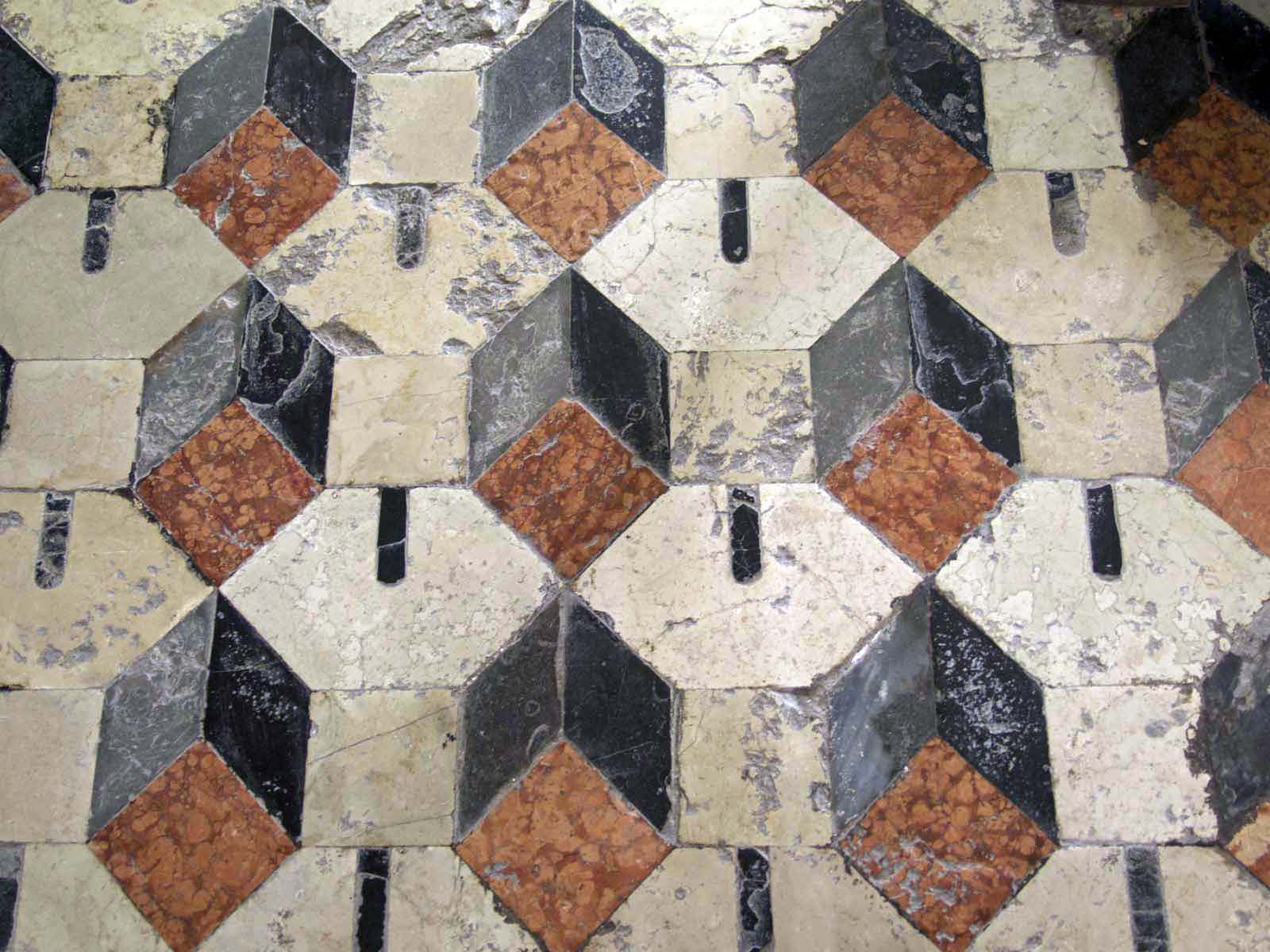
The city also deals with the damage brought to its streets and canals by accumulating trash; the wake of the many boats used for commerce as well as tourism is destroying house and bridge foundations, with repair funds then not available for prevention measures against flooding in general. The many, many feet entering historical sites across Italy, like churches and cathedrals, also wear out church and public building floors, often of archeological or art historical significance (thus today’s pictures from someone who participated in the tourism onslaught, admittedly. Tiles are marble, terracotta, mosaics – the gamut – all beautiful.)
Venice tried to lower the number of visitors by imposing an entrance fee, to no avail. They have now doubled the price of a daily admission ticket (over $10 per person), but if you read the conditions it is clear that there are more exceptions than rules: free after 4:30 pm, free if you stay in Venice proper itself, required only on certain days of the year, etc. – real decreases in number of visitors will have to be achieved by barring rentals, a legally difficult thing to pull off in a free market economy.
In any case, my thoughts went back to the exquisite days I spent in Venice by myself a decade or so ago, marveling at the displays of the Venice Biennale, when I read what our new administration pronounced recently regarding applications for showing at next year’s Biennale. For one, selections are to be announced in September, allotting an astonishingly short timeline, 8, instead of the customary 11 months for artwork preparation.
More importantly, “collaborating artists and curators are now expected to outline how their program ideas “will work to advance the interests of the United States in program administration, design, and implementation.” The proposal review criteria will evaluate an artist’s “ability to showcase American exceptionalism and innovation.” A funding limitations and restrictions section forbids any funds to be used for programming related to Diversity, Equity, and Inclusion (DEI) in accordance with President Trump’s executive order mandating the end of DEI initiatives at the federal level. (Ref.)
People have contacted the ECA and also the National Endowment for the Arts (NEA), responsible for convening the panel of proposal reviewers, for additional information regarding the shortened timeline, and what constitutes American values. So far, no clarification. Perhaps not surprising, given that the ENA, along with the National Endowment for the Humanities and the Institute of Museum and Library Services, is one of multiple government agencies President Trump has threatened to eliminate in his federal budget.
A gentle reminder: deciding which art was (un)acceptable was a huge part of Hitler’s use of his powers (as a slighted artist himself seeking sweet revenge) and the Nazis in general.
“After the Nazi seizure of power in 1933, Germany’s new rulers organised so-called ‘Schandausstellungen’ (condemnation exhibitions) across the Reich; these would ultimately serve as the blueprint for the 1937 Munich exhibition. The exhibitions, which had titles such as Schreckenskammer (Chamber of Terror), Kunst im Dienste der Zersetzung (Art in the Service of Subversion) and Entartete Kunst (Degenerate Art), were united by a common theme: they denounced works of art which were interpreted as an attack against the German people and as symptoms of a cultural decline inextricably associated with liberal democracy. The exhibitions argued that this art had been nurtured by those politicians who had betrayed Germany by signing the Versailles Treaty (the peace treaty that ended the First World War), condemning Germans to a life in servitude to outside forces, and who had thereafter promoted utterly destructive social and cultural trends. Many of the artworks displayed in these early exhibitions would later be confiscated in 1937, recorded on the inventory, and displayed in the Munich exhibition of Degenerate Art. Such pieces included Otto Dix’s anti-war paintings that depicted the gruesome reality of trench warfare and the emotionally and physically crippled veterans it produced. These were denounced as an attack on the honour of the German soldiers and an assault on their heroic memory.
It applied the ‘racial science’ of the day to the art world, establishing a disturbing connection between artistic expression and mental or physical disabilities, both of which were supposed to be eradicated from the ‘racial community’. According to this perspective, all artworks inherently mirrored the racial quality of the artists themselves. This meant that artists considered racially healthy would produce art that celebrated and furthered the advancement of the German race as a whole. By extension, individuals with mental or physical ‘defects’ were thought to be capable only of producing art that mirrored their ‘racial deficiencies’. (Ref.)
Maybe the US contribution to this year’s Architectural Biennale in Venice, should be considered along the administration’s criteria.- For a Biennale titled “Intelligens. Natural. Artifical. Collective,” curated by Carlo Ratti and devoted to illuminating architectural and design solutions for a world threatened by climate change and environmental destruction, the Americans picked: THE PORCH. Yup, that place that the exhibiting teams of architects call an “architecture of generosity.”
Well, I have obviously not seen it first hand, and one can also argue that porches are a place of socializing and potential connection, and extend beyond domesticity, given that we find porches occasionally oncivic buildings, libraries, grocery stores, public housing. Oops, is that DEI already? Yet porches are also primarily places of rest, when really we are called to action, at a time when the pressing environmental issues demand solutions.
All the other pavilions went in that direction, exploring tools of technology, artificial intelligence and collective action (under the umbrella of the title) to propose future-oriented designs. Here is a detailed overview of what is currently on offer. Some exhibitions are interactive, bringing the points home in sometimes uncomfortable ways. The German Pavilion, for example, exhibits Stresstest, where youenter a room that makes you suffer from the heat emitted by AC and other technologies.
“German Pavilion curators pose a critical question: How will humans, animals, plants, and infrastructures withstand these rapidly accelerating developments? The exhibition takes an urgent tone, warning that some European cities could become uninhabitable within a few decades. Despite this imminent threat, climate-adapted urban planning is still not being prioritized. The “STRESSTEST” exhibition aims to make this future urban climate both physically and psychologically tangible, asserting that architecture and landscape architecture can and must play a crucial role in creating climate-resilient cities.” Can you imagine something like this now funded by the US administration? Despite its relevance for the health and survival of our very own population?
“Kabage Karanja, co-founder and director of Cave_bureau based in Nairobi, Kenya, and Kathyrn Yusoff, professor of Inhuman Geography at the University of London, were the curators of the British Pavilion Titled GBR – Geology of Britannic Repair, the exhibition reflects on Britain’s architectural legacy and its entanglement with histories of colonialism, geological extraction, and the urgency of the climate crisis. In recognition of their exploration of the relationship between Great Britain and Kenya, focusing on themes of reparation and renewal, the Pavilion curators and commissioner were awarded a Special Mention for National Participation by the Biennale jury.” You think a proposal like this would even be read by the current US administration? Never mind receiving awards?
How will American artists be able to resist muzzling and still create something that speaks to contemporary society, much less has a chance of being awarded grants that allow exhibitions? How will we not become the laughing stock of the world?
In any case, if I were able (and willing) to travel to Venice right now, one of my first visits would be to the Procuratie Vecchie, a building running along one side of St. Mark’s Square, now open to the public for the first time in 500 years in its new form as the San Marco Arts Centre (SMAC). For its opening, they are featuring two architecture-themed solo shows, one a retrospective of the Austrian-Australian architect Harry Seidler—dubbed “the high priest of modernism”—and the other the first international exhibition of the pioneering landscape architect Jung Youngsun. Both promise to be fascinating.
Seidler brought Bauhaus to Australia, and his work is true to his maxim: “Architecture is and always was above all, an art form; that interdependence exists between all the visual arts… The form that architecture takes should have its roots and marriage with painters and the world of the other visual arts. They are all intertwined, and they all reflect the impetus of our time.”
YoungSun Jung has done incredible cross-cultural adaptations of landscaping styles to her native Korea and was a pioneer as a woman in a male dominated discipline.
And then you can go and feed the pigeons on St. Mark’s Place. They will probably still be around when the whole of the island has been washed away…. it is expected to have sunk completely by the year 2100. Details on causes for the sinking and proposed mitigations (all limited and insanely expensive) here.
By chance I encountered three artists across the last weeks who I was completely unfamiliar with. One lived in the 16th century, and two worked mostly in the 20th century. I had been researching portraiture for a potential project of mine, discovering that art historians seem to draw parallels between selfies on Instagram in 2025 and commissioned portraits during the Renaissance. Huh?
You probably know this already, but I had to be reminded that once portraiture was no longer purely religiously motivated, it became something else all together. It was not simply about likeness, but displayed a very distinct desire to convey something else via the chosen props, clothing, surrounds. Self-representation, or self-staging, if you will. Dress-code, jewelry, coats of arms and inscriptions all signaled rank and social status, descriptive of contemporary norms and expectations. Replace coat of arms with make of handbag, watch, or car, and the rest fits perfectly well with what we see on social media from people who yearn to be noticed and remembered.
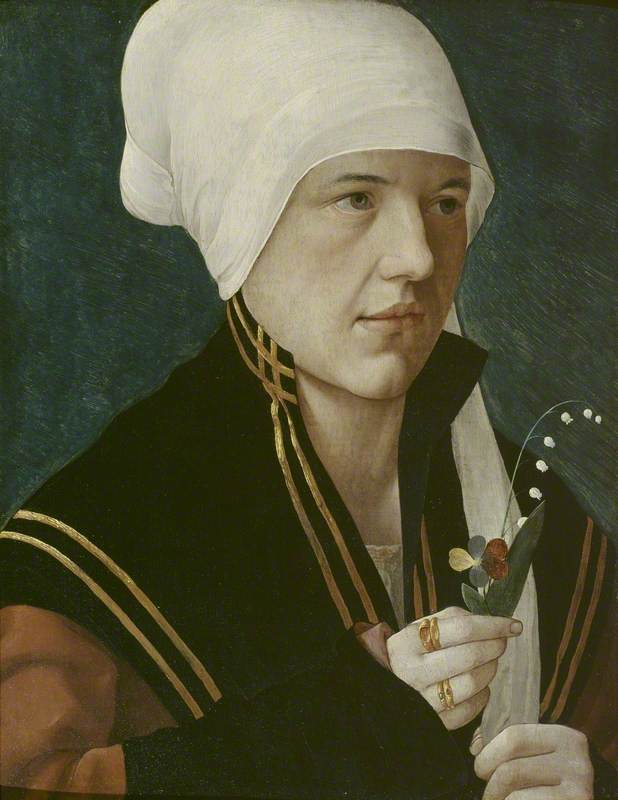
Marx Reichlich‘s gorgeous portrait of a woman holding flowers caught my eye first.
Marx Reichlich A Woman Holding a Lily-of-the-Valley and a Pansy (c.1510–1520)
I was struck by the androgyny of the face, the defiance in the lips, the silken headdress, the parallel gold appliqué on the dress matching the parallel gold of the rings, two pairs for good measure. The background might as well have been painted by an impressionist. The symbolic meaning of the May bells as they are know in German, was often one of modesty and spiritual purity during that time period. The juxtaposition with the abundance of rings, a focus on prosperity, is vexing. La Fête du Muguet, which honors the lily of the valley as a harbinger of spring and fortuity was only established a half century later. King Charles IX founded this custom in 1561 after receiving the flower as an emblem of prosperity. Reichlich, in any case, wasn’t French but Austrian, a citizen of Salzburg since 1494, and much sought after as a portraitist, although he also did commissioned altar pieces. His most famous portrait is a large painting of Canon Gregor Angrer of Brixen.
Marx Reichlich Gregor Angrer (1509)
Look at the physiognomy of that face, a mouth and forehead stylized to match the slope and crease of the red biretta, the Canons’ hat. The hint of a double chin points to being well fed and also echoes the double layers of the vestiges below. Those clothes: gold thread shimmering in the satin coat, vest underneath that looks like embossed leather, another layer, likelt a cassock, (it sure was cold in Tyrolean churches) and then a lace shirt, with what could be seen as two rings as fasteners! The red of hell’s flame in the background in case all this vanity gets too intense? What’s your first reaction when you look at him, though?
Some days later, my attention was drawn to a lovely portrait of a woman taking a quick nap, cat on her lap. She did not even bother to take off her satin slippers, she wears patterned silk stockings and her lipstick and necklace make it pretty obvious she is not the maid – she can afford a siesta in the middle of the day, as indicated by the light outside the curtains. I had never heard of the painter, ORAZI, a frenchman who insisted on capitalizing his name. When I looked him up, I could find few portraits, but an incredible evolution of styles across his life span – man, nothing he didn’t try. Actually admirable.
Orazio ORAZI Siesta (1934)
Let’s move on to Felice Casorati – someone posted the girl on a red carpet on Instagram and it felt creepy but also enticing.
Felice Casorati Girl on a Red Carpet (1912)
In between girl- and womanhood, judging by the toys and more teen-appropriate props, the figure, pet dog and paraphernalia are sort of compacted at the lower end of the painting, leaving room for the massive, sun streaked carpet to expand like the future for this adolescent. It might be a bright one, with her endlessly long legs and alabaster skin, never mind a sizable dowry, judging from the riches poured casually on the floor in front of her. (Yes, dowry – 1912 still a year where girls were expected to marry, after all.)
From what I learned, Casorati’s most famous painting is the neoclassicist portrait of Silvana Cenni, apparently referencing the Madonna Of Mercy by Piero della Francesca. (I had no clue. Below is what I found.) (Casorati also abandoned intensely progressive political leanings after he was arrested for a short stint, turning seemingly apolitical which did not hurt his career…. what else is new.)
Felice Casorati Silvana Cenni (1922)
I guess one can find parallels. But here is something that struck me as more interesting, and in need of further confirmation. If you look at all the paintings I posted today, the woman have something in common, in contrast to the male: they do not look directly at you. Ok, one is snoozing, so how could she. But the others are either looking sideways, or closing their eyes, no direct invitation to the viewer to establish eye contact, while the Canon is sternly gazing directly at you with whatever message contained in those icy eyes. I wonder how much was just coincidence, given that so few pictures were chosen by me, or if there is a pattern when you compare male vs female portraiture at least before modern times. Suggestions?
Here is an exception, pointing to the freedom experienced once you have reached the life stage of crone, and do no longer need to signal modesty, pliability, deference, submission with the averted gaze – all these attitudes that the contemporary rejection of feminism, spearheaded by the Right, is so keen on reestablishing.
Here is (at least some of) us looking straight at you – dedicated to all my own comrades in aging….
Felice Casorati The Old Comrades (Le Vecchie Comari) (1908).
Music today about Lily of the valley by Jun Miyake. Apparently used for a well-known Pina Bausch ballet. The other piece I like (and the composer is new to me too, just like the painters,) is this.
“I like maps, because they lie. Because they give no access to the vicious truth. Because great-heartedly, good-naturedly they spread before me a world not of this world.” – Wisława Szymborska
This stanza from Szymborska’s poem Map, the last one she wrote before she died, loomed large in my head when I drove home after a conversation with a local artist who had invited me for a studio visit to explore the project she is currently working on.
Kristie Strasen is a renowned colorist and textile designer, with numerous awards under her belt, and, more importantly, decades of experience in creating pattern and color schemes for high end textiles where execution matches her original visualization. In the decade or so since she relocated from New York City to the Columbia Gorge, she has infused her creativity, her skill set(s) and her curiosity about the history of her new home into ever more ambitious projects at the loom.
Her current endeavor can be described as a work of cartography, in the widest sense. The weavings model reality in the most abstract ways, combining scientific inquiry, aesthetics and technique, as all map making does that tries to capture reality in spatial form.
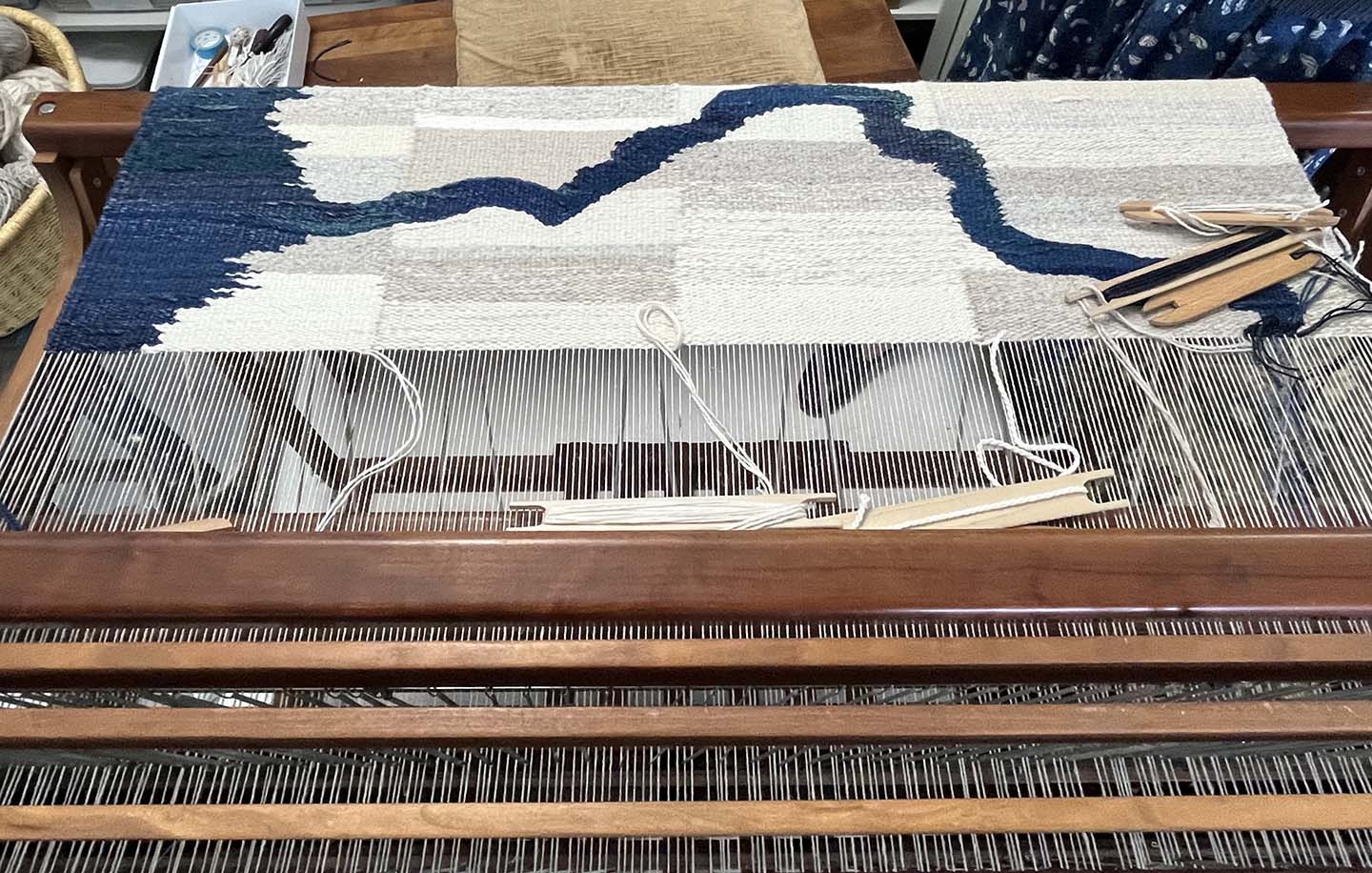
River Stories will depict the entire course of the Columbia River from the Canadian headwaters to the mouth where it enters the Pacific Ocean, some of the tributaries, like the Klickitat and the White Salmon river, and several sections of the Columbia Gorge Scenic Area.
It is technically a complex endeavor. Strasen enlarged maps that show the geographic features of the river course, bends and all, partitioned the sections into grids and then traced the river course, eventually with dots under the warp of her loom.
With free hand weaving she delineated an exact depiction of how the river runs, through six sections, with background colors reflecting the tone of the respective landscapes, the forests, the cliffs, and the eventual softness at the confluence. The color choices required more than just her perfect eye – because the wool in the requisite colors was of different weight, the straight edges, pride of accomplished weavers like Strasen, had a tendency to be less than perfectly straight, once off the loom. Probably only detectable for experts, but something the weaver had to grapple with given her high standards.
All I can say: The tapestries are a beautiful, but I equally marvel at the way Strasen transforms her curiosity about the world into a specific work of art that shares some of her insights with the viewer.
Curiosity about the world: in addition to a longstanding fascination with maps, the artist devoured the literature about the history of the Gorge, the consequences of Western expansionism, and the effects of human intervention on nature, once she had arrived in White Salmon, WA and made it her home. She felt called to draw our attention to both, the consequences of our meddling with nature, as well as the preservation of it, the latter largely due to early efforts of individuals like Nancy Neighbor Russell, who was instrumental in rescuing the Columbia River Gorge in Oregon and Washington, threatened by commercial interests. Russell founded Friends of the Columbia Gorge in 1980, working to protect the Gorge from development and secure it for federal protection, th Columbia River Gorge National Scenic Area Act, passed by the U.S. Congress in 1986.
***
Maps express particular viewpoints in support of specific interests.They can shape our view of the world and our place in it by selectively presenting information. This can be bad when the purpose of persuasion is manipulation. I had written about this some years ago in the context of another map making and art project:
“The goal of suggestive mapping was to achieve political objectives (while avoiding lies, which could be easily exposed) by appealing to emotions and rigorously excluding anything that didn’t support the desired message. Its maps were intended specifically to engage support from the general population, and they were often “shamelessly explicit. Cornell University has a wonderful introduction and collection of maps all sharing the purpose of persuasion. The topics range from religion, imperial geopolitics (think colonialism), slavery, British international politics, social and protest movements to, of course, war. The goal was made explicit in the 1920s (and later taken on in force by the Nazis) when in reaction to the shameful defeat in WW I German cartographers decided to go for the “Suggestive Map,” cartographic propaganda which they thought had given the British a strategic advantage.”
But the way information is presented can also have the positive impact of a warning or an invitation to think things through critically. A selective tool used by Strasen is the color she chose to mark the various dams blocking the natural flow of the river. In my interpretation, bright red bars signify the danger, the concept of halting, the possibility of destruction and the ongoing heat of the discussion around the justification (or absence thereof) of dam removal. These visual magnets emphasize obstructions that we now know had ongoing disastrous consequences for fish populations, never mind the trauma of displacement for the Native American tribes affected by the dam construction. They remind us how much the lifeblood of the Pacific Northwest, this river and all who it serves, are endangered by efforts towards relentless extraction, a view shared with the Columbia River Keeperswho are passionately engaged in its protection.
***
Maps in art have been around for some time (for a short history of this intersection, go here.)
Art, like maps, can be a tool of persuasion, doubling the force of that intention when utilizing maps’ suggestive power, which can be done in a number of ways.
Mona Hatoum, born in Lebanon to Palestinian parents and living in England, for example, took copies of the flight route maps you find in airplanes, and added hand-drawn designs in ink and gouache. Rather than focussing on geographic borders, she delineated the movement across the globe, leaving to us the decision if that movement was voluntary or not. She herself describes the paths she drew to be “routes for the rootless.”
Mona Hatoum Routes II (2002) Photo Credit: MOMA
Later work employs sculpture, with red neon outlining the continents, representing a globe riddled by hot spots, places of military or civil unrest, a world aflame.
Mona Hatoum Hot Spot III (2009) Photo Credit Agostino Osio.
Closer to home, artist Mark Bradford has made his mark with his large-scale mixed-media works that combine representations of geography and the ruinous fate of residents of depicted areas. The artist models the streets and buildings of specific neighborhoods with string or caulk, layering scavenged paper on top and cutting and peeling away layers to both conceal and expose the geography. Some of his map paintings refer to areas in L.A. shaken by violence in the 1992 riots. Others refer to scorched earth, referencing the Tulsa Race Massacres of 1921 which wiped out Oklahoma’s Black Wall Street.
Mark Bradford Black Venus (2005)
Mark Bradford Black Wall Street (2006)
Mark Bradford Scorched Earth (2006)
Not all art is, of course, explicitly political. Some, like Juan Downey‘s Map of America, draws swirls of color to stimulate the imagination.
Juan Downey Map of America (1975)
Then there is Maya Lin’s Pin River project – sculptures depicting river courses with pins or marbles, up to 20.000 in this rendering of the Hudson river watershed. She also uses installations created from more than 200 bamboo reeds in the form of a 3D drawing of the Hudson River basin,
Maya Lin Folding the Hudson (2018)
Maya Lin Pin River—Hudson Watershed (2018) detail.
Maya Lin Map of Memory, Hudson River (2018)
All of these works, in their own way, demonstrate that maps can be used for more than an efficient way to communicate spatial information.
This is also the case for Strasen’s tapestries, which are surely more than a tool to help us think about our physical surroundings. Her unapologetically reductive maps offer less context and more of a sense of wonder for a particular place, a particular beauty and history. A world not of this world, and yet.
The blue band of the river, set against an immense backdrop of diffuse landscape coded only in color, gives us a figure/ground constellation that tells a story emphasized by this degree of abstraction: the centrality of a river shaped by forces larger than us, defining a region, essential to its – and our own – survival.
The work will be completed in June when it will be inaugurated during a solo show at the Columbia Gorge Museum.
I cannot wait to see it hung!
Columbia Gorge Museum E.D. Lou Palermo, inspecting a finished section of the tapestry.
“The potter, in his concepts, must possess such a sheer love of truth as will carry him past the dangers of revivalism on the one hand and of futurism on the others.” – Bernard Leach, A Potter’s Outlook, Handworker’s Pamphlet #3, 1928.
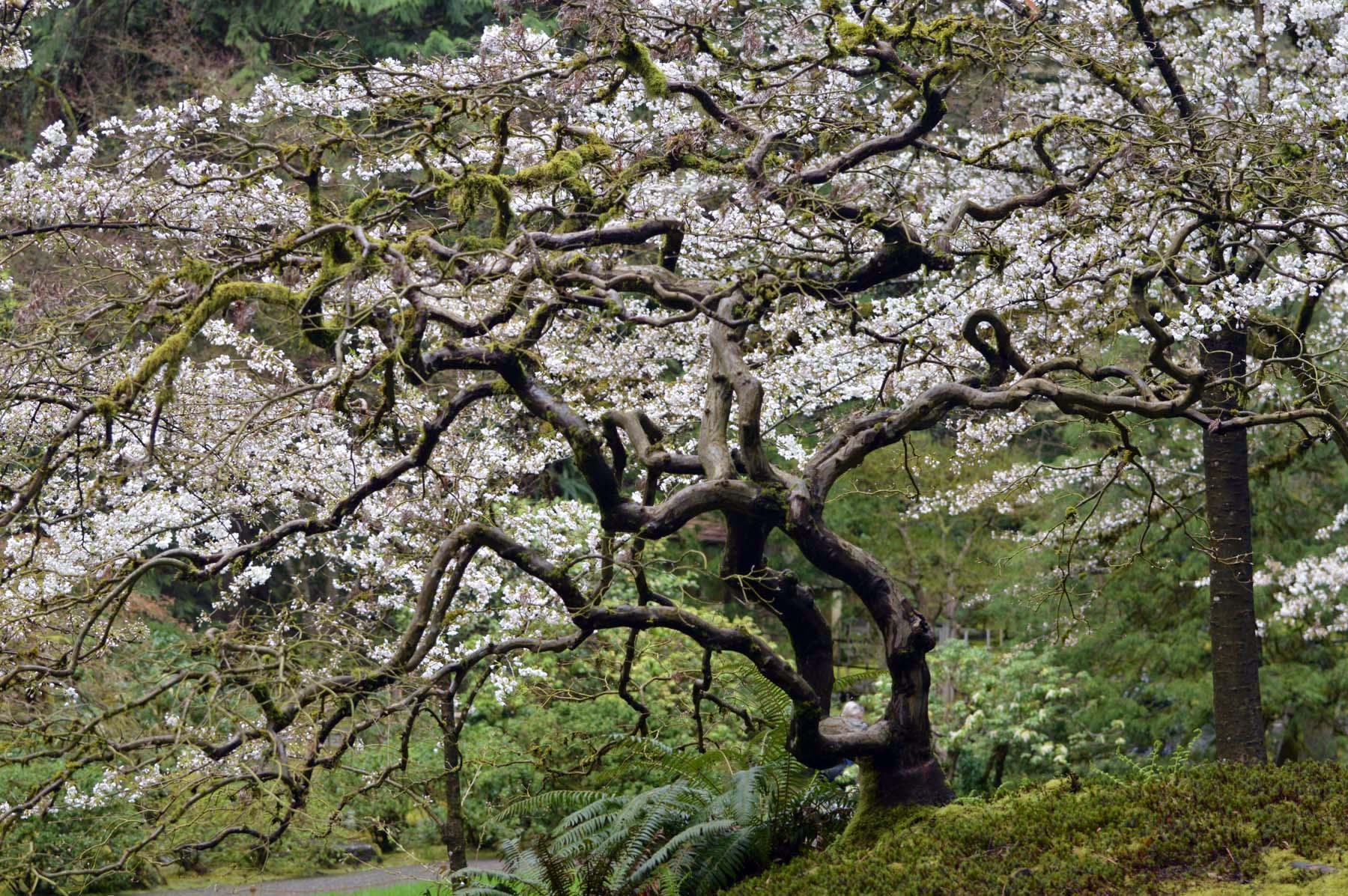
I should have known then, when I was barely able to find parking. But who would have thought that in the middle of the day on a weekday, half of Portland’s population and every other tourist in town would flock to the garden? I had made a spontaneous decision to visit without checking the website which I later learned announced peak bloom for the cherry trees. Of course the trees were spectacular. So was the weather’s control over people’s movements. Like one, we ripped out our cameras when the sun appeared, lasting for about five minutes, like one we scurried seeking cover when the torrential rains came down, again for the shortest amount of time. Proverbial April weather on steroids in March.
Once again, the garden offered some surprises. I really have difficulties thinking of a place that so regularly, reliably, offers food for thought at the same time that it gifts us with natural beauty. This time my eye was caught by the visual contrast between nature’s opulence, and that offered by Earthen Elegance: The Ceramic Art of Bizen inside the Pavilion Gallery. My brain, on the other hand, was occupied the minute I saw some antique stencils in the hallway near the Tanabe Gallery (in conjunction with an exhibition by artist Karen Illman Miller, Natural Patterns: Katazome Stencil Dyeing, that would open the next day and will be visited at some later point.)
***
Imagine clouds of pink and white cherry blossom from the weeping cherry at the flat garden, or the old tree near the Café, or the white cherry tree hill – soft, gossamer, delicate and impermanent, all of them, a study in fragility.
Contrast that with the dark hues of the Bizen ceramics, the toughness and resilience of pottery wood-kiln fired at extremely high temperatures for weeks on end. Earthen(ware), down-to-earth, earth-derived and earthbound in its utility, a study in sturdiness.
Manabu Suehiro Yunomi Cup (ca. 2000)
The name Bizen pottery originates with an ancient Japanese kiln from the Kamakura period (1185-1333.) The Chugoku region in the West of Japan is known for its special hiyose clay dug from the rice fields and red pines that are used to fire the kilns to this day, a lasting artisan trade. The vessels are fired in either Noboigama/climbing kilns or Anagama/tunnel kilns, and some of the artisanal skill lies in adjusting distances to the heat source, and changing the amount of heat, up or down, during the weeks of firing, with temperatures as high as 1,200 degrees Celsius.
Depending how much ash adheres to the pottery, the surface layers will appear rough, and depending how close or distant from the core heat, the colors will vary for these traditional storage containers.
There are no glazes or final painting of the vessels, no decorative motifs in the tradition. Sometimes the artist will wrap straw around the containers, which creates a unique pattern through the chemical reaction of the Potassium component contained in the straw with the iron oxide component contained in the clay. None of the beautiful red streaks look alike in this Hidasuki method.
Another variation of Bizen ceramic is Goma, with characteristics on the ceramic surface resembling special grainy sesame seeds. The ash of pine wood sticks to the vessels during the burning period, creating these floating seeds or even droplets.
Takashi Mezawa Vase (ca. 1998)
Works on loan from the Collection of David Sneider and Naomi Pollock feature contemporary artists who luckily inherited the processing skills and techniques accumulated across generations. I lack the expertise to pinpoint where they exactly deviate from or improve on the Bizen tradition, but the aesthetics speak to me, however much the past and the present co-mingle. Put differently, the vessels do create an emotional reaction, one that includes being drawn to the ultimate function of earthenware, a desire to use it. There is an earthiness to these containers, the way surfaces are rough, the forms vigorous and for the most part unpretentious, that spoke to me. I would have no qualms sticking some cherry blossom twigs or a magnolia branch into some of them, and reveling in the contrast between the light and the dark, the temporary and the timeless.
Masahiro Miyao Vase (ca. 2005)
***
“Japonisme is no longer a fashion, it’s infatuation, it’s insanity.” – Ernest Chesneau, French art critic, late 1800s.
Eventually, escaping the next deluge, I found myself in the corridor of the Japanese Arts Learning Center. Good thing I was double-masked. Really chanced onto an inconspicuously hung display of antique Katagami paper stencils from the collection of artist Karen Illman Miller, their creators unknown. Perusing these beauties set off a chain reaction of thinking about what I know and what I don’t know, followed later by some serious reading to brush up on the deficiencies. A wild ride, as it turned out. If the curator’s minimum intent was to teach but one person about some intricacies of Japanese cultural productions: mission accomplished.
So what is Katagami? The original stencils were created by making a paper pulp from the bark of mulberry trees, which was then made waterproof by applying a mixture of oil and the fermented juice of unripe persimmons. Next you pile up the sheets and create a pattern with knives and hole punchers all the way down. The top sheet is discarded, and the rest are often paired, with a mesh of human hair or silk threads to prevent tearing.
Left to Right: Antique Katagami Stencil Silk Making Process – (Artisanunknown)- Antique Katagami Stencil Diptych (Artisanunknown) – Antique Katagami Stencil Maple Leaves in Stream (Artisanunknown).
In parallel, you prepare the fabrics that are supposed to receive dye patterns with the help of these stencils, a process called Katazome. Once the fabric is ready, you put the stencil on top and then push something called a resist paste through the holes of the template. The traditional paste consisted of a mix of glutinous rice, rice powder and bran powder, salt, slaked lime (calcium hydroxide), and water. You take the stencil away, let the thing dry, and then color the surrounding fabric with dye or paint by hand, outside of the lines of the resist paste. Once the dye has dried you wash the paste off, traditionally in flowing water at small streams, and you got your kimono pattern in full beauty.
That art is partially the result of class divisions. The Japanese nobility of the 17th century enacted exclusionary laws that prohibited the wearing of silk garments by the increasingly prosperous merchant class. As a result cotton fabrics became more elaborate in design and complexity, with the Tokugawa Shogunate (1603 ~ 1868) encouraging and supporting artisans in their production of katagami stencils. Traveling traders bought bunches of them and then re-sold them to textile craftsmen throughout Japan, including remote rural regions, eventually enabling peasants to create beautiful garments at least for festive occasions.
Antique Katagami Stencil Tryptich and Floating Flowers (Artisan unknown)
Fast forward to 1854. After 250 years of isolation, Japan was forced open to Western colonial and trade forces. The nation reacted with prompt modernization, including a shift in national power structures, with the Samurai no longer being a force to be reckoned with – including their purchasing power. The search for replacement consumers turned westwards: enormous quantities of artisan wares, wood cuts, Katami stencils, ceramics and porcelain works were exported to Europe which soon landed in the grip of Japonisme: a sensitivity to Japanese culture that had an enormous impact on changes in Western art, shifting expression bound to the past to one open to future developments.
Designers (think William Morris, or the decorative artisans of the Wiener Werkstätten and Art Nouveau) were influenced by Japanese patterns.
William Morris, Green Leaves – Felix Vallotton Laziness (1896)
Painters also adopted new perspectives derived from Japanese prints, perspectives that included flattened spaces, new viewpoints, often from above, or providing a radically subjective positioning of the viewer, cropping of subjects, a tolerance for empty space and last but not least color choices that were no longer descriptive, but expressive instead. (Some examples of paintings and their (in)direct models can be found here.)
Hiroshige Plum Park in Kameido —- Vincent van Gogh Flowering Plum Orchard, after Utagawa Hiroshige 1887
Back to our Katagami stencils for textile printing. In 2015, the Staatliche Kunstsammlungen Dresden held a phenomenal exhibition of 140 Katagami stencils, Die Logik des Regens, all devoted to the subject of rain, at the Japanese Palais at Dresden, Germany. The curator, visual theorist Wolfgang Scheppe, had found a treasure trove of some 16.000 (!) of them at the Museum of Decorative Arts at Dresden’s Pillnitz Palace, largely unknown. They were held in ninety-two cassettes for more than 125 years.
How did they get there? We know that a purchase was made in 1889 at the height of Japonisme, the seller one Hermann Pächter, the owner of a Berlin art dealership that specialized in East Asian art. The Jewish business was destroyed during Kristallnacht, November 9, 1938, the surviving proprietor, Pächter’s wife, later murdered by the Nazis in Theresienstadt. So no real provenance from that end. The papers at the museum got lost or burnt during the allied bombings of Dresden. So no provenance there, either.
However, it is speculated that the art dealer bought the entire collection from the translator, diplomat and art collector Alexander von Siebold who at the time lived in Japan. He is another entry, together with his father, Phillip Franz von Siebold, into my Department of interesting People” ledger… the latter a traveler and a highly respected German naturalist and physician in 19th century Nagasaki whose daughter with a Japanese partner became the first female physician in Japan, the former one of his European children who served Japan throughout his life with distinction. If he sold 16.000 stencils, how many did he actually own?
In any case, the 2015 Katagami exhibition was beautifully arranged, hung at eye-level with indirect backlighting enabling the patterns to be seen in all their minimalist glory, details after detail flowing into abstraction. As the exhibition text noted: “140 different ways to graphically represent the falling of tiny drops in a rhythmic pattern.”
A handbook with more than 200 illustrations of these stencils will be published by the curator this August, 2025. I don’t know if and when there will be an English translation. But just seeing the art would be a treat.
The Dresden Katagami exhibition was accompanied by a sound installation of randomised computer modulations of the sound of falling rain, developed in collaboration with the Italian electronic musician Renato Rinaldi. Here in Portland, all you had to do was step out onto the Cultural Plaza and listen intently while getting soaked. Thinking about the flow of cultural practices and ideas across time, or across continents. About how minds open when they appreciate something new, or admire something from centuries ago. About artistic cross-fertilization, and always, always, individuals who blaze a path, approaching novel parts of the world, returning with knowledge, or providing us with art that we would otherwise not easily come in contact with.
The garden, exhibitions and nature alike, once again, an interdependent source of inspiration. A benevolently reappearing sun agreed.
Portland Japanese Garden
Earthen Elegance – The Ceramic Art of Bizen
FEBRUARY 8 – JUNE 9, 2025
Karen Illman Miller – Natural Patterns: Katazome Stencil Dyeing
– In memory of my friend, Dutch-American painter Henk Pander. You are missed. –
Henk Pander Remembering Haarlem (1922) Painted a year before his death on April 7, 2023.
***
Walk with me, and you’ll get rewarded with a fun fair ride, or a gigantic ice cream cone or a wine tasting at 11:15 in the morning on a Monday – up to you. I, of course, had come to photograph the tulips and the never disappointing sartorial choices that people make when they visit the fields.
On my way to the Wooden Shoe Tulip Farm, I drove by one of those traffic control machines that flash speed numbers at impatient drivers. Mine said instead: Great Job! I must have been, for once, under the speed limit, but could not help be irritated by patronizing traffic machines that are now talking to me. But I digress. Let us leave quibbles behind and indulge in beauty.
Wooden Shoe Tulip Farm South of Portland, in March 2025.
Claude Monet Tulip Fields at Sassenheim (1886)
Vincent van Gogh Fields of Tulips (1883)
What used to be a farm with a small store where you could get cut flowers and order bulbs for next year’s planting, is now a consumer’s paradise, with a fun fair, hot air balloon rides, endless booths for food and trinkets.
You have to book tickets on line and decide on a fixed time slot for arrival, so that the acres of parking lots can be managed by the staff. But you know what: it’s fine! Let people have fun in a world that offers little of that, let the kids squeal and the adults delight in a whiff of spring and distraction from daily worries. I certainly had a blast and was grateful to hear so much laughter.
The fields were a bit behind, given the strange weather patterns of this winter, with field color concentrated only in one corner, but found in planters generously spread throughout. What was in bloom showed most frequently shapes that no longer resemble much the sultans’ turbans, etymologically the root of the word tulip, from the Turkish language.
Jacob Marrle Four Tulips: Butter Man, Nobleman, The Great Plumed One, and With the Wind. (1635)
Erkin Tulpen in blauwe Kom (2018) He is a contemporary Dutch realist painter who goes only by one name.
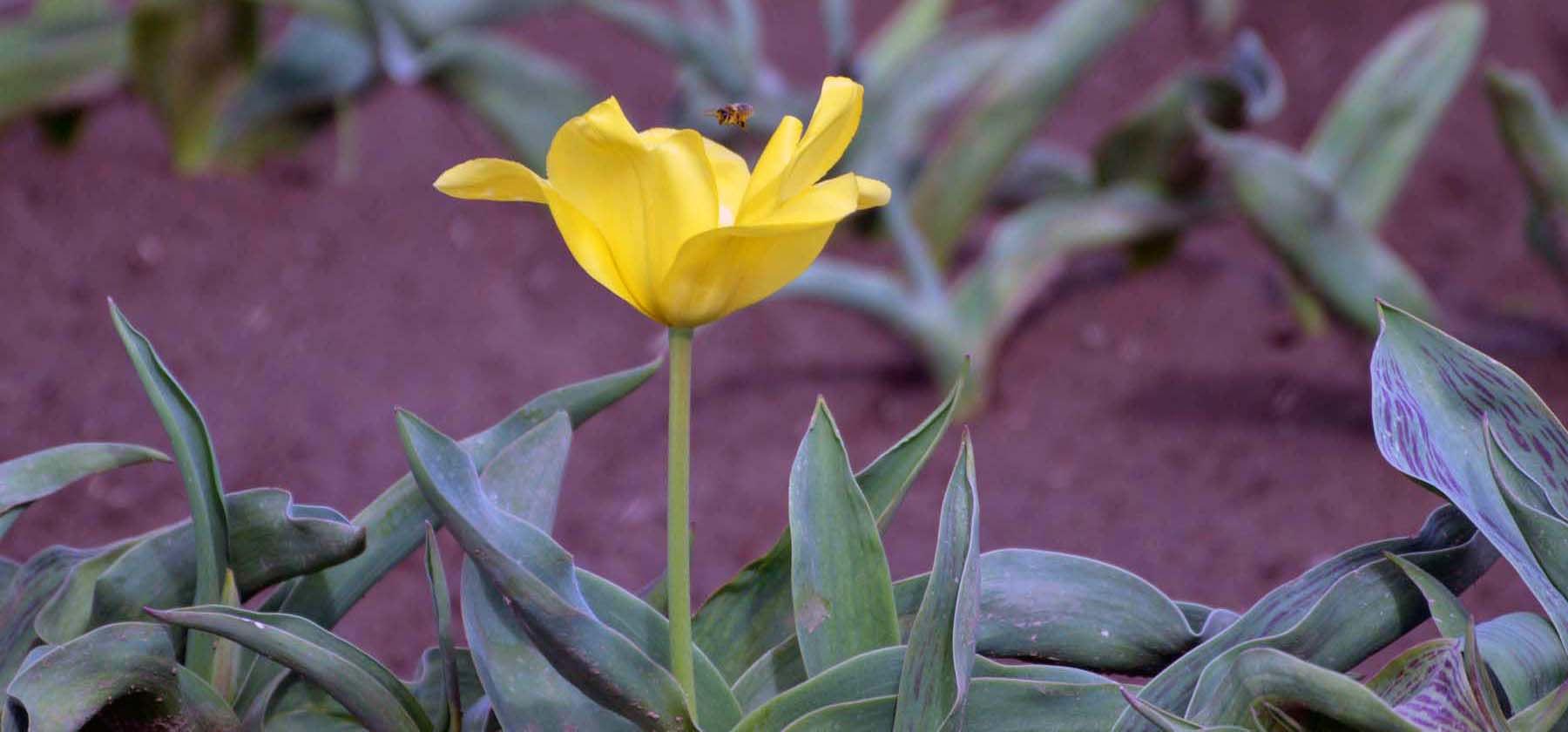
Yellow was definitely coming up, opening wide to a surprisingly warm morning.
Gerhard Richter Tulpen (1995)
Picked this painting despite the ongoing “let’s make them guess” style of this artist (I’m not a fan, as you know), with multiple options including a view from a moving train, fading of memories, or vision problems – which was what I thought about during my stroll. The farm had a sign out that suggested you could borrow glasses that would help overcome color blindness and help enjoy the full glory. I had to look it up, once back home, if these glasses really are able to keep what they promise – and wouldn’t you know it, only IF you have a mild version of the common red-green colorblindness (and not an absence of color receptors,) do they have an effect, enhancing contrast vision more so than color vision per se. (Ref.)
Lots of workers in the fields, picking flowers for sale, transporting goods, weeding, guarding against visitors flaunting the rules. Hard work on a still cold and damp ground.
Lots of appropriately themed garb.
But nothing beats the beauty of the blossoms – or, as a matter of fact, the breeding of new stem colors.
Max Beckmann Stillleben mit Ausblick aufs Meer (1938)
Paula Becker Modersohn Stillleben mit Tulpen in blauem Topf.
One tent housed a wood worker who made traditional Dutch Klompen out of poplar wood.
It made me think of the long history of Dutch colonialism, agricultural brilliance, and the 17th century tulip mania that ended in an economic crash. One thought about speculative bubbles led to another, and here I was wondering why so many young men are so attracted by crypto currency speculation, meme coins, and, for that matter, sports betting.
Anonymous The sale of tulip bulbs (17th Century)
For one, it is interesting to see that there are endless postings on the web where tulip mania and crypto speculation are compared and scathingly disentangled – the former bad, the latter good, in very LOUD voices… Of course, if you dig, you find opposing views and people quite worried about another bubble, eventually bursting and dragging the investments of young men down with them. The numbers are staggering – both in terms of how many young men are drawn to day trading, crypto and betting (relative to women and older populations,) how many of them consider themselves addicted in one form or another, and how much money they gain or loose in short amounts of time.
Roughly one in three young people has traded in or used crypto (when I can barely define what that actually is.) The new administration is helping, in terms of loosening banking restrictions, or active encouragement in investing in these kinds of currencies (Trump just yesterday introduced a new cryptocurrency, the Stablecoin.)
Listen to the expert (and this link leads to a smart, short piece on the psychology of crypto attraction):
Still, the bro-economy exploits its users’ penchant for risk. Crypto companies and betting sites do not generate value; they take cash from their users, reshuffle it, and redistribute it, while keeping a cut for themselves. Postmodern trading platforms encourage excess, making their margins on esoteric trades and superfluous volume. The casino lacks guardrails, not to benefit the bettors, but to benefit the house.
Musk and Trump have given young men something to aspire to. But their ascendance makes the stricter regulation of the bro-economy unlikely—and, in the case of crypto, makes deregulation a sure thing. Guys are about to lose billions and billions of dollars a year on apps designed to obscure risk and keep them coming back for a dopamine hit. Trump and Musk can afford to lose huge sums. Most young American men cannot.
Jan Brueghel the Younger Allégorie de la Tulipomanie (1640)
Oh, let’s just return to the beauty out there, and not fret, for five minutes.
Claude Monet Vase of Tulips (1850)
Emil Nolde Tulpen, (ca. 1940)
And one of my favorites:
François-Emile Barraud Parrot Tulips (1931)
***
I was not the only one who found joy.
And Easter around the corner.
The pug, on the other hand, was sort of done with it…
As was he.
Careful, Bigfoot, even the curbs have tulips…
Music today are variations on a famous composition by Dutch composer Simeon ten Holt who died in 2012. The piece is called Canto Ostinato (1979). Here is a version for four pianos, recorded live in 1984 and here is one I really like from 2017 at a world music festival, with incredible singing.
Confession: I “borrowed” this title from a neuroscience research study that explored the interaction between aesthetic experience and personal relevance when looking at a work of art. I liked the title more than the study, which demonstrated with brain scans what my grandmother could have told you over dinner: different people react differently to different pieces of art, and their reactions are influenced by the rest of their lives….
What, though, if the “rest of our lives” is systematically exposing us to acceptable definitions of art, contrasting it with unacceptable ones, declared degenerate, or met with any other form of denigration?
Am I thinking here of societies where “good” art is defined from above, and cultural centers are taken over to start setting certain standards? Yes.
Am I thinking of Walter Benjamin’s claim that “In fascist aesthetics, the conventional is uncritically enjoyed, and the truly new is criticized with aversion.” Yes.
Did these thoughts get triggered by looking at specific art? Yes!
I was interested in the juxtaposition of work of two photographers, and my spontaneous negative and positive reactions to each series, respectively. Both artists are women, both chose to photograph in specific locations historically meaningful to them, and both stage their images. This is where the similarities end. Maria Svarbova, born in 1988, hails from Slovakia, a country that is currently seeing massive anti-government demonstrations against the authoritarian and repressive government of Prime Minister Robert Fico who has become Putin’s new best friend and is head of a populist party accused of major corruption. Nona Faustine, on the other hand, was born a Black woman in the U.S., no need to spell out who is also best friends with whom in this country, at the moment. She died last week, heartbreakingly young at the age of 48. Rest in power.
Svarbova is quite in demand on the international circuit, with commissions by large corporations, and work shown in galleries as well as relevant publications like Vogue, Harpers’ Bazaar and so on. I am focusing on her Swimming Pools series that started in 2012 and is ongoing, often labeled as Nostalgic Futurism, or Retro Futurism.
She selects old buildings in Slovakia and abroad that house swimming pools, and stages models clad in precisely chosen garb and demanding color schemes, preparing the shoots and lighting of the halls with large teams of assistants, to get everything just right. There is no doubt the artist is extremely talented, and knows how to translate visual imagination into spatial and color-bound scenes that are striking.
My reaction? At best, these staged scenes remind me of kaleidoscopes, the thrill of my childhood, with masses of brightly colored pieces of plastic holding patterns in mirrored configurations. Eye candy. Except now “plastic dolls” instead of plastic confetti.
Or maybe they evoke synchronized swimming, albeit without the strength, skill of body control, and sense of perfect timing required by this sport. More like dead fish, sardines, to be precise, crammed into rigid positions in a jar. You realize that these flawlessly arranged, perfect bodies are devoid of individuality, and any hint of emotion.
But really, and here the goosebumps start to crop up, they make me think of the choreography of fascist displays of masses moving, whether the synchronicity of goose-stepping young men, or the gymnastic displays of youth in unison configurations.
I’ll get to that in a moment. Note again, that I describe my associations elicited by the photographs, not my speculation on what the artist intended. She certainly refers to the prominent display of a No Diving Allowed sign in multiple images as a reference to the restrictions upon women who should be allowed just to have fun in the pool.
But over the years, the work has become more technically accomplished, placed in more glamorous locations that had nothing to do with communist East-European brutalist architecture or oppressive rule (never mind that no diving is a safety measure found in pools around the world), and overall slicker.
***
Here is Nona Faustine’s White Shoes series in comparison. She was interested in how the past informs the present, and in creating images that would make us ask questions about and remembering the legacy of the slave trade. Her work has been widely praised and awarded, collected and presented in a solo show at the Brooklyn Museum just last summer.
Nona Faustine “Isabelle, Lefferts House, Brooklyn (Self-Portrait)” (2016) taken outside the Lefferts Historic House museum in Prospect Park, Brooklyn.
The choice of locations for the series was premeditated, just like Svarbova’s, and guides us to relevant places or areas that were constructed from chattel slavery and used significantly to perpetuate white supremacy. She would pose in various stages of undress in these public places with life going on around her, with a few props and the symbol-rich, sensible white shoes.
The representation of a voluptuous, nude, female black body, in a fat-phobic society no less, makes her self-portrait particularly vulnerable. There she stands, props in hand, on the ground that holds the bodies of her ancestors, the buildings above representing the power that put slaves into graves in the first place. Whether you experience her as a symbol for those who were made invisible, or an avenging force who demands visibility, or a woman unafraid to challenge our stereotypes of what constitutes beauty, in each interpretation you find a core of individual agency so utterly lacking in the conventional beauties aligned at the pool.
Nona Faustine “They Tagged The Land With Trophies and Institutions From Their Rapes And Conquests,” (2013) (Outside the Tweed Courthouse in downtown New York, New York, USA)
Her use of self-portraiture urges us to acknowledge the impact of the past on the lived present, to recognize the ongoing consequences of historical injustices on Black communities today. The artist reconstructs a narrative of racist oppression, making us think of the body as commodity – to deliver unpaid work and future generations of workers then, or to be traded in a world suffused by imposed unreachable body ideals, now – traumatic, both. The courage alone produced respect in me; the series as a whole was an aesthetic experience that fed my brain and made me feel sad, more than anything else, particularly now when we incredulously stare at distinct attempts of re-segregating our society. (Exaggeration? Read here and here.)
Nona Faustine Dorothy Angola, Stay Free, In Land of the Blacks, (2021) (Minetta Lane, Greenwich Village, New York, NY, USA.)
It is the juxtaposition, though, of the two series, that produces an affective aesthetic response colored by “the rest of my life,” informed by my links to German and Jewish history. I am thinking back to a book by Frederic Spotts, Hitler and the Power of Aesthetics in which he talked about the role carefully choreographed spectacles and pageants played in the consolidation of his power. He suggests that Hitler’s “lack of feeling for humans… was already evident at the Nuremberg rallies and other spectacles when his ‘architecturalizing’ of the participants and his deployment of them in geometrical patterns reduced them to noctambulent creatures.” “What his monumental aesthetic would leave behind, therefore, was not the uniqueness of individual human experience or its messy heterogeneity, but monolithic forms that imposed singular meaning on disparate deeds, experiences and lives.” (Ref.)
15,000 people perform synchronized gymnastics at the Nuremberg Rally. Germany. 1938. Imagno/Getty Images
Bund Deutscher Mädchen at gymnastics exercise – 1941
A declaration of what is beautiful and which aesthetic should dominate public (or private) life did not exist in isolation, though, in fascist or other authoritarian regimes. If there is but one standard of beauty, then all that does not conform must be done away with – and here we come to the erasure of those deemed ugly. If you are fat, you need to fast. If you are wrinkly, you need cosmetic surgery.
If you are degenerate, art and human beings alike, you need to be eradicated.
The norms WERE applied not just to paintings, sculpture, music or architecture. They were used to create out-groups that would be convenient scapegoats, or could be killed to ease economic press during the years when fascists were in power. The T4 program, the very first to attack who was deemed ugly, was used to systematically euthanize the disabled. We know what followed.
During the 1930s Paul Schultze-Naumburg—an architect and scholar—traveled Germany, lecturing on mental illness and modern art, flashing slides of avant-garde paintings beside pictures of people living with disabilities.
Fascists “beautified” the world through violence and forced conformity, trying to reduce individuals to non-significance, uniting an entire people as “one,” eliminating any sense of or desire for individual agency when you felt psychologically embedded in the amorphous whole. If you remove differences from public display – all those who are Black or female, for example, you get a mass of White men who no longer draw your eye to distinct visual qualities: de-individuation achieved. Note that it is not just those who are excluded from public life who get hurt. It is also those who remain, who are forged into a whole that can be manipulated at the leaders’ whims, sleep-walking through their use as puppets or eventual cannon fodder.
We are in need of art that fights that notion, and I am wary of trends that hail imagery that homogenizes beauty, reminiscent of a past that unleashed horrors upon humanity.
Music today is about the kind of flood I wish would wash all the evil away…. Sister Rosetta Tharpe sings Didn’t it rain.(1964)