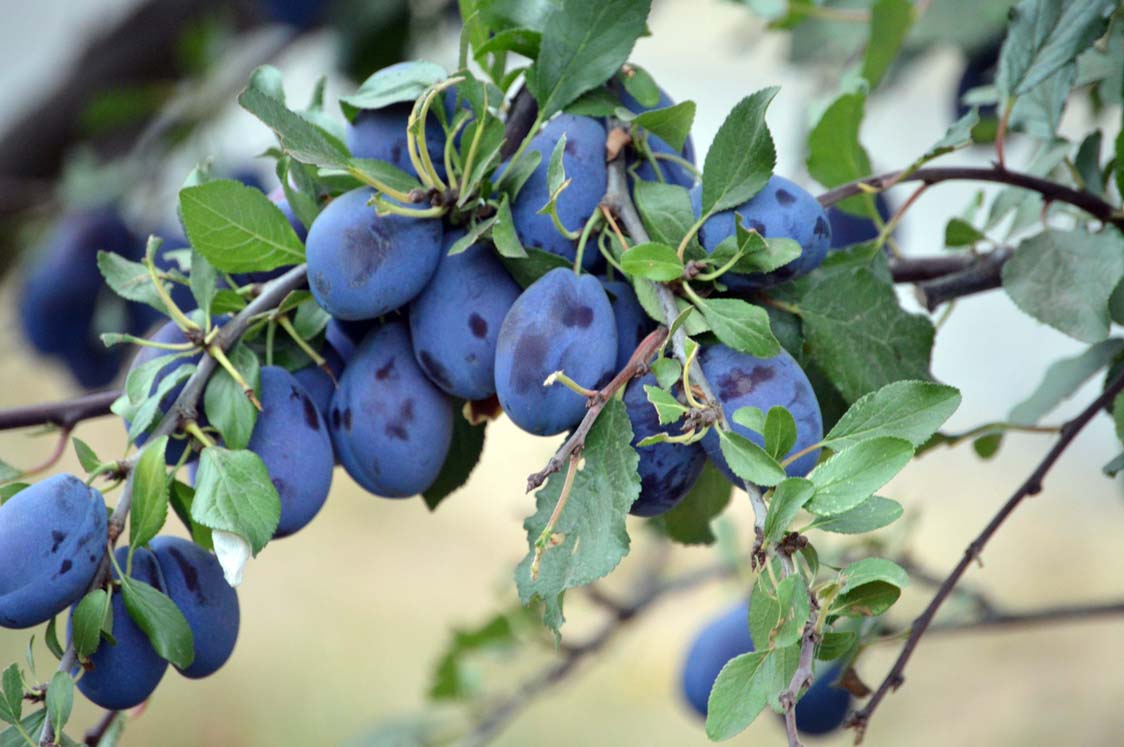
We went plum picking this week before the rains set in. An afternoon as good as it gets – with a happy three-year old bouncing around the orchard,
a happy baker filling her bags with ripe, juicy fruit,
a happy photographer relishing saturated colors, happy bees and wasps providing constant noise in the background, late summer sounds.
Some of the fruit trees not so happy, alas, the heavy load ripping branches right off the stem. What got flung into the nearby grass looked like late season Easter eggs.
Plums are one of the earliest fruit domesticated by humans, over 2000 years ago in both China and Eastern Europe. They can be dried and thus kept for lean times. Both fresh and dried plums have enormous nutritional value and are helpful for digestion. They are filled with antioxidants which helps combat inflammation in the body and also protects against cancer. They contain quercetin, a type of polyphenol that can improve heart health and brain function related to memory. They are also packed with potassium which helps bone health. A study of postmenopausal women who had prunes in their daily diet found lower rates of bone loss and improved overall bone health. Plums against osteoporosis! They do contain a lot of sugar, but apparently also a chemical that prevents sugar spikes in your blood.
And, of course, their beauty provided models for painter throughout the ages, as you can see below.
Lest you think I have changed and stick to the happy stuff – here are some thoughts that occurred to me after our outing, elicited by an article in Vox that I’ll summarize below.
The urge to eat locally produced food – and what is more local than U-pick farms? – has increased, given the many food-borne illnesses we have witnessed blossoming under the Trump Administration. There isn’t a day where there is not another food recall. Since May, the United States has seen more than 17,000 lab-confirmed cyclosporiasis cases, likely a huge undercount of what is happening in the general population. People have died from listeria infection brought on by cottage cheese, salmonella outbreaks originated in eggs and jalapeños. Frozen blueberries have been contaminated with e-coli, leading to highest warning level recall last week. Alfalfa sprout sickened people, contaminated with salmonella AND e-coli.
There are several factors contributing to these outbreaks, not just the administration’s decision to sharply curtail its ability to monitor for and respond to these outbreaks. Between the FDA and the US Department of Agriculture, which also oversees food safety, and several related agencies, more than 11,000 workers have been lost. The CDC, which helps respond to outbreaks once they start, has lost about a quarter of its workforce from January 2025 to October 2025. The federal government also shut down several national monitoring programs for foodborne illness in 2025—including for the cyclospora parasite specifically. The state and local agencies that surveil for and respond to food outbreaks have also faced staff cuts because they depend on the federal government for their funding.
The more general factors for the increase in illnesses we are seeing, are related to climate change, however, and the fact that we rely on globalized food chains. Warming temperatures across the globe increase humidity which helps both salmonella and e coli to thrive. Cyclospora has historically been found in subtropical climates, but now it grows inside the US as well. With warmer temperatures in more northern regions, it is likely to become epidemic here.
In addition, “the sometimes international trip from the farm to the store for a bagged salad kit offers multiple moments for potential contamination, including tainted irrigation water, local wildlife excrement, and poor storage practices, making it possible for dangerous pathogens to take hold before a person even buys their groceries.”
Carefully choose where you get your lettuce from, then, and buy full heads. Better still, get your vitamins with grilled vegetables, with heat putting an end to the offensive buggers. Best: live on prunes! Oh, I wish we could.
Jacob van Hulsdonk Still life with grapes, apricots and plums 17th Century
William Henry Hunt (1790 – 1864) Plums Date unknown by me
HENRY ARCHIBALD MAJOR Plums 1883
Jean-Simeon Chardin Still Life with Plums (1730)
Louise Moillon Still Life with Plums 17th Century
Unknown Early 20th century
Sasja Wagenaar Plums (2022)
Postcard from Provence
Music today is by Dvorak, celebrating natural beauty.
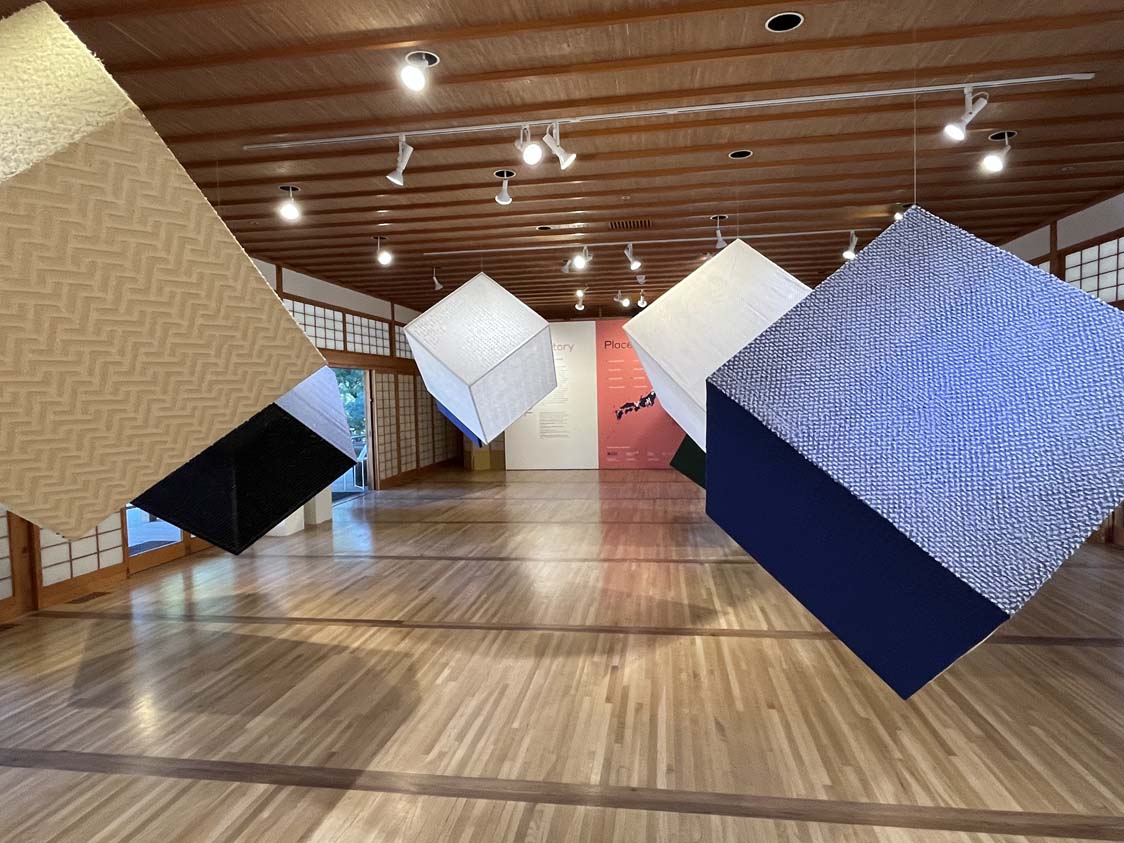
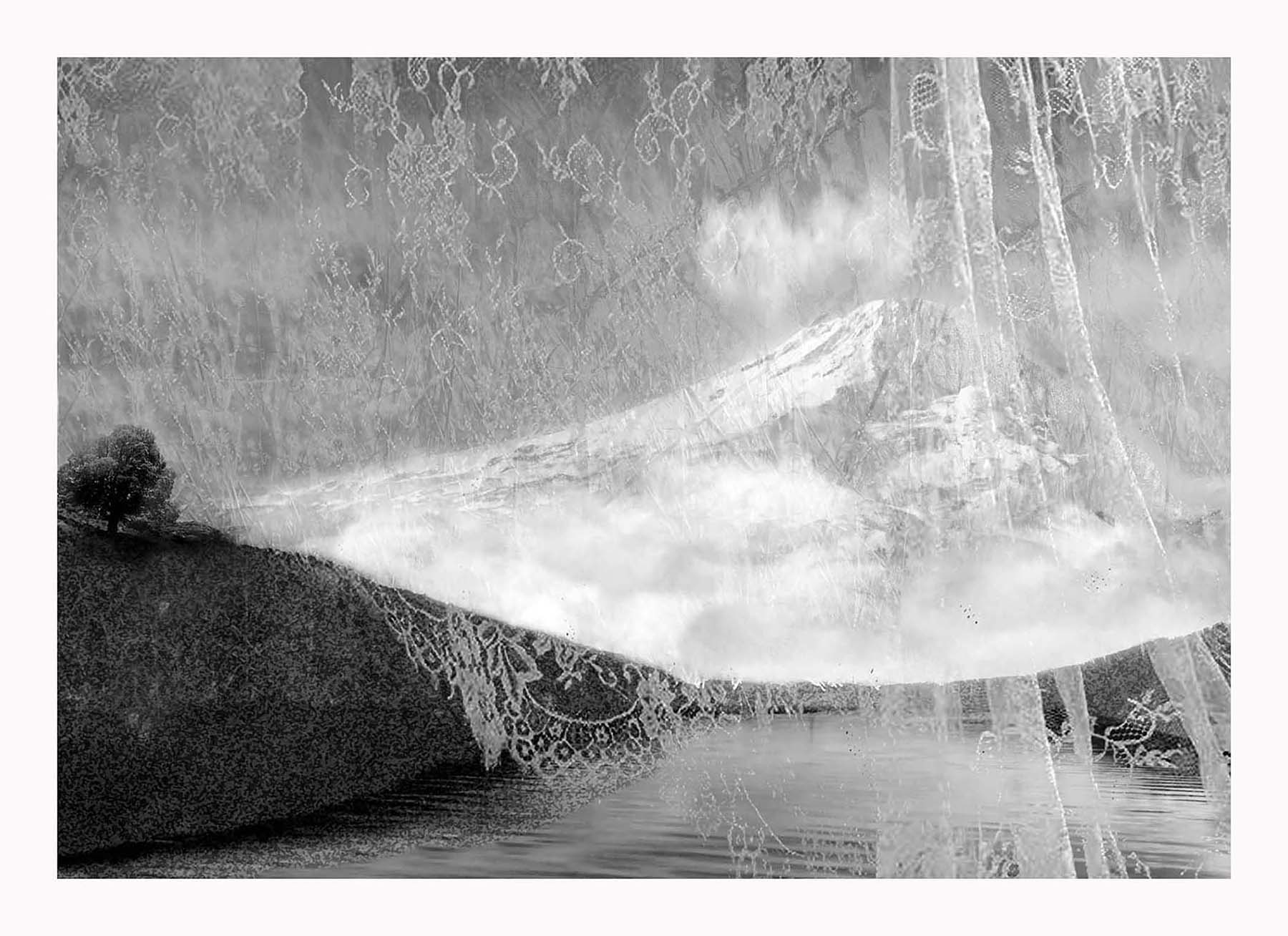
Please join me for the opening reception of Fragility, a series of photomontages in dialogue with Lacing Communities Together at the Columbia Gorge Museum.
The Lace project celebrates both, the heritage art form of lacemaking and a community of people dedicated to preserving traditional skills and/or elevating them to new forms fit for this century. Under the auspices of Australian artist Maggie Hensel-Brown, lace guilds in the PNW, and the engaged team at the Columbia Gorge Museum, a lace installation will be revealed in September.
People from all over the world have sent lace triangles to be included in a huge compilation – as of this point, there are over 380 of them to be sewn together…. Local libraries in WA have offered workshops and get-togethers, for people to learn the art form and find community with others around them. Details can be found here.
My contribution to this communal effort, other than a wonky little triangle,
was the inclusion of lace of all kinds into photographs of landscapes.
“Fragility: This 2025 series of photomontages grew out of ongoing concern about insufficient environmental protection. Fauna and flora in these landscapes – photographed predominantly in the Pacific Northwest – are endangered. Climate change and the renewed threat of industrial extraction of resources, forests and minerals alike, will do irreparable harm. I thought the ephemeral nature of clouds and the fragility of lace were fitting symbols for why we need step up in our efforts to turn things around.”
The photographic exhibition is on view now, ongoing through late fall.
The joint opening reception with the Lacing Project will be
Friday September 11, 2026 5:30 – 7:30 pm.
Columbia Gorge Museum
990 SW Rock Creek Dr, Stevenson, WA 98648 (near Skamania Lodge)
When the honey, fruit and flowery tablecloth were whisked from the table in one sweep, it flew off with a start. Entangled in the suffocating smoke of the curtains, it buzzed for a long time. At last it reached the window. It beat its weakening body repeatedly against the cold, solid air of the pane. In the last flutter of its wings drowsed the faith that the body’s unrest can awaken a wind carrying us to longed-for worlds.
You who stood under the window of your beloved, who saw your happiness in a shop window – do you know how to take away the sting of this death?
Imagine entering a small garden, overgrown paths lined with lungwort. A humongous fig tree granting shade, a few vegetable beds exploding with the smell of ripe tomatoes. Sun dappled verdant corners, whimsical ceramics catching the light here or there.
Red calla lilies shining like little lamps eager for attention, chicken contentedly clucking in a coop next to the persimmons, fruit still green.
Your eye is caught by the plum trees, laden with fruit, some ripe on the ground, the purple skin of Italian prunes encasing glimpses of gold where the fruit has split open.
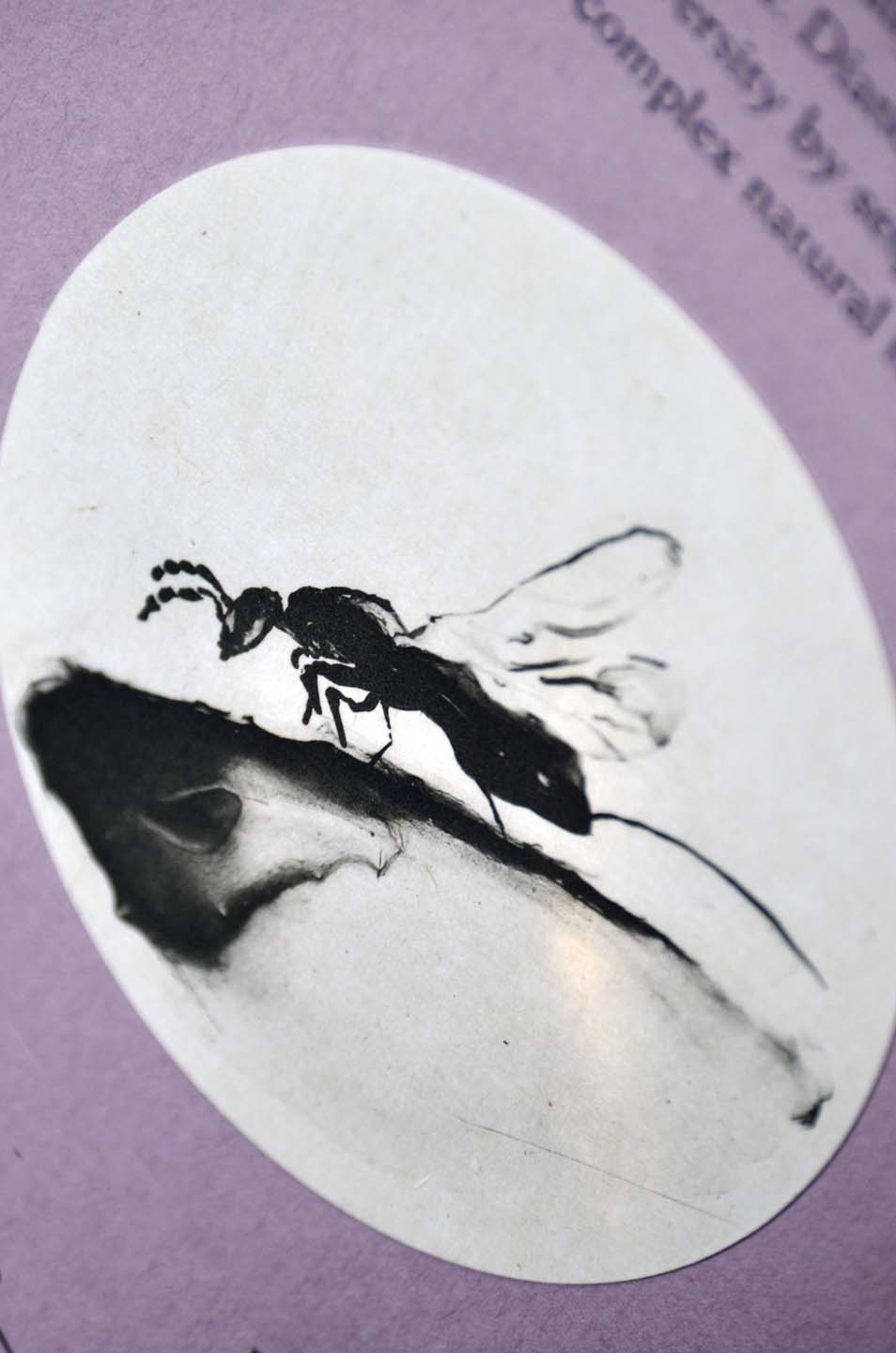
A feast for wasps, and wasps were what I came for.
An art book about wasps, to be precise.
Let me hazard a guess: your first reaction upon hearing the word “wasp” was not entirely positive. Pesky yellow jackets interfering with your labor day picnic, stings that not too infrequently hurt like hell or even lead to anaphylactic shock, visions of angrily buzzing swarms of insects building their dreaded nests too close to the eves of your house.
Wasp nest, displayed in the artist’s studio.
You would not be alone in this assessment, and surely not the first one. Already in 300 bc, Aristotle insisted ‘Hornets and wasps … are devoid of the extraordinary features which characterize bees; this we should expect, for they have nothing divine about them as the bees have.’
A recent scientific study published in the Royal Entomological Society, found that people across 46 countries really had it in for wasps. They are universally disliked much more than bees or other insects. The public associates them with negative terms like angry, painful, dangerous, scary, and those sentiments map onto relative research efforts: wasps are significantly under-studied. Across 40 plus years of thousands of papers published in entomological journals, more than 80% cover bees, and not even 20% wasps.
Paper fold drawing our attention to common reactions.
Consequently what we know is relatively little, and what little we know is not communicated sufficiently to open people’s eyes to the utility of wasps for humans as well as their general importance for ecosystems as a whole.
From the studio collections.
Just a few facts: the wasps that bug us – the yellow jackets, the hornets – represent less than 1% of the stinging wasps, the species Vespines. Wasps belong either to social or to solitary species – the latter containing many more species, in fact hundreds of thousands of them, who do not sting and live quite separate from human contact areas.
Folded paper telling a story.
Wasps have several functions. Like bees, they pollinate our crops (although to a lesser extent.) They excel, though, in helping get rid of parasites. They regulate populations of arthropod pests and vectors of disease, decompose organic matter and improve soils. Important contributors to maintaining biodiversity, then, and now severely threatened, just like bees. Agricultural practices (use of genetically modified seeds, pesticides, etc.) habitat loss due to encroaching urbanization, and climate change all contribute to endangering these guardians of our ecosystems.
Eco prints of plants frequented by wasps.
Our implicit bias against wasps can only be remedied, if we change the rhetoric of fear to a rhetoric of love. For that to happen, we need to be familiarized with what there is to love: the beauty, the amazing survival mechanisms, the intricacies of wasp life cycles, and last but not least the tremendous ecological services these insects render. Which brings me to the owner of the enchanted garden described above, artist Diane Jacobs who has just finished creating a book celebrating all things wasp, the culmination of years of study and creative exploration of the subject.
***
Jacobs received an MFA in printmaking from San Francisco State University in 1996. and was awarded multiple prizes, fellowships and residencies in the years since. Her work – prints, sculptures and folio books – can be found in museums (The Portland Art Museum, the San Francisco Museum of Modern Art, the De Young Fine Arts Museum,), and educational institutions (The New York Public Library, the Library of Congress, Savannah College of Art and Design, University of Alberta, University of Chicago Library, University of Miami, Corcoran School of the Arts & Design, Yale, and Stanford among them.)
Artist Diane Jacobs.
Her newest book intends to educate us about wasps and show the intrinsic beauty of Apocrita, those narrow waisted insects that populate pretty much our entire planet. Wasps and their environments are represented in stunning detail and through a plethora of artistic processes. The deeply serious intent to help us overcome our antipathies by getting to know the various species and their quirks, is often softened by using more whimsical means to do so.
Pop-up structures vie for attention,
Pop-ups.
paper layers inviting hands-on folding and unfolding to reveal ever more details are hidden in various pouches along the folios.
Paper folding for multi-surface info presentation.
Miniature sculptures made of natural and artificial materials expose the delicateness of wasps’ body parts, and also point to means of helping identification.
Beads and plant materials (thorns from a defunct dragon tree) sculpted into antennae.
The work evolved through Jacobs’ friendship with naturalist and photographer Kate Taormina, their shared interest and separate expertise cross-pollinating a successful collaboration. The joint project started in earnest during Jacobs’ 2024 residency at PLAYA, located in extremely remote Lake County in Oregon. The prestigious PLAYA residencies foster interaction between international artists and scientists, true to the belief of the organizers (and many of the rest of us who happen to have a foot in each of those camps!) that interdisciplinary exchange helps shape new ways of seeing the world, ultimately enhancing our approach to conservation. The concept of the book evolved over time. Now each page affords glimpses into a different universe, some pleasantly playful, others creating a sense of awe given nature’s diversity.
Whatever I learned about wasps, I learned even more about what can happen when an artist puts their mind to a singular pursuit of topic, but is open to embracing a huge number of different representational processes. Some of them surely needed to be acquired long after formal education had run its course.
Woodcuts in paper windows.
Just look a the list of processes and materials that the artist provided, all used to create the 16 hand-made copies of this book – one already snapped up by Yale University.
” Materials and printmaking techniques for this project include reduction woodcuts, wood engravings, mono print, lithography, photogravure etching, stitching, beading, hand painting, pressure printing, collage, polymer plates, book cloth, ceramic wasp, beech wood, unique eco print, and glass petri dish. Papers include Kitakata, handmade abaca, kozo, Gampi, mino washi, masa, Rives Lightweight, rayon, and Tyvek. All text on pages is handset and letterpress printed. Some booklets are letterpress printedfrom polymer plates and some are handset.”
So many artists who have had a successful 30 year career really stick to the tried and true, their developed expertise, even their general subjects. To embark on new fields of learning, as well as new processes that require tolerance of potential imperfection, takes courage. Jacobs, for example, was introduced to photogravure etching only 3 years ago, during a workshop at Mullowney Printing. Also fairly recently she learned how to do wood engraving. For Wasp Love alone the artist was going to carve 8 little wood engraving blocks. “It took me a bit to get in the groove.”
Wood engraving.
Yes, it takes courage, or at least an absence of vanity in pursuit of a greater goal. In this case helping nature to survive human indifference, or, worse, capitalism’s endless extractive exploitation, by deconstructing one stereotype after another.
Jacobs’ book Wasp Love is a marvel, not least in the way it balances education with art to be appreciated in its own right, independent of the book’s subject. Pacific NW audiences will be able to see and explore a show copy next February at The Patricia Reser Center for the Arts. It will be shown together with her wasp-related sculptural work and a series of her eco prints, as well as installations and paintings by Susan Murrell and my photomontages, in the context of Collective Effervescence. The exhibition is dedicated to our love of and fear for nature.
Pop-up folio.
***
Replacing the rhetoric of hate with the rhetoric of love – not an easy task. One of the obstacles lies in the psychological nature of hate, compared to love. For hate all you need is a simple, stereotyped target. There is “the enemy,” out to get us, in a zero-sum game of one side wins, when the other side loses. “Wasps are aggressive and hurtful.” Simplistic ideas like that are much more easily communicated and adhered to, than more complex ones.
It’s more difficult to convey the many aspects of multidimensional targets – endless species of wasps, a variety of functional advantages outweighing the occasional sting by a minority of Vespines. Complex concepts defy our desire to stereotype by means of their sheer diversity. You need to learn and integrate so many different facts. Which is made even more difficult by the reality that our old feelings were negative and now need to be recalibrated (in comparison to just sticking to your culturally transmitted biases that ruled the world across time.)
Wood engraved plates.
Art is enormously useful here. It can try and break the cycle of negative stereotyping in many different ways.
There is poetry. If we go back to the beginning of this post, you have Zbiegniew Herbert’s poem that subtly reminds us of the similarity of wasps and humans, not elevating one species over another. Rather than showering us with facts, and patronizing demands to let go of prejudice, its symbolism offers something that speaks to our emotions. Are we not all familiar with the feeling of being trapped in certain realms of our existence? Are we not all hoping against hope, to the last breath, that moving forward at all cost will bring us to a longed-for future, no matter how much we bang our heads against the wall? Because we look in the mirror, the observed death causes a premonition, a sting that cannot be resolved. Could it be that wasps are us?
Paper fold in book pocket.
Then there is literature. What comes to mind are Ursula LeGuin’s brilliant musings published some 40 years ago in The New Yorker. We are told that a woman is un-naming all members of creation, a woman who we later learn is Eve, about to leave Adam and the garden of Eden, unhappy with having been named in certain ways. The idea is that a name usually allows for categorization and/or stereotyping. Its absence will lead to equality not impeded by artificially drawn hierarchies.
“The insects parted with their names in vast clouds and swarms of ephemeral syllables buzzing and stinging and humming and flitting and crawling and tunnelling away.
…
None were left now to unname, and yet how close I felt to them when I saw one of them swim or fly or trot or crawl across my way or over my skin, or stalk me in the night, or go along beside me for a while in the day. They seemed far closer than when their names had stood between myself and them like a clear barrier: so close that my fear of them and their fear of me became one same fear. “
The merging of equals, affiliating through emotion, becoming extremely close: could it be love? As always with LeGuin, of course, there’s an undercurrent of brusqueness below the witty narration, pointing to the power naming has for those on top of social or gendered hierarchies.
Trial paper folding in the studio.
And finally, there is visual art. Jacobs’ book radiates joyfulness, in its colorfulness, playfulness with hidden and revealed shapes, its use of surprise perspectives. You cannot help but find these folios emotionally rousing, no matter how concept-driven and filled with scientific facts they are. The book might not manage to induce love, admittedly. But surely it ignites strong admiration for a life form that is so much more complex than we had known. A first step away from hate or fear.
The allegory of Fire combines objects that are related to fire. The cheek is formed by a large firestone, the neck and chin are formed by a burning candle and an oil lamp, the nose and ear are contoured by firesteels; a blond moustache is formed by a crossed bundle of wood shavings for kindling, the eye is an extinguished candle stub, the forehead area is a wound-up fuse, the hair of the head forms a crown of blazing logs. The breast is composed of fire weapons: mortar and canon barrels together with the respective gunpowder shovel and a pistol barrel. Prominently positioned in the picture is the collar of the Order of theGoldenFleece, beneath which the imperial double-eagle can be seen: a clear reference to the Habsburg House and the beneficiary of the series, Emperor Maximilian II. (Wikimedia)
***
The winds shifted, and we, the lucky ones in a city not yet burning, have been exposed to smoke coming from the fires in the region. Over 50 wildfires in Oregon alone, with fire season still lasting many more months. I pretty much stay indoors all day and night, with air purifiers running 24/7 and masks handy, when the little light starts to glow red. As of this moment our AQI is 159. Red zone, unhealthy for all, not just sensitive, groups.
Josepha Jane Battlehooke The Great Fire of London (1675)
The light is hazy orange, the sun burnt red when rising, plants and tree contours in my yard obscured by a thin layer of smoke. It brings back terrifying memories of California stays in 2020 and 2024, not to mention the familial proximity to the Eaton fire and the losses it caused last year.
Herri met de Bles – Fire of Sodom, (1545)
What are we inhaling from all this smoke?
“Wildfire smoke is a complex mixture composed of water vapor and numerous pollutants, including, gases (e.g., carbon monoxide, oxides of nitrogen [NOx]), organic compounds (e.g., polycyclic aromatic hydrocarbons [PAHs]), volatile organic compounds [VOCs]) and particulate matter (PM). Of these pollutants, PM is one of the main components found in smoke and there are decades of research documenting that exposure to PM is associated with serious health effects.” (Ref.)
And that is before even touching the issue of ozone pollution exponentially worsened by wild fires.
We are talking about exacerbation of asthma and heart failure and premature death here, potential impact on brain function, and pulmonary inflammation and transient reductions in lung function. All this long after your intermittent raw throat and burning eyes are gone.
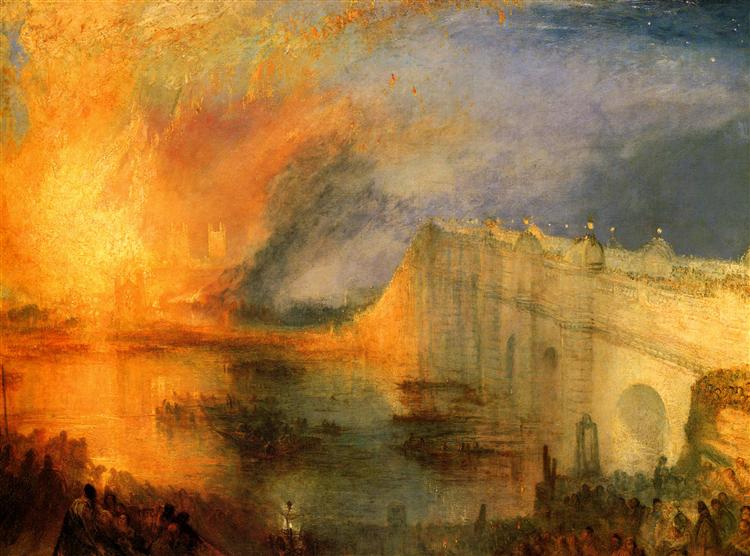
J.M.W. Turner The Burning of the Houses of Parliament, (1834)
What can we do? Leaving for healthier regions is not an option for most people, be it because of local obligations or lack of economic resources. Staying inside depends on the ability to cool off spaces without having to open windows. The EPA advice page tells people to go to the mall, the library, museums, sports arenas or senior centers. Hmmmm. Ever tried that if you are houseless, or working, or have a family with small kids?
Hubert Robert The Fire of Rome, July 18, 64 CE, (1786)
I decided to remind us that people during much of the history of the world were afflicted by fires, and somehow managed to go on. Painters clearly have been drawn to the visual drama of urban fires, and delivered eye witness accounts of sorts. Misery loves company, I guess.
William James Müller The Burning of the Mansion House, Queen Square, Bristol, 1831-32
Poets, on the other hand, are drawn to the psychological implications of traumatic, wide-ranging fires, and consequences that often remain obscured because they are too scary to think about. The poem below is timely, then, even if written 8 years ago, reminding us what it is that we are inhaling these days.
Francesco Guardi (Venice) Fire in the oil warehouses at San Marcuola (1789)
“I wrote this poem after the Camp Fire was contained in Paradise, CA, where 85 lives were lost. I live 50 miles away. A friend was running the domestic animal housing operation for the survivors at a nearby county fairground so I was in close touch with stories about the devastation. We’d been wreathed in smoke for weeks and something about her stories and the smoke caused me to think more specifically about exactly what we were breathing in. I’m a literal person. Plus the linguistic link of particulate to particular struck a chord.”
Antoine Félix Boisselier L’incendie du théâtre de l’Ambigu-Comique le 13 juillet (1827)
Why did we ever think we would be the exception to the rule? Particularly when ignoring the warning signs about climate change and building urban enclaves ever closer to nature in infinite hubris?
Those of us on the periphery of the fires should really not complain too much – my knees buckle when I think of all the evacuees and the fire fighters and personnel involved day and night in dangerous and arduous work with inevitable health consequences. So many of them prisoners who are more or less not having a choice to be exposed. My immense gratitude goes out to them, and my heart to those who are directly affected.
The Great Fire at Chicago Oct. 9th, 1871. View from the west side, Gibson & Co. (Cincinnati, Ohio), c. 1871. Source: Library of Congress, Washington DC
The weather gods were grumpy on Monday. No amount of pleading stopped the wind and pouring rain. They relented on Tuesday, a good thing, since it was the second and last day for the circus in town, slated for an outside performance. Not only that. It enabled the students of the McClaskey Culinary Institute at Clark College to shine and show off what they learned during the two-year career program in culinary management.
Alex Zavala Contreras
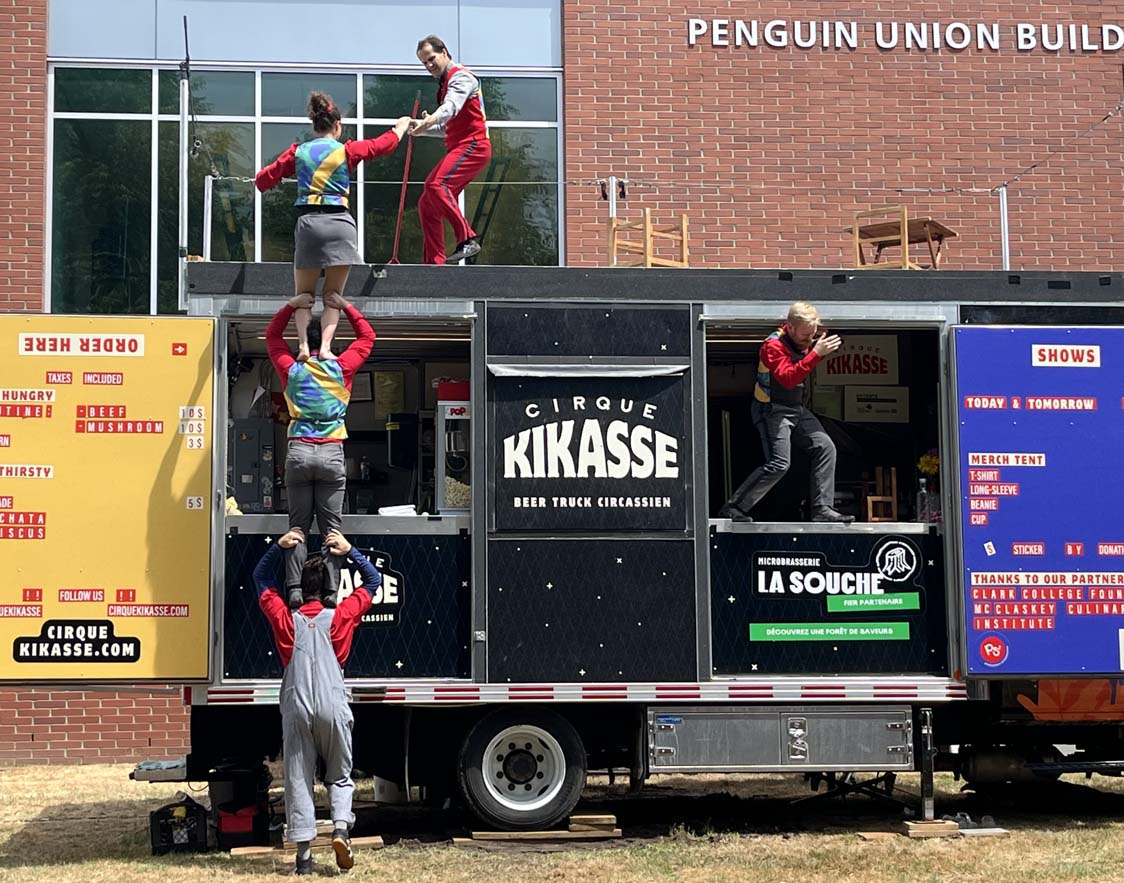
All this was made possible by an extraordinary collaboration organized and nurtured by the Clark College Foundation. Ruth Wikler, the foundation’s inaugural Director of Arts Programming, Partnerships, & Philanthropy, has extensive roots in the circus world. She invited Cirque Kikasse, based in Quebec, to bring their unusual mode of operations to the Pacific Northwest. The small band of highly talented acrobats works out of a food truck, which serves its original function before and after the show. It transforms, with the help of a few props and a trampoline, quickly and seamlessly into a stage for an energetic repertoire of juggling and acrobatics, in, under and on top of the truck.
For the first time in its history, the circus was joined by students training in the culinary arts. They developed the dishes and drinks to be served, and tended to the lines of hungry spectators, eager to grab a bite before the show. Chef Earl Frederick, the Director of the McClaskey Institute, and Service Lead Lucy Winslow were on hand to supervise and cheer on their charges.
Chef Earl Frederick
Lucy Winslow
The poutine, filled with either beef or mushrooms, was a hit, and the special drink (the usual beer for which the truck is known not served to campus students) was visually enticing – the capstone project of graduating student Alex Zavala Contreras. I should have tried it all, but had my hands full with the camera…
Alex Zavala Contreras
Students at the Clark College program have benefitted from a transformative gift by Tod and Maxine McClaskey that revamped the facilities and allows learning in state-of-the-art teaching and dining spaces, serving food to people on campus as well. The interdisciplinary encounter of these students with the arts is a next step up in reaching out to the community. By all reports, the collaboration was very much appreciated by participants from all sides.
I have always strongly believed that student participation in interdisciplinary settings opens minds and activates curiosity about the world that eventually feeds back into motivating a deeper learning of one’s own discipline. It brings people together as well, strengthening community. And in this case it made the artists quite happy, getting a break from working the bar/windows before a physically challenging performance.
***
Cirque Kikasse was founded by Hugo Ouellet-Côté and William Poliquin-Simms who have both decades of circus acrobatics and management under their belt. The idea of a self-contained truck that can travel across North America and provides entertainment and services for people’s festivities, parties, events of any kind, is both brilliant and pragmatic.
You don’t have to erect tents, schlepp endless structural parts, rent trucks etc. to be able to perform. You can feed people or ply them with special brands of beer even when the weather is so bad that you are unable to perform.
Should I get clothes matching my car?
William Poliquin-Simms
Hugo Ouellet-Côté
But the curiosity of that kind of “stage” should not draw our attention away from the actual performances. The 5 members of the crew who I was able to observe, were accomplished in their interactions. The show has assigned characters to the acrobats which require some acting, a funny story line here or there. It is choreographed to grab your attention for any one of the artists, when the others need a breather, or time to set up. There are occasions when pauses are filled with jokes, somewhat muted ones last Tuesday clearly geared to the audience – I assume some more political fireworks are in the repertoire when appropriate.
Left to Right: Hugo Ouellet-Côté, William Poliquin-Simms, Antoine Morin, Jérémie Saint-Jean, Adèle Saint-Martin. (I hope I got the names right!)
Of course the physical skills, the bravura when it comes to balancing acts 35 ft in the air on towers of rickety chairs tall, outshone whatever pleasure was derived from the contextual actions, slap-stick or the considerable showmanship during set – up of the actual acrobatics. They know what they are doing, and they are doing it very, very well.
It was not just my heart – that of a veteran circus goer – beating faster, as it turns out. The audience around me was rapt, and you could basically hear the communal intake, holding and then releasing of breaths when some particularly risky feat up in the air was safely accomplished. Some people had never seen a live circus before, as I overheard. Kids were already practicing their climbing skills, ready to join…
Antoine Morin 35 ft in the air.
There is something magical and unique about outdoors live performances (free ones at that – thank you Clark College Foundation!), when spectators are not confined into seats, able to shift vantage points, able to congregate with large groups of friends and enjoy their food.
I think I felt that doubly so given my own longing to experience live performances of any kind. Since the pandemic I have not been able to visit concerts, theater, or any other event with a large public inside, and have missed it deeply. It is simply different to see something in the moment and feel the connection to the emotions or reactions around you, than to watch even the best footage alone on a screen.
Jérémie Saint-Jean
Adèle Saint-Martin
I have written about circus before – its function, its promise, its idiosyncratic role as an art form. This week a different thought was prominent when I saw these artists push their physicality to extreme borders. Perhaps it was triggered by the ongoing discourse about physical power and masculinity in this country. Or by the fact that it is explicitly linked to military prowess by those in the administration concerned with and enthused by war. (Which is absurd, isn’t it, when war fare no longer depends on personal combat, but the ability to steer a drone or maneuver a jet…)
Physical strength and agility in the context of (imagined) masculinity is often associated with power – with dominance, prerogative, supremacy. The physical power that I observed in Tuesday’s circus performance – by both men and woman, no less – had none of those characteristics. It was tied to joy, the sheer joy of pushing boundaries, pulling some impressive tricks out of the hat comprised of all of those muscles, sinews, bones and brains tuned into precise and timed movements.
Flexibility ruled, not rigidity.
Coöperation made the feats possible, lightyears away from competition, so often found in the (sports) arena where we usually get to watch physical prowess.
What a difference. What a relief. What a treat!
Let’s hope they return soon, to better weather for the entirety of their stay.
“Marco Polo describes a bridge, stone by stone. ‘But which is the stone that supports the bridge?’ Kublai Khan asks. ‘The bridge is not supported by one stone or another,’ Marco answers, ‘but by the line of the arch that they form.’ Kublai Khan remains silent, reflecting. Then he adds: ‘Why do you speak to me of the stones? It is only the arch that matters to me.’ Polo answers: ‘Without stones there is no arch.” ― Italo Calvino, Invisible Cities
***
I should have known better and visited The Unknown City group exhibition at PLACE earlier. Now there are only a few days left for you local readers to decide if you agree or disagree with my assessment that the show is well worth exploring. Three days, to be precise, it closes this Friday afternoon, June 12th, with a reception. A quick shout-out then (not a formal review), to lure you into action!
The concept, developed by organizer and curator Horatio Law, is an interesting one. Take some 40 or so local photographers (split into two randomly assigned groups), all over 60 years of age, allot them a 3-6 ft wall space and ask them to display work that relates to the theme of subjective visions of Portland, OR. I had seen the work of the first group, some 4 weeks ago, on line. Decided I could not write about it since I am friends with several of the participants, friendly with others, not entirely objective. Looks like nobody else did either, maybe we are all too chicken to step on toes in a closely knit community?
On this rainy Monday, however, a dear friend, who had recently returned to Portland after a 7 year absence, and I decided it would be fun to look at captures of her former home turf. For this second group as well, I knew about 50% of the contributors, some closely. Others were completely new to me, despite the small local community. I threw caution into the wind because this show really deserves some attention.
The rules were simple: fit into the given space and pin prints to the wall. Artist decides how many, in what format or size, colored or black&white, carefully printed, or close to photocopies or postcards. The enormous variability along many dimensions can either be fun, or distracting. As it turns out, the curation worked well visually, without becoming too busy.
As is always true in group shows, some work draws your attention, some leaves you cold, some is a real discovery, some entices (or bores) with familiarity. My reactions to the displays were mainly driven by two perspectives: did I like the photographs in and of themselves (yes, in many, many instances.) Did I think they sufficiently connected to the claimed inspiration for this exhibition, Italo Calvino’s book Invisible Cities? Here the pool got much smaller. From the introduction of the exhibition:
Calvino’s novel puts the explorer Marco Polo and the isolated Kublai Khan into a room, with the former telling stories to the latter, who is starved to learn about the world. Many cities are evoked, Anastasia, Despina, Diomera, Dorothea, Fedora, Isidora, and Zora – all in reality describing Polo’s beloved hometown Venice. The conversations are structured in a complicated interactive pattern related to memory and desire, allowing the author to delve into the psychology of how these two functions shape each other and are intertwined in our understanding and depiction of the world.
The chapters contain overall place and object – specific descriptions for each of these imaginary cities. The person(s) involved were predominantly the traveler, the observer, in his particular relation to what he saw.
Ken Hochfeld with a caption for his Leaning series: “At sunrise everything is luminous but not clear.” -Norman Maclean
I had expected to see place-specific photographs, then, something that was identifiably related to Portland, or could have been, although not necessarily prototypical landmarks. How did objects or, more predominantly, portraits of persons that could have come from anywhere, unless identifiable local favorites, fit the bill? Some of those were among the strongest photographic work, as it turns out, and so unsurprisingly offered for display. But the link was missing for me.
Then again, I could go back and be reminded of Marco Polo’s admonishment contained in the Calvino quote at the beginning of this column:
“The bridge is not supported by one stone or another,’ Marco answers, ‘but by the line of the arch that they form.’ Kublai Khan remains silent, reflecting. Then he adds: ‘Why do you speak to me of the stones? It is only the arch that matters to me.’ Polo answers: ‘Without stones there is no arch.”
Brian Foulkes – one of the longtime chroniclers of the city, whose work I’ve known for over 30 years and admire for its hints of melancholy and humor, often within the same piece.
The work on the walls at PLACE does form an arch, an accumulation of many stones projecting diversity of both, the city itself and the perspectives taken by these many astute and sensitive observers. And they certainly depict change and growth, in this regard echoing something Calvino or his mouthpiece Polo strongly value. In another chapter (4) on cities and memory, the town Zora is introduced, a town that cannot be forgotten because it stays static for memorization. Polo concludes:
“But in vain I set out to visit the city: forced to remain motionless and always the same, in order to be more easily remembered, Zora has languished, disintegrated, disappeared. The earth has forgotten her.“
No such fate in store for our Portland, and no mandate for memorization either, given that we can rely on so many photographers preserving the reality, quirks and evolution of the city.
Obviously I am just showing a few samples – looking at the whole bodies of work (and in full sizes) is much more revelatory. Recommended! You have until Friday…
The weather has made it possible, nay, required, to be out and about lot. Last week I went on several walks, one of which was meant to visit the birds but I encountered an explosion of wildflowers instead.
Nothing particularly special – everything particularly beautiful in its unassuming presence.
Which had me thinking again about how artists portray flowers, from the early botanical sketches that served as tools for learning about the plants of the world and their function,
to the symbolism contained in medieval paintings or Victorian floriography, speculations about the secret meaning of flowers.
You can see it in the pre-raphaelites painters: Lawrence Alma-Tadema, for example, rendered the tragic tale of Emperor Heliogabalus watching his guests suffocate under a shower of rose petals (in the old story they happened to be violets – death by flower, who knew….). The artist chose the species specifically for its association with corruption and death, but the subject, I wager, for the ability to paint something big….
Lawrence Alma-Tadema The Roses of Heliogabalus (1888)
It seems to be never enough to just depict a simple flower as is, in an attempt to convey the sense of joy it inspires, hanging out in the meadows, at the forest borders, in modern times as well.
Photographers choose particular flowers that lend themselves to an emphasis of form, stark contrast, like Imogen Cunningham’s calla lilies or magnolia blossoms, abstracting an essence. If they do photograph less defined flora, they often apply post processing filters to give the image a mysterious hue.
Imogen Cunningham Two calla lilies (1920)
Edward Weston Purple leaved flower
20th/21st century painters go big – man, everyone always goes big these days, abstracting the plants or unifying them to the point of un-recognizability.
Real daisy meadow…
Takashi Murakami Field of Smiling Flowers, 2010
And then there are the installations using actual floral parts, either collected over time, or grown into absurd topiaries…. again, nothing won’t do unless humongous. (I was introduced to this work by an article asking: why did Jeff Koons make a giant puppy? I, too, wonder about that…)
Jeff Koons Giant Puppy (1992 to present )
Even one of my favorite contemporary artists focussed on nature joins the trend (I will write about him and his work one of these days in full).
herman de vries 108 pound rosa damascena at the 2015 Biennale Dutch Pavilion
Don’t get me wrong – there is a meaningful place for large works, no doubt. An important place. But the tendency to use subjects that are small and make them big in either size or accumulation seems to imply that that is the locus of awe – when really it should be felt when you encounter the miniature version indefatigably sprucing up the landscape under natural, often adverse conditions.
I fear that the preoccupation with spectacle really leads to a withering of our ability to detect, appreciate and protect what is small. Just like wildflowers being classified as “weeds” had to make room for more showy varieties, or blossoming meadows were replaced by spectacular lawns, truthful depictions of something unassuming gains no attention when placed next to artificial elevation of a subject.
Give me a tiny aster anytime…. and give me depictions in a format that I can take home, hang on the wall, enjoy every day as a reminder of the reality of beauty in the world, and my role as its steward.
“Education is not the filling of a pail, but the lighting of a fire. For the mind does not require filling like a bottle, but rather, like wood, it only requires kindling to create in it an impulse to think independently and an ardent desire for the truth.— Plutarch (often misquoted as William Butler Yeats.)
***
Finally, finally I made it to the Portland Art Museum, recently reopened after extensive architectural additions. I had heard nothing but positive reports about the ways two existing buildings are now connected by a glass pavilion. Can confirm that the design and execution, carried by a millions-of-dollars fund raising campaign, really work. Nothing glossy or ostentatious about them, overall functional and, from some perspectives, beautiful. A detailed account of the project can be found in my Oregon ArtsWatch colleague Brian Libby’s interview of the architects here.
My visit led me to the basement, or what is officially called the lower level of the North Wing. I wanted to explore the HeART of Portland Visual Art Exhibition, featuring over 100 works of students in our public schools, from Kindergarten to 12th grade, and a collaborative art project, Windows of Our Future, inspired by the Museum’s new Rothko Pavilion and the Hockney exhibition. I had read about the Museum’s vision to strengthen its youth and community outreach, investing in more education, and making space for programs in the revamped buildings. What a terrific development, particularly in economically distressed times where art education is one of the first things to be on the chopping block.
For the 2026 youth exhibition, every visual arts teacher in town was invited to pick one student’s work from their respective classes. In addition, some 2500 kids worked on the Windows of Our Future project, covering a glass wall of the remodeled Lana and Chris Finley Learning Studio.
Art ranged from works on paper – drawings, painting, prints, photography – to fabric art, collages, mobiles and sculptural exploration.
Must have been a bear to hang – and was beautifully done so! Hats off to whoever had to tackle works by an age range of 5 to 16 or so years, differing degrees of talent, – some impressive, others compensated by remarkable enthusiasm, and subject matters ranging all over the map.
Each piece was offered with information, provided either by the teacher or the student themselves. Very helpful for those of us no longer adjacent to art education, with kids long gone. I found the thought processes of the students almost as fascinating as the levels of sophistication exhibited in some of the works themselves.
One can debate whether this is a representative sample – after all the professional art teachers selected likely the best of the year’s output – but does that really matter? What convinced here was the freshness, the passion that kids put into their work, the insights into curricula that introduce many different forms of art and artists as a starting point for the students to find their own voice.
What impressed were multiple references, by teachers and students alike, to the importance of process, of exploration rather than insistence on perfect outcomes. Some of the works carried a sense of wonder, sometimes about the world, sometimes about the artist’s own capacity to pull something off to their liking.
I felt wonder, that’s for sure, being in the presence of so much imagination, creativity and conceptual ideas. In short: in the presence of art, embraced by a generation of young people ready to launch their talents into the world.
***
I had some time left and skimmed through the current photography exhibition, Together, a theme focussed on communal actions and relations. As per usual, the selections from the archives, including recent acquisitions, were soundly and predictably curated. Once, just once, I would like to be surprised, though, by what is included, or who is left out up there. (Speaking of surprise (and I digress): the 2026 Artists’ Biennial: The Price of the Ticket at Oregon Contemporary holds some serious eye openers. Ox is only open on the weekends, but I highly recommend planning a visit.)
Simone Leigh Sentinel IV (Gold) (2021)
Walking back to the entry level, I passed through Here we Are, smartly chosen works of contemporary art from the museum’s collection. It was poignant to read curator Sara Krajewski’s helpful outlines of thematic subjects of these accomplished adult artists, some of them quite famous. Many themes completely echoed what I had seen an hour earlier in the students’ works: “sense of self and identity“, “relationships to place,” “the human connection and the creative process.” Confirmation that some foundational and universal issues forever work their way into art, regardless the age (or stage) of the artist.
Carrie Mae Weems Painting the Town #1 (2021)
William Kentridge Dancing Couple (2003)
Then again, everything here was quite big in contrast to the students’ ability to pull some punches with small-sized formats.
Elias Sime Tightrope: Eyes and Ears of the Bat (1) (2020) Reclaimed electrical wires on wood.
And not a full critter in sight (unless I missed it) – in contrast to the fascination expressed in the younger students’ offerings. So many animals, so many versions. I wonder if something gets lost on the way by growing up, and a preoccupation with fauna labels you in some ways. Come to think of it, equine depictions wended their way through art history, from the paintings of aristocrats’ steeds to the horses of August Macke. Not all had to be “Monarch of the Glen”-type roaring stags, or the sweet avians of the Dutch Golden Age. Rousseau’s jungle creatures, or Picasso’s bulls anchor us in the recent past. So maybe I am just picking up a coincidental lack of representations, in no way typical for adult artists?
Paul Klee, move over…..
***
A photograph by Wolfgang Tillmans dominated a wall. His abstract work is done without a camera – he uses chemical solutions on different papers and exposes them to light waves, sometimes manipulating the canvas in the process. During a retrospective of his work at MoMa 4 years ago, he was compared to a genius by Peter Schjeldahl in the New Yorker, and every other critic, trying to find superlatives from brilliant to extraordinarily gifted, joined the chorus. I happen to agree, the man is a phenomenon with the camera. In fact, a postcard of one of his photographs has been hanging forever on that sacred space reserved for portraits of grandchildren, a.k.a. our fridge. A constant reminder of what to aspire to, in front of my eyes on a daily basis.
Wolfgang Tillmans Greifbar 50 (2017)
Yet I also concur with critics’ cautiously uttered sentiments, that his abstract work is less impressive than his representative photographs, although I would not go as far as to say they belong into the lobby of boutique hotels, as more belligerent voices suggested.
I think one of the problems about the abstract works is the fact that important pointers contained in the titles get lost in translation. Look, for example, at the signage for the PAM acquisition of Greifbar 50 (2017).
It talks about free style swimming, and a gay bar in Berlin by the name of Greifbar, a pun on fondling opportunities at a bar. (The bar at Prenzlauer Berg happens to have closed its doors permanently after the Covid pandemic, one of the last joints that offered pornographic films in the front room and a dark room in the back notorious for wild nights, open sex and a leather scene.)
Greifbar, however, also means “within reach,” a desired goal or object about to be on hand.
The term ultimately only makes sense in the context of the name of the series of abstracts Tillmans has been exploring. The series is called FREISCHWIMMER, which has nothing to do with free style swimming. Instead, it refers to one of the most coveted items of a German childhood, a badge received after passing a municipal swim test. Success required 15 minutes in the water with breast stroke and back stroke, diving for an object at 2 meter depth, jumping into the water from a certain height and answering some water safety questions. Once you had that piece of fabric in your hand (often in the form of a little seahorse to be sewn onto your bathing suit,) you were allowed to enter public pools on your own and swim there without adult supervision. Freedom beckoned!
We would spend endless summer days with friends at the pool, prepubescent or just entering puberty. During the 60s and 70s, long before the internet and TV offered plenty of nudity, it was a place to see people in various stages of undress, to touch each other surreptitiously in the crowded water. We would lie on closely spaced towels in the meadows around the pool, apply coconut oil to each other’s skins, and watch people disappearing behind the public rest- or changing rooms, for what we could only wildly guess at at the time, where “kissing” was the height of illicit behavior (I earned my Freischwimmer badge at the age of 10.) We would feel our bodies cooled by the wind when biking back home late afternoons all those years, damp swimsuit under cotton dresses. It was utterly physical, it was fluid in terms of developing an understanding of our own sexuality, straight or gay, it was a taste of independence, a new stage of life, freer, more agentic, adulthood with its assumed perks seemingly within reach.
I can see how Tillmans, a master of representative depiction, yearns to find new independence in an abstract medium. I can see the seduction of exploring new ways of expression that might potentially recreate the sense of discovery of who we are and what we can pull off, reliving younger ages when the world was still seemingly open. I can also speculate about the acknowledgement provided by hindsight, that much of what developed in us was caused by elements of chance, now reproduced with the processes he uses to generate these enormous abstracts. So many possible interpretations, but free style swimming not among them.
***
Serendipity ruled when I left the museum, ready for one last shot capturing Ugo Rondinone’s sculpture at the 10th Ave exit. The Sun encircled a school bus, a golden halo surrounding a stand-in for education. More power to PAM, fostering new generations, instructing them in the making or experiencing of art, kindling independent thinking and creativity. I very much hope that stamina and/or funds are sufficient to succeed with their goals. It would be to the benefit of all of us.
Yesterday I spent a lot of hours in a meeting at the Patricia Reser Center for the Arts. In between conversations and checking out the lay-out of the building for a planned exhibition, I caught some glimpses of the art currently on display.
I said glimpses and I mean glimpses. This is not a review, just what my camera was drawn to for quick snaps when walking the halls. Or my iPhone, as the case may be.
Upstair is devoted to The Nest Project, work by Debbie Baxter, in the context of the current show at the Reser: Hope is beyond Words. The multi-partner art exhibition focuses on survivors of domestic and sexual violence in Oregon. It was created in collaboration with the City of Beaverton Police Department and City of Beaverton, Family Peace Center of Washington County, and Patricia Reser Center for the Arts. (Run time April 3 – May 17, 2026)
A huge actual nest filled with down is an attention magnet, and photographs line the walls depicting various instantiations of Baxter’s idea of having people strip to their newborn status and find shelter in often fetal positions in the handmade nests created on each occasion. (David Slader at ArtsWatch described the project at length last year.)
Image by Debbie Baxter from her website.
The main gallery downstairs featuresa collection of works by people who experienced abuse. Here is the gallery blurb:
Uplifting voices and holding a safe space for self-expression, Hope is Beyond Words showcases creative works drawn from survivors’ experiences. Serving as a catalyst to prompt conversations about collective responsibility and eliminating violence in our communities, individuals come together to help other survivors realize they are not alone that behind the faceless statistics, trauma affects real people in our lives. Demonstrating the human spirit through visual art and written word, individuals from Beaverton and Washington County share insights into the complexities, struggles, realities, and resilience of experiencing trauma, recognizing that everyone deserves to be physically and emotionally safe in our community.
The cocoon can be entered. Fashioned by multiple artists, from what looked like paper machee and coffee grinds.
Two things stood out for me – the variety of ways to express loss and resilience, and the range of ability to elicit curiosity as well as empathy. As I said, this was not an occasion for me to linger with the work, or take it all in. But I WAS taken in by something that could have easily been trite, and has become such a fashionable mechanism to elicit viewer interaction: the opportunity to write down a few words related to the focus of the exhibition, in this case survivors.
Seeing them strung up on the walls, the words spoke to me, and actually gave me a lift. Some earnest about self acceptance, some brutally honest, some just witty. All meant to boost without sneering, and that, truly, hit the spot.
The strangest juxtaposition to a short (6 minute) clip I had watched that very morning, sent by a friend. “The Employment” is clever, handpainted animated work from 2008, by Santiago “Bou” Grasso an Argentinian artist, describing the alienation in a capitalist world, where people are treated as and become objects. Not so at the Reser: people communicating with people, creating bonds through shared experiences or just empathy, and giving comfort. And advice: If life gives you lemons, become a used-car salesman…
“I see my buildings as pieces of cities, and in my designs, I try to make them into responsible and contributing citizens.” – César Pelli, Argentine-American architect (1926–2019).
About a century ago, a young man with a vision started buying parcels of land on Portland’s East side. His plan for a large commercial hub away from downtown was realized some 40 years later, when he had become a loaded southern Californian oil company executive with the means to hire the best architects of the day. Ralph B. Lloyd (1875–1953) did not live to see the opening of the mall that bears his name, in August 1960. By that time it was touted the largest mall in the U.S., designed by John Graham Jr, architect of Seattle’s famed Space Needle, as one of the first in a string of commercial centers his firm became known for.
Lloyd Center, with its open air plan, anchor stores and various attractions, including a famous ice rink, soon became a landmark of the city. Lloyd and his architects understood the lure of free and ample parking. Enough spots for 800 cars materialized. So did the customers. In the 1990s the mall was enclosed and provided with a food court. Even though that separated the complex from the previously open connection to the neighborhood, it remained more than just a place to shop. The entire complex served as a “contributing citizen” reminiscent of Pelli’s formulation. Walking groups of all ages used the space in rainy season. People found shelter from summer heat in the air-conditioned passages. Kids experienced their first taste of freedom when dropped off at the movies or the game rooms. Students hung out, and the ice rink provided endless opportunities to marvel or just people watch. Importantly, it was a community space that reflected economic and racial diversity, so sorely missed by many of us in other parts of the city.
Between the advent of E-commerce, the Covid epidemic, and changes in the overall economy, things went into a downward spiral eventually. Anchor stores left, gang-related crime and the number of houseless congregating around the neighborhood rose, and we are now at a point where the mall will be closed for good by the beginning of August.
The current owners of the center, Urban Renaissance Group and KKR Real Estate Finance Trust Inc., plan to demolish all of it and divide the 29.3 acres into 14 parcels to be sold for mixed-use redevelopment. ZGF architects offered an urban renewal proposal, and a Master plan was approved by city’s Design Commission on March 5th, 2026. Strong opposition by neighborhood groups, including the Save Lloyd Ice Coalition, and the Save Lloyd Campaign in partnership with the Northeast Coalition of Neighborhoods, ignored by the Design Commission, have now led to appeals of this decision. The City Council is scheduled to hear arguments against efforts to replace the mall on Wednesday, June 24 at 9:45 a.m., deciding on approval, modification, or opposition to the proposal entirely.
***
Impending loss of the familiar spurs melancholy for some, curiosity for others. The increasingly abandoned Lloyd Center drew photographer and public art and installation artist Horatio Hung-Yan Law for repeat visits. They turned into a months-long project of poignant documentation of a communal space under the threat of an uncertain fate. The photographic voyage is currently on exhibit at PLACE in NW Portland. Run, don’t walk, to catch this show before it closes on May 1,2026.
Tomes have been written about the lure of ruins and abandoned or decaying industrial and commercial space for photographers. Lucky for us, Law does not yield to the temptation to accentuate morbid aspects of decline. Instead, he provides a portrait of a place that still occasionally vibrates, still has moments of beauty, still conveys a sense of the original optimism of builders trying to integrate structural elegance and airiness into dens of commerce. Add to that choice of positive depiction a clever way to display his photographic harvest: the images on the wall are sequenced in various fashions that echo the feelings of walking through a Mall. There is no unifying style, color and black&white happily co-reside, sizes are all over the map, prints refuse to be rigidly aligned. Some walls are dedicated to architectural themes, others hint at subjective moments that roused emotions in the photographer. Busy views are counterbalanced by quiet glimpses. Law’s capture of the space mirrors both aspects that were emphasized by the original designs (as well as the plans for redevelopment), namely activation AND lingering.
The artist is surely familiar to ArtsWatch readers for his Urban Studies series, portraits of Portland’s neighborhoods taken with his iPhone on daily walks. These images are picked up by chance and a discerning eye, linked only by the fact that they were spotted during ambulation. Almost always interesting takes by our flaneur-in-residence. I had also reported on his curatorial prowess with works by contemporary Asian-American artists at the Portland China Town Museum, where he served as Artist Residency Director. (He will soon again curate a community assemblage, Portland as seen by photographers over age 65. The line-up of 40 participants is a veritable who’s who of the photographic community’s éminences grises, in this case more referring to hair color than actual hidden powers, I presume. Running for 6 weeks again at PLACE which generously donates its space, it promises to be a gang buster event starting at the beginning of May.)
This was the first time I saw an entire body of work exhibited by the artist, again with terrific moxie to break the rules. Simply pinned to walls, repeat motifs with slight, but important modulations. If he can continue to stay safely away from the cliff edge of vaulting into technicolor overdrive, the work could be meaningfully gathered into a book that many of us, I believe, would cherish as a memento of times coming to a close.
***
“At the heart of capitalism is creative destruction.” – Harvard economist Joseph Schumpeter.
You’ve probably walked by this sculpture near Lloyd Center a hundred times. Larry Kirkland’s 1991 stack of money on an ionic column in a fountain is titled Capitalism. If you ever read the inscriptions on some 25 of those coins, you likely agree that their outstanding feature is a competition for triteness. Samples:”Business without profit, is not business anymore than a pickle is a candy.” “Never invest in anything that eats or needs repairing.””That money talks, I’ll not deny, I heard it once. It said: “Goodbye”. I rest my case.
An alternative would have been to include some of Schumpeter’s wisdoms, his theory of creative destruction. It describes the process where new innovations replace outdated systems. Whatever you think about capitalism, insights on business cycles, entrepreneurship, and capitalist development need to be considered for modern economics. Or city planning, for that matter, if you want keep your foot in the world as is, rather than what we wished it to be.
I understand the nostalgia, the love for places that served a meaningful role in the community. I also believe we must look forwards, with the contemporary needs for affordable housing and more green spaces overwhelming. Infill of central spaces, linked to public transportation, is paramount in my opinion, IF we can guarantee that the needs of the populace are filled, and not neglected at its expense. Building housing and parks on former parking lots and store fronts sounds like the right move to me. The question is, of course, if the manifold promises and allusions to neighborhood improvement found in the development plan (downloadable here) approved by the Design Committee, are nothing but.
Are there fixed requirements of x units of this or that? Did I miss them, perusing the documents in front of City Council? Are there development laws I am not familiar with? In the plan outlines on policy for Housing Diversity (Policy 2.LD-4), at least, we read: “Encourage development of new housing, especially in Central Lloyd and on the Irvington and Sullivan’s Gulch edges to foster a sense of community and support efficient provision of residential amenities and services.” (My bolding.) A discussion of required features of any redevelopment of Lloyd Center should be paramount during the appeal process in front of Portland City Council.
Then again, we are not facing the erection of a data processing center, or a warehouse to be used as concentration camp on these 29 acres. I guess there’s always something that could be worse.
Or something to be grateful for: in this case that we have Horatio Law’s splendid documentation of a Portland landmark that can serve as a memento to mid-century architectural citizenship.