Browsing Category

Art

Intermission

Don’t you believe everything you read….nothing is closed, things are just going to switch to travel mode. I will be reporting from the road, intermittently first, then hopefully on a more regular schedule again.

***

In the meantime you have several cultural riches to choose from in March:

Do NOT miss the special showing of our newest documentary at Cinema 21:

  • WHEN: March 12, 2023 at 3-5 p.m. Informational tables start at 2:30 p.m., film starts at 3 p.m.
  • WHERE: Cinema 21, 616 NW 21st Ave, Portland, OR 97209
  • TICKETS: Tickets can be purchased in advance or at the door (https://www.cinema21.com/movie/atomic-bamboozle)

I had written about the project and shown part of my set photography here along the Hanford site at the Columbia River earlier. Below is the official description from the film makers:

ATOMIC BAMBOOZLE is a feature-length documentary which exposes the claims of the nuclear energy industry to be a cure for the climate crisis.

This film grew out of the NECESSITY project @necessitythemovie as tribal communities raised concerns over false solutions to the climate crisis being presented in the form of small-modular reactors and a renaissance of nuclear power. Members of the core NECESSITY team found a need to share the story of nuclear resistance in the Northwest and chronicle the development of advertising aimed at convincing the public to trust nuclear power.

We are pleased to bring this story to the big screen with the premiere of ATOMIC BAMBOOZLE at @cinema21_portland. Join us for the premiere which will include a screening of a short film by Vanessa Renwicke, as well as a panel discussion to follow.

These are the slated speakers:

  • Jan Haaken, director, professor emeritus of psychology at Portland State University, a clinical psychologist, and documentary filmmaker
  • Lauren Goldberg, executive director for Columbia Riverkeeper with over a decade of experience advocating for Hanford Nuclear Site cleanup 
  • Lloyd Marbet, executive director Oregon Conservancy Foundation and longtime anti-nuclear activist
  • Cathy Sampson-Kruse, associate producer, enrolled member of the Waluulapum Tribe of the Confederated Tribes of the Umatilla Indian Reservation, retired social worker, and a champion in protecting clean water from fossil fuels and nuclear waste 
  • Greg Kafoury, attorney in private practice with Kafoury & McDoougal Attorneys, served as Co-Director of Don’t Waste Oregon
  • Moderated by Dr. Patricia Kullberg, former medical director of Multnomah County Health Department and member of Oregon Physicians for Social Responsibility

Again, tickets can be reserved here, proceeds will be shared with the Columbia Riverkeepers.

***

Also in March you can visit Bonnie Meltzer’s newest show tied to water and land, providing a retrospective of 15 years of work.

And if you happen to live in the NorthEast: God made my Face: A Collective Portrait of James Baldwin would be my first choice of all there is to explore:

https://www.amherst.edu/museums/mead/exhibitions/2023/god-made-my-face-a-collective-portrait-of-james-baldwin.

“This group exhibition is a special iteration of God Made My Face, originally organized by Hilton Als for David Zwirner Gallery in 2019. It presents works from iconic artists such as Richard Avedon, Marlene Dumas, and Kara Walker alongside archival materials in order to explore the life, work, and legacy of James Baldwin (1924–1987). Baldwin’s ways of seeing and being evolved through his relationships and exposure to the work of visual artists, during an era when the harsh realities of racial oppression were confronted with aesthetics emphasizing self-love, pride, and validation. God Made My Face explores Baldwin through his words, relationships, and the works of other artists produced during his own lifetime and today.  

Unbeknownst to many, Baldwin served as professor and Distinguished Fellow at the Institute for Advanced Study in the Humanities at UMass Amherst from 1983-86, finding a home within the W.E.B. Du Bois Department of Afro-American Studies and teaching students from across the Five Colleges. This period of Baldwin’s life highlights how far his reach extended beyond the cultural capitals of Paris and New York, where he resided for much of his life, as a writer. Baldwin’s engagements as an educator convey his legacy as a mentor to generations of intellectual and creative communities.”

In the meantime, I’ll be sending dispatches from the road, and eventually L.A. if all goes according to plan. Stay tuned!

Music appropriately Mahler’s songs of a wayfarer (one of my favorite song cycles of all time.)

Learning (from) History.

Ferocious, complicated, brave women. 

Also: resilience, clarity, decisive action.

⅔ into Black History month I figured it’s time to contemplate cultural offerings that embody what’s encapsulated by the terms above. Coincidentally, my friend Catón Lyle posted photographs I had taken of him and his students 8 years ago this week on Facebook, images of people I deeply care about and worked with, now likely strong and resilient young adults either in Highschool or off to college. Institutions where Black history is no longer guaranteed to be taught across the country.

Catón Lyes, drummer extraordinaire

Let’s look at possibilities to learn about Black History outside of the educational settings, then. When it comes to ferocious women, none portrays them better than Viola Davis in her magnum opus, now on Netflix, The Woman King. The actress is a marvel (in everything she touches). Here she was training in her late 50s for a physically demanding role as an African warrior leading an army of women in the State of Dahomey (now Benin) in battle and for the political future of a kingdom contemplating to step away from participating in the slave trade.

The film is an epic mix of action movie, intergenerational, intra- and inter-tribal conflict, serious depiction of slavery, with a hint of romance thrown in, involving a non-African man at the behest of the studio bosses who wanted a White man role for sales points and settled for someone with a White father and a Black mother. Various, really numerous, subplots tug on every emotional register imaginable.

Davis and director Gina Prince-Bythewood together with screenwriter Dana Stevens had to fight for 6 years to get this film made, and only got green light after the success of the Black Panther pointed to the possibility of having this kind of film be a box-office success. It was “the product of a thousand battles.” The obstacles the production team faced when pitching a historical epic centered on strong Black women and a State that celebrated gender equity until the French colonialists crushed it, are at length described in this review in the Smithsonian. The public reaction to the finished product has also been fierce: the extremist Right condemned it for Black women killing White men. Some Black organizations found fault with the depiction of African nations actively participating in the slave trade, which is of course historically correct, and brave to be acknowledged in a Hollywood film that wants to convey history, if you ask me. But the worry remains in the eyes of many, that it partly absolves the Euro-American slavers from their responsibility.

Then there is the complaint that the film’s narrative alters what actually happened, making the Kingdom of Dahomey into a place that abandoned the slave trade, when it actually didn’t. A general complaint regards the fact that a major Blockbuster Movie could have chosen a positive event in Black history, rather than one marred by complexity of historical trade alliances.

The film’s take on history is indeed stretched and to be taken with a grain of salt, or with the understanding that movies need to entertain, and have some lines that help us identify with good or evil. The choice of featuring a female standing army, the historically real Agoodjies with all their strength and complicated lives, though, should be a boost to a current generation of women who are searching for role models in an era that is dead set to roll back both women’s and civil rights (not necessarily in the setting of the military, but fighting everyday challenges.) If you want to learn more details about the actual history of the Agoodijes, there is a smart guideline, The Woman King Syllabus, provided by a group of US-based historians, Ana Lucia Araujo, Vanessa Holden, Jessica Marie Johnson and Alex Gil. 

***

When it comes to brave women, do I have a book for you. Organize, Fight, Win: Black Communist Women’s Political Writing is a stellar compendium of sources that help us understand the Black radical tradition, from the early 1920s to the late 1980s. If we can, for a moment, put aside our immediate reaction to the term “communist” in the title, still associated with extreme negative reactions, we might particularly benefit from the section that exposes how White supremacists have always successfully used the tool of the communist specter as a weapon in their political crusade. The book, edited by Charisse Burden-Stelly and Jodi Dean, also teaches a lot about the fight against fascism on the one hand, and organizing of labor on the other, both topics of obvious contemporary relevance.

***

And last but not least, when we look for resilience and decisive action, there is a new, digitally available, resource that I strongly urge you to sign up for: Hammer and Hope, a magazine of Black Politics and Culture, founded by Jen Parker and Keeanga-Yamahtta Taylor.

Or at least read the poem, Come In, by Ashley M. Jones, the current poet laureate of Alabama, in call and response with an image by photographer and performance artists Carrie Mae Weems, who was born in Portland, OR 69 years ago and is one of our most impactful and famous contemporary artists. It sets the tone and invites all of us to cross a threshold into a community of diverse backgrounds but shared goals.

The name for the new magazine, suggested by Derecka Purnell, a brilliant young lawyer and abolitionist, is a riff on a book, Hammer and Hoe, by Robin D. G. Kelley, a professor of American history at U.C.L.A.

The goals could not be clearer and more decisive:

“….a hammer to smash myths and illusions.”

And our hope? It is not the false optimism of liberals or the fatalism of armchair revolutionaries or the pessimism of pundits waiting for the end of the world. James Baldwin understood hope as determination in the face of catastrophe: “I can’t be a pessimist because I’m alive. To be a pessimist means that you have agreed that human life is an academic matter, so I’m forced to be an optimist. I’m forced to believe that we can survive whatever we must survive.” … victory is never certain but if we don’t fight, we can only lose. Hammer & Hope is here to fight.”

Music today is the soundtrack for the Woman King.

Love shown around the World.

Real love at home, virtual love that is exhibited around the world, what more could a person want for Valentine’s Day, you ask? To be honest, being able to see in person what’s shown out there wouldn’t be half bad. But I am content for now to help those who are still able to travel to visit some promising shows.

Love has, of course, been a topic for artists since time immemorial. There are some artist/wife/husband/partner relationships that have been famously immortalized.

Many paintings capture an astounding amount of details emanating from relationships.

Suzuki Harunobo Lovers Beneath an Umbrella in the Snow, 1764-77
Pablo Picasso Figures on a Beach, 1931
Kerry James Marshall Still Life with Wedding Portrait, 2015, (Harriet and John Tubman)

There is photography that floors me. Every time I look at it, I am in awe of skill with which it insinuates that which is not immediately visible.

Josef and Anni Albers at Black Mountain College, circa 1935. Photographer unknown.


Ellen Auerbach Elaine and Willem de Kooning in New York, 1944.
Florence Homolka’s “Double Wedding Portrait (Man Ray, Juliet Man Ray, Max Ernst and Dorothea Tanning),” 1946
Painters Jacob Lawrence and Gwendolyn Knight photographed by Irving Penn in New York, 1947.

Here is a whole series that lovers took of each other.

***

This spring offers a variety of exhibitions that are concerned with love or its trappings.

One might first travel in March to Tokyo, to see Painting Love in the Louvre Collections, a show of 73 paintings carefully selected from the vast collections of the Musée du Louvre, exhibiting Western artists from the 16th century to mid-19th century.

Alternatively, you could visit Greece and go to the National Museum of Contemporary Art Athens (ΕΜΣΤ). Modern Love (or Love in the Age of Cold Intimacies) is o display until the end of May, a major group exhibition which focuses on digital technology and its influence on intimate human relationships. In the curator’s words:

The subtitle of the exhibition is a reference to Eva Illouz’s book, Cold Intimacies: The Making of Emotional Capitalism, which argues that these relationships have become increasingly defined by economic and political models of bargaining, exchange, and equity. Modern Love (or Love in the Age of Cold Intimacies) explores the state of love and human bonds in the age of the Internet, social media, and high capitalism, probing how the digital sphere, the impact of technology giants, and neo-liberal practices have transformed love, social relations, and the way we interact with one another.

Here is a short teaser video – the show looks thought-provoking and the array of internationally curated artists is impressive.

Of course you know me. Won’t offer the joys of love without the caution of what comes after the happy – or not so happy- ending. Aiming at balanced reporting, after all…

Off to London, then, where you can take in Natasha Caruana’s Fairytale for Sale at the Centre for British Photography until April 22, 2023.

The artist connected with women advertising their used wedding dresses for sale on the internet, with photographs that block out their faces for privacy.

The images reveal the fantasy, performance and trophy moments of the traditional big day. The smiling faces of the bride, groom and their entourages’ are blocked out in white, cloned over, smothered in blue tac or scratched off in a bid to disguise and make anonymous their private day now in the public arena. What remains are bizarre theatres of marriage; white-faced performers have taken to the stage and act out emblematic scenes. The brides reveal that the artefacts of the big day are being discarded; sold for money to de-clutter the wardrobe, make space for births or in some cases because the dresses are now tainted with divorce. Their words punctuate the images.

And if we want to know what happens when things really got off the rails, there is always the option of visiting Zagreb or Los Angeles to go to the Museum of Broken Relationships (MBR). On display are items that anyone can provide to express their heartbreak or to get rid of emotional burdensome artifacts. And in case you think this is a joke,” it is a global, crowd-sourced project that gathers anonymous donations and stories of experience with love and loss from around the world. While MBR has a brick-and-mortar museum in Zagreb, Croatia, MBR’s co-founders Olinka Vištica and Dražen Grubištič regularly travel to places around the world to create community-based, local exhibitions that each blend community donations and themes with those from other countries in thought-provoking ways. Each exhibition becomes a unique exploration of love, loss, and growth by merging individual, communal, and universal perspectives.”  

Indiana University’s Museum Study Department in Indianapolis is currently partnering with MBR to create an interdisciplinary project featuring an exhibition and related public programs that will open at the Herron Galleries at IUPUI and at sites around Indianapolis in early 2023. Stay tuned! (And in the meantime marvel at the artifacts in the collection, many virtually accessible. )

Wishing you, Valentine’s Day or not, a sense of connectedness, to whoever or whatever in the universe! No heels or other props required.

Brahms Liebeslieder Walzer seem appropriate today.

Pet People.

Have you ever talked to your pet? “I know what you’re thinking! Some more of this sad face and she’ll relent and give you dinner early…quit manipulating!” Or have you ever yelled at your car that wouldn’t start, “Don’t do that to me! Don’t hate me! Not today! You know I can’t be late!” Or have you ever prayed to a God or Gods, with the plea that “You have the wisdom, you have the power, you can decide to act – please relieve this suffering?”

Most of us do this, at some point or another, attributing human characteristics, emotions, or behaviors to an animal, particularly domesticated ones, to objects, or even invisible entities. It’s not something new, just think of fairy tales, the pantheon of Greek and Roman Gods who were believed to share human foibles, enhanced by divine powers to the nth degree. I’ve been mulling about this, though, because it seems that the diet of anthropomorphic animals on social media, from talking dogs to willful emus, is steadily increasing. Admittedly sucking me in at times, too many times, really.

Seeing the third review of decidedly anthropomorphic art by the same painter within the span of a few years in one of the most popular art magazines, I decided to look at what we know about anthropomorphism and why it is so seemingly attractive. Matthew Grabelsky is currently showing the newest iteration of portraits of human subway riders equipped with animal heads at the The Brand Library & Art Center in Glendale, California, until the beginning of March. Riders consists of hyperrealistic oil paintings that are often witty, and appeal with the dichotomy of surrealistic appearance anchored in totally familiar, mundane environments. If you see a few of them they impress, both with painterly skill and the immediate recognition of chosen symbolism, although once you check out a lot of them they start to appear formulaic.

(All painted images by the artist, Matthew Grabelsky)

The artist, who graduated Cum Laude in both, art history and astrophysics from Rice University, explains his intentions:

“I have long been enthralled with the ways in which mythologies from different cultures make use of animals and animal/human hybrid characters to represent the mysterious nature of the subconscious… the paintings are not intended to be viewed as fantasy or as allegory, but rather as a blend of everyday experiences with the subconscious. They are enigmatic and create dream-like worlds that invite viewers to form their own interpretation of the imagery presented.”

Whatever his intentions might be, what are our own when we start to anthropomorphize? (I’ll summarize main points from a long review article by researchers at University of Chicago and UC Berkely here.)

For one, we are a species thriving on social connection. We certainly want to connect to people and we might want to extend that connection to animals or inanimate objects. It is no surprise, then, that the data show that the lonelier people are, the more they tend to anthropomorphize. It also makes sense that we tend to anthropomorphize things more when they already display some recognizable human features – a small kitten or a panda bear are more likely subjects than rats or trees or mechanical gadgets like clocks, although all of the latter can also be objects for our decision that they have a mind of their own – there is simply a gradient.

Secondly, we have a natural inclination to make sense of the world and to find ways to control it, a motivation to be able to explain and predict others’ actions so we can react appropriately. When the world is presenting us with unexpected hick-ups or unpredictably putting obstacles in our way – the car won’t start – we increase anthropomorphizing. Predictably, there is a correlation between personality traits and the inclination to anthropomorphize: people with high needs of control tend to do it more often.

Basically, then, it looks like anthropomorphizing is triggered by distinct motivational states, the desire to connect and the need to find an explanation when a situation is different from expectations.

Are there consequences to anthropomorphizing beyond our appreciation of art or desired emotional connection to pets? Well, if we imbue non-humans with human characteristics, it might raise our empathy levels, for animals perhaps the decisive factors of how well they are treated. It might help us feel protected by a higher power given that we associate them with parental qualities. Also think of the consequences for policies and laws. If you declare a non-human entity (corporations) with person-like traits it can (did) influence legislation around campaign contributions. If you imbue a non-sentient, non-sensory entity like a cell cluster (at conception) with human-like experiencing of pain and emotions, it will (did) affect abortion laws.

It also helps to sell goods. Think of all the advertising campaigns you remember that have anthropomorphic animals in them, geckos included. It also manages, in some cases, to shape social behavior. The most successful government advertising campaign of all times was Smokey Bear affecting wildfire prevention. (Successful, that is, in accomplishing its goal to reduce wildfires. That reduction, it turns out, was a disaster in the long run by adding fuel loads that are now leading to catastrophes.) These days researchers are trying to figure out if providing us with anthropomorphic stimuli of gadgets helps shape social causes like conserving energy. The data are mixed.

Some studies found the upper left image to be most effective.

Anthropomorphizing clearly affects us, whether we feel less lonely, are amused, are concerned with animal welfare, find a target for our frustrations, explain the unexpected, get sucked into consumption, change our behavior or be subjected to legislation.

For me, the most important point, however, lies in the fact that people have understood the principles at work in humanizing and have applied them, in inverse order, to achieve effects through dehumanizing. In other words, treating pets like people and people like animals (stealing this from the title of the research paper) gets you something. Some forms of dehumanizing might be related to apathy – you are not interested in other people’s mind outside of your own group or from the perch of a higher societal status, dehumanizing them by thinking of their minds as inferior, or not worth thinking about at all. Some of it might be motivated, linked to hatred, or a convenient tool for scapegoating – think of race relations, strife between religious groups or fascism’s tool kit.

Psychologically, dehumanization is “the perception and/or belief that another person (or group) is relatively less human than the self (or ingroup)”(Ref.) We animalize others, and not just with language that links them to specific animals like rats, or apes, cockroaches or lice, or general groups of animals like vermin or parasites. Dehumanizing also occurs when people categorically believe that members of other groups have fewer developed, specifically human emotions, like shame or remorse or guilt. Animalistic dehumanization is often reserved for ethnic minorities, by racial origin or religion. A more mechanistic dehumanization (e.g. cold or empty, like a machine,) often happens with out-group members that have a different status, either above or below the dehumanizing person.

“Dehumanising discourses and conceptions have been identified in almost all major mass atrocities, prominently including those of Nazi Germany, Stalinist Russia, Rwanda, Yugoslavia, Cambodia, Indonesia, and the Japanese occupation of China. Often, outgroup members (or victims-to-be) are even compared with toxins, microbes, or cancer, suggesting that they are polluting, despoiling, or debilitating the entire in-group—leading to particularly prominent recurring demands to ‘purify’ groups or societies from the supposedly toxifying elements.”

Which brings us back to where we started namely looking at what the social media provide. Ain’t just talking animals. It also provides a deluge of dehumanizing speech, often incited by images like these – and not removed from FB or Twitter, even before the Musk takeover.

Facebook Posting

Value neutral language is often used in the headlines to help avoid detection and removal – the dehumanizing language subsequently erupts in the comments, and shapes people’s perceptions that way. Those lesser than human don’t deserve the same rights and protections. If they breed like animals, treat them like that.

From perceptions to (violent) actions is but a small step.

Too much to think through? I’ll give you a full week – I’ll be taking Wednesday and Friday off for the blog because I have to finish a larger writing project.

Predictably, it’s Camille Saint-Saëns for music today.

.

For the Departed

Again we are numb when thinking about the number of people ripped out of life by gun violence and mass shootings in the U.S.

In January of 2023 over three thousand people already lost their lives to murder, accidental killings and suicide (up to date daily statistics here.) As of the 26th, the NYT reported on 39 mass shootings for this month alone, with 69 people killed and more wounded.

Today we are not digging into the causes for gun violence – you know my opinions! but just in case here is a link again to an essay in the Washington Post on how the normalization of gun violence paves the way for authoritarianism. Instead I was wondering about how people who were not famous, not on anyone’s radar other than family and friends, just everyday people like ourselves, are remembered. Once the “here are the victims” profiles have disappeared from the media who jump on the wagon of public attention after each egregious new massacre, how is the departed’s memory honored? What will remain of the mostly anonymous ones?

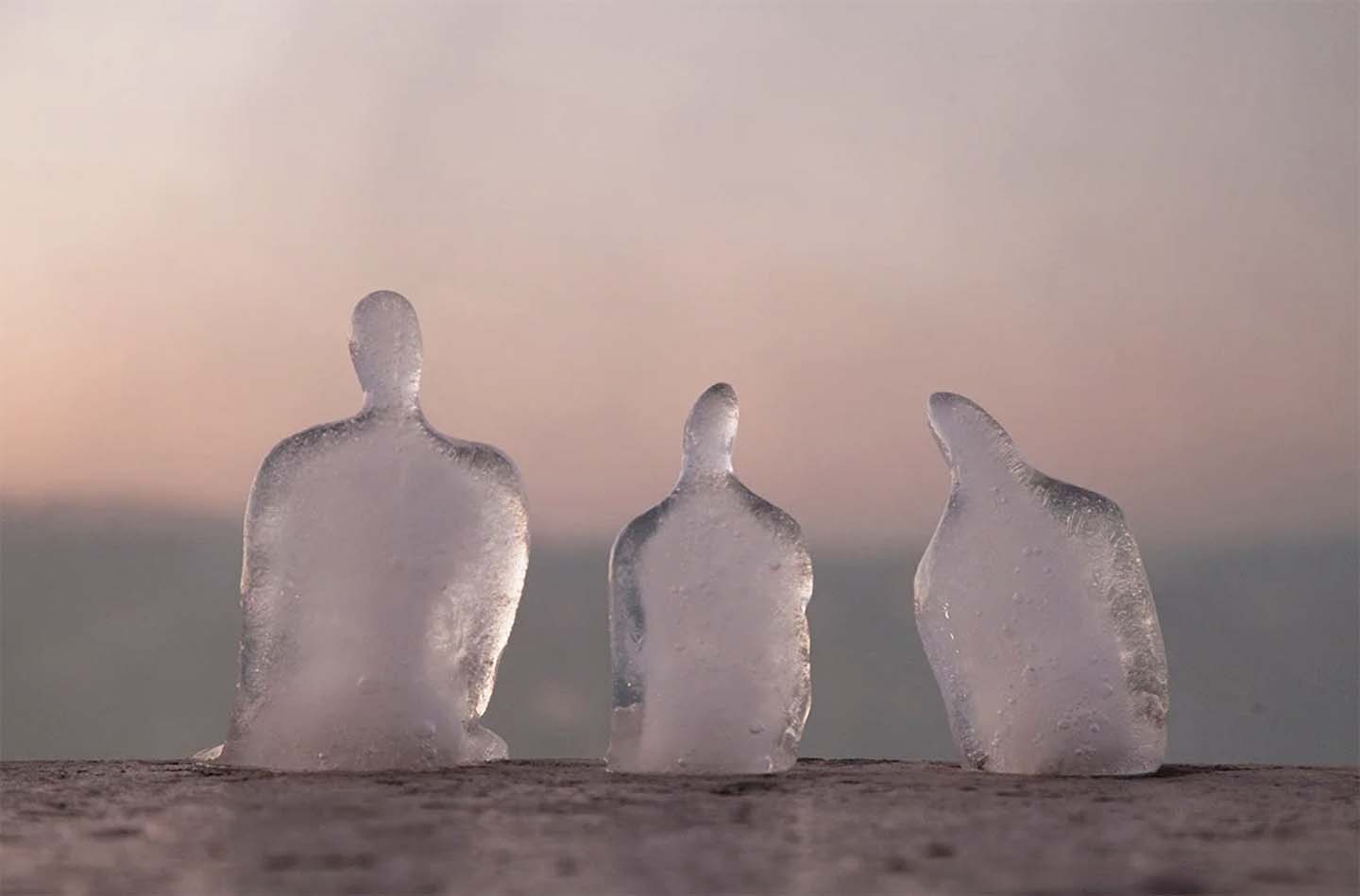
I am surely not the first nor the last one to think along those lines. But some do it with stunning creativity, like Brazilian artist Néle Azevedo. She started a project in 2005, Minimum Monument, that concentrated on small, ordinary men and woman made from ice. The 20 cm tall figures are spread out in public places to melt away, the opposite of static memorials to the famous. As she explains on her website (all images in this section from her website) :

In a few-minute action, the official canons of the monument are inverted: in the place of the hero, the anonym; in the place of the solidity of the stone, the ephemeral process of the ice; in the place of the monument scale, the minimum scale of the perishable bodies.

Néle Azevedo Minimum Monument Middlebury, Vermont (2018)

Here is a short video of the work process. The work has been shown in cities around the world.

The project, originally an attempt to elevate the memory of the defeated, the unknown, and to make us think of mortality rather than the immortality of fame, has evolved to embrace a larger issue as well. The climate movement has coopted the symbolism of these melting ordinary men and women, alerting us to the threats and dangers of global warming, the potential disappearance of human life.

Néle Azevedo Minimum Monument Rome, Italy (2020.)

Here is the artist’s statement:

The issue of global warming and the threatens posed by climate change on the planet that shows us an interdependence between different humans and puts us all in the same condition and in the face of a planetary urgency. This urgency requires a paradigm shift in the development of governments of all nations to think of another model of development outside the current level of consumption. These threats also finally put Western man in his place, his fate is along with the destiny of the planet, he is not the “king” of nature, but a constituent element of it. We are nature.

Néle Azevedo Minimum Monument Paris, France (2015) and Kendall Castle, GB (2016.)

***

Closer to home a colleague and fellow Oregon Art Watch Board member, Michael Griggs, died a death of more natural causes this week, an unsung hero of the Portland theater world, as someone called him. Rest in power.

Sabine Mirlesse Crystalline Thresholds Electra (12.22), 2022

There is another project embracing the beauty of ice and snow in all of it ephemeral instantiations that I rather like and I think Michael might have as well, given its theatric nature. Instead of standing in line at the pearly gates, waiting to cross into another realm of promised beauty and eternity, one might like to cross through these thresholds, where there is no change in locale, no upper- or under-world, no hell, just soft light.

Sabine Mirlesse Crystalline Thresholds, Maya (2022)

The gates were erected by Sabine Mirlesse on top of the Puy-de-Dôme volcano, home to the ruins of the Gallo-roman Temple of Mercury in the Massif Central, about 7 miles from Clermont-Ferrand (Auvergne, France.) The project, Crystalline Thresholds, was inspired by shapes from the temple door and research notes from the artist’s grandfather who investigated the properties of ice on airplane wings at this very site in 1936/37. The sculptures are exposed to the winds and weather in this micro climate, accumulating ice that will be melting by March or April.

Before and after the ice accumulated – Sabine Mirlesse Crystalline Thresholds Maia and Taygeta (12.22), 2022.

The ephemeral land-art installation consists of seven thresholds oriented to mirror the constellation of Pleiades and four pathmarkers for the cardinal directions. From what I learned from the press release (source for the photos in this section as well as the artist’s website):

Her research is centered around the visibility of thresholds and the interiority of landscape, with a particular interest in how geological sites are divined, interpreted, and recounted. Her creative practice is rooted in her background in mysticism and literature.

The majority of religions and thought systems across the globe do assume that after crossing the threshold of death there will be an extension of consciousness or some circular continuation of some kind after dying. There is the vision of eternal, experienced life in paradise, or that of rebirth, or the belief that an ancestral spirit is still able to commune with the living.

The walkway along the rim of the volcano and the installation.

I, no surprise, adhere to a more limited view of things to come: eternal oblivion, also referred to as nonexistence or nothingness, alternative to an extended conscience, possibilities already considered as early as the writings of Socrates and Cicero. That does not prohibit fantasizing, however, that, newly impervious to pain and cold, one might sail through these thresholds of otherworldly beauty, before the welcome nothingness sets in. We will, of course, never know. Or, to put it more cautiously, you are unlikely to read about it here….

Sabine Mirlesse Crystalline Thresholds Celaeno (12.22), 2022.

Temperatures are supposed to fall into the low 20s beginning this weekend, with snow possible for Wednesday. Thus music today from Schubert’s Winterreise (full cycle), song III. Frozen Tears and song IV. Turned to Ice.

Past, Present and Future: Thoughts at the Time of the Lunar New Year.

“Our mission is to collect, preserve and share the stories, oral histories and artifacts of Portland’s Chinatown as a catalyst for exploring and interpreting the history of past, present and future immigrant experiences.” Portland Chinatown Museum (PCM) Mission Statement

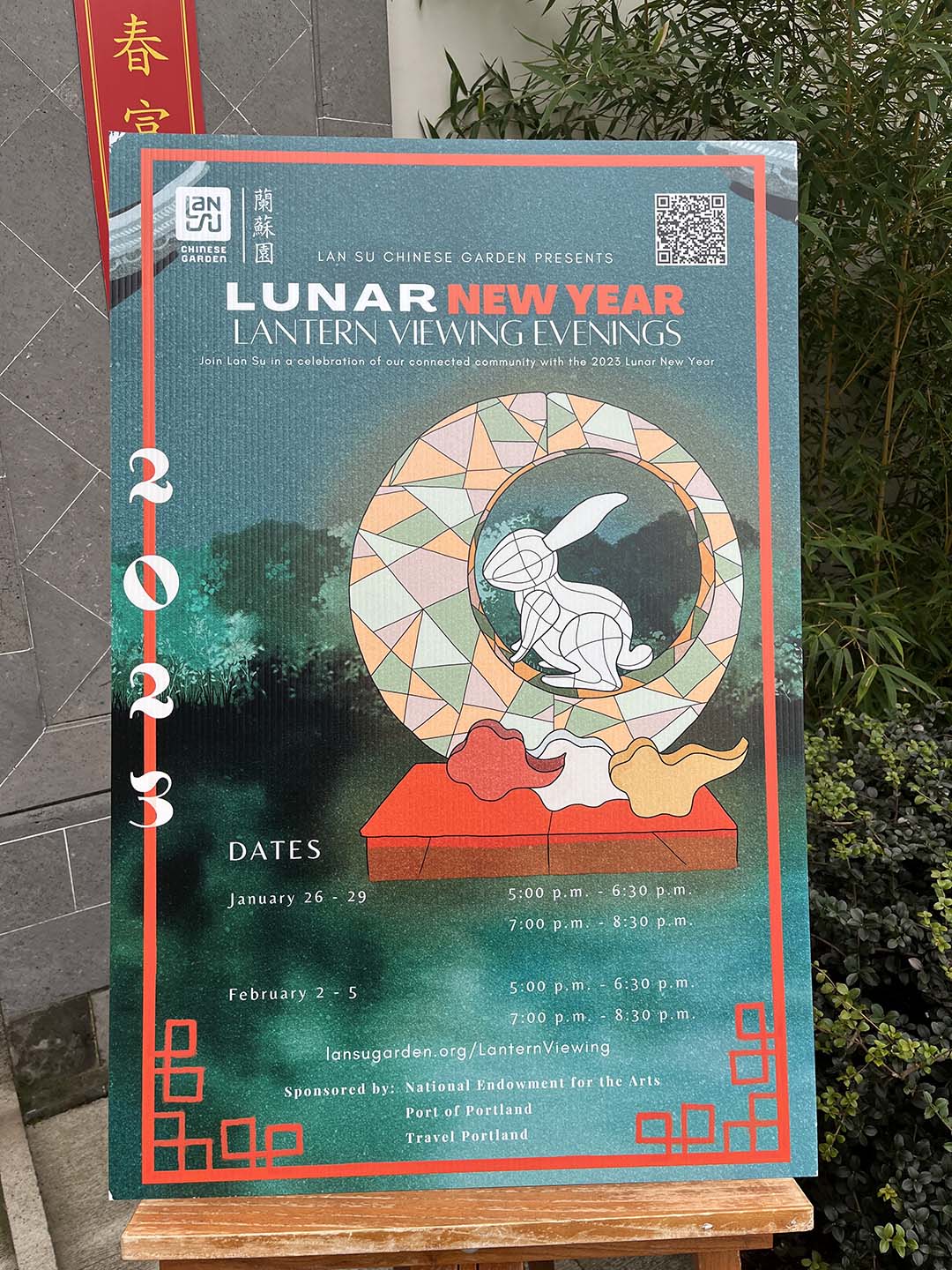
The Lunar New Year – The Year of the Water Rabbit – started yesterday and the Chinese government expects about 2.1 billion journeys to be made in Asia during a 40-day travel period around the celebration as people rush back for the traditional reunion dinner on the eve of the new year. I took a short trip to Portland’s Old Town Chinatown instead on Friday, an annual pilgrimage to admire the beauty of Lan Su Chinese Garden with its festive decorations for the occasion.

This year I added a second stop, a first visit to Portland Chinatown Museum (PCM,) which is just a block away on NW Third Ave, and not too far from the Chinatown Gateway. The museum opened in 2018 and did not appear on my radar during the pandemic years. I cannot recommend a visit strongly enough: opening hours are limited from Friday to Sunday, and the current temporary exhibition will close on January 29th. So if you can, make it down there next Friday or Saturday between 11 am-3 pm, there is some revelatory art on display.

The history of the museum’s founding can be found here. Like other Old Town institutions devoted to collecting and preserving immigrants’ histories, the Japanese American Museum of Oregon and the Oregon Jewish Museum and Center for Holocaust Education among them, PCM offers a permanent exhibition depicting the lives and plight of the Chinese immigrants. Beyond the Gate: A Tale of Portland’s Historic Chinatowns provides a comprehensive look at historical artifacts, some arranged in diverse dioramas, and guides you through the various aspects of the immigrant experience with informative exhibition texts and archival photographs.

***

Two separate galleries provide space for the work of contemporary Asian American artists, currently showing Illuminating Time, installations by three different artists-in-residence working with different media. The exhibition is exquisitely curated by Horatio Law, one of the PNW’s premier public art and installation artist who serves as the Artist Residency Director. It echoes the permanent exhibitions’s themes of loss, hope and belonging, so familiar to all immigrants.

___

一方有难,八方支援 “When trouble occurs at one spot, help comes from all quarters.” – Chinese Proverb

The theme of community, integral to collectivist cultures and so prominent in the museum’s permanent exhibition of historic Chinatown’s structural support systems, is picked up by Alex Chiu. Known to many of us for his vibrant murals that can be found across PDX, he undertook a series of ink drawings of community members that are displayed in the entrance hall of the museum. Placed against the backdrop of a stylized rendering of the Chinatown gateway, they depict a range of characters of all ages and degrees of visibility, pointing to the diversity of Portland’s Chinese population. Expressive and detailed, these portraits are a lively counterpart to the archival photographs of the Chinese ancestors who set foot here in the 1800s.

The juxtaposition between the traditional valuing of community and the artist’s modern ways of portraying individuals reminded me of the current trends in social psychology exploring the status of young Chinese who grow up in a world where the traditional collectivism of their culture and the modern demands and offers of Western individualism intersect. It is interesting work, based on spontaneous recollection of Chinese proverbs by these college students, reflecting which values come to mind first and how they are weighted. A changing world, yet heavily anchored still in tradition.

Clockwise from upper left: Portland Chinese Community Portrait Series: Billy Lee, Beatrix Li, Roberta Wong, Terry Lee.

***

“Take care of each other. Take care of the soil.” Shu-Ju Wang, in conversation.

Off to the side of the front venue is a room dedicated to Shu-Ju Wang‘s exploration of the history of Tanner Creek and its connection to the Chinese laborers and farmers who tended to its surrounding fertile soil to grow vegetables for both, sale and consumption. Her installation consists of multiple parts, prominently displaying a wooden slide constructed to represent the topography of the waterway with its angles and gradient. It is actually a marble run, and visitors are invited to play around, connecting through interaction. Above it hangs a mobile, made from silkscreen and gouache with a top part that was embroidered on paper tinted with gouache as well. It represents rain drops, a sense of fluidity enhanced by the aqua color range and the lightness of the material that slightly trembles in the draft. The sturdiness of the wood and the fragility of the paper assembly complement each other, rather than being opposed, representing aspects of nature that remind us of its power as much as its vulnerability.

Wang’s interest in and facility with science is evident in the exhibition posters that provide facts about the history of the creek within the build-up of Portland, the encroachment endangering the creek’s initial free run and displacing those human communities that had respected natural cycles of flooding necessary for fertile ground. Creatively, these narrative are told in letters from the creek to us, making a personal statement in a voice that I can see as particularly effective for young minds, children feeling addressed and drawn in. That said, it sure got my attention. The remaining walls are hung with the artist’s recent paintings and printings of nature-related topics, the theme of the need for environmental stewardship pervasive, meticulously and insistingly expressed.

Left to right: A fold-up book Castor and Sapient; A Study of Home (2021) Silk screen, pressure print and collage; a basket by Sara Siestreem (Hanis Coos) woven from native plant materials to catch the marbles.

I walked out with a plant cutting in hand, small annuals which are offered for free – by March, when this part of the exhibition is likely still on, it will be vegetable plantings to connect to the Chinese farmers’ history at Tanner Creek.

***

” …and someone far away will see flight patterns,” – excerpt from Sam Roxas-Chua’s poem Please Be Guided Accordingly.

If we link the immigrant experience to the past, present and future, as the museum intends to do, then Wang’s depiction of the past and Chiu’s capture of the present is joined by Roxas-Chua’s work incorporating the future. That might seem counterintuitive given the prevalence of allusions to memory, including the title for some of the major works.

Yet I was flooded with an impression that the work was about opening towards something, with the release that comes with the acknowledgement and acceptance of grief.

Detail: Gold Lighting and Lullaby Scripts

Part of that might have been triggered by the realization of the ephemeral character of both materials used and conceptual expression. The artist will destroy all that was presented by the end of the exhibition’s run and bury it at its source, the places in nature from which materials for the ink and paper were borrowed, and from which the inspiration was drawn. What is gone makes room for the new.

Left and RightL Gold Lighting and Lullaby Scripts. Center: Stone Satellites over an Excavation Site in John Day, Oregon.

Part of it can be found in the way Roxas-Chua’s calligraphy is open to interpretation. The technique of asemic writing that he uses is a form of communication that is unconstrained by syntax or semantics, an aesthetic rather than a verbal expression. It is the perfect medium for someone who is overburdened by the demands of too many languages (In Roxas-Chua’s case four) or too little rootedness in each.

Excerpt: Three Oranges and Blue Mountains Moon

For the viewer this opens space to connect to the calligraphy in ways unrestricted by formal demands. Unsurprisingly for me, who has spent her scientific research years studying memory, the art appeared as patterns of synaptic connections, but also of plaques causing retrieval failure, of parallel processing and encoding bias. The malleability of memory was perfectly caught in the flow of these marks, the way how present context is re-shaping, even altering what is remembered, ultimately influencing an assessment of the future.
How we approach the future is not just guided by how much our memory has changed over time, shifting away from facts and towards a narrative that helps emotional adaptation. How much any of us can remember the specifics of our past also plays a big role.

In many realms, all of our thinking about the future is rooted in memory. Policy planners, for example, routinely contemplate past patterns as a way of anticipating things to come. At a much more personal level, researchers suggest that a sense of hopefulness, or its lack, depends on how specifically we remember the past. Think about someone saying, “I cannot see how that could possibly happen,” or the opposite, “I can easily imagine how that can come to be.” That step of imagination is arguably central to how hopeful someone will be about the future, or not. And that ability to project is clearly linked to the specificity of your memory of how things unfolded in the past. Remembering opening the path to hope.

Excerpt: Three Oranges and Blue Mountains Moon

For the artist it was perhaps a way of connecting to the various landscapes and human sources that linked to the past of Chinese immigrants, from John Day to Astoria, where he interviewed people and recorded soundscapes of the environment (QR codes direct you to a listening experiences that captures these sounds, or music, or the artist’s poetry, providing additional levels of experience of the Gesamtkunstwerk, the totality of each artwork.)

Loss and re-emergence are central to the work. It was, I believe, most urgently captured in The Weeping Script. Please Be Guided Accordingly, the poem that accompanies the calligraphy, seizes the stages at which death rips a loved one away from you, bit by bit. There’s a release provided by inklings of hope and uplift in the future, though tempered by the knowledge that it will be a cold, lonely run. Maybe not the entire three year mourning period proscribed by Confucius, but the concession that grief exists and yet can be turned around. It calmly points to opening of new horizons.

For anyone mourning it will be brutally moving, and yet it is incredibly beautiful, hopeful work.

***

And now we turn to the elephant in the room. If the consummation of loss is part of the art inside the museum, wait until you see it instantiated in the suffering of the houseless in real life outside. The many houseless in the neighborhood, their tents, their misery, their detritus, are something the Old Town businesses are trying to deal with.

City plans almost a decade in the making have not yielded visible results, even though the mayor’s office claims progress. In October 2021, spurred by the rise in crime, violence and public camping in the Old Town neighborhood, the leaders of four cultural institutions — Lan Su Chinese Garden, the Japanese American Museum of Oregon, Oregon Jewish Museum and Center for Holocaust Education and Portland Chinatown Museum — wrote a joint open letter asking each city and county commissioner for immediate help. In March of last year, Old Town Community leaders unveiled a plan to repair and reopen the neighborhood, which included goals like reducing 911 call answering times, improving lighting in the area, and reducing tent camping by one-third.

The right words were said: “As Portland’s oldest neighborhood, home to immigrants who overcame decades of discrimination and indignity, and today, home to so many who are fighting just to stay alive, we must to whatever we can to respond to the crisis of humanity unfolding around us. And we must do it today,” said Elizabeth Nye, the executive director of Lan Su Chinese Garden, “the local government’s inability to safeguard Old Town disrespects its history.It is particularly devastating to our houseless neighbors who deserve more from their government.”

Mural on NW Davis St

The subsequent reality, however, amounted to an exponential increase in sweeps of the neighborhood. The 90-day “re-set” led to a particular form of camp removal, structure abatement sweeps, that can be ordered by the police chief or engineers in two different bureaus overseen by city commissioners. The standard Homelessness and Urban Camping Impact Reduction Program, or HUCIRP, sweep provides at least 72 hours’ notice to unhoused Portlanders so they can gather their belongings and voluntarily move before city contractors remove them from a given area. The structure abatement approach extends 1 hour warning, if that. If you happen to be away from your tent or belonging, all is lost. (For a detailed description of the way things unfolded last summer, here is a report by advocates from Streetroots, an organization where I taught writing workshops for the houseless until the pandemic started.) Shelter referrals given during or after sweeps are not enough – you can stay for one night, after having been completely uprooted. Many feel unsafe in shelters even for that one night, or can’t apply because they have pets.

Mural on NW Davis St depicting the view South on NW 4th Ave

Do these sweeps help solve the situation? Of course not. They clean up the streets for a short time or for a particular event, while making people less stable, re-traumatizing them, and shifting the entire problem just to a different location. Mayor Ted Wheeler and Commissioner Dan Ryan’s five October 2022 resolutions on homelessness included a ban on unsanctioned camping and the construction of compulsory mass homeless encampments, which would host up to 250 people. This can only be seen as a way to circumvent the Supreme Court decision letting the 9th Circuit Court of Appeals re Martin v. Boise decision stand, stating that a houseless persons cannot be punished for sleeping outside on public property in absence of alternatives.

Mural on NW Davis St

Of the six promised safe-rest villages only 2 have opened so far. Evictions from rental properties have skyrocketed since the renter protection during the pandemic was lifted – in the first 10 months of 2022 alone there were 18.831 evictions, as reported by a PSU research group. According to the 2022 Multnomah County Point-in-Time Count report, 24% of those experiencing unsheltered homelessness reported COVID-related reasons as the cause, adding to increased inflation and rising rent costs. Despite the stereotype, these are not all people with criminal records, or mental illness, or living with substance abuse problems. And even if they were, they would have the same human right to shelter as we all do. On top of it all, Senator Wyden’s DASH Act, (Decent, Affordable, Safe Housing for All) languishes in committee, even though it has support from all sides, business owners, land lord organizations and advocates for the houseless included.

I completely understand the need for businesses and institutions to be able to function in a safe environment and one that does not interfere with business under the specter of violence and crime. But let us acknowledge that the reaction so far has been to try and disperse the unhoused, without providing sufficient, actual housing, the only permanent solution to homelessness.

Archival photograph of NW Fourth Avenue

Until something changes structurally and expediently, I fear museums like the Portland Chinatown Museum will not get the exposure they deserve because many people hesitate to visit Old Town. It is truly sad, given what is on offer. But it is heartbreaking to see the suffering and loss in the surrounding streets, with poverty levels probably comparable to those experienced by the very first Chinese immigrants that came to seek a better life in a new home, leaving famine and disease behind. Past, present and future connected at the most basic level of human experience, daily survival.

Portland Chinatown Museum

127 NW Third Avenue
Portland, OR 97209

Friday – Sunday
11:00 AM – 3:00 PM

Docent-led group tours are Friday through Sunday by reservation only.

Current exhibition Illuminating Time closes on January 29th.

Join the museum on Saturday, January 28 at 10:00 a.m. for the seventh annual Lunar New Year Dragon Dance Parade and Celebration, presented in partnership with the Oregon Historical Society. 

The 150-foot dragon will be celebrating the holiday with lion dancers, performers, and a lively community parade through Old Town, Downtown, and up to the Oregon Historical Society Park 

Henk Pander – The Ordeal

Ordeal: any extremely severe or trying test, experience, or trial. Synonyms: agony, anguish, calamity, distress, nightmare, torment, torture, trial, tribulation – Thesaurus.com

Here’s the funny thing: when you look up the definition of ordeal, the word judgment is entirely missing from the dictionary listing, and yet that is the etymological root of the term: in Old English it was ordāl, in Dutch oordeel, and in German Urteil.

Why do I care? So many thoughts emerged about the concept of judgement after visiting an exhibition, titled The Ordeal, of recent paintings by my friend Henk Pander in the Alexander Art Gallery at Clackamas Community College. Let’s disentangle them one by one.

First of all, as a friend I cannot objectively judge the artwork, but I can certainly describe my reactions and put them in a context of what I know about the artist, which might help to understand what propels the art. Then again, it might be pure speculation, but that is the bread and butter of the critic. I certainly hold with Oscar Wilde’s notion, expressed in his preface to his 1891 novella The Picture of Dorian Gray:

The critic is he who can translate into another manner or a new material his impression of beautiful things. The highest as the lowest form of criticism is a mode of autobiography.”

Henk Pander photographed by me in his studio in 2017 during a double portrait session

Experience first.

The college’s Alexander Art Gallery, located in the award-winning Niemeyer Center that opened several years ago, is a windowless, effectively lit space that reminds of a sheltered cove, an impression fostered by a brown, highly reflective floor which resembles the surface of water mirroring the paintings on the wall.

It is a place of calm, until you lift your eyes and look at the walls: then all hell breaks loose.

The power of fire and brimstone, skeletons, skulls and wrecks, mythological creatures bent on destruction and barely human figures dancing on the ruins, all in intensely saturated, vibrant colors momentarily takes your breath away.

Henk Pander Rising Water (2015)

I was familiar with many, perhaps the majority of these paintings, having encountered them in the artist’s studio. The effect of seeing them grouped together, undistracted by any other visual input, precisely and mindfully lit, sequenced in a way where all are directionally anchored in relationship to their neighbors, elevates the work to a whole different dimension.

The exhibition consists of 8 enormous oils on linen, and 6 large pen-and-ink drawings which thrive on the contrast between their size and the pristine executions of small strokes, thin lines and subtle markings.

They also provide material for teaching about artistic practice: some of them are studies or just alternate versions of the oil paintings. Here is one example (referencing Rembrandt’s Night Watch, linking to art history as well).

Henk Pander Dawn (2017)

Thoughts next.

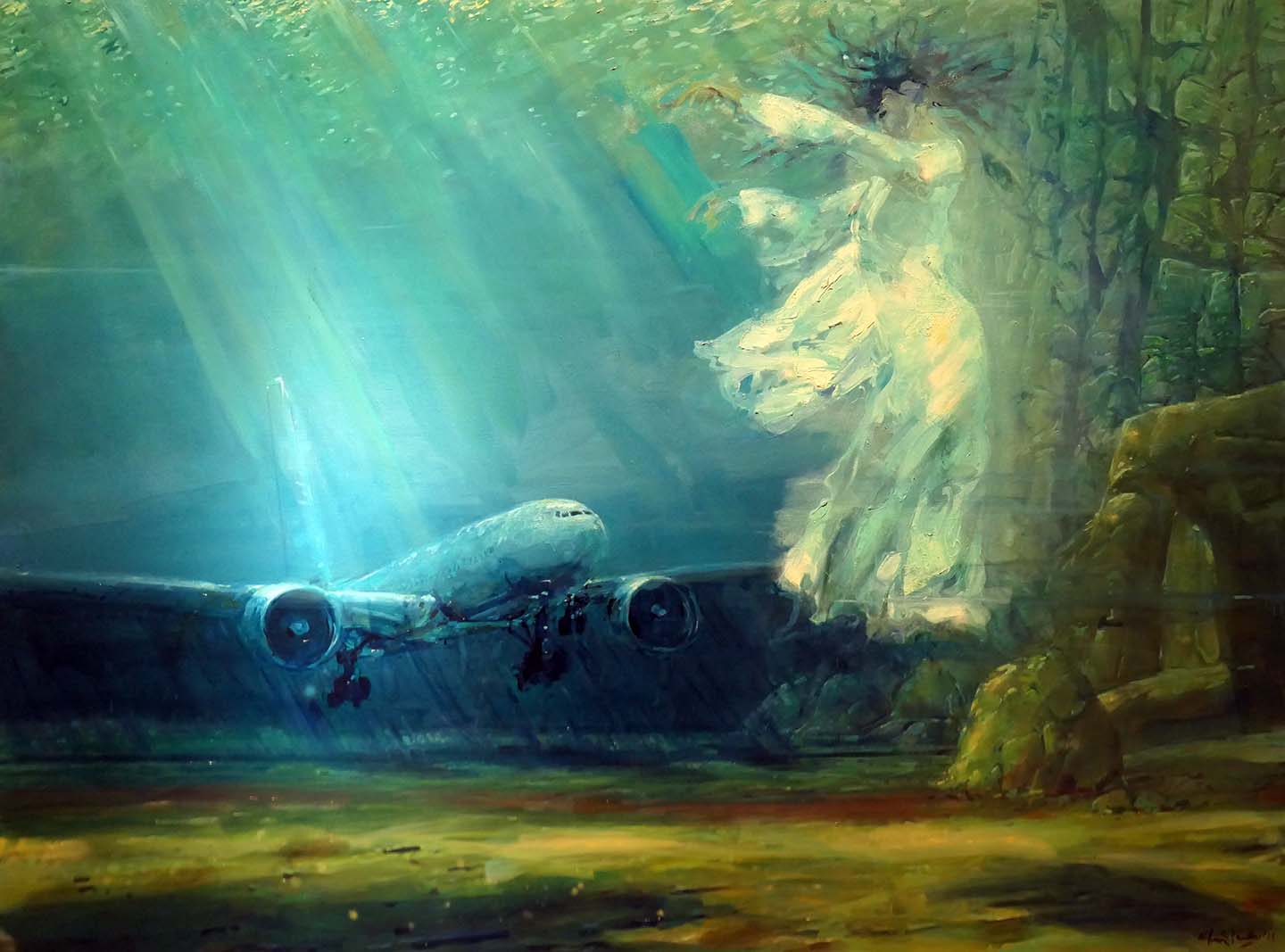
What drives a life-long preoccupation with apocalyptic scenarios and mythological narratives that predominantly reference death and destruction? Why remind us of threats to nature, of plane disasters, with pilots deliberately drowning themselves and their plane’s human cargo, or warmongers shooting planes down? Why dwell on the violence of man killing man, or mythological creatures symbolizing sudden, inevitable harm? No matter how expertly painted, how creatively crafted, how defiantly clinging to beauty in all its visual instantiations, these paintings are about horror, that which is unleashed upon the world by evil forces, that which is experienced by the subjects of the painting, and that induced in us who view the cruelty on hand. Or so one thinks at first glance.

Henk Pander Abyss (2015)

A possible explanation could be guided by the very first painting in the round, if you start with a clock-wise exploration of the art on display. The canvas unveils an autobiographical scene from the artist’s childhood, being shipped off to a region of Holland where food was still available during the hunger years under Nazi occupation. The existential horrors of war and deprivation, imprinted on a young child that saw death on a daily basis and witnessed the fear, despair and other intense reactions from the adults in his life, might guide an artistic exploration of the topic. Given the continuing abundance of existential threats to individuals and/or our planet, the sensibilities of the adult artist might be used to draw parallels.

Henk Pander The Skipper’s Wife (2015)

I believe there is something else going on here, though. For one, Pander was raised in a rigidly Calvinistic culture, a religion he long left behind with his emigration to the United States so many decades ago. Dutch Calvinism might have embedded parts of its philosophy deeply enough to exert continuing influence, if only in explicit rejection. Secondly, the artist’s formative years were spent being educated by the premier art teachers of his time in the Dutch academy, infused with the tenets of Dutch art history starting with the Golden Age of the 17th century. These two factors interact, I want to argue, producing work that is not about the witnessing of horror per se, but the fragility of our existence, caught in the very moment where something irreversibly changes, never to be the same again, raging at the claimed inevitability of it all.

The Dutch have a name for that circumstantial reversal, staetveranderinge, a term derived from the Greek word peripeteia, and a concept embraced in Dutch paintings since the 1600s. The change could be in any direction – from anguish to praise, like in Rembrandt van Riijn’s versions of The Angel appearing to Hagar, but most often captured when circumstances shifted irrevocably to disaster, like Jan Steen’s Esther, Haman, and Ahasuerus.

Jan Steen, Esther, Haman, and Ahasuerus, c. 1668, Cleveland Museum of Art, Cleveland.

The preoccupation with “state change” corresponded with the rise of Calvinism, a religion that dominated the Dutch provinces and led to long religious wars against Catholic nations but also to boundless prosperity, shaping the evolution of commerce and empire.

Henk Pander Don’t Look (2015)

I’m obviously oversimplifying, but one of Calvinism’s tenets was about judgment and inevitability: the doctrine of predestination, which implied that G-d had already decided everyone’s eternal fate before he created the world. Some, then, were destined to thrive and find salvation, the rest were not. Election was by the grace of G-d, reprobation, on the other hand, the judgement of a G-d bent on just punishment. Calvin himself is cited: “The praise of salvation is claimed for G-d, whereas the blame of perdition is thrown upon those who of their own accord bring it upon themselves.” I will, to the end of my days, not understand this logic, somehow it’s our own fault if we are bad, all the while being predestined to end up in hell. Riddle me that. In any case, things were inevitably decided from the start.

Judgement didn’t stop with the authority on high. Calvinism had judicial assemblies composed of the church’s ruling elders and the pastor, who watched over, regulated and judged the issues of the congregation. In fact there are historians who claim that the social control of Calvinism reached all the way into the social lives of the Dutch: their windows, even on street level, have no curtains so that everyone can look in (a custom that disappeared only during the last few decades). The cultural quirk was rooted in the concept that a praiseworthy Christian had nothing to hide.

Henk Pander Harpy (2015)

Cherished protestant traits like hard work and frugality, and the eagerness to spread the gospel of Calvinism around the world, helped establish colonial empires (never mind resource extraction and slave labor and trade). The 17th century United East India Company (VOC – Vereenigde Oost-Indische Compagnie) prospered from the East Indies (Indonesia) to Ceylon (Sri Lanka) to the Cape of Good Hope (South Africa), bringing untold riches home to the Netherlands, as did its later sister company trading the Atlantic regions, the West India Company (WIC.)

That wealth spread among a relatively large new middle-class, highly educated and willing to spend some money on the arts – they had plenty of master painters to choose from. The philosopher G.W.F. Hegel lectured in his Ästhetik:

“The Dutch painters also brought a sense of honest and cheerful existence to objects in nature. All their paintings are executed meticulously and combine a supreme freedom of artistic composition with a fine feeling for incidentals. Their subjects are treated both freely and faithfully, and they obviously loved the ephemeral. Their view was fresh and they concentrated intensely on the tiniest and most limited of things.”

This was written 200 years ago, about painters from 200 years earlier still. Applies to Henk Pander’s work across various media as well, with the cheerfulness restricted to water colors of floral assemblies and landscapes, the focus on ephemera ubiquitous in his oil paintings. But he also captures the vision that his artistic forbears were so keen on, the point of no return when the plane drowns, the earth floods, violence arrives in its devilishly incarnation, the sharpness of the Minotaur’s skull echoed in the thrust of erection, the Harpy harbinger of the fall of towers.

Henk Pander The Minotaur (2015)

Is the depiction of all these ordeals and threats, over and over again across his artistic lifetime, a nod to the inevitability of our fate? Or are the paintings, in contrast to and in rejection of religious determinism, a warning? Do they imply the possibility that there are ways to prevent catastrophe, escape harm, make the world a less violent place if we abdicate our lust for power or our addiction to materialism? Is the work about agency rather than inevitability, the possibility of change rather than a set fate?

Are the increasingly thick slathering of paint and the choice of – yes – occasional garish colors signs of the artist’s smoldering rage at the futility of his warnings? An outcry that no-one heeds the predictions of yet another prescient artist putting the writing on the wall – or the marks on the canvas, as the case may be?

Henk Pander Excerpts from Native Soil (2015)

I do know that people tend to look away, despite the awards and accolades Pander has accrued across a lifetime, with works included in the collections of the Rijksmuseum (Amsterdam), Museum Henriette Polak (Zutphen, The Netherlands), City of Amsterdam, City of Portland, Jet Propulsion Laboratory (Pasadena), Portland Art Museum, Frye Art Museum (Seattle), Jordan Schnitzer Museum of Art (University of Oregon), and Hallie Ford Museum of Art (Willamette University), where a fifty-year retrospective exhibition of his work was shown in 2011.

The avoidance is not so much in judgment of the art, but likely an act of self preservation, not wanting to disturb our already fragile equilibrium. More agony, anguish, calamity, distress, nightmare, torment, torture, trial, tribulation? Bad news sells in the media. In the arts, not so much, unless they are a particular contemporary darling of the art world. Historically, art that defied the powers that be or let us in on their malfeasances was censored by church and state alike. These days, free market mechanisms are all it takes. If people are avoiding that which troubles them, commercial galleries or museums who depend on sales and visitor numbers, respectively, are not rushing to put us through the ordeal of witnessing. It’s a judgement call, they say, with varying justifications, but a clear view of the bottom line. More power to educational institutions, then, that provide access, in an environment that does the work justice.

You have a chance to judge for yourself. There is an urgency in the paintings that deserves our collective attention.

Henk Pander Excerpt from Water Rising (2015)

The exhibition is free and open to the public until the end of the month, with an artist reception this Thursday Jan. 19, 2023, noon-1 p.m. Henk Pander will speak about his work at 1 p.m. There is plenty of free parking in front of the ADA accessible building.

Niemeyer Center at Clackamas Community College,

19600 Molalla Ave.

Oregon City, Oregon 97045

Monday-Friday, 9 a.m.-5 p.m.

Here is another review from Oregon Arts Watch.

Tiere und Türme

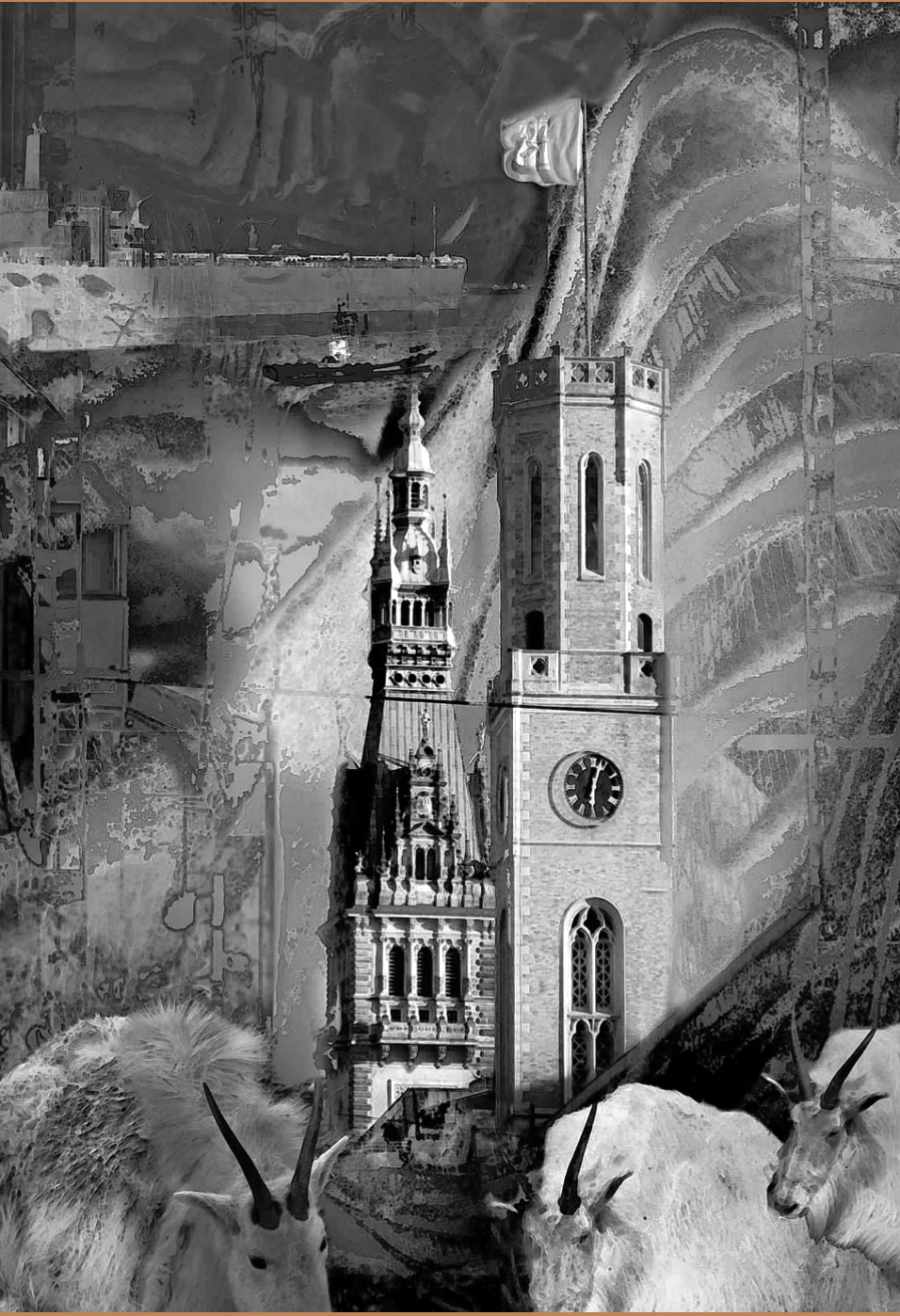
In tune with my surrealist forbears, I worked on a series of photomontages this fall: Turmwächter – Guardians of the Towers. The montages were propelled by two considerations: For one, they all depicted towers that I had photographed in Europe during multiple trips with my friends there across the years, a reminder of shared sights and better times. (The friends get a calendar each year with montage work that picks up on our travels.)

Secondly, I placed animals I had photographed (mostly) in the wild into these urban environments. I wanted to acknowledge the issue of habitat loss, ever closer contact between humans and animals, with all that that implies: the danger for those displaced and for those thrown into the company of wild animals, or the illnesses that animals now share with us, even if they themselves are harmless.

I was also thinking how our relationship to animals might change if we saw them as actors in environments belonging to us, rather than out on the pasture or other defined spaces (still) allotted to them. Would proximity and shared space make a difference, particularly when the non-humans seemingly had assigned human functions: guarding the towers? Would we afford them agency or still be masters, tempted to shoot the bears, hunt the geese, confine the giraffes to cramped zoo exhibits or slaughter the goats and sheep?

All this is a long-winded introduction to movie reviews that made me sad, because my immunocompromised body can’t sit in a theatre and watch films that I lust after, having read about them. The film in question is one that – if the reviews are on point – picks up on the issue of the relationship between animals and humans, ingeniously presented from the perspective of a donkey. What drew me last week to read the reviews of EO, the new film by the legendary Polish director Jerzy Skolimowski, was this image – I gather I don’t have to explain why.

Here is an early review of the film that describes in detail what a master can pull off when putting his mind (and technical brilliance) to telling a story that covers so many relevant dimension of the anthropocene. It opened in PDX on 12/23, go see it if you can! (Update: After reading the blog a friend uttered intense disagreement with the film-critics’ raving reviews – she and her companion left the screening half way through, despised the music and urged me to withdraw the recommendation. What can I say – as explained above, I have not seen it.)

***

I’ve talked about quite a few movies this year that were available on-line, with varying degrees of enthusiasm. C.G.Jung in the Wild West, delving into Jane Campion’s Power of the Dog, probably was the one that made me think hardest, and therefor lingers. If you are into violent and politically progressiv, astute modern Westerns – not for the faint of heart or stomach – there is a new series these days, The English, by Hugo Blick (on Amazon and BBC). Review from The Guardian here. Visually stunning, but goosebumps for the entire ride, be warned.

Music is the sound track for EO, by Pawel Mykietyn.

Die Qual der Wahl

How to translate this German idiom into English?

Tough Call!

Decisions, decisions!

Spoilt for Choice!

I guess they all apply when it comes to end-of-year choosing of a particular art review that I consider amazing: interesting writing, learnedness across multiple fields (poetry and literature as well as the visual arts,) an emotional hook added to the intellectual riches, clarity, and a willingness to defy majority opinion. So many to choose from.

I settled on the one linked below, partly because it is about a topic I care about deeply, more importantly because I learned so much from John Yau‘s essays over the years, and most importantly because it checks off on ALL of the factors mentioned above.

The show under review, Anselm Kiefer: Exodus at Gagosian (November 12–December 23, 2022,) is almost over, but since Kiefer’s work is ubiquitous, the general insights apply whereever you see his work next. As my regular readers know, I was never a fan, given Kiefer’s loose relationship with the truth and his self-aggrandizing, although I made one exception at a show in Montreal.

Yau’s review of the current exhibition was poignant in ways I wish I had thought of:

What does it mean to cover the lack of answers in gold …. Anselm Kiefer is the Steven Spielberg of painting. Both are masters of effect and convinced of their own genius. One cannot help but be impressed by what they do in their respective mediums. And yet, is being impressed enough? “

Photographs from last week captured nature’s gold (silver and brass) of withering ferns, rather than Kiefer’s applied gold-leaf.

***

When it comes to my own reviews of 2022, the choice was pretty easy. By far the hardest to write were Die Plage and The Central Park Five. The former because the Holocaust topic was so traumatic and the wealth of material about the artist and his own traumas required intense structuring and streamlining. The latter because the issue of racism and its horrific entrenchment in the American psyche, history, institutions and legal system is unresolved and painful to face, every single time I get up the nerve and try again

I had some difficulties with familiarizing myself with and appropriately framing Native American Art, but was happy with the results of both major reviews, The Red Shimmer of Remembering and Breathing the High-Altitude Ether of Discovery. I learned much and felt I could stimulate interest in equally uninformed readers.

The reviews I enjoyed most, of art that spoke to me with its intentionality and multi-layered meanings, were Correlations in Corvallis and Ripped Threads. I had zero guidance to go on for either, given the status of the artists, creating all their lives in relative obscurity. I had to rely entirely on my own thoughts and impressions, but also lots of freedom to speculate. I have nothing but admiration for these women even older than I, who never gave up, despite lack of even a hint of support from the established art world. For the latter, I felt there were politically important topics delivered without shock and awe or any other attention-grabbing means, just trickling slowly, subtly, intelligently into your consciousness, coloring your emotional responses. For the former I admired that the process of making art continues even when you have said all you had to say on the intellectual front. It is enough if only beauty flows at times, without pretense. And flow it did.

I very much hope that 2023 provides more opportunities to stretch myself as a writer while having my mind stretched by beauty and/or meaning.

Music: grandiosity, gold, German romanticism – you surely know what’s coming! (The beginning is very subtle, it gets louder soon.)

City Views

“A view that will never be mine,” I groused, when reading a review in Art in America of Michael Heizer‘s City. Then again, I will be in good company – only 6 people a day are allowed on this large land art project, in the making since 1970 and finally opened this summer. 6 people, no less, who are able to shell out $150 for a three hour visit, after having been approved when requesting a visit via email to the Triple Aught foundation. People who are able to fly into Nevada and willing to travel rough for many hours from Las Vegas into the desert to a secret location, and who are able walkers – no places to rest for ailing/aging bodies on this installation, by all reports.

Photo : Photo Joe Rome/©Michael Heizer and Triple Aught Foundation

Photo : Photo Mary Converse/©Michael Heizer and Triple Aught Foundation

Judging from the aerial photographs, it is a pretty stunning site. A mile and a half long, with 14 miles of concrete curbing, the site contains arrangements called “complexes,” meant to resemble urban units from a long-lost civilization. Inspired by a visit to Egypt’s pyramids, the artist said “In sculpture I attempt to maintain the venerable tradition of megalithic societies.” (Ref.) The mammoth project was funded with many millions of dollars by multiple organizations and private donors, and received a helping hand in 2015 by the late Senator Harry Reid and then President Obama who proclaimed the 700,000 acres as part of the Basin and Range National Monument, protecting City from railroad traffic and development near by (the artist had threatened to blow up the entire project if nuclear waste would be transported through the neighboring areas.)

Looks epic. Looks empty. Looks contrived, like a raked graveyard for a lost culture of giants. Made more desirable, I am certain, by the imposed mystery and scarcity aspects. But also admirable given a man’s dedication for half a century to creating something that connects across history and somehow, at least judging from the publicly available photographs, into the future with its echoes of alien geoglyphs.

My city views yesterday were on a more human – yet accessible! – scale. Walking along the river shortly before sunset, nature and industrial structures alike were bathed in faint orange glow.

Street cars and boats reveled in the season’s spirit:

and shadows were long under the Interstate bridge.

Which is where I found the Poetry Beach, a small walkway with engraved boulders celebrating the river. Water, a source of life and sustaining force. Who needs stimulation from a desert city, when urban children’s voices create meaning here and now?

Have to remind myself of the attitude that carried me for so long: there is interesting stuff to be found everywhere. A camera is wonderful. It keeps the mind from drying out.

Music today from Cesarini’s Urban Landscapes.