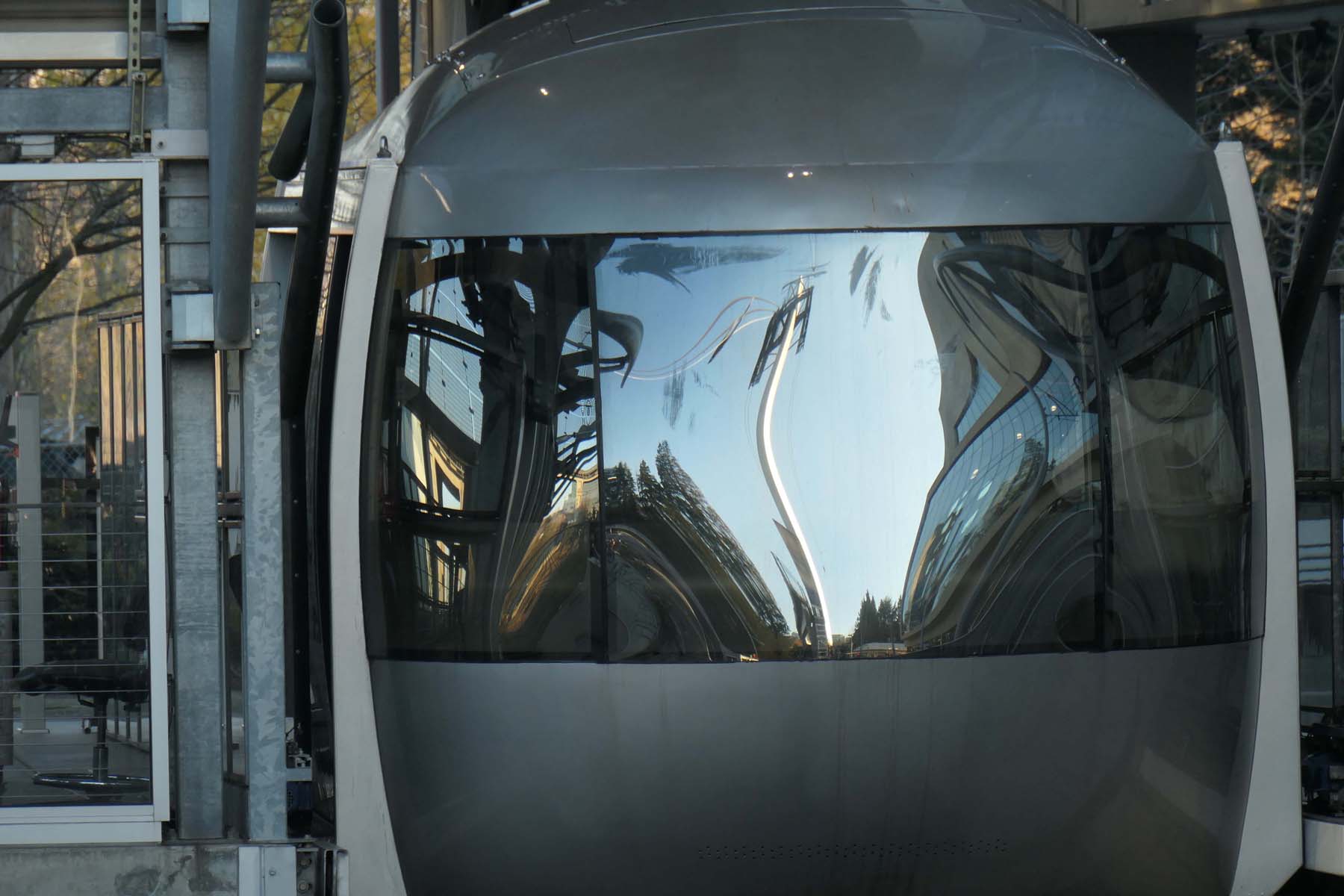
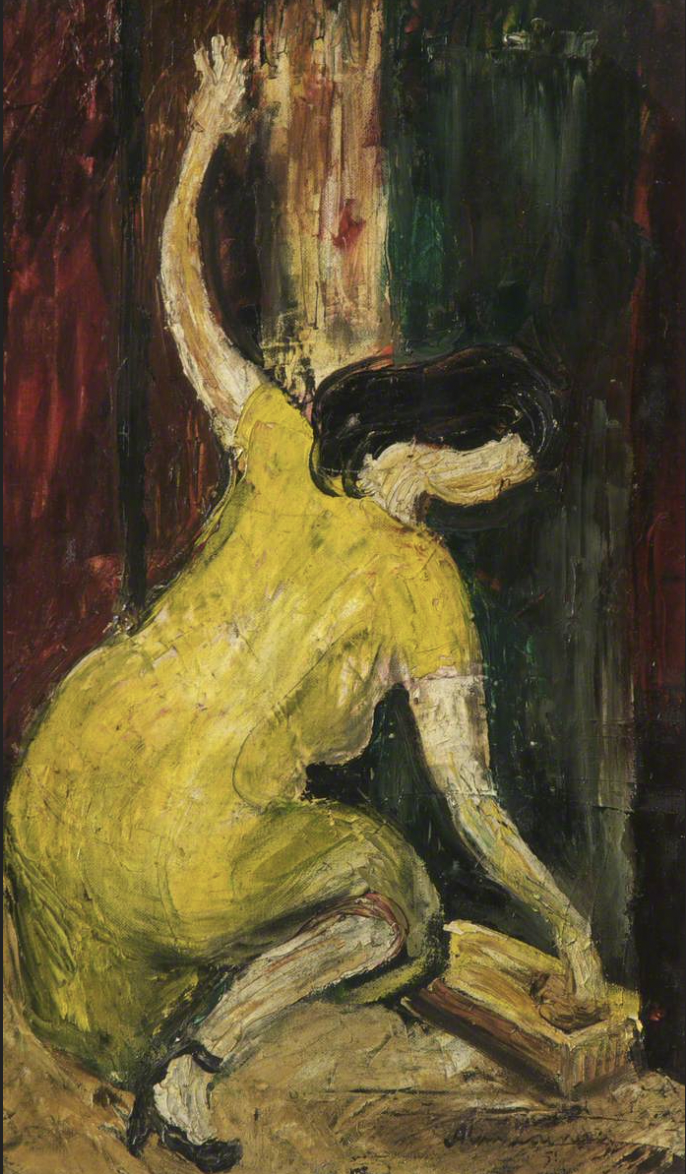
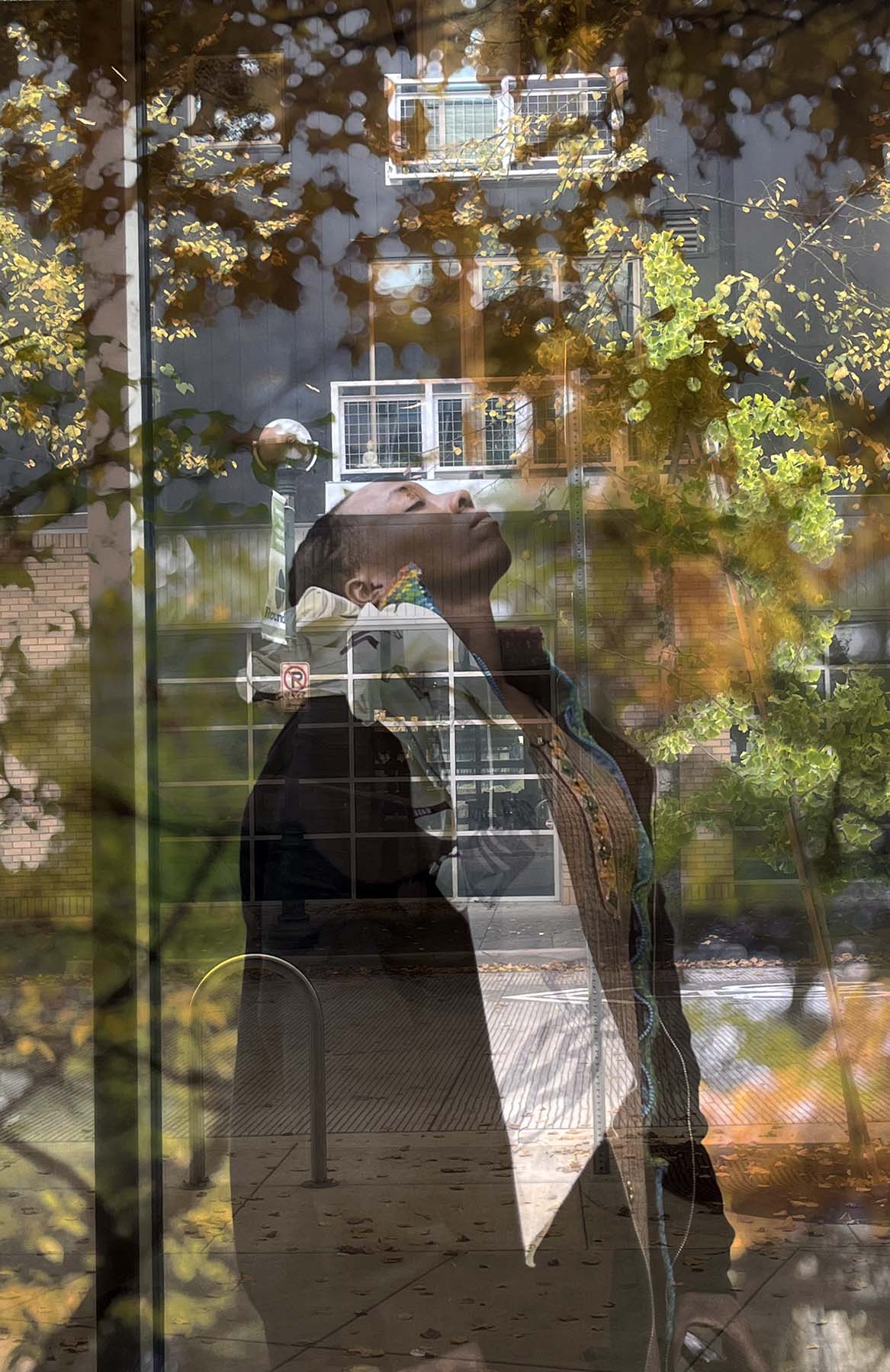
I guess they all apply when it comes to end-of-year choosing of a particular art review that I consider amazing: interesting writing, learnedness across multiple fields (poetry and literature as well as the visual arts,) an emotional hook added to the intellectual riches, clarity, and a willingness to defy majority opinion. So many to choose from.
I settled on the one linked below, partly because it is about a topic I care about deeply, more importantly because I learned so much from John Yau‘s essays over the years, and most importantly because it checks off on ALL of the factors mentioned above.
The show under review, Anselm Kiefer: Exodus at Gagosian (November 12–December 23, 2022,) is almost over, but since Kiefer’s work is ubiquitous, the general insights apply whereever you see his work next. As my regular readers know, I was never a fan, given Kiefer’s loose relationship with the truth and his self-aggrandizing, although I made one exception at a show in Montreal.
Yau’s review of the current exhibition was poignant in ways I wish I had thought of:
“What does it mean to cover the lack of answers in gold …. Anselm Kiefer is the Steven Spielberg of painting. Both are masters of effect and convinced of their own genius. One cannot help but be impressed by what they do in their respective mediums. And yet, is being impressed enough? “
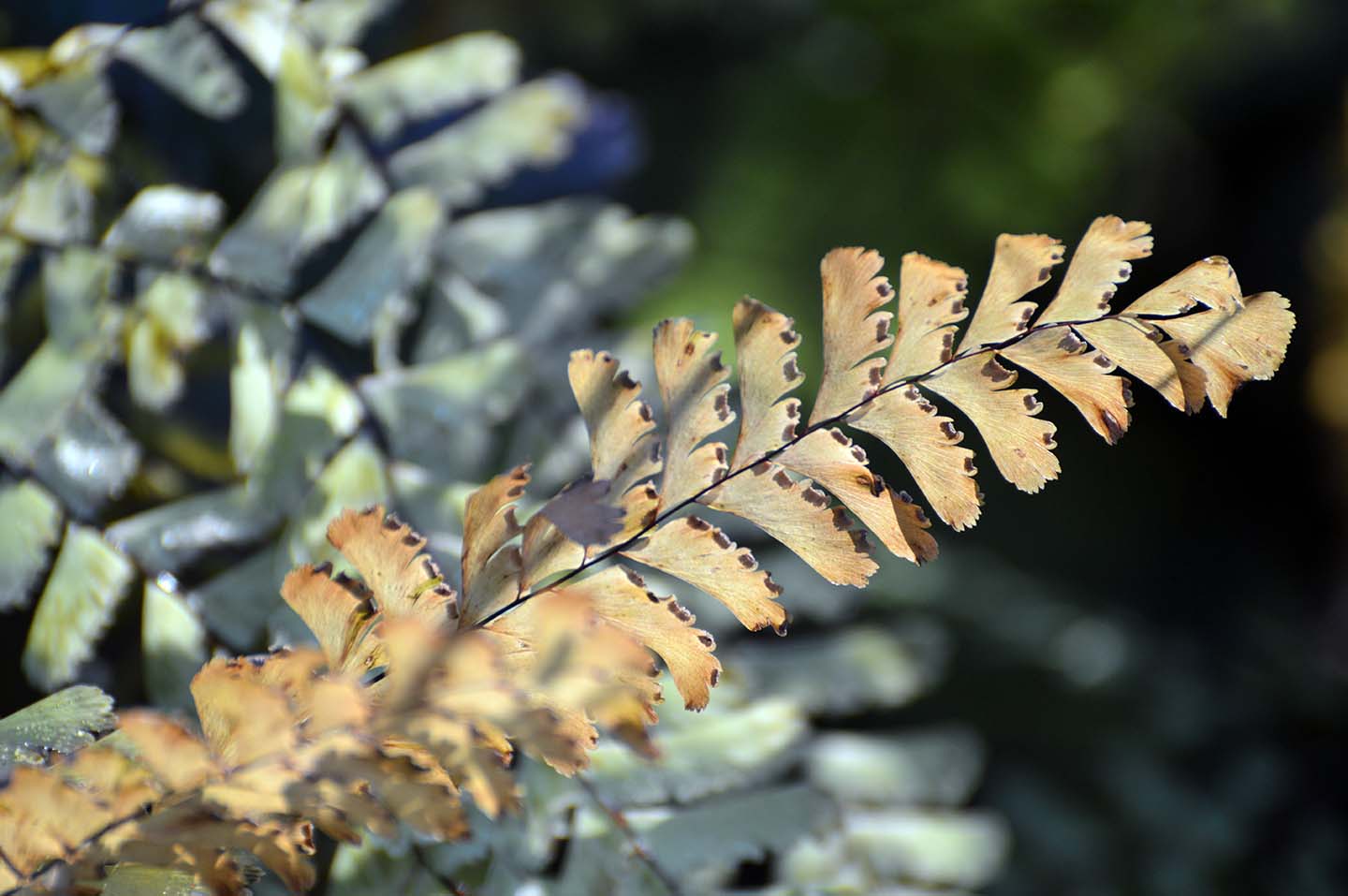
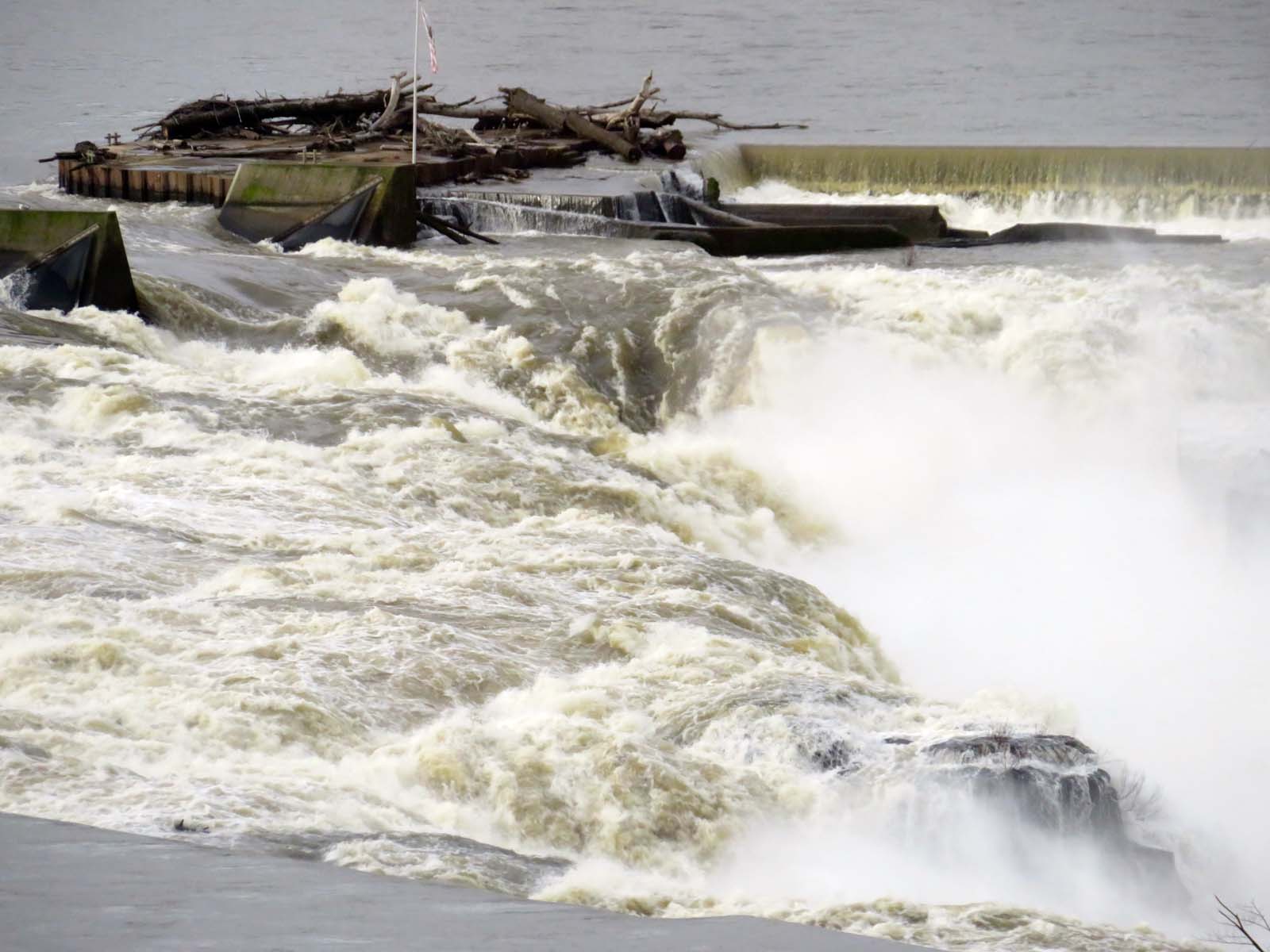
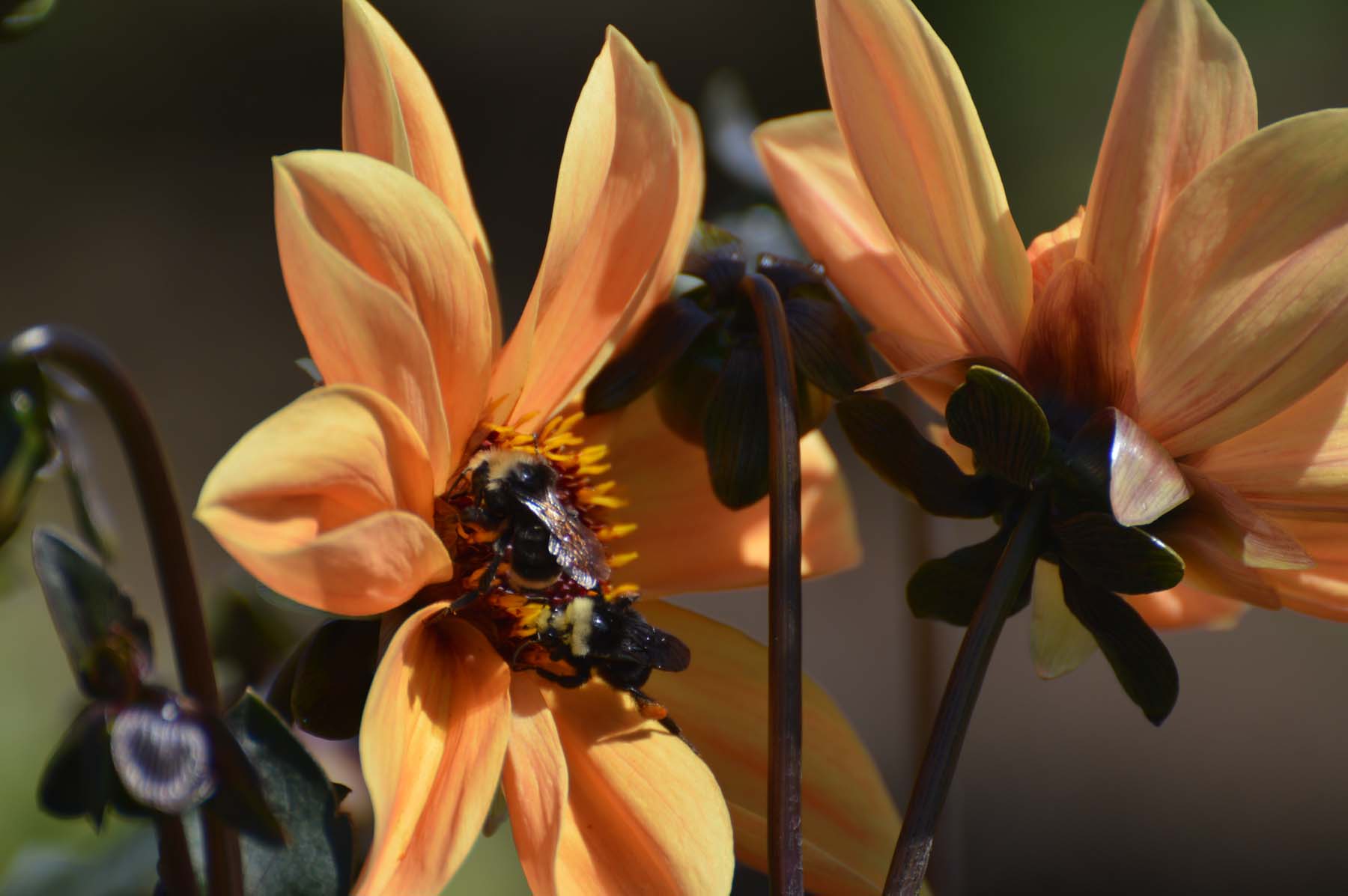
Photographs from last week captured nature’s gold (silver and brass) of withering ferns, rather than Kiefer’s applied gold-leaf.
***
When it comes to my own reviews of 2022, the choice was pretty easy. By far the hardest to write were Die Plage and The Central Park Five. The former because the Holocaust topic was so traumatic and the wealth of material about the artist and his own traumas required intense structuring and streamlining. The latter because the issue of racism and its horrific entrenchment in the American psyche, history, institutions and legal system is unresolved and painful to face, every single time I get up the nerve and try again
I had some difficulties with familiarizing myself with and appropriately framing Native American Art, but was happy with the results of both major reviews, The Red Shimmer of Remembering and Breathing the High-Altitude Ether of Discovery.I learned much and felt I could stimulate interest in equally uninformed readers.
The reviews I enjoyed most, of art that spoke to me with its intentionality and multi-layered meanings, were Correlations in Corvallis and Ripped Threads. I had zero guidance to go on for either, given the status of the artists, creating all their lives in relative obscurity. I had to rely entirely on my own thoughts and impressions, but also lots of freedom to speculate. I have nothing but admiration for these women even older than I, who never gave up, despite lack of even a hint of support from the established art world. For the latter, I felt there were politically important topics delivered without shock and awe or any other attention-grabbing means, just trickling slowly, subtly, intelligently into your consciousness, coloring your emotional responses. For the former I admired that the process of making art continues even when you have said all you had to say on the intellectual front. It is enough if only beauty flows at times, without pretense. And flow it did.
I very much hope that 2023 provides more opportunities to stretch myself as a writer while having my mind stretched by beauty and/or meaning.
Music: grandiosity, gold, German romanticism – you surely know what’s coming! (The beginning is very subtle, it gets louder soon.)
“A view that will never be mine,” I groused, when reading a review in Art in America of Michael Heizer‘s City. Then again, I will be in good company – only 6 people a day are allowed on this large land art project, in the making since 1970 and finally opened this summer. 6 people, no less, who are able to shell out $150 for a three hour visit, after having been approved when requesting a visit via email to the Triple Aught foundation. People who are able to fly into Nevada and willing to travel rough for many hours from Las Vegas into the desert to a secret location, and who are able walkers – no places to rest for ailing/aging bodies on this installation, by all reports.
Judging from the aerial photographs, it is a pretty stunning site. A mile and a half long, with 14 miles of concrete curbing, the site contains arrangements called “complexes,” meant to resemble urban units from a long-lost civilization. Inspired by a visit to Egypt’s pyramids, the artist said “In sculpture I attempt to maintain the venerable tradition of megalithic societies.” (Ref.) The mammoth project was funded with many millions of dollars by multiple organizations and private donors, and received a helping hand in 2015 by the late Senator Harry Reid and then President Obama who proclaimed the 700,000 acres as part of the Basin and Range National Monument, protecting City from railroad traffic and development near by (the artist had threatened to blow up the entire project if nuclear waste would be transported through the neighboring areas.)
Looks epic. Looks empty. Looks contrived, like a raked graveyard for a lost culture of giants. Made more desirable, I am certain, by the imposed mystery and scarcity aspects. But also admirable given a man’s dedication for half a century to creating something that connects across history and somehow, at least judging from the publicly available photographs, into the future with its echoes of alien geoglyphs.
My city views yesterday were on a more human – yet accessible! – scale. Walking along the river shortly before sunset, nature and industrial structures alike were bathed in faint orange glow.
Street cars and boats reveled in the season’s spirit:
and shadows were long under the Interstate bridge.
Which is where I found the Poetry Beach, a small walkway with engraved boulders celebrating the river. Water, a source of life and sustaining force. Who needs stimulation from a desert city, when urban children’s voices create meaning here and now?
Have to remind myself of the attitude that carried me for so long: there is interesting stuff to be found everywhere. A camera is wonderful. It keeps the mind from drying out.
When I came again across Helga Stentzel’s whimsical laundry lines this week I thought of one of the very first blogs I had written here some 6 years ago with a message that deserves recycling.
It was about “The Right to Dry,” the name of a movement that fights against state laws and community bans on drying your laundry outside. “Officially more than 60 million Americans are prohibited from hanging their laundry outside, in their own yards or balconies and porches. This 2 minute video clip is a poignant introduction to what served the interest of the electricity industry (with former President Regan and Nancy as their spokespeople!) and those selling dryers.”
By 2012 the ban was voided (or made it unenforceable) in 19 states (including Oregon) by referral to solar access laws. Many of these are from the 1970s and comprised of hidden clauses in state property laws. A 1979 Oregon Law, for example, says any restrictions on “solar radiation as a source for heating, cooling or electrical energy” are “void and unenforceable.” Clotheslines appear to fit under the umbrella of Oregon’s and other states’ solar rights because systems for hang-drying rely on the sun’s radiation to evaporate water in wet laundry.
***
It is winter. No-one hangs their laundry outside now. Those who are privileged to have dryers or basements with laundry lines have no worries. I am thinking, though, about what happens when poverty and restriction of energy sources soar, like now all across Europe.
Eugene Boudin, 1824-1898 Women Washing on the River Bank, n.d. Oil on panel,
Most severely in Ukraine, of course, where the war destroyed most electricity grids and basements are used as bomb shelters. Besides individuals for whom all reliable daily functions have been bombed out, think of institutions. Hospitals, for example. Can you imagine the volume of laundry that is now to be washed by hand and dried – where? And the implications of soiled linen for (re)infections?
Anton Mauve Woman at a Washing line in the Dunes/ Woman at a Washing line (both undated watercolors)
It is tempting to think of war as happening primarily on the battle field, soldiers and their families the visible victims, but the impact on civil society goes so much further than our imagination provides. Hunger, cold, unsanitary conditions fostering more disease are all cards played by the invaders.
Paul Gauguin Les Lavandières à Arles I 1888
And speaking of imagination – today’s paintings of washer women often repeat the tradition of depicting them as a busy bunch, happily doing their work outside, or in the calm of their yards.
Left to right: Edgar Degas The Laundresses (c.1884) – Hubert Robert Ruins of a Roman Bath with Washerwomen (after 1776) – Pierre-Auguste Renoir Washerwomen (188)
The more likely reality is captured here.
August Sander Waschfrau NB VI/42/14 CTC — ASA 3/42/17
Tourist snaps of pittoresque Italian laundry lines non-withstanding, laundry has been a hard and dirty business.
“The most obvious contribution to social change that literature can make is simply to inform people of something they know nothing about. There are other situations where we believe we know something but don’t really know it in a visceral way, don’t really know it emotionally, to the point where it moves us to action.” – Howard Zinn in Afterword to American Protest Literature.
HOWARD ZINN’S WORDS echoed when trying to take in the riches of the current exhibition at the Patricia Reser Center for the Arts, Red Thread : Green Earth. Here I was surrounded by narratives (words as well as visual and performative acts of storytelling) offered by a collective of six African American women, telling us about their relationship to nature, history and mythology along ancestral pathways. Many of the stories were unfamiliar to me. At the same time, the work shown would make anyone who is the slightest bit interested in nature feel a bond to the artists who explore their own deep love for it. That combination of differences and similarities makes for a powerful experience, a sense of being invited into an unfamiliar circle and then discovering you belong there in bits and piece as well, easing your way into learning about all that you don’t know.
Intisar Abioto TheBlack SwanHas Landed
The women of Studio Abioto, mother Midnite and daughters Amenta, Kalimah (Dr. Wood Chopper,) Intisar, Medina and Ni offer a range of work across different media: poetry, assemblage, sculpture, film making, photography, printmaking, computer graphics, music and interactive performance are all on the menu. The different art forms do not dominate (or distract from each other) but rather enhance each other, just as the artists did in real life when I interviewed them, in warm and mutually reenforcing interactions. The art on display provides individual pieces towards the completion of a larger puzzle. Whatever the dynamics in this tightly knit family of artists might be, their work is proof positive of the old German Gestalt Psychology adage: the whole is greater than the sum of its parts. Each individual voice contributes, but it is the message sung by the chorus that emerges with clarity and force.
Front Row center: Ni Abioto. Right in yellow jacket: Medinah Abioto. Back Row: Second from Left Dr. Wood Chopper, Center: Midnite, third from Right Intasar Abioto, Second from Right: Amenta Abioto.
Photo Credit: Joe Cantrell
***
“The Mystery Unfolds.” – Amenta Abioto, Lyrics to Plant It.
BRING TIME, when you visit this exhibition. For that matter, bring the kids, the grandparents, your Thanksgiving guests, uncle Theo, whoever you can think of. There is much to explore and much that would hold interests for everyone across generations. The informality in the display of the work – clothespins to the rescue! – immediately invites you in, curled paper creating a 3 D echo of the sculptural work in its vicinity.
There are planters scattered throughout, plant materials used in the creation of several assemblages, plants dominant in photographs, plant parts used in small sculptures. The red thread, it seems then, is nature and the artists’ relationship to it, winding its way through the gallery and in and out of the works. Dig a little bit deeper, though, and the red thread emerges as a symbol of the strength and suffering of Africans in the Diaspora: the trail of blood created by ruthless slavers, the blood lines conferred by women who brought their children into the world, and taught them the body of knowledge of their ancestors.
Midnite Abioto upper right, The Egungun upper left, details.
Two larger-than-life matriarchal figures can be found in the main gallery and in the upstairs lobby. Created by Midnite, they embody pretty much every possible symbolism representing the experience of slavery and the torturous path through a society that has yet to overcome structural racism. The artist was trained and worked as a lawyer and Civil Rights advocate in Mississippi and Tennessee before she relocated to Portland. Her art reflects both her analytic precision as an attorney and her broad knowledge of the historical backdrop. She attributes her confidence to explore ever new avenues of artistic expression to her upbringing in a Baptist church that empowered young girls to find their own way.
The Egungun Rise From the Depth of the Sea upstairs evokes the millions of lives lost during the Middle Passage, on ships, water and land. The many photographs, historical items, beads, tools, vessels and plant materials, are collaged into a statue that stands in front of a poem, The Egungun’s Song, which provides the frame for thoughts about freedom – or the absence thereof. A small mirror at eye level within the sculpture cleverly reflects the visitor’s own face while exploring the mysteries in front of us – we are drawn into a connection that implies a shared history, linked through the generations, part of the picture but on different sides.
The Forest QueenDescent in the Middle Passage downstairs, again juxtaposed with text, is a marvel constructed of foraged plant materials, pottery, fabric and written documents relating to the slave trade. Full-figured with an emphasis on voluptuous form so often ridiculed, a typical body type of Black women, she proudly lifts up new life and the memories of lost souls emerge through translucent dried leaves of the “silver dollar” plant (Lunaria Annua) also known as Annual Honesty. The concept of money and slave trade are easily understood; some of the other symbolism – river birch as protection, adaptability, and renewal, for example – need a bit of explanation. The European Renaissance tradition of symbolism in art, providing multitudes of clues that (only) the initiated understood, finds a perfect counterpart here, inviting us into a world of meaning that is new for many of us and begs for exploration. In some ways it alerts to the ways how specialized knowledge was used to separate people, historically used to keep power hierarchies intact.
Midnite The Forrest Queen Photo Credit for lower right: Joe Cantrell.
The upstairs Emerging Artist gallery also displays some of the work of the youngest member of the Abioto family, Medina. Her magical and mythological creatures are made with digital art processing programs and display throughout Black features overall still absent in the fantasy arts world. These fairies also contain a multitude of symbols associated with nature, tulips, flame lily, wisteria and, importantly, water, among them. I found them not just whimsical, maybe even enchanting for the younger kids, but suggesting a certain toughness, a brave willingness to engage the world on their own terms.
Medina Abioto, Water Nymph. Photo Credit on Left: Joe Cantrell.
***
“That by sharing our love of Nature, we might call each other into a better relationship with the Earth and with each other, rather than dismissing those whose views differ from our own. That by revealing what it is we love, we honor our common ground and our common humanity.” by Carolyn Finney, Earth Island Journal, 7/2022
INTISAR ABIOTO’S PHOTOGRAPHS, hung on the walls and etherial against the windows of the Reser Gallery, embrace portraiture and nature – preferably one situated within the other. Some of the images bring the point home by a kind of double exposure – photographing a person and then photographing a print of that portrait in the forest, a crossover in time and place. Next to the beauty and vivacity she reliably captures, both in the very young and the old, the photographer documents the relationship between these women and the environment, in the woods and on the farm. The interaction between Blacks and nature in this country has been often evaluated through a White lens – one claiming that White desire and privilege of embracing, experiencing and conserving nature was not shared. Funny we should think so, given that everything was done to prevent Black citizens from pursuit of existential interaction with the land – namely farming – or recreational experience of nature, hiking in the great Outdoors.
Intisar Abioto Sidony III Photo Credit on Left: Joe Cantrell.
Historic legislation limited both movement and accessibility for African Americans, as well as American Indians, Chinese, and other non-White people in the United States. This included the California Lands Claims Act of 1851, the Black Codes (1861–65), the Dawes Act (1887), and the Curtis Act (1898). The reason to exclude non-White people from nature was a simple one: with the abolition of slavery plantation owners and former slave holders needed a way to force the Freedmen to work during Reconstruction. Their solution, as I’ve written elsewhere,
“…make it so that the former slaves had no independent access to food or others means of survival, so that they were forced to accept working conditions and substandard wages just to stay alive. Previously, slaves had been assigned small garden plots and permitted to forage and hunt on the plantation grounds, so that the owners could save feeding costs. It was theoretically possible for the 4 million freed slaves to go on living from the land, and selling surplus goods if foraging was successful. It had happened before – In the Caribbean Islands slaves from sugar plantations went to live in the hills, and the British colonialists had to import workers from Asia at great cost. So hunting and fishing or grazing livestock on private land was outlawed, and labor laws and vagrancy statutes established that allowed courts “to sentence to hard labor “stubborn servants” and workers who did not accept “customary” wages.” The threat of starvation had to hang over laborers to force them into working the fields.”
These days, access to public land is theoretically no longer tied to race. Yet the remnants of historic exclusion linger, and there are horrifying statistics about how often Black hikers, campers and birdwatchers are threatened, even though their numbers are enormously underrepresented in State parks. The range includes attacks on property and physical safety, from slashing tires and tents, to actual attempts at lynching. Publications like the Sierra Club Magazine, not known for hyped-up commentary, delivers the statistical details.
Intisar Abioto Sidney and the Amaranth
Carolyn Finney’s eye-opening book Black Faces, White Spaces: Reimagining the Relationship of African Americans to the Great Outdoors describes the historical underpinnings of this exclusion, as well as facets of the African American experience of working with the land and regaining farming expertise. One of my favorite photographs in the exhibition is a young girl handling collard greens at the Mudbone Grown farm in Corbett, OR. Thoroughly grounded, clearly in her element, the girls looks like an embodiment of a new farming generation. Mudbone Grown “is a black-owned farm enterprise that promotes inter-generational community-based farming that creates measurable and sustainable environmental, social, cultural, and economic impacts… with a five-year goal to enhance food security, reduce energy use, improve community health and well-being, and stabilize our communities.” Reclaiming green space and production still has a long way to go, but vanguards exist, and Abioto’s documentation will hopefully spread the word as much as remind us that we share common ground in our love of nature.
Intisar Abioto Mone Auset
***
“I’m trying to speak––to write––the truth. I’m trying to be clear. I’m not interested in being fancy, or even original. Clarity and truth will be plenty, if I can only achieve them.” – Octavia Butler, Parable of the Sower.
LIKE BUTLER’S PROTAGONIST in the Parable of the Sower, Kalimah a.k.a. Dr. Wood Chopper, desires to present the truth as clearly as possible. She also embraces several of Butler’s recurring themes, the issue of inclusion and exclusion among them. She might not be interested in being fancy or original, but, let me tell you, original she is. Somehow the artist manages to make the deadly serious witty, and the seemingly funny descend into a dark place. The short films on display in the little projection room of the Gallery at the Reser are clever and enormously empathetic when it comes to describing how all that is “different” can be labeled in either constructive or destructive ways. The way that our gaze is directed to perceive something that might be a particular talent as something that is perhaps sinister, reveals the power of labeling, and/or othering. One video is a dire, yet extremely funny warning about climate change and the consequences of our greed undermining restorative action, again echos of Butler’s post-apocalyptic dystopia.
Screen Shots and Stills from the videos.
Kalimah has worked as a teaching artist at NW Film Center, Boedecker Foundation, Caldera Arts and others, centered around documentary and experimental video, story structure, and the technical aspects of making a short film. Take the time to view what is looped at the Reser. Much food for thought.
Amenta Abioto. Dr. Wood Chopper Photo Credit on right: Joe Cantrell.
Next to the video projection, Amenta Abioto’s lyrics can be read on the wall. Here is her music video of Plant It. She is a gifted musician and a notable figure in the Portland music scene and will perform in the context of the current show later this year. Some of her sculptures, fashioned from foraged materials and some of her prints can also be found at the downstairs gallery.
***
“Say the people who could fly kept their power […] They kept their secret magic in the land of slavery. .” – Virginia Hamilton, The People Could Fly.
Since last November, the Metropolitan Museum of Art in NYC offers an Afrofuturist Period Room named Before Yesterday We Could Fly. Afrofuturism is a transdisciplinary creative mode that centers Black imagination, excellence, and self-determination. The name of the Period Room is inspired by Virginia Hamilton’s legendary retellings of the Flying African tale, “which celebrates enslaved peoples’ imagination, creative uses of flight, and the significance of spirituality and mysticism to Black communities in the midst of great uncertainty.”
Well, the MET is late to the game. Already over a decade ago, the Abioto sisters co-produced The People Could Fly Project, a 200,000-mile flying arts expedition exploring realities of flight and freedom within the African diasporic myth of the flying Africans. Filmed in New York, Los Angeles, Cairo, Egypt; Djibouti, it traveled across the US, to Morocco, Djibouti, Jamaica, and beyond to seek the reality of this legend in the lives and dreams of people today.
Ni Abioto returns to the issue of dreaming and creating new realities for the world with her contribution to Red Thread:Green Earth, her installation of the Altar of the Emerald Ocelot. The site is intended as a portal into imagination, asking all of us to contribute our hopes and visions, written down on provided slips of paper or sent in via social media, tagged #emeraldocelot @niabioto @studioabioto.
Ni Abioto (Photo from Studio Abioto Website) Imagination Portal.
It is an inclusionary process, stressing the communal action required to imagine and then realize a better, healthier world. It really encapsulates what I took home from this exhibition in general: there should not be an us vs. them, particularly not when it comes to cherishing and protecting our earth. Love for nature is a shared enterprise, and so is stewardship, our responsibility to the planet and each other. The evil of slavery has left ugly scars on souls, bodies and access to nature alike, but these artists embrace all who are willing to work towards change and commit to conservancy. A powerful message of healing.
***.
THE RESER OPENED ITS DOOR IN MARCH, 2022, in Beaverton, OR, one of the most diverse places in this not very diverse state. In these short months, the Art Gallery has established itself as an important player in my book, with multiple exhibitions committed to “multicultural learning experiences” which research has shown to break down barriers between differing cultures and to encourage creative thinking. It helps to have a curator, Karen de Benedetti, who is willing to take on enormously complex exhibits and who seems to have a special radar for impressive local talent. Importantly, the shows I have seen did not sacrifice quality for message. But the commitment to message – one of common ground and shared humanity – seems to be strong at the Reser, and for that we should be grateful. This is all the more important in times like our’s when the teaching of history – ALL aspects of history of our nation – is under assault. From book banning to restricted curricula, there are powers that hope to erase, dismiss or ignore the experiences of whole populations of our nation. Learning about how non-White groups live, suffer, hope and dream is of the essence if we want social change towards a more equitable world. We have a long way to go.
—————————-
Red Thread: Green Earth
November 2 – January 7
—————————
Art Gallery at The Reser
12625 SW Crescent Street, Beaverton, OR 97005
Saturday, November 19 | 11:30 am: All Ages Performative Storytime
Wednesday, November 30 | 6:30 pm Artist Talk & Film Screening
Friday, December 2 | 6 – 9 pm First Friday
Friday, January 6 | 6 – 9 pm Closing Reception & First Friday
All gallery events are FREE and open to the public.
Feeling like the weight of time rests on your shoulders, buckling your knees in these unsettling days after we had to reset our clocks?
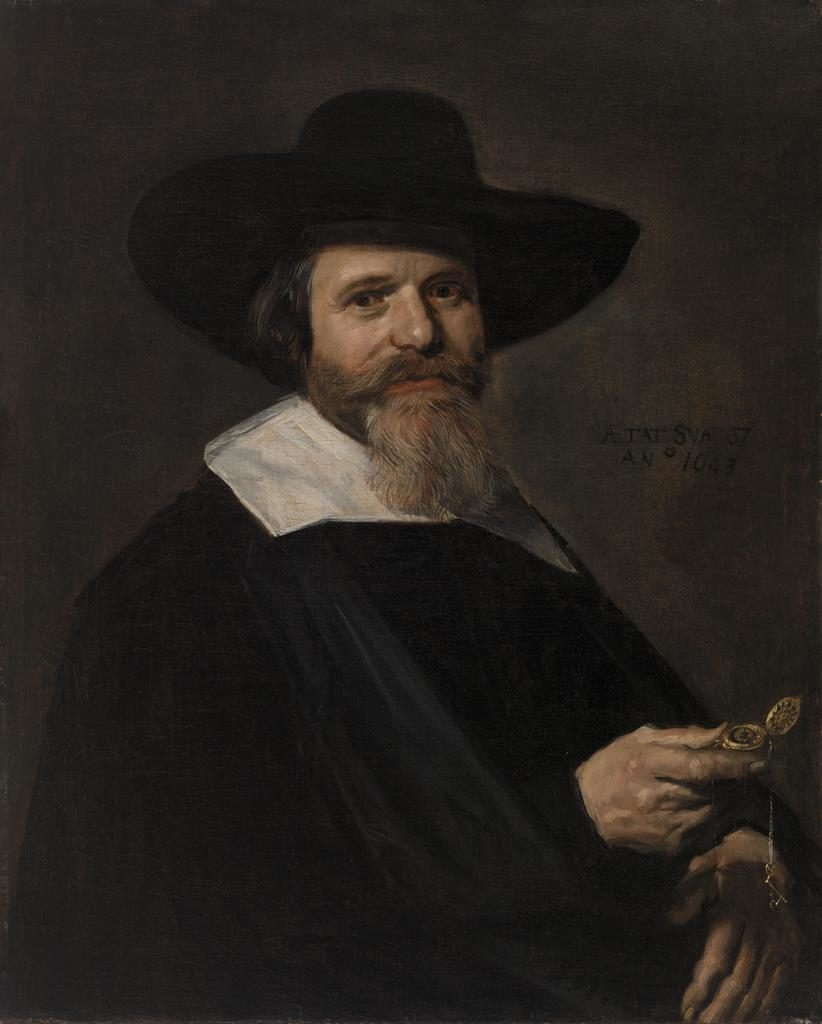
Antonio de Pereda Still life with clock (1652)
You’re not alone. The switch in time that happens twice annually is a generally unsettling experience, and, as it turns out, a generally unhealthy one as well.
Last week’s media were full of articles on the topic, with everybody and their uncle writing about the consequences of Daylight Saving Times, it seems. I thought I’ll add some additional value: art about clocks which, across centuries, reminded us of some basic truths: time is limited, the moment precious. Clocks rule us (even when they show a time that we know is not the correct one) and can be tyrannical in the workplace or at school, when our bodies are not keeping up with the demand. Artists have used clocks as symbols for synchronicity, or morphed them in surreal ways to help us question the reality of time. They have been displayed as symbols of luxury for those who have more free time than others, or as reminders that it is time to wake up and grab the day. Which brings me back to the alternation between Daylight Savings time and Standard time.
Pieter Claesz Vanitas (1625)
Our bodies contain numerous clocks – there is basically a timekeeper in each of our organs, and all of them are kept in perfect synchrony by the brain, that keeps score of the time with the first rays of light each day triggering the cycle. If you change the onset or disappearance of light by an hour, suddenly, the synchronicity between brain and the rest of the organs disappear, and everyone is playing catch up. (Jeffrey C. Hall, Michael Rosbash and Michael W. Young won the 2017 Nobel Prize in Medicine with their work on Circadian Rhythms that demonstrated the existence of these plethora of clocks.)
Marc Chagall Homage to Apollinaire (1912)
The consequences? An increase in heart problems, from fibrillation to infarction, particularly when Daylight Saving time arrives in spring. It is harder to fall asleep, during the brighter evenings, and harder to get up in the early mornings. Since the beginning of school, work or other commitments has not changed, “social jet lag” occurs, a mismatch between our internal clock and the external world that almost always leads to sleep deprivation. The health consequences of chronic sleep deprivation are well described: increased risk of mood disturbance, cardiovascular disease and metabolic dysregulation. (Ref.)
Paul Cezanne The Black Marble Clock (1869)
Statistics do not just show an increased hospitalization for heart and vascular disease issues directly after the time switch. We also see an increased number of car accidents and accidents in the workplace for the days following. That might have to do with driving during darker conditions, or being generally groggy and thus less able to pay attention, but the numbers do go up, in fact 6% for fatal crashes alone.
Who suffers the most from a mandated switch? Young people, it turns out.
“Because of the later biological pacing of the teenage brain, waking at 7 a.m. already feels to young people like waking at 5 a.m. With permanent daylight saving time, it would feel like 4 a.m. This would put a serious strain on teen mental health. The result would be, among other things, shortened sleep for a population that is already severely sleep-deprived and a potential uptick in rates of depression, when teens are already struggling with elevated levels of depressive symptoms and suicidal thinking.”(Ref.)
Raqs Media Collective Escapement (2009)
So, in its infinite wisdom, the government decided to do away with the back and forth between Standard time and Daylights Saving time. The Senate unanimously passed the Sunshine Protection Act of 2021, which would establish a fixed, year-round time. If passed by the House and signed by the president, our clocks would stay in the “spring forward” mode in November 2023, leading to permanent daylight saving time across the nation (except in a handful of states and territories that observe permanent standard time). Of course it picked, on the suggestion of Marco Rubio and Kyrsten Sinema, Daylight Saving Time that all of science says is much more unhealthy for us than Standard Time.
José Gurvich Still life with clock (1959)
This is particularly true for the westernmost areas of a given time zone. We already have later sunsets compared with the easternmost areas; during daylight saving time, West Coast citizens would experience a greater mismatch between their circadian clock and the external environment and an increased risk of adverse health outcomes. In addition, the seasonal variation in length of daylight is more pronounced at northern latitudes. Sunrise for the majority of months in a year at 9:30, dear Oregonians?
So why on earth mandate permanent jet lag? Whose demands could outweigh the advice of scientists across the board? Why, the economy’s, of course. Like clockwork.
“Proponents say that extra daylight in the evening increases opportunities for commerce and recreation, as people prefer to shop and exercise during daylight hours.” (Ref.) More time to spend money when it’s still light outside! Less crime which only happens under the mantel of darkness! (Apparently catalytic converter thieves are ignorant to the cover of darkness in the mornings, then. Maybe they like to sleep late…)
Our memories are short.
We’ve tried permanent daylight saving time twice before and it ended up disastrously. The UK installed it once before and ended it early. Russia tried it once, so did India, both abandoning it in no time.
It hurts humans.
Salvador Dali The Persistence of Memory (1931)
Of course the harm is insidious, not revealing itself until time has passed, with the exception of the immediate danger to school kids on their walk to school in the dark. This was also true for emerging cancers of whole groups of industrial workers. For decades, the luminous dial industry used young women to paint the dials of watches with paint containing radium. They were taught to tip their paint brushes on the tongue to make a sharp brush point; this procedure resulted in the ingestion of considerable radium leading to systemic uptake of some of the ingested radium. These massive intakes of emulsions of pure radium salts resulted in severe skeletal injuries and bone sarcomas of the dial painters.
Maybe we should gather all the clocks and walk them right out to fields, allowing our bodies to realign with exposure to natural light. Walk by the voting booth before, though, to make sure you install a Congress that is attuned to science when legislating for all of us. VOTE TOMORROW!
Jacek Yerka Nauka Chodzenia ( Learning to Walk) (2005)
How much beauty can you compress into a single day? Inordinate amounts, it turns out.
It helps, of course, if you live in Oregon, and if you define beauty in the most subjective ways, regardless of whether you look at art or nature.
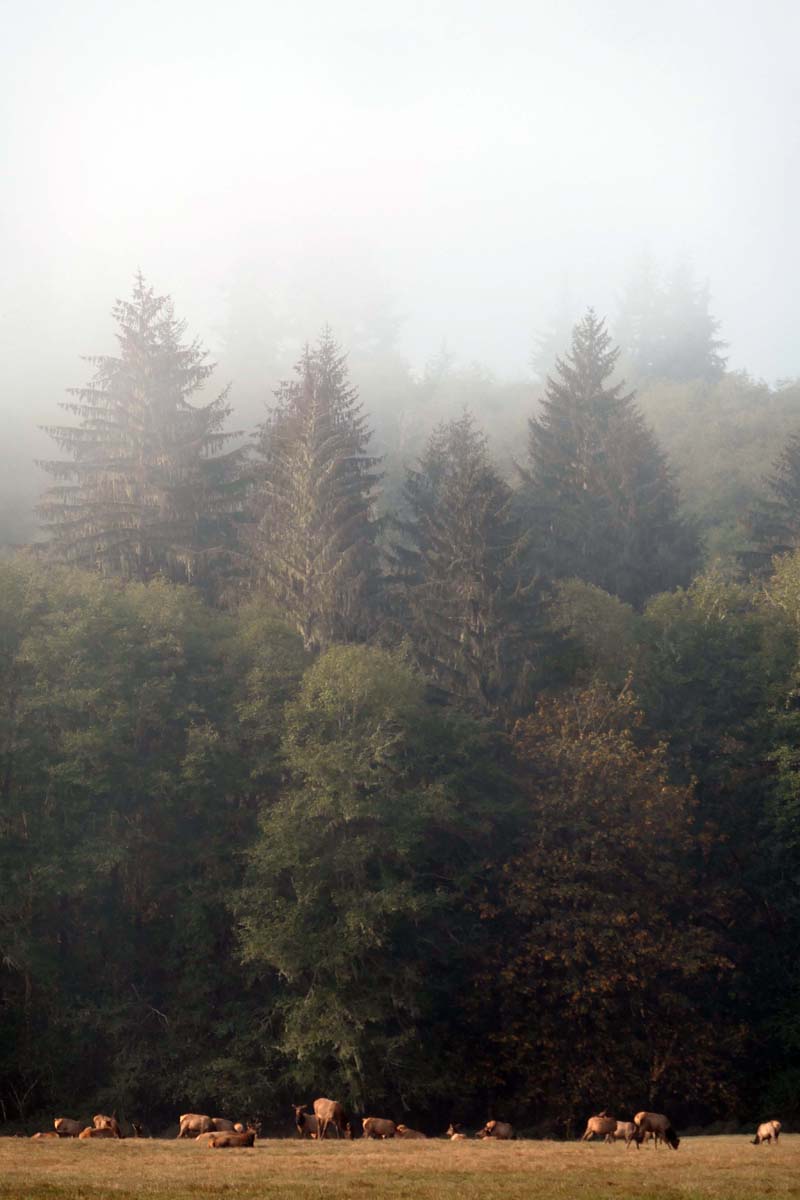
Come with me then, in the morning, to sneak a peek at herds of elk, in what could count as morning fog, but is more likely a mix of that and the intolerable amounts of smoke and haze wafting over the state from the Camas fires. Indeed, the entire stretch from Portland to the coast was filled with smoke.
The landscape looked worthy of a romantic painter, though, and the elk impervious. Kaspar David, where are you when we need you….
All of this was seen on the way to Astoria, itself shrouded in clouds on and off as well.
Reason for the field trip was the current exhibition at the CCC Royal Nebeker Gallery, The Ship Show, which was all about – you guessed it – ships.
Ben Killen Rosenberg, Clatsop Community College’s Printmaking Instructor, who conceived of and curated the exhibit, explains his concept for this show:
“When visiting Astoria, I always stop to watch the ships traveling up the Columbia River. Large vessels bringing goods or carrying vacationers from places near and far away pass by– a visual delight for all who see them. Ships are mysterious and romantic; they speak to an earlier time and a slower pace of travel, as they pass through vast bodies of waters. Ships can also be ominous harbingers of cruelty and environmental damage. From news reports I’ve followed, I’ve learned of ships carrying illegal cargo or using slave labor changing the GPS locations to avoid being caught by the few authorities on the “look out. Out at sea, in stateless open waters, the environmental impacts and horrendous labor conditions are monitored by almost no one. This is a show about ships as we know them–cruise ships, tanker ships, container ships, offshore vessels and fishing ships–it’s a Ship Show.”
I won’t be reviewing this one other than general remarks, since I have some of my own work in it as well as that of a close friend, but I urge a visit for the opening reception on Oct. 27, at 6:00pm. Not only will you be able to wrap your head around a remarkable variety of work (as well as quality differentials) by 20 artists working with different media. You can also admire Kristin Shauck’s success in hanging a show that would challenge the most experienced gallerist given the range of contributions.
Importantly, you will have a chance to look at a print that was one of the most beautiful images I have seen all year – and this has been a year pretty full of beauty. It was created by Royal Nebeker, who died some years ago, and for whom the gallery is named, after his distinguished career as an artist, but also a beloved teacher at the College and a strong community activist.
I will write about him, now that I have discovered him, (seemingly the last Oregonian to do so) in some future essay. For now let me say that the print could not be captures on camera to do it justice, but it is an incredibly suggestive and emotionally charged piece.
Here are some of the works on exhibit, paintings, photography, sculpture, and photomontage.
Powerful watercolors in background by Henk Pander
Anna Fiedler’s “Adventures are never fun when you are having them” can be yours for $2500….
Local photographer Roger Dorband captures Astoria like no other.
And here is work about the impact of climate change, any guesses?
The day started with nature, had art in the middle, and ended in the woods. A perfect sandwich to nourish the soul. A 3-mile afternoon hike along Ecola Creek, off 101 near Cannon Beach, provided plenty of daily wild life, and swathes of ferns, some now glittering with sun that had finally broken through.
Someone had left a mason jar with flowers and seashells in a tree hole, like an offering. Beauty in the gesture.
The rains will settle in tomorrow, FINALLY. Cherishing the last of the light.
Here is Ernest Bloch’s beautiful Epic Rhapsody, America – the composer lived in Oregon, and the 3rd movement shows some big ships in the video…..more importantly, I love his music.
In memory of Alice Meyer (z”l) who fought the rising dark forces to the end.
Tiresias:” You mock my blindness? Let me tell you this: You with your precious eyes,you’re blind to the corruption of your life, to the house you live in, those you live with – ” (415) – SophoclesOedipus the King, translated by Robert Fagles.
DO YOU REMEMBER the unfolding of this famous tragedy? A priest implores the mighty Oedipus, the king of Thebes who rescued all his people once before, to stop the plague that’s ravaging the land. The ruler eagerly agrees, but when he starts intuiting the truth that after all might save them, he does not want to see it – just as the blind prophet Tiresias, who knows and was commanded to reveal it, has trouble naming it for fear of wreaking havoc. The truth, once it’s acknowledged, will lift the plague but also devastate the king, and his desire to remain unseeing does end up leading to his ultimate demise, including gouging out his eyes himself. Blind, after all, for real.
Perhaps you share with me a sense of needing to protect ourselves from ever more bad news, unending, constant, one development more dire than the next. It feels like our sanity depends on turning our eyes and ears away from yet more fear-inducing bits, just like the king of Thebes. Pandemic(s), the rise of authoritarian regimes drifting into fascism, wars and the ultimate threat to our existence, the devastation of our planet through self-inflicted climate change: plagues, all.
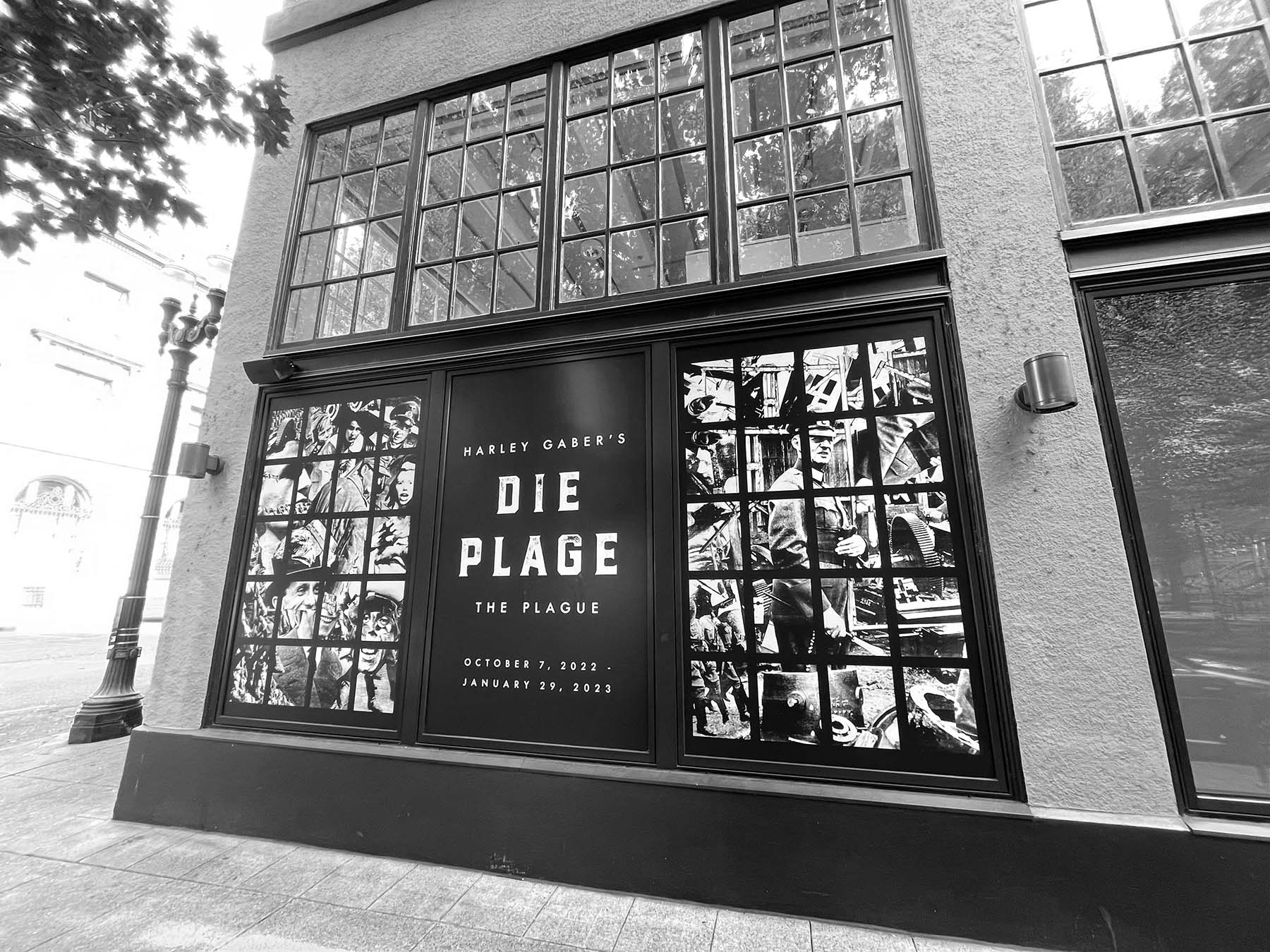
So why expose yourself to looking at depictions of the Holocaust, no matter how compelling, how educational, how directly speaking to the human heart? Won’t looking at the Oregon Jewish Museum and Center for Holocaust Education‘s current exhibition, Harley Gaber’s Die Plage (The Plague) depress us even more?
We must. We must engage because we’ve known since Ancient Greece, if not before, that blind passivity does not end well. We must, because the medium that carries the message, in this case walls and walls of 390 assembled, collaged, sometimes manipulated archival photographs from 1918-1945 Germany and other objects, is more effective than a thousand words or numbers. It conveys that plagues will haunt us unless we fight them and uproot the seeds that have been lying fallow, not destroyed. And if you argue I should skip the guilt trip, since all your life you’ve faced the issues of the Holocaust to utmost saturation, I get it, but I disagree.
The only way to fight the plague is to name, to depict and educate. It requires from all of us a willingness to be confronted with the history, our part in it, its implications for the world we live in right this moment. Even when looking is hard.
A close inspection of Gaber’s installation might reveal some parallels to social and political developments right here and now. It reminds us how authoritarian mindsets are fostered and how right wing structures are organized from scratch, with the support of protofascistic organizations. We live in a time where authoritarians get increasingly elected into office internationally, like Meloni in Italy, Orban in in Hungary, Erdogan in Turkey, Duterte in the Philippines, Putin in Russia or are hovering in the wings, like Le Pen in France, the Partij voor de Vrijheid, (party for Freedom) PVV in Holland, and the Sweden Democrats, a right wing, Islamo-phobic populist party that won in recent elections as part of a coalition with centrists. Yesterday holocaust survivor #LilianaSegre (a victim of Mussolini’s race laws) handed over the Presidency of Italy’s Senate to Benito La Russa, a man who wants to be an heir to Mussolini, gives the fascist salute, and collects fascist memorabilia.
Just last weekend, the far-right AfD (Alternative for Deutschland) doubled their votes in state elections to over 10%. One of their politicians, Holger Winterstein, publicly danced on the slabs of the Holocaust Memorial in Berlin this week, spouting phrases about the rebirth of the German Volk.
Memorial to the Murdered Jews of Europe, Berlin – Photo Friderike Heuer
Many characteristics of fascism can be found in the platforms of all of these leaders, including racial purity as a basis for national belonging, a fear of White-replacement, anti-feminism, a cult of leadership and worship of the military, a rebirth narrative, suspensions of democratic freedoms, and attacks against the press. I need not spell out how all of this applies to what is going on closer to home.
***
“Perhaps the belief that consciousness permeates everything and transcends – by that I mean encompasses – the cyclic nature of living and dying, would allow us to accept the inevitable beginnings and endings of things as part of a meaningful continuity, not just a tragic aberration” – Harley Gaber, September 2010 as related in the Interviews by Robert Reigle.
HARLEY GABER (1943 – 2011) was born in Chicago into a Jewish-American family. Until the 1970s he was trained and worked as a composer, studying with Horace Reisberg in high school, then Kenneth Gaburo at the University of Illinois, Champaign-Urbana, and later Darius Milhaud, among others. His minimalist work is hailed as among the most distinctive of post-World War II American music. (The link leads to a detailed review of the artist’s music.)
His interest in artistic abstraction had started early with a fascination of Jackson Pollock’s painting, which he claimed influenced his music. So did Morton Feldman‘s elegant 1963 chamber work dedicated to the painter “De Kooning,” by all reports. The cross-over between music and visual art was present then, from the beginning. So was the tendency, in both art forms, to alternate between sparseness – compression, exigence, selection – and abundance, with the former more characterizing the music, the latter the visual onslaught of the montage motifs. Major compositions include Sovereign of the Centre (1972-74),The Winds Rise in the North: String Quintet (1974), I Saw My Mother Ascending Mt Fuji in 2009, The Realm Of Indra’s Net and InMemoriam 2010.
Harley Gaber in front of one of his photomontage panels in 2000 – Photo courtesy of Christina Ankofska
In the late 1970’s Gaber moved from NYC to California, leaving music behind for a time, devoting himself to playing and teaching tennis, taking care of his aging parents, and eventually the montage work across a decade that resulted in Die Plage. Several trips to Germany were undertaken for archival research and exploring historic places, Weimar and the concentration camp Buchenwald memorial site in Weimar’s suburbs, among them.
KZ Buchenwald Memorial Site – Photos Friderike Heuer
By 2002 he returned to composing, as well as some forays into film-making. His view of music shifted in perspective, former technical musical tools and conceptualization of consciousness replaced by a focus on the complexities of the heart. In a profound crisis, wrecked by insomnia, he took his own life in 2011 two weeks after his last composition, In Memoriam 2010, was published, a piece commissioned by the Dan J. Epstein Family Foundation, dedicated to Nancy Epstein, who passed away in 2010 and was a close family friend of the Gabers.
***
“Eine neue Kunst muss endlich angeben müssen wozu sie gebraucht werden will. ” (It’s about time that a new form of art declares what it wants to be used for.) – Berthold Brecht, Schriften zur Literatur und Kunst.
FOR SOMEONE INTERESTED in quantum physics and in the art of the Weimar Republic, as Gaber was by all reports, photomontage seems ideally suited as a visual medium. The combination of intimate scale and monumental extent, with ever smaller units affecting each other across space, in some ways mirrored his approach to musical notation. He drew parallels between our insights from physics to how he perceived humanity to function. In quantum entanglement you cannot describe the state of one of the quanta without the state of the other one. They can only be apprehended as a unit, even if they are far apart. Gaber’s montages gave visual life to this concept: the distinct groups of a society only to be understood in their linkage to each other. Perpetrator and victim, oppressor and oppressed part of the same system under the umbrella of a deadly ideology.
Photomontage basically refers to collaging with photographs, creating new and different wholes from altered parts, telling a story. It used to be a dark room, paper, scissors and glue affair. These days computer technology allows seamless merging and alteration of digital images where all evidence of historical reality of the components disappears. At the heart of it is fragmentation and construction, playing with perspectives that encourage or prevent a subject’s visibility. The use of scale can obscure – sometimes smaller segments can distract from the larger picture, sometimes grand expansions blur your ability to see detail. Visibility, of course, will matter only if you are inclined to look. The switching back and forth between micro, macro or intermediate levels can be in itself demanding.
Then there is the matter of representation: who is represented, how do we represent? Are we manipulated by caricature, or surreal additions, by use of symbolism and/or text? If our hold on reality is ridiculed by including absurd juxtapositions, are we turned off enough to turn away? The question every artist needs to struggle with is how to represent a topic so over-saturated in visual memorial culture like the Holocaust. How do you prevent archival photographs of boots and soldiers, trains and camps and swastikas in endless repetition from being seen as overly familiar tropes, sparking associations only to a concept, safely relegated to the past?
In Europe between the wars, photomontage techniques were used by many artists who were part of the Dadaist movement, protesting against the First World War. The surrealists soon grasped this tool that lent itself to their exploration of consciousness and free association – with quite a few women as path breakers: Emila Medková, Claude Cahun, Dora Maar, and Hannah Höch. But the real surge of photomontage could be seen when first Russian constructivist artists applied it regarding issues of social justice and then the Neuer Deutscher Verlag (New German Press), run by Willi Münzenberg, committed itself to photomontage as a propaganda tool, most famously in its flagship periodical Die Arbeiter-Illustrierte Zeitung (or AIZ) (Worker’s Illustrated), which it began publishing in January 1925. By 1930, artist John Heartfield, clearly a model for Harley Gaber, began to contribute his intense montages to the AIZ, attracting yet more readers. The new art form had signaled its intentions: agit-prop.
In 1931, one of my favorite montage artists, César Domeal-Niewenhuis, curated the very first exhibition devoted solely to the new art form – Fotomontage – under the aegis of the Berliner Kunstbibliothek, in Berlin. Raoul Hausman opened the event, and the montages were displayed in sections divided between advertising and political art, with John Heartfield and the Bund revolutionärer bildender Künstler Deutschlands (The league of revolutionary German visual artists) dominating those exhibits. Experimental works by Lászlo Moholy-Nagy and Hannah Höch, among others, had their own corner. I do not know if Gaber saw the catalogue or was familiar with this work, but it likely would have resonated. A fascinating retrospective of the history of art during the Weimar Republic opened in Berlin at the Staatliche Kunsthalle in 1977 – Wem gehört die Welt: Kunst und Gesellschaft in der Weimarer Republik (Who owns the World: Art and Society in the Weimar Republic). It might have been an impetus for Gaber’s new dedication given that the exhibition focused on the ways in which the artists related to the people, how they attempted to contribute to changing the world and how those actions were received. The anti-war photomontage work of his U.S. contemporary, the brilliant Martha Rosler, devoted to exposing the failure of our political class to learn anything from history, might also have been of interest to him. We will never know.
Then again, the desire to create this monumental work might have come from a uniquely Jewish-American perspective trying to map the universal principles that emerge when humans embrace or are exposed to the maelstrom of ideology and desire for dominion. By deconstructing the specifics of that moment, or of the era that produced the horror, Gaber hoped, perhaps, to lay bare mechanisms that translate generally. As a humanist he certainly acknowledged the agency of human beings, respecting moral values, but was also quite aware that living up to our potential is contextually shaped.
***
“Here the ten plagues will be enumerated, and it is a widespread—though not particularly old—custom to remove a drop of wine from the cup for each plague. This strange practice was explained to me, when I was still a boy, that wine is a symbol of joy, and because each plague caused our tormentors to suffer on our account, the joy over our own liberation is diminished…Whether this explanation may make claim to historical truth may remain unanswered, but one must recognize the poetic truth in it, because it breathes the spirit of Judaism.”Rabbi Eduard E. BanethDer Sederabend: Ein Vortrag, (A Lecture on the Pesach Seder) published in Berlin in 1904.
ONE OF THE HIGHLIGHTS of the Passover Seder is the recitation of the plagues sent by G-d to punish the Egyptians who enslaved the Jews – that is if you share the table with young kids. With glee and abandon they dip their fingers, fling the drops of grape juice, yell the names of the afflictions, vermin among them. (Bonus: throwing the plastic frogs and locust used for decoration at each other.) The plagues seem far away, the threats averted. But much history is learned during this annual event, oral transmission linking generation after generation.
Harley Gaber did not grow up around a seder table, the household culturally Jewish, but he intuitively understood the role of children in societies that try to relate their history and, for some, keep their power hierarchies intact.
The montage display contains numerous single images of children and also groups them in ways that form more cohesive narratives. You have the (pre)-teens of the Hitler Youth right next to their Jewish age mates, ready for the trains to be transported. The uniforms of the Hitler Youth (an early unit of the Storm Troopers, mandatory participation for all youth) prepared for the soldierly character of the NSDAP, signified in-group membership, and conferred status. They had to be bought by the parents and many boys were keen on them, thinking it was cool. Children learn the values early, but also understand the power distribution, growing right into docile and willing soldiers, as long as they are not the bottom of the heap.
Top and bottom, after all, a major concept in fascistic thinking, which denies the truth that all of usare equal. In their twisted ways, race, religion, gender, sexuality, physical and mental health were markers of the hierarchy. The spatial word “unter” (below) an important suffix for power relations: there was the Untertan (imperial subject,) the Untergebene (subordinate) and eventually the Untermensch (subhuman), denying Jews and Roma their humanity.
One of the prominent texts in Gaber’s installation reads: “Wir fahren nach Polen um Juden zu versohlen.” (We’re traveling to Poland to give the Jews a good hiding.) The German verb is mostly used in the context of teachers beating their students, something children could easily comprehend. Now they weren’t the targets, but someone else was. It was not just the teaching that violent persecution of minorities was ideologically justified. Children learned early on that hatred, anger or resentment – the whole range of anti-humanistic feelings – were acceptable and even desirable, as long as they found their targets in convenient scape goats. Rote expression of loyalty in these paramilitary youth camps eventually turned to the real thing. Belonging felt good, de- individuation in those group settings eased remaining conscience.
Wir fahren nach Polen um Juden zu versohlen
Parallel to spending afternoons and evenings in these organizations (divided by age groups and gender,) indoctrination became part of the school day as well. It was not just what was NOT allowed to be read or learned, (book banning, anyone?) but importantly how curricula and instruction materials were centrally under the complete control of the party apparatus, as were the hiring and firing of (dis)loyal teachers and professors. Education was no longer geared towards the development of personality and learning, but forced the kids to put on mental blinders, uncritically digesting what was offered, a reduction to the atavistic stages of development. I see Harley Gaber’s work as enormously prescient in that the indoctrination of youth, so prominently displayed in his montages, is to be feared, and easily accomplished when education becomes usurped by those in power and ideologically or religiously driven. We see it, here and now.
***
“The purpose of art is to lay bare the questions that have been hidden by the answers.”– James Baldwin, The Price of the Ticket: Collected Nonfiction, 1948-1985
GABER’S INSIGHT about the interconnectedness of a nation’s strata can be found in his depictions of ordinary Germans going about their lives in union with the rising fascists, as well as conservative politicians, who engaged in Faustian bargains with the Nazi representatives in order to hold on to power. At least that was my interpretation, thinking that perhaps one of the photographs portrayed Kurt von Schleicher, the last chancellor of the Weimar Republic, eager to keep oversight over the military and appeasing his rival Hitler, eventually murdered by the Nazis during the Night of the Long Knives.
Top row, 6th panel from the left – portrait of someone reminding me of von Schleicher.
We often forget that during the rise of radical forces more moderate political parties are willing to form alliances with them in order to achieve or stay in power, with the strong belief, if one is generously speculating, that they might keep them in check and under influence within their power arrangements.(A good introduction to this topic can be found here.) That certainly was the case with Hindenburg and Hitler, or Emperor Emanuel and Mussolini, catastrophic miscalculations, both.
Just looking at the current gubernatorial race in Oregon, we have reports that one of the candidate has tied herself to “multiple far-right extremists, including a militia leader, a financial backer of the January 6th insurrection, and a Q-Anon conspiracy theorist.” Another one is reported to have sought the endorsement of the Timber Unit, a group full of extremists, and accepted their award. She lamented to The New York Times: ‘You can see the deterioration of the beautiful City of Roses, now the city of roaches.’ Some people have interpreted that as a de-humanizing reference to Portland’s many unhoused people (a claim denied by the candidate), and a dog whistle to the far right that calls them pests. Roaches. Pest. Plague.
It is not only politicians, though. When celebrities, like Kanye West this week, spout unequivocally anti-Semitic statements on Twitter to their 30 million followers (there are roughly 14.8 million Jews alive) and are welcomed to the platform by the richest man in the world in short succession, it opens more space for resonance for poisonous beliefs and strengthens those who already agree. In Germany, 36.000 people marched in the state of Thuringia alone, at the beginning of October, called by the AfD to protest political conditions, with far-right extremists joined by many ordinary citizens in fear of deteriorating economic conditions due to the war in Ukraine and other political decisions around immigration and environmental protection. When right-wing extremists take to the streets together with the supposedly “middle class,” when there are no longer any fears of contact, the citizenry acts like a sounding box for the Neo-Nazis, amplifying the message. It normalizes anti-democratic positions. Harley Gaber warned us.
***
“Memory, the mind’s power of having present what is irrevocably past and thus absent from the senses, has always been the most plausible paradigmatic example of the mind’s power to make invisibles present.” –Hanna Arendt,The Life of the Mind (1977)
HARLEY GABER’S PHOTOMONTAGES attempted to make the invisible present through creative juxtapositions. He was keenly aware that only testimony, in this case a visual, constructed epic, can keep the past and its lessons alive. In that way, this installation could not be more timely for Jewish museums and institutions in a day and age where the memory of the living is receding, given that the last survivors of the Holocaust are passing on. Memory can only be kept maintained, if we transmit it, true for German and U.S. history of fascism alike. We owe a debt of gratitude to individuals as well as organizations who engage in that task.
From left to right: Melissa Martens Yaverbaum, Steve Gaber, Harley’s brother, Christina Ankofska. Harley Gaber installing one of his panels. photo on right courtesy Christina Ankofska.
After Gaber’s death, his friend Dan Epstein, President of the Epstein Family Foundation that sponsors this exhibition, and Steve Rees, a close friend of the Gaber family, organized the preservation of the work. Much time and resources went into digitizing, cataloguing and storage of 4.200 (!) montages (the 390 on exhibition are a subset based on prior selections by the artist.) This will enormously help curations of this body of work in the future.
Alerted by an article in the NYT about new and diverse approaches to Holocaust and genocide education at Jewish museums, Epstein and Rees (the co-manager of the project) approached a number of them to discuss the possibility of exhibiting Gaber’s work. OJMCHE, under the leadership of Judy Margles, decided to host the project. Margles was able to secure the talents of Melissa Martens Yaverbaum, Executive Director of the Council of American Jewish Museums (CAJM) to act as guest curator who extended the scope of the project beyond the photomontage work. You will find interesting materials that allow glimpses of the musician and philosopher as well. Yaverbaum, in turn, received support from Gaber’s brother Steve and Harley’s former partner Christina Ankofska in exploring the art and life of Gaber.
Christina had accompanied Gaber on one of his research trips to Germany, and was present for much of his work creating his montages and preparing them for one of the few exhibits he lived to see. She told me a story that she thought encapsulated his humanism, as much a part of him as were his visionary and creative talents. They left the installation of Die Plage in L.A. (LA Times review from the year 2000 here,) long after midnight, starving. Miraculously they came upon a hot dog cart, amidst a group of unhoused people. Gaber decided: “Hotdogs for all!” and they found themselves happily gorging in famished company now generously treated in the early morning hours. A Mensch, in other words, whose memory should be a blessing. It is up to us to keep his memory and that of all who perished under fascist rule, alive. Gaber’s montages will be of great assistance in that effort.
Memorial marker at the concentration camp Buchenwald memorial site. Part of the inscription for the victims, women and girls in this case, reads: “But you live as long as other humans keep you in their memory.” Many other markers are spread across the site for specific groups of victims. NON OMNIS MORIAR – I shall not wholly die. Photo Friderike Heuer
____________________________________________
Harley Gaber: Die Plage
October 7, 2022 – January 29, 2023
OREGON JEWISH MUSEUM AND CENTER FOR HOLOCAUST EDUCATION 724 NW Davis Street Portland, OR 97209
“The Japanese garden is not an enigma. Instead, it is more like an intricate and beautiful specimen of origami whose secrets cannot be readily plumbed by the casual observer. Just as we can with patience and care learn the folds and tucks that comprise the delicate paper crane, so can we come to understand and appreciate the components of the Japanese garden and understand the ideology and philosophy that underlie its creation. The Japanese garden is not intended to be a riddle but rather a reserved – almost sacred space in which the rootless wanderer may pause from the travails of daily life long enough to place them within perspective…. They are spiritual amplifiers, sounding boxes for the human soul.” – Andrew R. Deane, Japanese Gardens: Notes on Perspectives, Perceptions & Synthesis.
GREAT GARDENS entice you to return. If you are lucky enough to live close to one, repeat visits across seasons provide a panorama of change, sometimes subtle, sometimes dramatic, depending on the weather, the amount of light present, and decisively the time of year.
And so it was for me, after just having written about Portland Japanese Garden some weeks ago, that I visited again, this time, however, with a bit of trepidation. The change I anticipated was not so much the maples, finding their way to full color only in late October, if that with the drought. Rather I wondered about the addition of art into the landscape, part of the current exhibition Garden of Resonance: The Art of Jun Kaneko. Multiple large sculptures are placed across the garden.
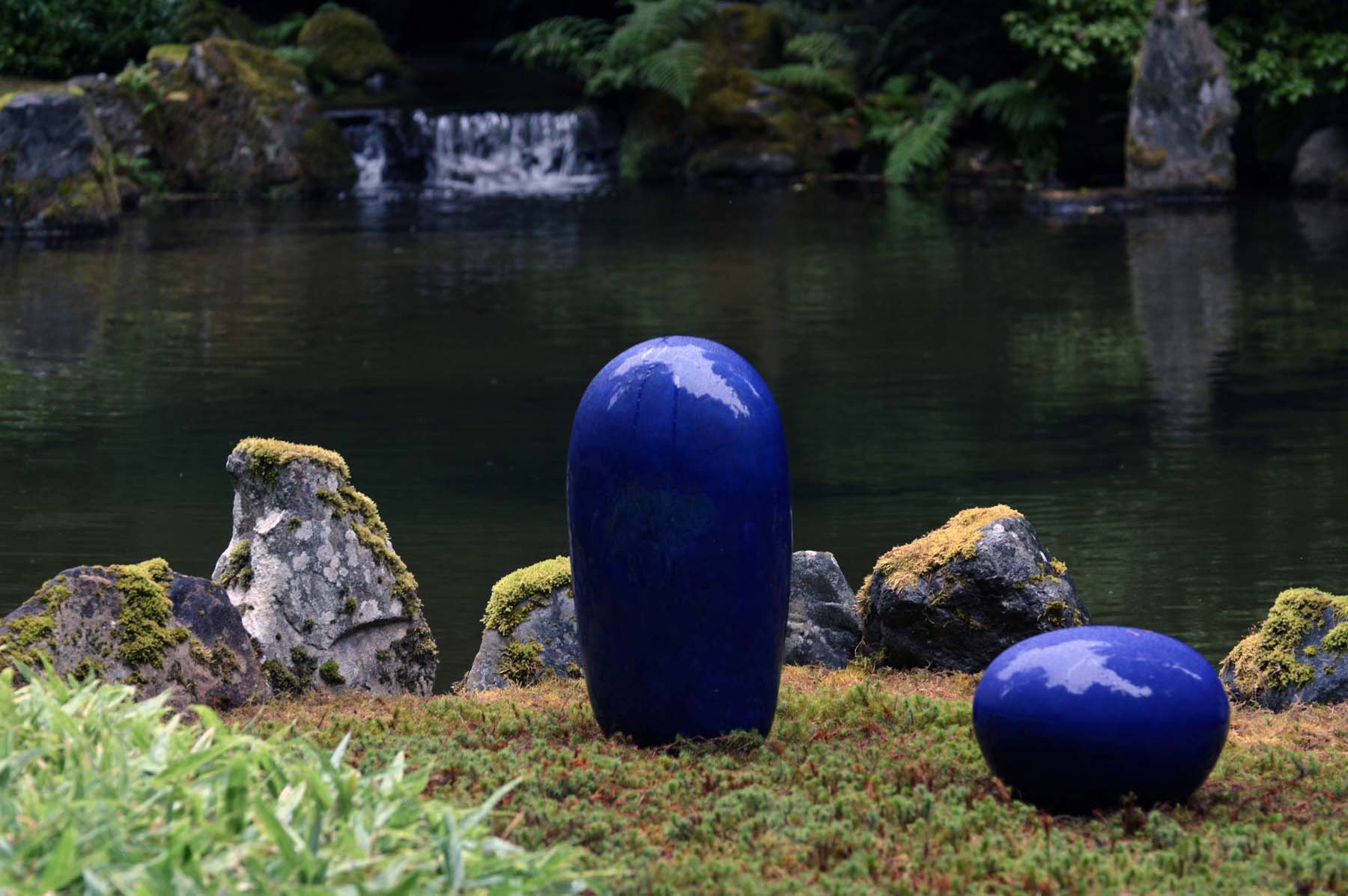
All images were taken by me at Portland Japanese Garden, unless otherwise noted. All of Kaneko’s sculptures are untitled. The taller Dango sculpture weighs 63 lbs, the shorter one 35 lbs. They are on heavy stone bases that have been neatly covered in soil and moss. The base for the shorter sculpture weighs 604 lbs, the base for the taller is 500 lbs. The sculptures are glazed by hand using traditional Japanese-made brushes.
The Pavilion contains recent work, including glass sculpture, drawings, paintings, hand built and glazed raku ceramics.
Drawings and paintings all untitled.
I have been, publicly and passionately, lamenting the fashionable practice of Botanical Gardens to drop art among the plants. I understand the temptation to succumb to the “wow” factor, as Sabina Carr, Atlanta Botanical Garden’s vice president for marketing, succinctly put it: “Wow, you have to see this.” (Visitors there can currently experience Origami in the Garden, metal sculptures resembling those folded papers, on steroids, many over 20 ft tall in technicolor hues. No comment.)
Photocredit: Friderike Heuer
I also understand that attracting more and different visitors, whether by presenting Chihuly’s eye candy or melancholic simians by local talent, makes a difference to marketing, and at times ensures economic survival. But I am worried that we’re losing the ability to pay the attention necessary for learning of, and finding out about, a single subject.
Photocredit: Friderike Heuer
This is inevitable, given how evolution geared our visual system to segregate figure from ground. Perceptual attention magnets that are linked to entertainment and visual pleasure are distracting from the task at hand – education about plants. Botanical gardens were historically, after all, meant to help us understand taxonomies, or possibly develop interest in biology. They are where pressing issues of conservation are made tangible, where you begin to understand the links of flora, climate and geography. Much of it pushed aside by the unavoidable visual pull of art among the shrubbery. I hastened to add, at the time,
“I have nothing whatsoever against Giacomettis on your pristine lawn that make the neighbors drool, or marble busts under your rows of Linden trees, or garden gnomes lining the lily pond. Well, I might reconsider the approach to gnomes. Art in gardens serves a purpose to guide the gaze toward the distance, shaping the way you view the horizon, or it delights you in the close-up, concentrating space. But your own garden, estate gardens, publicly accessible gardens, are not about what at the core defines botanic gardens: the scientific study of and education about plants.”
***
WHERE DOES A TRADITIONAL JAPANESE GARDEN fit into these considerations? On the one hand, one might argue that it is a space of quiet contemplation and immersion into nature. As Andrew Deane so aptly put it: “a sounding box for the human soul.” Adding thrills, no matter how beautiful the art, could potentially counteract this. It is also the case that traditionally Japanese gardens avoid combining out-of-scale elements. The art of reduction is an important principle within the Japanese tradition – miniaturization, after all, a trope – and the specific size of the objects is aesthetically important. Large objects, then, might interrupt the flow.
On the other hand – and I come decisively down on this side – these gardens are designed, not just traditionally incorporating sculpture, albeit restrained in size, in form of lanterns or bridges or pagodas, but in some ways being sculptured themselves, a fictional environment, as someone put it, resembling or symbolizing aspects of nature. Historically they have always been open to innovation. Varying philosophic and religious principles were applied to create a certain aesthetic, and changing tastes in general found their way into design. Already during the Muromachi period (1338–1573,) the character of gardens shifted with exploration added to or superseding contemplation. Different periods favored different degrees of elaboration—shin, gyo, and so – (“elaborate,” “intermediate,” and “informal”) are acknowledged principles in garden design, allowing evolution while maintaining a base of traditional elements. We might just think of the (temporary) addition of sculpture as a shin blossoming of this season that adds elaboration – and a reminder that perspectives change, our own as much as those found in the context of the garden landscape or the flora.
Before I turn to the absorbing art on display, two questions remain. How do the gardeners feel about these changes, given that their long involvement with the garden probably invokes a sense of ownership and responsibility to protect? They are the heart of a garden, their labor and care pumping the necessary ingredients through the veins of it, keeping it alive. Of course I could not ask them “Hey, how do you feel about 200+ pounds of clay being plopped on your delicate mosses,” and even if I did, what could they possibly say?
(The sculptures can range from 30 to 3,000lbs. The largest ones can take up to three years to complete and involves hand built construction by attaching thick, large slabs of clay to build up the shape, strategic drying to help make the sculpture sturdy enough to continue building higher and higher without the lower levels cracking and breaking, bisque firing in a kiln to solidify the form, then glazing and firing for a final time to bring out the colors of the glaze.)
A penny for their thoughts. And another one for the brains of the garden, to stick with the analogy, the leadership team that was responsible for the selection of the works. What criteria were used to exclude visual dominance or competition? The garden’s announcement contained the reassurance that
“While it is not the first time that Portland Japanese Garden has displayed large-scale art in its garden spaces, art “in situ” is still a rarity. Pieces on display were carefully selected by the team to accentuate the landscape, without overwhelming or competing with it.”
The choices, in the end, were quite convincing. Nothing was overwhelming, sizes manageable, and the one placement of extraordinarily large objects fit well into the center of the Cultural Village Courtyard, not distracting from the garden per se. There was a consistent, coherent and often peaceful color scheme of black, white and blues throughout, with the occasional outlier hue that related to its surround. A pleasure to take in.
***
“The challenge of making successful work is to create art that strongly engages the viewer’s imagination in any environmental circumstance in which it is place and experienced. Nothing exists by itself. Everything exists with the balance or imbalance of its relationship to others. This may be one of my central concerns and interests when creating any work. – Jun Kaneko
JUN KANEKO IS NO STRANGER to Portland. He has exhibited here at various venues across decades, and shown extreme generosity in his creation and partial donation of an artistic wall to the Beaverton Library. He is in continual collaboration with the folks at Bullseye Glass, and linked to our current composer in residence at the Oregon Symphony Orchestra, Andy Akiho. The world premiere of Akiho’s commissioned new work honoring Jun Kaneto will be presented in Omaha by the Omaha Symphony in March 2023.
Kaneko was born in Nagoya, Japan in 1942. Trained as a painter, he came to the United States in the early 1960s, and became interested in and involved with the California Clay Movement. Although he worked with different media throughout the years, his super-sized ceramics have been the focus of much public attention, and gained him the 2021 Lifetime Achievement in Contemporary Sculpture Award. Details about his career, honors, his studio(s) across the world and his and his wife’s Ree KANEKO Foundation in Omaha, Nebraska where he has lived since 1986, can be explored on their websites, which are exquisitely organized. There is also an informative introductory essay to the artist’s work and philosophical outlook from 2021 at Sculpture Magazine. A recent book offers gorgeous photographs and analysis of the evolution of the work.
All sources have interesting bits on the synthesis between ceramic work and formal and post-painterly abstraction, as well as Kaneko’s exploration of different modes of space – the way it is arranged between markings on a sculpture, the way it relates, and the dimensions it assumes. They also point to the evolution of artistic practice towards community interaction and public arts projects which have been a hallmark of the latter stages of Kaneko’s career.
I want to concentrate on Kaneko’s imperative (as quoted above) to engage the viewer’s imagination, and the fundamental relationships – that of maker to artwork, art work to or within environment, and eventually that of perceiver to artwork, the way I experienced it. And experience is the key concept here. I might understand a few things about what brought these sculptures about, more familiar with the vocabulary of modernist painting that is now applied to three-dimensional, often curved space, than the techniques of working with clay (I was stunned to learn that some of his larger works need several years to dry before even the first layer of glaze.) I might understand localism, but also that a traveler between distinct cultures has the choice to reinvent himself, adopt the super-sizing of a country keen on BIG, yet retain some sort of etherial aesthetic that I associate with Asian porcelains.
It is my emotional reaction to the combination of these two, however, those large, solid, earthy, comforting forms seemingly dressed with swathes of fluid, gauzy glazes, energized by dancing dots or swirling spirals or drooping fringes that echo falling rain, that gets me interested in this art. It is the experience that resonates.
Soft rain making the surface more reflective.
Jerome Bruner, one of the founders of the field of cognitive psychology and an eternity ago my dissertation advisor, used to lecture me that desire shapes perception, when at the time I only cared for research on the links between emotion and remembrance. He argued that our focus – my focus – on rational aspects of mental life, our ability to analyze and problem solve was too narrow. It is imagination, he suggested, that allows us to make experience meaningful. That narrative mode, as he laid it out in Actual Minds, Possible Worlds (1986), is of course context dependent. It is affected by our physical and emotional states, by stereotypes and closely held beliefs, and ultimately by our willingness to let go of our ties to logic and let our imagination roam without constraints.
Roam it did. Kaneko’s Dangos, Japanese dumpling-like shaped, might stand for childhood sweets for the artist. In me the vertical cones evoked, despite the absence of defining human features, associations to grandmotherly dimensions, some bulging forms of comforting embraces. Maybe it was the vague resemblance to the form of Babushkas of yore, my childhood nesting dolls. Maybe it was the isolation of the pandemic, the thirst for human contact that led to anthropomorphizing. A thirst not simply slacked by saturated colors, although the optimistic Prussian Blue provided lovely contrast to the misty morning air.
Note how the pattern echoes the surrounding leafy background. Resonating with the garden.
Little drops, the first fall precipitation, adorning some like pearls.
There seemed to be a guardian in front of the Pavilion, standing watch on land that once belonged to others. My imagination assigned the markings on this graceful piece the role of dreamcatcher – impressed by the strength of three-dimensionality captured in the painted shape.
A wound-like marking at the sculpture’s base completed the association to Pacific Northwest tribal history. Art stimulating narrative, potentially accounting for relationships with others and our debt.
***
BY INCLINATION AND BY TRAINING, I live in my head. My go-to mode is analytical, and I have always thought that being strongly drawn to gardens all across the world is rooted in the fact that those are places where the mind can wander. You don’t have to understand a garden, you are free to just experience it. Art is a trickier domain. It often begs for understanding, particularly when you’re trying to help others makes sense of it and judge its potential merits. Art that truly reaches me, however, is always one that manages to hush my analytic mode, and let imagination in, telling stories filled with affect. Building possible worlds, full of subjective resonance.
One of the strongest experiences of that kind happened a few years back during a fall visit to Venice for the 2015 Biennale, crowds long gone. I traveled alone and found myself late afternoon in the inner courtyard of an ancient Venetian church, Madonna dell’Orto, one of Tintoretto’s favorites. Large heads carved out of rock by British sculptor Emily Young were situated in the cloister, the covered walkways surrounding the enclosure, looking out into the space and at each other. The exhibition was titled Call and Response, and it felt indeed as if those faces called to me. A benevolent yet insistent, often female presence in the male dominated, hierarchical environment of the catholic church. I later learned that the artist intended her work to instill communication between mankind and nature, with an eye on climate change destruction in the wings. But at that moment, the distance between me and sculpture filled with emotional connection originating in the seeming call by inanimate faces carved in stone.
Photocredit Friderike Heuer
It is obvious why that memory resurfaced. When you enter Portland Japanese Garden you encounter two humongous heads, facing each other in the Village Courtyard. One has expressed facial features, the other encourages face pareidolia, our tendency to see faces in nebulous forms, an inclination that is often used to advantage by visionary artists. There is something distinctly theatrical in the way they are positioned, a call and response imaginable between them, a felt disruption when people’s movement fill the gap between.
Theatric expression, in the form of opera set and costume design, has been a part of Kaneko’s more recent artistic practice. So many constraints: constant shift in lighting, constant change in spatial relations, the need to have the music not overwhelmed by visual riches – by all reports, the artistry involved for productions of Puccini’s Madama Butterfly, Beethoven’s Fidelio, and Mozart’s The Magic Flute at world-renowned opera houses produced resounding successes. (The March 2023 concert of the Omaha Symphony will feature music from all three Kaneko-designed operas, accompanied by visual projections of his work. Images of the designs can be found here.)
Static sculpture escapes those pressures. Its relation to the visual environment is constant.
***
THE INSTAGRAM CROWD will descend on this display and any of the others that lend themselves to physical approach. But that will not be the only way these sculptures resonate. Resonance, after all, the term in the exhibition’s title, has so many different meanings. It refers to amplification through additional vibration – note, we’re back to the sounding box! It can also mean a quality of richness or variety, or the quality of evoking a response. A response that included a decided urge to touch the art, a desire to be physically connected, and not just for the junior set.
If the response to Kaneko’s work is to take pictures, our current means of linking to community and sharing the experience in times of isolation, that would be, by my prediction, a pleasing result to the master. It would be the other end of the arc in a career which saw the artist consigning creativity to the audience in early days. In 1971 people were invited (with seemingly empty invitations printed white on white) to come and see blank walls at the Form Gallery in Osaka, Japan. What do you experience in a space where there is nothing? Visitors were provided with a camera and allowed to take pictures of anything of interest to them and then the films were developed. The resulting photographs would fill the walls for the duration of the show.
We are privileged in 2022 to have our photography – and our narratives – stimulated by more than blank walls. Kaneko’s art at Portland Japanese Garden encourages immersion into different worlds of our own making.
Not sure how many people would agree with this sentiment found on Oregon City’s Willamette Terrace walkway. But I do believe we can all agree that the city, some 30 minutes south of Portland, is extremely polite. There is a welcome sign, wherever you turn.
You get encouraging advice (if I only knew what “there” is…)
perhaps leading to Eternal Impact, equally mysterious,
or fortification at the end of the road (the fountains themselves long dried out.)
Jokes aside, there is history wherever you look, preserved and displayed in public and museums. A lot of it can be found just looking at the buildings, the murals, the signage they offer, or the names they chose for their establishments.
Jail cells at the end of the alley center top – Masonic Temple center bottom. Municipal elevator from one level of the city to another.
Arch Bridge and original marker
I had come to Oregon City to look at the work of several artists displayed for the day at the Stevens Crawford Heritage House, another place where you can learn about the past. It was empty (still my condition to go inside in public places) on an early Saturday afternoon before a gathering organized by Art in Oregon to celebrate local artists and their work.
This is a collage made of paper clippings by one of the early inhabitants of the house – art always having been present, it seems.
The Craftsman American Foursquare House was built in 1908, and made into a museum after the last owner passed in 1968 and donated the property to the Clackamas Historical Society. It is furnished and equipped with everything original to the period, transporting you into the past. A large room on the ground floor has now been made in to the Mary Elizabeth Gallery, with local art hung there and in upstairs spaces as well.
On view were paintings by Kelsey Birsa, her Livingroom series containing a number of works dealing with the psychological effects of the pandemic and her ways of coping with it. One of the colorful attention magnets was a wall paper she created to reflect the garden surrounding the gallery, one of the few spaces to interact socially given the threat of infection. Her oil paintings, sometimes with added media, gold leaf, newspaper clippings or fabric draped over, were hung on top of the colorful background.
Kelsey Birsa Coping Mechanisms (2020)
Kelsey Birsa Here (2019)
Upstairs you could see some of Natalie Wood’s photographs,
Natalie Wood Were such her Silver Will (2019)
On display for the day were also the work of Clairissa Stephens, in the process of setting up her delicate botanical drawings with silverpoint on a gesso-like underpainting, from ink and pencil sketches.
All three of the artists had participated at some time or another in Art in Oregon‘s unique opportunity to spend a one-month residency at the Heritage House to work on their art in solitude. They are granted 24 hour access to a studio room and facilities (although they cannot live in the house,) in exchange for 20 hrs. of volunteer services at the museum. The Mary Elizabeth Gallery offers a chance to show work at the end, but is not exclusively slated for residents. The next exhibition, for example, is comprised of a huge variety of local talent, opening on September 23, 2022. The Ghost Showfeatures Alycia Helbling, Autumn Cornell, Don Hudgins, Elliott Wall, Erik Sandgren, James Dowlen, Jennifer Viviano, Kelly Shannon Chester, Kristin Neuschwander, Laura Weiler, Leslee Lukosh, Leslie Peterson Sapp, Nanette Wallace, Owen Premore, Tim Dallas – quite a range of divergent styles and media.
Mary Elizabeth Gallery
603 6th St. Oregon City, OR 97045

September 23 - November 1, 2022
RECEPTION: Friday, October 14, 6-9pm
Open on Halloween: 4-7pm
Gallery hours : Friday-Saturday 10-4pm
***
I am regularly drawn back to Oregon City because of the river, the falls, and the not-so-distant past that still affects a complicated presence. The industrialization of the place provided homes and work for many colonial settlers, while displacing the tribes who lived on the land and for whom Tumwater Falls was a place of great existential and cultural significance. A bit of a walkway can be found at the north end of the river, surrounded by informative signs and public art. A view point further south does the same and allows visitors to look at the falls from afar.
Adam Kuby and Brian Borrello are the public artist team that created the Waterfall sculpture at Willamette Terrace Walkway.
Mill after mill, using the power generated by the water for processing lumber, wool, flour and eventually paper, clogged the banks of the river and interfered with access to the falls.
Several years back I had actually participated in a walk through one of the old mills, Blue Heron Paper Company, now condemned, for an extended photoshoot that resulted in this compilation. (If you click on the book in the link and then on full view, you can scroll through the pages. Some of the resulting montages (below) were hung in a show at the Oregon City Hall.)
The site of the bankrupt paper mill, some 23 acres, was purchased in 2019 by the Confederate Tribes of Grand Ronde, who announced the new name for the planned restoration project just 2 weeks ago: Tumwata Village. It refers to the Native name for the falls and reflects the historic tribal connection to the area. Much demolition still going on, lots of rebuilding in the future. Details can be found in a newly launched website: www.tumwatavillage.org.
The planning process itself has been complex, though. Since 2011, much debate involved historic rights, and differing visions for a development that would protect tribal history and also would allow the general public to access the falls. Under the umbrella of the Willamette Falls Legacy Project multiple constituent partners focused on a commitment to public access, environmental and cultural restoration, as well as economic development. Oregon City, Clackamas County, regional government Metro and the state of Oregon partnered with the Grand Ronde Tribe, and eventually the Confederated Tribes and Bands of the Yakama Nation, Confederated Tribes of Siletz Indians, Confederated Tribes of the Umatilla Indian Reservation and Confederated Tribes of Warm Springs were invited by the Willamette Falls Trust, which began as the Legacy Project’s fundraising arm before expanding operations. As is so often the case in projects with numerous participants, conflicting needs, demands and eventually tensions were difficult to resolve.
This spring the Grand Ronde tribe left the project to pursue the restoration on their own propriety bordering the river directly and independently. Information about claims of conflicting interests can be found here and here, and in an OPB interview. Of importance to those of us who are not entitled to take a position, given our lack of historic knowledge and access to innumerable facts, is to remember:
“… these fractures stem from painful histories. None of these confederations, or the boundaries between them, existed before colonization. In fact, in 1855 there was only one western Oregon reservation: Siletz, which is where the tribes that became part of Grand Ronde were originally scheduled to be sent. But President James Buchanan abruptly decided to establish the Grand Ronde Reservation as a second western Oregon reservation instead of an extension of Siletz. On a foreigner’s whim, the tribes became separate peoples.
“Over the years, there’s been a lot of trauma and historical legal wrongs done to the tribes just falling out of that history.” (Ref.)
That is what I am thinking about when looking at this natural marvel, the largest waterfall in the Northwestern United States by volume, and the seventeenth widest in the world. It is 1,500 feet (460 m) wide and 40 feet (12 m) high with a flow of 30,849 cu ft/s (874 m³/s), located 26 miles (42 km) upriver from the Willamette’s mouth. Images below are from last week and from winter months, showing the effects of season on the river.
The horse-shoe shapes falls in September above, January below
The falls are one of the few remaining places to fish for lamprey eels.
September above, January below
Maybe the town itself is not one of the prettiest ever, but the nature at its doorstep is. They both hold a lot of history.
Here is what I currently listen to, water (or sea) foam, in musical form.
The only reason that you luck out with all these busy bee (or other insect) photos today is that I needed to counterbalance an account of an anything-but-busy writing routine that I – surprise! – found quite familiar.
This from Brian Bilston, the unofficial poet laureate of the Twitterverse, in an interview with Suffolk (UK) Libraries:
A typical day consists of the following:
7.30 - 9.30 Embrace the art of equivocation
9.30 - 11.00 Read a book on procrastination
11.00 - 11.30 Look up 'avoidance' in the dictionary
11.30 - 12.30 Dawdle, dither, delay continually
12.30 Break for lunch
1.30 - 2.30 Ponder the intrinsic nature of work
2.30 - 3.30 Re-prioritise some tasks to shirk
3.30 - 4.30 Hem and haw, chew my jaw, lurch and wallow
4.30 - 5.00 Write new To Do list for tomorrow
All the insects were found in dahlias. These are showy flowers in general, and have been favorites for painters for centuries, most often bundled in huge, colorful bouquets. Although there are innumerable new varieties, the basic types and colors can still be found 100s of years later, as the photographs attest.
Pierre-Auguste Renoir Dahlias 1918
Some like it daintier (I can relate, but am torn – these flowers lend themselves to bunching.)
Piet Mondrian Dahlia – circa 1920-1925Eugene Delacroix Still Life with Dahlias, Zinnias, Hollyhocks and Plums, 1835 Paul Gauguin Dahlias in a Copper Vase 1885Emil Nolde Rote und gelbe Dahlien, Undated watercolorHenri Rousseau Dahlia and Daisies in a Vase 1904SALVADOR DALI The Dahlia , 1979
And the most recent one from local master Henk Pander:
Henk Pander Still life with Dahlias 2022
And one of my all time favorites:
Theo van Rysselberghe Dahlias (to Mme Madeleine E.R Bonnet) 1912
Here are some of the ones that caught my eye independent of remembered paintings, again on the daintier side.
All the dahlia photographs shown here were taken during a visit to the Swan Island Dahlia farm near Canby, OR, some weeks ago. The fields are open until the end of September – it is really worth a trip if you don’t go on a weekend, about 30 minutes from Portland.