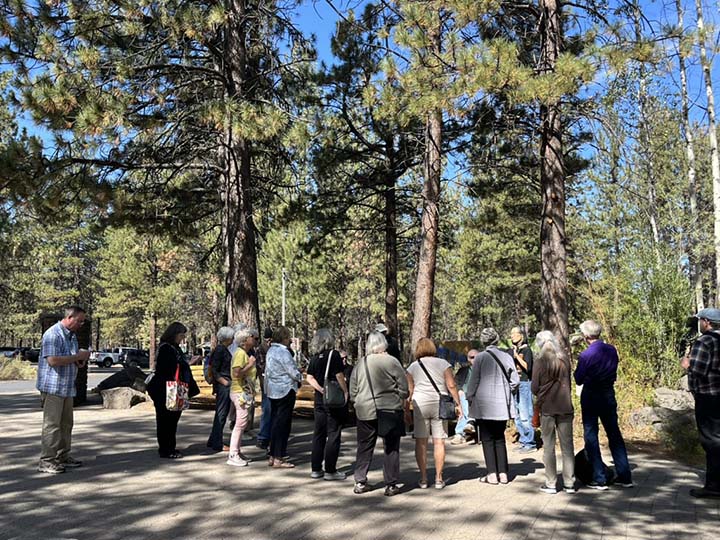
Last week OregonArtsWatch offered a roadtrip for some 20 participants to explore an exhibition at Clackamas Community College, the Museum at Warm Springs, the High Desert Museum, and various galleries and studios in eastern Oregon. Superbly organized, it provided glimpses into a wide range of artworks, art forms, encounters with artists and art administrators. For those able to attend, there was also the chance to see a play, hear a concert, and have a conversation with Ellen Waterston, current Oregon Poet Laureate from Bend.
A truly fun as well as educational trip. I was able to participate in some of these visits, having to cut short the trip when I started feeling under the weather.
What I marveled at: so many artists, such community efforts to gather and support the arts, so much success in preserving regional traditions and practices on various levels.

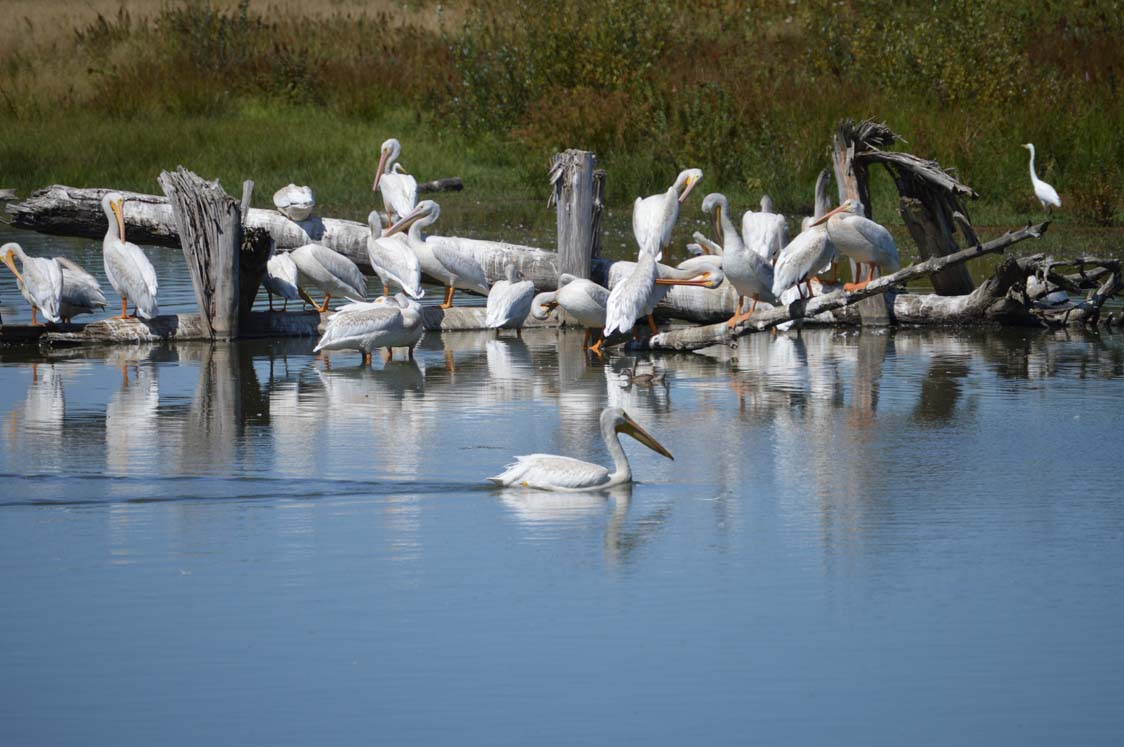
What I was surprised by: the focus on animals by the overwhelming majority of the art I encountered. I have never seen so many owl, raven or horse representations congregate on so few square miles in my life. Before anyone jumps to conclusions that I mean this condescendingly – let me differentiate. I wondered not about what I saw, but what I didn’t see.
Animals have played a role in art since people started to put paintings on cave walls. Originally likely provided with informational or spiritual intent by prehistoric societies, they later served as props to indicate status, or were meticulously drawn to inform about the natural world. They were used as codes for religious or political narratives, or simply depicted for the love of them. If you check out the animals in art overview by the MET, their 600 some items are stunning in their diversity and detail across the ages.
If animals are part of your cultural traditions, then their representations have symbolic value or help younger generations to preserve tribal knowledge.

Elizabeth Woody Sisters of Compassion 1 (1994) – part of the current exhibition at the Warm Springs Museum celebrating Lillian Pitt: Art, Memory, Home.
If your goal is an introduction to regional history and ecosystems, fauna and flora, then representing the relevant species is important and educational.

Battle of the Elks at High Desert Museum, Bend, OR
If your work is concerned with how we abuse our environment and how nature tries to find ways of healing, telling the story via a bit of animal magic is a compelling tool. (For PNW readers, run, don’t walk to Hilary Pfeiffer’s current exhibition, Microclimates, at the Alexander Gallery at Clackamas Community College. One of the most interesting shows I’ve seen in a while. More on that at some later point.)

Hilary Pfeiffer Timber (2026)
Artist Statement:

What are the reasons, though, for so many people who simply depict animals? An expression of emotional attachment, a love for nature the artist wants to share, a bit of escapism from the realities around us, focusing on whimsical distractions? Where is the line where whimsey crosses over into Kitsch?
Not that I mind whimsey in these times – here is one of the cutest examples that I was shown….

Owls ruled the back alleys of Bend, in public art.

Birds were a mainstay at up-scale galleries, and collaborative studios.


The High Desert Museum offered another example, Art in the West, a Fine Art Exhibition and Online Auction (still open for bidding!) that helps fundraise for artists and education programs. Look for yourself – here is the entire collection.

Todd Horton How to Craft a Poem (2026)
Critters galore, some of them exquisite, some leaving you wonder. One of the few contemporary works dealing with cultural/social issues was Frank Buffalo Hyde’s, a gifted painter and astute observer whose art I first encountered in New Mexico in 2017.
(The museum itself has excellent coverage of native history as well as the plight of immigrant workers in a terrific special exhibit – Miguel Almeida: Las Manos que dan de Comer (The Hands That Feed), just to be clear. I am talking here about what a call for art received as contributions.)

Karen Straight Stillness (2026) (needle and wet felted wool painting)
I am not asking for the presence of the likes of artists like Frida Kahlo, Kaethe Kollwitz, Carrie Mae Weems or Barbara Kruger, to name a few famous ones who deal(t) explicitly and predominantly with the issues of their time. But why have the current ecological disasters, from water shortage to wild fires across the West, the depletion of fish runs, the threat of species extinction, or the deportation of so many who were successfully and seamlessly integrated into communities, not made a proportional appearance? Any appearance?
There is a case to be made that depicting what you love – animals – might preserve your sanity in times that are challenging, to say the least. You focus on something positive and of value, rather than threats. It might also provide imagery of what is worth fighting for, once you return your focus to the realities of a country, or an administration that puts extreme stress on the environment and skimps protection for what is vulnerable within.
Yet I wonder: Are more directly political artworks avoided because we are saturated with bad news and need distraction, or are they absent for fear of stepping on toes? And are they avoided by artists, or are they limited by those who select artists for showing?
***
The road trip did not provide the answers. It did, however, offer one exception to the rule when we were invited to visit Scalehouse, a collaborative for the arts in Bend.
The 501(c)3 nonprofit organization was the brainchild of master printmaker, professor and arts advocate Patricia Clark, one of the instrumental co-founders who believed that creativity was not just a beneficial but an essential part of meeting the challenges of contemporary life. Some 15 years ago this group of innovators decided to create something more than exhibition space: they hoped to provide a platform for creative and intellectual exchange between artists, designers, scientists and community at large. Their programs include gallery space, an art lab education program, public art projects, and Bend Design, a conference that assembles problem-solving workshops, talks and films to instigate new ways of thinking for the future of design. Since 2015 thousands of participants have benefited from the offers.
In their own words: “Scalehouse promotes collaborations through a multidisciplinary and contemporary lens, encompassing visual and performing arts, architecture and design, film and storytelling, conceptual art and activism. From exhibitions to talks to the annual Bend Design conference, our programs catalyze a creative synthesis that’s impossible in isolation.”

The main gallery featured works by the community’s young. I spent my time, however, in the adjacent Patricia Clark Studio, which provides 6-months residencies to 2 artists with free workspace. One of them, artist and graphic designer Lona Owemo, has created a multidisciplinary collaboration between several local poets, the community at large and Owemo’s own visual representations of the poetry in chapbooks.

Drawings of Lona Owemo on Studio Wall
Mirrors of Dissemination was first revealed on the last day of April, National Poetry Month. Eight local poets read from their work in the studio, poetry that had been collected into chapbooks that Owemo designed and furbished. The public was invited to read or record their own reactions to the ideas on the walls of the gallery, which also hold many of the artist’s own graphite drawings.

Here is a typical example of the chapbooks, featuring poetry by Mello Versiz, a transplant from Queens, NY, who provides a contemporary voice with scathing insights and occasional truly lyrical phrasings despite fraught subject matter (heavily copyrighted, so I will not publish a poem.)

The figures looked to me like ever more abstracted versions of cubist portraits, reminiscent, for example, of Diego Riviera’s output once he had moved to Paris. I couldn’t decide if fractals were also at work. I looked up the definition: In mathematics, a fractal is a geometric shape containing detailed structure at arbitrarily small scales, usually having a fractal dimension strictly exceeding the topological dimension. In philosophy, Fractalism is a concept, roughly, that everything is connected to and communicates with everything else.

Diego Rivera Young Man with Stylograph – (1914)
Whatever applies, the project’s title certainly pointed to communication: Mirrors of Dissemination. Dissemination has its root in Latin, the scattering of seeds. A seeding of ideas, here, harvested by diverse audiences. Connection between communicator and listeners is not the only one, however. Mirrors have taken on an ever-central role in the visual arts as tools for communal interaction between artist and viewers.
Originally used as props, just like animals were, mirrors shifted from being depicted objects to becoming integral parts of the art works. You have the infinite reflections of Kusama’s Infinity mirror rooms.

I was photographing a Kusama installation at The Broad, L.A., I think in 2019
You have Michelangelo Pistoletto’s Mirror Paintings which use reflective surfaces, making the viewer part of the painting once they step up to look. There are Graham Caldwell’s mirrors, which reflect unstable fragmentations of the observer, to mention just a few.

Graham Caldwell Mirrors – I photographed myself in them at the Arsenal Art Contemporain Montréal in 2018.
The artist, the work and the audience are interacting, destabilizing the role of the creator and producing a communal output instead, however distorted by the chosen lens.
Owemo’s portraits are obviously not using actual mirrors, but the artist’s choice of title and the fragmentation of the portraits urge us to construct a percept rather than rely on a provided one. There is a collective, interactive dimension, then, that echoes that of the poetry project overall, as well as the general philosophy behind Scalehouse’s contribution to the Eastern Oregon community.
Thoughtful work, managing to draw us away from our constant preoccupation with self – as found in the various captured depictions in reflective surfaces so prevalent on social media – towards thinking about what others are about or have to say.
Grateful that the ArtsWatch road trip made the introduction!