 September 18, 2025
“You’ll be my first sale of the day!,” a woman in a wheelchair suggested to me, holding up a bundle of Street Roots newspapers while I walked next to her in the South park blocks. I had literally just left the Oregon Historical Society’s current exhibition celebrating 25 years of Street Roots publishing, looking at it together with Jim Lommasson, a friend and fellow photographer who has powerful work up in the show. Vendor Karen’s optimistic smile sparkled just as much as her zircon-encrusted sandals, lifting me out of very dark thoughts about the current and future plight of the unhoused in our city, our country.
Over 100 vendors, some 50% unhoused and all living below the poverty line, sell weekly newspapers published by Street Roots, a non-profit Portland newspaper covering local as well as national news, offering opinions and art. In operation since 1999, the newspaper serves as a means for vendors to earn some income – a single issue costs $1 – and helps to forge contact between the housed and unhoused population in the human encounters around the street sales. Many of the vendors have consistent spots and regular buyers, they and their customers getting to know each other.

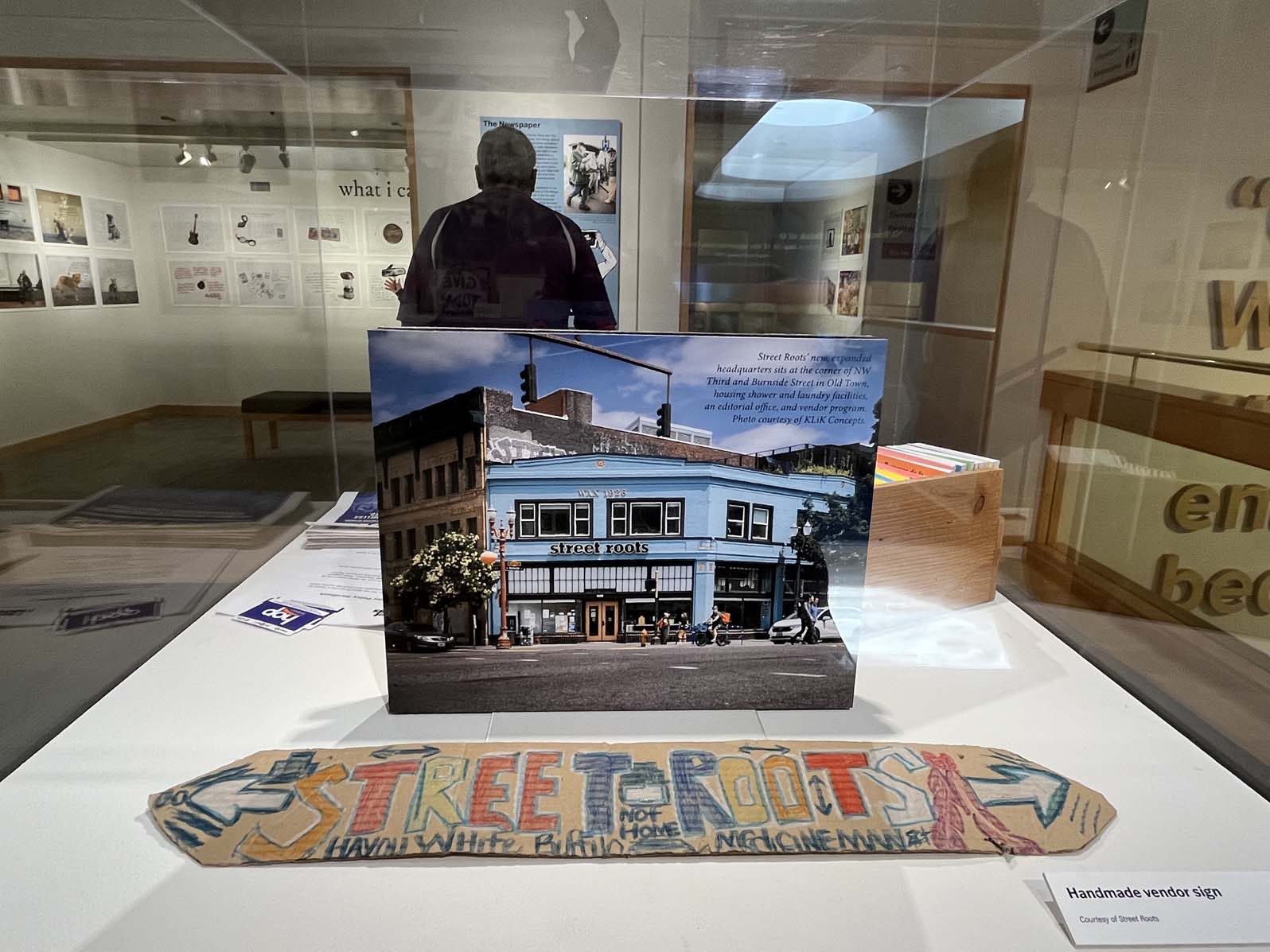
The organization, led by interim executive director Rebecca Nickels, provides more than just an opportunity to make money and community connections. The new building in Old Town offers opportunities for showers and laundry, help with administrative chores and opportunities for education or communal gatherings. With the move, Street Roots is in dire need to raise the funds for new operating coasts and changes in staff structures, not an easy task in the current economic and political climate.

Old vs. new digs….


Here is an in depth introduction about outreach by my ArtsWatch colleague Elizabeth Mehren, writing some months back about the weekly poetry workshop for vendors (for transparency, I regularly participated as a volunteer in that workshop before my immune system went south, some years ago.)
The exhibition at OHS presents a mix of informative text, objects related to the vendors’ trade and art by those involved with the newspaper. It depicts determination and resilience, as well as the difficulties and dangers of being unhoused. In the reverberating words of Kaia Sand, uttered at a previous showcase of vendors’ poetry, “There is a lot of courage out there.” Sand recently stepped down from her position as executive director of the organization after 7 years, and now writes an excellent column and a book about homelessness.
***
An entire room at the OHS gallery is filled with a collaborative project between photographer Jim Lommasson and vendors who wrote their thoughts and comments on pictures he took of their possessions, objects or animals that had particular meaning for them. There is a wall of dogs that tugs at your heart strings.

Jim Lommasson and collaborators what i carry.

There are items to cope with the hunger,

Jim Lommasson and collaborators what i carry.
the cold,

Jim Lommasson and collaborators what i carry.
the existence within a society that has turned its back on the unhoused, at best, and criminalizes and threatens them, at worst.

Jim Lommasson and collaborators what i carry.
And there is the constant reminder of the fragility of it all, with life-long, meaningful possessions lost to theft or, more frequently, sweeps.

Jim Lommasson and collaborators what i carry.
what i carry is an ongoing project by Lommasson, in which he uses his camera as well as his deep sense of justice to depict populations that have been displaced due to varying, most often traumatic, causes. His work with refugees, survivors of genocide and the Holocaust, whose few mementos are often the only thing that survived into life in the diaspora, has found national recognition. The photographs with their added commentary by the participants have been exhibited in countless national museums, including the Dallas Holocaust and Human Rights Museum, Ellis Island Museum of Immigration, NY, the National Veterans Art Museum, Chicago, the Japanese American National Museum, L.A, and the United Nations Headquarters in NYC.

Jim Lommasson in front of the images.
For the new project with Portland’s unhoused population, he faced a specific hurdle: you have to find individuals willing to participate, take a picture of what they offered, then print the work, and bring it back to the respective person for commentary: but where to find them in a population that is constantly on the move, due to the vagaries of street life and the constant pressure by the police to move away from previous spots, including regular sweeps of encampments? It took up to half a year to find some of the participants again. Street Roots, however, was one of the few institutions eager to support the project, and opened their doors to the photographer, with many of the regulars at the poetry workshop quickly engaged. Here is a detailed introduction to the series, exhibited at an earlier date at Place in full.
In our conversation we both agreed how working with this population immediately called out our very own stereotypes about the unhoused. The degree of learnedness and sophistication displayed in interaction around text and literature was a surprise. Just goes to show how deeply ingrained our prejudices are, our assumptions about what is or isn’t likely to be associated with precarious existence.

What Lommasson’s project does, however, is independent of the educational status of his collaborators. It unveils the humanity contained in all people, housed or unhoused, depressed and anxious or not, addicted in some fashion or another (easier to hide with a roof over your head, I might add) or not, sharing a place where we feel we belong – or are told that we don’t.
It is profound work that has the potential of opening someone’s eye to the underlying similarities rather than differences, of closing the gap between “us” and “them,” of diminishing stereotypes that continue to harm the pursuit of solutions addressing homelessness.
***
I did not ask vendor Karen in the wheelchair how she felt about the live TV remarks of well-known moderator and political commentator Brian Kilmeade last week. My sincere hope was that she had not heard them. I had not been able to shake the thoughts during my exhibition visit of what it must feel like to be unhoused and hear that someone publicly declares I should “simply be killed by involuntary lethal injection,” (after the Fox&Friends co-hosts discussed involuntary incarceration if “they refuse all the help regularly thrown at them.”) Kilmeade apologized several days later for “callous” remarks.
What is even happening? The U.S. homeless population includes over a million children and tens of thousands of veterans, many of whom served in Iraq or Afghanistan. Does poverty or mental illness, often PTSD-induced, justify extrajudicial mass killings? Does our desire to be spared the exposure to poverty and mental illness warrant detention camps? Scott Turner, Secretary of Housing and Urban Development in the second Trump administration, thinks so. During his confirmation hearings he indicated he would agree with his President’s plans. In Trumps own words:
“Under my strategy, working with states, we will BAN urban camping wherever possible. Violators of these bans will be arrested, but they will be given the option to accept treatment and services if they are willing to be rehabilitated. Many of them don’t want that, but we will give them the option.We will then open up large parcels of inexpensive land, bring in doctors, psychiatrists, social workers, and drug rehab specialists, and create tent cities where the homeless can be relocated and their problems identified. We will open up our cities again, make them livable and make them beautiful.”
Trump has now issued an executive order on July 24, calling for civil commitments of homeless people, criminalizing harm reduction efforts, an end to “housing first” policies and federal law enforcement assistance to help local governments sweep encampments. It follows the Supreme Court’s Grants Pass v. Johnson decision to criminalize public sleeping by those who are houseless, even if no shelter or other options available.
“In a 6-3 decision written by Justice Neil Gorsuch, the Supreme Court ruled that cities enforcing anti-camping bans, even if homeless people have no other place to go, does not violate the Eighth Amendment’s prohibition on cruel and unusual punishment. Gorsuch was joined by the rest of the court’s conservatives, including Chief Justice John Roberts.”
Since May 1, Oregonians living in encampments in forests have been evicted as well. (Ref.)
(I wrote about the historical, economic roots of No Trespassing laws regarding public lands following the abolition of slavery earlier here.)

Where are the unhoused supposed to go? Treatment and services are, of course, not just woefully underfunded, but simply not available for a large part of the population expected to agree to them. Here are the facts for Portland this summer:
Multnomah County’s Homeless Services Department estimates there are over 7,000 unsheltered homeless residents in the county as of May (likely a severe undercount). Since the beginning of the year, Mayor Wilson, who ran on a compassionate platform for the election, has added 430 new shelter beds, totaling 1,300 city-run beds. Including Multnomah County-funded shelters, 2,454 beds are available to local homeless residents on a given night (this number can be verified.) At least 4500 people then face civil or criminal penalties if found outside. Violation of the city’s current ordinance addressing “conduct prohibited on public property” is punishable by a $100 fine or up to seven days in jail.
Wilson has also increased the number of sweeps of encampments compared to his predecessor Mayor Wheeler, according to the statistics provided by the latest Impact Reduction Program, to an average of 26.6 sweeps a day, 4,815 for the first six months of 2025. The city sweeps homeless residents at a higher rate than its West Coast peers, and homeless residents in Multnomah County die at a higher rate than any other West Coast county with available homeless mortality data, as reported by Street Roots and ProPublica June 11.

Photograph part of the exhibition.
Many worry that the city’s clear investment in temporary shelters has led to a disinvestment of permanent housing. To be fair, in the last 8 years, the city built 2,238 permanent supportive housing units, which are currently in operation, and has 361 units in the pipeline to be built. That’s above its goal of building 2,000 units by 2028, but the number of people finding themselves without housing has dramatically increased over prior projections as well, and is likely to increase with the current trajectory of our economy.
The National Alliance to end Homelessness has an informative primer on the negative effects of criminalizing homelessness.
Two things stand out: By criminalizing people now, people who have nowhere to sleep other than the park or the street, you will make it harder for this population to land housing at any point in the future, given their criminal record. So the claim that it is about decreasing homeless populations is logically fallible.
Secondly, if you have the option to crack down punitively, you will likely ignore more structural remedies, since they would cost you more money up front. Building housing, the ONLY way out of the catastrophe we are experiencing here on the West Coast, will take a backseat. So will upping universal rental assistance, repairs to public housing, and funds for eviction prevention.

Found on a bookshelf at the old Street Roots Building – photograph by author.
One can only hope the exhibition at OHS educates large numbers of people about how much difference organizations can make in empowering and supporting the unhoused, paving a way back into a more secure life. These organizations, in turn, deserve our renewed, vigorous support.

Reading the newspaper, sold by Karen, Sept 10-16 2025 edition.


Sara Lee Silberman
What a splendid, edifying, touching posting!
It makes me glad that among my annual end-of-year-donations in recent years has been one to Street Roots. It clearly does vital, important work.
Cindy Lommasson
Wonderful article about an important exhibit. Thank you!