Browsing Category

Nature

Patterns

Here is the chain of events that led to today’s blog. Another one of those days of just me and the dog at home. I: trying to play the piano, as I only do when no-one is around given how much my skills have deteriorated these days. The dog: doing his best to make me stop, sharing that quality assessment, I guess. I: trying to explain to him the complicated structure of Bach’s fugues and how I needed to concentrate. He telling me in no uncertain terms that he hates counter point and really wants someone to throw a  ball.

Guess who won?

And guess who, reduced to reading, came across an interesting essay by Freud, flagged by someone who wrote about Bach’s ability to invoke both joy and fear, horror and beauty, exact opposites in his compositions?  Freud’s (1910) essay is called The Antithetical Meaning of primal Words (Über den Gegensinn der Urworte) and starts with a reference to his work on dreams and their ability to combine contraries into a unity – said simply: something can stand for both one meaning and its opposite. He then introduces an 1884 text by a historical linguist, Karl Abel, that describes at length a peculiarity of ancient languages. They contained, according to Abel, numerous words that have two meanings, one the exact opposite of the other. Some old Egyptian word might mean wet as well as dry, for example. Further, he claims, there were compound words that bind together things of opposite meaning (old- young, far-near) but they express only one of them.  All this was postulated for Egyptian, Semitic and Indo-European languages (and, coincidentally published at the same time in the late 1800s when Marx had written extensively about dialectics…)

Freud enthusiastically took off with finding words in the more familiar Latin that seemed proof for this: altus means high and low, sacer means sacred and accursed, and so on. Then he explored German, and wouldn’t you know it there were words with opposite meaning: e.g. Boden meaning the lowest part of the house as well as the attic… voila, archaic languages provided the pattern that re-appeared in dreams.

You can read his deductions now linking this perceived pattern to the analysis of dreams yourself (if you are not distracted by a bored puppy…) https://www.sas.upenn.edu/~cavitch/pdf-library/Freud_Antithetical.pdf

Only one problem: The bulk of Abel’s work was thoroughly discredited, it’s a croc; and that was already established by serious philologists in the late 19th century, for sure at the time of Freud’s writing. Freud was clearly seduced by a claimed pattern that fit with his hypothesizing around his discoveries and methods in his psychoanalytic studies. Whether he willfully ignored or was just hopelessly blind to the state of the art in linguistics, who knows. It is certainly the case that we are all subject to this kind of confirmation bias.

Independent of dreams, it is a fact that contradictory emotions can be experienced when listening to a single piece of music, and that patterns can be woven into compositions that are of a dialectical nature. Nobody did that better than J.S. Bach. Which was what started this whole train of thought….

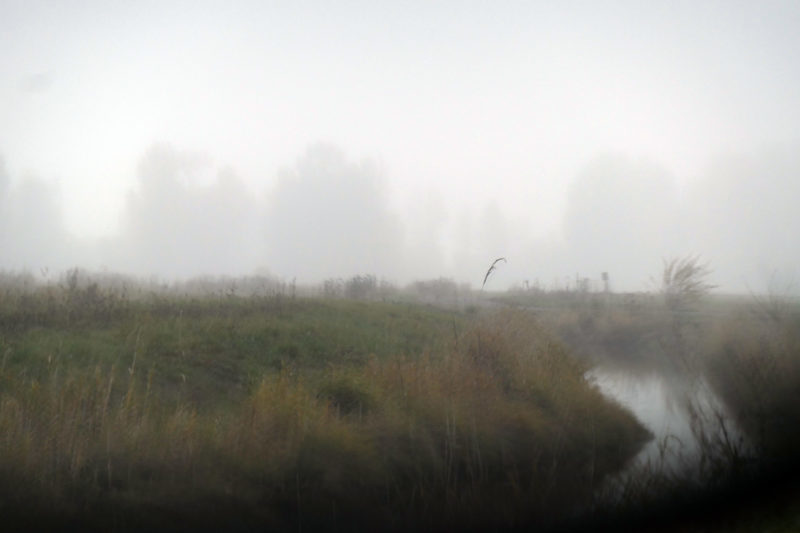
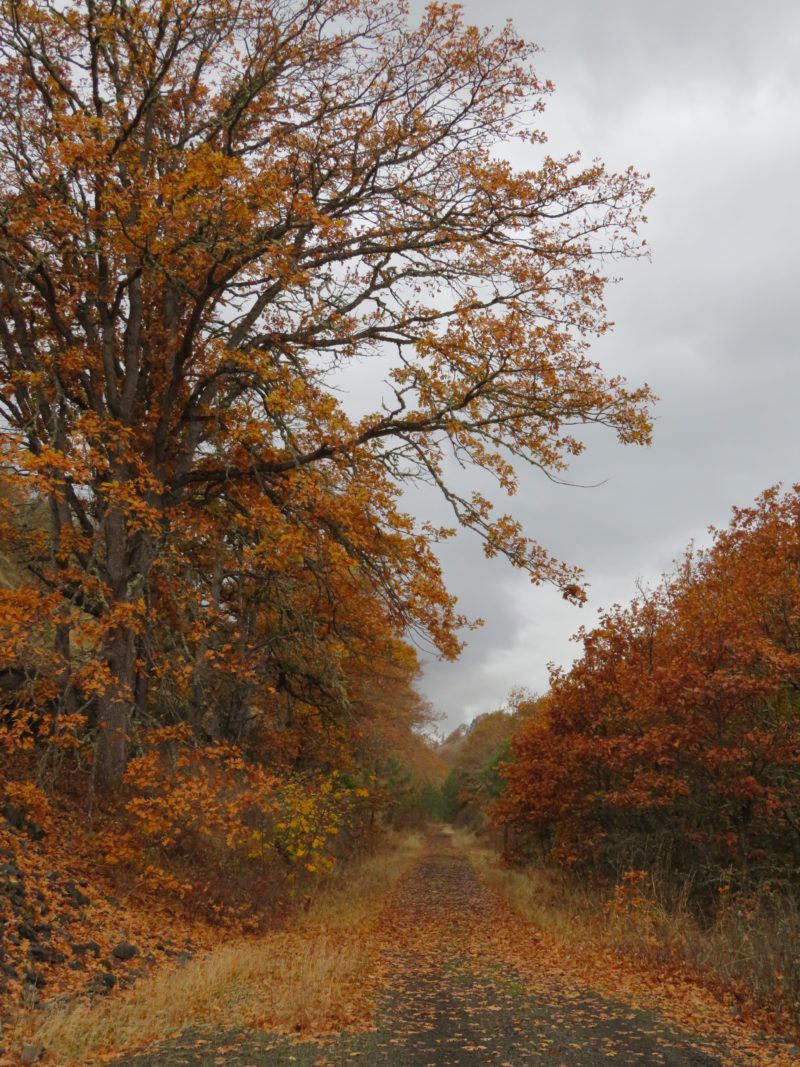
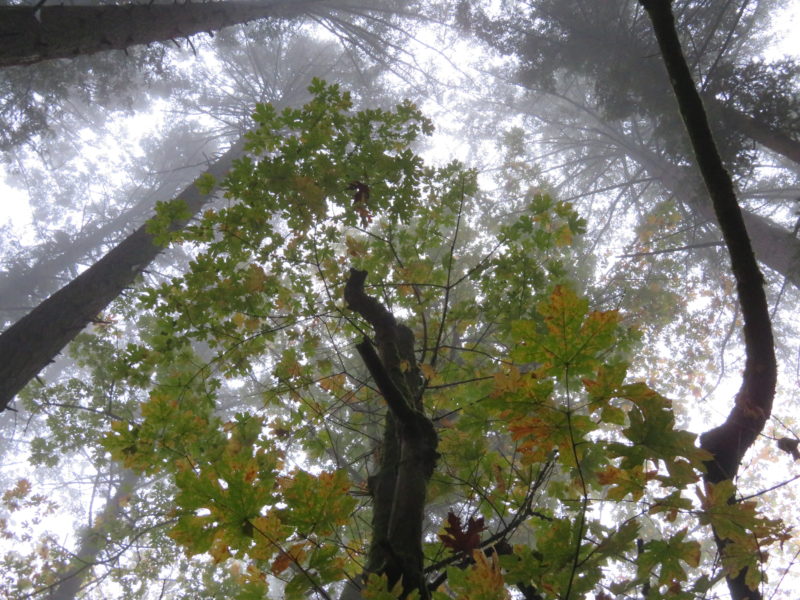
Photographs today of some lovely point/counterpoint reflections, collected during fall.


One for the birds, again…..

My grandfather was a small, musical man, his stand-up bass looming over him, or so it looked from the perspective of a small child. We rarely visited, but the visits were full of wonder and never more so than when he took us out on walks through the heather, forest and flats of Lower-Saxony. He knew all the bird sounds and was able to imitate them with his precise whistling, making music as we walked. He taught me about thrushes, robins and black birds, chickadees and woodpeckers, wrens, cuckoos and nightingales. I learned that there was a repertoire of communication among birds, from mating to warning to war fare, not unlike our own.

Listening to bird sounds, then, is a big source of joy for me; the first melodic ones in spring in the garden, or the rare, high pitched ones that hint at the presence of raptors when I am out on my jaunts, and now, in fall, the choruses of migrating flocks.

The migration of birds is in full swing – I thought it would be fun to share some of what I saw last week, and provide some recordings of what I heard. The Cornell Lab of Ornithology is a wonderful source – most of what is below I found there.

Here are the Canada geese which really are around all year, but seem to flock in masses during fall.

https://www.allaboutbirds.org/guide/Canada_Goose/sounds

“Various loud honks, barks, and cackles. Also some hisses.”

Then there are their cousins, the snow geese. This goose breeds north of the timberline in Greenland, Canada, Alaska, and the northeastern tip of Siberia, and spends winters in warm parts of North America from southwestern British Columbia through parts of the United States to Mexico. They fly as far south as Texas and Mexico during winter, and return to nest on the Arctic tundra each spring – says Wikipedia. I always feel particularly happy when I encounter them, since they remind me of one of my favorite children’s book: The wonderful adventures of Nils Holgersson by Selma Lagerlöf. A little misbehaving boy is shrunk and travels across Sweden on the back of a snow goose, having all sorts of adventures and providing the young readers, unawares, with a geography and biology lesson.


Then there were these huge flocks of ducks. I believe they were pintails, but am not sure, was too far away. They are shy creatures.

https://www.allaboutbirds.org/guide/Northern_Pintail/sounds

Throughout the year, male Northern Pintails give a short burst that sounds similar to a wheezy trainlike whistle. Females often make a rough stuttering quack similar to a Mallard.

And finally, my favorite of them all, the cranes. Not only are they beautiful, almost regal in their steady flight, but they have these amazing dances, of courtship or in territorial defense, where they seem to defy gravity, jumping high in the air with barely a lift of the wings, signaling muscle power that my limp, aging body can only dream of.

The link below gives you a glimpse of their toughness, engaging with black bears:

https://www.youtube.com/watch?v=M-NQgobvz40


https://www.allaboutbirds.org/guide/Sandhill_Crane/sounds

Sandhill Cranes give loud, rattling bugle calls, each lasting a couple of seconds and often strung together. They can be heard up to 2.5 miles away and are given on the ground as well as in flight, when the flock may be very high and hard to see. They also give moans, hisses, gooselike honks, and snoring sounds. Chicks give trills and purrs.

Here they are in flight:


Don’t you wish you could just travel with them? They are calling…..

Mushrooms Galore

Shortly after I first set foot on US soil in January 1978, New York City was blanketed by a snow storm. The kind where people where skiing up and down 5th Ave. Unprepared for the weather I went to Canal Jeans, a cavernous store on Canal St. near the lower Eastside that had a bargain bin/fleamarket section where you could purchase a used, moth-eaten, knee-length fur coat for less than the price of a new sweatshirt. Fur was not yet taboo and the warmest thing you could find on a severely limited budget.

Bundled in that monstrosity, woolen scarves wrapped around my head, I trecked north through winter wonder land, up to 57th St near Carnegie Hall, to check out the Russian Tea Room which had a significant reputation in the tourist guides.

http://www.russiantearoomnyc.com

I fit right in in that outfit, mothball smell and all, except that I did not have tightly curled bluish-white hair at the time but long blonde tresses. The waitress looked not a day over 100, which gave the the rest of those present a youthful appearance. Then 26, my age probably dropped the mean age in that room to around 79…..

Link below spells out the dress code for NYC restaurants in 1978….

All my budget allowed were a few mushroom-filled dumplings, which were divine. And every fall when mushrooms sprout and I am captivated by their beauty during my walks, I think back to those carefree times when the world seemed to be a place to be explored and conquered, observed and recorded. Come to think of it, I still do that. So enough of the nostalgia.

The mushrooms and fungi in our North Western forests at this time of year are little points of light,


popping up when you least expect them, guiding your gaze both downwards and upwards.

Some are like lacy ruffles,


others stodgy little fellows, some glow with moisture,

while the rest plays hide and seek.

Mushrooms have inspired composers to record “their” music:

and apparently they can save the world (poisoning certain people threatening the world not one of the suggested methods….)

Am I succeeding in taking your minds off politics today???

Another Hike

One of the things I like about Portland is the fact that you can immerse yourself in intense scenery with only an hour’s or so drive. To the West there is the stark Pacific, to the East there is the spectacular landscape of the Gorge. Somehow the wild mood swings of these fraught days can be absorbed into the drama of the vistas, the ever changing clouds, as mine did yesterday when driving along the Columbia River. It was intensely windy out there to the point where I had to hold on to the guard rails at the bluffs overlooking the river.


It also rained on and off in the morning, which meant I had to whip the camera out of my pocket and back in again during my hike. And hike I did, with physical exhaustion providing the desired peacefulness by the end of the day.

I chose the Klickitat trail, a 31 mile trail along Klickitat river in an old railroad corridor that used to link the towns of Lyle and Goldendale in the state of Washington. It starts at the confluence of the Klickitat and the Columbia, then goes for 13 miles through oaks and Pondarosa Pine woodlands, winds into the old town of Klickitat and eventually turns up into the remote Swale canyon, ending on the Goldendale plateau. I have never made it this far – my limit is at about 7-8 miles these days, for which I pay the next day….but it is fairly level and usually (not yesterday) fairly travelled, which means it’s safe when I do a solo hike.

But, man, was it worth it. The trail along the river was a symphony in rust,


Percy Manser In the Klickitats (1960)


sheltered from the wind, the only noises coming from the rushing water.


Some tribal members could be seen at their fishing spots. The traditional platforms seem to have been abandoned, I saw only salmon fishing from the banks and moored boats.


The best thing is, for me, the light.  With the large cloud banks driven over, the landscape often has homogenous shade punctuated by just one brilliant spot. I took it as a pointer to our times: let’s find that spot and ignore the rest.

Looking Up


Let’s take a deep breath and look up. Into an, admittedly, grey sky here in Oregon, but flecks of brightness can be seen none the less, in woods that have the beauty of mosaics right now, between leafy tiles and dark lines.

Not that I believe that help is guaranteed from up high, but there is something to be said for symbolic gestures. And if we are to make it through the least days before November 6 without losing our sanity, we might as well fortify ourselves with glimpses of nature.  That and bits of music written for fall.


Sometimes, however, it also pays to look straight ahead – in that case you might be cheered by Van Gogh’s Girl in the Woods or Heuer’s dog in same.

http://art-vangogh.com/

Or you might get lost in Gustav Klimt’s Buchenwald while I pursue the alders…


Get out there and breathe deeply. It will help.

Pigs and Pioneers

On Monday I reported on young artists working for change, on Tuesday on a long-ago icon being subjected to change, and today I am turning to someone who completely changed her life. Dr. Neena Roumell is the mother of one of my closest friends. Trained in developmental psychology by Barry Brazelton among others, she worked for large parts of her life with infants and their parents in the Detroit, MI area and authored books on fathers and infant attachment.

Recently married, she and her husband Atto Assi, a petroleum engineer from the Ivory Coast, decided in 2007 to pack everything up and move to Hawaii to start a self-sustaining farm. Now in her early 80s, Neena looks back at a decade + of adventure, learning, hard, hard work and incredible achievements.

Upon arrival the two cleared the 25 acres they had purchased from remnants of sugar cane and shrubbery, with their own physical labor as everything else they did. They built a house and water purification systems run by solar power, distilling drinking water.  They also constructed a green house, that provides zucchini, strawberries, tomatoes, cucumbers and numerous other fruits; together with an extended vegetable garden, and citrus and banana plants, they have their own basic food supply covered. I am trying to imagine tending to the gardens in a climate that drops 200 inches of rain annually on the Big Island….wimping out right there.

Next they planted 3500 oil palms, with the original seeds provided by the former Dean of the College of Agriculture at UH Hilo, who shared their interest in growing fuel crops to make the islands fuel-independent. Crushing the seeds provides bio-fuel, as do left-over restaurant oils with an extraction method devised by Atto. At peak, they can produce 240 gallons of bio-fuel per day. Trucks, tractors and generators are all covered by their yield, the rest is sold. Neena also wrote grants that received USDA support for their conservation efforts, helping them to set up the next big project:

A piggery!

Pigs are an essential staple of the Hawaiian diet and there used to be thousands of pig farming operations on the islands. The industry shrunk to next to nothing because of the smells associated with the trade and the incredibly unhealthy run-offs contaminating soil and water, and so most meat has to be imported, at high cost. There is a new movement now, however, joined by Neena and Atto, that reconnects to traditional Korean natural farming, a method that eliminates both odor and run-off problem. The approach uses IMOs, indigenous microorganisms, that break down the waste when combined with solar positioning and natural ventilation for drying and cooling.  Details here: https://www.hawaiitribune-herald.com/2014/02/10/hawaii-news/pioneering-piggery/

Key elements are a mix of homemade bacteria solutions applied to beds of organic mulch and logs that generate heat during the fermentation of the waste products, which is funneled off naturally. The beds stay dry, the piglets are snug and warm. The piglets are also fed a homemade diet of agricultural waste, algae, academia nuts, purple potatoes, papayas and tapioca. What started with 70 pigs is now a growing operation of hundreds, planned to peak at 1000.

Our pioneering farmers so far have only had occasional help, including numerous Wwoofers (WWOOF is a worldwide movement linking volunteers with organic farmers and growers to promote cultural and educational experiences based on trust and non-monetary exchange, thereby helping to build a sustainable, global community.) They are now hiring help, given how the farm has grown.

 http://wwoof.net  


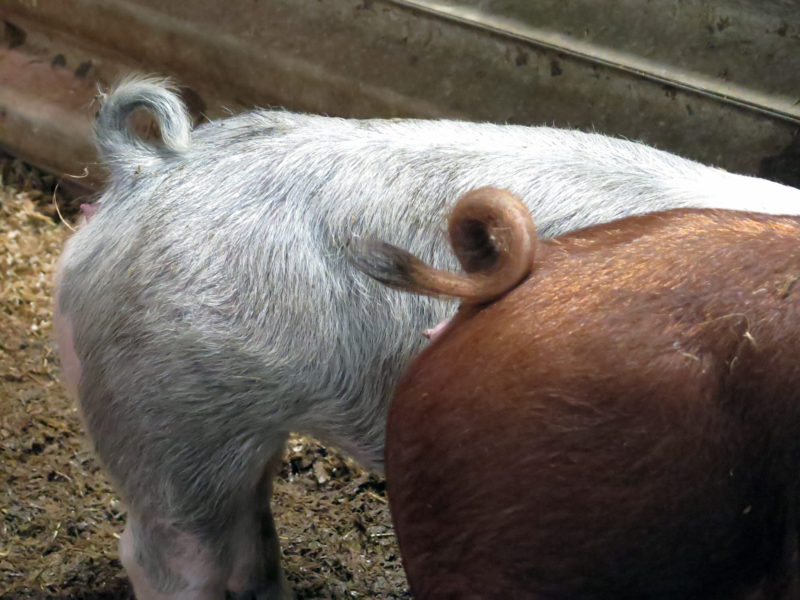
I don’t aspire to be a newly minted farmer in my 80s. I do, however, hope to have the pioneering spirit and physical strength to try out novel ways of being at any age that remains to me. I also hope to visit Hawaii at some point in time to take photographs myself. Today’s images are either sent by Neena or depict pigs that crossed my way stateside.


October Clamber

1680 feet elevation, coastal rain forest suffused by misty veils, a hidden treasure: what more could you want for the perfect day? Neahkahnie Mountain – also known as Place of the Gods in the Tillamook language – rises above the Pacific Coast a little bit north of Manzanita, OR.

Rumors of a hidden gold treasure, buried on or at the foot the mountain by Spanish sailors in the lat 16th century, won’t die. As the (gruesome) story goes, they put the gold in the ground, carefully watched by native tribe members of the area, and then killed one of their own black slaves on site, putting his corpse inside the hole with the treasure, knowing full well that the tribes were forbidden to disturb a man’s grave. Hundreds of treasure hunters have looked for the trove across the centuries, some of them dying when their excavations collapsed above them. Digging for treasure is now forbidden by law in this area.

The rumors were fed by the appearance of numerous artifacts of Spanish origin, including a cross with carvings embedded in slabs of beeswax. “Spanish archives list 33 ships as lost during the period of the Manila galleon. Five possible galleons from this list have been suggested as possible shipwrecks: the San Juanillo, lost in 1578; the San Juan, lost in 1586; the San Antonio, last heard from in 1603; the San Francisco Xavier, which sailed in 1705 and is known to carry beeswax; and the San Jose, which sailed from San Blas 16 June 1769.” This from the local historians. 

Where’s the treasure?

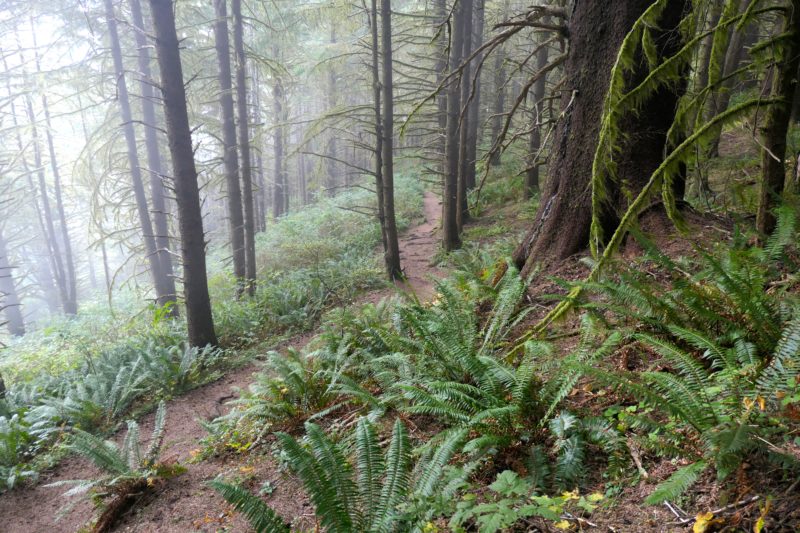
For me, the real treasure was right in front of my eyes: an incredible diversity of trees, mosses, lichen and fungi nourished by the up to 170 annual inches of rainfall (4.47 meters year!) at this point where a mountain and the sea meet (the definition of coastal temperate rain forest). Sitka Spruce, western red cedar, western hemlock and a variety of firs abound, all evergreen as is the Madrona tree.


Deciduous maples and alders are also in the mix, bringing some light and fall color into the dark forest.


Lots of Oregon grape and salal on the ground, as are ferns,

and epiphytes abound: you wonder how all that stuff growing on trees, particularly lungwort and cat tail moss, doesn’t suck the life out of them. But of course they are all part of a perfectly symbiotic system.

The quiet, when it is dry, is remarkable – when the rains come in the noise can be cacophonous. Yesterday, though, all we heard was a few single bird chirps, our own labored breathing at the steep uphill climb, the dull roar of the ocean somewhere in the background. The moisture in the air felt like someone was caressing your skin, and when the first sun rays broke through the mist, the fairy slides made this sentimental soul almost cry with joy.

And just when you thought you had gotten away with a happy blog for the day, here are some words of warning: this is what happens when you don’t manage these precious lands appropriately: habitat destruction, pollution, exotic species invasion and climate change lead to imperiled species:

https://www.biologicaldiversity.org/publications/papers/TillamookReport.pdf

On a happier note: we have a wise dog who abandoned digging for gold for the pleasure of romping with sticks….


Lift off!


Wave Jumping

Fall at the Pacific coast is another one of those reminders that nature rules, and even overrules the bad mood inflicted by too many thoughts about politics. This is particularly true if fall weather is as sunny as it has been this October, really breaking all norms. It makes for very happy bunnies,

intensely happy dogs

and extremely happy people.

It also foreshadows what is largely predicted now by all relevant researchers: a return of El Nino this winter, with warmer temperatures and less precipitation – maybe a boon for the coast but a disaster for snowpacks on inland mountains which serve as fresh water supply for Oregon all year long.

http://www.chinookobserver.com/co/free/20180725/climate-forecast-favors-onset-of-el-nixf1o-could-mean-warmer-winter-in-northwest

I have lived in the Pacific Northwest since 1986, and am still in awe, after 32 years, at the beauty of the landscape, its wilderness, its variety. I am also amused at the descriptions of this region – here is an example found in the Encyclopedia Britannica: …. the American Pacific Coast represented the western borderland area of the United States. As such, the people and the press of this region displayed over the years a degree of regional self-consciousness. Isolation from the rest of the country was early corrected by regional efforts to bring about a union of Eastern and Western lines of transportation and communication, an enhancement of maritime trade, and adequate coastal military defenses. Since then the Pacific Coast has been obliged to cope with many problems more peculiar to the West than to the East. For example, large-scale immigration from Mexico and Central America has been a major Pacific Coast concern, as has rapid urban population growth beginning during World War II. Another problem peculiar to this region has been the heavy dependence of West Coast business enterprises upon Eastern capital investment.

The people of the Pacific Coast are generally credited with being individualistic, casual in dress, and innovative in business management.

I arrived here yesterday and woke up to a misty sky this morning, just right for a planned hike on Neahkahnie mountain. There will be enough sweating as is, given the shape I’m in. I will take an individualistic tempo up hill, be casual in dress and innovative in my photography…..

This was yesterday’s sunset:


Thomas Moran’s Pacific Sunset (1907).


Leaf Hopping

The leaves are changing color. Uniform green now glows in gold, chartreuse, orange, red and brown. Some of the patterns look almost like expressionist watercolors.

Change is generally in the air, or so we hope. Across the generational divide people are promoting change – look, for one, what young people accomplish. On the heels of Parkland and the political engagement of the shooting survivors, we have seen a surge on youth voter registration. Will the young actually show up at the midterms? Some think it is possible, again the traditional pattern of midterm apathy among the 18-30 years olds.

Young Voters Might Actually Show Up At The Polls This Year


On the other end of the spectrum is this example of musical exhortation created by friends at the senior residence in Boston.of my 90-year old mother-in-law.

https://youtu.be/IVOycHHr270


Walking these last days under ethereally blue skies with leaves seemingly floating in the air even if they were still attached to their branches had a certain feeling of unreality.


There was a world suffused with beauty in front of my eyes, about to change the minute the rains hit, or the storms come in, just as nature proscribes it. We might not be able to escape the changes imposed by nature, but we sure do, as a society, make it hard for other change to happen.  That is true on the individual level – attached is a thought-provoking article from the NYT -click on the picture –

as well as the general level. And no, I am not going to discuss voter suppression, redistricting, closure of voting locales, hacking and so on – you are aware of it all as well as I am. I am just going to hop around in big piles of leaves, camera in hand, wishing that the forces battling the midterm elections are as strong as the forces of nature.

And here are Autumn Leaves from 1924 by Georgia o’Keefe

Lügen haben kurze Beine


Lies have short legs is one of the most commonly used German proverbs, implying you won’t get far with them. I was reminded of that phrase when photographing turtles and their short legs last Friday on an insanely beautiful Indian summer day out in Washington. Since I had every intention not to talk about politics during this week’s blog I won’t (for the most part) and instead regale you with another terrific travel adventure, conveniently linked to turtles.

Before I do so, though, let me point you to some psychological research attached at the end of today’s blog. The references might be of interest to those interested in understanding the evolutionary (dis)advantages of lying. My current favorite is towards the bottom: the Pinocchio Effect – nose temperature rises during lying…. maybe that’s why certain liars have to crumple it so often.

In the meantime, let’s flee to the turtle-paradise of the Galapagos Islands, specifically to the small island of Floreana, as did a bunch of truly strange people before us. I’ll skip the early inhabitants, marooned on the island in the 18oos and departing when a prison colony was established there by Equador by stealing some boats.

Rather, let’s look at the early 1930s when a Berlin couple, escaping married life of each to someone else, ventured to try a nudist life on the island. Dr. Ritter was a dentist (which probably led him to decide that in the absence of dental care to have all his teeth pulled and replaced by steel dentures. Rumor has it the same was true for his lover, Dore Strauch, and they shared the one set between them…) They settled on Floreana, trying hard to live off the land which was perennially short of water.

Another German family, the Wittmers, settled on the opposite side of the island; eventually, a mystery lady, “Baroness” Wagner de Bosquet and her male harem of 3 men, Robert Philippson, Rudolf Lorenz, and Felipe Valdiviseo appeared and she soon announced herself to be Empress of Floreana.

The Austrian woman seemed to have had  a zest for life, particularly its more carnal aspects, attracting many a yacht to this “end of the world,” to greet those sailors with ardor. She also got into endless fights with Dr. Ritter and was prone to violent fits if people did not heed the arbitrary rules she decided to impose. It did not end well.

We do, however, not know exactly how it ended for her – she simply disappeared with one of her lovers, after two others turned up dead on another island; and Dr. Ritter, a vegetarian, died of food poisoning, with Dore Strauch somehow making it back to Germany. A few other mysterious deaths occurred in the following years – an eyewitness account can be found in Frau Wittmer’s book Floreana – A Woman’s pilgrimage to the Galapagos. She died in 2000 at the age of 95, her family these days firmly established in the hospitality business on the island. Not that I’ve ever been there – and not on my list either, frankly, since all the excitement seems to have run out by the mid 1930s.

Here is some fascinating documentary footage and a link to a fuller exploration of the tale, a link I simply picked because I adored the title:

“The gruesome Tale of the Galapagos Islands’ Nietzsche-fueled Homesteader Death Showdown…..”

https://gizmodo.com/the-gruesome-tale-of-the-galapagos-islands-nietzsche-fu-1743091190

I WILL succeed in distracting us from the Kavanagh saga, eventually, but for now psychological research on lying can be found here:

Abe, N. (2011). How the Brain shapes deception: an integrated review of the literature. The Neuroscientist 17(5), 560–574.

Anthony, C. I., & Cowley, E. (2012). The labor of lies: how lying for material rewards polarizes consumers’ outcome satisfaction. Journal of Consumer Research 39, 478–492.

Bond, C. F., Jr., & DePaulo, B. M (2006). Accuracy of Deception Judgements. Personality and Social Psychology Review 10(3), 214–234.

Campbell, W. K., Hoffman, B. J., Campbell, S. M., & Marchisio, G. (2011). Narcissism in organizational contexts. Human Resource Management Review 21, 268–284

Dechêne, A., Stahl, C., Hansen, J., & Wänke, M. (2010). The truth about the truth: A meta-analytic review of the truth effect. Personality and Social Psychology Review 14(2), 238–257.

DePaulo, B. M., Kashy, D. A., Kirkendol, S. E., Wyer, M. M., & Epstein, J. A. (1996). Lying in everyday life. Journal of Personality and Social Psychology 70(5), 979–995.

Ekman, P. (2003). Darwin, deception, and facial expression. New York Academy of Science 1000, 205–221.

Ekman, P., & O’Sullivan, M. (1991). Who can catch a liar? American Psychologist 46, 913–920.

Levine, E. E., & Schweitzer, M. E. (2014). Are liars ethical? On the tension between benevolence and honesty. Journal of Experimental Social Psychology 53, 107–117.

Milán, E. G., & López, E. S. (2012). Researchers Confirm the “Pinocchio Effect”: When you lie, your nose temperature raises. http://canal.ugr.es/social-economic-and-legal-sciences/item/61182.

Piff, P. K., Stancato, D. M., Coté, S., Mendoza-Denton, R., & Keltner, D. (2012). Higher social class predicts increased unethical behavior. Psychological and Cognitive Sciences109(11), 4086–4091.