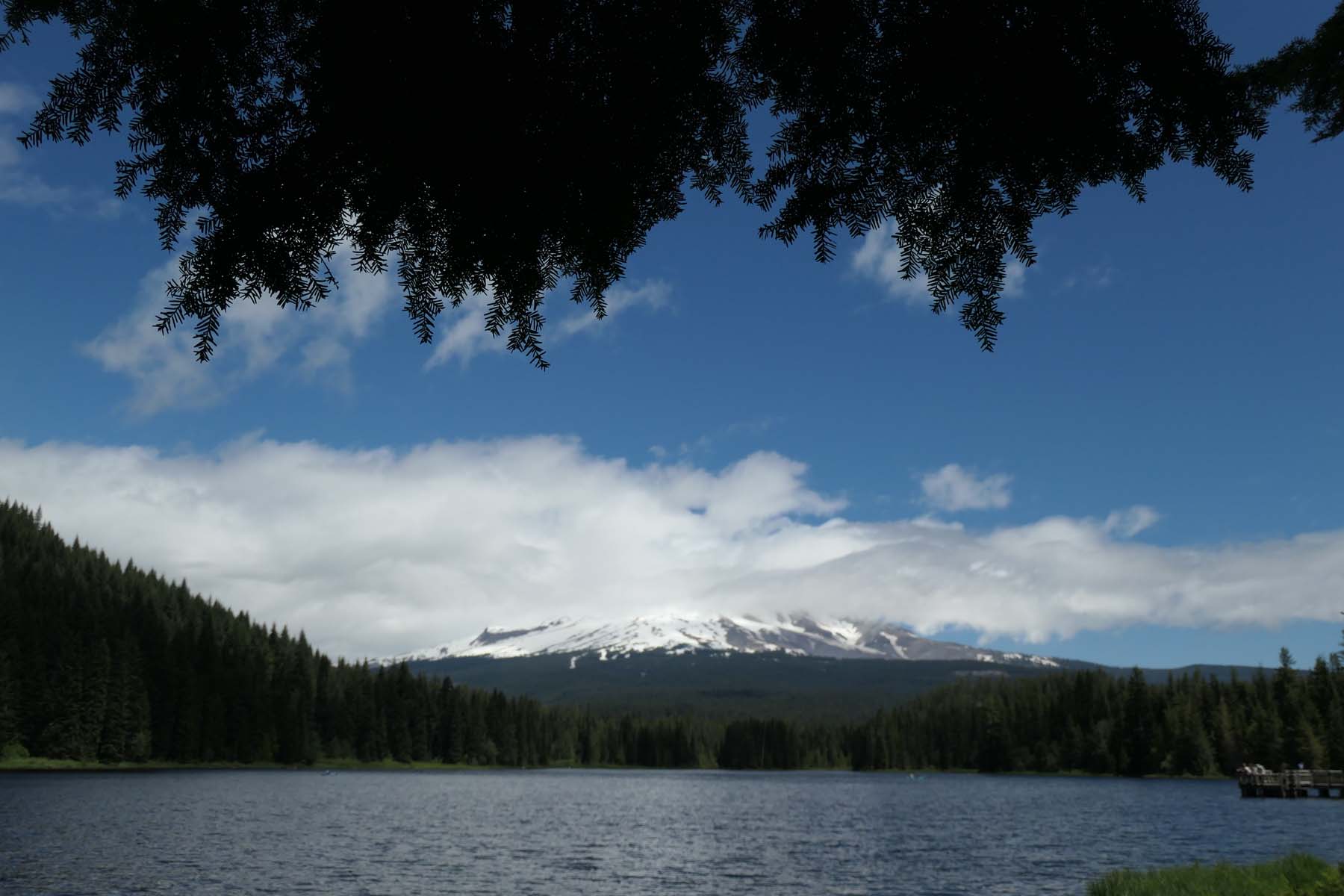
Last week saw me huffing and puffing on a perfectly flat path along the river, bones aching when I returned from a 3.5 miles hike (today’s photographs). My usual inclination would be to be demoralized. Particularly since I had been collecting stories of women my age and older, all of whom pulled off things physically a million times more challenging.
I was thinking of Ernestine Shepard who is a competitive body builder, trainer and model in her 80s.
I was wondering about Ginette Bedard who ran marathons at age 86 four years ago still. She did not start until she was 68 and has run 10 marathons since – good G-d.
I envied Jane Dotchin, a British woman now in her early eighties, who treks 600 miles with her dog and pony every year from Hexham, Northumberland to the Scottish Highlands.
Screenshot
Everything she needs, tent and food included, is in the saddlebacks, and she covers about 20 miles a day. Do yourself a favor and watch the short clip linked in her name above – it brings endless cheer.
Luckily, I had help fighting off demoralized thinking from two recently encountered sources. One is a a book by a contemporary social scientist at Yale University, Becca Levy. Her research, described at length in Breaking the Age Code, tackles how we internalize personal and cultural stereotypes about aging and how these adopted beliefs then have insidious consequences. The book lays out clearly how many structural factors contribute to ageism, but also how we can employ some simple mechanism so that we won’t fall for these beliefs and have them crimp our life expectancy. Here is an excerpt that succinctly tells what her focus is all about.
Her data suggest that activating positive age stereotypes for just 10 minutes or so improves people’s memory performance, gait, balance, speed, and even the will to live. I cannot judge if those are short term effects demonstrated in the lab, or actually extend to real life situations for the long run. I can confirm, though, that my other source of encouragement has captured what I have seen in my own context of aging and being surrounded by aging friends.
Here are the words of Simone de Beauvoir (from The Coming of Age, the obscuring American translation of her original title La Vieillesse, Old Age):
“Growing, ripening, aging, dying — the passing of time is predestined, inevitable.
There is only one solution if old age is not to be an absurd parody of our former life, and that is to go on pursuing ends that give our existence a meaning — devotion to individuals, to groups or to causes, social, political, intellectual or creative work… In old age we should wish still to have passions strong enough to prevent us turning in on ourselves. One’s life has value so long as one attributes value to the life of others, by means of love, friendship, indignation, compassion.” (Ref.)
Looks like we’re best served by marching some miles together with friends, passionately demonstrating for a cause close to our hearts. Connections and causes. Nature can wait!
Alternatively, it could be the cause. Some extraordinary lives were linked to nature – devoted to ecological research and saving the forests. Here is the spellbinding portrait of a woman academic who spent her adult life in a hunting lodge without electricity and running water in the Polish woods, sharing her housing with a 400 pound boar called Froggy, a lynx named Agatka and a kleptomaniac crow. Read the story here – it is guaranteed to make your day, another day towards old(er)age with a positive role model no less!
Simone Kossack with Froggy. What about all those clocks?
Music today is by another favorite activist who is still performing in her older years. Chaka Khan, Queen of Funk, and erstwhile member of the Black Panthers, will perform at the Hollywood Bowl, L.A. on July 26,2024!
Tell me something good!
(Song written by Stevie Wonder and originally performed with her band Rufus, heard a million years ago when I still attended live concerts…)
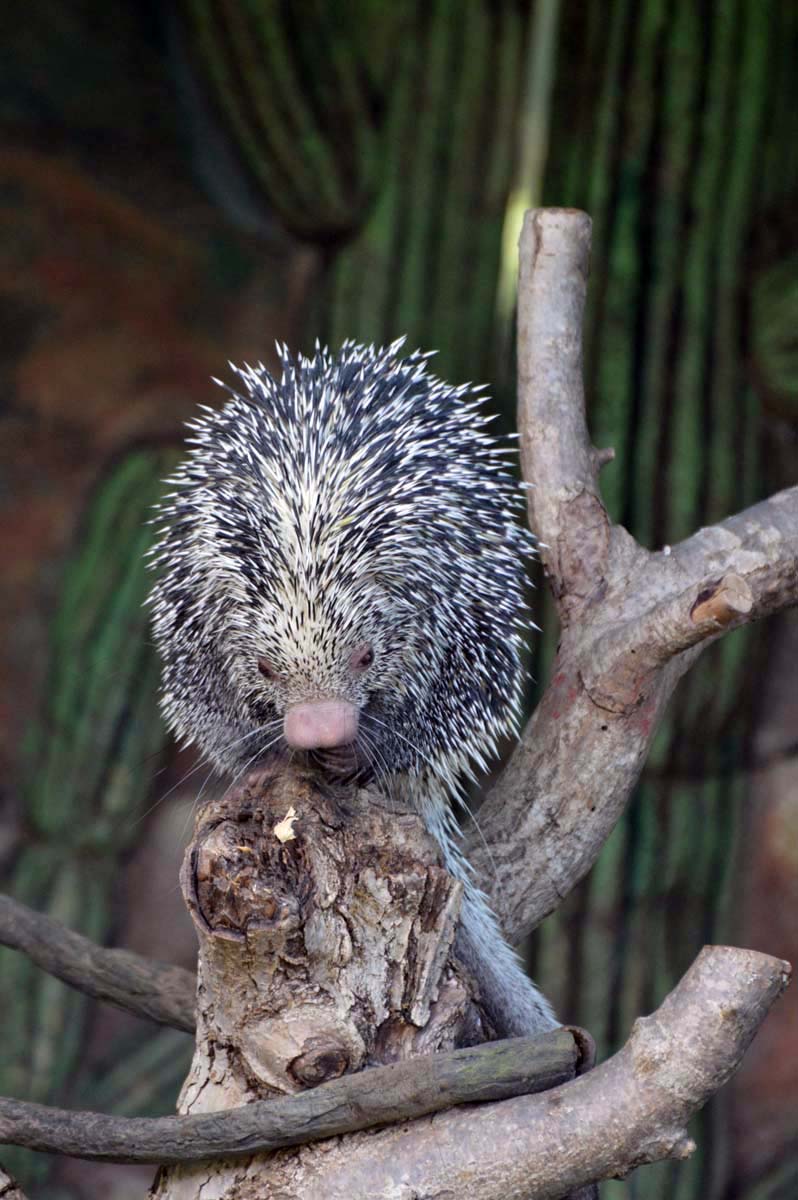
Long moans, yelps, grunts, clicks, mews, hisses and squeaks are the main auditory communications of prehensile-tailed, Brazilian porcupines. Quill rattling and tooth shattering as well. The latter, combined with squeaks of delight and yelps of surprise could be heard from this human as well, during a rodent-rich day of rejoicing at the zoo. A day punctuated by heavy rains and cold wind, while we were doing our annual pilgrimage to a zoo in celebration of our very first date at the Bronx Zoo 42 years ago.
These animals, who can hang with their tail from trees where they spend most of the day sleeping, hidden in the high canopy of South American rainforests, forage at night. The single offspring per breeding cycle is highly dependent on the mother, nursed for weeks before introduced to solid foods, fathers mostly absent. In general, a pretty reclusive and solitary species, with no known predators other than humans and stray dogs who eat them if they can find them (often getting infected at the point with the horrible Chagas disease, since the porcupines carry the kissing bug that transmits it.)
They were not the only rodents we encountered. The flamingos had fled into shelter from the deluge, with a single specimen ignoring the downpour.
Time for the rats to come out – they were everywhere, making good use of the food offerings temporarily abandoned by the birds.
In case you wondered why I’m writing about rats, you can stop now. I am really writing about rituals today. Or, more specifically, rituals in relationships, which turn out to be of enormous value to the longevity of the union, and, more importantly, to the emotional well being of the partners and greater relationship satisfaction. When I say rituals, I am referring to activities that we frame as having some symbolic meaning – me getting downstairs in the morning with coffee already made for me could be a shared routine, or it could be a ritual, if I see it as a gesture that implies a daily commitment to nurturing or some such. Routines don’t have the same positive effect on relationships. What elevates them to rituals is really the shared idea of what motivates the behavior, agreed upon by both partners, which in turn leads to more commitment.
As it turns out, commitment then fosters the duration of a relationship. Which, in turn, benefits psychologically all involved, including the potential entire family system, and the physical well being of the partners into older age.
It doesn’t have to be something big, like Zoo Day has been for us, on an annual basis. Or ways you celebrate birthdays in the family, with rituals extending across generations.
It can be your Friday night Pizza date, if not just a routine, or something as ridiculous as the two of us moving plastic trolls around the house to unconventional locations to surprise the other when they are down.
Since 1982 .we have also been known to engage in multiple exchanges of fortune cookies before we open the ones offered with a Chinese meal, just grabbing them from the other, with no specified iterations. It is completely senseless, not even an in-joke, since we don’t know what the joke would be, and neither one of us remembers the origins, but it is utterly reassuring to be able to predict the ritual will unfold. Knowing each other, sharing, immutable reliance on the familiar interaction – it all makes me – us – happy.
Rodents, rituals, rain – the rare, ravishing day. So grateful for positive occasions in a world that currently offers even more than the usual share of horrors.
Music today is a cover of a Villa-Lobos song from Brazil.
And another piece, for the fun of it, Natania Davrath adding to the repertoire of sounds mentioned today, with the most beautiful of them all.
Changing times and changing technology can sometime steal from us things we once had. And sometimes what they steal is hard to replace. Consider the means we have all had and used for knowing the world, and knowing what is real. The common expression is “seeing is believing.” The courts rely on witness testimony and reject as hearsay second-hand evidence. And in a range of moral and religious settings, we emphasize the importance of bearing witness.
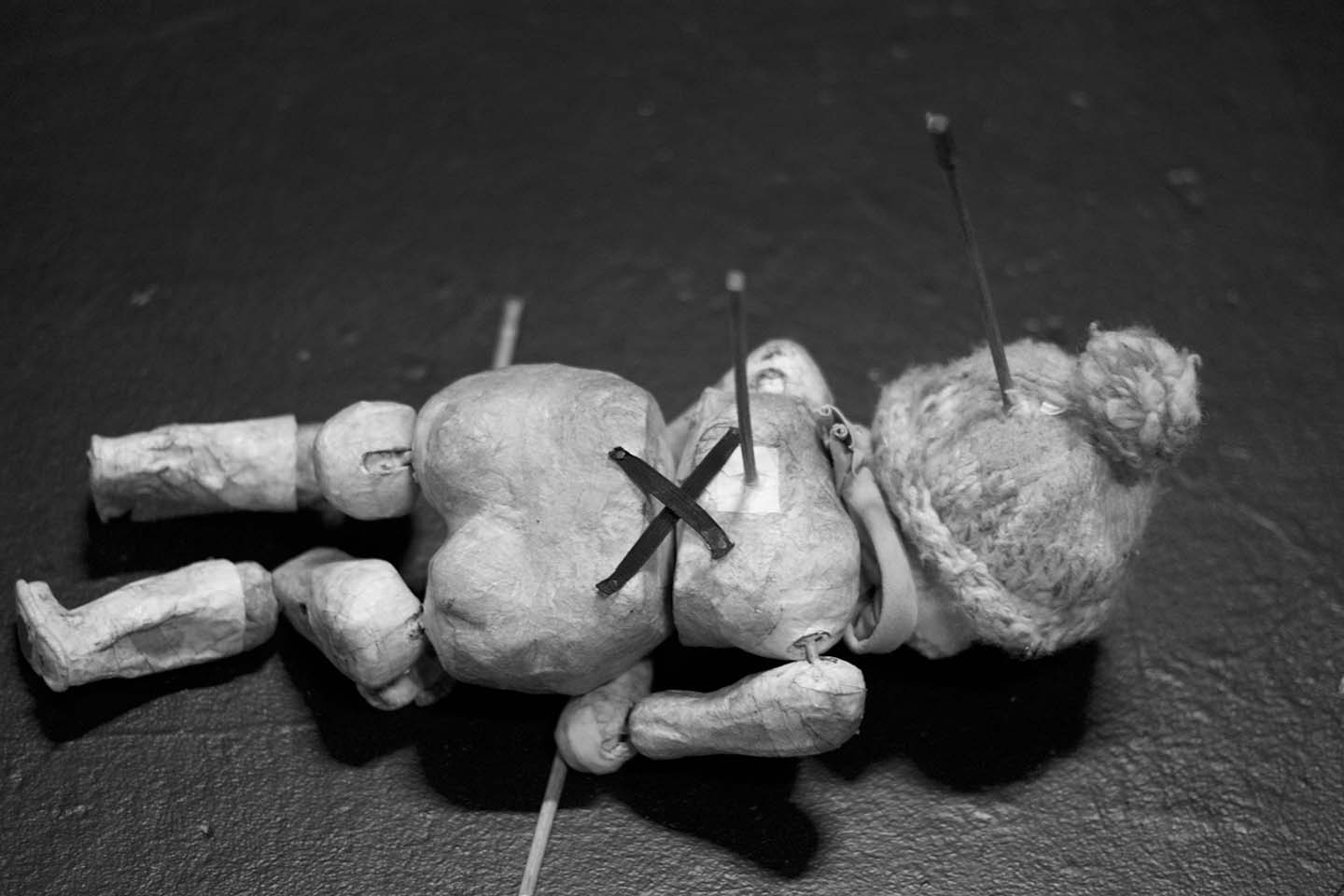
Photographs today are from my favorite Chilean Puppet Theatre Group SILENCIO BLANCO. Make believe where it belongs: in art and on the stage.
There is surely no question that first-hand viewing of an event or a situation is enormously compelling. Consider a peculiar Gedanken-experiment: imagine that we have you stand at the edge of a roof, blindfolded, and we urge you to step off the edge. We race to reassure you, though, that you will fall only 18 inches, because there is a safe and secure net positioned so that you are in no danger. We tell you this. We arrange for your best friend to tell you this. We arrange for your spiritual advisor to tell you this. But no matter who tells you, surely you would be more comfortable if you could lift the blindfold and inspect the safety net for yourself. There really is no substitute for first-hand, visual evidence.
This reliance on first hand-experience, and the powerful visual evidence it provides, is at risk from multiple threats. In a recent NYT editorial on partisan perception, Paul Krugman lamented that in our insanely polarized world, we have to reverse the original aphorism, because now “Believing is Seeing.” In other words, people’s opinions and beliefs are so heavily entrenched that they are ready to discount, or reinterpret, or flatly refuse the evidence of their own eyes. We see this, for example, in people’s refusing to acknowledge the videos by eyewitnesses documenting the horrors and war crimes happening in Gaza, or the carnage wrought by Hamas on October 7th.
In some cases, people are so committed to their views, that they refuse even to consider, even to look at visual evidence that will challenge their view. In other cases people choose not to look, because seeing would be too painful. This is understandable, but means people underestimate, or fully fail to understand, the extent of the horrors. Importantly, in many cases, people flatly deny the truth of what they see and declare it faked. In still other cases, people are not permitted to see the visual evidence – a state or an agency monitoring what gets published, fully aware of the impact the prohibited visuals might have.
All of these points are fueled by the rapid advances in digital photography. Speaking as a well practiced montage artist, I, of course, have a sense of how easily images can be manipulated to make them show what you want to show. But what artistry allows is dwarfed by what digital technology makes available to anyone who wishes to manufacture bogus evidence for almost any claim they wish to advance.
Here is a short list what bad actors using AI have already managed to fake in order to influence the 2024 elections. We are stuck with a situation where multiple factors combine: videos are either true or false, and we are told that they are either true or false (irrespective of their actual truth content) and we ourselves have to decide if we trust them or not- a difficult task, magnified by our desire to believe those we generally trust and who tell us to adopt their claims.
(If you are interested in a deeper exploration of the legal issues around regulating media deep fakes in the political arena, the Brennan Center for Justice has a great overview here.)
What to do? The power and immediacy of first hand experience is likely hardwired into us, making us appallingly vulnerable to things like deep fakes. The apprehension that we encounter fake input and fall for it can lead to a different disaster, however: to avoid being duped, we end up trusting no input. The solution may require a set of new habits. When you encounter information, do what you can to check it against other independent sources. (This is, of course, increasingly difficult as Murdoch and Sinclair take over more and more media outlets.) When you encounter information, do what you can to scrutinize who it is that is supplying the information. Be wary of “semi-anonymous” reporting, with entries like “a new study has shown…” or “it is reported that.”
The deepest problem here, though, is that many people don’t have the skills, resources or the inclination to take these cautionary steps. And so instead, they simply latch onto a single source that they deem trustworthy. Unfortunately this choice may lead them to rely on lunatic propaganda. Furthermore, selecting different sources of input as trustworthy, with the young relying on social media videos coming directly out of Gaza, filmed by eyewitnesses, and the old relying on Fox news, or the main stream media that avoid showing videos of the suffering unfolding in Gaza in the first place, further feeds the political polarization (one only has to look at the generational divide in people’s taking sides in this conflict, which doesn’t come out of nowhere.) “Propaganda!” each societal subset shouts against the other.
The habit of seeing is believing cements in place views that may be based on incomplete or distorted input. Something that once was a valuable capacity can these days become an obstacle to the truth. I wish I had a solution.
Walk with me. A slow, short amble through a park modeled after old English country estates. Weather in tune, soft rains alternating with violent deluges, making me clutch the camera under my raincoat, seeking shelter under old fir trees, since the paths are too slippery to run back to the car. Or what goes for running these days.
Signs of early spring everywhere, snowdrops dotted with rain,
scilla peaking out among them,
aconite trying to pretend sun(s) still exist.
Camelias bringing some red to the palette
Crocci abundant, some hiding from the rain.
A fragrant edgeworthia paper-bush attracts the very first bee.
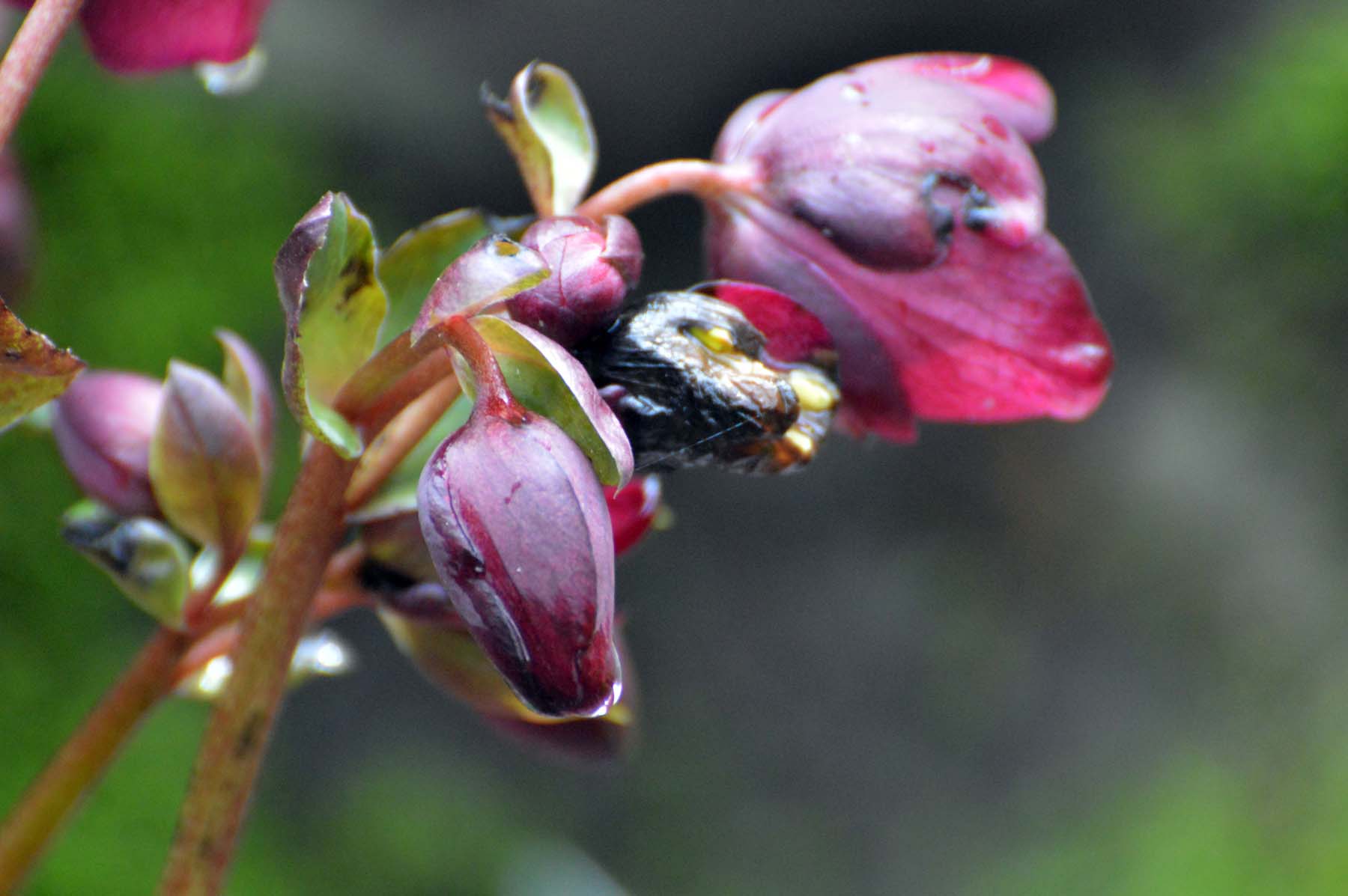
Center of my attention, though, were the hellebores, pummeled by the rain, bitten by earlier frost, struggling this year to develop their full glory. I had just learned some fascinating new facts about them (you might remember that I write about them almost every spring, so partial to them.) More importantly, these facts connect to something that modern science is beginning to explore: the relationship between our guts (literally, stomach and intestines) and that of our mental health. (I am going to summarize sources from here and here, and also a recent essay in the Atlantic discussing our preoccupation with gut health.)
Hellebores were linked to madness already in Greek mythology, not as a cause but as a cure, quieting the unruly, “hysteric” young daughters of a king. We find evidence for medicinal use in Ovid’s Metamorphoses as well as earlier writers, and the practice of using it to “heal” hysteria, epilepsy, mania and depression, lasted for centuries, documented across Europe, from early Romans to 18th century England. Paracelsus sang its praises. Wondrous cures were reported over and over again.
The plant contains helleborine and its derivatives are cardio-toxic glukosides, similar to digitalis. Ingestion even of only the seeds can prove to be fatal. The toxic compound protoanemonin, once swallowed by humans, causes “vomiting, inflammation of the mouth and throat, [and] abdominal pain and diarrhea that can be followed by severe ulcerations of the mouth and damage to the digestive and urinary systems.” The one saving grace might be that it induces vomiting so fast that not enough of the substance remains to kill you.
The roots were pulverized and put in a concoction that led to violent purging with excrements taking on a black color, interpreted to be the evil humors that left your body, the later now ready to heal, mind included. If dosage was mistaken, it led to death. The line between panacea and poison, miracle dram and murderous draught, was a thin one. But the psychological assumptions of emotions being lodged in the belly, and needing to be driven out, if maladaptive, were anything but thin: the perceived violence of Hellebore’s laxative action were seen as the necessary equivalent of the violence and perceived grossness of mental illness, to be forcefully exiled.
In the 17th century, doctors started to discuss the problems with something so potentially lethal, advocating for its use only in the most stubborn cases, and purging with less dangerous substances, like Senna, instead. The symbol of Hellebore was however also taken up by religious crusaders, talking about the need for sinners and “spiritually diseased” people to take the hellebore cure, thus intertwining moral with medical issues, with deranged emotions being at the core of both. Cleansing was necessary both to maintain health, but also to achieve pure spiritual interiors, free from demonic possession.
“Viewed in this light, a prescription of hellebore becomes about much more than just the removal of corrupted physical matter. The black substance voided from the bowels was the embodiment of the evil cast out, with the site of spiritual transformation being neither the soul nor the mind but the gut. Taking hellebore presented many of the same dangers as the condition it purported to cure: loss of control, internal corruption, and the very real possibility of death. By forcibly confronting sufferers with their own embodiment, it offered a temporary reprieve from the existential anguish of madness and melancholy. In doing so, it confirmed what many godly individuals already believed: that their bodies were vile and filthy vessels and that their best hope for deliverance lay in abasement before God.”
If we leave G-d and evil out of the discussion (although certain parts of our political establishment seem to bend over backwards to get them back in again…) what do we know scientifically about the gut-brain connection?
Gut and brain communicate through a number of pathways. There is the Vagus nerve, that sends info to the brain with neurotransmitters like serotonin and dopamine as messengers. Over 90 percent of the body’s serotonin—the neurochemical targeted by the class of commonly prescribed antidepressant medications that includes Prozac, Zoloft, and Lexapro—resides in the small intestine, facilitating multidirectional communication between the digestive tract and the central nervous system. If our gut’s fragile microbial balance is upended, it sends a message to the immune system, which may trigger gastrointestinal inflammation.
There is also an association (not a determined causal relationship) between gastrointestinal disorders and some psychiatric conditions, including bipolar disorder and depression. People who live with schizophrenia have higher rates of GI inflammation than the population as a whole. People who struggle with IBS [irritable bowel syndrome] are often also diagnosed with anxiety disorders.
This explains why we have an emerging field of nutritional psychiatry that teaches patients about the appropriate foods that might reduce inflammation — namely grains and plants rich in vitamins, minerals, antioxidants, fiber and pre- and probiotics. No need to buy expensive probiotic supplements that have sprung up like mushrooms provided by an industry ready to cash in; yoghurt, kimchi and sauerkraut all do the job just fine. Hellebore smoothies, however, will likely not be recommended!
Music today offers a bit of madness – demons and all, Faust riding with Mephistopheles, having sold his soul….
Full Opera (Berlioz’ The Damnation of Faust) here, with Solti conducting.
““I am black; I am in total fusion with the world, in sympathetic affinity with the earth, losing my id in the heart of the cosmos — and the white man, however intelligent he may be, is incapable of understanding Louis Armstrong or songs from the Congo.”
Last week I visited Africa Fashion and Black Artists of Oregon at the Portland Art Museum, downstairs and upstairs in the main building, respectively. Downstairs was empty, upstairs was jumping, middle of a weekday, for a show that has been open since September. I started my rounds on top and my eye was immediately caught by a group of young women motionless, except for their heads.
What were they staring at? Bent over, studying, then four heads lifting in unison, looking at each other, then bending again, back and forth, like a silent dance. Once the young women left, I walked over to see for myself and found this:
damali ayo Rent a Negro.com (2003) You can listen to the artist explain the evolution of this work here.
What reaction would an interactive piece like this, riffing on the commodification and objectification of Black labor, elicit in high school students who are most likely not (yet) too familiar with conceptual art? One of the first satirical pieces of internet art, damali ayo‘s Rent-a-Negro is an ingenious take on the system that has progressed from purchasing and owning the Black body to leasing it (although prison labor needs to be considered a form of slavery, if you ask me,) to using token Blacks to satisfy demands for “diversity.” How would it be processed by the Black high-schoolers in contrast to those like me, old White folk? Rage and revulsion by those whose ancestors were subjected to exploitation and oppression, ongoing even? Shame and sorrow by those whose forbears might have wielded the whip and ran the auctions, with patterns of discrimination not a thing of the past?
Julian V.L. Gaines Painfully Positive (2021)
Ray Eaglin Maid in USA (1990)
Fanon’s insight that someone like me will not be able to understand certain forms of art as they would be by those from whom it originates, popped up in my head with urgency. And this leads to one of the elephants in the room that needs to get aired: how does a White woman review exhibitions of Black art with the depth and understanding they deserve, while aware that the racial, potentially distorting, lens cannot be abandoned? It is naive, bordering on ignorant, to assume that art can be seen, understood, felt in some neutral fashion, when our implicit stereotypes guide our interpretations, and when our lack of knowledge specific to the history of a community affects our comprehension.
Tammy Jo Wilson She became the Seed (2021)
Al Goldsby Looking West (ca. 1970)
Furthermore, any reviewer aware of their implicit biases and wishing to be an ally to those who are burdened with historical or ongoing discrimination, will walk on eggshells. You want to avoid harsh criticism, or piling onto stereotypes, or being overly deferential, despite all of that being already a form of unequal treatment, born from awareness of culture constructed around race. You so want to avoid putting your foot in your mouth and appear arrogant.
Or racist.
Thelma Johnson Streat Monster the Whale (1940)
Mark Little Despondent (1991)
Isaka Shamsud- Din Land of the Empire Builder (2019)
I vividly remember a lecture I gave about the psychology of racism on invitation by PAM in the context of a Carrie Mae Weems exhibition over a decade ago. I talked about the Implicit Associations Test – IAT – the psychological measure that confirms how many of us hold stereotypical assumptions associated with racism. It is a test that looks at the strength of associations between concepts and even the most liberal takers have gasped at their scores. Mind you, it does not mean you are a racist; it just tells us that we have all learned associations between concepts that involve stereotypes associated with Blacks. Some in the audience erupted in anger, astute, educated, intelligent docents among them. That could not be true! They fought against racism all their lives! I clearly failed in getting the point across: there is a difference between consciously acting on your stereotypes and unconsciously being affected by them. But even the latter was denied by these well-meaning citizens.
Jason Hill Lion King (2019)
In any case, one can have read brilliant work like Franz Fanon’s about the Black psyche in a White world, racial differences, revolutionary struggle and the effects of colonialism until the cows come home, it will not ease the task of reviewing exhibitions like the one currently on view. Not that that has kept me from doing so, most recently with Dawoud Bey and Carrie Mae Weems in Dialogue at the Getty and Red Thread/Green Earthwhich showed work of several members of the Abioto family at the Patricia Reser Center for the Arts.
But it has made me aware of how much I already censor in my head, how worried I am about the reception of my takes, and the damage they could do, how my approach to work are colored by the political context, something that would not happen if I just walked into any old show of a collection of artists, race unknown.
Ralph Chessé The Black Women Work (1921)
Bobby Fouther Study in Black (2023)
***
The current exhibition was curated by Intisar Abioto after years of research into the spectrum of Black artists in Oregon, some famous, some locally known, some hidden in the embrace of their community. She put together a remarkable show, and her line of thinking as well as the expanse of the art is fully explained in a in-depth review by my ArtsWatch colleague Laurel Reed Pavic, who talked to the curator and listened to her podcasts about the exhibition. (You can listen to the podcasts yourself – they range from general introduction to a number of interviews with individual participating artists.)
My first association to the upstairs show was the contrast to what is exhibited downstairs, African Fashion. Previously shown at London’s Victoria and Albert Museum and the Brooklyn Museum, the latter was hailed as a vital and necessary exhibition by eminent art critics. It felt to me, however, like one of those luxury fruit baskets filled with luscious and exotic goods, wrapped in cellophane with a glittery bow – something that often does not live up to its visual promise when you are actually starting to peel the fruit.
Contrast that with the show upstairs: like a farm-to-table box dropped off at your doorstep, stuffed to the brim, packed to overflowing, with produce you sometimes don’t even recognize, but all locally grown and, most importantly, invariably, truly nourishing.
Katherine Pennington Busstop II (2023)
Latoya Lovely Neon Woman (2019)
Packed is the operative word here, 69 artists and over 200 objects, sorted into categories like “expanse, gathering, collective liberating,inheritance, collective presence, and definitions. The art is competing for space, focus, time and attention, with those limited resources not meeting demand. I assume it was a conscious curatorial decision. If you have, finally, a public space willing to open up to a neglected or even excluded collective of artists (collective in the sense of a shared history rather than a shared goal,) you might as well grab the opportunity and allow every one in the community a shot. This is particularly true when you don’t know what the future holds and which opportunities emerge in times where the racial justice backlash is raising its ugly head ever more prominently. Yet you do early-career artists, no matter how promising, no favor when placing them among the hard hitters.
Henry Frison African Prince (1976-79) with details
Alternatively, the inclusion of so many art works might have been a conscious attempt to demonstrate the diversity that is offered by a community long segregated from traditional art venues, never mind neighborhoods. It might be an attempt to shift what psychologists call the outgroup homogeneity bias, our tendency to assume that attitudes, values, personality traits, and other characteristics are more alike for outgroup members than ingroup members. “They are all the same! Know one, you know them all!” As a result, outgroup members are at risk of being seen as interchangeable or expendable, and they are more likely to be stereotyped. This perception of sameness holds true regardless of whether the outgroup is another race, religion, nationality, and so on.
That bias certainly affects what we expect (particularly, when our expectations are driven by other cognitive biases as well.) Our unconscious expectation of less diversity in the creative expressions of the art were certainly put in doubt with the plethora of work put up by Abioto. In confirmation of the bias – and thus the value of her curatorial decisions – I certainly caught myself regularly looking for a common thread of political statements, however indirect, commenting on the experience of being Black in Oregon, a notoriously racist state.
MOsley WOtta Baba was a Black Sheep (2023)
The history can be found here in detail. Simply put, Oregon had not one but three separate Black exclusion laws anchored in the Oregon Constitution and it took until 2001 to scrap the last bit of discriminatory language from the records.
We are one of the nation’s whitest states, and had at some point the highest Ku Klux Klan membership numbers nationally. Of our 4.2 million Oregon residents only about 6% are Black, and many of these have been displaced within the state over and over again, making room for construction projects and/or gentrification of neighborhoods. Nonetheless, Black leadership and organizations providing support for education, including the arts, are resilient and effective. (A recently updated essay by S. Renee Mitchell provides a thorough introduction to these achievements. Another informative article about Black pioneers can be found here.)
Arvie Smith Strange Fruit (1992) Detail below
Much of the art reflects the history, referencing the pain and injustice of lived as well as inherited experience. But there were also pieces that simply depicted beauty, documented landscape, revered what is. No message necessary or intended. It is a conversation I would love to have about all art, at this moment in time, how our ability and willingness to make art outside the need to bear witness, or instruct, or frighten, or alert to social change needed, is obstructed by multiple internal and external forces – but that has to wait for another time.
Sadé DuBoise Collective Mourn (2023) with detail
For this exhibition there was more art on display than could possibly be processed during a single visit. But all of it was nourishing, even in passing, as I tried to express in my initial description – food for thought, yes, as well as a feast for the eyes.
Natalie Ball Mapping Coyote Black, June 12 and 13, 1987 (2015)
Natalie Ball Mapping Coyote Black , June 12 and 13, 1872 (2015) (Artist new to me, enchanted by the work.)
I felt at times as if I was, if not an invited, surely a tolerated guest at a family reunion – meeting of long lost friends and relatives, happy to run into each other, artists introducing each other. It was a vivid, social experience during a time where I am still socially isolated due to the pandemic, even if I was standing double-masked at the margins, observing so many people truly engaging with art, potentially new to them. Twice (!) I was asked to take photographs of people who had met at the museum by chance and talked to each other in front of this or that piece.
I left the museum more hopeful than after any of the recent shows I’ve been reviewing (and the last year included some real winners!). The vibrancy of the work on the walls and the liveliness, even giddiness of the social interactions of many visiting generations all conveyed a sense of resilience and optimism that somehow rubbed off onto me. I might not get the songs of the Congo, but I do have an inkling, provided by this exhibition, of what local Black art stands for: a community that refuses to let go of history, no matter how painful. A community that believes in a more just tomorrow as well, forever willing to fight for it, no matter how hard that is made by the rest of us. A community standing its ground, with art that reflects that strength.
Let’s treat ourselves with something amusing, if slightly moralistic, at the end of this week: a short animated film about the strenuous efforts of parental love. Enjoy the clip while you can, because much darker contemplations follow in short order…
Would a parent risk their own life, like we’ve seen in that charming animation, if that pregnancy was violently imposed on them, created by rape, and secured by laws that demand forced birth? You probably have seen the same statistics as I did this week, horrifying enough that I could not just ignore them.
Since the SC Dobbs decision revoked the rights and protections offered by Roe vs Wade not so many months ago, some 64.500 pregnancies resulted from rape in the 14 states that now have complete abortion bans. (If that number is not horrifying enough, think about this one: it is estimated that 5% of all rapes result in pregnancy. That means that you have a 20 fold number of rapes that occurred in these states, within less than two years.
Friderike Heuer Jupiter’s Moons (2023) Figures by Paula Modersohn Becker (1876 – 1907)
What do we know about children born from rape? Psychologists have identified a number of factors that severely impact the development of these secondary victims of the crime. Risk factors are pregnancy and delivery, bad parent-child relationships, stigmatization and discrimination, identity issues, and, last but not least, significant numbers of infants being farmed out to foster care where they often enter a cycle of violence themselves since that system is not in good shape or under supervision.
The post-traumatic stress experienced by the mothers who were raped can influence the development in utero of these babies, as does the frequent intake of anti-depressant and anti-anxiety medications to deal with the horrors of PTSD, or self-medicating with alcohol and/or drugs, substances that affect embryonic development.
For many mothers it is hard to love a child that was forced on them twice, first by the rapist and then the state depriving them of bodily choices. According to the research literature, communities treat children of rape with disdain and families, communities and the children themselves are hyper-vigilantly looking for negative traits that might have come down to them from the criminal.
Many of these children, later on trying to get a handle on their identity, want to know their fathers despite the harm those brought upon their mothers, and that leads to internal conflict and a sense of guilt, particularly if these rapes occurred during war times.
These combined factors, exacerbated by the rape victims’ shame and/or anger, predict serious mental health consequences for the majority of children born this way.
Friderike Heuer Aphrodite (2023) Portraits by Helene Schjerfbeck (1862 – 1946)
As I said, I could not avoid touching on these issues, given their political importance in a country that is trying to take rights and decisions away from women, and willfully ignores what happens to their children as well.
Let’s have music that might lift the mood a bit, again related to some sort of animation. When was the last time you listened to Peter and the Wolf? There is a reason it has had such staying power.
Today’s photomontages are from an ongoing series that attempts to bring painters I cherish into my contemporary world. The two on offer happen to depict women protecting their children in landscapes I photographed in the US and in Europe.)
A scientific paper I recently encountered set off an intriguing line of thought about our reactions to art and artists. Let’s start with the obvious fact that artists are people, and so some of them are lovely folks with good values; and some are jerks. Should our assessment of the artist as a person color how we think about their artistic productions themselves? The article I read starts with a striking finding. The authors, Joe Siev and Jacob Teeny of the University of Virginia and Northwestern University respectively, surveyed 634 cases in which university faculty had been punished for some type of sexual misconduct, and went through an elaborate rating process to assess, first, how serious the transgression was, and, second, how serious the punishment was.
Helen Frankenthaler Skywriting (1997)
Skipping all the details, the blunt finding is this: at whatever level of transgression you choose, the artists received more extreme punishment than scientists. Specifically, the average level of punishment for the artists included the fact that they were suspended, or placed on leave, or their contracts were not renewed. For the scientists the average level of punishment was less severe. Honors were revoked or salaries reduced, but they were less likely to lose their jobs on average.
Helen Frankenthaler Free Fall (1992-93)
What is going on here? The authors of the paper offer the suggestion that, for artists, we cannot easily separate their professional output (their paintings, sculptures, compositions, etc.) from who the person is. This notion is rooted in the idea that artists’ output is, in important ways, a reflection of the artists’ emotional makeup, their perspective on the world, and their personality. For scientists, it is proposed that we can more readily separate who the person is from what they do professionally. Presumably this is a reflection of the assumption that scientific work is more likely to be objective, more likely to be governed by rigid rules about procedure and analysis, and in all of these ways just less personal. The authors therefor propose that a process referred to as moral decoupling, the ability or willingness to sever the work from the person, applies to scientists more readily than to artists.
Helen Frankenthaler CEDAR HILL (1983)
I worry that this explanation to some extent mythologizes how scientists work. I also worry, that there may be other ways to think about the data. (The article lists multiple follow-up experiments designed to exclude alternative explanations, something I do not have the space here to discuss.) And note: the contrast between artists and scientists disappears if the moral transgression is directly related to their work, for example an instance of outright plagiarism or fabrication of data. These work-related offenses costs scientists as well.
Yet the upsetting fact of differential punishment for the respective professions remains, and is troubling in a number of ways. As one concern, it raises questions about inequitable treatment, when some professional commits some moral offense. But the result also invites questions about whether we can, or should, separate our evaluation of the artist from our evaluation of their work.
Helen Frankenthaler Spoleto (1972)
One famous example is the huge condemnation of Woody Allen for his misdeeds, a condemnation that has led essentially to a boycott of his movies by many people, myself included. It is interesting to ask, whether this condemnation leads people to believe the movies themselves are less good, or whether the experience of watching a movie by Allen has itself become distasteful (I come down on the latter explanation.)
I wrestle with these issues in my own approach to certain art works and artists. For example, I took off my walls work by Emil Nolde, someone I had revered since childhood and had personal connections to, once his moral transgressions as a supporter of the Nazi regime, NS philosophy and virulent anti-Semitism became clear. (I wrote about all this previously here.) Even though my assessment of his work product, his art, has not changed – I still consider it brilliant – the man and the work have been canceled in my house. I simply refuse to be reminded of the betrayal.
Similarly, I had recently written a long diatribe in these pages in favor of canceling Salvador Dali, unable to decouple his work, still considered amazing, from the moral failures of that artist.
Helen Frankenthaler Westwind (1997)
Then again, I continue to listen to Wagner, even though he embraced Nazi ideology and was generally a pretty wicked human being. It is a guilty pleasure, listening to something that should be ignored if I were only true to my own standards. Not exactly a principled approach.
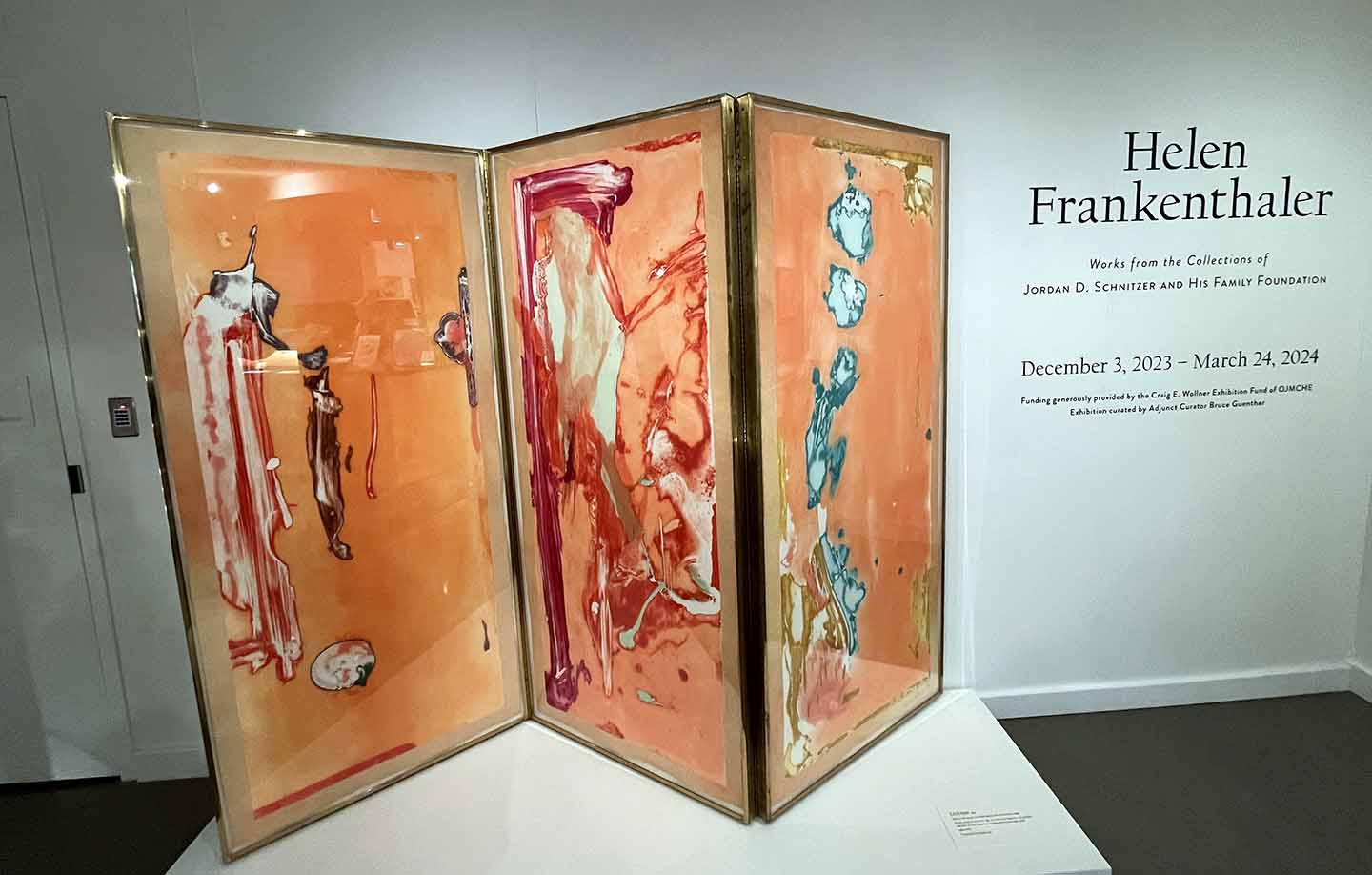
The possible connection between artist and their output was also felt in my reaction to the works on display in today’s photographs, the prints of Helen Frankenthaler currently on view at OJMCHE. Let me hasten to add I know of nothing she has done wrong, in sharp contrast to Nolde, Dali or Wagner. I just know that she was in a 5 year relationship with a critic who I despise for political reasons. I also know that she very much tried to make her mark as a woman in a field then dominated by men, even though her talent towers high over many of them. These bits of background information colored the way I read her prints, and how I experienced her work in ways that struck me as a tad too demonstrative and intellectually constructed (with one exception, a flowing print I really liked, below.) (For a positive, learned, detailed review of the show by my ArtsWatch colleague Laurel Reed Pavic, go here. I should also add that Frankenthaler’s work is incredibly beloved by most viewers. I seem to be the odd person out.)
I wonder how I would have reacted to the work if I had no idea who produced it.
Helen Frankenthaler Flirt (2003)
In sum, I wish I had a clear vision of why I canceled Nolde, but continue to regard Wagner’s music as tolerable even if listening to it has to be acknowledged as a guilty pleasure. These are mysteries to contemplate. In the meantime, and consistent with the article I discussed, it’s plain that, at least some times, I am unable to separate my views of the artist from my reactions to the work. Why this happens, and why there is inconsistency in how this plays out, remains to be answered.
Helen Frankenthaler Untitled From What Red Lines Can Do (1970)
Music today is in memory of a brilliant talent who died today 8 years ago. No guilty pleasure here with his last album, just pure, unadulterated longing that David Bowie could have lived and made music a little longer.
“Art must be an integral part of the struggle. It can’t simply mirror what’s taking place. It must adapt itself to human needs. It must ally itself with the forces of liberation. The fact is, artists have always been propagandists. I have no use for artists who try to divorce themselves from the struggle.”
–Charles White in Jeffrey Elliot, “Charles White: Portrait of an Artist,” Negro History Bulletin 41, no. 3
Part of this quote greets you when you visit MoMa’s artist page for Charles White. I had tried to figure out which visual artists managed to do the impossible: find ways to depict how to pursue change, as a society, as a nation, as individuals, rather than reminding us of the existing woes. Painting historical events is an indirect way of doing so. Those works show us the injustice, or the suffering, or the might of those who rule, potentially appealing to our conscience or raising our consciousness, or both. Important and valuable. But how do you show the way forwards? White seemed an appropriate starting point. One of his early lithographs suggested to us that hope is possible, and a motivating factor, some 20 years before the Civil Rights Movement brought some change. (And some 60 years before that change is on its way to be reversed…)
Charles White Hope for the Future 1945
If I look at the image, Hope is not the first thing that comes to mind. A dead tree with a noose hung from it, a baby in medium distress, walls closing in with wooden isolation. Yet there are those huge maternal hands, offering strength and protection. They are also notably angular, square. Squarely: in a direct and uncompromising manner; without equivocation, tells me the Oxford Dictionary. These hands are placing blame squarely on racism.
What about the face, though. Do you see hope there? Maybe the shape of the waning moon on her forehead, signaling a hope for he decline of racism? The expression itself struck me as, frankly, angry. And since I still haven’t figured out the answer to my question of how art should depict progressive utopias or the ways to get there, let’s turn to the depiction of anger in women instead. (You know me, thoughts jump around.) Female anger is not exactly a ubiquitous topic in centuries of painting, but one that at least spoke of disruption of rules, since the display of anger was historically considered unfeminine. Verboten, really.
Anger is a somewhat under-researched topic in my field. We define it as an emotion characterized by antagonism toward someone or something you feel has deliberately done you wrong. Psychologists are more concerned with aggression or other hurtful behaviors, which is separate from anger, although the latter can lead to the former. Just ask yourself, how often are you angry without aggressive behavior? But also, has anger ever morphed into a somewhat violent act? My guess is the former happens often, the latter rarely for most of us, though it does on occasion. If it happens all the time, then you have a problem.
Giotto L’Ira 1306 (Fresco)
Excessive anger has physiological consequences that harm you, including increased blood pressure that damages the heart, and it interferes with decision making, often leading to long lasting consequences. And of course violent outbursts can and will harm others.
On the positive side, non-violent anger can be an extremely motivating factor to find solutions to the perceived problems and initiate change. It also influences the way you approach or evaluate something or someone. If you are unwittingly cued by angry faces in association with something, you value that something, any given object, more. When you show pictures of angry men, rather than sad ones, they elicit more support. Men who display anger rather than sadness in negotiations are more successful in their demands – people yield to someone perceived to be dominant. (Ref.)
All of this is not true for women, even though they are cross-culturally shown to experience equivalent amounts of anger, both in frequency and intensity, compared to men, clearly a biologically built-in emotion. Anger conforms to display rules – the norms of a given culture what can or should be publicly shown – and women, in almost all cultures, do not act on their anger as men do. Importantly, they also are not perceived more positively when displaying their anger, in fact the opposite is true. Most modern psychologists subscribe to a bio-sociocultural interactive model to explain this fact. There might be biological gender differences that allow women to curb their angry outbursts to begin with – the orbital frontal cortex, which is involved in controlling aggressive impulses, is much larger in women. Good thing, too, given that women would easily be harmed by the physiologically stronger males, if they attack them. All kinds of evolutionary explanations have been offered. (For details on biological differences, here is an in-depth review.)
It is always hazardous to indulge in evolutionary story telling, though. For example, it seems entirely plausible, that, over evolutionary time, mothers who were particularly nurturing might have had greater reproductive process; therefor nurturing, not anger, would be favored by evolution. But it is equally plausible, that, over the years of evolution, mothers who were particularly ferocious in protecting their young would have had an evolutionary advantage. This contrasts highlights why many scientists, with a nod to Rudyard Kipling, refer to these evolutionary notions as “Just so stories.”
And speaking of angry mothers: one is Medea, about to murder her children out of rage over her unfaithful husband… note, how we are not even allowed to see her face frontally, and the presumably glaring eyes in particular are even further recessed into shade.
200 years earlier we see a raging Judith, slaying Holofernes, the general of Nebuchadnezzar’s army threatening Judith’s people. Two versions, one by a man, one by a woman painter, see for yourself who is actually expressly raging, spurting blood on her chest. These are of course depictions of a biblical story, so viewers can be amenable to be reminded of the tale.
Caravaggio Judith Beheading Holofernes c. 1598–1599 or 1602
A different approach is to serve culturally-based display demands by orienting the viewer to the (invisible) victim of a woman’s anger: the poor man.
Carl Dornbecher Poor man, 1919
Just a few years earlier, the intensely weird, academicist painting below was meant as a commentary on the new medium of photography, seen by the painter as a positive development: “It has opened our eyes and forced us to see that which previously we have not seen.” Riffing off Democritus’s aphorism: “Of truth we know nothing, for truth is in a well,” this fury appears with a whip instead of the usual mirror in her hand, revealing the “naked” truth all right. (I fear I’ll never be able to photograph that, even if I was inclined to capture aphorisms…)
Jean Léon Gérôme, Truth Coming Out of Her Well to Shame Mankind, 1896
One last, contemporary offering from the sparse menu of angry women in art: Pipilotti Rist’s still from a video of a woman unhesitatingly smashing car windows, extremely feminine in her red pumps, fluttery summer dress and make-up.
Pipilotti Rist Ever is Over All (still), 1997
Here is the video where she is actually smiling and bouncing along. A total disconnect between displayed emotion and enacted behavior, as if even during the outburst you still have to keep that grin on your face. The best part: a police woman walks by, smiles back and salutes her. Worth a few minutes of your time, if only for the sound track!
Of course we all know, if this had been the black child from Charles White’s litho in the beginning, the story would have a different ending. Hope for the future? You tell me where to go from here.
Angry, but beautiful music by Bartok today. In addition to Bela Bartok there is a bonus Schnittke…
Walk with me, in the wetlands around the Tualatin River, during almost 90 degrees at 10 am on a quiet Sunday morning. That was before we had 104 degrees. Wetlands? Dry lands, with a bit of water now shared by creatures in close proximity.
Some still have the energy to show off in front of a mate.
Much of the water is covered by a carpet of duck grits, or algae, enough to reflect the shadows of adjacent vegetation, greeting you with the most saturated chartreuse imaginable.
A lot of plant life is dry, on verge of crumbling, leaves, grasses, a wistful beauty.
Birds still out to find that morsel, before the full heat of the day. A Cedar waxwing, a brown creeper, perfectly camouflaged and an osprey showing off above me, flying from his perch directly to the space above me, so I get some footage even with the small camera, since I couldn’t schlepp the large lens in the heat.
Yet the views I was most enthusiastic about were the thistles. At this time of year you have all stages visible at once, still some blossoms, some flowers, and then all going to seed. The ground is carpeted with the fluff. It flies in the air, like little ghosts swarming the fields. It shimmers silvery, I believe gossamer is the word, something delicately spun, not by spiders, but by the plants that use air currents and weightlessness to propel their offspring to new worlds where they can settle and sprout. The next cycle begins.
In German I would say: “sie begeistern mich,” a word indicating an enthusiastic approach to something or someone. Literally translated it means, they fill me with ghost(s), but it is used in the sense of something touching your soul, or activating joy. Incidentally, you could also say “ich schwärme four see,” I adore them. The term literally means to swarm, like bees forming a swarm or swarming out – just like these seed fluffs do. The medieval usage turned from the verb associated with insects to one describing the ways of religious sects, deviating from the pre-determined church requirements to think along traditional paths and becoming free thinkers instead, around the 16th century. In the literary developments of the 18th century, the term became a commonplace for all kinds of wild enthusiasm and phantasmic thinking.
Why do I bore you with the etymology of German words? For one, because it is quite similar for English, when you look at the roots for the word enthusiasm. The original meaning had to do with religion, transferred from the Greek enthousiasmós, from enthousiázein “to be inspired or possessed by a god,” around the 17th century. Secondly, because I have been wondering what it means to be strongly, enthusiastically preoccupied with, in my case secular, matters all the time and expressing those feelings with abandon. Since childhood, really, I was easily excited about so many things, adored them, absorbing them as well as treating them with enthusiasm. Does that make you less critical? Impede judgment? Is it going to be interpreted differently by others, because I am a woman, seen as overly emotional rather than in possession of a trait that has components of both, affect and cognition?
As it turns out enthusiasm predicts satisfaction in life and positive relationships. If you’re up for it, here is an extensive but well written review of what we know about the cumulative effects of experience, interpretation, and regulation of positive stimuli and emotions that ultimately lead to the experience of happiness, life satisfaction, and wellbeing. The paper gives an overview of how wellbeing and happiness were defined across the centuries and how contemporary psychology is now looking at the underlying physiological processes that are at work – or that are missing. “Experiencing positive emotions (likeenthusiasm) benefits psychological and physical wellbeing in numerous, intersecting ways, including modulating neurophysiological correlates within the central and peripheral nervous systems.”
So there. I enthusiastically photograph thistles, marveling at their beauty. I also enthusiastically welcome the latest news out of a courthouse in Georgia. I enthusiastically watch the video clips of a grandchild learning to crawl. I enthusiastically count the hours until the thermometer lands on something under 90 degrees. (Luckily I can count that high. Turns out, enthusiasm is also a prime motivator for learning, so having had that in my tool kit for various forays into schooling was not a bad thing.)
Then again, I unenthusiastically read what Merriam-Webster had as an example for the use of the word enthusiasm on their website:
The criminal charges appear to have done little to dampen Republican voters’ enthusiasm for Trump, who remains the leading candidate for his party’s 2024 nomination for president.—The Salt Lake Tribune, 8 Aug. 2023
Let’s enthusiastically hope that on this August 16th things have changed! (Fat chance.)
And here is a passionate piece of music. Hard to believe it was composed during WW I, in 1916.
Housekeeping first: I am taking part of next week off from the blog, need to spend some time photographing, something that has gotten short shrift over all the writing.
***
I had to laugh at this headline found yesterday in an article in VOX:
“Especially the “if true” part” – UFOs, dead alien pilots, reverse engineering, secret government programs… the rumor mill is at it again, this time through a whistle blower, a former government official named David Grusch, who has worked in the National Geospatial-Intelligence Agency and the National Reconnaissance Office, who gave public testimony before a House of Representatives committee Wednesday.
No evidence provided, just more talk of hear-say. But what I find interesting is this eternal preoccupation with a world “out there,” instead of saving the one we’re currently wrecking, or at least loving it for what it is. I have written about the psychological function of alien narratives previously. Today I will just turn to the tried and true, a poet with whose views I agree more often than not, and whose remarkable ways of getting a point across with seeming ease belying masterful construction always puts me in awe.
She is content enough with our sleepy backwater…
The Ball
As long as nothing can be known for sure (no signals have been picked up yet), as long as Earth is still unlike the nearer and more distant planets,
as long as there’s neither hide nor hair of other grasses graced by other winds, of other treetops bearing other crowns, other animals as well-grounded as our own,
as long as only the local echo has been known to speak in syllables,
as long as we still haven’t heard word of better or worse mozarts, platos, edisons somewhere,
as long as our inhuman crimes are still committed only between humans,
as long as our kindness is still incomparable, peerless even in its imperfection,
as long as our heads packed with illusions still pass for the only heads so packed,
as long as the roofs of our mouths alone still raise voices to high heavens —
let’s act like very special guests of honor at the district-firemen’s ball dance to the beat of the local oompah band, and pretend that it’s the ball to end all balls.
I can’t speak for others — for me this is misery and happiness enough:
just this sleepy backwater where even the stars have time to burn while winking at us unintentionally.
Photographs today are of some of the more alien looking flora I’ve come across this year in this sleepy backwater. Wish it would stay sleepy and not burn up….
Here is a track – Of Beauty – from Gustav Mahler’s Das Lied von der Erde (THE SONG OF THE EARTH). Beautiful music about a beautiful world.