“He is formless, almost faceless, a man whose countenance is a caricature, a man whose framework seems cartilaginous, without bones. He is inconsequent and voluble, ill poised and insecure. He is the very prototype of the little man.”
Guess who? No, not that one. One of his predecessors, dangerously underestimated in these early words written by Dorothy Thompson, one of America’s most urgent, eloquent voices against Nazism. Her description of Hitler, as cited above, and her later flaming resistance against all things fascist led her to be thrown out of Germany in 1934, after having been one of the first successful female correspondents for the American media in Europe.
The woman was a marvel. Self-made, in many respects, suffragists, radio journalist, book author, political activist, she was a public speaker, on air for 15 nights and days straight after Germany invaded Poland in 1939. She became a source of facts and opinions for millions of American women who now had an alternative to what they were regaled with by their husband.
Her 1941 essay in Harpers, Who Goes Nazi?, is one of the most astute psychological assessments from a non-psychologist that I have read. Ever. She basically invents (or describes?) an upper-middle class dinner party with various and diverse guests (notably absent, alas, any person of color, which is probably historically an accurate scenario) and predicts for each person how likely they would join the Nazi movement if arriving on our shores. (It is no co-incidence that one of her three husbands, Nobel prize – winner Sinclair Lewis, wrote one of his famous novels, It can’t happen here, during their short marriage.)
If you took that essay and simply replaced the historically fixed term Nazi with a contemporary equivalent of immoral, unethical politician, you might have a perfect fit between the types of people she describes and those threatening an end to democracy who we are currently observing here and many European countries. Think impeachment and removal. Or the absence thereof, as the case may be….
December color!
Just as I worried in yesterday’s blog, I worry here: why don’t we learn from history? When it is all laid out for us in perfectly witty, insightful, premonitory writing?
“It’s fun—a macabre sort of fun—this parlor game of “Who Goes Nazi?” And it simplifies things—asking the question in regard to specific personalities. Kind, good, happy, gentlemanly, secure people never go Nazi. They may be the gentle philosopher whose name is in the Blue Book, or Bill from City College to whom democracy gave a chance to design airplanes—you’ll never make Nazis out of them. But the frustrated and humiliated intellectual, the rich and scared speculator, the spoiled son, the labor tyrant, the fellow who has achieved success by smelling out the wind of success—they would all go Nazi in a crisis. Believe me, nice people don’t go Nazi. Their race, color, creed, or social condition is not the criterion. It is something in them.”
One more remarkable item of courage and honesty associated with this path breaker: the woman who was on the cover of Time, declared together with Eleanor Roosevelt as undoubtedly the most influential women in the U.S., played by Kathrin Hepburn in Woman of the Year, and an early ardent supporter of Zionism, changed her views after visiting Palestine in 1945. Subsequently,
“She ran into difficulties, including accusations of anti-Semitism, which she strongly rebuffed, after being warned that hostility toward Israel was, in the American press world, “almost a definition of professional suicide”.[10][11] She eventually concluded that Zionism was a recipe for perpetual war.[12]“
She was silenced indeed, as are so many contemporary journalists in this country, who follow suit. Here is a 4 minute trailer to a documentary about her, laying out what happened to her career and livelihood, with lectures canceled, newspaper assignments withdrawn and a general shunning initiated by those who could not tolerate any criticism at all of the state of Israel. And the official accusation was, of all things, being too soft on Germany…. something taken out of thin air, to persuade a public open to that villain schema at that time. Sounds familiar?
Photographs today are from my Oaks Bottom Tuesday walk taken last week.
Music is in honor of Beethoven’s birthday yesterday, a brilliant, pure, fear-acknowledging and fear-conquering piece that seems in line with Thompson’s character, the Streichquartett #14.
Now why do you immediately assume I refer to a certain politician who shall remain nameless? Am I that predictable?
No, I want to discuss today yet another effect language can have on our interactions with the world. Over the last days I described how language can direct our attention to certain things, shaping our experiences with our environment.
I also described how language can establish certain frames which will influence how we all make our decisions (beast/virus), often through the use of metaphors. And last but not least I reported on how specific use of language can affect our emotions which in turn will lead to different actions we are willing to take (verb/noun form.)
Today I thought we’ll look at how language triggers beliefs which in turn lead you to (mis)perceive what’s out in the real world despite the facts in front of your very eyes.
Here is a straightforward example: I tell you that you will observe someone in a conversation and, by the way, we know this person to be a liar. After you have watched him or her, I ask you to estimate how often that person behaved in ways assumed typical of liars. Turns out you will tell me that that person quite frequently averted their gaze (a habit associated with liars in our belief system.) Problem #1: that belief is actually mistaken! Liars do not avert their gaze more often than non-liars….) Problem #2: the person who you watched converse with someone else did in no way avert their gaze as often as you swear you saw them do. (We have the videotape: we can count….)
The language suggested a concept – liar! – which in turn triggered a false belief – gaze aversion alert! – and you end up “observing” what you expected to see. Except the observation is in no way supported by what actually took place. No shifty eyes anywhere! (You can read a scholarly piece on many of our misconceptions about liars here.)
Here is a similar example, except this time language affects memory rather than perception. If you see a videotaped car accident and I probe your memory for it weeks later, asking how fast the cars were going when they bumped into each other (or, alternatively, when they crashed into each other) your estimate of the speed you observed will systematically vary. More striking, though, people in the “crashed” condition also remember vividly seeing broken glass, when there was none in the original tape. Just think about the implications for eyewitness reports in response to police questioning.
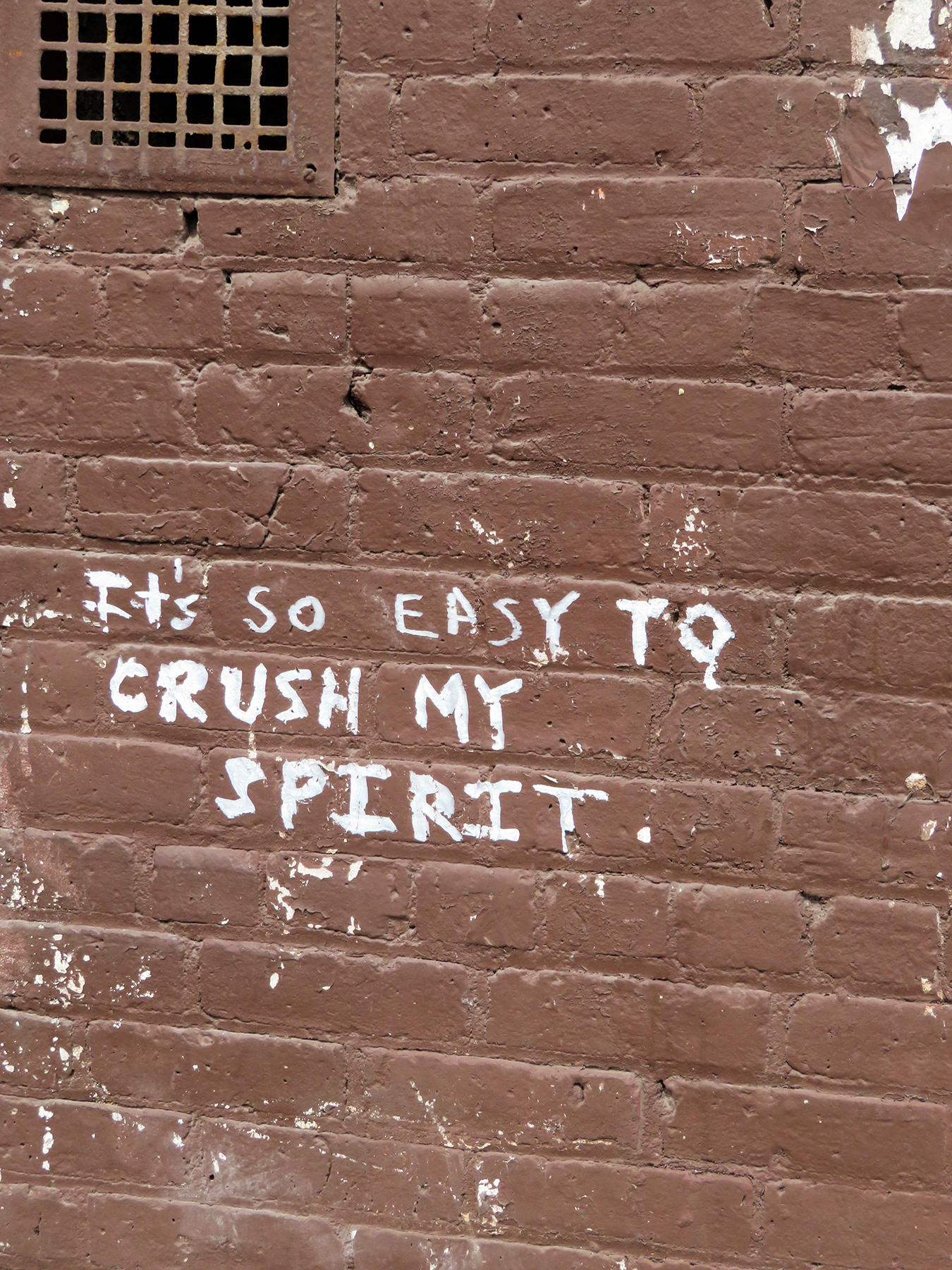
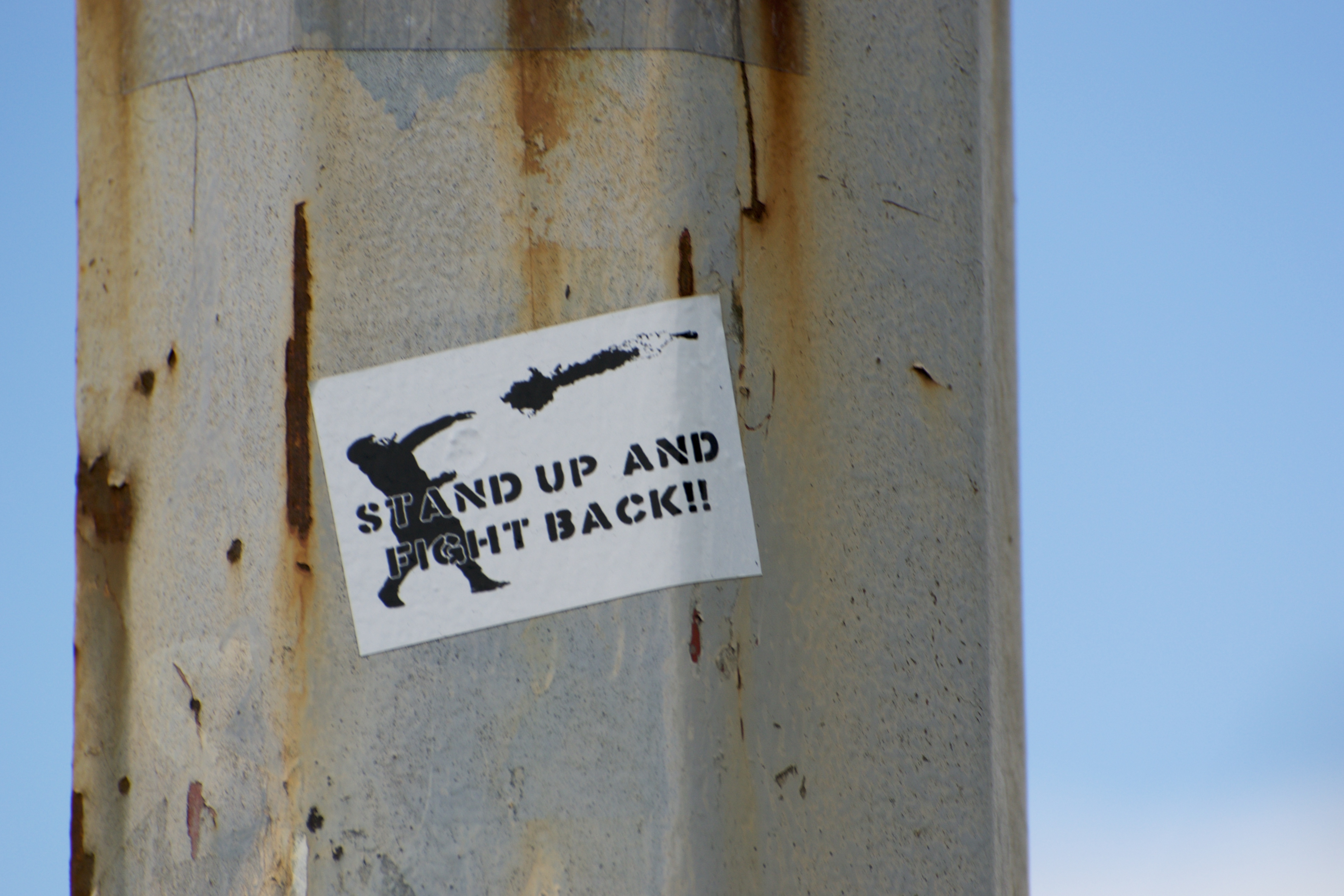
Photographs today show words I picked up on the street, often triggering certain concepts. From suggestions to commands…
Music was chosen for the fit with the concept, but also to stretch ourselves a little bit into the more contemporary realm. Stick with it!
Yesterday I tried to spell out that language does influence thought, although not in the direct, unchangeable way that anthropologists like Sapir and Whorf suggested. Language can guide attention and what you attend to ultimately shapes your thinking.
People who want to influence what you are thinking are perfectly aware of these mechanisms. I can frame something as a positive outcome – this experimental medication has a 50% success rate! – or as a negative one – this experimental medication shows a 50% failure rate… – and lo and behold, people choose the treatment in scenario one and decide to forgo it in scenario two, even though there is no objective difference in the information – the medication works half of the time in both scenarios. The language use of failure vs. success makes all the difference.
Politicians know how to grab your attention – incessant repetitive messages, for example, that constantly force you to attend to a claim, have an impact. (This is one of the reasons why you should avoid repeating your adversaries’ claims with your added criticism – it increases people’s exposure to those claims.)
Politicians also know that the values of their constituencies and those of the other side often vary. In our own polarized environment, Republicans overwhelmingly value in-group loyalty, respect for authority and purity, while Democrats pay attention to fairness, harm-avoidance and reciprocity in social interaction. You can trigger these values and consequently increase the support for your political programs by using language that is associated with those concepts. If you want Republicans to support environmental measures, for example, you will be more successful pointing to the purity of our water and forests, than to how pollution will harm those most likely exposed to it. (Long versions of this argument can be found in a book by linguist George Lakoff, Don’t think of an Elephant!which should be on the nightstand of every Democratic presidential campaign advisor…)
In more insidious ways, metaphors do the work for you just fine, when you try to manipulate people into a certain direction. Scientists at USC, for example, asked people for solving a typical social problem like crime. Half of the group learned about a city wrecked by crime that preyed like a beast on the people. The other half learned that crime was a virus infecting the city. Independent of political affiliation, people increased their support for punitive measures when exposed to the beast metaphor, and opted for supportive measures when thinking about a virus. (A current textbook example of this can be found in the British press after the London Bridge stabbing. Look at the language used for the perpetrator and the proposed counter measures by Tories vs. Labour….)
It’s not just apt metaphors, though, that trigger reactions. In a fascinating recent study, a team of Israeli scientists found that how we use language will influence our emotions, particularly anger, which in turn will shape policy preferences. The researchers explain:
One of the most central and prevalent emotions in the Israeli-Palestinian inter-group conflict context is anger. Anger stems from the perception that other people are carrying out an action that is unjust, unfair, or contrary to acceptable societal norms and is associated with the goal of actively challenging the injustice and confronting the agents responsible, both at the interpersonal level and intergroup level. Importantly, in the context of intergroup conflict, anger has largely been found to decrease support for concessions and increase support for aggressive policies toward adversaries
In the most subtle manipulation, using the same word as either a noun or a verb, the researchers were able to manipulate the degree to which anger was felt. Presenting a policy as “the division of Jerusalem” vs. “dividing Jerusalem,” for example, affected participants’ subsequent evaluation of the policies. “Phrasing support for concessions as well as retaliatory policies toward the out-group in noun form (vs. verb form) reduced levels of anger. Subsequently willingness to compromise went up, and support for retaliation was diminished.
Put simply: the less angry you are the more willing you are to compromise. Verbs pull your attention towards the agency of the adversaries (e.g., dividing Jerusalem) which incites anger since you deem them responsible for the crisis. They are also more vivid in our minds, since we can imagine the activity. Nouns, on the other hand, are more abstract, creating a larger psychological distance, not triggering as much anger.
Let’s use nouns then: Conflict Resolution! Anger Reduction! Concession! Compromise! Peace. (And no, I am not naive to suggest it’s this simple. I just firmly believe that every bit that might help is worth a try.)
Here are peaceful winter landscapes – first snow on the mountains – from last week.
Haydn‘s Missa in tempore belli (Mass at a Time of War) describes alternatives.
… a shimmering mass of cornelian leaves, dripping and moist with the rain. — Agnes Newton Keith, The Land Below the Wind, 1939
If you are like me you’ve never heard of these two color names before. Never, that is, unless you work in fashion design, own a cherry orchard, are a jeweler or a mineralogist.
Or, for that matter, peruse the Merraim-Webster dictionary, again the source for today’s words.
Carnelian refers to a reddish-orange or brownish-red color, like the colors often found in the quartz by that name. It is a variation of cornelian that is based on Latin carn-, meaning “flesh,” in reference to the flesh-red color that some perceive in the mineral. Cornelian itself is believed to derive from French cornele, the name for the cornel cherry, and so named because of its resemblance in color to the fruit. Both words often get used interchangeably to describe leaves in autumn.
I was thinking about all the weird color names that sound appealing and mysterious when applied to fall coloration. That, in turn, led to re-visit one of the more famous assumptions in the psychology of language, the Sapir – Whorfian Hypothesis.
More than a half-century ago, Whorf argued for a strong claim—that the language people speak has a lifelong impact, determining what people can or cannot think, what ideas they can or cannot consider. So, for example, if your language did not contain separate terms for green and blue, you could not tell the difference. There is an element of truth here, because language can and does shape cognition. But the strong form of the claim has long been debunked: the effects are NOT permanent, and it is not language per se, but your experience (mediated by language) that shapes thought.
Gamboge, can be used to describe the vivid yellows of autumn. The name of the color refers to a gum resin from southeast Asian trees that is used as a yellow pigment in art and as a purgative in medicine.
——————————————————
Experience is accumulated by what you pay attention to, and here language is one of the guides directing your attention, but only one. In other words, rather than uniquely and directly shaping thought in ways that can never be reversed, language indirectly pulls your attention towards things. If I manage to manipulate your attention in other ways, the outcome can and will be different.
Scarlet was not originally a word for a color but a name for a high-quality cloth, which is believed to have originated in Persia where it was called saqalāt. The word entered English via Anglo-French escarlet—a derivative of the Latin word for the cloth, scarlata—and became associated with bright red colors because the cloth was commonly dyed red
————————————————————
Color is often used as an example. Papua New Guineans who speak Berinmo make no distinction between “green” and “blue,”and so are never attending to them as separate categories. If you’re an English speaker, your language does make this distinction, and this can draw your attention to what all green objects have in common and what all blue objects have in common. If your attention is drawn to this point again and again, you’ll gain familiarity with the distinction and eventually become better at making the distinction in contrast to Berinmo speakers.
Crimson and carmine, words for deep reds, are doublets from the same Arabic source. The color crimson is a deep purplish red that is found in a dye made from pulverized kermes, or the dried bodies of insects. The name of the color and of the insect has been traced back to qirmiz, the Arabic name for the insect. The word crimson entered English in the 15th century via Old Spanish cremesín.
————————————————————————-
If you test both groups in a way that excludes direct language, though, they are much alike in their perception of the central distinctions between green and blue. We English speakers are only better at picking out small differences and remember them, given out years of experiences with grouping them into separate categories. If I inundated you from now on with carnelian, cornelian, crimson and carmine, auburn, maroon, russet, amber, scarlet, sepia and gamboge, guess what? You’ll get better at distinguishing them.
Will it shape you assessment of the beauty of fall? You tell me!
Maroon, as the name for a dark red color, derives from French marron, which is the Spanish name for a chestnut. The earliest examples in English of the word refer to the reddish-brown nut, with the color sense dating from the late-18th century. Before becoming a color name, maroon referred to a loud firework. Supposedly, people associated the noise of a chestnut bursting in a fire to an exploding firework. Most notably, maroons were used during World War I as a warning to take cover because of an approaching air raid.
———————————————————————-
PS: You’ve heard the claim that the native peoples of the far north (including the Inuit) have an enormous number of terms for various forms of snow and are correspondingly skilled in discriminating types of snow. It turns out, though, that the initial claim (the number of terms for snow) is wrong; the Inuit have roughly the same number of snow terms as do people living further south. In addition, if the Inuit people are more skilled in discriminating snow types, is this because of the language that they speak? Or is it because their day-to-day lives require that they stay alert to the differences among snow types? (After Roberson, Davies, & Davidoff, 2000)
Amber can describe the dark orange-yellow color of a floating leaf or a substance found floating in the sea. It is derived from Arabic, anbar, which refers to ambergris, a waxy secretion (there’s that word again) of the sperm whale that is used as a spice and in perfumery. In English, amber was originally used as the name for this substance, with the name ambergris developing later in French from ambre and gris (“gray”) to differentiate it from the fossilized tree resin type of amber, which is also found around the shore (of the Baltic Sea, largely).
————————————————————————
PPS: for those interested, here is a fascinating summary of the effects of types of language (strongly gendered or gender-neutral) on creating more or less gendered societies and what that implies for legislation around language use. In German, for example every noun has one of three gender terms attached to it and things are judged correspondingly male, female or neutral. For example the word “key” is masculine in German and feminine in Spanish. The respective speakers attend to very different attributes, correspondingly. Strong and hard comes to mind first for Germans, small and pretty for Spanish speakers.
Music today is a golden brown according to Rimsky-Korsakov who described the key of D major as that color.
Or shall it be purplish-red as Scriabin described the key of E flat major?
The ghastly history of lurid makes it a fitting adjective for dying pale-yellow leaves. It is from luridus, the Latin word for such a color, and in the 17th century, it was used to describe the pale yellowish color of diseased or bruised skin.
“It is curious that physical courage should be so common in the world and moral courage so rare.” Mark Twain – (Mark Twain in Eruption: Hitherto Unpublished Pages About Men and Events. Edited with an introduction by Bernard DeVoto. 1940)
IF YOU ARE CURIOUS about the world, have the privilege of meeting a lot of different artists, and risk tackling things that are not exactly central to your own expertise, you’ll expand your horizon. When I set out to portray people with my camera and my writing, the encounters are as varied as the artists who I meet. Some evolve into friendships, others are puzzling, some demand hard thinking, many provide nothing but pleasure. The last year alone introduced me to classically trained musicians turned Ukrainian girl-band, puppeteers from Chile, wheelchair-bound choreographers, Mexican political theatre activists, female conductors of sacred music, and numerous printmakers from around the nation. All offered glimpses into worlds different from my own, and in one way or another challenged the way how I view art or the process of creating art.
This has never been more true than for my most recent conversation with a man who has lived in worlds so distant from mine that they might as well exist in a different universe. I met him by chance in a museum cafe. He had come to Maryhill Museum to pick up paintings that had been on display in a group exhibition of, among others, student work of the Seattle-based Gage Academy of Art, his included. I was there because of my interest in the Exquisite Gorge Project that was in progress across the summer months. We started to talk and agreed to a studio visit, something I finally managed to set up last week.
Charles Burt, artist
*
PLATOON SERGEANT FIRST CLASS Charles Burt joined the army when he was 18 years old. He spent more than half of his life there, with a distinguished career in the tank division, multiple deployments to war zones and eventually operating as a drill sergeant and recruiter. The duties of an SFC typically include managing soldiers and tanks in a combat arms role, with responsibilities such as tactical logistics, tactical casualty evacuations, and serving as the senior tactical adviser to the platoon leader.
Born in Michigan, he moved to Texas at age nine, shunned in his middle school years as a “Yankee” in an environment where the Civil War had seemingly never ended. His love of drawing and art in general sustained him throughout his childhood. His mother, struggling after a hostile divorce, found a spiritual home in a fundamentally Christian, evangelical church which became to dominate Burt’s belief system during his formative years.
Charles Burt RespectPreparation of the correct blue for the American Flag
One of the hallmarks of his religious eduction was the demand for literal interpretation of the bible. If the world was created from scratch but some 10.000 years ago, then any science telling us otherwise was a work of the devil, meant to distract us. Dinosaurs did not exist. The concept of evolution was a satanic mirage. Heaven and hell were real places, and anyone not born into or converted to Christianity condemned to fry in the latter for all eternity.
Fast forward to Operation Desert Storm in reaction to Saddam Hussein’s invasion of Kuwait threatening US oil demands in 1991, with Burt deployed, now in his early twenties. The GulfWar casualties were enormous. Assumed numbers vary, with Les Aspin, then chairman of the House Armed Services Committee, estimating at the time that “at least 65,000 Iraqi soldiers were killed,” and later sources reporting one to two hundred thousand casualties. MEDACT reports on civilian casualties estimate the number of Iraqi deaths caused directly and indirectly by the Gulf War to be between 142,500 and 206,000.
Charles Burt Tank
Burt could not wrap his mind around the fact that all of these people, many innocently caught between the warring parties, would be condemned to eternal life in flames. It seemed amoral to decide that the element of chance – where you were born or what information you had access to – would determine your fate. Cracks appeared in his armor of evangelical convictions, leading to extensive reading and listening to other views offered by the varied mix of people he met in the army and his exposure to a foreign world. Being religious turned to being interested in religions, with faith eventually discarded and the emerging hole filled with learning about science and philosophy. A turn-around requiring enormous amounts of moral courage – matching his physical one – since it meant to leave behind everything that had been a constant in his life, everything that had been his ethical yardstick. Everything, that is, except his interest in art.
*
“All sorrows can be borne if you put them into a story or tell a story about them.” Hannah Arendt The Human Condition (1958)
WE TALK A LOT that morning we meet at the Atelier where Burt currently finishes his 4th year of art education, after retiring from the army in 2013. At times I find myself holding my breath at the intensity of what he experienced, how every sensory detail is etched into his memory.
“One of the toughest things I had to deal with while in the Army was a Bosnia rotation in 1997. We had to do patrols around towns and weapons inspections as well as patrol the mass grave sites so the UN soldiers could remove the bodies without getting harassed by those who did not want us doing that. I was the gunner on a High Mobility Multipurpose Wheeled Vehicle (HMMWV) and so I rode in the turret on top, and on our way to one of the mass grave sites I can smell that we were getting close. We had to go through an abandoned demolished village and our interpreter would talk to us about how this was one of the towns where the Serbian army went through and committed their mass genocide. They would drive-through with tanks blasting through houses and she showed us the large holes that were blown through different houses. In the middle of the town is the largest building which was the school and she explained to us how children were brought outside of the school and the Serbian soldiers would pull them out one at a time and she showed us a large indention in one of the walls outside where the children would get executed. The parents would try to come down and then they would shoot the parents that were trying to save the kids. It was a tough thing to hear about and be at this place. We had passed that town so many times and never gave it one thought until our interpreter told us about it. I never looked at the abandoned buildings around the country the same way again. It’s something that still haunts my dreams I am really glad that I did get to experience that and be a part of that. I met some wonderful people while I was there and learned a lot.”
Charles Burt Self Portrait (Reflection in the window of his tank, looking out)
I hear about how it felt to be under mortar attack while stationed in Ramadi Iraq in 2006 during the Sunni Awakening, the Iraqi revolt against al Qaeda in Iraq (AQI) in which Sunni Arabs partnered with U.S. forces to fight a common enemy. It was a bad place at a bad time. Burt’s small Forward Operating Base (FOB or camp) was under constant sniper and mortar attacks, often so close that the building would rattle and the noise could be heard by his wife with whom he was on the phone; he tells her white lies to protect her, about the generator blowing up or the gas tank rumbling, while his own men sit with pale faces pinned against the shaking walls.
A subsequent PTSD diagnosis captures the horrors of what was lived. His loving, remarkably kind and supportive wife, eases the re-entry.
*
GAGE ACADEMY OF ART is a non-profit, extended-learning and contemporary art center, that has provided community-based art instruction for some 30 years in Seattle. It offers public art events, lectures, youth programming and exhibitions, but central to its educational mission is the Atelier program. It promises a path to mastery in drawing, painting or sculpture in a deeply immersive environment under the tutelage of internationally renowned teaching artists.
Live Drawing Class before the lecture begins
The first year of instruction is entirely devoted to drawing, mostly with charcoal. The second year introduces but two colors in oil, and in the third year painting with the full palette is encouraged. The fourth year is dedicated to developing your own portfolio, which will be critiqued at the end of the year by the entire faculty, not just the specific Atelier head who guided you through the years.
Burt did his research well and chose wisely: he joined Juliette Aristide‘s Atelier which offers fundamental drawing and painting skills with a strong emphasis on observation from life in the tradition of American Classical Realism. Her own description:
“Like the great studios of the past, working from the human figure in life drawing and painting forms a pillar of our program. With that in mind we spend every morning throughout the year in the life room. The afternoons are spent in your studio working through the atelier’s curriculum of cast drawing, master-copy work and still life painting in a step-by-step progression. As you acquire each skill, new and more challenging projects are assigned. Aristides Atelier students are also provided additional classes in perspective, anatomy, composition, painting techniques and color theory.”
The term Classical Realism was coined by Minneapolis painter Richard Lack who founded the first studio patterned after the 19th-century French ateliers in 1967. By the 1980s a significant number of young artists emerged from this educational setting, continuing to spread the tradition. No-one seemed to mind the contradiction in terms: Classicism, after all, is devoted to subject matters, highly idealized, from ancient Greece and Rome. Realism, on the other hand, is devoted to common objects and themes, beautification be damned. No-one cared about the many voices in the art world either, who heaped scorn on what they perceived to be a reactionary movement.
Study objects at the Atelier
Classical Realism has become a living tradition. It finds its roots in both the techniques and the training approaches of the past: deep immersion in technical skill, draftsmanship and composition. A focus on honing perceptual sensitivities, representational devices and creation of harmonious beauty.
Charles Burt, Drawing of Moses Sculpture
Whatever one’s ultimate judgment of the Classical Realism movement, there surely could not be a better fit for Burt than it. For one who’s life has been a continual experience within structure, be it the stark religious corset of the evangelical movement, or the rank and file hierarchy and code of the military, a highly structured teaching of means and methods, now in a nurturing environment, provides some continuity.
Charles Burt Deployment
More significantly, a life once pressed into the scaffold of literal interpretation of imaginary worlds is now devoted to the literal observation of the real one, the here and now in front of our eyes. Burt’s choice of subjects for his portfolio concern two topics, both helping to externalize the internal struggles: objects associated with military and with religious service. While observing him at work in the studio I was reminded of Monet’s phrase linked to Impressionism: “To see we must forget the name of the thing we are looking at.” An inversion seems apt here: To look allows the painter to forget (for a few hours) the things he has seen.
*
THE US DEPARTMENT OF VETERAN AFFAIRS has a category of injury sustained in war related to, but distinct from PTSD: Moral injury.
Like psychological trauma, moral injury is a construct that describes extreme and unprecedented life experience including the harmful aftermath of exposure to such events. Events are considered morally injurious if they “transgress deeply held moral beliefs and expectations”. Thus, the key precondition for moral injury is an act of transgression, which shatters moral and ethical expectations that are rooted in religious or spiritual beliefs, or culture-based, organizational, and group-based rules about fairness, the value of life, and so forth. In the context of war, moral injuries may stem from direct participation in acts of combat, such as killing or harming others, or indirect acts, such as witnessing death or dying, failing to prevent immoral acts of others, or giving or receiving orders that are perceived as gross moral violations. The act may have been carried out by an individual or a group, through a decision made individually or as a response to orders given by leaders.
I could not, of course, ascertain if or to what degree moral injury was sustained above and beyond PTSD. But I saw moral courage in Burt’s creation of paintings that confront his experiences directly and simultaneously slow us down and force us to contemplate parts of someone’s experience with war and the shattering of faith.
The paintings do tell a story, many stories. One series, for example is constructed within a light box with light shining onto the tableaux from different angles. I forget the exact order, but a grouping of Judaic objects is centrally lit, objects related to Christian worship will be lit from a left angle, and those associated with Islam correspondingly from the right. A shared source of light for these Abrahamic religions, tilted into different perspectives.
Life Tableau in the Studio
Military boots serve as a reminder of deployment, now wiped from all traces of foreign contaminated soil, brushed to full shine. Working boots, by tradition put outside the door of the many wives and families waiting for their soldier to come home, alive and limbs intact.
Charles Burt Tanker BootsCharles Burt WorkBoots
Whether these stories will help to bear the sorrow is a question I cannot answer.
*
“I love the man that can smile in trouble, that can gather strength from distress, and grow brave by reflection.” Thomas Paine, The American Crisis, No. I (1776)
CHARLES BURT HAS BEEN DIAGNOSED with early-onset Parkinson Disease (PD). Many of the early symptoms of this disease overlap with those of Post Traumatic Stress Disorder (PTSD). Tremors, difficulty sleeping and poor emotional regulation, including anger and/or depression, can be evidence of either PD or PTSD. Parkinson Disease is a neurodegenerative disorder that affects predominately dopamine-producing (“dopaminergic”) neurons in a specific area of the brain called substantia nigra. Eventually the limbs will be rigid, the gait changes, there will be sensory loss, and cognitive impairment.
Charles Burt’s hands, steadying each other
Parkinson Disease cannot be cured, although science has produced an arsenal of interventions, from dopaminergic medications to surgical treatment providing deep brain stimulation. These treatment options provide symptom relief, but do not cure or halt the progression of the disease. They also need to be carefully timed across an expected life span, since they loose efficacy over time. Science has been dangling alternative approaches – gene therapy, immunotherapy, and cell transplantation, but so far they have not moved beyond the infancy stages of experimentation.
Recent studies point to the possibility that people diagnosed with PTSD have an increased risk of developing not only neurodegenerative disorders like Alzheimers, but also Parkinson Disease. The exact causal mechanisms are not yet known. The VA, for lack of causal documentation during his service years, has not acknowledged responsibility for Burt’s condition. There will never be proof that exposure to multiple IED explosions hurt neuronic pathways. There will never be a way to determine if the poisonous air inhaled from the oil fires in Kuwait acted as a precursor to nerve degeneration. Burt certainly remembers how they would be finally served a hot meal out in the open after a sortie and the plate would be covered with black soot particles before they reached the tables, the food inedible.
Charles Burt in front of Easel
Imagine what it means for someone in the early years of their painting career to face this affliction. To wonder when the ability to draw realistically will be impaired by uncontrollably shaking hands, when it will be impossible to paint for lack of coherent, fluid motion. How it will affect growing into a mature artist with a developed style.
Burt lives in the moment. His urge to build a body of work is unstoppable. His passion for the beauty of the world undiminished. “Science is my new religion,” he says, with a gentle smile full of optimism, “something will come along.” Thomas Paine’s words float in my brain, about gathering strength from distress and growing brave from reflection. No reflection needed: this man is a paragon of bravery. Sustained by art.
Yesterday I wrote about some reasons why people distrust or outright reject science: contradictory findings are held against the validity of the scientific enterprise, debunked studies are seen as signs of sham proceedings, problems with replicability are justifying overall doubtfulness.
Let’s look at this a bit more closely. Non-replications (which, by the way, happen mostly in the areas where the social and personality variables of are investigated,) and de-bunking are actually signs of a robust health of science, rather than the opposite. People care to get it right. Science is a cumulative enterprise that happens slowly, over time, with careful calibration. It is open to explore where things might have failed or, more likely were dependent on contextual variables that we are unable to re-create.
This is not picked up in news reporting which, for obvious purposes, goes for the latest, the flashy, the new. Nor do you read in the news each and every case of where replications succeeded – far outweighing the opposite cases, but not considered news-worthy. You have a real sampling problem here: I tell you the bad, because it sells the paper – never mind, it sells the on-line ads – but m silent on far more frequent good outcomes.
These are, alas, not the only causes for our view of science as untrustworthy. Science is often met with loud opposition, and those who oppose it know how to manipulate the general population. Think of what vested interest managed to do: if science was a threat to profit it was ignored, dissed, or its results never published. This is true for the tobacco industry, the fracking industry, the pharmaceutical industry – you probably can add considerably to this list. Threatened interests withhold science, they disparage science, they lie about science. (Here is a series of clever articles on the whole issue.)
Then there is the enlistment of “merchants of doubt,” who as willing media create “balanced” debates where, say, one scientist denying the causes and consequences of the climate crisis (or the crisis outright) is confronted with another scientist describing a different picture. Never mind that only a few scientists agree with the former and 99 % of the rest agree with the latter. Just this week 11.ooo of them urged us to change energy, food and reproduction habits or face dire consequences….
Manipulation is all too often willingly received, though, by the public and none of us is exempt. Inconvenient findings might be a threat to our worldview, or a threat to our comfort levels in living our lives, a threat to the status quo that provides longed-for stability and maintenance of status for some of us. Climate science is a good example: acknowledging the physics, the facts about greenhouse gasses, would compete with a system’s need to protect free enterprise, avoid government intervention, compete with a solar power industry overtaking the coal industry, etc.
It would force us to face changing our own behavior from what we eat to if and how we travel, keep the house warm, buy clothes, you name it. Or think mandatory vaccines – g-d forbid the government infers with parents’ rights, (particularly when vaccines concern STD’s and a presumed impact on (to be deterred) sexual behavior is part of the equation.) Thus the public is perfectly happy to listen only to the data that confirm their worldview, or disparage data altogether as untrustworthy if they don’t.
This is true for the opposite side of the political spectrum as well. If you look at the left’s receptivity (or absence thereof) to data about gene manipulation, nano technology, nuclear power or factory farming you see some of the same picture. I am the first to admit my own cherry picking of data: I am following research on Alzheimers, since it is one of the things I dread most in life – loosing my brain. I am way less critical towards studies that bring me comfort, than those that don’t. Case in point: a recent finding that sleep might help to prevent the disease. Well, let’s be more precise: there is the assumption that something that happens during sleep, your brain getting washed, quite literally, with slushing waves of cerebrospinal fluid that takes the gunk in there away, is beneficial to your mental health. Tell that to this passionate sleeper.
New research from Boston University suggests that tonight while you sleep, something amazing will happen within your brain. Your neurons will go quiet. A few seconds later, blood will flow out of your head. Then, a watery liquid called cerebrospinal fluid (CSF) will flow in, washing through your brain in rhythmic, pulsing waves.
Note, this does not allow us to make causal claims, even the correlations are tenuous, there might be a third variable problem, but oh, do I like a study like this, since as a deep sleeper it ever so marginally reduces my fears. Cherry picking, as I said. You will not find me promoting studies that seem to correlate frequent use of Benadryl with Alzheimers, on the other hand, since it would require changing my allergy medication habits…..
One more thing, and then I am done with the bully pulpit:
Science matters. Doing science right matters. Policy issues should be driven by science and not by individual taste or belief or industrial greed. But there is also a case to be made for some policy issues to be independent of science, and we have to be very careful in distinguishing the two. Take, for example, the argument that has been around for a while, that discrimination against the LGTBQ population should be prohibited because science has determined that genetics play a role in who you are and as who you present. What if science turns around and we find out it is all about social construct, not genes? Is it ok to discriminate then?
The point here is that there are moral arguments that should be independent of science, no matter what scientific claims we hold true at any given point in time.
And now, if you excuse me, I am off to catch a few winks of brain washing before I consider writing on morality…. Photographs are of waves, of course.
Never mind magic, miracles, witchcraft, the previous topics of this week. Many people don’t believe in science either, what with all the contradictory findings and and newly debunked studies that ruled the field for decades.
Coffee is bad for you. Coffee is good for you. A glass of wine with dinner will see you happily grow old. A glass of wine with dinner will be your demise! Exercise 20 hours a week and you will live forever. Exercise 20 minutes a week and you reap the same benefits. How often do we read that some previously touted finding is now completely reversed…. why should we ever trust scientific findings?
Note that my examples, the typical examples found in popular science writing you grab in the newspaper or listen to on NPR, do not concern physics, or chemistry, where it would be technically far harder to report something and far less interesting from a human interest point of view. It would also be far more consistent and thus of little interest to announce. The wild swings we read about come from epidemiological studies, research with large groups of people about something affecting their lives based in their life styles.
This is extremely hard science to do since it does not lend itself to one of the basic demands of the scientific method: random assignment of the participants. I cannot divide a random group of 1000 or more people into two, commanding and controlling one half to forgo alcohol for 10 years, while the other is allowed to indulge, and then test for outcomes. Instead, I have to rely on a group that happens to be non-drinkers to compare to those who are. This introduces the possibility that there is something else going on with one or both of the groups that feeds into my results.
Maybe non-drinkers are poorer and thus not buying wine, so other aspects of poverty affect the (negative) outcome. Maybe abstinent people are more health-conscious, reflected in additional healthy behavior, that is really at the core of the (positive) outcome. Maybe drinkers are in general a more social bunch, and the social aspects of their lives influence (positive) outcome. Maybe drinkers have underlying depression for which they self-medicate with alcohol and that affects the (negative) outcome. You get the idea. The conclusions – alcohol is good/bad for you – might be influenced by factors that have nothing to do with your beverage of choice after all and vary from study to study since these factors crop up in different populations. I might hope to control for all of these variables, but it is more or less impossible with self-selected populations.
*
Then there is the furious debate over the non-replicability of standard scientific studies and the discovery of scientific data massaging, or in worse cases, scientific fraud. I was reminded of that when I learned that a study I had taught for decades to great theatrical effect is now partially debunked. On being Sane in Insane Places by David Rosenhan came out in 1973 in the highly respected journal Science. Eight healthy participants went to local psychiatric hospitals, claiming they heard voices saying: “Hollow, empty, thud.” (Imagine my dramatic re-enactment in front of the college classroom.) The study reported that all of them were diagnosed with mental illness, in many cases schizophrenia, based on this symptom alone, and kept in hospital, up to 52 days, leaving eventually against the advisement of the doctors. A total of 2,100 pills — serious psychiatric drugs — were claimed to be prescribed to these otherwise pseudo patients.
A new book by Susan Callahan, The Great Pretender, unravels all that went wrong with the set-up and the representation of the results of this study, while at the same time examining the pitfalls of a broken mental health-care system, and acknowledging that mistaken labeling in psychiatric care is all too real. However, inventing data about it is not going to help the cause. The same seems to be the case for Phil Zimbardo’s famous Stanford Prison Study, with criticism delivered here.
And here is one last example, a study of gender bias, “Orchestrating Impartiality: The Impact of ‘Blind’ Auditions on Female Musicians,” by Claudia Goldin and Cecilia Rouse, that has been cited over 1500 times and even referenced by Justice Bader-Ginsburg in one or another dissent.
Two subsequent critics have taken apart the statistics used to arrive at these conclusion. Here is a summary report (short video clip) by Christina Hoff Sommers, who wrote on this for the Wall Street Journal implying that our mistaken efforts towards political correctness propelled this supposedly flawed paper into mainstream discourse.
My immediate reaction: why on earth would I trust an author from the conservative think tank American Enterprise Institute, known for her critique of contemporary feminism in her diatribes on The Factual Feminist? More on that tomorrow when Distrust in Science continues!
Photographs today echo public sentiment of science as feather weight.
Music today with a female conductor who broke the all too real glass ceiling: Marin Alsop.
Let me end this week devoted to issues of discrimination and how to combat them by looking at a recent scientific experiment that I found thought-provoking.
A group of political scientists from Penn and UCBerkeley went out to investigate parochialism – the way we favor members of our own group at the expense of members of other groups – to understand processes of discrimination in a world were intergroup conflict is on the rise. Donhyun Danny Choi and his colleagues wondered if encounters with a person of a migrant background who acts in ways that show they have integrated our cultural norms would diminish discrimination against them.
Concretely: if you encounter a young woman who is in need of help, and she is either looking like you, an average white person, or looking like an immigrant, or identified as a Muslim by wearing a headscarf, who do you think you’d help?
What if she has shown that she cares about them same norms as you do before she needs help, would that change anything?
Here is the set-up: you have a crew of confederates going to numerous German train stations and enacting the following scenario: Male actor throws a used coffee cup onto the floor. Female actor who is either German or not, identified as Muslima or not, either scolds him or not. She then accidentally drops a bag of oranges and we measure how the bystanders (close to 7000 by the end of the trials) – the German citizens who were privy to the previous events) decide to help her pick up the fruit.
Why Germany? Strongly internalized, widely accepted cultural norm of non-littering that can serve as an indicator of integration if the migrant appeals to it. Also pretty homogenous subject pool of who is waiting around at train stations, adding no noisy variables to the design.
So what you think happened? Was the degree of assistance offered to strangers the same in all groups?
Did immigrants receive less assistance than natives and did religious identity markers (hijabs) that increase the difference (social distance) between natives and immigrants decrease assistance? The answer is: yes. Immigrants were helped less often, and particularly refused help if they were identified as Muslim. The effect was almost double the size in East Germany (the current location of most widely spread White supremacist and nationalist ideology) compared to West Germany.
Did the condition where the immigrant showed adherence to social norms (she scolds the guy for littering) offset the negative bias towards immigrants, indicating that good integration will lead to less discrimination? The answer is yes, but…. it does a little bit, but it does not eliminate bias in its entirety.
Visibly shared norms, then, form a potential basis for a reduction in discrimination and improved cooperation. But the effectiveness of adhering to norms, signaling shared values, is constrained by the salience of intergroup differences. In plain English: no matter how you act like the host culture, if you look quite different, triggering a particular negative stereotype, you’ll be discriminated against.
Note that the non-German actress had still pretty European features. I wonder if they would find more ethnic discrimination than they did with someone who is a black person; even more so if they ran the experiment in the US…although what would the internalized cultural norm be here, that could be appealed to?
A salient religious symbol signaling cultural difference can, theoretically, be removed. Black skin can’t.
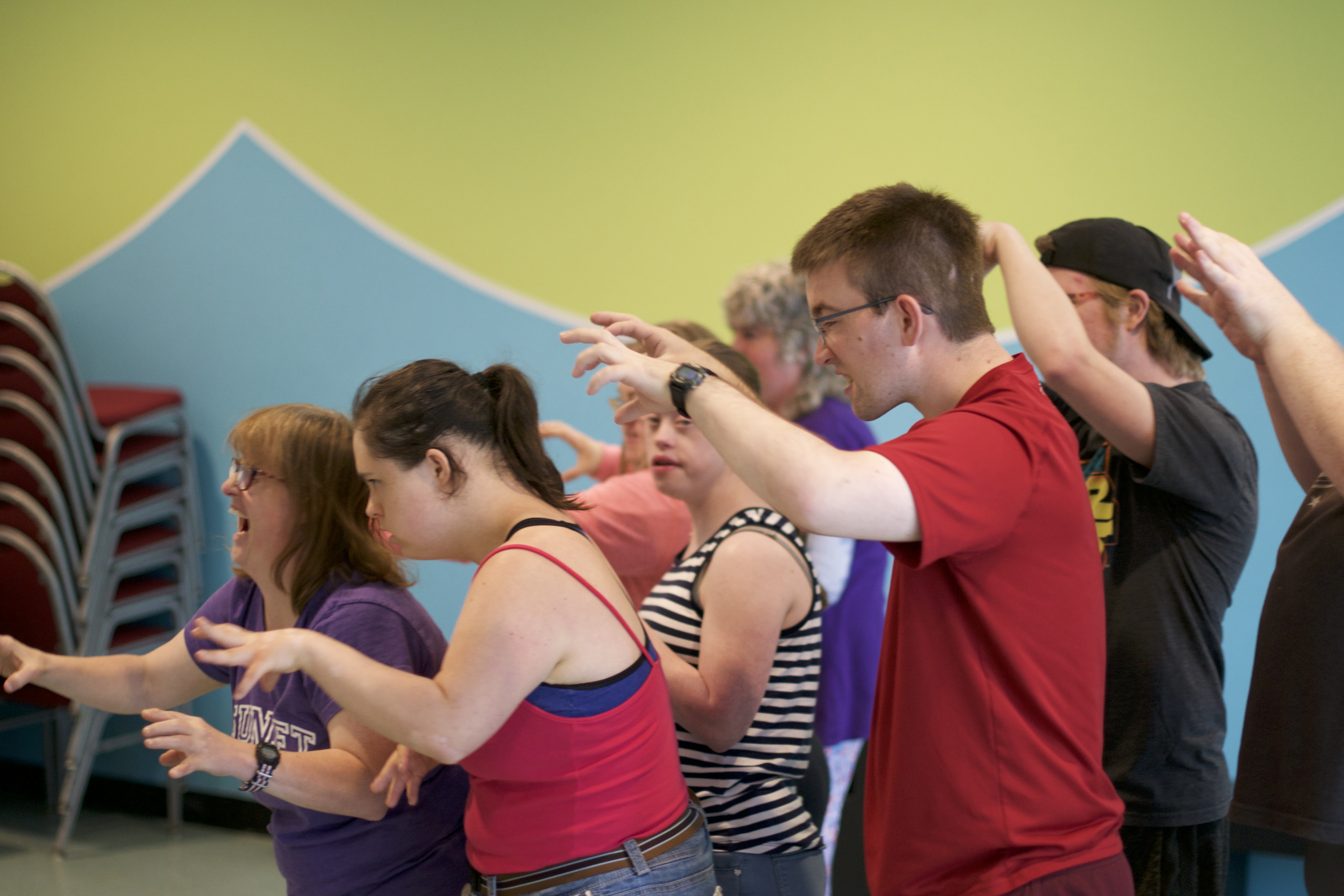
My focus this week is on strength in the face of an onslaught of discrimination. What better opportunity to re-introduce some of the most resilient people I know, the performers of and contributors to PHAME, Portland’s fine and performing arts academy serving adults with intellectual and developmental disabilities. I have previously written about different aspects of their work here, here, and here.
Choir Rehearsal for Phame’s Rockopera The Poet’s Shadow
Today I feel compelled to write because PHAME‘s current project, a Rock Opera titled The Poet’s Shadow, prepared in conjunction with Portland Opera, and directed by Bruce Hostetler, artistic director of Portland Revels, is well underway. I have had the privilege to document the rehearsal process photographically. Portraits of truly talented folks. They wrote the libretto, the music, they designed the costumes and the advertising posters, they dance to the choreography of Wobbly Dance, they sing in the choir, they play the music on iPads, they have five principals with demanding roles.
It is exceptional.
The iPad ensemble directed by Matthew Gailey
“The rock opera brings to fruition an 18-month collaboration between PHAME Academy and Portland Opera. In addition to lending PHAME the use of their Hampton Opera Center for the production’s performances, Portland Opera has taught opera-related classes at PHAME and has provided one-on-one vocal coaching to lead actors. The production also partners with Portland’s acclaimed dance duo Wobbly Dance, who will be choreographing the movement chorus, and with Metropolitan Youth Symphony, whose students will join PHAME’s iPad musicians in making up the production’s orchestra.” (https://pamplinmedia.com/pt/11-features/435217-345460-phame-and-portland-opera-rock-new-show)
Choreographers Yulia Arakelyan and Erik Ferguson from Wobbly The movement group rehearsing the monster
Equally timely, though, is the need to spell out some of the darkest aspects that come with our society’s ignorance about, ideology around and treatment of disability.
Tess Raunig, principal role of Elizabeth
I am not even thinking about the extremes: White supremacists, say, who try to disenfranchise marginalized groups, disabled people included, by recourse to an ideology enshrined in Eugenics and Race science. (After all the Nazis were inspired and crafted their laws after American Jim Crow and extended them to the disabled population.)
Aaron Hobson, principal role of Beautiful Love
Not thinking about people enabling that ideology by implying mental illness is at the root of violent excess, rather than domestic radicalization, something repeatedly experienced in the wake of mass shootings, as the recent one in El Paso, Tx.
Anne-Marie Plass, principal role of The Rose
Not thinking about the ideology of some of the highest judges in the land (Kavanaugh’s record on disability issues is hair-raising), or the assault on the rights of people living with disability, including undermining the Affordable Care Act.
Lea Mulligan, principal role of Mrs. Peacock
No, I am thinking of the daily volume of violence that is par for the course for this population living in a society bent on ableism – discrimination in favor of able-bodied people – in addition to all of the other obstacles thrown in their way, from problems with physical access and barriers to lack of employment opportunities creating a feedback loop between poverty and assumptions that disability is a sign of cognitive inferiority.
Maxwell Rochette, principal role of The Fairyguide
The statistics are staggering. For a succinct overview (with research references) go here. Here are summary quotes from the linked article:
Violent crimes are three times more likely to victimize disabled people than those living without disability (and the data exclude people who are institutionalized, not covered by the research. Numbers of victims there are expected to be significantly higher.)
Then there is law enforcement. “Police violence comprises so much violence against disabled people that we constitute up to half of those killed by law enforcement officers. They are quick to view disability, from deafness to neurodivergence to physical disabilities, as noncompliance—and even quicker to use that perceived noncompliance to justify excessive force.”
Schools: “Of the nearly 50,000 US students who were physically restrained during the 2013–2014 school year, more than 75%were students who received disability accommodations. This is absurdly disproportionate given that these students represented just 14% of the student population.“
*
Members of the iPad ensemble
*
The added value of organizations like PHAME lies not just in providing opportunities for talented artists and performers to be seen and heard or to be integrated into a community, lessening social isolation. The quality of the projects, of what they as individuals and as a group accomplish, reveals how wrong we are in our assumptions about a population many of us have little contact with. The imperative of full integration into the lives we all share is and should be, of course, independent of quality of performance or creative achievement. But having the public view accomplishments like these will help undermine our deeply rooted stereotypes. If this leads to changes in views around employability or independent housing or the degree of openness to interact on a level playing field, much will be gained.
In the meantime I suggest you do yourself a favor and buy tickets to “The Poet’s Shadow.” You will be moved beyond words.
Continuing from yesterday, here is another long take on what to do about fake news.
Yesterday I offered some suggestions why propaganda and other big lies are so successful in manipulating all of us. Some of us – those prone towards delusion, dogmatism, religious fundamentalism or lacking analytic thinking skills – are more vulnerable to manipulation than others. But all of us are in the same boat when it comes to cognitive overload: if we are flooded with information, particularly contradictory information, we often feel overwhelmed, don’t know who to trust and eventually decide not to believe anything at all. Or we decide it is just too much effort to dig deep into analysis and/or not worth it to expand so much mental energy.
The second point – is it really worth the effort? – is where a mix of self service and poor calibration determines how much you are likely to buy into falsehoods. If you really hate a claim, then you’re motivated to challenge and undermine the claim, so maybe you do the work. If the claim aligns with your prior beliefs, confirmation bias will make you lazy. Calibration suffers because people are often poor in judging how well established a claim is — i.e., how good the evidence is. As a result, they often regard strong claims as only weakly established (and so they waste time challenging the claim), and often regard weak claims as well established (and so, mistakenly, don’t bother to scrutinize the evidence). If you look at how social media influence your assessment of “well established” by the sheer number of likes or retweets or linked Hashtags, it is easy to understand why we are increasingly bad at calibration.
Recent research in Europe has shown that people intent on manipulation are quite aware of these factors and form entire troll bands to sway public opinion towards their right-wing or neo-fascist directions by sheer volume of clicks. There are now movements to oppose this tendency, under the hashtag #Iamhere. Private individuals, more than 10.000 in Germany alone, although the initiative started in Sweden, are fighting hate speech on FaceBook. They don’t argue directly with extremists. Instead they collectively inject discussions with facts and reasonable viewpoints. The idea is to provide balance so that other social media users see that there are alternative perspectives beyond the ones offered up by the trolls. FB supports this here.
The big difference between US and European approaches to free speech, hate speech and lies, however, is not happening in the private sector but in European legislation. Germany, with its fascist past, is particularly alert to the dangers associated with hate speech. Free speech is acknowledged to be a fundamental right and a basic constituent for democracy. But it is seen as something to be balanced with other factors necessary to maintain a democracy, which can restrict certain contents of speech if deemed a danger to democracy. (It is part of a concept of militant democracy, held by German government since the establishment of the republic, more on that another time.)
The German criminal code contains 22 statutes that prohibit and punish actions deemed a threat in this regard. They include inciting hatred, racist insulting of particular groups and Holocaust denial; forming terrorist organizations, the use of symbols of unconstitutional organizations, defamation of religions, religious and ideological associations in a manner that is capable of disturbing the public peace, and forgery of data intended to provide proof, among others.
These restrictions are justified by assuming that propaganda would create racist majorities, could lead to violence and discrimination and could cause resentment that in turn destabilizes the democratic order. Not many of these statutes would stand the test of the US 1st amendment; the differences are really based on a fundamentally opposed understanding of government: Here, in our mistrust of government and celebration of individualism, we seek the least amount of intervention possible. In Germany, pluralism is valued above individualism, and the government is seen as a protector of minorities, of tolerance, of the good of the whole, rather than of individuals only or foremost.
And from the other side of the political spectrum:
Free speech, folks.
In this spirit, as of 2018, Germans also ratified a Network Enforcement Act (Netzwerkdurchsetzungsgesetz or NetzDG) that holds social media platforms responsible for enforcing the statutes mentioned above.
NetzDG targets large social network platforms, with more than 2 million users located in Germany. It requires these platforms to provide a mechanism for users to submit complaints about illegal content. Once they receive a complaint, platforms must investigate whether the content is illegal. If the content is “manifestly unlawful,” platforms must remove it within 24 hours. Other illegal content must be taken down within 7 days. Platforms that fail to comply risk fines of up to €50 million.
Serious criticism of this hate speech law can be found here
Most importantly, you have a restriction of free speech enshrined in the German constitution: Art. 18 states that anyone who abuses freedom of expression (or any number of other important freedoms cited within) in a way to undermine a freedom-oriented democratic system cannot invoke this fundamental right. They have learned their lesson, it seems.
————————–
Photographs today are from the Esplanade during this year’s Rose Festival. Free speech reigned, as did disgusting visuals, and I would have given a lot to have the military personnel talk to me about their views of democracy…..
Here is a wonderful essay on Beethoven and democracy – let’s go for the 9th in 1989! Such hope then.