Browsing Category

Psychology

Widow-makers

The term widow-maker probably means different things to different people. The uninitiated older-than-35-year-old set who has never heard of, much less played the video game Overcraft, is probably oblivious to the fact that the term refers to an assassin also known as Amélie Lacroix. The unconcerned younger-than-35-year-old set will have no idea that it is the informal term for a deadly heart attack that involves 100 percent blockage in the left anterior descending (LAD) artery. And all of us in the overlap of those sets will probably be blissfully unaware that it is a term used in conjunction with dreadful accidents in forestry.

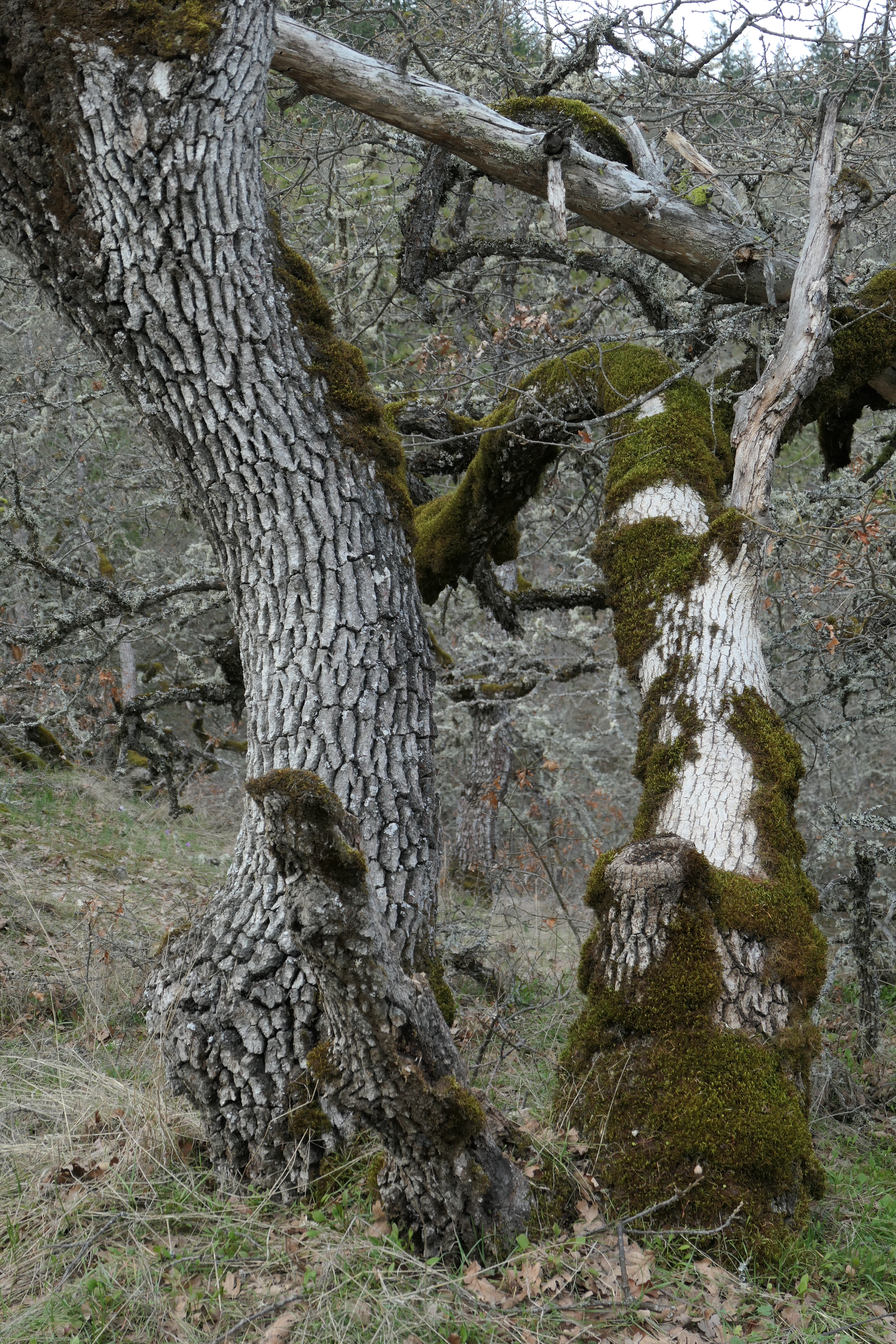
The reason this came to mind was a conversation with a person who happened to come by when I stood in front of the tree below – or what’s left of it – on Monday. A large part of the tree had come down last year, luckily falling when no-one was around. The remaining stump, still taller than a person, seemed solid enough, but all of a sudden in the last few days all of its bark, huge pieces of it, had come down at once, forming a large pile.

I was wondering out loud if someone or something had attacked it, it looked so violent. The guy explained: this is a widow-maker. I learned that diseased or old trees not only have limbs that break off, hang in the crowns and topple down when forestry workers try to fell the trees. They often spontaneously shed their entire bark when shaken by wind or axes, and those can kill the people underneath. The passer-by had indeed a friend who met that fate while working in the Oregon forestry industry.

Walking home, I was thinking of how many of those trees I encounter in my regular wanderings, here in Tryon Creek, Forest park, Oaks Bottom and out in the Gorge. How much depends on luck, not to be at the wrong place at the wrong time. And how overthinking of the possibilities can lead to levels of anxiety that would make it impossible to explore my world. This in turn lead me to remember a psych paper I read (with the advisory that the research area of personality is often subject to non-replication problems.) But here is the argument, a theoretically interesting one, in a nutshell (all research details and data sources can be found in the link below):

People have different attachment styles, some being secure, others less so. This leads to different advantages and disadvantages when it comes to how we function in life in general and face threats and dangers in particular. A third of us are securely attached and faring fine, the other two thirds not so much, being either highly anxious or avoidant. Why would evolution tolerate such a mix? It seems that independently of what it means for an individual to be anxious, or avoidant, or securely integrated, these differences in style might have huge positive implications for the social groups we live in.

For example, people who are close with their family members are less likely to react to noises or alarms indicating impending danger, like a fire. They only react to unambiguous signs, like flames and smokes, when precious time is already running short. Highly anxious people, on the other hand, are like the canary in the coal mine, sentinels who signal early warning.

Avoidant people are also late to realize danger, but then act quite decisively to rescue themselves, and their protective action signals to others the presence of danger as well as potential escape routes. The avoidant person’s survival behavior then might also, if unintentionally, save other people’s lives.

https://www.ncbi.nlm.nih.gov/pmc/articles/PMC4261697/

Now, all of this might be of no relevance if I walk alone in the woods, but it is reassuring to think that we as a social species have evolved to help each other out in social situations with present danger, whether consciously or not. Probably won’t be my last thought, though, when that branch hits……

Music today seems to beckon for Dvorack’s Silent Woods…..

https://www.youtube.com/watch?v=yZYmFWcHdB4

And here is one of the most beautifully written essays on facing just this kind of threat. https://www.nytimes.com/interactive/2019/03/20/magazine/kayaking-trip-alaska.html

Consider the Monkey

This week I will try to convey how singular examples can bring a point home, and sometimes pave the way to understand a larger pattern. At least they do so for me. often provoking thoughts about how we are repeating history in one way or another.

I will start with the case of Ota Benga, a Congolese pygmy of the Mbuti tribe, who was bought by an American explorer from African slave traders in 1904. After having been displayed at the St Louis World Fair, he was brought to the Bronx zoo. Together with his pet chimpanzee he was locked in the Orangutan cage and exhibited to visitors as a kind of animal, his teeth filed to sharp pints by the zoo keepers and with bones added to the cage to hint at cannibalism.

Clergy eventually protested and had him moved to an orphanage for non-white children. By 1910 he was forced to work at a tobacco company in Lynchburg, VA where he later killed himself, having built his own pyre beforehand, with a stolen gun.

https://www.powells.com/post/original-essays/consider-the-monkey

Treating someone who looks different from the white norm as subhuman has not stopped, even if we don’t put exemplars in the zoo these days. We still put them behind bars, in large numbers, caging them for the purported fear of their wild, dangerous impulses. We call them animal names – remember George Allen, Republican Senator from Virginia, who called Indians at his rallies Macaques? Or Roseanne Barr decrying Valerie Jarrett as the child of an ape? Or he who shall not be named calling Omarosa Manigault a dog?? And if you are a soccer fan you’ll know about the 1000s of European fans making monkey noises in stadiums when the scoring opposing-team player is a black person.

Psychological research, originally looking into Nazi use of dehumanizing language in preparation for the Holocaust, has shown that merely listening to it increases the willingness to use violence; some international agencies even consider that kind of naming a precursor to genocide. Once a class of people is dehumanized, the usual compassion and empathy that we extend to fellow human beings is weakened. The part of your brain that controls social relations becomes less active, a physiologically measurable effect when you are exposed to this kind of language. The door to systematic mistreatment is then wide open.

http://theconversation.com/the-slippery-slope-of-dehumanizing-language-97512

One of the ways we try to expose the past and help overcome it, is by creating museum exhibits that show the consequences of racist behavior. Case in point is the The Equal Justice Initiative’s National Memorial for Peace and Justice , a public memorial of the lynching of Black people in Alabama. By all reports – I have not been there – it is an astoundingly emotional site that brings the relevant points home. At a cost, though, that few of us probably considered.

Kunta Kinte – Alex Haley – Roots Memorial

The disturbing article attached below talks about the re-opening of wounds for those who lost family members to lynching. More generally, it describes how watching the exhibits can become itself a kind of voyeurism, or entertainment for those taking selfies with the displays. “This memorial, intentionally or not, reproduces the opportunity for white onlookers to engage in the spectacle of lynching.”

It makes you really wonder, what can be done to provoke change. One thing we can start with, I think, is to watch our own language and eradicate the spontaneous use of animal terms during denigrating fits – myself included.

Photographs today from Annapolis, Maryland, where a memorial celebrates the first African-American Supreme Court Justice, Thurgood Marshall.

And Strange Fruit by Billie Holiday, in commemoration of the lynchings.

Kvetching

The yiddish word to kvetch refers to whining or complaining. A fun book by Michael Wex gives a good introduction: Born to Kvetch: Yiddish Language and Culture in All Its Moods. It contains nuggets like this: “Judaism is defined by exile, and exile without complaint is tourism.”  If you don’t trust me, read this review….  https://www.nytimes.com/2005/09/28/books/to-provoke-in-yiddish-try-how-are-you.html 

So let me kvetch today: What is a woman to do when her art did not make it into an exhibit she had put high hopes on? Particularly when said exhibit was juried by someone whose curatorial eye she greatly respects? And concerned a theme, environmental threat from climate change, that is a  focus of her work? 

Why, eat a bag of Fritos and go for a long walk. Preferably simultaneously, although my camera is starting to complain about all the crumbs. Alas, the conversations in my head prohibited an escape from the emotional sting…

“Why not join the flock of sheep,” say the sheep. “Just fit in.” “I’m not a sheep,” say I,”I’ve always done my own thing. And besides who wants to have starlings on your back, stealing your persimmons treat.

“Why not join the gaggle of geese,” say the geese. “Just get in line.” “I’m not a goose,” say I, “goose-stepping not desired.” Besides, why walk across the road when you can fly?

“Why not try it straight up,” whispers the landscape, “your work is so obtuse.” “I’m not a photographer per se,” I whine,” I do montages. No matter how many straight lines I put in, the images are complicated.” 


“You’re just a speck in the landscape” hollers the eagle, “just like I.” “Which is my point, say I, ” a tiny speck in a sea of artists. But is that so because of the numerical odds, or because the quality of my work is just not up to par?”

Baldie on left hand side in the water

Imaginary exchanges aside, what is the psychological basis for such self doubt? In my professional and academic life, I never suffered from impostor syndrome, the belief of successful, high achievement people that they are in fact frauds who have managed to dupe their way to the top. (It used to be thought of as a female problem, which more recent research shows to be false. Men experience that syndrome too, and are hit harder by its negative consequences for performance, as it turns out.) The link below is to the classic Clance and Imes paper that paved the way, still quite informative.) 

http://www.paulineroseclance.com/pdf/ip_high_achieving_women.pdf

But I face a different scenario: rather than doubting the roots for existing achievement, there is doubt regarding the possibility of achievement in a new domaine. Doubt despite the fact, as kind friends point out, that recognition has already happened in the few years that I have been at it, expressed through numerous solo shows and feedback from artists I admire, who do not know me personally. Doubt that reminds me of the days as a professor when you had the entire class give you the highest points on evaluations and one single student dissed you in most aggressive ways. All that stuck, for days, was that negative comment; just like last week’s rejection for the exhibition blotted out the shows I was admitted to this year.

So much about art is amorphous, contextually charged, subject to ever changing tastes, rooted in familiar processes (of which mine deviate), Zeitgeist-dependent. Knowing all that why still the attribution to a potential failure of my personal ability?  You tell me. I need to get back to making more montages.

Photographs today were taken on Sauvie Island last Thursday. 

Big Words

Consequences of Erudite Vernacular Utilized Irrespective of Necessity: Problems with Using Long Words Needlessly is the title of a decade-old Princeton study by cognitive psychologist Danny Oppenheimer who now teaches at Carnegie Mellon. The paper won the Ig Nobel Science Humor award which recognizes “achievements that first make people LAUGH, then make them THINK.” Which it does indeed, as does its author (who introduces himself on his university website with” Some people say I like corny puns. There’s a kernel of truth to that, I’ve got an ear for puns that pop… ” )

The paper reported on a clever set of 5 studies that found basically that less complex writing is preferred over more complex one, and the author’s intelligence is judged more positively when writing simple texts. “The negative consequences of needless complexity were shown in widely disparate domains (personal statements, sociology dissertation abstracts and philosophical essays), across different types of judgements (acceptance decisions and intelligence ratings), and using distinct paradigms (active word replacement and translation differences). The effect was demonstrated regardless of the quality of the original essay or prior beliefs about a text’s quality. All in all, the effect is extremely robust: needless complexity leads to negative evaluations.”

https://www.affiliateresources.org/pdf/ConsequencesErudite.pdf

The assumption was that something that feels less fluent (because you have a harder time processing it) is associated with a less intelligent author. This was confirmed when a manipulation of how easily we can read a text, by presenting it in an impossibly hard font, also led to a negative judgement of the text author’s smarts. The reader could not easily process the text and so laid that at the feet of the author, even though it had nothing to do with the expressed ideas of the article. In summary, then: We protect ourselves from feeling dumb by blaming the writer.

Be careful, then, with using big words, if your writing aims at impressing other people. If, on the other hand, you just want to have fun cranking your brain, by all means adopt a commodious vocabulary as a meritorious selection over quotidian asseveration…… 

Here are the biggest words you might want to avoid (actually they are the longest, but sufficiently obtuse for my purposes):

http://mentalfloss.com/article/50611/longest-word-in-the-world

I’ll end with today’s favorite: FLOCCINAUCINIHILIPILIFICATION, the longest non-technical word in English, which refers to the act of describing something as having little or no value.  Like complex word use.

Then again, I might go for the longest German word at 80 characters:

Donaudampfschifffahrtselektrizitätenhauptbetriebswerkbauunterbeamtengesellschaft, the “Association for Subordinate Officials of the Head Office Management of the Danube Steamboat Electrical Services,

given that German is my first language, one for which Mark Twain observed: “Some German words are so long that they have a perspective.”

Just don’t judge my intelligence by it…..

Photographs today are of extremely simple utterances found on the street:

The Rise of the Phoenixes

Yesterday I wrote about laughter, today it shall be tears. Rest assured not mine, or at least not publicly.

I will discuss them in the context of the confession of a Netflix addict, yours truly, who has been hooked on a Chinese Soap Opera for the last several weeks.  The Rise of the Phoenixes has me mesmerized and I am trying hard, and largely unsuccessfully, to figure out why exactly.

A word of warning, you don’t want to start watching this, unless you care to waste 45 minutes x 70 (no typo) episodes of your life’s time. Even I will not make it to the last episode, particularly since it doesn’t have a happy ending. (How do I know? Why, I do the same for Tv that I do for books, I always check the ending out first, and don’t even think about calling me on this, I’ve had that debate too often…)

My entire knowledge of China consist of having read Clavell’s Tai Pan  and other such beach novels, and a serious perusal of The Selected Works of Mao Zedong in an equally serious book group of my first year at university, aged 17. Man, were we naive.

So why am I glued to a historical drama, whose every allusion (as critics claim) to contemporary Chinese society escapes me? The story has a few main strands. There is the old emperor who’s 10 sons fight for succession, with every court intrigue imaginable, killing each other off if need be. There is a rival empire trying to restore past glory and usurp the current realm. There is boy meets girl mixed in (in sort of a Chinese variation on taming of the shrew), with girl having to pretend to be a boy until another scheming courtier unravels the secret and has her (almost) executed.


There is no other way than to describe the visual experience as Vermeer meets Dior meets Monet meets Eisenstein. The colors and lighting are straight out of the old Dutch Masters. The costumes are exquisite, ever changing, subtly matched in color to amplify the gilded surroundings and intricate carvings of the palace interiors. The (rare) outdoor shots along willowy waterways or bridges are reminiscent of french impressionism. And the battle scenes choreography would make Sergey Eisenstein proud.

The intellectual experience, if you dare to call it that, is one of extreme gendered display: with few exceptions, all the background women are scheming, nasty, power hungry or push-overs who spend 18 years parked in cold corner of the imperial palace, waiting for a turn as concubine. They all have secrets in their past, and are meeting sordid fates, never being shown in positive relationships. Then there are the men, spread across a much larger canvas of possible qualities, and often in buddy relationships or with side kicks, blurring the lines between servant and master, teacher and friend. Our hero stands out as breathtakingly beautiful (a 42 year old actor playing a prince in his 20s and you believe it in a second) and smart and just and beloved by all, including our heroine who, alas, can’t marry him. As long as she plays a man, she also has friends and social contacts and guards that adore her (the kind that can fly through the air in true Chinese martial arts-movie fashion.) And she manages to rescue our hero multiple times, while serving as the smartest scholar in the land at the side of the emperor. Almost impressive enough to let you forget the negative portrayal of the rest of the fair sex…..


The emotional experience, then, must be what draws me in. For one, the pace is glacial, as to be expected when you fill 70 episodes, which means lingering camera shots, endless scene changes that allow you to take in the sets, instilling a sort of meditative trance while being awash in all that color, particularly if you let the Chinese rush over you and ignore the subtitles (which translate the same word in 100 different ways…) Secondly, there are the tears – I knew I was getting to them eventually. There are harsh ones, copious ones, silent ones, noisy ones, forced ones, spontaneous ones, fearful ones, enraged ones, elegant ones, swallowed ones, single drops to flowing streams, nose running and all: and they are primarily displayed by all the men!  I have never seen so many men crying with abandon around every corner! Yes, the women cry as well, but the real focus is on all those machos, dissolving.  Throws out of the window everything I ever learned about emotional display rules in collectivist cultures.


And now I better get back to episode 21 to see who rescues whom from the next looming palace intrigue, leaving someone in tears before being thrown into the dungeons.

Photographs are from the PDX Chinese Garden.


The Faghag and her friends in the summer of love

I have a tendency to burst into spontaneous laughter when I read something funny. This amused my mother, irritated my father and baffles my husband to no end. As to my sons, they just roll their eyes. As they also do, incidentally, when I crack some jokes myself; the Heuer-Humor, as they call it, seems to be the kind that elicits, if any at all, amusement with a side of head shaking.

If you look at the scientific literature, this turns out to be true for women’s attempts at humor in general. Men don’t laugh as much at women’s jokes as women do, and certainly not as much as women laugh at men’s jokes. The gender differences are striking. If asked what is desirable in a partner, both genders give high value to “having a sense of humor.” Except that they mean two very different things: women want a man who can make them laugh, men desire women who laugh at their jokes.

Here is the long argument – my summary below:

https://www.theatlantic.com/health/archive/2015/11/plight-of-the-funny-female/416559/?utm_campaign=the-atlantic&utm_content=5bf662079ac56400011d1fc9_ta&utm_medium=social&utm_source=facebook&fbclid=IwAR1mG0QaQcnRb9y7m7XHxefbRyJehreLajvWiFHhxYes7VG31FgEc1hmhvI

Why should that be? Evolutionary psychologists (yes, that line of psychology seems exempt from extinction) have some handy explanatory moves: Humor is linked to intelligence (true fact: there is a correlation between IQ points and ratings of funniness in men.) Women want smart men (the old supporter theory,) therefor they go for funny. Men don’t like women to be smarter than themselves (indeed those correlations are also established) and so avoid the comediennes among us.

If you observe men and women in social settings, not only do women laugh more, but they do so with increasing frequency if men are nearby. This is the kind of laughter by the way, that researchers called “posed” in contrast to the spontaneous laughter that cracks you up, whether in company or not. These two kinds of laughter have distinct physiological profiles that we can measure, and also allow us inferences about the social function of posed laughter: as a tool for communication, support, social cohesion, mating and – alas, – condescension and exclusion, when people get laughed at rather than with.

Men try harder at making jokes and more often; even if they fall flat repeatedly –  eventually they get better at it. We women, who do not get rewarded for being funny, on the other hand, give up trying early on and so never develop the ease or repertoire necessary to make people laugh, regardless of gender.

Lucky for us, however, not all of us do give up. Some have the courage, determination and talent to become outstanding stand-up comics. You can go see for yourself: we have one of the funniest (and as it turns out most incisively intelligent, sarcastic and wise) female performers coming to town this week, with several shows to choose from. Penny Arcade, the NYC icon of irreverent political humor, is back with a variety of skits.

November 29-December 1, 2018
Venue: Imago Theatre, 17 SE 8th Ave, Portland

  • November 29—The Faghag and Her Friends in the Summer of Love (work-in-progress) – 7:30pm
  • November 30—Longing Lasts Longer – 7:30pm
  • December 1—Longing Lasts Longer* – 7pm
  • & The Girl Who Knew Too Much (work-in-progress)* – 9p
  • Tix here:https://web.ovationtix.com/trs/cal/34673


I saw Longing Last Longer earlier this year and share Portland City Commissioner Chloe Eudaly’s assessment: “I laughed, I cried, I remembered, I dreamed, I longed, I saw the light… There shouldn’t be an empty seat in the house!”

This time I look forward to The Faghag – a trip down memory lane of the 1960s gay bars in New York and P’town.  Let’s hope my laughter doesn’t interfere with my camerawork…..

Here is a (longish) piece on the artist’s background and philosophy ever since her years as part of Andy Warhol’s entourage: https://www.thedailybeast.com/warhol-stonewall-and-where-lgbtq-activism-went-wrong-penny-arcade-takes-center-stage

Portraits were taken this February. Link below is a TED talk on the different kinds of laughter I described above.


Patterns

Here is the chain of events that led to today’s blog. Another one of those days of just me and the dog at home. I: trying to play the piano, as I only do when no-one is around given how much my skills have deteriorated these days. The dog: doing his best to make me stop, sharing that quality assessment, I guess. I: trying to explain to him the complicated structure of Bach’s fugues and how I needed to concentrate. He telling me in no uncertain terms that he hates counter point and really wants someone to throw a  ball.

Guess who won?

And guess who, reduced to reading, came across an interesting essay by Freud, flagged by someone who wrote about Bach’s ability to invoke both joy and fear, horror and beauty, exact opposites in his compositions?  Freud’s (1910) essay is called The Antithetical Meaning of primal Words (Über den Gegensinn der Urworte) and starts with a reference to his work on dreams and their ability to combine contraries into a unity – said simply: something can stand for both one meaning and its opposite. He then introduces an 1884 text by a historical linguist, Karl Abel, that describes at length a peculiarity of ancient languages. They contained, according to Abel, numerous words that have two meanings, one the exact opposite of the other. Some old Egyptian word might mean wet as well as dry, for example. Further, he claims, there were compound words that bind together things of opposite meaning (old- young, far-near) but they express only one of them.  All this was postulated for Egyptian, Semitic and Indo-European languages (and, coincidentally published at the same time in the late 1800s when Marx had written extensively about dialectics…)

Freud enthusiastically took off with finding words in the more familiar Latin that seemed proof for this: altus means high and low, sacer means sacred and accursed, and so on. Then he explored German, and wouldn’t you know it there were words with opposite meaning: e.g. Boden meaning the lowest part of the house as well as the attic… voila, archaic languages provided the pattern that re-appeared in dreams.

You can read his deductions now linking this perceived pattern to the analysis of dreams yourself (if you are not distracted by a bored puppy…) https://www.sas.upenn.edu/~cavitch/pdf-library/Freud_Antithetical.pdf

Only one problem: The bulk of Abel’s work was thoroughly discredited, it’s a croc; and that was already established by serious philologists in the late 19th century, for sure at the time of Freud’s writing. Freud was clearly seduced by a claimed pattern that fit with his hypothesizing around his discoveries and methods in his psychoanalytic studies. Whether he willfully ignored or was just hopelessly blind to the state of the art in linguistics, who knows. It is certainly the case that we are all subject to this kind of confirmation bias.

Independent of dreams, it is a fact that contradictory emotions can be experienced when listening to a single piece of music, and that patterns can be woven into compositions that are of a dialectical nature. Nobody did that better than J.S. Bach. Which was what started this whole train of thought….

Photographs today of some lovely point/counterpoint reflections, collected during fall.


Reality Check

This week’s report on one of the loveliest weddings I ever attended will conclude with a few observations.

Observation #1: Everyone is a photographer now, although they all leave their cameras behind while on the dance floor…..


Or they check on the images immediately….

Observation # 2: I cry at weddings. Never mind that I know the political roots of the institution, the oppression it was associated with for many centuries and in many cultures. I am moved to pieces when I look at a happy couple, so full of hope for the future, and families merging, differences be damned.

Observation# 3: People always throw around these statistics that marriage improves your physical and mental health, assuming there is a causal relationship. It is indeed the case that compared to singles, married people live longer, have fewer strokes and heart attacks, recover faster from them if they get them, are likely to survive cancer longer, and have fewer incidence of mental health issues, particularly depression. But these findings have to be looked at with caution because they are largely correlational. That means any number of other factors could account for them.

For one, there is a gender differential. Men profit from marriage much more than women do when it comes to health effects.

Secondly, people in unhappy, stressful marriages are way worse off than singles who have a good friendship support network.

Third, people who have already compromised health might not get married in the first place, and so when they have worse outcomes for coronary diseases it is because of their original health status, not their married life. Isolation leads to depression, and it is the absence of any partner/family network rather than the marriage status that might account for higher rates of depression in singles.


The health advantages of marriage

The effects also seem to solidify when a marriage lasts for a long time, (counted as 10 years and up), while the positive effects are not pronounced in shorter marriages. With this said, my current favorite bride and groom will have a long marriage, excellent health, no regrets that they tied the knot and will live happily ever after.


My current favorite singles, on the other hand, can also rejoice: there are nifty benefits out there:

https://health.usnews.com/wellness/mind/articles/2018-02-12/5-health-benefits-of-being-single

And just think: girls night out whenever you want!

i’m giving the last word to  Mozart’s Marriage of Figaro:


Conflict Solved

I came of age during a feminist wave that pretty much condemned the desire to be or make oneself beautiful. It was never exactly clear to me why a movement towards androgynous looks – so obviously tending in the direction of the masculine away from the feminine – was a sign of strength, rather than a narrow reaction to society’s demands on women.

But the question remains: Can feminists embrace beauty and beautification, or is it a sell-out to The Man? Is it just one more thing where women are not in control of their fate, but trying to live up to ideals set for them by someone else?


The advantage of having raised feminist sons is that they are perfectly able to solve the conundrum for you when you mull over this at the dinner table, while trying to explain how you are drawn to photograph all the beauty found in people’s hair, their necklines, the way they dress, and, let’s not forget it, their feet. Have to photograph that coveted footwear!

“Of course you can enjoy beauty, Mutti! That is different from  forcing ideals onto people, or body shame them when they don’t reach them, or fill their heads with preoccupation with looks rather than ideas. You want to honor bodily autonomy, in both women and men. And you want to think through your choices – if three hours of putting on make-up stops you from volunteering it might not be a cool choice, but you still are free to choose. If your choices are driven by a desire to conform, or please, or not be excluded, maybe think again.”


Indeed, I think we want  to free ourselves of gender expectations, but be free to express our gender anyway we want – if that includes stereotypically feminine aspects, from heels to nail polish, so what. We should simply not judge or be judged by ways of self expression. I know that when it comes to theory – in fact I brought my infant sons dressed in perfect pink into my graduate class room to have my students react with glee or frowns or astonishment or pure joy – to discuss gendered issues. I also let my boys play with Barbies which they coveted at childcare, and am certain I would have found that unacceptable if they had been daughters because of the body image issues. But when it comes to practice – myself drooling over lace and pearl- studded veils, or frilly pink, or shining tresses –  I still have pangs of bad conscience.


I also remember the far more consequential discussions among women, myself included, who had to make choices after mastectomies. Do you opt for breast reconstruction, or not? It involves serious additional surgery, money and potential obstacle to easy detection of cancer recurrence. Do you opt for false bras, or go flat? Does it matter that you are 30 or 50 or 70 years when the plague hits, partnered or still searching? When looks and sexuality are directly linked in a society that is so focused on these specific body parts, “free” choice is made maddeningly difficult.


https://www.elle.com/culture/books/a37113/can-beauty-culture-and-feminism-co-exist/

So there  – here is the juxtaposition of theory and practice, my dialectic approach to fashion: I document the beauty around me, adore it, allow myself to buy funky clothes as long as it doesn’t involve cutting the budget for charity and includes second-hand stores, I skip make-up, and dream of high heels.  A start.


And I plan to wear unmatched socks, too!

Musical choice today is the Marshallin from Strauss’ Rosenkavalier who bemoans the loss of beauty and the burden of aging when inside she is and feels like still the same young person she always was.  But then she declares that all that matters is how you tackle it.  Onwards!

Street Roots


After a week of portraying travel options mostly linked to the past, today I want to direct us to the present. The here and now where we are all called upon to walk on paths shared with those who are less fortunate than most of us. And with those who are steadfastly around to help them. Traveling, in other words, not necessarily for fun and adventure, but for the larger good. Good for social justice as much as for your soul. Down a road that is not necessarily comfortable, either.

These thoughts were triggered by attending a breakfast fundraiser at the ungodly hour of 7:30 in the morning, in the company of hundreds of other slightly bleary-eyed souls, to celebrate the incredible work of Street Roots, our local weekly newspaper produced and sold by people experiencing homelessness and poverty. Here is what they do:


From a beginning of a few volunteers 19 years ago, they have grown to a large organization winning prizes for their journalism, winning political battles affecting housing and poverty, and, most importantly, giving voice to those who are not usually listened to, with their contributed articles and in their interactions with those of us who buy the paper. More detailed history here: http://streetroots.org/about/work#history 

The organization has a fighting spirit, in the best possible meaning of the word, not shy to risk losing donors if demanded by principle (they lost an annual $10.000 grant from the PDX Archdiocese for refusing to take Planned Parenthood off their resource guide for people in need, not exactly peanuts.) But they also fight for cooperative action, as was evident by the wide range of city players and business donors present at the breakfast, willing to engage across social class, political and economic divides.

Metro

Portland Fire and Rescue

Trimet

Portland Housing Bureau


Kaia Sand, recently appointed executive director of Street Roots, embodies these core values of principled defiance and energetic partnership quite well. (She’s also one of those more interesting poets meandering at the crossroads of literary art and activism – more on that on another day.) http://kaiasand.net/#wavebook


The award procedures for Vendor of the Year and Keystone member of the Street Roots community were moving,

and I was lucky enough to be close to a beloved 4-legged companion of one of the honorees,  Migo the best dressed dog in recent memory.


Still resonating is the keynote address by Michael Buonocore, executive director of  Home Forward, (the former Housing Authority of Portland,) which provides access to affordable housing and services for people facing low income, addiction, disabilities and other issues making it difficult to maintain a safe existence.

http://www.homeforward.org/home-forward/welcome


He called on everyone to choose what I called a difficult path at the beginning of today’s musings: to engage in honest interaction with those outside of our comfort zone, when encountering them on the street, when put off by their attire, when seeking distance because of the potential threat to our own emotional well being while confronted with misery.” LEARN TO SEE EACH OTHER. ”

It might provide the best traveling companions yet!

PS: On my way home from the bus after the event I came by this under the bridge that carries the Highway traffic. A steep cement slope, noisy and full of exhaust gases, attracts sleepers desperate to be dry. Regularly dispersed.