Browsing Category

Culture

Reshuffling the Natural World.

· Vögel, höret die Signale! ·
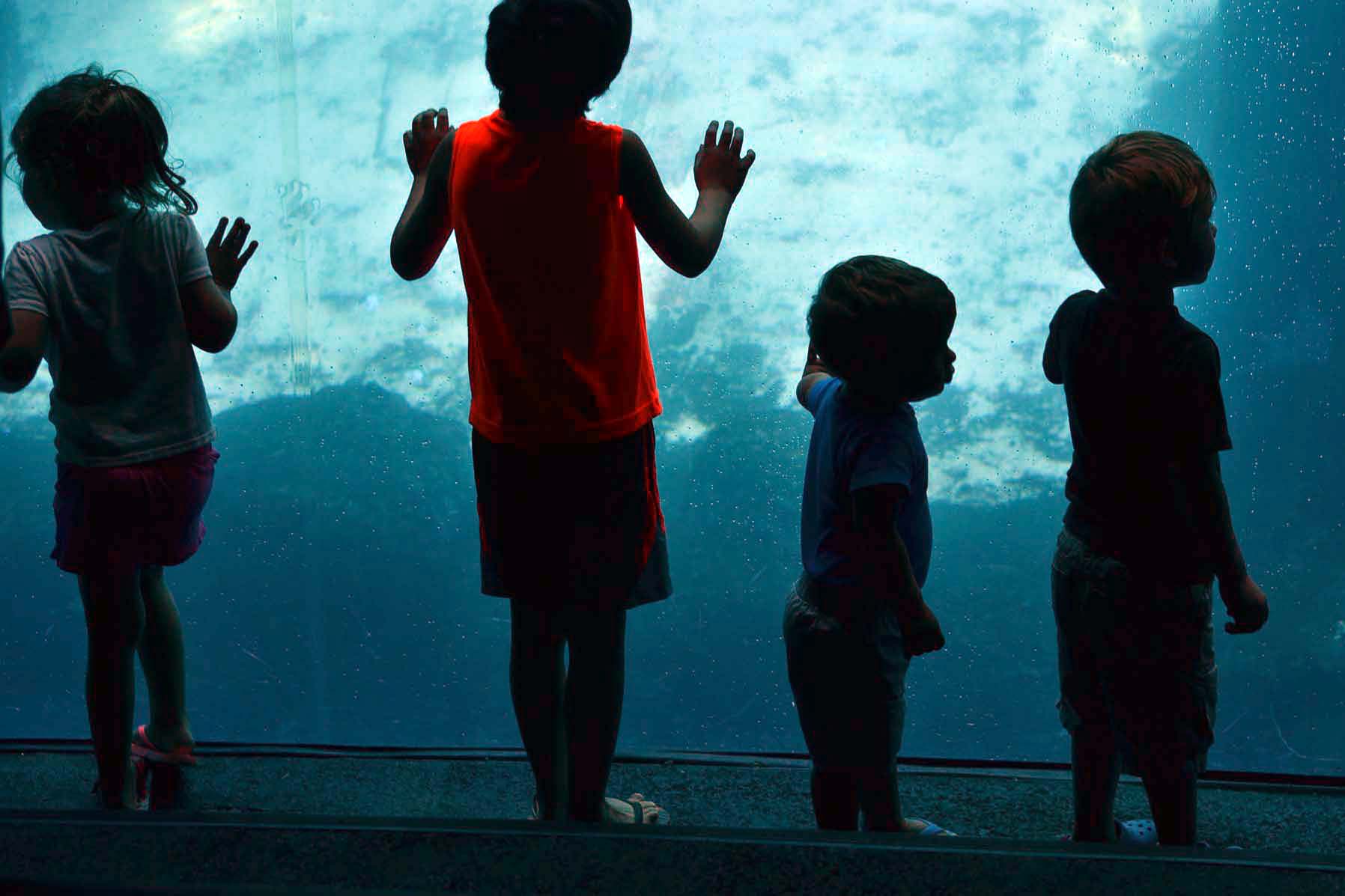
I don’t know about you, but when I go to aquariums or zoos there are a lot of conflicted feelings – from what it means to deprive animals of their freedom and often put them in torturously narrow cages deprived of stimulation, to what it means to have this way of keeping species alive when they are no longer safe in their natural environments. I sometimes wonder if the decorations we find in various tanks and cages are an expression of humor to distract from the zoo keepers’ own conflicted feelings, or if there are yet another sign that we have to put our “civilization” stamp on everything…..

Cue Zed Nelson’s new photo book  “The Anthropocene Illusion.” I read a captivating review of it in the New Yorker, a magazine that I avoided to subscribe to for 44 years, long story. Clearly my loss, now that I discover the power of Elizabeth Kolbert’s writing – but I digress. Again.

(Link here to Nelson’s spectacular photography – all the captions below the photographs are provided in his book.)

Polar bear. Dalian Forest Zoo. China.
Polar bears are the largest land carnivore in the world, weighing up to 800kg and growing up to 3 metres in length.
The typical zoo enclosure for a polar bear is one-millionth the size of its range in the wild, which can reach 31,000 square miles (80,290 km²).
Polar bears live in Arctic regions in Canada, Alaska, Russia, Greenland and Norway, in temperatures as low as -46°C (-50.8°F)


The book displays photographs taken across the world of settings containing or pointing to animals, settings that try to reproduce the natural world they would inhabit if free. The attempts at providing verisimilitude are, of course, futile, and the photographer very much hones in on the artificiality of the backdrops. In addition, there is magnificent photography capturing civilization encroaching on habitat, or humans making encounters with nature into a distraction, at best.

Railway bridge. Nairobi National Park.Kenya Nairobi National Park, established in 1946, is the only national park in the world bordering a major capital city. Home to lions, rhinos, giraffe and the remnants of a once-thriving wildebeest migration, the park has faced increasing pressure from urban expansion and infrastructure projects. The Chinese-built Nairobi-Mombasa railway now cuts through the park on an elevated bridge, prioritising cost-saving over conservation. Further developments, including proposed hotels and fencing plans, threaten to sever the park from critical wildlife corridors, turning a once-open ecosystem into an enclosed and managed space.

Kolbert summarizes Nelson’s main message:

But Nelson’s point seems to be that all efforts to reproduce the natural world, whether motivated by crassly commercial interests or ones that are, ostensibly, more edifying, are much alike in the end. The Anthropocene illusion is that we can somehow connect with the natural world at the same time that we have, as Nelson puts it, “turned our back” on it.”

Niagara Falls. Ontario, Canada.

Established in 1885, Niagara Falls is the oldest state park in America. Over 8 million visitors visit annually. More than 5,000 bodies, mostly suicides, have been found at the foot of Niagara Falls.

Or as Nelson himself phrases it:

“While we destroy the natural world around us, we have become masters of a stage-managed, artificial ‘experience’ of nature – a reassuring spectacle, an illusion.”

Kolbert again:

From the mountains to the savanna, it’s alienation all the way down. The volume’s power lies in its relentless impulse toward disenchantment. Wonder isn’t really an option.

Polar bear tours. Hudson Bay, Canada.

On the southern edge of the Arctic, Hudson Bay is known as the ‘polar bear capital of the world’. Bears come ashore here in the summer when the sea ice melts, to wait for the ice to return in November.
Tour companies cater to an annual influx of tourists eager to see polar bears during the six-week ‘bear season’, when the bears roam the shoreline, waiting for the sea ice freeze over.

I see that somewhat differently, having just taken a beloved 2.5 year-old to the zoo, including their fish tank. There is still wonder galore, even if it is somewhat restricted to the short set. And there is something unsettlingly privileged about the claim that connection to nature is lost if it is presented in artificial environments. For inner city kids and poor families in general, the only access to seeing a live animal and not just something on a screen, might very well be the zoo or a cage in a city park. That experience, in turn, might make them more interested and engaged in thinking about habitats or what we do to species other than our own.

Restaurant with live penguin display. Penguin Hotel. Guangdong, China.

At the Chimelong Penguin Hotel in China, visitors can dine alongside captive penguins in a 1,600-seat, glacier-themed restaurant. While guests enjoy a curated spectacle of nature, wild emperor penguins face an uncertain future. The slow-evolving birds have survived for millions of years, yet nearly 70% of their colonies could vanish by 2050 as a result of climate change.
The hotel also offers close-up penguin encounters at the Penguin Pavilion and a Penguins on Parade show at the Penguin Ice Palace Theatre.

I am the first to mourn our devastation of nature, as my blog’s writing over and over demonstrates.

Here, for example, is the latest compilation of all the assaults on the environment committed by the current administration. Read it and weep.

But experience with something alive, even if corseted in artificial settings, might teach future generations that there is something worth rescuing.

***

The relationship between nature and human interference has been one of the main topics of art, through the ages, but is particularly prominent in contemporary art informed by climate action. Regular readers might remember that I offered a somewhat whimsical series some years back, focussed on the way habitat is encroached by cities, and animals, in turn, intruding closer into our spaces, a destructive development in both direction, but heavily weighted against them. For Guardians of the Towers (Turmwächter) my photographs of cityscapes were combined with the wild life I captured elsewhere.

There are many more serious approaches, with strong work presented in Germany by, among others, Dennis Siering. His 2022 exhibition Unnatural territories, speculative landscapes was enthusiastically reviewed at the time.

He has turned to a different version of reshuffling nature this year. Together with experts in ornithology, bioacoustics (Andre Siering), audio design (Aleksei Maier), and artificial intelligence (Bastian Kämmer), he has developed sound installations – Radical Climate Action Birds – that translate melodies composed by humans into artificial bird calls.

The synthetic bird songs are broadcasted with solar power for about three hours a day in a public park in Karlsruhe (Supported by the UNESCO City of Media Arts Karlsruhe Project Funding Program for Media Arts), potentially leading to uptake by the birds: mimicking the melodies and gradually importing them into their repertoire. I have no clue if this is actually happening, or if the claims that black bird were the fastest learners, is verified as more than wishful thinking.

Here is the fun part of this installation, though: the melodies are all from anti-fascist protest songs. Bella Ciao, whistled by a black bird, might be quite the wake up call! The idea is, of course, that the resurgence of nationalist and neo-fascist ideas, generally inclined to extract rather than protect natural resources, should be of concern to all of us, with direct reminders from nature itself as brilliant a messenger medium as is conceivable. Instead of illusions of nature transplanted into human environments, it is illusions of culture transplanted into nature itself then, in theory. Would be a riot if it worked….

(For non-German readers: my subtitle “Vögel, höret die Signale! plays on a line in the German version of the International, which says Völker, höret die Signale! Birds (people) listen to the call!

Völker, hört die Signale!
Auf, zum letzten Gefecht!
Die Internationale
Erkämpft das Menschenrecht!

In the English text, the refrain begins with:

So comrades, come rally
And the last fight let us face
The Internationale unites the human race.

The original French refrain: (the anthem was written by Eugène Pottier, in Paris, June 1871; he was a refugee from the Paris Commune, who wrote the poem while in hiding in the aftermath of the massacre of the Communards. It was set to music 2 years after his death by Pierre Degeyter in 1889.)

C’est la lutte finale
Groupons-nous et demain
L’Internationale
Sera le genre humain.

Here is the anthem sung in German for today’s music. And here is Bella Ciao.

Let’s hope the birds are fast learners!

History Lesson, anyone?

It could not have been more perfect. The light was right, the temperature warm, but not hot, there was a feeling of adventure in the air. After way too many days listlessly stuck at home with the oppressive heat, I was exploring the sandstone cliffs of Cape Kiwanda, located some 2 hours southwest of Portland at the shores of the Pacific.

The colors and configurations were breathtaking, I could have photographed all day long. Much of it reminded me of Paul Klee (and so some of today’s images are overlays of his art and nature, just to give you the idea.)

The association had probably been triggered by the fact that I had yearned to visit an exhibition that recently closed in Berlin, and was stuck with thinking around the issues it raised, without being able to travel to see it.

This photograph of a sandstone angel overlooking the bombed-out city of Dresden in 1945 was part of the show at the Bode Museum, which brought together images of angels from the Berlin museums that were damaged or burned during the Second World War.

Richard Peter Sr. View from the town hall tower to the south, 1945 © Deutsche Fotothek / Richard Peter sen.

The Angel of History: Walter Benjamin, Paul Klee and the Berlin Angels 80 Years after World War II centered around Paul Klee’s most famous artwork Angelus Novus and Benjamin’s texts laying out his thoughts on the “angel of history,” as he called him. The exhibition also showed excerpts of Wim Wenders’ Wings of Desire(1987), a film in which two angels stand watch over a divided Berlin and in which explicit reference is made to Klee’s 1920 watercolor and Benjamin’s interpretation of the artwork.

Here is what Benjamin wrote in the ninth thesis of his 1940 essay “Theses on the Philosophy of History”:

A Klee painting named Angelus Novus shows an angel looking as though he is about to move away from something he is fixedly contemplating. His eyes are staring, his mouth is open, his wings are spread. This is how one pictures the angel of history. His face is turned toward the past. Where we perceive a chain of events, he sees one single catastrophe which keeps piling wreckage upon wreckage and hurls it in front of his feet. The angel would like to stay, awaken the dead, and make whole what has been smashed. But a storm is blowing from Paradise; it has got caught in his wings with such violence that the angel can no longer close them. The storm irresistibly propels him into the future to which his back is turned, while the pile of debris before him grows skyward. This storm is what we call progress.[3]

The piles of debris are, of course, not restricted to the past – we see them growing skyward all around us, in the present, if we don’t close our eyes in desperation.

***

The look backwards towards the past, however, is under (re)construction – what we are allowed to see now depends on the whims of those who think they own the interpretation of the past.

President Trump’s executive order, titled “Restoring Truth and Sanity to American History,” aims to review and align the Smithsonian Institution’s exhibitions and materials with his interpretation of American history, focusing on removing what he calls “improper ideology.” This initiative is part of a broader effort to ensure that national museums reflect a narrative of American exceptionalism and unity ahead of the 250th anniversary of the United States. The White House

Whether it is controlling the Smithsonian, other museums or our universities, the National Park Service or the National Endowments for the Arts, Public Broadcasting or the Voice of America or shifting public to private education – it boils down to preventing people to gain knowledge and engage in independent thought – both reviled by authoritarians. (I had previously written about fascism and education in more detail here.)

While we still can, let’s look back at history not so long ago.

(My sources for today are the general education you get when visiting the site of the U.S. Holocaust Museum, Michael Burleigh’s The Third Reich: A New History, a moral history reasserting the existence of a totalitarian dictatorship in Germany, Sebastian Haffner’s Defying Hitler: A Memoir, and, most importantly, Richard. J. Evans’ The Coming of the Third Reich. It is an intellectually rich guide, written in totally accessible language and structured in ways that really cover all aspects of the German people falling for the lure of Nazism.)


From its very beginnings, the National Socialist regime of Germany tried to shape cultural displays and production, trying to force German culture into the frame of the preferred ideology. Art that did not conform to the Nazi norms was declared degenerate, confiscated and/or destroyed, Paul Klee’s works among them (and he was fired from his position as a professor at a prestigious art school). Work was sold on the international market to enrich the regime and pay for war preparations. This was, of course, just one facet of societal control.

If we look at the larger picture, the goal was to amass absolute power right off the bat – handily provided by the Enabling Act which got passed in 1933. It allowed Hitler to pass laws without the consent of the Reichstag, basically eliminating all power for our parliament. If you look at power consolidation here, now, you will not have to venture far from the text of Project 2025, or, for that matter, the Supreme Court decisions of late.

One of the Nazi regime’s early undertakings was to identify minorities who could be dehumanized, labeled as them to create an us, both through rhetoric and through punitive actions of cleaning the streets of subhumans (Untermenschen) and later people with disabilities – we know what ultimately followed. (Rounding up the homeless in Washington, D.C. anyone? Putting immigrants or political opponents on trial or in deportation camps?)

Parallel to that, there were purges of the civil service, firing all who were deemed illegal or simply disloyal from professional institutions. The Law for the Restoration of the Professional Civil Service from 1933 allowed the immediate removal of Jews and political opponents. (Just peruse the jobless numbers in Washington D.C. right now. Or look at the state of the Veterans’ Administration.)

At the same time, Hitler confronted military leaders and started to shape the military as his own power tool. Here is a link to the historical time line of submission of the military, documented in the encyclopedia of the U.S. Holocaust Museum. (As of this writing, military personnel from numerous states have been deployed in Washington, D.C. Armed, no less.)

In addition to the military, the Nazi regime established the Geheime Staatspolizei, the Gestapo. They wanted a centralized political police force that would be directly reporting to Nazi leadership, undermining state and local police. It took but three years, to 1936, to form such a force; that summer it was combined with the criminal police (what would here be the feds) under SS leader Himmler and his deputy Heydrich. The Gestapo’s mission was to “investigate and combat all attempts to threaten the state.” It could arrest, try and send those who criticized the regime to camps, under the 1934 law that made it illegal to criticize the Nazi Party. It could monitor individual behavior, and even send people directly to camps, under a mechanism called protective custody. They were allowed arbitrary warrantless searches and surveillance on mail and telephone calls. (Here is a smart piece on why it is risky to form analogies between ICE and the Gestapo, yet commonly seen these days.)

Note that the vast majority of Aryan Germans did not encounter or even expect to encounter the Gestapo during the 1930s. But the Gestapo was a constant threat for political opponents, religious dissenters, homosexuals, people of color and Jews. In fact, both Klee and Benjamin had to flee their country. Paul Klee left for Switzerland in 1935 and got very ill very fast. He died in June 1940, after 5 painful and increasingly debilitating years, from an autoimmune disorder triggered by stress as one factor, a disease that destroyed his body; his friend, admirer and collector Walter Benjamin took his own life but three months later, stranded in Spain while trying to escape the Nazis.

***

Exhibitions like the one in Berlin allow us to look back at the horrors brought upon human kind and the environment by a fascistic regime. They bear witness to the death, the loss, the damage wrought by war, and make us think about the reach this suffering had for subsequent generations. It is this kind of honest assessment about the ravages of historical events that many fear will be suppressed by the administration’s executive orders and institutions bending the knees.

What I don’t understand, though, is that we seem to be oblivious to this history even while we are still able to look at it, read about it, being taught about it. How can we so blindly follow the play book that brought us darkness once and is likely to bring it again in one form or another? A play book, step by step mirrored by the one now catapulted into use under the guidance of the Federalist society? Amassing absolute power, destroying democratic norms, ignoring the rule of law, marginalizing and demonizing scape goats to speak to the baser instincts of people who feel powerless, has plunged the world into catastrophe. What prevents us from learning from this? Honest question, not a rhetorical one.

Richard J. Evans, citing journalist Sebastian Haffner who interviewed contemporary witnesses, provides some hint at how the process of voluntary subjugation psychologically unfolds:

Lawyer Raimund Pretzel asked himself what had happened to the 56 per cent of Germans who had voted against the Nazis in the elections of 5 March 1933. How was it, he wondered, that this majority had caved in so rapidly? Why had virtually every social, political and economic institution in Germany fallen into the hands of the Nazis with such apparent ease? ‘The simplest, and, if you looked deeper, nearly always the most basic reason’, he concluded, ‘was fear. Join the thugs to avoid being beaten up. Less clear was a kind of exhilaration, the intoxication of unity, the magnetism of the masses.’ Many, he also thought, had felt betrayed by the weakness of their political leaders, from Braun and Severing to Hugenberg and Hindenburg, and they joined the Nazis in a perverse act of revenge. Some were impressed by the fact that everything the Nazis had predicted seemed to be coming true. ‘There was also (particularly among intellectuals) the belief that they could change the face of the Nazi Party by becoming a member, even now shift its direction. Then of course many jumped on the bandwagon, wanted to be part of a perceived success.’ In the circumstances of the Depression, when times were hard and jobs were scarce, people clung to the mechanical routine ofdaily life as the only form of security: not to have gone along with the Nazis would have meant risking one’s livelihood and prospects, to have resisted could mean risking one’s life. “( Haffner, S. Defying Hitler pg. 111-114.)

***

So the angel of history looks at piles of debris. Sandstone is also a pile of debris, generally speaking. It is made out of fragments of other minerals or rocks, grains from quartz and feldspar flying through the air and accumulation for eons, then cemented by silica, calcite, and iron oxide, which contribute to the color the we see. Silica and calcite are general very light in color or even colorless, iron oxide, however, is rust-red and often stains the sandstone that way.

The cliffs at Cape Kiwanda are made of some 18-million-year-old particles, and the fact that these formations still stand has to do with their position relative to a haystack rock in front of them – it breaks up the wave action, sheltering the walls from the ever eroding surf, although erosion is not stopped completely.

Bits and pieces are constantly worn away, and sometimes massive sections drop off into the ocean. Two years ago, two large sinkhole appeared with months of each other on top of the cliffs, forcing a costly re-fencing to protect the public wandering around there.

Climate change makes it all worse. More frequent storms whipping the waves, longer periods of rain, heavier rainfall in general during climate patterns like the El Niño Southern Oscillation (ENSO) which is brought about by rising temperatures, create more and more damage. Of course, whether we will learn about climate change or support science to combat it, is another question that warrants looking at historical precedents. Doesn’t look too good. The Angel of History is at this point probably better off flying around with the pelicans to distract him/herself rather than be glued in horror to the views of wreckage accumulating around them…..

Then again, Robert Reich reminds us: “Remember: If we allow ourselves to fall into fatalism, or wallow in disappointment, or become resigned to what is rather than what should be, we will lose the long game. The greatest enemy of positive social change is cynicism about what can be changed.”

What he says.

Music today are George Crumb compositions reacting to some of Klee’s paintings. Here, an here.

Hereness.

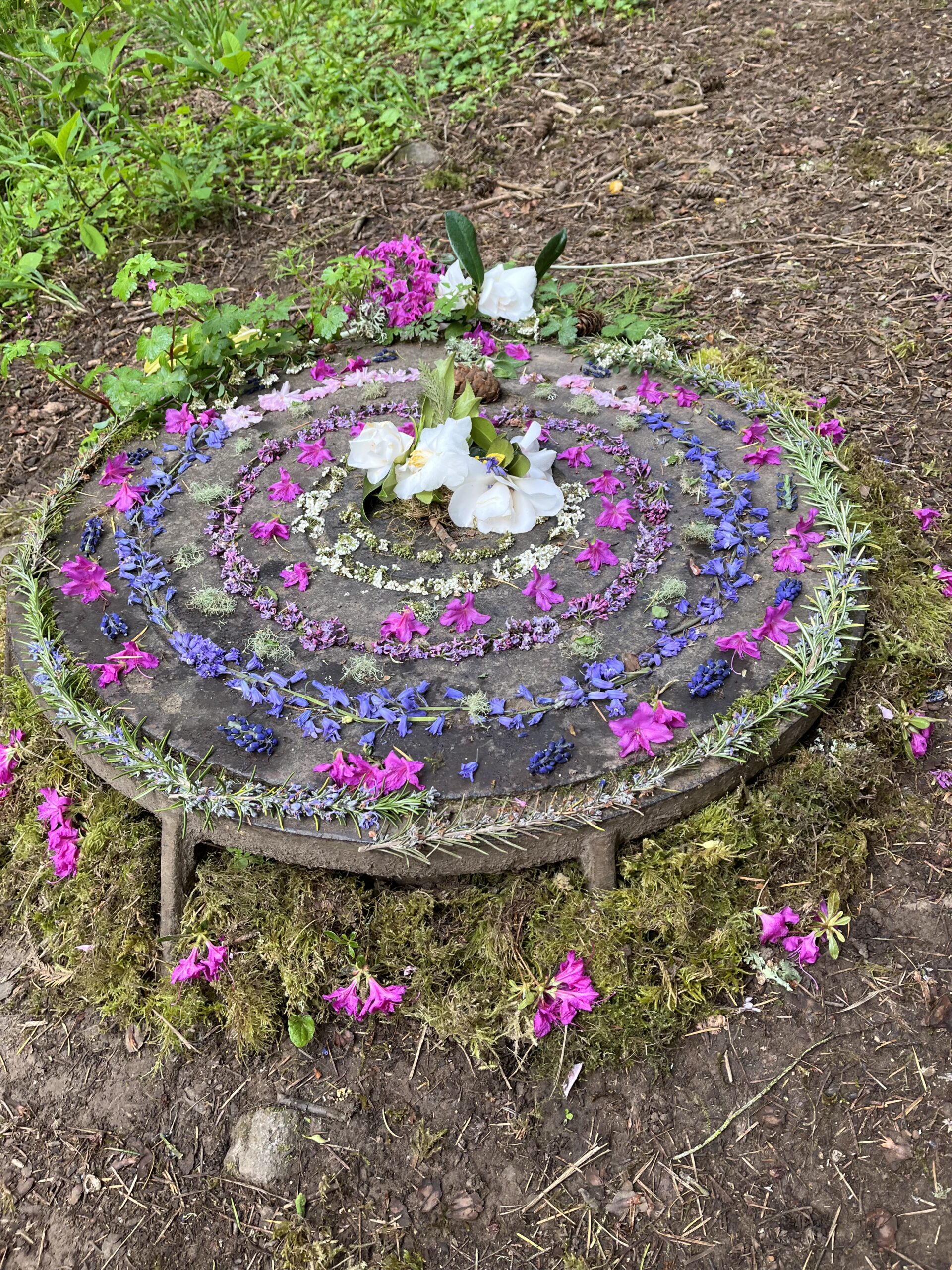
There is a woman in my neighborhood who spreads beauty. She lays out blossoms and greenery into flower mandalas at a local park, refreshing or changing them ever so often, usually early in the morning, before anybody sees her. I don’t know who she is, or her motivations, but I know this: the joy of walking by these little works of art and discovering new patterns and/or colors (never mind learning about what is currently in bloom) is immense. It feels like we have our very own local flower fairy. Or, for differently inclined people, a hint at the powers of Gaia, the earth Goddess, who appreciates, by all reports, these kinds of offerings…

What I appreciate is living HERE, amongst people who are kind and offer gestures of comfort or encouragement. Or remind us of beauty. People who give to 2-can Tuesdays, leaving food items for the local hungry, dependent on Neighborhood House food pantries, under their mailbox every Tuesday, to be picked up by volunteers. People who will soon start to exchange the overflow produce of their gardens, people who don’t know your name but that of your dog, from friendly chit-chat on the daily dog rounds. Or people who are handing out ACLU cards with printed instructions in different languages about what to do when stopped by police, ICE or the FBI. People who offer rides to the doctor, or free translation services.

There is a term in Yiddish, doikayt or doikejt (in english-speaking or german-speaking countries respectively) that refers to Hereness – the idea that you should live and fight for what is right, what you believe in, right where you live and not in some distant place or in nationally defined borders. It was a guiding concept to the Eastern-European Jewish Labor Bund, a secular, socialist, Jewish party dedicated to fighting for a better world and against anti-Semitism, founded in Vilna in 1897. Rather than following Zionist ideas (officially founded in the very same year) or emigrating to the U.S., they favored integration at the local level. The Bund believed that culture, not a place or state, would be the glue that held our people together, within the context of a world of multicultural and multi-ethnic countries. Here is an interview about the history with artist and writer Molly Crabapple, who is working on a book about Doikayt. It gives some background and is generally wonderfully snarky and informative.

I think the concept, hereness, should really be held in a more universal way, constructively appropriated from the original ideas of the Bund, then relevant to the Jewish Diaspora. We all should focus on the “here” in making our communities places where we can live in dignity, provide mutual support, protect the planet, and take that ideology with us whenever and wherever we are forced to move, by circumstance outside of our control. Moves that these days might very well be forced on many of us, by geographic, economic, catastrophic or political circumstances, integrating into ever new communities.

Returning to the flower lady, local support can be as simple as small gestures of spreading joy in times when it is increasingly more difficult to come by that commodity… joy reinvigorates, strengthens. But small gestures that you yourself are capable of, can also add up to inoculating you against larger dangers, making it less likely to sink into indifference because so much is overwhelming. Psychologist Robert Cialdini‘s principles of commitment and consistency apply here (even though developed for marketing strategies.) Once you have committed with a small step, you are likely to engage in larger ones later, feeling bound to the principle of consistency.

Why would this matter? I am reminded here of a quote by Gordon Hirabayshi, a Seattle-born Japanese American who fought legally against the internment policies of the government in 1942.

We had the Constitution behind us in 1942. It didn’t because the will of the people (wasn’t) behind it.”

(We might take note, given current events, of the legal issues surrounding internment of American citizens.

Hirabayshi’s case before the Supreme Court, Hirabayashi v. United States (1943), was the first challenge to the government’s wartime curfew and expulsion of Japanese Americans. The Court ruled against him 9-0. In the 1980s, 40 years after his wartime convictions, Hirabayashi challenged the decisions with a little used legal recourse called coram nobis, which allowed for judicial review of a judgment based on factual error not known to the court at the time the judgment was delivered. Researchers and legal scholars Peter Irons and Aiko Herzig-Yoshinaga had uncovered irrefutable evidence that the government had withheld information from the Office of Naval Intelligence, contradicting the United States Army’s claim of widespread disloyalty among Japanese Americans. This was the so-called “military necessity” rationale for the evacuation. In fact, not one Japanese American was ever convicted of sabotage or espionage during the entire war. Hirabayashi’s exclusion and curfew convictions were overturned in 1986 and 1987 respectively.” 

***

The will of the people – it will be influenced by our perceptions of ourselves guided by moral principles, rather than governed by fear. No one is asking you (yet) of hiding someone in the attic. But, of course, there are other ways of strengthening the struggle for justice and equality at the local level, and sometimes the means are provided from farther away. I am thinking here of two national data bases that affect the local level.

One is this one. There are over 700 Oregon businesses that have chosen to be listed as PRO-MAGA businesses. You can check them out and then decide what to do with that information…..

Another one is a data based established by Georgetown Law students (2Ls no less) recording law firms’ responses to the EO singling out law firms for political retribution. They titled document “Legal Industry Responses to Fascist Attacks Tracker” and included by now more than 800 firms, assigning them to one of five stark categories: “Caved to Administration,” “Complying in Advance,” “Other Negative Action,” “Stood Up Against Administration’s Attacks,” or “No Response.”

This will help people looking for internships, or future employers, or hiring a lawyer, to make informed decisions; wherever you are locally, you can check the data base about the status of that particular firm. (It works so well that apparently some firms are now asking to have changes or updates to assignment.)

As today’s reestablished Bund demands: “We must strengthen our communities, workplaces, and economies by making them more democratic, exemplary, moral, and marked by respect for all, striving for both justice and peace.” On any given day, I might just include creating beauty.

We just need enough people. As Thomas Paine wrote in 1776 : “When a people agree to form themselves into a republic … it is understood that they mutually resolve and pledge themselves to each other, rich and poor alike, to support this rule of equal justice among them … (and) they renounce as detestable, the power of exercising, at any future time any species of despotism over each other, or of doing a thing not right in itself, because a majority of them may have the strength of numbers sufficient to accomplish it.” (Ref.)

Music today by a Viennese musician who has pursued the concept of doikayt. This album contains old Yiddish songs from the Bund and also compositions integrating the works of Yiddish poets.

The Repair of a Torn Civic Fabric.

Today I want us to think through the connection between hobbies and Pope Francis. “What on earth,” you mutter, wondering if I have lost my marbles, or at least the relevant respect for the recently deceased. Neither, I assure you, just give me a minute.

The number of obituaries for the Pope matched those of articles contemplating what will come next, just as the differing political leanings were obvious in both kinds of publications: reverence for what he represented and had accomplished, or hopes for a return to less progressive eras.

Some popes perfectly complement the age in which they live. A few were reformers—agents of positive change. Others railed against modernity and the diminishing power of the Roman Catholic Church. Some accomplished great things, some horrific.

It was a pope who, parleying with Attila the Hun, persuaded the great conqueror not to invade Italy; a pope who, in what remains the greatest psy-op of all time, riled up disgruntled Normans and sent them to Jerusalem to repulse the Seljuk Turks; a pope whose legate, after indiscriminately slaughtering the entire population of Béziers because a gnostic sect was based there, replied, when asked how to tell the heretics from the faithful, “Kill them all and let God sort them out”; a pope who divvied up lands in the New World between Portugal and Spain; a pope whose Papal Bull was used to justify slavery in the Americas; a pope who excommunicated Henry VIII, indirectly establishing the Church of England; a pope whose corrupt and venal policies prompted Martin Luther to nail his Ninety-Five Theses to the door of the Wittenberg church, jumpstarting the Reformation; and so on.”

This from the most insightful – and funny – essay on the power of the papacy in general that I read yesterday.

What stuck we me, however, regarding Pope Francis, was a paragraph in the NYT obituary about his personal focus:

Francis …called for “Synodality”, the word given to the ancient church habit of assembling, discussing, discerning and deciding. Francis adapted the ancient practice of synods and councils in a radically inclusive way that invites all the faithful to be involved. The cardinals may conclude that right now, this is the greatest sign of hope the church can offer the world.

This “culture of encounter,” as Francis called it, may seem a puny thing to the powers that be. But it starts from the idea that those in thrall to the will to power cannot understand: the innate dignity of all, the need to listen to everyone, including those on the margins, and the importance of patiently waiting for consensus. These things are all crucial to the repair of a torn civic fabric.

And here, of course, we have our bridge to hobbies: the culture of encounter.

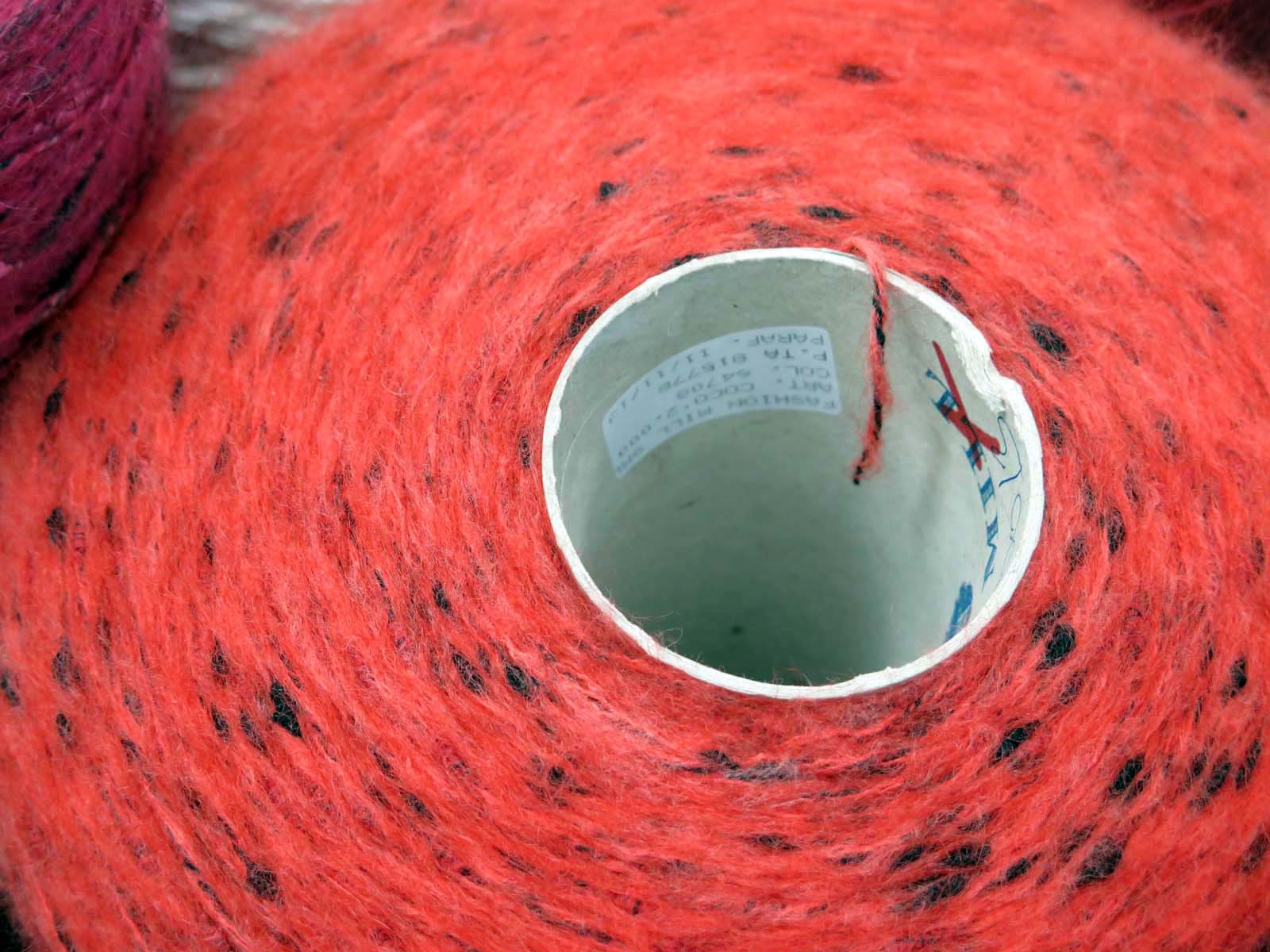
New reports on the effects of the devastating consequences of this administration’s economic kamikaze include the fact that many people are priced out of their hobbies, with cost increases put on consumers’ backs. Now, for usually more solitary passions like mine, knitting, the horrendous prices for wool might register in decreased sanity – after all, it is my form of therapy, and absent those hours spent with my needles, neuroticism might visibly increase – beware, dear reader. Might lose my marbles after all.

Can you guys what my current project is?

But many hobbies are activities where you meet other people, or engage with them, often providing exposure to very different types from different walks of life, who would usually not be encountered. You meet people fishing, bowling, hunting, or in bike clubs – you get the idea. Usually, the Meso-world, as sociologists call it, the tiny publics you find in groups that come together to act on the local level, consist of people who already have much in common. Your unions, your prayer circle, your book club or who you go to demonstrations with are all comprised of somewhat like-minded compatriots.

Hobbies, on the other hand, really draw participants from different worlds. And if they now exclude the segments that simply can no longer afford them, you have lost an opportunity for civic encounter in small collectives. That means losing the dialogues that can lead to cooperation, or to conflict – both drive civic commitment that can provide a metaphorical hinge between individuals and societies. (Informative reading here: Gary Alan Fine The Hinge: Civil Society, Group Cultures, and the Power of Local Commitments.)

One way to counteract the price surges and foster local engagement at the same time, are lending libraries – not for books, but for tools or other items needed for activities once easily shared. These are, of course, not new inventions. I remember driving my teenager, who had a new expensive hobby every 5 minutes, to a tool shop where you could rent space and time with existing wood working tools that would have cost a fortune, even then, to acquire. He met quite a few people who would mentor or share his interests. These days, these shops take on a different kind of urgency.

These non-profits have, of course, their challenges. Who does the tool maintenance? How do you recoup the tools that wander off… who pays for liability insurance and how do you raise funds, if you don’t charge membership dues or other fees? But on net, they are a marvelous way to create community, connecting people around them and supporting other communal efforts of small collectives. After all, community-based volunteer programs around the country, from tree plantings to building renovations, from picking up trash to community garden projects, all depend on borrowing massive numbers of tools when they call for action.

Here is a way to find your local tool lending library or other ways to share tools.

As for crafts? There are certainly ways to find or found local craft groups, or, if your health or transportation issues preclude in-person meetings, there are zoom encounters with like-minded knitters. For folks in Portland, there is a wonderful offer by the Multnomah Library system, to be taught and to meet with others in their A good yarn project for knitting and crocheting, all levels of experience welcome. And of course there is always the BUY NOTHING possibility for scoring some tools and wool that generous people donate.

The civic fabric might be torn, but we still have ways to mend it. Don’t let inertia be the enemy.

And since we are talking politics and craft/ tools, it has to be Hans Sachs today, singing about the madness of the world… Wagner’s Meistersänger is endless (4:29 hours, although in Herman Prey’s company it might fly by…), but I figured we could stomach this short aria.


2025: the Year of the Snake.

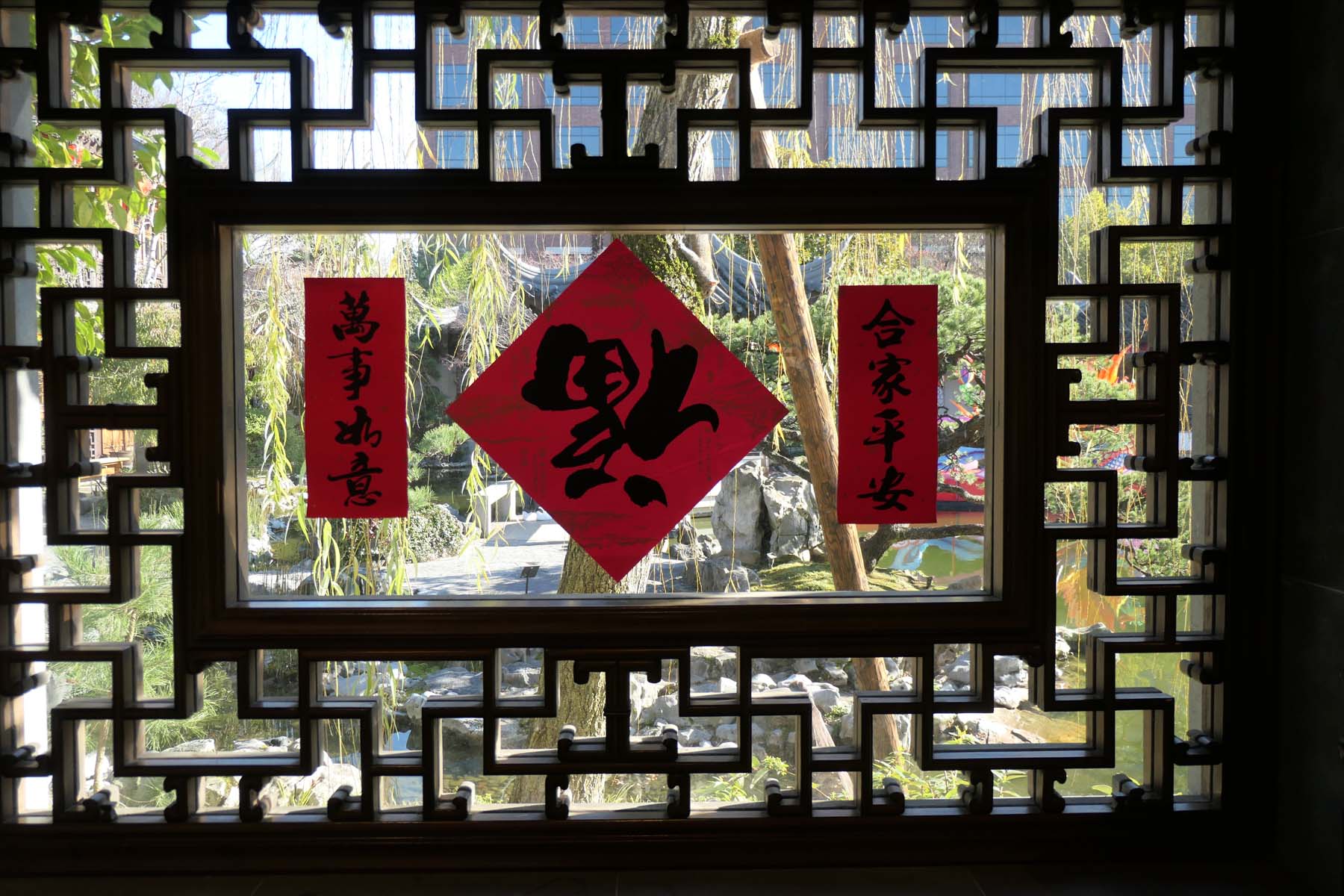
I went down to Lan Su Chinese Garden last week in anticipation of the Chinese New Year this coming Wednesday. The celebratory red balloons and technicolor floats on the pond were illuminated by a bright sun in a cloudless sky, strange for a late January day in the Pacific North West.

Cherries bloomed like little white stars,

moss gleamed on the tiles,

winter jasmine was fragrant,

camellias dainty,

and the white paper bush stretched into the path.

The Year of the Snake is upon us, one of the 12 Chinese Zodiac signs. Each of those is paired with one of five elements – Wood, Fire, Earth, Metal, and Water, and this year, for the first time since 1965, it is wood linked to the snake.

From what I could glean from various explanations, this bodes well. Wood stands for flexibility (think bamboo) and growth. Combine this with Zodiac snake characteristics of wisdom and strategic, if rigid and sometimes secretive, thinking, you can anticipate adaptability to difficult situations and reaching new heights.

The garden was filled with offerings for family feasts and remembrance. A striking absence of visual snake representations, though, apart from the gift store where rubber toys and metal pins were lying in wait. I wonder why.

Was I too early? Last year they had little dragons hanging all over. A consideration of people’s snake phobias? After all, most frequently snakes are associated with something negative, at least in Western realms, with the Staff of Aesculapius, a serpent-entwined rod held by the Greek god associated with healing and medicine one of the few exceptions I can think of.

I guess visual depictions of wisdom are harder to fashion than those envisioning seduction and cunning, violence and wrath. Searching, I found some neutral sculptures,

some signaling power of protection,

some hinting and human’s control of the beast.

But the memorable sculptures drawing and paintings were geared towards infusing us with terror.

Laocoon and his sons.

The terror contained in snake pits. Like being surrounded by colleagues and friends who have been officially instructed to be snitches. (Federal workers were told by the new administration to name colleagues who work in DEI position or face “adverse consequences.”)

Like living among bounty hunters, new legislation proposed by Mississippi district attorneys. For each successful deportation people help facilitate, they would be paid $1000, funded by the general assembly and administered by the state treasurer.

Surrounded by vigilantes who might just rough you up for the color of your skin.

Serving under those aiming at re-segregation – even without specific instructions by Trump’s DEI initiatives,

“the Air Force has removed training courses with videos of its storied Tuskegee Airmen and the Women Air Force Service Pilots, or WASPs — the female World War II pilots who were vital in ferrying warplanes for the military — to comply with the Trump administration’s crackdown on diversity, equity and inclusion initiatives.” (Ref.)

As it turns out that decision has been reversed as of this posting, protests howling, but the initial damage was done.

Peter Paul Rubens The Head of Medusa ( Circa 1617-1618.)

I wish I could return to the Fairy Tale world of my childhood where a snake, sacrificed no less, was the key to a hero’s survival. Remember The Brother Grimm’s The White Snake? Young peasant steals king’s privileged, secretive meal and takes a bite of a white snake. All of a sudden he can hear and understand all the animals. Goes on a journey and rescues fish, ants and crow fledglings from certain death (slaughtering his horse, no less, to feed the latter.) Then has to win three challenges to get to marry the princess (awful in her breaking her word and making more and more demands – I never understood why anyone would want to live happily ever after with an amoral person, but what did I know, naive eight year old…) and, of course, the rescued animals come to his aid and he wins the prize. The transformational power of a snake, giving him protection and prosperity, just as the Chinese New Year in 2025 implies.

I take it, from my adult perch now, that the fairy tale stresses that empathy is rewarded, and begins with understanding the other, rather than upholding our ignorance about strangers, deaf to them. Maybe we should just dole out magical white snakes to those eschewing mercy…

Why that has to be facilitated by a theft and consumption of something potentially poisonous – you tell me.

Spread Peace: Yoko Ono’s installation at Portland Japanese Garden.

A dream you dream alone is only a dream. A dream you dream together is reality.” -Yoko Ono

The next few days (6/7 – 6/10/2024) offer all of us the opportunity to raise our voices in support of a better world, one without violence or suffering. We are invited to interact with SPREAD PEACE: Wish Tree, an art installation by Yoko Ono, manifesting our hopes for peace by writing them on slips of paper and hanging them on 5 Japanese Maple trees specifically provided for the occasion.

5 Japanese Maples at the Plaza of the Cultural Village

It could not have arrived at a more poignant time or a more appropriate place: a time when wars have raised their ugly heads across the world again, a place – Portland Japanese Garden – that was founded to help heal the ruptures and wounds carved by an earlier war.

In addition, we are afforded this interaction in the company of other important public gardens across the globe – Keihanna Commemorative Garden in Japan, Kokoro no Niwa in Chile, and Johannesburg Botanical Gardens in South Africa will all be exhibiting Wish Trees during these four days as well.

The international collaboration with multiple organizations, including the Nobel Peace Center in Oslo, Norway which houses the Yoko Ono: Peace is Power exhibition, is led by Japan Institute of Portland Japanese Garden, our own cultural institution that, in its own words, is focussed on fostering dialogue and bridging divides. (I had written a more detailed history here.)

The Japanese garden is the perfect setting for the installation, and not just due to its historic focus on issues of reconciliation and peace. It currently provides a particularly peaceful atmosphere: rather than the fiery colors of autumn, spring produces softness and calm in most of the garden’s appearance, the muted purples and whites of the last rhododendrons,

the pink and whites of the mountain laurels,

the pink and white of the azaleas,

and the ever graceful dogwoods.

The garden joins the ranks of many other important places chosen across the life-time of the Wish Tree project, started in 1996, now almost 30 years in the making. Some of the previous trees were placed temporarily for exhibition purposes, in museums or cultural institutions, others have found a permanent home in public gardens, still in use, or just beautifying their respective location. I have seen them in New York City, the Arlington Gardens in Pasadena, CA, and at a gallery in Venice,Italy, but they really spread across the entire world, to Europe, South America and Asia.

The instructions are simple:

Make a wish. Write it down on a piece of paper. Fold it and tie it around a branch of a Wish Tree. Ask your friends to do the same. Keep wishing. Until the branches are covered with wishes.

The power of wishes has been a theme throughout mythology and literature, just think of the Greek or Norse Pantheon, the Brothers Grimm Fairy Tales or 1001 Arabian Nights, the drama of Dr. Faustus. Whether Gods, fairy godmothers, genies or the devil granted the wishes (often three of them) the warning was about the content of the wishes – driven by greed, longing or lust – and the distinction between cleverness and foolishness, with individuals believing they possessed the former but exhibiting the latter. Be careful what you wish for is often the moral of those tales.

Detail views of the trees that will host the wishes.

The power of Ono’s work lies in the leap from individual desire to collectively expressed hope around a shared dream. Looking at a tree covered with hundreds of pieces of paper provides a sense of collective voice, a gratitude for being joined by many in our very own aspirations. That feeling is multiplied by millions, the number of wishes collected so far, all of whom get deposited in one final resting place: Imagine Peace Tower on Viðey Island in Kollafjörður Bay in Iceland. There is something about shared action that adds value to an experience, whether singing in a group or choir, praying in unison with a congregation, or a shared exposure to cultural events – it provides a qualitative, not just quantitative shift in the way we feel, given that we are a social species.

Group actions, whether through economic alliances or political coalitions, or the structure of societies geared around families or clans, have, of course, shaped cultures in other ways as well. We are all aware that partisanship exists, and that the struggle for power, limited resources, land or revenge for historical slights, can lead to horrid consequences, including war. It is all the more important then to have projects like Ono’s that demonstrate a desire for peace likely crossing the boundaries of partisanship. The majority of people, no matter who we vote for, or where we live, do not want to be exposed to violent harm or inflict it upon others. We will hang our wishes on the tree joined by others who in that moment become simply allies.

I had felt this years ago in another show concerned with interaction around wishes, although not defined solely by a single theme. The New Museum in NYC exhibited work by Brazilian artist Rivane Neuenschwander in 2010. In A Day Like Any Other you entered a room with white walls covered with colorful ribbons on which wishes, previously written by visitors and deposited in small holes in the walls, were printed. You were encouraged to add your own, and permitted to take a ribbon and bind it across your wrist, with three knots, if you shared the particular wish written on it. Lore had it that the wish would come true once the knots dissolved and fell off. (Note: I can confirm that that happened, against my better rational judgement, and yes, you may roll your eyes now.) The main emotion was contained in a sense of shared longing, bound to an unknown companion in a particular hopefulness.

Rivane Neuenschwander A Day Like Any Other (2010)

***

The Tate Modern in London is currently exhibiting a retrospective of Yoko Ono’s work, open until September 1, 2024. Yoko Ono: Music of the Mind received rave reviews both for its content and curation of seven decades of work by this iconoclastic artist. Much of the work expresses a leap of faith around the dichotomy of war and peace, the core focus of her creative imagination. The artist, who grew up In Japan during World War II, a deadly conflict that ended with nuclear bombs destroying Hiroshima, is convinced that WE, the interactive participants in so many of her installations, will, in the end, provide individual contributions to make our world less belligerent.

In April, the nonagenarian has also been awarded the Edward MacDowell Medal, an honor previously given to Stephen Sondheim and Toni Morrison among others. The lifetime achievement prize honored her continuous engagement with her Leitmotiv: Peace. Projects like the one we’re about to experience at Portland Japanese Garden will be a reminder that we all, indeed, can, no, should contribute to this singular goal.

***

Wishing Trees (or for that matter wells) have been around for a long time, across diverse cultures. Many speak to existential issues of love, fertility, poverty, and, of course, war. The wishes can be expressed via words, or pieces of cloth or the donation of coins, depending on custom. Why trees? They might be particularly visible and relatively stable. In many mythologies they are linked to forces of nature or habitats of benevolent grantors, the spirit world.

Clockwise from upper left: Tanabata Festival wishing tree in Japan; Wishing tree from Alaçati, Turkey;Wishing tree hung with Nazar in Anatolia; Wishing tree spiked with coins in Scotland. (Photographs all web sourced.)

Portland has had its very own wishing tree for over a decade now, an ancient chestnut tree at the corner of 7th and NE Morris St. I wrote about it some years ago, puzzling over the diverse sentiments found at the location.

“For me psychologically more interesting is the fact that people like to externalize what could be a private prayer or wish – the very act of making it public, saying it out loud, seems to have some meaning. Maybe the act of sharing makes you feel less alone, or heard, even if the next reader is not the powerful entity that could fulfill your wish. Maybe the act of voicing it defines a problem that you want to be collectively remembered and then collectively tackled (certainly for the wishes for peace or end of poverty.) Maybe putting it in words clarifies, through the very act of verbalizing, the hierarchy of your own needs and provides access to thoughts about action.”

Whatever motivates us, it is Ono’s creative insight that mobilizes a communal agreement about a worthy goal, reminding all of us about the fact that there are some things that are truly at the core of our existence and that they are forever endangered by war. If you have a chance to visit Portland Japanese Garden this weekend, add your voice to the chorus. If you can’t, you can still make yourself heard: here is a link to the Imagine Peace Tower site, where you can send your wishes electronically or with old fashioned postcards.

Then go and take in the peacefulness of Portland Japanese Garden and its current bloom at a more convenient time. It nourishes hope for a better world.

Modes of Philanthropy

Does this happen to you as well? A particular topic enters your thoughts and then you see it everywhere you turn?

Philanthropy came to my mind when I stopped at a small history museum in Southern Oregon that was established in the late 50s by an Oregon politician who wanted to help Oregonians remember their history. More on Pottsville in a moment – photographs today are from that site.

I was also wondering about the mechanisms of philanthropy last week when reading about Melinda Gates’ decision to pull out of the Gates Foundation and start moving her philanthropic investment in a different direction.

I was thinking about philanthropy when I heard that multiple Jewish organizations in Oregon cut off their charitable donations to the Oregon Food Bank when the latter called for cease fire in Gaza in a statement critical of Israeli military actions. Never mind that Hamas’ atrocities were condemned as well, and the statement had been discussed with Jewish allies prior to publication. It seems particularly poignant to think of locally increased hunger being the outcome of ideologically motivated decisions when forced starvation of a locked -in region at war has been criticized by many entities across the world.

Last but not least, a chance conversation with a woman a bit younger than myself, elegance personified and a legend in her professional field, raised a different notion of philanthropic involvement: rather than (or in addition to) writing the big checks, with or without strings attached, you quietly contribute by adding your insights and knowledge to help steer non-profits that you are passionate about in a direction that allows them to maximize their impact and develop their full potential. A true form of more or less anonymous giving back.

I had simplistic notions of charitable giving. It can be either ethically or religiously driven, in fact for us in the Jewish realm it is a mitzvah, a commandment, not a choice. (If you are interested in the religious roots of charity, here is a neat summary out of Harvard.)

Giving can be used to promote or preserve a name – think buildings across American or European campuses, sports arenas, concert halls.

It can be a means to erase shame – think of the many donors and board members who make astronomical contributions to cultural institutions like museums, who are eventually called out for where their money came from. I had written about a specific case not so long ago at the Whitney. Recently, the V&A Dundee, the National Gallery in London and the Louvre in Paris severed connections to the Sacklers, a dynasty indelibly linked to the global opioid epidemic, from which some members of the family profited via their company Purdue Pharma. The British National Portrait Gallery severed ties with BP in 2022, the end of a relationship that had lasted more than 30 years.

Reading up on the idea of philanthropy, I now learn that people categorize charity in more complex ways as well. (I’m summarizing, among others, from a source here.)

There is Philanthropic Investment  which aims to invest resources into nonprofit enterprises in order to increase their ability to deliver programmatic execution. The Philanthropic Investor, like a for-profit investor, is primarily focused on the longer term increase and improvement in programmatic execution relative to grant size. Basically, they are building the organization, rather than engaging in spontaneous charitable giving for whatever need arises in the moment.

Then there are two types of philanthropy that try to affect change systematically. One is Strategic Philanthropy  which buys up nonprofit goods and services in a way that aligns with a theory of change defined by the strategic philanthropist. This approach hopes to advance the solution that they believe is most likely to solve the problem they seek to address. The other is Social Entrepreneurism  which seeks to directly execute programs that align with a theory of change, defined by themselves. I had previously written about philanthropy that hopes to be a direct agent of change here.

Politics enter the arena of charitable giving of course not only from the side of individual donors with specific goals or groups of protesters who try to influence the flow and acceptance of charitable funds. There exist direct attempts to oversee what can be given to whom, assessing the legality of the donations. Case in point is ‘Not On Our Dime’, a recently (re)introduced bill by New York Assembly member Zohran Mamdani and endorsed by Congresswoman Alexandria Ocasio-Cortez.  The bill aims to sanction New York charities who send more than $ 60.000.000 a year towards Israeli settlement expansion, that the bill’s sponsors consider to occur in violation of international law.

Much to think about. Far easier to wander around a photographer’s candy store of agricultural machinery gently rusting itself into oblivion, among small buildings recreating villages of yore. The museum itself is only open by appointment, and the fairgrounds serve mostly locals for motorcycle swap meets, parades, fairs and the likes. We were the only living souls in the vicinity, mid-afternoon on a weekday, acres and acres to ourselves.

Pottsville’s founder, Eugene “Debbs” Potts (1909 – 2003) was by all reports quite a character, serving multiple roles, including decades as a state senator. Although named for the famous socialist Eugene W. Debs, his leanings were more centric, voting as a Democrat quite frequently with his Republican colleagues. He donated the land, gave seed money to the non-profit, and eventually contributed his gigantic collection of tools and machinery.

The highlight of my visit came when I saw a few murals by one Mark M. Jones on the sides of the buildings. Landscape scenery was lovingly depicting the wonders of our state,

a rodeo snippet was attributed to Olaf Wieghorst, a Danish-American painter who specialized in depictions of the American frontier in the vein of Frederic Remington and Charles Russell.

Then this.

My first thought was, “Is he familiar with Oskar Schlemmer?”

Then I read the signage and the referent painting was Farmers Planting Potatoes by van Gogh.

Oh, the surprises of Pottsville. Oh, the generous sharing of one’s means and/or skills for all of us to enjoy.

Long live giving.

Music today was written in 1915 to support charity for refugees. Polonia was first performed at London’s Queen’s Hall at a Polish Victims’ Relief Fund Concert in July 1915, with Elgar conducting. He dedicated the work to his friend Paderewski, a great pianist and later Prime Minister of Poland.

Bosch, Revisited

Poor is the mind that always uses the inventions of others and invents nothing itself. -Hieronymus Bosch, one of the most idiosyncratic painters in all of art history….

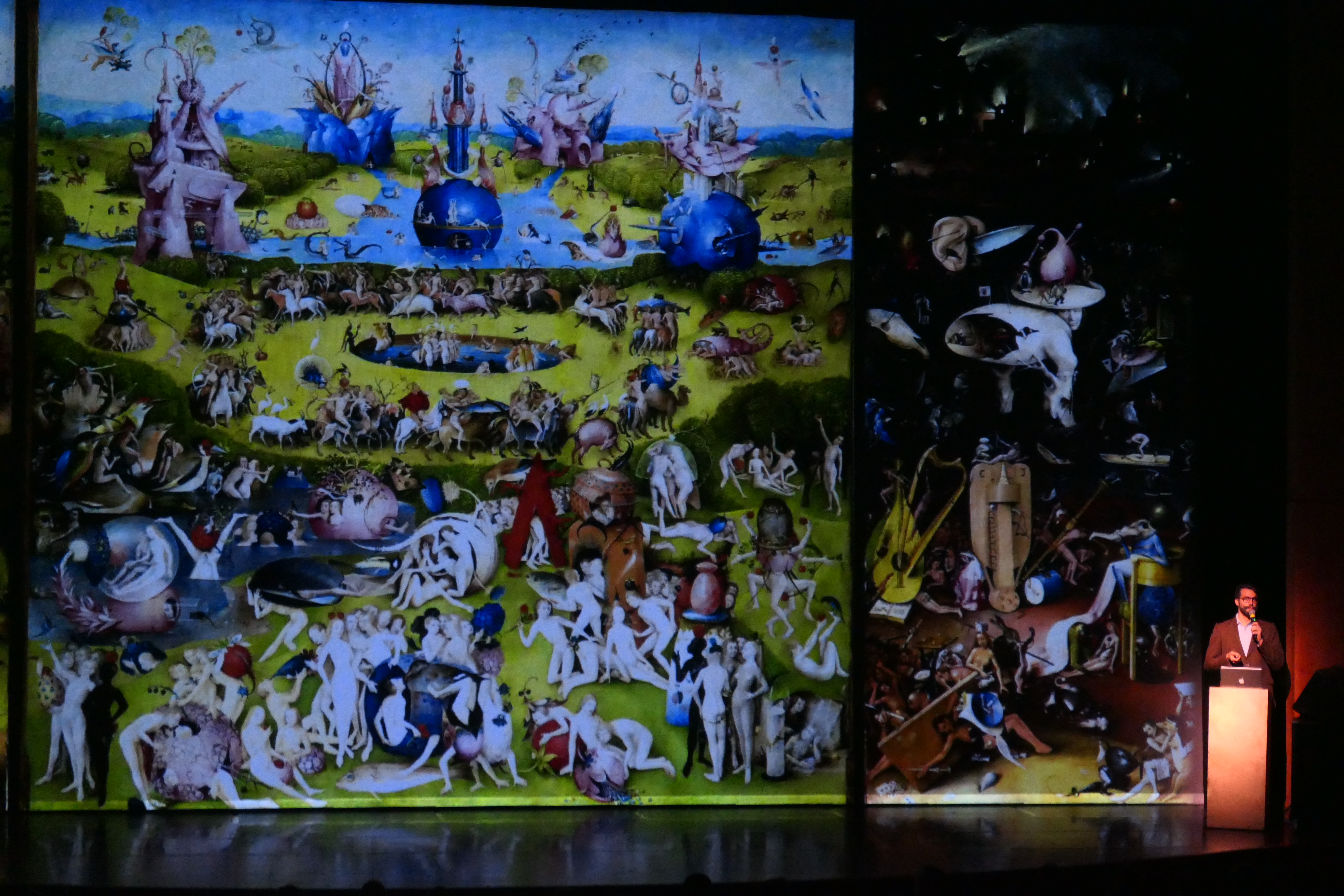
About an hour’s drive north of the village where I grew up lies s’Hertogenbosch, the capital of the Dutch province North Brabant. Its most famous son was probably Hieronymus Bosch (born Jheronimus van Aken, ca. 1450 – 1516 – he renamed himself after the town – the Duke’s Forest.) A permanent Jheronymus Bosch Art Center with reproductions of all his works was opened in a local church in 2002; for the last many years the town has also been hosting an extremely popular festival, the Bosch Parade. (Images are from their website and a Dirkjm Photography from the 2022 festival.)

Floats fashioned by individuals sail for a number of days down the river Dommel, its banks and the medieval city walls lined with spectators. All of the floats re-envision snippets of some of Bosch’s art, dependent on the theme chosen for the bi-annual festivity – this year it is Contemporary Demons. A Garden of Delight serves drinks and foods, there is music, and costumed individuals parade around before climbing into their respective floats that reproduce the fantastical and mysterious creatures from Bosch’s paintings.

Locals’ enthusiasm for 15th century art of one of their own is understandable, but it is widely shared internationally. It’s not just the museums (most of his known 25 paintings and a few drawings are housed in Madrid’s Prado), or books and poster industry. From bags, Doc Martin boots, t-shirts, mouse pads to phone cases, there is a whole range of consumer products with printed excerpts from mostly The Garden of Earthly Delights, his late masterpiece. The only other artists I can think of matching this range is Frida Kahlo. Riddle me that.

Quite a number of surrealist painters cited Bosch’s influence over their own creations. His work has made its way into other visual media as well, dance and circus performances among them. (Photographs below are from my last pre-Covid shoot in Montréal for the circus performance Scenes from Bosch Dreams, a production by Les 7 Doigts, a 500th anniversary commission by the Hieronymus Bosch Society, all of it mounted by TOHU. My write-up can be found here. Video snippets here.)

Ballets capture the ominous quality of the paintings, like Compagnie Marie Chouinard‘s Le Jardin de Délices and digital animations (this one commissioned by the Stedelijk Museum for the 500 year Bosch celebration) translate the ideas into modern movement.

So what is behind the contemporary interest and preoccupation? Spectacle and sex come to mind. The inventiveness of his couplings, bestiary and architectural structures are truly spectacular, and easily divided into self-contained narrative scenes, fit for printing or reconstruction into costumed staging. A boon for commercial exploitation.

The weirdness of it all, coupled with sexually explicit imagery, lent itself to certain conspiracy theories, like the proposal banded about in the 1940s that he was a member of the Adamites, a heretical sex cult, or that he was high on ergotic wheat – eating too much moldy bread, in other words.

Serious art historians place his work into a very different context, that of a committed, faithful catholic who was intent to warn of the wages of sin, using every biblical parable under the sun to make his point. The visual referents, in turn, are mirroring imagery found in the churches and cloisters of his hometown (95 gargoyles, for example, in just the main cathedral.) Drolleries in the side margins of theological books and devotionals, put in by sex obsessed monks in abandon, and pictures of foreign animals found in bestiaries of his time and accessible to him are used as templates to create the scenarios that will lead to hell. If you have time, watch this lecture by a British curator on Bosch’s religious conservatism, I found it truly educational.)

But I believe there is something else at work here. The 16th century saw seismic changes in politics and social structuring of societies, not unlike our own. There was a worry (for some, hope for others) of end times, after a famous astrologer predicted the end of the world in early 1524, to be preceded by catastrophic flooding. Bosch, Albrecht Dürer and many other artists picked up on it, pointing to the Last Judgment. The apocalyptic tone of the work might very well resonate with us, not for its religious implications, but due to recognition that our sense of impending catastrophe is best ignored by engaging in all kinds of distracting activities, however frivolous or lustful they might be. The more, the better in fact, to drone out the sense of helplessness.

It is not poor minds who are too lazy to invent their own ideas, but agile ones that sense the relevance of existing, if 500 years old, imagery for its predictive power of a world gone mad. He should be proud of his art’s longevity and prescience. Then again, pride is a cardinal sin….

Music today directly from the painting…

The Chinese Zodiac: 2024 – Year of the Dragon.

You learn something new every day. For example, your fortunes can be told not only by the zodiac sign associated with the year of your birth (I am a water dragon) but your personality can be predicted by the sign in combination with your blood type! Apparently AB positive dragons are “the most independent ones among all the Dragons. They love nature and travel far to enjoy various landscapes. The born sensitivity to art and beauty make them outstanding romantics.” Hmmmm.

Nature ✅ Travel ✅ Born sensitivity, eh? Dedicated to art and beauty, ✅ (if acquired rather than innate), but surely I cannot be counted as a romantic. Never have been, never will be.

I also learned that “Dragon women are typical feminists. They think women can perform as well as men, and even do better. Besides. They have a clear plan about their future and will be determined to fight for it. In life, women with Chinese zodiac Dragon sign prefer simple and comfortable clothing to fashionable styles. At work, they tend to be career-oriented and creative.”

Note that the claim is “we think” we can perform as well as men”, not that we do…. Hmmmmmm.

Not believing at all in horoscopes from any cultural background, I was nonetheless relieved that these instances of contradiction provide enough evidence of the futility of soothsaying. Thus I will not take the prediction that this is a year that will be hard for water dragons seriously… Hmmmmmm.

As the photographs show, I had occasion to check out Portland’s Lan – Su Chinese Garden, a few days after the Chinese New Year started. As beautiful a visit as ever, starting with the friendly smile of the young cashier who sported an extravagant tie brooch.

Lots of decorations for the occasion, including new (to me) lanterns that seemed disproportionately large for their surroundings, and some inexplicable plastic pandas climbing across the roofs near the tea house.

Signs of spring everywhere, in single blossoms, and budding magnolia capsules.

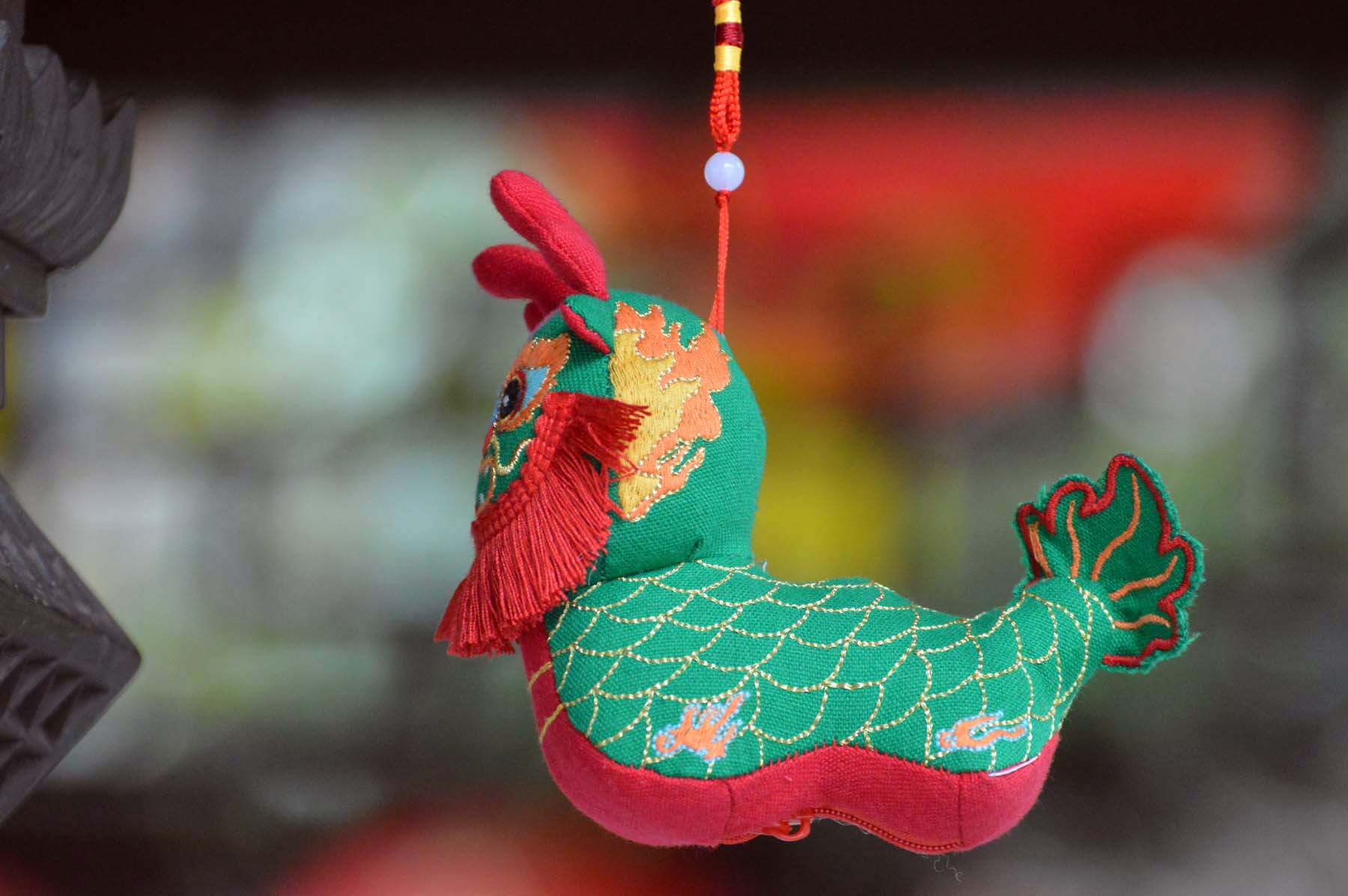
Hummingbirds came and went, resting near the dragon figures on the roofs.

If the dragons displayed across the garden did not suffice,

there were plenty more in the gift shop. Take your pick!

Not suitable, though, to represent the dragon of the poem below, who, in the end, decides to continue being a terror.

A Dragon’s Lament

I’m tired of being a dragon,
Ferocious and brimming with flame,
The cause of unspeakable terror
When anyone mentions my name.
I’m bored with my bad reputation
For being a miserable brute,
And being routinely expected.
To brazenly pillage and loot.

I wish that I weren’t repulsive,
Despicable, ruthless and fierce,
With talons designed to dismember
And fangs finely fashioned to pierce.
I’ve lost my desire for doing
The deeds any dragon should do,
But since I can’t alter my nature,
I guess I’ll just terrify you.

~ Jack Prelutsky

The boys loved that one when they were little. I wonder where the book is. Oh no, the predictions come true: a hard year it will be, if chaos rules the bookshelves and memory fails me…. Hmmmmm.

Of course the joke freezes on my tongue, when I see people dumpster diving right under a mural of the local PDX food distribution center for the houseless, Blanchet House, across from the garden. Talk about a hard year.

Here is Wu Man playing the pipa, a traditional Chinese instrument. Her fingers fly, just like a dragon.