Up for a bit of vicarious travel? The kind where you see a tons of things at once, not knowing where to look first, and how to make sense of it all? Follow me to Long Beach, CA, a city about 20 miles south of down town L.A., on land that was once populated by the Tongva before the colonial settlers arrived.
Beautiful beaches (hence the name). Stunning yachts in the harbor. The wealthy, sunny California dream, until you move in more closely. It is a town with quite a tumultuous history; in the 1900s it was known for its beaches and amusement parks, drawing rich vacationers and tourists. Oil fields on land and under water were discovered in the 1920s, leading to a massive boom, with population influx from many mid-western states. The town was demolished by a 6.4 magnitude earthquake in 1933, with at least two redeeming consequences: it led to the California Field Act of 1933, which requires earthquake-resistant design and construction for all public schools, and downtown was rebuilt with the new Art-Deco style, making for some interesting discoveries of architectural gems.
“Recreation” on the south side of the parking structure of the now-defunct Long Beach Plaza.
Lots of interesting architecture in general, including a Convention Center that sports the largest mural ever, visible from space. Created by maritime artist Robert Wyland for his series of Whaling Walls, Planet Ocean was dedicated in 1992.
In general, quite a few murals, even while walking only a small district down town.
Earthquakes are one thing. One shudders to think what happens when the sea levels rise and storm surges flood the area – there is not bit of protection from the ocean.
Photocredit: Wikimedia
The ocean is, as it turns out, part of the economic force that drives the city: it houses the second busiest container port in the U.S. and is among the world’s largest shipping ports. Unfortunately that is not just good news, despite the jobs for tens of thousands of people it provides, as do the oil rigs. Which, to the amazement of this visitor here, are camouflaged as little tropical islands, ringed by rocks from Catalina Island and filled with millions of cubic yards of material dredged from the bay. On that they landscaped with palm trees, fake condo towers and waterfalls, all designed by a Disneyland architect, Joseph Linesch.
Originally known as the THUMS Islands, based on the name of the oil consortium that built them: Texaco, Humble (now Exxon), Union Oil, Mobil and Shell. Since 1967, they are now the Astronaut Islands, with the each named after the American astronauts killed in an accident in preparation for the Apollo 1 mission. Workers still commute there via barge to wrest 46,000 barrels of oil from the earth each day.
Pretty make-believe that camouflages a terrible price for the local community (or the world at large, given continued fossil fuel consumption.)
Between the port and the oilfields, Long Beach sports among the worst air pollution in the entire country. “Sources are the ships themselves, which burn high-sulfur, high-soot-producing bunker fuel to maintain internal electrical power while docked, as well as heavy diesel pollution from drayage trucks at the ports, and short-haul tractor-trailer trucks ferrying cargo from the ports to inland warehousing, rail yards, and shipping centers. Long-term average levels of toxic air pollutants (and the corresponding carcinogenic risk they create) can be two to three times higher in and around Long Beach than anywhere else in L.A. County.
Add to that the output of the oil refineries and you get air so bad that it matches the quality of the Long Beach water: the poorest on the entire West Coast. The Los Angeles River discharges directly into the Long Beach side of San Pedro Bay, meaning a large portion of all the urban runoff from the entire Los Angeles metropolitan area pours directly into the harbor water. This runoff contains most of the debris, garbage, chemical pollutants, and biological pathogens washed into storm drains in every upstream city each time it rains. Because the breakwater prevents tidal flushing and wave action, these pollutants build up in the harbor.”(Ref.)
Ok, we won’t go swimming or fishing here.
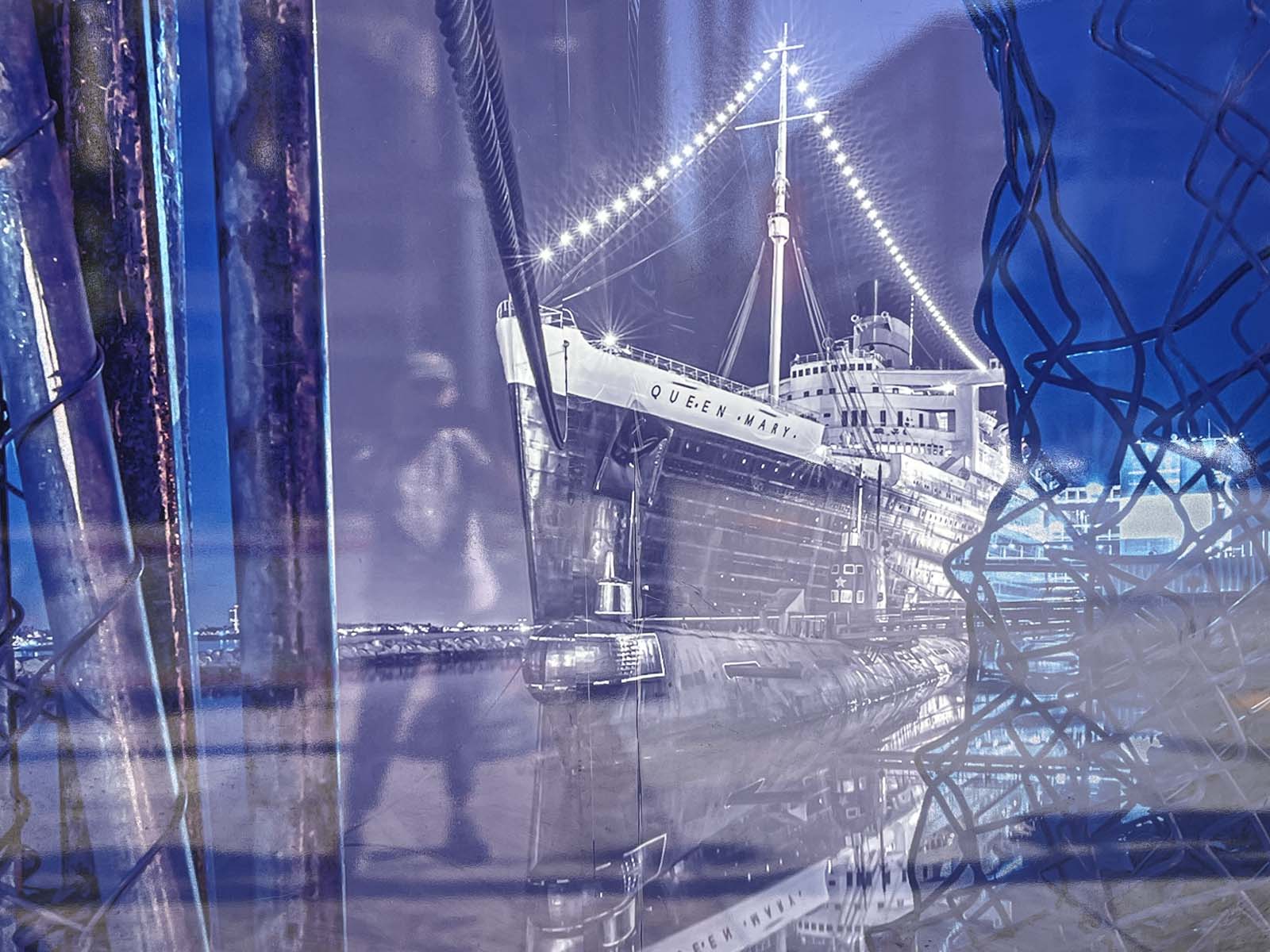
Instead we will take a peek at the Queen Mary, who took her maiden voyage in 1936 from England, and retired in Long Beach in 1967, functioning as a hotel, events venue and a huge tourist attraction. The ship carried some 2.2 million passengers in peacetime and 810,000 military personnel in the Second World War, but here in Long Beach, an estimated 50 million people have visited.
Make that one more, me being dimly attracted by rumors of a resident ghost. I did not detect one, (truth be told, did not set foot on the ship either…) but I did see something of a Doppelgänger. Or maybe it was Camilla herself, what’s her name, consort to the current King of England, escaping her entourage for a private phone call. Or perhaps I am imagining the resemblance.
What really drew me to the city in the first place was the Inaugural U.S. International Poster Biennial that you could walk through on an outside promenade. It was actually worth the visit, with high quality contemporary poster design on offer from both national and international artists. According to the organizers, over 200 graphic design pieces were carefully chosen from a pool of 7,000 submissions across 75 countries. Themes ranged as widely as war & peace, gender relations, racism, specific announcements for theater productions, environmental concerns, and the issues of refugees, displacement and migration. Take your pick below!
And my favorite: White clouds forming “Gedenken” – Remembrance (commemorating the date of a mass shooting in Switzerland in 2001.) The whole ephemeral nature of memory, like clouds, but also a blue sky dotted by them, like a brighter place for souls released and drifting.
It was a full day, with moments of levity, so direly needed.
I think it is important to find things that lift our spirits, if only momentarily, or we will not be able to function during these dark months to come. Nourish your souls, in whatever way available, to make them stronger.
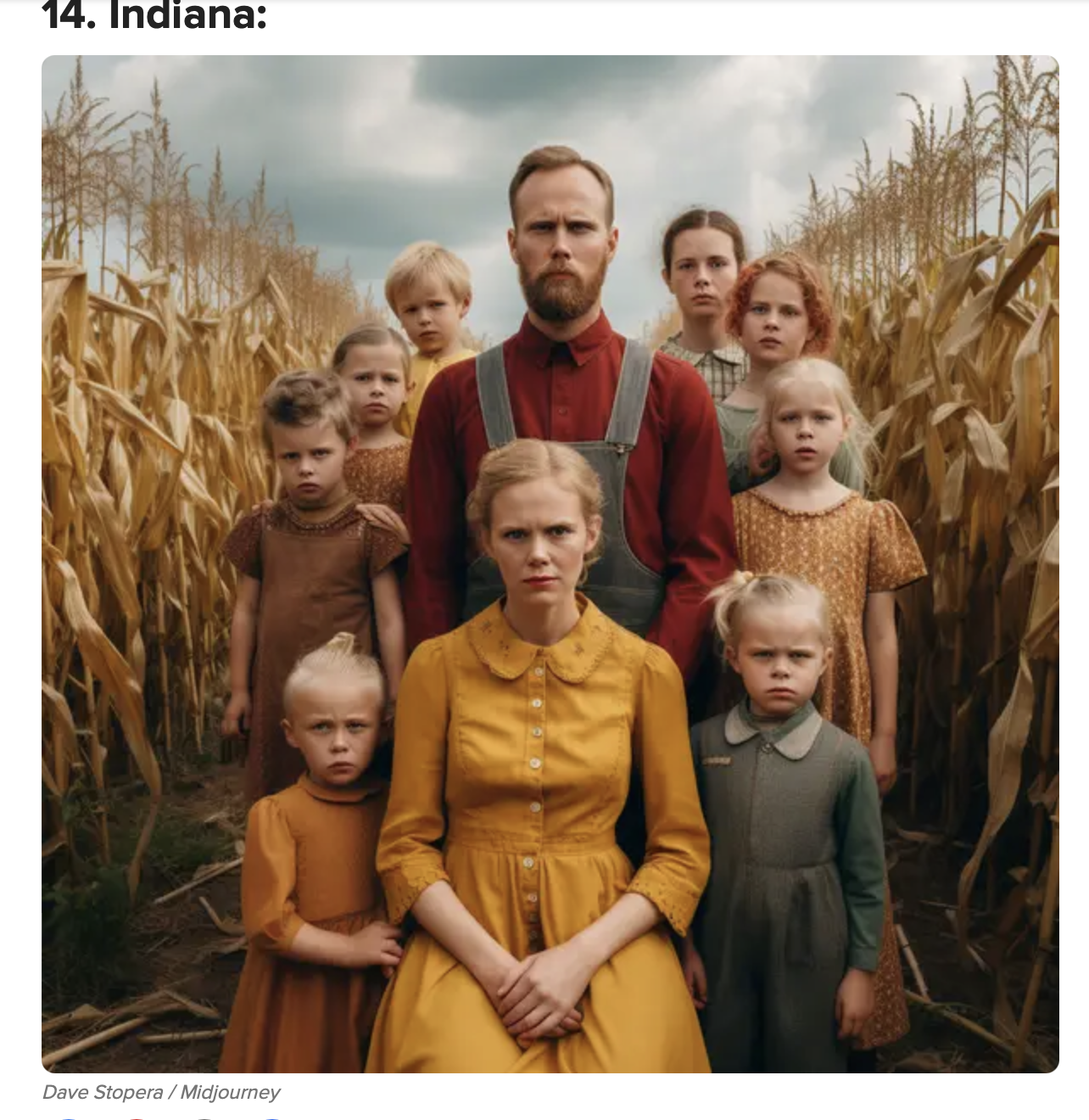
Today I am linking to a short piece in Buzzfeed. It shows images that Artificial Intelligence generated when asked to capture the stereotypesthat Europeans might hold about the prototypical residents of each of the U.S. states (with Native Americans, Blacks and Asians apparently not even making an appearance as a background character. Even the South Carolina football coach looks White.)
One might wonder what it means to say “Europeans.” Do we think someone from Finland holds the same stereotypes as someone from, say, Portugal? Do the French manage the same assumptions as the Danes? Just asking for a German…..
And what were the parameters that were provided around stereotypic aspects? Food items (Do you really think “Europeans” associate PA with Hershey chocolate?) Landscape? Type of professions? And, just as a thought, what do you think AI would do if asked about stereotypes Americans hold about the different countries in Africa? Would we even know where to place them on a map, much less hold specific ideas? Oh, my brain, drifting again. Do some of these look more like photographs than caricatures – and if so, what does that tell us about the use of AI ?in the ongoing effort to make the truth irrelevant?
Here is Buzzfeed’s disclaimer, well placed before the images:
The following images were created using generative AI image models for the sake of entertainment and curiosity. The images also reveal the biases and stereotypes that currently exist within AI models and are not meant to be seen as accurate or full depictions of human experience.
Recognize anyone? Do you realize that the reason so many of these seem darkly true or perhaps funny is because we (the Americans) understand and know the stereotypes? (A succinct introduction to the psychology of stereotyping by a very smart psychologist can be found here. There has been more work published in recent years, but this is a solid basic account, showing how it relates to person section and the continuation of racism, misogyny and self handicapping, among others.) Figuring out how AI learned the stereotypes in the first place has to wait for another day.
Grabbing another cup of coffee and getting out of the flannel shirt…while you try and digest these images.
And here is another European, Dvorak, who wrote a string quartet capturing his views, “American,” during his visit here in 1893. At least we know he was for real….
Let’s start the week on a lighter note – did I hear a collective sigh of relief?
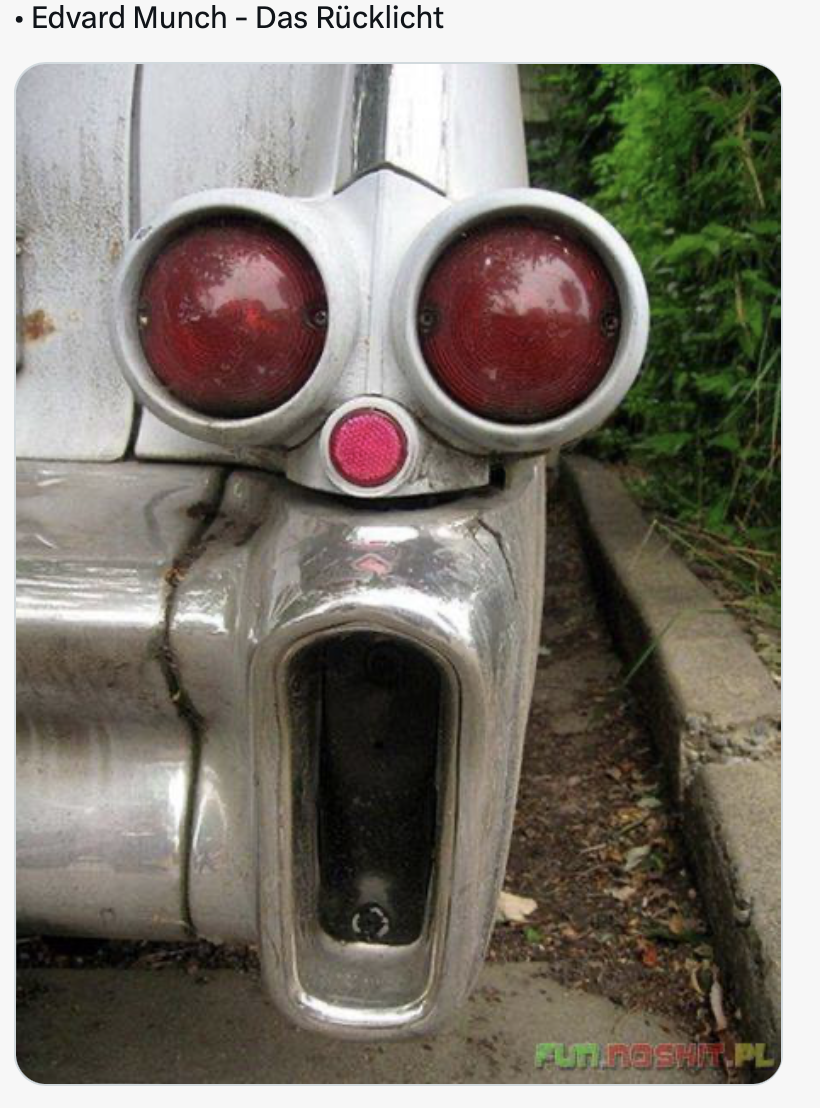
I came across some things that amused me last week and fed my appreciation for the creativity all around us. (Most images were seen on an IG site called The Last Artist Ever, who features what catches his/her eye.)
How do you like this version covering Vermeer’s The Girl with the Pearl Earring?
‘When the dishes turn accidentally into art’ by @e.schwaerzler
Or this version of the Royal Delft Blue porcelain artists?
In some ways, getting the jokes depends on knowing the originals in the first place. Which is not guaranteed given the state of art education in this country. (Yes, we ar not staying on the lighter note for all too long, true to character.) In Portland alone, The Oregon College of Arts and Crafts shut its door in 2019 after a 112 year run, and the Art Institute of Portland, a for-profit school owned by the Education Management Corporation (EDMC), closed in 2018. Marylhurst University also closed its Marylhurst and Portland campuses in 2018.
Congress allocated $180 millionto the National Endowments for the Arts in 2022. This amounts to just 54 cents per capita. Compare that to $8.8 billion for the National Science Foundation in the same year. When it comes to art as a profession, Fine art degrees ranked last of 162 different majors for their employment prospects, and of an estimated two million arts graduates, only 10 percent make a living as working artists.
A recent article in the New York Times spells out the details about art education decline.
Mark Rothko Untitled (Red) (1969)
Of course there is always something we can enjoy without needing prior knowledge, just embracing the weirdness. Although you can find a pretty fascinating review of monkeys as motifs in art here.
And then there is this.
I don’t know what to say about this – not my next knitting project is all that comes to mind.
Instead, I’ll collect memes that show engagement with art – I’ve selected some that have personal relevance, as you might easily see:
And here is a different kind of cover for the musical choice of the day. Some well-meaning website introduces Rock lovers to classical music.
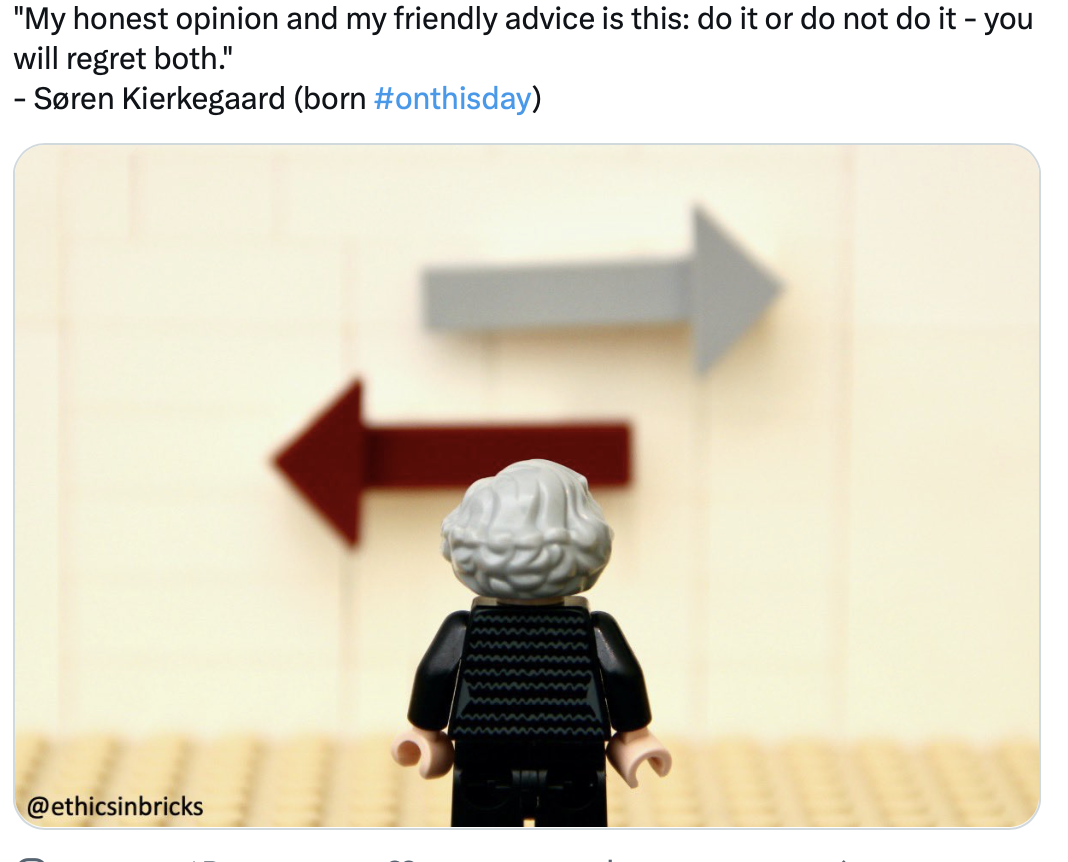
Having written almost enough to fill a weekly quota on Monday, I figured today I’ll share someone else’s observations – conveniently offered with Legos, so you don’t have to read much more either….
Ethics in Bricks continues to amuse me, or remind me of what is important to pursue or reassures me that there are people out there sharing many of my values. You find it on various social media.
Enjoy!
—
—
—
—
—
And of course here is the one that refers to the most recent tragedy which reveals our values:
Here is the American Wild Ensemble with Shy Bricks by Christopher Stark, a composer new to me. Wort keeping an eye on.
“History is who we are and why we are the way we are.” – David McCullough, American historian (1933- 2022)
***
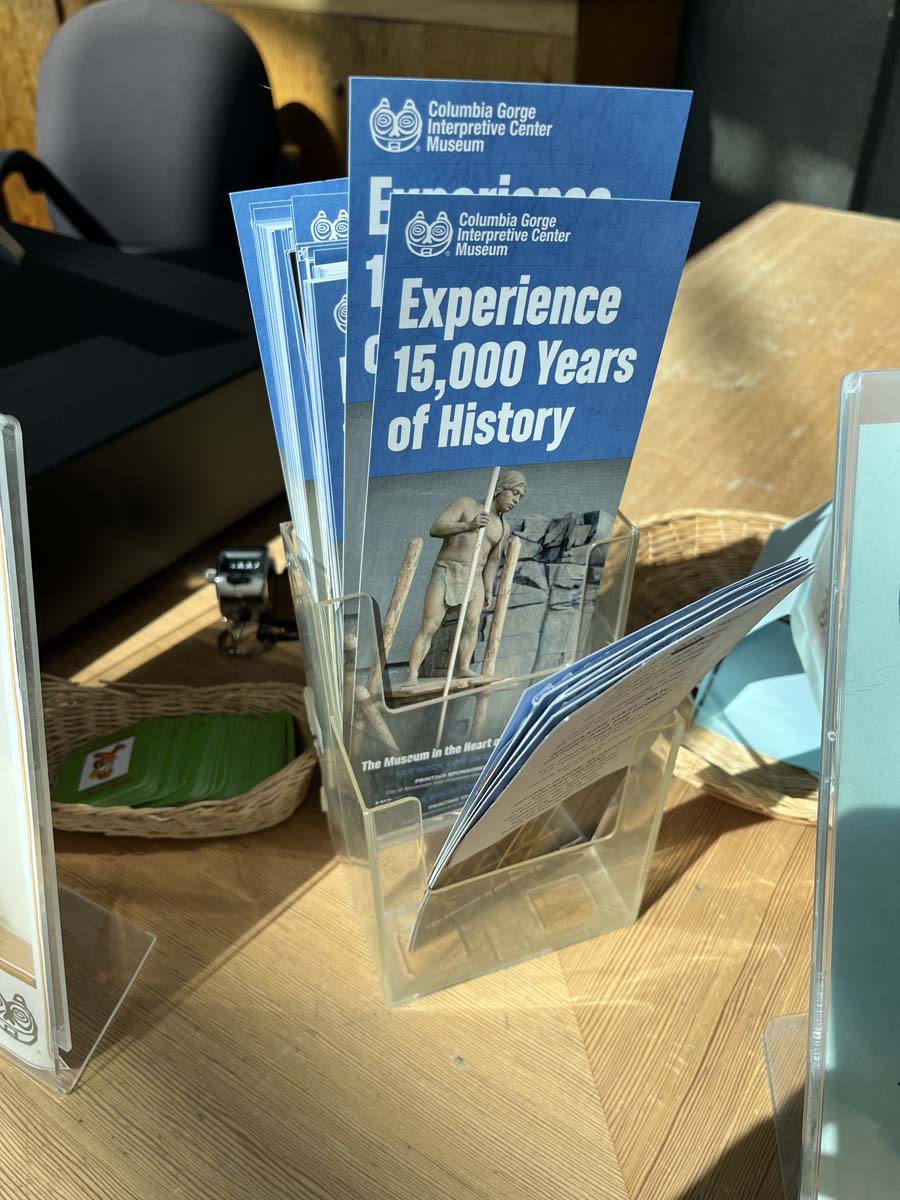
I’m curious: how many of you have ever visited the Columbia Gorge Interpretive Center Museum in Stevenson, WA? A mere 50 minutes from Portland, the drive there takes you through beautiful scenery and ends up at a multiple-acres piece of land adjacent to Skamania Lodge, alongside a small lake dotted with islands and views of the Columbia and the mountains as backdrop. A compact, modern building made of glass and concrete overlooks the property, with some rather large wood carvings and a collection of historical tools and machinery outside, and multiple exhibitions dedicated to the history of the region displayed on the inside.
I had never known the museum existed, much less visited there, until recent changes at the institution brought it onto my radar. That might have simply been my ignorance – wouldn’t be the first time – or it might have had to do with lack of outreach or appealing programming. That is in the process of changing now, under a new executive director, Louise Palermo, who is very much engaged in putting this hidden jewel onto the map beyond its familiar supporters and viewership of long-time residents of the Gorge. (And a heads-up: a new website, reflecting changes, is in the process of being installed and will be up in a few days. Information about location, opening hours and directions have, of course, not changed.)
The building houses numerous collections across two floors, conveying the history of the land and the people, from First Nations to modern settlement, forestry and industrialization of the region. A small theatre shows documentary films, some exploring the geology of the Gorge. There are a few quilts exhibited, and there is an unexpected, one might say quirky, collection of thousands upon thousands of rosaries, spiking my curiosity how some of these, donated by famous people – Lawrence Welk, Al Smith, the first Catholic to run for the office of president in 1928, one donated in memory of Robert Kennedy, who had left it in a small church in Bavaria; and one donated in memory of Dag Hammerskjold, Secretary General of the United Nations from 1953-1961, and one donated by President John F. Kennedy – ended up in cupboards in the Gorge.
You enter the museum through two rooms of exhibits describing the ways of life and fates of the tribal populations of the region.
Much needs to be done, I suggest, to bring this collection and particularly the explanatory signage up to date. Some of the language obscures the consequences of settler colonialism. Pretty much the rest of the museum is teaching us about how the settlers lived and thrived and changed the land, including the rationale for building dams and their fateful consequences.
The Grand Gallery focusses on the way wood was harvested and processed from the surrounding forests down to the mills, much to the delight of visiting school classes who get to see moving and noisy machinery, once you lure them away from the stuffed mountain lion overseeing it all,
or unexpected signs of Big Foot in the corners.
To my delight as well; I had no clue about the complex processes involved and was fascinated by the traditional steam engine, the Corliss, providing power needed to run sawmills. Harvesting of fish is shown by juxtaposing mechanical methods, a fish wheel, and Native American techniques, represented by the model of a native dip netter, at a water feature. This alone would be an interesting starting point for a conversation about extraction and preservation, particular if there were youth programs that would seed not just a love of history but an understanding of each person’s possible role as a steward of the resources of the Gorge.
Louise Palermo instructing 3rd graders
There is also a gift shop that carries arts and craft by local providers in addition to the usual fare. A small gallery offers the opportunity for changing exhibitions, with the current one, Women Artists of the Gorge, being the reason for my recent visit of the place.
PhotoCredit: Kristie Strasen
***
“If you don’t know history, it’s as if you were born yesterday. If you were born yesterday then any leader can tell you anything.” – Howard Zinn, American historian (1924-2010)
I don’t know if these things existed in the U.S., but in my German childhood one of the highlights were the trips to the country fair or the green grocer were you could plunk down your 10 Pfennig and receive a tiny paper packet stuffed with miniature toys, colored puffed rice and small candies. It was called a Wundertüte, a “wonder packet,” full of surprises. (Of course it was also a way to assure that young kids got used to return customer – consumerism, given the inclusion of collectibles, cards or toys.)
The current exhibition Women Artists of the Gorge, brought the analogy to mind. Here is a collection of incredibly varied works hung in a small space, with many of them delectable and some eliciting, well, wonder. Shout out to Jen Smith, who artistically hung a show that ranged across so many dimensions, type of media included, paintings, prints, photography, collage, macrame and woven tapestries in this tight space. Shout out to the folks at the White Salmon Valley Community Library and the White Salmon Arts Council, Ruth Shafer and Kristi Strasen respectively, who had originally conceptualized an exhibition of regional women artists in honor of Women’s History month, from which a subset followed the invitation to show their work at the Columbia Gorge Interpretive Center. Shoutout to the staff who kept the daily visitors happy and helped with the pragmatics of mounting the exhibition. The loudest shout out of them all, of course, goes to the artists:
Julie Beeler, Jillian Brown, Janet Essley, Sally Gilchrist, Daiva Harris, Kristine Pollard, Autumn Quigley, Jacqueline Moreau, Cathleen Rehfeld, Ana Rugani, Jen Smith, Kristie Strasen, Cyndi Strid, Kelly Turso and Jodi Wright.
Their work teaches us history in different, more personalized ways, through love of place and depictions of its beauty up to warnings about environmental protection and the need for inclusion and conflict resolution.
I can obviously not review each and every one of the works, so know that my selections are based on personal interest or curiosity, and not at all linked to the quality of the work. As a photographer, I was drawn to one of the photographs on exhibit which anchored the entire show for me in its depiction of female family members capturing a moment of laughter and joy. For many decades, San Francisco-born Jacqueline Moreau‘s work has documented the lives of Native American peoples along the Columbia River, and their fight to secure the rights afforded to them by a provision in the 1855 (Confederate Tribes of Warm Springs) treaty. The intimacy of this photograph is evidence of how integrated a photographer can become with a subject if respect, empathy and shared values overcome outsider status, enabling new forms of community.
Jacqueline Moreau The Spino family (Mona, Geneva, Andrie, Joyce, and Delores.)
As someone who has worked on documentary film projects about the fossil fuel industry, I was moved by the portrait of an Alaskan native whose land, heritage and fate is intrinsically connected to the future of drilling and pipelines and the havoc they can wreak. Janet Essley, a muralist, teaching artist and activist for justice used dabbed motor oil on paper for the portraits in her series Endangered Species (2004), which features people across the world (Columbian, Indonesian and Tajikestani natives among them) whose lives are touched by oil extraction and production.
Janet Essley Alaska
Two depictions of wildlife caught my attention – Autumn Quigley‘s for the wit and thoughtfulness that went into the collage, which seamlessly combined spring’s trilliums and fall’s seed pods and fallen leaves, and Jen Smith‘s for the obvious concern how shared space can be made a reality for creatures that are still truly wild. Ever encroaching human construction is a true threat to habitats, at the same time that we are in such dire need to provide more housing for ever growing populations.
Autum Quigley Windfall
Jen Smith Queen of the High Country
Last but not least there were tapestries that impressed with motion (the strong Gorge winds, swaying the grasses and echoing the waves of the river, were palpable in the one depicted below,)
Jodi Wright Mount Adams
and coloration, the subtle and beautiful gradations of which could not be fully captured under the light conditions.
Kristie Strasen River Tryptich
(I got a better shot at the intricate color play when I visited Strasen in her studio to learn more about the origins of this communal exhibition that she originally co-mounted. Let me share the beauty.)
A set of pillowcases and a collection of small works done during pandemic isolation, defiantly exuberant.
Sometimes I learned interesting backstories that helped to appreciate a work even more. Driven by her passion for mycology, the science of mushrooms, Julie Beeler, together with some collaborators, created a Mushroom Color Atlas which “is a resource and reference for everyone curious about mushrooms and the beautiful and subtle colors derived from dyeing with mushrooms.” People around the world can use this on-line resource, learning and experimenting with it, being drawn into a growing interest for our natural environment. Beeler also teaches in person in various workshops around the nation and lectures at scientific conferences. The best part: not knowing ANY of this would make no difference for the appreciation of the sheer beauty of her pieces. Well, for this viewer, in any case.
Julie Beeler Fungi Bedrock
***
I photographed the show when it had been hung on the day before before opening night, and so worked in an empty room bereft of people. Yet a sense of community was palpable, since the accumulated works really seemed representative of so many different artists, stages of experience, cross section of interests. By all reports that experience of community was present in squares during the opening reception, with a lot of people attending, fortified by wine generously provided by Domaine Pouillon, and interested in getting to know each other.
In some ways that seems to me an important part of the mission this museum under new leadership could adopt: providing a commons, a platform where people with shared interests or concerns, for that matter, can meet, mingle, learn and exchange ideas. One of the definition of commons is “natural resources that groups of people (communities, user groups) manage for individual and collective benefit.” Here it could simply be the offer of a cultural space, shared by the the many of us.
Artists play an important role in this endeavor. Knowing history is surely something that most people see as important. Yet we live in a time of increasing restrictions on teaching history, at all or in specific ways, depending on who you ask or in which state you live. Teaching the history of a place – here the Columbia Gorge – cannot come from a single source, however richly endowed with objects and artifacts to support a particular claim. It has to be provided with the help of different perspectives, and who better equipped than visual artists to relate something in non-didactic, vivid, personal ways that might register much more easily than dry facts or official story lines. I am not implying that the artists in this show intentionally set out to convey insights about history. But the accumulative power of much of the work suggests something about what it means to live in the Gorge, be exposed to both its beauty and its hurt, its past and its present, its nature and culture that needs stewardship and protection.
If the museum opens a commons, inviting and presenting diverse voices easily found in the rich tapestry of the Gorge population, during fun events or serious shows, it will establish its place on the map in no time, an invaluable resource for all of us.
WOMEN ARTISTS OF THE GORGE
June 17th – September 5th, 2023
Columbia Gorge Interpretive CenterMuseum 990 SW Rock Creek Dr Stevenson, WA 98648
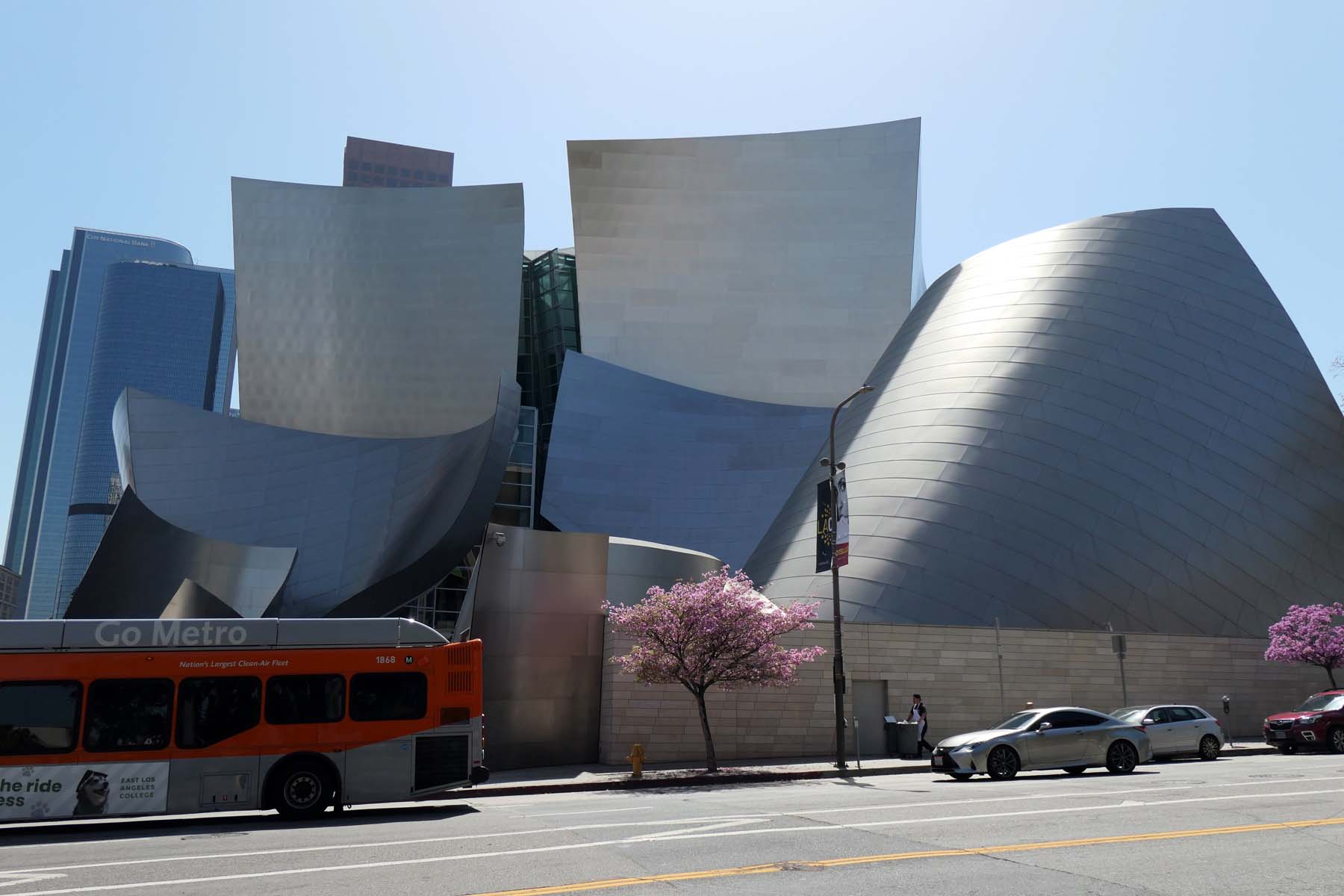
I’ve been told a thousand times over that the word love should be reserved for living beings, and inanimate objects should be liked. I guess adjectives have to pull a lot of weight, then, to express my feelings: I boundlessly, fervently, intensely, unabashedly like L.A.’s Walt Disney Concert Hall, despite the insane amount of money that was poured into its creation, money that was so direly needed elsewhere in this city. (Upon completion, the project cost an estimated $274 million; the parking garage alone cost $110 million, paid by L.A.County raising the funds by selling bonds.)
Designed by Frank Gehry, the home of the Los Angeles Philharmonic opened its doors 20 years ago. It was in the works since 1987, with plans approved by Disney’s widow, Lillian Disney, who had commissioned the project. The construction went through quite a few rough patches, with fund raising stuttering along, and some not happy with the Deconstructionist design.
Inside, a large concert hall contains 2,265 seats with a vineyard-style seating arrangement that helps the audience feel close to the orchestra. There are no boxes and balconies, an attempt to avoid implied social hierarchies that are so often found in traditional performance venues. The room is also column-free, made possible by its large steel roof structure.
The outside is dominated by stainless steel panels, the waves and arcs made possible by a French computer modelling software, CATIA (computer-aided three-dimensional interactive application), a technology borrowed from aerospace and automotive industries. It allowed Gehry to transfer complicated models of the project into buildable forms and help contractors to translate a vision into an actual facade.
That facade delivered unexpected problems: most of it had a matte finish, but some parts were polished mirror-like panels. They ended up functioning like parabolic mirrors, reflecting sunlight in such concentrated fashion that the resulting glare led to increased traffic accidents. The reflected light also heated up surrounding condominiums, causing the air-conditioning costs for those residents to explode, and created hot spots on adjacent sidewalks of as much as 140 °F (60 °C). Two years after opening, the offending panels were identified and the surface sanded down to minimize the reflection ( I learned that from the brilliantly titled report “Dimming Disney Hall. Gehry’s Glare Gets Buffed.” )
The exuberant forms of the building, the simulated motion captured in the curvature, the strutting of the wings, the shimmering, glossy surfaces all seem the perfect instantiation of the movie industry’s selling of dreams that transport us, or try to, as the case may be. The structure links to and echoes its surrounds, both physically and in axiomatic ways, as all truly good architecture does.
It was remarkably quiet on the streets on a pleasantly warm and sunny weekend afternoon, with nary a person walking the blocks around the hall and the adjacent contemporary art museum, The Broad, side walk cafes almost empty.
The contrast to my other stop that afternoon could not have been more glaring: no sterility at the garment district. It was packed with people perusing outdoor markets around Santee Alley, in L.A.’s fashion quarters.
It was so crowded that I had to wear a mask outside. A stream of people perusing the wares, including fashion, jewelry, cosmetics, toys and electronics, hawkers’ calls, laughter and excited talk filling the air, kids included. Somewhat reminiscent of the wonderful time I spent in Mexico City, some years ago, given that I was surrounded by mostly Spanish speaking people this Sunday. The goods on offer were colorful and in abundance. So was the sea of humanity that meandered between the stalls, trying to spot a bargain amidst mass produced plastics and cheap imports.
It felt so alive in comparison to the sterile environment at the city’s center, if also living proof of the income inequality that marks our society.
L.A. county, home to one in four Californians, is one of the leaders in poverty, and direly affected by the epidemic. It hasn’t matched California’s gains in education, health, or jobs. And Los Angeles has been the biggest driver of rising inequality across the state.
The gap between high- and low-income families in California is among the largest in the nation—exceeding all but three other states in 2021 (the latest data available). Families at the top of the income distribution earned 11 times more than families at the bottom. California’s income distribution reflects high rates of poverty. Income is frequently not enough to meet basic needs. Families in the bottom quarter of the income distribution are at risk of poverty absent major safety net programs. Wealth is more unevenly distributed than income. In California, 20% of all net worth is concentrated in the 30 wealthiest zip codes, home to just 2% of Californians. (Ref.)
The density of people dropped abruptly once you entered the adjacent alleys, where I was lured by colorful graffiti and mural works, once again.
The excursion yielded one other discovery: a shop where you can rent some time and appropriate implements to express if not get rid of your rage. There are old car wrecks in a cage, cars you can hit, bang and stomp in any way you like with tools provided, sort of the adult version of the kids’ pillows that absorb their fury. Not the worst idea! Particularly in a city that incites lots of parking frustrations….
Music today is what you could listen to at the Philharmonic this week with Leila Josefowicz playing Thomas ADÈS Violin Concerto, “Concentric Paths.”
My path will go straight North as of this weekend. Will resume posting later next week.
Just a short walk, if you want to join, another one to bring home the immense variety of what L.A. has to offer, one neighborhood at a time. Highland Park has two dubious distinctions: for one it was the very first suburb of L.A. proper until 1895, when it was annexed after the community pleaded for incorporation, by all reports to assure increased police presence in a flourishing red light district. It took but two days after annexation, that the police chief and his posse came in and literally burned down all the brothels and gambling saloons. Maybe not a coincidence that L.A.’s Police Museum is located in this neighborhood. I did not inquire. Or set foot in it. Surprise.
Secondly, Highland Park has had the highest speed of gentrification of all small L.A. neighborhoods in recent years, which can be a good thing or a bad thing, depending on your perspective and the size of your wallet.
Lots of stuff that is too hard to move or had to be sold, ends up in second hand stores that line the streets.
As does the stuff itself.
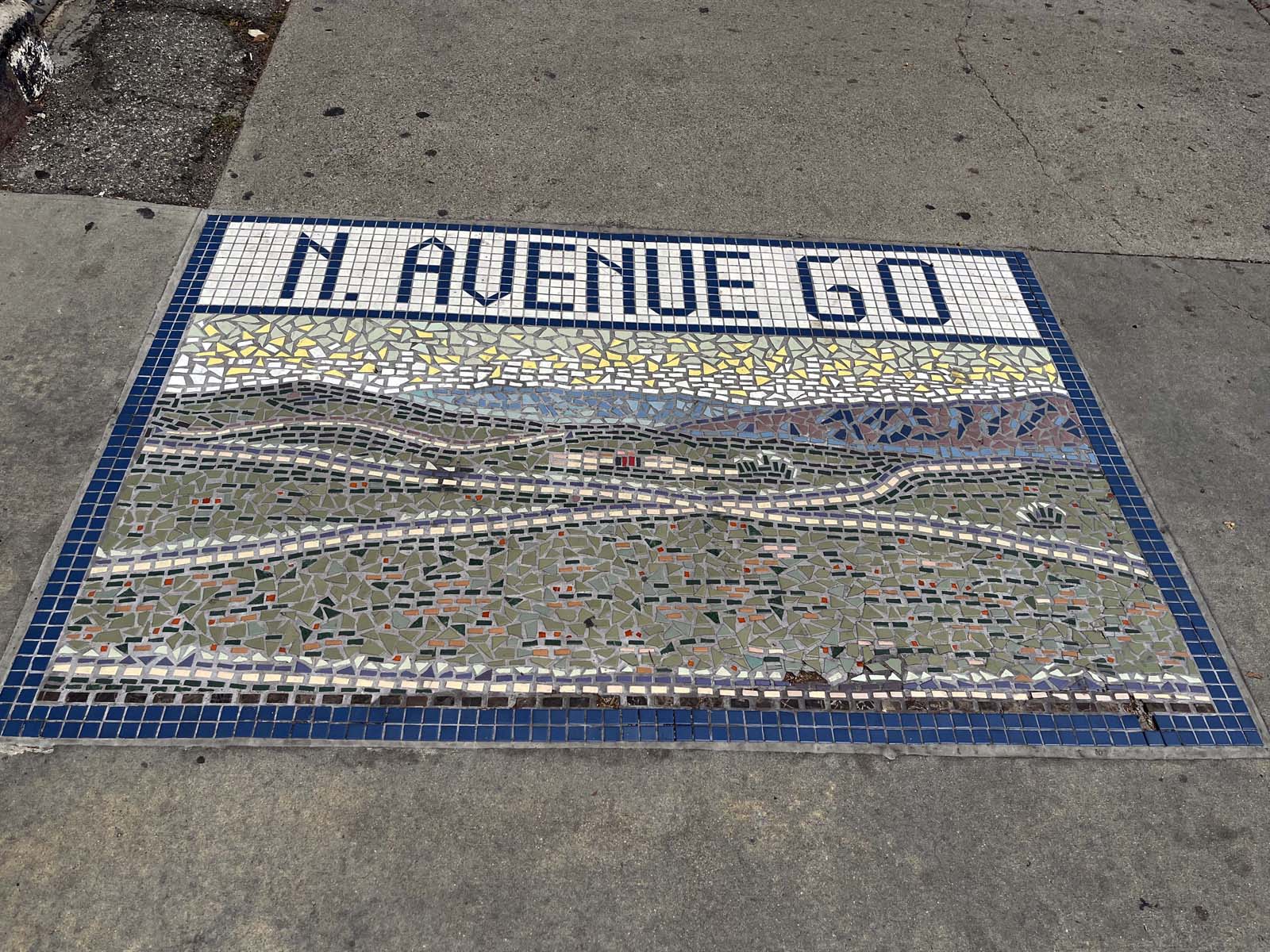
The neighborhood is situated between central L.A. and Pasadena alongside the Arroyo Secco. Much of its history is commemorated with sidewalk mosaics and information columns that display archival photographs and explanatory texts, quite informative.
Highland Park started to flourish with the arrival of the San Gabriel Valley Railroad which opened a station in 1885, followed by the Los Angeles and Pasadena Electric Railway that laid down the first interurban electric railway in Southern California in 1895, helping people to commute. Today you find suicide prevention signs at every crossing.
Image courtesy of the Los Angeles Public Library
Occidental College, established by the Presbyterian Church, opened its campus in the early 1900s and has been serving generations ever since.
Image courtesy of the USC Digital Library
Many of the public buildings from the time have been preserved, but are no less exposed to change. A historic landmark, the nearly century-old Highland Theatre building on Figueroa Street, one of the two main drags through the area, was up for sale as of last August, since its 99 year lease, signed in 1924, will expire. It was the last of 4 theaters along this street to survive, including the historic Sunbeam Theatre. The facade will have to be preserved, but the function and lay-out inside is the new investors’ domain.
Some public buildings are well maintained, other establishments show the ravages of the economy. Here is the public library
and the municipal water building.
The minute you venture off the main thoroughfares you find small, well maintained bungalows and funky gardens or wall paintings. But also signs of distress.
Lots of color to be found on the major streets as well, tempered by the presence of police in front of swank new shops and restaurants, though absent at the traditional stores.
Someone chose aphorisms for public utility meters,
And murals commemorate the history of the place.
And sometimes color just pops up unintentionally….
Lots of eateries behind screens on the sidewalk, filled with young people enjoying lunch – the place is clearly vibrant, with traditional mini-malls sharing space with new upscale boutiques.
I must say, I will miss the diversity of it all when returning to PDX. Then again, it will be good to be home after such a long stretch. Just think of all the bird pictures you’ll be getting…..
Walk with me, if you can stand driving with me first, on L.A. highways that challenge even the most ardent motorist (and I count myself among those.) Someone called the experience soul crushing. I wouldn’t go that far, but it’s pretty insane if you add the difficulties with finding parking, or, as a friend more aptly phrased it: crazy insane.
However, I made it to the northern edge of L.A. in one piece this Sunday, ready to check out a Japanese enclave, Little Tokyo, that existed since the beginning of the 20th century. The roughly 5-block district was home to some 10.000 Japanese immigrants by the early 1900s, a market place and cultural hub that nowadays offers a mix of traditional stores and restaurants next to tourist traps and skateboard businesses.
On a sunny, windblown Sunday, the place was jumping, throngs of people standing in line in front of various shops, sushi-joints and Karaoke studios, mostly ignoring the multiple reminders of the district’s history, spread throughout.
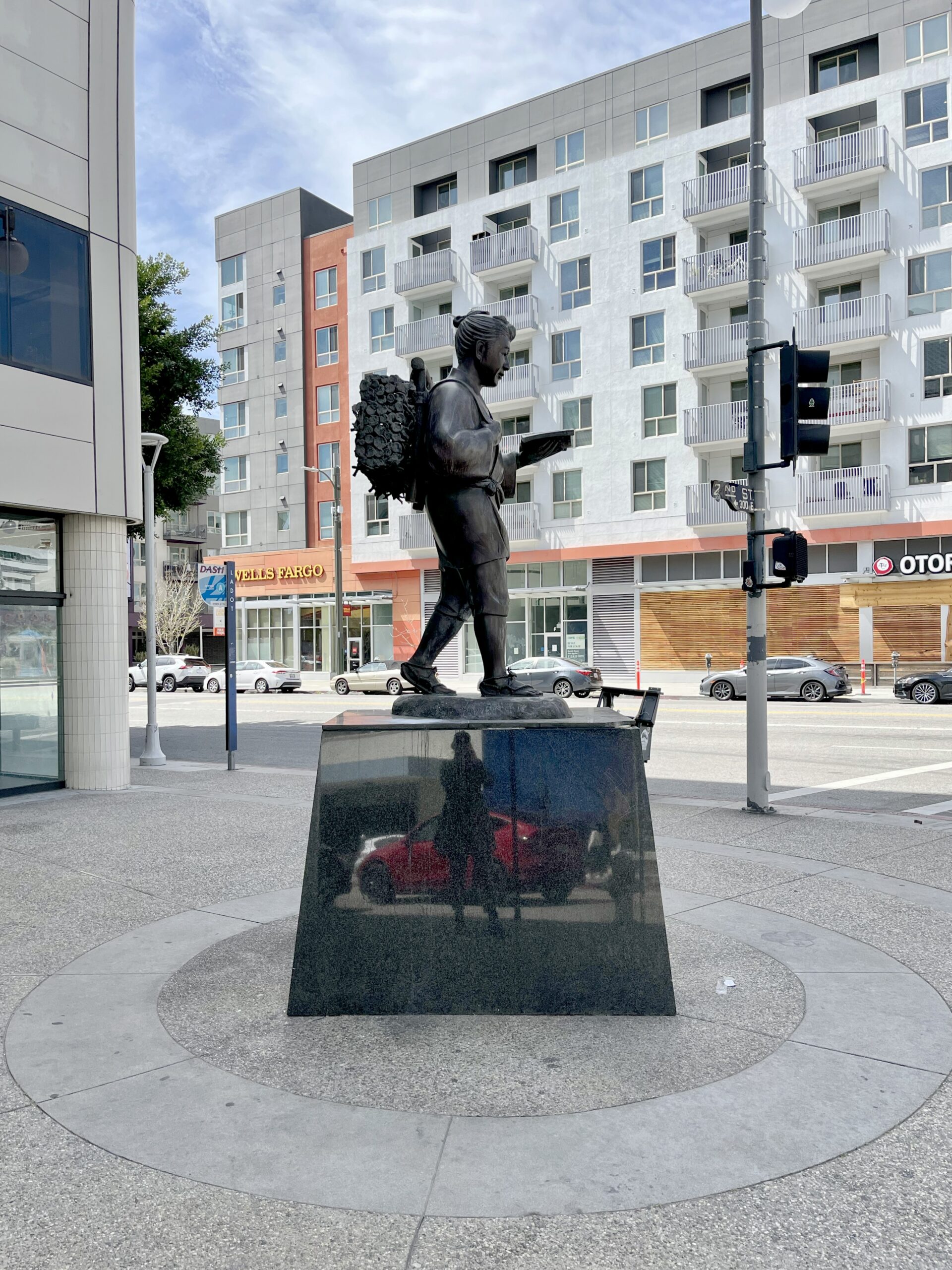
Sculptures tells stories, as do wall plaques and photographic mosaics.
Junichiro Hannya Ninomiya Kinjiro (1983) – It is actually a controversial sculpture, see details here.
Ramon G. Velasco Chiune Sugihara Memorial, Hero of the Holocaust 2002.
As the Japanese Vice-Consul for Lithuania, Sugihara helped over 2000 Jews to escape Nazi Germany by handing out transit visas that allowed them to flee through Poland and Russia. He did so against the explicit instructions of the Japanese Foreign Ministry.
JANM’s renovated Historic Building was formerly the Nishi Hongwanji Buddhist Temple, the first Buddhist temple building constructed in Los Angeles in 1925.
“From the plaque for the camera sculpture: First-generation Japanese American photographer Toyo Miyatake (1895) opened his photography studio in Little Tokyo in 1923 and spent the rest of his life documenting his community’s life on film. When Miyatake, his family and 120,000 Japanese Americans were unjustly incarcerated by the U.S. government during World War II, Miyatake bravely smuggled a camera lens and a film plate, considered contraband, into the Manzanar concentration camp in California. Using a secretly-constructed camera, he captured everyday life in Manzanar. Artist Nobuho Nagasawa created a three-times-as-large bronze replica of the Miyatake camera in homage to Toyo Miyatake. The sculpture projects slides of Miyatake’s work onto a window of the Japanese American National museum each evening. This sculpture was commissioned by the Community Redevelopment Agency and was first installed in 1993.“
***
The Japanese American National Museum was surprisingly airy and empty, and everyone was wearing masks, which made me comfortable enough to meander through both, the permanent exhibit that describes in detail the traumatic experiences of immigrants even before they were rounded up and incarcerated in concentration camps in 1941, and the current exhibition, Don’t Fence Me In, that traces the coming of age of so many young people in the camps during these horror years with superb archival photographs and other objects. (Details here.) Thoughtful curation throughout. The museum is the largest of its kind in the U.S. and holds over 60.000 artifacts. Hello Kitty included…
The OOMO Cube by photographic messaging artist Nicole Maloney was installed near the main entrance of the JANM Pavilion in 2014. OOMO stands for “Out Of Many One” and Maloney conceived of her installation as a giant Rubik’s cube with five sides filled with photographs and the sixth side as a mirror.
Maloney explained that people are often identified through five different characteristics: race, religion, gender, socio-economic status, and sexual orientation. The cube allows visitors to JANM to have interactions with it by rotating the sections into different configurations. Maloney hoped that those interacting with her cube will be reminded that everyone belongs to one world and one humanity and that it will encourage people to “stand in awe instead of judgment of one another.” (Ref.)
Also located on that plaza is the Geffen Contemporary at MOCA, an outpost of downtown L.A.’s Museum of Contemporary Art. The doors were locked, despite regular business hours. Just as well, I would not have been able to process two museums in a day.
Barbara Kruger’s imposing 30 by 191 feet red, white, and blue mural mural, Untitled (Questions), provided enough to look at and think about.
An installation of airplane parts was home to quite a few birds, coming and going and disappearing inside – urban nesting of the finest.
Nancy Rubin Chas’ Stainless Steel, Mark Thompson’s Airplane Parts, About 1,000 Pounds of Stainless Steel Wire (2002)
Wandering around, I was struck by the absence of graffiti – there were a few commissioned, professional murals and the usual plastering of electric cable boxes, meters or some such.
Katie Yamasaki Moon Beholders (2014)
The mural is intended to represent, celebrate, challenge, and preserve different concepts within the Japanese American culture, both contemporary and historic, while connecting with the diverse community around JANM. The mural depicts a young girl, clothed in several furoshiki, a traditional Japanese cloth often used to carry, cover, and protect objects, most often gifts.
The mural also depicts lanterns or akari, representing light or illumination and displays a haiku poem by Basho, a famous Japanese poet from the Edo period. (Ref.)
I will have to figure out where to find it, but that is for another outing. Should I survive the maze of freeways yet again.
The Home is Little Tokyo (2005) mural depicts present-day life in Little Tokyo with vibrant images reflecting Little Tokyo’s revitalization and the community’s strong personal ties to the district. The brightly-colored mural spans 40-feet along the wall fronting Central and is 16-feet tall. Artists Tony Osumi, Sergio Diaz and Jorge Diaz involved community members in the mural design process through open meetings to discuss and collect ideas. The process of creating the mural took three years. (Ref.)
Music today needs a bit of attention. It is a beautiful act of story telling with music.
The Nikkei Music Reclamation Project, in their own words, aims to (re)imagine Nikkei (Japanese American) musical identities and to examine pre- and post-WWII Japanese American political history and music. The goal of the Nikkei Music Reclamation Project is to bring together multiple generations of musicians in extending this legacy and envisioning new directions for Nikkei musical culture in Little Tokyo.
⅔ into Black History month I figured it’s time to contemplate cultural offerings that embody what’s encapsulated by the terms above. Coincidentally, my friend Catón Lyle posted photographs I had taken of him and his students 8 years ago this week on Facebook, images of people I deeply care about and worked with, now likely strong and resilient young adults either in Highschool or off to college. Institutions where Black history is no longer guaranteed to be taught across the country.
Catón Lyes, drummer extraordinaire
Let’s look at possibilities to learn about Black History outside of the educational settings, then. When it comes to ferocious women, none portrays them better than Viola Davis in her magnum opus, now on Netflix, The Woman King. The actress is a marvel (in everything she touches). Here she was training in her late 50s for a physically demanding role as an African warrior leading an army of women in the State of Dahomey (now Benin) in battle and for the political future of a kingdom contemplating to step away from participating in the slave trade.
The film is an epic mix of action movie, intergenerational, intra- and inter-tribal conflict, serious depiction of slavery, with a hint of romance thrown in, involving a non-African man at the behest of the studio bosses who wanted a White man role for sales points and settled for someone with a White father and a Black mother. Various, really numerous, subplots tug on every emotional register imaginable.
Davis and director Gina Prince-Bythewood together with screenwriter Dana Stevens had to fight for 6 years to get this film made, and only got green light after the success of the Black Panther pointed to the possibility of having this kind of film be a box-office success. It was “the product of a thousand battles.” The obstacles the production team faced when pitching a historical epic centered on strong Black women and a State that celebrated gender equity until the French colonialists crushed it, are at length described in this review in the Smithsonian. The public reaction to the finished product has also been fierce: the extremist Right condemned it for Black women killing White men. Some Black organizations found fault with the depiction of African nations actively participating in the slave trade, which is of course historically correct, and brave to be acknowledged in a Hollywood film that wants to convey history, if you ask me. But the worry remains in the eyes of many, that it partly absolves the Euro-American slavers from their responsibility.
Then there is the complaint that the film’s narrative alters what actually happened, making the Kingdom of Dahomey into a place that abandoned the slave trade, when it actually didn’t. A general complaint regards the fact that a major Blockbuster Movie could have chosen a positive event in Black history, rather than one marred by complexity of historical trade alliances.
The film’s take on history is indeed stretched and to be taken with a grain of salt, or with the understanding that movies need to entertain, and have some lines that help us identify with good or evil. The choice of featuring a female standing army, the historically real Agoodjies with all their strength and complicated lives, though, should be a boost to a current generation of women who are searching for role models in an era that is dead set to roll back both women’s and civil rights (not necessarily in the setting of the military, but fighting everyday challenges.) If you want to learn more details about the actual history of the Agoodijes, there is a smart guideline, The Woman King Syllabus, provided by a group of US-based historians, Ana Lucia Araujo, Vanessa Holden, Jessica Marie Johnson and Alex Gil.
***
When it comes to brave women, do I have a book for you. Organize, Fight, Win: Black Communist Women’s Political Writing is a stellar compendium of sources that help us understand the Black radical tradition, from the early 1920s to the late 1980s. If we can, for a moment, put aside our immediate reaction to the term “communist” in the title, still associated with extreme negative reactions, we might particularly benefit from the section that exposes how White supremacists have always successfully used the tool of the communist specter as a weapon in their political crusade. The book, edited by Charisse Burden-Stelly and Jodi Dean, also teaches a lot about the fight against fascism on the one hand, and organizing of labor on the other, both topics of obvious contemporary relevance.
***
And last but not least, when we look for resilience and decisive action, there is a new, digitally available, resource that I strongly urge you to sign up for: Hammer and Hope, a magazine of Black Politics and Culture, founded by Jen Parker and Keeanga-Yamahtta Taylor.
Or at least read the poem, Come In, by Ashley M. Jones, the current poet laureate of Alabama, in call and response with an image by photographer and performance artists Carrie Mae Weems, who was born in Portland, OR 69 years ago and is one of our most impactful and famous contemporary artists. It sets the tone and invites all of us to cross a threshold into a community of diverse backgrounds but shared goals.
The name for the new magazine, suggested by Derecka Purnell, a brilliant young lawyer and abolitionist, is a riff on a book, Hammer and Hoe, by Robin D. G. Kelley, a professor of American history at U.C.L.A.
The goals could not be clearer and more decisive:
“….a hammer to smash myths and illusions.”
“And our hope? It is not the false optimism of liberals or the fatalism of armchair revolutionaries or the pessimism of pundits waiting for the end of the world. James Baldwin understood hope as determination in the face of catastrophe: “I can’t be a pessimist because I’m alive. To be a pessimist means that you have agreed that human life is an academic matter, so I’m forced to be an optimist. I’m forced to believe that we can survive whatever we must survive.” … victory is never certain but if we don’t fight, we can only lose. Hammer & Hope is here to fight.”
“Our mission is to collect, preserve and share the stories, oral histories and artifacts of Portland’s Chinatown as a catalyst for exploring and interpreting the history of past, present and future immigrant experiences.” – Portland Chinatown Museum (PCM) Mission Statement
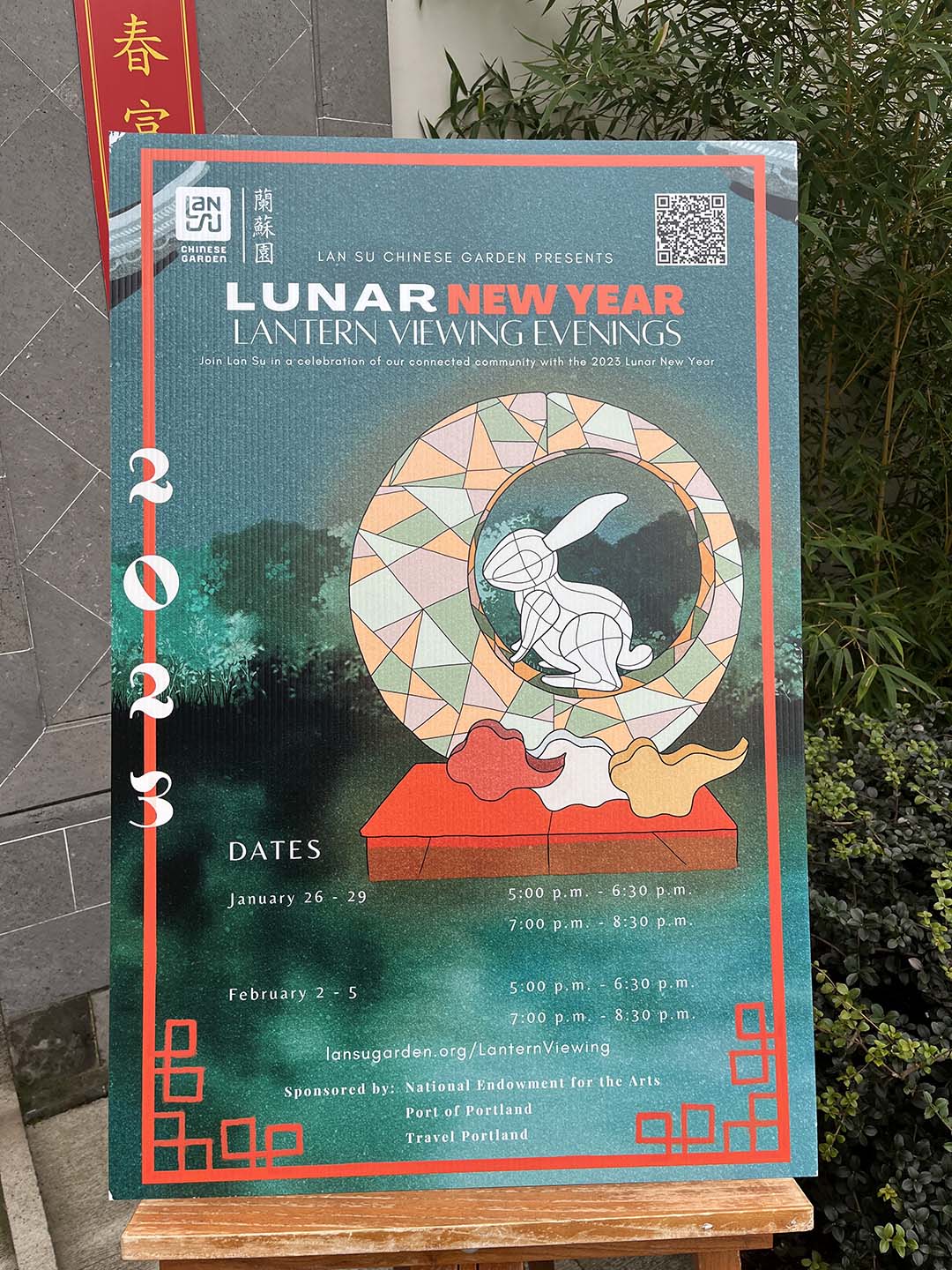
The Lunar New Year – The Year of the Water Rabbit – started yesterday and the Chinese government expects about 2.1 billion journeys to be made in Asia during a 40-day travel period around the celebration as people rush back for the traditional reunion dinner on the eve of the new year. I took a short trip to Portland’s Old Town Chinatown instead on Friday, an annual pilgrimage to admire the beauty of Lan Su Chinese Garden with its festive decorations for the occasion.
This year I added a second stop, a first visit to PortlandChinatownMuseum (PCM,) which is just a block away on NW Third Ave, and not too far from the Chinatown Gateway. The museum opened in 2018 and did not appear on my radar during the pandemic years. I cannot recommend a visit strongly enough: opening hours are limited from Friday to Sunday, and the current temporary exhibition will close on January 29th. So if you can, make it down there next Friday or Saturday between 11 am-3 pm, there is some revelatory art on display.
The history of the museum’s founding can be found here. Like other Old Town institutions devoted to collecting and preserving immigrants’ histories, the Japanese American Museum of Oregon and the Oregon Jewish Museum and Center for Holocaust Education among them, PCM offers a permanent exhibition depicting the lives and plight of the Chinese immigrants. Beyond the Gate: A Tale of Portland’s Historic Chinatowns provides a comprehensive look at historical artifacts, some arranged in diverse dioramas, and guides you through the various aspects of the immigrant experience with informative exhibition texts and archival photographs.
***
Two separate galleries provide space for the work of contemporary Asian American artists, currently showing Illuminating Time, installations by three different artists-in-residence working with different media. The exhibition is exquisitely curated by Horatio Law, one of the PNW’s premier public art and installation artist who serves as the Artist Residency Director. It echoes the permanent exhibitions’s themes of loss, hope and belonging, so familiar to all immigrants.
___
一方有难,八方支援 “When trouble occurs at one spot, help comes from all quarters.” – Chinese Proverb
The theme of community, integral to collectivist cultures and so prominent in the museum’s permanent exhibition of historic Chinatown’s structural support systems, is picked up by Alex Chiu. Known to many of us for his vibrant murals that can be found across PDX, he undertook a series of ink drawings of community members that are displayed in the entrance hall of the museum. Placed against the backdrop of a stylized rendering of the Chinatown gateway, they depict a range of characters of all ages and degrees of visibility, pointing to the diversity of Portland’s Chinese population. Expressive and detailed, these portraits are a lively counterpart to the archival photographs of the Chinese ancestors who set foot here in the 1800s.
The juxtaposition between the traditional valuing of community and the artist’s modern ways of portraying individuals reminded me of the current trends in social psychology exploring the status of young Chinese who grow up in a world where the traditional collectivism of their culture and the modern demands and offers of Western individualism intersect. It is interesting work, based on spontaneous recollection of Chinese proverbs by these college students, reflecting which values come to mind first and how they are weighted. A changing world, yet heavily anchored still in tradition.
Clockwise from upper left: Portland Chinese Community Portrait Series: Billy Lee, Beatrix Li, Roberta Wong, Terry Lee.
***
“Take care of each other. Take care of the soil.” Shu-Ju Wang, in conversation.
Off to the side of the front venue is a room dedicated to Shu-Ju Wang‘s exploration of the history of Tanner Creek and its connection to the Chinese laborers and farmers who tended to its surrounding fertile soil to grow vegetables for both, sale and consumption. Her installation consists of multiple parts, prominently displaying a wooden slide constructed to represent the topography of the waterway with its angles and gradient. It is actually a marble run, and visitors are invited to play around, connecting through interaction. Above it hangs a mobile, made from silkscreen and gouache with a top part that was embroidered on paper tinted with gouache as well. It represents rain drops, a sense of fluidity enhanced by the aqua color range and the lightness of the material that slightly trembles in the draft. The sturdiness of the wood and the fragility of the paper assembly complement each other, rather than being opposed, representing aspects of nature that remind us of its power as much as its vulnerability.
Wang’s interest in and facility with science is evident in the exhibition posters that provide facts about the history of the creek within the build-up of Portland, the encroachment endangering the creek’s initial free run and displacing those human communities that had respected natural cycles of flooding necessary for fertile ground. Creatively, these narrative are told in letters from the creek to us, making a personal statement in a voice that I can see as particularly effective for young minds, children feeling addressed and drawn in. That said, it sure got my attention. The remaining walls are hung with the artist’s recent paintings and printings of nature-related topics, the theme of the need for environmental stewardship pervasive, meticulously and insistingly expressed.
Left to right: A fold-up book Castor and Sapient; A Study of Home (2021) Silk screen, pressure print and collage; a basket by Sara Siestreem (Hanis Coos) woven from native plant materials to catch the marbles.
I walked out with a plant cutting in hand, small annuals which are offered for free – by March, when this part of the exhibition is likely still on, it will be vegetable plantings to connect to the Chinese farmers’ history at Tanner Creek.
If we link the immigrant experience to the past, present and future, as the museum intends to do, then Wang’s depiction of the past and Chiu’s capture of the present is joined by Roxas-Chua’s work incorporating the future. That might seem counterintuitive given the prevalence of allusions to memory, including the title for some of the major works.
Yet I was flooded with an impression that the work was about opening towards something, with the release that comes with the acknowledgement and acceptance of grief.
Detail: Gold Lighting and Lullaby Scripts
Part of that might have been triggered by the realization of the ephemeral character of both materials used and conceptual expression. The artist will destroy all that was presented by the end of the exhibition’s run and bury it at its source, the places in nature from which materials for the ink and paper were borrowed, and from which the inspiration was drawn. What is gone makes room for the new.
Left and RightL Gold Lighting and Lullaby Scripts. Center: Stone Satellites over an Excavation Site in John Day, Oregon.
Part of it can be found in the way Roxas-Chua’s calligraphy is open to interpretation. The technique of asemic writing that he uses is a form of communication that is unconstrained by syntax or semantics, an aesthetic rather than a verbal expression. It is the perfect medium for someone who is overburdened by the demands of too many languages (In Roxas-Chua’s case four) or too little rootedness in each.
Excerpt: Three Oranges and Blue Mountains Moon
For the viewer this opens space to connect to the calligraphy in ways unrestricted by formal demands. Unsurprisingly for me, who has spent her scientific research years studying memory, the art appeared as patterns of synaptic connections, but also of plaques causing retrieval failure, of parallel processing and encoding bias. The malleability of memory was perfectly caught in the flow of these marks, the way how present context is re-shaping, even altering what is remembered, ultimately influencing an assessment of the future.
How we approach the future is not just guided by how much our memory has changed over time, shifting away from facts and towards a narrative that helps emotional adaptation. How much any of us can remember the specifics of our past also plays a big role.
In many realms, all of our thinking about the future is rooted in memory. Policy planners, for example, routinely contemplate past patterns as a way of anticipating things to come. At a much more personal level, researchers suggest that a sense of hopefulness, or its lack, depends on how specifically we remember the past. Think about someone saying, “I cannot see how that could possibly happen,” or the opposite, “I can easily imagine how that can come to be.” That step of imagination is arguably central to how hopeful someone will be about the future, or not. And that ability to project is clearly linked to the specificity of your memory of how things unfolded in the past. Remembering opening the path to hope.
Excerpt: Three Oranges and Blue Mountains Moon
For the artist it was perhaps a way of connecting to the various landscapes and human sources that linked to the past of Chinese immigrants, from John Day to Astoria, where he interviewed people and recorded soundscapes of the environment (QR codes direct you to a listening experiences that captures these sounds, or music, or the artist’s poetry, providing additional levels of experience of the Gesamtkunstwerk, the totality of each artwork.)
Loss and re-emergence are central to the work. It was, I believe, most urgently captured in The Weeping Script.Please Be Guided Accordingly, the poem that accompanies the calligraphy, seizes the stages at which death rips a loved one away from you, bit by bit. There’s a release provided by inklings of hope and uplift in the future, though tempered by the knowledge that it will be a cold, lonely run. Maybe not the entire three year mourning period proscribed by Confucius, but the concession that grief exists and yet can be turned around. It calmly points to opening of new horizons.
For anyone mourning it will be brutally moving, and yet it is incredibly beautiful, hopeful work.
***
And now we turn to the elephant in the room. If the consummation of loss is part of the art inside the museum, wait until you see it instantiated in the suffering of the houseless in real life outside. The many houseless in the neighborhood, their tents, their misery, their detritus, are something the Old Town businesses are trying to deal with.
City plans almost a decade in the making have not yielded visible results, even though the mayor’s office claims progress. In October 2021, spurred by the rise in crime, violence and public camping in the Old Town neighborhood, the leaders of four cultural institutions — Lan Su Chinese Garden, the Japanese American Museum of Oregon, Oregon Jewish Museum and Center for Holocaust Education and Portland Chinatown Museum — wrote a joint open letter asking each city and county commissioner for immediate help. In March of last year, Old Town Community leaders unveiled a plan to repair and reopen the neighborhood, which included goals like reducing 911 call answering times, improving lighting in the area, and reducing tent camping by one-third.
The right words were said: “As Portland’s oldest neighborhood, home to immigrants who overcame decades of discrimination and indignity, and today, home to so many who are fighting just to stay alive, we must to whatever we can to respond to the crisis of humanity unfolding around us. And we must do it today,” said Elizabeth Nye, the executive director of Lan Su Chinese Garden, “the local government’s inability to safeguard Old Town disrespects its history.It is particularly devastating to our houseless neighbors who deserve more from their government.”
Mural on NW Davis St
The subsequent reality, however, amounted to an exponential increase in sweeps of the neighborhood. The 90-day “re-set” led to a particular form of camp removal, structure abatement sweeps, that can be ordered by the police chief or engineers in two different bureaus overseen by city commissioners. The standard Homelessness and Urban Camping Impact Reduction Program, or HUCIRP, sweep provides at least 72 hours’ notice to unhoused Portlanders so they can gather their belongings and voluntarily move before city contractors remove them from a given area. The structure abatement approach extends 1 hour warning, if that. If you happen to be away from your tent or belonging, all is lost. (For a detailed description of the way things unfolded last summer, here is a report by advocates from Streetroots, an organization where I taught writing workshops for the houseless until the pandemic started.) Shelter referrals given during or after sweeps are not enough – you can stay for one night, after having been completely uprooted. Many feel unsafe in shelters even for that one night, or can’t apply because they have pets.
Mural on NW Davis St depicting the view South on NW 4th Ave
Do these sweeps help solve the situation? Of course not. They clean up the streets for a short time or for a particular event, while making people less stable, re-traumatizing them, and shifting the entire problem just to a different location. Mayor Ted Wheeler and Commissioner Dan Ryan’s five October 2022 resolutions on homelessness included a ban on unsanctioned camping and the construction of compulsory mass homeless encampments, which would host up to 250 people. This can only be seen as a way to circumvent the Supreme Court decision letting the 9th Circuit Court of Appeals re Martin v. Boise decision stand, stating that a houseless persons cannot be punished for sleeping outside on public property in absence of alternatives.
Mural on NW Davis St
Of the six promised safe-rest villages only 2 have opened so far. Evictions from rental properties have skyrocketed since the renter protection during the pandemic was lifted – in the first 10 months of 2022 alone there were 18.831 evictions, as reported by a PSU research group. According to the 2022 Multnomah County Point-in-Time Count report, 24% of those experiencing unsheltered homelessness reported COVID-related reasons as the cause, adding to increased inflation and rising rent costs. Despite the stereotype, these are not all people with criminal records, or mental illness, or living with substance abuse problems. And even if they were, they would have the same human right to shelter as we all do. On top of it all, Senator Wyden’s DASH Act, (Decent, Affordable, Safe Housing for All) languishes in committee, even though it has support from all sides, business owners, land lord organizations and advocates for the houseless included.
I completely understand the need for businesses and institutions to be able to function in a safe environment and one that does not interfere with business under the specter of violence and crime. But let us acknowledge that the reaction so far has been to try and disperse the unhoused, without providing sufficient, actual housing, the only permanent solution to homelessness.
Archival photograph of NW Fourth Avenue
Until something changes structurally and expediently, I fear museums like the Portland Chinatown Museum will not get the exposure they deserve because many people hesitate to visit Old Town. It is truly sad, given what is on offer. But it is heartbreaking to see the suffering and loss in the surrounding streets, with poverty levels probably comparable to those experienced by the very first Chinese immigrants that came to seek a better life in a new home, leaving famine and disease behind. Past, present and future connected at the most basic level of human experience, daily survival.
Portland Chinatown Museum
127 NW Third Avenue Portland, OR 97209
Friday – Sunday 11:00 AM – 3:00 PM
Docent-led group tours are Friday through Sunday by reservation only.
Current exhibition Illuminating Time closes on January 29th.
Join the museum on Saturday, January 28 at 10:00 a.m. for the seventh annual Lunar New Year Dragon Dance Parade and Celebration, presented in partnership with the Oregon Historical Society.
The 150-foot dragon will be celebrating the holiday with lion dancers, performers, and a lively community parade through Old Town, Downtown, and up to the Oregon Historical Society Park