“And now let us believe in a long year that is given to us, new, untouched, full of things that did not exist before, full of work that has never been done, full of tasks, expectations and impositions; and let us see to it that we learn to tackle all that without dropping too much of what it has to bestow…”
„Und nun wollen wir glauben an ein langes Jahr, das uns gegeben ist, neu, unberührt, voll nie gewesener Dinge, voll nie getaner Arbeit, voll Aufgabe, Anspruch und Zumutung; und wollen sehen, daß wirs nehmen lernen, ohne allzuviel fallen zu lassen von dem, was es zu vergeben hat […]” – Rainer Maria Rilke Letter to Clara Rilke 1907.
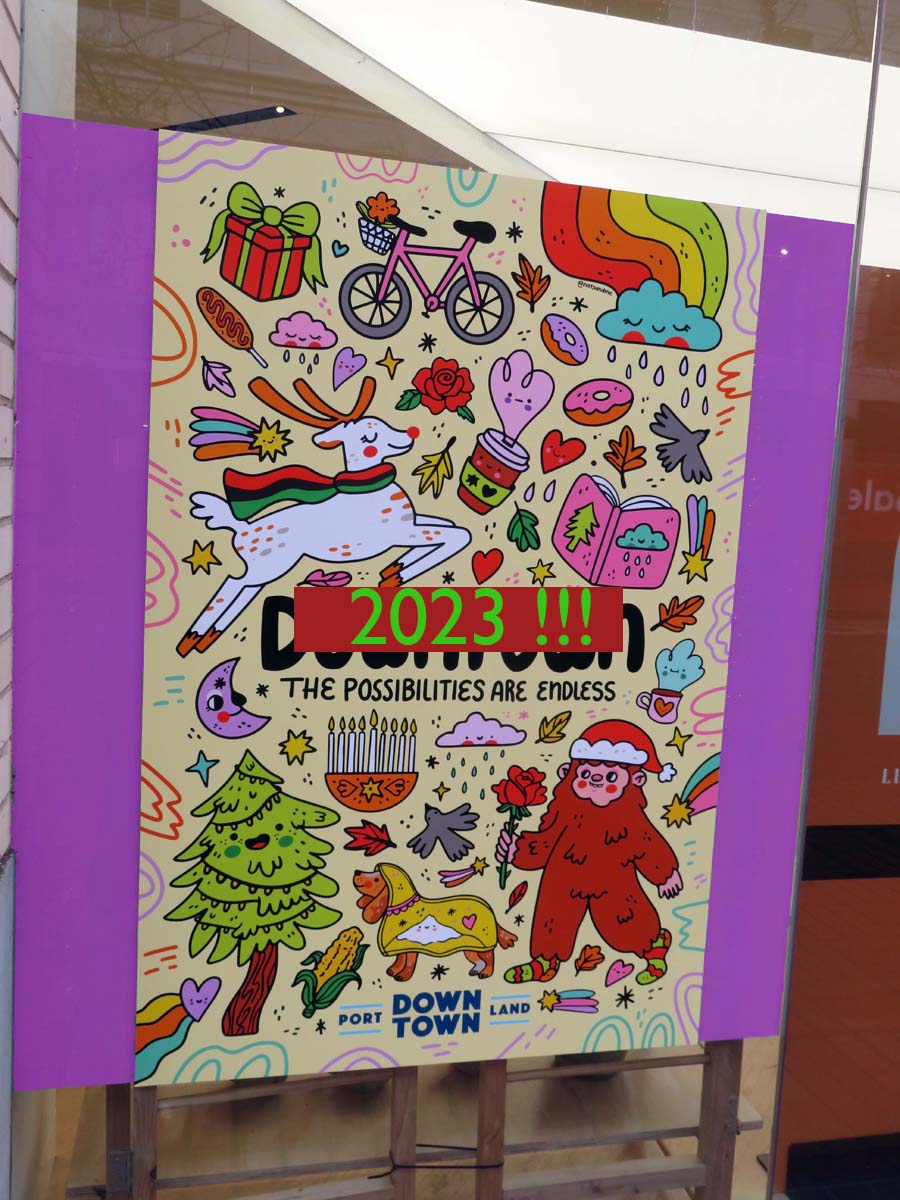
Walk with me. On one of the last days of the old year, as it happened, a stroll through downtown that was a deserted place on a grey Friday morning, the quiet ruptured only by loud screams of a houseless person, the wailing echoing in the canyons between the high-rises. The few pedestrians cautiously crossed the street away from the misery, avoiding eye contact with the tent that looked wet, cold, forlorn.
Photographs today are all from a downtown PDX walk between the Portland Art Museum and Pioneer Square, going north on 10th Ave and coming back South in the park blocks.
And now 2023 already here. No New Year’s resolutions for me, since I know from long experience I won’t keep them in the first place. Although IF I would claim some, they would be echoing this British advice:
Get slightly older each day – Eat more cheese – Discard old socks – Drink the same amount of tea (ok, coffee for me) – Never run out of biscuits – Say “getting there” a lot – Muddle through.
Yet I do have a wish: to have the courage to witness (and report on) what is happening in the world, no matter how deep the darkness goes.
I want to continue to fight against the gentrification of the soul, the self, that comes with aging and privilege. It is so easy to narrow your focus when you become overwhelmed by the suffering in the world, to declare that turning away from the darkness is an act of self protection, when it is an act of choosing comfort instead.
Comfort that is not available, much less granted, to the people exposed to war, oppression, subjugation, or exploitation, by mad men in power, governments, institutions or their neighbors. If the people of Ukraine have incomparable courage to live through bombardments and invasion, the people of Iran facing gallows for desiring liberation, as do their Afghan brothers and sisters, if the Kurds have no allies in the world, nor the Palestinians any protectors, if they all summon this courage daily to live, I might at least have the courage to look. To witness, fully knowing my solidarity amounts to nothing other than emotional discomfort over the experienced helplessness.
Empty squares, with the houseless crouched in corners, and a lone city worker blowing fallen pine needles that moved in small waves and eddies.
We don’t just have to look abroad. There are plenty of discomforting sights close to home. So easy to narrow your eyes and blink the “blight” away, turning to more uplifting views. Don’t get me wrong – I embrace the powerful offerings of nature and art, literature and science as happily as anyone to make me feel better or console me, perhaps even to bestow some hope for a more just world, as my regular readers know full well. But not at the expense of the minimal tribute I can pay by witnessing what else is going on in a nation filled with racism, inequality, culture wars and drifts towards authoritarianism, even or particularly when I have reached an age where active participation in a fight for change has become harder. Maybe my reporting can encourage others who still have energy to get engaged.
Age imposes a narrowing of our lives through the declining powers of our bodies or the restrictions of disease, all multiplied to the nth degree by living in a pandemic era. It is understandable that that narrows the heart as well, the capacity for compassion when preoccupied with your own making it through the day.
It need not narrow the mind though, as long as we are mindful of how and where we apply attention and if we make sure we stretch towards learning. American-Serb poet Charles Simic once said: “The attentive eye makes the world mysterious.” I never understood that, still don’t. For me the attentive eye is all about learning about the world, de-mystifying what we are told to believe. The Jewish tradition with its intense focus on learning has always struck me as something that provided more than just tools for professional advancement, or, more importantly, understanding. It is such a thrill when you realize there is an infinite potential for growth, both of knowledge and as a person, every day, even when the potential for your body is decidedly limited.
For 2023 that means my steady diet of junk novels and movies will continue to be supplemented with stuff that is hard to read and topics that require intense familiarization.
It is somehow fittingly ironic that the question about liberty and justice for all is raised at the Louis Vuitton store. The brand’s trade tag is “Truth. Live and love truth.” No clue why a manufacturer of luxury goods comes up with that, but I don’t exactly think they’d like to hear the truth about the effects of capitalism where the consumption of luxury items plays a large role, if only as marker of the class that can afford the luggage.
***
What I learned on the first day of 2023 came about because I wondered why the sound of human misery is so deeply afflicting when you walk by, half scared, half upset. My search found, instead, a splendid analysis on a related topic: Why do Rich People love Quiet. The Brooklyn-based author of Puerto Rican descent, Xochitl Gonzales, was just made a staff writer at The Atlantic. She describes how she and her cohort of students of color experienced their lives at an Ivy League Institution and then again when White young professionals’ arrivals started to gentrify the traditionally non-White boroughs of NYC.
“The passive-aggressive signals to wind our gatherings down were replaced by point-blank requests to make less noise, have less fun, do our living somewhere else, even though these rooms belonged to us, too. … In those moments, I felt hot with shame and anger, yet unable to articulate why. It took me years to understand that, in demanding my friends and I quiet down, these students were implying that their comfort superseded our joy. And in acquiescing, I accepted that.
For generations, immigrants and racial minorities were relegated to the outer boroughs and city fringes. Far, but free. No one else much cared about what happened there. When I went to college, it was clear to me that I was a visitor in a foreign land, and I did my best to respect its customs. But now the foreigners had come to my shores, with no intention of leaving. And they were demanding that the rest of us change to make them more comfortable.”
The essay then explores the regulation of noise from above, the various administrations, mayoral office and NYPD, through laws and by moving noisy venues like nightclubs out of gentrifying neighborhoods like Chelsea and the Lower East Side and into Brooklyn. That borough, now thoroughly gentrified itself, racked up the most noise complaints of 2019 to the city hotline, the majority of them grievances about lifestyle choices: music and parties and people talking loudly. One culture’s preferences demanding acquiescence from another.
The Apple Store is barricaded behind steel net fences, with only one entrance ramp controlled by police. Moats next? Tiffany, on the other hand, let’s you peek into the window under the watchful eyes of no fewer than three security guards for the one storefront.
Gonzales’ recent novel Olga Dies Dreaming was named a Best of 2022 by The New York Times, TIME, Kirkus, Washington Post, and NPR. On my ever expanding list to read. The title is taken from a stirring poem by Pedro Pietri (1944-2004), Puerto Rican Obituary, linked here because it is too long to post. Don’t want to go overboard with the first blog of the year. Read it, though, if you have the time, it expanded my narrowing view of the world, offering glimpses into a culture so close and yet so far from my experience.
The park blocks offer a strange assortment of sculpture. The museum declared itself “indigenized” – whatever that means – during an exhibition by a Native American artist, Jeffrey Gibson, who produced timelines recording important events for indigenous and non indigenous Americans alike. How will 2023 be added? Since I still do not go inside museums and galleries I cannot report on the show.
Music today offers some classic Puerto Rican Salsa by Héctor Lavoe and, if you want to stretch yourself, the song Titi me preguntó, by Black Bunny, Billboard’s Artist of the Year. “Titi” is Time Magazine’s best song of 2022 pick, the voice of someone who acknowledges and tries to break with his toxic masculinity. The rapper’s music is ubiquitous in NYC right now.
No Black Bunny, but a bronze sculpture of an English bulldog, ridiculously dressed like the doormen of the Heathman Hotel where she resides outside, flagging the pet friendly policies of the establishment.
Capturing once more the beauty that surrounds us and respond with loosely (if at all) related musings? Let’s try.
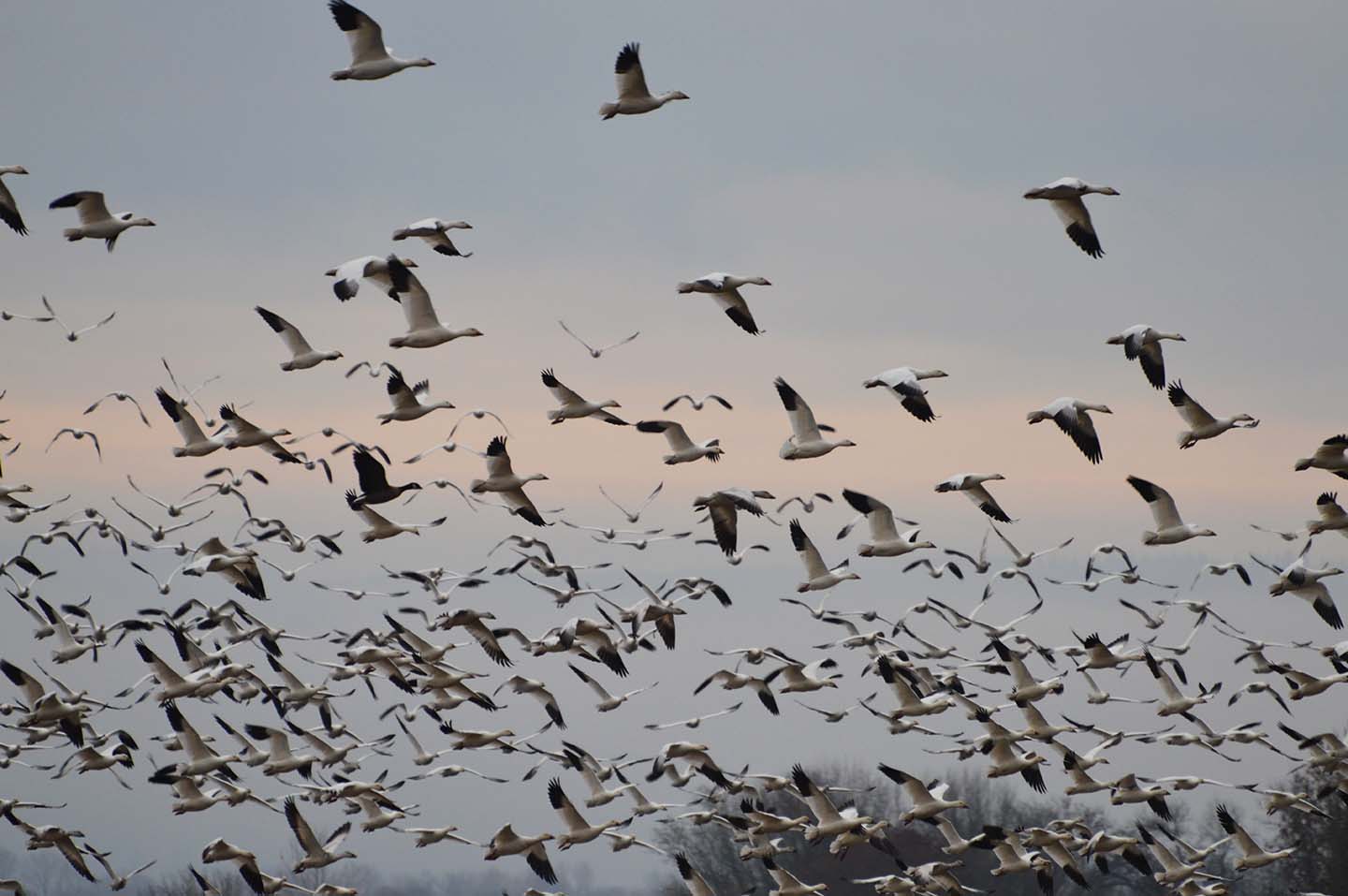
If you are lucky enough to be present when a flock of snow geese gets spooked and you look at them through the very circumscribed lens of your camera, you sometimes experience something strange. Some of the geese are still ascending while others are descending already. If you loose track of who is who – easy to do from far away in the chaos – you perceive a strange undulation – as if the same thing is obliquely going up and down simultaneously, the laws of physics abandoned. For a split second you question the reality that surrounds you, fooled by a perceptual illusion.
A related question has been debated since times immemorial: what is reality and how can we be certain we perceive it correctly? It is on my mind because of the current glut of suggestions in both the cultural scene and computer science, that maybe we are mistaken about the reality we experience. Maybe, just maybe, we all live in a simulation, a computer game if you will, in which we are just puppets playing within the structures set by code, installed by some advanced beings somewhere in the universe. Frown all you want (as I do) but there are some serious, smart philosophers out there thinking through this possibility.
Honestly, watch Netflix, and there is the simulation hypothesis, if you click on 1899, a German series that is even darker and less comprehensible than its predecessor, Dark. (Actually, don’t, not worth it.) Or turn to the bestseller lists. The NYT raved about “Sea of Tranquility” by Emily St. John Mandel, the simulation hypothesis was the basis of the plot. (Again, don’t, I thought it infuriatingly superficial, never getting to the interesting question, much less providing answers about the concept of living in a simulation. An alternative would be a book on the same topic, The Anomaly, that I found more clever by far earlier this year.)
More seriously you find even respectable thinkers and philosophers captivated by the idea, frequently debated in academia and tech/computer science circles. (Link below gives a graspable overview.)
So why this sudden preoccupation with it, decades after The Matrix offered the proposal that we are all dreaming our existence while stuffed into electronic boxes, our bodies mined for whatever the advanced evil civilization that is holding all of humanity captive, needs for their purposes? Why this emergence of Longtermism, whose prominent adherents often subscribe to the simulation hypothesis?
Why seriously engage with a hypothesis when it cannot be tested and so far there has been zero evidence to support it? If we live in a perfect simulation there is no way to get outside of the game (that is one of the problems that all these movies and books simply ignore.) Only from the outside could you judge if something is real or not. This is already the trap Descartes, wondering about our perception of reality, was caught in. His way out was to postulate that innate feelings and thoughts are pre-determined by God, and as a result, an individual’s perception of reality is in fact defined by God. Therefore, it cannot be the wrong one.
Instead of (a) God/ess who preordained everything, now we have some advanced civilization taking that place? Calvinism 2.0? Why would such a civilization waste computational superpowers on creating a simulation? What would the simulation be for? Why does it simulate consciousness, why stay within certain parameters, like the laws of evolution? Why create a place of misery and harm? And how do you deal with the problem of infinite regression, where every simulated world has potentially one above it, equally simulated into perpetuity – where is the endpoint? Back to a God/ess?
What does it buy us to engage with such a concept? Escapist fantasy? The hope that future life-forms are interested in us, some form of ancestor worship? Release from moral imperatives – if I have no free will, just like a character in Grand Theft Auto the umpteenth or Minecraft, why not engage in immoral, unethical or violent behavior without pangs of conscience? Giving in to ennui and lack of initiative because nothing can be changed, unless the puppeteers permit? Being so bored with your life that you do everything to find a glitch in the matrix as evidence that your life is not “real”? Having lost or given up on one religion, turning to the next one in disguise?
Let me know if you have the answers. Clearly the question of reality perception has been around for a long time.
Wishing you all a healthy 2023 with a grip on reality and dreams that are not turning into nightmares.
“A view that will never be mine,” I groused, when reading a review in Art in America of Michael Heizer‘s City. Then again, I will be in good company – only 6 people a day are allowed on this large land art project, in the making since 1970 and finally opened this summer. 6 people, no less, who are able to shell out $150 for a three hour visit, after having been approved when requesting a visit via email to the Triple Aught foundation. People who are able to fly into Nevada and willing to travel rough for many hours from Las Vegas into the desert to a secret location, and who are able walkers – no places to rest for ailing/aging bodies on this installation, by all reports.
Judging from the aerial photographs, it is a pretty stunning site. A mile and a half long, with 14 miles of concrete curbing, the site contains arrangements called “complexes,” meant to resemble urban units from a long-lost civilization. Inspired by a visit to Egypt’s pyramids, the artist said “In sculpture I attempt to maintain the venerable tradition of megalithic societies.” (Ref.) The mammoth project was funded with many millions of dollars by multiple organizations and private donors, and received a helping hand in 2015 by the late Senator Harry Reid and then President Obama who proclaimed the 700,000 acres as part of the Basin and Range National Monument, protecting City from railroad traffic and development near by (the artist had threatened to blow up the entire project if nuclear waste would be transported through the neighboring areas.)
Looks epic. Looks empty. Looks contrived, like a raked graveyard for a lost culture of giants. Made more desirable, I am certain, by the imposed mystery and scarcity aspects. But also admirable given a man’s dedication for half a century to creating something that connects across history and somehow, at least judging from the publicly available photographs, into the future with its echoes of alien geoglyphs.
My city views yesterday were on a more human – yet accessible! – scale. Walking along the river shortly before sunset, nature and industrial structures alike were bathed in faint orange glow.
Street cars and boats reveled in the season’s spirit:
and shadows were long under the Interstate bridge.
Which is where I found the Poetry Beach, a small walkway with engraved boulders celebrating the river. Water, a source of life and sustaining force. Who needs stimulation from a desert city, when urban children’s voices create meaning here and now?
Have to remind myself of the attitude that carried me for so long: there is interesting stuff to be found everywhere. A camera is wonderful. It keeps the mind from drying out.
The season is upon us. Gifts needed. Gifts hoped for. Gifts dreaded.
What to get? Where to get it? How to escape consumerism, when you, like I do, love giving and receiving gifts? How to hide disappointment and lie successfully when well-intended gifts don’t hit the spot, as to not hurt the feelings of the giver? How to hide the embarrassment when funds are so stretched that gift giving can no longer occur? How to avoid credit card debts when caution is thrown to the wind? How to give freely while wanting to discard unspoken reciprocity rules and assumptions, and not be overbearing? How to feel not obliged when flooded with unexpected presents? How to say no to receiving when longing to break the cycle without breaking the underlying relationship?
I thought I’d do a quick survey of the psychological literature to figure out what we know about gift giving. Wouldn’t you know it, the first things popping up in the search were ubiquitous articles in consumer research publications, about gifts and philanthropy among others – how to rope in donors by giving them something (hear me, OPB membership drive???) and ways to surreptitiously force people into expanding gift giving in ever widening social circles.
The next large area was anthropology: how did cultural contexts determine gift exchanges, a custom as old as history and universal across different cultures? As a form of reciprocity it was assumed to integrate societies, and to communicate in symbolic ways about social dimensions of power, status and/or desire for connection. It greased the gears of economic exchange, consolidated political power (note that women were given as “gifts” into alliance marriages, slaves were given as “gifts” to appease conquerers,) solidified peace treaties, and created obligations ($2 billion for Jared Kushner’s equity firm from the Saudis ain’t just good will, one might speculate.)
Last but not least, from an anthropological perspective, gifts were universally used to socialize. Want that toy – better behave! Even charitable giving, seemingly without hidden motive, can be transactional as well – just think of greenwashing or the tycoons who give to museums and concert halls, trying to distance themselves from their role as merchants of death – just ask the Guggenheim or the Tate about the Sacklers. Or New York’s Museum of Modern Art, the Massachusetts Institute of Technology, the Mayo Clinic and the Guggenheim who accepted millions of dollars from tycoons aligned with Russian President Vladimir Putin, including several who are the targets of Western sanctions.
In cultural contexts, then, gifts are a form of contract and a way of shaping behavior and expectations. Reciprocity is generally assumed and needed to keep the cycle going. Giving too much, too little or too late can strain relationships to the point of cracking.
So what’s up with the gift giving in our own lives, at this fraught time of year? Current Directions in Psychological Science tells me that we have to look at what givers and recipients, respectively, focus on and how alignment in those two perspective matters. For one, people often prefer to receive gifts of potential experiences, rather than objects and consumergoods. Secondly, people really prefer gifts that they explicitly wanted (go to that couple’s registry at Target, don’t surprise them with an unrequested gift, no matter how extravagant!) while gift givers think the surprise would be a smashing success. Gift recipients don’t care as much about the price of a gift, while givers think it matters.
Givers also assume that a gift that reflects its recipient (I give her a gift card for Powells, she loves books!) is a great hit. Recipients disagree, on the whole, preferring versatility (give me a Visa gift card I can use anywhere, for what I need most.) And, surprisingly, since it is opposite to my own experience (which once again goes to show n=1 is not a successful scientific predictor,) gift recipients are not particularly fond of socially responsible gifts like donations to charities. Givers might think that it is appreciated, but recipients experience little ownership value in this and would prefer traditional gifts. (Think about that for the next Bar Mitzvah in your life. Then again, our bookshelves still hold umpteen copies of the book ” The Jews of Oregon.”…) Last but not least, gifts that confer value over an extended period of time, rather than make for a brilliant splash at the moment of delivery are by far the most appreciated. That boring wooden salad bowl for the newlyweds WILL score, when still around on your 40th wedding anniversary!
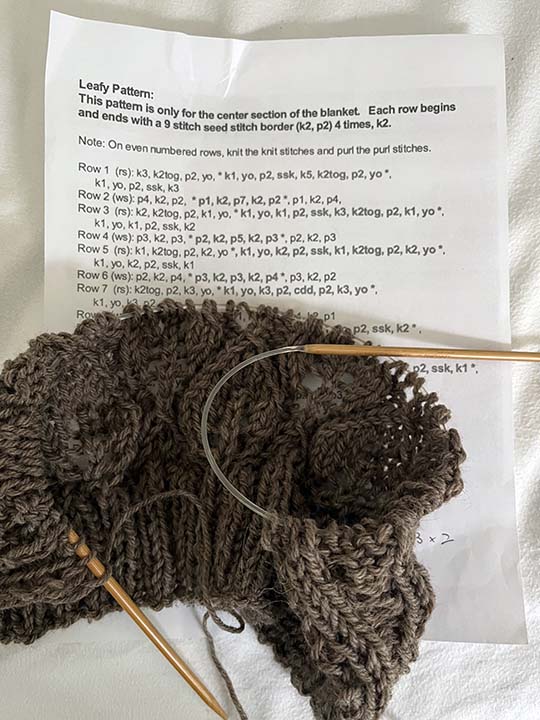
I make my own gifts these days where retirement allows the time and leisure to produce needle work – knitting has turned out to be an effective therapy for frayed nerves. And the photomontages from across the year usually find their way into a calendar. I do appreciate receiving self made gifts, given that I am surrounded by so many talented friends who excel in creativity. But that requires privilege, and people should not add to their stressful lives by investing time that is already a scarce commodity. A friend and I who experienced 30 years of lovely exchanges, decided that from now on its going to be books for the other’s grandchildren in lieu of our own pleasures, to build libraries for the next generation. There’s a way to break the cycle without bad feelings and only fleeting regret since I loved her presents.
It’s still true, though, that gifts – the ones given and the ones gotten – CAN provide a lot of joy, a sense of connectedness and enrichment beyond the material value. Not everything has to be transactional, or part of structural pressures that want to stratify social relations. Just make sure there are no strings attached.
Music contains words about the Magi, the three Kings who brought gifts to Bethlehem, in the classic version – Bach’s Christmas Oratorio Cantata 5 and 6.
I went down a dusty side road to take a last walk on the dike before hunting season begins and the area is closed off. Not that the season is promising. I learned from chatting with the hunters that all are concerned with the absolute drought, wondering if migrating waterfowl would find sufficient water to rest on.
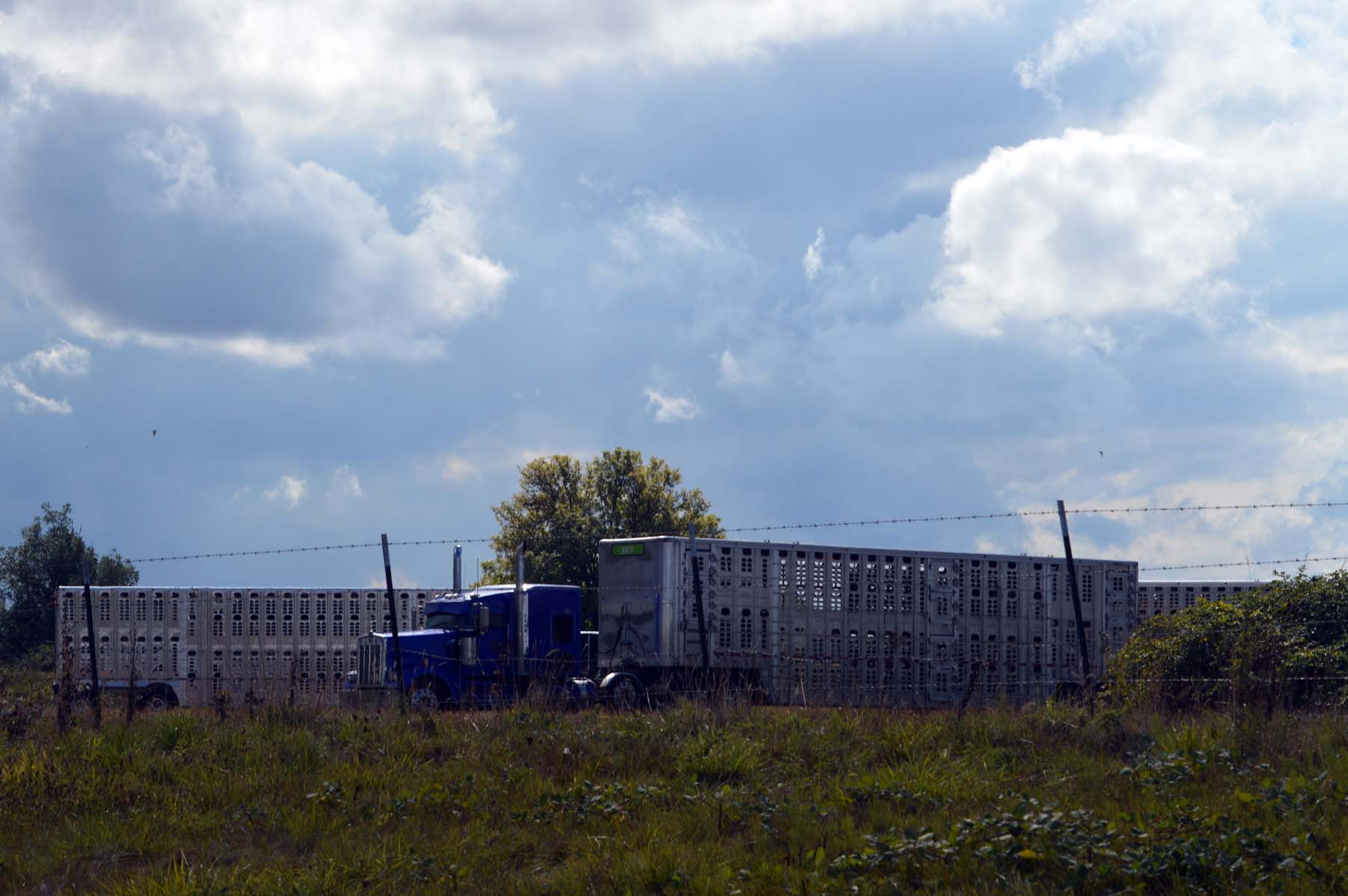
Much going on at the end of the road, with cattle being rounded up and loaded onto large trucks. Ranchers on horses and small quad bikes moved various herds who had summered in the surrounding fields and flatlands.
Rancher in Training
One herd was still unaware of its imminent transfer, whether to barn or slaughterhouse I do not know. I was relieved that we have stuck to our intention to remove beef from our household’s menu – this year, now October, I’ve had it maybe twice despite loving a steak as much as anyone.
I had a moment of unabashed joy when one of the ranchers approached me and asked: “Are you the cattle inspector?” Let me try and explain my reaction, something more difficult to describe than the wave of relief spreading across his face when I assured him I was not.
Being identifiable by looks, before ever opening my mouth, has always played a role in my life. At times it was connected to being rejected – oh, did I long for petticoats, nylon windbreakers, anklet socks and patent leather Mary-Janes as an elementary school child of the 1950s. It was wool coats, knee socks, lace-up brogues, smocked dresses and hats (!) for yours truly instead, sticking out like a sore thumb against the village population who snickered at me in the school yard.
Who might be the only one with braids, forever slouching knee socks and gabardine skirt, in 1959, I wonder?
My beloved sister knew what’s ridiculous already at a young age…..
Later, sufficiently politicized in the late 1960s and early ’70s, I was finally able to make my own clothing choices. It became a demonstrative act of protest against codes and norms of a class I resented. I was drawn to the flower child aesthetic of the times (though not that life style – I functioned as a lawyer, after all.) An act of rejection, rather than being rejected then.
These days, after decades and decades of figuring out who I am or want to be, I enjoy being dressed as neutrally as I can when it comes to identifying markers, but still have some style of my own, with this or that flourish and flair, when you look beyond the jeans and sweatshirts. That is, of course, easier here in the U.S. than in my native Germany. There, non-conforming to the norms of formal dress or coded class symbols still raises eyebrows in certain circles which would have stung when still my teenage self. Interpreted as a faux-pas, it seems inconceivable to family or friends that deviating from those norms might not be a mistaken wrong step, but a step in the right direction of expressing that one does not want to share the codex, no longer rebellion as much as an escape from bourgeois conformity and what and who those insider cues represent. Why would I want to look like the people I don’t want to be like?
The focus has shifted to what I feel comfortable in or with. The discomfort of rejection – wether being on the receiving end or the one dishing it out – safely a thing of the past. Then again…you have to deal with commentary, always: I remember a guy at the bus stop who called out, “Hey Lady, cool boots. I have a cat that color in Vermont.”
Never a dull moment.
Of course you can never shake off your origins completely, and pretending to be someone you are not has never appealed. But you can make choices about being pegged, or identifiable, to provide room for connecting with others before class divisions stop you from the start. I might not be the cattle inspector, but not being pinpointed as a cerebral, aging academic has its perks. I ended up having the best time among the crews, invited to photograph up close, and lots of waving on all sides when the trucks departed.
I escaped tagging, once again. The cattle’s dreams of great escape, in contrast, thwarted.
As Barbara Kingsolver phrased it in Animal Dreams:
“The very least you can do in your life is figure out what you hope for. And the most you can do is live inside that hope. Not admire it from a distance but live right in it, under its roof.”
Not sure how many people would agree with this sentiment found on Oregon City’s Willamette Terrace walkway. But I do believe we can all agree that the city, some 30 minutes south of Portland, is extremely polite. There is a welcome sign, wherever you turn.
You get encouraging advice (if I only knew what “there” is…)
perhaps leading to Eternal Impact, equally mysterious,
or fortification at the end of the road (the fountains themselves long dried out.)
Jokes aside, there is history wherever you look, preserved and displayed in public and museums. A lot of it can be found just looking at the buildings, the murals, the signage they offer, or the names they chose for their establishments.
Jail cells at the end of the alley center top – Masonic Temple center bottom. Municipal elevator from one level of the city to another.
Arch Bridge and original marker
I had come to Oregon City to look at the work of several artists displayed for the day at the Stevens Crawford Heritage House, another place where you can learn about the past. It was empty (still my condition to go inside in public places) on an early Saturday afternoon before a gathering organized by Art in Oregon to celebrate local artists and their work.
This is a collage made of paper clippings by one of the early inhabitants of the house – art always having been present, it seems.
The Craftsman American Foursquare House was built in 1908, and made into a museum after the last owner passed in 1968 and donated the property to the Clackamas Historical Society. It is furnished and equipped with everything original to the period, transporting you into the past. A large room on the ground floor has now been made in to the Mary Elizabeth Gallery, with local art hung there and in upstairs spaces as well.
On view were paintings by Kelsey Birsa, her Livingroom series containing a number of works dealing with the psychological effects of the pandemic and her ways of coping with it. One of the colorful attention magnets was a wall paper she created to reflect the garden surrounding the gallery, one of the few spaces to interact socially given the threat of infection. Her oil paintings, sometimes with added media, gold leaf, newspaper clippings or fabric draped over, were hung on top of the colorful background.
Kelsey Birsa Coping Mechanisms (2020)
Kelsey Birsa Here (2019)
Upstairs you could see some of Natalie Wood’s photographs,
Natalie Wood Were such her Silver Will (2019)
On display for the day were also the work of Clairissa Stephens, in the process of setting up her delicate botanical drawings with silverpoint on a gesso-like underpainting, from ink and pencil sketches.
All three of the artists had participated at some time or another in Art in Oregon‘s unique opportunity to spend a one-month residency at the Heritage House to work on their art in solitude. They are granted 24 hour access to a studio room and facilities (although they cannot live in the house,) in exchange for 20 hrs. of volunteer services at the museum. The Mary Elizabeth Gallery offers a chance to show work at the end, but is not exclusively slated for residents. The next exhibition, for example, is comprised of a huge variety of local talent, opening on September 23, 2022. The Ghost Showfeatures Alycia Helbling, Autumn Cornell, Don Hudgins, Elliott Wall, Erik Sandgren, James Dowlen, Jennifer Viviano, Kelly Shannon Chester, Kristin Neuschwander, Laura Weiler, Leslee Lukosh, Leslie Peterson Sapp, Nanette Wallace, Owen Premore, Tim Dallas – quite a range of divergent styles and media.
Mary Elizabeth Gallery
603 6th St. Oregon City, OR 97045

September 23 - November 1, 2022
RECEPTION: Friday, October 14, 6-9pm
Open on Halloween: 4-7pm
Gallery hours : Friday-Saturday 10-4pm
***
I am regularly drawn back to Oregon City because of the river, the falls, and the not-so-distant past that still affects a complicated presence. The industrialization of the place provided homes and work for many colonial settlers, while displacing the tribes who lived on the land and for whom Tumwater Falls was a place of great existential and cultural significance. A bit of a walkway can be found at the north end of the river, surrounded by informative signs and public art. A view point further south does the same and allows visitors to look at the falls from afar.
Adam Kuby and Brian Borrello are the public artist team that created the Waterfall sculpture at Willamette Terrace Walkway.
Mill after mill, using the power generated by the water for processing lumber, wool, flour and eventually paper, clogged the banks of the river and interfered with access to the falls.
Several years back I had actually participated in a walk through one of the old mills, Blue Heron Paper Company, now condemned, for an extended photoshoot that resulted in this compilation. (If you click on the book in the link and then on full view, you can scroll through the pages. Some of the resulting montages (below) were hung in a show at the Oregon City Hall.)
The site of the bankrupt paper mill, some 23 acres, was purchased in 2019 by the Confederate Tribes of Grand Ronde, who announced the new name for the planned restoration project just 2 weeks ago: Tumwata Village. It refers to the Native name for the falls and reflects the historic tribal connection to the area. Much demolition still going on, lots of rebuilding in the future. Details can be found in a newly launched website: www.tumwatavillage.org.
The planning process itself has been complex, though. Since 2011, much debate involved historic rights, and differing visions for a development that would protect tribal history and also would allow the general public to access the falls. Under the umbrella of the Willamette Falls Legacy Project multiple constituent partners focused on a commitment to public access, environmental and cultural restoration, as well as economic development. Oregon City, Clackamas County, regional government Metro and the state of Oregon partnered with the Grand Ronde Tribe, and eventually the Confederated Tribes and Bands of the Yakama Nation, Confederated Tribes of Siletz Indians, Confederated Tribes of the Umatilla Indian Reservation and Confederated Tribes of Warm Springs were invited by the Willamette Falls Trust, which began as the Legacy Project’s fundraising arm before expanding operations. As is so often the case in projects with numerous participants, conflicting needs, demands and eventually tensions were difficult to resolve.
This spring the Grand Ronde tribe left the project to pursue the restoration on their own propriety bordering the river directly and independently. Information about claims of conflicting interests can be found here and here, and in an OPB interview. Of importance to those of us who are not entitled to take a position, given our lack of historic knowledge and access to innumerable facts, is to remember:
“… these fractures stem from painful histories. None of these confederations, or the boundaries between them, existed before colonization. In fact, in 1855 there was only one western Oregon reservation: Siletz, which is where the tribes that became part of Grand Ronde were originally scheduled to be sent. But President James Buchanan abruptly decided to establish the Grand Ronde Reservation as a second western Oregon reservation instead of an extension of Siletz. On a foreigner’s whim, the tribes became separate peoples.
“Over the years, there’s been a lot of trauma and historical legal wrongs done to the tribes just falling out of that history.” (Ref.)
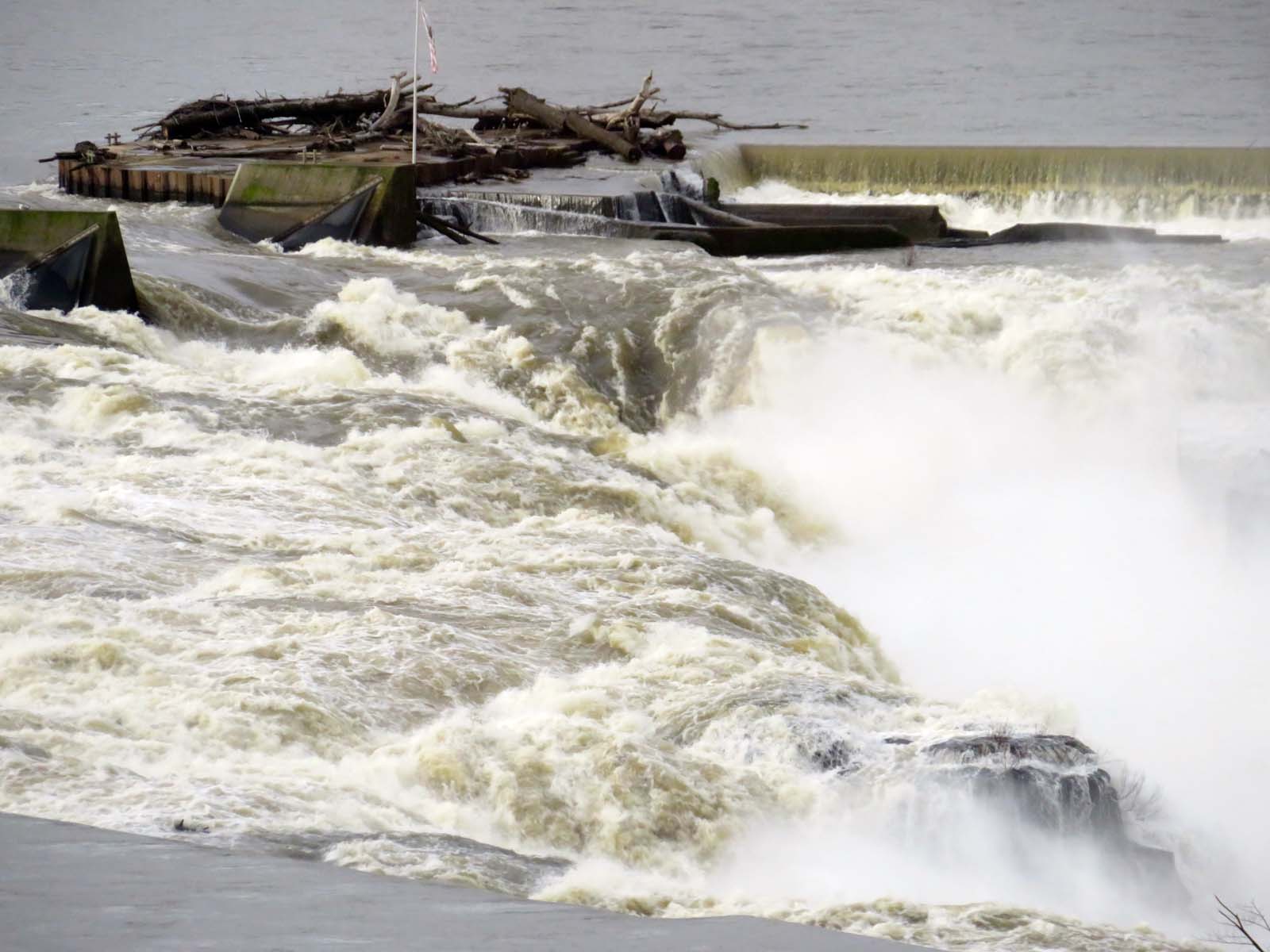
That is what I am thinking about when looking at this natural marvel, the largest waterfall in the Northwestern United States by volume, and the seventeenth widest in the world. It is 1,500 feet (460 m) wide and 40 feet (12 m) high with a flow of 30,849 cu ft/s (874 m³/s), located 26 miles (42 km) upriver from the Willamette’s mouth. Images below are from last week and from winter months, showing the effects of season on the river.
The horse-shoe shapes falls in September above, January below
The falls are one of the few remaining places to fish for lamprey eels.
September above, January below
Maybe the town itself is not one of the prettiest ever, but the nature at its doorstep is. They both hold a lot of history.
Here is what I currently listen to, water (or sea) foam, in musical form.
“Memories of Hiroshima are what drives me to take action to restore peace. In order to achieve peace, the international community must make it clear that aggression as such brings consequences.”
– Japanese Prime Minister Fumio Kishida in a speech at the Guildhall in London, U.K., on May 5, 2022.
SCIENCE. ART. GARDEN(S). A perfect trifecta, all told. Superseded by thoughts of peace. Recent visits to Portland Japanese Garden, one of our city’s treasures, stretched both mind and senses along those lines.
I had not been to the garden in a while. First it was closed for a serious $33.5 million remodel, with new buildings added, and the approach path restructured. Then the pandemic ensued. I was excited, therefore, when my visiting kids suggested the outing – delighted by novelty and grateful for the familiar.
You now pay at the bottom of the hill, then climb up a beautifully landscaped path, eventually entering through the old gate which still greets you with familiar detail.
Bamboo grids support aquatic planting and platforms amplify the sound of dripping water or rainfall while installed as visual screens on the ground, covering mechanical features and drains.
Bell at the old entrance gate
Portland Japanese Garden was an idea conceived in the late 1950s in the context of the US’s attempt to improve relations with Japan after the horrors of WW II. It was founded in 1963, declared the Year of Peace. The project was based on the assumption that the experience of a peaceful environment could be transferred to healing on a larger scale, leaving the hostilities between the nations behind us, promoting reconciliation. I had to look it up, of course, since I don’t speak Japanese, but there are multiple words in Japanese linked to these aspects. 和平 (wahei) means peace, 和解 (wakai) means reconciliation or rapprochement, and 和む (nagono) means to be softened or calming down. All three concepts can be found in the garden: peace as a mission, rapprochement in acts of cultural exchange (more below) and calming, if you immerse yourself in the nature on offer.
Sign at the entrance, maple plantings and water feature.
It is only fitting that the Japan Institute, an extension of Portland Japanese Garden founded last year and devoted to connecting people internationally and exchanging ideas about peace through cultural diplomacy, has created a Peace Program Series.
The first symposium,“Peacemaking at the Intersection of Culture, Art, and Nature,” will be staged in Tokyo, Japan on the United Nation’s International Day of Peace, September 21, 2022. Before that, replicas of the garden’s own peace lantern will be given as Peace Lantern as symbolic gifts to Hiroshima, Nagasaki, and Tokyo.
The “Peace Lantern” (neko ashi yukimi), on the East bank of the Upper Strolling Pond.
***
IT TOOK ALMOST seven years from site dedication to opening in 1967, revealing a riveting acreage of 5-in-1 gardens, each reflecting different historical development styles in Japanese horticulture, designed by Paul Takuma Tono (1891 – 1987.) Educated both in Japan and the US, Tono was the head of the landscape architecture department at Tokyo Agricultural University, led a design firm that produced renowned public and private landscapes, and designed a Japanese garden for the Memphis, TN, Botanic Garden as well as the one here in Portland.
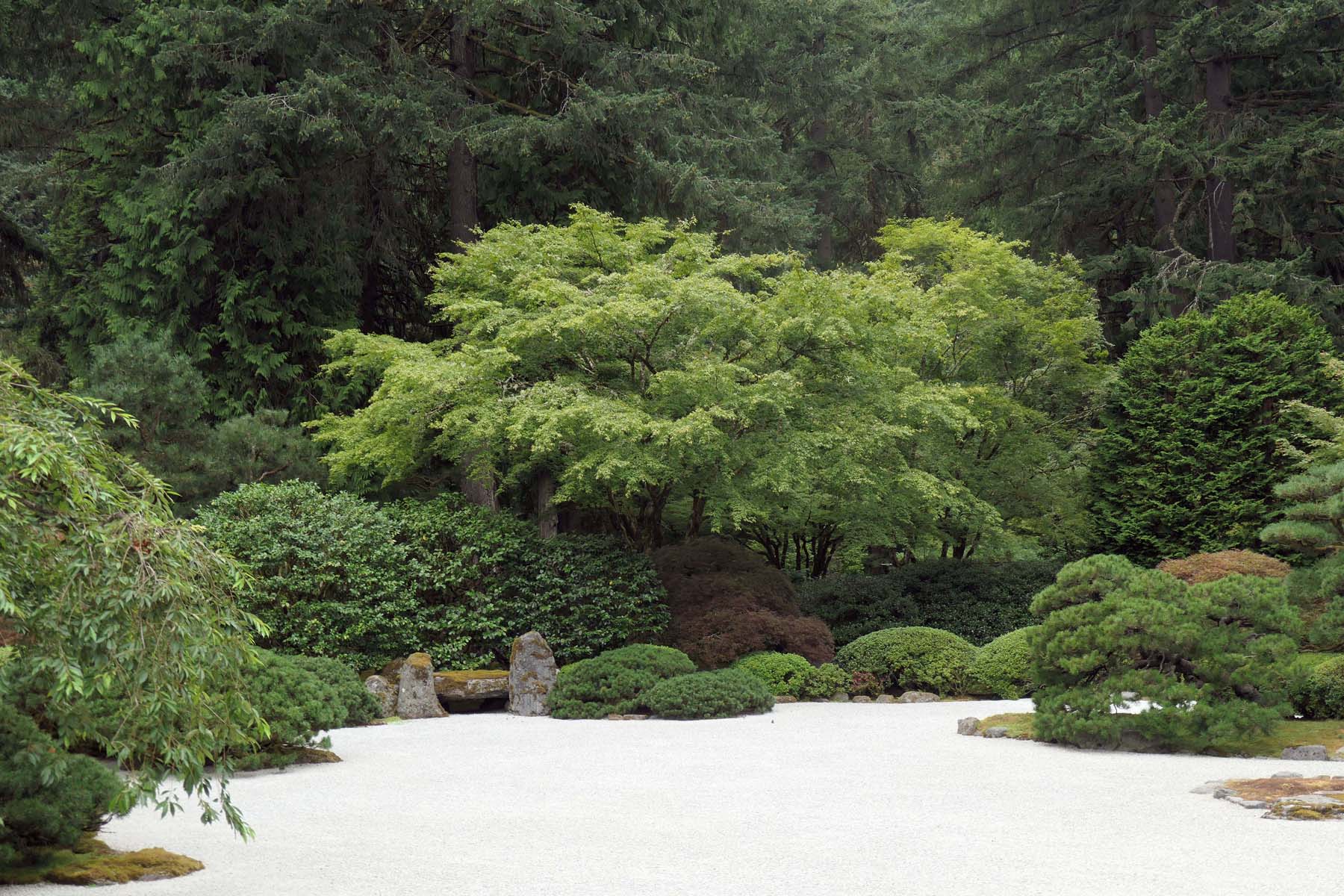
Tono’s vision of the flat garden (hira-niwa). The gravel was imported from Japan, deemed too white in its original marble and color- adjusted with more off-white gravel. That kind of attention to detail, getting it “right,” is a hallmark of this garden.
Across the decades, the space began to be open year round, and several structures were added; most recently three LEED-certified buildings compose a Cultural Village, skillfully nestled in the surrounding nature, realized by Japanese architectKengo Kuma for whom this was the first American project. (You can find a recent book about his approach to this particular design and his vision in general here.) Three steel-and-glass pavilions linked by a large courtyard provide space for arts, horticulture, education, a library and a giftshop (quadrupled in size to the old one) and a café. Real growth for a cultural institution, grounds for celebration. Not everyone was happy, though.
Some members of the adjacent Arlington Heights Neighborhood Association worried that the commercial additions to the garden were double the approved size from the city’s land use decision, and would result in increased noise and congestion, a loss of open space. They claimed that the garden didn’t honor promises to mitigate lighting to maintain a dark sky in the park and limit spillover to the neighborhood, or use bird-safe construction practices. (Ref.) This was during the construction phase some years back – I could find no further information, so hopefully all is resolved.
Water not absorbed by the green roofs drips into graveled dry-wells. Class- and meeting rooms are airy with glass sliding doors that allow the outside in and sheltered by wooden slats.
The buildings flank a new wall, Zagunis Castle wall, the first of its kind outside of Japan. Built by a 15th-generation (!) master stonemason, Suminori Awata, who usually repairs old ones at home and was delighted in the opportunity to build a new one, it is supposed to invoke medieval Japan.
Zagunis Castle Wall
The garden attracts between 3000 and 4000 visitors on its most crowded days, much dependent on season, but also receives other communal support. Lots of organizations, for examples, have donated trees like this red pine.
Individuals volunteered to build bridges – I was told that a 98 year-old Robert C. Burbank recently visited to look at the Moon Bridge he helped fashion from an old redwood effluent container no longer in use at the factory where he worked many years ago.
The garden, in turn, gives back – there is, I learned after wondering about the high cost of admission, making visits seemingly out of reach for economically disadvantaged folks, a membership category named in honor of this Moon Bridge. For $20, Oregon and Southwest Washington families receiving public income-related assistance can become annual members of the garden. It also participates in the Multnomah Library Discovery Pass program, donating free tickets that library patrons in need can reserve.
The basic structure of the garden is unchanged, with its many inviting and/or hidden vistas,
its Koi ponds,
tea house garden (cha-niwa,)
its maple trees that attract practically every single Portland photographer in the fall,
and its strolling (kaiyū-shiki-teien) or sand and stone gardens (karesansui).
Buddha and the Tiger cubs. Karesansui or dry landscape garden, focusses on the beauty of blank space, often found as parts of Zen monasteries.
Eight full-time gardeners and many volunteers tend to the place, with daily (!) raking of moss one of the many repetitive chores. I appreciated that they interrupted their work for me, answering my questions and letting me take photographs. Thank you, caretaker Masaki! Of course, I always return to photographing the same subjects, my beloved conifers and the occasional maples. He, on the other hand, returns to taking care of the Bonsai.
A 500 year-old Rocky Mountain Juniper at the Bonsai Display at the Bonsai Terrace.
***
THE VISUAL BEAUTY of the garden is renowned and the obvious magnet for scores of visitors each year. There is another feature, though, that we should think about as well. A growing movement in contemporary landscape architecture suggests to integrate soundscapes and thinking about sound in gardens, a sensory experience that has scientifically acknowledged positive effects on our health. There has been a recent flurry of research focussing on the impact of sound, with some concentrating on untouched natural environments to prevent more sound pollution, and others looking at designed natural spaces. The upshot of much of the medical literature: too much noise is bad for your health, but exposure to nature and garden visits can lead to reduced heart rate and improve our circulatory systems as well as our mood, and they certainly engage our senses. Perhaps not news to traditional gardeners. Sound has been integral to Japanese landscape design for centuries, after all. For the rest of us, new to the idea and curious, I am summarizing an in-depth exploration of 88 Japanese gardens, found here, and apply examples found in our very own garden.
Water features add wanted natural sound and also provide auditory masking for unwanted sounds.
Sound is a variable that can be looked at from different perspectives. You can embrace wanted sounds, you can avoid unwanted sounds, and sometimes you can invite unwanted sounds (as a contrast effect.) Wanted sounds can be introduced in gardens by the sounds of water, vegetation, the materials you walk on, certain biotopes and resonance and reflection. Unwanted sounds can be reduced by noise screens (walls, buildings or hedges etc.) by topography (don’t build next to the highway…) and absorbing (moss as a ground cover) or deflecting materials (tree stands next to garden walls that stop the city noise carried over by wind) to mention a few. None of these are exhaustive lists.
Absorbant moss carpets
Wooden screens at the tea house, protecting against extraneous noise, but also producing natural noise when the fall winds hit at the right angle.
Wanted sounds can be enhanced if you place the garden close to other natural landscapes that provide nature sounds – as is the case in town where Forest Park is a natural backdrop with its wooded hills, bird- and squirrel sounds wafting over. Water features like loud streams or water falls are both providing wanted natural sounds but are also good for auditory masking of traffic or other unwanted noises.
By all reports, Tono stood with his back to the waterfall during installation and directed the placement of rocks and boulders according to the sound that was achieved by different interrelations.
The subtle noise of water trickling engages our senses, it can vary in rhythm and tone, speed and amplitude.
Vegetation can provide pleasant noise: the rustling of leaves, the creaking of branches, the swooshing when the wind moves bamboo, the noise rain makes on broad-leaved plants.
Gravel paths make sounds (as would have the traditional stone paths when frequented by people who historically wore geta, wooden shoes, that clomped along.) Large pebbles provide sound surfaces for dripping water.
Biotopes, conscious planting of species that attract birds and their song, for example, also bring about sound, as do shallow ponds for frogs. The fish, of course, splash, occasionally and unexpectedly, with those huge carp making quite the noise.
Add to that the joyous noises of kids squealing with delight when the Koi jump, and the politely mumbled but insistent exhortations by staff/volunteers to refrain from bending too closely over the water to get that perfect shot….
Hard surfaces like concrete walls or large sculptures can amplify desirable sounds.
In sum, next time you visit, extend your awareness to the auditory components delivered by Portland Japanese Garden. They might reliably, if subtly, increase your pleasure. Announced with a gong seen at the Pavilion Gallery some times back! Maybe too loud….
***
“Intimacy: noun“
1: the state of being intimate : FAMILIARITY
2: something of a personal or private nature – Merriam-Webster Dictionary
SOMETIMES IT PAYS OFF TO BE BRAVE AND CHEERFUL. I cold-called the folks at the garden to see if I could meet their very first artist-in-residence invited by the Japan Institute, who arrived last week. The Institute is in the process of remodeling a new campus that will eventually hold artist studios and housing as well as lecture halls and administrative offices, an extended cultural space. For now, artists are privately accommodated, recruited through leadership connections and networks keen on showcasing international art related and/or relevant to Japan.
The response to my query could not have been friendlier. Sarah Kate Nomura, the Assistant Director of Exhibitions, filled me in on the mission and future plans of the Japan Institute. Will Lerner, the media relations specialist, fount of knowledge about the garden and all-round interesting conversationalist, made the arrangements and gave me a terrific tour, adding new bits of knowledge when here I thought I knew the place pretty well. And finally I met the artist, who was gracious in giving me time during her whirlwind arrival for a month-long stay now, and repeat visits planned for December and March, when her exhibit will open in the Pavilion Gallery.
Rui Sasaki, conceptual glass artist.
Rui Sasaki is an internationally exhibited, conceptual glass artist who strikes an unusual balance of sensitivity and edginess. Born in Japan, she has lived in multiple places on the archipelago as well as long stretches abroad. The thread that connects much of her work relates to her desire to experience herself within place, craving understanding of and familiarity with her environment, a desire shared by many of us who have changed countries and cultures, in some cases frequently.
What distinguishes her from the rest of us migratory folks, is her ability to create intelligent beauty from the intimacy she develops with her surrounds, extending her descriptive powers to everything from the flora of a particular place to its weather, from observations of present detail of a familiar building, to encapsulation of historic specifics of a particular region.
Sasaki received her BA in industrial, interior and craft design at Musashino Art University in Tokyo, before attending Rhode Island School of Design, where she received her MFA in glass in 2010. I was first alerted to her conceptual gift when I saw images of her craft
Detail of “Liquid Sunshine/I am a Pluviophile” (2019), glass, phosphorescent material, broad-spectrum UV lights, motion detector, 3,353 x 4,267 x 3,658 millimeters as installation. Photo by Yasushi Ichikawa, 33rd Rakow Commission, courtesy of The Corning Museum of Glass.
and heard the interview about the work that scored her the prestigious Corning Museum of Glass Rakow Commission in 2018. The work is gorgeous. The weather theme was subsequently expanded upon with a series on Wearing rain, where the artist re-imagines traditional Japanese rainwear fashioned from rice straw in glass and silver wire, one of my favorites.
Wearing Rain Glass, silver wire (2016) Photo Credit Pal Hoff
Capturing images of a particular site, or representing it in some ways is not new to glass work, of course. One of Sasaki’s favorite artists, Roni Horn (new to me and now I can’t get her out of my head,) for example, collected samples of water from numerous Icelandic glaciers and stored them in transparent glass columns. The Library of Water (2007) is an installation of 24 such containers, refracting and reflecting the light onto a floor covered with a field of words in Icelandic and English which relate to the environmental conditions. Some of the water stored is the last evidence of glaciers that have since melted, a document to the mutability of environments, our unstable place within them, and the need for a sensitive approach to preservation. Here is an interview from Horn’s current show in Paris, laying out some of the principles behind her art anchored in identity and change.
Roni Horn The Library of Water (2007)
One of my own admired glass artists, Beth Lipman, has several projects related to place as well. Her series Alone and the Wilderness (2014) places gazing balls and other blown containers into the landscape, video-graphing the ongoing reflections of nature with changes in light, temperature and weather conditions, exemplified in the video of Windfall, a continuously looped time lapse displayed at the Corning Museum of Glass.
Beth Lipman Windfall (2014)
Rui Sasaki will use her residency at Portland Japanese Garden to extend an ongoing search for connection to the environment she moves in. What started in Japan during a stay at the Houen Temple in Kanazawa will be continued with specifics from the current site. The artist collects local plants and fires them together with the glass, providing a repository for the ashes that maintain a semblance to their prior form, holding past and present in one. I could not help wondering about the significance of ashes for an artist whose country has quite literally risen from the ashes of nuclear incineration. The trans-generational trauma for offspring of survivors of Hiroshima is scientifically well documented, as for many later generations of communities who experienced collective loss, the Holocaust, the families of war veterans, be it Vietnam, Afghanistan, Irak or former Yugoslavia. Prime Minister Fumio Kishida’s unshakable anti-nuclear weapons position can be directly linked to his nation’s trauma. Perhaps Sasaki’s subtle beauty can be indirectly associated with the notion that we must not forget. Both urged me to contemplate peace.
She plans to create four walls composed of these glass components in an installation measuring around 8 feet long and more than 9 feet high, with two openings allowing visitors to move among all sides of the display. The combination of Japanese and newly site-acquired plants will link the two cultures. Sasaki also hopes to represent what she’s gleaned in planned conversations with gardeners and staff of the garden, adding historical bits that forge connection to people as well as botanical environment, opening our eyes to different perspectives on the garden. The work will be fired at Bulleseye Studio and displayed in March at the garden’s Pavilion Gallery.
***
THE QUESTION OF (NOT) BELONGING can loom large for people who experience culture (and reverse culture!) shock when moving between countries. It is psychologically adaptive to focus on the next best thing – familiarity with and closeness to a place and its people – since rational as well as affective exploration can distract from the pain of uprootedness, probably made worse by the isolation throughout the pandemic.
Some months ago I reviewed an old, but seminal science fiction novel by Sakyo Komatsu, Japan Sinks, which took 9 years to write. The scenario imagines a scientist’s discovery of the likelihood that all of Japan, the entire archipelago, is going to go under due to earthquakes, ocean floor faults, and what not. One of the narrative lines concerns how the government is handling the crisis, from negligence to obstruction to panic. Another focusses on the distribution of millions of people around the world, with nationalist impulses against immigration vying with empathy for a drowning people. My thoughts:
“The philosophical question it raises, though, is one that we will have to think through in climate change migrations to come: what does it do to your identity, as member of a nation, or a tribe or a culture or a language group, when the place that defines you ceases to exist? Literally is no longer there to return to? Is it destructive to lose that connection to place which is a base for underlying sense of self, or is it empowering because you can shed the debt you incurred as a member of the nation (say of an imperialistic or fascistic past) and start from scratch? “
Sasaki’s work speaks to a version of this question, the subjective disconnection to origin as experienced by the migrant. She demonstrates resilience to loss by forging an intimate connection to whatever can still be embraced, finding succor in the perceived beauty of an environment, preserving it in glass for all of us to see. But ashes represent the very notion of loss as well. Art as a wake-up call as much as consolation.
Portland will be enriched by her presence.
Details found on the access path.
Here is a 2021 concert of Japanese music presented in the garden.
Instead of a nature walk you get to accompany me on a neighborhood walk this week. I figured I’d do a bit of my daily “practicing hope,” after this sign early on reminded me that we are all kind of limping along. All photographs taken with iPhone within a 2 mile radius in NE PDX.
So what could I interpret in ways providing us all with a bit of optimism?
—> Not everyone sits on a high horse – there are some down to earth ones to be found, always.
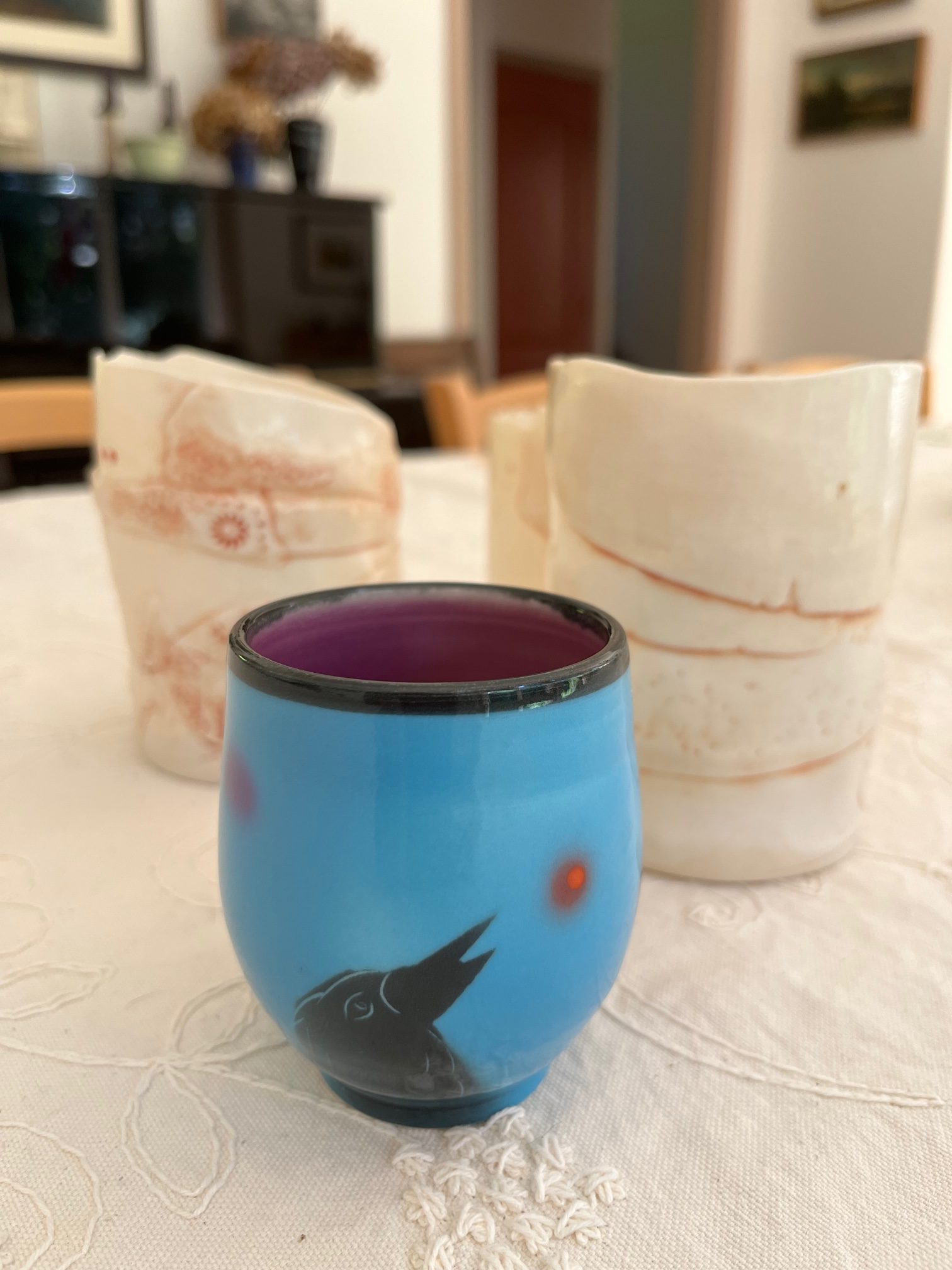
—> My favorite birds decorated cottage gardens, and pottery at pop-up sales, arranged on brightly colored shelves. I found the website of the artist, Natalie Warren, here. And am now thew proud owner of a tiny cup painted with a crow’s head. Art + birds, wherever you look!
I know, consumerism. But then again, we need to support local artists!
—> Unclear whose art this was, some shades of Max Ernst, some Phoenix more Escher than ashes, some arrangement of pies that had me lust, fully aware that I have enough to eat and even afford the luxuries of sweets…
—> Happy to note that Yellow Peril support Black Power and that someone, anyone, still remembers Leonard Peltier.
Not everyone, then, withdraws into idyls complete with Gartenzwerg….
In fact, some neighbors very explicitly reminded us that we have obligations to remember:
All of us:
—> In any event, the keys to hope were visible: in explicit and implicit forms – you’ll forgive me if I post an overused poem, but could not escape the symbolism in front of my eyes.
And because I did not make your brains work today, I will go harder on your ears – here is what I am currently listening to, constantly, some fascinating experimental music from a Chicago/NY based group je’raf. Their political satire is another reason for hope – there are still people out there fighting! AND having fun while doing it.
Afternoon walk at the beginning of the week. The sun was out – finally – it started to warm up – finally! Somehow it felt as if all of nature erupted into a collective sigh of “Ahhhhh,” turning little flower faces skyward, soaking it all up.
Butterflies hung out, luxuriating in the sun.
Huge tadpoles floated in the water like being suspended from invisible threads, shifting a little with soft currents of the lake. (Hate to break it to you, they are Rana Catesbeiana, invasive bull frog babies, as my learned friend Mary told me when I showed her the pictures.)
Herons stalking in slo-mo, trying to keep a lid on the bull frog population…
Hello….
Ospreys eying the ducklings, then being chased by smaller, upset birds.
Red-winged blackbirds everywhere, as were swallows and brown-headed cowbirds.
I tried to focus on my surround and not on what to do with the barrage of emails that enter my inbox on a daily basis for unknown reasons, often prefaced by Dear Mr. Friderike Heuer…Somehow I must have gotten on a distribution list of people who think I do book reviews for a living. The wrong kind of people. Or the wrong kind of books, as the case may be. Certainly the wrong amount of time spent on reading the mails if only out of curiosity. Here is a selection for last week only, to give you a taste.
Book Review Op – Your Marriage God’s Way: A Biblical Guide to a Christ-Centered Relationship – The problems we see in marriages today have existed throughout human history, says Pastor Scott LaPierre, which is why he relies on biblical lessons when dispensing marital counseling. Scott dissects the culture of marriage intended by God in his new book, Your Marriage God’s Way, and he is available to discuss these valuable insights with your audience to help them build relationships that are strong and vibrant. Would you please read the press release below and let me know if you would like to schedule an interview with pastor and author Scott LaPierre? I would also be happy to forward a complimentary copy of his new book in consideration of a review or feature. To hear a recent interview, please visit https://anchor.fm/heidistjohn/episodes/Husbands–Love-Your-Wives-with-Scott-LaPierre-e1i3fcd.
Let’s say mine centers on a Jewish man as well…
Book Review / Interview Op – 60 Clear-Cut Ideas That Make Handling Crises and Career Setbacks Easier -in these troubling times, nothing is easy. But sought-after business coach Chris Westfall says that there is an easier way. In his new book, Easier, Chris uses a profoundly powerful approach to deliver 60 clear-cut ideas for handling crises, career setbacks, loss, grief and more — so we can heal ourselves, our companies and our culture. Please let me know if you would like to schedule an interview with Chris, who makes an extremely engaging guest. I would also be happy to forward a complimentary copy of Easier, in consideration of a review or feature. More information can be found in the press release below. To watch a recent interview, please visit….
Only 60?
I wanted to make sure you’d heard about Jerremy’s new children’s book focused on the stock market? The following is a link to the press release: https://www.digitaljournal.com/pr/real-life-trading-making-investment-in-financial-literacy-for-kidsJerremy has been putting an extra focus on financial literacy for children. He was recently featured on CNBC. I’d be happy to send you a copy of his book if you’d like to review it or I can schedule an interview with him if you’d like to learn more about why he wrote it and how he’s giving back to schools and kids. He will also have a guest piece in the Tennessean soon advocating for his home state to pass a similar financial literacy bill as Florida just did.
I know I reared the kids all wrong…
Steamy Romance About Love, Sex and Chocolate – The word-of-mouth sensation, Chocolate Burnout, is now a seven-part series for Hubbard Small Press Publications with the first in the series, Chocolate Burnout: Chocolate 4 Life(June 7, 2022) launching this summer. Each novel in the series will follow a different character and address a variety of social issues including racism and interracial relationships. Chocolate 4 Life follows Chantel Reed, a successful, single African American woman who has given up on romance to pursue her lifelong dream of becoming a master chocolatier. Chantel’s best friend Astrid, a prosperous, single white woman who sacrificed relationships to conquer her dream job as a certified chocolatier, is the owner of Sweet Indulgence, one of the most popular chocolate shops in downtown Seattle. The story follows Chantel as she deals with life’s challenges and bounces between an obsession with chocolate, friendships and her desire to find the perfect romance.“Throughout the seven-part series, there will be different perspectives, and the protagonists will develop and change their views as they grow older,” says La-Paz. “The main character, Chantel Reed, her eccentric group of friends and her peculiar relationships give readers something to look forward to as the series progresses.” With a romance series, a memoir, and a picture book forthcoming, Emunah La-Paz is a talented author on the rise. Please let me know if I can send you a review copy of this delicious and enticing tale.
Maybe I’ll have some chocolate. Maybe I’ll pick um painting again…
Hey Friderike — below is an image of American Angie Crabtree surrounded by her hyperrealistic portraits of actual diamonds. Her art speaks for itself so I won’t bother you with fluff and BS. She has a show coming up and a great backstory. She is collected mostly by major diamond companies, celebs etc. How would you feel about a quick interview via zoom phone or email? We would be grateful! Keep sparkling, Tyler.
Or maybe I’ll escape to outer space since I can keep sparkling there as yet another star…
I am writing to you with an urgent story idea. Former Deputy NASA Administrator Lori Garver has a new book scheduled to be released on June 21st entitled “Escaping Gravity: My Quest to Transform NASA and Launch a New Space Age.” It is the story of how Garver drove the commercial space program with Elon Musk against the wishes of Senators on both sides of the aisle. It is her story of how she was threatened and called the worst of names by politicians including Senators whose goal was to protect NASA programs in their districts versus Congress investing in the commercial program. The Senator from Florida who led the battle to stop the commercial program was Bill Nelson, now the NASA administrator. Garver pulls no punches on Nelson. She opens up about the excessive $20 billion-plus in cost overruns that have dogged the SLS program that Nelson drove. SLS still has not been launched after a decade of technical and financial issues. Garver writes in her book about working with Musk, Bezos, Branson, etc… and has many personal stories to share. The Former Deputy NASA Administrator passionately writes and speaks about how women have been suppressed, degraded, and objectified in the male-dominated NASA culture. In addition to the PDF, I have attached book highlights and Garver’s thoughts regarding how women have been treated at NASA.
Would you be interested in interviewing Garver for your outlet? This promises to be a dynamic interview, bestseller, and drop a number of political bombshells. I look forward to hearing from you. Please contact me at this email or xxxxxxxxxxx to schedule an interview.
Or maybe I’ll read something truly relevant to my pursuit of sharing tidbits about nature: here is the best article of last week in that regard. It will enrich your weekend!
The Oregon Humanities offers a terrific program called Dear Stranger. It is an annual letter-exchange project that connects Oregonians with each other, to share bits about their lives, their experiences and beliefs. You send a letter in and they randomly swap it for another one sent back to you. This year’s topic revolves around care: who cares about what, whom, where do you see care and where its absence. You can still join, the deadline is in June, I believe.
I wish I had gotten one of these letters, years ago, from someone living in Hillsboro. It would have helped me discover a vibrant community, devoted to the arts, caring for education and inclusivity. It’s sort of absurd that I have hiked and photographed in neighboring Jackson Bottom Wetlands Preserve for years on end, and never ever set foot into the town nearby, so easily reached by the MAX Blue line or by car with plenty of free parking.
Maybe you all knew all along. But I am not the only one who had no clue what’s on offer. When I visited the Glenn and Viola Walters Cultural Arts Center by invitation of the gallery specialist, Karen de Benedetti, I uttered something along the lines of “I didn’t know this existed!” This seems to be a sentiment frequently voiced by visitors right next to the belief that the building is a church. Which it was, and a beautiful one inside at that.
The Walters opened its doors in 2004 and has since served the community in many ways. Like the Parks and Recreation, Cultural Arts Division, all the Walters’ programs are part of the City of Hillsboro. What used to be a sanctuary is now a performance space with a stage, a fully equipped, concert-quality sound booth, and a program that includes something for every interest, from music to dance to the spoken word, diverse genres and cultural perspectives included. Of the 16 performances in each annual series, 6 are grant funded by the Performance Series Grant Program, providing opportunity for local groups to join the series. There are also other grant programs that support local artists and arts organizations. Cultural Arts Manager Michele McCall-Wallace is one of the forces at work to shape these programs at the Walters as well as the town’s cultural arts action plan that envisions future developments.
Entrance Hall and Performance Space at the Walters
The large space with its beautiful wood-work ceiling arches can also be rented for social occasions, from weddings, to quinceañeras, to celebratory luncheons, fundraisers and so on. Another, perhaps even more important way to serve the community, is the educational program offered by the center.
Melissa Moore is responsible for the education and outreach program which offers a wide variety of learning opportunities, from painting, to dance, theatre, music, drawing, and more. Among them is a fully equipped ceramics studio that welcomes students of all levels and provides access to its kilns for those enrolled in the classes.
From pre-school to seniors, with scholarships available, art education is prized, as is community involvement. The center, in partnership with the Washington County Office for Aging, Disability, and Veteran Services, offers a Memory Café, for example, which is designed for people with memory loss, early stage Alzheimer’s or a related dementia, and their families. Trained guides help participants experience art in a gentle environment.
Various local-non-profits engage with youths in programs at the Walters, in ways that contribute both knowledge and occasional gifts. The Hillsboro police department, for example, donated and fitted helmets at the end of a class that had kids create designs and then paint a skateboard. Skateboards reminded me of Hillsboro author’s Blake Nelson’s novel Paranoid Park, made into a movie by Gus van Sant. Remember? The film won, among others, the Cannes Film Festival’s special 60th anniversary prize. Nelson these days has an interesting travel blog, by the way.
***
Gallery space upstairs and downstairs
I had come to explore the current exhibition, Fire & Ice: Magic from the Earth, at the Walters’ art gallery which covers a set of spaces upstairs and downstairs, wide open and more intimate, respectively. Sensitively and tightly curated by de Benedetti, the exhibit alone is worth a trip out to Portland’s Western neighbor. The work is divided between ceramics and photography, the latter of frozen constellations captured by notable PNW fine art photographer Don Jacobson. Some of the icy landscapes might make it into the history annals, if the current warming climate trends continue (never mind this strange snowy April weather.)
Don Jacobson: Eagle Creek #1
Don Jacobson Ice Cathedral – Lower Multnomah Falls #2
Don Jacobson – Porcelain Basin #2
The ceramics were created by the folks at East Creek Art, a community art studio in Willamina, OR, that serves students, artists and educators, offering an introduction to and use of the West’s first Anagama wood burning kiln. Making these objects requires firing the wares in a collaborative process that takes several days of round-the-clock stoking, with flames and ashes creating the incredible patterning on the art.
Aubrey Sloan and Joe Robinson Flotsam
Cooper Jeppesen Tripod Vase
From left to right: Jenna Lee Wood-fired ZigZag Planter; Katy McFadden A Union; Chris Schwartz Wood fried Temmoku Vase; Elijah Pilkington Altered Stoneware Vase;
Jess “Squirrel” Komaromy Old Rosie.
What struck me most was not just the beauty of individual pieces, but the communal richness of the show: art ranged from works of absolute beginners to masters of the form, reinforcing rather than distracting from each other. Instructing new generations in an ancient Asian methodology.
Cooper Jeppesen East Creek Basket #1
Lew Allen Ashfall (Excerpt) Carrie Gibbs Oregon’s Elusive Bigfoot 2020 “Barely Made It!”
About a quarter of Hillsboro’s population (in total now well over 100.000 inhabitants, thus Oregons 5th largest city) could probably read Cervantes in the original, given their Hispanic background. I can only manage in translation: “One who reads and walks a lot, sees and knows a lot.” And walk we did during this visit, as well as drive, guided by yet another friendly person willing to devote some of his work day to showing me around.
Karl LeClair, a recent transplant from Idaho, is the new Public Art Supervisor in the Hillsboro Parks & Recreation universe. He guided me to three points of interest beyond the Walters, relevant to the appreciation of public art. (Further reading, in agreement with Cervantes, will involve this link to the Public Art Archive, a fount of information.)
We looked at the Hillsboro Civic Center and the adjacent Plaza first. The few remaining Sequoias across the street are reflected in the building, and a bold piece on its walls traces the needle branches.
Brian Borrello Sequoia Frond (2004)
The Plaza itself is a lively place when the weather warms up and Tuesday night markets resume. It is lined with basalt boulders that reveal their secrets with differing degrees of ease – 30 petroglyphs have been carved by Lillian Pitt (Confederated Tribes of Warm Springs/ Wasco/ Yakama) in an installation called Riverbed. It is a timely reminder that the city is located on Tualatin Kalapuya (Atfalati) land (I wrote about some of the Kalapuyan tribal history earlier here.)
Lillian Pitt Riverbed
Inside the Civic Center the visitor is greeted with colorful art on the elevator doors, glass art on the stair well, and a gallery space, the Shirley Huffman Auditorium Gallery, that contains permanent as well as changing exhibitions, currently showing work of some of the faculty that teaches at the Walters.
Hampton Rodriguez Diversity
Linda Haworth Father Time (2004) – John Groth Grand Staircase (2004) – Walters’ Faculty show Creative Brilliance – Skateboard included!
Another gallery space can be found at the recently opened Hidden Creek Community Center, a stream-lined, state-of-the-art facility for sports, education and meeting rooms. OPSIS Architecture collected tons of well deserved awards across the last two years for this first-of-its-kind mass timber building that blends into the adjacent forest. Situated close to a site designated for a large affordable housing development, the wood and glass structure is functional and inviting. Better still, with a large solar array on the roof of the community wing, natural ventilation, water conservation measures, and balanced daylighting, the Community Center is enrolled in the Energy Trust of Oregon’s Path to Net-Zero program and is expected to achieve net-zero energy use.
The public art above and below is by acclaimed Seattle public artist Norie Sato, a front entry steel wall with embedded tiny mirrors that reflect light and a free standing sculpture, E+MergenCe: Energy and Memory.
There are clearly numerous decentralized spaces for art in this city, and, as LeClair told me, conversations have often looked to find ways to coordinate and harmonize the isolated showings and offerings. As a City of Hillsboro program, the Cultural Arts Division of Parks & Recreation operates under the guidance of the Hillsboro Art and Culture Council (HACC) which is a citizen advisory committee appointed by the Mayor and City Council. The City’s Cultural Arts Action Plan captures the spirit of critical mass within Hillsboro advocating for the growth of cultural assets that benefits the local community and guides the work of Cultural Arts in serving the community.
Here are some of the upcoming programs at the Walters – just so you get a glimpse of the variety on offer.
———————————————————————————–
A Thousand Words June 7 – July 22, 2022
Joy Cartier, Mark Dunst, Jane Kearns, Stacey Stoudenmeyer, & Eliza Williams
On display Jun 7 – Jul 22
First Tuesday’s (June 7 & July 5)
Like the pages of a book, artists Joy Cartier, Mark Dunst, Jane Kearns, Stacey Stoudenmeyer and Eliza Williams explore the messy, imperfect space between thoughts and words. Layering paper, paint, and meaning over time, the artists merge simplicity and complexion, with captured emotions and expressions to tell abstracted stories.
Upcoming programs:
First Tuesday Art Walk, May 3rd 5:00 – 8:00 pm (Walters)
Lee Kelly dedication, May 17th 11:30 – 1:00 pm (Public Works building)
Rasika Dance Friday, May 20th 6:30 – 7:30 pm (Walters)
Barro Mestizo Friday, May 6th 7:30 pm (Walters)
Grupo Borikuas Friday, June 10th 7:30 pm (Walters)
Rejoice Friday, April 22nd 7:30 pm (Walters)
————————————————————————————-
***
And then there was the unexpected detour to the Hillsboro Public Works facility. Think transportation, sanitary sewer, and storm drainage, housed in a modern structure, designed by the same LRS architectural group that built the Civic Center. In front, an unwieldy, huge sculpture emerges through mist and rain, seemingly dropped from the sky like an alien crustacean. It stands there stubbornly, daring us to find a linkage, any association at all, to the building behind it, which I failed to come up with. Not that it mattered: Lee Kelly’s 30 year-old Untitled (Omark) piece breathes freely on its own. A powerful, abstract Cor-Ten steel structure stretches all of its 14x26x36 feet size into space, solidly anchored on stout columns, beckoning with openings under its arches.
Rumor has it that the sculpture by Kelly, who passed away last month, was in limbo at its old location and destined for the steelyard. Originally commissioned by Omark Industries, (Oregon Saw Chain Company in its beginnings) it stood at their business site along Macadam Ave, at the Willamette river. When property changed hands nobody knew what to do with the piece. Kelly’s representative, Elizabeth Leach Gallery, came to the rescue, as did Hillsboro’s Public Art Program, and this new location was secured. A dedication ceremony is slated for May 17th.
Lee Kelly Untitled (Omark) (1992)
***
Portland, OR April 2022
“Dear Stranger,
I hope this letter finds you well and able to explore some of what our state has to offer. I immigrated to the US in 1981, and have lived in PDX since 1986. I am interested in practically everything, except sports and cooking. (Yes, people like that do exist.)
Art has a special place in my world and I admit that I have not been particularly informed about what Oregon provides state-wide, or even in my own vicinity. My bad. One of the remedies was an exploration of Hillsboro, a small town west of Portland.
Since the topic of this year’s pen-pal exchange is “care,” let me report that I just discovered how much Hillsboro and its organizations, its art- and public service-related staff, all care about the arts. Work for the arts. Educate about the arts. Invest in the arts.
There seems to be an implicit understanding that private and public art does not just enrich physical environments, or boost local economies. Art can raise community pride, promote civic discourse, connect neighbors and their communities in all their diversity and/or shared history. I am grateful that a single proactive gallery curator got me out to a place where all of this seems to be happening! Let me do you the favor in turn – head to Hillsboro!
Sincerely,
Another Stranger.”
——————————————————————————
The Glenn and Viola Walters Cultural Arts Center
150 E. Main Street, Hillsboro, Oregon 97123
Hours of Operation Monday through Thursday: 9 am to 9 pm Friday: 9 am to 5 pm Saturday & Sunday: Closed except for special events & private rentals
Exhibit Reception for Fire& Ice: Tuesday, May 3, 5 to 8 pm